Market Minds Advisory
Breast Biopsy Devices Market

Breast Biopsy Devices Market: Four In Five Find Nothing, And That Is The Design

Screening deliberately over-refers, because missing a cancer is worse than an unnecessary biopsy. Device volume therefore rests on a false positive rate that everybody in radiology is now trying to reduce.

Lead Analyst

Alice Ballenger

Published

September 2026

Make Smarter Decisions with Customized Research Insights

Request a free sample report and evaluate market opportunities, growth trends, and competitive dynamics relevant to your business needs.

2025 MARKET VALUE$1.6BMarket Size 2025
2036 FORECAST VALUE$3.7BBase Case , 2026 to 2036
CAGR 2026 TO 20367.8 %Bull 9.0% / Bear 6.6%
INCREMENTAL OPPORTUNITY$1.9BNet 10- year value creation
EXPANSION MULTIPLE2.12x2036 value over 2026 base
Strategic Levers
M&A Pipeline
Regional Outlook
Country Rankings
Competitive Intelligence
Segmental Deep-dive
Call-Us : 91 93563 13602

Executive Snapshot and Market Trajectory

Roughly four breast biopsies in five return a benign result. That is deliberate rather than accidental, since a screening programme that misses cancers is far worse than one that over-refers women. Device volume rests on exactly that ratio. The market reaches USD 1.6 billion in 2025 and grows at 7.8%.
Wire-free localisation systems grow fastest at 11.7%, exactly 1.50 times the market rate, because magnetic seeds and radar reflectors allow radiology and surgery to be scheduled entirely independently of one another. East Asia holds 30% of value, where vacuum-assisted devices are used to excise benign lesions rather than only to sample them. South Asia and Pacific takes 12% of value and grows faster than any other region.
Concentration is high at 71% across the top five, with a single supplier holding most of the vacuum-assisted installed base and the whole proprietary consumable stream attached to it. Competition turns on console placement terms, on tissue yield per pass, and on surgical workflow rather than on any measure of diagnostic accuracy. Artificial intelligence reading mammograms is somehow both the growth driver and the biggest medium-term threat at the same time.
Market Definition
The breast biopsy devices market covers instruments and consumables used to sample or localise breast tissue for diagnosis, spanning vacuum-assisted biopsy systems, core needle biopsy devices, fine needle aspiration devices, wire-free and wire localisation systems, and tissue markers and clips, together with the guidance and specimen handling accessories supplied for them. Mammography and ultrasound imaging systems, magnetic resonance scanners, pathology laboratory equipment, therapeutic breast surgery instruments, and screening software are excluded.
Base Year Value
$1.6B in 2025 (MMA Primary Research Dataset, August 2026)
Forecast Period
2026 to 2036, eleven discrete annual values
CAGR
7.8% base case. Bull 9.0%. Bear 6.6%.
Fastest Growth Segment
Wire-Free Localisation Systems: 11.7% CAGR
Fastest Growth Country
India: 11.4% CAGR
Fastest Growth Region
South Asia and Pacific: 9.8% CAGR
Largest Region
East Asia: 30% of 2025 global value
Market Leaders
Hologic, Becton Dickinson, Devicor Medical Products, Merit Medical, Argon Medical Devices. Source: MMA Primary Research Dataset, July 2026.
Primary Survey
n=3,800 procurement and R&D decision-makers, Q4 2025, six countries
Methodology
Demand-side build-up, cross-validated against public data, 47 expert interviews

Breast Biopsy Devices Market Forecast Scenarios

breast-biopsy-devices-market-size-forecast-scenario-1787297903438
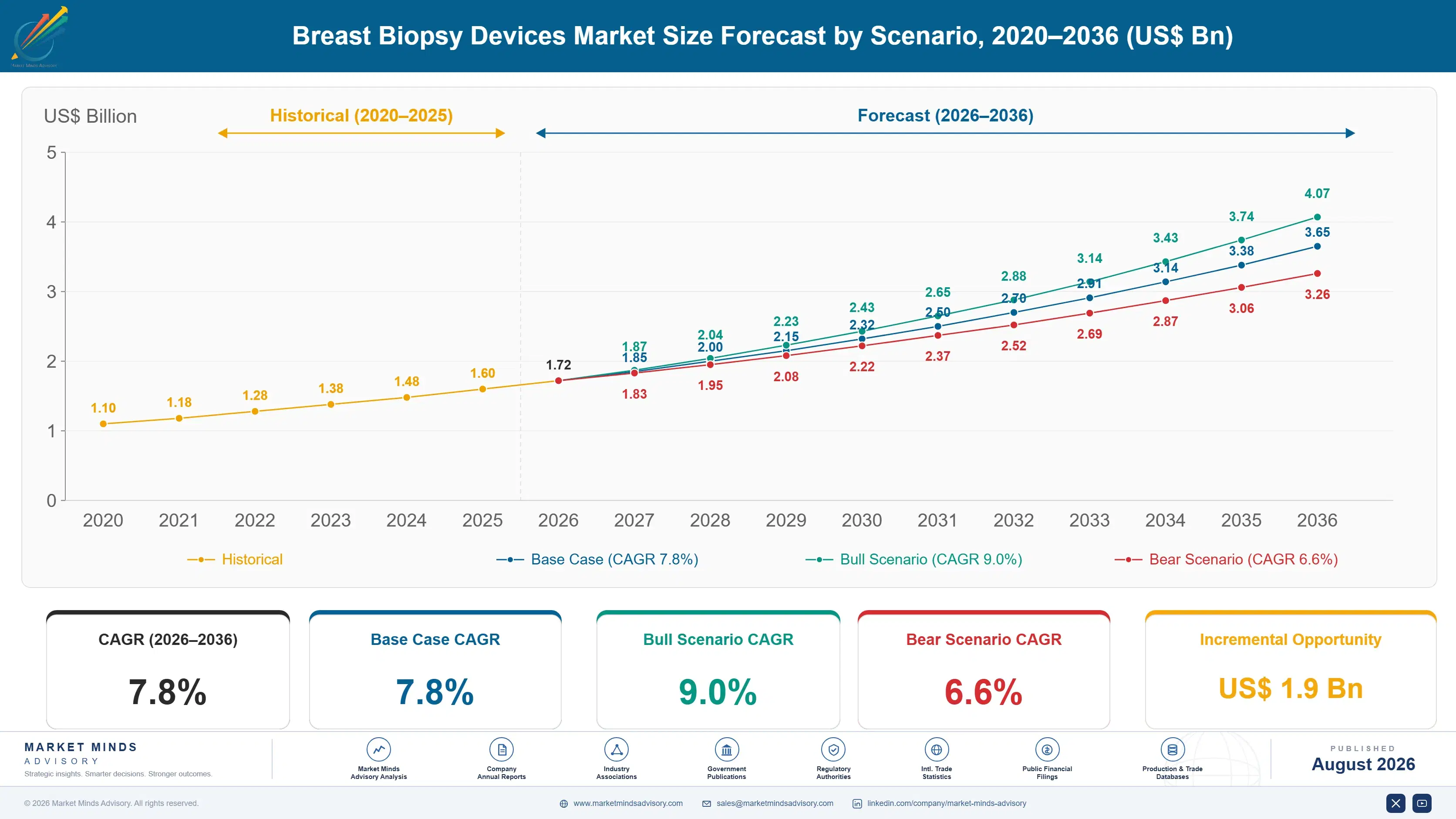
Between 2020 and 2025 screening stopped and then restarted with a backlog behind it. Programmes suspended through 2020 produced a surge of delayed diagnoses from 2021, and biopsy volumes ran above trend for two years while services caught up. Wire-free adoption accelerated throughout on scheduling pressure. A 6.7% historical CAGR averages a suspension, a catch-up surge, and a return to normal.
Three mechanisms carry the 7.8% base case. Screening programme expansion is the largest, with China, India, and several middle income countries building organised mammography for the first time. Wire-free localisation conversion is the second, replacing a forty-year-old technique for reasons that are entirely operational. And vacuum-assisted therapeutic excision of benign lesions is the third, a practice pattern established in East Asia and spreading slowly elsewhere. Programme design rather than incidence decides it.
The 9.0% bull case rests on screening reaching the large unscreened populations of South Asia and Africa, where breast cancer presents late and mortality is correspondingly high. The 6.6% bear case is artificial intelligence reducing recall rates across established programmes, since a lower false positive rate means fewer biopsies, and the technology reducing them is being deployed by the same health systems that buy the devices.

A Volume Built On False Positives

Breast screening is calibrated to catch cancers rather than to avoid biopsies, and the arithmetic follows from that choice. Around one woman in ten is recalled after a screening round, most recalls resolve on further imaging, and of those who reach biopsy roughly four in five turn out benign. Every one of those biopsies consumes a device. The industry's volume is a direct product of a deliberately conservative threshold.
TOP FIVE CONCENTRATION71%One supplier holds most of the vacuum-assisted installed base
BENIGN BIOPSY RATIO4 to 1Benign results returned for every cancer actually found
VACUUM DEVICE COSTUSD 480Single-use probe and consumable cost for one procedure
LOCALISATION DEVICE SHARE38%Procedures using wire-free markers rather than guide wires
SAME-DAY RESULT RATE22%Biopsies where imaging and pathology conclude within one visit
SCREENING RECALL RATE10%Women called back for further assessment after a screening round
That makes artificial intelligence an awkward development. Software reading mammograms alongside or instead of a second radiologist is reducing recall rates in several European programmes without missing more cancers, which is unambiguously good for women and directly reduces biopsy counts. The health systems deploying it are the same ones buying the devices, and nobody in the device industry can argue against it.
Meanwhile the wire finally went. Guide-wire localisation was unchanged for forty years and is being displaced by magnetic seeds, radar reflectors, and radiofrequency tags that can be placed days before surgery. The benefit is scheduling rather than accuracy: radiology and theatre no longer have to happen on the same morning. Hospitals value that far more than they ever valued a millimetre of placement precision.
"Everybody in this industry knows that most of what they sell is used on women who turn out not to have cancer. Nobody says it because it sounds like a criticism of screening, and it is not. It is just the arithmetic of catching things early."
Director, Diagnostic Imaging Practice · MMA Medical Devices Practice &midd

Market Trends

Wire-Free Localisation Decouples Radiology From Theatre

Guide-wire localisation required a radiologist to place a wire on the morning of surgery, which chained two departments to the same schedule and made either one running late everybody's problem. Magnetic seeds, radar reflectors, and radiofrequency tags can be placed days or weeks ahead, and the surgeon locates them with a handheld probe. The clinical accuracy argument is marginal and the operational one is decisive, which is why conversion has moved faster than any evidence base would predict. Roughly 38% of procedures now use a wire-free approach. Nobody has yet argued the accuracy case successfully.
Market Impact: Programmes cover 200 million women
Artificial Intelligence Reduces The Recalls That Drive Volume

Software reading screening mammograms is now deployed across several European programmes, replacing or supporting a second human reader, and published results show recall rates falling without cancer detection dropping. Fewer recalls means fewer diagnostic workups and fewer biopsies, which reduces device consumption directly in the largest and best-funded screening markets. Radiology workforce shortages make adoption close to inevitable regardless of what it does to biopsy volumes. This is the clearest medium-term threat in the market and it comes from the customer rather than a competitor. Radiologist shortages make adoption close to inevitable regardless.
Market Impact: Excision uses 3 times more consumable

Market Opportunities and Growth Drivers

Organised Screening Reaches New National Populations

China, India, and several middle income countries are building organised breast screening where only opportunistic testing previously existed, which converts populations of tens of millions of women into a screened cohort generating recalls and biopsies for the first time. Programme design matters enormously to device demand, since a two-view biennial programme with double reading produces a different biopsy rate from a clinical examination pathway. Each new programme creates volume that simply did not exist before, and it builds for a decade as coverage widens. Coverage builds over a decade rather than arriving at once.
Market Impact: Reviews cover 15 national programmes

Vacuum Devices Used To Remove Benign Lesions

Vacuum-assisted biopsy was designed to sample tissue and is used across much of East Asia to excise fibroadenomas and other benign lesions completely, avoiding open surgery for a young woman with a lump she wants removed. That converts a diagnostic device into a therapeutic one and multiplies procedure volume against the same screening population. Chinese hospitals in particular perform these routinely and consumable consumption reflects it. The practice is spreading slowly into other markets as evidence accumulates and patients ask for it. Patients ask for it once they know it exists. That demand pull is unusual for a device category.
Market Impact: Consoles last 8 to 10 years

Market Restraints and Challenges

Overdiagnosis Debate Questions Screening Intensity Itself

Long-running argument over how many screen-detected cancers would never have caused harm has produced real policy movement, with several countries reviewing screening intervals, starting ages, and recall thresholds. The root cause is that screening cannot distinguish an indolent lesion from an aggressive one at the point of detection. Commercially any loosening of thresholds reduces recalls and therefore biopsies across an entire national population at once. Participants are mitigating by supporting risk-stratified screening, which concentrates biopsies on higher risk women rather than reducing them in aggregate. No supplier can argue publicly against reducing unnecessary biopsies.
Market Impact: Wire-free reaches 38% of procedures

Console Placement Locks Consumable Supply For Years

Vacuum-assisted biopsy requires a console that a hospital buys or receives on placement, and the single-use probes are proprietary to it, which means a competitor cannot sell consumables into an installed base it does not own. The root cause is deliberate design rather than any technical necessity. Commercially it makes share gains extremely slow and concentrates the market around whoever placed equipment first. Challengers are mitigating with aggressive console placement terms, reagent rental structures, and probes designed to work across more than one platform. Placement terms decide the next decade of consumable revenue.
Market Impact: Recall rates fell 5 percentage points
3 additional market trends, 2 additional growth drivers, and 4 additional restraints and challenges are covered in the full report. Contact sales@marketmindsadvisory.com to access the complete intelligence.

Segment CAGR and Growth Architecture

Segmentation follows device category, because each one is bought by a different department, consumed at a different rate, and justified on a different argument entirely. A localisation marker is a theatre scheduling decision while a vacuum probe is a radiology consumable. Guidance modality, care setting, and lesion type are handled in the framework instead.
breast-biopsy-devices-market-market-share-analysis-1787297903970

Wire-Free Localisation Systems

Wire-free localisation grows fastest at 11.7%, exactly 1.50 times the market rate, and the argument is operational rather than clinical. Magnetic seeds, radar reflectors, and radiofrequency tags can be placed days or weeks before surgery, which breaks the chain that forced radiology and theatre to run to the same morning schedule. Surgeons locate them with a handheld probe. Accuracy against a guide wire is comparable rather than superior, and hospitals adopt anyway because a delayed radiology list no longer cancels an operating list. Around 38% of procedures now use one, and conversion is running well ahead of any published evidence. Theatre management rather than radiology is signing off the purchase.
CAGR 11.7%

Vacuum-Assisted Biopsy Systems

Vacuum-assisted systems grow at 9.4%, sampling considerably more tissue per pass than a core needle and allowing complete removal of small lesions in a single sitting. Consoles are placed with hospitals and the single-use probes are proprietary to them, which makes the installed base the real asset and consumable revenue the real business. East Asian practice extends the device well beyond diagnosis, using it to excise fibroadenomas that would otherwise need open surgery, and consumable consumption per patient rises sharply where that is routine. Probe cost near USD 480 makes this the largest consumable line in the category. The console is placed and the probes are where the business sits. Nobody treats the equipment as the product being sold.
CAGR 9.4%
Full segment breakdown across 5 segments available in the complete report.

Regional Architecture and Country Demand Map

Regional shares here follow screening programme design and practice pattern rather than breast cancer incidence, which varies far less between regions than biopsy rates do. How aggressively a system recalls, and what it does with a benign lesion once found, matter more than anything epidemiological.

East Asia

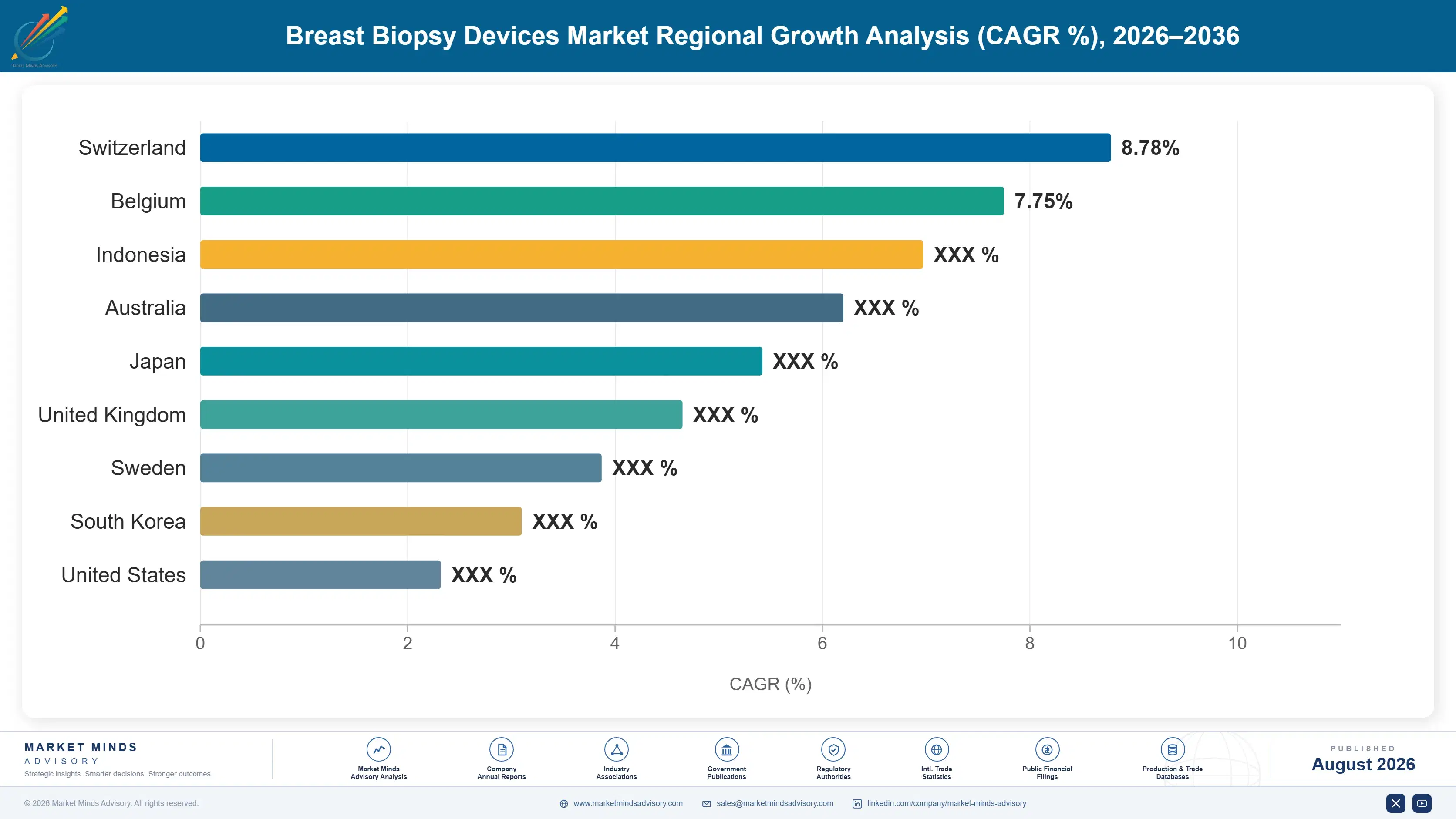
East Asia takes 30% of value, at the ceiling of the band this framework applies, and Chinese practice pattern rather than screening coverage explains most of it. Chinese hospitals routinely use vacuum-assisted devices to excise fibroadenomas and other benign lesions completely, which converts a diagnostic tool into a therapeutic one and multiplies consumable consumption per patient several times over. China also diagnoses more breast cancer than any other country. Japanese and Korean organised screening programmes have high participation and well-equipped diagnostic units. Growth at 8.8% exceeds the global rate on screening expansion and therapeutic use together. Domestic manufacturers now supply consoles at a fraction of imported cost. Procurement policy favours them where equivalence is demonstrable.
Share: 30% | CAGR: 8.8% (2026 to 2036)

South Asia and Pacific

Fastest growth sits in South Asia and Pacific at 9.8%, on 12% of global value. Indian breast cancer incidence is rising steeply and presentation remains late, with most women diagnosed at stages where screening would have found the disease years earlier. Organised screening is being built in several states and through private hospital chains, each of which generates recalls and biopsies where none previously existed. Australian participation in organised screening is among the highest anywhere. Growth reflects programme construction rather than any change in underlying disease incidence. Late presentation is precisely what screening is being built to change. Private chains are moving faster than public programmes. Recall volume is only beginning to appear.
Share: 12% | CAGR: 9.8% (2026 to 2036)
Regional intelligence for 5 additional markets available in the complete report: North America, Western Europe, Latin America, Middle East and Africa, Eastern Europe. Contact sales@marketmindsadvisory.com.
breast-biopsy-devices-market-country-cagr-analysis-1787297904485

Where Breast Biopsy Money Actually Sits

Nobody makes any money at all on the biopsy needle itself. Value sits in the console placed for a decade with proprietary probes attached to it, in localisation devices sold on operating theatre scheduling rather than on accuracy, and in the therapeutic use of a diagnostic device that multiplies consumption per patient several times over.

Place The Console And Own The Probes

A vacuum-assisted console sits in a radiology department for eight to ten years and every procedure consumes a proprietary probe costing around USD 480. Suppliers pricing the console to place it and earning on consumables capture 40% to 60% of equipment value annually thereafter, and a competitor cannot sell into that installed base at all. Defending console margin at the expense of placements protects the smaller number by a wide margin, and several challengers have learned that expensively. The window to win a base opens once a decade. Nothing else about this category is contestable.
Market Impact: Consumables recover 40 to 60 percent each year

Sell Localisation To Theatre Scheduling, Not Radiology

Wire-free markers are only marginally more accurate than a guide wire and considerably more expensive, which makes them a poor sell to a radiologist comparing techniques on their merits. Presented to an operating theatre manager as a way to stop a delayed radiology list cancelling an operating list, the same product addresses a cost near USD 2,000 for every theatre hour lost. That reframing reaches a different budget and a different decision maker entirely, and conversion has run well ahead of the evidence because of it. Radiology never sees that budget line at all.
Market Impact: Theatre hours cost around 2,000 dollars every hour

Support Therapeutic Excision Of Benign Lesions

Using a vacuum device to remove a fibroadenoma completely rather than merely sample it is routine across much of East Asia and rare almost everywhere else, and it consumes roughly 3 times the disposable volume of a diagnostic pass. Building the evidence base and the surgeon training that lets clinicians elsewhere offer it converts a diagnostic procedure into a therapeutic one that patients actively request. Young women wanting a lump removed without open surgery are an unusually enthusiastic audience for it. Adoption elsewhere has been slow despite the demand. Evidence and training are what is missing.
Market Impact: Excision uses 3 times more consumable per patient

Who Controls the Margin Pool

Concentration reaches 71% across the top five measured on breast biopsy device revenue, and installed console base rather than product superiority explains most of it. Hologic holds the largest vacuum-assisted position along with a strong localisation portfolio, and Becton Dickinson is the principal challenger across both. Devicor supplies the Mammotome platform with a particularly strong East Asian position, while Merit and Argon compete in localisation and core needle respectively.
Competition currently turns on console placement terms, on tissue yield per pass, and on whether a localisation product fits the operating theatre workflow rather than the radiology one. Diagnostic accuracy differences between the major platforms are marginal and very rarely decide anything at all. Price competition happens on core needle devices and almost nowhere else across the category.

Pressure comes from artificial intelligence reducing recall rates in the best-funded screening programmes, and from Chinese domestic manufacturers supplying vacuum consoles and probes into their own very large market at a fraction of imported cost. Rankings will shift wherever consoles come up for replacement, since that is the only moment an installed base is genuinely contestable at all.
breast-biopsy-devices-market-company-positioning-matrix-1787297904996

Competitive Moat and Risk Dimensions

HOLOGIC

Moat: Installed console base and consumables

Hologic placed vacuum-assisted consoles across a very large share of radiology departments, and each one consumes proprietary probes for eight to ten years afterwards. A competitor cannot sell a single consumable into that base without first replacing the console, which happens rarely and only at end of life. The installed base is the product being defended.
HOLOGIC

Risk: Recall reduction shrinks procedure volume

Revenue scales directly with the number of biopsies performed, and artificial intelligence reading is reducing recall rates in exactly the mature high-price markets where Hologic earns most. The health systems deploying that software are its own customers, and no commercial argument exists against reducing unnecessary biopsies in women who do not have cancer.
BECTON DICKINSON

Moat: Breadth across radiology consumables

Becton Dickinson reaches radiology departments across biopsy, vascular access, and interventional consumables through a single contracting relationship, which matters to a hospital consolidating suppliers to reduce administrative burden. That breadth supports console placement terms a single-category competitor cannot easily match on its own economics alone.
BECTON DICKINSON

Risk: Second position in installed base

Holding fewer consoles than the leader means fewer captive consumable streams, and console replacement cycles running eight to ten years make that gap slow to close whatever the product does. Winning placements requires accepting terms that erode equipment margin immediately in exchange for consumable revenue arriving across a decade.

Players Tracked

Prominent Players

Hologic
Becton Dickinson
Devicor Medical Products
Merit Medical
Argon Medical Devices

Other Key Players

Cook Medical
Cardinal Health
Sterylab
Planmed
Siemens Healthineers
Endomagnetics
TransMed7
Scion Medical
Medtronic
Izi Medical Products
Biopsybell
Gallini Medical
Somatex Medical
Geotek Medical
Ranfac

Recent Developments

JANUARY 2025

Screening programme reported lower recalls with artificial intelligence

A national screening programme reported its recall rates falling measurably after deploying artificial intelligence alongside human mammogram reading, with cancer detection rates fully maintained throughout. Fewer recalls translate directly into fewer diagnostic workups and fewer biopsies across an entire screened population of several million women.
Signal: The technology reducing biopsy volume is being bought by the same customers who buy the devices.
JULY 2024

Hospital group converted entirely to wire-free localisation

A hospital group converted its breast surgery pathway entirely to wire-free localisation, citing operating theatre scheduling rather than any clinical advantage over guide wires. Radiology and surgery lists had previously been chained to the same morning, and either running late cancelled work in both departments.
Signal: Operational arguments are converting this whole category far faster than any clinical evidence ever managed to.
NOVEMBER 2024

Chinese manufacturer launched domestic vacuum biopsy console

A Chinese manufacturer launched a domestically produced vacuum-assisted biopsy console and probe range priced substantially below the imported systems, targeting those hospitals performing therapeutic excision of benign lesions at very high volume. Domestic procurement policy favours locally manufactured equipment wherever clinical equivalence can be demonstrated.
Signal: Domestic manufacture reaches exactly the practice pattern generating the highest consumable volume found anywhere in the world.

Stainless Steel, Polymers, And Sterilisation

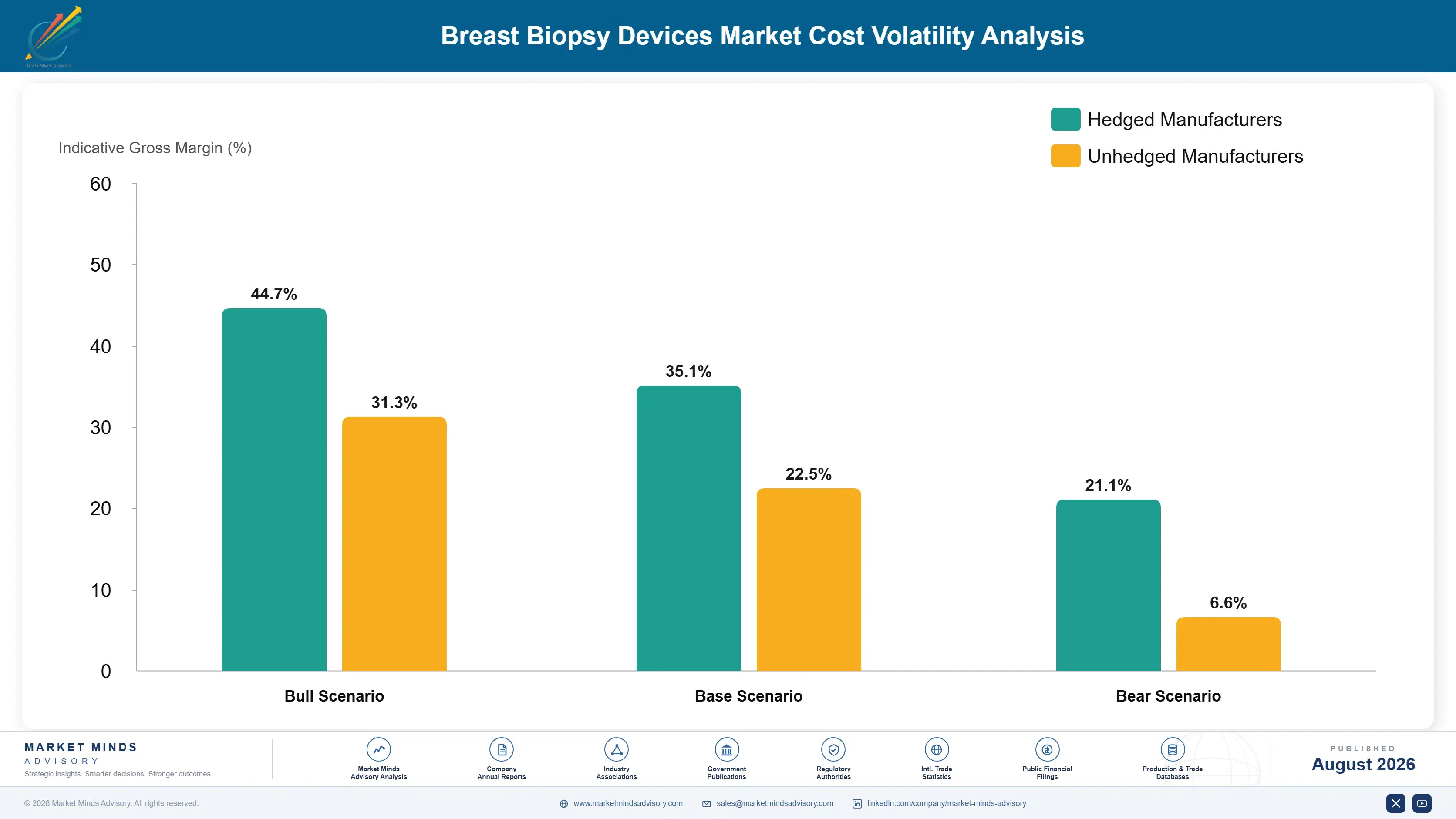
Precision stainless steel needle stock and cutting cannula carry roughly 22% to 30% of cost of goods, drawn from specialist tube drawing suppliers in Europe, Japan, and the United States. Medical grade polymers for handles, tubing, and vacuum chambers add 18% to 24%. Electronics and motors in powered devices, ethylene oxide sterilisation, and packaging validation make up most of the remainder.
Stainless tube and specialty polymer pricing rose sharply through 2021 and 2022 as medical device demand competed with wider industrial supply, and European Commission energy statistics record industrial electricity roughly doubling at the 2022 peak. Ethylene oxide sterilisation capacity also tightened following facility closures on emissions grounds in the United States. Becton Dickinson and Merit Medical both reported input cost and sterilisation capacity pressure across that period.

Exposure divides by whether a device is powered or passive. Core needle devices are mechanically simple, use little polymer, and carry modest exposure that regional manufacturing absorbs comfortably. Vacuum-assisted probes contain motors, tubing sets, and vacuum components, which makes them considerably more exposed to both electronics and polymer pricing. Sterilisation capacity affects everybody equally and cannot be substituted quickly by anyone.
breast-biopsy-devices-market-cost-volatility-analysis-1787297905192

Qualify sterilisation capacity across multiple facilities

Ethylene oxide capacity has tightened as facilities closed on emissions grounds, and a device qualified at only one site stops shipping when that site does. Validating alternative facilities and alternative modalities takes months of work that has to be completed before a closure rather than after one. Most manufacturers have qualified fewer options than the risk actually justifies.

Standardise needle stock across the device range

Precision drawn stainless tube comes from few suppliers and gets priced according to how little any single device programme buys. Common gauge and wall specifications shared across several products consolidate that purchasing into volumes worth negotiating. Engineering resists it because each device was designed around its own optimum, and the saving usually outweighs the compromise.

Index console placement contracts to consumable pricing

Placing a console free against a multi-year consumable commitment leaves the supplier carrying input cost movement across the whole of that period. Linking consumable pricing to published material indices transfers part of that exposure back to the hospital. Establishing the clause at placement is far easier than raising it later. Hospitals accept indexing more readily than a higher probe price.

Portfolio Architecture for Margin Defence

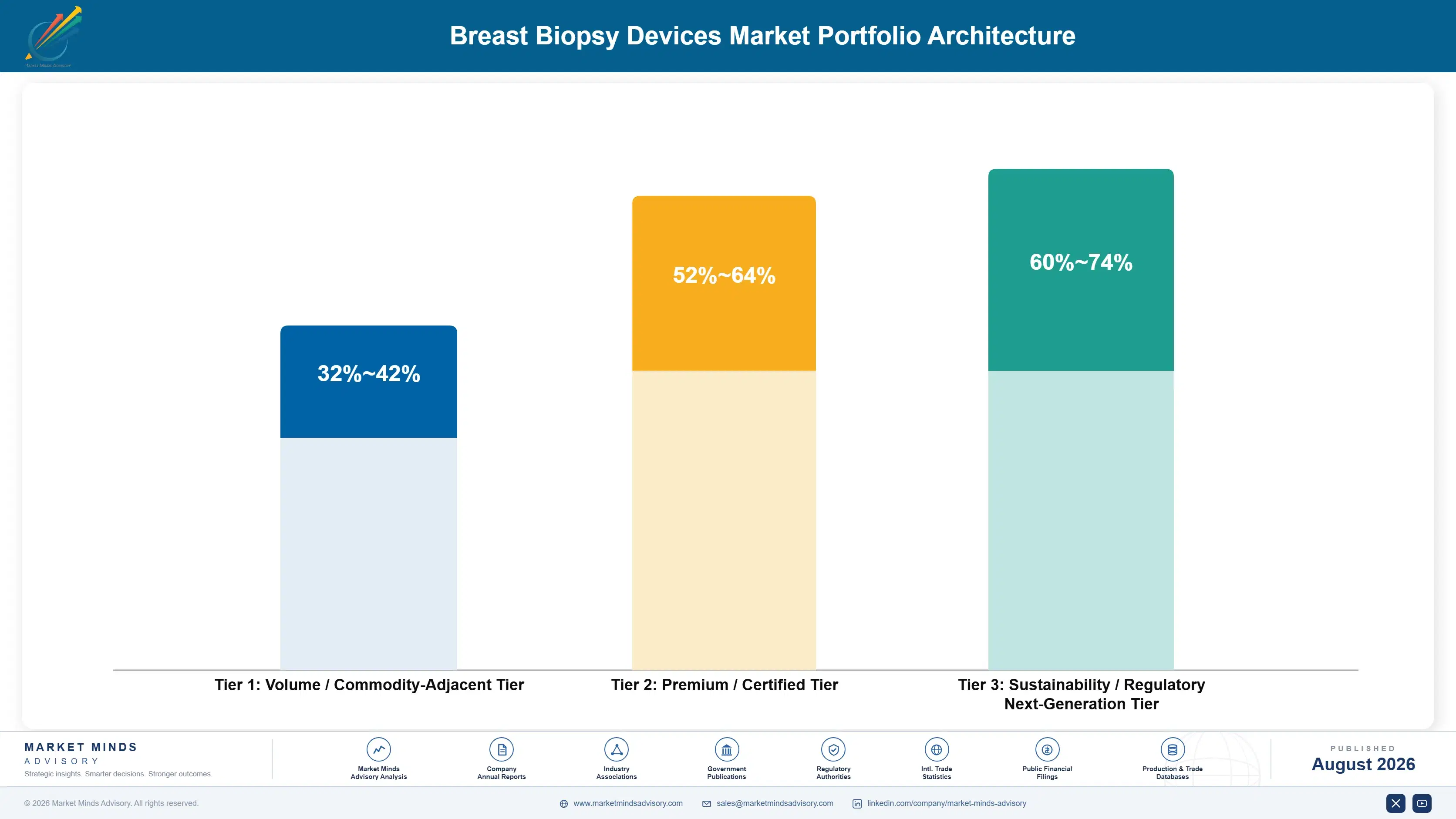
Margin here tracks whether the supplier controls what comes afterwards. A core needle device is sold once, competes against many alternatives on price, and earns a disposable margin accordingly. A vacuum console placed for a decade earns almost nothing itself and locks a proprietary probe stream worth several times the equipment, which is exactly why nobody in this category treats the console as the product being sold.
The volume tension is between procedure count and value per procedure. Core needle biopsy is the larger number of procedures and much the smaller share of value, performed wherever budgets are tight or the lesion is straightforward. Vacuum-assisted work is fewer procedures at several times the consumable spend, and therapeutic excision multiplies that again. Suppliers holding only the cheaper category have most of the volume and very little of the money.

High-value pools sit in three places. Proprietary probes attached to a placed console, wire-free localisation sold on theatre scheduling economics, and therapeutic excision that converts a single diagnostic pass into several. All three of them depend on controlling something the hospital cannot easily substitute rather than on any diagnostic advantage at all.

Volume / Commodity-Adjacent Tier

Core needle biopsy devices, fine needle aspiration sets, and general procedure consumables bought against many alternatives. The range reflects how differently established and regional manufacturers carry an equivalent single-use device.
Gross Margin: 32-42%

Premium / Certified Tier

Vacuum-assisted probes and tubing sets proprietary to a placed console, plus tissue markers and clips. Installed base lock rather than manufacturing cost sustains the margin across an eight to ten year equipment life.
Gross Margin: 52-64%

Sustainability / Regulatory / Next-Generation Tier

Wire-free localisation markers and readers, and the consumables supporting therapeutic lesion excision. The wide range reflects genuinely different economics between a single implanted marker and a multi-pass excision consumable set.
Gross Margin: 60-74%
breast-biopsy-devices-market-portfolio-architecture-1787297905687

High-value Sub-segments and Strategic Watch-out

Proprietary Vacuum Probes

Consumed on every procedure across an eight to ten year console life, and entirely closed to any competitor who did not place the equipment. Recovering 40% to 60% of console value each year makes the placement itself worth almost giving away. Nothing else in this category is as closed.
Gross Margin: 56-70%

Wire-Free Localisation Markers

Growing at 11.7% purely on operating theatre scheduling economics rather than on any clinical superiority at all over an ordinary guide wire. The buyer sits in theatre management rather than in radiology, which is a budget that most of the competitors never approach at all.
Gross Margin: 62-76%

Core Needle Biopsy Devices

The largest procedure count in the whole category and the smallest share of its total value, competed by very many suppliers wherever budgets are constrained. Departments start here before eventually placing a vacuum console with somebody, which is the only real reason to hold it.
Gross Margin: 32-42%

Therapeutic Excision Consumables

Using a diagnostic device to remove a benign lesion entirely, which triples consumable consumption per patient where it is routine. The watch-out is that practice patterns outside East Asia have been slow to adopt it despite patient enthusiasm. Patient demand exists wherever the option is offered.
Gross Margin: 58-72%

What Follows The Console Placement

Placing a vacuum-assisted console is the beginning of the revenue rather than the substance of it. The equipment sits in a radiology department for eight to ten years and every procedure consumes a proprietary probe, tubing set, and marker, recovering 40% to 60% of console value each year. Suppliers pricing the console to place it and earning afterwards end up considerably ahead of those defending equipment margin at the point of sale.
Stickiness is close to absolute for the life of the console and then briefly contestable. A department cannot buy another manufacturer's probes, so consumable share is fixed the moment placement happens and stays fixed until the equipment reaches end of life. Core needle and localisation products are the opposite and move at every tender. The whole competitive game happens in a window that opens once a decade.

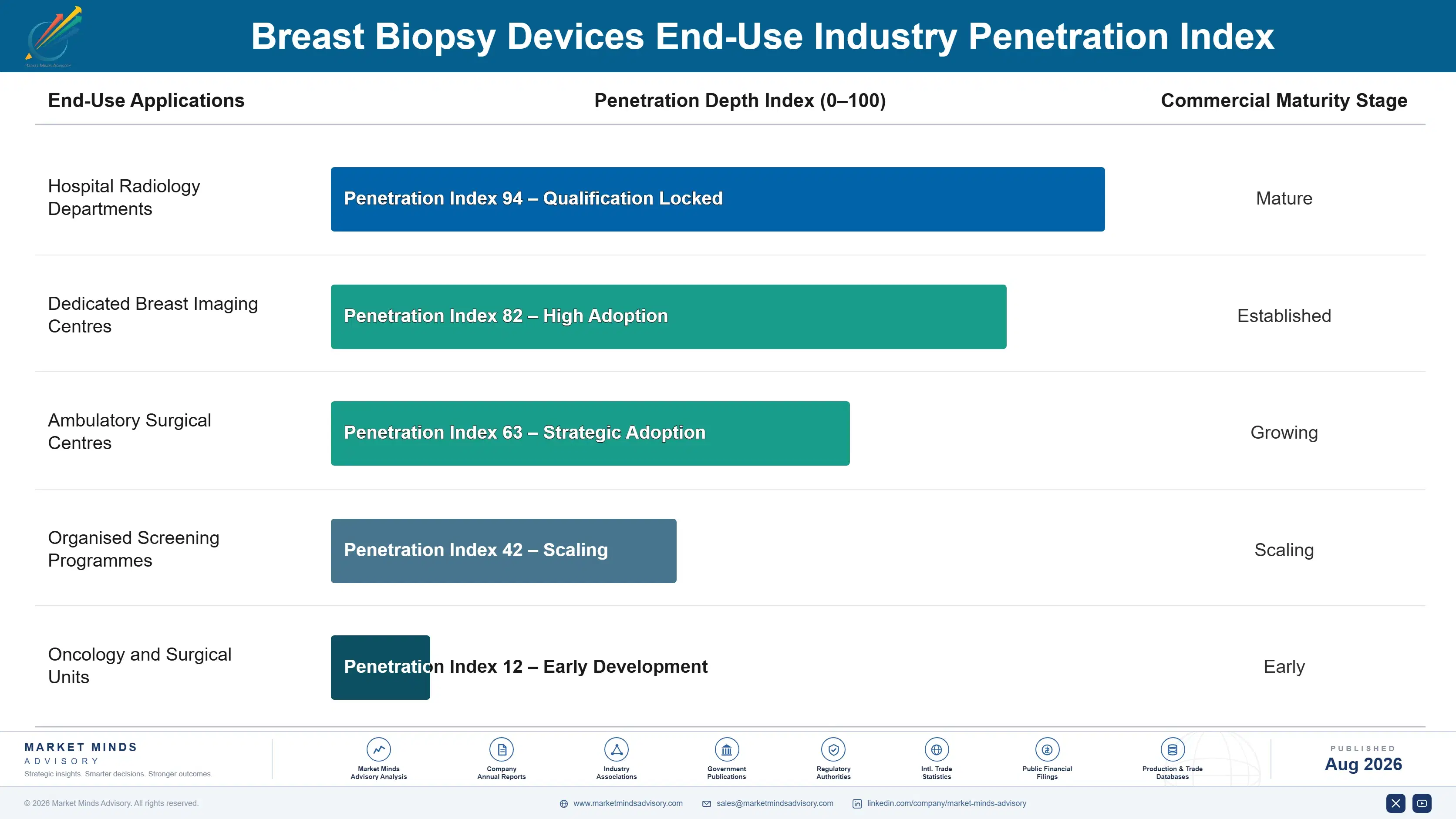
Buyer profiles differ across the category more than the products suggest. Radiology decides consoles and probes on tissue yield and workflow. Theatre management increasingly decides localisation on scheduling economics. Procurement decides core needle devices on price alone. Suppliers organised entirely around radiology are missing the budget that is currently converting fastest.
breast-biopsy-devices-market-end-use-penetration-index-1787297906173

Where To Compete Here

These are among the four positions where our research anticipates prominent divergence between winners and laggards over the coming forecast period. Each is grounded in the demand model, the regulatory perimeter, and the announced capacity pipeline.
01 / CONSOLE PLACEMENT PRIORITY

Give away the machine, own the probes

A vacuum console sits in a radiology department for eight to ten years and every single procedure consumes a proprietary probe that no competitor can supply into it. Recovering two fifths to three fifths of equipment value in consumables each year makes the placement itself worth almost giving away. Suppliers defending console margin at the expense of placements are protecting much the smaller number, and the installed base only becomes contestable once a decade when the equipment finally reaches end of life.
02 / THEATRE BUDGET ACCESS

Sell localisation on lost operating hours

Wire-free markers are marginally more accurate than a guide wire and considerably more expensive, which makes them a weak proposition for a radiologist comparing techniques on their merits. Presented to theatre management as a way to stop a delayed radiology list cancelling an operating list, the same product addresses a cost measured in thousands of dollars per lost hour. That reframing reaches an entirely different budget and decision maker, which explains why conversion has outrun the published evidence quite so comfortably.
03 / THERAPEUTIC USE DEVELOPMENT

Turn one diagnostic pass into several

Vacuum devices are used across much of East Asia to remove fibroadenomas completely rather than merely sample them, which consumes roughly three times the disposable volume per patient and avoids open surgery for a young woman. The practice is clinically well established there and barely adopted anywhere else at all. Building the evidence base and the surgeon training that allows it converts a diagnostic procedure into a therapeutic one, and patients asking for a lump removed without a scar are an unusually enthusiastic audience.
04 / RECALL REDUCTION PREPAREDNESS

Plan for fewer biopsies, not more

Roughly four biopsies in every five return a benign result, and artificial intelligence reading mammograms is now reducing recall rates across the best-funded screening programmes without missing more cancers. Those health systems are the industry's own customers, and no supplier can credibly argue against reducing unnecessary procedures in women who turn out not to have cancer. Growth therefore has to come from new screening populations and from value per procedure, because volume per screened woman across mature markets is going to fall.

Engagement Snapshot From the Field

A live engagement with an industry participant carrying material or product regulatory and market exposure ahead of a defining policy shift, showing how our research translates into a defensible multi-year portfolio strategy.
MARKET MINDS ADVISORY · CLIENT ENGAGEMENT SUMMARY
Breast Biopsy Devices Producer Strategic Portfolio Review and Transition Roadmap 2026·Investment Scenario on Breast Biopsy Devices Exposure Evaluation 2025-26
CLIENT PROFILE
A medical device manufacturer with annual breast biopsy revenue near USD 240 million (client-reported, unverified by MMA), holding a clear second position in vacuum-assisted systems behind one considerably larger incumbent. Console placements had grown only slowly for several years while the company kept defending equipment pricing across a competitive tender process it went on losing narrowly.
STRATEGIC CHALLENGE
Commercial leadership treated the console as a capital product to be sold at a margin and the probes as an attached consumable, and had rejected aggressive placement terms as value-destroying. Market share had not moved in four years, and nobody had modelled what a placement was actually worth across the full life of the installed equipment.
MMA APPROACH
MMA modelled total contribution per console across an eight to ten year life, including probe, tubing, and marker consumption at realistic procedure volumes by department size. Competitive placement terms were reconstructed from tender outcomes. The window in which an installed base becomes contestable was then mapped against forecast equipment replacement cycles.
KEY FINDINGS
  1. Consumable contribution across a console life exceeded the equipment margin by roughly seven times at median departmental procedure volume (client-reported, unverified by MMA).
  2. Every single tender the client had lost narrowly was decided on console pricing rather than on probe performance or any clinical preference.
  3. Only around 12% of the competitor installed base would reach end of life within the following five years, which bounded how much share could realistically move.
  4. Departments performing therapeutic excision consumed roughly three times the probe volume of purely diagnostic units, and the client had no commercial view of which were which.
CLIENT PROFILE
A medical device manufacturer with annual breast biopsy revenue near USD 240 million (client-reported, unverified by MMA), holding a clear second position in vacuum-assisted systems behind one considerably larger incumbent. Console placements had grown only slowly for several years while the company kept defending equipment pricing across a competitive tender process it went on losing narrowly.
STRATEGIC CHALLENGE
Commercial leadership treated the console as a capital product to be sold at a margin and the probes as an attached consumable, and had rejected aggressive placement terms as value-destroying. Market share had not moved in four years, and nobody had modelled what a placement was actually worth across the full life of the installed equipment.
MMA APPROACH
MMA modelled total contribution per console across an eight to ten year life, including probe, tubing, and marker consumption at realistic procedure volumes by department size. Competitive placement terms were reconstructed from tender outcomes. The window in which an installed base becomes contestable was then mapped against forecast equipment replacement cycles.
KEY FINDINGS
  1. Consumable contribution across a console life exceeded the equipment margin by roughly seven times at median departmental procedure volume (client-reported, unverified by MMA).
  2. Every single tender the client had lost narrowly was decided on console pricing rather than on probe performance or any clinical preference.
  3. Only around 12% of the competitor installed base would reach end of life within the following five years, which bounded how much share could realistically move.
  4. Departments performing therapeutic excision consumed roughly three times the probe volume of purely diagnostic units, and the client had no commercial view of which were which.
RECOMMENDED STRATEGY
Phase 1: Phase one: reprice consoles to win placements outright, accepting equipment losses against consumable contribution measured across the full equipment life. Phase 2: Phase two: identify and prioritise those departments performing therapeutic excision, where consumable consumption per console runs three times the average. Phase 3: Phase three: track competitor console age systematically, since any installed base is only genuinely contestable during a narrow replacement window.
OUTCOME
The client repriced console placement and reported winning more placements in the following eighteen months than in the previous four years combined (client-reported, unverified by MMA). Consumable revenue growth exceeded the equipment margin forgone within the second year, and departmental targeting concentrated placements in the highest consumption accounts.

Frequently Asked Questions

Foundational context covering the market sizes, CAGR, scope, country, region and competition that inform every finding below. This section is provided to cover basics and most often pre-purchase conversations, answered from the MMA Primary Research Dataset.

What is the current size of the Breast Biopsy Devices Market?

The market reached USD 1.6 billion in 2025 and is forecast at USD 1.72 billion for 2026. Volume follows screening programme design rather than breast cancer incidence, which varies far less between regions.

How large will the Breast Biopsy Devices Market be by 2036?

MMA forecasts USD 3.66 billion by 2036, an increase of USD 1.93 billion over 2026. That represents an expansion multiple of 2.12 times across the forecast period.

What is the CAGR for the Breast Biopsy Devices Market 2026 to 2036?

The base case CAGR is 7.8%, with a bull case at 9.0% and a bear case at 6.6%. The bear case is artificial intelligence reducing recall rates in established screening programmes.

Which segment is growing fastest?

Wire-free localisation systems grow fastest at 11.7%, exactly 1.50 times the market rate. They let radiology and surgery be scheduled independently, which hospitals value more than any accuracy gain.

Who are the major companies in the Breast Biopsy Devices Market?

Hologic, Becton Dickinson, Devicor Medical Products, Merit Medical, and Argon Medical Devices lead the market. The top five hold roughly 71% of revenue, sustained by installed console bases rather than by product superiority.

Which country is growing fastest?

India grows fastest at 11.4%, driven by organised screening being built where only opportunistic testing existed and by rising incidence. Presentation remains late, which is precisely what screening programmes are being built to change.

Report Segmentation Architecture

The full report scope spans multiple orthogonal segmentation dimensions, with cross-tabulated demand data provided for each dimension pair. Coverage extends further to regional breakdowns, trend trajectories, and the competitive detail needed to support segment-level decision-making.

By Device Category

  • Wire-Free Localisation Systems
  • Vacuum-Assisted Biopsy Systems
  • Tissue Markers and Clips
  • Core Needle Biopsy Devices
  • Fine Needle Aspiration Devices

By End-Use Industry

  • Hospital Radiology Departments
  • Dedicated Breast Imaging Centres
  • Ambulatory Surgical Centres
  • Organised Screening Programmes
  • Oncology and Surgical Units

By Commercial Dimension

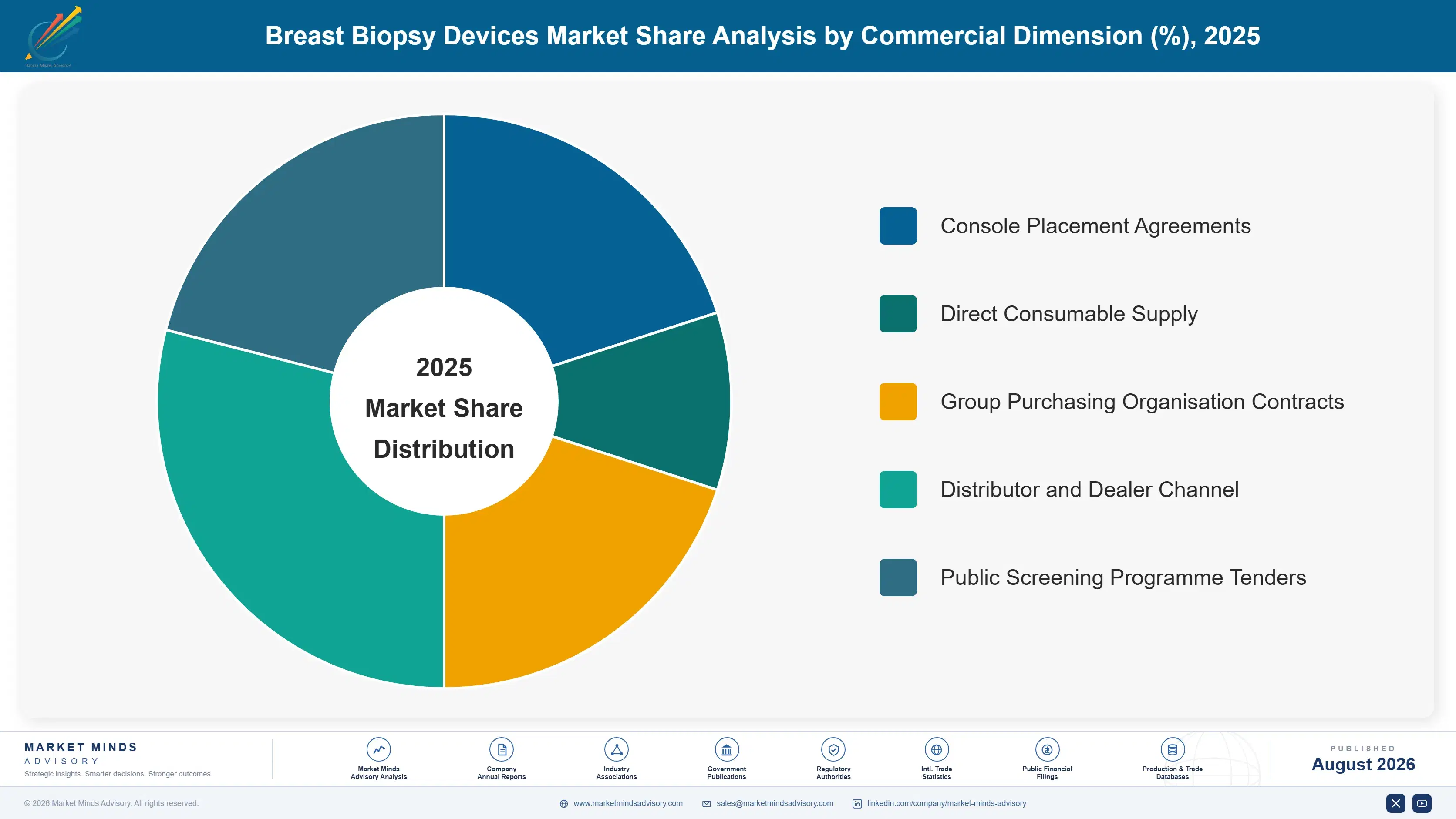
  • Console Placement Agreements
  • Direct Consumable Supply
  • Group Purchasing Organisation Contracts
  • Distributor and Dealer Channel
  • Public Screening Programme Tenders

By Region

  • East Asia
  • South Asia and Pacific
  • North America
  • Western Europe
  • Latin America
  • Middle East and Africa
  • Eastern Europe

Scope, Methodology, and Coverage

Every figure in this report is reproducible from documented input assumptions. The scope below maps the historical period, the forecast horizon, the segmentation dimensions, and the countries covered, alongside the underlying primary and qualitative methodology.
Historical Period
2020 to 2025
Forecast Period
2026 to 2036
Base Year
2025 (USD billions; MMA Primary Research Dataset, August 2026)
Market Definition
The breast biopsy devices market comprises instruments and single-use consumables used to sample breast tissue for diagnosis or to localise lesions before surgery, valued at supplier selling prices to hospital radiology departments, dedicated breast imaging centres, ambulatory surgical centres, and screening programmes. It spans vacuum-assisted biopsy consoles and proprietary probes, core needle biopsy devices, fine needle aspiration sets, wire and wire-free localisation systems including magnetic seeds, radar reflectors and radiofrequency tags, and tissue markers and clips, together with the guidance accessories and specimen handling consumables supplied alongside them. Mammography, ultrasound, and magnetic resonance imaging systems, pathology laboratory equipment and reagents, therapeutic breast surgery instruments and implants, screening software and artificial intelligence reading tools, and patient positioning equipment are excluded.
Quantitative Units
USD billions (current prices); volume in procedures and consumables supplied
Segmentation Dimensions
By Device Category; By End-Use Industry; By Commercial Dimension; By Region
Regions Covered
East Asia, South Asia and Pacific, North America, Western Europe, Latin America, Middle East and Africa, Eastern Europe
Countries Covered
China, Japan, South Korea, Taiwan, India, Australia, Singapore, Thailand, Indonesia, USA, Canada, Mexico, Brazil, Argentina, Colombia, Chile, Germany, France, UK, Netherlands, Sweden, Denmark, Italy, Spain, Switzerland, Finland, Poland, Czechia, Hungary, Romania, Saudi Arabia, United Arab Emirates, Egypt, South Africa, Nigeria, and additional markets relevant to this sector
Key Companies Profiled
Hologic, Becton Dickinson, Devicor Medical Products, Merit Medical, Argon Medical Devices, Cook Medical, Cardinal Health, Sterylab, Planmed, Siemens Healthineers, Endomagnetics, TransMed7, Scion Medical, Medtronic, Izi Medical Products, Biopsybell, Gallini Medical, Somatex Medical, Geotek Medical, Ranfac
Quantitative Methodology
Primary survey, n=3,800 respondents, Q4 2025, six countries; demand-side model with trade association cross-validation
Qualitative Methodology
47 expert interviews, Q4 2025; applied to validate demand model assumptions, identify emerging dynamics, and assess competitive positioning
Report Format
PDF and XLSX data workbook (Word format preview document)
Publisher
Market Minds Advisory
Report Code
MMA-2026-MED-743
Published
August 2026
Contact
sales@marketmindsadvisory.com | www.marketmindsadvisory.com

Purchase the full Breast Biopsy Devices Market Report (2026 to 2036).

The full report examines breast biopsy device demand across seven regions and five device categories, with particular attention to how screening programme design rather than cancer incidence determines procedure volume. It quantifies the effect of artificial intelligence recall reduction on biopsy counts and models console replacement windows where installed bases become contestable. Competitive analysis covers twenty participants assessed on breast biopsy device revenue, including how therapeutic excision practice multiplies consumable consumption per patient. Regional chapters separate screening coverage, recall thresholds, and practice pattern, which drive volume very differently.
Seven-region screening design and recall rate analysis
Five device category segmentation with growth rates
Twenty participant competitive assessment and installed base positioning
Console lifetime consumable contribution modelling by department
Recall reduction impact on biopsy volume by programme
Therapeutic excision practice adoption assessment by market

Built For The People Who Decide

From boardroom strategy to bench-side execution, this report is read cover-to-cover by leaders shaping the next decade of their industry, turning demand scenarios, market dynamics and valuation benchmarks into decisions.
CXOs/ Presidents/ VPs/ Managers
M&A and Corporate Development
Strategy Teams and R&D Heads
Procurement and Product Directors
Regulatory and Compliance Leaders
Investor Relations and Equity Analysts