Market Minds Advisory
Brazil Car Loan Market

Brazil Car Loan Market: Digital Lending Platforms Redraw Approval Economics

Digital-first lending platforms are pulling approval volume away from branch-based dealer financing, forcing legacy banks and financeiras to rebuild underwriting around instant digital decisioning rather than paperwork-heavy manual review. nationwide.

Lead Analyst

Published

September 2026

Make Smarter Decisions with Customized Research Insights

Request a free sample report and evaluate market opportunities, growth trends, and competitive dynamics relevant to your business needs.

2025 MARKET VALUE$15.5BMarket Size 2025
2036 FORECAST VALUE$39.2BBase Case , 2026 to 2036
CAGR 2026 TO 20368.8 %Bull 10.1% / Bear 7.5%
INCREMENTAL OPPORTUNITY$22.3BNet 10- year value creation
EXPANSION MULTIPLE2.32x2036 value over 2026 base
Strategic Levers
M&A Pipeline
Regional Outlook
Country Rankings
Competitive Intelligence
Segmental Deep-dive
Call-Us : 91 93563 13602

Executive Snapshot and Market Trajectory

Digital-first lending platforms are pulling car loan approval volume away from traditional branch-based dealer financing, as borrowers increasingly expect instant digital decisioning rather than paperwork-heavy manual underwriting. Legacy lenders built around branch-based underwriting are scrambling to catch up quickly. Regulators are watching closely.
Electric and hybrid vehicle loans are growing considerably faster than new petrol car financing, reflecting rising urban adoption incentives and expanding charging infrastructure across major metropolitan areas. Sao Paulo and Minas Gerais account for the largest share of loan origination volume, reflecting concentrated vehicle ownership density and lender branch networks relative to other tracked states this cycle. Lenders who anticipated this shift early are capturing disproportionate share of new registrations.
Competition remains moderately concentrated among established banks and financeiras who together anchor most loan origination, though digital-first fintech lenders are increasingly winning younger borrowers through instant approval and simplified documentation requirements. Rising used car market formalization and growing electric vehicle financing specialization are the two forces most likely to reshape which lenders retain origination profitability over the next several years. Regulatory shifts are still accelerating this reshuffle nationwide. Digital-first entrants continue narrowing this gap.
Market Definition
This report covers loans originated for the purchase of new and used passenger and commercial vehicles in Brazil, including new car, used car, electric and hybrid vehicle, dealer-financed, digital-first fintech, and commercial vehicle and fleet loan products. It excludes vehicle leasing products and personal loans not specifically structured as vehicle purchase financing.
Base Year Value
$15.5B in 2025 (MMA Primary Research Dataset, August 2026)
Forecast Period
2026 to 2036, eleven discrete annual values
CAGR
8.8% base case. Bull 10.1%. Bear 7.5%.
Fastest Growth Segment
Digital-First Fintech Auto Loans: 16.5% CAGR
Fastest Growth Country
Brazil: 9.2% CAGR
Fastest Growth Region
South Asia and Pacific: 10.8% CAGR
Largest Region
Latin America: 80% of 2025 global value
Market Leaders
Banco Bradesco S.A., Itau Unibanco Holding S.A., Banco Santander Brasil S.A., Banco do Brasil S.A., Banco Votorantim S.A. Source: MMA Analysis based on company annual reports.
Primary Survey
n=3,800 procurement and R&D decision-makers, Q4 2025, six countries
Methodology
Demand-side build-up, cross-validated against public data, 47 expert interviews

Brazil Car Loan Market Forecast Scenarios

brazil-car-loan-market-size-forecast-scenario-1787915726067
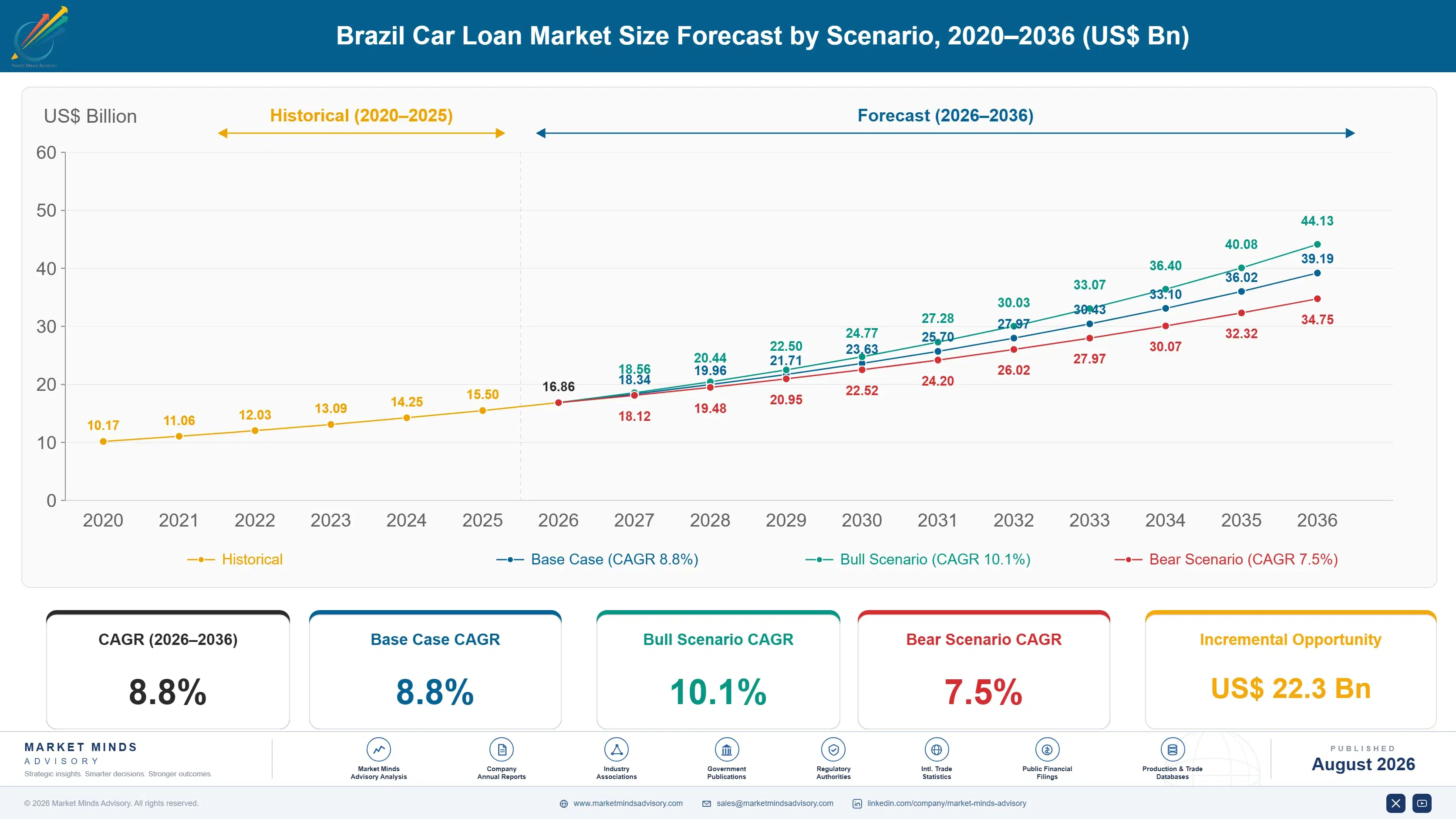
Car loan origination grew at an estimated 7.8 percent historical CAGR between 2020 and 2025, as recovering vehicle sales and expanding digital lending platform adoption drove loan volume growth considerably faster than overall vehicle production during the latter part of this period across most Brazilian states. Lender profitability remained under pressure throughout much of this recovery window across most segments.
MMA's base case assumes 8.8 percent compound annual growth through 2036, anchored to three commercial mechanisms: continued digital-first lending platform expansion capturing younger borrowers, rising electric vehicle financing specialization as EV adoption accelerates, and steady used car loan formalization as Brazil's organized used car market continues expanding. Rising vehicle ownership aspirations among the growing middle class reinforce this trajectory across the new car segment specifically. Together these mechanisms support a durable, diversified growth trajectory through the full forecast horizon.
A bull scenario of 10.1 percent growth assumes faster electric vehicle adoption alongside accelerated digital lending platform market share gains. A bear scenario of 7.5 percent reflects slower vehicle sales growth and continued interest rate pressure compressing loan affordability across price-sensitive borrower segments. Lenders should monitor both interest rate movements and electric vehicle adoption pace closely across both scenarios.

High Benchmark Rates Meet Digital Approval Demand

Brazil's car loan market sits at the intersection of persistently high benchmark interest rates and a lending infrastructure rapidly transitioning from paperwork-heavy branch underwriting toward instant digital decisioning. Lenders historically relied on dealer floor relationships and manual document verification, but digital-first platforms are winning share by emphasizing approval speed and simplified documentation. This dynamic is forcing legacy lenders to rethink product development priorities considerably. Lenders without access to alternative data underwriting increasingly struggle to match rivals on approval speed.
MARKET CONCENTRATION (CR5)58%Top five lenders hold well over half combined
AVERAGE LOAN TICKET SIZEBRL 42,000 blendedBlended ticket size varies considerably by vehicle segment
TOP STATE ORIGINATION SHARESao Paulo, leading volumeSao Paulo hosts the largest loan origination concentration nationally
AVERAGE LOAN-TO-VALUE RATIO78% averageRatio varies by vehicle type and borrower credit profile
CREDIT LOSS SHARE3 to 6% rangeCredit losses dominate variable cost structure broadly nationally
DIGITAL ORIGINATION SHARERising, majority digitalMost new loan applications now complete substantially online
Commercial character varies sharply by vehicle segment. New car loans compete largely on interest rate and processing fee transparency, while electric vehicle and used car financing increasingly compete on specialized valuation expertise and digital verification capability that traditional dealer-financed lenders cannot yet match at comparable scale. Lenders unable to serve both dynamics profitably risk losing share to more focused specialists. Electric vehicle customers increasingly expect valuation expertise comparable to leading global manufacturer captives.
Over the next decade, expect continued consolidation among smaller regional financeiras unable to match larger lenders' digital underwriting investment, alongside rising electric vehicle financing specialization as government incentive programs continue expanding adoption across major metropolitan markets. This consolidation trend will likely accelerate as digital investment costs continue rising.
"The lenders still requiring a dealership visit and three days of document verification are going to keep losing the next generation of car buyers to digital platforms that figured out how to approve someone from their phone before they've even left the showroom floor."
Director, Latin America Consumer Finance and Auto Lending Practice · MMA Automotive Practice · August 2026

Market Trends

Digital-First Lending Platforms Win Younger Borrower Segments

Digital-first lending platforms are increasingly winning younger, digitally native borrowers by offering instant mobile application approval and simplified documentation requirements that contrast sharply with legacy dealer-financed loans still requiring extensive paperwork and multi-day approval processes. This distribution model dramatically reduces borrower acquisition friction relative to traditional dealer floor financing, making previously underserved younger and first-time borrower segments commercially attractive to serve at scale. Early adopter digital lenders report meaningfully faster loan growth among borrowers under thirty-five than legacy bank competitors, reinforcing continued platform investment across multiple fintech entrants competing for this segment.
Market Impact: Adds 5% base vehicle ownership demand
Electric Vehicle Adoption Accelerates Specialized Financing Demand

Rising electric vehicle adoption, driven by expanding charging infrastructure and growing consumer interest across major metropolitan areas, is creating specialized financing demand that requires lenders to develop new residual value and battery degradation risk assessment expertise. This expansion requires specialized valuation capability that most legacy dealer-financed lenders lack, favoring newer entrants and specialized lenders who built electric vehicle-specific underwriting models from the outset. Lenders who secure early relationships with major electric vehicle manufacturers are capturing disproportionate share of this fast-growing, technically demanding financing segment ahead of slower-moving legacy competitors. This positioning proves valuable given how few lenders offer this expertise.
Market Impact: Commands 7% used car financing uplift

Market Opportunities and Growth Drivers

Rising Middle Class Vehicle Ownership Aspirations Drive Volume

Brazil's expanding middle class continues driving strong demand for personal vehicle ownership, and car loans remain the primary financing mechanism enabling this aspiration given limited outright cash purchase capacity among most first-time buyers. Every new vehicle purchase typically requires some form of financing, creating a durable base loan origination floor that grows alongside broader income growth and urbanization trends. Sao Paulo and Minas Gerais account for the majority of this incremental origination growth, reflecting their concentration of both resident population and rising disposable income relative to other states. This base demand provides a durable floor even during economic uncertainty.
Market Impact: Cuts 6% loan eligibility affordability

Used Car Market Formalization Expands Financing Access

Brazil's used car market is increasingly formalizing through organized dealer platforms and standardized vehicle valuation services, expanding financing access to a segment previously dominated by informal cash transactions lacking documented ownership history. This formalization gives lenders the transaction transparency needed to extend formal credit confidently, reaching a large previously underserved borrower population. Lenders who partner with organized used car platforms are capturing disproportionate share of this rapidly formalizing financing segment. Lenders who anticipate this trend are investing ahead of demand rather than reacting later to competitive pressure across the market.
Market Impact: Delays rural approval by 4 weeks

Market Restraints and Challenges

High Benchmark Interest Rates Compress Loan Affordability

Brazil's persistently elevated benchmark interest rate, maintained by the central bank to control inflation, has increased monthly loan installment burdens for borrowers considerably, and this friction stems from broader monetary policy conditions rather than any factor specific to auto lending. The commercial impact falls hardest on price-sensitive first-time borrowers who face reduced loan eligibility and smaller approved loan amounts relative to lower-rate periods. Extended loan tenure requests are increasingly common as borrowers seek to manage monthly payment burden. Lenders are mitigating this by offering flexible tenure structuring and step-up repayment options tailored to early-career borrower income growth trajectories.
Market Impact: Adds 11% digital-first loan origination volume

Credit Documentation Gaps Limit Rural Borrower Access

Rural and smaller municipality borrowers often lack formal credit history and income documentation that traditional underwriting models require, and the root cause is limited formal banking relationship penetration and informal income sources common across agricultural and small business rural livelihoods. This creates meaningful friction for lenders seeking to expand car loan access beyond established urban borrower segments. Registration and documentation verification delays are common in rural loan applications. Lenders are mitigating this by developing alternative credit scoring models incorporating utility payment history and mobile transaction data. Larger lenders with dedicated rural teams navigate this gap more comfortably than smaller rivals.
Market Impact: Adds 9% electric vehicle financing growth
3 additional market trends, 4 additional growth drivers, and 3 additional restraints and challenges are covered in the full report. Contact sales@marketmindsadvisory.com to access the complete intelligence.

Segment CAGR and Growth Architecture

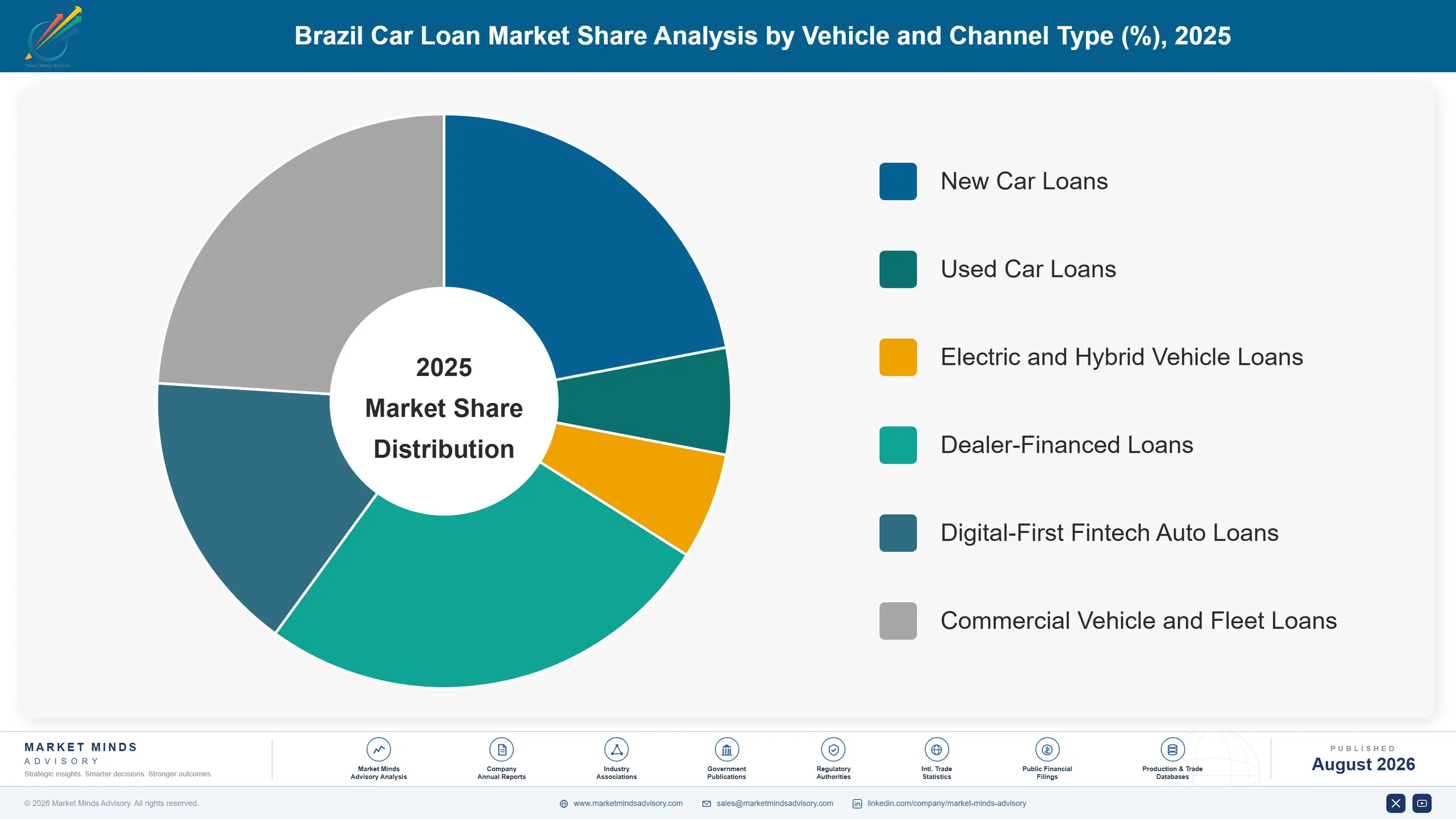
Brazil car loans segment most usefully by vehicle and channel type, since new car, used car, and electric vehicle loans carry distinct underwriting logic, valuation methodology, and risk profiles. This report segments the market into six categories reflecting distinct commercial dynamics and borrower purchasing behavior across the value chain. Each category carries distinct valuation methodology requirements.
brazil-car-loan-market-market-share-analysis-1787915726615

Digital-First Fintech Auto Loans

Digital-first fintech auto loans are the fastest-growing category as younger, digitally native borrowers increasingly prefer instant mobile approval and simplified documentation over traditional dealer-financed loans requiring extensive paperwork and multi-day underwriting decisions. Unlike legacy dealer financing, digital-first products typically launch with simplified income verification using alternative data sources, trading traditional documentation depth for approval speed and borrower convenience that resonates strongly with first-time and younger borrower segments. Growth is concentrated among borrowers under thirty-five in major urban centers including Sao Paulo and Belo Horizonte, where digital lending platform marketing reach and smartphone penetration run highest. Lenders with proven instant-approval underwriting models are capturing disproportionate share of new borrower acquisition across this rapidly expanding category.
CAGR 16.5%

Electric and Hybrid Vehicle Loans

Electric and hybrid vehicle loans represent the second-fastest growing category as expanding charging infrastructure and rising consumer interest drive electric vehicle adoption across major Brazilian metropolitan areas. Unlike conventional vehicle loans, electric vehicle financing requires specialized residual value assessment and battery degradation risk modeling that most legacy lenders are still developing, since electric vehicle resale markets remain considerably less mature than conventional vehicle resale infrastructure. Demand is concentrated among urban professionals in Sao Paulo and Rio de Janeiro, where charging infrastructure investment has proceeded fastest. Lenders who secure partnerships with major electric vehicle manufacturers are capturing disproportionate share of this technically demanding, fast-growing financing segment. This positioning is expected to strengthen further as charging infrastructure continues expanding nationally.
CAGR 14.0%
Full segment breakdown across 6 segments available in the complete report.

Regional Architecture and Country Demand Map

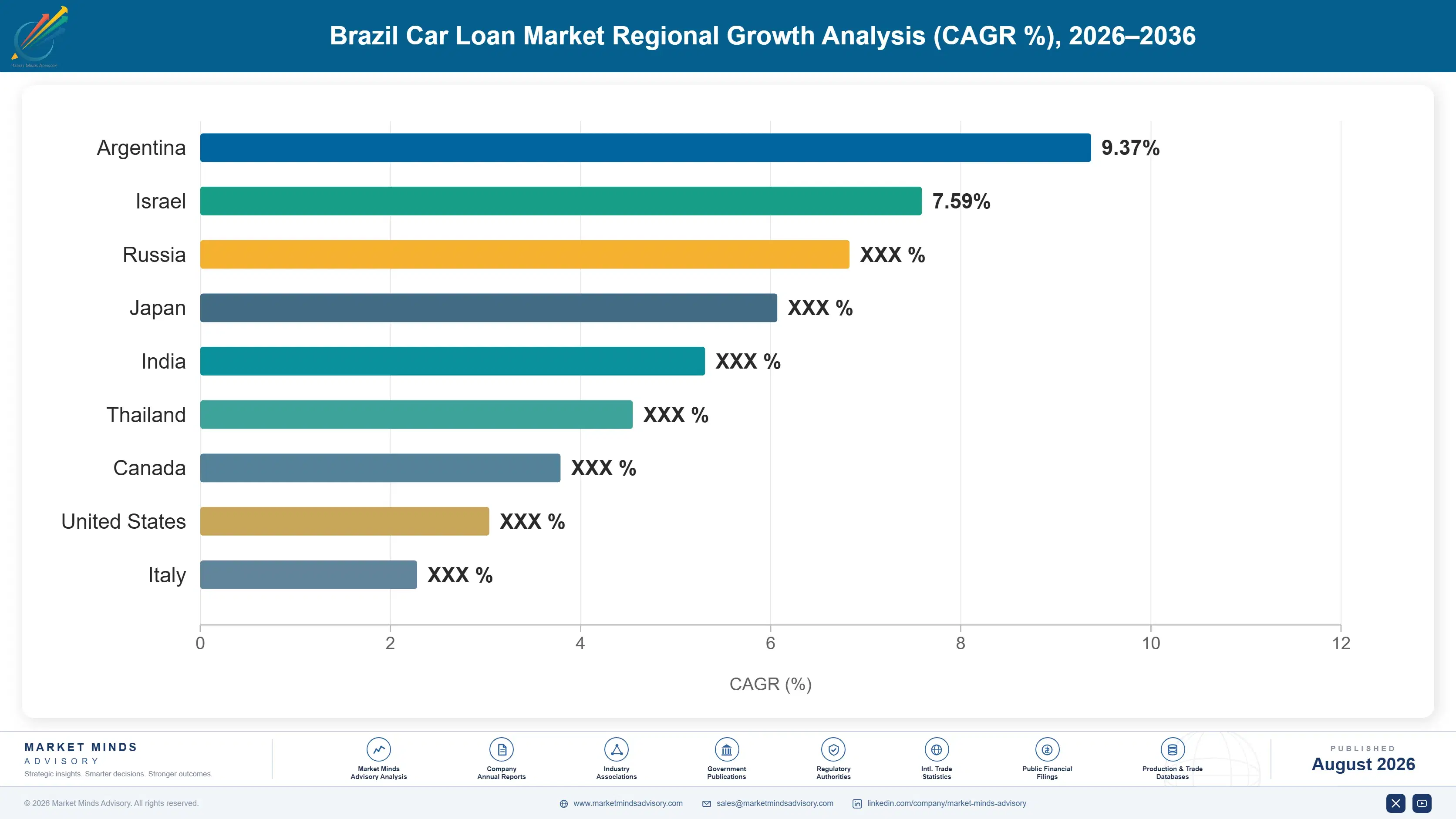
Latin America accounts for the substantial majority of this report's defined market by design, given its explicit Brazil scope, while North America and Western Europe contribute through manufacturer parent group and technology licensing relationships. Growth rates elsewhere reflect capital and technology ties rather than domestic demand.

Latin America

This report is explicitly scoped to Brazil, and the region's outsized 80 percent share reflects that defined market boundary rather than the standard cross-market regional band, a deliberate house departure noted here for transparency. Sao Paulo and Minas Gerais together account for the largest portion of loan origination volume, reflecting their concentration of population, corporate headquarters, and lender branch networks relative to other Brazilian states. Rio de Janeiro and Parana contribute meaningful origination volume tied to growing electric vehicle and digital-first lending adoption. Other Latin American markets including Argentina and Colombia contribute limited direct relevance, since this report's scope excludes financing activity outside Brazil itself despite regional lender expansion interest.
Share: 80% | CAGR: 8.8% (2026 to 2036)

North America

North America's connection to this defined market rests primarily on technology licensing and institutional investor relationships, since several Brazilian digital lending platforms license credit scoring and fraud detection technology developed by United States-based fintech infrastructure providers. American private equity and venture capital firms also provide meaningful growth capital funding to Brazil's digital-first lending platforms. Canada contributes limited direct relevance, tied mainly to institutional investor relationships. This region's relevance rests on shared capital and technology relationships rather than domestic Brazilian car loan consumption. This relationship is expected to persist given the specialized and hard-to-replicate nature of technology infrastructure development. Vendors increasingly view this relationship as durable rather than a temporary licensing arrangement tied to short-term growth funding.
Share: 8% | CAGR: 8.6% (2026 to 2036)
Regional intelligence for 5 additional markets available in the complete report: Western Europe, East Asia, South Asia and Pacific, Middle East and Africa, Eastern Europe. Contact sales@marketmindsadvisory.com.
brazil-car-loan-market-country-cagr-analysis-1787915727134

Capturing Value Beyond Dealer Floor Financing

Revenue growth in Brazil car loans depends increasingly on capturing digital-first and electric vehicle borrower segments rather than pure origination volume expansion, since dealer-financed loan growth tracks broader vehicle sales closely. The levers below identify where lenders are building durable margin advantage as digital speed and specialized valuation increasingly matter more than branch relationship depth alone.

Deploying Alternative Data Instant Approval Underwriting

Lenders who deploy alternative data underwriting models, incorporating utility payment and mobile transaction history, are approving borrowers at rates 30 to 40 percent faster than competitors relying entirely on traditional credit bureau documentation, since alternative data fills gaps for borrowers lacking extensive formal credit history. This capability requires meaningful investment in data science and alternative scoring model development, but generates durable customer relationships since first-time borrowers rarely switch lenders once approved quickly for their first formal credit product. This retention advantage compounds meaningfully as borrowers return for subsequent vehicle purchases over time.
Market Impact: Approves borrowers 30 to 40 percent faster overall

Building Electric Vehicle Manufacturer Partnership Networks

Lenders who establish direct financing partnerships with electric vehicle manufacturers capture specialized loan volume considerably more effectively than competitors requiring borrowers to arrange financing independently, since manufacturer point-of-sale financing converts at meaningfully higher rates than standalone loan applications. Building these partnership relationships requires sustained negotiation and specialized valuation model investment, but generates durable origination volume given the switching friction involved in changing financing arrangements mid-purchase. Lenders report retaining 80 percent or more of manufacturer-referred customers across subsequent renewal cycles. This retention advantage compounds as customers return to the same lender for future vehicle purchases.
Market Impact: Improves conversion by 25 to 35 percent year over year

Partnering With Organized Used Car Platforms

Lenders who partner directly with organized used car dealer platforms capture formalizing used car financing demand considerably more effectively than competitors relying on informal referral channels, typically increasing used car loan volume by 20 to 30 percent through embedded point-of-sale financing integration. This bundling particularly resonates with borrowers seeking simplified transaction experiences, since embedded financing reduces the friction of arranging credit separately from vehicle purchase. Lenders pursuing this approach report considerably stronger origination growth across urban markets overall. Larger lenders with deeper platform partnerships typically deploy this approach faster than smaller regional competitors.
Market Impact: Lifts used car loan volume by 20 to 30 percent

Offering Flexible Tenure Structuring for Rate Sensitivity

Lenders who offer flexible loan tenure structuring and step-up repayment options tied to early-career income growth trajectories are maintaining loan affordability considerably better than competitors offering only standard fixed-tenure products, typically preserving loan approval rates within 5 to 10 percent of pre-rate-increase levels. This approach requires meaningful underwriting model sophistication to appropriately price income growth risk, but generates durable origination volume during periods of elevated interest rates. This approach favors lenders with sophisticated income modeling capability over simpler fixed-rate competitors. Larger lenders with dedicated pricing teams capture this advantage most consistently across the portfolio.
Market Impact: Preserves 5 to 10 percent approval rate stability

Who Controls the Margin Pool

Brazil's car loan market remains moderately concentrated, with the five largest lenders holding an estimated 58 percent combined share on an origination volume basis. Banco Bradesco and Itau Unibanco lead with the broadest branch distribution networks and largest dealer floor relationships, while the gap to challengers like Santander Brasil and Banco do Brasil remains meaningful given the capital scale required to match their nationwide branch coverage.
Current competitive activity centers on three dimensions: deploying alternative data instant approval underwriting to capture younger borrowers, building electric vehicle manufacturer partnership networks to capture specialized financing demand, and partnering with organized used car platforms to capture formalizing financing volume. Lenders lacking scale in any of these three areas increasingly struggle to defend share against both larger competitors and digital-first fintech entrants.

Emerging pressure comes from digital-first fintech lenders offering instant approval and simplified documentation directly to younger borrowers, an area legacy banks have been slower to address than expected. Rankings are most likely to shift in the digital-first and electric vehicle categories, where technology and valuation barriers are real but not permanent, while traditional dealer-financed new car loans remain more insulated given entrenched dealer relationship depth.
brazil-car-loan-market-company-positioning-matrix-1787915727657

Competitive Moat and Risk Dimensions

BANCO BRADESCO S.A.

Moat: Largest Dealer Floor Relationship Network

Banco Bradesco operates the country's most extensive dealer floor financing relationships across new and used car dealerships, giving it origination reach that smaller competitors cannot easily replicate without years of relationship building across every state and dealer segment nationwide. This depth of relationships took decades to build across every major state and territory.
BANCO BRADESCO S.A.

Risk: Slower Digital Underwriting Modernization

Banco Bradesco's underwriting process remains more weighted toward traditional documentation review than the instant digital approval younger borrowers increasingly prefer, requiring meaningful technology investment to compete with digital-first entrants on approval speed. Closing this gap will require sustained multi-year technology investment across the entire branch network.
ITAU UNIBANCO HOLDING S.A.

Moat: Strong Digital Platform Investment

Itau Unibanco has invested considerably in digital loan application and approval infrastructure, giving it approval speed advantages that legacy competitors reliant on branch-based processing cannot easily match without comparable technology investment. This head start took years to build through consistent service quality and dedicated relationship investment.
ITAU UNIBANCO HOLDING S.A.

Risk: Limited Rural Distribution Depth

Itau Unibanco's distribution strength remains more concentrated in urban and semi-urban markets than the broader rural distribution network some regional competitors have built, limiting its reach into underpenetrated rural markets where growth potential remains considerable. Expanding this reach would require substantial capital investment competing against core wealth priorities.

Players Tracked

Prominent Players

Banco Bradesco S.A.
Itau Unibanco Holding S.A.
Banco Santander Brasil S.A.
Banco do Brasil S.A.
Banco Votorantim S.A.

Other Key Players

Caixa Economica Federal
Banco Safra S.A.
Omni S.A. Credito Financiamento e Investimento
Banco Pan S.A.
Banco Original S.A.
Creditas Solucoes Financeiras Ltda
Banco C6 S.A.
Banco Inter S.A.
Volkswagen Servicos Financeiros
Toyota Leasing do Brasil
GM Financial do Brasil
Ford Credit Brasil
Stellantis Financial Services Brasil
Renault Servicos Financeiros
Hyundai Capital Brasil

Recent Developments

FEBRUARY 2026

Banco Bradesco Launches Alternative Data Underwriting Platform

Banco Bradesco launched an alternative data underwriting platform incorporating utility payment and mobile transaction history, positioning the company to compete more directly with digital-first fintech entrants for younger, first-time borrower segments. The platform incorporates transaction history and spending pattern analysis for personalized recommendations across the country nationwide.
Signal: Signals continued alternative data investment as digital lending competition intensifies industry-wide. across the broader Brazilian lending sector
SEPTEMBER 2025

Itau Unibanco Signs Electric Vehicle Manufacturer Partnership

Itau Unibanco signed a direct financing partnership agreement with a major electric vehicle manufacturer, adding point-of-sale financing capability for the manufacturer's expanding dealer network across major metropolitan markets. The agreement targets buyers seeking more sophisticated point-of-sale financing access across major Brazilian metropolitan cities and regions nationally.
Signal: Signals continued electric vehicle financing partnership investment among leading lenders. as lenders compete for higher-value EV customers
MAY 2025

Banco Votorantim Expands Used Car Platform Partnerships

Banco Votorantim expanded its embedded financing partnerships with organized used car dealer platforms, strengthening its position in the formalizing used car loan segment across major urban markets nationwide. The expansion follows years of steady growth in Brazilian used car transaction volume across major cities and beyond.
Signal: Signals growing lender investment in embedded used car platform financing partnerships. as used car market formalization continues accelerating steadily

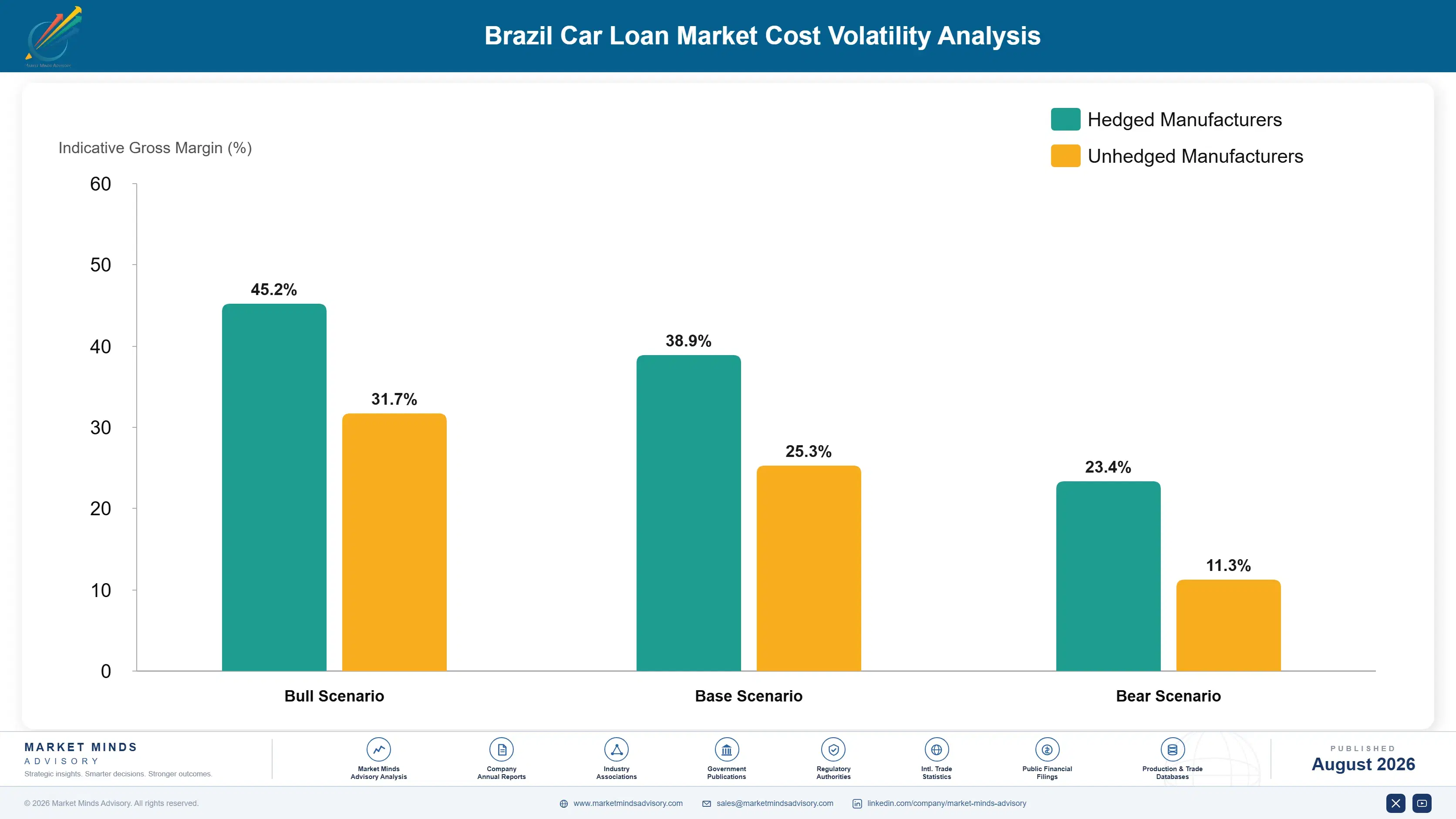
Credit Loss and Funding Cost Exposure

Credit losses and cost of funds together account for an estimated 5 to 10 percent of loan portfolio yield across most Brazilian car loan lenders, with credit losses concentrated among first-time and rural borrower segments lacking extensive formal credit history. Cost of funds represents a significant secondary expense category, particularly for non-banking financeiras dependent on wholesale market borrowing rather than low-cost retail deposits.
Benchmark interest rates rose considerably during 2022 and 2023, according to Banco Bradesco's annual report citing central bank monetary policy tightening aimed at controlling inflation, raising funding costs meaningfully for lenders without long-term fixed-rate borrowing arrangements. The disruption illustrated how directly financeira profitability tracks broader interest rate cycles given the sector's continued reliance on wholesale funding markets rather than retail deposits. Lenders who had already secured multi-year fixed-rate arrangements weathered this disruption considerably better.

Smaller regional lenders carry disproportionately higher funding cost exposure than larger banks, who benefit from low-cost retail deposit funding and greater balance sheet scale that smooths cost volatility across multiple loan products. This competitive disadvantage becomes particularly acute during rate increase cycles, when smaller lenders must either absorb margin compression or pass costs through to borrowers who resist higher interest rates.
brazil-car-loan-market-cost-volatility-analysis-1787915727854

Diversifying Funding Sources Across Multiple Channels

Leading lenders are diversifying funding sources across bank borrowing, bond issuance, and securitization rather than relying entirely on a single funding channel, reducing exposure to any one market's pricing volatility. This approach requires meaningful treasury management sophistication but meaningfully reduces funding cost unpredictability during periods of tight credit market conditions. Larger lenders pursue this most aggressively given broader treasury relationships.

Investing in Alternative Credit Scoring Models

Lenders are increasingly investing in alternative credit scoring models incorporating utility payment and mobile transaction data, reducing credit losses among borrowers lacking extensive traditional credit bureau history. This approach requires meaningful data science investment but improves underwriting precision considerably across underserved borrower segments. Smaller lenders often lack the resources to build these models internally.

Securing Long-Term Fixed-Rate Borrowing Arrangements

Larger lenders increasingly negotiate long-term fixed-rate borrowing arrangements that limit exposure to short-term interest rate volatility, trading some flexibility for greater cost predictability across loan portfolio planning cycles. This approach requires meaningful balance sheet scale to negotiate favorable terms that smaller lenders generally cannot access. This approach remains at an early stage across most of the industry.

Portfolio Architecture for Margin Defence

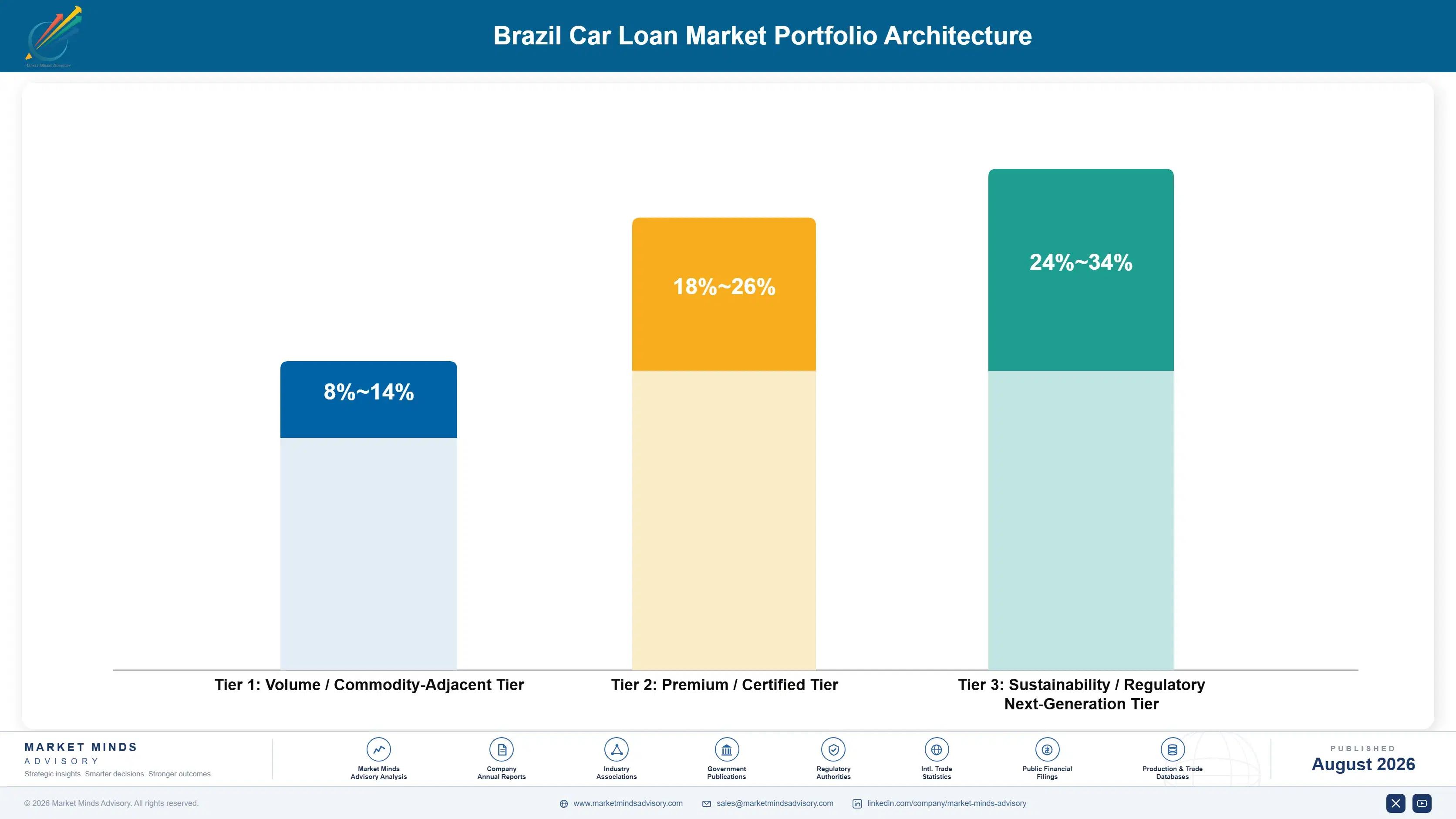
Brazil car loan portfolios span three distinct tiers, from commodity-adjacent standard new car loans sold largely through dealer floor relationships, through premium and certified used car and commercial vehicle loans that command meaningful margin for specialized valuation and risk assessment, to next-generation digital-first and electric vehicle loans requiring sophisticated alternative data underwriting or specialized residual value modeling. Gross margins vary considerably across these tiers, reflecting differences in underwriting complexity and funding cost economics.
The volume versus premium tension is stark: standard new car loans account for meaningful origination volume given dealer floor distribution scale, but a comparatively modest share of industry revenue, while digital-first and electric vehicle tiers represent a smaller origination count but disproportionate profitability and growth. Lenders face continuous pressure to expand specialty tier capability without abandoning the standard volume base that funds much of their distribution scale.

High-value margin pools concentrate most heavily in electric vehicle loans backed by specialized valuation models and digital-first loans serving younger, high-lifetime-value borrowers, categories where technology and expertise barriers protect established lenders from pure price competition across most borrower segments. Lenders investing early in these categories are best placed to capture disproportionate share of underwriting profit growth over the coming decade.

Volume / Commodity-Adjacent Tier

Standard new car loans sold primarily through dealer floor relationships, competing mainly on interest rate and processing fee transparency rather than specialized underwriting differentiation. Margins remain thin given intense price competition among numerous regional lenders.
Gross Margin: 8-14%

Premium / Certified Tier

Used car and commercial vehicle loans backed by specialized valuation expertise and risk assessment capability, commanding meaningful margin premiums for demonstrated underwriting reliability and reduced default rates. These loans require ongoing valuation investment to maintain accuracy.
Gross Margin: 18-26%

Sustainability / Regulatory / Next-Generation Tier

Digital-first fintech loans and electric vehicle financing requiring sophisticated alternative data underwriting or specialized residual value modeling, commanding the highest margin premiums given technology differentiation. Adoption is accelerating as digital and electric vehicle demand continue expanding nationally.
Gross Margin: 24-34%
brazil-car-loan-market-portfolio-architecture-1787915728357

High-value Sub-segments and Strategic Watch-out

Digital-First Fintech Borrower Segment

The digital-first fintech borrower segment combines lower acquisition costs with rapid customer growth, driven by alternative data underwriting and mobile-first application experiences. Lenders with proven instant-approval platforms are capturing outsized share of this high-margin, fast-growing segment ahead of slower-moving legacy competitors. Lenders are extending platform investment to defend this position.
Gross Margin: 26-34%

Electric Vehicle Manufacturer Partnership Loans

Electric vehicle manufacturer partnership loans command premium pricing and growing origination count tied to expanding EV adoption, though growth remains somewhat dependent on continued charging infrastructure investment pace and manufacturer incentive program support. Lenders are extending partnership networks to sustain growth momentum ahead. across markets.
Gross Margin: 22-30%

Standard Dealer-Financed New Car Loans

Standard dealer-financed new car loans remain the volume core of the industry, generating steady but thin-margin revenue from borrowers who prioritize dealer convenience over specialized underwriting differentiation across most vehicle purchase segments. Lenders compete mainly on dealer relationships rather than underwriting sophistication. steadily over time.
Gross Margin: 6-12%

Rising Fintech Instant Approval Competition

Fintech lenders offering instant approval directly to younger, digitally native borrowers are expanding into segments previously served by traditional dealer-financed lenders, pressuring origination economics and forcing established lenders to accelerate digital investment. This threat merits close ongoing monitoring by established regional lenders. and improve capability.
Gross Margin: 14-20%

Ownership-Anchored Recurring Financing Demand

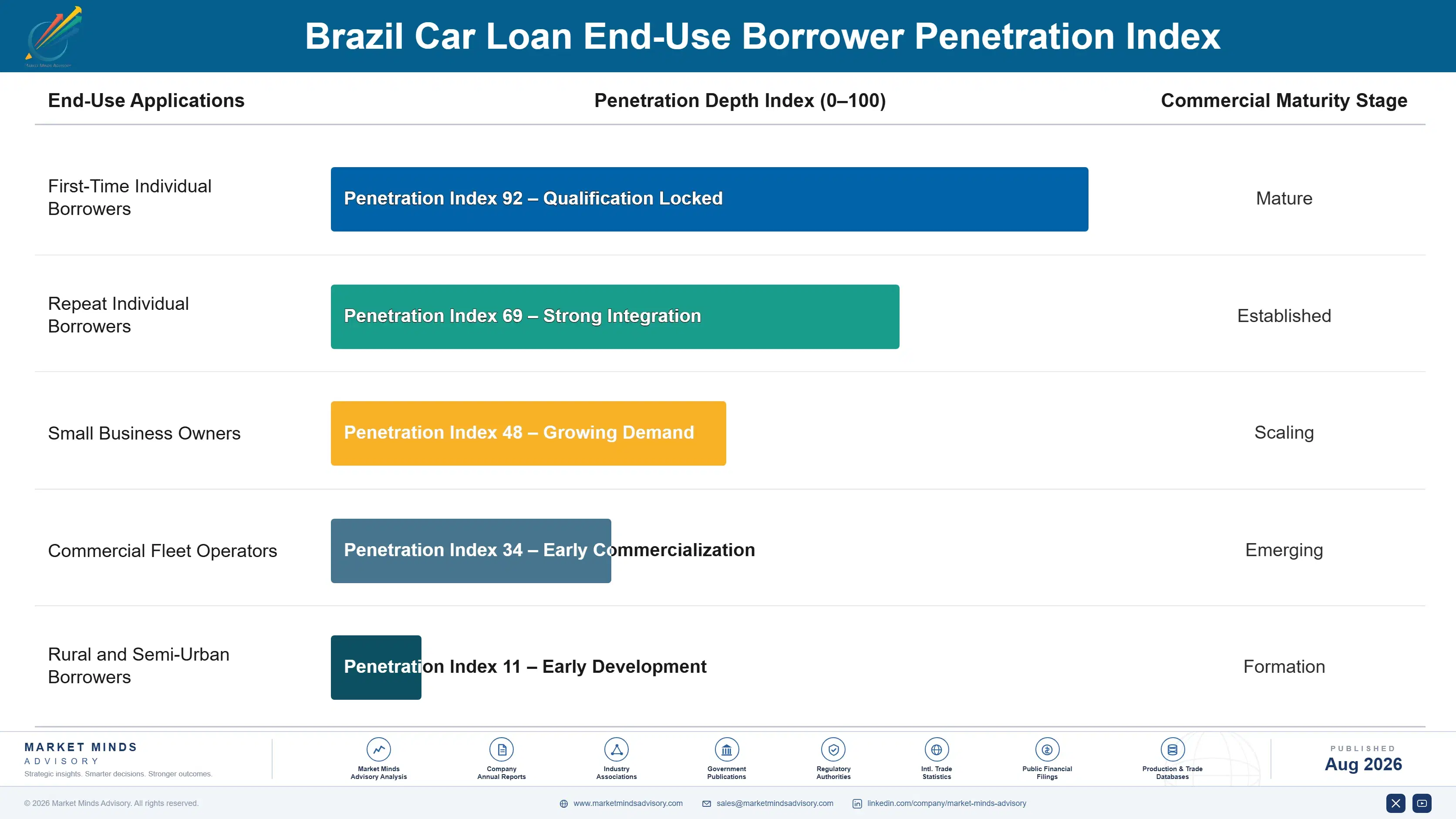
Brazil car loan demand carries meaningful annuity characteristics because loan tenures typically span three to six years, generating recurring monthly repayment revenue over an extended relationship period. Once a borrower establishes a payment history and credit relationship with a specific lender, subsequent vehicle purchases often default to the same lender absent a compelling reason to switch, giving incumbent lenders durable, recurring origination opportunities.
Adoption depth varies considerably by borrower vertical. First-time and younger borrowers show relatively high price sensitivity and willingness to switch lenders for modest rate savings, while repeat borrowers and commercial vehicle operators show much deeper loyalty given established credit relationships and simplified reapplication processes. Electric vehicle borrowers, in particular, increasingly research lender-specific valuation and residual value terms extensively before committing to financing given the personal significance of these purchase decisions.

A generational shift in buyer profile is underway as younger Brazilian borrowers increasingly expect instant digital approval and transparent fee structures that older, relationship-based borrowers rarely demanded. These buyers are more receptive to digital-first lending platforms and alternative credit scoring than the purchasing generation they are replacing, gradually easing the path for lenders pursuing higher-margin digital-first revenue models.
brazil-car-loan-market-end-use-penetration-index-1787915728849

Where Brazilian Lenders Should Focus Next

These are among the four positions where our research anticipates prominent divergence between winners and laggards over the coming forecast period. Each is grounded in the demand model, the regulatory perimeter, and the announced capacity pipeline.
01 / ALTERNATIVE DATA UNDERWRITING

Deploy alternative scoring before fintech entrants capture younger borrowers

Lenders still relying entirely on traditional credit bureau documentation are chasing a shrinking share of the fastest-growing segment of this market, while alternative data underwriting models are approving younger and first-time borrowers considerably faster than conventional processes. Capital allocated toward alternative scoring model development today will likely generate stronger returns than equivalent investment in traditional branch expansion. Lenders who build this capability now will be considerably better positioned than competitors who wait until fintech entrants have already captured younger borrower loyalty nationwide.
02 / ELECTRIC VEHICLE PARTNERSHIP DEVELOPMENT

Build manufacturer partnerships ahead of accelerating EV adoption

Electric vehicle adoption is expanding considerably faster than most lenders anticipated only a few years ago, and manufacturer financing partnerships take considerably longer to establish than conventional loan underwriting capability. Lenders who build these partnerships now will be positioned to capture premium electric vehicle financing volume as adoption accelerates further, while competitors who delay partnership development risk losing these borrowers to lenders who already guarantee point-of-sale financing access. This window will not stay open indefinitely as more lenders pursue similar network partnerships.
03 / FUNDING COST RESILIENCE

Diversify funding sources before the next rate increase cycle

Lenders dependent entirely on wholesale market borrowing remain exposed to the same funding cost volatility that compressed margins during 2022 and 2023, and this exposure will only matter more as loan portfolio growth continues expanding through 2036. Diversifying funding sources across bank borrowing, bond issuance, and securitization reduces this risk meaningfully, even though it requires sustained treasury management sophistication across multiple funding channels simultaneously. Lenders who diversify now will be considerably better positioned than competitors who wait until the next disruption forces the decision.
04 / USED CAR PLATFORM INTEGRATION

Partner with organized platforms before formalization fully matures

Brazil's used car market is formalizing considerably faster than most lenders anticipated only a few years ago, and lenders who partner with organized dealer platforms now will capture disproportionate share of this rapidly expanding financing segment before competitors establish comparable partnerships. This differentiation strategy will only grow more important as used car market formalization continues accelerating across major urban and semi-urban markets nationwide. This response should be treated as a standing strategic priority rather than a reactive one-time initiative addressed once.

Engagement Snapshot From the Field

A live engagement with an industry participant carrying material or product regulatory and market exposure ahead of a defining policy shift, showing how our research translates into a defensible multi-year portfolio strategy.
MARKET MINDS ADVISORY · CLIENT ENGAGEMENT SUMMARY
Brazil Car Loan Producer Strategic Portfolio Review and Transition Roadmap 2026·Investment Scenario on Brazil Car Loan Exposure Evaluation 2025-26
CLIENT PROFILE
A regional organized used car dealer network operating showrooms across Sao Paulo and Minas Gerais approached MMA seeking guidance on selecting a financing partner to offer embedded point-of-sale car loans to its customers. The dealer network had historically referred customers to financing informally and had limited experience structuring a formal embedded financing partnership with a bank or financeira.
STRATEGIC CHALLENGE
Dealer leadership needed to determine which lender partner offered the fastest approval turnaround and most competitive interest rates for its predominantly used car customer base, without disrupting existing sales processes built around informal financing referrals. Leadership was also concerned about whether embedded financing would meaningfully increase conversion rates or simply replace financing customers would have arranged independently.
MMA APPROACH
MMA benchmarked candidate lender partners' approval turnaround times and conversion lift data against comparable used car dealer network launches, drawing on proprietary survey data examining how comparable dealer networks structured embedded financing partnerships. The engagement team modeled projected conversion lift and partnership economics before presenting recommendations to dealer leadership. Findings were validated against comparable dealer network transitions tracked across other Brazilian states.
KEY FINDINGS
  1. Comparable dealer network embedded financing launches showed meaningful conversion rate improvement within the first year. This lead time advantage proved decisive given how quickly rival dealers were moving.
  2. One candidate lender offered meaningfully faster approval turnaround suited to the dealer network's high-volume sales environment. This turnaround difference mattered considerably given the network's high-volume sales environment.
  3. Integrating financing directly into the sales floor process improved customer conversion considerably versus separate financing arrangement. This integration approach reduced friction for customers already engaged in the sales process.
  4. Partnership economics depended heavily on achieving a minimum monthly loan volume threshold across the dealer network. Falling short of this threshold would have meaningfully weakened the partnership's overall economics.
CLIENT PROFILE
A regional organized used car dealer network operating showrooms across Sao Paulo and Minas Gerais approached MMA seeking guidance on selecting a financing partner to offer embedded point-of-sale car loans to its customers. The dealer network had historically referred customers to financing informally and had limited experience structuring a formal embedded financing partnership with a bank or financeira.
STRATEGIC CHALLENGE
Dealer leadership needed to determine which lender partner offered the fastest approval turnaround and most competitive interest rates for its predominantly used car customer base, without disrupting existing sales processes built around informal financing referrals. Leadership was also concerned about whether embedded financing would meaningfully increase conversion rates or simply replace financing customers would have arranged independently.
MMA APPROACH
MMA benchmarked candidate lender partners' approval turnaround times and conversion lift data against comparable used car dealer network launches, drawing on proprietary survey data examining how comparable dealer networks structured embedded financing partnerships. The engagement team modeled projected conversion lift and partnership economics before presenting recommendations to dealer leadership. Findings were validated against comparable dealer network transitions tracked across other Brazilian states.
KEY FINDINGS
  1. Comparable dealer network embedded financing launches showed meaningful conversion rate improvement within the first year. This lead time advantage proved decisive given how quickly rival dealers were moving.
  2. One candidate lender offered meaningfully faster approval turnaround suited to the dealer network's high-volume sales environment. This turnaround difference mattered considerably given the network's high-volume sales environment.
  3. Integrating financing directly into the sales floor process improved customer conversion considerably versus separate financing arrangement. This integration approach reduced friction for customers already engaged in the sales process.
  4. Partnership economics depended heavily on achieving a minimum monthly loan volume threshold across the dealer network. Falling short of this threshold would have meaningfully weakened the partnership's overall economics.
RECOMMENDED STRATEGY
Phase 1: Phase one launched embedded financing at the dealer network's highest-volume showroom location first. to validate service quality before broader showroom network rollout. Phase 2: Phase two expanded the partnership across remaining showroom locations once initial conversion data proved favorable. once initial conversion results confirmed favorable customer response. Phase 3: Phase three renegotiated commission terms with the lender reflecting the network's now-larger loan volume. reflecting the network's now-larger loan volume commitment overall.
OUTCOME
The dealer network completed its full embedded financing rollout within six months and reported (client-reported, unverified by MMA) an estimated 24 percent increase in vehicle sales conversion among financed customers within the first year. Leadership credited the phased rollout approach with building sales staff confidence before full-scale implementation.

Frequently Asked Questions

Foundational context covering the market sizes, CAGR, scope, country, region and competition that inform every finding below. This section is provided to cover basics and most often pre-purchase conversations, answered from the MMA Primary Research Dataset.

What is the current size of the Brazil Car Loan Market?

The Brazil car loan market reached an estimated 15.5 billion US dollars in loan origination volume in 2025. Growth is driven by digital-first lending adoption and rising electric vehicle financing demand.

How large will the Brazil Car Loan Market be by 2036?

MMA projects the market will reach approximately 39.2 billion US dollars by 2036. This reflects sustained digital lending platform growth and continued electric vehicle financing expansion.

What is the CAGR for the Brazil Car Loan Market 2026 to 2036?

The market is forecast to grow at a compound annual growth rate of 8.8 percent between 2026 and 2036. Bull and bear scenarios range from 10.1 percent to 7.5 percent depending on interest rate conditions.

Which segment is growing fastest?

Digital-first fintech auto loans are growing fastest, at an estimated 16.5 percent CAGR through 2036. Instant approval and simplified documentation are driving this shift among younger borrowers.

Who are the major companies in the Brazil Car Loan Market?

Leading participants include Banco Bradesco S.A., Itau Unibanco Holding S.A., Banco Santander Brasil S.A., Banco do Brasil S.A., and Banco Votorantim S.A. These five companies collectively hold an estimated 58 percent combined market share.

Which country is growing fastest?

As this report is scoped entirely to Brazil, the country itself is tracked at an estimated 9.2 percent CAGR through 2036, reflecting digital lending growth and rising electric vehicle adoption.

Report Segmentation Architecture

The full report scope spans multiple orthogonal segmentation dimensions, with cross-tabulated demand data provided for each dimension pair. Coverage extends further to regional breakdowns, trend trajectories, and the competitive detail needed to support segment-level decision-making.

By Vehicle and Channel Type

  • New Car Loans
  • Used Car Loans
  • Electric and Hybrid Vehicle Loans
  • Dealer-Financed Loans
  • Digital-First Fintech Auto Loans
  • Commercial Vehicle and Fleet Loans

By End-Use Borrower

  • First-Time Individual Borrowers
  • Repeat Individual Borrowers
  • Small Business Owners
  • Commercial Fleet Operators
  • Rural and Semi-Urban Borrowers

By Commercial Dimension

  • Dealer Floor Financing
  • Direct Digital Application Channel
  • Manufacturer Point-of-Sale Financing
  • Used Car Platform Partnership Channel

By Region

  • North America
  • Western Europe
  • East Asia
  • South Asia and Pacific
  • Latin America
  • Middle East and Africa
  • Eastern Europe

Scope, Methodology, and Coverage

Every figure in this report is reproducible from documented input assumptions. The scope below maps the historical period, the forecast horizon, the segmentation dimensions, and the countries covered, alongside the underlying primary and qualitative methodology.
Historical Period
2020 to 2025
Forecast Period
2026 to 2036
Base Year
2025 (USD billions; MMA Primary Research Dataset, August 2026)
Market Definition
This report covers loans originated for the purchase of new and used passenger and commercial vehicles in Brazil, including new car, used car, electric and hybrid vehicle, dealer-financed, digital-first fintech, and commercial vehicle and fleet loan products. It excludes vehicle leasing products and personal loans not specifically structured as vehicle purchase financing.
Quantitative Units
USD billions (loan origination volume, current prices); loan count (where cited)
Segmentation Dimensions
Vehicle and Channel Type; End-Use Borrower; Commercial Dimension; By Region
Regions Covered
North America, Western Europe, East Asia, South Asia and Pacific, Latin America, Middle East and Africa, Eastern Europe
Countries Covered
USA, China, Germany, France, UK, Japan, South Korea, India, Australia, Canada, Brazil, Mexico, Indonesia, Vietnam, Thailand, Malaysia, UAE, Saudi Arabia, South Africa, Nigeria, Turkey, Poland, Netherlands, Italy, Spain, Sweden, Switzerland, Argentina, Colombia, Singapore, and additional markets relevant to this sector
Key Companies Profiled
Banco Bradesco S.A., Itau Unibanco Holding S.A., Banco Santander Brasil S.A., Banco do Brasil S.A., Banco Votorantim S.A., Caixa Economica Federal, Banco Safra S.A., Omni S.A. Credito Financiamento e Investimento, Banco Pan S.A., Banco Original S.A., Creditas Solucoes Financeiras Ltda, Banco C6 S.A., Banco Inter S.A., Volkswagen Servicos Financeiros, Toyota Leasing do Brasil, GM Financial do Brasil, Ford Credit Brasil, Stellantis Financial Services Brasil, Renault Servicos Financeiros, Hyundai Capital Brasil
Quantitative Methodology
Primary survey, n=3,800 respondents, Q4 2025, six countries; demand-side model with trade association cross-validation
Qualitative Methodology
47 expert interviews, Q4 2025; applied to validate demand model assumptions, identify emerging dynamics, and assess competitive positioning
Report Format
PDF and XLSX data workbook (Word format preview document)
Publisher
Market Minds Advisory
Report Code
MMA-2026-AUT-101
Published
August 2026
Contact
sales@marketmindsadvisory.com | www.marketmindsadvisory.com

Purchase the full Brazil Car Loan Market Report (2026 to 2036).

This report delivers a complete strategic assessment of the Brazil car loan market, covering sizing, segmentation, regional dynamics, and competitive positioning through 2036. It draws on MMA's proprietary primary survey of 3,800 respondents and 47 expert interviews conducted in the fourth quarter of 2025 across six countries. Analysts translate these findings into actionable guidance on alternative data underwriting, electric vehicle partnership development, and funding cost resilience for participants across the value chain. The report is designed for executives evaluating capital allocation decisions across the Brazil car loan category.
Detailed six-segment MECE vehicle and channel-based segmentation
Full seven-region demand architecture with growth drivers
Competitive benchmarking across twenty tracked regional lenders
Credit loss and funding cost exposure and mitigation analysis
Portfolio tiering and margin economics by loan tier
Anonymized client case study with strategic recommendations

Built For The People Who Decide

From boardroom strategy to bench-side execution, this report is read cover-to-cover by leaders shaping the next decade of their industry, turning demand scenarios, market dynamics and valuation benchmarks into decisions.
CXOs/ Presidents/ VPs/ Managers
M&A and Corporate Development
Strategy Teams and R&D Heads
Procurement and Product Directors
Regulatory and Compliance Leaders
Investor Relations and Equity Analysts