Market Minds Advisory
Brake Cables Market

Brake Cables Market: Two-Wheeler Volume Growth, Coating Technology, and Regional Supplier Strategy Through 2036

Hydraulic actuation keeps displacing mechanical cables in premium automotive and bicycle applications, yet the two-wheeler fleet expanding across South and Southeast Asia sustains brake cable demand at a scale mature-market decline cannot offset.

Lead Analyst

David Horsley

Published

September 2026

Make Smarter Decisions with Customized Research Insights

Request a free sample report and evaluate market opportunities, growth trends, and competitive dynamics relevant to your business needs.

2025 MARKET VALUE$2.4BMarket Size 2025
2036 FORECAST VALUE$3.8BBase Case , 2026 to 2036
CAGR 2026 TO 20364.2 %Bull 5.4% / Bear 3.0%
INCREMENTAL OPPORTUNITY$1.3BNet 10- year value creation
EXPANSION MULTIPLE1.51x2036 value over 2026 base
Strategic Levers
M&A Pipeline
Regional Outlook
Country Rankings
Competitive Intelligence
Segmental Deep-dive
Call-Us : 91 93563 13602

Executive Snapshot and Market Trajectory

Brake cables are disappearing from premium automotive and high-end bicycle applications as hydraulic actuation takes over, yet the category as a whole keeps growing because two-wheelers, the single largest cable-brake application by volume, keep multiplying steadily across South and Southeast Asia.
Motorcycle and two-wheeler brake cables are absorbing the fastest growth as rising two-wheeler ownership across India, Indonesia, and Vietnam sustains cable demand at a volume no mature-market decline can offset. East Asia anchors both the largest component manufacturing base and the deepest two-wheeler supply chain, with Chinese manufacturers supplying cable assemblies to export markets across South Asia and Southeast Asia years ahead of Western suppliers building comparable regional manufacturing scale.
Consolidation remains slow given the category's low technical barrier for standard cable assemblies, even as the largest suppliers extend PTFE-lined and coated cable technology to differentiate on friction and durability performance. Automotive parking brake cable demand continues declining in mature markets as electronic parking brakes displace mechanical actuation, a structural headwind the two-wheeler and bicycle segments more than offset in aggregate. Suppliers who mistake the surface picture misjudge where the real growth actually sits.
Market Definition
The brake cables market covers mechanical brake cable assemblies used in bicycles, motorcycles and two-wheelers, automotive parking brakes, off-highway and agricultural equipment, and marine and recreational vehicles. It excludes hydraulic brake lines, electronic parking brake actuators, and clutch cables sold as a separate mechanical actuation category outside braking function specifically.
Base Year Value
$2.4B in 2025 (MMA Primary Research Dataset, August 2026)
Forecast Period
2026 to 2036, eleven discrete annual values
CAGR
4.2% base case. Bull 5.4%. Bear 3.0%.
Fastest Growth Segment
Motorcycle and Two-Wheeler Brake Cables: 6.5% CAGR
Fastest Growth Country
India: 6.8% CAGR
Fastest Growth Region
South Asia and Pacific: 6.2% CAGR
Largest Region
East Asia: 29% of 2025 global value
Market Leaders
Kongsberg Automotive, Dura Automotive Systems, Continental AG, Gates Corporation, and Shimano lead by disclosed brake cable shipment volume. Source: MMA Analysis based on company annual reports.
Primary Survey
n=3,800 procurement and R&D decision-makers, Q4 2025, six countries
Methodology
Demand-side build-up, cross-validated against public data, 47 expert interviews

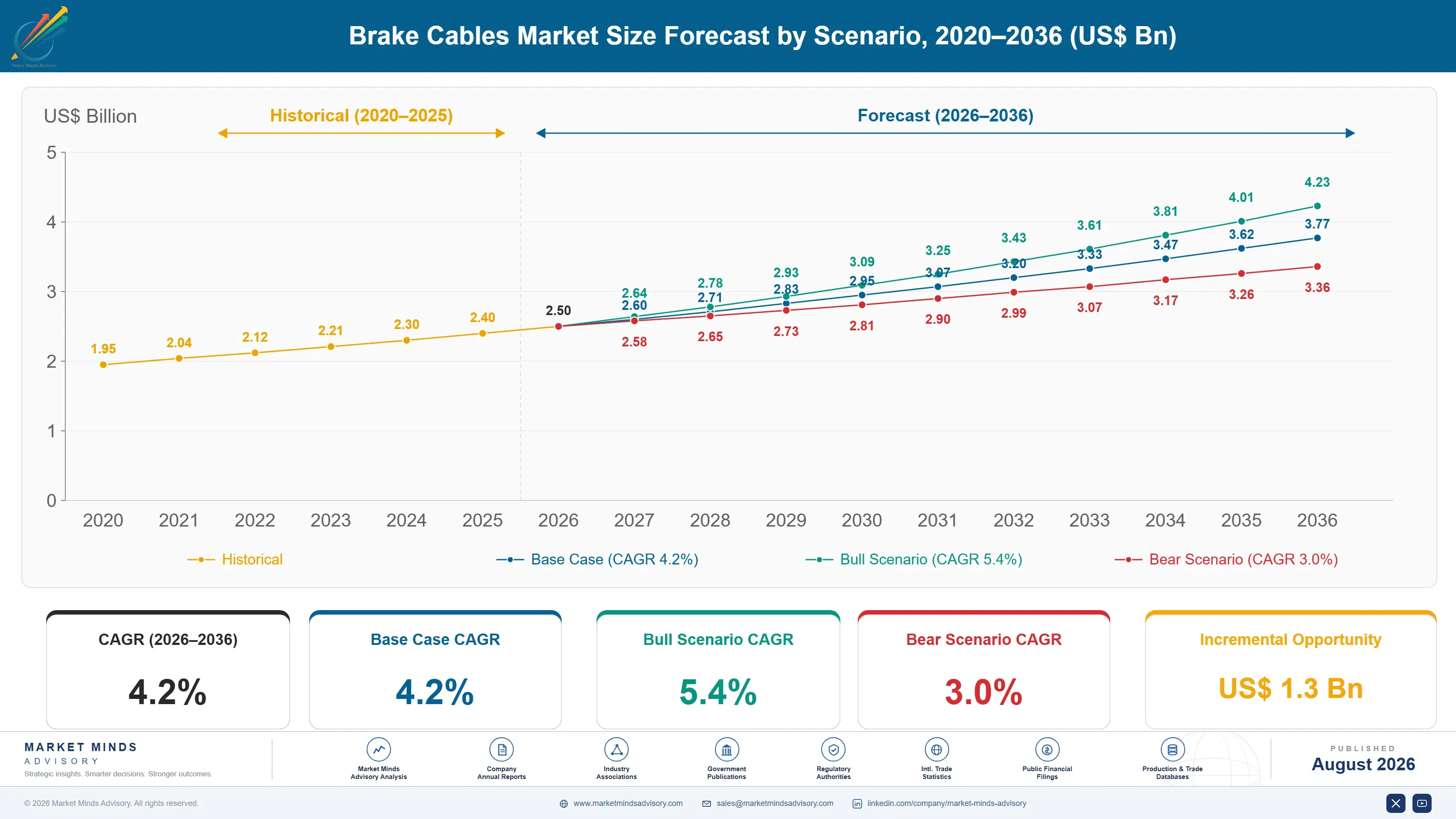
Brake Cables Market Forecast Scenarios

brake-cables-market-trends-size-forecast-scenario-1787315954626
Between 2020 and 2025 brake cable demand grew modestly as two-wheeler volume growth across emerging markets offset continued automotive parking brake cable decline in mature markets transitioning toward electronic parking brake actuation during that period. Suppliers that anticipated the shift toward electronic actuation early are now capturing a disproportionate share of two-wheeler design wins. That gap defined the category's trajectory.
The base case assumes continued two-wheeler ownership growth across India, Indonesia, and Vietnam sustaining cable demand at scale, a steady decline in automotive parking brake cable volume as electronic actuation spreads across more mature-market vehicle platforms, and stable bicycle brake cable demand even as premium hydraulic disc brakes capture the top of that market. Together they keep the market growing modestly despite decline in its legacy automotive application. This mix shift underpins the category's overall forecast trajectory through 2036.
The bull case rests on two-wheeler ownership in South Asia and Southeast Asia growing faster than currently projected, extending the addressable cable base further than modeled. The bear case is electronic parking brake adoption spreading into mainstream mid-market vehicles faster than expected, compressing automotive cable volume ahead of schedule, even as two-wheeler demand provides a partial offset for several more years.

A Legacy Mechanism Still Growing on Two-Wheeler Volume

A brake cable does one job that has not changed in a century, transmitting lever force to a braking mechanism through a sheathed steel wire, yet the category's fortunes now split sharply by application as hydraulic actuation takes over the premium end of both automotive and bicycle markets. Two-wheelers remain the category's largest and most reliably growing application, a volume base mature-market decline elsewhere cannot offset. Few categories split this cleanly between decline and durable gro
MARKET CONCENTRATIONCR5 24%top five suppliers hold a modest combined shipment share
AVERAGE SELLING PRICE$3.20 per cable assemblyblended average price across bicycle and motorcycle designs
LEADING PRODUCTION COUNTRYChina, 26% shareoutput concentrated near two-wheeler and bicycle assembly hubs
CAPACITY UTILISATION64%cable extrusion and assembly lines running below full ceiling
MATERIAL COST SHARE38% of COGSsteel wire and PTFE liner material dominate finished cost
TRADE INTENSITY49% cross-bordercable fabrication is rarely co-located with vehicle assembly
The market's commercial character splits between high-volume standard cable assemblies competing largely on cost and a smaller, higher-margin segment of PTFE-lined and coated performance cables specified for reduced friction and extended service life. Suppliers serving the two tiers compete on different terms, since standard buyers negotiate purely on unit price while performance buyers value documented friction reduction and durability testing data.
The next decade will be shaped by continued two-wheeler volume growth across South and Southeast Asia sustaining the category's largest application, by electronic parking brake adoption steadily eroding automotive cable demand in mature markets, and by coated cable technology spreading from premium bicycle and motorcycle applications into broader mainstream product lines as material costs fall.
"Everyone assumes brake cables are a dying category because hydraulics keep winning at the top end. They forget two-wheelers alone sell more units a year than the entire premium car and bike market combined."
Director, Mechanical Actuation Components Practice · MMA Mechanical Actuation Co

Market Trends

PTFE-Lined Coated Cables Spreading From Premium to Mainstream

PTFE-lined brake cables, which reduce internal friction and extend service life relative to uncoated steel cables, have moved from premium bicycle and motorcycle applications into mainstream mid-tier product lines since 2023 as coating material costs have fallen closer to standard cable parity. At least seven major two-wheeler manufacturers have specified PTFE-lined cables as standard equipment on new models launched since 2024, up from a handful of premium-only references five years earlier. Suppliers report coated cables now carry a meaningful unit price premium over standard designs, reflecting both material cost and the documented friction reduction manufacturers increasingly specify by name.
Market Impact: Sustains demand across 40 million u
Two-Wheeler Manufacturers Consolidating Cable Sourcing Now

Larger two-wheeler manufacturers are increasingly consolidating cable sourcing among fewer, more capable suppliers who can deliver validated brake and clutch cable assemblies as a bundled package rather than sourcing each cable type from separate specialized vendors. This consolidation has affected sourcing decisions at several major two-wheeler manufacturers since 2024, who now prefer suppliers capable of delivering complete cable kits across multiple vehicle systems simultaneously. The shift favors larger manufacturers with broad cable manufacturing capability, and suppliers offering bundled kits are winning share worth roughly 25 percent more per contract than standalone supply.
Market Impact: Sustains 60 pct of unit volume

Market Opportunities and Growth Drivers

Two-Wheeler Ownership Growth Across South and Southeast Asia

Two-wheeler ownership continues expanding rapidly across India, Indonesia, and Vietnam as rising incomes support first-time vehicle purchases, directly expanding the addressable base for motorcycle and scooter brake cables at a pace no other application in this category can match. India alone produced tens of millions of new two-wheelers in 2025, each requiring at least two brake cables, a volume base that dwarfs the cable content of the entire automotive parking brake segment combined. This driver alone sustains meaningful unit volume growth even as mature-market automotive cable demand plateaus or gradually declines further.
Market Impact: Erodes volume 5 pct yearly

Bicycle and E-Bike Growth Sustaining Cable Demand Broadly

Bicycle and e-bike ownership continues growing across both emerging and mature markets, sustaining mechanical brake cable demand even as premium bicycles increasingly specify hydraulic disc brakes instead of cable-actuated systems at the top of the price range. Entry and mid-tier bicycles, which represent the large majority of global unit sales, continue specifying cable-actuated brakes almost universally given their lower cost and simpler field maintenance relative to hydraulic alternatives. This driver sustains baseline bicycle cable volume even as the premium segment shifts toward hydraulic actuation, with entry-tier bicycles alone accounting for roughly 60 percent of total category unit volume.
Market Impact: Confines cables below 10 pct share

Market Restraints and Challenges

Electronic Parking Brake Adoption Erodes Automotive Volume

Electronic parking brake systems, which use a small electric motor rather than a mechanical cable to actuate the parking brake, have become standard equipment across a growing share of mature-market vehicles, a root cause tied directly to the convenience and packaging advantages electronic actuation offers over cable-based mechanisms automakers increasingly view as outdated. The commercial impact is steepest in Western Europe and North America, where electronic parking brake penetration keeps climbing, compressing the addressable automotive cable base year over year. Suppliers are shifting capacity toward two-wheeler and bicycle production, transferring expertise to categories with more durable growth prospects.
Market Impact: Adds coated cables on 7 platforms

Hydraulic Disc Brakes Displace Cables in Premium Bicycles

Hydraulic disc brakes, valued by performance cyclists for stronger and more consistent stopping power than cable-actuated rim or mechanical disc brakes, have become standard equipment across nearly the entire premium bicycle segment, a root cause tied to genuine performance advantages that cable systems cannot fully match regardless of coating technology improvements. The commercial impact confines cable-actuated brakes to entry and mid-tier bicycles, a large volume base but one that commands considerably lower unit pricing than the premium segment cable systems have largely lost. Suppliers are pursuing coated technology to narrow the performance gap and retain some presence in higher-tier lines.
Market Impact: Shifts 25 pct toward bundled kits
3 additional market trends, 3 additional growth drivers, and 4 additional restraints and challenges are covered in the full report. Contact sales@marketmindsadvisory.com to access the complete intelligence.

Segment CAGR and Growth Architecture

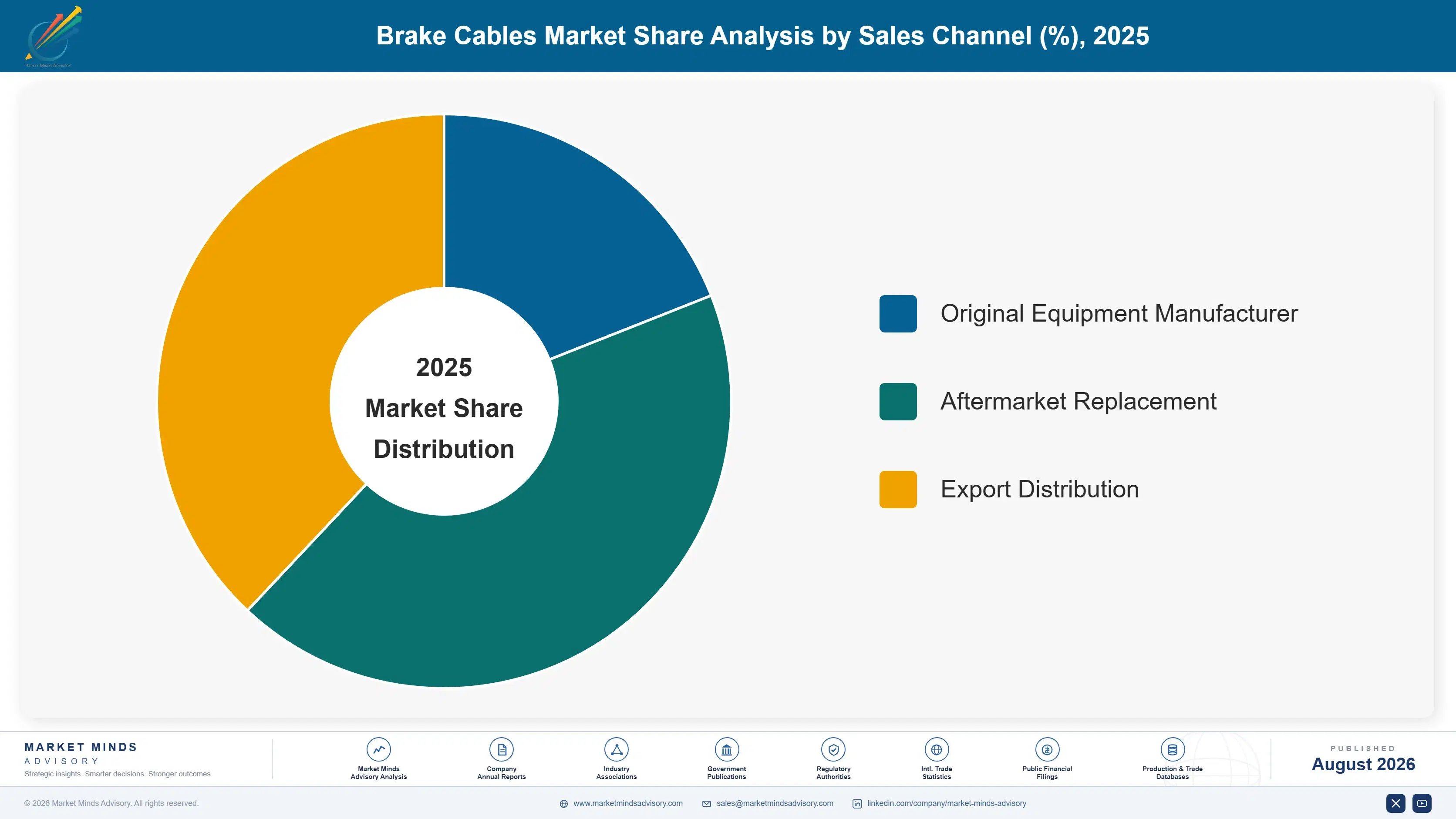
Segmentation follows end-use application rather than cable construction type, since manufacturers and buyers alike procure brake cables by vehicle system first and specify construction and coating as a downstream engineering decision within that application category. That distinction shapes procurement more than construction type or material ever does. Buyers weigh cost, durability, and coating technology very differently across each application.
brake-cables-market-trends-market-share-analysis-1787315955162

Motorcycle and Two-Wheeler Brake Cables

Motorcycle and two-wheeler brake cables are growing fastest as rising ownership across India, Indonesia, and Vietnam sustains cable demand at a volume no other application category in this market can match, a growth pattern that shows no near-term sign of slowing given continued income growth. The segment benefits from two-wheelers' inherent reliance on cable-actuated brakes even on many mid-tier and premium models, unlike bicycles and automobiles where hydraulics dominate the premium tier. Adoption of PTFE-lined coated cables is spreading fastest here as manufacturers seek durability improvements that reduce warranty claims across high-mileage commuter duty cycles. Competitive intensity remains moderate, since manufacturing scale and regional proximity to assembly matter more than coating technology alone in winning volume contracts here.
CAGR 6.5%

Bicycle Brake Cables

Bicycle brake cables are growing faster than the broader market as global bicycle and e-bike ownership continues expanding across both emerging and mature markets, sustained primarily by entry and mid-tier bicycles that represent the large majority of global unit sales and continue specifying cable-actuated brakes almost universally. The segment benefits from cable brakes' lower cost and simpler field maintenance relative to hydraulic alternatives, a genuine advantage for cost-sensitive buyers and markets without dense specialist bicycle service infrastructure available nearby. Growth is broad-based across both mature and emerging bicycle markets rather than concentrated in any single region, since entry-tier bicycle demand for cable-actuated brakes remains structurally similar across most geographies covered in this particular study regardless of overall economic development level.
CAGR 5.8%
Full segment breakdown across 6 segments available in the complete report.

Regional Architecture and Country Demand Map

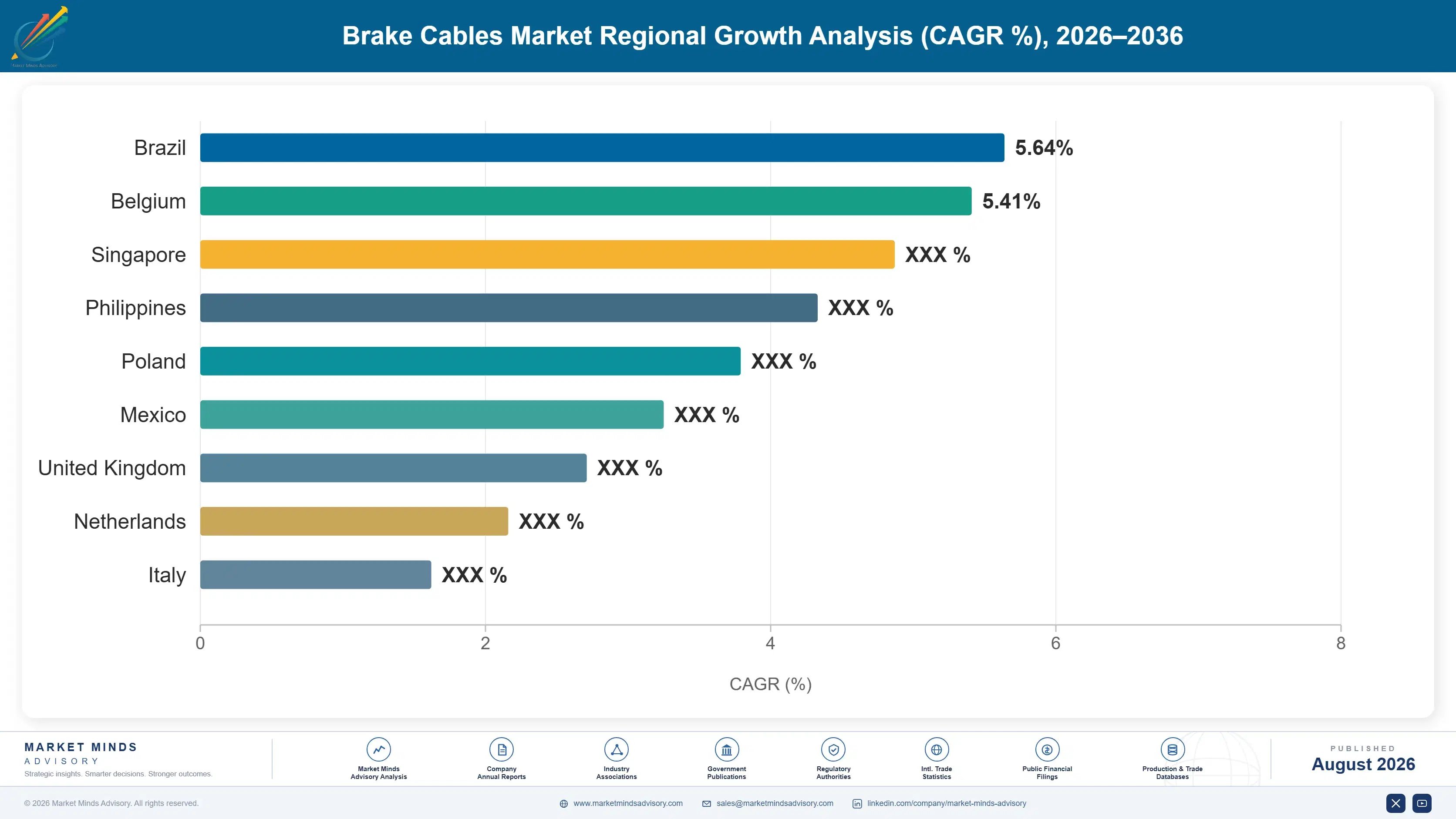
East Asia leads on the combined strength of component manufacturing capacity and proximity to the largest two-wheeler and bicycle assembly hubs, with South Asia and Pacific close behind on sheer two-wheeler ownership growth across the region. reflecting where two-wheeler demand and cable manufacturing capacity now concentrate most heavily.

North America

The United States drives the bulk of regional demand, split between a shrinking automotive parking brake cable base as electronic actuation spreads across mainstream vehicle platforms and a stable bicycle and off-highway equipment cable business tied to recreational and utility vehicle ownership. Domestic automakers have adopted electronic parking brakes faster than most emerging markets, reflecting stricter convenience and packaging priorities at the premium end of the vehicle lineup. Canada contributes a modest, stable share tied to the same platforms sold across the US market. Mexico's role centers on component fabrication for export rather than domestic demand. Regional growth trails East Asia, reflecting the fastest electronic parking brake adoption curve among the seven regions here.
Share: 22% | CAGR: 3.2% (2026 to 2036)

Western Europe

Germany anchors regional demand through its large automotive manufacturing base, even as its own automotive cable demand continues declining fastest among major economies as electronic parking brake adoption accelerates across nearly every mainstream vehicle segment sold regionally. France, Italy, and Spain contribute meaningful volume across bicycle and off-highway equipment applications, partially offsetting the automotive decline that dominates headline regional trends. The region posts the slowest regional growth rate in this study, a direct consequence of Europe's aggressive electronic parking brake adoption curve compressing the addressable automotive cable base faster than any other region covered here, a dynamic distinct from every other market in this particular study. Poland-adjacent manufacturing capacity increasingly supports finished vehicle production across the wider region.
Share: 18% | CAGR: 2.4% (2026 to 2036)
Regional intelligence for 5 additional markets available in the complete report: East Asia, South Asia and Pacific, Latin America, Middle East and Africa, Eastern Europe. Contact sales@marketmindsadvisory.com.
brake-cables-market-trends-country-cagr-analysis-1787315955662

Where Cable Manufacturers Can Expand Margin

Four commercial levers separate suppliers capturing premium value from those competing purely on standard cable price, spanning PTFE coating technology, bundled cable kit sourcing, two-wheeler manufacturer relationships, and geographic positioning relative to South Asian and Southeast Asian assembly clusters. Each pulls margin from a different point in the manufacturing stack. Suppliers ignoring any lever cede ground to more diversified rivals.

Build PTFE Coating and Friction Reduction Capability

Suppliers that invest in PTFE-lined cable manufacturing capture materially higher unit pricing than standard steel cables ever commanded, since the added friction reduction and service life justify premium multi-year supply agreements two-wheeler and bicycle manufacturers are willing to sign. Coated cables carry roughly 2 to 3 times the unit price of comparable standard cables, reflecting both material cost and the documented durability testing manufacturers require before specifying a supplier. Suppliers without this capability are increasingly excluded from the fastest-growing product tier entirely, regardless of how competitive their standard pricing remains against shrinking legacy demand.
Market Impact: Captures roughly 2 to 3 times stand

Offer Bundled Cable Kits Across Vehicle Systems

Suppliers that bundle brake cables with clutch and throttle cables into a single consolidated purchasing relationship capture larger contract sizes than standalone brake cable supply ever provides, since two-wheeler manufacturers increasingly prefer fewer, more capable vendors over piecemeal component sourcing arrangements across separate suppliers. Bundled contracts typically carry 20 to 30 percent higher total deal value than an equivalent brake-cable-only agreement, reflecting the convenience premium manufacturers pay for simplified procurement and unified quality accountability. Suppliers offering complete bundled kits are winning share from smaller competitors supplying cables as a standalone line item only.
Market Impact: Lifts contract value by 20 to 30 pc

Build Direct Two-Wheeler Manufacturer Relationships Now

Suppliers that establish direct original equipment relationships with major two-wheeler manufacturers, rather than selling through distributors, capture higher margin and more durable multi-year volume commitments than distributor-dependent competitors ever secure from the same underlying demand base. These direct relationships typically carry meaningfully better payment terms and forecast visibility than distributor channel sales, reducing working capital strain for suppliers managing high-volume, low-unit-price transactions across thin margins. Suppliers with established direct relationships win platform-level design wins as manufacturers standardize sourcing. Direct suppliers report margin roughly 15 to 20 percent higher than distributor-dependent competitors serving the same underlying accounts.
Market Impact: Captures a margin uplift of 15 to 2

Localize Fabrication Near South and Southeast Asian Hubs

Cables are bulky relative to their value and expensive to ship internationally, so suppliers locating fabrication near growing two-wheeler assembly hubs in India, Indonesia, and Vietnam capture freight and just-in-time delivery advantages that distant competitors cannot match, alongside meaningfully reduced working capital tied up in transit inventory. Localized suppliers typically capture freight savings of 6 to 9 percent over distant competitors, winning preferred supplier status as manufacturers compress lead time requirements to match faster refresh cycles. Suppliers without local presence lose bids to competitors who can guarantee shorter, more reliable delivery windows across the region.
Market Impact: Captures freight savings of 6 to 9

Who Controls the Margin Pool

CR5 sits at 24 percent, among the more fragmented concentration levels in this research program, reflecting a category where hundreds of regional manufacturers remain viable competitors even as the largest suppliers extend their reach through coating technology and bundled sourcing relationships. That gap is most visible in who can credibly bid on new coated cable and bundled kit programs today.
Current competitive activity centers on PTFE coating capacity expansion to serve growing two-wheeler and bicycle demand, bundled cable kit partnerships between suppliers and two-wheeler manufacturers, and gradual consolidation as larger suppliers acquire regional manufacturers seeking exit given persistently thin standard-cable margins. These moves are reshaping vendor shortlists at nearly every major two-wheeler manufacturer across multiple regions.

Emerging pressure comes from Indian and Southeast Asian cable manufacturers whose domestic scale and rapidly improving coating capability are closing the technology gap with established Chinese and Japanese suppliers faster than most incumbents expected just a few years ago. Automotive-focused suppliers entering the two-wheeler category from adjacent product lines are also gaining ground, since manufacturers increasingly value diversified supplier relationships. Neither trend looks likely to reverse over the coming several years given current investment patterns.
brake-cables-market-trends-company-positioning-matrix-1787315956198

Competitive Moat and Risk Dimensions

KONGSBERG AUTOMOTIVE

Moat: Deep automotive OEM integration

Kongsberg's established relationships with major automakers on parking brake cable systems give it design-win visibility and platform integration depth that narrower regional cable specialists cannot replicate, letting it bundle cable systems into broader vehicle interior and actuation contracts. Automakers increasingly value that single-relationship convenience across broader interior actuation sourcing decisions.
KONGSBERG AUTOMOTIVE

Risk: Concentrated automotive exposure risk

Kongsberg's heavy concentration in automotive parking brake cables leaves it more exposed than diversified competitors to the structural decline electronic parking brake adoption is driving across mature-market vehicle platforms specifically. Diversification into two-wheeler cables could help offset this exposure over the coming years. Kongsberg's revenue growth increasingly depends on how quickly it diversifies beyond legacy automotive parking brake systems.
GATES CORPORATION

Moat: Broad mechanical power transmission scale

Gates' position as a leading global mechanical power transmission and cable manufacturer gives it manufacturing scale and material science depth across multiple cable and belt product categories that narrower single-application competitors struggle to match consistently. Automakers and equipment manufacturers value that breadth when consolidating mechanical sourcing relationships.
GATES CORPORATION

Risk: Minor brake cable line

Gates' brake cable business remains a small adjacent product line relative to its core power transmission business, limiting the strategic priority and dedicated capital investment the category receives internally compared to specialist competitors. That relative priority gap could widen further if brake cables never become a strategic focus internally.

Players Tracked

Prominent Players

Kongsberg Automotive
Dura Automotive Systems
Continental AG
Gates Corporation
Shimano Inc

Other Key Players

Jagwire
Elvedes
Venhill Engineering
Barnett Clutches and Cables
Kuster Holding
Fico Triad
Hi-Lex Corporation
Motion Pro Inc
Nissin Kogyo
Yazaki Corporation
Domino Racing
Doga SA
ASW Automotive
CalMotron
Setrab

Recent Developments

APRIL 2025

Shimano Expands PTFE Coating Line in Japan

Shimano commissioned an expanded PTFE coating production line at its Japanese facility, adding capacity dedicated to premium bicycle brake cable manufacturing to serve growing global demand from multiple bicycle brand customers. The expansion represents Shimano's largest dedicated coating capacity addition to date. The line focuses on bicycle brake cable applications.
Signal: Confirms coated cable demand has reached t
SEPTEMBER 2025

Gates and a Major Two-Wheeler Manufacturer Sign Bundled Supply Agreement

Gates signed a multi-year supply agreement with a major Indian two-wheeler manufacturer covering bundled brake and clutch cable assemblies across an upcoming model lineup, structured as a supply contract rather than a joint venture or equity arrangement. The agreement covers multiple vehicle platforms through 2030.
Signal: Confirms two-wheeler manufacturers are con
JANUARY 2026

Kongsberg Acquires a Regional Two-Wheeler Cable Specialist

Kongsberg Automotive acquired a mid-sized Southeast Asian cable manufacturer specializing in motorcycle brake and clutch cables, adding regional manufacturing capacity ahead of expanding two-wheeler demand across the region. The acquisition was Kongsberg's first dedicated move into two-wheeler cable ownership rather than automotive-only focus. Terms of the transaction were not disclosed.
Signal: Shows automotive-focused suppliers diversi

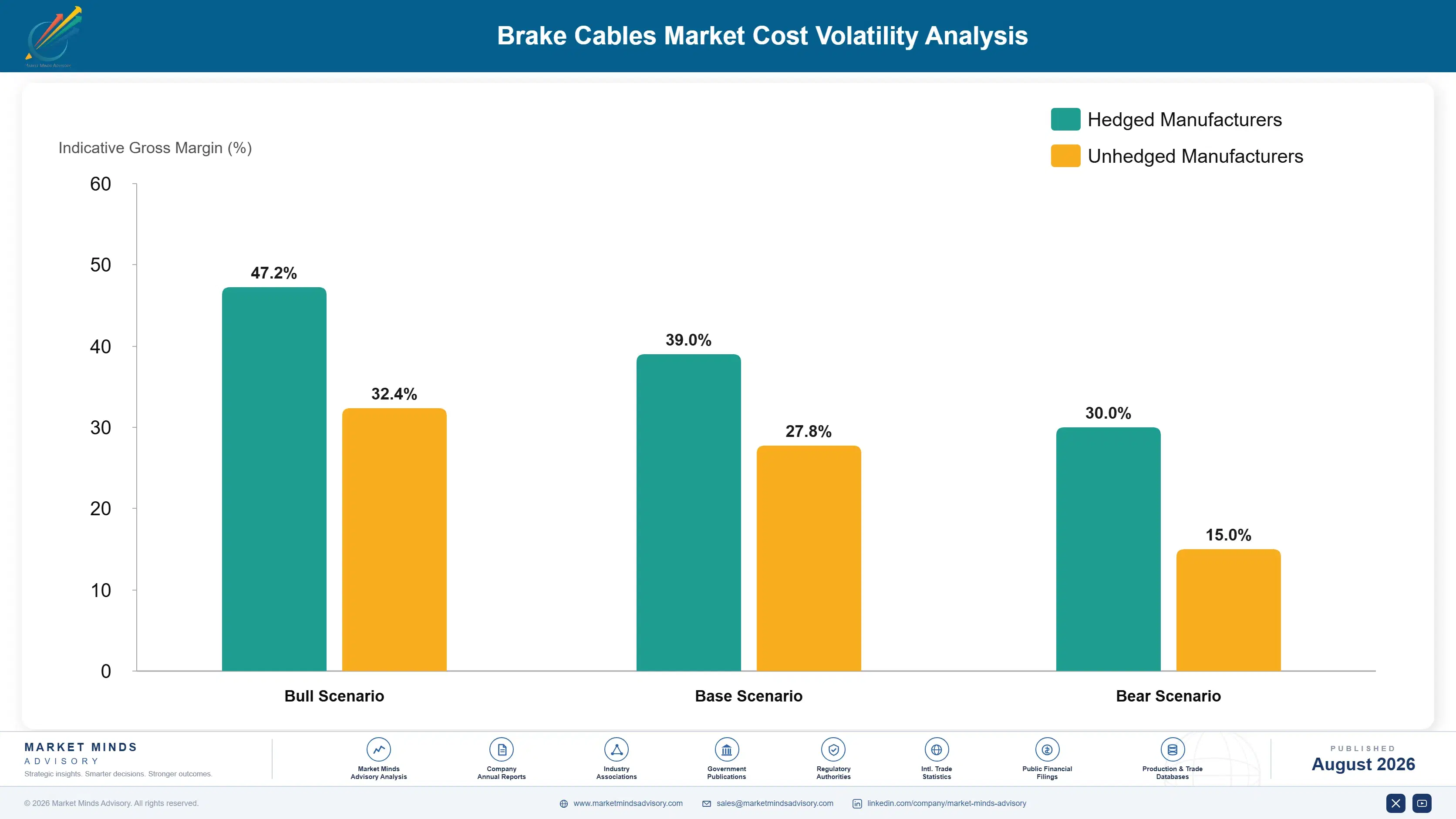
Steel Wire and PTFE Liner Material Exposure

Steel wire and PTFE liner material together account for roughly 38 percent of finished cable cost, with coated designs carrying meaningfully higher exposure to PTFE and fluoropolymer commodity pricing than standard uncoated cables that rely primarily on steel wire input alone. This cost structure differs meaningfully from most other mechanical actuation components carrying lower material exposure.
Steel wire prices, which track broader industrial commodity markets, rose noticeably through 2023 and 2024 according to industry pricing data referenced in multiple supplier annual reports, squeezing margins at cable manufacturers without long-term steel supply agreements in place at the time. Several suppliers reported temporary cost pass-through negotiations with two-wheeler and bicycle manufacturer customers during that period, a disruption still referenced in current supplier risk disclosures. That volatility is expected to persist as industrial demand keeps recovering unevenly.

The competitive disadvantage falls hardest on smaller regional manufacturers without long-term steel and PTFE supply agreements, since spot-market purchasing leaves them exposed to price swings that larger, vertically integrated competitors with direct supplier relationships can partially absorb through scale and hedging. Smaller suppliers without hedging programs carry meaningfully higher earnings volatility from this exposure than larger, better-capitalized competitors.
brake-cables-market-trends-cost-volatility-analysis-1787315956394

Long-Term Steel and PTFE Supply Agreements

Larger manufacturers are locking in multi-year steel wire and PTFE liner supply contracts with fixed or collared pricing to reduce exposure to spot market volatility, trading some cost upside for predictability that smaller competitors without negotiating leverage cannot access on comparable terms and pricing. Several major manufacturers signed new multi-year agreements during 2024 specifically to address this exposure.

Alternative Coating Material Development

Suppliers are developing alternative low-friction coating materials that approach PTFE performance at meaningfully lower material cost, offering entry-level and mid-tier product lines a way to avoid full exposure to fluoropolymer price volatility entirely. Several suppliers are already piloting these alternatives with two-wheeler manufacturer customers ahead of broader commercialization. for both suppliers and their downstream customers.

Regional Steel Sourcing Diversification

Suppliers are qualifying steel wire from multiple regional sources rather than depending on a single supplier or geography, reducing the risk that any one region's price spike or supply disruption stalls production across the manufacturing line. Larger suppliers with greater purchasing scale are better positioned to negotiate favorable multi-year terms. keeping production schedules stable through volatility.

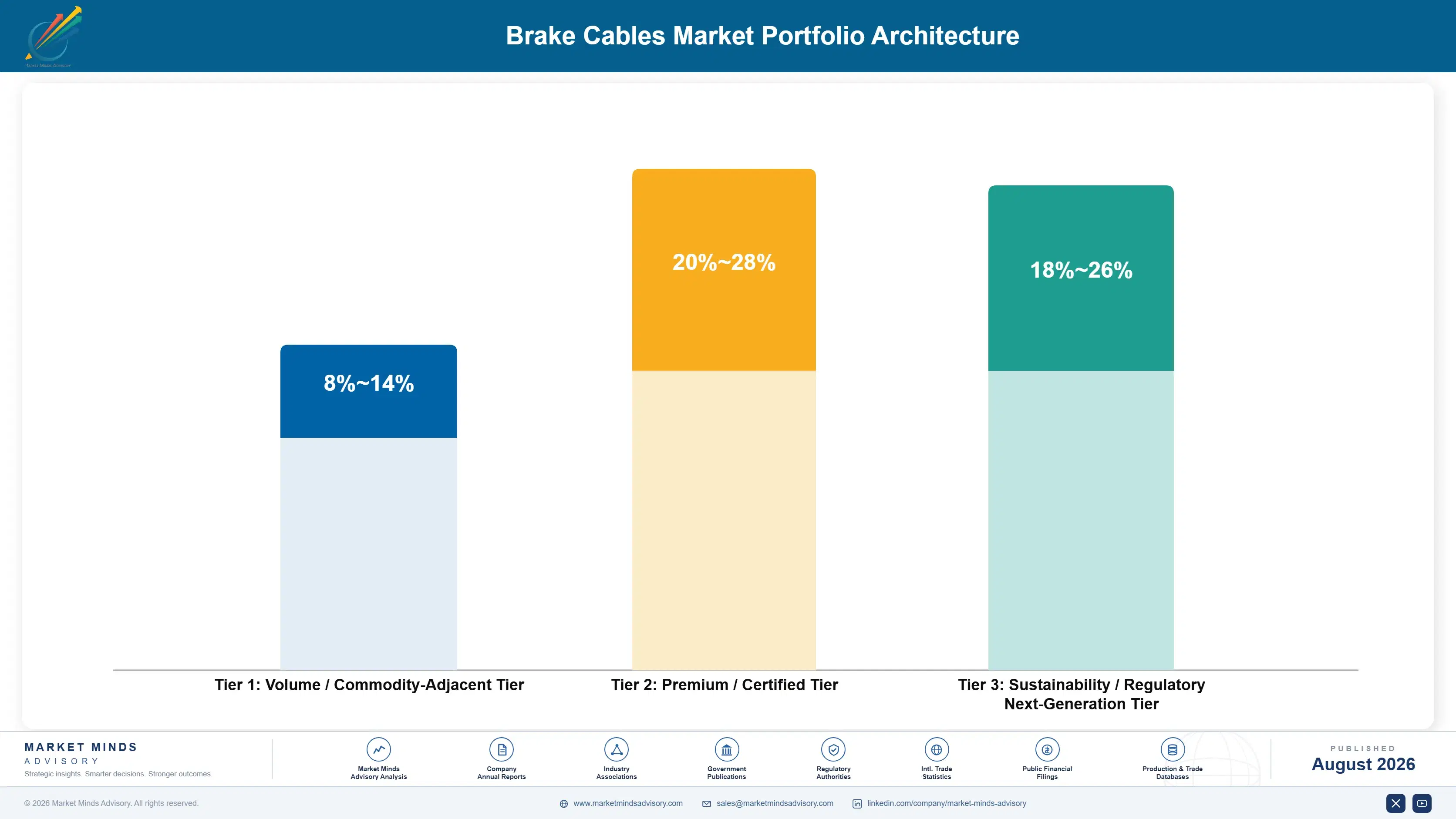
Portfolio Architecture for Margin Defence

The portfolio splits into three tiers running on distinct economics: a volume tier built on standard uncoated cables sold near cost parity across competing manufacturers, a premium tier of PTFE-lined and coated cables carrying meaningfully higher margin, and an emerging next-generation tier built on bundled cable kits that commands a convenience premium beyond pure material differentiation alone. Suppliers rarely compete meaningfully across more than one of these tiers at once.
The tension between volume and premium is not simply about margin, since two-wheeler and bicycle manufacturers buying standard cables are extremely price-sensitive and switch suppliers readily at contract renewal, while premium and bundled-kit buyers are paying for genuine durability and convenience differentiation and tolerate meaningfully less price sensitivity as long as the performance benefit holds up against realistic alternatives. That difference in buyer behavior shapes how each supplier structures its sales approach.

High-value margin pools concentrate in PTFE-lined coated cables and bundled component kits, both of which combine technical or convenience differentiation with two-wheeler volume tailwinds that commodity standard cables simply cannot generate, giving suppliers positioned in either pool meaningfully more pricing power than the broader market average would otherwise suggest.

Volume / Commodity-Adjacent Tier

Standard uncoated steel cables for entry-tier bicycles, two-wheelers, and equipment applications, priced to compete directly against other commodity manufacturers on cost and delivery reliability. Competition here centers almost entirely on cost and delivery reliability.
Gross Margin: 8-14%

Premium / Certified Tier

PTFE-lined coated cables meeting manufacturer durability and friction reduction standards, sold into premium two-wheeler and bicycle trims at a meaningful margin premium over standard designs. Suppliers here compete on documented durability and friction reduction performance.
Gross Margin: 20-28%

Sustainability / Regulatory / Next-Generation Tier

Bundled brake, clutch, and throttle cable kits combining multiple product categories into a single consolidated supply relationship, commanding a convenience premium manufacturers value. This tier draws the strongest interest from consolidation-minded manufacturers.
Gross Margin: 18-26%
brake-cables-market-trends-portfolio-architecture-1787315956896

High-value Sub-segments and Strategic Watch-out

PTFE-Lined Two-Wheeler Brake Cables

Combines the fastest growth rate in the market with premium material pricing, making it the single most valuable pool for suppliers with coating manufacturing capability built up over several years of dedicated investment and testing. Few competitors currently hold both coating capability and automotive-adjacent certification at once.
Gross Margin: 22-28%

Bundled Two-Wheeler Cable Kits

Growing steadily as manufacturers consolidate sourcing among fewer capable vendors, offering suppliers with broad cable manufacturing capability a durable margin premium over standalone brake cable specialists facing structural decline. Suppliers without broad component capability are increasingly locked out of this category. Suppliers investing early capture disproportionate share of new contracts.
Gross Margin: 18-26%

Standard Bicycle and Two-Wheeler Cables

The steady volume core of the market, growing roughly in line with overall two-wheeler and bicycle production and offering predictable but noticeably thinner margin than either the coated or bundled tiers discussed above. It remains the segment most exposed to continued low-cost regional competition. Margin here has compressed gradually.
Gross Margin: 8-14%

Legacy Automotive Parking Brake Cables

A strategic watch-out segment facing steady decline as electronic parking brake adoption expands across mature-market vehicle platforms, leaving suppliers dependent on this application exposed to structural volume erosion. Suppliers still reliant on this application should plan for continued volume decline. Volume has fallen sharply across most mature markets since 2022.
Gross Margin: 6-12%

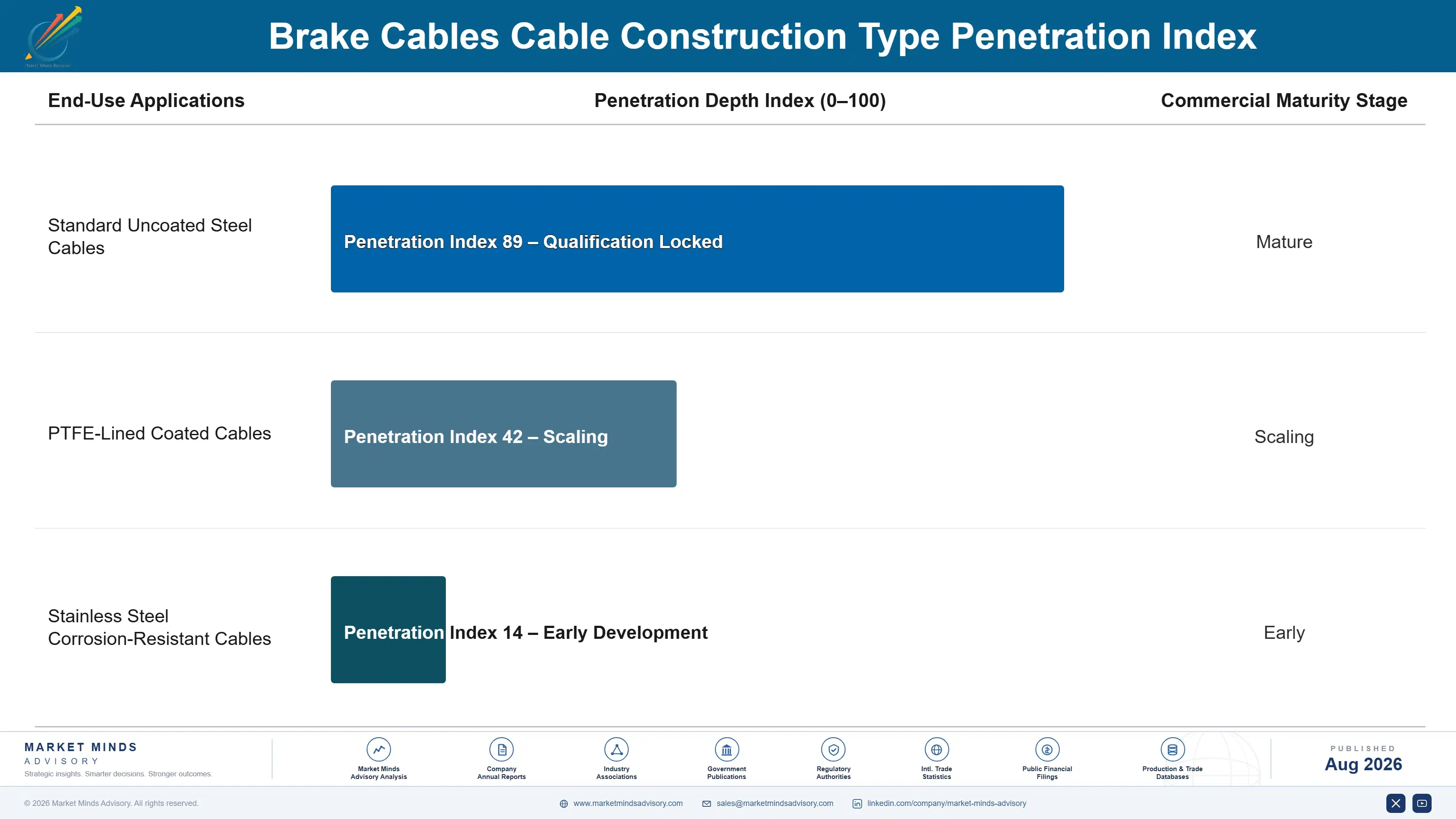
From Design Win to Replacement Cycle

Cable supply contracts behave closer to annuities than one-off transactional sales once a supplier wins a platform design slot, since requalifying an alternative cable supplier mid-program disrupts routing and durability validation work manufacturers are reluctant to repeat within a single vehicle generation. Manufacturers treat a cable design win as effectively locked in once routing validation testing is complete.
Adoption depth varies sharply by end-use vertical: two-wheeler and bicycle manufacturers rely on cables as a primary actuation mechanism across most of their model lineup, while automotive applications have already shifted the majority of premium platforms toward electronic actuation, leaving cables confined to entry trims and legacy models. Off-highway and marine applications lag furthest behind in adoption of coated technology, prioritizing proven durability and low replacement cost over friction performance passenger applications increasingly expect.

A generational shift is underway in buyer expectations as two-wheeler manufacturers increasingly bundle cable sourcing with broader mechanical actuation contracts rather than sourcing each cable type as a standalone commodity item, a change that favors integrated suppliers over narrow specialists who cannot offer that broader capability across the full vehicle system. Suppliers slow to adapt risk losing relevance with exactly the manufacturers driving procurement decisions forward.
brake-cables-market-trends-end-use-penetration-index-1787315957387

Two-Wheeler Volume Decides Long-Term Position

These are among the four positions where our research anticipates prominent divergence between winners and laggards over the coming forecast period. Each is grounded in the demand model, the regulatory perimeter, and the announced capacity pipeline.
01 / COATING INVESTMENT FOCUS

Build PTFE coating manufacturing capability now

Coated cables carry two to three times the pricing of standard steel cables and require coating manufacturing capability only a subset of suppliers currently possess at automotive-adjacent quality standards. Suppliers without this capability are increasingly excluded from premium two-wheeler and bicycle design wins as manufacturers standardize coated specifications across mainstream trims. Suppliers should direct capital toward coating capability rather than expanding standard cable capacity, since that path offers shrinking differentiation against low-cost regional competitors already scaling aggressively across most major markets.
02 / BUNDLING STRATEGY FOCUS

Build bundled cable kit capability now

Two-wheeler manufacturers increasingly prefer consolidated cable sourcing over piecemeal purchasing from separate specialized vendors, and suppliers without bundling capability will be relegated to the thinnest margins in the category regardless of individual product quality delivered. Larger suppliers already offering bundled kits are capturing disproportionate contract share relative to standalone brake cable specialists lacking that broader capability. Building or partnering toward bundled sourcing capability now positions suppliers to capture larger contracts than standalone brake cable supply alone could ever provide across a full vehicle system.
03 / GEOGRAPHIC POSITIONING STRATEGY

Expand fabrication capacity in South Asia now

South Asia and Pacific combines the fastest regional growth with a two-wheeler ownership base that shows no near-term sign of slowing, giving suppliers with capacity there durable volume other regions increasingly cannot match. This is a materially different calculus than a decade ago when mature-market automotive volume alone justified most capacity investment decisions industry-wide across the category. Suppliers still concentrated in legacy mature-market locations should evaluate South Asian capacity additions as a near-term priority rather than a longer-term option to revisit.
04 / AUTOMOTIVE DECLINE RISK MANAGEMENT

Diversify away from automotive cable dependence now

Electronic parking brake adoption is not a near-term threat but a certainty suppliers must plan for well ahead of when it materially compresses their automotive cable revenue further across mature markets. Suppliers shifting manufacturing capacity toward two-wheeler and bicycle applications are building a more durable revenue base that offsets this structural automotive decline before it affects overall company results materially. Suppliers should begin this diversification now rather than waiting until automotive volume decline forces a more urgent and costly transition later on.

Engagement Snapshot From the Field

A live engagement with an industry participant carrying material or product regulatory and market exposure ahead of a defining policy shift, showing how our research translates into a defensible multi-year portfolio strategy.
MARKET MINDS ADVISORY · CLIENT ENGAGEMENT SUMMARY
Brake Cables Producer Strategic Portfolio Review and Transition Roadmap 2026·Investment Scenario on Brake Cables Exposure Evaluation 2025-26
CLIENT PROFILE
The client was a regional cable manufacturer with roughly $62 million in annual revenue (client-reported, unverified by MMA), supplying primarily standard automotive parking brake cables to automakers across Western Europe, seeking to reposition its portfolio toward two-wheeler cables ahead of shrinking automotive volume growth. The client had no prior two-wheeler manufacturer relationships internally. The client had no prior two-wheeler relationships.
STRATEGIC CHALLENGE
The client's automotive-focused business faced sustained volume decline as electronic parking brake adoption accelerated across its core customer base, while the client lacked established relationships with two-wheeler manufacturers who represented the category's fastest-growing application. Leadership set a two-year window to build credible two-wheeler market presence before automotive decline further eroded overall revenue.
MMA APPROACH
MMA conducted a competitive capability assessment against established two-wheeler cable suppliers, modeled the market entry investment case for building South Asian manufacturing and distribution presence against projected volume, and benchmarked coating technology investment to identify a realistic path forward for the client. MMA also reviewed joint venture partnership models used by competitors who had completed similar transitions.
KEY FINDINGS
  1. Two-wheeler cable contracts carried roughly 1.8 times the volume of the client's existing automotive parking brake orders, based on comparable disclosed program economics across peers.
  2. South Asian manufacturing investment payback fell within three years given the region's sustained two-wheeler ownership growth and the client's existing coating technology capability.
  3. The client's existing PTFE coating expertise transferred directly to two-wheeler applications, reducing the technical investment required relative to starting from scratch. that competitors would need years to replicate independently.
  4. A joint venture partnership with a regional distributor could accelerate market entry faster than building independent distribution capability from the ground up.
CLIENT PROFILE
The client was a regional cable manufacturer with roughly $62 million in annual revenue (client-reported, unverified by MMA), supplying primarily standard automotive parking brake cables to automakers across Western Europe, seeking to reposition its portfolio toward two-wheeler cables ahead of shrinking automotive volume growth. The client had no prior two-wheeler manufacturer relationships internally. The client had no prior two-wheeler relationships.
STRATEGIC CHALLENGE
The client's automotive-focused business faced sustained volume decline as electronic parking brake adoption accelerated across its core customer base, while the client lacked established relationships with two-wheeler manufacturers who represented the category's fastest-growing application. Leadership set a two-year window to build credible two-wheeler market presence before automotive decline further eroded overall revenue.
MMA APPROACH
MMA conducted a competitive capability assessment against established two-wheeler cable suppliers, modeled the market entry investment case for building South Asian manufacturing and distribution presence against projected volume, and benchmarked coating technology investment to identify a realistic path forward for the client. MMA also reviewed joint venture partnership models used by competitors who had completed similar transitions.
KEY FINDINGS
  1. Two-wheeler cable contracts carried roughly 1.8 times the volume of the client's existing automotive parking brake orders, based on comparable disclosed program economics across peers.
  2. South Asian manufacturing investment payback fell within three years given the region's sustained two-wheeler ownership growth and the client's existing coating technology capability.
  3. The client's existing PTFE coating expertise transferred directly to two-wheeler applications, reducing the technical investment required relative to starting from scratch. that competitors would need years to replicate independently.
  4. A joint venture partnership with a regional distributor could accelerate market entry faster than building independent distribution capability from the ground up.
RECOMMENDED STRATEGY
Phase 1: Phase 1 (0-9 months): Establish a joint venture partnership with a regional South Asian distributor. to validate the regional entry model. Phase 2: Phase 2 (9-24 months): Bid two-wheeler cable programs on two upcoming manufacturer platform awards. while establishing a credible track record. Phase 3: Phase 3 (24-42 months): Build independent regional manufacturing capacity to reduce partnership dependence. to reduce long-term partnership costs. across the broader regional footprint.
OUTCOME
The client won two-wheeler cable contracts with one of two targeted manufacturers within eighteen months of the joint venture launch, adding an estimated $14 million in annual contracted revenue (client-reported, unverified by MMA) that partially offset its continuing automotive parking brake cable decline. A second engagement on manufacturing capacity expansion followed shortly after.

Frequently Asked Questions

Foundational context covering the market sizes, CAGR, scope, country, region and competition that inform every finding below. This section is provided to cover basics and most often pre-purchase conversations, answered from the MMA Primary Research Dataset.

What is the current size of the Brake Cables Market?

The global brake cables market is valued at approximately $2.4 billion in 2025, spanning bicycle, motorcycle, automotive parking brake, and off-highway equipment cable applications. That figure spans every application category tracked in this report.

How large will the Brake Cables Market be by 2036?

The market is projected to reach approximately $3.8 billion by 2036, driven primarily by sustained two-wheeler ownership growth across South and Southeast Asia. Two-wheeler ownership growth is the primary driver of that expansion.

What is the CAGR for the Brake Cables Market 2026 to 2036?

The market is projected to grow at a compound annual rate of 4.2 percent between 2026 and 2036, with motorcycle and two-wheeler brake cables growing fastest within that total.

Which segment is growing fastest?

Motorcycle and two-wheeler brake cables are growing fastest at 6.5 percent annually, roughly 1.55 times the overall market rate, driven by rising two-wheeler ownership across emerging markets.

Who are the major companies in the Brake Cables Market?

Kongsberg Automotive, Dura Automotive Systems, Continental, Gates Corporation, and Shimano lead the market by disclosed shipment volume, alongside fifteen other significant manufacturers. Fifteen additional manufacturers round out the field.

Which country is growing fastest?

India is growing fastest among major markets at 6.8 percent annually, supported by rapidly expanding two-wheeler ownership and rising incomes across a large underserved population.

Report Segmentation Architecture

The full report scope spans multiple orthogonal segmentation dimensions, with cross-tabulated demand data provided for each dimension pair. Coverage extends further to regional breakdowns, trend trajectories, and the competitive detail needed to support segment-level decision-making.

By End-Use Application

  • Bicycle Brake Cables
  • Motorcycle and Two-Wheeler Brake Cables
  • Automotive Parking Brake Cables
  • Off-Highway and Agricultural Equipment Cables
  • Marine and Recreational Vehicle Cables
  • Industrial and Stationary Equipment Cables

By Cable Construction Type

  • Standard Uncoated Steel Cables
  • PTFE-Lined Coated Cables
  • Stainless Steel Corrosion-Resistant Cables

By Sales Channel

  • Original Equipment Manufacturer
  • Aftermarket Replacement
  • Export Distribution

By Region

  • North America
  • Western Europe
  • East Asia
  • South Asia and Pacific
  • Latin America
  • Middle East and Africa
  • Eastern Europe

Scope, Methodology, and Coverage

Every figure in this report is reproducible from documented input assumptions. The scope below maps the historical period, the forecast horizon, the segmentation dimensions, and the countries covered, alongside the underlying primary and qualitative methodology.
Historical Period
2020 to 2025
Forecast Period
2026 to 2036
Base Year
2025 (USD billions; MMA Primary Research Dataset, August 2026)
Market Definition
This report covers mechanical brake cable assemblies used in bicycles, motorcycles and two-wheelers, automotive parking brakes, off-highway and agricultural equipment, and marine and recreational vehicles. It excludes hydraulic brake lines, electronic parking brake actuators, and clutch cables sold as a separate mechanical actuation category outside braking function specifically.
Quantitative Units
USD billions (current prices); million cable units shipped where applicable
Segmentation Dimensions
By End-Use Application; By Cable Construction Type; By Sales Channel; By Region
Regions Covered
North America, Western Europe, East Asia, South Asia and Pacific, Latin America, Middle East and Africa, Eastern Europe
Countries Covered
USA, China, Germany, France, UK, Japan, South Korea, India, Australia, Canada, Brazil, Mexico, Indonesia, Vietnam, Thailand, Malaysia, UAE, Saudi Arabia, South Africa, Nigeria, Turkey, Poland, Netherlands, Italy, Spain, Sweden, Switzerland, Argentina, Colombia, Singapore, and additional markets relevant to this sector
Key Companies Profiled
Kongsberg Automotive, Dura Automotive Systems, Continental AG, Gates Corporation, Shimano Inc, Jagwire, Elvedes, Venhill Engineering, Barnett Clutches and Cables, Kuster Holding, Fico Triad, Hi-Lex Corporation, Motion Pro Inc, Nissin Kogyo, Yazaki Corporation, Domino Racing, Doga SA, ASW Automotive, CalMotron, Setrab
Quantitative Methodology
Primary survey, n=3,800 respondents, Q4 2025, six countries; demand-side model with trade association cross-validation
Qualitative Methodology
47 expert interviews, Q4 2025; applied to validate demand model assumptions, identify emerging dynamics, and assess competitive positioning
Report Format
PDF and XLSX data workbook (Word format preview document)
Publisher
Market Minds Advisory
Report Code
MMA-2026-AUT-204
Published
August 2026
Contact
sales@marketmindsadvisory.com | www.marketmindsadvisory.com

Purchase the full Brake Cables Market Report (2026 to 2036).

The full Brake Cables Market report delivers a complete quantitative and qualitative assessment across all six application segments, seven regions, and twenty profiled companies operating in this space. It includes detailed sizing and forecast models through 2036, competitive benchmarking on shipment volume, and a full technology tracker covering PTFE coating adoption timelines by application. Buyers receive segment-level and country-level data tables supporting the full analysis presented throughout this report. Analysts update the underlying dataset each quarter to reflect the latest supplier disclosures and two-wheeler production data.
Segment-level sizing across six end-use application types
Country-level forecast data for thirty markets
Competitive benchmarking on shipment volume basis
Technology tracker for PTFE coating adoption by application
Two-wheeler cable demand curves by country and manufacturer
Twenty-company competitive profile database, updated quarterly

Built For The People Who Decide

From boardroom strategy to bench-side execution, this report is read cover-to-cover by leaders shaping the next decade of their industry, turning demand scenarios, market dynamics and valuation benchmarks into decisions.
CXOs/ Presidents/ VPs/ Managers
M&A and Corporate Development
Strategy Teams and R&D Heads
Procurement and Product Directors
Regulatory and Compliance Leaders
Investor Relations and Equity Analysts