Market Minds Advisory
Brain Implants Market

Brain Implants Market: Brain-Computer Interface Trials and Neurostimulation Expansion

Brain-computer interface trials are moving from proof-of-concept demonstrations into genuine clinical programmes, while deep brain stimulation adoption keeps expanding into new indications faster than most manufacturers had projected only a few years ago.

Lead Analyst

Alice Ballenger

Published

September 2026

Make Smarter Decisions with Customized Research Insights

Request a free sample report and evaluate market opportunities, growth trends, and competitive dynamics relevant to your business needs.

2025 MARKET VALUE$4.6BMarket Size 2025
2036 FORECAST VALUE$18.7BBase Case , 2026 to 2036
CAGR 2026 TO 203613.6 %Bull 14.8% / Bear 12.4%
INCREMENTAL OPPORTUNITY$13.5BNet 10- year value creation
EXPANSION MULTIPLE3.58x2036 value over 2026 base
Strategic Levers
M&A Pipeline
Regional Outlook
Country Rankings
Competitive Intelligence
Segmental Deep-dive
Call-Us : 91 93563 13602

Executive Snapshot and Market Trajectory

Neurosurgical centres worldwide are enrolling patients into brain-computer interface trials at a pace that has surprised even device developers themselves, reflecting genuine clinical momentum behind a technology category that spent decades confined largely to academic laboratory demonstrations. Momentum in trial enrolment shows no sign of slowing.
Deep brain stimulation continues expanding into new neurological and psychiatric indications beyond its established Parkinson's disease and essential tremor base, concentrated heavily in North American and Western European neurosurgical centres, while brain-computer interface trials advance fastest in markets with the regulatory infrastructure and surgical expertise needed to support first-in-human implant procedures safely. Payers everywhere are watching this shift closely as coverage decisions increasingly follow evidence.
Five companies hold just over half of category revenue, reflecting an established neurostimulation base alongside a wave of well-funded brain-computer interface startups racing toward their own regulatory milestones. Clinical trial data from leading BCI developers is becoming the single most consequential catalyst reshaping investor and competitor attention across this category. Smaller developers face growing pressure to differentiate through trial data rather than novelty alone entirely. Buyers agree this shift shows no sign of reversing.
Market Definition
The brain implants market covers surgically implanted devices that interface directly with brain tissue, including deep brain stimulation systems, responsive neurostimulation systems, brain-computer interface systems, cortical stimulation devices, intracranial pressure monitoring implants, and neural prosthetics. It excludes cochlear implants, peripheral nerve stimulation devices not implanted intracranially, and external non-invasive neurostimulation or neurofeedback devices.
Base Year Value
$4.6B in 2025 (MMA Primary Research Dataset, August 2026)
Forecast Period
2026 to 2036, eleven discrete annual values
CAGR
13.6% base case. Bull 14.8%. Bear 12.4%.
Fastest Growth Segment
Brain-Computer Interface (BCI) Systems: 24.5% CAGR
Fastest Growth Country
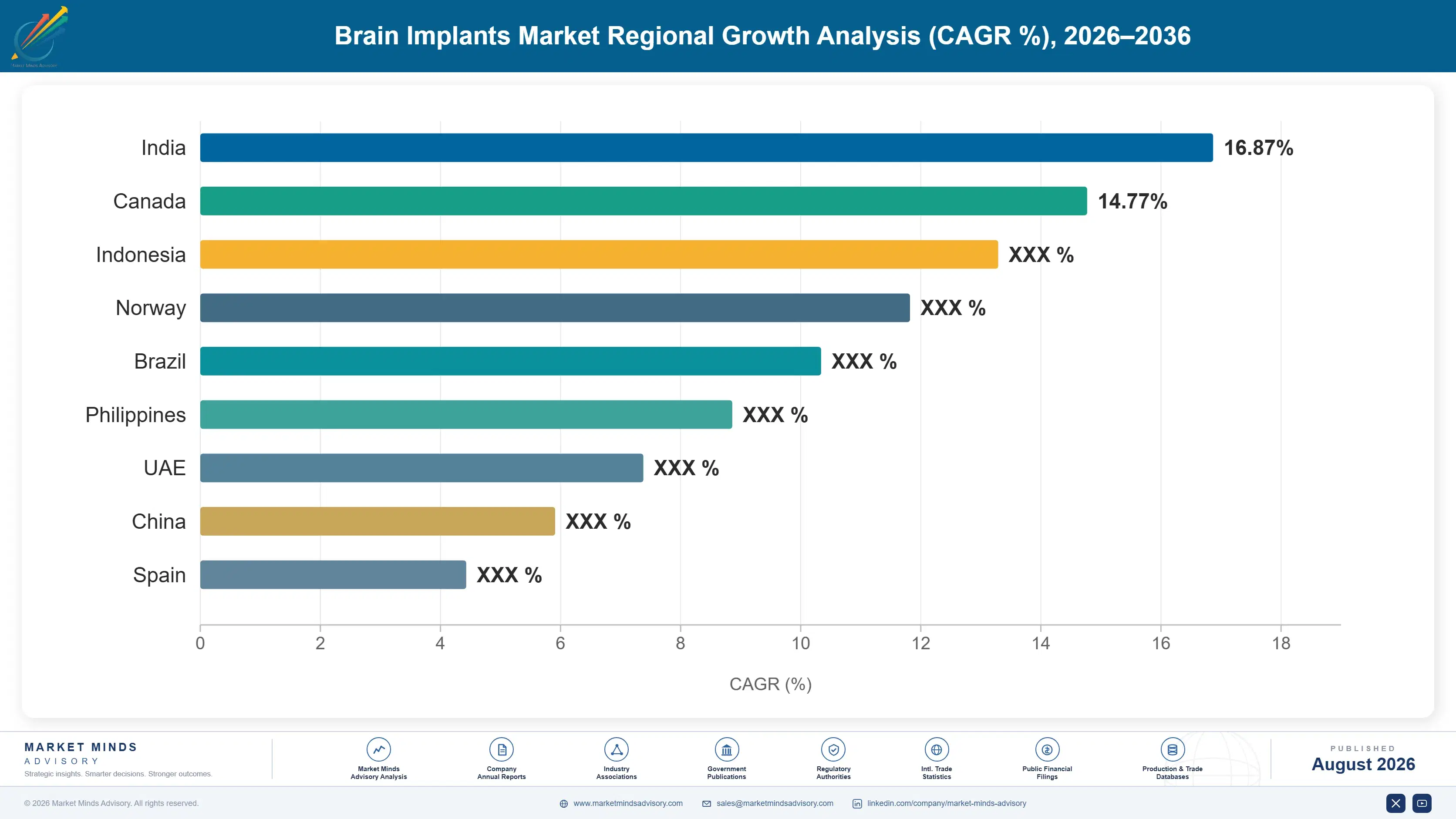
Australia: 16.8% CAGR
Fastest Growth Region
South Asia and Pacific: 15.6% CAGR
Largest Region
North America: 32% of 2025 global value
Market Leaders
Medtronic, Boston Scientific, Abbott, NeuroPace, and Neuralink. Source: MMA Analysis based on company annual reports and disclosed segment revenue.
Primary Survey
n=3,800 procurement and R&D decision-makers, Q4 2025, six countries
Methodology
Demand-side build-up, cross-validated against public data, 47 expert interviews

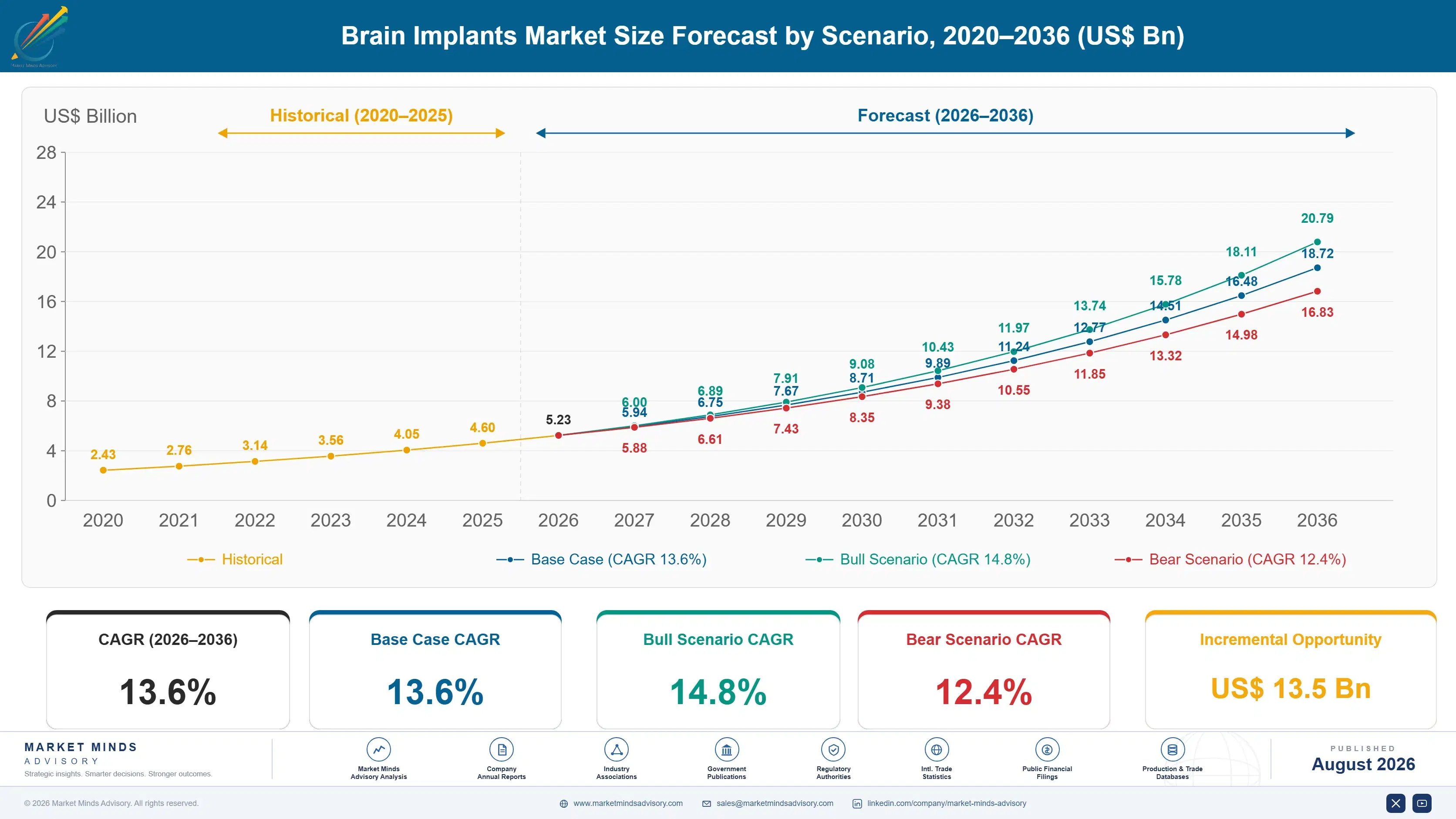
Brain Implants Market Forecast Scenarios

brain-implants-market-size-forecast-scenario-1787303603237
Between 2020 and 2025 the market grew at roughly 12.6% a year, a pace shaped early by pandemic-era elective neurosurgery deferrals before accelerating meaningfully as deferred deep brain stimulation procedures resumed and early brain-computer interface trials began generating genuine clinical momentum during the recovery period that followed shortly afterward. across most major neurosurgical treatment economies tracked closely.
The base case assumes 13.6% annual growth through 2036, driven by three commercial mechanisms operating together across the industry: deep brain stimulation adoption expanding into new neurological and psychiatric indications beyond its established base, brain-computer interface trials advancing toward potential regulatory approval for paralysis and communication applications, and neural prosthetics research maturing toward genuine motor and sensory restoration capability. Platform licensing partnership expansion adds a fourth complementary growth channel worth tracking closely.
A bull case near 14.9% follows if a leading brain-computer interface developer secures regulatory approval faster than currently expected by most industry observers tracking pivotal trial timelines closely. A bear case near 12.3% follows instead if trial safety data raises unexpected concerns or regulatory review extends meaningfully beyond current expectations, delaying commercial availability further into the forecast period.

Clinical Trial Momentum and Indication Expansion

Three forces converge on brain implant development and adoption this decade: deep brain stimulation expanding into new neurological and psychiatric indications beyond its established base, brain-computer interface trials advancing from proof-of-concept toward genuine clinical programmes with defined regulatory pathways, and neural prosthetics research maturing toward real motor and sensory restoration capability for patients with severe paralysis. Companies that read this shift early are already
MARKET CONCENTRATIONCR5 54%share held by top five companies by disclosed revenue
PROCEDURE COST RANGE$35,000-$180,000range spans standard DBS implant to experimental BCI procedures
TOP PRODUCING COUNTRYUSA, 31% shareof global brain implant manufacturing output by shipment value
DBS INDICATION COUNT6-8distinct neurological and psychiatric conditions with approved use
ACTIVE BCI TRIAL SITES12-18clinical centres currently running active BCI trial programmes
DEVICE REPLACEMENT CYCLE9-15 yearstypical service life before battery or system replacement needed
Commercial character has shifted from single-indication device sales toward platform strategies where manufacturers pursue multiple neurological and psychiatric applications from shared underlying hardware architecture. Neurosurgical centres increasingly select an implant partner based on indication breadth and long-term software update roadmap rather than single-procedure pricing alone, giving platform-strategy manufacturers a durable advantage over narrowly focused competitors.
Over the next decade, brain-computer interface regulatory milestones, expanding deep brain stimulation indications, and neural prosthetics clinical validation will keep separating companies with genuine platform breadth and trial data from smaller competitors still building the clinical evidence base needed to compete for neurosurgeon and payer attention in this rapidly evolving category. Companies investing in evidence generation now are shaping how the whole field evolves going forward.
"Five years ago a brain implant meant a deep brain stimulator for Parkinson's disease and not much else. Now neurosurgeons are fielding questions about communication restoration and paralysis treatment that simply were not part of the conversation before."
Director, Neurotechnology Devices Practice · MMA Medical Devices Practice

Market Trends

Brain-Computer Interface Trials Advance Toward Clinical Programmes

Brain-computer interface developers including Neuralink and Synchron have moved beyond early feasibility demonstrations into structured clinical trial programmes enrolling patients with severe paralysis, generating genuine safety and performance data that regulators can evaluate against defined approval criteria rather than isolated case reports. Trial participants demonstrating meaningful device control over computer cursors and communication interfaces are generating publicity that accelerates both patient interest in trial enrolment and investor confidence in the underlying technology's commercial viability. Multiple developers have expanded trial site networks considerably over the past two years. Enrolment interest now exceeds available trial slots at several leading centres.
Market Impact: Drives 8 percent yearly investment
Deep Brain Stimulation Expands Beyond Movement Disorders

Deep brain stimulation, historically concentrated in Parkinson's disease and essential tremor treatment, is expanding into psychiatric indications including treatment-resistant depression and obsessive-compulsive disorder as clinical trial data accumulates supporting these newer applications beyond the technology's original movement disorder focus. Manufacturers including Medtronic and Abbott have pursued expanded regulatory indications specifically to capture this broader addressable patient population, recognising that psychiatric applications represent a considerably larger potential patient base than movement disorders alone. Neurosurgical centres report growing referral volume from psychiatric specialists exploring deep brain stimulation for patients who have exhausted conventional treatment options without adequate symptom relief.
Market Impact: Adds 6 percent reimbursement-driven

Market Opportunities and Growth Drivers

FDA Breakthrough Device Designations Accelerate BCI Development

The FDA has granted breakthrough device designation to multiple brain-computer interface programmes in recognition of their potential to address severe unmet need for patients with paralysis and communication disorders, meaningfully compressing typical development and review timelines compared to standard regulatory pathways most novel device categories must follow from scratch. This regulatory momentum has accelerated venture capital investment considerably, since investors now have clearer visibility into an achievable regulatory pathway that did not previously exist for this genuinely novel device category. Developers report breakthrough designation meaningfully easing ongoing dialogue with regulators throughout the clinical trial design and execution process.
Market Impact: Limits 15 pct trial capacity

Expanding Deep Brain Stimulation Reimbursement Coverage

Major payers including Medicare have expanded reimbursement coverage for deep brain stimulation across newer indications as clinical evidence accumulates supporting expanded use beyond the technology's original movement disorder applications, removing a significant adoption barrier that previously constrained neurosurgeon willingness to recommend the procedure for psychiatric conditions specifically. This coverage expansion is broadening the addressable patient population considerably faster than manufacturers had originally projected for the current forecast period, since psychiatric indications alone represent a substantially larger patient base than movement disorders ever did. Manufacturers report growing referral volume from psychiatric specialists newly considering this treatment pathway.
Market Impact: Extends approval timelines by 12 pe

Market Restraints and Challenges

Surgical Complexity Limits Available Trial and Treatment Sites

Brain implant procedures require specialised neurosurgical expertise and dedicated operating room infrastructure that only a limited number of academic medical centres worldwide currently possess, genuinely constraining how quickly trial enrolment and eventual commercial treatment volume can scale even where patient demand is considerable. The root cause is that few neurosurgeons have the specific training and case volume needed to perform these procedures safely and consistently, making rapid site network expansion inherently difficult regardless of available capital. Manufacturers are mitigating this through structured training and proctoring programmes. though capacity expansion still proceeds considerably more slowly than demand growth would otherwise support.
Market Impact: Adds 24.5 percent segment growth ye

Long-Term Safety Data Requirements Extend Approval Timelines

Regulators require extensive long-term safety follow-up data for novel implanted devices interfacing directly with brain tissue, meaningfully extending approval timelines compared to less invasive device categories where shorter-term safety data typically suffices for regulatory clearance decisions. The root cause is that brain tissue interfaces carry genuinely higher stakes for patient safety than most other device categories, justifying the more conservative regulatory approach even where it slows commercial timelines developers would prefer to see move faster. Developers are mitigating this by designing trials with built-in long-term follow-up protocols from the outset rather than treating extended monitoring as an afterthought added later.
Market Impact: Lifts psychiatric indication share
3 additional market trends, 3 additional growth drivers, and 4 additional restraints and challenges are covered in the full report. Contact sales@marketmindsadvisory.com to access the complete intelligence.

Segment CAGR and Growth Architecture

Segmentation follows implant technology, the dimension that determines surgical approach, target brain region, and which neurological or psychiatric application a given device typically addresses, since technology choice drives regulatory pathway and procedure selection more than any other factor. across most current clinical settings and patient populations encountered. for physicians and researchers alike. right now.
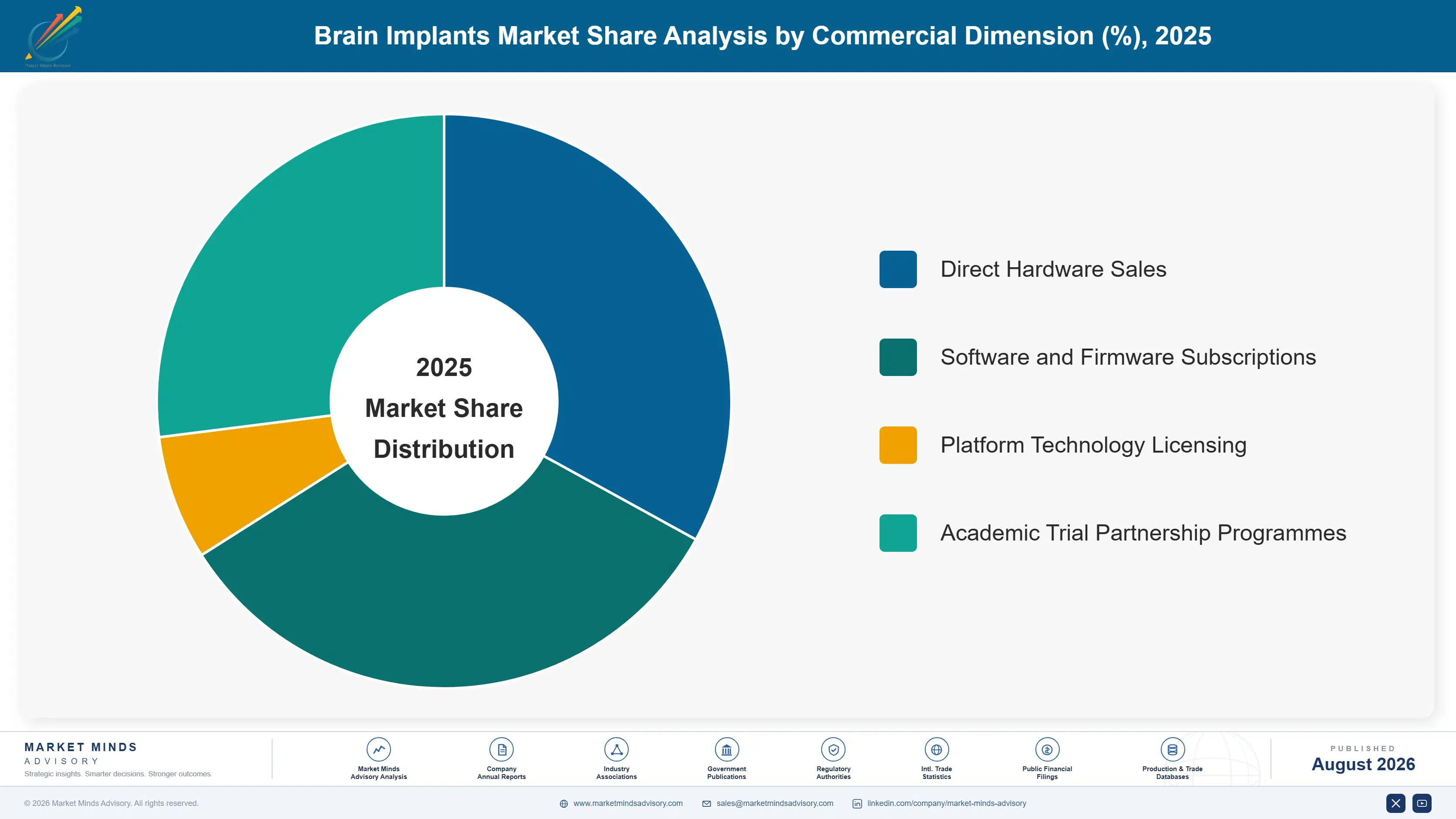
brain-implants-market-market-share-analysis-1787303603769

Brain-Computer Interface (BCI) Systems

Brain-computer interface systems are pulling dramatically ahead as developers including Neuralink and Synchron advance structured clinical trial programmes demonstrating meaningful device control over computer interfaces for patients with severe paralysis who previously had no comparable communication or control restoration option available. Trial participants generating genuine functional improvement are attracting considerable investor and media attention, accelerating both venture funding availability and patient interest in enrolment across active trial sites. Growth concentrates in North American academic medical centres first, where specialised neurosurgical expertise and regulatory infrastructure already exist from decades of deep brain stimulation experience. The segment's growth consistently outpaces every other brain implant category tracked. Multiple developers have advanced toward potential regulatory milestones, reinforcing this segment's clear lead.
CAGR 24.5%

Neural Prosthetics

Neural prosthetics form the second-fastest category, favoured for their potential to restore genuine motor and sensory function rather than only managing symptoms, representing a meaningfully different value proposition than the symptom-management approach deep brain stimulation has historically offered patients with movement disorders. Developers are advancing devices targeting motor cortex signal decoding for prosthetic limb control and sensory restoration applications, building on decades of academic research that is only now translating into genuine commercial development programmes with defined regulatory pathways. Growth concentrates in specialised rehabilitation and academic medical centres first, where researchers have the clinical infrastructure needed to manage the complex signal processing and patient training these systems require for meaningful functional benefit.
CAGR 17.2%
Full segment breakdown across 6 segments available in the complete report.

Regional Architecture and Country Demand Map

North America leads on brain-computer interface trial activity and neurosurgical infrastructure, while South Asia and Pacific grows fastest as Australia's research base and regional clinical trial capacity expand. East Asia and Western Europe both show steady, guideline-driven neurostimulation growth. Latin America shows steadier, private-insurance-driven growth.

North America

FDA breakthrough device designations for leading brain-computer interface programmes form the dominant demand mechanism here, giving developers a meaningfully compressed regulatory pathway that has attracted considerable venture capital investment into US-based trial programmes at leading academic medical centres. Medtronic and Abbott, both with substantial domestic manufacturing and neurosurgical relationships, supply the large majority of established deep brain stimulation platforms sold into the region's dense concentration of academic and community neurosurgical centres. Medicare's expanded reimbursement coverage for newer deep brain stimulation indications continues broadening the addressable patient population considerably faster than manufacturers had projected for the current period. Growth here outpaces most developed markets given the sheer concentration of both trial activity and neurosurgical infrastructure occurring domestically.
Share: 32% | CAGR: 14.5% (2026 to 2036)

Western Europe

National health system treatment guidelines across Germany, France, and the UK have incorporated deep brain stimulation for an expanding range of movement disorder and psychiatric indications, driving steady adoption even as brain-computer interface trial activity proceeds somewhat more cautiously than in North America given more centralised, multi-year regulatory review processes across different national systems. Boston Scientific supplies a meaningful share of regional demand directly from local manufacturing and distribution infrastructure built specifically to serve European neurosurgical treatment centres. Growth trails North America because brain-computer interface trial infrastructure, while emerging, remains considerably less developed than the concentration of active programmes already established domestically in the United States market currently underway. Regional payers continue closely tracking real-world outcomes as adoption widens further.
Share: 22% | CAGR: 12.0% (2026 to 2036)
Regional intelligence for 5 additional markets available in the complete report: East Asia, South Asia and Pacific, Latin America, Middle East and Africa, Eastern Europe. Contact sales@marketmindsadvisory.com.
brain-implants-market-country-cagr-analysis-1787303604309

Platform Licensing, Software Upgrades, and Trial Partnerships

Companies are shifting commercial strategy toward hardware platform licensing, recurring software and firmware upgrade revenue, and academic trial partnerships, capturing more value across the device lifecycle rather than competing purely on the upfront price of implant hardware sold through traditional single-procedure purchasing arrangements across most markets. across most vendor relationships tracked closely. each cycle.

Recurring Software and Firmware Upgrade Subscriptions

Manufacturers including Medtronic and Boston Scientific now offer software and firmware upgrade subscriptions that improve stimulation algorithm performance and add new programming capability without requiring surgical device replacement, converting a single hardware sale into a recurring revenue relationship tied directly to the implant's multi-year service life. This addresses genuine patient and neurosurgeon demand for continuous improvement without repeated surgical risk, since algorithm refinements can meaningfully improve symptom control even on already-implanted hardware. Manufacturers report subscription attach rates above 38% on new implants, with attach rates highest among patients enrolled in specialised movement disorder treatment programmes.
Market Impact: Adds roughly 38 percent recurring r

Platform Technology Licensing to Smaller Developers

Companies with established implant platform technology are licensing underlying hardware architecture and regulatory pathway experience to smaller developers pursuing new indications or novel applications, capturing royalty revenue while helping licensees reach market faster than independent development would allow given the platform's already-validated safety profile. This lever extends platform reach into applications the originating company might not pursue directly itself, while building a growing set of complementary applications around shared underlying hardware. Companies report licensing revenue growing by roughly 22% annually as more developers seek validated platform technology rather than building comparable systems from scratch.
Market Impact: Grows licensing revenue by about 22

Academic Trial Site Partnership and Data Sharing Agreements

Manufacturers are structuring academic trial partnerships that provide research centres with implant hardware and technical support in exchange for data sharing rights and priority access to clinical outcomes information, accelerating both companies' regulatory evidence generation and academic centres' research capability without requiring either party to bear the full cost independently. This lever captures value from research collaboration that previously happened on a more ad hoc, uncompensated basis between manufacturers and academic partners. Companies report structured partnerships reducing trial data collection costs by roughly 20% compared to fully independent trial infrastructure.
Market Impact: Cuts data collection cost by roughl

Extended Warranty and Battery Replacement Service Plans

Companies are introducing extended warranty and proactive battery replacement service plans that reduce the risk of unexpected device failure requiring emergency surgical intervention, closing a gap that previously left patients and hospitals managing replacement timing reactively rather than through structured, predictable planning ahead of time. Extended service plans typically bundle remote device monitoring with scheduled replacement consultation, giving neurosurgical centres better visibility into their patient population's upcoming procedure needs. Manufacturers report service plan enrolment cutting emergency replacement volume by roughly 27%. This reduction has held steady across two consecutive years since service plans first launched broadly.
Market Impact: Cuts emergency replacements by roug

Who Controls the Margin Pool

Five companies hold a combined 54% of revenue on a consistent company-disclosed segment revenue basis, a moderately concentrated level reflecting an established deep brain stimulation base alongside a wave of well-funded brain-computer interface startups still building toward their own meaningful commercial revenue and regulatory milestones. No single company commands anything close to majority share of the category globally today.
Current competitive activity centres on three fronts at once: brain-computer interface trial data accumulation racing toward potential regulatory milestones among leading developers, deep brain stimulation indication expansion targeting psychiatric and other newer applications beyond movement disorders, and platform licensing and academic partnership expansion capturing value across a broadening set of clinical applications and research collaborations. Each front requires meaningfully different capital and clinical development investment from companies involved.

Pressure is building steadily as multiple brain-computer interface developers advance through overlapping trial timelines, a dynamic that could compress any single company's first-mover commercial advantage if several genuinely different approaches reach meaningful clinical milestones within a similar window, forcing neurosurgeons and patients to differentiate candidates on nuanced performance data rather than simple novelty or availability. Established leaders are watching this shift closely and adjusting commercial strategy accordingly across markets.
brain-implants-market-company-positioning-matrix-1787303604832

Competitive Moat and Risk Dimensions

MEDTRONIC PLC

Moat: Broad indication and platform breadth

Medtronic's presence across the widest range of approved deep brain stimulation indications, combined with decades of neurosurgeon relationships and accumulated clinical outcomes data, gives it prescribing advantages and platform credibility that newer entrants find genuinely difficult to replicate quickly across comparable geographic and clinical scope.
MEDTRONIC PLC

Risk: Brain-computer interface development gap

Medtronic's more limited presence in brain-computer interface development leaves it more exposed than dedicated BCI specialists to losing ground in the category's fastest-growing segment, particularly as well-funded startups advance trial programmes with meaningfully more focused resource allocation than a broad diversified device manufacturer. Investors are watching this gap closely across the category.
NEURALINK CORP.

Moat: Trial visibility lead

Neuralink's early trial progress and considerable public visibility have built patient awareness and investor confidence that newer BCI entrants cannot easily replicate quickly, giving it a genuine advantage in attracting both trial participants and continued funding as the company advances toward broader regulatory milestones. Competitors cannot easily replicate this visibility quickly.
NEURALINK CORP.

Risk: Narrow product and revenue base

Neuralink's concentration in a single novel technology category without an established revenue-generating product line creates meaningful financial risk if trial timelines extend or safety data raises unexpected concerns, unlike diversified competitors with existing commercial device revenue supporting continued operations. Analysts flag this concentration risk explicitly.

Players Tracked

Prominent Players

Medtronic plc
Boston Scientific Corporation
Abbott Laboratories
NeuroPace Inc.
Neuralink Corp.

Other Key Players

Synchron Inc.
Blackrock Neurotech
Precision Neuroscience Corp.
Onward Medical N.V.
Paradromics Inc.
Integra LifeSciences Holdings Corporation
Nevro Corp.
Aleva Neurotherapeutics SA
Inbrain Neuroelectronics SL
Motif Neurotech Inc.
Cortigent Inc.
Science Corporation
CorTec GmbH
Axoft Inc.
Renishaw plc

Recent Developments

FEBRUARY 2025

Synchron reports positive trial data for stentrode BCI system

Synchron reported positive clinical trial data for its minimally invasive stentrode brain-computer interface system, showing meaningful device control performance in paralysis patients using an endovascular implantation approach that avoids the open brain surgery other competing BCI systems currently require. for this difficult patient population. nationwide.
Signal: Signals minimally invasive implantation ap
OCTOBER 2024

Medtronic expands deep brain stimulation indication for treatment-resistant depression

Medtronic secured expanded regulatory approval for deep brain stimulation in treatment-resistant depression, following favourable clinical trial data that broadens the company's addressable patient population considerably beyond its established movement disorder treatment base into psychiatric applications. for future indication expansion broadly. across additional trial centres. today.
Signal: Confirms established manufacturers are pri
MAY 2025

Blackrock Neurotech raises growth funding for BCI commercialisation

Blackrock Neurotech raised a significant growth funding round to scale manufacturing and commercial operations ahead of anticipated regulatory milestones, positioning the company to compete more directly against better-known competitors already commercialising brain-computer interface systems more broadly. Analysts see this as a durable funding trend. broadly.
Signal: Shows investor confidence extending beyond

Biocompatible Electronics and Precision Manufacturing

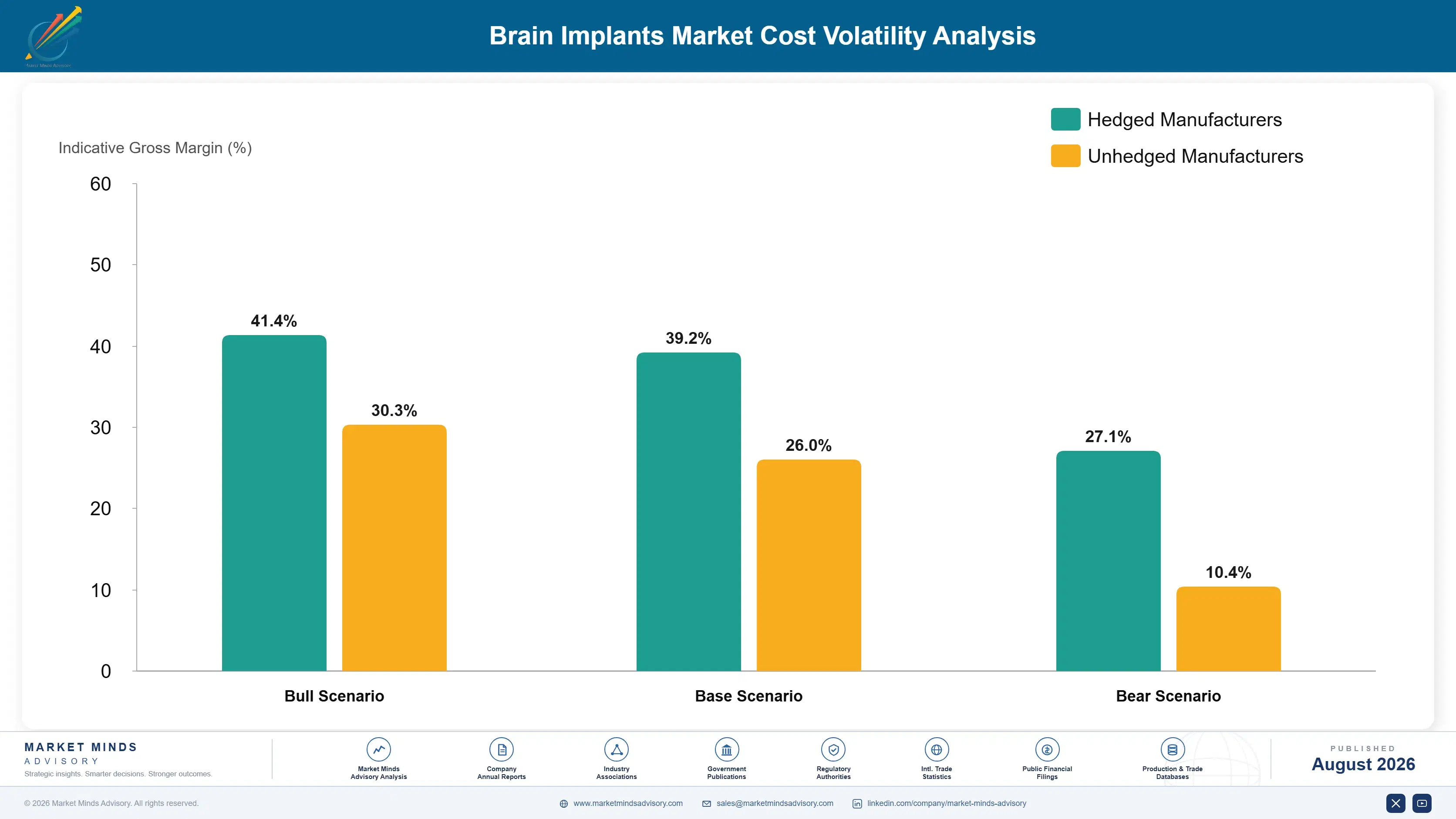
Biocompatible electrode array and encapsulation materials account for roughly 34% of unit cost of goods sold for brain implant systems, sourced primarily from specialised medical-grade materials suppliers in the United States and Western Europe, while precision electronics and battery components add another 22%, sourced from a concentrated group of specialised component manufacturers serving the implantable device industry.
Semiconductor and specialised electrode component shortages during 2021 and 2022 significantly disrupted implant manufacturing timelines across several developers, and company communications from that period documented extended manufacturing lead times as component availability constrained production output well below clinical trial and commercial demand levels during the disruption period that persisted longer than most manufacturers initially expected. reflecting how significantly this constrained specialised production capacity across the industry that year.

Larger manufacturers with diversified component sourcing agreements and greater purchasing scale absorbed the shortage more smoothly than smaller clinical-stage developers dependent on fewer suppliers, giving them a durable continuity advantage during the disruption period that followed. Smaller developers without established long-term component supply agreements remain the most exposed to any future disruption of this kind affecting the broader implantable electronics supply chain.
brain-implants-market-cost-volatility-analysis-1787303605029

Diversified Biocompatible Materials Supply Agreements

Larger manufacturers are qualifying multiple biocompatible materials suppliers across different geographies rather than depending on a single source, reducing exposure to the kind of component shortage that constrained implant production during the 2021 to 2022 disruption period referenced across the industry today. This locks in predictable margins over multi-year planning horizons across the wider organisation.

Extended Critical Component Inventory Buffer Strategy

Manufacturers are maintaining larger safety stock inventory buffers for critical electronics and electrode array components than pre-pandemic practice typically required, accepting modestly higher carrying costs in exchange for production continuity during periods of potential future supply disruption across the industry. This diversification spans production facilities across several countries and component suppliers. across the wider global supply chain.

In-House Precision Electronics Manufacturing Investment

Several larger companies are bringing precision electronics manufacturing partially in-house rather than depending entirely on external specialised suppliers, reducing exposure to the concentrated component supply base that has occasionally constrained production schedules across the wider implantable device industry recently. This investment has already paid off during one recent period of elevated capacity constraint. for critical component sourcing needs.

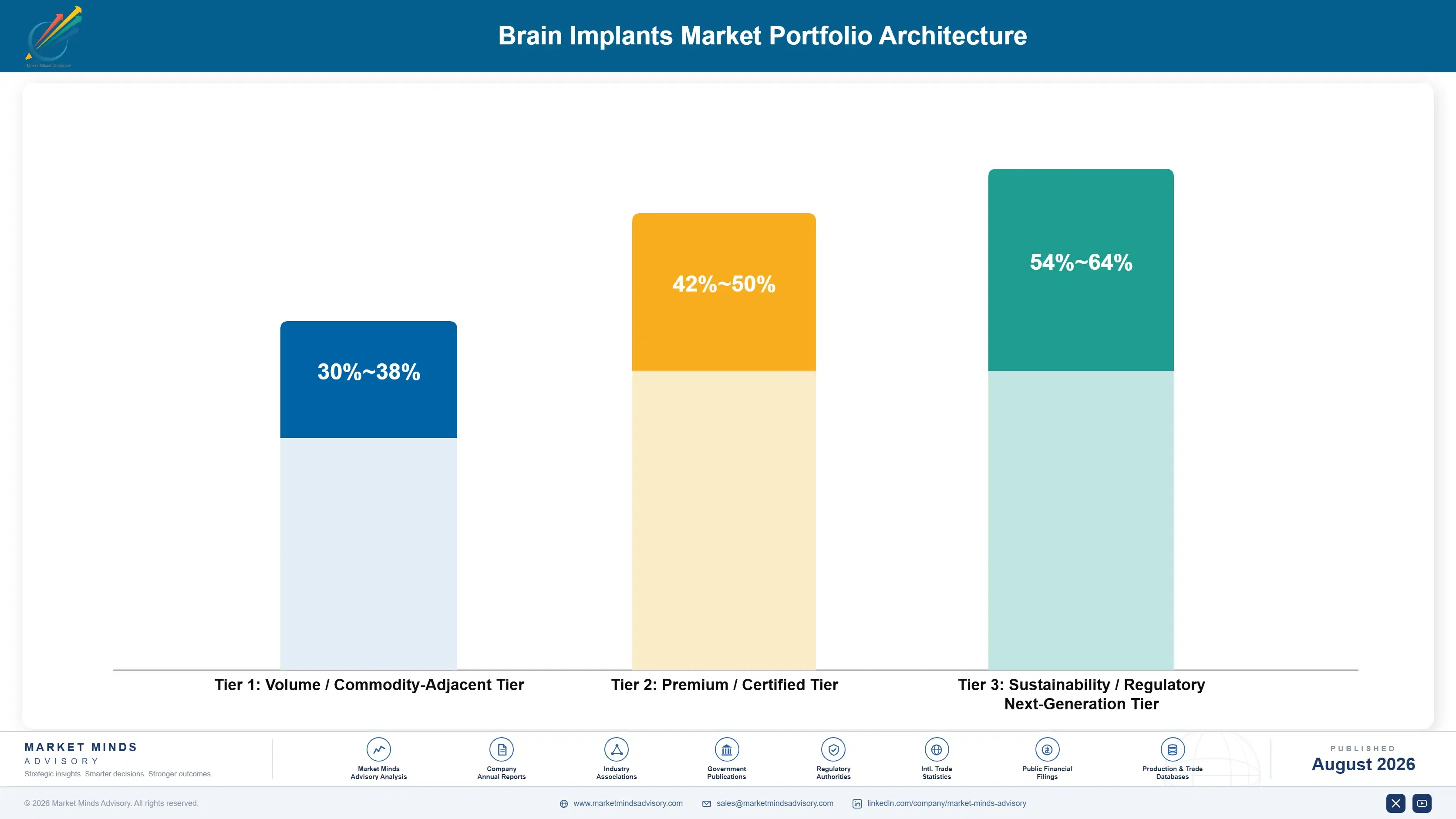
Portfolio Architecture for Margin Defence

The portfolio splits into three tiers running from established deep brain stimulation systems sold largely on proven clinical outcomes, through expanded-indication neurostimulation platforms carrying newer psychiatric and neurological approval, up to next-generation brain-computer interface and neural prosthetic systems aimed at patients and researchers pursuing the most advanced available functional restoration capability. Margins widen as clinical differentiation and regulatory proximity incre
Established deep brain stimulation systems still account for the largest procedure volume overall but generate comparatively thinner margins than newer technology categories, while brain-computer interface and neural prosthetic systems, though representing a smaller share of total procedures today, carry the potential for substantially higher margins once regulatory clearance and broader commercial availability are secured. This dynamic mirrors patterns seen across many other premiumising medical device categories in recent years broadly.

The highest-value pools concentrate in brain-computer interface systems nearing potential regulatory milestones, where clinical differentiation matters most and eventual payers will pay a meaningful premium for genuinely novel functional restoration capability, followed closely by expanded-indication deep brain stimulation serving the considerably larger psychiatric patient population beyond movement disorders. Companies with strong neurosurgeon and payer partnerships capture a disproportionate share of this pool.

Volume / Commodity-Adjacent Tier

Established deep brain stimulation systems sold largely on proven clinical outcomes into movement disorder treatment centres with well-established procedure protocols. Volume stays highest here across most established treatment centres worldwide.
Gross Margin: 30-38%

Premium / Certified Tier

Expanded-indication neurostimulation platforms carrying newer psychiatric and neurological regulatory approval, sold into centres pursuing broader treatment capability. Margins improve meaningfully once expanded indications are attached to a platform. Margins improve as newer regulatory approvals accumulate across the platform.
Gross Margin: 42-50%

Sustainability / Regulatory / Next-Generation Tier

Brain-computer interface and neural prosthetic systems aimed at patients and researchers pursuing the most advanced available functional restoration capability anywhere. Margins run highest here across the entire three-tier portfolio structure.
Gross Margin: 54-64%
brain-implants-market-portfolio-architecture-1787303605525

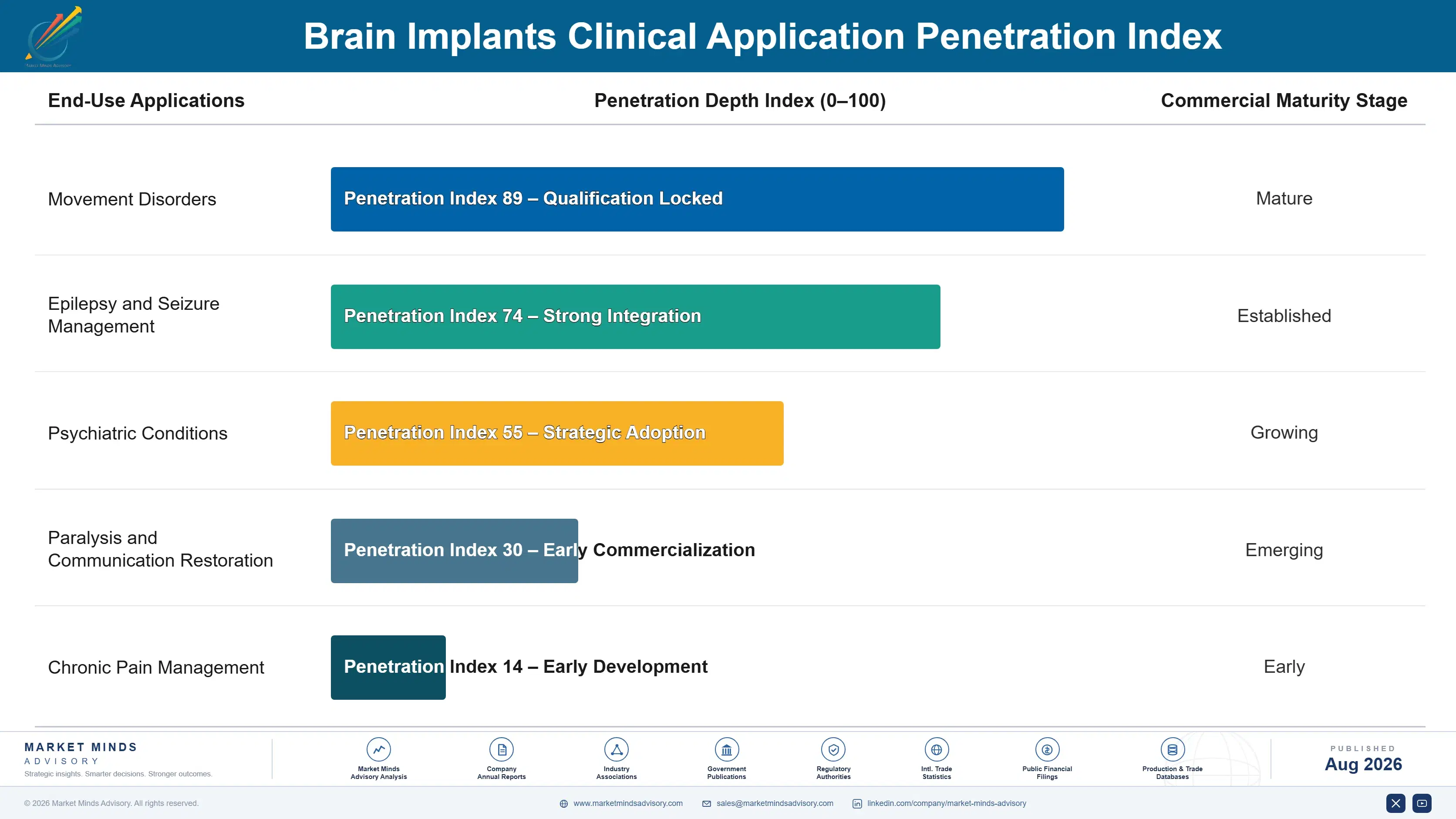
Implant Lifecycle and Indication-Linked Adoption

Demand behaves less like a one-time equipment purchase and increasingly like a multi-decade implant lifecycle relationship, since brain implant systems require periodic battery replacement, software updates, and ongoing clinical monitoring that manufacturers increasingly capture through structured service programmes rather than leaving entirely to ad hoc replacement scheduling handled reactively. This dynamic rewards consistent clinical performance over one-time promotional marketing considerabl
Adoption depth varies sharply by institution type: academic medical centres running active clinical trials show the deepest engagement with newer brain-computer interface and expanded-indication technology, while community neurosurgical centres with less trial infrastructure exposure continue relying primarily on established deep brain stimulation for well-validated movement disorder indications pending broader technology maturation. Institutions increasingly tailor engagement strategy around these two distinct adoption behaviours across networks.

A generational shift is underway in the neurosurgeon population itself, as younger physicians trained during fellowship programmes that already incorporated brain-computer interface and expanded-indication clinical data increasingly champion adoption of newer technology, while more senior physicians accustomed to movement-disorder-focused practice patterns remain somewhat more cautious about departing from decades of established clinical habit and patient selection criteria. Companies investing in medical education and conference visibility are capturing this shift fastest today.
brain-implants-market-end-use-penetration-index-1787303606016

Where Clinical Trial Advantage Concentrates Next

These are among the four positions where our research anticipates prominent divergence between winners and laggards over the coming forecast period. Each is grounded in the demand model, the regulatory perimeter, and the announced capacity pipeline.
01 / TRIAL DATA ACCUMULATION

Early brain-computer interface data will keep compounding advantage

Companies with the largest accumulated clinical trial data and longest track record of patient enrolment are building investor confidence and regulatory dialogue depth that later entrants cannot replicate quickly regardless of available development capital or technical sophistication brought to the category. Developers without meaningful trial site networks are struggling to overcome the data and credibility advantage early movers have already established across leading academic medical centres. This dynamic will keep favouring Neuralink and Synchron over the next several forecast years across most major trial markets tracked.
02 / INDICATION EXPANSION STRATEGY

Psychiatric applications will keep expanding the addressable patient base

Deep brain stimulation's expansion into treatment-resistant depression and other psychiatric indications represents a considerably larger addressable patient population than movement disorders alone ever provided, creating genuine commercial upside for manufacturers pursuing these newer regulatory approvals ahead of competitors. Companies without expanded indication strategies are ceding this fast-growing patient population entirely to manufacturers who invested early in the required clinical trial evidence. Expect psychiatric indication revenue to grow meaningfully faster than movement disorder revenue through the remainder of the forecast period.
03 / MINIMALLY INVASIVE APPROACHES

Endovascular and less invasive implantation will broaden eligible patients

Developers pursuing minimally invasive implantation approaches that avoid open brain surgery, including endovascular delivery methods, are positioned to broaden the eligible patient population considerably beyond what open surgical approaches alone could support given surgical risk tolerance among certain patient populations. This approach trades some technical capability for meaningfully reduced procedural risk, a trade-off increasingly attractive to both patients and treating physicians evaluating candidacy. Expect minimally invasive approaches to capture disproportionate growth as clinical data continues validating their safety profile relative to open surgical alternatives.
04 / NEUROSURGICAL CAPACITY CONSTRAINT

Limited surgical site capacity will slow the whole category's growth pace

The specialised neurosurgical expertise required for brain implant procedures represents a genuine bottleneck constraining how quickly the entire category can scale toward its addressable patient population, regardless of any individual developer's available capital or regulatory approval status achieved to date across the industry. This capacity constraint affects every developer competing in the category simultaneously rather than favouring any single company specifically over its rivals. Expect neurosurgical training and proctoring investment to become an increasingly important strategic priority across the wider industry going forward.

Engagement Snapshot From the Field

A live engagement with an industry participant carrying material or product regulatory and market exposure ahead of a defining policy shift, showing how our research translates into a defensible multi-year portfolio strategy.
MARKET MINDS ADVISORY · CLIENT ENGAGEMENT SUMMARY
Brain Implants Producer Strategic Portfolio Review and Transition Roadmap 2026·Investment Scenario on Brain Implants Exposure Evaluation 2025-26
CLIENT PROFILE
The client is a leading academic medical centre with an established deep brain stimulation programme performing approximately 180 procedures annually, generating related neurosurgical revenue of approximately $95 million (client-reported, unverified by MMA). Leadership sought guidance on whether to pursue brain-computer interface trial site designation alongside its existing established programme. The centre already had strong relationships across the neurosurgical research community nationally.
STRATEGIC CHALLENGE
The client faced a decision about committing meaningful capital and specialised staff time toward brain-computer interface trial site infrastructure without certainty about which developer partnership would offer the strongest long-term research and commercial positioning within an increasingly competitive academic trial site landscape nationally. Leadership wanted a clear-eyed comparison before committing scarce resources.
MMA APPROACH
MMA's team benchmarked leading brain-computer interface developers against the client's existing surgical expertise, research infrastructure, and patient population profile, modelling trial site partnership economics and long-term research positioning against continued focus on the established deep brain stimulation programme alone without expansion. The analysis incorporated funding timelines and staff readiness assessments directly.
KEY FINDINGS
  1. Two leading BCI developers showed strong alignment with the client's existing paralysis and movement disorder patient referral base, making trial site partnership genuinely feasible without major infrastructure changes.
  2. Trial site designation could generate meaningful research funding and publication opportunities that would strengthen the centre's academic standing considerably within the competitive national neurosurgical research landscape.
  3. Existing neurosurgical staff required only modest additional training to support BCI trial procedures, based on comparable programme onboarding timelines reviewed during the engagement.
  4. Trial site partnership revenue and research funding could offset a meaningful share of the infrastructure investment required within the first three years of programme operation.
CLIENT PROFILE
The client is a leading academic medical centre with an established deep brain stimulation programme performing approximately 180 procedures annually, generating related neurosurgical revenue of approximately $95 million (client-reported, unverified by MMA). Leadership sought guidance on whether to pursue brain-computer interface trial site designation alongside its existing established programme. The centre already had strong relationships across the neurosurgical research community nationally.
STRATEGIC CHALLENGE
The client faced a decision about committing meaningful capital and specialised staff time toward brain-computer interface trial site infrastructure without certainty about which developer partnership would offer the strongest long-term research and commercial positioning within an increasingly competitive academic trial site landscape nationally. Leadership wanted a clear-eyed comparison before committing scarce resources.
MMA APPROACH
MMA's team benchmarked leading brain-computer interface developers against the client's existing surgical expertise, research infrastructure, and patient population profile, modelling trial site partnership economics and long-term research positioning against continued focus on the established deep brain stimulation programme alone without expansion. The analysis incorporated funding timelines and staff readiness assessments directly.
KEY FINDINGS
  1. Two leading BCI developers showed strong alignment with the client's existing paralysis and movement disorder patient referral base, making trial site partnership genuinely feasible without major infrastructure changes.
  2. Trial site designation could generate meaningful research funding and publication opportunities that would strengthen the centre's academic standing considerably within the competitive national neurosurgical research landscape.
  3. Existing neurosurgical staff required only modest additional training to support BCI trial procedures, based on comparable programme onboarding timelines reviewed during the engagement.
  4. Trial site partnership revenue and research funding could offset a meaningful share of the infrastructure investment required within the first three years of programme operation.
RECOMMENDED STRATEGY
Phase 1: Phase 1 (Months 1-6): Initiate partnership discussions with the two best-aligned BCI developers and begin staff training enrolment now. immediately. Phase 2: Phase 2 (Months 7-12): Finalise trial site partnership agreement and complete required infrastructure and site qualification steps fully. on schedule. Phase 3: Phase 3 (Months 13-18): Begin patient enrolment and establish ongoing research collaboration infrastructure supporting the new programme's long-term growth successfully.
OUTCOME
The client secured trial site designation with its preferred developer partner and reported (client-reported, unverified by MMA) enrolling its first trial patients within fourteen months of the initial partnership decision, considerably faster than the eighteen-to-twenty-four-month timeline typical for comparable academic trial site establishment without dedicated advisory support.

Frequently Asked Questions

Foundational context covering the market sizes, CAGR, scope, country, region and competition that inform every finding below. This section is provided to cover basics and most often pre-purchase conversations, answered from the MMA Primary Research Dataset.

What is the current size of the Brain Implants Market?

The global brain implants market reached an estimated $4.6 billion in 2025, based on MMA's primary research dataset and company-disclosed segment revenue across the five largest companies tracked worldwide.

How large will the Brain Implants Market be by 2036?

The market is projected to reach approximately $18.70 billion by 2036, roughly 3.58 times its 2026 value under MMA's base-case forecast scenario for the coming decade ahead.

What is the CAGR for the Brain Implants Market 2026 to 2036?

The base-case compound annual growth rate is 13.6%, with a bull case near 14.8% and a bear case near 12.4% depending on brain-computer interface regulatory approval timing.

Which segment is growing fastest?

Brain-computer interface systems are the fastest-growing segment at a 24.5% CAGR, roughly 1.8 times the overall market rate, driven by advancing clinical trial data and investor interest.

Who are the major companies in the Brain Implants Market?

Medtronic, Boston Scientific, Abbott, NeuroPace, and Neuralink are the five largest companies by disclosed segment revenue, together holding a combined 54% share of the category.

Which country is growing fastest?

Australia is the fastest-growing major market at an estimated 16.8% CAGR, driven primarily by a well-funded neurotechnology research base and strong government research grant support.

Report Segmentation Architecture

The full report scope spans multiple orthogonal segmentation dimensions, with cross-tabulated demand data provided for each dimension pair. Coverage extends further to regional breakdowns, trend trajectories, and the competitive detail needed to support segment-level decision-making.

By Implant Technology

  • Deep Brain Stimulation (DBS) Systems
  • Responsive Neurostimulation (RNS) Systems
  • Brain-Computer Interface (BCI) Systems
  • Cortical Stimulation Devices
  • Intracranial Pressure Monitoring Implants
  • Neural Prosthetics

By Clinical Application

  • Movement Disorders
  • Epilepsy and Seizure Management
  • Psychiatric Conditions
  • Paralysis and Communication Restoration
  • Chronic Pain Management

By Commercial Dimension

  • Direct Hardware Sales
  • Software and Firmware Subscriptions
  • Platform Technology Licensing
  • Academic Trial Partnership Programmes

By Region

  • North America
  • Western Europe
  • East Asia
  • South Asia and Pacific
  • Latin America
  • Middle East and Africa
  • Eastern Europe

Scope, Methodology, and Coverage

Every figure in this report is reproducible from documented input assumptions. The scope below maps the historical period, the forecast horizon, the segmentation dimensions, and the countries covered, alongside the underlying primary and qualitative methodology.
Historical Period
2020 to 2025
Forecast Period
2026 to 2036
Base Year
2025 (USD billions; MMA Primary Research Dataset, August 2026)
Market Definition
The brain implants market covers surgically implanted devices that interface directly with brain tissue, including deep brain stimulation systems, responsive neurostimulation systems, brain-computer interface systems, cortical stimulation devices, intracranial pressure monitoring implants, and neural prosthetics. Cochlear implants, peripheral nerve stimulation devices not implanted intracranially, and external non-invasive neurostimulation or neurofeedback devices are excluded from this scope.
Quantitative Units
USD billions (current prices); implant procedure volume where disclosed
Segmentation Dimensions
By Implant Technology; By Clinical Application; By Commercial Dimension; By Region
Regions Covered
North America, Western Europe, East Asia, South Asia and Pacific, Latin America, Middle East and Africa, Eastern Europe
Countries Covered
USA, China, Germany, France, UK, Japan, South Korea, India, Australia, Canada, Brazil, Mexico, Indonesia, Vietnam, Thailand, Malaysia, UAE, Saudi Arabia, South Africa, Nigeria, Turkey, Poland, Netherlands, Italy, Spain, Sweden, Switzerland, Argentina, Colombia, Singapore, and additional markets relevant to this sector
Key Companies Profiled
Medtronic plc, Boston Scientific Corporation, Abbott Laboratories, NeuroPace Inc., Neuralink Corp., Synchron Inc., Blackrock Neurotech, Precision Neuroscience Corp., Onward Medical N.V., Paradromics Inc., Integra LifeSciences Holdings Corporation, Nevro Corp., Aleva Neurotherapeutics SA, Inbrain Neuroelectronics SL, Motif Neurotech Inc., Cortigent Inc., Science Corporation, CorTec GmbH, Axoft Inc., Renishaw plc
Quantitative Methodology
Primary survey, n=3,800 respondents, Q4 2025, six countries; demand-side model with trade association cross-validation
Qualitative Methodology
47 expert interviews, Q4 2025; applied to validate demand model assumptions, identify emerging dynamics, and assess competitive positioning
Report Format
PDF and XLSX data workbook (Word format preview document)
Publisher
Market Minds Advisory
Report Code
MMA-2026-MED-146
Published
August 2026
Contact
sales@marketmindsadvisory.com | www.marketmindsadvisory.com

Purchase the full Brain Implants Market Report (2026 to 2036).

The full Brain Implants Market report delivers detailed segmentation by implant technology, clinical application, and commercial channel across all seven world regions through 2036. It includes company-level competitive profiles for all twenty companies profiled, covering platform technology, trial status, and licensing activity underway across the category. Regional chapters detail country-level neurosurgical infrastructure, regulatory pathway timelines, and trial site distribution for each of the seven regions covered. A dedicated input cost chapter tracks biocompatible materials and precision electronics exposure alongside mitigation strategies used by leading companies today.
Full seven-region data tables and CAGR breakdowns
Twenty-company competitive profiles and moat analysis
Regulatory designation and trial site tracker included
Input cost exposure and mitigation playbook detailed
Segment-level growth and margin forecasts provided
Editable data appendix in spreadsheet format

Built For The People Who Decide

From boardroom strategy to bench-side execution, this report is read cover-to-cover by leaders shaping the next decade of their industry, turning demand scenarios, market dynamics and valuation benchmarks into decisions.
CXOs/ Presidents/ VPs/ Managers
M&A and Corporate Development
Strategy Teams and R&D Heads
Procurement and Product Directors
Regulatory and Compliance Leaders
Investor Relations and Equity Analysts