Market Minds Advisory
Body Tape Market

Body Tape Market: Body Tape Market: The Colours Do Nothing, The Removal Is What Injures, And Fashion Now Outsells Therapy, 2026 to 2036

Around 62% of kinesiology products imply the colour changes the effect, which it does not. Skin damage on removal drives 34% of complaints and fashion use now supplies 43% of revenue.

Lead Analyst

Published

September 2026

Make Smarter Decisions with Customized Research Insights

Request a free sample report and evaluate market opportunities, growth trends, and competitive dynamics relevant to your business needs.

2025 MARKET VALUE$1.9BMarket Size 2025
2036 FORECAST VALUE$4.6BBase Case , 2026 to 2036
CAGR 2026 TO 20368.2 %Bull 9.4% / Bear 7.0%
INCREMENTAL OPPORTUNITY$2.5BNet 10- year value creation
EXPANSION MULTIPLE2.19x2036 value over 2026 base
Strategic Levers
M&A Pipeline
Regional Outlook
Country Rankings
Competitive Intelligence
Segmental Deep-dive
Call-Us : 91 93563 13602

Executive Snapshot and Market Trajectory.

Colour does nothing. Around 62% of kinesiology products imply otherwise, and the pigment has no bearing on lymphatic flow, muscle activation, or anything else. The tactile cueing effect the tape genuinely produces is real and has no relationship to what shade it is. The mechanism claims did not survive review.
Breast lift and body contour tape grows at 12.3%, half again the market rate of 8.2%, and fashion use now supplies about 43% of category revenue, which sports medicine largely declines to acknowledge. Garment and fashion double-sided tape follows at 10.6%. Rigid athletic strapping grows slowest of the six classes at 5.8%. Hypoallergenic underwrap grows at 8.7% as skin injury awareness spreads among athletes and consumers alike.
East Asia holds 34% of demand and manufactures most of it, with Indonesian growth of 14.2% leading every market covered on social commerce and a young population together. Skin damage on removal drives around 34% of complaints, and about 7% of products publish a measured peel adhesion figure of any kind. Real wear duration also falls roughly 48% short of claims, because those figures come from degreased skin in controlled humidity.
Market Definition
This market covers adhesive tapes applied directly to skin for support, positioning, or garment adherence, including kinesiology therapeutic tape, rigid athletic strapping tape, hypoallergenic underwrap and pre-tape, breast lift and body contour tape, garment and fashion double-sided tape, and cosmetic skin-smoothing tape. It excludes surgical and wound closure tapes, adhesive bandages and dressings, transdermal drug patches, industrial and packaging tapes, and hair and wig adhesives.
Base Year Value
$1.9B in 2025 (MMA Primary Research Dataset, September 2026)
Forecast Period
2026 to 2036, eleven discrete annual values
CAGR
8.2% base case. Bull 9.4%. Bear 7.0%.
Fastest Growth Segment
Breast Lift And Body Contour Tape: 12.3% CAGR
Fastest Growth Country
Indonesia: 14.2% CAGR
Fastest Growth Region
South Asia and Pacific: 10.2% CAGR
Largest Region
East Asia: 34% of 2025 global value
Market Leaders
3M, Nitto Denko, Mueller Sports Medicine, KT Health, and Beiersdorf lead the field. Source: MMA Primary Research Dataset, July 2026.
Primary Survey
n=3,800 procurement and R&D decision-makers, Q4 2025, six countries
Methodology
Demand-side build-up, cross-validated against public data, 47 expert interviews

Body Tape Market Forecast Scenarios

body-tape-market-size-forecast-scenario-1790020339137
Growth from 2020 to 2025 ran at 7.1% and its composition changed almost completely. Kinesiology tape demand flattened as systematic reviews accumulated and the mechanism claims lost credibility with clinicians, while fashion and garment tape expanded rapidly through social video into a mass consumer category that had barely existed. The therapeutic and fashion halves of this market now behave nothing like each other.
The base case at 8.2% rests on three mechanisms. Fashion and body contour tape keeps growing through social commerce channels, particularly in Southeast Asia where Indonesian growth at 14.2% leads every country covered. Hypoallergenic underwrap grows as skin injury awareness spreads among both athletes and consumers. And kinesiology tape holds its position on tactile cueing rather than on any mechanism claim. None of the three assumes the mechanism claims recover any clinical standing.
The bull case at 9.4% depends on gentle adhesive systems reaching parity on wear time, which would remove the trade-off between holding power and skin damage that currently caps both halves of the category. The bear case at 7.0% is regulatory: skin injury drives about 34% of complaints, and an authority requiring peel adhesion disclosure would affect most products sold.

What The Tape Actually Does

Kinesiology tape does something and it is not what the packaging says. Systematic reviews have not found meaningful effects on lymphatic drainage or muscle activation beyond what sensory feedback explains, and the colour has no bearing on anything at all despite around 62% of products implying it does. What it genuinely provides is tactile cueing, a persistent reminder of joint position. That is a different claim.
TOP FIVE CONCENTRATION29%Share of category revenue held by the leading manufacturers
COLOUR CLAIM PREVALENCE62%Kinesiology products implying different colours perform differently in use
PEEL ADHESION DISCLOSURE7%Products publishing measured peel adhesion or removal force
SKIN INJURY COMPLAINT SHARE34%Complaints citing skin damage on removal rather than adhesion failure
REAL WEAR TIME SHORTFALL48%Gap between claimed wear duration and duration achieved in use
FASHION SEGMENT SHARE43%Category revenue from fashion and garment rather than therapeutic use
The failure mode that matters is removal. Adhesive pulls at the outer skin layer, and repeated application to the same site thins it, which is why around 34% of complaints cite skin damage rather than the tape falling off. Clinical settings have a vocabulary and a protocol for this. Consumer body tape carries the identical risk with none of that framing, and about 7% of products publish a measured peel adhesion figure.
The commercially awkward fact is that the fashion half is now larger than most of the therapeutic half and growing faster. Breast lift and garment tape together supply about 43% of category revenue, driven by social video rather than by any clinical channel. Sports medicine suppliers mostly decline to discuss it, leaving the growth to beauty retail entrants.
"The colours do nothing, the mechanism claims did not survive review, and the tape still works because it reminds you where your knee is. Meanwhile the biggest growth in this category is women taping their chests for a night out, and nobody in sports medicine will say the word."
Practice Director, Medical Devices and Consumer Health · MMA Medical Devices and Personal Care Practice · September 2026

Market Trends

Fashion Use Overtakes The Therapeutic Category

Breast lift and body contour tape grows at 12.3% and garment double-sided tape at 10.6%, together supplying around 43% of category revenue. Both arrived through beauty retail and social video rather than through clinical or sporting channels, and neither carries any therapeutic claim. The commercial consequence is that established sports medicine suppliers hold declining share of a growing market, because the entrants taking the growth reached a customer those suppliers have no route to. Very few have attempted to build one. The adhesive technology transfers directly and the channel does not.
Market Impact: Country grows at 14.2%
Gentle Adhesives Displace Aggressive Ones Steadily

Hypoallergenic underwrap and pre-tape grows at 8.7% against rigid athletic strapping at 5.8%, and skin injury awareness is the driver rather than any performance argument. Around 34% of complaints cite damage on removal, and repeated application to the same site thins skin measurably over a season. Silicone and acrylate hybrid adhesive systems hold acceptably while releasing without stripping. The trade-off against wear time is real and narrowing, and manufacturers publishing both figures separate themselves from those publishing neither. Repeated application to the same site thins skin measurably across a season, which clinicians notice long before consumers do.
Market Impact: Segment grows at 7.4%

Market Opportunities and Growth Drivers

Southeast Asian Social Commerce Builds The Fashion Half

Indonesia grows at 14.2%, faster than any country covered, on social commerce reach that puts body contour tape in front of a large young population through demonstration video rather than through retail shelves. South Asia and Pacific holds 16% of world demand on that basis. Humidity works directly against adhesion in exactly those markets, so failure rates are higher than temperate testing suggests and the products succeeding there are formulated for the condition rather than shipped into it. Local converting capacity is expanding to serve that demand at prices imported product cannot reach.
Market Impact: Injury drives 34% complaints

Tactile Cueing Survives What The Mechanism Claims Did Not

Kinesiology tape grows at 7.4% despite systematic reviews finding no support for its lymphatic or muscle activation claims, because the proprioceptive cueing effect is genuine and clinicians who stopped believing the mechanism kept using the tape. That is an unusual position: a product whose marketing failed review while its actual utility held. Manufacturers repositioning on cueing rather than defending the original claims report better clinician retention, and the repositioning costs nothing but a change of language. It is an unusual position: a product whose marketing failed review while its actual utility held.
Market Impact: Shortfall reaches 48% typically

Market Restraints and Challenges

Removal Injures Skin And Nobody Measures It

About 34% of complaints cite skin damage on removal, and the root cause is that adhesive strong enough to hold through movement and sweat is also strong enough to strip the outer skin layer when peeled. Around 7% of products publish a measured peel adhesion figure. Commercially this leaves gentler systems unable to demonstrate the advantage. Manufacturers respond with silicone and acrylate hybrid adhesives, with removal technique guidance printed on the packaging, and with published removal force data. Silicone and acrylate hybrid systems hold acceptably while releasing without stripping, and the trade-off against wear time is narrowing.
Market Impact: Fashion supplies 43% revenue

Claimed Wear Time Assumes Conditions Nobody Has

Real wear duration falls roughly 48% short of claimed duration, and the root cause is that wear time figures are generated on prepared, degreased skin in controlled humidity rather than on sebum-bearing skin in a hot room. Commercially this produces disappointment that gets recorded as product failure. Manufacturers respond by publishing wear time under stated humidity and skin preparation conditions, by supplying preparation wipes, and by designing adhesives for sebum tolerance rather than for peak initial tack. Sebum tolerance and peak initial tack pull directly against each other, which is a formulation choice rather than a limitation.
Market Impact: Injury drives 34% complaints
3 additional market trends, 4 additional growth drivers, and 2 additional restraints and challenges are covered in the full report. Contact sales@marketmindsadvisory.com to access the complete intelligence.

Segment CAGR and Growth Architecture

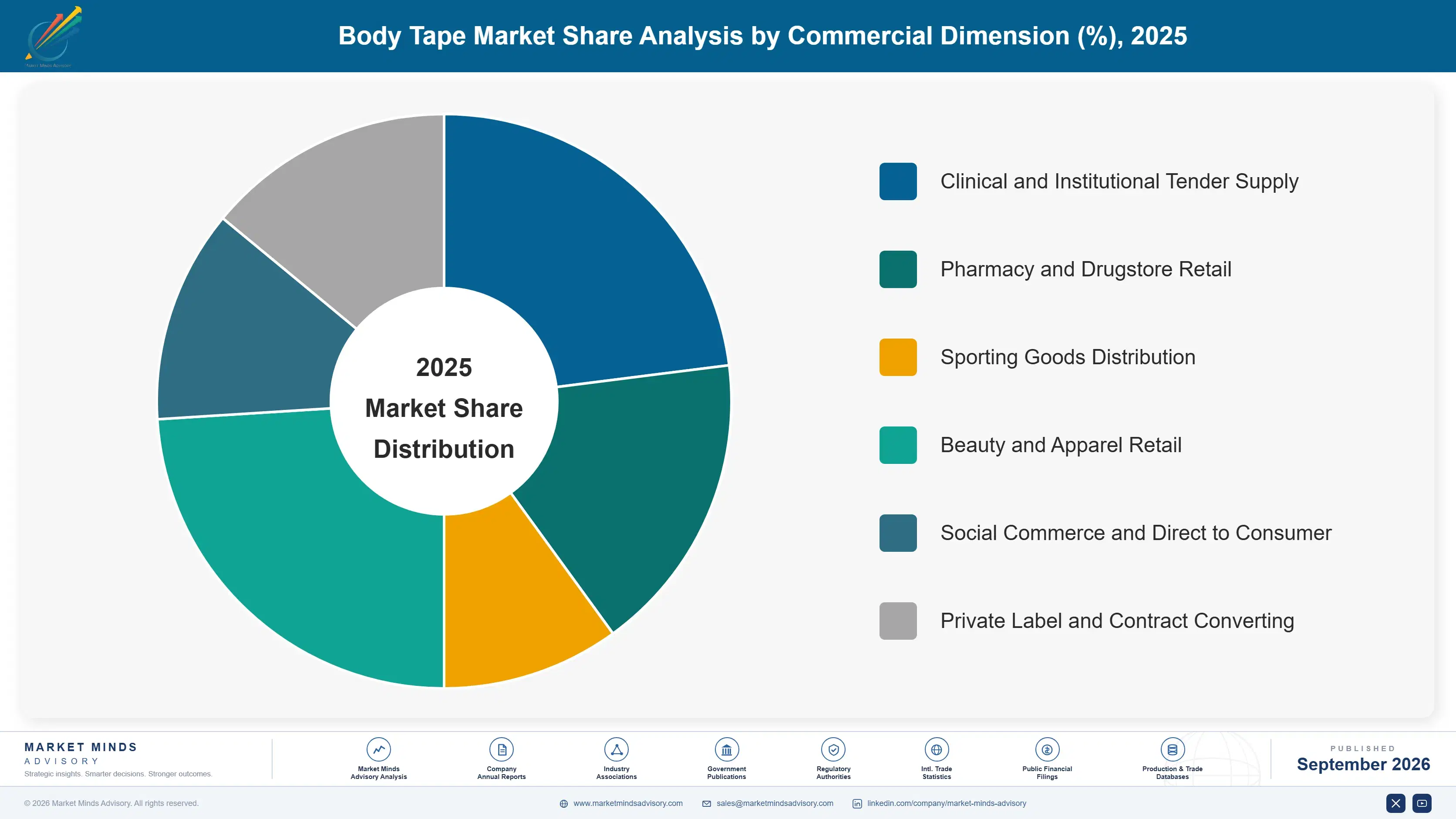
Segmentation follows tape function and construction class across six categories: kinesiology therapeutic tape, rigid athletic strapping tape, hypoallergenic underwrap and pre-tape, breast lift and body contour tape, garment and fashion double-sided tape, and cosmetic skin-smoothing tape. End-use setting, adhesive chemistry, and channel are treated as separate dimensions. Wound dressings, drug patches, and industrial tapes fall outside the defined scope entirely.
body-tape-market-market-share-analysis-1790020339677

Breast Lift And Body Contour Tape

Breast lift and body contour tape grows at 12.3%, half again the market rate of 8.2%, and it reached mass consumer scale entirely outside the channels the rest of this category uses. Social video demonstration rather than clinical recommendation drives discovery, and the buyer is choosing between products on hold strength and skin comfort rather than on any therapeutic claim. Adhesive performance in humidity is the binding technical constraint, since the fastest growing markets are also the hottest. Skin injury on removal is more common here than in athletic use, because application sites are more delicate and removal technique guidance is rarely supplied at all. Removal guidance is almost never supplied at all.
CAGR 12.3%

Garment And Fashion Double-Sided Tape

Garment and fashion double-sided tape grows at 10.6% on a straightforward job that has no clinical dimension at all: holding fabric against skin without visible fixing. The technical requirement is genuinely difficult, because the adhesive must bond to two dissimilar surfaces, survive body heat and movement for hours, and release from skin without injury afterwards. Most products optimise the fabric side and treat the skin side as an afterthought, which is where the complaints originate. Manufacturers designing both interfaces deliberately hold noticeably better repeat purchase. Distribution runs almost entirely through beauty and apparel retail rather than pharmacy. Most products optimise the fabric interface and treat the skin side as an afterthought.
CAGR 10.6%
Full segment breakdown across 6 segments available in the complete report.

Regional Architecture and Country Demand Map

Regional shares reflect where body tape is purchased for therapeutic and fashion use rather than where it is manufactured. Three regions sit outside the standard bands, for reasons named in their own paragraphs and summarised below for operator review. Humidity and channel structure vary sharply between them.

East Asia

At 34% this sits above the standard band, and the justification is that the region manufactures most of the world's skin-contact adhesive tape while Korean and Chinese beauty channels originated the fashion body tape category that now supplies much of the growth. Growth of 9.2% runs above the world rate. Japanese manufacturers hold the deepest positions in adhesive chemistry and in the hypoallergenic systems that address removal injury. Chinese converters supply most fashion tape volume at prices no other region approaches. Humidity across southern China and Southeast Asian export markets shapes adhesive specification directly. Fashion tape converting and clinical adhesive chemistry sit in entirely different companies across the region. Very little crosses between them.
Share: 34% | CAGR: 9.2% (2026 to 2036)

North America

Athletic and clinical use carries proportionally more of the regional market than anywhere else, supported by a large physical therapy profession and school and collegiate sports programmes. Growth of 7.6% runs a little under the world rate. Kinesiology tape reached mass awareness here first and has lost clinical credibility here fastest as reviews accumulated. Fashion body tape has grown quickly through beauty retail and direct channels without any crossover from the sports suppliers. Skin injury complaints are documented more thoroughly than in other regions, which is why the share is measurable. Sports medicine suppliers here hold almost none of the fashion segment despite owning adhesive technology that transfers directly into it.
Share: 22% | CAGR: 7.6% (2026 to 2036)
Regional intelligence for 5 additional markets available in the complete report: Western Europe, South Asia and Pacific, Latin America, Middle East and Africa, Eastern Europe. Contact sales@marketmindsadvisory.com.
body-tape-market-country-cagr-analysis-1790020340211

Where Tape Makers Build Position

Four commercial moves matter in a category whose mechanism claims did not survive review, whose failure mode is the removal rather than the hold, and whose fastest growth is happening in a channel its incumbents refuse to enter. Each replaces a claim with a measurement or a channel. Each is available now and none requires new adhesive chemistry.

Publish Measured Peel Adhesion And Removal Force

Around 34% of complaints cite skin damage on removal while about 7% of products publish any measured peel adhesion figure, which means a genuinely gentle adhesive competes against an aggressive one on identical marketing terms. Manufacturers publishing removal force alongside hold strength report price realisation 2.5 times higher in clinical and premium channels. The test is standard adhesive laboratory work costing very little. Its absence is why gentle adhesive development currently earns nothing at all. Clinicians tracking skin condition across a season are the buyers who will act on the figure first.
Market Impact: Raises achieved price realisation to 2.5 times higher

Reposition Kinesiology Onto Tactile Cueing Instead

Systematic reviews found no support for lymphatic or muscle activation claims, and around 62% of products still imply that colour matters. Manufacturers repositioning on proprioceptive cueing, which is genuine, report clinician retention 2.8 times higher than those defending the original mechanism. The repositioning costs a change of language rather than any reformulation. Clinicians who stopped believing the mechanism kept using the tape, and giving them an accurate reason to keep doing so is straightforwardly useful. Defending a claim that reviews have already dismantled costs credibility with exactly the professionals who decide institutional purchasing.
Market Impact: Raises clinician retention rates to 2.8 times higher

Enter The Fashion Channel Rather Than Ignoring It

Fashion and garment tape supplies about 43% of category revenue and grows at more than 10%, and established sports medicine suppliers hold almost none of it. Manufacturers building beauty retail and social commerce reach report category revenue growth 3.2 times faster than clinical-only competitors. The adhesive technology transfers directly and the channel does not. Declining to enter a segment because of where it sits culturally is a decision worth making deliberately rather than by omission. Operating the fashion range without therapeutic claims also avoids the medical device registration burden that clinical products carry in every market served.
Market Impact: Grows category revenue 3.2 times faster than peers

Formulate Adhesives For Humidity And Sebum

Real wear duration falls roughly 48% short of claims because figures are generated on degreased skin in controlled humidity, and the fastest growing markets are the hottest ones. Manufacturers designing for sebum tolerance rather than peak initial tack, and publishing wear time under stated conditions, report return rates 2.6 times lower in tropical markets. The physics is not negotiable and the disclosure is. Products shipped into these markets without reformulation fail visibly and quickly. Supplying preparation wipes alongside the tape closes part of the gap for nothing, and stating the conditions the figure was measured under closes the rest.
Market Impact: Cuts tropical return rates 2.6 times lower overall

Who Controls the Margin Pool

Concentration is very low. Five manufacturers hold 29% of category revenue, measured consistently on that basis across all participants, and the field divides sharply between medical adhesive groups serving clinical channels, sports medicine brands, beauty and fashion entrants who arrived through social commerce, and a large Chinese converting base supplying private label across every segment. The leader to challenger gap is wide in clinical adhesive chemistry and almost absent in fashion tape.
Competition currently turns on three dimensions: adhesive chemistry depth, particularly in systems that hold without stripping skin on removal; channel reach into beauty and social commerce, where most category growth is happening; and humidity and sebum tolerance, which decides performance in the fastest growing markets. Price decides in clinical and institutional tender, which still accounts for a substantial share of therapeutic volume across every region.

Pressure builds from two directions at once. Beauty and fashion entrants are taking the growth without any clinical credentials. Chinese converters supply private label at costs Western manufacturers cannot approach. Rankings will shift toward manufacturers holding gentle adhesive capability and genuine fashion channel presence rather than clinical heritage alone. Manufacturers holding only clinical channels are the most exposed of anyone here.
body-tape-market-company-positioning-matrix-1790020340737

Competitive Moat and Risk Dimensions

3M

Moat: Adhesive Chemistry And Clinical Position

Depth in skin-contact adhesive chemistry combined with an established clinical position gives access to hypoallergenic systems that hold acceptably while releasing without stripping skin. That capability addresses the failure mode driving most complaints in this category and is difficult for a converting-led competitor to replicate.
3M

Risk: Absent From Fashion Growth

The fashion and garment segment supplies about 43% of category revenue and grows fastest, and clinical adhesive credentials carry almost no weight with a buyer discovering the product through a demonstration video. Reaching that customer requires beauty retail and social commerce capability that a medical business is not organised to build.
NITTO DENKO

Moat: Converting Scale And Humidity Formulation

Adhesive formulation depth developed for humid Asian conditions produces products that hold where temperate specifications fail, which matters directly in the fastest growing regional markets. Converting scale also supports private label supply across segments that a branded-only manufacturer cannot serve profitably. Temperate formulations simply fail in those conditions.
NITTO DENKO

Risk: Limited Consumer Brand Presence

Strength in formulation and converting does not translate into brand position with fashion tape consumers, who buy on demonstration and social recommendation rather than on technical specification. Supplying the entrants taking that growth is profitable and captures a fraction of the value those brands realise.

Players Tracked

Prominent Players

3M
Nitto Denko
Mueller Sports Medicine
KT Health
Beiersdorf

Other Key Players

Johnson and Johnson
Smith and Nephew
Medline Industries
Cardinal Health
Nichiban
Kinesio Holding
Implus Footcare
Andover Healthcare
Milliken Healthcare
Lohmann and Rauscher
Scapa Group
Shurtape Technologies
Dr Fredericks Original
Jaybird and Mais
Yiwu Pengchuang Adhesive

Recent Developments

MARCH 2026

3M Publishes Peel Adhesion And Removal Force Across Its Tape Range

3M released measured peel adhesion and removal force figures alongside hold strength across its skin-contact tape products. The disclosure puts a comparable number where hold claims and colour coding have carried most of the category's marketing. Figures are stated per product rather than as a range across the range.
Signal: Removal force is the measurement that separates gentle adhesives from aggressive ones. Gentle adhesive development can finally be charged for.
SEPTEMBER 2025

Nitto Denko Expands Humidity-Tolerant Adhesive Production Capacity

Nitto Denko completed an organic expansion of humidity-tolerant skin adhesive manufacturing, funded internally with no partner involved. Management cited Southeast Asian fashion tape demand rather than any growth in clinical or athletic applications. Sebum tolerance rather than peak initial tack was the stated formulation target.
Signal: The hottest markets are growing fastest and temperate formulations fail there. Formulating for the condition beats shipping into it.
MAY 2025

Beiersdorf Acquires Fashion Body Tape Brand With Social Channel Reach

Beiersdorf completed an acquisition of a fashion body tape brand built through social commerce distribution. The transaction was an outright acquisition rather than a joint venture or minority stake, with channel reach cited as the stated rationale. The brand operates without therapeutic claims and carries no device registration.
Signal: Social channel capability is being bought because it cannot be built clinically. Clinical credentials carry no weight there.

What Skin Tape Costs

Three cost groups dominate. Adhesive systems and backing substrate run 34% to 42% of cost of goods sold, and the eight-point range separates silicone and acrylate hybrid systems from conventional acrylic adhesives. Coating and converting take 26% to 34%, rising for elastic knitted backings and precision die-cut fashion formats. Packaging and regulatory registration account for 20% to 28%, weighted heavily toward products carrying therapeutic claims.
Acrylate monomer and synthetic elastomer pricing moved through 2024 and 2025 on petrochemical feedstock and freight together, and American Chemistry Council statistics documented the underlying movements across the period. Several converters described silicone adhesive input costs as the faster-rising line in their annual reports. Cotton and synthetic backing substrate followed textile cycles unconnected to either of them. The three exposures moved independently across the period.

The competitive disadvantage mechanism runs through regulatory registration rather than through materials. A manufacturer carrying therapeutic claims registers as a medical device in every market it serves, while a fashion tape entrant making no such claim carries almost none of that burden on comparable adhesive technology. Exposure therefore varies by claim position rather than by scale, and clinical manufacturers entering fashion carry costs the entrants do not.
body-tape-market-cost-volatility-analysis-1790020340935

Separate Fashion And Therapeutic Product Registrations

Therapeutic claims trigger medical device registration in every market served, while an identical adhesive sold without those claims does not. Operating the fashion range as a distinct product line without therapeutic language removes a registration burden that competitors in that segment never carry, and it costs nothing technically. The adhesive itself can be identical across both lines.

Contract Acrylate And Silicone On Separate Calendars

Acrylate monomers follow petrochemical feedstock while silicone adhesive inputs follow an entirely separate specialty cycle with no meaningful relationship between them. Contracting the two independently rather than through one procurement view prevents a single approach from carrying exposure to markets that move for unrelated reasons. Silicone supply tightened while acrylate eased across the same window.

Convert Elastic Backings Close To Demand

Elastic knitted backings are bulky relative to their value and freight is a meaningful share of landed cost in distant markets. Converting close to the fastest growing regional demand rather than shipping finished rolls removes freight exposure and shortens the response time to humidity formulation requirements. Regional converting also shortens the humidity reformulation cycle considerably.

Portfolio Architecture for Margin Defence

Margin follows adhesive capability and claim position rather than format. Commodity rigid strapping competes close to converting terms against private label supply. Kinesiology tape earns moderately on brand and clinical familiarity. Hypoallergenic systems earn well where removal force is published and the gentleness is demonstrable, and fashion body contour tape earns most, because the buyer is comparing on hold and comfort without any reference price from a clinical channel.
The tension between volume and premium runs through who the buyer is and what they can verify. A physiotherapy purchaser buying strapping by the case is running a commodity purchase decided on price per roll. A consumer choosing body contour tape after watching a demonstration is buying confidence that it will hold through an evening and release without injury, and there is no established price anchor limiting what that is worth.

High-value pools concentrate in fashion body contour tape, in hypoallergenic systems with published removal force, and in humidity-tolerant formulations for tropical markets where temperate products fail visibly. Where the product is rigid athletic strapping sold by the case on price, Chinese converting capacity holds cost and there is very little differentiation available to anybody else.

Volume / Commodity-Adjacent

Rigid athletic strapping and basic underwrap sold by the case on price per roll into clinical and institutional channels. The ten-point range reflects converting scale and freight position rather than any adhesive capability a buyer evaluates at all.
Gross Margin: 26% to 36%

Premium / Certified

Kinesiology tape and branded athletic products carrying medical device registration and clinical channel presence. The twelve-point range separates genuine adhesive formulation from private label converting sold under a brand with colour options.
Gross Margin: 44% to 56%

Sustainability / Regulatory / Next-Generation

Fashion body contour tape and hypoallergenic systems with published removal force and humidity-tolerant formulation. The sixteen-point range reflects adhesive development depth and channel position, which very few participants hold together.
Gross Margin: 62% to 78%
body-tape-market-portfolio-architecture-1790020341440

High-value Sub-segments and Strategic Watch-out

Fashion Body Contour Tape

Highest value in the category, sold to a buyer with no clinical price anchor and reached entirely through demonstration rather than recommendation. The sixteen-point range reflects channel position, which sports medicine incumbents have almost entirely failed to build. The adhesive technology transfers and the channel does not.
Gross Margin: 64% to 80%

Published Removal Force Systems

High value addressing the skin damage behind about 34% of complaints, with a measurement almost nobody in the field publishes. The fourteen-point range reflects adhesive chemistry depth rather than any difference in backing or format. Clinicians tracking skin condition across a season act on it first.
Gross Margin: 54% to 68%

Humidity Tolerant Formulations

Volume core in exactly the markets growing fastest, where temperate specifications fail visibly within hours of application. The twelve-point range reflects formulation capability, since sebum tolerance and peak tack pull against each other directly. Most imported product is formulated for conditions it will never actually meet.
Gross Margin: 46% to 58%

Commodity Rigid Strapping Tape

The strategic watch-out. Slowest growing class, bought by the case on price per roll, with Chinese converting holding the cost position outright. The ten-point range reflects converting scale and freight alone, with nothing else defending it. Switching costs in tender purchasing are close to zero.
Gross Margin: 24% to 34%

How This Demand Repeats

This is a genuine consumable and it repeats on use rather than on any purchase decision. A physiotherapy clinic reorders strapping on patient volume, an athlete replaces tape after every application, and a consumer using body contour tape for occasions buys again when the roll runs out. That makes the category unusually predictable, and it means the value of a customer is set by application frequency rather than by loyalty.
Repeat behaviour differs sharply by half. Clinical purchasing runs on tender and price per roll with switching costs close to zero, so a supplier holding that volume holds it only while the price holds. Fashion purchasing runs on a specific product that worked at a specific event, and a consumer who taped successfully once repurchases the same brand almost automatically rather than comparing again.

The buyer profile is diverging rather than shifting. Clinicians are becoming more sceptical about mechanism claims and more interested in removal force and skin condition over a season. Fashion consumers are becoming more demanding about humidity performance as the category spreads into hotter markets. Manufacturers organised around one conversation are increasingly unable to hold the other.
body-tape-market-end-use-penetration-index-1790020341932

Where This Market Rewards

These are among the four positions where our research anticipates prominent divergence between winners and laggards over the coming forecast period. Each is grounded in the demand model, the regulatory perimeter, and the announced capacity pipeline.
01 / REMOVAL FORCE PUBLISHING

The peel is what injures

Around 34% of complaints cite skin damage on removal while only about 7% of products publish any measured peel adhesion figure, which leaves a genuinely gentle adhesive competing on identical marketing terms with an aggressive one. Manufacturers publishing removal force alongside hold strength report price realisation 2.5 times higher in clinical and premium channels. The test is standard adhesive laboratory work, and its absence is why gentle adhesive development earns nothing, and clinicians tracking skin condition across a season will act on the figure first.
02 / CUEING CLAIM REPOSITIONING

The colours never did anything

Systematic reviews found no support for lymphatic or muscle activation claims, and about 62% of kinesiology products still imply the colour changes what the tape does. Manufacturers repositioning on proprioceptive cueing, which is a genuine and demonstrable effect, report clinician retention 2.8 times higher than those defending the original mechanism. Clinicians who stopped believing the mechanism kept using the tape, and an accurate reason costs only a change of language, and defending a dismantled claim costs credibility with the professionals deciding institutional purchasing.
03 / FASHION CHANNEL ENTRY

Forty-three per cent and rising

Fashion and garment tape supplies about 43% of category revenue and grows at more than ten per cent, while established sports medicine suppliers hold almost none of it despite owning the adhesive technology. Manufacturers building beauty retail and social commerce reach report category revenue growing 3.2 times faster than clinical-only competitors. Declining to enter a segment on cultural grounds is a decision worth taking deliberately rather than arriving at by omission, and operating without therapeutic claims avoids the device registration burden entirely as well.
04 / HUMIDITY FORMULATION DESIGN

Hot markets break temperate adhesives

Real wear duration falls roughly 48% short of claims because figures come from degreased skin in controlled humidity, and the fastest growing markets in this category are also the hottest ones. Manufacturers designing for sebum tolerance rather than peak initial tack, and publishing wear time under stated conditions, report return rates 2.6 times lower in tropical markets. The physics is not negotiable and the disclosure entirely is, and supplying preparation wipes closes part of that gap for almost nothing at all.

Engagement Snapshot From the Field

A live engagement with an industry participant carrying material or product regulatory and market exposure ahead of a defining policy shift, showing how our research translates into a defensible multi-year portfolio strategy.
MARKET MINDS ADVISORY · CLIENT ENGAGEMENT SUMMARY
Body Tape Producer Strategic Portfolio Review and Transition Roadmap 2026·Investment Scenario on Body Tape Exposure Evaluation 2025-26
CLIENT PROFILE
A sports medicine supplier with skin tape revenue near USD 84 million (client-reported, unverified by MMA) across North America, Western Europe, and Australia. Kinesiology tape revenue had been flat for four years while the overall category grew, and management had commissioned a review of whether to exit the product line entirely. No adhesive testing against fashion benchmarks had been run.
STRATEGIC CHALLENGE
The flat performance was being read as category decline, when the category was growing rapidly in a segment the business had no presence in and no route to. Nobody had assessed whether the company's adhesive technology transferred into fashion tape, or what clinicians actually still valued about the product. Flat revenue was being read as category decline.
MMA APPROACH
MMA sized the fashion and therapeutic halves separately, surveyed clinicians on why they continued using kinesiology tape after the mechanism reviews, tested the company's adhesives against fashion tape benchmarks including humidity performance, and modelled channel entry against product line exit. Clinicians were surveyed on continued use rather than on belief, so the answer described behaviour rather than opinion.
KEY FINDINGS
  1. The category was growing at more than eight per cent while the client's segment was flat, because fashion and garment tape supplied most of the growth and the client sold none of it.
  2. Clinicians continuing to use kinesiology tape overwhelmingly cited proprioceptive cueing rather than any lymphatic or activation effect, which the client's marketing still led with.
  3. The client's hypoallergenic adhesive outperformed every fashion tape benchmark tested on removal force while matching them on hold strength. Nobody internally had tested that.
  4. Humidity testing showed the client's formulations holding well beyond the benchmarks, an advantage worth most in exactly the markets growing fastest. That advantage had never been marketed.
CLIENT PROFILE
A sports medicine supplier with skin tape revenue near USD 84 million (client-reported, unverified by MMA) across North America, Western Europe, and Australia. Kinesiology tape revenue had been flat for four years while the overall category grew, and management had commissioned a review of whether to exit the product line entirely. No adhesive testing against fashion benchmarks had been run.
STRATEGIC CHALLENGE
The flat performance was being read as category decline, when the category was growing rapidly in a segment the business had no presence in and no route to. Nobody had assessed whether the company's adhesive technology transferred into fashion tape, or what clinicians actually still valued about the product. Flat revenue was being read as category decline.
MMA APPROACH
MMA sized the fashion and therapeutic halves separately, surveyed clinicians on why they continued using kinesiology tape after the mechanism reviews, tested the company's adhesives against fashion tape benchmarks including humidity performance, and modelled channel entry against product line exit. Clinicians were surveyed on continued use rather than on belief, so the answer described behaviour rather than opinion.
KEY FINDINGS
  1. The category was growing at more than eight per cent while the client's segment was flat, because fashion and garment tape supplied most of the growth and the client sold none of it.
  2. Clinicians continuing to use kinesiology tape overwhelmingly cited proprioceptive cueing rather than any lymphatic or activation effect, which the client's marketing still led with.
  3. The client's hypoallergenic adhesive outperformed every fashion tape benchmark tested on removal force while matching them on hold strength. Nobody internally had tested that.
  4. Humidity testing showed the client's formulations holding well beyond the benchmarks, an advantage worth most in exactly the markets growing fastest. That advantage had never been marketed.
RECOMMENDED STRATEGY
Phase 1: Phase one: retain the product line, reposition kinesiology marketing onto tactile cueing, and publish measured removal force across the range. Phase 2: Phase two: launch a fashion body contour range under a separate brand without therapeutic claims, avoiding the device registration burden. Phase 3: Phase three: build social commerce distribution for that range rather than routing it through clinical or sporting goods channels. Keep the two brands commercially separate.
OUTCOME
The product line was retained and the fashion range reached profitability within its first year (client-reported, unverified by MMA). Clinician repurchase improved after the repositioning. Removal force now appears on every product the business sells worldwide. Two competitors have since published comparable removal force data.

Frequently Asked Questions

Foundational context covering the market sizes, CAGR, scope, country, region and competition that inform every finding below. This section is provided to cover basics and most often pre-purchase conversations, answered from the MMA Primary Research Dataset.

What is the current size of the Body Tape Market?

The market was worth USD 1.9 billion in 2025 and stands at USD 2.1 billion in 2026. Value covers skin-applied adhesive tapes for support, positioning, and garment adherence at manufacturer selling price.

How large will the Body Tape Market be by 2036?

MMA forecasts USD 4.6 billion by 2036, an increase of USD 2.5 billion across the forecast period. That represents 2.19 times the 2026 base of USD 2.1 billion.

What is the CAGR for the Body Tape Market 2026 to 2036?

The base case compound annual growth rate is 8.2%, with a bull case at 9.4% and a bear case at 7.0%. Historical growth from 2020 to 2025 ran at 7.1%.

Which segment is growing fastest?

Breast lift and body contour tape grows at 12.3%, half again the market rate of 8.2%. It reached mass scale entirely outside the clinical channels the rest of the category uses.

Who are the major companies in the Body Tape Market?

3M, Nitto Denko, Mueller Sports Medicine, KT Health and Beiersdorf lead the field. Together they hold only 29% of category revenue, with fashion entrants taking most of the growth.

Which country is growing fastest?

Indonesia grows at 14.2%, on social commerce reach that puts body contour tape in front of a large young population through demonstration video rather than retail shelves.

Report Segmentation Architecture

The full report scope spans multiple orthogonal segmentation dimensions, with cross-tabulated demand data provided for each dimension pair. Coverage extends further to regional breakdowns, trend trajectories, and the competitive detail needed to support segment-level decision-making.

By Tape Function and Construction

  • Kinesiology Therapeutic Tape
  • Rigid Athletic Strapping Tape
  • Hypoallergenic Underwrap and Pre-Tape
  • Breast Lift and Body Contour Tape
  • Garment and Fashion Double-Sided Tape
  • Cosmetic Skin-Smoothing Tape

By End-Use Industry

  • Physiotherapy and Rehabilitation Clinics
  • Professional and Collegiate Sport
  • Recreational Athletic Use
  • Fashion and Occasion Wear
  • Everyday Consumer Garment Use
  • Performing Arts and Entertainment

By Commercial Dimension

  • Clinical and Institutional Tender Supply
  • Pharmacy and Drugstore Retail
  • Sporting Goods Distribution
  • Beauty and Apparel Retail
  • Social Commerce and Direct to Consumer
  • Private Label and Contract Converting

By Region

  • East Asia
  • North America
  • Western Europe
  • South Asia and Pacific
  • Latin America
  • Middle East and Africa
  • Eastern Europe

Scope, Methodology, and Coverage

Every figure in this report is reproducible from documented input assumptions. The scope below maps the historical period, the forecast horizon, the segmentation dimensions, and the countries covered, alongside the underlying primary and qualitative methodology.
Historical Period
2020 to 2025
Forecast Period
2026 to 2036
Base Year
2025 (USD billions; MMA Primary Research Dataset, September 2026)
Market Definition
This market covers adhesive tapes applied directly to skin for support, positioning, or garment adherence, across kinesiology therapeutic tape, rigid athletic strapping tape, hypoallergenic underwrap and pre-tape, breast lift and body contour tape, garment and fashion double-sided tape, and cosmetic skin-smoothing tape. It excludes surgical and wound closure tapes, adhesive bandages and dressings, transdermal drug patches, industrial and packaging tapes, and hair and wig adhesives.
Quantitative Units
USD billions, revenue at manufacturer selling price
Segmentation Dimensions
Tape function and construction, end-use setting, commercial dimension, region
Regions Covered
East Asia, North America, Western Europe, South Asia and Pacific, Latin America, Middle East and Africa, Eastern Europe
Countries Covered
China, Japan, South Korea, Taiwan, Indonesia, India, Philippines, Thailand, Vietnam, Australia, United States, Canada, Mexico, Germany, Netherlands, United Kingdom, France, Italy, Spain, Poland, Czechia, Brazil, Argentina, Colombia, Chile, Saudi Arabia, United Arab Emirates, Turkey, Egypt, South Africa
Key Companies Profiled
3M, Nitto Denko, Mueller Sports Medicine, KT Health, Beiersdorf, Johnson and Johnson, Smith and Nephew, Medline Industries, Cardinal Health, Nichiban, Kinesio Holding, Implus Footcare, Andover Healthcare, Milliken Healthcare, Lohmann and Rauscher, Scapa Group, Shurtape Technologies, Dr Fredericks Original, Jaybird and Mais, Yiwu Pengchuang Adhesive
Quantitative Methodology
Primary survey, n=3,800 respondents, Q4 2025, six countries; demand-side model with trade association cross-validation
Qualitative Methodology
47 expert interviews, Q4 2025; applied to validate demand model assumptions, identify emerging dynamics, and assess competitive positioning
Report Format
PDF and XLSX data workbook (Word format preview document)
Publisher
Market Minds Advisory
Report Code
MMA-2026-MED-681
Published
September 2026
Contact
sales@marketmindsadvisory.com | www.marketmindsadvisory.com

Purchase the full Body Tape Market Report (2026 to 2036).

The full report sizes the body tape market across six function and construction classes, seven regions, and thirty countries, with forecasts to 2036 under base, bull, and bear cases. It separates the fashion half of the category from the therapeutic half, assesses the evidence behind kinesiology mechanism and colour claims, and quantifies skin injury complaints against peel adhesion disclosure. Competitive analysis covers twenty participants evaluated consistently on category revenue, with detailed treatment of adhesive chemistry depth and social commerce channel reach. Humidity performance and regulatory registration burden are analysed throughout. Primary research includes 3,800 survey responses and 47 expert interviews.
Six function and construction classes sized separately
Twenty participants evaluated on category revenue consistently
Fashion revenue separated from therapeutic revenue throughout
Kinesiology mechanism and colour claims assessed against published review evidence
Skin injury complaints measured against peel adhesion disclosure
Claimed wear time compared with duration achieved in use

Built For The People Who Decide

From boardroom strategy to bench-side execution, this report is read cover-to-cover by leaders shaping the next decade of their industry, turning demand scenarios, market dynamics and valuation benchmarks into decisions.
CXOs/ Presidents/ VPs/ Managers
M&A and Corporate Development
Strategy Teams and R&D Heads
Procurement and Product Directors
Regulatory and Compliance Leaders
Investor Relations and Equity Analysts