

Market Minds Advisory
Blow Molding Resin Market

Blow Molding Resin Market: Recycled-Content Certification Redefines Resin Supply

Blow molding resin demand is shifting from generic commodity HDPE and PET supply toward certified recycled-content and barrier-layer formulations, as producer responsibility regulation forces converters to compete on documented material traceability rather than resin price.

Lead Analyst

Bilal Shaikh

Published

September 2026

Make Smarter Decisions with Customized Research Insights

Request a free sample report and evaluate market opportunities, growth trends, and competitive dynamics relevant to your business needs.

2025 MARKET VALUE$6.8BMarket Size 2025
2036 FORECAST VALUE$12.2BBase Case , 2026 to 2036
CAGR 2026 TO 20365.4 %Bull 6.6% / Bear 4.2%
INCREMENTAL OPPORTUNITY$5.0BNet 10- year value creation
EXPANSION MULTIPLE1.69x2036 value over 2026 base
Strategic Levers
M&A Pipeline
Regional Outlook
Country Rankings
Competitive Intelligence
Segmental Deep-dive
Call-Us : 91 93563 13602

Executive Snapshot and Market Trajectory

Plastic converters no longer buy blow molding resin on commodity price alone. Extended producer responsibility regulation now dictates recycled-content thresholds, pushing packaging and automotive customers to specify resin grades with documented traceability rather than lowest delivered cost, reshaping how producers compete for large multi-year converter supply contracts.
Growth right now is concentrated in bio-based and recycled-content formulations, as brand owners commit to recycled-content targets ahead of regulatory deadlines across major packaging categories. East Asia now holds the largest share of global demand, anchored by the sheer scale of China's petrochemical cracking and resin production capacity, while South Asia and Pacific grows fastest as Vietnam's expanding beverage packaging and consumer goods manufacturing base scales alongside rising export-oriented plastic converting investment nationwide.
Capacity expansions at integrated cracking complexes, not large mergers, are how petrochemical majors are consolidating supply here, as established producers add recycled-content processing capability ahead of competitors still relying on virgin resin output alone. Competitive pressure is intensifying as Asian producers undercut established Western and Middle Eastern suppliers on price for standard commodity grades, while tightening extended producer responsibility regulation pushes smaller converters to source certified recycled-content resin they previously avoided, forcing supply reformulation.
Market Definition
The blow molding resin market covers HDPE, PET, PP, PVC, multilayer barrier, and bio-based or recycled-content resin formulations engineered specifically for extrusion and injection blow molding processes used to produce bottles, containers, drums, and automotive fuel tanks. It excludes resin grades formulated exclusively for injection molding, film extrusion, or fiber spinning applications.
Base Year Value
$6.8B in 2025 (MMA Primary Research Dataset, August 2026)
Forecast Period
2026 to 2036, eleven discrete annual values
CAGR
5.4% base case. Bull 6.6%. Bear 4.2%.
Fastest Growth Segment
Bio-based and Recycled-Content Blow Molding Resin: 9.6% CAGR
Fastest Growth Country
Vietnam: 9.4% CAGR
Fastest Growth Region
South Asia and Pacific: 7.5% CAGR
Largest Region
East Asia: 30% of 2025 global value
Market Leaders
ExxonMobil Chemical Company, LyondellBasell Industries N.V., Dow Inc., Indorama Ventures Public Company Limited, SABIC. Source: MMA Analysis based on company annual reports.
Primary Survey
n=3,800 procurement and R&D decision-makers, Q4 2025, six countries
Methodology
Demand-side build-up, cross-validated against public data, 47 expert interviews

Blow Molding Resin Market Forecast Scenarios

blow-molding-resin-market-size-forecast-scenario-1787302562273
Between 2020 and 2025 the market grew at roughly 4.8% a year, recovering from pandemic-era packaging demand disruption before accelerating as beverage and consumer goods converters resumed deferred capacity investment. Stricter extended producer responsibility regulation introduced during the period pushed converters toward recycled-content resin grades, pulling compliant producers ahead of competitors still selling standard virgin-resin formulations.
The base case carries the market to 12.2 billion dollars by 2036 on three mechanisms. First, extended producer responsibility mandates are converting standard virgin-resin contracts into certified recycled-content and bio-based supply agreements across most packaging categories. Second, East Asian petrochemical capacity is scaling faster than the traditional Western and Middle Eastern production base that historically anchored global blow molding resin supply. Third, beverage and consumer goods packaging growth in South Asia and Pacific is creating resin demand that did not previously exist at meaningful scale.
The bull case reaches roughly 6.6% annual growth if recycled-content mandates accelerate faster than currently scheduled and beverage packaging investment expands ahead of plan. The bear case falls near 4.2% if consumer goods output slows on macroeconomic headwinds and converters defer recycled-content upgrades to manage capital budgets during periods of weaker packaging investment nationwide across major consumer markets.

Where Recycled-Content Certification Redefines Resin Specification

Blow molding resin used to be a straightforward commodity purchase decided mostly on delivered price and melt-flow index; now packaging and automotive converters specify resin grades against documented recycled-content share and traceability records before approving a supplier for large-scale brand-owner contracts. Every batch must demonstrate a measurable material-composition outcome a converter can present to sustainability auditors and regulators alike. That documented composition, not delive
MARKET CONCENTRATION (CR5)38%Top five producers hold over a third of volume
AVERAGE SELLING PRICEUSD 1,180 per metric tonBlended price across HDPE, PET, and PP grades
TOP PRODUCING COUNTRY SHAREChina, 27% of global outputLargest single national source of blow molding resin
RECYCLED-CONTENT GRADE PENETRATION22% of volume certifiedShare of output meeting current brand-owner recycled-content commitments
TRADE INTENSITY24% cross-borderAbout a quarter of resin volume crosses a border
FEEDSTOCK COST SHARE52% of cost of goods soldShare of production cost attributable to ethylene and paraxylene
Commercially the market behaves like a specification-driven compliance business wearing a commodity petrochemical label. Feedstock cost is a substantial share of unit price; the recycling infrastructure and traceability certification investment required to substantiate a recycled-content claim drives most of the value premium producers capture. Converters rarely switch suppliers once a producer clears their approved-vendor qualification review, since switching means restarting a lengthy requalification process against an unproven alternative.
The next decade turns on three forces: producer responsibility mandates converting virgin-resin contracts into certified recycled-content categories, East Asian petrochemical capacity scaling ahead of Western and Middle Eastern supply, and packaging growth in South Asia creating demand that did not previously exist. Producers positioned across all three will set the pace industry-wide, while single-lever specialists fall behind.
"A resin lot that can't prove its recycled content isn't just a compliance headache, it's a lost contract with any brand owner reporting to regulators. That's why converters want the chain-of-custody paperwork, not just the pellets."
Director, Polymer and Packaging Materials Practice · MMA Chemicals and Materials

Market Trends

Certified Recycled-Content Grades Gain Broad Specification

Recycled-content blow molding resin grades engineered to document validated post-consumer material share and consistent processing performance have moved from specialized pilot packaging programs into standard procurement specifications across beverage, household, and personal care categories. Brand owners now request documented chain-of-custody certificates and traceable batch records before qualifying a new resin supplier, converting what was once a differentiating premium feature into a baseline procurement requirement undifferentiated virgin-resin producers can no longer avoid. That specification shift has compressed the timeline producers have to build accredited recycling infrastructure before losing contract renewal opportunities to better-prepared competitors already holding recognized certifications.
Market Impact: Adds demand from 2.1 million tons

East Asian Petrochemical Scale Reshapes Supply

China's integrated petrochemical cracking and resin production complex has scaled blow molding resin capacity far faster than Western and Middle Eastern markets over the past five years, converting the region into the world's largest single source of both consumption and production capacity. That capacity growth has let regional producers win multi-year converter supply contracts directly from packaging manufacturers that previously sourced exclusively from established Western producers. Western and Middle Eastern producers are responding by expanding regional production and investing more heavily in recycled-content processing technology that Asian competitors cannot yet replicate at comparable cost.
Market Impact: Adds 3,400 brands to compliance sco

Market Opportunities and Growth Drivers

Beverage Packaging Growth Expands Resin Demand

New beverage and consumer goods packaging capacity across South Asia, East Asia, and Latin America is creating blow molding resin demand that did not previously exist at meaningful commercial scale, since each new bottling and container production line requires a complete initial resin supply agreement before production can begin. That construction-driven demand behaves differently from replacement demand in mature markets, since new converters specify resin grades fresh rather than working around existing supplier relationships built over years. Producers with established regional distribution are capturing that new-facility demand directly from global suppliers still building equivalent regional infrastructure.
Market Impact: Cuts producer margins by 6 points

Producer Responsibility Regulation Raises Content Standards

Updated extended producer responsibility guidance from national and regional environmental regulators has raised the certified recycled-content threshold packaging brand owners must demonstrate before regulators will approve continued market access across most beverage and household product categories. That regulatory tightening has pulled a much broader share of converter capital budgets toward certified recycled-content resin supply, since sustainability auditors increasingly flag uncertified virgin-resin packaging as a compliance risk during routine brand reporting reviews. Producers with established recycling and traceability infrastructure are capturing that expanding compliance-driven budget directly from suppliers still relying on legacy virgin-resin specifications that predate current content requirements.
Market Impact: Delays contract onboarding by 6 wee

Market Restraints and Challenges

Feedstock Cost Volatility Pressures Producer Margins

Ethylene and paraxylene inputs, the base feedstocks for most blow molding resin production, have experienced sharp price swings tied to crude oil and natural gas commodity markets, and that volatility has squeezed producer margins that converter supply contracts typically fix for multi-year terms without adjustment clauses. The root cause is that most supply contracts were negotiated before volatility became a persistent feature of petrochemical feedstock markets, leaving producers exposed to cost increases they cannot pass through until renewal. Some producers are responding by negotiating shorter contract terms with price adjustment clauses tied to published indices.
Market Impact: Cuts virgin resin dependency by 19%

Recycling Infrastructure Gaps Limit Content Supply

Certified post-consumer recycling infrastructure remains limited relative to the pace of rising recycled-content demand, and producers serving multiple simultaneous brand-owner commitments face real allocation constraints whenever several major converters require certified recycled-content supply within the same qualification window. The root cause is that recycling collection and processing infrastructure investment has not scaled as fast as brand-owner commitments themselves, so producers compete directly for a limited pool of certified recycled feedstock across most regions. That capacity constraint creates real allocation risk for converters working against fixed compliance deadlines. Some producers are responding by investing in additional recycling capacity directly.
Market Impact: Shifts 18% of supply to Asia
3 additional market trends, 4 additional growth drivers, and 3 additional restraints and challenges are covered in the full report. Contact sales@marketmindsadvisory.com to access the complete intelligence.

Segment CAGR and Growth Architecture

Segmentation follows resin technology, a single materials-logic that groups blow molding resin by the polymer chemistry and processing formulation a grade uses rather than by which converter industry eventually purchases the finished pellets. Each technology category carries its own processing specification, certification pathway, and pricing structure, so commercial position tracks the resin technology rather than the buyer industry.
blow-molding-resin-market-market-share-analysis-1787302562815

Bio-based and Recycled-Content Blow Molding Resin

Bio-based and recycled-content blow molding resin grows fastest at 9.6%, about 1.78 times the overall market rate, as brand owners commit to recycled-content targets ahead of regulatory deadlines across major beverage and household packaging categories. Beverage and personal care converters dominate current volume, valued for certified post-consumer material share and documented chain-of-custody records that sustainability auditors and regulators increasingly require before approving continued market access. The segment commands premium pricing relative to virgin-resin formulations, reflecting both the specialized recycling investment involved and the certification testing producers have made to support specific content claims. Producers with early recycling investment are winning premium contracts directly from suppliers still relying on standard virgin-resin output that brand owners increasingly reject.
CAGR 9.6%

Multilayer Barrier Blow Molding Resin

Multilayer barrier blow molding resin grows second-fastest at 7.8%, driven by automotive fuel-tank and food packaging applications where permeation control regulation mandates the highest available level of barrier protection. The technology uses co-extruded layer structures engineered for oxygen and hydrocarbon barrier performance compared with single-layer resin formulations that provide comparatively lower protection for lower-barrier applications. Growth concentrates specifically among automotive, industrial chemical, and specialty food packaging applications, where permeation risk and expanding regulatory enforcement increasingly favor multilayer barrier resin over single-layer alternatives previously deemed acceptable. Producers with validated barrier certification and testing capability are winning specification directly from suppliers whose offerings lack comparable certified performance history across major automotive supply programs.
CAGR 7.8%
Full segment breakdown across 6 segments available in the complete report.

Regional Architecture and Country Demand Map

Supply concentrates where petrochemical cracking scale and integrated production infrastructure intersect, which increasingly means East Asia rather than the historically dominant Western and Middle Eastern base. China's sheer cracking capacity is pulling production east even as North America retains meaningful specialty-grade output serving domestic converters directly.

North America

North America holds 23% of global value, retaining meaningful specialty-grade production capacity serving domestic packaging and automotive converters directly. ExxonMobil and Dow both maintain established manufacturing and distribution operations, giving American converters direct access to certified resin supply generated specifically for local regulatory requirements. Growth of 5.9% tracks steady conversion of standard virgin-resin contracts into certified recycled-content alternatives, rather than any single dominant demand driver alone across the market. The region's established regulatory infrastructure means new resin specifications often gain acceptance here first before expanding into other markets worldwide, giving domestic producers a genuine first-mover certification advantage over slower-moving international rivals across most categories, regional markets, and converter segments nationwide.
Share: 23% | CAGR: 5.9% (2026 to 2036)

Western Europe

Western Europe accounts for 19% of value, a mature base shaped by some of the world's most established plastics circularity regulatory infrastructure and converter procurement sophistication anywhere. Borealis and INEOS both run substantial European manufacturing and distribution operations, positioned to serve the continent's increasingly standardized procurement framework under EU packaging and packaging waste regulation. Regulatory scrutiny over recycled-content claims and traceability runs notably stricter here than in less-regulated markets, pushing producers toward extensively documented, evidence-backed certification from the outset of any product launch. Growth of 3.9% trails the global rate directly because the region's blow molding resin market, while sophisticated, is growing more slowly than the newer capacity scaling across Asian markets.
Share: 19% | CAGR: 3.9% (2026 to 2036)
Regional intelligence for 5 additional markets available in the complete report: East Asia, South Asia and Pacific, Latin America, Middle East and Africa, Eastern Europe. Contact sales@marketmindsadvisory.com.
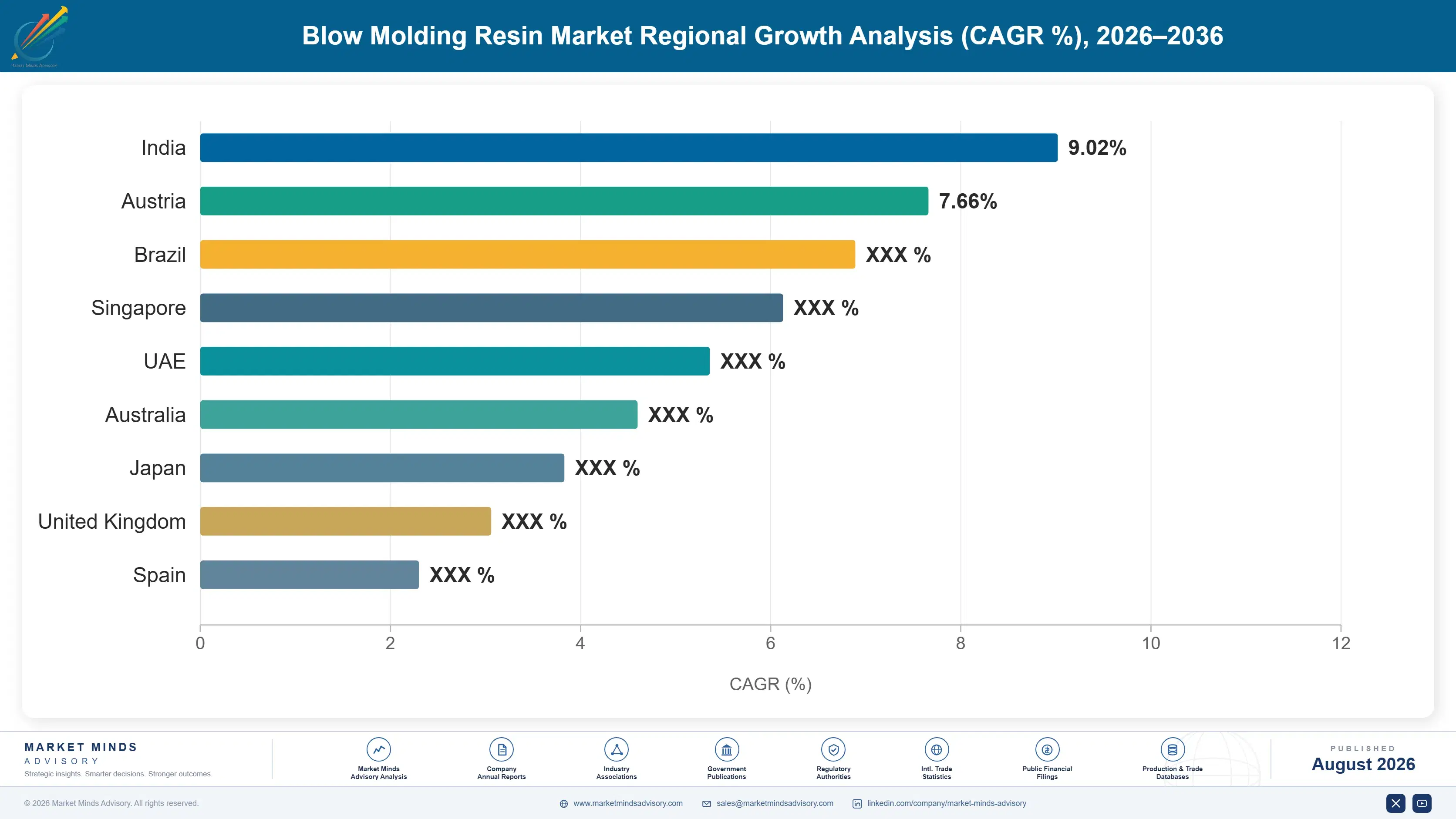
blow-molding-resin-market-country-cagr-analysis-1787302563321

How Producers Can Capture Recycled-Content Value

Selling blow molding resin on commodity price alone leaves the highest-margin part of this market on the table. The four moves below shift revenue toward positions that command a premium over standard virgin-resin supply: certified recycled-content documentation, regional manufacturing localization, recycling capacity investment, and long-term qualified-supplier contracts that smaller competitors cannot easily replicate quickly.

Invest In Certified Recycled-Content Documentation Systems

Producers that invest in certified recycled-content documentation and traceability testing capability, rather than relying on third-party auditors for every batch, capture a documented price premium of roughly 16% to 27% from brand owners that increasingly require certified chain-of-custody data before qualifying a new resin supplier. That documentation investment costs real money and takes time to build, but it converts a generic commodity sale into producer-specific, defensible content evidence competitors relying on slower third-party audit queues cannot match on speed. LyondellBasell and Indorama have both built in-house certification programs to capture this premium ahead of smaller regional competitors.
Market Impact: Captures a 16% to 27% certified rec

Localize Production Closer To Converter Hubs

Producers that build regional production capacity closer to major beverage and packaging converter hubs, rather than shipping resin from centralized global production facilities, capture faster delivery times and reduced logistics cost that increasingly matter to converters managing tight production schedules. That localized capacity typically captures 10% to 18% more contract value than centralized production models, since converters increasingly weight supply chain reliability alongside price when qualifying resin suppliers for multi-year contracts. Producers with established regional manufacturing footprints are winning contract renewals directly from suppliers still shipping product from distant centralized facilities with longer lead times.
Market Impact: Captures 10% to 18% more contract r

Expand Recycling Capacity For Certified Supply

Producers that invest in dedicated recycling and reprocessing capacity for certified recycled-content grades, rather than allocating standard virgin-resin lines to premium orders, capture faster qualification turnaround and reduced allocation risk that increasingly matters to converters managing fixed compliance deadlines against tight qualification windows. That recycling investment typically captures 13% to 23% more contract value than competitors relying on shared standard-grade production capacity, since converters increasingly weight supply reliability alongside price when qualifying suppliers for multi-year contracts. Producers with established dedicated recycling lines are winning contract renewals directly from competitors still facing capacity allocation constraints across major qualification cycles.
Market Impact: Captures 13% to 23% more contract r

Offer Long-Term Qualified-Supplier Volume Supply Contracts

Producers that offer long-term qualified-supplier volume contracts, rather than selling resin on a spot-market transactional basis, capture recurring revenue that funds recycling and testing investment competitors dependent on inconsistent spot-market sales cannot easily match. That contract structure typically captures 12% to 21% more lifetime customer value than spot sales, since predictable recurring revenue reduces customer acquisition cost pressure and lets producers invest further ahead of near-term sales results across the business. Producers with established long-term contract programs are winning renewals directly from competitors selling resin without any ongoing qualified-supplier relationship in place today.
Market Impact: Captures 12% to 21% more lifetime c

Who Controls the Margin Pool

Concentration sits at a moderate CR5 of 38%, split between integrated petrochemical majors with broad platform reach and specialized recycled-content processors with narrower but deeper certification depth. The gap between the top five and the next tier is real but moderate: leaders combine feedstock integration with established recycling infrastructure, while challengers typically compete only on regional commodity supply. All participants are assessed on one basis: disclosed blow molding resin
Competition today runs across three dimensions. First, certified recycled-content depth, since a producer with published traceability data wins contracts competitors relying on unverified claims cannot match. Second, regional manufacturing capability, as producers with localized production can offer delivery speed competitors shipping from distant facilities cannot sustain. Third, feedstock integration, since producers with captive ethylene and paraxylene supply capture margin protection competitors reliant on merchant feedstock cannot access.

Pressure is building from Asian producers who have closed much of the certification gap on standard grades while undercutting incumbents sharply on price. Regional recyclers are pushing into premium content territory, competing directly against established producers on certification positioning. Rankings will shift toward producers who pair certification depth with genuine feedstock integration, since neither alone wins the largest contracts.
blow-molding-resin-market-company-positioning-matrix-1787302563852

Competitive Moat and Risk Dimensions

EXXONMOBIL CHEMICAL COMPANY

Moat: Integrated Feedstock And Cracking Scale

ExxonMobil Chemical operates integrated feedstock and cracking scale spanning ethylene, polyethylene, and downstream blow molding resin capacity that smaller standalone producers cannot replicate without years of comparable capital investment. That integration lets ExxonMobil protect margin during feedstock volatility that competitors reliant on merchant ethylene supply cannot credibly match.
EXXONMOBIL CHEMICAL COMPANY

Risk: Broad Portfolio Limits Grade Focus

ExxonMobil's broad petrochemical portfolio means blow molding resin-specific recycling innovation investment competes internally against dozens of other product categories for capital and management attention, limiting how quickly it can respond to emerging recycled-content specification trends. Specialized recycled-content competitors can move faster on certification innovation, potentially capturing premium brand-owner contracts before ExxonMobil's broader portfolio can respond.
LYONDELLBASELL INDUSTRIES N.V.

Moat: Deep Polyolefin Technical Expertise

LyondellBasell operates decades-deep polyolefin-specific technical expertise spanning resin, catalyst, and processing technology, generating a trusted qualification channel that smaller unknown developers cannot replicate without comparable relationship investment over many years. That expertise depth lets LyondellBasell secure pilot qualifications and expedited procurement review that competitors without established converter trust cannot credibly access as quickly.
LYONDELLBASELL INDUSTRIES N.V.

Risk: Recycling Capacity Lags Content Demand

LyondellBasell's recycled-content processing capacity has not scaled as fast as brand-owner content commitments have accelerated, limiting its ability to fully capture the certified recycled-content premium relative to competitors that invested earlier in dedicated recycling infrastructure. As demand for certified content continues outpacing supply, LyondellBasell risks losing allocation-constrained contracts to better-positioned recycling specialists.

Players Tracked

Prominent Players

ExxonMobil Chemical Company
LyondellBasell Industries N.V.
Dow Inc.
Indorama Ventures Public Company Limited
SABIC

Other Key Players

Braskem S.A.
INEOS Group
Chevron Phillips Chemical Company LLC
Formosa Plastics Corporation
Reliance Industries Limited
China Petroleum & Chemical Corporation (Sinopec)
PetroChina Company Limited
Borealis AG
Alpek, S.A.B. de C.V.
Far Eastern New Century Corporation
TotalEnergies SE
Mitsui Chemicals, Inc.
Westlake Chemical Corporation
Nan Ya Plastics Corporation
PTT Global Chemical Public Company Limited

Recent Developments

APRIL 2025

LyondellBasell Expands Certified Recycled-Content Production Capacity

LyondellBasell announced expanded manufacturing capacity for its certified recycled-content blow molding resin line, adding dedicated reprocessing production to serve accelerating brand-owner demand for validated post-consumer content. The organic expansion, not a joint venture or acquisition, followed three years of rising converter demand for certified resin supply nationwide.
Signal: Signals established petrochemical majors a
OCTOBER 2024

ExxonMobil Acquires Regional Recycling Technology Specialist

ExxonMobil completed the acquisition of a regional advanced recycling technology specialist for an undisclosed sum, adding dedicated post-consumer processing capacity to its existing blow molding resin business. The deal gives ExxonMobil direct recycling capability it previously accessed only through third-party supply agreements with outside contract partners.
Signal: Signals large petrochemical producers incr
JUNE 2025

Indorama and a Vietnamese Beverage Group Form Supply Partnership

Indorama and a major Vietnamese beverage group formed a partnership to supply certified recycled-content resin locally for the group's expanding bottling operations. The partnership targets deployment across several new production sites within three years, combining Indorama's certification expertise with its partner's regional processing scale directly.
Signal: Signals global resin producers increasingl

Ethylene and Paraxylene Feedstock Exposure

Ethylene and paraxylene together make up roughly 52% to 60% of cost of goods sold across blow molding resin production, well above conventional plastics economics, since both feedstocks trace directly to volatile crude oil and natural gas commodity markets. Component costs trace to global naphtha and natural gas feedstock pricing, while conversion costs track cracking and polymerization energy cycles.
The 2021 to 2022 supply constraint illustrated the exposure directly. Industry data recorded ethylene and paraxylene costs reaching multi-year highs through 2022 as global natural gas price volatility affected petrochemical feedstock production capacity broadly across most regions. ExxonMobil Chemical's 2022 Annual Report disclosed elevated feedstock and energy costs across its polymer supply chain, attributing margin pressure partly to natural gas volatility that took several quarters to ease meaningfully.

Smaller regional producers without long-term feedstock supply agreements absorbed the cost spike hardest, since their purchase volumes were too small to secure the favorable supply contracts that larger producers like ExxonMobil and LyondellBasell negotiate directly with feedstock suppliers. That gap compounds: large producers can pre-purchase feedstock months ahead using capacity smaller competitors lack, leaving regional specialists exposed every time a feedstock cycle repeats.
blow-molding-resin-market-cost-volatility-analysis-1787302564059

Secure Multi-Year Feedstock Supply Contracts

Negotiating multi-year fixed or indexed feedstock supply agreements directly with petrochemical suppliers, rather than buying on the spot market, secures allocation priority during shortage cycles and smooths cost volatility. The approach requires committing to volume forecasts years in advance, a real forecasting risk, but it has protected larger producers' margins through two feedstock constraint cycles since 2020.

Diversify Feedstock Sourcing Across Suppliers

Qualifying more than one feedstock supplier for ethylene and paraxylene inputs, rather than relying on a single producer, reduces exposure to any single supply disruption or allocation decision during a shortage. Requalification takes real quality validation time, so producers are prioritizing it for their highest-volume product lines first before extending diversified sourcing across their full catalog over time.

Pass Through Cost Via Indexed Pricing

Structuring converter supply contracts with feedstock-indexed pricing clauses, rather than fixed long-term pricing, shifts some cost exposure to converter buyers who absorb feedstock volatility through periodic price adjustments tied to published indices. Producers have increasingly negotiated indexed pricing structures to protect margin on multi-year contracts while still offering price predictability during periods of stable feedstock cost.

Portfolio Architecture for Margin Defence

The portfolio splits into three tiers with wide margin separation tied to content certification and processing sophistication rather than raw feedstock cost alone. Standard virgin-resin grades sold on price and basic specification carry thin margins. Certified recycled-content and barrier formulations backed by published traceability data carry the strongest margins. A third tier of next-generation bio-based and advanced-recycled formulations is still scaling toward proven, repeatable commercial
The tension between commodity volume and premium certified resin shapes how producers allocate capital: standard virgin-resin sales fund the production scale and distribution reach that make premium resin attractive to sell against, while certification programs fund the recycling investment and testing engineering that create genuine competitive protection. Producers that lean too far toward commodity volume risk losing the certification depth that differentiates them; those leaning too far toward premium risk under-utilized commodity capacity.

High-value pools concentrate specifically in recycled-content and barrier formulations, where technical barriers and converter switching costs both run highest. Standard virgin-resin grades used in general container formation generate volume but thin, price-competitive margins, since multiple producers can supply functionally similar formulations against the same basic specification.

Volume / Commodity-Adjacent Tier

Standard virgin-resin HDPE and PET grades sold against several regional producers competing primarily on price, delivery time, and basic melt-flow specification across large beverage and household commodity orders placed year round across most distribution channels nationwide.
Gross Margin: 6-14%

Premium / Certified Tier

Certified recycled-content and multilayer barrier formulations backed by published traceability data and accreditation certification that brand owners increasingly require before approving a new supplier for any facility-wide deployment use nationwide.
Gross Margin: 18-30%

Sustainability / Regulatory / Next-Generation Tier

Bio-based and advanced-recycled next-generation formulations still scaling toward proven, repeatable commercial economics across a broad and varied converter customer base of different application requirements and content thresholds right now globally.
Gross Margin: 22-36%
blow-molding-resin-market-portfolio-architecture-1787302564565

Why Certification Locks In Converters

Demand here behaves like an annuity once a producer wins a converter's approved-vendor qualification, because a converter rarely switches away from a qualified supplier given the lengthy requalification process an unproven alternative would require. A producer that wins the original qualification typically retains that relationship for years of continuous multi-year contracting, converting an initial qualification win into a recurring, largely captive purchasing relationship.
Adoption depth varies sharply by converter type. Large beverage and automotive converters switch suppliers rarely, given the extensive requalification review involved in adopting a new source and the perceived production risk of an unproven alternative, which makes their relationships the stickiest in the market. Smaller household and industrial converters treat procurement more like a commodity purchase and switch suppliers more readily based on price, giving them real negotiating leverage large converters typically do not exercise.

Buyer profiles are shifting generationally too. A newer cohort of packaging sustainability managers, trained under stricter post-pandemic circularity and content standards, now weighs a supplier's certification depth and traceability transparency as heavily as price, a shift that favors producers with genuine recycling capability over commodity suppliers competing purely on unit cost.
blow-molding-resin-market-end-use-penetration-index-1787302565059

Where MMA Sees This Market Heading

These are among the four positions where our research anticipates prominent divergence between winners and laggards over the coming forecast period. Each is grounded in the demand model, the regulatory perimeter, and the announced capacity pipeline.
01 / CERTIFICATION TESTING PREMIUM

Documented content data will separate winners from unverified suppliers

Producers with credible, documented recycled-content and traceability certification data will keep winning brand-owner contracts and multi-year renewal behavior regardless of price, because converters increasingly demand proof before approving a resin supplier rather than accepting unverified content claims. Producers without that certification depth will increasingly compete only on commoditized price against formulations facing genuine credibility risk in an increasingly scrutinized packaging procurement environment. Expect continued investment in certification testing infrastructure as unverified suppliers race to close the evidence gap before converters stop qualifying their products entirely.
02 / EAST ASIAN PRODUCTION SCALE

East Asia's share keeps growing as cracking capacity expands

East Asia already holds the largest regional share at 30% and grows near the top of its band as China's sheer petrochemical cracking capacity pulls production east at real, sustained pace year after year across every category tracked. Domestic Chinese producers are closing the certification and engineering gap with Western incumbents faster than most industry observers expected just a few years ago. Multinationals that fail to build direct Asian production relationships risk losing the single largest volume opportunity in the entire global market.
03 / REGIONAL MANUFACTURING CAPTURE

Localized production will command real premium over centralized supply

Producers who build genuine regional manufacturing capability will capture the delivery speed and supply chain reliability premium that converters increasingly weight alongside price when qualifying suppliers for multi-year contracts nationwide. The approach commands genuine margin precisely because it removes the logistics uncertainty centralized-production competitors would otherwise pass on to converters managing tight production schedules from scratch and at real cost. Expect regional manufacturing capability to become standard practice across the entire top supplier tier well within the ten-year forecast window.
04 / RECYCLING CAPACITY ADVANTAGE

Dedicated recycling capacity will keep separating credible suppliers from unverified ones

Producers who invest in genuine dedicated recycling and reprocessing capacity will keep winning trust-sensitive brand-owner contracts that unverified competitors simply cannot reach once content and allocation scrutiny intensifies across the broader market. That recycling depth commands genuine commercial value precisely because it removes performance-uncertainty risk converters would otherwise bear themselves when purchasing from an unverified or uncertified supplier outright. Expect recycling capacity depth to become a standard differentiator across the entire top supplier tier well within the ten-year forecast window.

Engagement Snapshot From the Field

A live engagement with an industry participant carrying material or product regulatory and market exposure ahead of a defining policy shift, showing how our research translates into a defensible multi-year portfolio strategy.
MARKET MINDS ADVISORY · CLIENT ENGAGEMENT SUMMARY
Blow Molding Resin Producer Strategic Portfolio Review and Transition Roadmap 2026·Investment Scenario on Blow Molding Resin Exposure Evaluation 2025-26
CLIENT PROFILE
A regional beverage packaging converter operating four bottling lines approached MMA while evaluating whether to diversify its blow molding resin supply base ahead of a planned capacity expansion. The client reported annual resin procurement spend near USD 34 million across three separate suppliers, with growing compliance exposure tied to inconsistent recycled-content documentation across its existing supply base (client-reported, unverified by MMA).
STRATEGIC CHALLENGE
Management knew supplier diversification would reduce compliance exposure and support the capacity expansion but worried about qualification timeline and whether new suppliers could match existing content and consistency performance. The procurement team wanted immediate diversification; the quality team worried about qualification risk; and plant leadership needed a clear risk mitigation plan before committing.
MMA APPROACH
MMA benchmarked supplier qualification practices and content compliance outcomes across comparable regional beverage packaging converters, modeled the compliance risk and qualification timeline new supplier relationships could realistically require, and quantified the exposure the client faced without diversifying its supply base. We also assessed which of three candidate producers held certification depth sufficient to support the expansion.
KEY FINDINGS
  1. Inconsistent recycled-content documentation across two existing suppliers was creating measurable compliance exposure, flagged during a recent internal brand audit review (client-reported, unverified by MMA).
  2. A phased qualification of two additional certified suppliers could reduce compliance exposure meaningfully within the first seven months while limiting disruption to existing production commitments.
  3. One of the client's three candidate producers already held certification depth sufficient to support the capacity expansion without requiring an entirely new qualification process.
  4. Comparable beverage packaging converters that diversified their resin supply base saw measurably lower compliance incidents than converters relying on single-source supply relationships.
CLIENT PROFILE
A regional beverage packaging converter operating four bottling lines approached MMA while evaluating whether to diversify its blow molding resin supply base ahead of a planned capacity expansion. The client reported annual resin procurement spend near USD 34 million across three separate suppliers, with growing compliance exposure tied to inconsistent recycled-content documentation across its existing supply base (client-reported, unverified by MMA).
STRATEGIC CHALLENGE
Management knew supplier diversification would reduce compliance exposure and support the capacity expansion but worried about qualification timeline and whether new suppliers could match existing content and consistency performance. The procurement team wanted immediate diversification; the quality team worried about qualification risk; and plant leadership needed a clear risk mitigation plan before committing.
MMA APPROACH
MMA benchmarked supplier qualification practices and content compliance outcomes across comparable regional beverage packaging converters, modeled the compliance risk and qualification timeline new supplier relationships could realistically require, and quantified the exposure the client faced without diversifying its supply base. We also assessed which of three candidate producers held certification depth sufficient to support the expansion.
KEY FINDINGS
  1. Inconsistent recycled-content documentation across two existing suppliers was creating measurable compliance exposure, flagged during a recent internal brand audit review (client-reported, unverified by MMA).
  2. A phased qualification of two additional certified suppliers could reduce compliance exposure meaningfully within the first seven months while limiting disruption to existing production commitments.
  3. One of the client's three candidate producers already held certification depth sufficient to support the capacity expansion without requiring an entirely new qualification process.
  4. Comparable beverage packaging converters that diversified their resin supply base saw measurably lower compliance incidents than converters relying on single-source supply relationships.
RECOMMENDED STRATEGY
Phase 1: Phase 1 (0 to 3 months): Audit existing resin supply compliance exposure and evaluate three candidate producers against current content requirements. Phase 2: Phase 2 (3 to 9 months): Qualify the selected additional suppliers while maintaining all existing production commitments throughout the transition period. Phase 3: Phase 3 (9 to 15 months): Transition a meaningful share of volume to the new suppliers ahead of the planned capacity expansion.
OUTCOME
The client completed its supplier diversification within fourteen months and supported its planned capacity expansion without any compliance incidents during the transition. Compliance exposure declined meaningfully following diversification, and the client reported avoided costs worth roughly USD 1.4 million in the following year from reduced compliance risk and improved negotiating position (client-reported, unverified by MMA).

Frequently Asked Questions

Foundational context covering the market sizes, CAGR, scope, country, region and competition that inform every finding below. This section is provided to cover basics and most often pre-purchase conversations, answered from the MMA Primary Research Dataset.

What is the current size of the Blow Molding Resin Market?

The market stood at USD 6.8 billion in 2025, spanning HDPE, PET, PP, PVC, multilayer barrier, and bio-based or recycled-content formulations. Bio-based and recycled-content resin is the fastest-growing segment within that base.

How large will the Blow Molding Resin Market be by 2036?

The market is projected to reach USD 12.2 billion by 2036 under the base case scenario. That represents roughly 1.69 times the 2026 value of USD 7.2 billion.

What is the CAGR for the Blow Molding Resin Market 2026 to 2036?

The base case CAGR is 5.4% annually through 2036. The bull case reaches 6.6% on faster recycled-content mandate adoption, while the bear case falls to 4.2%.

Which segment is growing fastest?

Bio-based and recycled-content blow molding resin grows fastest at 9.6% annually, well ahead of conventional virgin-resin categories. That pace is roughly 1.78 times the overall market growth rate through 2036.

Who are the major companies in the Blow Molding Resin Market?

ExxonMobil, LyondellBasell, Dow, Indorama, and SABIC lead the market on disclosed segment revenue worldwide, ahead of fifteen other named competitors profiled in the full report.

Which country is growing fastest?

Vietnam grows fastest among all countries at 9.4% annually, ahead of other major Asian packaging markets. Growth is driven by expanding beverage packaging and consumer goods manufacturing investment.

Report Segmentation Architecture

The full report scope spans multiple orthogonal segmentation dimensions, with cross-tabulated demand data provided for each dimension pair. Coverage extends further to regional breakdowns, trend trajectories, and the competitive detail needed to support segment-level decision-making.

By Resin Technology

  • HDPE Blow Molding Resin
  • PET Blow Molding Resin
  • PP Blow Molding Resin
  • PVC Blow Molding Resin
  • Multilayer Barrier Blow Molding Resin
  • Bio-based and Recycled-Content Blow Molding Resin

By End-Use Industry

  • Beverage and Food Packaging
  • Household and Personal Care Products
  • Automotive Fuel Tanks and Components
  • Industrial and Chemical Containers
  • Pharmaceutical and Healthcare Packaging

By Commercial Dimension

  • Direct Converter Supply Contracts
  • Distributor and Trading Channel
  • Long-Term Qualified-Supplier Contracts
  • Spot Market Transactional Sales

By Region

  • North America
  • Western Europe
  • East Asia
  • South Asia and Pacific
  • Latin America
  • Middle East and Africa
  • Eastern Europe

Scope, Methodology, and Coverage

Every figure in this report is reproducible from documented input assumptions. The scope below maps the historical period, the forecast horizon, the segmentation dimensions, and the countries covered, alongside the underlying primary and qualitative methodology.
Historical Period
2020 to 2025
Forecast Period
2026 to 2036
Base Year
2025 (USD billions; MMA Primary Research Dataset, August 2026)
Market Definition
The blow molding resin market covers HDPE, PET, PP, PVC, multilayer barrier, and bio-based or recycled-content resin formulations engineered specifically for extrusion and injection blow molding processes used to produce bottles, containers, drums, and automotive fuel tanks. It excludes resin grades formulated exclusively for injection molding, film extrusion, or fiber spinning applications.
Quantitative Units
USD billions (current prices); million metric tons shipped where applicable
Segmentation Dimensions
By Resin Technology; By End-Use Industry; By Commercial Dimension; By Region
Regions Covered
North America, Western Europe, East Asia, South Asia and Pacific, Latin America, Middle East and Africa, Eastern Europe
Countries Covered
USA, China, Germany, France, UK, Japan, South Korea, India, Vietnam, Australia, Canada, Brazil, Mexico, Indonesia, Thailand, Saudi Arabia, UAE, South Africa, Nigeria, Poland, Netherlands, Italy, Spain, Sweden, Switzerland, Argentina, Colombia, Singapore, and additional markets relevant to this sector
Key Companies Profiled
ExxonMobil Chemical Company, LyondellBasell Industries N.V., Dow Inc., Indorama Ventures Public Company Limited, SABIC, Braskem S.A., INEOS Group, Chevron Phillips Chemical Company LLC, Formosa Plastics Corporation, Reliance Industries Limited, China Petroleum & Chemical Corporation (Sinopec), PetroChina Company Limited, Borealis AG, Alpek, S.A.B. de C.V., Far Eastern New Century Corporation, TotalEnergies SE, Mitsui Chemicals, Inc., Westlake Chemical Corporation, Nan Ya Plastics Corporation, PTT Global Chemical Public Company Limited
Quantitative Methodology
Primary survey, n=3,800 respondents, Q4 2025, six countries; demand-side model with trade association cross-validation
Qualitative Methodology
47 expert interviews, Q4 2025; applied to validate demand model assumptions, identify emerging dynamics, and assess competitive positioning
Report Format
PDF and XLSX data workbook (Word format preview document)
Publisher
Market Minds Advisory
Report Code
MMA-2026-CHM-308
Published
August 2026
Contact
sales@marketmindsadvisory.com | www.marketmindsadvisory.com

Purchase the full Blow Molding Resin Market Report (2026 to 2036).

The full MMA Blow Molding Resin report sizes the market across six resin technologies, five end-use industries, four commercial models, and seven regions through 2036. It profiles 20 producers on a consistent basis of disclosed blow molding resin segment revenue, scoring each on certified recycled-content depth, regional manufacturing capability, and feedstock integration. Scenario models quantify how producer responsibility regulation, East Asian production scale, and beverage packaging growth move both demand and realizable pricing. The report also includes feedstock cost modeling by category, a recycled-content investment framework across major resin technologies, and a regional manufacturing feasibility model built for procurement, engineering, and manufacturing strategy teams.
Six-category segmentation with cross-tabulated regional demand data
Twenty-company competitive benchmarking on consistent revenue basis
Recycled-content investment framework across major resin technologies
Feedstock cost and sourcing exposure modeling by category
Scenario forecasts through 2036 under bull and bear cases
Case study on regional beverage packaging converter qualification

Built For The People Who Decide

From boardroom strategy to bench-side execution, this report is read cover-to-cover by leaders shaping the next decade of their industry, turning demand scenarios, market dynamics and valuation benchmarks into decisions.
CXOs/ Presidents/ VPs/ Managers
M&A and Corporate Development
Strategy Teams and R&D Heads
Procurement and Product Directors
Regulatory and Compliance Leaders
Investor Relations and Equity Analysts