Market Minds Advisory
Blinds and Shades Market

Blinds and Shades Market: Blinds And Shades: Made To Measure Economics, Fitter Scarcity And The Child Safety Rule That Reset Everything

Almost every window is a different size, which makes this a made to measure business pretending to be a product business and explains why nobody has ever scaled it properly.

Lead Analyst

Published

September 2026

Make Smarter Decisions with Customized Research Insights

Request a free sample report and evaluate market opportunities, growth trends, and competitive dynamics relevant to your business needs.

2025 MARKET VALUE$24.0BMarket Size 2025
2036 FORECAST VALUE$45.6BBase Case , 2026 to 2036
CAGR 2026 TO 20366.0 %Bull 7.2% / Bear 4.8%
INCREMENTAL OPPORTUNITY$20.1BNet 10- year value creation
EXPANSION MULTIPLE1.79x2036 value over 2026 base
Strategic Levers
M&A Pipeline
Regional Outlook
Country Rankings
Competitive Intelligence
Segmental Deep-dive
Call-Us : 91 93563 13602

Executive Snapshot and Market Trajectory.

Windows are all different sizes, which means almost everything here is cut to order. That single fact makes this a manufacturing business with no inventory, no returns and a measurement error that somebody has to pay for. Nobody has ever scaled a bespoke business very easily.
Motorised and automated shading grows fastest at 9.0%, because commercial buildings now specify shading as part of energy performance rather than as decoration. A building meeting a solar gain requirement buys automated shading the way it buys glazing, and that removes the discretionary decision entirely. Residential motorisation follows behind on considerably thinner reasoning. A building meets its target or it does not, which is a firmer basis than a household liking something.
Concentration is very low at 21% and fitters rather than manufacturers hold the customer. A homeowner does not choose a blind so much as accept what the person measuring their window recommends, and that person carries whichever supplier delivers accurately and remakes errors without argument. Manufacturers competing for household attention are addressing somebody who will defer to whoever turns up with a tape measure anyway in the end.
Market Definition
Revenue from interior window covering products and their installation, covering motorised and automated shading systems, made to measure roller and vertical blinds, shutters and hard window treatments, commercial and architectural shading, ready made and standard size products, and measurement, installation and service work. Excludes exterior shutters and awnings fitted outside the building envelope, curtains and soft drapery, glazing and window units themselves, and building management systems sold without any shading hardware.
Base Year Value
$24.0B in 2025 (MMA Primary Research Dataset, August 2026)
Forecast Period
2026 to 2036, eleven discrete annual values
CAGR
6.0% base case. Bull 7.2%. Bear 4.8%.
Fastest Growth Segment
Motorised and Automated Shading Systems: 9.0% CAGR
Fastest Growth Country
India: 8.2% CAGR
Fastest Growth Region
South Asia and Pacific: 8.2% CAGR
Largest Region
East Asia: 28% of 2025 global value
Market Leaders
Hunter Douglas, Springs Window Fashions, Somfy, Warema Renkhoff and Nien Made Enterprise lead on window covering revenue across residential and commercial channels. Source: company annual reports and MMA Primary Research Dataset, July 2026.
Primary Survey
n=3,800 procurement and R&D decision-makers, Q4 2025, six countries
Methodology
Demand-side build-up, cross-validated against public data, 47 expert interviews

Blinds and Shades Market Forecast Scenarios

blinds-and-shades-market-size-forecast-scenario-1788167769440
The 2020 to 2025 period brought a home improvement surge and then a regulatory reset. Households spent heavily on interiors while confined to them, and the demand normalised afterwards. Corded blind safety requirements tightened across major markets and obliged product redesign across entire ranges rather than at the margins. Revenue compounded near 4.8%, with commercial specification growing more steadily than the residential spike suggested at the time.
Three mechanisms carry the base case. Building energy performance requirements continue pulling automated shading into specification alongside glazing rather than leaving it as an interiors decision. Child safety regulation continues obliging redesign and replacement across corded product ranges. And residential motorisation grows steadily as retrofit systems become simple enough for a fitter to install without any electrical work at all. None of the three depends on households replacing anything sooner.
The bull catalyst is shading being formally credited within building energy calculations across more jurisdictions, which would move it from a discretionary specification into a required one. The bear risk is fitter availability: this category depends on people who measure and install accurately, that workforce is ageing across every developed market, and nobody is training replacements at anything like the rate required.

Every Window Is Different

The made to measure share explains most of what is odd about this industry. Around 68% of volume is cut to order because windows are all different, which means no inventory, no shelf, no returns and no product until somebody measures accurately. It also means a remake rate near 7%, where a wrong measurement produces a blind that fits nothing and somebody absorbs the cost.
MARKET CONCENTRATION CR521%Share of category revenue held by the leading manufacturers
MADE TO MEASURE SHARE68%Portion of volume cut to order rather than ready made
REMAKE RATE7%Orders remade because measurement or manufacture went wrong
FITTER SPECIFIED SHARE59%Residential purchases where the installer chose the supplier
COMMERCIAL ORDER VALUEUSD 34,000Typical shading package on a mid sized commercial project
REPLACEMENT INTERVAL12 yearsTypical period before residential window coverings are replaced
That structure puts the fitter between the manufacturer and the customer permanently. Around 59% of residential purchases are specified by the person doing the measuring, because a homeowner deciding between products they cannot visualise defers to somebody holding a tape measure. Fitters carry whichever supplier delivers accurately, remakes errors without argument and answers the telephone, which is a considerably shorter list than the number of manufacturers competing.
Commercial demand behaves entirely differently and is growing more reliably. A shading package on a mid sized project runs around USD 34,000 and is specified alongside glazing because solar gain now sits inside building energy calculations. That converts shading from an interiors decision into a performance requirement, which is the most durable demand mechanism this category has ever had and one nobody in it created.
"This is a bespoke manufacturing business that everybody keeps trying to run like a consumer products company. The customer is the fitter, the product does not exist until somebody measures a window, and the remake rate is where the margin actually goes."
Director, Building Interiors Practice · MMA Building Interiors and Window Furnishings Practice · August 2026

Market Trends

Energy Performance Pulled Shading Into Building Specification

Solar gain now sits inside building energy calculations across most developed jurisdictions, which means automated shading is specified alongside glazing rather than chosen afterwards as an interiors decision. A shading package on a mid sized project at around USD 34,000 is approved by the same people who approve the facade. That removes the discretionary element entirely, and it is the most durable demand mechanism this category has ever acquired from anybody. Nobody in this industry argued for that and every participant benefits from it, which is an unusually comfortable position to find yourself in.
Market Impact: Grows at 9.0% against 6.0%

Child Safety Regulation Obliged Redesign Across Whole Ranges

Corded blind requirements tightened across major markets and obliged manufacturers to redesign entire ranges rather than adjust individual products, since accessible cords and chains became unacceptable regardless of the mechanism behind them. Cordless, motorised and tensioned systems replaced them across the board. The change reset product ranges industry wide and favoured participants who moved early over those who waited for enforcement to arrive at their own door. Regulation that obliges a redesign rather than a modification is unusually disruptive, and it separates participants by how quickly they moved rather than by anything about the products themselves.
Market Impact: Installs in 1 fitter visit

Market Opportunities and Growth Drivers

Automated Shading Now Carries A Performance Requirement

A building meeting a solar gain target buys automated shading the way it buys glazing, which converts a decorative purchase into a specified component approved by the design team rather than by an occupant. Motorised systems accordingly grow at 9.0% against a market rate of 6.0%. The specification decision happens years before completion and covers every window on a project simultaneously, which is an entirely different commercial event from a household choosing a blind. Nobody consults the occupant about a facade, and shading has quietly joined that same broad category.
Market Impact: Remakes 7% of all orders

Retrofit Motorisation Became Simple Enough To Fit

Battery and radio-controlled systems now install without electrical work, which means a fitter can motorise an existing window in a single visit rather than involving an electrician and a second appointment. That removed the practical obstacle that had confined residential motorisation to new build and major renovation. The reasoning behind a household purchase is considerably thinner than the commercial case, and the installation barrier disappearing has done more for volume than any argument about convenience. Removing an appointment does more for conversion than any argument about convenience ever did anywhere.
Market Impact: Depends on 59% fitter specification

Market Restraints and Challenges

Remakes Consume The Margin Nobody Budgeted For

A remake rate near 7% means one order in fourteen produces a product that fits nothing, and the cost falls on whoever measured or manufactured incorrectly. The root cause is that made to measure has no tolerance and no second chance, since a blind cut short cannot be adjusted afterwards. Commercially it consumes margin that pricing rarely anticipates. Mitigation runs through measurement verification systems, fitter training, tolerance design in the product and clear liability allocation between manufacturer and installer. Nobody prices for a product that will need making twice over.
Market Impact: Specifies USD 34,000 packages routinely

The Fitter Workforce Is Ageing And Not Replacing Itself

This category depends entirely on people who measure and install accurately, and that workforce is ageing across every developed market while almost nobody trains replacements at the rate required. The root cause is that fitting is skilled, unglamorous and rarely presented as a trade worth entering. Commercially it caps how much work can actually be delivered. Mitigation runs through manufacturer-run training programmes, product design that reduces installation difficulty, and measurement technology that lowers the skill threshold. Nobody grows a business faster than they can find people to install it properly.
Market Impact: Redesigned 1 whole product range
4 additional market trends, 3 additional growth drivers, and 2 additional restraints and challenges are covered in the full report. Contact sales@marketmindsadvisory.com to access the complete intelligence.

Segment CAGR and Growth Architecture

Segmentation follows product and specification route, since a commercial shading package and a household roller blind are ordered by different people through entirely different processes. Six categories describe the market completely, from ready made products bought off a shelf through to automated systems specified alongside glazing years before any building has ever been occupied.
blinds-and-shades-market-market-share-analysis-1788167770005

Motorised and Automated Shading Systems

The fastest category grows at 9.0%, half again the market rate of 6.0%, and building regulation rather than consumer preference explains most of it. Solar gain sits inside energy calculations across most developed jurisdictions, so automated shading is now specified alongside glazing by the design team rather than chosen afterwards by an occupant. A mid sized project package runs around USD 34,000 and covers every window at once. Residential motorisation follows behind on considerably thinner reasoning, helped mainly by battery and radio systems that a fitter can install in one visit without involving an electrician at all. Nobody actually chooses shading in a commercial building and that is the whole point.
CAGR 9.0%

Commercial and Architectural Shading

Commercial shading grows at 7.8% on a specification process that has almost nothing in common with residential purchasing. The decision is taken by architects and building services engineers years before completion, covers every window on a project simultaneously, and is evaluated against solar gain, glare control and facade appearance rather than against any interior preference. Order values are substantial and the relationship runs through specification rather than retail. Getting onto a specification requires technical documentation, project support and relationships with practices, which is a completely different capability from anything the residential half of this market requires. A product named in the drawings is very rarely substituted at any later stage afterwards.
CAGR 7.8%
Full segment breakdown across 6 segments available in the complete report.

Regional Architecture and Country Demand Map

Demand follows construction activity, climate and building regulation rather than population alone. East Asia leads on manufacturing and construction volume, with North America strongest on made to measure residential and South Asia growing fastest overall. Building regulation shapes the commercial half of this considerably more.

East Asia

The largest share at 28% combines construction volume that no other region approaches with manufacturing capacity supplying window coverings globally regardless of the brand on the headrail. Chinese and Taiwanese production dominates component and finished product supply at every price point. Japanese and Korean commercial specification is technically demanding and treats shading as a building system rather than an interior finish. Regional construction activity rather than any replacement cycle drives the majority of demand across the region. Construction activity rather than replacement being the primary driver makes this region behave like a new build market throughout, which is a different commercial rhythm from the retrofit cycles that govern Western demand.
Share: 28% | CAGR: 7.0% (2026 to 2036)

North America

Made to measure residential is more developed here than anywhere, with a substantial specialist retail and fitter network serving households who expect a measuring visit rather than a shelf purchase. Corded safety requirements reset product ranges across the market and enforcement has been genuinely active. Commercial specification runs through architects and building services consultants on a pattern comparable with Europe. Fitter workforce ageing is more visible here than in most markets and is beginning to constrain delivery. A specialist fitter network that expects a measuring visit is a genuine asset and an ageing one, and the participants who have started training installers themselves are the only ones addressing that properly.
Share: 26% | CAGR: 5.6% (2026 to 2036)
Regional intelligence for 5 additional markets available in the complete report: Western Europe, South Asia and Pacific, Latin America, Middle East and Africa, Eastern Europe. Contact sales@marketmindsadvisory.com.
blinds-and-shades-market-country-cagr-analysis-1788167770534

Where Window Covering Margin Sits

Four levers work on fitter relationships, specification access and remake economics rather than on product design, which competitors copy readily and buyers cannot easily compare. Fitter support, architect specification, measurement systems and motorisation simplicity each address something a manufacturer controls now. None of the four requires a better blind than any competitor already makes today.

Serve The Fitter Better Than Anybody Else Does

Around 59% of residential purchases are specified by whoever measured the window, and that person carries the supplier who delivers accurately, remakes errors without argument and answers the telephone. Those three things cost operational discipline rather than capital. A fitter who has been let down once rarely returns to a supplier, and the list of manufacturers they trust is considerably shorter than the number competing for their attention every year. Winning one fitter is worth considerably more than winning one household, and this industry keeps advertising to the wrong one entirely.
Market Impact: Reaches the 59% of residential purchases fitters specify

Get Onto Architect Specifications Years Ahead

Commercial shading is specified by architects and building services engineers years before completion, covering every window on a project at once and valued around USD 34,000 on a mid sized building. Getting onto a specification requires technical documentation, project support and practice relationships rather than any selling in the conventional sense. Participants approaching a project at tender are competing against somebody whose product is already named in the drawings. A specification decision taken 3 years before completion is a decision nobody revisits when the tender finally arrives at all afterwards.
Market Impact: Specifies USD 34,000 packages on each building project

Attack The Remake Rate As A Margin Problem

A 7% remake rate means one order in fourteen produces something that fits nothing, and the cost falls somewhere between manufacturer and fitter regardless of who caused it. Measurement verification, photograph confirmation and tolerance built into the product all reduce that materially. Halving the remake rate is worth more than any price increase available in this category. Most participants treat remakes as an operational irritation rather than as the margin line they demonstrably are. Nobody has ever won an argument about who measured the window wrongly in the first place.
Market Impact: Halves the 7% remake rate across all orders

Make Motorisation Installable In One Visit

Battery and radio systems that a fitter installs without electrical work removed the practical obstacle confining residential motorisation to new build, and the products that fit in a single visit are the ones that actually sell. A second appointment involving an electrician kills roughly half of residential motorisation quotes. Design for single-visit installation is a commercial specification rather than an engineering preference, and several participants still have not treated it as one. Roughly 50% of residential motorisation quotes die at the second appointment rather than on any question of price.
Market Impact: Saves 1 entire additional fitter visit per installation

Who Controls the Margin Pool

Concentration is very low at around 21% across the five largest participants measured on window covering revenue, and the fragmentation is definitional. Made to measure manufacturing is regional by necessity because products cannot economically ship far, fitters operate locally, and a national manufacturer competes against hundreds of workshops that serve their own areas perfectly adequately. Nobody has built a national position here easily.
Competition runs on fitter relationships, specification access and delivery reliability. Fitter relationships decide residential volume, since the person measuring chooses the supplier. Specification access decides commercial volume, which is where the growth is. Delivery reliability decides both, because a made to measure product that arrives late or wrong costs the fitter a day and the manufacturer a relationship.

Pressure is arriving from motorisation component suppliers and from regional manufacturers rather than from new national entrants. Motor and control suppliers hold the growing part of the value while the blind itself commoditises. Regional workshops serve local fitters at costs national participants cannot match on freight alone. Rankings will shift toward participants with specification positions and motorisation capability, since one drives growth and the other captures value.
blinds-and-shades-market-company-positioning-matrix-1788167771054

Competitive Moat and Risk Dimensions

HUNTER DOUGLAS

Moat: Brand recognition with fitter networks

Hunter Douglas holds consumer brand recognition unusual in a category where most households cannot name a manufacturer, supported by dealer and fitter networks built across decades that reach the person actually specifying the product. Product breadth across shading types lets a single fitter relationship serve a whole house. Manufacturing scale supports development that regional workshops cannot approach.
HUNTER DOUGLAS

Risk: Regional workshop cost competition

Made to measure products cannot ship far economically, which means hundreds of regional workshops serve local fitters at costs a national manufacturer struggles to match on freight alone. Brand recognition matters less when the fitter chooses. Motorisation value increasingly sits with component suppliers rather than with whoever assembles the finished blind.
SOMFY

Moat: Motorisation components across manufacturers

Somfy supplies motorisation and control components into window coverings made by many different manufacturers, which places it inside the growing part of the value regardless of whose blind is eventually fitted. That position is largely independent of the residential brand competition happening downstream. Building system integration relationships reach commercial specification directly through building services engineers.
SOMFY

Risk: Component position without finished product

Supplying components means the customer relationship belongs to the blind manufacturer rather than to the component supplier, and manufacturers with scale may eventually integrate motorisation themselves. Radio and battery systems are becoming simpler, which lowers the technical barrier over time. Commercial specification increasingly names complete systems rather than components separately.

Players Tracked

Prominent Players

Hunter Douglas
Springs Window Fashions
Somfy
Warema Renkhoff
Nien Made Enterprise

Other Key Players

Lutron Electronics
Draper
Mecho
Silent Gliss
Decomatic
Griesser
Faber Blinds
Levolor
Bali Blinds
Style Studio
Coulisse
Louvolite
Vertilux
TOSO Company
Tachikawa Corporation

Recent Developments

APRIL 2024

Building standard credited internal shading within energy calculations

A national building standard formally credited internal shading systems within energy performance calculations, moving automated shading from a discretionary interiors decision into a component specified alongside glazing by the design team. This was a regulatory standards decision rather than any commercial arrangement between the manufacturers involved.
Signal: Crediting shading within energy calculations converts a decorative purchase into a properly specified building component instead.
SEPTEMBER 2024

Corded blind safety requirements extended across additional markets

Child safety requirements restricting accessible cords and chains on window coverings extended into additional markets, obliging manufacturers to redesign entire product ranges rather than modify individual items within them. This was regulatory action rather than any commercial arrangement between the manufacturers who were affected by it.
Signal: Range-wide redesign favours participants who moved early over those who were awaiting enforcement at their own door.
FEBRUARY 2025

Manufacturer launched single visit retrofit motorisation systems

A window covering manufacturer launched battery and radio motorisation designed for installation without electrical work, allowing a fitter to motorise an existing window in one visit rather than scheduling an electrician separately. This was a product launch rather than any acquisition or joint venture between participants.
Signal: Removing the second appointment converts residential motorisation quotes that a second visit would otherwise have killed.

What A Fitted Blind Costs

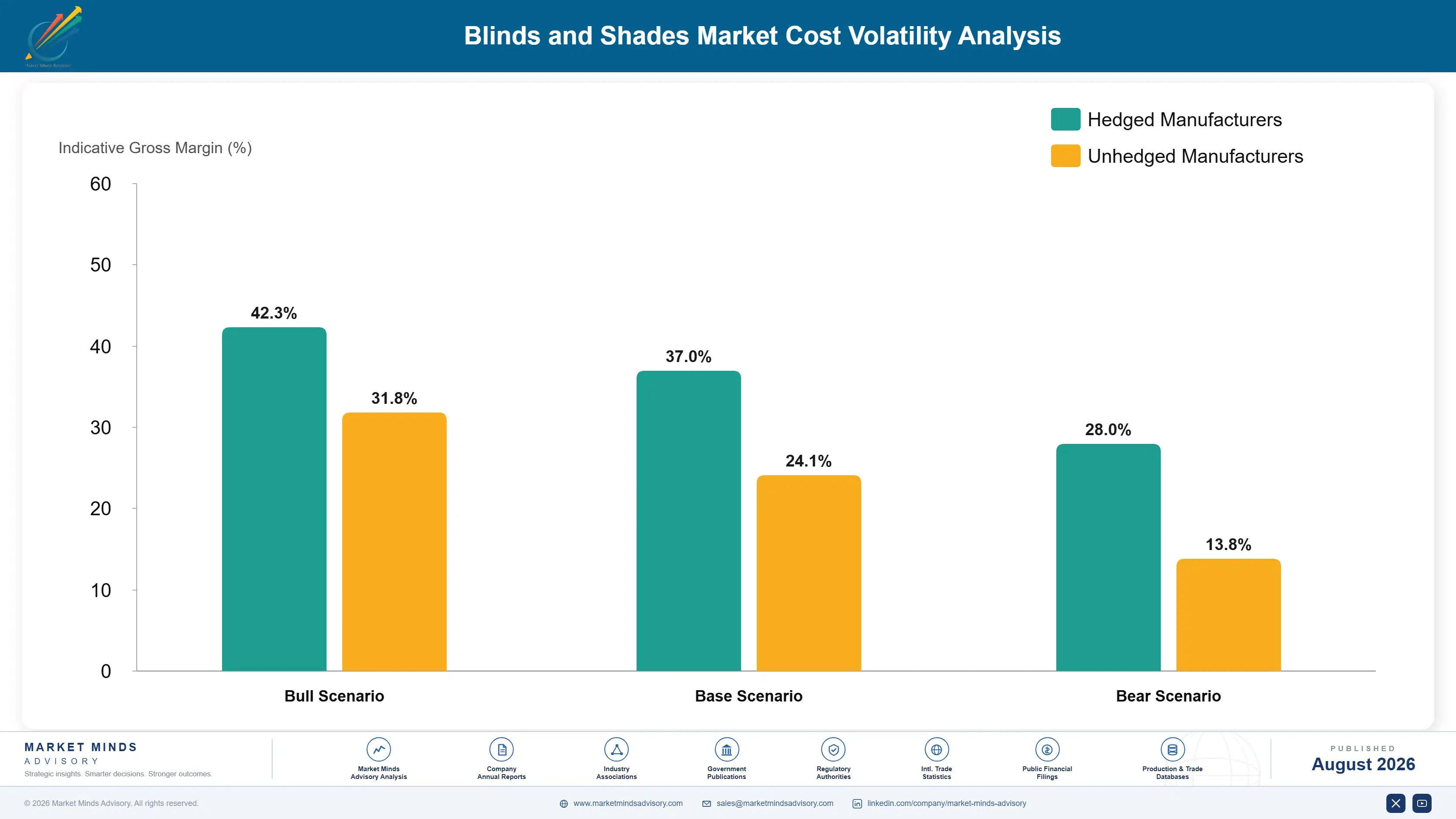
Cost divides four ways and installation carries more than the product does. Measurement, installation and fitter margin absorb roughly 35% of installed price, fabric and slat material near 24%, components, headrails and motorisation near 26%, and remake provision with logistics the remaining 15%. Made to measure manufacturing has no inventory cost and no returns processing, and it carries a remake line ready made product never considers.
Fabric, aluminium and polymer component pricing moved across recent years and raised material cost accordingly, while motor and control electronics availability constrained several participants during the same period. Hunter Douglas and Somfy have both discussed input cost and component supply across recent reporting periods. Fitter labour cost has moved further still, since the workforce is ageing across developed markets and skilled installers can effectively set their own rates.

Exposure varies by manufacturing model rather than by geography. Regional workshops carry low freight cost against limited scale in purchasing. National manufacturers carry freight on bulky made to measure product that cannot ship far economically. Motorisation component suppliers carry electronics exposure against a value share that keeps rising as the blind itself becomes the less interesting part of the assembly.
blinds-and-shades-market-cost-volatility-analysis-1788167771251

Measurement verification reducing remake provision materially

Remakes absorb a meaningful share of installed price and fall on whoever measured or manufactured incorrectly, with the argument about which consuming further time. Photograph confirmation, verification prompts and tolerance designed into the product all reduce the rate measurably. Participants treating remakes as an operational irritation rather than as a margin line have never measured what they actually cost.

Regional manufacturing footprint against freight economics

Made to measure product is bulky, fragile and cannot economically ship far, which is precisely why hundreds of regional workshops survive against national manufacturers. Distributed finishing close to the fitter network removes freight cost that scale purchasing cannot offset. Participants running a single plant across a wide geography are paying freight that regional competitors simply never incur.

Fitter training investment against ageing workforce cost

Skilled installers are ageing across every developed market and can increasingly set their own rates, which raises installed cost faster than any material input has moved. Manufacturer-run training expands the workforce and creates loyalty at the same time. Participants competing for the existing fitter pool on price alone are bidding against everybody else for a shrinking group.

Portfolio Architecture for Margin Defence

The portfolio separates by who specifies. Made to measure residential is the volume core: fitter specified, regionally manufactured, competing against hundreds of workshops on delivery accuracy rather than product, and carrying a remake line that consumes margin nobody priced for. Large, fragmented and genuinely difficult to build a national position within. Nothing about that half of this business rewards national scale at all.
Margin concentrates in commercial specification and in motorisation. Commercial packages at around USD 34,000 are specified by design teams years ahead and cover whole buildings. Motorisation grows at 9.0% and increasingly carries the value while the blind commoditises around it. Both are reached through capabilities the residential half of this business does not require. Neither of those is reached through the residential channel.

The overlooked pool is the remake rate. One order in fourteen produces something that fits nothing, the cost falls somewhere between manufacturer and fitter, and halving it is worth more than any price increase available in this category. Most participants treat it as an operational irritation rather than the margin line it demonstrably is. Almost nobody has ever measured what it actually costs them.

Volume / Commodity-Adjacent

Ready made standard size products, basic roller blinds and component supply into other manufacturers. Range spans nine points because manufacturing scale and freight position decide outcomes far more than product does.
Gross Margin: 16-25%

Premium / Certified

Made to measure roller, vertical and pleated blinds, shutters and hard window treatments. Range spans eleven points because remake performance and fitter relationships vary considerably between participants in this tier.
Gross Margin: 27-38%

Sustainability / Regulatory / Next-Generation

Motorised and automated systems, commercial architectural shading and specification support services. Range spans sixteen points because component supply and complete system delivery are barely comparable within one tier. Specification access decides much.
Gross Margin: 36-52%
blinds-and-shades-market-portfolio-architecture-1788167771754

High-value Sub-segments and Strategic Watch-out

Motorised and Automated Shading Systems

High value and high growth at 9.0%, pulled into building specification by energy calculations rather than chosen by any occupant. The fourteen point range separates complete system suppliers from participants supplying motorisation components into somebody else's finished product. Nobody consults the occupant about any of it.
Gross Margin: 38-52%

Commercial and Architectural Shading

High value with moderate growth at 7.8%, specified by design teams years before completion across every window simultaneously. The twelve point range reflects specification access, which requires technical documentation and practice relationships rather than any conventional selling effort at all. Substitution after specification is rare.
Gross Margin: 34-46%

Made To Measure Residential Blinds

The volume core, fitter specified and regionally manufactured against hundreds of workshops competing on delivery accuracy. Carries a remake line that consumes margin nobody priced for, and cannot economically ship far enough to build national scale. Freight and remakes together decide who survives in it.
Gross Margin: 27-38%

Fitter Workforce Availability

The strategic watch-out rather than a growth pool. This category depends on people who measure and install accurately, that workforce is ageing everywhere, and almost nobody is training replacements at the rate required. Nobody here grows faster than they can find people willing to install.
Gross Margin: Variable

Why Fitters Stay Loyal

The annuity in this category belongs to the fitter relationship rather than to any household. A household replaces window coverings roughly every twelve years and the manufacturer hears nothing in between, while a fitter orders continuously and specifies for every customer they visit. Winning one fitter is worth considerably more than winning one homeowner, and this industry keeps advertising to the wrong one of those two entirely.
Stickiness runs on reliability rather than on product. A fitter carries the supplier who measures correctly, delivers on time and remakes errors without argument, because a wrong blind costs them a wasted day and an unhappy customer they have to face personally. That loyalty is genuinely durable and lost permanently the moment it fails badly. Commercial specification is stickier still, since a product named in drawings is rarely substituted afterwards.

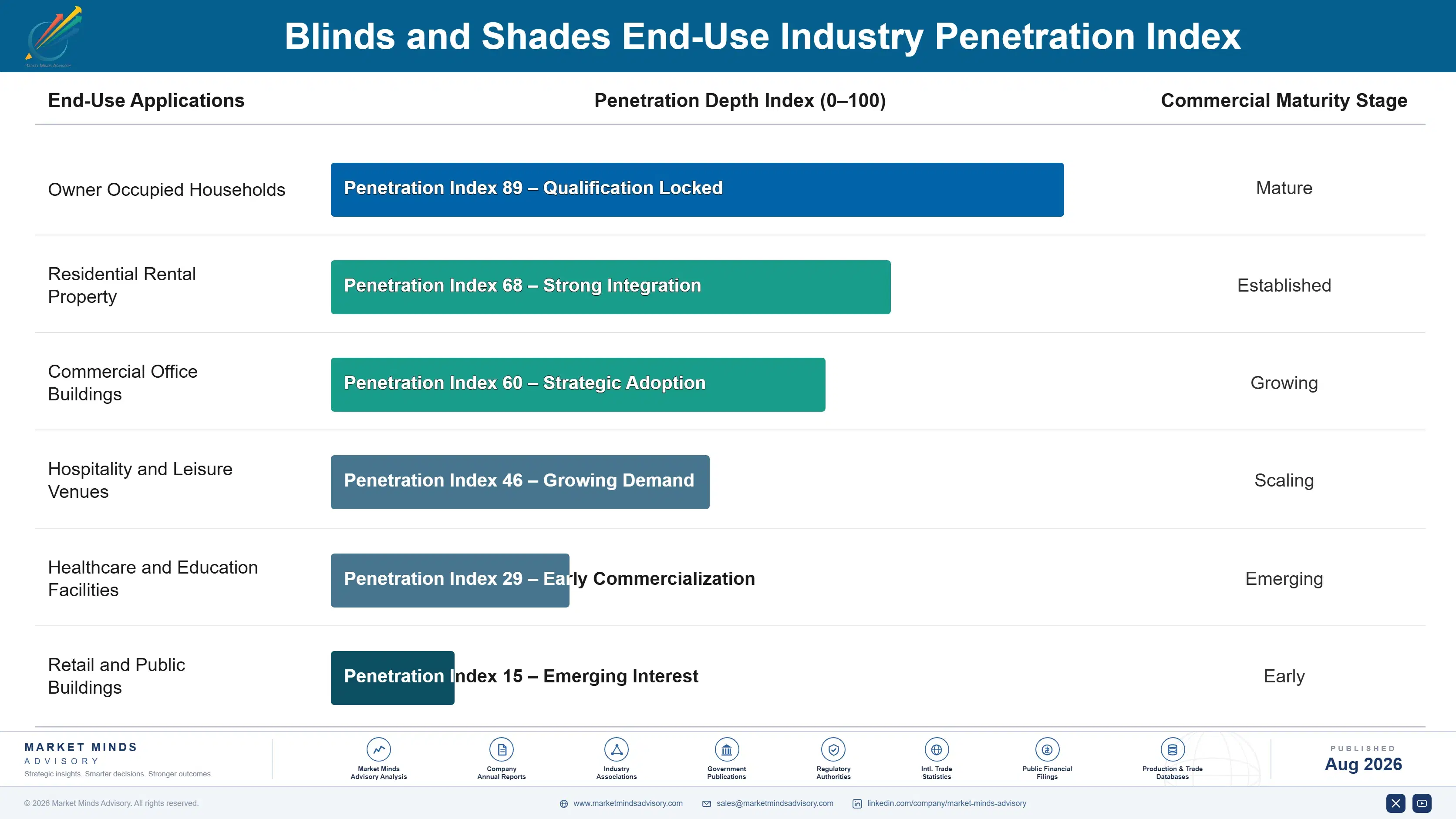
The buyer has shifted toward the design team on the commercial side and barely moved on the residential one. Households still choose what they are shown by whoever measures. Commercial shading is now approved by building services engineers evaluating solar gain, which is a different person entirely with different criteria and no interest at all in how the product looks in a showroom.
blinds-and-shades-market-end-use-penetration-index-1788167772245

Where Manufacturers Should Commit

These are among the four positions where our research anticipates prominent divergence between winners and laggards over the coming forecast period. Each is grounded in the demand model, the regulatory perimeter, and the announced capacity pipeline.
01 / FITTER SERVICE DISCIPLINE

The person measuring the window is the customer

Around 59% of residential purchases are specified by whoever measured the window, and that person carries the supplier who delivers accurately, remakes errors without any argument and reliably answers the telephone when something goes wrong. Those three things cost operational discipline rather than capital investment of any kind at all. A fitter who has been let down once rarely returns, and the list of manufacturers they actually trust is considerably shorter than the number competing for them every single year.
02 / SPECIFICATION ACCESS BUILDING

Named in the drawings beats bidding at tender

Commercial shading is specified by architects and building services engineers years before a building completes, covering every window on a project at once and valued at around USD 34,000 on a mid sized building scheme. Getting onto a specification requires technical documentation, project support and genuine practice relationships rather than any selling in the conventional sense of it at all. Participants approaching a project at tender stage are competing against somebody whose product is quite already named in the drawings.
03 / REMAKE RATE REDUCTION

One order in fourteen fits absolutely nothing

A remake rate of near 7% means one order in every fourteen produces a product that fits nothing at all, and the cost falls somewhere between the manufacturer and the fitter regardless of who actually caused it in the very first place. Measurement verification, photograph confirmation and tolerance designed into the product itself all reduce that rate quite materially indeed. Halving the remake rate is worth considerably more than any price increase available to anybody anywhere in this entire category.
04 / SINGLE VISIT INSTALLATION

A second appointment kills half the quotes

Battery and radio systems that a fitter can install without any electrical work removed the one practical obstacle that had confined residential motorisation to new build and major renovation projects alone previously. A second appointment involving an electrician kills roughly half of all the residential motorisation quotes before they are ever accepted by anybody. Designing for single-visit installation is a commercial specification rather than an engineering preference, and several participants have still not yet treated it as one at all.

Engagement Snapshot From the Field

A live engagement with an industry participant carrying material or product regulatory and market exposure ahead of a defining policy shift, showing how our research translates into a defensible multi-year portfolio strategy.
MARKET MINDS ADVISORY · CLIENT ENGAGEMENT SUMMARY
Blinds and Shades Producer Strategic Portfolio Review and Transition Roadmap 2026·Investment Scenario on Blinds and Shades Exposure Evaluation 2025-26
CLIENT PROFILE
A made to measure blind manufacturer supplying independent fitters across two markets from a single national plant, with a small commercial business and no specification presence with architects. Revenue was flat while margin had declined for three years, and management attributed the decline to regional workshop competition rather than to the remake and freight costs it was carrying itself.
STRATEGIC CHALLENGE
The board needed to establish how much margin remakes and freight were consuming relative to price competition, and whether distributed finishing closer to fitter networks justified the capital involved. It also faced a decision on building architect specification capability, which the sales organisation regarded as a slow indirect activity with no measurable return attached to it.
MMA APPROACH
MMA rebuilt margin by order with remake and freight cost allocated properly for the first time, comparing performance against regional workshop economics. It modelled distributed finishing against the single plant model. Expert interviews with fitters, architects, building services engineers and competing manufacturers established what actually decides both residential and commercial orders.
KEY FINDINGS
  1. Remakes and freight together consumed more margin than price competition did, and neither had ever been allocated to individual orders in any internal reporting.
  2. Fitters interviewed chose suppliers on delivery accuracy and remake handling above price, and several had left the client after a single badly handled error.
  3. Architects specifying shading named two competitors consistently, and the client had no technical documentation in any format a specifier could actually use.
  4. Distributed finishing near fitter concentrations modelled better than the single plant despite higher fixed cost, entirely because freight and remake response improved.
CLIENT PROFILE
A made to measure blind manufacturer supplying independent fitters across two markets from a single national plant, with a small commercial business and no specification presence with architects. Revenue was flat while margin had declined for three years, and management attributed the decline to regional workshop competition rather than to the remake and freight costs it was carrying itself.
STRATEGIC CHALLENGE
The board needed to establish how much margin remakes and freight were consuming relative to price competition, and whether distributed finishing closer to fitter networks justified the capital involved. It also faced a decision on building architect specification capability, which the sales organisation regarded as a slow indirect activity with no measurable return attached to it.
MMA APPROACH
MMA rebuilt margin by order with remake and freight cost allocated properly for the first time, comparing performance against regional workshop economics. It modelled distributed finishing against the single plant model. Expert interviews with fitters, architects, building services engineers and competing manufacturers established what actually decides both residential and commercial orders.
KEY FINDINGS
  1. Remakes and freight together consumed more margin than price competition did, and neither had ever been allocated to individual orders in any internal reporting.
  2. Fitters interviewed chose suppliers on delivery accuracy and remake handling above price, and several had left the client after a single badly handled error.
  3. Architects specifying shading named two competitors consistently, and the client had no technical documentation in any format a specifier could actually use.
  4. Distributed finishing near fitter concentrations modelled better than the single plant despite higher fixed cost, entirely because freight and remake response improved.
RECOMMENDED STRATEGY
Phase 1: Phase one: introduce measurement verification and photograph confirmation before making any other operational change of any kind at all whatsoever. Phase 2: Phase two: establish distributed finishing near the two largest fitter concentrations, accepting higher fixed cost for the freight and response benefit. Phase 3: Phase three: build architect specification capability with proper technical documentation, treating commercial as an entirely separate business from residential work.
OUTCOME
The client reported that remake rates were falling by roughly a third within just four quarters (client-reported, unverified by MMA). Fitter retention improved measurably in the same period. A first distributed finishing site was opened, and specification documentation reached three architectural practices for the very first time.

Frequently Asked Questions

Foundational context covering the market sizes, CAGR, scope, country, region and competition that inform every finding below. This section is provided to cover basics and most often pre-purchase conversations, answered from the MMA Primary Research Dataset.

What is the current size of the Blinds and Shades Market?

The market is valued at USD 24.0 billion in 2025, measured as revenue from interior window covering products and their associated measurement and installation work.

How large will the Blinds and Shades Market be by 2036?

MMA forecasts USD 45.56 billion by 2036, up from USD 25.44 billion in 2026. That represents incremental revenue of USD 20.12 billion and an expansion multiple of 1.79 times.

What is the CAGR for the Blinds and Shades Market 2026 to 2036?

The base case CAGR is 6.0%, with a bull case of 7.2% and a bear case of 4.8%. Automated shading and commercial specification supply most of that growth.

Which segment is growing fastest?

Motorised and automated shading systems grow at 9.0%, half again the market rate of 6.0%, because energy calculations now pull shading into the building specification process.

Who are the major companies in the Blinds and Shades Market?

Hunter Douglas, Springs Window Fashions, Somfy, Warema Renkhoff and Nien Made Enterprise lead on revenue, holding only around 21% between them across a highly fragmented market.

Which country is growing fastest?

India grows fastest at 8.2%, driven by commercial construction where solar gain is a genuine functional problem and by residential adoption rising with apartment building.

Report Segmentation Architecture

The full report scope spans multiple orthogonal segmentation dimensions, with cross-tabulated demand data provided for each dimension pair. Coverage extends further to regional breakdowns, trend trajectories, and the competitive detail needed to support segment-level decision-making.

By Product And Specification Route

  • Motorised and Automated Shading Systems
  • Made To Measure Roller and Vertical Blinds
  • Shutters and Hard Window Treatments
  • Commercial and Architectural Shading
  • Ready Made and Standard Size Products
  • Measurement, Installation and Service Work

By End-Use Industry

  • Owner Occupied Households
  • Residential Rental Property
  • Commercial Office Buildings
  • Hospitality and Leisure Venues
  • Healthcare and Education Facilities
  • Retail and Public Buildings

By Commercial Dimension

  • Independent Fitter Supply
  • Specialist Retail and Showroom
  • Architect and Consultant Specification
  • Builder and Developer Fit-Out
  • Online Made To Measure Sales
  • Component and Contract Manufacture

By Region

  • East Asia
  • North America
  • Western Europe
  • South Asia and Pacific
  • Latin America
  • Middle East and Africa
  • Eastern Europe

Scope, Methodology, and Coverage

Every figure in this report is reproducible from documented input assumptions. The scope below maps the historical period, the forecast horizon, the segmentation dimensions, and the countries covered, alongside the underlying primary and qualitative methodology.
Historical Period
2020 to 2025
Forecast Period
2026 to 2036
Base Year
2025 (USD billions; MMA Primary Research Dataset, August 2026)
Market Definition
Revenue from interior window covering products and their installation, spanning motorised and automated shading systems, made to measure roller and vertical blinds, shutters and hard window treatments, commercial and architectural shading, ready made and standard size products, and measurement, installation and service work. Independent fitter supply, specialist retail and showroom, architect and consultant specification, builder and developer fit-out, online made to measure sales and component manufacture are all included. Exterior shutters and awnings fitted outside the building envelope, curtains and soft drapery, glazing and window units, and building management systems sold without shading hardware are excluded.
Quantitative Units
USD billions, window covering product and installation revenue
Segmentation Dimensions
Product and specification route, building type, commercial channel, region
Regions Covered
East Asia, North America, Western Europe, South Asia and Pacific, Latin America, Middle East and Africa, Eastern Europe
Countries Covered
China, Japan, South Korea, United States, Canada, United Kingdom, Germany, Netherlands, India, Australia, Brazil, Mexico, United Arab Emirates, Poland
Key Companies Profiled
Hunter Douglas, Springs Window Fashions, Somfy, Warema Renkhoff, Nien Made Enterprise, Lutron Electronics, Silent Gliss, Griesser, Louvolite, TOSO Company
Quantitative Methodology
Primary survey, n=3,800 respondents, Q4 2025, six countries; demand-side model with trade association cross-validation
Qualitative Methodology
47 expert interviews, Q4 2025; applied to validate demand model assumptions, identify emerging dynamics, and assess competitive positioning
Report Format
PDF and XLSX data workbook (Word format preview document)
Publisher
Market Minds Advisory
Report Code
MMA-2026-CON-481
Published
August 2026
Contact
sales@marketmindsadvisory.com | www.marketmindsadvisory.com

Purchase the full Blinds and Shades Market Report (2026 to 2036).

The full report treats this as the bespoke manufacturing business it actually is rather than the consumer products category it is usually analysed as. It quantifies the remake rate as a margin line rather than an operational irritation, measures fitter specification against consumer choice across residential orders, and assesses building energy regulation as the mechanism converting shading into a specified component. Segment analysis covers all six product and specification routes, with particular attention to automated systems and commercial shading where the growth genuinely sits. Competitive assessment ranks twenty participants on window covering revenue.
Six product and specification segmentation with growth rates
Remake rate quantified as a margin line item
Twenty participant assessment on window covering revenue
Fitter specification measured against direct consumer choice
Building energy regulation traced into shading specification
Distributed finishing economics compared against single plant models

Built For The People Who Decide

From boardroom strategy to bench-side execution, this report is read cover-to-cover by leaders shaping the next decade of their industry, turning demand scenarios, market dynamics and valuation benchmarks into decisions.
CXOs/ Presidents/ VPs/ Managers
M&A and Corporate Development
Strategy Teams and R&D Heads
Procurement and Product Directors
Regulatory and Compliance Leaders
Investor Relations and Equity Analysts