Market Minds Advisory
Biosensors Market

Biosensors Market: One Analyte Pays for the Entire Industry

Glucose sensing funds nearly everything in this field, and the second analyte has been fifteen years away for two decades now, because enzyme stability rather than electronics is what keeps failing.

Lead Analyst

Alice Ballenger

Published

September 2026

Make Smarter Decisions with Customized Research Insights

Request a free sample report and evaluate market opportunities, growth trends, and competitive dynamics relevant to your business needs.

2025 MARKET VALUE$32.4BMarket Size 2025
2036 FORECAST VALUE$88.8BBase Case , 2026 to 2036
CAGR 2026 TO 20369.6 %Bull 10.8% / Bear 8.4%
INCREMENTAL OPPORTUNITY$53.3BNet 10- year value creation
EXPANSION MULTIPLE2.50x2036 value over 2026 base
Strategic Levers
M&A Pipeline
Regional Outlook
Country Rankings
Competitive Intelligence
Segmental Deep-dive
Call-Us : 91 93563 13602

Executive Snapshot and Market Trajectory

Glucose is roughly 78% of this market and has been for a generation. Every other analyte, lactate, ketones, cortisol, alcohol, has been announced as the next platform and none has reached comparable scale, because the obstacle is enzyme and receptor stability at body temperature rather than anything in the electronics.
Growth runs at 9.6% and continuous monitoring is where it concentrates. Continuous interstitial sensors grow at 14.4%, exactly 1.50 times the market rate, displacing intermittent finger-stick testing wherever reimbursement permits. East Asia holds the largest share at 30%, on Chinese and Indian diabetes populations and domestic manufacturing scale rather than on any pricing advantage. Strip volume is now declining in every reimbursed market rather than merely growing more slowly, which changes capacity planning.
Concentration sits at 62% across the top five measured on annual sensor units shipped, and it reflects sensor chemistry and manufacturing yield rather than commercial position. Reimbursement decisions govern volume far more than clinical evidence does, since a continuous sensor costs a patient many times a test strip and very few pay that difference themselves. Chinese manufacturers now compete hard on price wherever public tenders cap the device budget.
Market Definition
This market covers biosensor devices incorporating a biological recognition element coupled to a transducer, spanning single-use electrochemical test strips, continuous interstitial monitoring sensors, wearable and patch-format biosensors, laboratory and point-of-care biosensor cartridges, and industrial, environmental, and food safety biosensors. Optical imaging systems without a biological recognition element, laboratory analysers sold as capital equipment, molecular diagnostic amplification platforms, and reagents supplied independently fall outside scope.
Base Year Value
$32.4B in 2025 (MMA Primary Research Dataset, August 2026)
Forecast Period
2026 to 2036, eleven discrete annual values
CAGR
9.6% base case. Bull 10.8%. Bear 8.4%.
Fastest Growth Segment
Continuous Interstitial Monitoring Sensors: 14.4% CAGR
Fastest Growth Country
India: 12.4% CAGR
Fastest Growth Region
South Asia and Pacific: 11.8% CAGR
Largest Region
East Asia: 30% of 2025 global value
Market Leaders
Abbott Laboratories, Dexcom, Roche Diagnostics, LifeScan, Medtronic. Source: MMA Analysis based on company annual reports.
Primary Survey
n=3,800 procurement and R&D decision-makers, Q4 2025, six countries
Methodology
Demand-side build-up, cross-validated against public data, 47 expert interviews

Biosensors Market Forecast Scenarios

biosensors-market-size-forecast-scenario-1787300369159
The 2020 to 2025 period ran at 8.4% and continuous monitoring displaced test strips faster than the total suggested. Strip volume declined in reimbursed markets while continuous sensor revenue more than replaced it, which raised revenue while cutting unit counts. Point-of-care biosensor demand surged through 2020 and 2021 then normalised. Non-glucose analyte programmes advanced clinically and none reached commercial scale.
Three mechanisms carry the 9.6% base case. Continuous monitoring reimbursement expansion is the largest, since coverage decisions rather than clinical evidence determine whether patients can access sensors at all. Type two diabetes population growth across Asia is the second, adding patients faster than any technology shift. And sensor wear duration extension is the third, which lowers annual cost per patient and widens the reimbursable population. None of the three requires a new analyte reaching commercial scale.
The 10.8% bull case rests on a non-glucose analyte reaching genuine commercial scale, most plausibly lactate or ketones where enzyme chemistry is closest to solved. The 8.4% bear case is reimbursement tightening as payers examine continuous monitoring outcomes in non-insulin-treated populations, where the clinical benefit is considerably less settled than in insulin-dependent patients. Neither case turns on any advance in sensor electronics.

Everything Rests on One Molecule

Roughly 78% of this market measures one molecule. Glucose has funded biosensor development for four decades, and the field's recurring promise has been that the same architecture would extend to lactate, ketones, cortisol, alcohol, and eventually to panels of analytes on a single wearable. Programmes have run continuously toward that goal. None has reached commercial scale comparable to glucose, and the reason is consistent.
GLUCOSE SHARE78%Of total market value from a single measured analyte
SENSOR WEAR DURATION15 daysTypical continuous sensor life before enzyme activity degrades
TOP FIVE CONCENTRATION62%High, reflecting sensor chemistry and manufacturing yield difficulty
CONTINUOUS TO STRIP COST9 timesAnnual patient cost against intermittent finger-stick testing alternatives
MANUFACTURING YIELD LOSS13%Of sensors rejected on calibration variance at final test
REIMBURSED PATIENT SHARE54%Of continuous sensor users with coverage rather than paying directly
The obstacle is biology rather than electronics. Glucose oxidase is an unusually forgiving enzyme: stable, specific, cheap, and tolerant of the conditions inside a sensor worn on a body for two weeks. Most other recognition elements are not. They lose activity at body temperature, drift with hydration, respond to interferents, or require concentration ranges that push the transducer beyond its resolution. The circuit was never the constraint.
Commercially, reimbursement decides almost everything. A continuous sensor costs a patient roughly nine times what intermittent strip testing does over a year, and only about 54% of continuous users have coverage. Where payers fund sensors, adoption is rapid and near-universal in insulin-treated populations. Where they do not, sensors remain a self-pay product for a minority, and the clinical argument makes very little difference.
"Every eighteen months somebody shows me a multi-analyte patch. The electronics are always excellent. Then you ask how long the cortisol channel holds calibration on a warm arm, and the conversation moves to the roadmap."
Director, Diagnostics and Sensing Technologies Practice · MMA Medical Devices an

Market Trends

Continuous Sensing Displaces Intermittent Strip Testing

Continuous interstitial sensors grow at 14.4% against 9.6% for the market, and strip volume is declining in every reimbursed market rather than merely growing more slowly. The displacement raises revenue while cutting unit counts, since one sensor replaces several hundred strips a year at many times the price. Coverage rather than clinical preference sets the pace, because a continuous sensor costs a patient roughly nine times annual strip testing and only 54% have reimbursement. Manufacturers gain revenue while losing unit counts, which complicates every capacity plan. Chinese producers are winning tendered supply where reimbursement caps device budgets.
Market Impact: India growing at 12.4%

Wear Duration Extension Reprices The Whole Category

Sensor life has moved from seven days toward fifteen and programmes target longer still, which cuts annual cost per patient directly and widens the population a payer will fund. Enzyme activity degradation rather than adhesive or electronics failure sets the current limit, and each extension requires chemistry work rather than device engineering. Manufacturers gain volume through reimbursement expansion while losing units per patient, which makes the net commercial effect genuinely finely balanced. Formulation depth rather than device engineering decides who extends duration first. Payers respond to annual cost per patient rather than to price per sensor.
Market Impact: Around 54% hold reimbursement

Market Opportunities and Growth Drivers

Asian Diabetes Populations Add Patients Faster Than Technology

Type two diabetes prevalence across China, India, and Southeast Asia is rising faster than in any high-income population, and the absolute patient numbers dwarf Western markets even at low treatment penetration. Growth here comes from patients entering diagnosis and treatment rather than from any device shift, which favours low-cost strip products and domestically manufactured continuous sensors over premium Western systems. Domestic manufacturing capability in China has developed considerably faster than most Western manufacturers anticipated. Most of that volume enters through low-cost strip testing rather than continuous monitoring. Reimbursement for continuous sensors remains largely absent across the region.
Market Impact: Glucose remains 78% of market

Reimbursement Expansion Governs Continuous Sensor Access

Coverage decisions determine continuous monitoring volume more completely than clinical evidence does, since only around 54% of continuous users hold reimbursement and the annual cost runs roughly nine times intermittent testing. Payer expansion into type two diabetes on basal insulin, and in some systems into non-insulin-treated patients, converts a self-pay minority into a covered population within months. Each such decision produces a step change in volume that no commercial programme could achieve independently. Manufacturers positioned with evidence and supply before a decision capture that volume entirely. Those reacting afterward compete for share already allocated to somebody else.
Market Impact: Yield loss reaches 13%

Market Restraints and Challenges

Non-Glucose Analytes Keep Failing On Enzyme Stability

Around 78% of this market measures glucose, and every attempt to extend the architecture to lactate, cortisol, or alcohol has stalled at the same place. The root cause is that glucose oxidase is unusually stable, specific, and tolerant of body temperature over a two-week wear period, while most other recognition elements lose activity, drift, or respond to interferents. Commercial impact is a market dependent on one analyte. Mitigation runs through engineered enzymes, aptamer receptors, and affinity-based approaches that avoid enzymes altogether. Lactate and ketones sit closest to solved and deserve most of the resource.
Market Impact: Continuous growing at 14.4%

Manufacturing Yield Losses Constrain Sensor Economics

Roughly 13% of continuous sensors are rejected at final test on calibration variance, and the root cause is that enzyme deposition and membrane thickness vary at tolerances difficult to hold in high-volume production. Commercial impact is a cost floor that limits how far prices can fall toward the reimbursement thresholds that would widen access. Mitigation runs through deposition process control, factory calibration methods that tolerate variance, and sensor designs less sensitive to membrane thickness. Yield improvement returns proportionally to volume, which favours the largest manufacturers heavily. Smaller producers gain more from variance-tolerant calibration algorithms than from process capital.
Market Impact: Wear duration reaches 15 days
3 additional market trends, 4 additional growth drivers, and 2 additional restraints and challenges are covered in the full report. Contact sales@marketmindsadvisory.com to access the complete intelligence.

Segment CAGR and Growth Architecture

Segmentation follows sensor format and measurement mode, because those determine recognition chemistry, manufacturing process, regulatory pathway, and the reimbursement category each product falls into. Analyte and end-user setting both cut across every format rather than separating them cleanly, which makes either a considerably weaker primary dimension for this particular market. Format decides the reimbursement category more than analyte does.
biosensors-market-market-share-analysis-1787300369732

Continuous Interstitial Monitoring Sensors

The fastest format at 14.4%, exactly 1.50 times the market rate, and the one displacing an incumbent rather than opening new ground. Strip volume is falling in every reimbursed market as continuous sensors replace several hundred tests a year with a single device at many times the price. Wear duration near fifteen days sets annual cost, and each extension widens the population a payer will fund. Manufacturing yield near 87% at final test remains the cost floor that limits how far prices can fall. Closed-loop insulin integration removes the sensor choice from the patient entirely, which makes those positions unusually durable. Chinese manufacturers are competing on price in tendered markets. Coverage rather than clinical preference sets the pace.
CAGR 14.4%

Wearable And Patch Format Biosensors

Second fastest at 12.6%, covering sweat, interstitial, and skin-contact formats aimed at lactate, hydration, electrolytes, and eventually multi-analyte panels. Electronics and adhesive engineering are genuinely solved; recognition chemistry is not, which is why this segment has grown steadily for a decade without producing a product at glucose scale. Sports and occupational safety applications carry most current revenue, since those buyers tolerate accuracy that clinical use would reject outright. Regulatory pathways stay lighter accordingly, which is both the opportunity and the ceiling. Occupational safety and hydration monitoring have proved the most commercially durable applications so far. Multi-analyte panels remain research positions being funded as product programmes across much of the field.
CAGR 12.6%
Full segment breakdown across 5 segments available in the complete report.

Regional Architecture and Country Demand Map

East Asia leads at 30% on Chinese and Japanese patient populations and domestic sensor manufacturing scale. North America follows on continuous monitoring reimbursement depth, ahead of Western Europe. South Asia and Pacific grows fastest as Indian diagnosis rates rise. Coverage criteria rather than prevalence govern regional value.

East Asia

Thirty percent, the largest share, and patient population combined with manufacturing scale explains it rather than pricing. China has the largest diagnosed diabetes population anywhere and domestic continuous sensor manufacturers have developed capability considerably faster than Western firms anticipated, supplying both domestic demand and export volume at prices Western systems cannot match. Japanese and Korean reimbursement for continuous monitoring is well established in insulin-treated populations. Growth at 10.6% runs above the market rate, driven by Chinese diagnosis rates and domestic sensor capacity expanding together. Chinese producers are now winning tendered supply outside their domestic base on price. Strip volume also remains substantial across the markets where continuous sensor reimbursement has not yet arrived.
Share: 30% | CAGR: 10.6% (2026 to 2036)

North America

Continuous monitoring reimbursement depth rather than population size carries this 25%. American coverage for insulin-treated patients is the most extensive anywhere and has expanded into basal insulin and some non-insulin-treated populations, which produced adoption rates no other region approaches. Prices per sensor are also the highest globally, making the region disproportionately valuable relative to its patient count. Payer scrutiny of outcomes in non-insulin populations is the live risk. Growth at 9.0% sits close to the market rate, with coverage expansion offsetting price pressure. Closed-loop insulin delivery integration is furthest advanced here, which locks patients into system choices rather than sensor choices. Strip volume decline is correspondingly steep across the whole region.
Share: 25% | CAGR: 9.0% (2026 to 2036)
Regional intelligence for 5 additional markets available in the complete report: Western Europe, South Asia and Pacific, Latin America, Middle East and Africa, Eastern Europe. Contact sales@marketmindsadvisory.com.
biosensors-market-country-cagr-analysis-1787300370254

Building Around the Reimbursement Decision

Glucose is 78% of the market, wear duration reaches fifteen days, roughly 13% of sensors fail final test, and only 54% of continuous users hold coverage. Value comes from positioning ahead of reimbursement decisions, from extending wear duration, from yield improvement, and from choosing non-glucose targets honestly. Coverage rather than evidence decides how fast any of it happens.

Position Ahead Of Each Reimbursement Decision

Coverage governs continuous sensor volume far more completely than clinical evidence does, since only around 54% of users hold reimbursement and annual cost runs roughly nine times intermittent testing. Each payer expansion into basal insulin or non-insulin-treated populations converts a self-pay minority into covered volume within months. Manufacturers holding health economic evidence, supply capacity, and prescriber relationships before a decision capture that step change, while those reacting afterward compete for a share already allocated. Health economic evidence built for a specific payer criterion converts far better than general clinical data. Supply capacity has to exist before the decision, not after.
Market Impact: Only 54% of continuous users now hold coverage

Extend Wear Duration Through Enzyme Chemistry

Sensor life near fifteen days sets annual cost per patient directly, and every extension widens the population a payer will fund at a given budget. The limit is enzyme activity degradation rather than adhesive or electronics failure, so the work is chemistry rather than device engineering, and it is where manufacturers with formulation depth hold advantage. Units per patient fall as duration rises, which makes the commercial calculation finely balanced and the reimbursement expansion the part that actually pays. Duration has moved from 7 days toward 15 and programmes target longer still. Each extension cuts annual cost per patient directly.
Market Impact: Wear duration now reaches about 15 days typically

Attack Yield Losses To Reach Price Thresholds

Roughly 13% of continuous sensors are rejected at final test on calibration variance driven by enzyme deposition and membrane thickness tolerance, which sets a cost floor limiting how far prices can fall toward the thresholds that open broader coverage. Deposition process control and factory calibration methods tolerating variance both address it directly. A manufacturer improving yield meaningfully gains pricing headroom in tendered European and Asian markets where the decision is made on cost. Variance-tolerant calibration algorithms deliver the same gain without any process capital investment. That route is available to smaller manufacturers too.
Market Impact: Roughly 13% of sensors fail the final test

Choose Non-Glucose Targets On Chemistry Not Demand

Glucose remains 78% of this market because glucose oxidase is stable, specific, and tolerant of two weeks on a warm body, and most alternative recognition elements are none of those things. Programmes selected on market attractiveness rather than on chemistry feasibility have consumed development budget for two decades without producing scale. Lactate and ketones sit closest to solved and deserve the resource. Cortisol and multi-analyte panels remain research positions being funded as product programmes. Aptamer receptors and affinity approaches that avoid enzymes altogether are the more promising direction. Two decades of evidence supports selecting on feasibility.
Market Impact: Glucose still holds 78% of total market value

Who Controls the Margin Pool

Concentration sits at 62% across the top five measured on annual sensor units shipped, and it has held there through a full technology transition from strips to continuous sensing. That persistence is chemistry and manufacturing yield rather than commercial position: enzyme deposition control, membrane consistency, and factory calibration are difficult to reproduce, and roughly 13% of output is rejected even by manufacturers who have done it for years. The leader to challenger gap is wide.
Competitive activity concentrates on three fronts. Wear duration is the first and the most visible to patients, since it sets annual cost and therefore payer willingness. Accuracy against reference measurement in the hypoglycaemic range is the second, where clinical and regulatory scrutiny is sharpest. And integration with insulin delivery is the third, which converts a sensor into part of a closed-loop system that patients cannot casually switch away from.

Pressure comes from two directions. Chinese manufacturers are competing on price in markets where reimbursement caps the device budget. And insulin pump makers keep pulling sensing inward to control the whole loop.

Rankings move on reimbursement decisions and on wear duration.
biosensors-market-company-positioning-matrix-1787300370773

Competitive Moat and Risk Dimensions

ABBOTT LABORATORIES

Moat: Manufacturing scale and factory calibration

Producing continuous sensors at volumes an order of magnitude above most competitors, with factory calibration removing patient calibration steps entirely, gives both a cost position and a usability advantage that reinforce each other. Yield improvements compound across enormous volume in a way they cannot for smaller producers. Enzyme deposition consistency at that scale took many years to establish.
ABBOTT LABORATORIES

Risk: Reimbursement scrutiny in type two

Volume growth increasingly depends on coverage expanding into non-insulin-treated type two populations, where clinical outcome evidence is considerably less settled than in insulin-dependent patients. Payers examining those outcomes could halt the expansion that current volume assumptions rest on. Scale advantages amplify a coverage reversal exactly as they amplify a coverage expansion.
DEXCOM

Moat: Accuracy and closed-loop integration

Sustained accuracy performance in the hypoglycaemic range, where clinical consequences are most serious, underpins integration into automated insulin delivery systems from multiple pump manufacturers. A patient inside a closed loop is not choosing a sensor independently, which converts a consumable relationship into a system relationship. That integration takes years of engineering and regulatory work to replicate.
DEXCOM

Risk: Pump makers internalise sensing

Insulin delivery manufacturers have consistent incentive to control the whole closed loop rather than depend on an external sensor supplier, and several have acquired or developed sensing capability toward that end. An integration partner today is a competitor once the internal sensor performs adequately. Partnership positions in this market have historically proved less durable than they appear.

Key Players

Abbott Laboratories
Dexcom
Roche Diagnostics
LifeScan
Medtronic

Others

Ascensia Diabetes Care
Senseonics
Ypsomed
Sinocare
Yuwell Medical
i-SENS
ARKRAY
Terumo
Nova Biomedical
Trividia Health
Bio-Rad Laboratories
Siemens Healthineers
Nemaura Medical
PharmaSens
Biolinq

Recent Developments

MARCH 2025

Payer extends continuous monitoring coverage to basal insulin patients

A national payer extended continuous glucose monitoring reimbursement to type two diabetes patients on basal insulin therapy, substantially widening the eligible population beyond intensively treated patients. The change was a coverage policy decision rather than any commercial agreement, joint venture, or acquisition involving sensor manufacturers.
Signal: Coverage criteria rather than clinical evidence continue to set how fast continuous sensing spreads through a population.
JUNE 2025

Manufacturer extends approved sensor wear duration further

A continuous sensor manufacturer received approval for extended wear duration on an existing platform, achieved through enzyme formulation work rather than through any change to electronics or adhesive design. The approval was a regulatory decision rather than any partnership, acquisition, or licensing arrangement with another company.
Signal: Wear duration gains come from chemistry work, not from the device engineering buyers assume it comes from.
SEPTEMBER 2025

Chinese manufacturer wins tendered continuous sensor supply abroad

A Chinese continuous sensor manufacturer won tendered public supply in several markets outside its domestic base, competing on price where reimbursement budgets cap device spending per patient. The awards were competitive procurement outcomes rather than any joint venture, acquisition, or distribution partnership with an established supplier.
Signal: Tendered markets are where domestic Asian manufacturing capability converts into international share fastest into international market share.

Enzymes, Membranes and Clean Room Capacity

Enzyme and biological recognition materials carry roughly 21% of cost of goods sold, membrane and polymer materials near 17%, electronics and application-specific circuits around 19%, clean room manufacturing and assembly labour about 24%, and sterilisation, packaging, and quality release the balance. Enzyme supply concentrates among a few specialist producers in Western Europe and Japan, and substitution at short notice is impractical.
Semiconductor allocation through 2021 and 2022 constrained the application-specific circuits used in continuous sensors, and several device manufacturers disclosed component shortages and production scheduling difficulty in annual filings covering those years. Enzyme supply held through the period. Clean room manufacturing labour cost has risen persistently since and has not retreated, which now represents the larger persistent pressure on unit cost. Enzyme supply held throughout without allocation. Component substitution required regulatory work.

The competitive disadvantage mechanism runs through manufacturing yield rather than through input purchasing. Roughly 13% of sensors are rejected at final test, and a producer running several points better spreads every input cost across substantially more saleable units. Scale compounds it, since yield improvement returns proportionally to volume. Geography matters less than process control here, which is unusual for a device manufactured at these volumes.
biosensors-market-cost-volatility-analysis-1787300370967

Attack calibration variance at the deposition step

Roughly 13% of continuous sensors are rejected at final test on calibration variance driven by enzyme deposition and membrane thickness tolerance rather than by any electronics fault at all. Process control at the deposition step addresses that loss at its origin instead of screening for it afterward. Yield improvement returns proportionally to volume produced.

Qualify second enzyme sources despite regulatory cost

Enzyme supply concentrates among very few specialist producers, and substitution requires regulatory work rather than merely a purchasing decision. Manufacturers who qualified alternative sources hold supply flexibility that single-source competitors simply do not, at the cost of duplicate validation. Semiconductor allocation demonstrated how quickly single-source dependency becomes a production halt across a whole product line.

Design sensors tolerant of membrane thickness variance

A sensor whose accuracy depends tightly on membrane thickness converts every process variation into a rejected unit at final test. Designs with algorithmic compensation for membrane variance widen the acceptable manufacturing window considerably without any process investment. The engineering effort sits in calibration algorithms rather than in production equipment, which makes it available to smaller manufacturers too.

Portfolio Architecture for Margin Defence

Three tiers describe this business and the spread is set by recognition chemistry difficulty rather than by electronics content. Single-use electrochemical strips sit at the bottom, manufactured at enormous volume by many producers and priced accordingly in tendered and self-pay markets. Point-of-care cartridges and industrial biosensors occupy the middle. Continuous interstitial and closed-loop integrated sensors sit at the top, where yield difficulty and clinical accuracy both apply.
The tension is that strips remain the access product for most of the world's diabetes population while continuous sensors carry almost all the growth and margin. A manufacturer abandoning strips loses presence in Asian and Latin American markets where diagnosis is expanding fastest. One holding strips carries a declining business in every reimbursed market. Managing both across shared manufacturing has proved harder than it appears.

High-value pools concentrate where a sensor becomes part of a system rather than a consumable. Closed-loop insulin integration is the clearest case, since a patient inside a loop is not choosing a sensor independently at all. Point-of-care and industrial cartridges pool value similarly, because validation requirements support pricing that strip volume never can. Both pools resist the tender pressure commodity strips face.

Volume / Commodity-Adjacent Tier

Single-use electrochemical test strips manufactured at enormous volume by many producers, priced through tenders and self-pay channels. Still the access product across Asian and Latin American markets where diagnosis is expanding fastest, and declining everywhere reimbursement funds continuous sensing.
Gross Margin: 38-48%

Premium / Certified Tier

Point-of-care biosensor cartridges and industrial, environmental, and food safety sensors, where recognition chemistry is more demanding and volumes far smaller. Regulatory and validation requirements support pricing that strip manufacturing volume never can.
Gross Margin: 52-62%

Sustainability / Regulatory / Next-Generation Tier

Continuous interstitial sensors and closed-loop integrated systems, where manufacturing yield difficulty and hypoglycaemic accuracy both apply. Best margin by a clear distance, and defended by system integration that removes the sensor choice from the patient entirely.
Gross Margin: 64-74%
biosensors-market-portfolio-architecture-1787300371458

High-value Sub-segments and Strategic Watch-out

Continuous Interstitial Monitoring Sensors

Fastest growth at 14.4%, exactly 1.50 times the market rate, displacing strips wherever reimbursement permits it. Wear duration near fifteen days sets annual patient cost, and yield near 87% at final test remains the floor limiting price reduction. Coverage rather than clinical preference sets the pace.
Gross Margin: 64-74%

Closed-Loop Integrated Sensing

Highest value position, since a patient inside an automated insulin delivery loop is not choosing a sensor independently at all. Pump manufacturers keep pulling sensing inward, which makes integration partnerships considerably less durable than they appear. Integration work takes years of engineering and regulatory effort to replicate.
Gross Margin: 64-74%

Single-Use Electrochemical Strips

The volume core, still the access product across Asian and Latin American markets where diagnosis expands fastest. Declining in every reimbursed market as continuous sensing replaces several hundred annual tests with one device. Domestic Asian manufacturers hold most of that volume now. Price decides awards almost entirely.
Gross Margin: 38-48%

Non-Glucose Analyte Programmes

The strategic watch-out, since glucose holds 78% of this market and two decades of alternative analyte programmes have not produced comparable scale. Enzyme stability rather than electronics is the obstacle, and it has not moved much. Lactate and ketones sit closest to being genuinely solved.
Gross Margin: 52-62%

Consumables, Coverage and Loops

Revenue is overwhelmingly consumable rather than capital, which makes this a recurring business with unusually predictable volume once a patient starts. A continuous sensor user generates roughly two dozen sensors a year indefinitely, and a strip user several hundred strips. Reimbursement rather than clinical decision determines whether that annuity ever begins, and around 54% of continuous users hold coverage, so the addressable annuity is smaller than the patient population suggests.
Stickiness varies enormously by how embedded the sensor becomes. A patient inside a closed-loop insulin delivery system is not choosing a sensor at all, since the pump determines compatibility, and switching means changing the whole therapy system. Standalone continuous sensor users switch more readily, generally when reimbursement changes or a wear duration difference becomes material. Strip users switch on price and pharmacy stocking almost entirely.

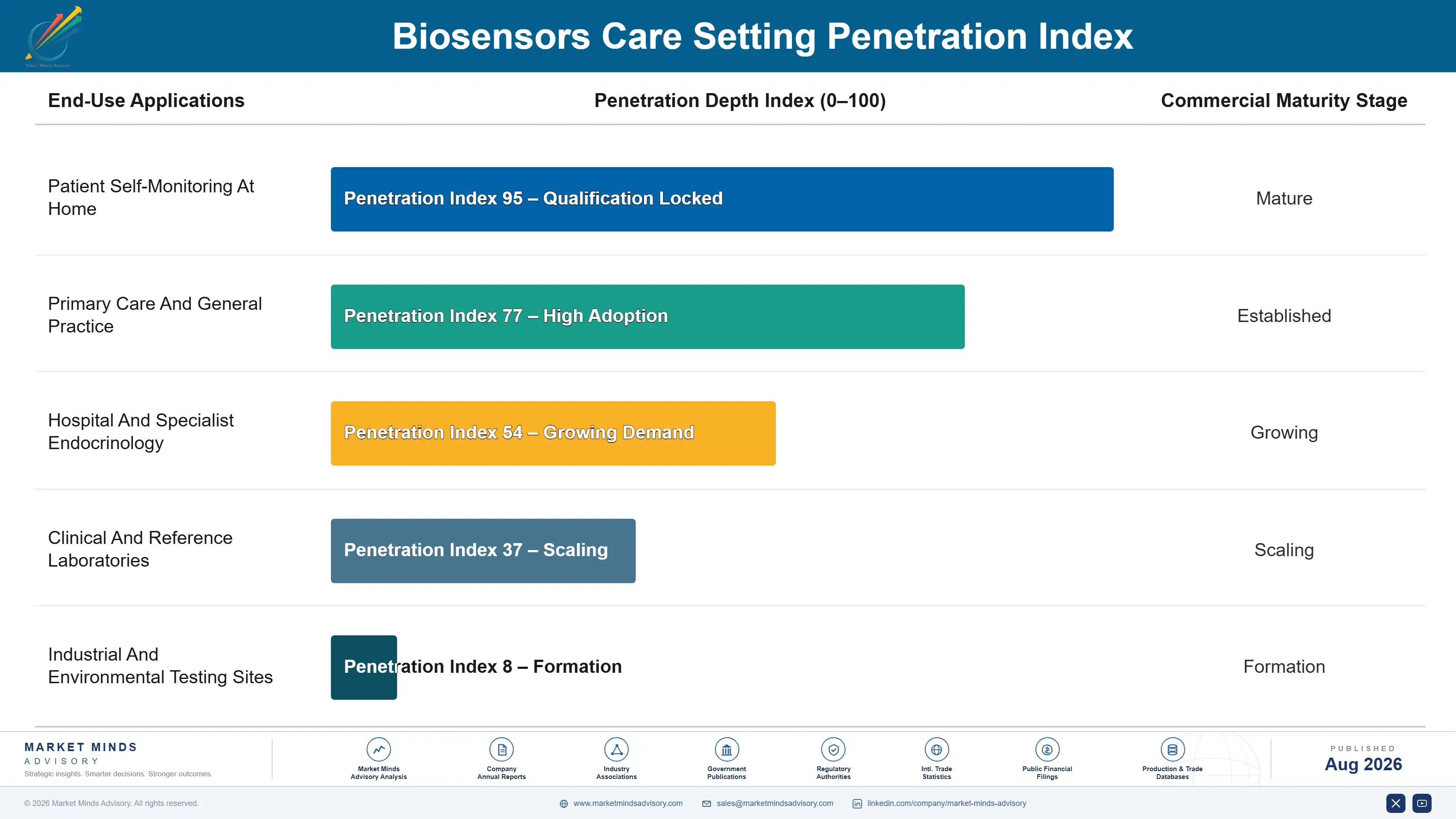
Buyer profiles shifted as continuous monitoring moved from specialist endocrinology into primary care prescribing. The earlier buyer was a diabetes specialist evaluating accuracy data. The current one is frequently a general practitioner working within a coverage criterion and a formulary somebody else has already set. Formulary position and coverage criteria therefore matter more than accuracy data now does.
biosensors-market-end-use-penetration-index-1787300371943

What We Would Tell a Board

These are among the four positions where our research anticipates prominent divergence between winners and laggards over the coming forecast period. Each is grounded in the demand model, the regulatory perimeter, and the announced capacity pipeline.
01 / REIMBURSEMENT DECISION TIMING

Coverage decides volume, so be there before the vote

Only around 54% of continuous sensor users hold reimbursement, and annual cost runs roughly nine times intermittent strip testing, so coverage rather than clinical evidence determines whether a patient can access the product at all. Each payer expansion into basal insulin or non-insulin populations converts a self-pay minority into covered volume within months rather than years. Manufacturers holding health economic evidence, supply capacity, and prescriber relationships before the decision capture that step change entirely, while later entrants compete for share already allocated.
02 / WEAR DURATION ENGINEERING

The limit is enzyme chemistry, not the device

Sensor life near fifteen days sets annual cost per patient directly, and every extension widens the population a payer will fund within a fixed budget envelope. The binding constraint is enzyme activity degradation rather than adhesive or electronics failure, which means the work belongs to formulation chemists rather than to device engineers. Units per patient fall as duration rises, so the commercial return comes from the reimbursement expansion a lower annual cost permits rather than from the wear extension itself.
03 / MANUFACTURING YIELD DISCIPLINE

Thirteen percent scrapped is the real price floor

Roughly 13% of continuous sensors are rejected at final test on calibration variance driven by enzyme deposition and membrane thickness tolerances, and that loss sets the cost floor limiting price reduction toward the thresholds that widen coverage. Deposition process control and variance-tolerant calibration algorithms both attack that loss at its origin rather than screening for it afterward. Yield improvement returns proportionally to volume, which makes it the highest value engineering work available to any large manufacturer in this market today.
04 / ANALYTE PROGRAMME SELECTION

Pick the next analyte on chemistry, not on market size

Glucose holds 78% of this market because glucose oxidase is stable, specific, and tolerant of two weeks on a warm human body, and most alternative recognition elements are none of those three things. Programmes chosen on market attractiveness rather than on chemistry feasibility have consumed development budget for two decades without producing anything at comparable scale. Lactate and ketones sit closest to being solved and deserve the resource, while cortisol and multi-analyte panels remain research positions currently funded as product programmes.

Engagement Snapshot From the Field

A live engagement with an industry participant carrying material or product regulatory and market exposure ahead of a defining policy shift, showing how our research translates into a defensible multi-year portfolio strategy.
MARKET MINDS ADVISORY · CLIENT ENGAGEMENT SUMMARY
Biosensors Producer Strategic Portfolio Review and Transition Roadmap 2026·Investment Scenario on Biosensors Exposure Evaluation 2025-26
CLIENT PROFILE
A diagnostics manufacturer with approximately 620 million dollars in annual revenue (client-reported, unverified by MMA), supplying electrochemical test strips across three regions and holding an early-stage continuous sensor programme alongside two non-glucose analyte development projects. Strip revenue was declining in reimbursed markets and holding in emerging ones, and development spending had grown for four consecutive years without a product launch.
STRATEGIC CHALLENGE
Management proposed accelerating both non-glucose analyte programmes on the argument that strip decline required a differentiated position, and wanted continuous sensor development deprioritised as a crowded field. The board asked for an independent technical and commercial assessment before reallocating development budget on that basis. Development spending had grown for four consecutive years.
MMA APPROACH
We assessed both non-glucose programmes against recognition element stability data, interference profiles, and required concentration ranges, comparing each with published performance for equivalent chemistries. Strip revenue was decomposed by market against reimbursement status. Continuous sensor competitive positions were benchmarked on wear duration, yield, and accuracy, and development spending was mapped against realistic time to approval.
KEY FINDINGS
  1. One non-glucose programme relied on a recognition element losing substantial activity within days at body temperature, with no formulation route identified to address it.
  2. The second programme targeted an analyte where the required concentration range sat below the transducer resolution the platform could achieve at reasonable cost.
  3. Strip revenue decline correlated almost entirely with continuous monitoring reimbursement status by market, and emerging market volume was growing steadily. Emerging market volume was growing.
  4. The continuous sensor programme was behind on wear duration and yield, and closing that gap looked considerably more achievable than either analyte programme.
CLIENT PROFILE
A diagnostics manufacturer with approximately 620 million dollars in annual revenue (client-reported, unverified by MMA), supplying electrochemical test strips across three regions and holding an early-stage continuous sensor programme alongside two non-glucose analyte development projects. Strip revenue was declining in reimbursed markets and holding in emerging ones, and development spending had grown for four consecutive years without a product launch.
STRATEGIC CHALLENGE
Management proposed accelerating both non-glucose analyte programmes on the argument that strip decline required a differentiated position, and wanted continuous sensor development deprioritised as a crowded field. The board asked for an independent technical and commercial assessment before reallocating development budget on that basis. Development spending had grown for four consecutive years.
MMA APPROACH
We assessed both non-glucose programmes against recognition element stability data, interference profiles, and required concentration ranges, comparing each with published performance for equivalent chemistries. Strip revenue was decomposed by market against reimbursement status. Continuous sensor competitive positions were benchmarked on wear duration, yield, and accuracy, and development spending was mapped against realistic time to approval.
KEY FINDINGS
  1. One non-glucose programme relied on a recognition element losing substantial activity within days at body temperature, with no formulation route identified to address it.
  2. The second programme targeted an analyte where the required concentration range sat below the transducer resolution the platform could achieve at reasonable cost.
  3. Strip revenue decline correlated almost entirely with continuous monitoring reimbursement status by market, and emerging market volume was growing steadily. Emerging market volume was growing.
  4. The continuous sensor programme was behind on wear duration and yield, and closing that gap looked considerably more achievable than either analyte programme.
RECOMMENDED STRATEGY
Phase 1: Phase 1 (months one to nine): close the weaker non-glucose programme, redirect its budget into continuous sensor yield and enzyme formulation work. Phase 2: Phase 2 (months nine to twenty-four): defend strip position in emerging markets on cost while continuous development targets wear duration parity. Phase 3: Phase 3 (months twenty-four to forty-eight): pursue tendered continuous sensor supply where reimbursement caps device budgets and price decides. on cost grounds.
OUTCOME
One non-glucose programme was closed and the second was rescoped to research funding rather than product development. Continuous sensor wear duration improved measurably within three quarters once formulation resource was redirected, and strip margin in emerging markets was protected through the transition (client-reported, unverified by MMA).

Frequently Asked Questions

Foundational context covering the market sizes, CAGR, scope, country, region and competition that inform every finding below. This section is provided to cover basics and most often pre-purchase conversations, answered from the MMA Primary Research Dataset.

What is the current size of the Biosensors Market?

The market is valued at USD 32.4 billion in 2025, rising to USD 35.51 billion in 2026. Scope covers devices combining a biological recognition element with a transducer, not laboratory analysers or molecular amplification platforms.

How large will the Biosensors Market be by 2036?

MMA forecasts USD 88.80 billion by 2036, an increase of USD 53.29 billion over the 2026 base. That represents an expansion multiple of 2.50 times across the forecast period.

What is the CAGR for the Biosensors Market 2026 to 2036?

The base case CAGR is 9.6%, with a bull case of 10.8% and a bear case of 8.4%. The historical rate from 2020 to 2025 was 8.4%, with continuous sensing displacing strips throughout.

Which segment is growing fastest?

Continuous interstitial monitoring sensors at 14.4%, exactly 1.50 times the market rate. They replace several hundred annual strip tests with one device, and reimbursement rather than clinical preference sets the pace.

Who are the major companies in the Biosensors Market?

Abbott Laboratories, Dexcom, Roche Diagnostics, LifeScan, and Medtronic lead on annual sensor units shipped. The top five hold 62%, reflecting sensor chemistry and manufacturing yield difficulty rather than commercial position.

Which country is growing fastest?

India at 12.4%, where diagnosis rates are rising sharply as screening extends beyond metropolitan centres. Most of that volume enters through low-cost strip testing rather than continuous monitoring, since reimbursement is largely absent.

Report Segmentation Architecture

The full report scope spans multiple orthogonal segmentation dimensions, with cross-tabulated demand data provided for each dimension pair. Coverage extends further to regional breakdowns, trend trajectories, and the competitive detail needed to support segment-level decision-making.

By Sensor Format And Measurement Mode

  • Single-Use Electrochemical Test Strips
  • Continuous Interstitial Monitoring Sensors
  • Wearable And Patch Format Biosensors
  • Laboratory And Point-Of-Care Cartridges
  • Industrial, Environmental And Food Safety Sensors

By Care Setting

  • Patient Self-Monitoring At Home
  • Primary Care And General Practice
  • Hospital And Specialist Endocrinology
  • Clinical And Reference Laboratories
  • Industrial And Environmental Testing Sites

By Payer Channel

  • Public Health System Reimbursement
  • Private Health Insurance Coverage
  • Patient Self-Pay Direct Purchase
  • Tendered National Procurement
  • Institutional And Industrial Purchasing

By Region

  • East Asia
  • North America
  • Western Europe
  • South Asia and Pacific
  • Latin America
  • Middle East and Africa
  • Eastern Europe

Scope, Methodology, and Coverage

Every figure in this report is reproducible from documented input assumptions. The scope below maps the historical period, the forecast horizon, the segmentation dimensions, and the countries covered, alongside the underlying primary and qualitative methodology.
Historical Period
2020 to 2025
Forecast Period
2026 to 2036
Base Year
2025 (USD billions; MMA Primary Research Dataset, August 2026)
Market Definition
This market comprises biosensor devices incorporating a biological recognition element, whether enzyme, antibody, aptamer, or whole cell, coupled to an electrochemical, optical, or piezoelectric transducer, measured at manufacturer revenue across consumable and device sales. Coverage spans single-use electrochemical test strips, continuous interstitial monitoring sensors, wearable and patch format biosensors, laboratory and point-of-care biosensor cartridges, and industrial, environmental, and food safety biosensors. Optical imaging systems without a biological recognition element, laboratory analysers sold as capital equipment, nucleic acid amplification and sequencing platforms, immunoassay reagents supplied independently, and insulin delivery devices fall outside scope.
Quantitative Units
USD billions (current prices); sensor units shipped annually; sensor wear duration in days; reimbursed against self-pay patient share
Segmentation Dimensions
By Sensor Format And Measurement Mode; By Care Setting; By Payer Channel; By Region
Regions Covered
East Asia, North America, Western Europe, South Asia and Pacific, Latin America, Middle East and Africa, Eastern Europe
Countries Covered
China, Japan, South Korea, Taiwan, United States, Canada, Germany, France, United Kingdom, Netherlands, Sweden, Denmark, India, Australia, Brazil, Mexico, Argentina, Chile, Saudi Arabia, United Arab Emirates, South Africa, Poland, Czechia, and additional markets relevant to this sector
Key Companies Profiled
Abbott Laboratories, Dexcom, Roche Diagnostics, LifeScan, Medtronic, Ascensia Diabetes Care, Senseonics, Ypsomed, Sinocare, Yuwell Medical, i-SENS, ARKRAY, Terumo, Nova Biomedical, Trividia Health, Bio-Rad Laboratories, Siemens Healthineers, Nemaura Medical, PharmaSens, Biolinq
Quantitative Methodology
Primary survey, n=3,800 respondents, Q4 2025, six countries; demand-side model with trade association cross-validation
Qualitative Methodology
47 expert interviews, Q4 2025; applied to validate demand model assumptions, identify emerging dynamics, and assess competitive positioning
Report Format
PDF and XLSX data workbook (Word format preview document)
Publisher
Market Minds Advisory
Report Code
MMA-2026-MED-595
Published
August 2026
Contact
sales@marketmindsadvisory.com | www.marketmindsadvisory.com

Purchase the full Biosensors Market Report (2026 to 2036).

The full report sizes biosensors across five sensor formats, five care settings, five payer channels, and seven regions, with glucose separated from all other analytes since one molecule carries most of the market. Reimbursement status is quantified by market against continuous sensor adoption, because coverage governs volume more completely than clinical evidence does anywhere. Manufacturing yield and wear duration are analysed together as the cost drivers that set achievable pricing. Competitive profiling covers twenty companies on annual sensor units shipped, with non-glucose programmes assessed on recognition chemistry feasibility.
Glucose separated from all other analytes throughout sizing
Reimbursement status quantified against continuous sensor adoption rates
Manufacturing yield and wear duration analysed as cost drivers
Non-glucose programmes assessed on recognition chemistry feasibility
Closed-loop integration positions mapped across pump manufacturers
Strip decline modelled against reimbursement status by market

Built For The People Who Decide

From boardroom strategy to bench-side execution, this report is read cover-to-cover by leaders shaping the next decade of their industry, turning demand scenarios, market dynamics and valuation benchmarks into decisions.
CXOs/ Presidents/ VPs/ Managers
M&A and Corporate Development
Strategy Teams and R&D Heads
Procurement and Product Directors
Regulatory and Compliance Leaders
Investor Relations and Equity Analysts