Market Minds Advisory
Bioplastic Packaging Bag Market

Bioplastic Packaging Bag Market: Regulatory Bans Force a Feedstock Transition Across the Retail Bag Supply Chain

Single-use plastic bans across more than one hundred jurisdictions are forcing retailers to requalify supply chains around PLA, PHA, and starch-blend resins faster than feedstock and composting infrastructure can scale.

Lead Analyst

Bilal Shaikh

Published

September 2026

Make Smarter Decisions with Customized Research Insights

Request a free sample report and evaluate market opportunities, growth trends, and competitive dynamics relevant to your business needs.

2025 MARKET VALUE$6.8BMarket Size 2025
2036 FORECAST VALUE$16.2BBase Case , 2026 to 2036
CAGR 2026 TO 20368.2 %Bull 9.4% / Bear 6.9%
INCREMENTAL OPPORTUNITY$8.8BNet 10- year value creation
EXPANSION MULTIPLE2.20x2036 value over 2026 base
Strategic Levers
M&A Pipeline
Regional Outlook
Country Rankings
Competitive Intelligence
Segmental Deep-dive
Call-Us : 91 93563 13602

Executive Snapshot and Market Trajectory

Bioplastic bag demand is shifting from a niche sustainability purchase into a regulatory compliance requirement as single-use plastic bans spread across more jurisdictions than converters can requalify supply chains for simultaneously, creating persistent capacity shortfalls in qualified resin supply across most major producing regions worldwide.
PHA resin bags are pulling investment fastest given their marine biodegradability advantage over PLA in regions with weak composting infrastructure, while PBAT and PBS blends follow closely as the workhorse chemistry behind most compostable retail and produce bags sold today. East Asia carries the largest production base, anchored by China's PLA and PBAT manufacturing scale, while regulatory pressure in Western Europe and South Asia pulls demand growth fastest.
Five manufacturers hold roughly a third of category revenue, leaving substantial share open to regional converters who move fastest on compostability certification and retailer qualification testing. A technology transition toward PHA and next-generation PBAT blends, combined with tightening single-use plastic regulation, is reshaping which suppliers win the largest retail and food service contracts over the coming decade of category growth.
Market Definition
The market comprises packaging bags manufactured from biodegradable or compostable bio-based plastic resins, including PLA, PHA, starch blends, PBAT and PBS blends, cellulose-based films, and bio-based polyethylene, used for retail carrier bags, produce bags, food service bags, and compostable waste liner bags. It excludes conventional petroleum-based plastic bags and non-bag bioplastic packaging formats such as rigid containers or films sold separately.
Base Year Value
$6.8B in 2025 (MMA Primary Research Dataset, August 2026)
Forecast Period
2026 to 2036, eleven discrete annual values
CAGR
8.2% base case. Bull 9.4%. Bear 6.9%.
Fastest Growth Segment
PHA Bags: 15.5% CAGR
Fastest Growth Country
India: 12.8% CAGR
Fastest Growth Region
South Asia and Pacific: 10.3% CAGR
Largest Region
East Asia: 27% of 2025 global value
Market Leaders
NatureWorks, Novamont, Total Corbion PLA, BASF, Kaneka. Source: MMA Analysis based on company annual reports.
Primary Survey
n=3,800 procurement and R&D decision-makers, Q4 2025, six countries
Methodology
Demand-side build-up, cross-validated against public data, 47 expert interviews

Bioplastic Packaging Bag Market Forecast Scenarios

bioplastic-packaging-bag-market-size-forecast-scenario-1787300079681
Between 2020 and 2025 the market grew at a historical pace of 7.2 percent as an accelerating wave of national and municipal single-use plastic bag bans pulled bioplastic bag demand forward faster than composting infrastructure investment kept pace, a mismatch that defined much of the category's growing pains during this period and left converters scrambling for qualified resin supply.
The base case rests on three commercial mechanisms holding together over the decade: continued expansion of single-use plastic bag bans and extended producer responsibility regulations across additional national and sub-national jurisdictions, growing retailer commitments to compostable packaging tied to corporate sustainability targets independent of regulatory mandate entirely, and PHA and next-generation PBAT resin capacity finally catching up with demand that has outstripped supply for several consecutive years running across most producing regions.
A bull scenario hinges on major additional markets, particularly across South Asia and Latin America, adopting comprehensive plastic bag bans faster than current legislative timelines suggest is likely. The bear case centers on composting infrastructure gaps undermining consumer and regulator confidence in compostable claims broadly, slowing adoption momentum faster than resin capacity expansion could otherwise support across the category.

Regulation-Led Demand Meets a Constrained Resin Supply Chain

Three forces are converging on this category at once: an accelerating global wave of single-use plastic bag bans that has turned bioplastic substitution from optional to mandatory across a growing list of jurisdictions, a resin supply base still catching up to demand after years of underinvestment relative to bag converter needs, and a composting infrastructure gap that undermines end-of-life claims in many of the very markets adopting bans fastest.
MARKET CONCENTRATIONCR5 32%top five manufacturers hold roughly a third of total revenue
AVERAGE UNIT PRICE$0.06/bagblended average selling price across all bioplastic bag formats
LEADING PRODUCING REGIONEast Asia, 27% sharelargest single-region production base by resin manufacturing capacity
REGULATORY-DRIVEN DEMAND58% of revenueproportion of category revenue tied directly to ban compliance
INDUSTRIAL COMPOST TIME90 to 180 daystypical certified breakdown period under industrial composting conditions
RESIN INPUT COST SHARE42% of COGSPLA and PHA feedstock proportion of total goods sold
Commercially, the market increasingly splits along regulatory exposure rather than pure product-class lines. Converters selling into ban-compliant jurisdictions compete primarily on certified compostability documentation and resin supply reliability, while converters selling into voluntary sustainability markets compete more on brand positioning and price relative to conventional plastic alternatives still legally available there.
Over the next decade, resin supply security will matter as much as bag manufacturing scale. Converters who lock in long-term PLA, PHA, and PBAT supply agreements will capture a disproportionate share of the fastest-growing ban-compliant demand before the broader converter base secures comparable feedstock access of its own.
"Everyone assumed this category would grow because consumers wanted it. It's actually growing because legislators mandated it, and those are two very different demand curves to plan resin capacity around."
Director, Sustainable Packaging Materials Practice · MMA Sustainable Packaging M

Market Trends

Single-Use Plastic Bans Spread Across New Jurisdictions

More than one hundred national and sub-national jurisdictions have now enacted some form of single-use plastic bag ban or restriction, a figure that has climbed steadily as additional countries across South Asia, Africa, and Latin America join the European Union and a growing list of United States states already enforcing bans. Each new jurisdiction requires converters to navigate distinct compostability certification standards, since national standards bodies have not fully harmonized testing requirements across regions. This regulatory fragmentation creates meaningful compliance complexity, favoring larger suppliers with dedicated regulatory affairs capability over smaller regional players unable to maintain certification across many jurisdictions at once.
Market Impact: Cuts packaging fees over 20%
PHA Resin Capacity Expands to Meet Marine Biodegradability Demand

PHA resin, which biodegrades in marine and soil environments without requiring industrial composting infrastructure, is attracting the fastest capacity investment of any bioplastic chemistry as manufacturers race to meet demand from coastal and island jurisdictions lacking composting infrastructure entirely. Several major PHA producers have announced or completed new production facilities in the past two years, though total global PHA capacity still lags PLA and starch-blend capacity by a wide margin relative to underlying demand growth. This capacity gap has kept PHA resin pricing well above other chemistries, a premium converters increasingly pay given the marketing value of marine biodegradability claims.
Market Impact: 40% of major chains now compliant

Market Opportunities and Growth Drivers

Extended Producer Responsibility Laws Shift Costs to Brands

Extended producer responsibility regulations, now active across the European Union and an expanding list of additional markets, require brand owners and retailers to bear the financial cost of packaging waste management, creating a direct financial incentive to switch toward compostable bag formats that carry lower disposal fees under most national fee schedules currently in effect. Several major European retailers have disclosed measurable packaging fee savings, in some cases exceeding 20 percent, after switching a substantial share of their bag inventory to certified compostable formats. This financial incentive is proving a more durable demand driver than voluntary sustainability commitments alone, since it directly affects retailer operating costs.
Market Impact: Leaves 60% of claims unmet

Food Service Sector Adopts Compostable Bags at Scale

Quick-service restaurants and food delivery platforms are increasingly specifying compostable bags for takeout and delivery orders, driven both by regulatory requirements in many jurisdictions and by consumer expectation among younger demographic cohorts favoring brands with visible sustainability commitments. Roughly 40 percent of major quick-service restaurant chains in developed markets have now adopted or announced timelines for compostable bag transitions, up substantially from a smaller share just several years earlier. This channel represents a particularly high-volume, repeat-purchase demand source that rewards converters able to guarantee consistent supply at the scale major restaurant chains require nationally across their store networks.
Market Impact: Prices resin 2 to 3x higher

Market Restraints and Challenges

Composting Infrastructure Gaps Undermine End-of-Life Claims

Many jurisdictions mandating compostable bag adoption lack sufficient industrial composting infrastructure to actually process the resulting waste stream, meaning certified compostable bags frequently end up in landfills or conventional recycling streams where they fail to break down as designed. The root cause is that composting infrastructure investment has not kept pace with the regulatory push toward compostable packaging, a mismatch regulators are only beginning to address. The commercial impact is growing consumer and media skepticism toward compostability claims broadly, risking the category's credibility even where resin technology performs exactly as certified. Manufacturers mitigate this through education campaigns and infrastructure advocacy.
Market Impact: Covers 100+ ban jurisdictions

Resin Price Premium Slows Small-Retailer Adoption

Bioplastic resins, particularly PHA and PLA, carry a substantial price premium over conventional polyethylene, a cost difference that smaller independent retailers and food service operators find harder to absorb than large chains with greater purchasing scale. The root cause is that bioplastic resin production still operates at a fraction of conventional plastic's global manufacturing scale, keeping per-unit costs persistently higher despite years of capacity investment. The commercial impact is uneven adoption concentrating fastest among large retailers and slowest among small independent businesses, who sometimes resort to non-compliant alternatives. Manufacturers mitigate this through tiered pricing and smaller minimum order quantities.
Market Impact: Prices PHA 2x above PLA
3 additional market trends, 3 additional growth drivers, and 4 additional restraints and challenges are covered in the full report. Contact sales@marketmindsadvisory.com to access the complete intelligence.

Segment CAGR and Growth Architecture

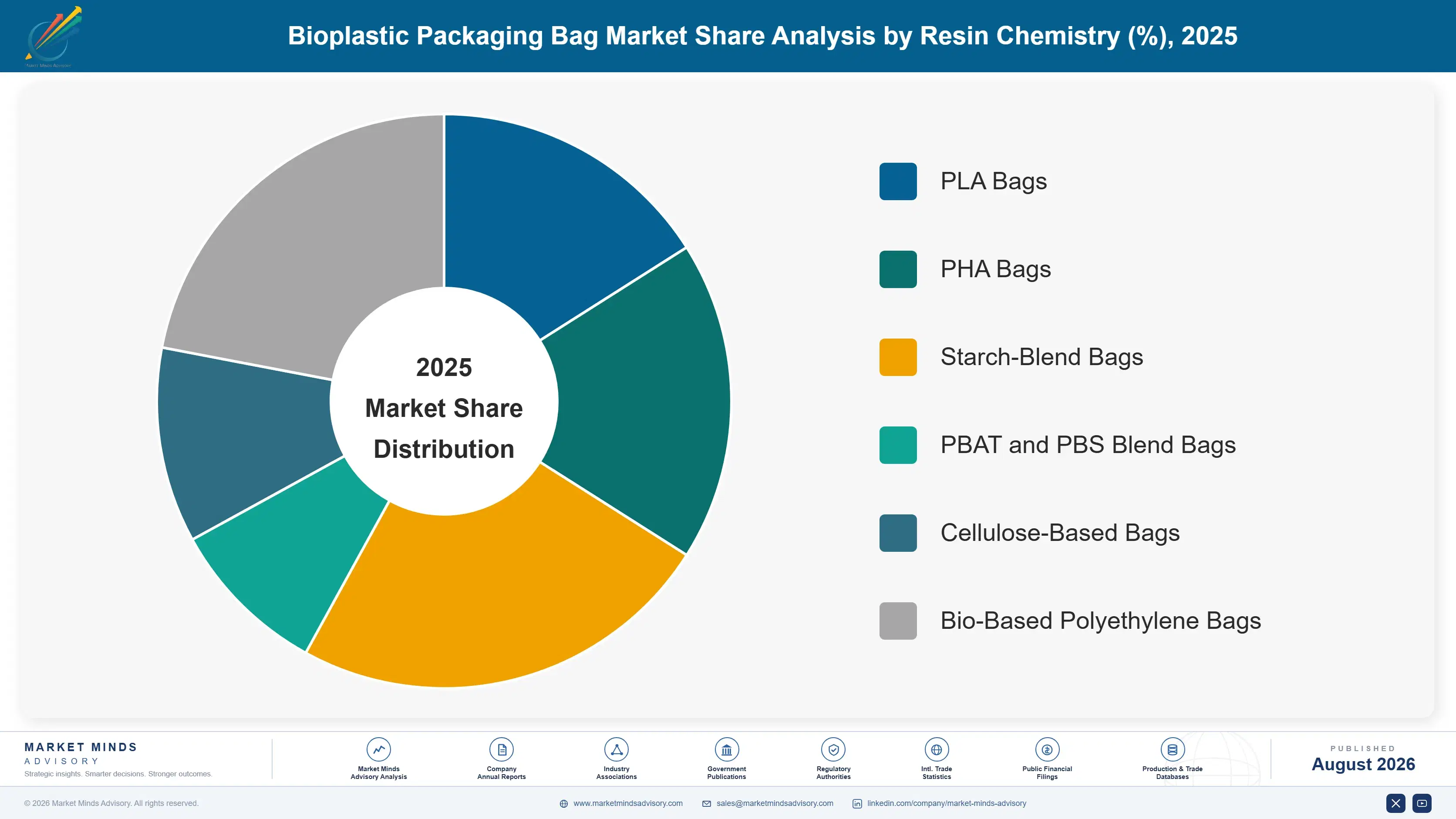
Segmentation follows resin chemistry, the dimension converters and regulators use to classify compostability performance and certification requirements across this market. PHA bags are treated as a distinct category given their marine biodegradability advantage relative to industrially compostable chemistries requiring dedicated infrastructure to properly break down.
bioplastic-packaging-bag-market-market-share-analysis-1787300080266

PHA Bags

PHA bags are the fastest-growing product category, valued for biodegrading in marine and soil environments without requiring industrial composting infrastructure, a distinct advantage over PLA and other chemistries that only break down properly under controlled industrial conditions many markets lack entirely. Demand concentrates among coastal and island jurisdictions with limited composting infrastructure, where marine biodegradability carries both regulatory and marketing value other chemistries cannot match as credibly. Production capacity remains the primary constraint on growth, since PHA manufacturing still operates at a fraction of PLA's global scale despite several major capacity announcements recently. Suppliers with proven large-scale PHA production are commanding meaningful pricing power and long-term supply agreements from retailers eager to secure allocation ahead of constraints.
CAGR 15.5%

PBAT and PBS Blend Bags

PBAT and PBS resin blends, typically combined with PLA or starch to balance cost and performance, form the second-fastest-growing category and remain the workhorse chemistry behind most compostable retail and produce bags sold globally today. These blends offer a favorable combination of industrial compostability certification, adequate mechanical strength for retail bag applications, and resin costs meaningfully lower than PHA, making them the default choice for cost-sensitive retail accounts. Growth tracks the broader wave of single-use plastic bans directly, since PBAT blends satisfy most national certification standards without requiring the marine biodegradability only PHA reliably delivers. Regional production capacity has expanded across China and Europe, giving converters increasingly reliable domestic supply.
CAGR 9.8%
Full segment breakdown across 6 segments available in the complete report.

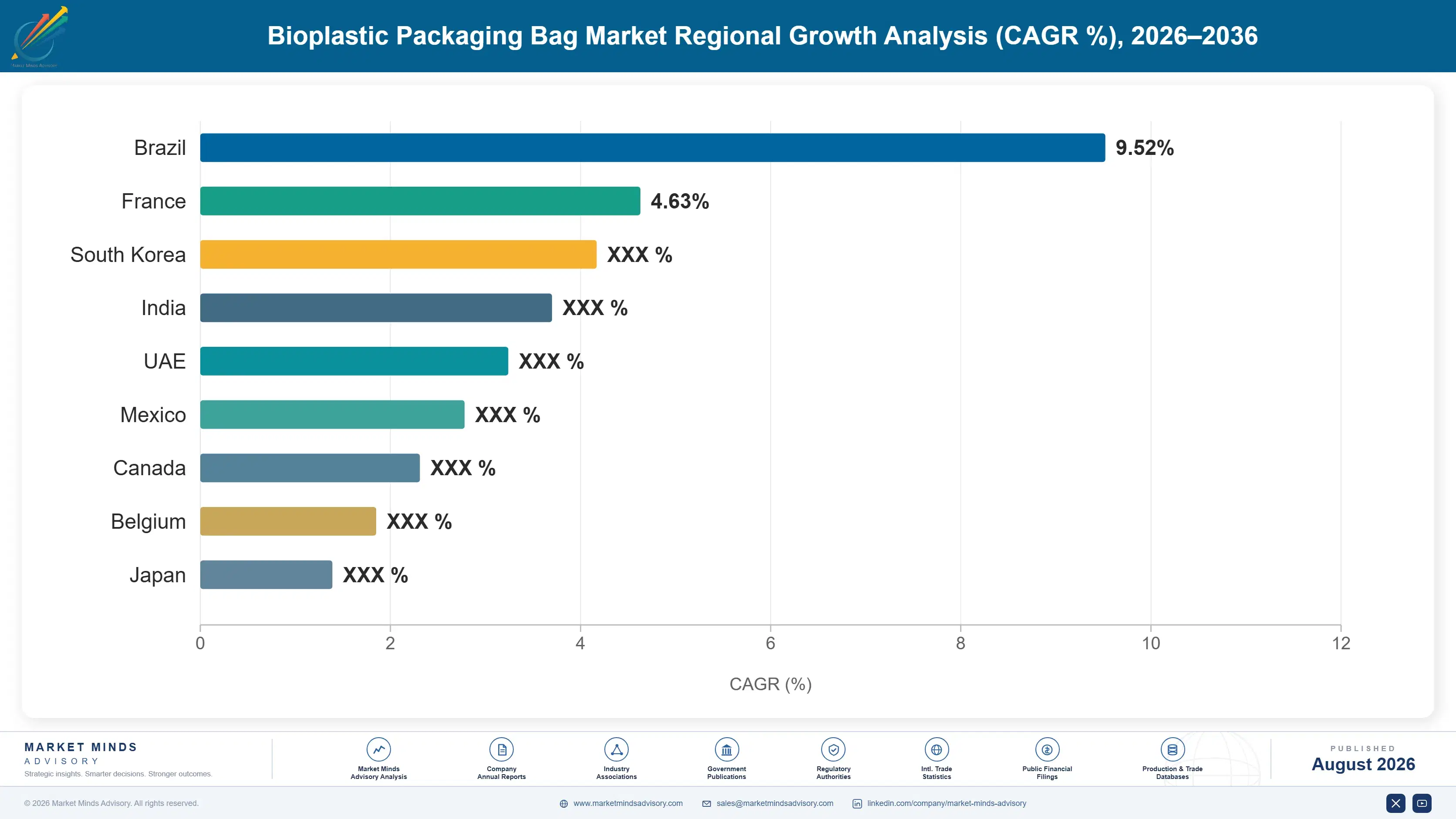
Regional Architecture and Country Demand Map

East Asia leads on resin production scale led by China's PLA and PBAT manufacturing base, Western Europe follows closely on the region's earliest and strictest single-use plastic regulation, and South Asia and Pacific is the fastest-growing region on India's expanding ban enforcement.

North America

State-level single-use plastic bag bans across California, New York, and a growing list of additional states have created a patchwork regulatory environment that national retailers must navigate with state-specific compliance strategies rather than a single uniform national policy. Canada's federal single-use plastics regulation has driven broad national adoption more uniformly than the state-by-state approach still evolving south of its border. Mexico's largest cities have implemented bag bans independently of federal action, creating pockets of strong demand within a national market where enforcement otherwise varies considerably by municipality. Food delivery platforms operating across the region have voluntarily adopted compostable bag standards in several markets even ahead of formal regulatory mandate, anticipating future requirements likely to spread further.
Share: 22% | CAGR: 7.4% (2026 to 2036)

Western Europe

The European Union's Single-Use Plastics Directive, among the earliest and most comprehensive regulatory frameworks globally, has driven broad regional adoption across member states well ahead of most other regions covered in this report. Germany and France both maintain extended producer responsibility fee structures that financially reward compostable bag adoption beyond the baseline regulatory requirement itself, accelerating retailer transitions further. Italy's domestic bioplastics industry, anchored by established manufacturers with decades of starch-blend and PLA production experience, gives the country a meaningful regional production advantage relative to import-dependent neighbors. The United Kingdom's post-Brexit regulatory framework has largely mirrored European Union standards, maintaining consistent cross-channel compliance requirements for converters serving both markets simultaneously.
Share: 24% | CAGR: 6.7% (2026 to 2036)
Regional intelligence for 5 additional markets available in the complete report: East Asia, South Asia and Pacific, Latin America, Middle East and Africa, Eastern Europe. Contact sales@marketmindsadvisory.com.
bioplastic-packaging-bag-market-country-cagr-analysis-1787300080779

Where Converters Can Defend Category Margin

As resin costs compress under new capacity investment, converters are shifting commercial strategy toward long-term resin supply agreements, multi-jurisdiction certification investment, and direct retailer partnership programs to defend margin across the category's fastest-growing regulatory-driven segments over the coming decade.

Lock In Long-Term PHA and PLA Supply Agreements

Converters who secure multi-year fixed-volume resin supply agreements ahead of anticipated capacity constraints are protecting themselves from the spot-market price volatility and allocation shortages that have periodically affected competitors relying on open-market resin purchasing. Suppliers with locked-in supply agreements report margins roughly 30 percent more stable during recent periods of tight PHA capacity than competitors forced to pay premium spot pricing during shortage windows. This lever requires meaningful upfront commitment, often including minimum-volume guarantees, but converts into a durable cost and reliability advantage that spot-market-dependent competitors cannot easily replicate without comparable long-term commitments.
Market Impact: Keeps margins roughly 30% more stable

Invest In Multi-Jurisdiction Compostability Certification

Converters who maintain certification against multiple national compostability standards simultaneously, rather than certifying for a single home market only, can serve retail and food service customers operating across several regulatory jurisdictions without requiring separate supplier relationships in each market. Suppliers with broad multi-jurisdiction certification report winning multinational retailer contracts at rates roughly 2x higher than single-jurisdiction competitors bidding the same cross-border opportunities. This lever requires sustained regulatory affairs investment but positions converters to capture share as more retailers consolidate global packaging supply under fewer certified vendors.
Market Impact: Wins contracts at a 2x higher rate

Build Direct Retailer Sustainability Partnership Programs

Converters who establish direct sustainability partnership relationships with major retailers, including co-branded compostability education and in-store consumer messaging, are building deeper commercial relationships than transactional suppliers competing purely on unit price alone. Retailers participating in these partnership programs report supplier retention rates roughly 25 percent higher and longer contract terms than retailers sourcing bags through conventional competitive bidding processes alone. This lever rewards converters with dedicated sustainability marketing capability over pure manufacturing specialists, though it requires sustained relationship investment beyond simple product delivery and fulfillment.
Market Impact: Lifts retailer retention by roughly 25%

Expand Manufacturing Presence Near Fast-Growing Ban Markets

Establishing bag converting capacity near fast-growing regulatory markets, particularly across South Asia and Southeast Asia, shortens delivery lead times and reduces import tariff exposure relative to converters shipping finished bags from distant manufacturing facilities across long supply chains. Converters with local presence in these fast-growing markets have won meaningfully higher shares, often above 40 percent, of new retailer contracts than distant competitors bidding the same opportunities with longer delivery timelines. This lever requires meaningful capital commitment but converts into a durable advantage on the fastest-growing regulatory-driven demand pool in the entire market.
Market Impact: Wins over 40% of new local contracts

Who Controls the Margin Pool

The top five manufacturers hold roughly 32 percent of revenue on a company-revenue basis, one of the more fragmented structures in this report, reflecting how regional converters with local retailer relationships and certification still compete successfully even as the largest resin producers control an outsized share of upstream feedstock supply. The gap between NatureWorks and Kaneka, the two largest players, and the broader field remains meaningful but leaves substantial room for regional spe
Current competitive activity centers on three fronts: resin capacity expansion races to meet demand that has outstripped supply for several consecutive years, multi-jurisdiction certification investment designed to serve multinational retailer accounts, and direct sustainability partnership programs intended to deepen retailer relationships beyond transactional purchasing.

Pressure is building from regional Asian converters, particularly in China and India, who are moving up the value chain from generic starch-blend bag supply into certified PBAT and PHA-based premium formats that historically only Western and Japanese specialists could reliably supply. Several have already won domestic retailer reference contracts, evidence that could accelerate their move into higher-margin certified segments faster than incumbents currently expect.
bioplastic-packaging-bag-market-company-positioning-matrix-1787300081299

Competitive Moat and Risk Dimensions

NATUREWORKS LLC

Moat: Largest Global PLA Production Scale

NatureWorks operates the largest single PLA production facility globally under its Ingeo brand, giving it a cost and reliability advantage on standard PLA resin that smaller regional producers cannot easily match without comparable manufacturing scale investment of their own to compete.
NATUREWORKS LLC

Risk: Concentrated in a Single Chemistry

NatureWorks' business remains heavily concentrated in PLA specifically, leaving it more exposed than diversified competitors if buyer preference or regulatory requirements shift decisively toward PHA or other chemistries better suited to marine biodegradability performance in coastal markets.
KANEKA CORPORATION

Moat: Deepest PHA Manufacturing Expertise

Kaneka holds some of the industry's most advanced PHA production technology and years of accumulated manufacturing experience, giving it a qualification and reliability advantage in the fastest-growing bioplastic chemistry that newer PHA entrants would need years to credibly match at scale.
KANEKA CORPORATION

Risk: Smaller Scale Than Diversified Rivals

Kaneka's PHA-focused bioplastics business operates at smaller absolute scale than diversified chemical giants entering the category, potentially limiting its ability to fund the aggressive capacity expansion needed to keep pace with rapidly growing global PHA demand across regions.

Players Tracked

Prominent Players

NatureWorks LLC
Novamont S.p.A.
Total Corbion PLA
BASF SE
Kaneka Corporation

Other Key Players

Danimer Scientific Inc.
Braskem S.A.
FKuR Kunststoff GmbH
Biome Bioplastics Limited
Plantic Technologies Limited
Cardia Bioplastics Limited
Green Dot Bioplastics Inc.
Novolex Holdings
TIPA Corp Ltd.
BioBag International AS
Taghleef Industries
Trioworld Group
RWDC Industries Pte Ltd.
Mondi Group
Futerro

Recent Developments

APRIL 2025

Total Corbion PLA Expands Manufacturing Capacity in Thailand

Total Corbion PLA announced an organic capacity expansion at its existing Thailand facility, adding new PLA production lines to meet growing demand across Southeast Asia and export markets without relying on capacity from its other global manufacturing sites elsewhere.
Signal: Established PLA producers are increasingly committing dedicated regional capacity near fast-growing Southeast Asian demand.
SEPTEMBER 2025

Kaneka Signs Multi-Year Supply Agreement With Major Global Retailer

Kaneka signed a multi-year supply agreement, not an acquisition or joint venture, with a major global retailer to provide certified PHA resin for the retailer's compostable produce bag program across multiple countries, securing predictable long-term order volume ahead of demand.
Signal: Major retailers are increasingly securing long-term PHA supply ahead of anticipated future capacity constraints emerging.
JANUARY 2026

NatureWorks Forms Joint Venture for New PLA Production Facility

NatureWorks formed a joint venture with a regional feedstock partner to build a new PLA production facility, a genuine joint venture rather than an acquisition, sharing capital investment and feedstock sourcing risk across both partner organizations involved.
Signal: Resin producers are increasingly sharing capacity expansion risk through joint ventures rather than solo capital investment.

PLA and PHA Feedstock Exposure

PLA and PHA resin feedstock, derived from corn starch, sugarcane, and other agricultural sources depending on chemistry, together account for roughly 42 percent of cost of goods sold across the category, with bag converting, printing, and packaging making up most of the remainder. Feedstock costs are directly exposed to agricultural commodity price cycles that behave differently from the petrochemical cycles affecting conventional plastic bag production.
Corn and sugarcane feedstock prices rose meaningfully during 2022 and 2023 amid weather-related crop disruptions across major agricultural producing regions, a period the United States Department of Agriculture's commodity outlook reports described as unusually volatile for the row crops underlying much of global bioplastic feedstock supply. Several resin producers disclosed margin compression in earnings materials directly attributable to this agricultural commodity volatility during the period.

Exposure varies by feedstock source and company scale. Larger resin producers with diversified feedstock sourcing across multiple agricultural regions absorbed the volatility with comparatively limited disruption, while smaller specialists reliant on a single regional feedstock source faced sharper cost swings that occasionally opened share for better-diversified or alternative-feedstock competitors during the tightest supply quarters of the cycle.
bioplastic-packaging-bag-market-cost-volatility-analysis-1787300081495

Diversify Feedstock Sourcing Across Regions

Manufacturers are increasingly sourcing agricultural feedstock from multiple growing regions rather than a single geographic source, reducing exposure to weather-related crop disruptions concentrated in any one agricultural region and providing meaningfully greater supply resilience overall across cycles.

Invest In Non-Food Feedstock Alternatives

Several producers are researching and piloting bioplastic feedstock derived from agricultural waste and non-food biomass sources, reducing both cost exposure to food commodity markets and the food-versus-fuel criticism sometimes directed at corn-based bioplastic production broadly.

Secure Long-Term Agricultural Supply Contracts

Leading resin producers are signing multi-year supply agreements directly with agricultural cooperatives and grain processors, trading some pricing flexibility for meaningfully greater feedstock supply certainty during periods of tight regional agricultural commodity markets and pricing.

Portfolio Architecture for Margin Defence

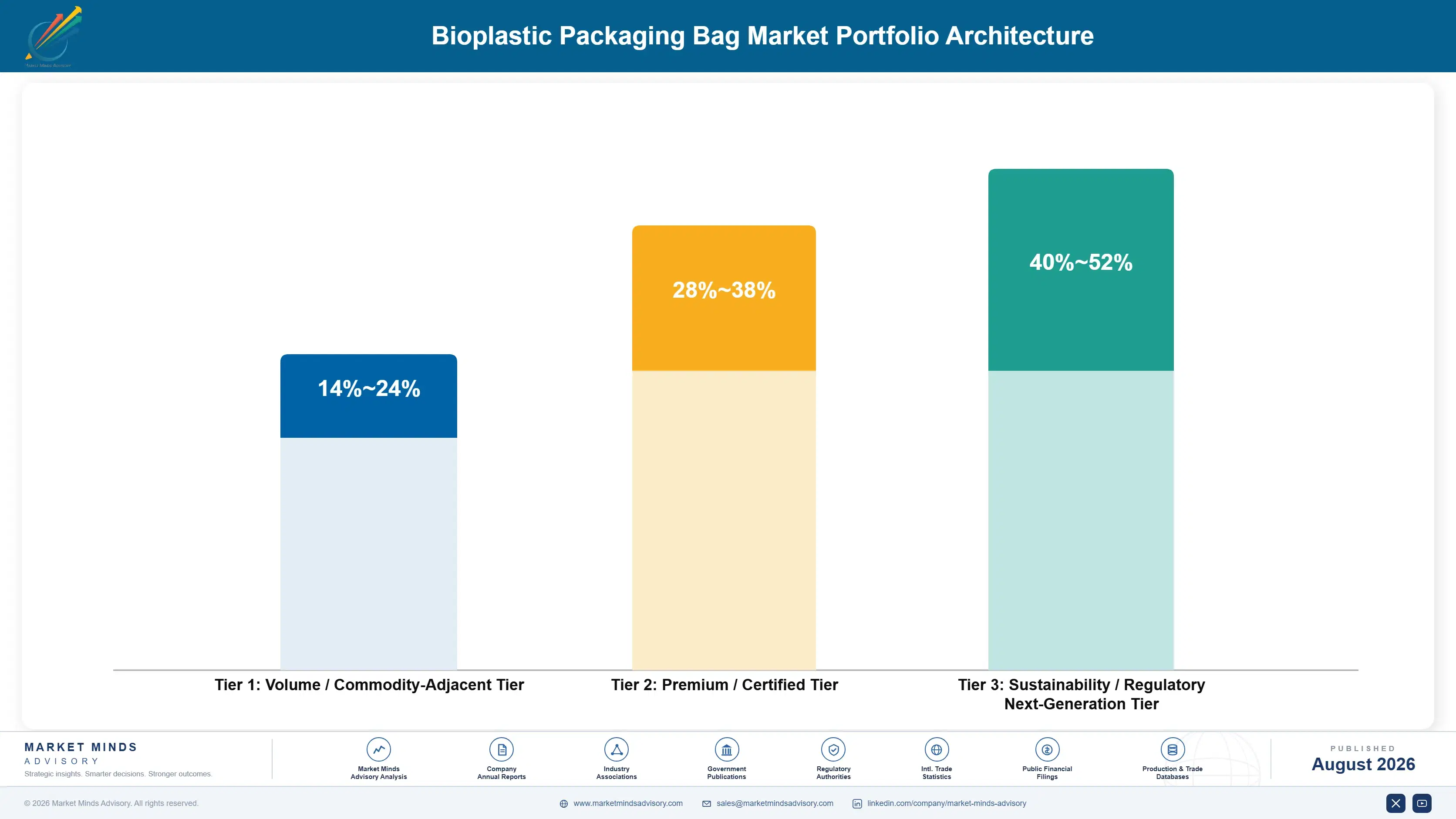
The market splits into three commercial tiers with distinct margin economics. Generic starch-blend and basic PLA bags compete largely on price and delivery lead time, certified PBAT and PBS blend formats carry meaningfully higher margin on compostability certification breadth, and PHA-based marine-biodegradable bags command the highest margin given their constrained resin supply and premium positioning.
The tension between volume and premium positioning shapes how converters allocate resin sourcing investment: generic starch-blend bags still represent the largest unit volume by a wide margin across the broadest regulatory-compliance base, but nearly all incremental profit growth over the forecast period concentrates in PHA and premium certified formats, which is where the leading converters increasingly direct sourcing and certification spending.

High-value margin pools concentrate specifically in PHA bags during their current supply-constrained window and in multi-jurisdiction certified products serving multinational retailer accounts. Both pools reward converters who invest ahead of demand in resin supply security and certification breadth rather than those who wait for regulatory mandates to fully mature before committing capital.

Volume / Commodity-Adjacent Tier

Generic starch-blend and basic PLA bags sold largely on price and delivery lead time across broad regulatory-compliance retail channels worldwide serving most jurisdictions.
Gross Margin: 14-24%

Premium / Certified Tier

PBAT and PBS blend bags carrying multi-jurisdiction compostability certification, commanding meaningful premiums tied directly to certification breadth and proven supply reliability.
Gross Margin: 28-38%

Sustainability / Regulatory / Next-Generation Tier

PHA-based marine-biodegradable bags, carrying the category's highest margins given their currently constrained global resin supply and strong premium market positioning.
Gross Margin: 40-52%
bioplastic-packaging-bag-market-portfolio-architecture-1787300081996

High-value Sub-segments and Strategic Watch-out

PHA Bags

Highest current margin and fastest volume growth in the category, constrained mainly by limited global production capacity and the small number of suppliers with proven large-scale manufacturing today worldwide.
Gross Margin: 42-52%

PBAT and PBS Blend Bags

Steady high-value growth tracking the broader wave of single-use plastic bans closely, increasingly favoring suppliers with multi-jurisdiction certification over regional single-market specialists lacking breadth.
Gross Margin: 28-38%

Generic Starch-Blend Bags

The volume core of the market by unit count, competing primarily on price and delivery lead time rather than deep technical differentiation between competing regional suppliers overall.
Gross Margin: 14-22%

Non-Certified Compostable Claims

A strategic watch-out segment as regulatory scrutiny and consumer skepticism toward unverified compostability claims threaten a substantial share of currently marketed generic bioplastic products globally.
Gross Margin: 10-20%

Regulatory Mandate Meets Retailer Supply Lock-In

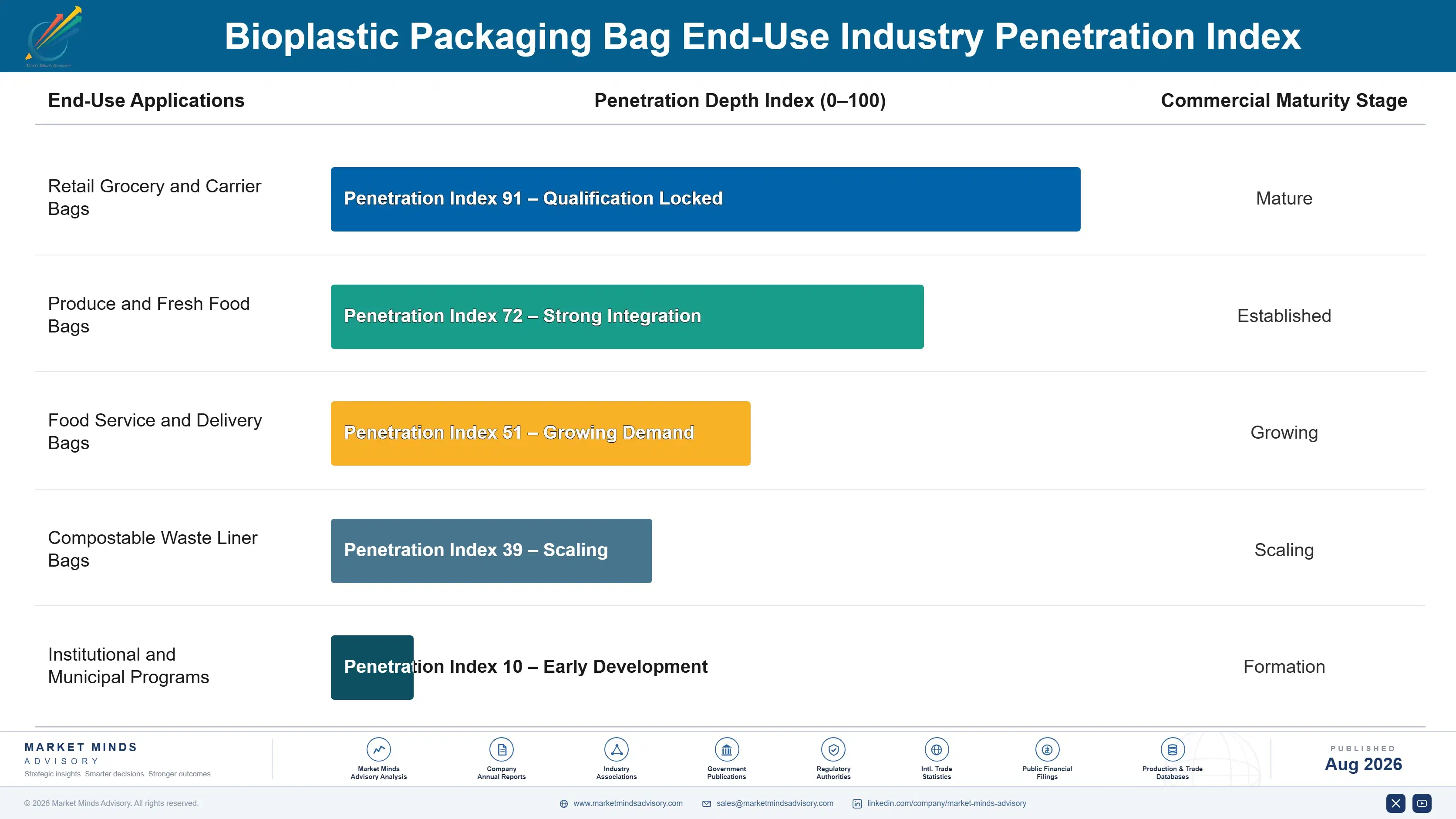
Bioplastic bag demand behaves less like a discretionary consumer purchase and more like a compliance-driven annuity once a jurisdiction enacts a ban, generating recurring, predictable order volume from covered retailers and food service operators who have no legal alternative but to source certified compostable formats within their operating region.
Adoption depth varies sharply by end-use vertical. Large national and multinational retailers show the deepest supply relationship lock-in given the complexity of qualifying certified suppliers across multiple jurisdictions simultaneously, small independent retailers remain far more price-sensitive and transactional, and food service chains sit between the two, increasingly standardizing around a small number of certified national suppliers for consistency across their store networks.

A generational shift in buyer profile is underway as retail sustainability and compliance teams increasingly include dedicated packaging specialists rather than pure procurement generalists trained under an older cost-focused sourcing model. Regulatory affairs teams at converters are also reshaping how suppliers must present certification evidence earlier in the retailer qualification process, well before a contract reaches final commercial negotiation.
bioplastic-packaging-bag-market-end-use-penetration-index-1787300082486

Where This Market Goes Next

These are among the four positions where our research anticipates prominent divergence between winners and laggards over the coming forecast period. Each is grounded in the demand model, the regulatory perimeter, and the announced capacity pipeline.
01 / RESIN SUPPLY SECURITY

Locked-in feedstock agreements will decide who scales fastest

Resin supply, not bag manufacturing capacity, is the binding constraint on growth for most converters in this market, particularly for PHA and premium PBAT blends where demand has outstripped capacity for several consecutive years running. Converters who secured long-term supply agreements ahead of the current shortage are protected from the spot-market volatility disrupting competitors without similar coverage. This gap should widen rather than narrow as new capacity comes online slower than demand, rewarding early movers who locked in allocation before the broader converter base recognized the coming constraint.
02 / MULTI-JURISDICTION CERTIFICATION STRATEGY

Certification breadth is becoming a prerequisite for scale

Multinational retailers increasingly prefer consolidating packaging supply under fewer certified vendors capable of serving every jurisdiction where they operate, rather than managing separate certified suppliers market by market as regulatory fragmentation across ban jurisdictions continues expanding. Converters with broad multi-jurisdiction certification are winning larger, more durable retailer contracts than single-market specialists competing for the same accounts. Manufacturers who delay this certification investment risk losing access to the largest and most valuable multinational retailer relationships as consolidation continues across the category.
03 / COMPOSTING INFRASTRUCTURE ADVOCACY

Suppliers must help close the infrastructure gap they depend on

Compostable bag credibility depends on composting infrastructure that many ban jurisdictions still lack, a gap that threatens the category's long-term reputation regardless of how well individual resin chemistries perform under proper conditions. Suppliers who invest in infrastructure advocacy and consumer education are protecting the category's broader credibility rather than treating infrastructure gaps as someone else's problem to solve eventually. Manufacturers who ignore this risk a consumer trust backlash that could slow adoption momentum across the entire category, not just their own individual product lines.
04 / PHA CAPACITY INVESTMENT

Early PHA capacity investors are capturing outsized pricing power

PHA's marine biodegradability advantage over other bioplastic chemistries is driving demand that current global production capacity cannot fully satisfy, giving early capacity investors like Kaneka meaningful pricing power likely to persist until new capacity closes the supply gap. Manufacturers weighing capital allocation between expanding conventional PLA capacity and newer PHA capacity should recognize that PHA's imbalance is currently more favorable to sellers than any other chemistry here. This window will not stay open indefinitely as announced capacity expansions gradually come online.

Engagement Snapshot From the Field

A live engagement with an industry participant carrying material or product regulatory and market exposure ahead of a defining policy shift, showing how our research translates into a defensible multi-year portfolio strategy.
MARKET MINDS ADVISORY · CLIENT ENGAGEMENT SUMMARY
Bioplastic Packaging Bag Producer Strategic Portfolio Review and Transition Roadmap 2026·Investment Scenario on Bioplastic Packaging Bag Exposure Evaluation 2025-26
CLIENT PROFILE
The client is a national grocery retail chain operating several hundred stores across multiple states, distributing tens of millions of retail carrier bags annually (client-reported, unverified by MMA) prior to engaging MMA. The chain faced an approaching state-level single-use plastic bag ban deadline across a meaningful share of its store footprint and had not yet finalized a compliant bag transition strategy.
STRATEGIC CHALLENGE
Leadership needed to select certified compostable bag suppliers capable of meeting the chain's volume requirements within a compressed compliance timeline, while managing the cost impact of switching to a materially more expensive bag format across its full store network nationwide before the deadline hit.
MMA APPROACH
MMA benchmarked candidate suppliers against certification breadth, production capacity, and pricing structure, modeled the total cost impact of the transition under three distinct sourcing scenarios, and recommended a dual-sourcing strategy balancing supply security against the chain's aggressive compliance timeline requirements across its footprint.
KEY FINDINGS
  1. Only three of eight candidate suppliers evaluated maintained sufficient certified production capacity to meet the chain's full volume requirements within the compressed compliance timeline available.
  2. Dual-sourcing across two qualified suppliers was modeled to reduce single-supplier disruption risk by roughly 40 percent relative to a single-source strategy across the transition.
  3. Total bag cost was modeled to rise by approximately 2.5 times versus the chain's prior conventional plastic bag program (client-reported, unverified by MMA), a cost partially offset by extended producer responsibility fee reductions.
  4. Regional resin allocation constraints meant lead times varied by more than eight weeks across candidate suppliers, materially affecting which suppliers could realistically meet the deadline.
CLIENT PROFILE
The client is a national grocery retail chain operating several hundred stores across multiple states, distributing tens of millions of retail carrier bags annually (client-reported, unverified by MMA) prior to engaging MMA. The chain faced an approaching state-level single-use plastic bag ban deadline across a meaningful share of its store footprint and had not yet finalized a compliant bag transition strategy.
STRATEGIC CHALLENGE
Leadership needed to select certified compostable bag suppliers capable of meeting the chain's volume requirements within a compressed compliance timeline, while managing the cost impact of switching to a materially more expensive bag format across its full store network nationwide before the deadline hit.
MMA APPROACH
MMA benchmarked candidate suppliers against certification breadth, production capacity, and pricing structure, modeled the total cost impact of the transition under three distinct sourcing scenarios, and recommended a dual-sourcing strategy balancing supply security against the chain's aggressive compliance timeline requirements across its footprint.
KEY FINDINGS
  1. Only three of eight candidate suppliers evaluated maintained sufficient certified production capacity to meet the chain's full volume requirements within the compressed compliance timeline available.
  2. Dual-sourcing across two qualified suppliers was modeled to reduce single-supplier disruption risk by roughly 40 percent relative to a single-source strategy across the transition.
  3. Total bag cost was modeled to rise by approximately 2.5 times versus the chain's prior conventional plastic bag program (client-reported, unverified by MMA), a cost partially offset by extended producer responsibility fee reductions.
  4. Regional resin allocation constraints meant lead times varied by more than eight weeks across candidate suppliers, materially affecting which suppliers could realistically meet the deadline.
RECOMMENDED STRATEGY
Phase 1: Phase 1 (Months 1-2): Complete supplier evaluation and finalize a dual-sourcing agreement across two qualified certified suppliers nationwide. Phase 2: Phase 2 (Months 3-5): Secure resin allocation commitments and begin phased store-by-store rollout ahead of the ban deadline. Phase 3: Phase 3 (Months 6-9): Complete full network transition and establish ongoing supply monitoring across both supplier relationships continuously.
OUTCOME
The chain completed its full network transition one month ahead of the regulatory deadline with zero reported stockouts across its entire store footprint (client-reported, unverified by MMA), validating MMA's dual-sourcing recommendation under a compressed timeline.

Frequently Asked Questions

Foundational context covering the market sizes, CAGR, scope, country, region and competition that inform every finding below. This section is provided to cover basics and most often pre-purchase conversations, answered from the MMA Primary Research Dataset.

What is the current size of the Bioplastic Packaging Bag Market?

The market is valued at approximately 6.8 billion dollars in 2025, expanding to roughly 7.36 billion dollars in 2026 as single-use plastic bans and retailer sustainability commitments continue driving adoption.

How large will the Bioplastic Packaging Bag Market be by 2036?

MMA forecasts the market reaching approximately 16.18 billion dollars by 2036, roughly 2.2 times its 2026 value, driven primarily by expanding regulatory bans and growing PHA resin capacity.

What is the CAGR for the Bioplastic Packaging Bag Market 2026 to 2036?

The base-case compound annual growth rate is 8.2 percent, with a bull scenario of 9.4 percent and a bear scenario of 6.9 percent depending on regulatory expansion pace and resin capacity growth.

Which segment is growing fastest?

PHA bags are growing fastest at a 15.5 percent CAGR, roughly 1.89 times the overall market rate, driven by marine biodegradability advantages in coastal markets lacking composting infrastructure.

Who are the major companies in the Bioplastic Packaging Bag Market?

NatureWorks, Novamont, Total Corbion PLA, BASF, and Kaneka lead the market, together holding roughly 32 percent of revenue on a company-revenue basis across all resin chemistries.

Which country is growing fastest?

India is the fastest-growing country at a 12.8 percent CAGR, driven by nationwide single-use plastic bag enforcement and expanding domestic bioplastic resin production capacity.

Report Segmentation Architecture

The full report scope spans multiple orthogonal segmentation dimensions, with cross-tabulated demand data provided for each dimension pair. Coverage extends further to regional breakdowns, trend trajectories, and the competitive detail needed to support segment-level decision-making.

By Resin Chemistry

  • PLA Bags
  • PHA Bags
  • Starch-Blend Bags
  • PBAT and PBS Blend Bags
  • Cellulose-Based Bags
  • Bio-Based Polyethylene Bags

By End-Use Industry

  • Retail Grocery and Carrier Bags
  • Produce and Fresh Food Bags
  • Food Service and Delivery Bags
  • Compostable Waste Liner Bags
  • Institutional and Municipal Programs

By Commercial Dimension

  • Direct Retailer Supply Contracts
  • Distributor and Wholesale Channel
  • Food Service Chain Contracts
  • Municipal and Government Procurement

By Region

  • North America
  • Western Europe
  • East Asia
  • South Asia and Pacific
  • Latin America
  • Middle East and Africa
  • Eastern Europe

Scope, Methodology, and Coverage

Every figure in this report is reproducible from documented input assumptions. The scope below maps the historical period, the forecast horizon, the segmentation dimensions, and the countries covered, alongside the underlying primary and qualitative methodology.
Historical Period
2020 to 2025
Forecast Period
2026 to 2036
Base Year
2025 (USD billions; MMA Primary Research Dataset, August 2026)
Market Definition
The market covers packaging bags manufactured from biodegradable or compostable bio-based plastic resins, including PLA, PHA, starch blends, PBAT and PBS blends, cellulose-based films, and bio-based polyethylene, used for retail carrier bags, produce bags, food service bags, and compostable waste liner bags. Conventional petroleum-based plastic bags and non-bag bioplastic packaging formats are excluded.
Quantitative Units
USD billions (current prices); unit shipments in billions of bags where cited
Segmentation Dimensions
By Resin Chemistry; By End-Use Industry; By Commercial Dimension; By Region
Regions Covered
North America, Western Europe, East Asia, South Asia and Pacific, Latin America, Middle East and Africa, Eastern Europe
Countries Covered
USA, China, Germany, France, UK, Japan, South Korea, India, Australia, Canada, Brazil, Mexico, Indonesia, Vietnam, Thailand, Malaysia, UAE, Saudi Arabia, South Africa, Nigeria, Turkey, Poland, Netherlands, Italy, Spain, Sweden, Switzerland, Argentina, Colombia, Singapore, and additional markets relevant to this sector
Key Companies Profiled
NatureWorks LLC, Novamont S.p.A., Total Corbion PLA, BASF SE, Kaneka Corporation, Danimer Scientific Inc., Braskem S.A., FKuR Kunststoff GmbH, Biome Bioplastics Limited, Plantic Technologies Limited, Cardia Bioplastics Limited, Green Dot Bioplastics Inc., Novolex Holdings, TIPA Corp Ltd., BioBag International AS, Taghleef Industries, Trioworld Group, RWDC Industries Pte Ltd., Mondi Group, Futerro
Quantitative Methodology
Primary survey, n=3,800 respondents, Q4 2025, six countries; demand-side model with trade association cross-validation
Qualitative Methodology
47 expert interviews, Q4 2025; applied to validate demand model assumptions, identify emerging dynamics, and assess competitive positioning
Report Format
PDF and XLSX data workbook (Word format preview document)
Publisher
Market Minds Advisory
Report Code
MMA-2026-PAC-611
Published
August 2026
Contact
sales@marketmindsadvisory.com | www.marketmindsadvisory.com

Purchase the full Bioplastic Packaging Bag Market Report (2026 to 2036).

The full report delivers a complete quantitative and strategic assessment of the bioplastic packaging bag market across all seven regions and more than thirty countries covered in this study. It includes detailed segment-level forecasts through 2036, competitive benchmarking across twenty profiled manufacturers, and primary research drawn from 3,800 survey respondents and 47 expert interviews conducted in Q4 2025. Buyers receive editable data tables and full regional narrative detail beyond the two regions previewed in this summary document. A dedicated appendix covers single-use plastic ban timelines and compostability certification standards by country.
Fully editable Excel data tables included
All seven full regional narratives included
Twenty-company competitive profiles included
Ban timelines and certification appendix provided
Segment-level 2026-2036 detailed forecasts
Primary survey and interview data provided

Built For The People Who Decide

From boardroom strategy to bench-side execution, this report is read cover-to-cover by leaders shaping the next decade of their industry, turning demand scenarios, market dynamics and valuation benchmarks into decisions.
CXOs/ Presidents/ VPs/ Managers
M&A and Corporate Development
Strategy Teams and R&D Heads
Procurement and Product Directors
Regulatory and Compliance Leaders
Investor Relations and Equity Analysts