Market Minds Advisory
Biodegradable Baby Diapers Market

Biodegradable Baby Diapers Market: Biodegradable Baby Diapers Market: The Core, The Claim and The Missing Disposal Route

The absorbent core is a synthetic polymer that does not break down, almost nowhere accepts a used diaper for composting, and the claim on the pack is about to meet a regulator.

Lead Analyst

Published

September 2026

Make Smarter Decisions with Customized Research Insights

Request a free sample report and evaluate market opportunities, growth trends, and competitive dynamics relevant to your business needs.

2025 MARKET VALUE$2.8BMarket Size 2025
2036 FORECAST VALUE$10.1BBase Case , 2026 to 2036
CAGR 2026 TO 203612.4 %Bull 13.6% / Bear 11.2%
INCREMENTAL OPPORTUNITY$7.0BNet 10- year value creation
EXPANSION MULTIPLE3.22x2036 value over 2026 base
Strategic Levers
M&A Pipeline
Regional Outlook
Country Rankings
Competitive Intelligence
Segmental Deep-dive
Call-Us : 91 93563 13602

Executive Snapshot and Market Trajectory.

A biodegradable diaper is roughly two thirds biodegradable. The absorbent core is sodium polyacrylate, it is a third of the product by weight, and it does not break down anywhere. Every commercial question in this category follows from that one single unresolved fact about it.
Certified compostable core diapers grow at 18.6%, half again the market rate of 12.4%, because a certification is the only thing left that a regulator will accept. East Asia holds 28% of demand on the highest premium diaper spend per child anywhere and on the bamboo viscose and nonwoven supply base that everybody else buys from. Only 3% of households can compost the product at all in practice. Nobody advertises that number.
Concentration is low at 29%, because a diaper brand needs no factory: contract converters in China and Eastern Europe will run any specification a founder can write. The barrier is certification and pulp sourcing rather than manufacturing. A price premium of 2.1 times over conventional product buys a deal of tolerance, and the participants who will survive are the ones who can document what that premium pays for.
Market Definition
The biodegradable baby diapers market covers single-use absorbent infant diapers and training pants marketed on biodegradable, compostable or plant-based content, spanning chlorine-free fluff pulp constructions, bamboo viscose topsheets, plant-based backsheets, reduced or bio-based superabsorbent cores and certified compostable formats. Scope includes own-label eco ranges sold by retailers. Excluded are conventional disposable diapers carrying no environmental claim, reusable cloth diapers and covers, adult incontinence products, baby wipes and changing accessories, and diaper disposal or laundering services.
Base Year Value
$2.8B in 2025 (MMA Primary Research Dataset, August 2026)
Forecast Period
2026 to 2036, eleven discrete annual values
CAGR
12.4% base case. Bull 13.6%. Bear 11.2%.
Fastest Growth Segment
Certified Compostable Core Diapers: 18.6% CAGR
Fastest Growth Country
India: 14.6% CAGR
Fastest Growth Region
South Asia and Pacific: 14.6% CAGR
Largest Region
East Asia: 28% of 2025 global value
Market Leaders
Abena Group, Essity, Ontex Group, Eco by Naty and Kimberly-Clark. Source: MMA Analysis, July 2026.
Primary Survey
n=3,800 procurement and R&D decision-makers, Q4 2025, six countries
Methodology
Demand-side build-up, cross-validated against public data, 47 expert interviews

Biodegradable Baby Diapers Market Forecast Scenarios

biodegradable-baby-diapers-market-size-forecast-scenario-1788171154695
Between 2020 and 2025 the category compounded at 11.2%, almost entirely on retailer own-label eco ranges rather than on the founder brands that get the attention. European grocery chains built credible lines at price points the specialists could not match, and that did more for volume than every direct-to-consumer launch combined. The specialists took the margin and the retailers took the shelf entirely.
The 12.4% base case rests on three mechanisms. Claims regulation is forcing brands toward certified formats that carry documented content, which raises price and removes the cheapest competitors from the shelf. Certified pulp supply has expanded enough that the input premium has narrowed considerably. And East Asian premium diaper spend keeps rising per child even as birth numbers fall, which lifts value without needing volume. None of the three depends on a composting infrastructure appearing anywhere at all.
The bull case at 13.6% turns on a bio-based superabsorbent polymer reaching parity absorbency, which would make the whole product genuinely compostable and end the argument. The bear case at 11.2% is regulatory in the other direction: a claims ruling that forces brands to state the non-biodegradable core percentage on the pack would reset consumer trust almost overnight.

Two Thirds Of A Claim

The core is the problem. Sodium polyacrylate absorbs many times its own weight and nothing plant-based comes close, which is why it sits in almost every diaper sold on a biodegradable claim. It is roughly a third of the product by weight and it does not break down. The honest number for a typical certified pack is around 68% biodegradable mass, and almost nobody prints it.
TOP FIVE CONCENTRATION29%Share held by the five largest biodegradable diaper sellers
AVERAGE SELLING PRICEUSD 0.48Mean retail price per diaper across major consumer channels
BIODEGRADABLE MASS SHARE68%Portion of finished diaper weight that actually breaks down
PRICE PREMIUM2.1xMultiple over conventional disposable diapers at equivalent absorbency
FLUFF PULP COST SHARE31% of COGSCertified pulp as proportion of finished product cost
INDUSTRIAL COMPOSTING ACCESS3%Share of households with facilities that accept used diapers
End of life is where the claim collapses entirely. Only about 3% of households have access to a facility that will accept a used diaper, because industrial composters reject human waste streams and home composting of them is prohibited nearly everywhere. A handful of European recovery plants exist and process a rounding error of the volume. The environmental case therefore rests on materials sourcing, not on disposal.
A 2.1 times price premium over conventional product is doing a lot of work. It funds certified pulp, plant-based film and the certification audits, and it still leaves margins well above the conventional diaper business. That premium exists because the buyer is not comparing on absorbency, which means the day a claims regulator narrows what can be said, a part of the pricing goes with it.
"Ask any brand in this category what percentage of the product actually biodegrades and watch how long the pause is. The ones who answer without pausing are the ones who will still be selling in five years."
Director, Personal Care and Absorbent Hygiene Practice · MMA Packaging Practice · August 2026

Market Trends

Claims regulation is forcing certification over marketing

Green claims rules tightening across the European Union and United States are moving this category from unverified adjectives toward documented content percentages and third-party certification. A brand saying biodegradable without a standard behind it now faces a substantiation requirement that most founder brands cannot meet, because no compostability standard was ever written for a product containing human waste. Certified formats grow at 18.6% against a market rate of 12.4% as a direct result. The regulation did more to sort this shelf than any consumer education campaign has ever managed to.
Market Impact: Narrows pulp premium to 8%

Retailer own-label captured the volume growth

European grocery and drug chains built credible eco diaper lines at price points the specialist brands could not reach, using the same contract converters and often the same certified pulp. That did more for category volume than every direct-to-consumer launch of the last five years combined, and it happened almost entirely without marketing spend. The commercial consequence is uncomfortable for the founder brands: they proved the demand and a retailer monetised it. Specialists now hold the margin while retailers hold the shelf, which is a difficult position to defend indefinitely.
Market Impact: Prices at 2.1x conventional product

Market Opportunities and Growth Drivers

Certified pulp supply expanded and narrowed the premium

Chlorine-free fluff pulp certified to recognised forestry standards was scarce and expensive when this category started, and the input premium alone made an eco diaper commercially awkward. Supply from Nordic, Canadian and Brazilian mills has expanded considerably since, and the gap against conventional pulp has narrowed to a point where certification is no longer the binding cost. That change is why retailer own-label eco lines became possible at accessible prices, and it moved the competitive question from who can source pulp to who can document the rest of the construction.
Market Impact: Caps biodegradable content at 68%

Premium spend per child rises as births fall

Birth numbers are contracting across East Asia, Western Europe and North America, and diaper spend per child is rising fast enough in the premium tiers to more than offset it. Japanese and Korean households in particular buy infant products at price points no Western market reaches outside gifting, and Chinese premium demand has followed. That combination is why a category priced at 2.1 times conventional product grows at double digits in markets where the number of babies is falling. It is a value story rather than a volume one at all.
Market Impact: Reaches only 3% of households

Market Restraints and Challenges

The absorbent core will not biodegrade

Sodium polyacrylate is roughly a third of a diaper by weight and it does not break down, which caps the honest biodegradable content of a typical certified pack at around 68%. The root cause is performance: bio-based superabsorbents from starch, citric acid and itaconic acid absorb materially less per gram, so a diaper using them is thicker, leaks sooner and gets returned. Commercial impact is a claim that cannot be made fully and a regulator increasingly interested in it. Participants are responding with reduced-SAP hybrid constructions, published mass balance figures, and funding into next-generation absorbent chemistry that nobody expects soon.
Market Impact: Grows certified formats 18.6%

No disposal route exists at any scale

Only around 3% of households can send a used diaper anywhere except landfill or incineration, because industrial composting facilities exclude human waste streams and home composting of them is prohibited across almost every jurisdiction. The root cause is public health regulation rather than any technical limitation, and no manufacturer can change it. Commercial impact is that the environmental benefit rests entirely on materials sourcing, which is a considerably weaker argument than the packaging implies. Mitigation runs through honest sourcing claims, participation in the handful of European recovery plants, and lobbying for a diaper-specific collection standard that does not currently exist.
Market Impact: Holds 40% of category volume
3 additional market trends, 4 additional growth drivers, and 2 additional restraints and challenges are covered in the full report. Contact sales@marketmindsadvisory.com to access the complete intelligence.

Segment CAGR and Growth Architecture

Segmentation follows material construction, the dimension on which certification eligibility, absorbency and claim substantiation all operate together. Chlorine-free pulp and plant-based backsheet formats carry the volume at modest premiums. Certified compostable cores and bamboo topsheets carry the growth, because those are the constructions that survive a claims review with all the documentation still intact behind them.
biodegradable-baby-diapers-market-market-share-analysis-1788171155230

Certified Compostable Core Diapers

Certified compostable core diapers grow at 18.6%, half again the market rate of 12.4%, and the growth is regulatory rather than consumer-led. A certification is now the only defensible answer to a substantiation request, and the brands holding one are taking listings from brands that relied on an adjective. The construction uses reduced or bio-based superabsorbent chemistry, which costs absorbency: these products are thicker than conventional equivalents and parents notice on a night nappy. That trade is acceptable to a buyer paying 2.1 times conventional pricing and unacceptable to anybody else, which is exactly why the segment stays premium. Nobody has found a way to widen it beyond that buyer yet.
CAGR 18.6%

Bamboo Viscose Topsheet Diapers

Bamboo viscose topsheet diapers at 15.2% occupy the most commercially comfortable position in this category and also the most exposed one. Bamboo grows fast, needs no irrigation and carries an unusually strong consumer association with sustainability, which is worth a premium no technical argument earns. The exposure is that viscose is a chemically intensive regenerated fibre, and a claims regulator examining the processing rather than the plant would find the story considerably less clean than the packaging suggests. Closed-loop lyocell processing answers that objection at higher cost, and the brands that moved early are the ones who will not have to explain themselves. Very few of them moved early enough to matter.
CAGR 15.2%
Full segment breakdown across 6 segments available in the complete report.

Regional Architecture and Country Demand Map

East Asia takes 28% on the highest premium diaper spend per child anywhere plus the bamboo and nonwoven supply base. Western Europe holds the highest penetration rate but a smaller cohort. South Asia grows fastest of all seven regions from almost nothing at all today.

East Asia

Spend per child rather than number of children explains this position, and the gap is larger than most Western participants realise. Japanese and Korean households buy infant products at price points that Western markets reach only in gifting, and Chinese premium demand has followed the same pattern within a decade. The supply base sits here too: bamboo viscose, spunbond nonwovens and the contract converters that most Western eco brands actually use are concentrated in China. Birth cohorts are contracting fast, which would be alarming in a volume category and matters less in one growing on price. The region is where the value in this category actually sits, and very few Western brands treat it that way.
Share: 28% | CAGR: 13.4% (2026 to 2036)

North America

Direct-to-consumer built this market and retail is now taking it back. American eco diaper brands proved the demand through subscription models and social advertising, at customer acquisition costs that only worked while the category was novel, and the major chains have since listed own-label and licensed eco ranges at lower prices. Federal claims guidance is the live risk, since terms like biodegradable and compostable carry substantiation expectations that most packs on shelf cannot currently meet. Brands holding third-party certification are considerably better placed than brands holding an adjective. Several of the early direct-to-consumer names have already been acquired or wound down. That pattern is not finished and more of them will follow.
Share: 25% | CAGR: 12.0% (2026 to 2036)
Regional intelligence for 5 additional markets available in the complete report: Western Europe, South Asia and Pacific, Latin America, Middle East and Africa, Eastern Europe. Contact sales@marketmindsadvisory.com.
biodegradable-baby-diapers-market-country-cagr-analysis-1788171155758

Four Moves Toward Real Documentation

None of these four is a marketing move, because marketing is precisely what claims regulation is about to take away from this category. Each replaces an adjective with something a regulator, a retail buyer or a sceptical parent can actually check: a certificate, a mass balance figure, a processing route or a published sourcing chain of some kind.

Certify the construction before regulation forces it

Claims rules tightening across Europe and the United States are moving from adjectives to substantiation, and a brand without third-party certification will be asked to prove a claim it cannot prove. Certification costs a testing and audit programme and perhaps 9 months, which is trivial against losing every regulated listing at once. Certified formats already grow at 18.6% against a category rate of 12.4%, which says retail buyers moved before the regulators did. The brands certifying now are buying shelf space from competitors who will lose it involuntarily quite soon.
Market Impact: Certifies within 9 months ahead of the regulation

Publish the mass balance figure yourself

A typical certified pack is around 68% biodegradable by mass and almost nobody states it, which leaves the number available to whichever competitor or journalist calculates it first. Publishing it converts a vulnerability into a credibility position, because a brand that volunteers the uncomfortable figure is trusted on everything else it says. Retail buyers interviewed consistently say they would act on a published figure and none has ever been offered one. The disclosure costs nothing beyond the courage required to be the very first one with it anywhere at all.
Market Impact: Publishes an honest 68% biodegradable mass share figure

Move bamboo processing to closed-loop lyocell

Bamboo carries a consumer association with sustainability that no technical argument earns, and viscose processing is the weakest link in that story by a distance. Closed-loop lyocell processing recovers solvent and answers the objection completely, at a cost premium of roughly 12% on the topsheet. Bamboo formats already grow at 15.2%, and a claims regulator examining processing rather than the plant is a matter of time rather than probability. Brands moving now protect a premium; brands moving later will be explaining themselves instead of selling anything at all to anybody.
Market Impact: Protects the premium in a 15.2% growth segment

Supply the retailer own-label programmes directly

European grocery own-label eco ranges took most of the volume growth in this category using the same contract converters the specialist brands use, which means the specialists watched a retailer monetise demand they created. Supplying those programmes converts a competitor into a customer at contract volumes that fill a converting line and fund the certification overhead. Margins run perhaps 14 points below own-brand and require no marketing spend at all. It is an uncomfortable decision that several founder brands have taken quietly and none of them discusses it publicly at all.
Market Impact: Trades 14 margin points for contract volume instead

Who Controls the Margin Pool

CR5 stands at 29%, measured on retail unit shipment volume, since no participant reports eco diapers separately from conventional ranges. That is low and it reflects an absence of manufacturing barriers: contract converters will run any specification a founder can write. The gap between the hygiene groups and the specialist brands is narrow on product and wide on the ability to document what is in it.
Competition runs on certification, pulp sourcing and channel access. Certification decides which retailers will list you once claims rules bite. Pulp sourcing decides cost, and the premium has narrowed enough that it no longer separates participants the way it did. Channel access decides everything else, because retailer own-label took the volume and the specialists are competing for what remains of the branded shelf. Advertising decides nothing.

Rankings will move on who can survive a substantiation request. A brand holding third-party certification, a published mass balance figure and a documented pulp chain competes on things a founder brand with an adjective cannot assemble. The hygiene groups hold that capability and have been slow to use it. Pressure runs from regulators and retail compliance departments rather than from competitors, which this category did not expect.
biodegradable-baby-diapers-market-company-positioning-matrix-1788171156283

Competitive Moat and Risk Dimensions

ABENA GROUP

Moat: Certification held from the start

The group built its eco diaper range around third-party certification rather than adding claims to an existing product, which means the documentation a substantiation request demands already exists in the file. Competitors retrofitting certification onto an established construction find that the construction has to change first. Nordic pulp relationships held for decades underpin the position and cannot be bought quickly.
ABENA GROUP

Risk: Scale limits against hygiene majors

Converting capacity and purchasing scale sit well below the large hygiene groups, which matters when a retailer wants a national own-label programme at short notice. The group competes on credibility rather than on cost, and credibility is what a major with a compliance department can now assemble. Defending the position means staying ahead on certification depth rather than on price.
ESSITY

Moat: Regulatory capability across categories

A hygiene group of this scale already runs the regulatory, testing and claims substantiation function that eco diaper brands are now discovering they need, at no incremental cost. It also holds retailer relationships across every European grocery chain and the converting capacity to serve an own-label programme nationally. A specialist brand would have to build all of that from nothing.
ESSITY

Risk: Conventional portfolio invites scrutiny

The same corporate name sits behind conventional diaper ranges using exactly the materials the eco line is sold against, and a buyer who reads ingredient lists reads ownership too. Internal incentives also work against pushing a premium eco range that cannibalises far larger conventional volume through the same retail accounts. That tension slows decisions a specialist takes in a week.

Players Tracked

Prominent Players

Abena Group
Essity
Ontex Group
Eco by Naty
Kimberly-Clark

Other Key Players

Hengan International
Unicharm
Daio Paper
Oji Holdings
Delipap Oy
WIPS
Dyper
Coterie
Kit and Kin
Beaming Baby
Mama Bamboo
Eco Boom
Joone
Tidoo
Bumboo

Recent Developments

FEBRUARY 2025

European claims rules tightened substantiation on biodegradable labelling

European claims enforcement moved against unsubstantiated biodegradable and compostable labelling on consumer goods, requiring documented evidence rather than general environmental adjectives. Diaper brands carrying claims without third-party certification faced retailer questions within a single buying cycle, and several own-label ranges were relabelled ahead of any formal ruling.
Signal: Retail buyers acted on the direction of regulation long before any enforcement action actually arrived anywhere.
JULY 2025

Abena expanded certified eco diaper converting capacity

Abena Group brought additional converting capacity for its certified eco diaper range into operation in Denmark, an organic capacity expansion rather than any acquisition or joint venture. The investment supports branded volume and contract supply to European retailer own-label programmes, which have taken most of the category's volume growth.
Signal: Specialist brands are quietly supplying the own-label programmes that took most of their own category volume.
OCTOBER 2025

European diaper recovery plant expanded processing capacity

A European used diaper recovery operation expanded its processing capacity, separating pulp, plastics and superabsorbent material from collected household waste. The plant remains one of very few worldwide, and the volume it handles is negligible against category consumption, but it gives participating brands a genuine disposal route to reference.
Signal: A real disposal route exists at a scale that changes nothing except what brands can honestly claim.

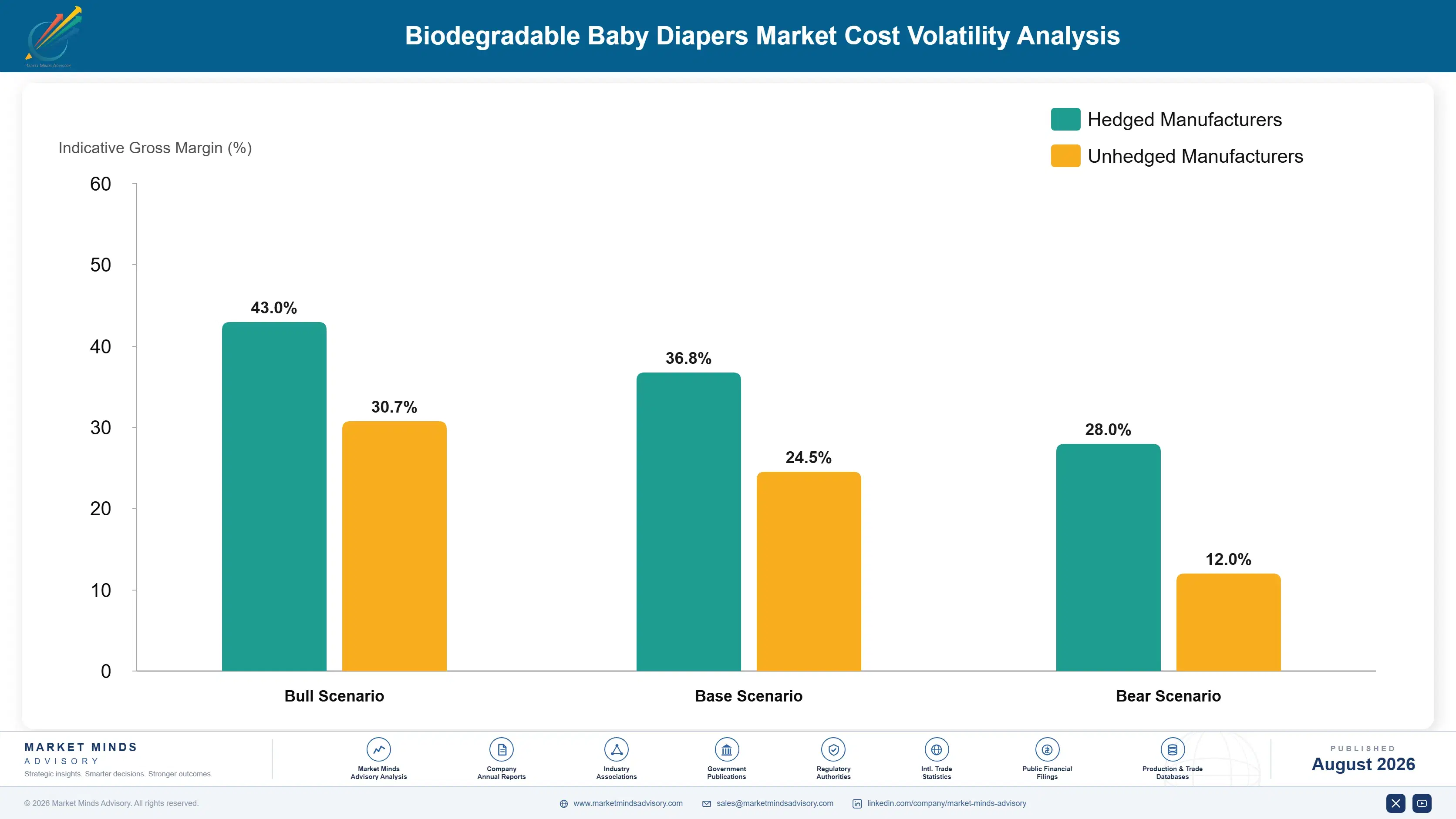
Pulp, Polymer And The Premium

Certified chlorine-free fluff pulp accounts for roughly 31% of cost of goods, superabsorbent polymer a further 19%, and plant-based backsheet film around 12%. Pulp comes from Nordic, Canadian and Brazilian mills holding recognised forestry certification. Superabsorbent polymer originates with a small number of chemical producers, and no biodegradable equivalent exists at comparable absorbency anywhere in commercial supply.
Fluff pulp pricing gave this category its clearest lesson. Pulp markets tightened through 2021 and 2022 on shipping disruption and mill outages, and certified grades moved further than conventional ones because the qualified supply base was narrower. Essity referenced raw material cost pressure across its hygiene businesses in its Annual Report 2022. Brands holding annual pulp contracts came through it; spot buyers absorbed the whole move and several eco brands did not survive that year.

The disadvantage falls on scale rather than on geography. A hygiene group contracts certified pulp annually across a portfolio and barely notices a grade move. A specialist brand buys small volumes on spot, sells at a price list agreed with a retailer six months earlier, and has nowhere to put the increase. Certification audit costs compound it, since they fall the same at any volume.
biodegradable-baby-diapers-market-cost-volatility-analysis-1788171156479

Contract certified pulp on annual volume terms

Certified chlorine-free pulp is nearly a third of cost of goods and the qualified supply base is narrower than the conventional one, which is why certified grades move further in a tight market. Annual contracts with a Nordic or Brazilian mill cost a premium over spot in a soft market and remove the largest uncontrolled line in the cost sheet.

Share certification audits across a product family

Audit and testing costs fall largely on the construction rather than on the individual product, so a single certified platform extended across diaper sizes, training pants and adjacent formats spreads the same overhead across considerably more volume. Brands certifying each product separately pay repeatedly for the same evidence. Very few have organised their ranges around a common certified construction.

Qualify a second converting country

Contract converting concentrated in one country is a tariff and lead time exposure rather than a cost advantage, and this category runs on contract capacity. Polish and Czech converters serve European buyers with shorter lead times than Asian supply, and qualifying one costs a specification transfer and a certification extension. The protection matters most in the quarter nobody planned for.

Portfolio Architecture for Margin Defence

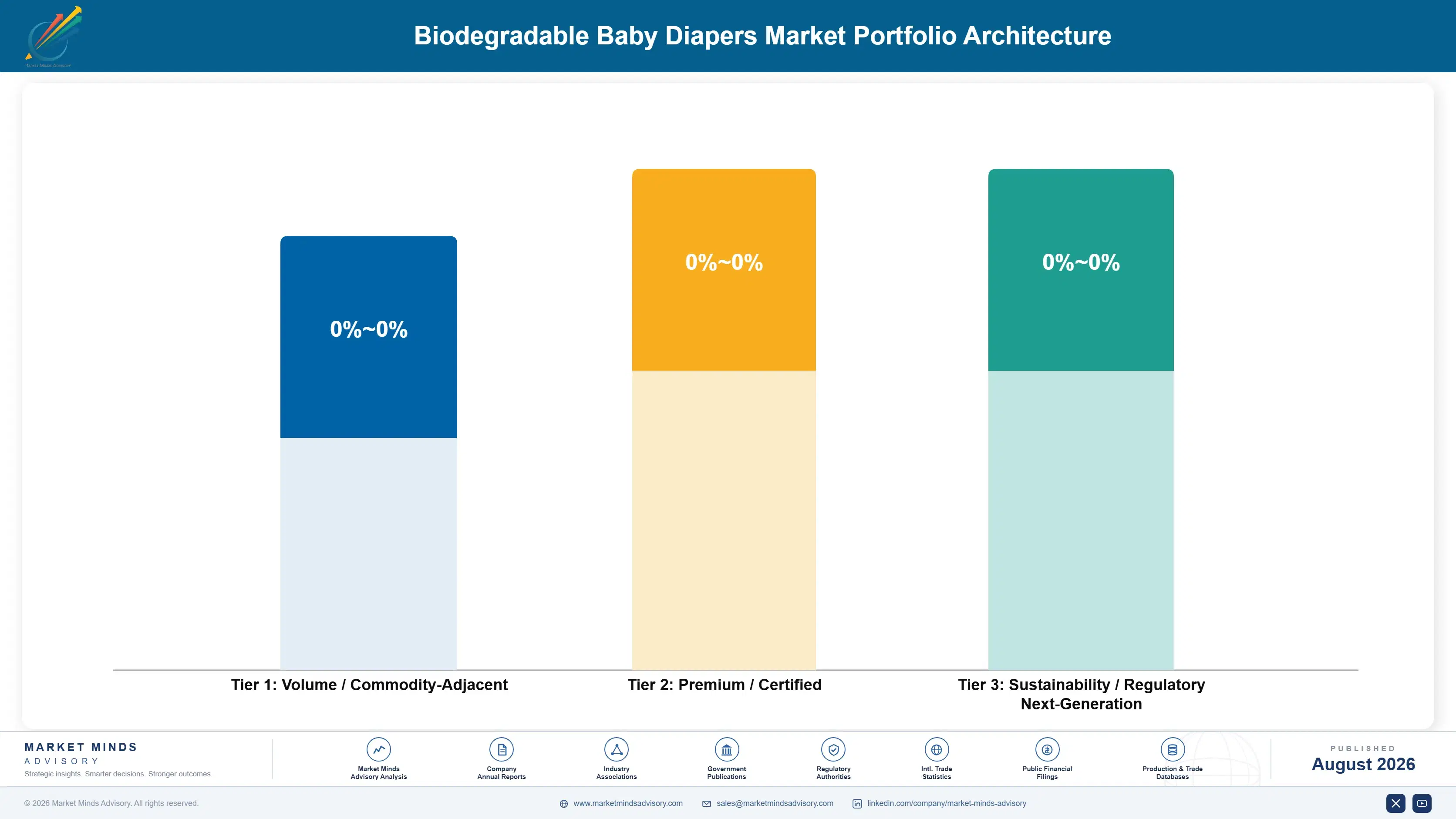
Margin here follows documentation depth rather than material cost, which is not obvious from a shelf. Two packs at the same price can differ by a few percent in construction cost and by everything in whether they survive a claims review, and only one will still be listed in three years. Brands costing on certified volume rather than on unit contribution run a different portfolio.
Volume and premium pull against each other through the converting line rather than the market. Own-label contract supply fills capacity and funds the certification overhead that the branded premium range depends on, and it does so at margins 14 points lower. Refusing that work leaves a line half loaded and a certification cost spread across too little volume. Taking it means arming the competitor who took your shelf.

High-value pools sit in certified compostable constructions, in bamboo formats with closed-loop processing and in certification services themselves. The third is barely recognised: a brand that has already built the testing and audit relationships can certify constructions for other brands who have none, at margins the diaper itself never reaches. Nobody in this category has built that business.

Volume / Commodity-Adjacent

Chlorine-free pulp and plant-based backsheet formats sold through grocery own-label and marketplace channels at modest premiums. Competes on price against conventional diapers and against near-identical eco product. The 9 point spread reflects whether converting is contracted or held in house.
Gross Margin: 24 to 33%

Premium / Certified

Third-party certified constructions with documented content, sold through specialist retail, pharmacy and brand direct channels. Certification rather than performance supports the price, and buyers increasingly require it before listing. The 9 point spread reflects channel mix between direct and wholesale distribution.
Gross Margin: 38 to 47%

Sustainability / Regulatory / Next-Generation

Certified compostable cores, closed-loop lyocell bamboo formats and certification services supplied to other brands. Margins are high because documented capability is scarce rather than because volume is large. The 14 point spread separates finished product sales from certification and development services.
Gross Margin: 44 to 58%
biodegradable-baby-diapers-market-portfolio-architecture-1788171156980

High-value Sub-segments and Strategic Watch-out

Certified Compostable Core Diapers

High value and high growth at 18.6%. Certification is the only defensible answer to a substantiation request, and retail buyers moved on it before the regulators did. The 8 point spread reflects whether the certification is held directly or through a contract converter partner instead.
Gross Margin: 46 to 54%

Bamboo Viscose Topsheet Diapers

High value with strong growth at 15.2%. Bamboo carries a consumer association no technical argument earns, though viscose processing is the weakest part of that story. The 8 point spread reflects whether processing runs conventional viscose or closed-loop lyocell solvent recovery processing instead of it.
Gross Margin: 42 to 50%

Chlorine-Free Fluff Pulp Diapers

The volume core. It earns modestly and competes against conventional product on price, but it fills the converting line and funds the certification overhead everything else depends on. The 9 point spread reflects whether converting capacity is owned outright or contracted out entirely to others.
Gross Margin: 22 to 31%

Uncertified Claim-Based Product

The strategic watch-out. Substantiation requirements now arriving will remove packs carrying unsupported biodegradable claims from regulated shelves rather than merely rewording them. The 26 point spread reflects how much still sells into markets that have no claims enforcement of any kind at all in place.
Gross Margin: 20 to 46%

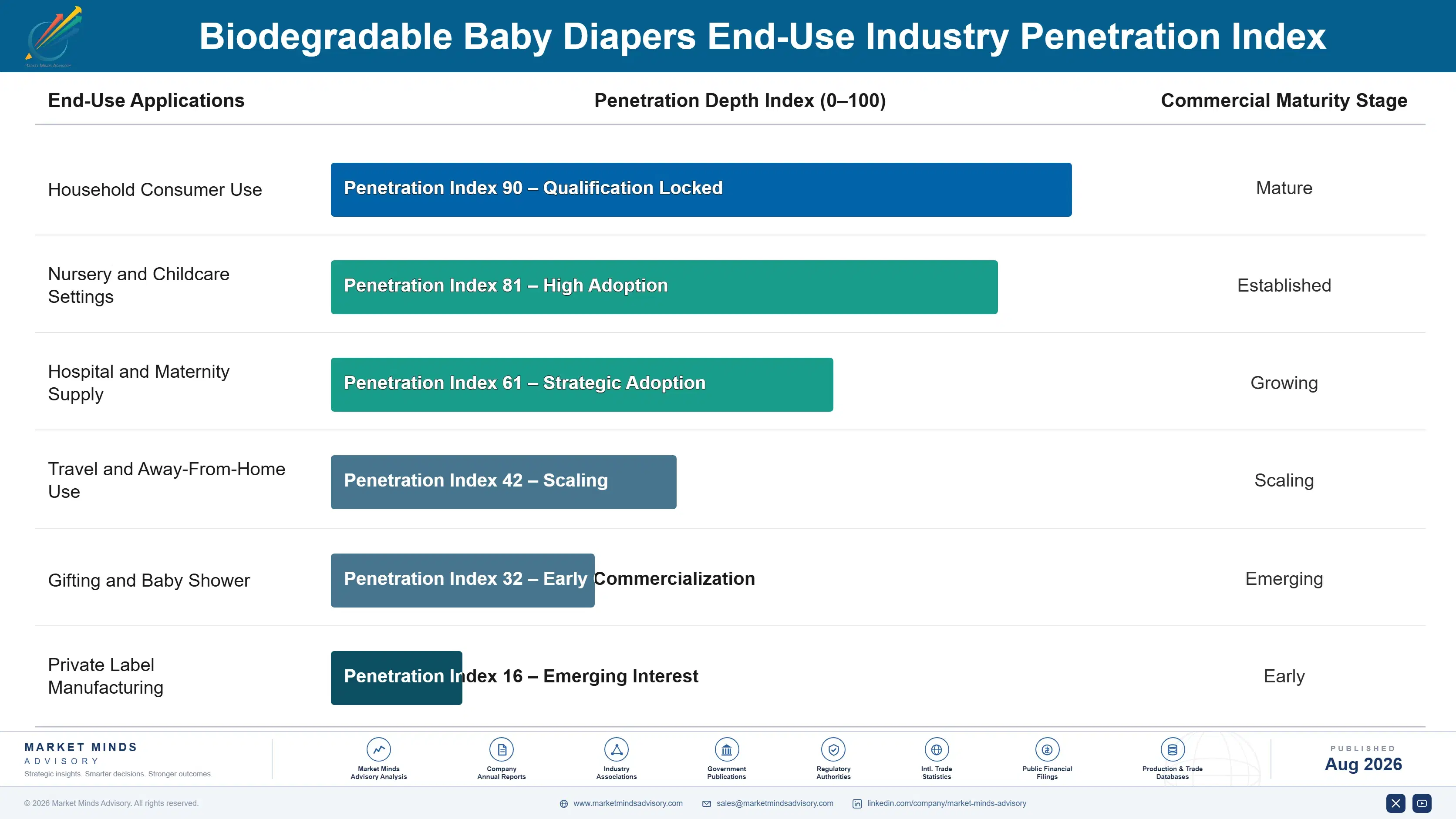
Why Parents Keep Paying More

The annuity is unusually strong and unusually short. A household using eco diapers buys them every week for roughly two and a half years and then stops entirely, which produces a concentrated revenue stream with a hard end date. Acquisition cost has to amortise inside that window, and it is why subscription models dominated the early direct-to-consumer wave and why their economics eventually stopped working.
Stickiness inside the window is very high and depends almost entirely on leaks. A parent who finds a diaper that holds overnight will not experiment again, and switching cost is measured in ruined sheets rather than in money. That is why the absorbency trade in compostable cores matters so much more than its technical description suggests. Brands that lose a customer to a leak rarely get them back.

Buyer profiles have shifted from belief toward verification. The first eco diaper buyers accepted an environmental claim at face value and paid the premium on trust. The current buyer reads the material list, searches for the certification and asks what percentage actually breaks down, often before the child is born. Brands still selling on green imagery are addressing a parent who stopped existing several years ago.
biodegradable-baby-diapers-market-end-use-penetration-index-1788171157475

What Survives A Claims Review

These are among the four positions where our research anticipates prominent divergence between winners and laggards over the coming forecast period. Each is grounded in the demand model, the regulatory perimeter, and the announced capacity pipeline.
01 / THIRD PARTY CERTIFICATION

Certify now or be delisted involuntarily later

Claims rules tightening across Europe and the United States are moving this category from adjectives to substantiation, and a brand without third-party certification will be asked to prove something it cannot prove. Certification costs a testing and audit programme and roughly 9 months, which is trivial measured against losing every regulated listing in a single buying cycle. Certified formats already grow at 18.6% against a category rate of 12.4%, which shows retail buyers moved well before the regulators finally did.
02 / MASS BALANCE DISCLOSURE

Publish the uncomfortable number before somebody else does

A typical certified pack is around 68% biodegradable by mass, the absorbent core accounts for most of the remainder, and almost nobody in this category states either figure on a pack. That leaves the number available to whichever competitor, regulator or journalist works it out first and publishes it in a context nobody chose. Volunteering it converts a standing vulnerability into a credibility position that costs nothing beyond the willingness to be the one who goes first with it publicly.
03 / BAMBOO PROCESSING INTEGRITY

Close the loop before the regulator opens it

Bamboo formats grow at 15.2% on a consumer association with sustainability that no technical argument earns, and conventional viscose processing is the weakest point in that whole story by a wide margin. Closed-loop lyocell recovers solvent and answers the objection completely, at a cost premium of roughly 12% on the topsheet alone. A claims regulator examining processing rather than the plant is a question of timing rather than of probability, and the timing on it is already remarkably short indeed.
04 / OWN-LABEL CONTRACT SUPPLY

Supply the retailer who took your shelf

European grocery own-label ranges took most of the volume growth in this category using the same contract converters the specialist brands already use, which means the specialists proved a demand that a retailer then monetised. Supplying those programmes converts a competitor into a customer at contract volumes that fill a converting line and fund the certification overhead. Margins run roughly 14 points below own-brand and require no marketing spend whatever, which is an uncomfortable piece of arithmetic to have to face.

Engagement Snapshot From the Field

A live engagement with an industry participant carrying material or product regulatory and market exposure ahead of a defining policy shift, showing how our research translates into a defensible multi-year portfolio strategy.
MARKET MINDS ADVISORY · CLIENT ENGAGEMENT SUMMARY
Biodegradable Baby Diapers Producer Strategic Portfolio Review and Transition Roadmap 2026·Investment Scenario on Biodegradable Baby Diapers Exposure Evaluation 2025-26
CLIENT PROFILE
A European eco diaper specialist selling through pharmacy, organic retail and direct subscription across eight countries, with annual revenue in the low hundreds of millions of euros (client-reported, unverified by MMA). All production ran through two contract converters, and the range carried biodegradable and plant-based claims without third-party certification on any product in the range.
STRATEGIC CHALLENGE
Two retail customers had asked for claim substantiation within a single quarter and a third had delisted a competitor over the same question. Subscription acquisition costs had also roughly doubled in two years. Management wanted to know whether certification was worth the cost and time, and what the business would look like if it did nothing.
MMA APPROACH
MMA calculated the biodegradable mass fraction of every product in the range from the bill of materials, then mapped each claim against the substantiation standards arriving in each market. Forty-seven expert interviews with retail buyers, certification bodies, contract converters and pulp suppliers established what documentation would actually change a listing decision and what certification would cost.
KEY FINDINGS
  1. The range averaged 66% biodegradable by mass, close to the category norm, and nobody inside the business had ever calculated the figure.
  2. Certification of a single common construction covering four sizes was available for a fraction of what certifying each product separately would have cost.
  3. Every retail buyer interviewed said a published mass balance figure would strengthen rather than damage the listing case, and none had ever seen one.
  4. Both contract converters already ran certified own-label programmes for grocery chains, using constructions almost identical to the client's own branded product range.
CLIENT PROFILE
A European eco diaper specialist selling through pharmacy, organic retail and direct subscription across eight countries, with annual revenue in the low hundreds of millions of euros (client-reported, unverified by MMA). All production ran through two contract converters, and the range carried biodegradable and plant-based claims without third-party certification on any product in the range.
STRATEGIC CHALLENGE
Two retail customers had asked for claim substantiation within a single quarter and a third had delisted a competitor over the same question. Subscription acquisition costs had also roughly doubled in two years. Management wanted to know whether certification was worth the cost and time, and what the business would look like if it did nothing.
MMA APPROACH
MMA calculated the biodegradable mass fraction of every product in the range from the bill of materials, then mapped each claim against the substantiation standards arriving in each market. Forty-seven expert interviews with retail buyers, certification bodies, contract converters and pulp suppliers established what documentation would actually change a listing decision and what certification would cost.
KEY FINDINGS
  1. The range averaged 66% biodegradable by mass, close to the category norm, and nobody inside the business had ever calculated the figure.
  2. Certification of a single common construction covering four sizes was available for a fraction of what certifying each product separately would have cost.
  3. Every retail buyer interviewed said a published mass balance figure would strengthen rather than damage the listing case, and none had ever seen one.
  4. Both contract converters already ran certified own-label programmes for grocery chains, using constructions almost identical to the client's own branded product range.
RECOMMENDED STRATEGY
Phase 1: Phase one: certify a single common construction across all four sizes rather than certifying each individual product in the range separately. Phase 2: Phase two: publish the mass balance figure on pack and in trade materials, ahead of any competitor or regulator doing it first. Phase 3: Phase three: bid for retailer own-label contract supply through the existing converters, accepting lower margin to fill capacity and spread certification cost.
OUTCOME
Within four quarters the certified construction was in market, both retail customers renewed rather than delisting, and a third chain listed the range for the first time (client-reported, unverified by MMA). The published mass balance figure attracted no negative response at all, and own-label supply covered the certification cost within a single year.

Frequently Asked Questions

Foundational context covering the market sizes, CAGR, scope, country, region and competition that inform every finding below. This section is provided to cover basics and most often pre-purchase conversations, answered from the MMA Primary Research Dataset.

What is the current size of the Biodegradable Baby Diapers Market?

The global biodegradable baby diapers market was valued at USD 2.8 billion in 2025, covering single-use diapers sold on biodegradable or plant-based content. The 2026 figure reaches USD 3.15 billion.

How large will the Biodegradable Baby Diapers Market be by 2036?

MMA forecasts USD 10.13 billion by 2036, an increase of USD 6.98 billion over the 2026 base. That represents an expansion multiple of 3.22 times across the forecast period.

What is the CAGR for the Biodegradable Baby Diapers Market 2026 to 2036?

The base case compound annual growth rate is 12.4%, with a bull case at 13.6% and a bear case at 11.2%. Historical growth between 2020 and 2025 ran at 11.2%.

Which segment is growing fastest?

Certified compostable core diapers grow at 18.6%, half again the market rate of 12.4%, because certification is the only defensible answer to a substantiation request. Bamboo topsheet formats follow at 15.2%.

Who are the major companies in the Biodegradable Baby Diapers Market?

Abena Group, Essity, Ontex Group, Eco by Naty and Kimberly-Clark lead on retail unit shipment volume, with combined CR5 of 29%. Retailer own-label holds much of the remainder.

Which country is growing fastest?

India grows fastest at 14.6%, from a very small base, where the eco tier competes against no diaper at all rather than a conventional one. South Asia and Pacific leads regionally at 14.6%.

Report Segmentation Architecture

The full report scope spans multiple orthogonal segmentation dimensions, with cross-tabulated demand data provided for each dimension pair. Coverage extends further to regional breakdowns, trend trajectories, and the competitive detail needed to support segment-level decision-making.

By Material Construction

  • Chlorine-Free Fluff Pulp Diapers
  • Bamboo Viscose Topsheet Diapers
  • Plant-Based Backsheet Diapers
  • Reduced-SAP Hybrid Diapers
  • Certified Compostable Core Diapers
  • Biodegradable Training Pants

By End-Use Industry

  • Household Consumer Use
  • Nursery and Childcare Settings
  • Hospital and Maternity Supply
  • Travel and Away-From-Home Use
  • Gifting and Baby Shower
  • Private Label Manufacturing

By Commercial Dimension

  • Grocery and Mass Retail
  • Pharmacy Chains
  • Organic and Specialist Retail
  • Online Marketplaces
  • Brand Direct Subscription
  • Retailer Own-Label Supply

By Region

  • North America
  • Western Europe
  • East Asia
  • South Asia and Pacific
  • Latin America
  • Middle East and Africa
  • Eastern Europe

Scope, Methodology, and Coverage

Every figure in this report is reproducible from documented input assumptions. The scope below maps the historical period, the forecast horizon, the segmentation dimensions, and the countries covered, alongside the underlying primary and qualitative methodology.
Historical Period
2020 to 2025
Forecast Period
2026 to 2036
Base Year
2025 (USD billions; MMA Primary Research Dataset, August 2026)
Market Definition
The biodegradable baby diapers market covers single-use absorbent infant diapers and training pants marketed on biodegradable, compostable or plant-based content, spanning chlorine-free fluff pulp constructions, bamboo viscose topsheets, plant-based backsheets, reduced or bio-based superabsorbent cores and certified compostable formats. Scope includes own-label eco ranges sold by retailers. Excluded are conventional disposable diapers carrying no environmental claim, reusable cloth diapers and covers, adult incontinence products, baby wipes and changing accessories, and diaper disposal or laundering services.
Quantitative Units
USD billion, 2025 base year, 2026 to 2036 forecast period
Segmentation Dimensions
Material construction, end-use setting, commercial channel, region
Regions Covered
North America, Western Europe, East Asia, South Asia and Pacific, Latin America, Middle East and Africa, Eastern Europe
Countries Covered
United States, Canada, Germany, France, United Kingdom, Sweden, Denmark, Poland, China, Japan, South Korea, India, Australia, Brazil, Mexico, Saudi Arabia, United Arab Emirates, South Africa
Key Companies Profiled
20 companies across hygiene groups, eco specialists and contract converters
Quantitative Methodology
Primary survey, n=3,800 respondents, Q4 2025, six countries; demand-side model with trade association cross-validation
Qualitative Methodology
47 expert interviews, Q4 2025; applied to validate demand model assumptions, identify emerging dynamics, and assess competitive positioning
Report Format
PDF and XLSX data workbook (Word format preview document)
Publisher
Market Minds Advisory
Report Code
MMA-2026-PAC-191
Published
August 2026
Contact
sales@marketmindsadvisory.com | www.marketmindsadvisory.com

Purchase the full Biodegradable Baby Diapers Market Report (2026 to 2036).

The full MMA report on the biodegradable baby diapers market runs to detailed construction and regional models across the 2026 to 2036 forecast period, with material cost benchmarks separated by component. It profiles 20 companies on a consistent retail unit shipment basis, covering hygiene groups, eco specialists and the contract converters supplying both. Claim substantiation requirements are mapped by market alongside the certification schemes that satisfy them. Regional chapters cover the seven MMA regions with country-level detail on the eighteen markets surveyed. Primary research draws on a quantitative survey of 3,800 respondents across six countries and 47 expert interviews conducted in Q4 2025.
Material cost benchmarks separated by diaper component
Biodegradable mass fraction calculated across leading products
Claim substantiation requirements mapped by regulated market
Twenty company profiles on consistent shipment volume basis
Retailer own-label programme sizing across European grocery
Seven regional chapters with eighteen country detail tables

Built For The People Who Decide

From boardroom strategy to bench-side execution, this report is read cover-to-cover by leaders shaping the next decade of their industry, turning demand scenarios, market dynamics and valuation benchmarks into decisions.
CXOs/ Presidents/ VPs/ Managers
M&A and Corporate Development
Strategy Teams and R&D Heads
Procurement and Product Directors
Regulatory and Compliance Leaders
Investor Relations and Equity Analysts