Market Minds Advisory
Biocompatible Polymers Market

Biocompatible Polymers Market: Material Qualification as the New Barrier to Entry

Biocompatible polymers sit at the center of a decade-long shift toward minimally invasive implants, resorbable devices, and drug-eluting coatings, forcing material suppliers to prove biocompatibility data years before device makers commit to a single formulation.

Lead Analyst

Bilal Shaikh

Published

August 2026

Make Smarter Decisions with Customized Research Insights

Request a free sample report and evaluate market opportunities, growth trends, and competitive dynamics relevant to your business needs.

2025 MARKET VALUE$18.6BMarket Size 2025
2036 FORECAST VALUE$46.5BBase Case , 2026 to 2036
CAGR 2026 TO 20368.7 %Bull 9.9% / Bear 7.5%
INCREMENTAL OPPORTUNITY$26.3BNet 10- year value creation
EXPANSION MULTIPLE2.30x2036 value over 2026 base
Strategic Levers
M&A Pipeline
Regional Outlook
Country Rankings
Competitive Intelligence
Segmental Deep-dive
Call-Us : 91 93563 13602

Executive Snapshot and Market Trajectory

Device makers are no longer buying polymer resin off a datasheet. They are buying years of toxicology files, ISO 10993 evidence packages, and drug master file access, which has turned material qualification into the real barrier to entry across implants, catheters, and drug-eluting coatings.
Bioresorbable polyesters and injectable hydrogels are pulling the market forward fastest, as drug-eluting stents, resorbable orthopedic fixation, and sustained-release depots move from pilot lines to commercial scale. East Asia now anchors the largest share of global demand, driven by China's expanding contract manufacturing base for catheters, wound dressings, and implantable components, while device brands in North America and Western Europe still control the highest-margin design work and clinical validation.
Consolidation is proceeding through licensing and bolt-on acquisitions rather than mega-mergers, since specialty chemistry houses prefer buying validated regulatory files over building them from scratch. Regulatory pressure is reshaping the competitive map too: the EU Medical Device Regulation now demands full biological evaluation dossiers, and FDA's expanded scrutiny of extractables and leachables is pushing device makers toward suppliers who already hold master access files rather than newer entrants offering only technical data sheets.
Market Definition
The biocompatible polymers market covers polymeric materials engineered and certified for direct or prolonged contact with human tissue, blood, or bodily fluids in medical devices, implants, and drug delivery systems. It includes resins, elastomers, and hydrogels sold to device manufacturers as raw material, along with custom-compounded and licensed formulations carrying biocompatibility data packages. Finished medical devices, coatings applied as a service without material sale, and non-medical industrial polymers are excluded.
Base Year Value
$18.6B in 2025 (MMA Primary Research Dataset, August 2026)
Forecast Period
2026 to 2036, eleven discrete annual values
CAGR
8.7% base case. Bull 9.9%. Bear 7.5%.
Fastest Growth Segment
Bioresorbable Polyesters (PLA, PLGA, PCL): 11.5% CAGR
Fastest Growth Country
India: 13.4% CAGR
Fastest Growth Region
South Asia and Pacific: 10.7% CAGR
Largest Region
East Asia: 29% of 2025 global value
Market Leaders
Evonik Industries AG, DSM-Firmenich, Covestro AG, Solvay SA, Celanese Corporation. Source: MMA Analysis based on company annual reports.
Primary Survey
n=3,800 procurement and R&D decision-makers, Q4 2025, six countries
Methodology
Demand-side build-up, cross-validated against public data, 47 expert interviews

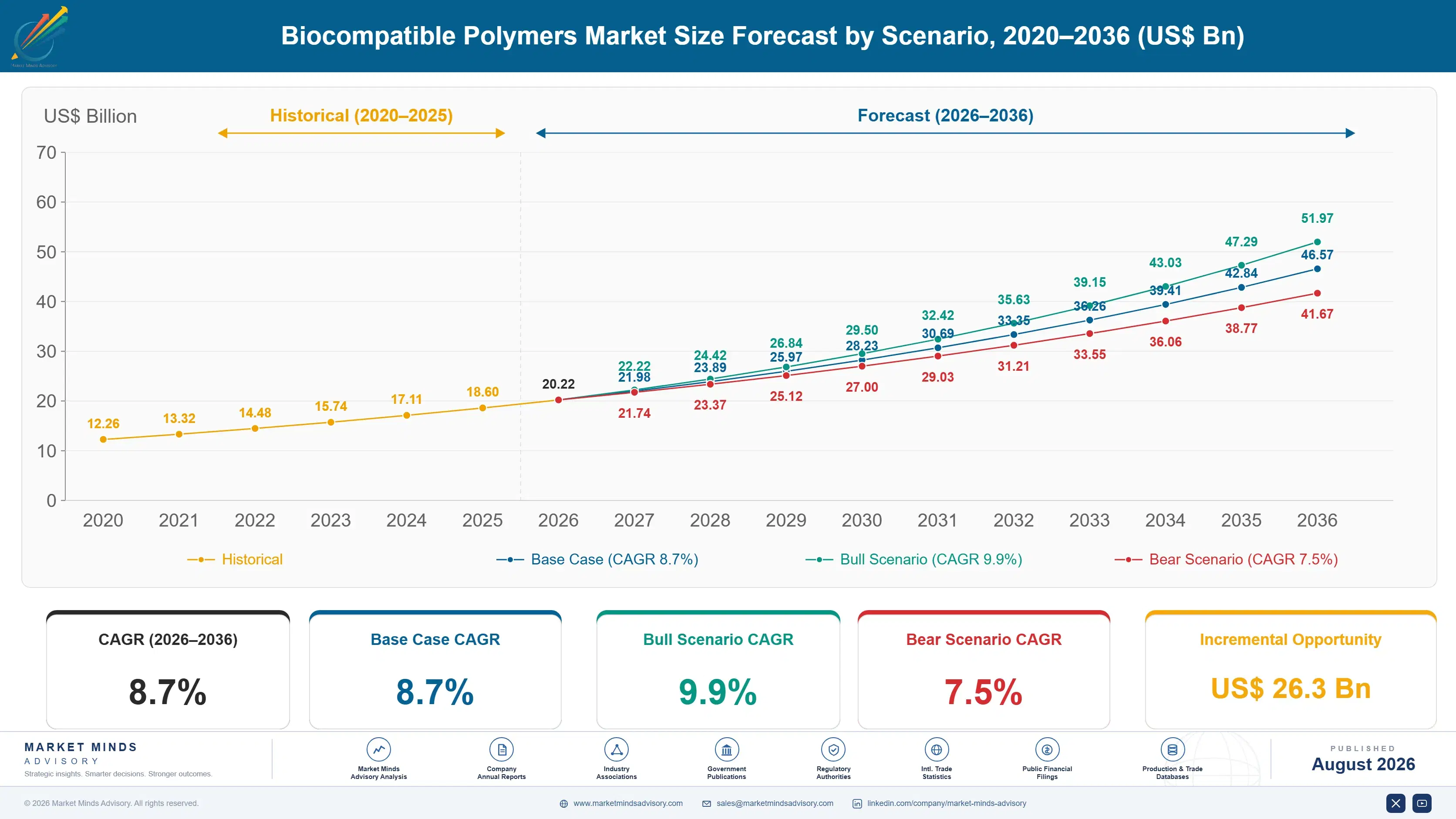
Biocompatible Polymers Market Forecast Scenarios

biocompatible-polymers-market-size-forecast-scenario-1787300333019
Between 2020 and 2025 the market grew at roughly 7.7% a year, a period defined more by qualification backlogs than by demand weakness. Pandemic-driven device production surges collided with constrained toxicology testing capacity at contract labs, pushing several new-formulation approvals out by twelve to eighteen months. Suppliers with pre-existing FDA master files captured share simply by being ready first.
The base case carries the market to 46.5 billion dollars by 2036 on three mechanisms. First, orthopedic and cardiovascular device makers keep shifting fixation and stent platforms toward resorbable chemistries that eliminate a second surgery, expanding volume per procedure. Second, biologics and peptide drug developers need injectable depot and hydrogel carriers for sustained release, a category barely commercial a decade ago. Third, contract device manufacturers across China, India, and Vietnam are qualifying local biocompatible polymer supply to cut import lead times.
The bull case reaches roughly 13% annual growth if the FDA finalizes its extractables and leachables guidance and removes approval uncertainty, letting suppliers scale qualified capacity faster. The bear case falls near seven percent if naphtha and specialty monomer costs stay elevated long enough that device makers delay reformulation and stretch existing device lifecycles instead of adopting newer resorbable materials.

Where Regulatory Data Becomes the Product

Biocompatible polymers used to be a niche corner of specialty chemicals; now they are the gating input for an entire category of minimally invasive medicine. Every resorbable stent, drug-eluting catheter coating, and injectable depot formulation depends on a resin or hydrogel that has already cleared years of biological evaluation. That qualification lag, not raw material cost, increasingly decides which device programs launch on schedule and which slip.
MARKET CONCENTRATION (CR5)32%Top five suppliers hold roughly one third of volume
AVERAGE SELLING PRICEUSD 14.20/kgBlended price across resin, elastomer, and hydrogel grades
TOP PRODUCING COUNTRY SHAREChina, 24% of global outputLargest single national source of compounded medical polymer
CAPACITY UTILIZATION78%Compounding lines run near full rate most quarters
TRADE INTENSITY41% cross-borderNearly half of finished resin volume crosses a border
FEEDSTOCK SHARE OF COGS52-58%Specialty monomers and catalysts dominate total production cost
Commercially the market behaves like a specialty ingredients business wearing a medical device label. Suppliers sell relatively small volumes at high margins, protected less by patents than by regulatory master files that competitors cannot copy without years of their own toxicology work. Device makers rarely dual-source a qualified grade mid-program, since requalification triggers a fresh regulatory filing, which locks in supplier relationships for the life of a device platform.
The next decade turns on three forces: tightening extractables and leachables scrutiny from FDA and the EU Medical Device Regulation, the migration of contract device manufacturing toward Asia, and biologics developers pulling hydrogel and depot chemistries into mainstream use. Suppliers positioned across all three will set pricing; those exposed to only one face margin compression.
"The real product here isn't the resin, it's the regulatory file attached to it. Device makers aren't buying chemistry, they're buying somebody else's completed toxicology work."
Director, Medical Materials and Polymer Science Practice · MMA Chemicals and Mat

Market Trends

FDA Extractables and Leachables Guidance Tightens Qualification

FDA's 2024 draft guidance on extractables and leachables testing for combination products raises the analytical bar for any polymer in prolonged tissue contact, requiring suppliers to characterize degradation products across the full device shelf life rather than a single time point. Material suppliers that already run this testing in-house are converting the requirement into a sales argument, since device makers now factor testing turnaround directly into program timelines. Smaller compounders without dedicated analytical chemistry teams are increasingly outsourcing to contract testing labs, adding months and real cost to their qualification cycle before a single gram ships commercially.
Market Impact: Cuts revision surgery rate 30%
Contract Device Manufacturing Migrates Toward Asian Hubs

Global device brands have shifted a growing share of catheter, wound-care, and disposable component assembly to contract manufacturers in China, India, and Vietnam over the past five years, and those manufacturers now qualify their own regional polymer supply rather than importing pre-approved American or European grades. Local Chinese and Indian compounders have invested heavily in ISO 10993 testing capability to meet that demand, narrowing the technical gap with established Western suppliers. The shift is reshaping where qualification decisions actually happen, moving procurement authority away from headquarters teams and toward regional sourcing groups that increasingly write their own supplier specifications.
Market Impact: Adds 12 hydrogel depots in trials

Market Opportunities and Growth Drivers

Resorbable Orthopedic Fixation Replaces Second-Surgery Metal Hardware

Resorbable fixation screws and plates, built from PLA and PLGA copolymer blends, are replacing titanium hardware across pediatric and sports-medicine orthopedic procedures because they eliminate the second surgery required to remove permanent metal implants. Surgeons cite reduced imaging interference and lower long-term infection risk as added reasons to switch once a resorbable grade matches the mechanical strength of the metal it replaces. Major orthopedic device makers have expanded resorbable product lines over the past three years, and reimbursement codes in several countries have started recognizing single-procedure resorbable fixation as a distinct billing category, reinforcing the shift at the payer level.
Market Impact: Adds 2 to 4 year delay

Injectable Hydrogels Expand Sustained-Release Biologic Drug Delivery

Peptide and biologic drug developers increasingly need a carrier that releases active ingredient over weeks rather than hours, and injectable hydrogels built from crosslinked hyaluronic acid or PEG-based chemistries meet that need without a surgical implant. Roughly a dozen new hydrogel-based depot products have reached late-stage clinical trials over the past three years, spanning ophthalmology, oncology, and chronic pain management. Contract development and manufacturing organizations have added dedicated hydrogel formulation lines to capture that pipeline, and specialty polymer suppliers are signing multi-year supply agreements earlier in clinical development than before, locking in volume years ahead of commercial approval.
Market Impact: Cuts margin 4 to 6 points

Market Restraints and Challenges

Regulatory Master File Costs Deter New Entrants

Building a complete FDA drug master file or EU technical dossier for a new biocompatible polymer grade now costs several million dollars and takes two to four years of biocompatibility, cytotoxicity, and long-term implantation studies before a single commercial sale. The root cause is that regulators evaluate the material and its intended contact duration together, so a supplier cannot reuse data across applications with different tissue exposure. That cost structure keeps smaller specialty chemical firms out of the highest-margin implant grades entirely. Some are responding by licensing access to an established supplier's master file rather than building their own.
Market Impact: Adds 12 to 18 months delay

Naphtha and Monomer Price Volatility Squeezes Margins

Specialty monomers such as lactide, caprolactone, and medical-grade silicone precursors trace back to naphtha and propylene feedstocks, so crude oil price swings pass through to polymer cost within one to two quarters. The root cause is thin monomer supply: only a handful of qualified producers hold the purity certifications medical-grade production requires, leaving little buffer capacity when one plant goes offline. Device makers on fixed-price supply contracts absorb little of that volatility themselves, pushing the full margin pressure onto compounders. Several suppliers are now securing dual-sourced monomer contracts and building small safety-stock buffers to smooth the worst of the swings.
Market Impact: China compounding capacity up 40%
3 additional market trends, 3 additional growth drivers, and 4 additional restraints and challenges are covered in the full report. Contact sales@marketmindsadvisory.com to access the complete intelligence.

Segment CAGR and Growth Architecture

Segmentation follows polymer chemistry class, a single materials-science logic that groups grades by molecular structure and biological behavior rather than by end device. Each chemistry class carries its own regulatory pathway, sterilization compatibility, and mechanical profile, so commercial position tracks the polymer family rather than the device it enters. Finished devices and coating services sit outside this framework.
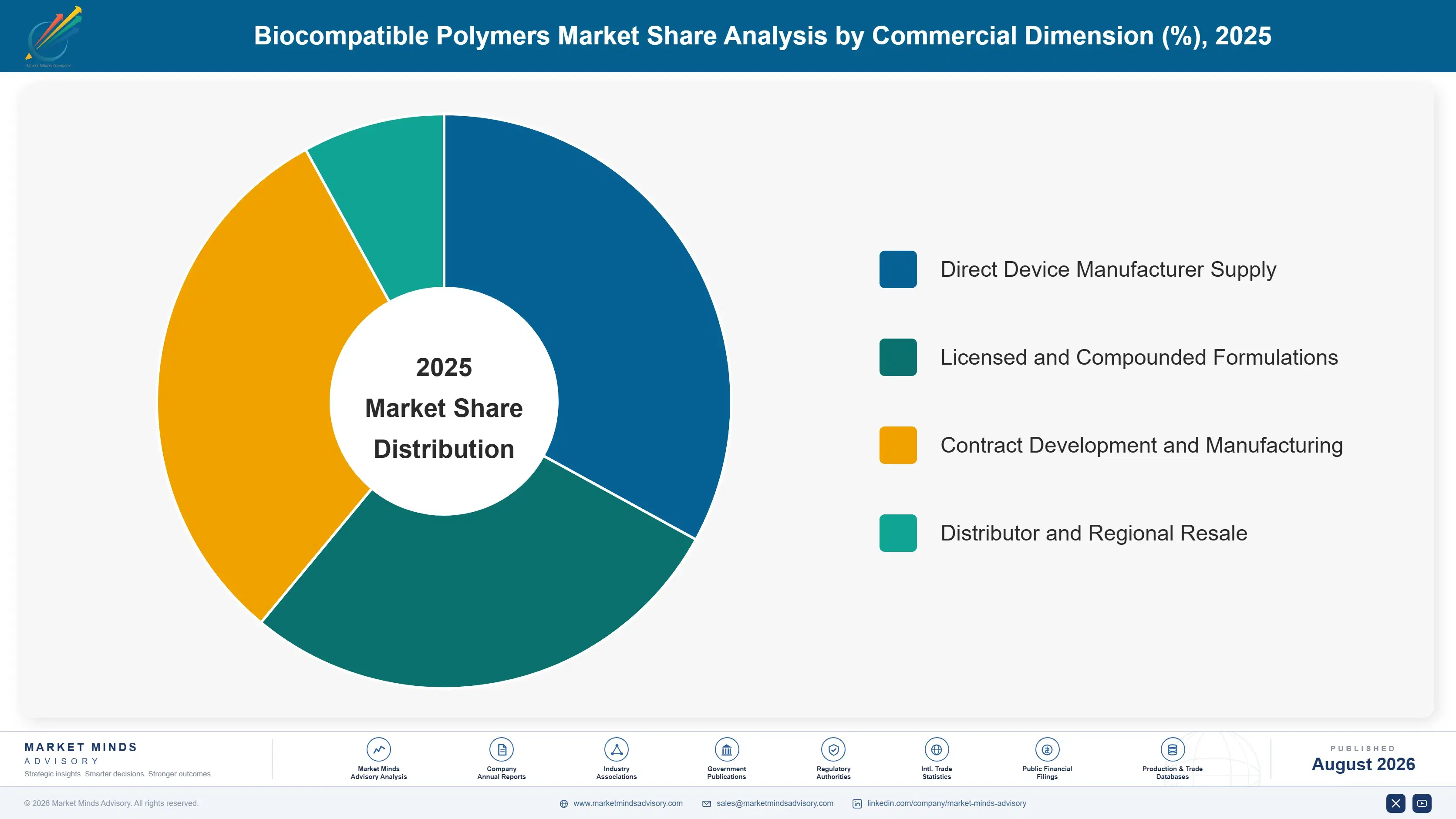
biocompatible-polymers-market-market-share-analysis-1787300333555

Bioresorbable Polyesters (PLA, PLGA, PCL)

Bioresorbable polyesters grow fastest at 11.5%, about 1.32 times the overall market rate, as orthopedic fixation, drug-eluting stent scaffolds, and suture-adjacent implants shift toward chemistries the body absorbs on a controlled timeline. PLA and PLGA dominate current volume, with degradation tuned from months to years by adjusting the lactide-to-glycolide ratio, while polycaprolactone serves longer-duration drug depots. Regulatory approval already exists for dozens of resorbable device platforms, lowering the qualification barrier for new formulations built on the same base chemistry. Orthopedic and cardiovascular device makers are expanding resorbable lines faster than any other segment, and several have signed multi-year supply agreements to secure capacity ahead of anticipated demand growth across the forecast window.
CAGR 11.5%

Hydrogels (Injectable and Wound-Care)

Hydrogels grow second-fastest at 10.2%, pulled forward by two distinct demand lines that happen to share a chemistry platform. Injectable depot hydrogels built from crosslinked hyaluronic acid or PEG carry peptide and biologic drugs for sustained release, a use case that barely existed commercially a decade ago and is now moving through late-stage clinical trials across oncology and chronic pain management. Advanced wound-care hydrogels, applied directly to chronic and surgical wounds, keep growing on an aging population and rising diabetic ulcer incidence in developed markets. The two applications draw on overlapping polymer science but separate regulatory pathways: a drug-carrying hydrogel is reviewed as a combination product, a wound dressing as a device, and suppliers increasingly specialize in one path.
CAGR 10.2%
Full segment breakdown across 6 segments available in the complete report.

Regional Architecture and Country Demand Map

Demand concentrates where device manufacturing capacity and clinical procedure volume already sit, which increasingly means East Asia rather than the historical North American and European base. Contract manufacturing growth, hospital infrastructure build-out, and rising domestic device approvals are shifting purchasing decisions toward compounders and converters near final device assembly.

North America

North America holds 24% of global value, anchored by the design and clinical validation work that still happens close to headquarters even as production disperses elsewhere. Medtronic, Boston Scientific, and Stryker run design authority for the highest-margin implant platforms from Minnesota and Massachusetts, and FDA's 510(k) and PMA pathways still set the compliance bar most global suppliers design toward first. Domestic compounders including Foster Corporation and Lubrizol Life Science hold deep master-file libraries built over decades, giving them an incumbency advantage that newer entrants struggle to match regardless of price. Growth of 9.2% tracks steadily rather than spectacularly, since regional demand now follows device innovation cycles more than raw procedure volume.
Share: 24% | CAGR: 9.2% (2026 to 2036)

Western Europe

Western Europe accounts for 21% of value, a share depressed relative to its device-manufacturing legacy because the EU Medical Device Regulation has slowed new product launches since full application began in 2021. German and Swiss suppliers, including Evonik, Covestro, and Momentive, hold some of the industry's deepest biocompatibility data libraries, built supplying implant and catheter components to Fresenius and B. Braun. That regulatory drag is real: notified body capacity has not kept pace with MDR's documentation demands, and several smaller device makers have delayed or abandoned product lines rather than complete the required clinical evaluation. Growth of 7.2% trails the global rate as a direct result, though the region still writes many of the technical standards competitors elsewhere must meet.
Share: 21% | CAGR: 7.2% (2026 to 2036)
Regional intelligence for 5 additional markets available in the complete report: East Asia, South Asia and Pacific, Latin America, Middle East and Africa, Eastern Europe. Contact sales@marketmindsadvisory.com.
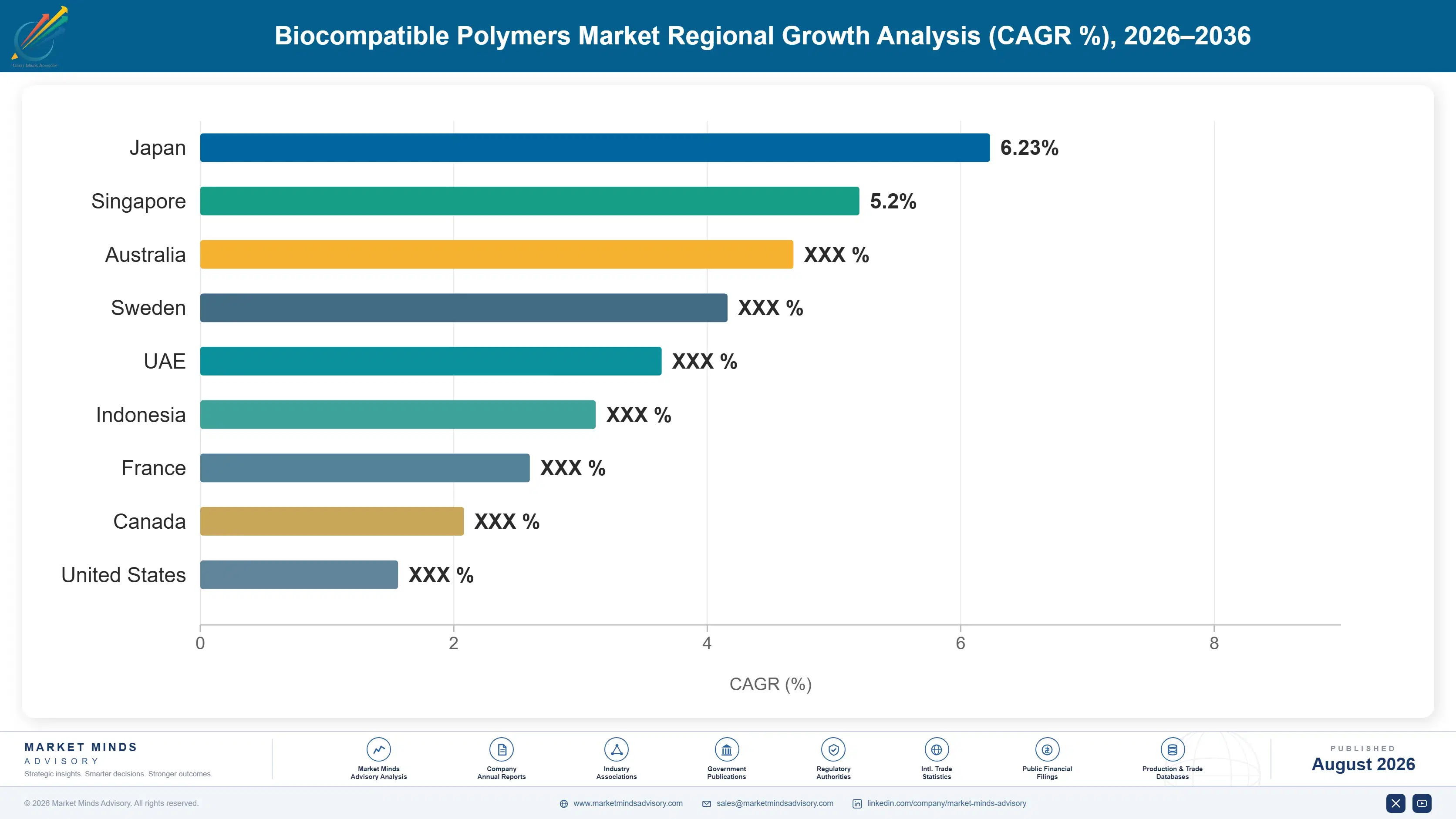
biocompatible-polymers-market-country-cagr-analysis-1787300334060

Where Polymer Suppliers Can Defend Margin

Waiting for the next device platform to specify a grade cedes pricing power to whoever qualifies first. The four moves below shift revenue toward positions that pay regardless of which specific device wins in the clinic: proprietary master files, dual-pathway regulatory strategy, regional compounding presence, and data-backed sustainability claims that increasingly matter to hospital procurement committees.

Build Proprietary Master Files Around Novel Chemistries

A completed FDA drug master file or EU technical dossier is the most defensible asset in this market, since a device maker that has built a submission around one supplier's data rarely reopens that work for a marginal price difference. Suppliers that fund the full biocompatibility and implantation study package themselves, rather than waiting for a customer to co-fund it, typically secure preferred-supplier status for 5 to 7 years on that chemistry. The upfront cost runs into several million dollars per grade, but it converts a commodity resin into a protected stream competitors cannot underbid without repeating that work.
Market Impact: Secures preferred supplier status for 5 to 7 years

Pursue Parallel Regulatory Pathways Across Jurisdictions

Filing simultaneously with FDA and under the EU Medical Device Regulation, rather than sequencing one after the other, cuts two to three years off the time before a grade can be sold into both major markets. Most mid-sized suppliers still file sequentially to conserve regulatory affairs headcount, ceding the parallel-market window to larger competitors who can staff both submissions at once. China's NMPA increasingly accepts bridging data from either dossier, so a supplier that files against all three regimes from the start captures roughly 40% more addressable device-maker demand within the first two years after approval than a single-market filer.
Market Impact: Captures 40% more device-maker demand within 2 years

Open Compounding Capacity Inside Key Device Hubs

Locating a compounding or converting line inside China, India, or another fast-growing device manufacturing hub cuts delivered lead time from 12 weeks to under 3, which matters more to device makers than a small unit-price difference once a program is behind schedule. Evonik and Celanese have both added Asian compounding capacity over the past two years specifically to shorten that cycle rather than to chase lower labor cost. A local line also signals long-term commitment to regional device makers who prefer suppliers embedded in their own jurisdiction, and early movers are capturing preferred-supplier status before competitors even open a facility.
Market Impact: Cuts delivered lead time to under 3 weeks

Certify Sustainability Credentials For Procurement Committees

Hospital procurement committees and group purchasing organizations increasingly screen suppliers on documented environmental and social criteria alongside price and clinical performance, and roughly 33% of large device makers now ask for third-party sustainability certification as part of supplier qualification. Suppliers that can document reduced solvent use, lower-carbon feedstock sourcing, or bio-based monomer content, without compromising biocompatibility performance, are being shortlisted ahead of otherwise-equivalent competitors. Certification and reformulation cost real money upfront, often several hundred thousand dollars per product line, but it is increasingly a qualification gate rather than a differentiator, and suppliers without it risk exclusion from bid lists.
Market Impact: Wins preferred shortlisting on roughly 33% of new bids

Who Controls the Margin Pool

Concentration sits at a moderate CR5 of 32%, low enough that no single supplier sets price across the whole market, but the gap between the top five and the next tier is real: leaders hold completed master files across dozens of grades, while challengers typically hold one or two. All participants here are assessed on one consistent basis: disclosed medical-grade polymer revenue.
Competition today runs across three visible fronts. First, master file breadth, since a supplier with data covering silicone, polyurethane, and PEEK can serve a device maker's whole platform rather than one component. Second, regional compounding footprint, as device makers prefer suppliers with a qualified line inside their own geography. Third, sustainability documentation, which purchasing organizations are folding into scorecards faster than most compounders can respond with reformulated grades.

Pressure is building from mid-sized Asian compounders that have closed much of the technical gap on ISO 10993 testing while undercutting Western suppliers on price for commodity grades. Rankings will shift toward suppliers who pair deep master-file libraries with genuine regional manufacturing presence, since neither alone is enough. Pure-play Western incumbents without Asian capacity, and Asian entrants without completed dossiers, both face erosion from the middle.
biocompatible-polymers-market-company-positioning-matrix-1787300334583

Competitive Moat and Risk Dimensions

EVONIK INDUSTRIES AG

Moat: Broadest Biomedical Polymer Portfolio

Evonik's Resomer bioresorbable polyester line and its silicone and drug-delivery grades give it the broadest biomedical polymer portfolio of any supplier, spanning resorbable, silicone, and drug-delivery chemistries under one regulatory support organization. That breadth lets device makers qualify multiple components from one supplier, cutting supply-chain complexity and giving Evonik pricing power across whole platforms.
EVONIK INDUSTRIES AG

Risk: Exposure To European Cost Base

Evonik's biomedical production remains concentrated in Germany, exposing it to European energy costs and labor rates that Asian compounders do not carry. As device makers qualify regional alternatives in China and India to shorten lead times, Evonik's cost base becomes a harder argument to defend on commodity-adjacent grades, even though its master-file depth still protects the highest-specification chemistries.
DSM-FIRMENICH (DSM BIOMEDICAL)

Moat: Deep Polyurethane and PEEK Data

DSM Biomedical holds one of the industry's deepest long-term implantation data sets for polyurethane and PEEK-based chemistries, built over more than two decades of cardiovascular and orthopedic device partnerships. That accumulated safety record shortens the regulatory review a device customer faces when qualifying a new component, a benefit newer entrants cannot replicate however competitive their pricing looks on paper.
DSM-FIRMENICH (DSM BIOMEDICAL)

Risk: Integration Risk After Firmenich Merger

The 2023 merger with Firmenich shifted corporate priority toward flavors and fragrances, a much larger business by revenue, raising questions about long-term capital allocation to the smaller biomedical unit. Customers report longer response times on some technical queries since the merger, and competitors are pitching device makers on continuity concerns.

Key Players

Evonik Industries AG
DSM-Firmenich
Covestro AG
Solvay SA
Celanese Corporation

Others

SABIC
Trinseo
Foster Corporation
Arkema SA
BASF SE
Mitsubishi Chemical Group
Teijin Limited
Victrex plc
Eastman Chemical Company
Corbion N.V.
Avient Corporation
Lubrizol Corporation
Momentive Performance Materials
Kuraray Co., Ltd.
Shin-Etsu Chemical Co., Ltd.

Recent Developments

MARCH 2025

Solvay Completes Acquisition of Resorbable Implant Specialist

Solvay completed the acquisition of a European bioresorbable polymer specialist for an undisclosed sum, adding PLGA and polycaprolactone compounding capacity to its existing specialty polymers business. The deal gives Solvay direct access to orthopedic fixation and drug-depot device customers it previously reached only through licensing arrangements with third-party compounders.
Signal: Signals that specialty chemical majors are buying completed regulatory dossiers outright rather than building resorbable capability organically.
SEPTEMBER 2024

Evonik Commissions Medical-Grade PEEK Line in Alabama

Evonik brought a new medical-grade PEEK compounding line online at its Alabama site, adding capacity dedicated to orthopedic and spinal implant customers in North America. The organic expansion, not a joint venture or acquisition, followed two years of customer-funded qualification work tied to specific device platforms already in development.
Signal: Signals suppliers increasingly build regional capacity around specific named customer programs rather than speculative anticipated volume.
JUNE 2025

Celanese and Toray Form Hydrogel Joint Venture in Japan

Celanese and Toray Industries formed a joint venture to develop and manufacture injectable hydrogel platforms for the Japanese and broader Asian biologics market. The partnership combines Celanese's polymer chemistry with Toray's regional regulatory relationships and device-manufacturing customer base, targeting commercial hydrogel supply within three years.
Signal: Signals Western material suppliers increasingly need a local partner to navigate Asian device regulatory pathways efficiently.

Feedstock and Specialty Monomer Cost Exposure

Specialty monomers and catalysts make up 52% to 58% of cost of goods sold across biocompatible polymer grades, above typical industrial polymer economics, because medical-grade purity requirements limit sourcing to a handful of qualified producers. Lactide and glycolide monomers used in resorbable chemistries trace back to fermentation-derived lactic acid from Southeast Asian and American processors, while silicone precursors originate from a concentrated group of Western and Japanese siloxane p
The 2022 to 2023 energy shock illustrated the exposure directly. EIA data recorded natural gas and naphtha price spikes through 2022 as European supply was disrupted, and siloxane and lactide feedstock costs followed within two quarters, since both trace back to petrochemical and agricultural inputs sensitive to energy pricing. Evonik's 2022 Annual Report disclosed higher raw material costs across its specialty additives and nutrition divisions, attributing part of the pressure to energy-linked feedstock inflation that persisted into 2023.

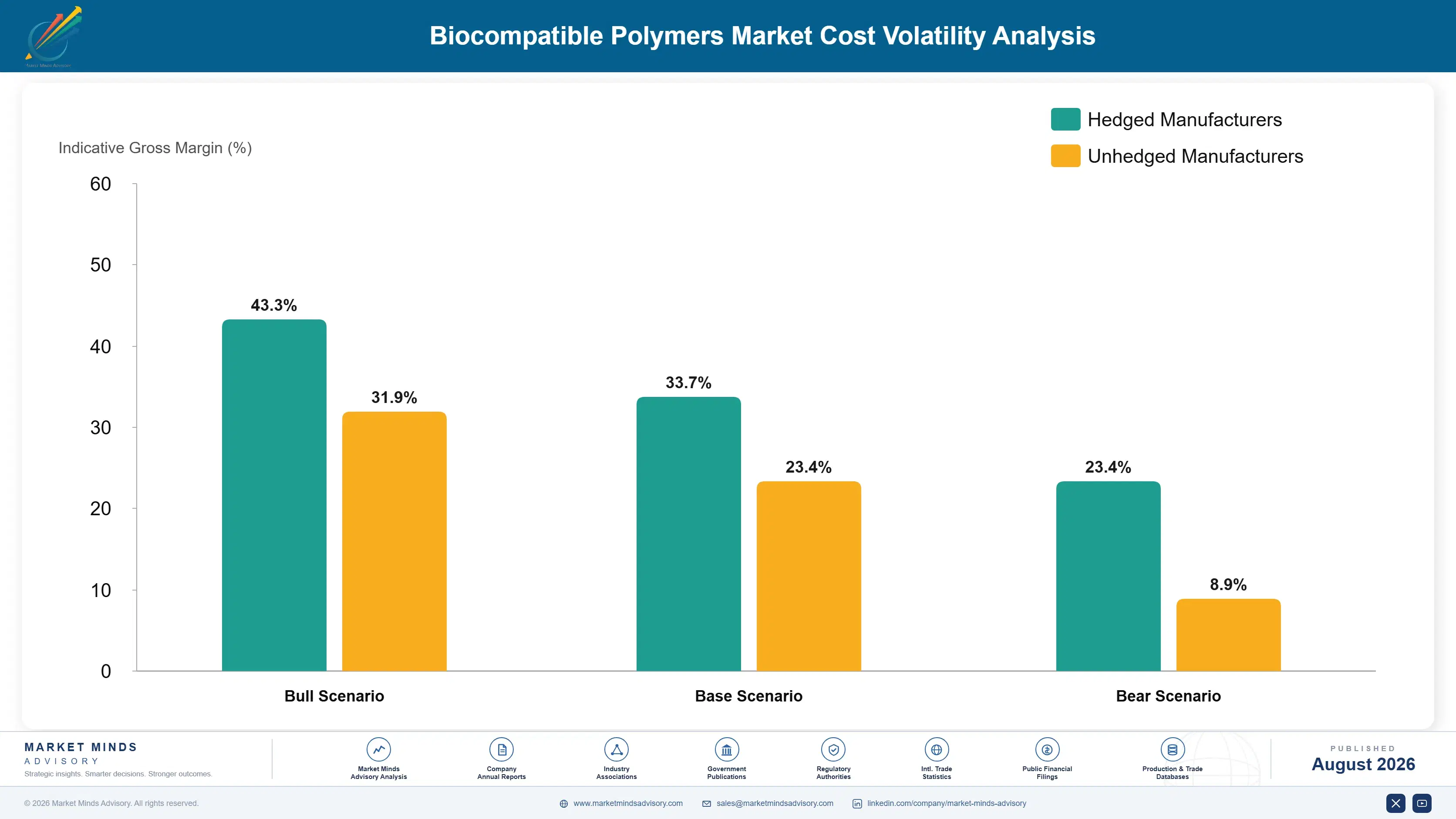
Smaller compounders without long-term feedstock contracts absorb price spikes immediately, since their volumes are too small to negotiate the multi-year fixed pricing majors like Evonik and BASF secure. That gap compounds during volatility: a large supplier smooths a monomer spike across a diversified purchasing book, while a specialist with one feedstock line has nowhere to hedge, forcing margin loss or a price pass-through that risks losing share.
biocompatible-polymers-market-cost-volatility-analysis-1787300334778

Lock Multi-Year Fixed-Price Contracts With Fermentation Suppliers

Securing three to five year fixed-price agreements directly with lactic acid fermentation producers, rather than buying lactide monomer on spot markets, smooths cost volatility and guarantees allocation during supply-tight periods. The approach requires committing to minimum volumes years ahead of confirmed demand, a real planning risk, but it has protected major suppliers' margins through two feedstock price spikes.

Diversify Siloxane Sourcing Across Multiple Geographies

Qualifying a second or third siloxane source across different regions, rather than relying on one Western producer, reduces exposure to a single regional energy shock or plant outage. Requalification carries its own cost and timeline, so suppliers are staging it deliberately, starting with lower-specification grades before extending diversified sourcing to their highest-margin implant chemistries.

Pass Through Cost Via Multi-Year Supply Indexation

Structuring supply agreements with indexed pricing tied to published monomer or energy benchmarks, rather than fixed annual pricing, shifts some volatility risk back to device-maker customers who have more balance sheet capacity to absorb it. Device makers increasingly accept indexed terms in exchange for guaranteed allocation, a trade suppliers use to protect margin without losing volume.

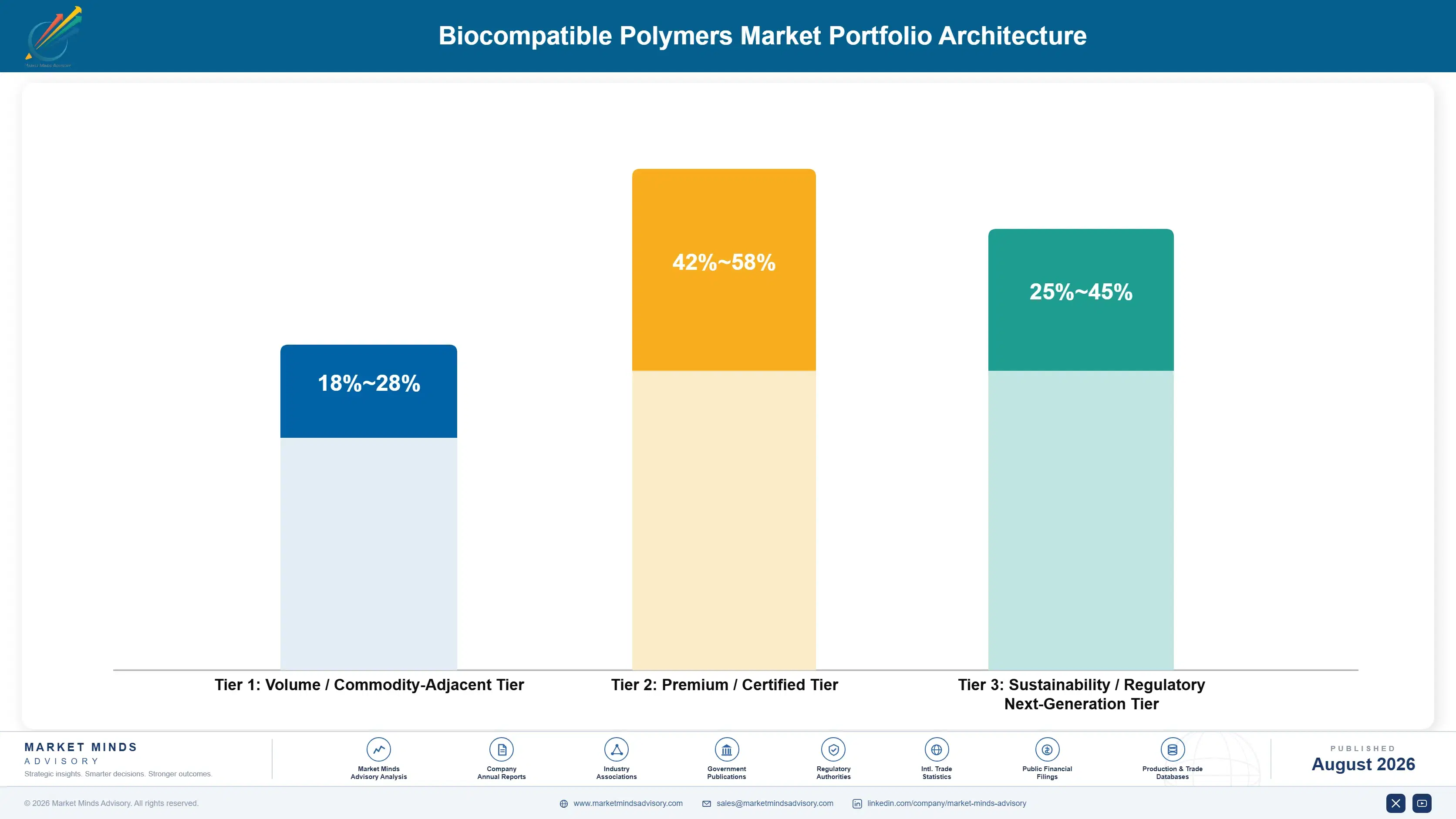
Portfolio Architecture for Margin Defence

The portfolio splits into three tiers with wide margin separation tied directly to regulatory complexity rather than manufacturing difficulty. Commodity-adjacent grades used in disposable, short-contact devices carry thin margins and intense price competition. Certified premium grades for implants and long-contact devices carry the deepest master-file protection and the strongest margins. A third tier of sustainability-linked and next-generation chemistries, including bio-based and fully resorba
The tension between volume and premium work shapes how compounders allocate capital: commodity-adjacent grades fund the plant utilization and cash flow that keep a compounding line running, while premium implant-grade chemistries fund the regulatory affairs teams and toxicology testing that create genuine competitive protection. Suppliers that lean too far toward volume risk losing the master-file depth that differentiates them; those that lean too far toward premium risk under-utilized capacity.

High-value pools concentrate specifically in resorbable orthopedic and cardiovascular chemistries and in injectable hydrogel carriers, where regulatory barriers are highest and device makers are least willing to requalify a cheaper alternative mid-program. Commodity silicone and polyurethane grades used in short-contact disposables generate volume but limited pricing power, since multiple qualified suppliers can compete on a like-for-like basis.

Volume / Commodity-Adjacent Tier

Short-contact disposable components, tubing, and basic wound-contact silicones sold against multiple qualified suppliers on price and delivery reliability rather than differentiated chemistry or deep regulatory data, with thin but stable margins.
Gross Margin: 18-28%

Premium / Certified Tier

Implant-grade PEEK, polyurethane, and silicone chemistries carrying deep master-file protection and multi-year exclusive or preferred-supplier device relationships that competitors cannot easily displace without years of their own regulatory work.
Gross Margin: 42-58%

Sustainability / Regulatory / Next-Generation Tier

Bio-based feedstock grades and fully resorbable chemistries still scaling toward commercial volume, priced ahead of proven cost position and clinical adoption data as device makers evaluate long-term switching.
Gross Margin: 25-45%
biocompatible-polymers-market-portfolio-architecture-1787300335275

High-value Sub-segments and Strategic Watch-out

Bioresorbable Polyesters

The fastest-growing and highest-value segment, carrying the deepest regulatory protection of any chemistry class as orthopedic and cardiovascular device makers shift decisively toward chemistries the body fully absorbs on a clinically proven, well-documented timeline rather than permanent metal hardware requiring a second procedure.
Gross Margin: 42-58%

Injectable and Wound-Care Hydrogels

High value with steadier growth than resorbable polyesters, spanning both biologic drug-delivery carriers in clinical development and established wound-care applications serving an aging, increasingly diabetic patient population across developed and several fast-growing emerging markets alike.
Gross Margin: 38-52%

Medical-Grade Silicone Elastomers

The volume core of the market, supplying catheters, seals, and short-contact components against several qualified suppliers competing primarily on price, delivery reliability, and consistent lot-to-lot quality across large, continuous production runs worldwide.
Gross Margin: 22-32%

Polycarbonate and Engineering Polymer Blends

The strategic watch-out, facing substitution pressure from newer bio-based and resorbable chemistries in applications where regulatory and clinical inertia, not cost, has kept device makers from already switching to available alternatives.
Gross Margin: 20-30%

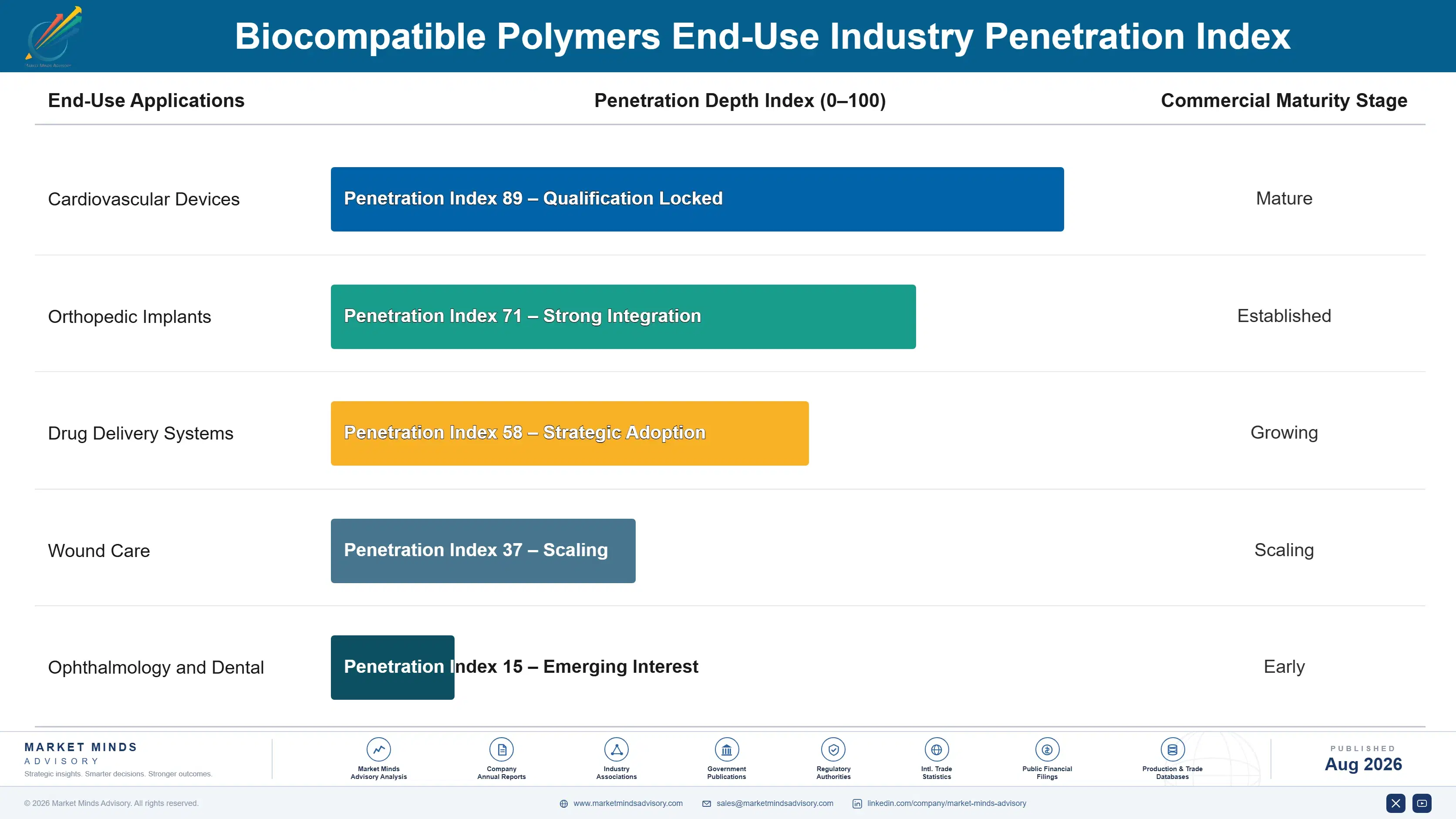
Why Device Qualification Locks In Demand

Demand here behaves like an annuity once a grade clears qualification, because a device maker rarely reopens a completed regulatory submission for a marginal cost saving. A resin qualified into an implant platform typically supplies that platform for the full commercial life of the device, often a decade or more, converting what looks like a chemical sale into a recurring, largely captive revenue stream for the supplier that won the original qualification.
Adoption depth varies sharply by end-use vertical. Orthopedic and cardiovascular implant makers requalify almost never, given the clinical and regulatory cost involved, which makes their supplier relationships the stickiest in the market. Wound-care and disposable component makers requalify more readily, since shorter contact duration means a lighter regulatory burden, giving those buyers real switching leverage that implant makers simply do not have.

Buyer profiles are shifting generationally too. A newer cohort of regulatory affairs leaders, trained under the EU Medical Device Regulation's stricter evidentiary standard, now weighs a supplier's data depth and responsiveness as heavily as unit price when selecting a material partner, a shift that favors established suppliers with genuine long-term implantation data over newer entrants offering only technical data sheets.
biocompatible-polymers-market-end-use-penetration-index-1787300335761

Where MMA Sees This Market Heading

These are among the four positions where our research anticipates prominent divergence between winners and laggards over the coming forecast period. Each is grounded in the demand model, the regulatory perimeter, and the announced capacity pipeline.
01 / REGULATORY DATA MOATS

Master files, not chemistry, will decide who wins the next decade

Suppliers with completed FDA and EU dossiers across multiple chemistries will keep winning preferred-supplier status regardless of price, because device makers rarely reopen a qualified submission once clinical trials begin in earnest. Newer entrants without that accumulated data face a multi-year, multi-million-dollar entry cost that only the most differentiated resorbable and hydrogel chemistries can realistically justify absorbing. Expect further consolidation as specialty chemical majors acquire smaller compounders specifically for their regulatory files rather than their production assets, following the acquisition pattern Solvay set in March 2025.
02 / ASIAN MANUFACTURING SHIFT

East Asia's share keeps rising as device assembly follows it there

East Asia already holds the largest regional share at 29% of global value and grows near the top of its band as Chinese and Indian contract manufacturers scale catheter, wound-care, and implant component assembly rapidly. Domestic compounders are closing the ISO 10993 testing gap with established Western suppliers faster than most incumbents expected even three years ago. Multinationals that fail to open regional compounding capacity risk losing new device-platform qualifications to local suppliers embedded closer to the customer and the regulator.
03 / HYDROGEL COMMERCIAL SCALING

Injectable hydrogels move from clinical promise to real supply contracts

Hydrogel-based depot products are clearing late-stage clinical trials at a pace that will convert several into genuine commercial supply agreements within the forecast window, and specialty suppliers are already locking in multi-year contracts years ahead of approval. That early contracting behavior signals real confidence in the pipeline rather than speculative positioning by either drug developers or their material partners. Suppliers without dedicated hydrogel formulation capability will find themselves shut out entirely of a category growing at more than 10% annually.
04 / COST BASE REALIGNMENT

Feedstock volatility will keep separating hedged suppliers from exposed ones

Specialty monomer and siloxane costs will keep moving with wider energy and agricultural commodity cycles, and suppliers without multi-year fixed-price or indexed contracts will keep absorbing the sharpest margin swings each time one hits. Smaller compounders lacking purchasing scale are most exposed, since they cannot smooth a monomer spike across a diversified feedstock book the way Evonik or BASF routinely can today. Expect further consolidation among mid-sized compounders that prove unable to secure durable feedstock terms on their own within the next several years.

Engagement Snapshot From the Field

A live engagement with an industry participant carrying material or product regulatory and market exposure ahead of a defining policy shift, showing how our research translates into a defensible multi-year portfolio strategy.
MARKET MINDS ADVISORY · CLIENT ENGAGEMENT SUMMARY
Biocompatible Polymers Producer Strategic Portfolio Review and Transition Roadmap 2026·Investment Scenario on Biocompatible Polymers Exposure Evaluation 2025-26
CLIENT PROFILE
A mid-sized cardiovascular device manufacturer supplying catheter and stent-delivery systems to hospitals across North America and Western Europe approached MMA while evaluating a second polymer supplier for its flagship delivery-catheter platform. The client reported annual device revenue near USD 640 million, with roughly 60% of that revenue tied to a single catheter platform dependent on one qualified polyurethane grade (client-reported, unverified by MMA).
STRATEGIC CHALLENGE
Management worried about single-source dependency on its incumbent polymer supplier but faced a real regulatory cost to requalifying an alternative grade mid-platform. The commercial team wanted pricing leverage from a second source; the regulatory affairs team warned that requalification could take eighteen months and risk a supply gap; and the board needed a decision before the incumbent's next contract renewal.
MMA APPROACH
MMA benchmarked the incumbent supplier's master file depth against three alternative compounders, modeled realistic requalification timelines under both FDA and EU pathways, and quantified the single-source revenue-at-risk if the incumbent faced its own supply disruption. We also assessed whether a dual-source strategy on a newer device platform, rather than the flagship line, could build supplier leverage without near-term requalification risk.
KEY FINDINGS
  1. Requalifying the flagship platform's polyurethane grade would have taken roughly sixteen months and cost an estimated USD 2.8 million, longer and costlier than the commercial team had assumed (client-reported, unverified by MMA).
  2. The incumbent supplier's master file depth was genuinely difficult to replicate quickly, since only two of three alternative compounders held comparable long-term implantation data for cardiovascular contact.
  3. A newer, lower-volume device platform in development offered a realistic dual-sourcing entry point, letting the client build a second qualified relationship without disrupting flagship-platform revenue.
  4. Single-source dependency on the flagship platform represented a genuinely material risk, with no alternative supplier able to step in inside twelve months if the incumbent faced a disruption.
CLIENT PROFILE
A mid-sized cardiovascular device manufacturer supplying catheter and stent-delivery systems to hospitals across North America and Western Europe approached MMA while evaluating a second polymer supplier for its flagship delivery-catheter platform. The client reported annual device revenue near USD 640 million, with roughly 60% of that revenue tied to a single catheter platform dependent on one qualified polyurethane grade (client-reported, unverified by MMA).
STRATEGIC CHALLENGE
Management worried about single-source dependency on its incumbent polymer supplier but faced a real regulatory cost to requalifying an alternative grade mid-platform. The commercial team wanted pricing leverage from a second source; the regulatory affairs team warned that requalification could take eighteen months and risk a supply gap; and the board needed a decision before the incumbent's next contract renewal.
MMA APPROACH
MMA benchmarked the incumbent supplier's master file depth against three alternative compounders, modeled realistic requalification timelines under both FDA and EU pathways, and quantified the single-source revenue-at-risk if the incumbent faced its own supply disruption. We also assessed whether a dual-source strategy on a newer device platform, rather than the flagship line, could build supplier leverage without near-term requalification risk.
KEY FINDINGS
  1. Requalifying the flagship platform's polyurethane grade would have taken roughly sixteen months and cost an estimated USD 2.8 million, longer and costlier than the commercial team had assumed (client-reported, unverified by MMA).
  2. The incumbent supplier's master file depth was genuinely difficult to replicate quickly, since only two of three alternative compounders held comparable long-term implantation data for cardiovascular contact.
  3. A newer, lower-volume device platform in development offered a realistic dual-sourcing entry point, letting the client build a second qualified relationship without disrupting flagship-platform revenue.
  4. Single-source dependency on the flagship platform represented a genuinely material risk, with no alternative supplier able to step in inside twelve months if the incumbent faced a disruption.
RECOMMENDED STRATEGY
Phase 1: Phase 1 (0 to 6 months): Qualify a second polymer supplier on the newer device platform in development, avoiding near-term disruption to flagship revenue. Phase 2: Phase 2 (6 to 18 months): Build long-term implantation data with the second supplier on that platform while monitoring the incumbent's own supply reliability closely. Phase 3: Phase 3 (18 to 36 months): Reassess flagship-platform requalification only if the second supplier's data package matures enough to materially shorten the sixteen-month timeline.
OUTCOME
The client qualified a second polymer supplier on its newer platform within seven months, avoiding disruption to flagship revenue while building negotiating leverage ahead of the incumbent's renewal. The incumbent responded with improved pricing rather than risk losing volume, and the client renewed on better terms, worth roughly USD 4 million annually (client-reported, unverified by MMA).

Frequently Asked Questions

Foundational context covering the market sizes, CAGR, scope, country, region and competition that inform every finding below. This section is provided to cover basics and most often pre-purchase conversations, answered from the MMA Primary Research Dataset.

What is the current size of the Biocompatible Polymers Market?

The market stood at USD 18.6 billion in 2025, anchored by medical-grade silicone, polyurethane, and PEEK chemistries. Bioresorbable polyesters and injectable hydrogels are the fastest-growing chemistry classes within that base.

How large will the Biocompatible Polymers Market be by 2036?

The market is projected to reach USD 46.5 billion by 2036 under the base case scenario. That represents roughly 2.30 times the 2026 value of USD 20.2 billion.

What is the CAGR for the Biocompatible Polymers Market 2026 to 2036?

The base case CAGR is 8.7% annually through 2036. The bull case reaches 9.9% on faster regulatory clearance, while the bear case falls to 7.5%.

Which segment is growing fastest?

Bioresorbable polyesters, including PLA, PLGA, and PCL chemistries used in orthopedic fixation, grow fastest at 11.5% annually. That is roughly 1.32 times the overall market growth rate.

Who are the major companies in the Biocompatible Polymers Market?

Evonik Industries AG, DSM-Firmenich, Covestro AG, Solvay SA, and Celanese Corporation lead the market on disclosed medical-grade polymer revenue. Together the top five suppliers hold a CR5 of 32%.

Which country is growing fastest?

India grows fastest among all countries at 13.4% annually, ahead of China and other East Asian markets. Growth is driven by device manufacturing capacity expanding under domestic production-linked incentive programs.

Report Segmentation Architecture

The full report scope spans multiple orthogonal segmentation dimensions, with cross-tabulated demand data provided for each dimension pair. Coverage extends further to regional breakdowns, trend trajectories, and the competitive detail needed to support segment-level decision-making.

By Polymer Chemistry Type

  • Medical-Grade Silicone Elastomers
  • Polyurethanes
  • Polyetheretherketone and Polyaryletherketones
  • Bioresorbable Polyesters (PLA, PLGA, PCL)
  • Hydrogels
  • Polycarbonate and Engineering Polymer Blends

By End-Use Industry

  • Cardiovascular Devices
  • Orthopedic Implants
  • Drug Delivery Systems
  • Wound Care
  • Ophthalmology and Dental

By Commercial Dimension

  • Direct Device Manufacturer Supply
  • Licensed and Compounded Formulations
  • Contract Development and Manufacturing
  • Distributor and Regional Resale

By Region

  • North America
  • Western Europe
  • East Asia
  • South Asia and Pacific
  • Latin America
  • Middle East and Africa
  • Eastern Europe

Scope, Methodology, and Coverage

Every figure in this report is reproducible from documented input assumptions. The scope below maps the historical period, the forecast horizon, the segmentation dimensions, and the countries covered, alongside the underlying primary and qualitative methodology.
Historical Period
2020 to 2025
Forecast Period
2026 to 2036
Base Year
2025 (USD billions; MMA Primary Research Dataset, August 2026)
Market Definition
The biocompatible polymers market covers polymeric materials engineered and certified for direct or prolonged contact with human tissue, blood, or bodily fluids in medical devices, implants, and drug delivery systems, including resins, elastomers, and hydrogels sold as raw material or custom-compounded formulations carrying biocompatibility data packages. Finished medical devices, coating services performed without material sale, and non-medical industrial polymers are excluded.
Quantitative Units
USD billions (current prices); metric tonnes of medical-grade polymer resin where applicable
Segmentation Dimensions
By Polymer Chemistry Type; By End-Use Industry; By Commercial Dimension; By Region
Regions Covered
North America, Western Europe, East Asia, South Asia and Pacific, Latin America, Middle East and Africa, Eastern Europe
Countries Covered
USA, China, Germany, France, UK, Japan, South Korea, India, Australia, Canada, Brazil, Mexico, Indonesia, Vietnam, Thailand, Malaysia, UAE, Saudi Arabia, South Africa, Nigeria, Turkey, Poland, Netherlands, Italy, Spain, Sweden, Switzerland, Argentina, Colombia, Singapore, and additional markets relevant to this sector
Key Companies Profiled
Evonik Industries AG, DSM-Firmenich, Covestro AG, Solvay SA, Celanese Corporation, SABIC, Trinseo, Foster Corporation, Arkema SA, BASF SE, Mitsubishi Chemical Group, Teijin Limited, Victrex plc, Eastman Chemical Company, Corbion N.V., Avient Corporation, Lubrizol Corporation, Momentive Performance Materials, Kuraray Co., Ltd., Shin-Etsu Chemical Co., Ltd.
Quantitative Methodology
Primary survey, n=3,800 respondents, Q4 2025, six countries; demand-side model with trade association cross-validation
Qualitative Methodology
47 expert interviews, Q4 2025; applied to validate demand model assumptions, identify emerging dynamics, and assess competitive positioning
Report Format
PDF and XLSX data workbook (Word format preview document)
Publisher
Market Minds Advisory
Report Code
MMA-2026-CHM-131
Published
August 2026
Contact
sales@marketmindsadvisory.com | www.marketmindsadvisory.com

Purchase the full Biocompatible Polymers Market Report (2026 to 2036).

The full MMA Biocompatible Polymers report sizes the market across six polymer chemistry classes, five end-use industries, four commercial supply models, and seven regions through 2036. It profiles 20 suppliers on a consistent basis of disclosed medical-grade polymer revenue, scoring each on master-file breadth, regional manufacturing footprint, and feedstock cost exposure. Scenario models quantify how FDA extractables and leachables guidance, EU Medical Device Regulation enforcement, and Asian contract manufacturing growth move both demand and realizable pricing. The report also includes delivered-cost modeling by chemistry class, a regulatory pathway comparison across major jurisdictions, and a feedstock volatility exposure assessment built for materials science, procurement, and corporate strategy teams.
Six-chemistry segmentation with cross-tabulated regional demand data
Twenty-company competitive benchmarking on consistent revenue basis
Regulatory pathway comparison across FDA, EU, and NMPA
Feedstock cost and volatility exposure modeling by chemistry
Scenario forecasts through 2036 under bull and bear cases
Case study on supplier requalification and dual-sourcing strategy

Built For The People Who Decide

From boardroom strategy to bench-side execution, this report is read cover-to-cover by leaders shaping the next decade of their industry, turning demand scenarios, market dynamics and valuation benchmarks into decisions.
CXOs/ Presidents/ VPs/ Managers
M&A and Corporate Development
Strategy Teams and R&D Heads
Procurement and Product Directors
Regulatory and Compliance Leaders
Investor Relations and Equity Analysts