

Market Minds Advisory
Bioacoustics Sensing Market

Bioacoustics Sensing Market: Bioacoustics Sensing: Consent Obligations, Unlistened Recordings and Where the Analysis Value Sits

Recording biological sound became almost free and analysing it did not, which is why terabytes sit unreviewed while the revenue concentrates wherever a regulator requires somebody to produce an answer.

Lead Analyst

Published

September 2026

Make Smarter Decisions with Customized Research Insights

Request a free sample report and evaluate market opportunities, growth trends, and competitive dynamics relevant to your business needs.

2025 MARKET VALUE$0.4BMarket Size 2025
2036 FORECAST VALUE$2.2BBase Case , 2026 to 2036
CAGR 2026 TO 203616.8 %Bull 18.0% / Bear 15.6%
INCREMENTAL OPPORTUNITY$1.8BNet 10- year value creation
EXPANSION MULTIPLE4.72x2036 value over 2026 base
Strategic Levers
M&A Pipeline
Regional Outlook
Country Rankings
Competitive Intelligence
Segmental Deep-dive
Call-Us : 91 93563 13602

Executive Snapshot and Market Trajectory.

Around 9% of recorded bioacoustic audio is ever properly analysed. Devices and storage became cheap while expert listening did not, and the gap between what gets collected and what gets understood defines this market. Collection scaled and expert listening never did, which is the whole commercial story here.
Revenue concentrates wherever somebody is legally required to produce an answer. Marine mammal monitoring for offshore consent grows at 25.2%, half again the market rate of 16.8%, and livestock health monitoring follows at 21.6% on a countable return. Around 61% of revenue traces to a regulatory obligation. Western Europe takes 32% on North Sea offshore construction and the most advanced livestock monitoring practice anywhere.
Concentration is low at roughly 24% across the top five on measured hardware, software and services revenue, and the field mixes marine instrument makers with ecology specialists who rarely meet. The commercial dividing line is renewal: compliance work repeats every consent cycle, while grant-funded ecology deployments continue past their initial funding only about 22% of the time. Grant funding produces excellent science and very few durable businesses, and this industry has proved that repeatedly.
Market Definition
This market covers passive acoustic sensing of biological sound and its analysis, spanning marine mammal monitoring and offshore compliance, livestock health and welfare monitoring, terrestrial biodiversity monitoring, fisheries and aquaculture acoustics, pest and invasive species detection, and urban soundscape and environmental compliance. Revenue is measured as sensor hardware, analysis software and attributable monitoring service value. Active sonar and echo sounding for navigation or seabed survey, human clinical diagnostic acoustics, industrial machine condition monitoring and general environmental noise measurement without biological classification are excluded.
Base Year Value
$0.4B in 2025 (MMA Primary Research Dataset, September 2026)
Forecast Period
2026 to 2036, eleven discrete annual values
CAGR
16.8% base case. Bull 18.0%. Bear 15.6%.
Fastest Growth Segment
Marine Mammal Monitoring and Offshore Compliance: 25.2% CAGR
Fastest Growth Country
Vietnam: 22.6% CAGR
Fastest Growth Region
South Asia and Pacific: 19.0% CAGR
Largest Region
Western Europe: 32% of 2025 global value
Market Leaders
Teledyne Marine, JASCO Applied Sciences, Wildlife Acoustics, SoundTalks and Seiche lead on measured bioacoustics hardware, software and services revenue. Source: MMA Primary Research Dataset, July 2026.
Primary Survey
n=3,800 procurement and R&D decision-makers, Q4 2025, six countries
Methodology
Demand-side build-up, cross-validated against public data, 47 expert interviews

Bioacoustics Sensing Market Forecast Scenarios

bioacoustics-sensing-market-size-forecast-scenario-1788421653988
Growth ran at 15.4% from 2020 to 2025 and it came from two quite separate places. Offshore wind development in Europe and North America created marine mammal monitoring obligations attached to consent, which is contracted work with a named payer. Ecology research deployments expanded alongside on grant funding that produced enormous datasets, much published work and very little recurring revenue.
The base case at 16.8% rests on three mechanisms. Offshore construction consent conditions require documented marine mammal detection and mitigation before and during piling, which is a compliance obligation rather than a scientific preference. Livestock respiratory monitoring produces a measurable reduction in mortality and antibiotic use that a farm manager can verify. Third, classification models made large recorded datasets usable, turning collected audio into something worth paying to interpret. Storage was never the constraint anyway.
The bull case at 18.0% assumes biodiversity reporting obligations attached to corporate disclosure and financing conditions become enforceable, which would convert ecology monitoring from grant work into contracted compliance. The bear case at 15.6% is that offshore wind construction slows and grant funding tightens together, which would remove both demand mechanisms at once. Those funding sources correlate more than the industry acknowledges.

Recording Got Cheap and Listening Did Not

Autonomous recorders became cheap enough to deploy dozens at a time, and storage fell far enough that keeping everything beats deciding what to keep. The result is an enormous quantity of recorded biological sound, of which roughly 9% is ever properly analysed. That is not a failure of intent. Expert listening is slow, skilled and expensive, and no funding model scaled it alongside collection.
TOP FIVE CONCENTRATION24%Fragmented across marine instrument makers and ecology specialists
COMPLIANCE DRIVEN REVENUE61%Share funded by a regulatory consent obligation somewhere
RECORDED AUDIO REVIEWED9%Portion of collected recordings anyone actually analyses properly
CLASSIFIER VERIFICATION RATE17%Detections needing human review before any regulatory submission
GRANT FUNDED RENEWAL RATE22%Research deployments continuing after initial funding period ends
AVERAGE DEPLOYMENT COSTUSD 14,600Outlay per monitored site including devices and analysis
Classification models changed the position rather than resolving it. Automated detection makes large datasets tractable and produces detections that still need checking, with around 17% requiring human verification before anything can be submitted to a regulator. That verification requirement is where the commercial value concentrated, because a regulator will accept a documented process with expert oversight and will not accept an unverified model output on its own.
The funding divide runs straight through this market. Compliance work attached to offshore consent, livestock health and environmental permitting recurs each project cycle with a named payer, and represents around 61% of revenue. Grant-funded ecology deployments produce excellent science and continue past their initial funding period only about 22% of the time. The technology serves both equally well and only one of them is a business.
"This field has produced brilliant instruments, remarkable datasets and remarkably few durable companies. The ones that worked out that a regulator paying for an answer beats a grant paying for a recording are the ones still trading."
Director, Environmental Sensing and Monitoring Practice · MMA Technology Practice · September 2026

Market Trends

Classification Shifts Value From Recording to Interpretation

Autonomous recorders are cheap and largely interchangeable, and the constraint moved years ago to making sense of what they capture. Automated species and event classification made enormous datasets usable, which relocated the commercial value from hardware into analysis and verification. Around 17% of detections still require expert human review before regulatory submission, and that combination of model output plus documented oversight is what a consenting authority will actually accept. Hardware makers without an analysis capability are supplying a commodity into a market where the interesting margin sits somewhere else entirely.
Market Impact: Fastest segment at 25.2% growth

Livestock Monitoring Brings a Buyer Who Counts Returns

Respiratory disease in pig and poultry housing announces itself acoustically before it becomes visible, and detecting it early reduces mortality, treatment cost and antibiotic use in ways a farm manager can verify within a production cycle. That produces something unusual in bioacoustics: a commercial buyer with an arithmetic return rather than a research grant or a compliance obligation. It grows at 21.6% and the sales conversation is completely different, since the customer evaluates cost per animal rather than detection sensitivity. Integrators and veterinary suppliers rather than acoustics companies increasingly own that relationship.
Market Impact: Vietnam grows at 22.6% annually

Market Opportunities and Growth Drivers

Offshore Construction Consent Requires Documented Detection

Marine consent conditions for offshore wind, cable installation and seismic survey require documented marine mammal detection and mitigation before and during activities that generate underwater noise, and work stops if the monitoring is not in place. That makes it a compliance obligation with a project budget behind it rather than an environmental preference. Marine mammal monitoring accordingly grows at 25.2%, faster than anything else in this market. Demand tracks offshore construction schedules, which are set by energy policy and grid connection availability rather than by anything ecological. Nothing ecological determines the timing at all.
Market Impact: Only 22% continue past funding

Aquaculture Expansion Creates Acoustic Monitoring Demand

Intensive fish and shrimp production benefits from acoustic monitoring of feeding behaviour, stress and stock condition, because sound propagates in water where cameras are limited by turbidity and light. Southeast Asian production scale makes it the most commercially significant application outside compliance work, and Vietnam is the fastest-growing country market at 22.6%. Feed represents the largest cost in intensive aquaculture, and acoustic feeding response monitoring reduces waste measurably. The buyer is a production manager comparing feed conversion rather than anyone interested in acoustics for its own sake. Feed conversion is the number that matters here.
Market Impact: Requires review on 17% of detections

Market Restraints and Challenges

Grant-Funded Deployments Do Not Renew Reliably

Ecology research monitoring continues past its initial funding period only about 22% of the time, because the grant paid for a study rather than for an ongoing observation programme. The root cause is that scientific funding is project-shaped and monitoring value accumulates over years, which the funding structure does not accommodate. Commercially this produces excellent references and very little recurring revenue for suppliers. Mitigation runs through attaching monitoring to compliance obligations, institutional infrastructure funding and corporate reporting requirements rather than to individual research projects. Excellent science and poor businesses have coexisted here for years.
Market Impact: Verification needed on 17% of detections

Regulators Will Not Accept Unverified Model Output

Automated classification produces detections that a consenting authority treats as evidence only when accompanied by documented expert oversight, and around 17% require human verification before submission. The root cause is that a false negative in marine mammal monitoring has consequences no regulator will accept on a model's assurance alone. Commercially this caps how far analysis can be automated and keeps expert labour in the cost structure permanently. Suppliers mitigate by designing verification workflows that concentrate expert time on ambiguous detections rather than reviewing everything. Expert labour stays in the cost structure permanently as a result.
Market Impact: Segment grows at 21.6% annually
3 additional market trends, 4 additional growth drivers, and 2 additional restraints and challenges are covered in the full report. Contact sales@marketmindsadvisory.com to access the complete intelligence.

Segment CAGR and Growth Architecture

Segmentation follows the application, because that determines who pays and whether they pay again. Applications attached to a consent condition or a production cost recur reliably, while those funded by research grants do not, and that difference explains almost all of the growth divergence across an otherwise technically similar set of deployments. Funding source decides everything.
bioacoustics-sensing-market-market-share-analysis-1788421654534

Marine Mammal Monitoring and Offshore Compliance

This is the fastest part of the market at 25.2%, half again the market rate of 16.8%, and the only one where monitoring stops a construction programme if it is absent. Consent conditions for offshore wind, cable laying and seismic survey require documented detection and mitigation around noise-generating activity, with defined protocols and reporting. The payer is a project budget rather than a research fund, and the work repeats with each construction phase and each new development. Detection evidence must survive regulatory scrutiny, which keeps expert verification in the process permanently and makes this a services business with instrumentation attached rather than the reverse. Vessel access rather than instrumentation governs the scheduling.
CAGR 25.2%

Livestock Health and Welfare Monitoring

Acoustic detection of respiratory disease in pig and poultry housing grows at 21.6% on a return a farm manager can verify within a single production cycle, through reduced mortality, lower treatment cost and less antibiotic use. That makes it the clearest commercial application in bioacoustics and the one least dependent on regulation or grant funding. The buyer compares cost per animal rather than detection sensitivity, which is an entirely different sale from anything else in this market. Veterinary suppliers and barn equipment integrators increasingly own the customer relationship, which pushes acoustics specialists toward supplying capability rather than selling systems directly. Trust in the alerts rather than sensitivity is what determines whether producers actually act on them.
CAGR 21.6%
Full segment breakdown across 6 segments available in the complete report.

Regional Architecture and Country Demand Map

Demand follows regulatory obligation and production intensity rather than biodiversity or coastline. Regions with active offshore construction consent regimes and intensive livestock or aquaculture production buy substantially more than regions with far greater ecological interest and no obligation attached. Obligation matters more than ecology. Ecology alone funds little.

Western Europe

Western Europe holds 32%, above the regional band, on two obligations that both carry project budgets. North Sea offshore wind construction requires documented marine mammal detection and mitigation under consent conditions across British, German, Dutch, Danish and Belgian waters, and the construction pipeline has been the largest anywhere for over a decade. Separately, intensive pig and poultry production in the Netherlands, Denmark and Belgium has adopted acoustic respiratory monitoring further than any other region, driven by antibiotic reduction targets. Terrestrial biodiversity monitoring is substantial and largely grant-funded, which limits how much of it recurs. Regional growth at 15.2% is the slowest of the major markets, since much of the offshore construction obligation is already being served.
Share: 32% | CAGR: 15.2% (2026 to 2036)

North America

American and Canadian demand rests on marine mammal protection requirements that predate offshore wind by decades and apply to seismic survey, naval activity and coastal construction alike. Federal protection legislation creates obligations with genuine enforcement behind them, and the associated monitoring is contracted work with defined protocols. Atlantic offshore wind development added a substantial new demand source, though project timing has been considerably less predictable than in Europe. Terrestrial biodiversity monitoring is well funded through federal and state programmes and academic institutions, and it renews more reliably here than in most regions. Regional growth at 16.0% reflects protection legislation with genuine enforcement rather than any recent policy development driving it.
Share: 26% | CAGR: 16.0% (2026 to 2036)
Regional intelligence for 5 additional markets available in the complete report: East Asia, South Asia and Pacific, Latin America, Middle East and Africa, Eastern Europe. Contact sales@marketmindsadvisory.com.
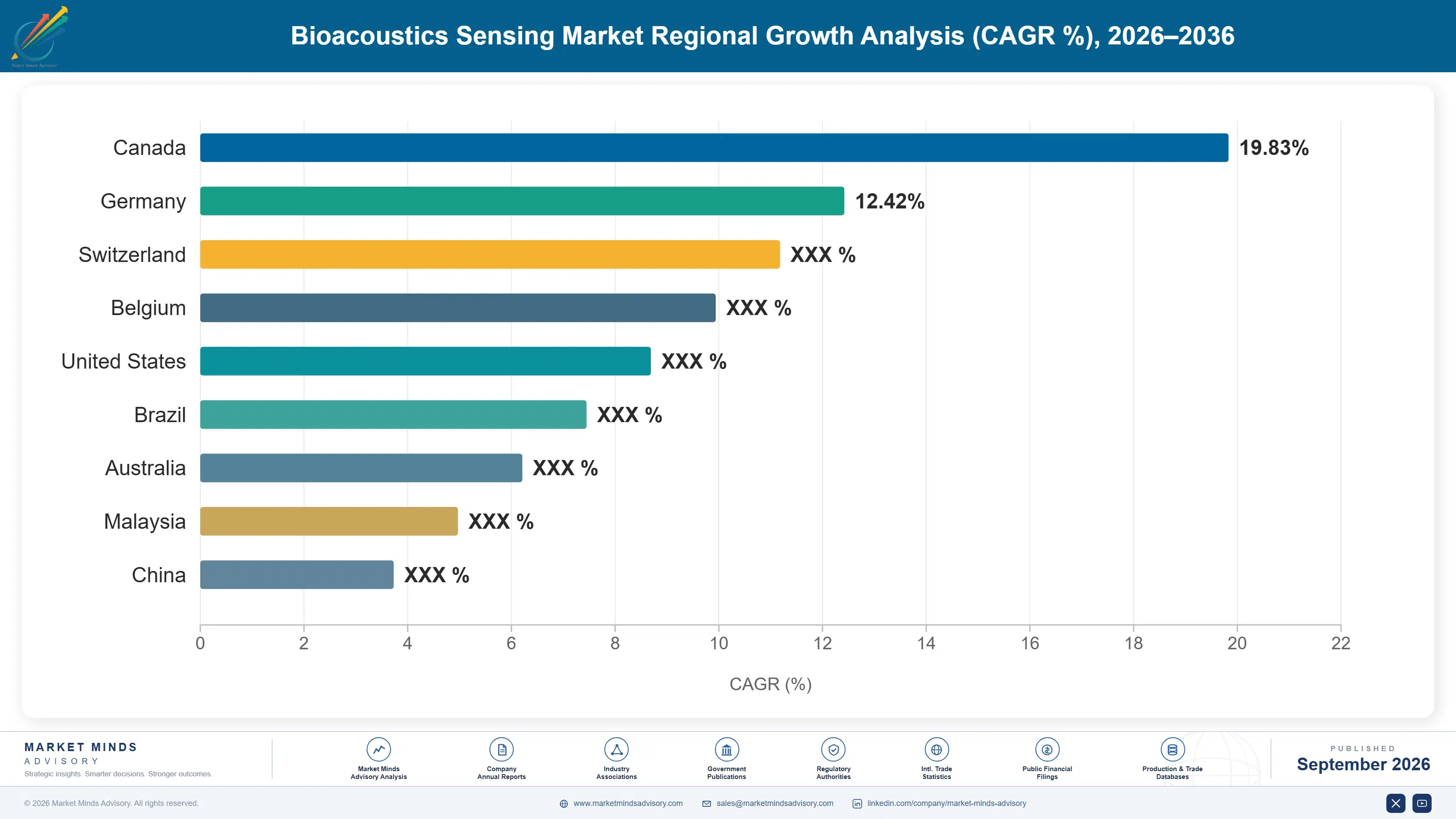
bioacoustics-sensing-market-country-cagr-analysis-1788421655067

Where Bioacoustics Revenue Actually Recurs

Recorders are close to commodity and grant-funded deployments largely do not renew, so durable revenue comes from applications where somebody must produce an answer to a regulator or can count a production saving. Verification expertise rather than detection capability is what those buyers are paying for. Recording is no longer the difficult or valuable part.

Follow the Consent Condition Not the Ecology

Around 61% of revenue in this market traces to a regulatory obligation with a project budget behind it, and marine consent work recurs with every construction phase and every new development. Suppliers organised around compliance contracts achieve roughly 4 times the revenue per deployment of research-funded work and renew reliably, because the obligation returns whether or not anyone found the last survey interesting. Research references remain valuable for credibility. They do not pay for a business, and several excellent instrument makers have proved that expensively. References do not pay for a business.
Market Impact: Compliance work funds 61% of the total revenue

Sell Verified Detection Rather Than Recording Hardware

Recorders are inexpensive and largely interchangeable, while a regulator accepts detection evidence only with documented expert oversight covering roughly 17% of detections that need human review. Suppliers providing verified detection as a service capture around 5 times the value of the hardware in the same deployment, and they hold the relationship when the next construction phase begins. Building verification capacity means employing acousticians rather than engineers. That is a different business, and hardware makers consistently underestimate how different it is. Employing acousticians is a genuinely different business. Instrument makers underestimate that difference consistently.
Market Impact: Captures 5 times the underlying hardware value alone

Target Production Applications With Countable Returns

Livestock respiratory monitoring and aquaculture feeding acoustics both produce savings a manager verifies within a production cycle, through mortality, treatment cost or feed conversion. That is an entirely different buyer from a regulator or a research council, and the segments grow at 21.6% and 17.0% respectively without depending on either. Deployment cost near USD 14,600 per site is recovered quickly in intensive operations. The sale requires agricultural rather than scientific selling, which specialists find harder than the technology ever was. Agricultural selling is the actual obstacle here. Intensive operations recover the cost quickly.
Market Impact: Recovers USD 14,600 per site within a few months

Concentrate Expert Time on Ambiguous Detections Only

Verification labour is the largest recurring cost in compliance work and it does not scale if experts review everything a classifier produces. Workflows that route only genuinely ambiguous detections to human review cut verification effort by roughly 60% while preserving the documented oversight regulators require. It depends on classifier confidence calibration being honest rather than optimistic, which is an uncomfortable engineering discipline. Suppliers who built it can bid competitively on large monitoring programmes that manual review economics simply exclude them from. Honest calibration matters more than headline accuracy claims. Manual review economics exclude smaller bidders entirely.
Market Impact: Cuts verification effort by roughly 60% in total

Who Controls the Margin Pool

Concentration is low at roughly 24% across the top five on measured hardware, software and services revenue, and the field contains three groups that seldom compete with each other. Marine instrument manufacturers supply hydrophones and arrays into offshore and defence applications. Monitoring consultancies deliver compliance services against consent conditions. Ecology equipment specialists sell recorders to researchers and conservation organisations. Very few participants operate credibly in more than one of those.
Competition runs on three dimensions. Regulatory acceptance of methodology is first in compliance work, since a consenting authority effectively decides which approaches are usable. Second is verification capacity, meaning employed acousticians able to review detections at the volume large programmes generate. Third is classifier performance on the specific species and conditions a project involves, which varies far more by location than general benchmarks suggest.

Two pressures are reshaping the field. Offshore construction demand is pulling the market toward services delivered under consent conditions and away from instrument supply, which favours consultancies over hardware makers. Meanwhile agricultural and aquaculture integrators are absorbing production monitoring applications, reaching farm customers through channels acoustics specialists do not hold. Rankings will move toward participants with verification capacity and regulatory standing rather than the best sensors.
bioacoustics-sensing-market-company-positioning-matrix-1788421655592

Competitive Moat and Risk Dimensions

TELEDYNE MARINE

Moat: Marine instrument breadth and scale

Teledyne supplies hydrophones, arrays and deployment platforms across scientific, offshore energy and defence applications, giving it manufacturing scale no ecology specialist approaches. Its instruments appear in monitoring programmes regardless of which consultancy delivers the service, which spreads exposure across competing service providers. Established offshore and naval customer relationships bring visibility of construction and survey programmes well ahead of formal procurement.
TELEDYNE MARINE

Risk: Limited analysis and verification depth

The company supplies instruments into a market where value has moved toward classification and documented expert verification, which is a services capability rather than a manufacturing one. Consultancies delivering compliance monitoring hold the customer relationship and specify hardware within it. Building verification capacity means employing acousticians at scale, which sits awkwardly alongside an instrument manufacturing business with entirely different economics.
JASCO APPLIED SCIENCES

Moat: Regulatory acceptance and analysis depth

JASCO delivers acoustic monitoring and impact assessment accepted by consenting authorities across several jurisdictions, which is standing earned over years of submitted work rather than any product feature. Its analysis and modelling capability spans detection, propagation and impact assessment, which consent applications require together. Employed acoustician capacity lets it bid on programmes that hardware-led competitors cannot staff at all.
JASCO APPLIED SCIENCES

Risk: Offshore construction cycle exposure

Revenue depends substantially on offshore wind and seismic survey programmes whose timing is set by energy policy, grid connection availability and financing conditions rather than by anything the company influences. A slowdown in construction removes demand across many projects simultaneously. Verification capacity is also a fixed cost carried through those cycles, since acousticians cannot be recruited quickly when programmes resume.

Players Tracked

Prominent Players

Teledyne Marine
JASCO Applied Sciences
Wildlife Acoustics
SoundTalks
Seiche

Other Key Players

Ocean Sonics
RTSys
Aquatec Group
Subacoustech
Titley Scientific
Pettersson Elektronik
Elekon
Frontier Labs
Rainforest Connection
Chorus
Sonsetc
Bruel and Kjaer
Sonardyne
Nortek
Cetacean Research Technology

Recent Developments

MAY 2025

Offshore wind consent conditions extend acoustic monitoring requirements

Marine consenting authorities in several European jurisdictions extended documented detection and mitigation requirements across additional construction activities and longer monitoring windows. The changes clarified existing expectations rather than introducing any new obligation on developers or their contractors. Contractors were given notice ahead of the next construction season.
Signal: Consent conditions rather than any ecological argument continue to determine exactly where monitoring budgets actually exist.
SEPTEMBER 2025

Veterinary and barn equipment suppliers integrate acoustic health monitoring

Livestock equipment and animal health suppliers added acoustic respiratory monitoring to product ranges sold through existing farm channels, licensing detection capability from specialists rather than acquiring them. The offerings target producers already buying climate control and feeding systems from the same suppliers. Acoustics specialists supplied capability rather than the relationship.
Signal: Farm channel access matters more than acoustic capability, and specialists do not hold that channel at all.
FEBRUARY 2025

Nature disclosure frameworks progress toward financing conditions

Biodiversity reporting frameworks advanced toward incorporation in lender and investor requirements for site-based operations, though obligations remained largely voluntary in most jurisdictions. Where financing conditions applied, monitoring shifted from research proposals to contracted services with defined terms. Voluntary adoption grew steadily across the year. Frameworks remain largely voluntary.
Signal: Enforceable disclosure would convert ecology monitoring from grant work into contracted compliance almost immediately across every market.

What Monitoring a Site Costs

Cost structure in compliance work looks like a consultancy rather than an instrument business. Acoustician time for verification, reporting and regulatory submission runs between 38% and 52% of cost, the range reflecting how much detection is automated before review. Deployment and recovery, including vessel time for marine work, adds roughly 24%, hardware amortisation 16%, and data storage and compute the balance. Vessel access rather than instrumentation governs marine deployment scheduling.
Vessel day rates have been the sharpest pressure. Offshore wind construction absorbed survey and support vessel capacity through 2024 and 2025, and monitoring providers competing for the same vessels paid substantially more for deployment and recovery windows. Teledyne Technologies and Spectris both referenced marine and test instrumentation demand conditions in recent annual reporting. Providers holding fixed-price monitoring contracts absorbed the increase across contract terms measured in years.

Exposure varies by delivery model rather than by scale. Providers employing acousticians carry verification labour as fixed cost, rewarding utilisation and punishing gaps between programmes. Those using associate networks flex more easily and pay a premium per hour. Hardware suppliers avoid both and address a shrinking share of deployment value. Small consultancies hold specialist staff without the pipeline to keep them occupied.
bioacoustics-sensing-market-cost-volatility-analysis-1788421655806

Calibrate classifier confidence to route review honestly

Verification labour dominates compliance cost and only falls if expert time is concentrated on genuinely ambiguous detections rather than on everything a classifier flags. Honest confidence calibration cuts review effort by roughly 60% while preserving the documented oversight regulators require. It demands resisting optimistic claims, since an overconfident classifier moves cost into missed detections regulators eventually find.

Contract vessel access ahead of construction programmes

Marine deployment and recovery depends on vessel availability that offshore construction absorbs first, and monitoring providers are secondary customers whenever the market tightens. Securing access ahead of programme award costs commitment and removes the scheduling risk that delays monitoring and therefore construction. Developers increasingly ask about vessel arrangements during tender, which turns preparation into a competitive advantage.

Balance employed and associate acoustician capacity deliberately

Verification capacity cannot be recruited quickly when a programme starts and cannot be carried economically when construction pauses, which makes the employed and associate mix a genuine strategic decision. A core employed team holding methodology and regulatory relationships, supplemented by associates at peak, carries capability through cycles. Providers who staffed entirely for peak demand have not survived previous slowdowns.

Portfolio Architecture for Margin Defence

Margin architecture separates on who is obliged to pay. Compliance monitoring delivered against consent conditions earns services margins protected by regulatory acceptance that competitors take years to establish. Production monitoring for livestock and aquaculture earns well because the buyer verifies a return. Research equipment supply earns thin manufacturing margins into a customer base that buys once per grant and rarely returns.
The volume tension is between hardware volume and services margin. Recorders and hydrophones fill manufacturing capacity, reach the widest customer base and command commodity pricing against interchangeable alternatives. Verified monitoring services reach far fewer customers, require employed acousticians and earn several times more per deployment. Organisations built for one struggle to operate the other, and the few that manage both keep them separate for exactly that reason.

High-value revenue concentrates in compliance monitoring services and in production applications with countable returns. Both share the property that the buyer faces a consequence, whether a stopped construction programme or an avoidable production loss. Research equipment supply occupies the volume position, generates the scientific credibility that compliance work depends on for methodology, and produces very little recurring revenue for anybody selling into it.

Volume / Commodity-Adjacent

Autonomous recorders, hydrophones and deployment hardware sold to researchers and conservation organisations. The wide range separates specialist marine instruments from largely interchangeable terrestrial recorders. Buyers purchase against a grant and rarely return, which caps both pricing and lifetime value.
Gross Margin: 27-41%

Premium / Certified

Production monitoring for livestock and aquaculture, sold against a verifiable operational return. Margin holds because the buyer measures the saving rather than comparing specifications. Farm and aquaculture channel access increasingly sits with integrators rather than with acoustics specialists themselves.
Gross Margin: 39-53%

Sustainability / Regulatory / Next-Generation

Compliance monitoring services delivered against consent conditions with documented expert verification. The widest range in the portfolio, reflecting how much verification and impact assessment is included. Highest margin and the only revenue that recurs with each construction phase reliably.
Gross Margin: 48-67%
bioacoustics-sensing-market-portfolio-architecture-1788421656305

High-value Sub-segments and Strategic Watch-out

Consent Compliance Monitoring Services

High value and high growth together, because construction stops without the monitoring and the payer is a project budget rather than a research fund. The margin range reflects verification and impact assessment content. Regulatory acceptance of methodology takes years to earn and protects the position substantially once established.
Gross Margin: 52-67%

Production Monitoring Applications

High value with strong growth, sold on mortality, treatment cost and feed conversion improvements a manager verifies within a production cycle. The range reflects integration depth with existing barn and farm systems. Channel access through veterinary and equipment suppliers is becoming the constraint rather than acoustic capability.
Gross Margin: 42-56%

Research and Conservation Equipment

The volume core of unit shipments and the least attractive part commercially, sold against grants that renew only about a fifth of the time. It generates the scientific credibility and methodology that compliance work depends on. Suppliers need the reference base and cannot build a durable business on the revenue.
Gross Margin: 26-40%

Integrator Channel Capture

The strategic watch-out, carried at zero because it represents farm customer relationships moving to equipment and veterinary suppliers rather than to acoustics specialists. Those channels reach producers that specialists never will. Treating integrators purely as distribution partners misreads who ends up owning the production monitoring customer.
Gross Margin: 0-0%

How This Revenue Repeats

Recurrence depends entirely on what funds the deployment. Compliance monitoring returns with each construction phase and each new consent application, making a developer relationship worth far more than any single project suggests. Production monitoring in livestock and aquaculture runs continuously once installed because the saving continues. Research deployments continue past initial funding about 22% of the time, which means a supplier serving that base sells to a new customer almost every time.
Adoption depth varies sharply by application. Offshore developers use monitoring intensively to a prescribed protocol, since the alternative is a stopped programme. Livestock producers integrate it into daily management once they trust the alerts. Aquaculture operators use it around feeding decisions specifically. Conservation organisations deploy widely and analyse selectively, given limited expert capacity. Urban environmental monitoring is used lightly and mostly for reporting.

The buyer profile is quite different in each half of the market. Compliance work is bought by consenting and environmental managers inside energy developers, working to regulator-written conditions. Production monitoring is bought by farm and aquaculture managers comparing cost per animal. Research equipment is bought by principal investigators against grant lines. Suppliers organised around the last of these address the buyer with the smallest budget.
bioacoustics-sensing-market-end-use-penetration-index-1788421656811

Where This Market Pays

These are among the four positions where our research anticipates prominent divergence between winners and laggards over the coming forecast period. Each is grounded in the demand model, the regulatory perimeter, and the announced capacity pipeline.
01 / CONSENT OBLIGATION FOCUS

Follow the regulator, not the ecological interest

Roughly 61% of revenue in this market traces to a regulatory obligation carrying a project budget, and marine consent work returns with every construction phase and each new development application. Suppliers organised around compliance contracts earn around 4 times the revenue per deployment of research-funded work and renew reliably, because the obligation comes back whether or not the last survey produced anything interesting. Research references remain genuinely valuable for credibility and have never paid for a business on their own.
02 / VERIFICATION CAPACITY OWNERSHIP

Employ the acousticians, do not just sell recorders

Regulators accept detection evidence only with documented expert oversight, and roughly 17% of all automated detections still require human verification before any submission anywhere. Suppliers that deliver verified detection as a service capture around 5 times the value of the hardware within the same deployment and hold the relationship into the next construction phase. Building that capacity means employing acousticians rather than engineers, which is a genuinely different kind of business, and instrument makers consistently underestimate quite how different it is.
03 / COUNTABLE RETURN APPLICATIONS

Sell to managers who measure the saving themselves

Livestock respiratory monitoring and aquaculture feeding acoustics both produce results a manager verifies inside one production cycle through mortality, treatment cost or feed conversion, which is an entirely different buyer from a regulator or a research council. Deployment cost near USD 14,600 per site is recovered quickly in intensive operations, and the segments grow at 21.6% and 17.0% respectively. The obstacle here is agricultural selling rather than acoustics, and specialists consistently find that considerably harder than the technology ever was.
04 / REVIEW ROUTING DISCIPLINE

Send only ambiguous detections to a human reviewer

Verification labour remains the largest recurring cost in any compliance monitoring programme, and it does not scale at all if experts review everything a classifier produces from a season of recordings. Routing only the genuinely ambiguous detections cuts that effort by roughly 60% while preserving exactly the oversight regulators insist upon. It depends entirely on classifier confidence being calibrated honestly rather than optimistically, which lets suppliers bid competitively on the large programmes that manual review economics would otherwise exclude them from.

Engagement Snapshot From the Field

A live engagement with an industry participant carrying material or product regulatory and market exposure ahead of a defining policy shift, showing how our research translates into a defensible multi-year portfolio strategy.
MARKET MINDS ADVISORY · CLIENT ENGAGEMENT SUMMARY
Bioacoustics Sensing Producer Strategic Portfolio Review and Transition Roadmap 2026·Investment Scenario on Bioacoustics Sensing Exposure Evaluation 2025-26
CLIENT PROFILE
An offshore wind developer with roughly 3.2 gigawatts under construction and a further 4.8 gigawatts in consenting across three separate jurisdictions (client-reported, unverified by MMA). Marine mammal monitoring had been contracted separately for each individual project, with four suppliers engaged across the portfolio and no shared methodology, data or reporting arrangement between any of them.
STRATEGIC CHALLENGE
A piling campaign had been suspended for eleven days after monitoring detections could not be verified quickly enough to satisfy the consenting authority, at an estimated cost of USD 6.4 million in vessel and contractor standby (client-reported, unverified by MMA). The developer needed to know whether the delay reflected supplier capability, methodology or the consent condition itself.
MMA APPROACH
MMA reconstructed the detection and verification timeline hour by hour rather than reviewing the incident report, which had recorded outcomes without timings. We interviewed 11 project staff, four monitoring suppliers, two consenting authority representatives and the vessel operator. Supplier evaluation weighted verification turnaround and regulatory standing ahead of detection sensitivity or hardware specification entirely.
KEY FINDINGS
  1. The delay originated in verification queue time rather than in detection, with ambiguous detections waiting an average of nine hours for an available acoustician to review them.
  2. Two of four suppliers routed every classifier detection to human review, which was the direct cause of the queue rather than any shortage of qualified staff.
  3. Methodology differed enough between suppliers that the consenting authority treated each project as unrelated, removing any benefit from the developer's portfolio scale.
  4. Only one supplier had committed vessel access for deployment and recovery, and the other three depended on spot availability during the busiest construction season.
  5. Consolidating to two suppliers on a common methodology would have qualified the whole portfolio for a simplified reporting route that the authority already offered.
CLIENT PROFILE
An offshore wind developer with roughly 3.2 gigawatts under construction and a further 4.8 gigawatts in consenting across three separate jurisdictions (client-reported, unverified by MMA). Marine mammal monitoring had been contracted separately for each individual project, with four suppliers engaged across the portfolio and no shared methodology, data or reporting arrangement between any of them.
STRATEGIC CHALLENGE
A piling campaign had been suspended for eleven days after monitoring detections could not be verified quickly enough to satisfy the consenting authority, at an estimated cost of USD 6.4 million in vessel and contractor standby (client-reported, unverified by MMA). The developer needed to know whether the delay reflected supplier capability, methodology or the consent condition itself.
MMA APPROACH
MMA reconstructed the detection and verification timeline hour by hour rather than reviewing the incident report, which had recorded outcomes without timings. We interviewed 11 project staff, four monitoring suppliers, two consenting authority representatives and the vessel operator. Supplier evaluation weighted verification turnaround and regulatory standing ahead of detection sensitivity or hardware specification entirely.
KEY FINDINGS
  1. The delay originated in verification queue time rather than in detection, with ambiguous detections waiting an average of nine hours for an available acoustician to review them.
  2. Two of four suppliers routed every classifier detection to human review, which was the direct cause of the queue rather than any shortage of qualified staff.
  3. Methodology differed enough between suppliers that the consenting authority treated each project as unrelated, removing any benefit from the developer's portfolio scale.
  4. Only one supplier had committed vessel access for deployment and recovery, and the other three depended on spot availability during the busiest construction season.
  5. Consolidating to two suppliers on a common methodology would have qualified the whole portfolio for a simplified reporting route that the authority already offered.
RECOMMENDED STRATEGY
Phase 1: Consolidate to two suppliers operating a single agreed methodology across the portfolio, and register that methodology with each consenting authority before the next campaign. Phase 2: Require confidence-routed verification with a contracted turnaround, so that only the genuinely ambiguous detections ever reach a human reviewer at all. Phase 3: Contract vessel access for deployment and recovery ahead of the construction season rather than relying on spot availability during peak demand.
OUTCOME
The developer completed the following two piling campaigns without any monitoring-related suspension, and verification turnaround fell to under two hours (client-reported, unverified by MMA). Monitoring cost across the portfolio fell by roughly 18% despite the consolidated suppliers charging higher day rates than those they replaced.

Frequently Asked Questions

Foundational context covering the market sizes, CAGR, scope, country, region and competition that inform every finding below. This section is provided to cover basics and most often pre-purchase conversations, answered from the MMA Primary Research Dataset.

What is the current size of the Bioacoustics Sensing Market?

The market was worth USD 0.4 billion in 2025 and reaches USD 0.47 billion in 2026. Roughly 61% of that revenue traces to a regulatory consent obligation rather than to research funding.

How large will the Bioacoustics Sensing Market be by 2036?

MMA forecasts USD 2.22 billion by 2036, an expansion of 4.72 times over the forecast period. That represents USD 1.75 billion of incremental annual revenue against 2026.

What is the CAGR for the Bioacoustics Sensing Market 2026 to 2036?

The base case is 16.8% compound annual growth, with a bull case at 18.0% and a bear case at 15.6%. Offshore construction pace and grant funding conditions separate the scenarios.

Which segment is growing fastest?

Marine mammal monitoring and offshore compliance grows at 25.2%, half again the market rate of 16.8%. Construction stops without it, which makes the payer a project budget rather than a research fund.

Who are the major companies in the Bioacoustics Sensing Market?

Teledyne Marine, JASCO Applied Sciences, Wildlife Acoustics, SoundTalks and Seiche lead on measured hardware, software and services revenue. Together they hold roughly 24% across three groups that seldom compete.

Which country is growing fastest?

Vietnam grows fastest at 22.6%, on intensive aquaculture where acoustic feeding and stress monitoring addresses the feed cost that dominates producer economics across the whole sector.

Report Segmentation Architecture

The full report scope spans multiple orthogonal segmentation dimensions, with cross-tabulated demand data provided for each dimension pair. Coverage extends further to regional breakdowns, trend trajectories, and the competitive detail needed to support segment-level decision-making.

By Primary Market Dimension

  • Marine Mammal Monitoring and Offshore Compliance
  • Livestock Health and Welfare Monitoring
  • Terrestrial Biodiversity Monitoring
  • Fisheries and Aquaculture Acoustics
  • Pest and Invasive Species Detection
  • Urban Soundscape and Environmental Compliance

By End-Use Industry

  • Offshore Wind and Marine Energy
  • Oil, Gas and Seismic Survey
  • Livestock and Poultry Production
  • Aquaculture and Fisheries
  • Conservation and Research Institutions
  • Government and Environmental Agencies

By Commercial Dimension

  • Consent Compliance Service Contracts
  • Direct Equipment Sales
  • Agricultural Integrator Channels
  • Research Grant Procurement
  • Government and Donor Programmes
  • Analysis and Reporting Services

By Region

  • Western Europe
  • North America
  • East Asia
  • South Asia and Pacific
  • Latin America
  • Middle East and Africa
  • Eastern Europe

Scope, Methodology, and Coverage

Every figure in this report is reproducible from documented input assumptions. The scope below maps the historical period, the forecast horizon, the segmentation dimensions, and the countries covered, alongside the underlying primary and qualitative methodology.
Historical Period
2020 to 2025
Forecast Period
2026 to 2036
Base Year
2025 (USD billions; MMA Primary Research Dataset, September 2026)
Market Definition
This market covers passive acoustic sensing of biological sound and the analysis of that sound, spanning marine mammal monitoring and offshore compliance, livestock health and welfare monitoring, terrestrial biodiversity monitoring, fisheries and aquaculture acoustics, pest and invasive species detection, and urban soundscape and environmental compliance. Revenue is measured as sensor and recorder hardware, analysis software and directly attributable monitoring, verification and reporting service value at supplier level. Active sonar and echo sounding for navigation or seabed survey, human clinical diagnostic acoustics, industrial machine condition monitoring, and general environmental noise measurement without biological classification are excluded.
Quantitative Units
USD billions, hardware, software and attributable service revenue
Segmentation Dimensions
Monitoring application, end-use industry, funding source, region
Regions Covered
Western Europe, North America, East Asia, South Asia and Pacific, Latin America, Middle East and Africa, Eastern Europe
Countries Covered
United Kingdom, Germany, Netherlands, Denmark, Belgium, France, Norway, Sweden, Poland, Czechia, United States, Canada, Mexico, Brazil, Chile, China, Japan, South Korea, Taiwan, Vietnam, Thailand, Indonesia, India, Australia, New Zealand, Saudi Arabia, United Arab Emirates, Nigeria, South Africa
Key Companies Profiled
Teledyne Marine, JASCO Applied Sciences, Wildlife Acoustics, SoundTalks, Seiche, Ocean Sonics, RTSys, Aquatec Group, Subacoustech, Titley Scientific, Pettersson Elektronik, Elekon, Frontier Labs, Rainforest Connection, Chorus, Sonsetc, Bruel and Kjaer, Sonardyne, Nortek, Cetacean Research Technology
Quantitative Methodology
Primary survey, n=3,800 respondents, Q4 2025, six countries; demand-side model with trade association cross-validation
Qualitative Methodology
47 expert interviews, Q4 2025; applied to validate demand model assumptions, identify emerging dynamics, and assess competitive positioning
Report Format
PDF and XLSX data workbook (Word format preview document)
Publisher
Market Minds Advisory
Report Code
MMA-2026-TEC-891
Published
September 2026
Contact
sales@marketmindsadvisory.com | www.marketmindsadvisory.com

Purchase the full Bioacoustics Sensing Market Report (2026 to 2036).

The full MMA report separates the compliance-funded part of bioacoustics from the grant-funded part, and explains why only one of them supports a durable business. It sizes the market to 2036 across six monitoring applications, seven regions and 29 countries, with segment growth rates and regional demand mechanisms set out in full. Competitive analysis covers 20 participants assessed on measured hardware, software and services revenue, including moat and risk assessment for the two leaders. The report quantifies delivery cost structure, verification economics and margin architecture across three portfolio tiers. It closes with four strategic verdicts and an anonymised offshore wind developer engagement.
Six monitoring applications sized to 2036
Seven regions with demand mechanism analysis
Twenty participants on consistent revenue basis
Verification cost and renewal rate benchmarks
Margin architecture across three portfolio tiers
Anonymised offshore developer monitoring strategy engagement

Built For The People Who Decide

From boardroom strategy to bench-side execution, this report is read cover-to-cover by leaders shaping the next decade of their industry, turning demand scenarios, market dynamics and valuation benchmarks into decisions.
CXOs/ Presidents/ VPs/ Managers
M&A and Corporate Development
Strategy Teams and R&D Heads
Procurement and Product Directors
Regulatory and Compliance Leaders
Investor Relations and Equity Analysts