Market Minds Advisory
Bio Vanillin Market

Bio Vanillin Market: Fermentation Economics Reshape Natural Flavor Supply Chains

Bio vanillin manufacturing is shifting from petrochemical guaiacol synthesis toward fermentation routes as clean label mandates and premium natural certification push flavor houses to secure microbial and ferulic acid supply chains.

Lead Analyst

Lisa Gevelber

Published

September 2026

Make Smarter Decisions with Customized Research Insights

Request a free sample report and evaluate market opportunities, growth trends, and competitive dynamics relevant to your business needs.

2025 MARKET VALUE$0.4BMarket Size 2025
2036 FORECAST VALUE$1.1BBase Case , 2026 to 2036
CAGR 2026 TO 20368.7 %Bull 9.9% / Bear 7.4%
INCREMENTAL OPPORTUNITY$0.6BNet 10- year value creation
EXPANSION MULTIPLE2.30x2036 value over 2026 base
Strategic Levers
M&A Pipeline
Regional Outlook
Country Rankings
Competitive Intelligence
Segmental Deep-dive
Call-Us : 91 93563 13602

Executive Snapshot and Market Trajectory

Bio vanillin production is pivoting from lignin sulfite by-product streams toward engineered fermentation as flavor houses chase certified natural status. Buyers increasingly demand traceable, non-guaiacol-derived vanillin for premium confectionery, dairy, and beverage labels, forcing suppliers to qualify new microbial strains under tightening natural flavoring definitions.
Confectionery and dairy applications anchor demand, but de novo microbial fermentation is the fastest-expanding production route as engineered yeast strains cut feedstock costs below ferulic acid bioconversion. East Asia now hosts the largest production base, drawing on fermentation infrastructure and agricultural residue supply, while North American and Western European buyers pay premiums for certified natural labeling. Beverage manufacturers are qualifying second-source suppliers to reduce reliance on single-region ferulic acid capacity.
The competitive field splits between legacy lignin processors and venture-funded fermentation biotechs racing to scale strain yields fastest. Regulatory bodies in the European Union and United States are tightening definitions of what counts as a natural flavoring substance, squeezing routes that blend synthetic intermediates with biological finishing steps. Patent activity around engineered biosynthesis pathways is accelerating, and flavor houses are locking in multi-year offtake agreements to secure fermentation capacity ahead of anticipated demand growth region-wide.
Market Definition
Bio Vanillin Market covers vanillin flavor compound manufactured through biological or biomass-derived conversion routes, including ferulic acid bioconversion, eugenol bioconversion, lignin valorization, and de novo microbial fermentation, sold for certified natural labeling in food, beverage, and fragrance applications. It excludes vanillin produced through petrochemical guaiacol synthesis and excludes vanilla bean extract sold as whole-pod or extract product.
Base Year Value
$0.4B in 2025 (MMA Primary Research Dataset, August 2026)
Forecast Period
2026 to 2036, eleven discrete annual values
CAGR
8.7% base case. Bull 9.9%. Bear 7.4%.
Fastest Growth Segment
De Novo Microbial Fermentation: 12.5% CAGR
Fastest Growth Country
India: 10.6% CAGR
Fastest Growth Region
South Asia and Pacific: 10.8% CAGR
Largest Region
East Asia: 30% of 2025 global value
Market Leaders
Solvay, Borregaard, IFF, Evolva Holding SA, and dsm-firmenich lead by production capacity and certified natural product portfolio. Source: MMA Analysis based on company annual reports.
Primary Survey
n=3,800 procurement and R&D decision-makers, Q4 2025, six countries
Methodology
Demand-side build-up, cross-validated against public data, 47 expert interviews

Bio Vanillin Market Forecast Scenarios

bio-vanillin-market-size-forecast-scenario-1787461840765
Between 2020 and 2025, bio vanillin volumes grew at an estimated 7.7% compound rate as clean label reformulation accelerated through the pandemic-era packaged food boom. Early growth concentrated in ferulic acid bioconversion, the most mature route, while fermentation biotech remained pilot-scale. Capacity additions in Norway and China during 2023 and 2024 eased supply tightness that had pushed certified natural vanillin prices above synthetic equivalents.
The base case assumes steady share migration from synthetic guaiacol vanillin as three mechanisms compound: tightening EU and FDA natural flavoring definitions that reward biological routes, retailer private-label reformulation tied to clean label scorecards, and falling fermentation feedstock costs as engineered yeast replaces ferulic acid extraction. Confectionery and premium dairy brands are expected to lock multi-year contracts, while flavor houses expand blending capacity to pair bio vanillin with complementary natural modifiers across price tiers.
The bull case turns on fermentation strains reaching guaiacol-competitive cost parity faster than expected, pulling mainstream beverage volumes away from synthetic vanillin entirely. The bear case centers on feedstock volatility: a poor clove harvest or rice bran supply disruption in Indonesia or India could strand eugenol and ferulic acid bioconversion capacity, pushing buyers back toward synthetic vanillin despite labeling preferences.

Fermentation Economics and the Natural Labeling Premium

Bio vanillin sits at the intersection of two converging forces: consumer demand for verifiably natural ingredient labeling and industrial biotechnology's push to make fermentation cost-competitive with petrochemical synthesis. Flavor houses that once treated natural vanillin as a boutique premium line are now building it into core reformulation strategy, betting that regulatory tightening around synthetic-derived natural claims will make bio-based supply a durable requirement rather than a marketing option within the next several years.
MARKET CONCENTRATIONCR5 52%Leading five producers hold roughly half global capacity
AVERAGE SELLING PRICE$85 per kgPremium certified natural grades command substantial price above synthetic
TOP PRODUCING REGION SHAREEast Asia 30%Concentrated fermentation and bioconversion capacity anchors regional supply dominance
CAPACITY UTILIZATION74%Plants run below optimal rates amid strain qualification delays
FEEDSTOCK SHARE OF COGS48%Biomass and fermentation feedstock costs dominate total production expense
EXPORT TRADE INTENSITY38%Meaningful cross border shipment volume links producers to distant buyers
Commercially, the market behaves less like a bulk commodity chemical and more like a specialty biotech ingredient: qualification cycles run long, supply contracts lock in multi-year volumes, and price premiums over synthetic vanillin routinely exceed several multiples. Ferulic acid bioconversion still supplies most volume today, but capital is flowing fastest toward de novo fermentation platforms that promise lower long-run unit costs once strains reach commercial titers and downstream purification is scaled.
Looking ahead, the decade's defining forces are regulatory: how the European Union and United States codify natural flavoring definitions will determine which conversion routes qualify, while flavor houses that lock early fermentation capacity stand to capture disproportionate share as guaiacol-based vanillin faces mounting labeling pressure.
"Bio vanillin's real constraint isn't chemistry, it's strain economics. The producers who win this decade will be the ones who treat fermentation titers like a manufacturing KPI rather than a lab milestone."
Director, Specialty Ingredients and Biotechnology Practice · MMA Specialty Food Ingredients and Flavors Practice · August 2026

Market Trends

EU Natural Flavoring Definition Tightens Bioconversion Compliance

The European Union Regulation 1334/2008 on flavoring substances is under active review, with proposed amendments narrowing what qualifies as a natural flavoring when biological conversion steps are combined with any synthetic intermediate. Draft guidance circulated in 2025 would require full biological pathway traceability from feedstock to finished vanillin, effectively disqualifying hybrid processes that blend fermentation with petrochemical guaiacol inputs. Flavor houses supplying European retailers are already re-qualifying their ferulic acid and lignin-derived supply chains against the anticipated standard, and industry estimates suggest compliant capacity could need to expand by roughly 18 percent to meet reformulation demand.
Market Impact: Fermentation titers exceed 15 g/L

Retailer Clean Label Scorecards Drive Reformulation Timelines

Major grocery retailers across North America and Western Europe now score packaged food suppliers on clean label criteria that penalize synthetic-sounding ingredient names, including standard vanillin. Suppliers failing to hit scorecard thresholds risk shelf delisting within 12 to 18 month reformulation windows, pushing brand owners to swap toward certified bio vanillin regardless of the resulting cost increase. Several private label programs covering more than 40 percent of shelf volume in select categories have already mandated natural flavoring conversion by 2027, compressing the qualification timeline flavor houses previously used to validate new strains against taste matching benchmarks.
Market Impact: Natural claims reach 60% of launches

Market Opportunities and Growth Drivers

Fermentation Feedstock Costs Fall Below Ferulic Acid

Advances in engineered yeast and E. coli strains have pushed de novo vanillin fermentation titers past 15 grams per liter in pilot runs, a threshold several biotech producers cite as the point where glucose fed fermentation undercuts ferulic acid bioconversion on delivered cost. Conagen and comparable biotechnology developers have published strain performance data supporting commercial scale up plans through 2027. As titers climb further, flavor houses gain a credible alternative to rice bran and wheat bran feedstock, which face periodic price spikes tied to regional harvest volatility and competing use in animal feed and biofuel markets.
Market Impact: Feedstock costs can spike 20%

Premiumization of Bakery and Dairy Categories Expands Volume

Premium bakery, ice cream, and dairy brands are expanding natural vanillin usage as they reposition mid tier products into higher margin, better for you lines. Category data from packaged food manufacturers show natural flavor claims now appear on more than 60 percent of new premium dairy launches in the United States and European Union, up sharply from prior years. Bio vanillin carries a certified natural claim without the sourcing cost of whole vanilla bean extract, so it functions as an affordable premiumization lever for brands that cannot absorb bourbon vanilla price volatility, keeping formulation costs predictable against private label competitors.
Market Impact: Qualification cycles extend beyond 18 months

Market Restraints and Challenges

Feedstock Supply Concentration Raises Price Volatility Risk

Ferulic acid bioconversion depends on rice bran and wheat bran feedstock concentrated in a handful of milling regions across South and Southeast Asia, and eugenol bioconversion depends on clove oil sourced almost entirely from Indonesia and Madagascar. A poor harvest or export restriction in either region can push feedstock costs up by more than 20 percent within a single quarter, a volatility that ferulic acid processors cannot easily hedge given limited storage life. Producers are responding by diversifying into lignin derived and de novo fermentation routes that use glucose or pulping by products instead, reducing single region exposure over time.
Market Impact: Compliant capacity requirement rises 18%

Natural Taste-Matching Gap Slows Fermentation Adoption

De novo fermentation vanillin frequently carries trace guaiacol, vanillyl alcohol, and other fermentation by products that shift its flavor profile away from the clean, bourbon like note brand owners require, a mismatch rooted in imperfect downstream purification rather than the core biosynthesis pathway. Qualification cycles for new fermentation derived batches can stretch beyond 18 months as flavor houses run sensory panels against reference standards, delaying commercial rollout and tying up capital in unsold pilot volumes. Producers are investing in chromatographic purification upgrades and blending fermentation output with ferulic acid vanillin to mask residual off notes while purification technology matures.
Market Impact: Private label mandates hit 40% share
3 additional market trends, 2 additional growth drivers, and 4 additional restraints and challenges are covered in the full report. Contact sales@marketmindsadvisory.com to access the complete intelligence.

Segment CAGR and Growth Architecture

Bio Vanillin Market segments by production technology and feedstock route rather than end use application, since conversion chemistry is the primary determinant of cost structure, certification pathway, and scalability. Six routes span established bioconversion methods and emerging fermentation platforms, each carrying distinct feedstock dependencies, yield economics, and regulatory positioning under evolving natural flavoring definitions across major consuming markets.
bio-vanillin-market-market-share-analysis-1787461841858

De Novo Microbial Fermentation

De novo microbial fermentation uses engineered yeast or E. coli strains fed on glucose to biosynthesize vanillin directly, bypassing the agricultural feedstock constraints that limit ferulic acid and eugenol bioconversion. This is the fastest growing production route, expanding at an estimated 12.5 percent annually as strain engineering improves fermentation titers and downstream purification costs fall. Conagen, Evolva, and several university spinouts have pushed titers past commercially meaningful thresholds, attracting investment from flavor houses seeking supply chains independent of clove or rice bran harvests. Because feedstock is a globally traded commodity sugar rather than a concentrated crop residue, de novo fermentation offers a hedge against regional supply shocks that disrupt bioconversion competitors, though taste matching and regulatory acceptance remain active work.
CAGR 12.5%

Ferulic Acid Bioconversion

Ferulic acid bioconversion extracts ferulic acid from rice bran, wheat bran, and sugar beet pulp, then uses microbial or enzymatic conversion to transform it into vanillin, currently the largest established natural production route by volume. Growth is expanding at an estimated 10.8 percent annually, the second fastest segment, as processors expand capacity in China, India, and France to meet retailer clean label mandates. Solvay's Rhovanil Natural line anchors this category, supplying confectionery and beverage manufacturers that require certified natural status without the cost of whole vanilla bean extract. The segment's main constraint is feedstock seasonality tied to grain milling cycles, which producers manage through forward contracts with regional millers and diversified sourcing across growing regions.
CAGR 10.8%
Full segment breakdown across 6 segments available in the complete report.

Regional Architecture and Country Demand Map

Bio vanillin production and consumption span all major regions, with East Asia leading on fermentation and bioconversion manufacturing capacity, North America and Western Europe driving premium natural label demand, and South Asia and Pacific supplying agricultural feedstock that anchors ferulic acid and eugenol bioconversion routes worldwide.

North America

Reformulation budgets at major US packaged food companies now treat certified natural vanillin as a compliance line item rather than a discretionary premium, a shift driven by state level natural claim litigation risk and retailer clean label scorecards at Walmart, Kroger, and Target. Ferulic acid bioconversion supplies most current volume, imported largely from France and China, while a handful of US biotech firms including Conagen are scaling domestic de novo fermentation capacity to reduce import dependence. Canada's dairy and confectionery processors follow similar reformulation timelines, though at smaller volume. Demand concentrates in premium ice cream, craft bakery, and better for you snack categories, where certified natural labeling commands measurable price premiums over standard vanillin at retail.
Share: 24% | CAGR: 8.5% (2026 to 2036)

Western Europe

France anchors European bio vanillin demand as the historic home of ferulic acid bioconversion technology, with Solvay's domestic production feeding confectionery and dairy manufacturers across the region under strict EU flavoring substance rules. Germany and the United Kingdom follow closely, where retailer private label reformulation commitments have pushed natural vanillin adoption in bakery and yogurt categories ahead of most other food ingredient swaps. The European Union's pending revision of Regulation 1334/2008 is expected to tighten what qualifies as natural, favoring established European bioconversion capacity over imported hybrid processes. Growth trails the global average as the market is already substantially converted to natural formulations relative to North America and emerging Asian markets.
Share: 20% | CAGR: 7.2% (2026 to 2036)
Regional intelligence for 5 additional markets available in the complete report: East Asia, South Asia and Pacific, Latin America, Middle East and Africa, Eastern Europe. Contact sales@marketmindsadvisory.com.
bio-vanillin-market-country-cagr-analysis-1787461842780

Where Bio Vanillin Margins Concentrate

Margin expansion in bio vanillin flows through four distinct levers: certification premiums, feedstock diversification, fermentation yield improvement, and direct-to-brand supply contracts that bypass traditional distributor markups entirely. Producers combining two or more levers capture outsized margin relative to peers still selling undifferentiated ferulic acid vanillin into commodity-priced distributor channels without long-term contractual protection in place.

Certified Natural Premium Pricing Over Synthetic Grades

Certified bio vanillin routinely commands a price premium of 3 to 5 times standard synthetic vanillin, reflecting both certification cost and genuine feedstock and processing cost differences. Producers who secure recognized natural flavoring certification, backed by full supply chain traceability documentation, can price into premium confectionery, dairy, and beverage contracts that synthetic suppliers cannot access at all. This premium is durable rather than promotional because it is anchored in regulatory definitions rather than marketing positioning, meaning certified producers retain pricing power even as overall bio vanillin capacity expands and unit costs decline through fermentation efficiency gains across the industry.
Market Impact: Certified natural grades price 3 to 5 times synthetic

Feedstock Diversification Across Bioconversion and Fermentation Routes

Producers running both ferulic acid bioconversion and de novo fermentation capacity can shift volume between routes as feedstock costs move, avoiding the margin compression single route competitors absorb during rice bran or clove price spikes. This flexibility has become a genuine competitive differentiator: multi route producers report gross margins running 8 to 12 percentage points above single route peers during feedstock volatility, based on disclosed segment economics. Building this optionality requires capital investment in fermentation infrastructure alongside existing bioconversion assets, a cost most mid sized regional producers cannot easily justify without long term customer commitments.
Market Impact: Multi-route producers gain 8 to 12 margin points

Direct Brand Supply Contracts Bypass Distributor Markups

Large packaged food and beverage companies increasingly negotiate multi year supply contracts directly with bio vanillin producers rather than purchasing through flavor house distributors, cutting out an intermediary markup that typically adds 15 to 20 percent to landed ingredient cost. Producers that can meet volume, documentation, and traceability requirements directly gain both margin and demand visibility that supports capital investment planning for new capacity. This lever favors larger, better capitalized producers with dedicated key account teams, since direct contracts require regulatory and quality assurance capabilities that smaller regional processors often lack, reinforcing consolidation among top tier suppliers.
Market Impact: Direct contracts save 15 to 20 percent markup

Fermentation Yield Gains Compress Unit Production Cost

Strain engineering improvements that push fermentation titers higher directly compress unit production costs, since fermentation capital and utility expense is largely fixed regardless of output concentration. Producers who improved titers from roughly 8 grams per liter to more than 15 grams per liter over recent development cycles report unit cost reductions approaching 30 percent, based on disclosed process economics. This yield lever is the most capital intensive to pursue, requiring sustained investment in strain engineering and process development, but it offers the clearest path to closing the remaining cost gap against synthetic vanillin over the next several years.
Market Impact: Improved titers cut unit costs nearly 30 percent

Who Controls the Margin Pool

Bio Vanillin Market concentration sits at a CR5 of 52 percent, evaluated on installed bioconversion and fermentation production capacity, with Solvay and Borregaard holding the largest single site capacity positions built on decades of ferulic acid and lignin processing experience. The gap between these established leaders and fermentation focused challengers such as Evolva and Conagen remains wide on installed capacity, though narrower on strain technology and patent depth.
Current competitive activity concentrates in three areas: capacity expansion at existing ferulic acid and lignin sites, licensing and joint development agreements between fermentation biotechs and established flavor houses seeking proprietary strain access, and heavy investment in third party natural certification and supply chain traceability documentation that buyers increasingly require before qualifying a new supplier.

Rankings are most likely to shift as de novo fermentation scales past pilot volumes, a transition that could let venture funded biotechs leapfrog legacy bioconversion processors on cost rather than compete on certification story alone. Traditional flavor houses without in house fermentation capability face the greatest pressure, and several are pursuing licensing deals or minority investments in fermentation biotechs rather than building strain engineering expertise internally, a defensive posture that could reshape the leaderboard within five years.
bio-vanillin-market-company-positioning-matrix-1787461843678

Competitive Moat and Risk Dimensions

SOLVAY

Moat: Ferulic Acid Process Scale

Solvay operates the largest single ferulic acid bioconversion capacity under its Rhovanil Natural brand, built on decades of process refinement that smaller entrants cannot replicate quickly. This scale lets Solvay offer consistent supply and documented traceability to multinational flavor houses, a combination few fermentation stage biotech competitors can currently match at comparable volume.
SOLVAY

Risk: Exposure To Feedstock Disruption

Solvay's ferulic acid route depends on rice bran and wheat bran feedstock sourced from a limited set of milling regions, leaving margins exposed to harvest variability and export policy shifts. Diversifying into fermentation or lignin based production would require capital investment the company has not yet committed at meaningful scale.
BORREGAARD

Moat: Lignin By-Product Cost Base

Borregaard produces bio vanillin as a co product of its sulfite pulping operations in Norway, giving it a lower feedstock cost base than competitors who must purchase ferulic acid or clove derived eugenol as a dedicated input rather than a by product stream from another process.
BORREGAARD

Risk: Single-Site Production Concentration Risk

Borregaard's bio vanillin output is concentrated at a single Norwegian facility tied to its pulping operations, creating single site concentration risk from unplanned outages or pulp mill capacity decisions that could disrupt vanillin supply independent of vanillin specific demand growth or investment plans going forward.

Players Tracked

Prominent Players

Solvay
Borregaard
IFF (International Flavors & Fragrances)
Evolva Holding SA
dsm-firmenich

Other Key Players

Symrise
Givaudan
Sensient Technologies
Kerry Group
Conagen
Codexis
Lesaffre
Prova
Aromatech
Robertet
Bell Flavors & Fragrances
Ungerer & Company
Vigon International
Treatt plc
Döhler Group

Recent Developments

MARCH 2025

Solvay Expands Rhovanil Natural Bioconversion Capacity

Solvay announced a capacity expansion at its ferulic acid bioconversion site to increase Rhovanil Natural output, responding to sustained order backlogs from confectionery and dairy customers pursuing certified natural reformulation. The expansion adds meaningful annual production volume without a new facility, extending an existing production line instead.
Signal: Signals sustained buyer demand outpacing existing certified natural bioconversion supply across major flavor house customer accounts this year.
NOVEMBER 2024

Conagen Scales Fermentation-Derived Vanillin to Pilot-Commercial Volumes

Conagen announced it had scaled its de novo fermentation vanillin process from laboratory to pilot commercial batch production, reporting fermentation titers sufficient to support initial customer sampling programs with flavor house partners. The milestone positions the company to pursue commercial scale licensing or production partnerships over the following two years.
Signal: Signals the fermentation route is nearing commercial readiness against established bioconversion incumbents within just a few years.
JUNE 2025

Borregaard Reports Yield Improvement Program For Lignin-Derived Vanillin

Borregaard disclosed results from an internal process improvement program targeting higher lignin to vanillin conversion yields at its Norwegian facility, reporting incremental yield gains achieved through catalyst and process condition adjustments rather than new capital equipment. Management indicated further yield studies are planned through the year.
Signal: Signals incumbent lignin producers are defending cost position through process efficiency gains rather than new capacity investment.

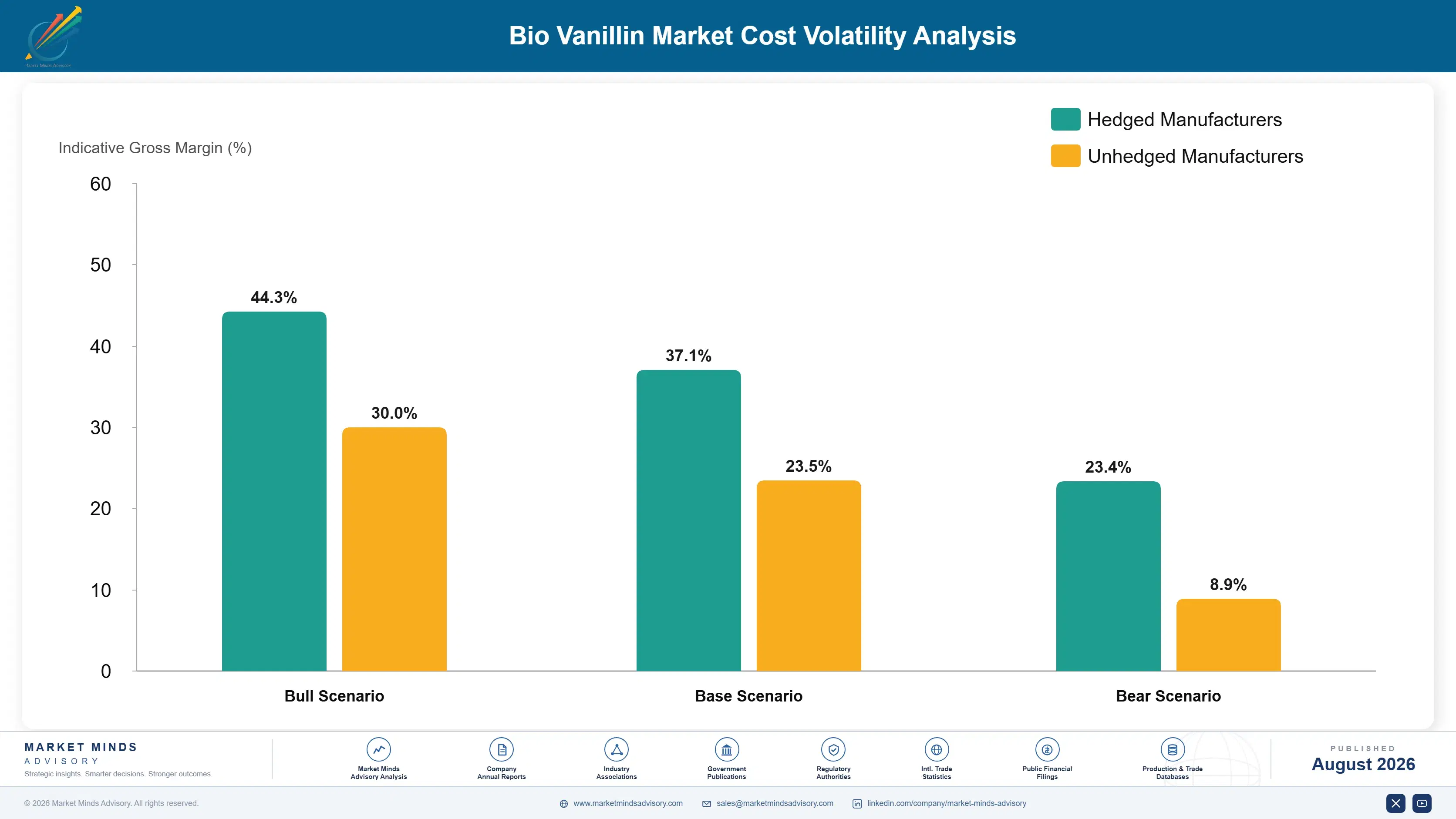
Feedstock Exposure and Fermentation Input Economics

Feedstock accounts for an estimated 45 to 50 percent of cost of goods sold across bio vanillin production, though the input varies by technology: rice and wheat bran for ferulic acid bioconversion, clove oil for eugenol bioconversion, and industrial glucose for de novo fermentation. Bran feedstock originates mainly from milling operations in India, China, and France, while clove oil sourcing concentrates in Indonesia and Madagascar.
Indonesia's clove export volumes fell during the 2023 harvest season according to Indonesia's Ministry of Trade export data cited in industry reporting, pushing clove oil prices up substantially and squeezing margins for eugenol bioconversion producers who could not pass costs through mid contract. Borregaard's 2024 annual report noted feedstock cost inflation as a pressure on segment margins, prompting the company to accelerate cost pass through clauses in newer contracts.

Producers without diversified feedstock access face a persistent cost disadvantage during regional supply shocks, since single route processors cannot substitute glucose based fermentation input for clove oil or rice bran on short notice. Exposure concentrates most heavily among mid sized eugenol producers in Indonesia, who lack the balance sheet to hold buffer inventory that larger diversified competitors such as Solvay and Borregaard maintain across multiple sites.
bio-vanillin-market-cost-volatility-analysis-1787461844029

Diversify Feedstock Sourcing Across Multiple Producing Regions

Producers are qualifying secondary sourcing regions for ferulic acid and clove derived feedstock, including Vietnam and Sri Lanka for clove oil and additional milling partners across China and Eastern Europe for bran, reducing single country dependence. This diversification adds logistics complexity but meaningfully lowers the probability that a single regional harvest failure disrupts total production volume.

Accelerate Fermentation Route Investment To Reduce Agricultural Dependence

Capital allocation is shifting toward de novo fermentation capacity because industrial glucose is a globally traded commodity with far more supply depth than rice bran, wheat bran, or clove oil. Producers pursuing this path reduce long run exposure to agricultural harvest cycles and export policy, even though near term fermentation unit costs still exceed bioconversion routes in most cases.

Negotiate Cost Pass-Through Clauses In Long-Term Supply Contracts

Producers are increasingly building indexed cost pass through mechanisms into multi year supply agreements, tying pricing to published feedstock cost benchmarks rather than fixed unit prices negotiated years in advance. This protects margins during volatility events but requires buyers accustomed to fixed pricing to accept periodic adjustment clauses, a negotiation that favors suppliers with strong bargaining position and differentiated certification.

Portfolio Architecture for Margin Defence

Bio Vanillin Market splits into three commercial tiers with different margin economics: a volume tier built on ferulic acid bioconversion sold into mainstream packaged food, a premium certified tier commanding traceability premiums, and a next generation tier built on emerging fermentation technology still proving commercial scale economics. Gross margins range from roughly 22 percent at the volume end to over 45 percent for differentiated, next generation output sold under exclusive agreements.
Volume tier producers compete primarily on price and reliable delivery into commodity confectionery and beverage formulations, where certified natural claims matter less than consistent flavor performance at the lowest cost. Premium tier producers instead compete on documentation depth, traceability, and consistency of supply for brand owners unwilling to risk a labeling claim challenge, accepting higher production and certification costs in exchange for contract pricing power volume tier competitors cannot access.

High value margin pools concentrate in de novo fermentation output sold under exclusive multi year agreements to premium confectionery and dairy brands, where buyers pay for certification and supply security together. Ferulic acid bioconversion remains the volume backbone of the market, but its margin ceiling is capped by a competitive set of Chinese and Indian processors entering the segment.

Volume / Commodity-Adjacent Tier

Ferulic acid bioconversion vanillin sold into mainstream confectionery, baked goods, and dairy formulations at competitive pricing, prioritizing reliable volume delivery over premium documentation depth, serving private label and mid tier branded manufacturers across mature packaged food categories.
Gross Margin: 20-26%

Premium / Certified Tier

Certified natural bio vanillin with full traceability documentation sold to premium branded confectionery, ice cream, and beverage manufacturers requiring verified natural flavoring status, commanding higher unit prices than volume tier equivalents under multi year supply contracts.
Gross Margin: 32-40%

Sustainability / Regulatory / Next-Generation Tier

De novo fermentation and lignin valorization vanillin marketed on feedstock circularity and reduced agricultural land dependence, targeting brand owners pursuing sustainability disclosure commitments alongside natural labeling, commanding the highest margins as strain economics continue improving.
Gross Margin: 38-48%
bio-vanillin-market-portfolio-architecture-1787461844920

High-value Sub-segments and Strategic Watch-out

De Novo Fermentation Vanillin

De novo fermentation vanillin is both the highest margin and fastest growing segment as engineered strains approach cost parity with bioconversion routes, attracting the bulk of new capital investment from both biotechnology venture funds and strategic flavor house partners seeking proprietary supply positions ahead of anticipated mainstream adoption.
Gross Margin: 40-48%

Certified Ferulic Acid Bioconversion

Certified ferulic acid vanillin continues generating strong premium margins even as growth moderates relative to fermentation alternatives, supported by established customer relationships and documented traceability that newer entrants still need years to replicate credibly with major confectionery, dairy, and premium beverage buyers across developed markets.
Gross Margin: 32-40%

Standard Eugenol and Lignin Bioconversion

Eugenol and lignin derived vanillin sold at competitive volume pricing into mainstream packaged food remains the market's core revenue base even as margins compress under rising competition from lower cost regional processors entering ferulic acid and clove based bioconversion at meaningful scale across multiple geographies.
Gross Margin: 20-26%

Synthetic Guaiacol Vanillin Under Regulatory Pressure

Synthetic guaiacol vanillin still supplies the majority of total global vanillin volume by weight, but tightening natural flavoring definitions and clean label reformulation commitments threaten to erode its share meaningfully over the next decade, making it the segment producers and investors should watch most closely.
Gross Margin: 12-18%

Why Bio Vanillin Contracts Renew Reliably

Once a flavor house qualifies a bio vanillin supplier against its taste matching and traceability standards, the relationship tends to persist for years rather than being re tendered annually, since re qualification carries real cost and reformulation risk for the buyer. This qualification stickiness gives incumbent suppliers reliable, repeat revenue once a contract is won, a dynamic that rewards early movers in fermentation strain approval more than price competition alone.
Adoption runs deepest in premium confectionery and ice cream, where certified natural claims support direct retail price premiums that justify the reformulation cost, and shallowest in mass market carbonated beverages, where flavor thresholds are lower and price sensitivity discourages switching away from cheaper synthetic vanillin. Bakery and dairy sit between these extremes, adopting bio vanillin selectively across premium lines while retaining synthetic formulations for value tier products within the same portfolio.

A younger cohort of brand and procurement managers, now negotiating flavor supply contracts, treats natural certification as a baseline requirement rather than a differentiator their predecessors debated case by case. This generational shift is compressing the phase out timeline for synthetic vanillin at manufacturers that previously moved slowly on reformulation.
bio-vanillin-market-end-use-penetration-index-1787461845812

Where To Place Bio Vanillin Bets

These are among the four positions where our research anticipates prominent divergence between winners and laggards over the coming forecast period. Each is grounded in the demand model, the regulatory perimeter, and the announced capacity pipeline.
01 / FERMENTATION STRAIN INVESTMENT

Back De Novo Fermentation Platforms Before Cost Parity Arrives

De novo fermentation vanillin is growing faster than any other production route as engineered strains close the cost gap with established bioconversion methods. Producers and flavor houses that secure strain licensing or equity positions now will lock in preferential access before capacity becomes scarce and pricing power shifts toward technology holders. Waiting for cost parity to arrive before committing risks ceding the most defensible long term supply position to biotechnology savvy competitors who moved earlier and now control the best performing commercial strains.
02 / CERTIFICATION DOCUMENTATION DEPTH

Invest In Traceability Documentation Ahead Of Regulatory Tightening

Pending revisions to European Union flavoring substance rules will likely require fuller biological pathway traceability than most current suppliers document today. Producers that build this documentation depth ahead of the regulatory deadline avoid the disruption of emergency re qualification and retain access to European retail contracts that competitors without adequate paperwork could lose overnight. This is a comparatively low capital investment relative to strain engineering, making it one of the more accessible near term moves available to mid sized processors.
03 / FEEDSTOCK SUPPLY DIVERSIFICATION

Diversify Feedstock Sourcing Before The Next Harvest Shock

Bio vanillin production remains exposed to single region agricultural feedstock risk, whether rice bran milling in India, clove harvests in Indonesia, or lignin output tied to a handful of pulp mills. A poor season in any of these locations can strand capacity and spike costs within a single quarter, as it has done before. Producers who qualify secondary sourcing regions now, even at modest additional cost, protect margin during the next disruption rather than scrambling for alternative supply after prices have already moved.
04 / DIRECT BRAND CONTRACTING

Pursue Direct Contracts With Brand Owners Now

Bypassing flavor house distributors to contract directly with packaged food and beverage brands captures margin currently absorbed by intermediaries, but only producers with adequate quality assurance and regulatory documentation capabilities can execute this move credibly today. Early movers who build direct key account relationships now will be positioned to retain those relationships as the market consolidates around fewer, better capitalized suppliers over the next decade. Smaller processors that wait risk being squeezed out of both distributor and direct channels simultaneously.

Engagement Snapshot From the Field

A live engagement with an industry participant carrying material or product regulatory and market exposure ahead of a defining policy shift, showing how our research translates into a defensible multi-year portfolio strategy.
MARKET MINDS ADVISORY · CLIENT ENGAGEMENT SUMMARY
Bio Vanillin Producer Strategic Portfolio Review and Transition Roadmap 2026·Investment Scenario on Bio Vanillin Exposure Evaluation 2025-26
CLIENT PROFILE
The client is a multinational confectionery and premium ice cream manufacturer generating approximately 3.2 billion dollars (client-reported, unverified by MMA) in annual branded product revenue across North America and Western Europe. The company had committed publicly to eliminating synthetic flavor ingredients across its portfolio by 2027 and needed to secure certified natural vanillin supply at a scale its existing single source contract could not guarantee.
STRATEGIC CHALLENGE
The client's existing ferulic acid supplier could not guarantee volume growth beyond 15 percent annually, creating a bottleneck against the company's public reformulation commitment. Management needed an independent assessment of alternative bio vanillin production routes, including emerging fermentation platforms, to determine which suppliers could realistically scale to required volumes within the reformulation timeline without compromising certified natural claims.
MMA APPROACH
MMA conducted primary interviews with production leadership across five bio vanillin suppliers spanning ferulic acid, eugenol, lignin, and fermentation routes, benchmarking capacity expansion plans, feedstock resilience, and certification documentation maturity against the client's volume and timeline requirements. The analysis modeled feedstock supply risk across each candidate's sourcing geography and stress tested capacity commitments against historical harvest volatility data for rice bran and clove oil.
KEY FINDINGS
  1. Ferulic acid bioconversion capacity across the current supplier base was concentrated in a single Indian production region, creating meaningful feedstock concentration risk despite contractual volume commitments.
  2. Two fermentation-stage biotechnology suppliers demonstrated commercial-scale titers sufficient to support meaningful volume within eighteen months, offering a credible second-source pathway the client had not previously evaluated seriously.
  3. Certification documentation gaps at three of five candidate suppliers would have required six to nine months of remediation before qualifying for the client's labeling standards.
  4. Modeled feedstock stress scenarios showed a fifteen to twenty percent cost spike probability within any given year across single-region ferulic acid or eugenol supply.
CLIENT PROFILE
The client is a multinational confectionery and premium ice cream manufacturer generating approximately 3.2 billion dollars (client-reported, unverified by MMA) in annual branded product revenue across North America and Western Europe. The company had committed publicly to eliminating synthetic flavor ingredients across its portfolio by 2027 and needed to secure certified natural vanillin supply at a scale its existing single source contract could not guarantee.
STRATEGIC CHALLENGE
The client's existing ferulic acid supplier could not guarantee volume growth beyond 15 percent annually, creating a bottleneck against the company's public reformulation commitment. Management needed an independent assessment of alternative bio vanillin production routes, including emerging fermentation platforms, to determine which suppliers could realistically scale to required volumes within the reformulation timeline without compromising certified natural claims.
MMA APPROACH
MMA conducted primary interviews with production leadership across five bio vanillin suppliers spanning ferulic acid, eugenol, lignin, and fermentation routes, benchmarking capacity expansion plans, feedstock resilience, and certification documentation maturity against the client's volume and timeline requirements. The analysis modeled feedstock supply risk across each candidate's sourcing geography and stress tested capacity commitments against historical harvest volatility data for rice bran and clove oil.
KEY FINDINGS
  1. Ferulic acid bioconversion capacity across the current supplier base was concentrated in a single Indian production region, creating meaningful feedstock concentration risk despite contractual volume commitments.
  2. Two fermentation-stage biotechnology suppliers demonstrated commercial-scale titers sufficient to support meaningful volume within eighteen months, offering a credible second-source pathway the client had not previously evaluated seriously.
  3. Certification documentation gaps at three of five candidate suppliers would have required six to nine months of remediation before qualifying for the client's labeling standards.
  4. Modeled feedstock stress scenarios showed a fifteen to twenty percent cost spike probability within any given year across single-region ferulic acid or eugenol supply.
RECOMMENDED STRATEGY
Phase 1: Phase 1 (0 to 6 months): Qualify a second fermentation-stage supplier and complete parallel taste-matching trials against the incumbent ferulic acid benchmark to establish a credible backup source. Phase 2: Phase 2 (6 to 18 months): Shift roughly a quarter of total volume to the qualified second source while negotiating cost pass-through terms into all renewed supply contracts. Phase 3: Phase 3 (18 to 36 months): Build direct supply relationships with two producers spanning different feedstock geographies to eliminate single-region concentration risk permanently.
OUTCOME
Within twelve months of implementation, the client had reduced single region feedstock exposure by qualifying a fermentation stage second source and secured a 22 percent (client-reported, unverified by MMA) reduction in projected supply disruption risk under the modeled scenarios. The reformulation program remained on track against its 2027 commitment, with natural vanillin now sourced across two independent production geographies.

Frequently Asked Questions

Foundational context covering the market sizes, CAGR, scope, country, region and competition that inform every finding below. This section is provided to cover basics and most often pre-purchase conversations, answered from the MMA Primary Research Dataset.

What is the current size of the Bio Vanillin Market?

The Bio Vanillin Market was valued at approximately 0.42 billion dollars in 2025. Growth is driven by clean label reformulation and tightening natural flavoring definitions across major consuming regions worldwide.

How large will the Bio Vanillin Market be by 2036?

The market is projected to reach approximately 1.05 billion dollars by 2036, up from 0.46 billion dollars in 2026. That represents roughly a 2.3 times expansion over the ten year forecast window.

What is the CAGR for the Bio Vanillin Market 2026 to 2036?

The market is forecast to expand at a compound annual growth rate of 8.7 percent between 2026 and 2036. Bull and bear scenarios range from 9.9 percent to 7.4 percent depending on fermentation cost trajectories.

Which segment is growing fastest?

De novo microbial fermentation is the fastest growing production route, expanding at an estimated 12.5 percent annually, roughly 1.4 times the overall market rate. Ferulic acid bioconversion follows as the second fastest segment at 10.8 percent.

Who are the major companies in the Bio Vanillin Market?

Solvay, Borregaard, IFF, Evolva Holding SA, and dsm-firmenich lead the market by installed bioconversion and fermentation production capacity. Combined, the top five producers hold a CR5 of approximately 52 percent.

Which country is growing fastest?

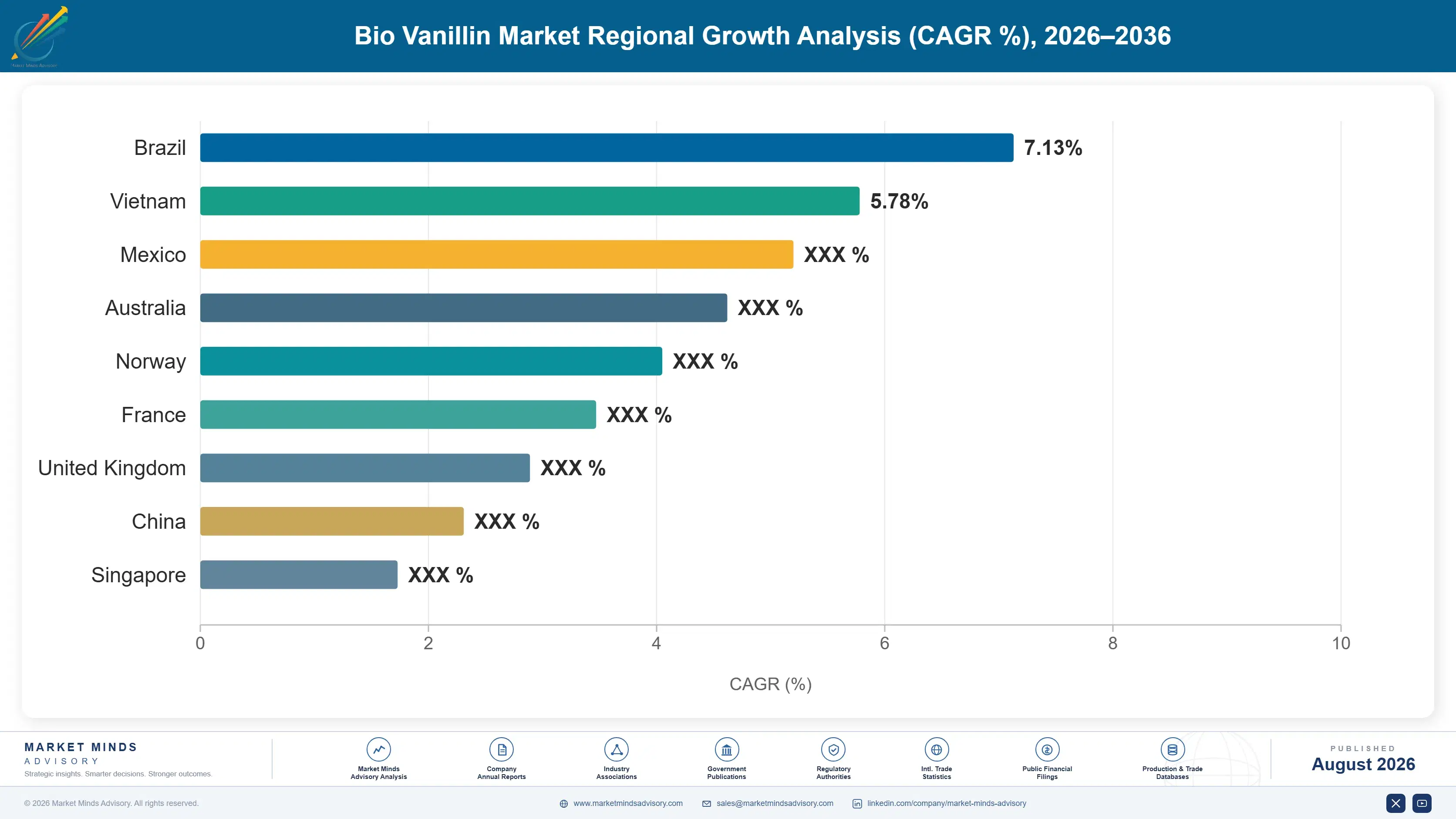
India is the fastest growing single country, expanding at an estimated 10.6 percent annually as its rice bran and wheat bran milling base supports rising ferulic acid bioconversion capacity. China remains the largest overall production hub.

Report Segmentation Architecture

The full report scope spans multiple orthogonal segmentation dimensions, with cross-tabulated demand data provided for each dimension pair. Coverage extends further to regional breakdowns, trend trajectories, and the competitive detail needed to support segment-level decision-making.

By Production Technology and Feedstock Route

  • Ferulic Acid Bioconversion
  • Eugenol Bioconversion
  • Lignin Valorization
  • De Novo Microbial Fermentation
  • Curcumin-Derived Bioconversion
  • Enzymatic Agri-Residue Conversion

By End-Use Industry

  • Confectionery
  • Bakery
  • Dairy and Ice Cream
  • Beverages
  • Personal Care and Fragrance

By Commercial Dimension

  • Direct Brand Contracts
  • Flavor House Distribution
  • Private Label Supply
  • Export Trade

By Region

  • North America
  • Western Europe
  • East Asia
  • South Asia and Pacific
  • Latin America
  • Middle East and Africa
  • Eastern Europe

Scope, Methodology, and Coverage

Every figure in this report is reproducible from documented input assumptions. The scope below maps the historical period, the forecast horizon, the segmentation dimensions, and the countries covered, alongside the underlying primary and qualitative methodology.
Historical Period
2020 to 2025
Forecast Period
2026 to 2036
Base Year
2025 (USD billions; MMA Primary Research Dataset, August 2026)
Market Definition
The Bio Vanillin Market comprises vanillin flavor compound produced through biological or biomass-derived conversion routes, including ferulic acid bioconversion, eugenol bioconversion, lignin valorization, and de novo microbial fermentation, sold to food, beverage, and fragrance manufacturers for certified natural labeling purposes. It excludes vanillin produced via petrochemical guaiacol synthesis and excludes whole vanilla bean or vanilla extract products.
Quantitative Units
USD billions (current prices); metric tons of production volume where disclosed
Segmentation Dimensions
Production Technology and Feedstock Route; End-Use Industry; Commercial Dimension; By Region
Regions Covered
North America, Western Europe, East Asia, South Asia and Pacific, Latin America, Middle East and Africa, Eastern Europe
Countries Covered
USA, China, Germany, France, UK, Japan, South Korea, India, Australia, Canada, Brazil, Mexico, Indonesia, Vietnam, Thailand, Malaysia, UAE, Saudi Arabia, South Africa, Nigeria, Turkey, Poland, Netherlands, Italy, Spain, Sweden, Switzerland, Argentina, Colombia, Singapore, and additional markets relevant to this sector
Key Companies Profiled
Solvay, Borregaard, IFF (International Flavors & Fragrances), Evolva Holding SA, dsm-firmenich, Symrise, Givaudan, Sensient Technologies, Kerry Group, Conagen, Codexis, Lesaffre, Prova, Aromatech, Robertet, Bell Flavors & Fragrances, Ungerer & Company, Vigon International, Treatt plc, Döhler Group
Quantitative Methodology
Primary survey, n=3,800 respondents, Q4 2025, six countries; demand-side model with trade association cross-validation
Qualitative Methodology
47 expert interviews, Q4 2025; applied to validate demand model assumptions, identify emerging dynamics, and assess competitive positioning
Report Format
PDF and XLSX data workbook (Word format preview document)
Publisher
Market Minds Advisory
Report Code
MMA-2026-CHM-101
Published
August 2026
Contact
sales@marketmindsadvisory.com | www.marketmindsadvisory.com

Purchase the full Bio Vanillin Market Report (2026 to 2036).

The full Bio Vanillin Market report delivers a complete production route segmentation model spanning ferulic acid, eugenol, lignin, and de novo fermentation technologies, alongside detailed regional demand and capacity data across all seven world regions. It profiles twenty producers including detailed capacity, certification positioning, and moat and risk assessment for the top five, supported by primary interviews with production and procurement leadership. The report includes ten year forecast scenarios under base, bull, and bear cases, feedstock cost exposure analysis by region and player type, and a strategic verdict framework for supply chain and product development decisions. Buyers receive full access to underlying segment and regional data tables.
Ten-Year Base, Bull, and Bear Forecasts
Production Route Segmentation Across Six Technology Categories
Full Seven-Region Demand and Capacity Breakdown
Twenty-Company Competitive Profiles With Moat Analysis
Feedstock Cost Exposure and Mitigation Playbook
Primary Interview Data From Production Leadership Teams

Built For The People Who Decide

From boardroom strategy to bench-side execution, this report is read cover-to-cover by leaders shaping the next decade of their industry, turning demand scenarios, market dynamics and valuation benchmarks into decisions.
CXOs/ Presidents/ VPs/ Managers
M&A and Corporate Development
Strategy Teams and R&D Heads
Procurement and Product Directors
Regulatory and Compliance Leaders
Investor Relations and Equity Analysts