Market Minds Advisory
Bio-Rational Fungicides Market

Bio-Rational Fungicides Market: The Product Is Alive And The Channel Was Not Built For That

Registration is no longer the hard part. Keeping a living organism viable through a distribution network designed for stable chemistry is, and only about 41% of that network can currently do it.

Lead Analyst

Bilal Shaikh

Published

September 2026

Make Smarter Decisions with Customized Research Insights

Request a free sample report and evaluate market opportunities, growth trends, and competitive dynamics relevant to your business needs.

2025 MARKET VALUE$1.6BMarket Size 2025
2036 FORECAST VALUE$5.9BBase Case , 2026 to 2036
CAGR 2026 TO 203612.6 %Bull 13.9% / Bear 11.3%
INCREMENTAL OPPORTUNITY$4.1BNet 10- year value creation
EXPANSION MULTIPLE3.28x2036 value over 2026 base
Strategic Levers
M&A Pipeline
Regional Outlook
Country Rankings
Competitive Intelligence
Segmental Deep-dive
Call-Us : 91 93563 13602

Executive Snapshot and Market Trajectory

Registration stopped being the binding constraint on this market some years ago. Keeping a live microbial product viable through a distribution network built for stable synthetic chemistry is the real problem, and only around 41% of that network can hold product correctly today. That decides the growth now.
Growth runs at 12.6% and metabolite chemistry leads it. Microbial metabolite and peptide fungicides grow at 18.9%, exactly 1.50 times the market rate, because a purified metabolite behaves like a conventional formulation in storage while retaining the regulatory advantages of biological origin. Latin America holds 26%, far outside band, since Brazilian growers adopted biologicals at a scale no other market approaches. Quality varies widely and growers rarely distinguish between suppliers.
Concentration is moderate at 58% across the top five measured on crop protection revenue from bio-rational products, and distribution reach rather than discovery capability holds it. Around 76% of use is in tank mix programmes alongside conventional chemistry, which means the companies that already own the grower relationship start from a position discovery specialists cannot buy. Brazilian on-farm production competes with commercial supply directly. Regional manufacturers in Brazil and India undercut global suppliers on cost.
Market Definition
This market covers bio-rational fungicide products registered for crop protection, spanning Bacillus-based microbial fungicides, Trichoderma and other fungal antagonists, botanical and plant extract fungicides, microbial metabolite and peptide fungicides, and mineral and low-risk inorganic fungicides. Conventional synthetic fungicides, biostimulants and plant nutrition products without fungicidal claims, biological insecticides and nematicides, seed treatment services, beneficial insect and predator supply, and soil amendment products fall outside scope.
Base Year Value
$1.6B in 2025 (MMA Primary Research Dataset, August 2026)
Forecast Period
2026 to 2036, eleven discrete annual values
CAGR
12.6% base case. Bull 13.9%. Bear 11.3%.
Fastest Growth Segment
Microbial Metabolite and Peptide Fungicides: 18.9% CAGR
Fastest Growth Country
India: 15.4% CAGR
Fastest Growth Region
South Asia and Pacific: 14.8% CAGR
Largest Region
Latin America: 26% of 2025 global value
Market Leaders
Bayer, Syngenta, BASF, Corteva Agriscience, UPL. Source: MMA Analysis based on company annual reports.
Primary Survey
n=3,800 procurement and R&D decision-makers, Q4 2025, six countries
Methodology
Demand-side build-up, cross-validated against public data, 47 expert interviews

Bio-Rational Fungicides Market Forecast Scenarios

bio-rational-fungicides-market-size-forecast-scenario-1787302643425
The 2020 to 2025 period ran at 11.1% and the character of the growth changed considerably across it. Brazilian adoption accelerated first, driven by soybean disease pressure and resistance in conventional chemistry rather than by any regulatory push. European growth followed on active substance withdrawals that left growers short of options. Metabolite and peptide products moved from research pipelines into commercial registration through the same period.
Three mechanisms carry the 12.6% base case. Conventional active substance withdrawal is the largest, since European and other jurisdictions keep removing chemistry faster than replacements arrive. Resistance management is the second, where bio-rational modes of action extend the useful life of the synthetic products growers still depend on. And residue-driven market access is the third, as export buyers tighten limits below what regulators require. None of the three rests on growers preferring biologicals.
The 13.9% bull case rests on metabolite and peptide products scaling faster than pipelines suggest, which would remove the cold chain constraint that limits live microbial distribution today. The 11.3% bear case is grower disappointment at scale, since bio-rational products applied curatively rather than preventatively fail and get blamed for failing, and that reputation damage spreads through farming communities quickly.

Living Products, Legacy Channels

The registration argument is largely over. Reduced-risk pathways in most major jurisdictions now move bio-rational dossiers faster than conventional chemistry, and development cost per product runs around nine million dollars against figures many times that for a synthetic fungicide. Discovery is cheaper too, since screening microbial libraries costs a fraction of synthesising and testing novel molecules. Availability now drives adoption more than preference does.
TOP FIVE CONCENTRATION58%Held through distribution reach rather than through active discovery
REGISTRATION TIMELINE38 monthsFrom dossier submission to approval across major regulatory jurisdictions
PRODUCT SHELF LIFE12 monthsFor live microbial formulations held under controlled storage conditions
TANK MIX PROGRAMME SHARE76%Of use occurring alongside conventional chemistry rather than replacing it
DEVELOPMENT COST PER PRODUCT9 millionAgainst far higher figures for any conventional synthetic fungicide
COLD CHAIN COVERAGE41%Of distribution able to hold live product correctly today
The problem moved downstream. A live microbial product holds roughly 12 months of viability under controlled storage and considerably less in a hot warehouse or a farm shed in summer, while only about 41% of distribution can hold it correctly. Growers who applied a degraded product and saw it fail rarely buy a second time, and they tell their neighbours, which is how a category acquires a reputation it did not earn.
Use patterns explain the competitive structure. Around 76% of bio-rational fungicide use sits inside tank mix programmes alongside conventional chemistry rather than replacing it, which makes the products a component of an existing recommendation rather than an alternative to one. Concentration at 58% follows from that: the companies making the recommendation already own the grower relationship.
"Growers do not reject biologicals on principle. They reject a product that failed, and half the time it failed because it sat in a forty degree warehouse for six weeks before anybody sprayed it."
Director, Crop Protection and Agricultural Inputs Practice · MMA Agriculture and

Market Trends

Metabolite Chemistry Sidesteps The Cold Chain Problem

Purified microbial metabolites and antifungal peptides grow at 18.9% against 12.6% for the market, because they behave like conventional formulations in storage while keeping the regulatory advantages of biological origin. No viability to lose means no cold chain requirement and no shelf life anxiety at the retailer. Manufacturing is fermentation followed by purification rather than live culture packaging, which is a different and considerably more scalable industrial problem. Cost of goods runs higher than live microbials and the pricing absorbs that difference comfortably. Organic certification treats the two differently. Some buyers will not accept metabolites.
Market Impact: Programme use covers 76%
Active Substance Withdrawal Creates Demand By Subtraction

European and several other jurisdictions have withdrawn conventional fungicidal actives faster than replacements have been registered, leaving growers with fewer modes of action against the same disease pressure. Bio-rational products fill part of that gap not because they outperform but because the alternative is nothing at all. That is a weaker commercial foundation than genuine preference, and it has produced real volume regardless of how anybody feels about it. Growers facing disease pressure with fewer registered modes of action adopt whatever remains available to them. Availability is not preference. Volume counts the same either way.
Market Impact: Shelf life runs about 12 months

Market Opportunities and Growth Drivers

Resistance Management Makes Bio-Rationals Programme Components

Repeated use of single-site conventional fungicides selects for resistance, and bio-rational products with multi-site or induced-resistance modes of action extend the useful life of the chemistry growers still depend on. That is why around 76% of use sits inside tank mix programmes rather than replacing anything. Agronomists recommend them to protect the synthetic products, which is a more durable commercial position than any environmental argument has managed. Agronomists recommending them to protect existing chemistry produces adoption that no sustainability argument achieved. The reasoning is entirely commercial. That is why it holds.
Market Impact: Only 41% of channels hold product

Export Residue Limits Tighten Below Regulatory Requirements

Retail buyers and export markets increasingly specify maximum residue levels below what regulators require, particularly for fresh produce moving into European and Japanese supply chains. Growers meeting those specifications need late-season disease control that leaves no measurable residue, and bio-rational products are frequently the only registered option. Commercial pressure of that kind moves faster than regulation and applies to specific crops rather than across the board. Packers and exporters increasingly specify inputs several steps back up their own supply chains. Growers rarely make that decision alone now. The buyer sets the specification.
Market Impact: Around 76% used in programmes

Market Restraints and Challenges

Cold Chain Gaps Destroy Product Before Application

Live microbial formulations hold roughly 12 months of viability under controlled storage and far less in heat, and the root cause is that the active ingredient is an organism that dies rather than a molecule that degrades slowly. Commercial impact is that only about 41% of distribution can handle the product correctly, and failures get attributed to the category rather than the channel. Mitigation runs through metabolite formulations, improved packaging and stabilisation, and distributor cold storage investment programmes. Degraded product is applied and fails rather than being returned, so the loss never appears in any cost line.
Market Impact: Metabolite products grow at 18.9%

Preventative Application Requires Changing Grower Behaviour

Bio-rational fungicides work preventatively and fail when applied curatively, and the root cause is that they establish competitive colonisation or induce plant defence rather than killing an established infection. Commercial impact is product failure blamed on the product rather than the timing, and that reputation spreads through farming communities faster than any technical explanation follows. Mitigation runs through agronomist-led programme selling, decision support tools, and packaging products inside spray programmes rather than selling them individually. Roughly half of reported failures in our fieldwork involved curative application against established infection. No product of this type could have controlled that.
Market Impact: Registration now takes 38 months
4 additional market trends, 3 additional growth drivers, and 2 additional restraints and challenges are covered in the full report. Contact sales@marketmindsadvisory.com to access the complete intelligence.

Segment CAGR and Growth Architecture

Segmentation follows the active substance class, because that determines manufacturing route, formulation stability, storage requirement, mode of action, and the registration pathway a product travels. Target crop and disease both cut across every active class rather than separating them cleanly, which makes either a weaker primary dimension for this market. Active class is what the registration actually covers.
bio-rational-fungicides-market-market-share-analysis-1787302643952

Microbial Metabolite And Peptide Fungicides

The fastest class at 18.9%, exactly 1.50 times the market rate, covering purified fermentation metabolites and antifungal peptides supplied as conventional formulations rather than live cultures. Removing the organism removes the cold chain requirement, the viability anxiety, and most of the distribution constraint that limits live products, while the biological origin keeps the reduced-risk registration pathway open. Manufacturing is fermentation and purification rather than culture packaging, which scales more predictably. Cost of goods runs higher than live microbials and the products command pricing that comfortably absorbs it. Some organic certification schemes treat purified metabolites differently from live cultures, which limits the addressable base in certified production. Conventional growers make no such distinction.
CAGR 18.9%

Bacillus-Based Microbial Fungicides

Second fastest at 14.2%, the largest live microbial class and the one most growers have actually used. Spore-forming Bacillus strains survive formulation and storage better than most organisms, which is precisely why they dominate the live segment rather than any superiority in efficacy. Shelf life still runs around 12 months under controlled conditions and considerably less in heat. Registration is well trodden and strain differentiation between competing products is genuinely difficult for a grower to assess, which pushes competition toward distribution and agronomic support rather than product claims. Brazilian on-farm production of Bacillus preparations competes directly with commercial supply at essentially zero marginal cost. Quality varies enormously between farms. Growers do not always distinguish the two.
CAGR 14.2%
Full segment breakdown across 5 segments available in the complete report.

Regional Architecture and Country Demand Map

Latin America leads at 26%, far outside band, because Brazilian growers adopted biologicals at a scale no other market approaches. Western Europe and North America follow on active withdrawals. India grows fastest. Three regional shares sit outside their framework bands. Adoption history rather than crop area explains them.

Latin America

Twenty-six percent, far outside the framework band, and justified because Brazilian growers adopted biological crop protection at a scale and speed no other market has approached, driven by soybean disease pressure and resistance in conventional chemistry rather than by regulation. On-farm production of microbial products became widespread enough that commercial suppliers had to compete with growers making their own. Argentine and Paraguayan adoption followed similar patterns. Growth at 13.4% runs above the market rate as commercial products displace on-farm preparations on quality grounds. Distribution across Brazilian growing regions runs through warehouses that were never built to hold living product, which is where most viability loss actually occurs. Suppliers have begun funding refrigerated storage directly.
Share: 26% | CAGR: 13.4% (2026 to 2036)

Western Europe

Twenty-one percent, and active substance withdrawal has done more to create this market than any positive preference for biologicals ever did. Growers facing disease pressure with fewer registered modes of action adopt what remains available. Cold chain infrastructure is better here than anywhere, which makes live microbial products genuinely viable through distribution. Residue requirements from retailers exceed regulatory limits across most fresh produce. Growth at 11.4% is the slowest of any region, reflecting a base that established early rather than any loss of momentum. Programme-based selling through agronomists is more established here than anywhere, which is a large part of why application failures are rarer. Timing sits with the adviser rather than the grower.
Share: 21% | CAGR: 11.4% (2026 to 2036)
Regional intelligence for 5 additional markets available in the complete report: North America, East Asia, South Asia and Pacific, Middle East and Africa, Eastern Europe. Contact sales@marketmindsadvisory.com.
bio-rational-fungicides-market-country-cagr-analysis-1787302644466

Channel, Programme And Formulation Choices

Cold chain covers only 41% of distribution, shelf life runs 12 months, roughly 76% of use is in tank mix programmes, and metabolite products grow at 18.9%. Value comes from channel capability, from programme selling, and from formulations that remove the viability problem entirely. Discovery capability matters least of the three. Channel decides most.

Invest In Channel Cold Chain Before Expanding Volume

Live microbial products hold around 12 months of viability under controlled storage and far less in heat, while only about 41% of distribution can handle them correctly. Volume pushed through the remaining channel produces failures that get blamed on the category rather than the storage. Distributor cold storage support costs real money and protects a reputation that is considerably more expensive to rebuild than to preserve in the first place. Degraded product is applied and fails rather than returned, so the loss appears as a lost customer instead of a cost. Nobody measures it properly.
Market Impact: Only 41% of channels hold live prod

Sell Inside Spray Programmes Rather Than As Products

Around 76% of bio-rational use sits in tank mix programmes alongside conventional chemistry, and products applied curatively by growers who bought them as standalone alternatives fail predictably. Packaging bio-rationals inside a season-long programme recommendation puts the application timing in the agronomist's hands rather than the grower's. That single change removes most of the failure mode that has damaged this category's reputation across several markets. Roughly half of reported failures involve curative application against infections no product of this type controls. Timing rather than efficacy is the fault. Growers rarely make that distinction.
Market Impact: Programme use now covers 76% of all

Shift Portfolio Weight Toward Metabolite Formulations

Microbial metabolites and antifungal peptides grow at 18.9% against 12.6% for the market and behave like conventional formulations in storage, which removes the cold chain constraint entirely. Cost of goods runs higher than live microbials and the pricing absorbs it comfortably. A portfolio weighted toward live cultures is weighted toward the products that the distribution network handles worst, in exactly the markets where that network is weakest. A live-weighted portfolio concentrates exposure in the hot markets growing fastest, where refrigerated distribution is thinnest. That is the worst possible alignment. Nothing about that alignment is accidental.
Market Impact: Metabolite products now grow at 18.

Use Registration Speed To Widen Portfolio Breadth

Reduced-risk pathways move bio-rational dossiers through registration in around 38 months at development costs near nine million dollars per product, against far higher figures for conventional chemistry. That economics supports a wider portfolio of narrower products rather than a few blockbusters. Companies still running bio-rational development on synthetic timelines and budgets are underusing the one real advantage the category genuinely has over conventional crop protection. Registration maintenance is largely fixed per product, so portfolio breadth has to be weighed against that overhead carefully. The pathway is cheap and the upkeep is not.
Market Impact: Development costs 9 million dollars

Who Controls the Margin Pool

Concentration is moderate at 58% across the top five measured on crop protection revenue from bio-rational products, and distribution reach rather than discovery capability holds it there. Finding a promising microbial strain is comparatively cheap and several specialists do it well; putting the resulting product in front of a grower through an agronomist who already makes the season's recommendation is not. The leader to challenger gap is widest in broadacre markets and narrowest in specialty c
Competitive activity runs on three fronts. Channel capability is the first, since only around 41% of distribution can handle live product and the rest destroys it. Programme integration is the second, where bio-rationals are recommended alongside the conventional chemistry the same company sells. And metabolite formulation capability is the third, which removes the distribution constraint that shapes everything else.

Pressure arrives from two directions. Regional manufacturers in Brazil and India produce microbial products at costs global suppliers cannot match, with quality that varies. And on-farm production in Brazil competes with commercial supply directly. Rankings shift on channel investment rather than on discovery announcements. Neither pressure has reached the programme-based channel that carries most commercial volume, since on-farm and low-cost product competes outside it.
bio-rational-fungicides-market-company-positioning-matrix-1787302644989

Competitive Moat and Risk Dimensions

BAYER

Moat: Agronomist channel and programme integration

Bio-rational products sold inside a season-long programme alongside conventional chemistry reach growers through the agronomist who already makes the recommendation, which is a position discovery specialists cannot buy at any price. Around 76% of use is programme-based, so that channel is the market rather than a route to it. Portfolio breadth across both chemistries reinforces it.
BAYER

Risk: Cannibalising conventional fungicide revenue

Every bio-rational application inside a programme is one that a conventional fungicide might otherwise have filled, and the conventional product carries higher revenue per hectare. Pushing bio-rationals hard means competing against a more profitable part of the same portfolio. That tension slows adoption at exactly the companies best placed to drive it.
SYNGENTA

Moat: Global registration and formulation depth

Registration capability across many jurisdictions turns a promising strain into a commercial product in more markets than a specialist can reach, and formulation science determines whether a live organism survives to reach the field at all. Both capabilities transfer directly from conventional crop protection. Neither is available to a discovery-led entrant without partnership.
SYNGENTA

Risk: Regional low-cost manufacturer competition

Brazilian and Indian manufacturers produce microbial products at costs global suppliers cannot approach, and in Brazil on-farm production competes with commercial supply directly. Quality varies considerably and growers do not always distinguish. Those markets are where the fastest growth sits, which makes the cost gap commercially awkward rather than merely irritating.

Players Tracked

Prominent Players

Bayer
Syngenta
BASF
Corteva Agriscience
UPL

Other Key Players

Novonesis
Certis Biologicals
Koppert Biological Systems
Andermatt Group
Bioceres Crop Solutions
Sumitomo Chemical
FMC Corporation
Nufarm
Isagro
Biobest Group
Lallemand Plant Care
Stockton Group
T. Stanes and Company
Vittia Group
Seipasa

Recent Developments

FEBRUARY 2025

Supplier funds distributor cold storage across Brazilian network

A crop protection supplier funded refrigerated storage at distributor sites across Brazilian growing regions after product viability testing showed substantial losses in warehouse conditions before application. The investment was direct channel support rather than any acquisition, joint venture, or equity arrangement with the distributors involved. Viability testing had prompted it.
Signal: Channel storage capability now limits sale
MAY 2025

Metabolite fungicide registered without cold chain requirement

A purified microbial metabolite fungicide received registration in a major jurisdiction with ambient storage labelling, removing the cold chain requirement that constrains distribution of live microbial products entirely. The approval followed a reduced-risk regulatory pathway rather than any conventional fungicide assessment route. Ambient labelling was the material change.
Signal: Removing the living organism also removes
AUGUST 2025

Retailer sets residue specification below regulatory limits

A European retail group specified maximum residue levels below regulatory requirements for several fresh produce categories, requiring suppliers to use late-season disease control leaving no measurable residue. The specification was a private commercial standard rather than any regulatory change or government requirement. Suppliers were given one season.
Signal: Commercial residue specifications now move

Fermentation, Formulation and Cold Storage

Production cost divides between fermentation substrate and utilities at roughly 29%, downstream formulation, stabilisation, and packaging near 26%, cold chain storage and distribution around 18%, registration maintenance and stewardship about 14%, and quality control, labour, and overhead the balance. Cold chain is the distinctive line here and it has no equivalent in conventional crop protection, where products sit on a shelf for years without attention.
Fermentation substrate and industrial energy costs both rose sharply through 2022, and several crop protection and industrial biotechnology producers disclosed input cost pressure in filings covering that year, with IEA data tracking the underlying energy movement. Cold storage costs rose alongside on the same energy pricing. Neither could be passed through into a season already priced, since crop protection pricing is largely set before planting.

The competitive disadvantage mechanism runs through cold chain exposure rather than through fermentation efficiency. Fermentation costs are broadly comparable between competent producers, while a company selling live microbials into hot regions with thin refrigerated distribution carries product losses, returns, and reputational damage that a metabolite-based competitor simply does not. That exposure is worst in exactly the markets growing fastest.
bio-rational-fungicides-market-cost-volatility-analysis-1787302645186

Reformulate toward stabilised and ambient-stable presentations

Cold chain storage and distribution carry around 18% of production cost and cause losses that never appear in any cost line, since degraded product is applied and fails rather than being returned. Stabilised formulations, spore-forming strain selection, and metabolite alternatives each reduce that exposure. The formulation work is substantial and it removes a cost and a reputational risk together.

Contract fermentation capacity rather than building it

Fermentation substrate and utilities carry roughly 29% of production cost and dedicated capacity sits idle between production campaigns, since crop protection demand is intensely seasonal. Contract fermentation converts that fixed cost into a variable one and gives access to capacity scaled correctly for each product. The trade is losing some process control, which matters more for live organisms

Share registration maintenance across a wider portfolio

Registration maintenance and stewardship carry about 14% of cost and are largely fixed per product regardless of its sales volume. A wider portfolio of narrower products, which the reduced-risk pathway economics supports, spreads that burden but also multiplies it. Portfolio decisions have to weigh registration overhead against market coverage far more carefully than conventional chemistry ever required.

Portfolio Architecture for Margin Defence

Three tiers describe this business and the spread follows formulation stability rather than efficacy. Mineral and low-risk inorganic products sit at the bottom, where the chemistry is old, unpatentable, and competes purely on delivered price. Live microbial products occupy the middle. Metabolite and peptide products sit at the top, where fermentation and purification cost more and the product behaves like conventional chemistry in every commercial respect.
The tension is that live microbials carry the volume and the category's identity while creating every distribution problem the business has. A company weighted there is exposed to channel capability it does not own, in the hot markets growing fastest. One weighted toward metabolites has cleaner economics on a product line that some buyers, particularly in organic-certified production, will not accept as biological

High-value pools concentrate where the alternative has been withdrawn. European specialty crops are the clearest case, since growers facing disease pressure with few registered modes of action are buying availability rather than performance, and that is a considerably less price sensitive purchase. Metabolite chemistry is the second such pool, priced against the conventional products it functionally resembles rather than against live microbials. Neither pool competes on cost per hectare.

Volume / Commodity-Adjacent Tier

Mineral and low-risk inorganic fungicides where the chemistry is old, unpatentable, and competes purely on delivered price. Volume is real and differentiation between suppliers is essentially nonexistent. Copper and sulfur chemistry anchors this tier.
Gross Margin: 22-30%

Premium / Certified Tier

Live microbial fungicides including Bacillus and Trichoderma products sold inside programme recommendations. Carries the category's volume and every distribution problem it has, particularly in hot regions. Shelf life anxiety follows every shipment.
Gross Margin: 34-44%

Sustainability / Regulatory / Next-Generation Tier

Microbial metabolite and antifungal peptide products supplied as ambient-stable conventional formulations. Higher cost of goods, best margin available, and none of the viability exposure live products carry. Some certification schemes treat them differently.
Gross Margin: 48-60%
bio-rational-fungicides-market-portfolio-architecture-1787302645699

Seasons, Programmes and Agronomists

Demand is seasonal, planned before the season starts, and mediated almost entirely by agronomists rather than decided by growers at point of purchase. A product that is not in the spray programme written in winter will not be applied in summer whatever its merits, which puts the commercial decision months ahead of any order and inside a conversation most suppliers never join. Around 76% of use follows that pattern.
Stickiness runs through programme inclusion rather than through any product preference. Once a bio-rational sits in a season-long recommendation that worked, agronomists repeat it, and the switching effort is a conversation about disease risk that nobody wants to reopen without cause. Standalone purchases stick hardly at all. On-farm produced microbials in Brazil compete outside the programme structure altogether, which makes them a different problem.

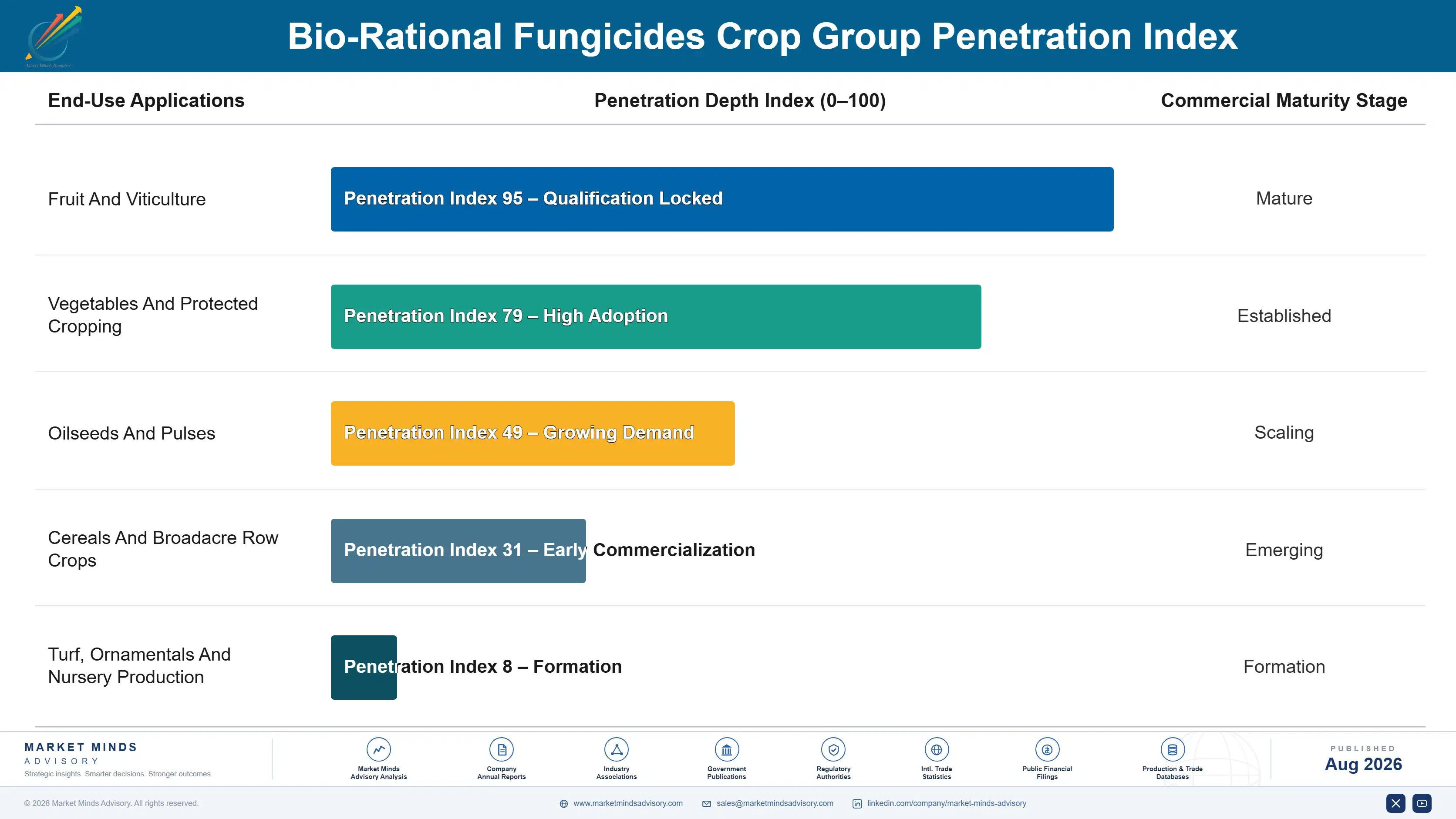
Buyer profiles shifted as export residue requirements grew. The earlier buyer was a grower or agronomist choosing a disease control product on efficacy and cost per hectare. The current conversation increasingly involves a packer or exporter whose retail customer has set residue limits below regulatory requirements, and who is specifying inputs several steps back up the supply chain.
bio-rational-fungicides-market-end-use-penetration-index-1787302646191

What We Would Tell a Board

These are among the four positions where our research anticipates prominent divergence between winners and laggards over the coming forecast period. Each is grounded in the demand model, the regulatory perimeter, and the announced capacity pipeline.
01 / CHANNEL CAPABILITY INVESTMENT

Fix the cold chain before pushing more volume

Live microbial products hold roughly 12 months of viability under controlled storage and considerably less in a hot warehouse, while only about 41% of distribution can handle them correctly at present. Volume pushed through the remaining channel produces failures that growers attribute to the whole category rather than to the storage conditions at their own distributor. Reputation in farming communities travels quickly and is far more expensive to rebuild afterwards than refrigerated storage at distributor level is to fund in the first place.
02 / PROGRAMME SELLING DISCIPLINE

Never sell these products as standalone alternatives

Bio-rational fungicides work preventatively and fail when applied curatively against an established infection, which is exactly what a grower who bought one as a standalone alternative will eventually try to do with it. Around 76% of successful use already sits inside season-long programmes where an agronomist rather than the grower controls the application timing entirely. Packaging these products inside a season-long recommendation puts timing in the agronomist's hands and removes most of the failure mode that has damaged this whole category.
03 / FORMULATION PORTFOLIO SHIFT

Metabolites remove the problem rather than managing it

Microbial metabolites and antifungal peptides grow at 18.9% against 12.6% for the wider market and behave like conventional formulations throughout storage and distribution, which eliminates the viability constraint outright rather than merely mitigating it. Cost of goods runs higher than live microbials and current pricing absorbs that difference comfortably across every registered market. A live-weighted portfolio is concentrated in exactly the products the distribution channel handles worst, and it is most exposed in the hot markets that are growing fastest.
04 / REGISTRATION ECONOMICS EXPLOITATION

Use the cheap pathway to go wide, not deep

Reduced-risk regulatory pathways move bio-rational dossiers through to approval in around 38 months at development costs near nine million dollars per product, against figures many times higher for conventional synthetic chemistry. That economics supports a wide portfolio of narrow products rather than the few blockbuster actives that conventional development economics has always required instead. Companies still running bio-rational development on synthetic chemistry timelines and budgets are quietly wasting the one genuine advantage this whole category holds over conventional crop protection.

Engagement Snapshot From the Field

A live engagement with an industry participant carrying material or product regulatory and market exposure ahead of a defining policy shift, showing how our research translates into a defensible multi-year portfolio strategy.
MARKET MINDS ADVISORY · CLIENT ENGAGEMENT SUMMARY
Bio-Rational Fungicides Producer Strategic Portfolio Review and Transition Roadmap 2026·Investment Scenario on Bio-Rational Fungicides Exposure Evaluation 2025-26
CLIENT PROFILE
A biological crop protection specialist with approximately 130 million dollars in annual revenue (client-reported, unverified by MMA), selling live microbial fungicides through distributors across four countries. The portfolio was entirely live product, no metabolite programmes existed, and return rates and grower complaints had risen sharply across two hot-climate markets over three seasons. Two seasons of reformulation had produced nothing.
STRATEGIC CHALLENGE
Management believed the complaints reflected a formulation problem and had funded reformulation work for two seasons without improvement, and the board wanted an independent view before committing further research budget to the same hypothesis. Nobody had tested product viability anywhere below the factory gate, and no application timing survey had ever been run.
MMA APPROACH
We sampled product viability at distributor and retailer level across all four markets rather than at the factory gate. Application timing was surveyed with growers who had reported failures. Channel storage capability was audited by site, and metabolite portfolio options were assessed against the same target diseases and crops. Reformulation economics were then tested against both alternatives.
KEY FINDINGS
  1. Product leaving the factory met specification consistently, while viability at retailer level in the two hot markets had fallen well below label claim before any grower applied it.
  2. Roughly half of surveyed failure reports involved curative application against established infection, which no bio-rational product of this type could have controlled.
  3. Refrigerated storage existed at fewer than a third of distributor sites in the affected markets, and none of the retailers below them held product correctly at all.
  4. Two of the client's target diseases had commercially available metabolite chemistry that would have removed the viability exposure entirely from those product lines.
CLIENT PROFILE
A biological crop protection specialist with approximately 130 million dollars in annual revenue (client-reported, unverified by MMA), selling live microbial fungicides through distributors across four countries. The portfolio was entirely live product, no metabolite programmes existed, and return rates and grower complaints had risen sharply across two hot-climate markets over three seasons. Two seasons of reformulation had produced nothing.
STRATEGIC CHALLENGE
Management believed the complaints reflected a formulation problem and had funded reformulation work for two seasons without improvement, and the board wanted an independent view before committing further research budget to the same hypothesis. Nobody had tested product viability anywhere below the factory gate, and no application timing survey had ever been run.
MMA APPROACH
We sampled product viability at distributor and retailer level across all four markets rather than at the factory gate. Application timing was surveyed with growers who had reported failures. Channel storage capability was audited by site, and metabolite portfolio options were assessed against the same target diseases and crops. Reformulation economics were then tested against both alternatives.
KEY FINDINGS
  1. Product leaving the factory met specification consistently, while viability at retailer level in the two hot markets had fallen well below label claim before any grower applied it.
  2. Roughly half of surveyed failure reports involved curative application against established infection, which no bio-rational product of this type could have controlled.
  3. Refrigerated storage existed at fewer than a third of distributor sites in the affected markets, and none of the retailers below them held product correctly at all.
  4. Two of the client's target diseases had commercially available metabolite chemistry that would have removed the viability exposure entirely from those product lines.
RECOMMENDED STRATEGY
Phase 1: Phase 1 (months one to eight): stop reformulation work and fund refrigerated storage at distributor level in the two affected markets. Phase 2: Phase 2 (months eight to twenty): move product sales into agronomist-led spray programmes rather than standalone distributor listings. Put application timing with the adviser. Phase 3: Phase 3 (months twenty to forty-two): license or develop metabolite chemistry for the two highest-volume target diseases identified. Remove viability exposure from those lines.
OUTCOME
Reformulation work was halted and storage funding redirected within one quarter. Return rates in both affected markets fell by roughly two thirds within a season, and a metabolite licensing discussion opened for the largest product line (client-reported, unverified by MMA). Agronomist programme selling was adopted across both affected markets.

Frequently Asked Questions

Foundational context covering the market sizes, CAGR, scope, country, region and competition that inform every finding below. This section is provided to cover basics and most often pre-purchase conversations, answered from the MMA Primary Research Dataset.

What is the current size of the Bio-Rational Fungicides Market?

The market is valued at USD 1.6 billion in 2025, rising to USD 1.80 billion in 2026. Scope covers registered bio-rational fungicide products, not biostimulants, biological insecticides, or conventional synthetic chemistry.

How large will the Bio-Rational Fungicides Market be by 2036?

MMA forecasts USD 5.90 billion by 2036, an increase of USD 4.10 billion over the 2026 base. That represents an expansion multiple of 3.28 times across the forecast period.

What is the CAGR for the Bio-Rational Fungicides Market 2026 to 2036?

The base case CAGR is 12.6%, with a bull case of 13.9% and a bear case of 11.3%. The historical rate from 2020 to 2025 was 11.1%, led by Brazilian adoption.

Which segment is growing fastest?

Microbial metabolite and peptide fungicides at 18.9%, exactly 1.50 times the market rate. Removing the living organism removes the cold chain constraint that limits every live microbial product.

Who are the major companies in the Bio-Rational Fungicides Market?

Bayer, Syngenta, BASF, Corteva Agriscience, and UPL lead on bio-rational crop protection revenue. The top five hold 58%, held there by distribution reach rather than discovery capability.

Which country is growing fastest?

India at 15.4%, driven by horticulture and export crops where residue limits determine market access. Domestic manufacturers produce below imported costs, though viability varies between suppliers.

Report Segmentation Architecture

The full report scope spans multiple orthogonal segmentation dimensions, with cross-tabulated demand data provided for each dimension pair. Coverage extends further to regional breakdowns, trend trajectories, and the competitive detail needed to support segment-level decision-making.

By Active Substance Class

  • Bacillus-Based Microbial Fungicides
  • Trichoderma And Other Fungal Antagonists
  • Botanical And Plant Extract Fungicides
  • Microbial Metabolite And Peptide Fungicides
  • Mineral And Low-Risk Inorganic Fungicides

By Crop Group

  • Fruit And Viticulture
  • Vegetables And Protected Cropping
  • Oilseeds And Pulses
  • Cereals And Broadacre Row Crops
  • Turf, Ornamentals And Nursery Production

By Commercial Model

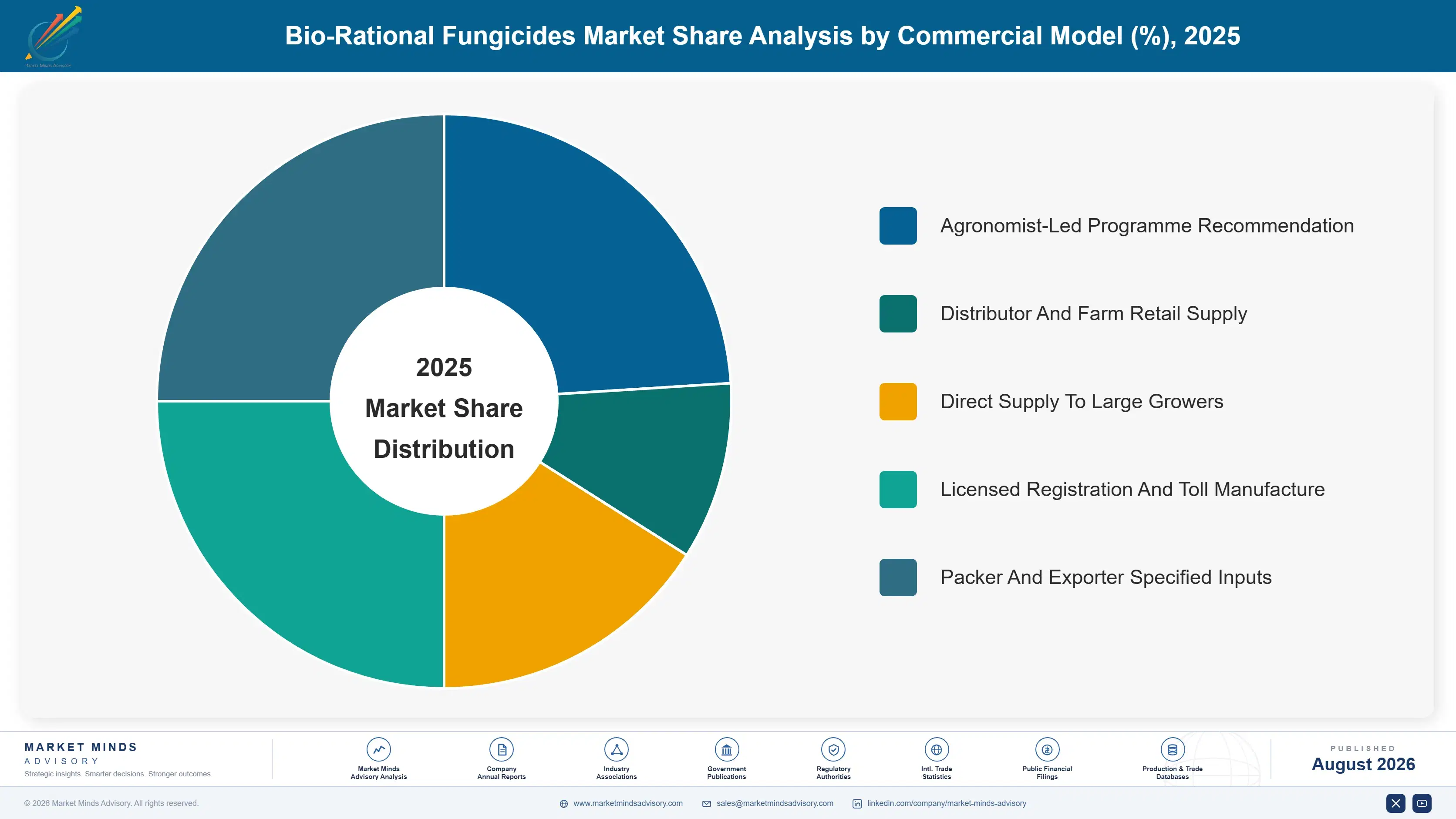
  • Agronomist-Led Programme Recommendation
  • Distributor And Farm Retail Supply
  • Direct Supply To Large Growers
  • Licensed Registration And Toll Manufacture
  • Packer And Exporter Specified Inputs

By Region

  • Latin America
  • Western Europe
  • North America
  • East Asia
  • South Asia and Pacific
  • Middle East and Africa
  • Eastern Europe

Scope, Methodology, and Coverage

Every figure in this report is reproducible from documented input assumptions. The scope below maps the historical period, the forecast horizon, the segmentation dimensions, and the countries covered, alongside the underlying primary and qualitative methodology.
Historical Period
2020 to 2025
Forecast Period
2026 to 2036
Base Year
2025 (USD billions; MMA Primary Research Dataset, August 2026)
Market Definition
This market comprises bio-rational fungicide products registered for agricultural and horticultural crop protection, measured at supplier revenue across agronomist programme, distributor, direct grower, licensing, and specified input channels. Coverage spans Bacillus-based microbial fungicides, Trichoderma and other fungal antagonist products, botanical and plant extract fungicides, microbial metabolite and antifungal peptide products, and mineral and low-risk inorganic fungicides. Conventional synthetic fungicides, biostimulants and plant nutrition products carrying no fungicidal claim, biological insecticides, nematicides and herbicides, beneficial insect and predator supply, seed treatment application services, soil amendments and composts, and post-harvest sanitation chemistry fall outside scope.
Quantitative Units
USD billions (current prices); treated hectares by crop group; price per hectare by active class; product viability at point of application
Segmentation Dimensions
By Active Substance Class; By Crop Group; By Commercial Model; By Region
Regions Covered
Latin America, Western Europe, North America, East Asia, South Asia and Pacific, Middle East and Africa, Eastern Europe
Countries Covered
Brazil, Argentina, Mexico, Chile, United States, Canada, Spain, Italy, France, Germany, Netherlands, United Kingdom, China, Japan, South Korea, India, Australia, Vietnam, Thailand, Israel, Morocco, South Africa, Poland, Hungary, Romania, and additional markets relevant to this sector
Key Companies Profiled
Bayer, Syngenta, BASF, Corteva Agriscience, UPL, Novonesis, Certis Biologicals, Koppert Biological Systems, Andermatt Group, Bioceres Crop Solutions, Sumitomo Chemical, FMC Corporation, Nufarm, Isagro, Biobest Group, Lallemand Plant Care, Stockton Group, T. Stanes and Company, Vittia Group, Seipasa
Quantitative Methodology
Primary survey, n=3,800 respondents, Q4 2025, six countries; demand-side model with trade association cross-validation
Qualitative Methodology
47 expert interviews, Q4 2025; applied to validate demand model assumptions, identify emerging dynamics, and assess competitive positioning
Report Format
PDF and XLSX data workbook (Word format preview document)
Publisher
Market Minds Advisory
Report Code
MMA-2026-AGR-826
Published
August 2026
Contact
sales@marketmindsadvisory.com | www.marketmindsadvisory.com

Purchase the full Bio-Rational Fungicides Market Report (2026 to 2036).

The full report sizes bio-rational fungicides across five active substance classes, five crop groups, five commercial models, and seven regions, with cold chain capability audited against live product distribution requirements throughout. Programme integration is assessed as the primary commercial route, since standalone sales fail in ways that damage the whole category. Registration pathway economics are compared against conventional chemistry development. Competitive profiling covers twenty suppliers on bio-rational crop protection revenue, and metabolite capability is assessed separately from live microbial production. Regional demand is built from adoption history and channel capability rather than crop area.
Cold chain capability audited against live product distribution requirements
Programme integration assessed as the primary commercial route
Registration pathway economics compared against conventional chemistry development costs
Metabolite capability assessed separately from live microbial production
Active substance withdrawal schedules mapped against regional demand creation
Export residue specifications tracked separately from regulatory limits

Built For The People Who Decide

From boardroom strategy to bench-side execution, this report is read cover-to-cover by leaders shaping the next decade of their industry, turning demand scenarios, market dynamics and valuation benchmarks into decisions.
CXOs/ Presidents/ VPs/ Managers
M&A and Corporate Development
Strategy Teams and R&D Heads
Procurement and Product Directors
Regulatory and Compliance Leaders
Investor Relations and Equity Analysts