Market Minds Advisory
Bio PET Film Market

Bio PET Film Market: Bio-MEG Feedstock and the Brand Owner Sustainability Mandate

Packaging converters are locking in multi-year bio-based glycol supply contracts as brand owners commit to renewable-content packaging targets, even as feedstock premiums and limited certified supply keep bio PET film confined to premium categories.

Lead Analyst

Bilal Shaikh

Published

September 2026

Make Smarter Decisions with Customized Research Insights

Request a free sample report and evaluate market opportunities, growth trends, and competitive dynamics relevant to your business needs.

2025 MARKET VALUE$1.9BMarket Size 2025
2036 FORECAST VALUE$5.5BBase Case , 2026 to 2036
CAGR 2026 TO 203610.2 %Bull 11.3% / Bear 8.9%
INCREMENTAL OPPORTUNITY$3.4BNet 10- year value creation
EXPANSION MULTIPLE2.64x2036 value over 2026 base
Strategic Levers
M&A Pipeline
Regional Outlook
Country Rankings
Competitive Intelligence
Segmental Deep-dive
Call-Us : 91 93563 13602

Executive Snapshot and Market Trajectory

Packaging brand owners are converting voluntary renewable-content pledges into binding multi-year supply contracts for bio-based PET film, treating bio-content sourcing as a procurement line item rather than a marketing claim. That contractual shift is what is pulling converter capacity investment forward across the industry this year.
Barrier and laminate film formats are capturing the fastest growth as extended-shelf-life food packaging applications demand both renewable content and multi-layer performance that basic monolayer bio PET cannot deliver alone. East Asia holds the deepest single manufacturing base given its BOPET film production scale, while Thailand's bio-MEG feedstock investment drives the fastest-growing single country market as regional capacity keeps expanding rapidly across multiple new production sites.
Competitive intensity concentrates around a handful of large polyester film producers that can absorb the capital cost of bio-feedstock qualification, even as smaller regional converters wait for certified supply to become more broadly available. Indorama Ventures and Toray's feedstock integration and brand-owner relationships set the pace that challengers chase, while bio-MEG capacity additions in Brazil and Southeast Asia keep pulling delivered costs down each year, narrowing the gap between premium and commodity film pricing tiers.
Market Definition
The bio PET film market covers polyethylene terephthalate film manufactured using bio-based monoethylene glycol, bio-based purified terephthalic acid, or both, in place of conventional petroleum-derived feedstock, sold into flexible packaging, label, thermoforming, shrink, and barrier film applications. It excludes conventional fossil-based PET film carrying no verified bio-content, mechanically recycled PET film without bio-based feedstock content, and biodegradable or compostable film categories built on entirely different polymer chemistry such as PLA.
Base Year Value
$1.9B in 2025 (MMA Primary Research Dataset, August 2026)
Forecast Period
2026 to 2036, eleven discrete annual values
CAGR
10.2% base case. Bull 11.3%. Bear 8.9%.
Fastest Growth Segment
Barrier and Laminate Film: 13.4% CAGR
Fastest Growth Country
Thailand: 13.2% CAGR
Fastest Growth Region
South Asia and Pacific: 12.5% CAGR
Largest Region
East Asia: 29% of 2025 global value
Market Leaders
Indorama Ventures PCL, Toray Industries Inc., DuPont Teijin Films, Jindal Poly Films Ltd, Mitsubishi Chemical Group. Source: MMA Analysis based on company annual reports and investor filings.
Primary Survey
n=3,800 procurement and R&D decision-makers, Q4 2025, six countries
Methodology
Demand-side build-up, cross-validated against public data, 47 expert interviews

Bio PET Film Market Forecast Scenarios

bio-pet-film-market-size-forecast-scenario-1787300509022
Bio PET film demand accelerated unevenly between 2020 and 2025, as early brand-owner pilot programs gave way to firm multi-year procurement commitments once bio-MEG supply scaled past the pilot stage and certification infrastructure matured. The category closed 2025 at an estimated 9.2% historical CAGR, meaningfully ahead of conventional PET film growth over the same five-year period.
The base case rests on three reinforcing mechanisms. First, major consumer packaged goods companies are converting voluntary renewable-content targets into supplier scorecards that directly influence purchasing decisions. Second, bio-MEG capacity expansion in Brazil and Southeast Asia narrows the cost premium over conventional feedstock, making bio PET economically viable for a wider range of applications. Third, tightening EU packaging waste regulation is beginning to reward renewable content alongside recyclability, adding a regulatory tailwind beyond sustainability commitments alone.
The bull case turns on the EU finalizing renewable-content mandates under its revised packaging and packaging waste regulation that specifically reward bio-based feedstock, pulling volumes forward faster than the base forecast assumes. The bear risk is bio-MEG feedstock costs failing to converge with conventional pricing as quickly as producers project, keeping bio PET film confined to premium categories longer than brand owners' stated targets imply.

Feedstock Economics and the Renewable-Content Premium Curve

Bio PET film sits at the intersection of two converging pressures: brand owner sustainability commitments that increasingly specify renewable content by name, and packaging waste regulation that is beginning to reward bio-based feedstock alongside recyclability rather than treating them as separate compliance tracks. Both forces favor film with verified, certified bio-content over conventional PET marketed on recyclability claims alone, a durable distinction that regulators increasingly police.
MARKET CONCENTRATION54% CR5Feedstock integration limits share captured by smaller converters
AVERAGE SELLING PRICE$2.40-5.80 per kgPrice varies steeply by bio-content share and film specification
TOP PRODUCING COUNTRYChina, 27% shareChinese converters supply the largest single national output share
CAPACITY UTILISATION71%Utilisation trails conventional PET film amid rapid capacity additions
TRADE INTENSITY51% cross-borderRoughly half of volume crosses a border before final conversion
FEEDSTOCK COST SHARE52% of COGSBio-based glycol and acid feedstocks dominate input spending lines
Commercially, the market splits between partially bio-based film using bio-MEG alone, which commands a modest premium and serves the broadest range of applications, and fully bio-based film using both bio-MEG and bio-PTA, which carries a steeper premium but satisfies the strictest brand-owner renewable-content targets. Large converters increasingly offer both tiers to serve customers at different points in their sustainability commitment timelines and budget cycles.
Over the next decade, feedstock cost convergence will matter more than film engineering alone. Bio-MEG capacity additions in Brazil and Southeast Asia are narrowing the premium over conventional glycol, and the converters that lock in long-term bio-feedstock supply agreements now stand to capture the largest share of brand-owner contracts as renewable-content specification becomes standard practice rather than a premium differentiator.
"Bio PET film isn't really a film innovation story, it's a feedstock supply chain story wearing a packaging label. The converters winning the big brand contracts are the ones who solved bio-MEG sourcing years before anyone asked them to."
Director, Sustainable Packaging Materials Practice · MMA Packaging Practice

Market Trends

Brand Owners Convert Pledges Into Supplier Scorecards

Major consumer packaged goods companies are moving beyond voluntary renewable-content pledges to embed specific bio-content percentage targets directly into supplier scorecards and procurement contracts, converting what was once a marketing aspiration into a binding purchasing criterion. Several large food and beverage brands have disclosed bio-content targets for flexible packaging film reaching 30% or more by 2027, and converters report these targets increasingly determine which suppliers make the qualified vendor list. Indorama Ventures and Toray have both expanded dedicated bio PET film production lines since 2024 to meet this scorecard-driven demand across their networks.
Market Impact: Cited by 55%+ of European converters
Bio-MEG Capacity Expansion Narrows the Cost Premium

Bio-based monoethylene glycol capacity additions in Brazil, built on sugarcane ethanol feedstock, and Southeast Asia, built on a mix of sugarcane and other renewable feedstocks, have expanded meaningfully since 2023, pulling bio-MEG pricing closer to conventional fossil-based glycol than at any point since the category's commercial launch. Industry-reported bio-MEG premiums have narrowed from roughly 40% above conventional pricing in 2022 to closer to 18% by 2025, a compression that is bringing bio PET film within reach of a wider range of applications beyond the premium accounts that absorbed the earlier, steeper cost gap.
Market Impact: Barrier orders outpace category growth 2x

Market Opportunities and Growth Drivers

EU Packaging Waste Regulation Adds Renewable-Content Incentive

The European Union's revised Packaging and Packaging Waste Regulation, finalized in 2024, introduces renewable-content provisions alongside its established recyclability and recycled-content requirements, giving bio-based PET film a second regulatory tailwind beyond corporate sustainability commitments alone. The European Commission's implementation guidance signals that renewable-content credit will apply independently of recycled-content credit, meaning converters can satisfy both tracks with the same bio-based film rather than choosing between them. MMA's primary survey found more than 55% of European packaging converters now evaluating bio PET film specifically in response to the regulation, a meaningfully higher share than reported before the 2024 finalization.
Market Impact: Adds 15-25% cost premium

Extended Shelf Life Applications Demand Barrier Bio PET

Food and beverage brands extending shelf life to reduce waste and support longer supply chains increasingly specify multi-layer barrier film that combines bio-based PET substrate with oxygen and moisture barrier coatings, a higher-value application than basic monolayer bio PET can serve. Converters report barrier bio PET film orders growing meaningfully faster than the broader bio PET category as brand owners pursue shelf-life extension and renewable content simultaneously rather than treating them as separate packaging redesign projects. This convergence is pulling bio PET film into categories, including fresh protein and dairy packaging, that previously used only conventional barrier film.
Market Impact: Favors converters with 3+ years history

Market Restraints and Challenges

Bio-MEG Feedstock Premium Still Limits Broad Adoption

Despite recent narrowing, bio-based glycol still costs meaningfully more than conventional fossil-based glycol, a premium rooted in smaller production scale and sugarcane feedstock costs rather than any single supply bottleneck, and that premium keeps bio PET film confined mostly to premium, brand-committed accounts rather than the broader commodity film market. Mid-tier converters without dedicated brand-owner sustainability contracts often cannot justify the cost premium to price-sensitive customers, limiting adoption to accounts where the brand has already committed publicly to renewable-content targets. Suppliers are responding with blended, partially bio-based formulations that capture some credit at a smaller premium.
Market Impact: Targets reach 30%+ bio-content by 2027

Certified Supply Chain Traceability Remains Complex

Verifying and certifying bio-content through mass-balance or segregated supply chain accounting requires third-party certification and documentation that smaller converters often lack the scale or expertise to manage reliably, a barrier rooted in the genuine complexity of tracking bio-based feedstock through shared processing infrastructure rather than any single certification body's requirements. That complexity, following several documented instances of disputed bio-content claims across the broader bioplastics industry, is pushing brand owners toward established certification schemes including ISCC PLUS, which favors larger converters with the resources to maintain compliant documentation across multi-year contracts.
Market Impact: Narrows bio-MEG premium to roughly 18%
3 additional market trends, 4 additional growth drivers, and 3 additional restraints and challenges are covered in the full report. Contact sales@marketmindsadvisory.com to access the complete intelligence.

Segment CAGR and Growth Architecture

Segmentation follows film application format rather than bio-content percentage, since the end-use requirement, whether flexible packaging, labeling, thermoforming, or barrier protection, determines film engineering specifications more than the specific bio-MEG or bio-PTA blend ratio used. Flexible packaging film remains the volume base, but barrier and label formats now address performance requirements basic film cannot satisfy.
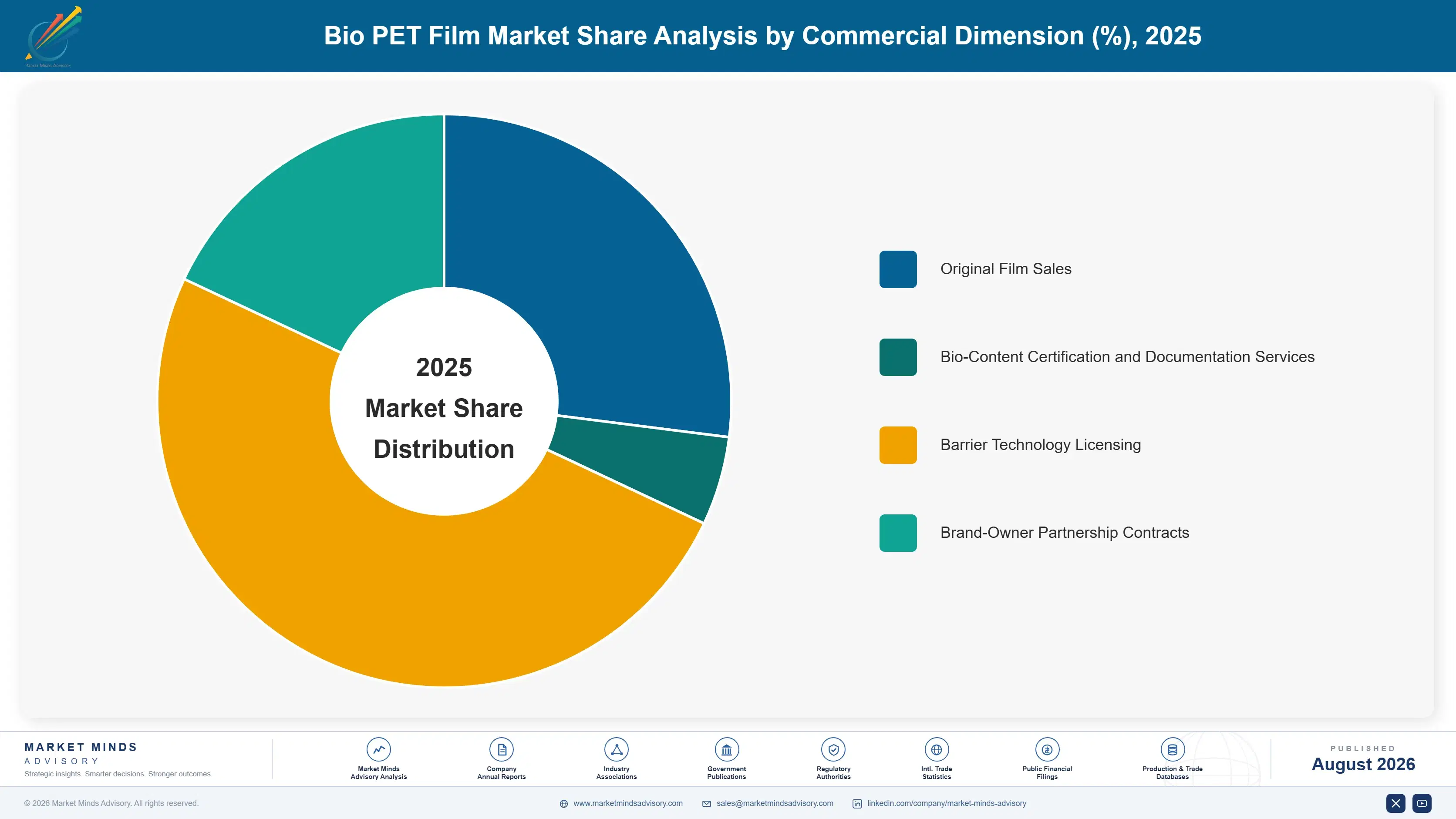
bio-pet-film-market-market-share-analysis-1787300509549

Barrier and Laminate Film

Barrier and laminate bio PET film is the fastest-growing application format, expanding at an estimated 13.4% CAGR against a market average of 10.2%, roughly 1.31 times the overall pace. Growth tracks directly with extended-shelf-life packaging demand that requires both renewable content and multi-layer barrier performance basic monolayer film cannot deliver, pulling bio PET into fresh protein, dairy, and other categories previously served only by conventional barrier film. Toray and DuPont Teijin Films currently lead on shipped barrier bio PET volume, though the segment requires meaningfully more capital investment in coating and lamination capacity than standard flexible film converting. Continued adoption depends on bio-MEG feedstock costs continuing to converge with conventional pricing across the forecast period.
CAGR 13.4%

Label Film

Label film, including shrink sleeve and pressure-sensitive label formats, ranks second-fastest, growing at an estimated 12.1% CAGR as beverage and personal care brands specify renewable-content labels to complement bio-based or recycled-content bottles and containers. The segment benefits from labels representing a highly visible packaging component that brand owners use to communicate sustainability commitments directly to consumers at the point of purchase. Adoption still trails flexible packaging film by a wide margin given the segment's smaller absolute volume base and more specialized printing and conversion requirements label applications demand. Growth is concentrated among suppliers including Avery Dennison and Taghleef Industries that have expanded bio PET label film capacity specifically to meet beverage brand demand.
CAGR 12.1%
Full segment breakdown across 5 segments available in the complete report.

Regional Architecture and Country Demand Map

Bio PET film demand concentrates where BOPET manufacturing scale and bio-feedstock access overlap. East Asia leads on both film production capacity and expanding bio-feedstock investment, North America follows on brand-owner sustainability commitments, and South Asia and Pacific grows fastest as regional bio-feedstock and film capacity both scale together.

North America

Brand-owner sustainability commitments anchor North America's bio PET film demand, as major consumer packaged goods companies headquartered in the region set renewable-content targets that ripple through global packaging supply chains from a US or Canadian corporate base. The region's converters, including DuPont Teijin Films, benefit from proximity to major brand-owner decision-makers even though bio-feedstock production capacity remains more limited domestically than in Brazil or Southeast Asia. Food and beverage packaging represents the largest single demand channel, since extended-shelf-life and label applications concentrate disproportionately there. Canada contributes a smaller, steadier share tied to its packaged food sector, while Mexico's contribution grows fastest of the three as nearshoring adds converting capacity closer to US supply chains.
Share: 22% | CAGR: 11.0% (2026 to 2036)

Western Europe

Regulation, not brand voluntarism alone, increasingly shapes Western Europe's bio PET film demand. The EU's revised Packaging and Packaging Waste Regulation, finalized in 2024, gives renewable content independent regulatory credit alongside recyclability, pushing converters across Germany, France, and the Netherlands to evaluate bio PET film as a compliance pathway rather than a purely voluntary sustainability upgrade. Consumer expectations in several markets run ahead of the regulation's minimum requirements, particularly in Germany and Scandinavia, where retailers have begun independently specifying renewable content on private-label packaging. Growth here trails the global average, reflecting a mature packaging film base and continued regulatory finalization that has only recently converted into firm converter demand across the bloc.
Share: 21% | CAGR: 9.0% (2026 to 2036)
Regional intelligence for 5 additional markets available in the complete report: East Asia, South Asia and Pacific, Latin America, Middle East and Africa, Eastern Europe. Contact sales@marketmindsadvisory.com.
bio-pet-film-market-country-cagr-analysis-1787300510058

Where Bio PET Film Margin Concentrates Next

Four commercial moves separate converters capturing outsized margin from those competing purely on delivered film price. Each depends on shifting revenue toward certification, feedstock integration, barrier technology, or brand-owner contract depth that current shipment volume does not yet fully reflect, particularly as conventional PET film pricing keeps compressing at the commodity end of the category.

Third-Party Bio-Content Certification Pricing Premium Program

Converters that secure recognized third-party bio-content certifications, including ISCC PLUS mass-balance certification, are commanding a durable price premium over uncertified bio-claim film, since large brand owners increasingly require documented certification to satisfy their own sustainability disclosure and audit obligations. Certified bio PET film typically commands a price premium of 12 to 20% over functionally similar uncertified alternatives, a margin reflecting both certification cost and the reduced compliance risk buyers value highly. Converters without recognized certification increasingly lose large brand-owner contracts to certified rivals regardless of underlying film performance, making certification a baseline requirement for enterprise accounts.
Market Impact: Commands a durable 12 to 20% price premium

Long-Term Bio-Feedstock Supply Contract Structuring Program

Converters that lock in long-term bio-MEG and bio-PTA supply agreements directly with feedstock producers, particularly in Brazil and Thailand, are protecting margin against feedstock price volatility that smaller competitors purchasing on the spot market cannot avoid. A well-structured multi-year feedstock agreement typically stabilizes input cost within a narrow band even as spot bio-MEG pricing swings 15 to 25% across a given year, letting converters quote firm multi-year film pricing to brand owners without repricing risk mid-agreement. This capability increasingly determines which converters can credibly compete for the largest, longest-duration contracts.
Market Impact: Stabilizes costs against 15-25% spot price swings yearly

Barrier and Lamination Technology Licensing Program

Converters with proprietary barrier coating and lamination technology optimized for bio-based PET substrates are licensing that technology to smaller regional converters rather than keeping it exclusive, capturing royalty revenue on volume they could never manufacture themselves while extending their technology's market reach. A barrier technology license typically carries royalty fees of $0.02 to $0.08 per square meter of film produced under license, a meaningful margin layer given the volumes involved in large brand-owner packaging programs. This licensing model lets technology innovators monetize research investment across a far larger production base than their own converting capacity could reach alone.
Market Impact: Adds $0.02 to $0.08 royalty per square meter

Multi-Year Brand-Owner Sustainability Partnership Investment Program

Converters securing formal multi-year sustainability partnership agreements with major brand owners, often tied to specific renewable-content roadmap milestones, are capturing volume commitments that protect against price-only competition from converters without comparable brand relationships built over years. These partnership agreements typically carry a price premium of 8 to 15% over open-market purchasing, reflecting the value brand owners place on supply continuity and joint sustainability reporting credibility across their portfolio. Converters able to demonstrate transparent, auditable bio-content sourcing increasingly win these partnerships over lower-cost competitors with less documented supply chains and thinner compliance staffing overall.
Market Impact: Commands 8 to 15% premium in partnership deals

Who Controls the Margin Pool

The top five converters hold an estimated 54% of global bio PET film shipment volume, a meaningfully higher concentration than conventional PET film, reflecting the capital and feedstock relationship requirements that keep smaller converters out. Indorama Ventures and Toray lead on feedstock integration and brand relationships, while a broad second tier remains largely confined to conventional film pending broader bio-feedstock access.
Current competitive activity centers on three fronts. Bio-feedstock supply agreements are redrawing the cost-competitive tier, with Indorama Ventures, Toray, and DuPont Teijin Films racing to secure long-term Brazilian and Thai bio-MEG contracts. Barrier and lamination technology development is becoming a genuine differentiator among converters targeting extended-shelf-life applications. Several regional converters are pursuing certification and smaller-scale feedstock partnerships to enter without full vertical integration.

Emerging pressure comes from Southeast Asian and Indian converters moving up the value chain into certified, brand-contracted bio PET categories once dominated by larger integrated producers, aided by proximity to Thailand's expanding bio-MEG feedstock base that keeps their input costs consistently lower. If regional converters close the certification and brand-trust gap further, expect share to shift meaningfully, particularly in South Asia and Latin America where feedstock proximity now favors local converters over distant competitors.
bio-pet-film-market-company-positioning-matrix-1787300510577

Competitive Moat and Risk Dimensions

INDORAMA VENTURES PCL

Moat: Vertical Feedstock Integration

Indorama Ventures built direct ownership and long-term supply relationships across the bio-MEG and bio-PTA feedstock chain that smaller converters cannot replicate without comparable capital, giving it cost and supply certainty advantages that translate into more competitive long-term brand-owner contract pricing than converters buying feedstock on the open market.
INDORAMA VENTURES PCL

Risk: Capital Intensity Limits Flexibility

Indorama's vertical integration strategy requires sustained heavy capital investment across the feedstock chain, a commitment that could become a disadvantage if bio-feedstock technology or sourcing geography shifts faster than its existing asset base can adapt, leaving more flexible, asset-light competitors better positioned to pivot toward newer feedstock sources quickly.
TORAY INDUSTRIES INC.

Moat: Barrier Technology and Brand Trust

Toray's decades of advanced film technology development give it a genuine performance edge in barrier and lamination bio PET applications that smaller converters cannot match quickly, and its established relationships with major Japanese and global brand owners provide a trust advantage in categories where certification credibility matters as much as price.
TORAY INDUSTRIES INC.

Risk: Premium Positioning Under Cost Pressure

Toray's premium technology positioning depends on brand owners valuing barrier performance and certification depth enough to pay meaningfully more than lower-cost regional alternatives, and that willingness to pay could erode if Southeast Asian and Indian converters close the technology gap faster than Toray can defend its lead through continued innovation.

Key Players

Indorama Ventures PCL
Toray Industries Inc.
DuPont Teijin Films
Jindal Poly Films Ltd
Mitsubishi Chemical Group

Others

Toyobo Co.
SKC Inc.
Polyplex Corporation
Uflex Ltd
Kolon Industries
Far Eastern New Century Corporation
China Resources Packaging
Cosmo Films Ltd
Treofan Group
Taghleef Industries
Klöckner Pentaplast
Coveris Holdings
Amcor plc
Sealed Air Corporation
Avery Dennison Corporation

Recent Developments

MARCH 2025

Indorama Ventures Signs Long-Term Bio-MEG Supply Agreement in Brazil

Indorama Ventures PCL signed a long-term bio-based monoethylene glycol supply agreement with a Brazilian sugarcane ethanol producer, securing feedstock volume dedicated to its global bio PET film production across multiple facilities. The agreement followed two years of pilot-scale supply testing across Indorama's polyester film facilities worldwide.
Signal: Signals feedstock supply security becoming the primary competitive battleground among large integrated bio PET producers this cycle.
OCTOBER 2024

Toray Launches Advanced Barrier Bio PET Film Line for Fresh Protein Packaging

Toray Industries commissioned a new barrier-coated bio PET film production line specifically targeting extended-shelf-life fresh protein and dairy packaging applications across major markets. The launch followed eighteen months of joint development work with several major North American and Japanese food brand customers ahead of general release.
Signal: Signals barrier technology becoming a key differentiator beyond basic renewable-content credentials alone across the entire industry.
JANUARY 2025

Jindal Poly Films Expands Bio PET Capacity to Serve Export Demand

Jindal Poly Films Ltd commissioned additional bio PET film production capacity at its Indian facilities, roughly doubling dedicated output to serve both domestic packaged food customers and growing export demand from European and North American brand owners. The expansion followed sustained order backlog growth through 2024.
Signal: Signals Indian converters scaling to capture export demand as certified capacity remains constrained globally this cycle.

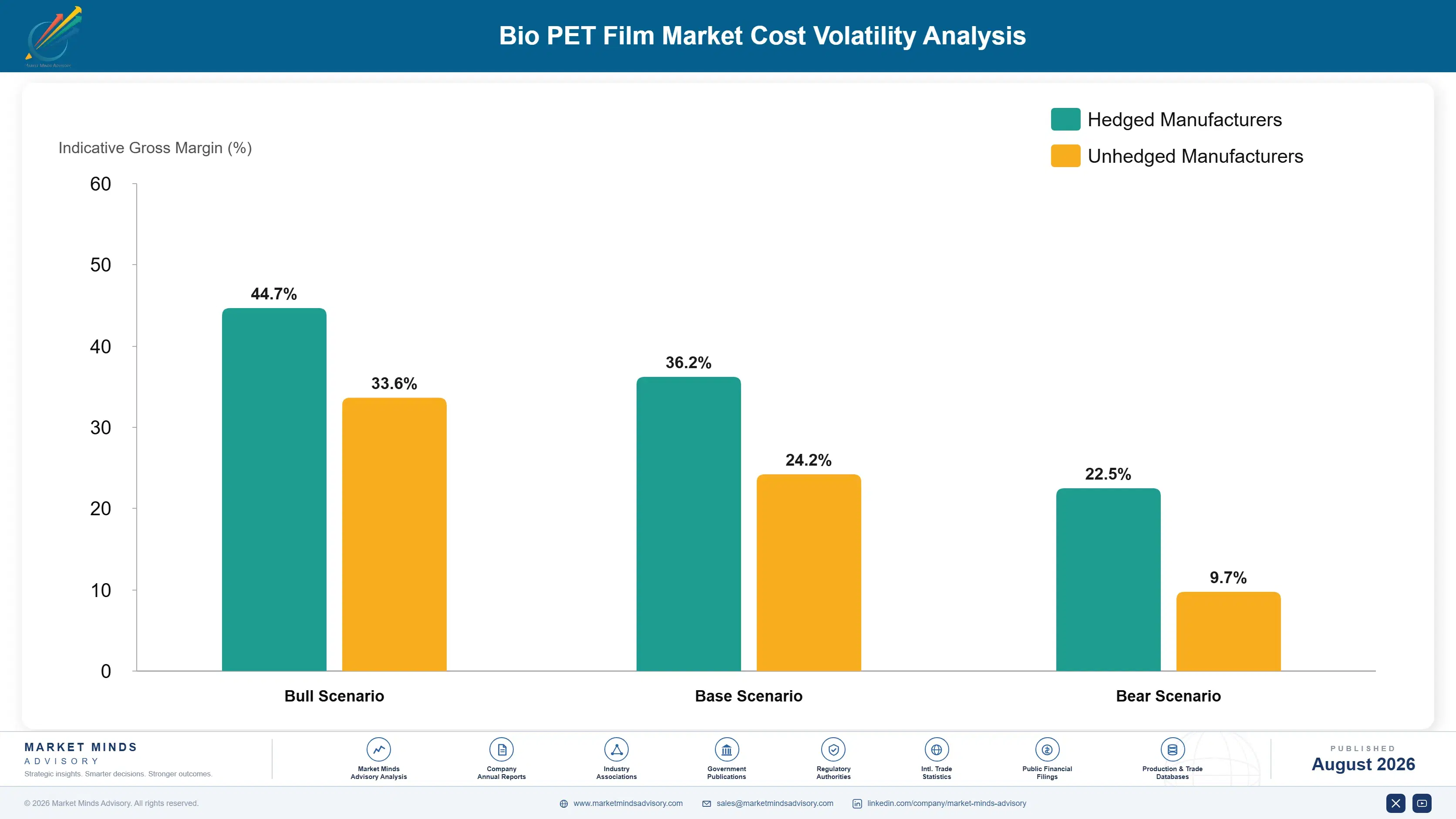
Bio-Based Glycol and Acid Feedstock Exposure

Bio-based monoethylene glycol and bio-based purified terephthalic acid together account for roughly 52% of cost of goods sold in bio PET film manufacturing, with bio-MEG supply concentrated among Brazilian and Southeast Asian producers, while bio-PTA supply remains more limited among a small number of specialized producers globally. Film-grade additive and coating chemicals add a further meaningful share, sourced predominantly from specialty chemical suppliers regardless of converter location.
Bio-MEG prices carried a premium exceeding 40% over conventional glycol through 2022 and into 2023, reflecting limited production scale, before Brazilian and Southeast Asian capacity additions began narrowing that gap meaningfully through 2024 and 2025. Industry sustainability reports from major converters have documented this compression as the largest factor determining how quickly bio PET film adoption can expand beyond premium accounts into broader packaging categories.

Smaller regional converters without long-term supply agreements absorbed the earlier, steeper premium hardest, losing contract bids to larger suppliers including Indorama Ventures and Toray that had negotiated priority pricing with Brazilian and Thai producers. Converters with direct feedstock ownership weathered the premium period substantially better than those dependent on the open market, a durable cost advantage that persists as demand climbs faster than supply.
bio-pet-film-market-cost-volatility-analysis-1787300510773

Multi-Year Bio-Feedstock Supply Agreements

Larger converters are locking multi-year bio-MEG and bio-PTA supply agreements directly with Brazilian and Southeast Asian producers, trading some pricing flexibility for guaranteed volume and price stability that protects margin during continued feedstock market volatility, an increasingly standard practice among the top five converters following the 2022 to 2023 premium peak experience across the industry.

Backward Integration Into Bio-Feedstock Production

Several larger converters are investing directly in bio-MEG production capacity rather than purchasing entirely on the open market, reducing exposure to feedstock price swings and improving supply reliability, though this requires meaningfully higher fixed capital investment than pure film converting operations alone require, often spread across multiple fiscal years and production sites over time.

Blended Partial Bio-Content Formulation Strategy

Converters are offering blended, partially bio-based film formulations that combine bio-MEG with conventional bio-PTA or vice versa, capturing meaningful renewable-content credit at a smaller cost premium than fully bio-based film requires, a pragmatic bridge strategy while certified full bio-content feedstock supply continues scaling across major producing regions worldwide and delivered prices keep gradually converging.

Portfolio Architecture for Margin Defence

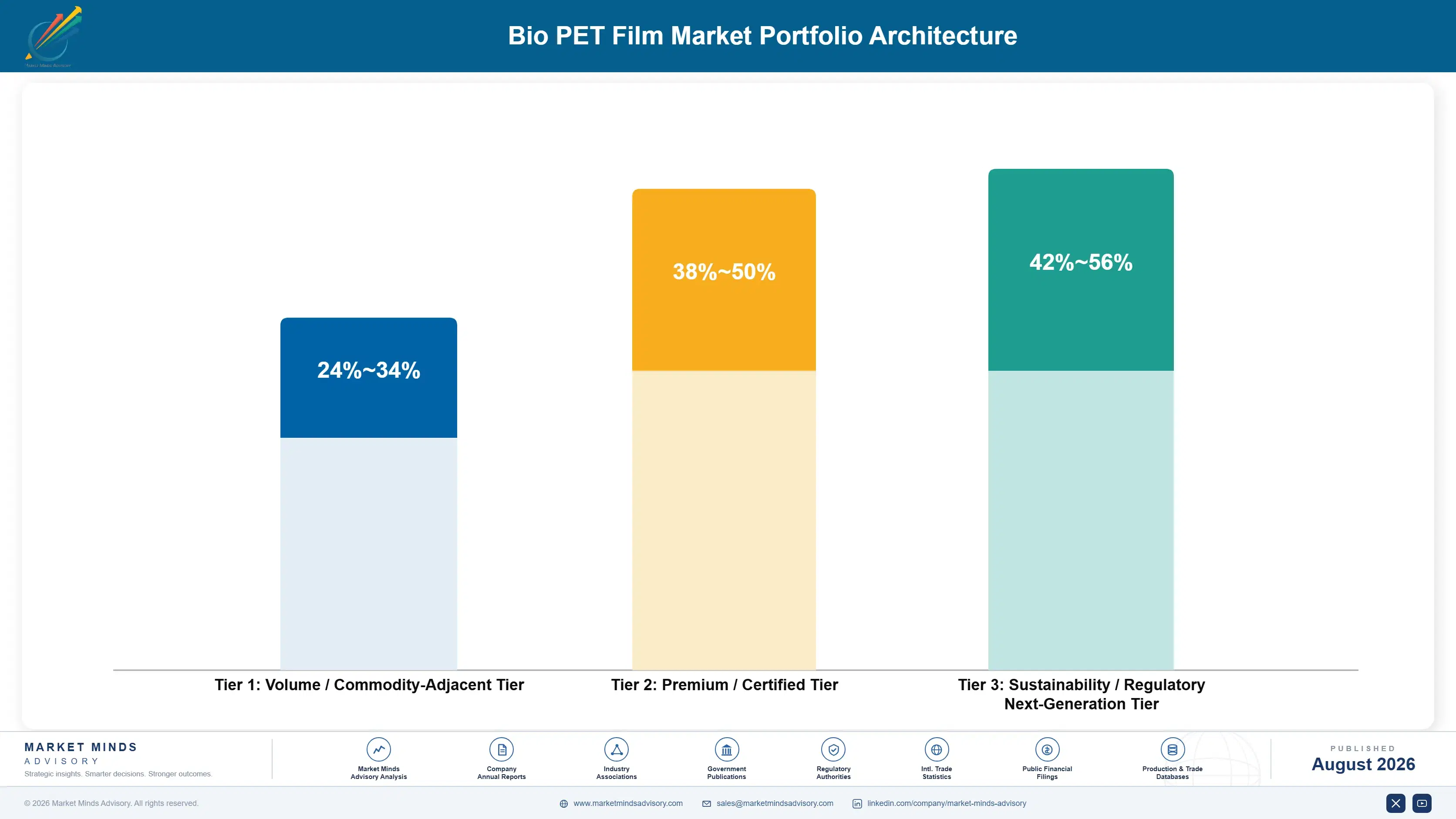
Bio PET film portfolios split across three tiers with different margin economics. The volume tier, partially bio-based film using bio-MEG alone, competes on price against conventional PET and delivers gross margins in the 24 to 34% range. Premium certified fully bio-based film bundling both bio-MEG and bio-PTA with recognized certification commands materially higher margins, reflecting feedstock and certification investment layered on top of base chemistry and testing.
The tension between volume and premium tiers shapes capacity allocation decisions across the industry. Partially bio-based capacity is easiest to scale given more available bio-MEG supply, but competes where conventional PET remains a viable substitute for price-sensitive accounts. Fully bio-based and barrier capacity requires deeper feedstock integration and certification investment, but rewards patient capital with margins that hold up as renewable-content targets tighten across regions.

High-value margin pools concentrate in certified fully bio-based film, barrier and laminate formats, and the licensing and feedstock-security service layer that increasingly separates established converters from commodity sellers. These pools remain a modest share of total volume today, but they are growing faster than the base category and are where most research and development spending is now directed.

Volume / Commodity-Adjacent Tier

Partially bio-based flexible packaging film using bio-MEG alone, sold primarily on price against both conventional PET and other partial bio-content converters. These units carry the thinnest margins in the portfolio and depend on feedstock cost management rather than certification depth.
Gross Margin: 24-34%

Premium / Certified Tier

Fully bio-based film bundling both bio-MEG and bio-PTA feedstock with recognized third-party certification that large brand owners pay a premium to access. This tier generates steady repeat business, since certified brand relationships rarely switch suppliers without cause.
Gross Margin: 38-50%

Sustainability / Regulatory / Next-Generation Tier

Barrier and laminate bio PET film tied to extended-shelf-life packaging demand and expanding EU renewable-content regulation. This tier draws the heaviest research spending, since barrier technology and feedstock certification both require sustained investment to defend.
Gross Margin: 42-56%
bio-pet-film-market-portfolio-architecture-1787300511267

High-value Sub-segments and Strategic Watch-out

Barrier and Laminate Film

The fastest-growing, highest-margin pool in the market, driven by extended-shelf-life packaging demand that rewards converters with mature barrier coating technology and certified bio-feedstock supply already proven at scale. Converters without that capability risk losing the fastest-growing accounts to specialists that moved earlier in the adoption cycle.
Gross Margin: 44-56%

Label Film

A smaller but rapidly scaling high-value pool as beverage and personal care brands specify renewable-content labels alongside bio-based bottles and containers, gated by specialized printing and conversion qualification cycles. Converters that secure early beverage brand qualification tend to hold that relationship for years given switching costs.
Gross Margin: 40-52%

Partially Bio-Based Flexible Packaging Film

The volume core of the market, serving cost-sensitive flexible packaging accounts where conventional PET competition keeps margins under the most sustained pressure of any product tier. This segment still generates the largest absolute shipment volume, and defending share funds the research spending premium tiers require to grow.
Gross Margin: 24-32%

Uncertified Bio-Claim Film

A strategic watch-out segment where film marketed with unverified or loosely documented bio-content claims could face regulatory or brand-owner scrutiny as certification standards tighten industry-wide. Converters without genuine third-party certification should expect these claims to lose commercial credibility as buyers demand stronger documentation over time.
Gross Margin: 16-26%

The Feedstock Relationship as the Moat

Bio PET film economics increasingly resemble a feedstock security business rather than a simple film sale. Long-term bio-MEG and bio-PTA supply agreements, certification renewal, and joint sustainability reporting relationships generate recurring engagement with brand owners that persists well beyond the initial supply contract, and converters that own that feedstock relationship can forecast renewal demand with more confidence than converters buying feedstock on the open spot market.
Adoption depth varies by end-use vertical. Large consumer packaged goods brands, once qualified on a converter's certified bio-content supply chain and documentation, rarely switch given the cost and audit risk of requalifying an entire packaging line's sustainability claims. Smaller regional brands show shallower stickiness so far, since they often buy through packaging distributors rather than direct converter relationships and switch more readily on price.

A generational shift in buyer profiles is underway as sustainability and packaging innovation officers, rather than pure procurement, increasingly co-sign film sourcing decisions given brand reputation exposure tied to renewable-content claims. These buyers weight certification credibility and feedstock traceability alongside unit cost, a shift that favors converters with proven, auditable supply chains over those competing purely on price.
bio-pet-film-market-end-use-penetration-index-1787300511757

Where MMA Sees the Opportunity

These are among the four positions where our research anticipates prominent divergence between winners and laggards over the coming forecast period. Each is grounded in the demand model, the regulatory perimeter, and the announced capacity pipeline.
01 / BARRIER TECHNOLOGY INVESTMENT

Prioritize barrier bio PET capacity over basic flexible film expansion

Barrier and laminate bio PET film is growing roughly 1.31 times faster than the overall market, driven by extended-shelf-life packaging demand that combines renewable content with performance requirements basic film cannot satisfy. Converters still weighted toward partially bio-based flexible film risk ceding the fastest-growing, highest-margin accounts to specialists that built barrier technology and certified feedstock supply earlier in the adoption cycle. Capital directed toward barrier capacity and feedstock security now should pay back faster than incremental flexible film expansion into an increasingly crowded, price-competitive commodity tier.
02 / FEEDSTOCK SECURITY BUILD-OUT

Treat long-term bio-feedstock contracts as a core competitive moat

Converters that still purchase bio-feedstock entirely on the spot market are leaving significant value on the table that long-term supply agreements, certification, and joint brand-owner sustainability reporting are already capturing for established players. These feedstock relationships carry materially higher switching costs than the underlying film sale, locking brand owners into renewal patterns that price-only competitors struggle to break. Building this capability now, before regional converters close the feedstock access gap further, is worth more than matching a rival's price cut for cut.
03 / FEEDSTOCK COST HEDGING

Lock multi-year bio-MEG agreements ahead of continued premium compression

Bio-feedstock costs already run close to 52% of cost of goods sold, and the 2022 to 2023 period showed premiums can exceed 40% above conventional pricing before capacity catches up with demand. Converters without multi-year supply agreements risk losing contract bids to better-hedged rivals during the next tight cycle, damaging brand-owner relationships built over years of premium volatility and price uncertainty. Locking supply now, even before premiums fully compress, protects margin stability and the credibility needed to win long-duration brand contracts.
04 / REGIONAL CAPACITY POSITIONING

Weigh East Asian film scale against Latin American feedstock access carefully

East Asia now holds the largest manufacturing base for bio PET film production, making cost leadership there increasingly important for converters competing on delivered price across the broader commodity tier. Brazilian and Thai producers still hold a genuine feedstock cost advantage that East Asian converters without direct sourcing relationships have not yet fully closed today. The sounder strategy is not chasing East Asian film manufacturing scale alone, but securing the Latin American and Southeast Asian feedstock access that increasingly determines which converters can defend margin as the category matures.

Engagement Snapshot From the Field

A live engagement with an industry participant carrying material or product regulatory and market exposure ahead of a defining policy shift, showing how our research translates into a defensible multi-year portfolio strategy.
MARKET MINDS ADVISORY · CLIENT ENGAGEMENT SUMMARY
Bio PET Film Producer Strategic Portfolio Review and Transition Roadmap 2026·Investment Scenario on Bio PET Film Exposure Evaluation 2025-26
CLIENT PROFILE
The client is a global beverage brand with a public commitment to reach 40% renewable content across its flexible packaging and label portfolio by 2028, sourcing film for operations spanning more than 30 countries. The brand had historically sourced conventional PET film through a fragmented regional distributor network and needed an assessment of how to consolidate bio PET film sourcing to meet its renewable-content commitment credibly (client-reported, unverified by MMA).
STRATEGIC CHALLENGE
The brand needed to decide whether to consolidate bio PET film sourcing with a small number of large, vertically integrated converters offering certified supply chain traceability, or maintain a broader regional distributor network that offered more local flexibility but weaker bio-content documentation for global sustainability reporting purposes required by regulators.
MMA APPROACH
MMA conducted a vendor-neutral assessment of consolidated versus distributed bio PET film sourcing models, benchmarking certification credibility, regional feedstock access, pricing stability, and supply continuity risk against the brand's own historical procurement data across its ten largest packaging markets, supplemented by structured interviews with regional supply chain managers and converter leadership.
KEY FINDINGS
  1. Certification documentation quality varied sharply across the existing distributor network, with fewer than half of current suppliers able to provide auditable, third-party-verified bio-content traceability meeting the brand's reporting standards.
  2. Consolidating volume with three large integrated converters would improve bio-content certification consistency substantially while reducing supplier count from more than forty to a manageable, auditable number.
  3. Feedstock proximity analysis showed meaningful cost advantages available through converters with direct Brazilian and Thai bio-MEG sourcing relationships compared to converters purchasing feedstock through intermediary distributors.
  4. Regional flexibility concerns proved manageable, since the three recommended converters collectively maintained conversion facilities across enough regions to serve the brand's ten largest markets without meaningful logistics disruption.
CLIENT PROFILE
The client is a global beverage brand with a public commitment to reach 40% renewable content across its flexible packaging and label portfolio by 2028, sourcing film for operations spanning more than 30 countries. The brand had historically sourced conventional PET film through a fragmented regional distributor network and needed an assessment of how to consolidate bio PET film sourcing to meet its renewable-content commitment credibly (client-reported, unverified by MMA).
STRATEGIC CHALLENGE
The brand needed to decide whether to consolidate bio PET film sourcing with a small number of large, vertically integrated converters offering certified supply chain traceability, or maintain a broader regional distributor network that offered more local flexibility but weaker bio-content documentation for global sustainability reporting purposes required by regulators.
MMA APPROACH
MMA conducted a vendor-neutral assessment of consolidated versus distributed bio PET film sourcing models, benchmarking certification credibility, regional feedstock access, pricing stability, and supply continuity risk against the brand's own historical procurement data across its ten largest packaging markets, supplemented by structured interviews with regional supply chain managers and converter leadership.
KEY FINDINGS
  1. Certification documentation quality varied sharply across the existing distributor network, with fewer than half of current suppliers able to provide auditable, third-party-verified bio-content traceability meeting the brand's reporting standards.
  2. Consolidating volume with three large integrated converters would improve bio-content certification consistency substantially while reducing supplier count from more than forty to a manageable, auditable number.
  3. Feedstock proximity analysis showed meaningful cost advantages available through converters with direct Brazilian and Thai bio-MEG sourcing relationships compared to converters purchasing feedstock through intermediary distributors.
  4. Regional flexibility concerns proved manageable, since the three recommended converters collectively maintained conversion facilities across enough regions to serve the brand's ten largest markets without meaningful logistics disruption.
RECOMMENDED STRATEGY
Phase 1: Phase 1 (Months 1 to 4): Select three primary converters based on certification depth and feedstock sourcing transparency criteria established earlier. Phase 2: Phase 2 (Months 5 to 12): Transition the ten largest packaging markets to consolidated sourcing with joint sustainability reporting protocols. Phase 3: Phase 3 (Months 13 to 20): Extend consolidated sourcing to remaining markets and formalize multi-year renewable-content roadmap milestones jointly with converters.
OUTCOME
The brand began transitioning its ten largest markets to the three selected converters in early 2026, ahead of its original full-portfolio timeline. Early data through mid-2026 showed certification documentation quality improving substantially, though full progress toward the 2028 renewable-content target will not be confirmed until the transition completes across all markets (client-reported, unverified by MMA).

Frequently Asked Questions

Foundational context covering the market sizes, CAGR, scope, country, region and competition that inform every finding below. This section is provided to cover basics and most often pre-purchase conversations, answered from the MMA Primary Research Dataset.

What is the current size of the Bio PET Film Market?

The global bio PET film market reached an estimated $1.9 billion in 2025. Growth concentrates in brand-owner packaging programs where renewable-content commitments have become binding procurement requirements rather than voluntary goals.

How large will the Bio PET Film Market be by 2036?

MMA forecasts the market reaching approximately $5.52 billion by 2036, well over double its 2026 value. Barrier and laminate film formats are expected to drive the largest share of that incremental growth.

What is the CAGR for the Bio PET Film Market 2026 to 2036?

The base case CAGR is 10.2% across the forecast period, with a bull case near 11.3% and a bear case near 8.9% depending on bio-MEG feedstock cost convergence and regulatory finalization pace.

Which segment is growing fastest?

Barrier and laminate film is the fastest-growing segment, expanding at roughly 13.4% CAGR, about 1.31 times the overall market pace, driven by extended-shelf-life packaging demand.

Who are the major companies in the Bio PET Film Market?

Leading converters include Indorama Ventures, Toray, DuPont Teijin Films, Jindal Poly Films, and Mitsubishi Chemical. The top five hold an estimated 54% of global shipment volume.

Which country is growing fastest?

China leads growth in absolute manufacturing volume, but Thailand is expanding fastest in percentage terms, driven by its bio-MEG feedstock investment and expanding regional film capacity.

Report Segmentation Architecture

The full report scope spans multiple orthogonal segmentation dimensions, with cross-tabulated demand data provided for each dimension pair. Coverage extends further to regional breakdowns, trend trajectories, and the competitive detail needed to support segment-level decision-making.

By Film Application Format

  • Flexible Packaging Film
  • Label Film
  • Thermoforming Film
  • Shrink Film
  • Barrier and Laminate Film

By End-Use Industry

  • Food and Beverage Packaging
  • Personal Care and Cosmetics
  • Pharmaceutical and Healthcare Packaging
  • Industrial and Consumer Goods Packaging
  • Beverage Labels

By Commercial Dimension

  • Original Film Sales
  • Bio-Content Certification and Documentation Services
  • Barrier Technology Licensing
  • Brand-Owner Partnership Contracts

By Region

  • North America
  • Western Europe
  • East Asia
  • South Asia and Pacific
  • Latin America
  • Middle East and Africa
  • Eastern Europe

Scope, Methodology, and Coverage

Every figure in this report is reproducible from documented input assumptions. The scope below maps the historical period, the forecast horizon, the segmentation dimensions, and the countries covered, alongside the underlying primary and qualitative methodology.
Historical Period
2020 to 2025
Forecast Period
2026 to 2036
Base Year
2025 (USD billions; MMA Primary Research Dataset, August 2026)
Market Definition
The bio PET film market covers polyethylene terephthalate film manufactured using bio-based monoethylene glycol, bio-based purified terephthalic acid, or both, in place of conventional petroleum-derived feedstock, sold into flexible packaging, label, thermoforming, shrink, and barrier film applications. It excludes conventional fossil-based PET film carrying no verified bio-content, mechanically recycled PET film without bio-based feedstock content, and biodegradable or compostable film categories built on entirely different polymer chemistry such as PLA.
Quantitative Units
USD billions (current prices); shipment volume in thousands of metric tons where disclosed
Segmentation Dimensions
By Film Application Format; By End-Use Industry; By Commercial Dimension; By Region
Regions Covered
North America, Western Europe, East Asia, South Asia and Pacific, Latin America, Middle East and Africa, Eastern Europe
Countries Covered
USA, China, Germany, France, UK, Japan, South Korea, India, Australia, Canada, Brazil, Mexico, Indonesia, Vietnam, Thailand, Malaysia, UAE, Saudi Arabia, South Africa, Nigeria, Turkey, Poland, Netherlands, Italy, Spain, Sweden, Switzerland, Argentina, Colombia, Singapore, and additional markets relevant to this sector
Key Companies Profiled
Indorama Ventures PCL, Toray Industries Inc., DuPont Teijin Films, Jindal Poly Films Ltd, Mitsubishi Chemical Group, Toyobo Co., SKC Inc., Polyplex Corporation, Uflex Ltd, Kolon Industries, Far Eastern New Century Corporation, China Resources Packaging, Cosmo Films Ltd, Treofan Group, Taghleef Industries, Klöckner Pentaplast, Coveris Holdings, Amcor plc, Sealed Air Corporation, Avery Dennison Corporation
Quantitative Methodology
Primary survey, n=3,800 respondents, Q4 2025, six countries; demand-side model with trade association cross-validation
Qualitative Methodology
47 expert interviews, Q4 2025; applied to validate demand model assumptions, identify emerging dynamics, and assess competitive positioning
Report Format
PDF and XLSX data workbook (Word format preview document)
Publisher
Market Minds Advisory
Report Code
MMA-2026-PAC-096
Published
August 2026
Contact
sales@marketmindsadvisory.com | www.marketmindsadvisory.com

Purchase the full Bio PET Film Market Report (2026 to 2036).

The full Bio PET Film Market report delivers a comprehensive assessment of feedstock technology, competitive positioning, and regional demand through 2036. It includes detailed segmentation by film application format, end-use industry, and commercial dimension, alongside profiles of all twenty companies covered in this summary. The report quantifies regional market size and growth across all seven world regions, with country-level detail for the thirty-plus markets MMA tracks. Buyers receive access to MMA's underlying primary survey dataset and expert interview transcripts, enabling further custom analysis. A dedicated chapter benchmarks bio-based feedstock cost exposure and mitigation strategies across converter types.
Format-level segmentation across five film application categories
Profiles of twenty leading bio PET film converters worldwide
Regional sizing and forecasts across all seven world regions
Bio-based feedstock cost exposure and mitigation strategy chapter
Primary survey dataset access covering 3,800 respondent interviews
Competitive development tracking with dated corporate event log

Built For The People Who Decide

From boardroom strategy to bench-side execution, this report is read cover-to-cover by leaders shaping the next decade of their industry, turning demand scenarios, market dynamics and valuation benchmarks into decisions.
CXOs/ Presidents/ VPs/ Managers
M&A and Corporate Development
Strategy Teams and R&D Heads
Procurement and Product Directors
Regulatory and Compliance Leaders
Investor Relations and Equity Analysts