Market Minds Advisory
Bio-Inspired Omega Fatty Acids Market

Bio-Inspired Omega Fatty Acids Market: Bio-Inspired Omega Fatty Acids Market: The Cheapest Sustainable Route Is The One Sustainable Markets Reject, And Nearly A Third Of Retail Product Fails On Oxidation, 2026 to 2036

Transgenic oilseed produces omega-3 at roughly 58% below fermentation cost, and no major premium market accepts the labelling. Heterotrophic algal routes use about 2.4 times the energy of marine oil.

Lead Analyst

Published

September 2026

Make Smarter Decisions with Customized Research Insights

Request a free sample report and evaluate market opportunities, growth trends, and competitive dynamics relevant to your business needs.

2025 MARKET VALUE$1.6BMarket Size 2025
2036 FORECAST VALUE$5.3BBase Case , 2026 to 2036
CAGR 2026 TO 203611.4 %Bull 12.7% / Bear 10.1%
INCREMENTAL OPPORTUNITY$3.5BNet 10- year value creation
EXPANSION MULTIPLE2.94x2036 value over 2026 base
Strategic Levers
M&A Pipeline
Regional Outlook
Country Rankings
Competitive Intelligence
Segmental Deep-dive
Call-Us : 91 93563 13602

Executive Snapshot and Market Trajectory.

Transgenic oilseed produces EPA and DHA at roughly 58% below heterotrophic fermentation cost at equal purity. No major premium market currently accepts the labelling without restriction, which is the central commercial problem in this category. So the cheapest route feeds farmed salmon while nutrition pays several times more.
Transgenic oilseed omega-3 grows at 17.1%, half again the market rate of 11.4%, almost entirely on aquaculture feed demand where consumer labelling never applies. Microbial fermentation omega-7 follows at 14.8% on skin and metabolic positioning. Photoautotrophic algal routes grow slowest at 7.8%, held back by the land, water, and light economics that heterotrophic fermentation was developed to escape. Structured triglycerides grow at 9.4% on bioavailability differences that are real and modest.
East Asia holds 34% of demand, with Chinese growth at 15.6% leading every market covered on infant formula requirements and aquaculture feed volume together. Around 44% of category volume goes to farmed fish feed rather than human nutrition. Independent testing finds about 31% of retail omega products exceeding voluntary peroxide and anisidine limits. Heterotrophic fermentation uses around 2.4 times the energy per kilogram of marine oil, which is not the direction most sustainability positioning implies.
Market Definition
This market covers omega fatty acids produced by biotechnology routes rather than extracted from marine sources, including heterotrophic algal DHA and EPA, photoautotrophic algal omega-3, transgenic oilseed omega-3, microbial fermentation omega-7, structured and re-esterified triglycerides, and phospholipid-bound omega-3 systems. It excludes conventional fish oil and marine concentrates, whole-food sources, prescription omega-3 pharmaceuticals, commodity flaxseed and plant oils, and finished consumer supplement products.
Base Year Value
$1.6B in 2025 (MMA Primary Research Dataset, September 2026)
Forecast Period
2026 to 2036, eleven discrete annual values
CAGR
11.4% base case. Bull 12.7%. Bear 10.1%.
Fastest Growth Segment
Transgenic Oilseed Omega-3: 17.1% CAGR
Fastest Growth Country
China: 15.6% CAGR
Fastest Growth Region
South Asia and Pacific: 13.4% CAGR
Largest Region
East Asia: 34% of 2025 global value
Market Leaders
DSM-Firmenich, Corbion, BASF, Cargill, and Archer Daniels Midland lead the field. Source: MMA Primary Research Dataset, July 2026.
Primary Survey
n=3,800 procurement and R&D decision-makers, Q4 2025, six countries
Methodology
Demand-side build-up, cross-validated against public data, 47 expert interviews

Bio-Inspired Omega Fatty Acids Market Forecast Scenarios

bio-inspired-omega-fatty-acids-market-size-forecast-scenario-1790017852193
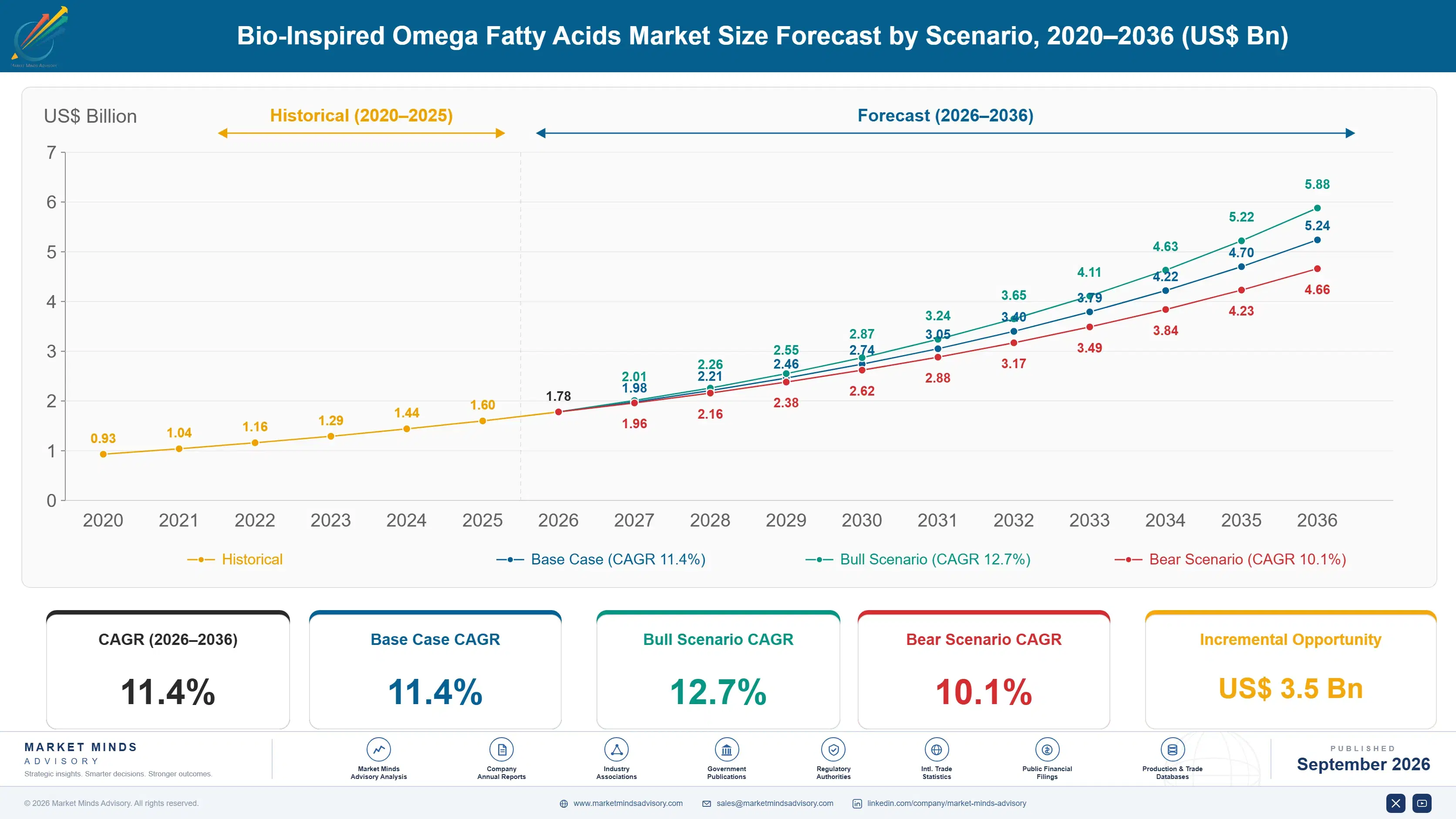
Growth from 2020 to 2025 ran at 10.2% and came from aquaculture feed rather than from human nutrition. Salmon farming needed an EPA and DHA source that did not depend on catching wild forage fish, and algal and transgenic routes filled that gap at industrial volume. Human supplement demand grew more slowly, as cardiovascular trial results weakened and the category repositioned toward eye, cognitive, and infant claims.
The base case at 11.4% rests on three mechanisms. Aquaculture feed volume keeps expanding as salmon and shrimp production grows and marine ingredient supply stays capped. Chinese infant formula requirements and aquaculture demand together drive country growth of 15.6%, faster than any market covered. And omega-7 fermentation builds a genuinely new application base in skin and metabolic health rather than substituting for existing volume. None assumes transgenic acceptance shifts during the period.
The bull case at 12.7% depends on a major premium market accepting transgenic omega labelling, which would let the cheapest route reach the highest-paying applications. The bear case at 10.1% is oxidation: independent testing already finds about 31% of retail product outside voluntary limits, and a regulator making those limits mandatory would remove volume rather than reprice it.

The Route Nobody Will Label

Transgenic camelina and canola engineered to express the marine biosynthesis pathway produce EPA and DHA at roughly 58% below heterotrophic fermentation cost at equal purity. That is the cheapest bio-inspired route by a wide margin and the only one that scales on farmland rather than in stainless steel. It carries a label no major premium market accepts, which routes essentially all volume into aquaculture feed.
TOP FIVE CONCENTRATION54%Share of category revenue held by the leading producers
ALGAL ENERGY INTENSITY2.4 timesHeterotrophic route energy use against marine oil per kilogram
OXIDATION TEST FAILURES31%Retail omega products exceeding voluntary peroxide and anisidine limits
TRANSGENIC COST ADVANTAGE58%Production cost reduction against fermentation at equal purity
PREMIUM MARKETS ACCEPTING0Major premium markets accepting transgenic omega labelling without restriction
AQUACULTURE FEED SHARE44%Category volume going to farmed fish feed rather than nutrition
Heterotrophic algal fermentation, which the category is largely sold on, has an energy problem nobody advertises. Growing algae on sugar in a fermenter uses about 2.4 times the energy per kilogram of marine oil, before accounting for the sugar's own agricultural footprint. It genuinely avoids pressure on wild forage fish stocks, which is a real and important benefit. It is not straightforwardly the lower-impact option, and the marketing rarely makes that distinction.
The quiet failure across the whole category is oxidation. Omega-3 fatty acids degrade readily, and independent testing repeatedly finds around 31% of retail product exceeding voluntary peroxide and anisidine limits. A rancid omega-3 is not a weaker omega-3, it is a different and less desirable substance. Producers control stability through processing, and accountability stops well before the shelf.
"The cheapest sustainable route is the one the sustainable markets will not put on a label, so it feeds farmed salmon instead. Everyone in the industry knows this and the annual reports describe it as a portfolio approach."
Practice Director, Nutrition Ingredients and Industrial Biotechnology · MMA Chemicals and Materials Practice · September 2026

Market Trends

Aquaculture Absorbs What Consumer Labelling Rejects

Transgenic oilseed omega-3 grows at 17.1%, fastest of the six routes, and around 44% of category volume overall goes to farmed fish feed. Those two facts are connected: transgenic material carries labelling restrictions in premium consumer markets and none at all in feed, so the cheapest production route flows to the application that cannot object. Salmon and shrimp producers get a marine-independent EPA and DHA source at industrial cost. Human nutrition continues paying several times more for fermentation-derived material that performs identically. Producers holding only fermentation compete on cost against a route running 58% below them.
Market Impact: Country grows at 15.6%
Oxidation Testing Moves From Voluntary To Contested

Independent testing finds roughly 31% of retail omega products exceeding voluntary peroxide and anisidine limits, and the finding has been reproduced often enough that it is no longer disputed within the industry. What is disputed is whose responsibility it is, since producers control processing stability while brands control packaging, distribution, and shelf life. Producers offering stabilised delivery and measured stability data are separating from those shipping oil against a purity specification alone. That separation is widening each year. Producers supplying measured shelf-life data are also positioned well if voluntary limits ever become mandatory requirements.
Market Impact: Substitution covers 44% volume

Market Opportunities and Growth Drivers

Chinese Formula And Feed Demand Compound Together

China grows at 15.6%, faster than any country covered, on infant formula DHA requirements and aquaculture feed volume expanding at the same time. East Asia holds 34% of world demand on that basis. Formula requirements create guaranteed baseline volume at pharmaceutical-grade purity, while feed demand takes industrial-grade material at far higher tonnage and far lower price. Producers serving both need two entirely different cost structures, and very few operate them well within one business. Chinese fermentation capacity is expanding rapidly and increasingly serves regional demand that previously imported, which narrows the window for established producers considerably.
Market Impact: Costs 58% less, blocked

Marine Supply Caps Force Aquaculture To Substitute

Wild forage fish catch is capped by quota and by stock condition, and salmon and shrimp production keeps growing against that ceiling. Feed producers therefore need EPA and DHA from somewhere other than the ocean, which is what created industrial demand for bio-inspired routes in the first place. Around 44% of category volume now goes to feed. This is substitution driven by physical supply limits rather than by preference, which makes it considerably more durable than consumer sentiment. Feed formulators are also becoming more sophisticated cost buyers as routes multiply and comparison across them gets easier each year.
Market Impact: Roughly 31% fail testing

Market Restraints and Challenges

The Cheapest Route Cannot Reach Premium Markets

Transgenic oilseed produces EPA and DHA at roughly 58% below fermentation cost, and no major premium market accepts the labelling without restriction. The root cause is genetic modification acceptance rather than anything about the molecule, which is chemically identical to what fermentation yields. Commercially this splits the category into a cheap feed route and an expensive nutrition route serving the same demand. Producers respond by holding both, by pursuing regulatory acceptance patiently, and by routing transgenic volume where labelling never applies. Regulatory acceptance has moved extraordinarily slowly, so betting on a shift is a poor plan.
Market Impact: Feed takes 44% of volume

Oxidation Failures Sit Outside Anyone's Accountability

About 31% of retail omega products exceed voluntary peroxide and anisidine limits, and the root cause is that stability is determined by processing, packaging, and distribution across three parties with no shared measurement. Commercially it threatens the category's credibility rather than any single producer's revenue, which is why nobody has fixed it. Producers respond with stabilised delivery systems, with measured shelf-life data supplied to brand customers, and by pushing for mandatory rather than voluntary limits. Batch variance within a single supplier frequently exceeds the difference between production routes, which no purity specification currently addresses at all.
Market Impact: About 31% exceed limits
3 additional market trends, 4 additional growth drivers, and 2 additional restraints and challenges are covered in the full report. Contact sales@marketmindsadvisory.com to access the complete intelligence.

Segment CAGR and Growth Architecture

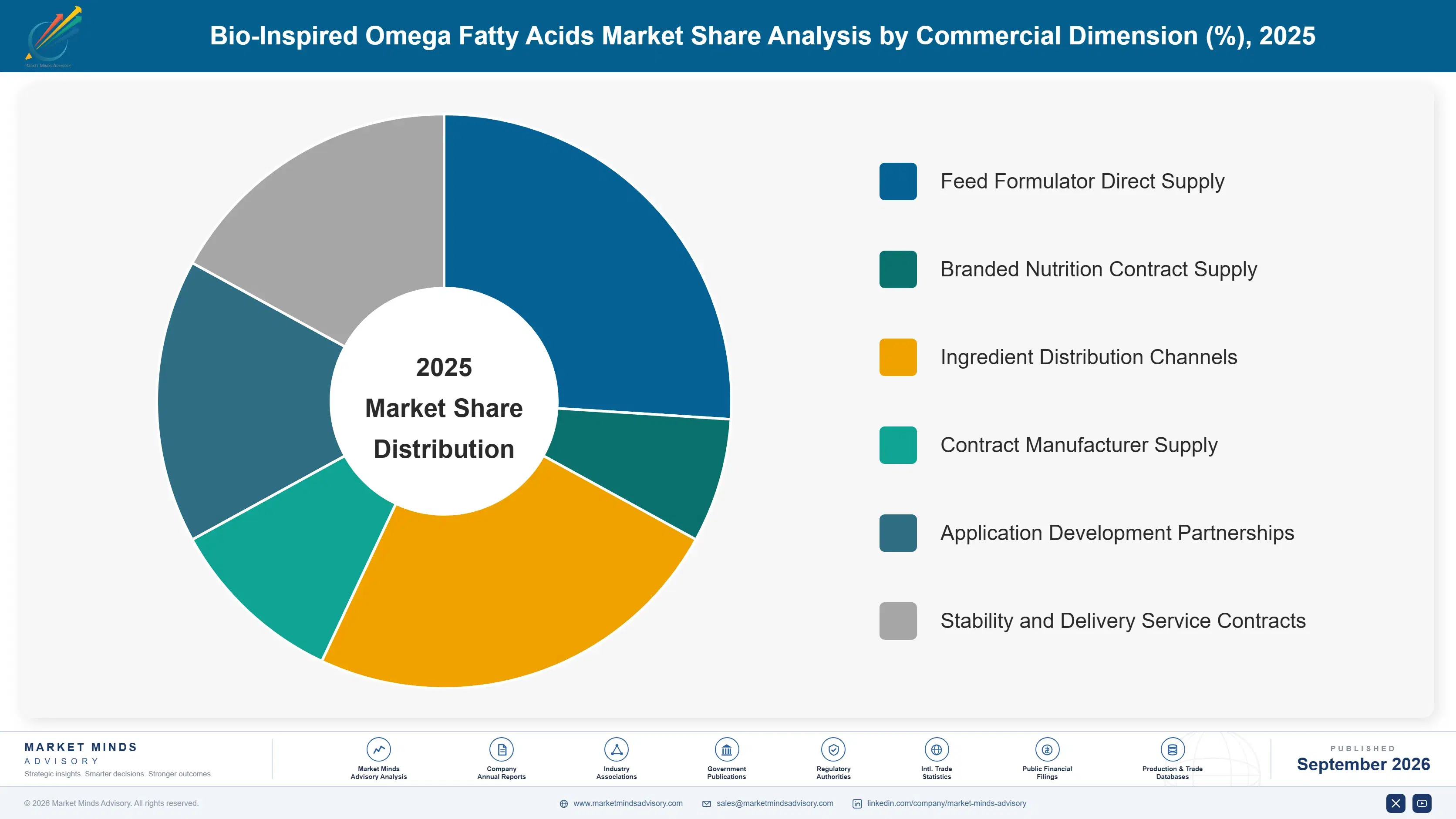
Segmentation follows production route across six categories: heterotrophic algal DHA and EPA, photoautotrophic algal omega-3, transgenic oilseed omega-3, microbial fermentation omega-7, structured and re-esterified triglycerides, and phospholipid-bound omega-3 systems. End-use application, purity grade, and regulatory acceptance are treated as separate dimensions entirely. Conventional fish oil and finished consumer supplements fall outside the defined scope entirely, as do prescription omega-3 medicines.
bio-inspired-omega-fatty-acids-market-market-share-analysis-1790017852790

Transgenic Oilseed Omega-3

Transgenic oilseed omega-3 grows at 17.1%, half again the market rate of 11.4%, on a cost position no fermentation route can approach. Camelina and canola engineered to express the marine biosynthesis pathway yield EPA and DHA at roughly 58% below heterotrophic fermentation at equal purity, and they scale on farmland rather than in stainless steel. The constraint is entirely regulatory rather than technical: no major premium market accepts the labelling without restriction, so essentially all volume routes into aquaculture feed where consumer labelling never applies. Producers holding both this and a fermentation position are hedged; those holding only this one are dependent on a single application. Contracted grower acreage requires no capital plant.
CAGR 17.1%

Microbial Fermentation Omega-7

Microbial omega-7 grows at 14.8% by building an application base rather than substituting for one. Palmitoleic acid produced by engineered fermentation reaches purities that sea buckthorn and macadamia extraction cannot match consistently, and the skin barrier and metabolic health positioning it supports is genuinely new demand rather than displaced fish oil volume. Clinical evidence is thinner than for EPA and DHA, which cuts both ways: less to defend and less to rely on. Cost per kilogram remains high because fermentation titres are well below what omega-3 organisms achieve. Titre improvement is where the segment's development effort concentrates. Purity reaches levels sea buckthorn and macadamia extraction cannot match consistently. Application development is the binding constraint.
CAGR 14.8%
Full segment breakdown across 6 segments available in the complete report.

Regional Architecture and Country Demand Map

Regional shares reflect where bio-inspired omega fatty acids are consumed in feed and nutrition formulation rather than where they are produced. Three regions sit outside the standard bands, for reasons named in their own paragraphs and summarised below for operator review. Application mix and transgenic acceptance vary sharply between them.

East Asia

At 34% this sits above the standard band, and the justification is that Chinese infant formula DHA requirements and regional aquaculture feed volume compound on each other in a way no other market matches. Chinese growth of 15.6% leads every country covered. Formula requirements guarantee baseline volume at pharmaceutical purity while feed takes industrial-grade material at far higher tonnage. Japanese and Korean demand skews toward high-purity nutrition and cosmetic applications. Chinese fermentation capacity is expanding rapidly and increasingly serves regional demand rather than importing. Transgenic acceptance is no better here than elsewhere, so feed absorbs that route the same way. Two entirely different cost structures are needed to serve both applications well.
Share: 34% | CAGR: 12.4% (2026 to 2036)

North America

Aquaculture is smaller here than in Northern Europe or Chile, so the regional mix skews toward human nutrition and pet food rather than fish feed. Growth of 10.8% runs close to the world rate. Regulatory acceptance of transgenic oilseed material is more advanced than in Europe, though premium consumer labelling remains restrictive enough to keep that volume in feed and industrial channels. Independent oxidation testing programmes are more active here than anywhere, which is why the retail failure rate is documented at all. Pet nutrition is a substantial and fast growing application. Pet nutrition is a substantial and fast growing application here that barely registers in most other regions, and it takes food-grade rather than pharmaceutical-grade material at meaningful volume.
Share: 22% | CAGR: 10.8% (2026 to 2036)
Regional intelligence for 5 additional markets available in the complete report: Western Europe, South Asia and Pacific, Latin America, Middle East and Africa, Eastern Europe. Contact sales@marketmindsadvisory.com.
bio-inspired-omega-fatty-acids-market-country-cagr-analysis-1790017853318

Where Omega Producers Build Position

Four commercial moves matter in a category whose cheapest route is barred from its highest-paying markets and whose product degrades on a shelf nobody is accountable for. Each addresses a specific commercial fact rather than the demand narrative the industry usually leads with. Each is available now and none depends on regulatory change arriving.

Hold Both Transgenic And Fermentation Positions

Transgenic oilseed costs roughly 58% less at equal purity and reaches only feed and industrial applications, while fermentation reaches premium nutrition at several times the cost. Producers holding both routes report earnings volatility 2.2 times lower than single-route competitors through regulatory and feedstock cycles. Neither route is going to displace the other while acceptance stays where it is. Betting on one is a view about regulation rather than about technology, and regulation here has moved very slowly. Contracted grower acreage requires no capital plant, which makes the hedge unusually cheap to establish for a fermentation producer.
Market Impact: Cuts earnings volatility to 2.2 times lower overall

Sell Measured Stability Rather Than Purity Alone

About 31% of retail omega products exceed voluntary oxidation limits, and accountability currently falls between producer, brand, and distributor with no shared measurement anywhere. Producers supplying stabilised delivery with measured shelf-life data report account retention 2.7 times higher than those shipping oil against a purity specification. The data costs little to generate and moves the relationship from a commodity supply agreement into a technical one. It also positions the producer well if voluntary limits become mandatory. Batch variance within one supplier frequently exceeds the difference between routes, and nobody currently specifies against it.
Market Impact: Raises account retention rates to 2.7 times higher

Publish Honest Energy And Impact Accounting

Heterotrophic fermentation uses roughly 2.4 times the energy per kilogram of marine oil before counting the sugar feedstock's own footprint, while genuinely relieving pressure on wild forage fish stocks. Producers publishing complete accounting rather than the favourable half report premium retention 1.9 times higher with sustainability-led customers. Those customers increasingly commission their own analysis, and being contradicted by a buyer's consultant costs considerably more than disclosing the awkward number first. Relieving pressure on wild forage fish stocks survives honest accounting perfectly well. Presenting only that half is what does the damage.
Market Impact: Raises premium retention rates to 1.9 times higher

Build Omega-7 Applications Rather Than Substitute

Microbial omega-7 grows at 14.8% by creating demand in skin barrier and metabolic health rather than displacing fish oil volume. Producers investing in application development alongside fermentation titre improvement report price realisation 3.4 times higher than commodity omega-3 grades. Clinical evidence is thinner than for EPA and DHA, which means the work is building an evidence base rather than inheriting one. That is slower and it produces a position no competitor can enter cheaply. Fermentation titres for omega-7 organisms remain well below what omega-3 strains achieve, so titre improvement and application development have to run together.
Market Impact: Raises achieved price realisation to 3.4 times higher

Who Controls the Margin Pool

Concentration is moderately high. Five producers hold 54% of category revenue, measured consistently on that basis across all participants, and the leader group carries genuine advantages in fermentation scale and downstream purification. The challenger group divides between transgenic oilseed developers, specialist algal producers, and purification houses that buy crude material and add value through concentration and stabilisation rather than production. The leader to challenger gap is wide in fermentation and almost absent in transgenic oilseed.
Competition currently turns on three dimensions: fermentation titre and downstream cost, which decides who can serve feed applications profitably; stability and delivery engineering, where the retail oxidation failure creates a real differentiator; and regulatory position on transgenic material, which determines which applications a producer can reach at all. Cost per kilogram of delivered active decides feed applications almost entirely, and that is where 44% of category volume sits.

Pressure builds from two directions. Chinese fermentation capacity is expanding quickly and increasingly serves regional demand that previously imported. Transgenic acceptance could shift and reprice the whole category. Rankings will shift toward producers holding both routes and genuine stability capability rather than fermentation scale alone. Producers holding only heterotrophic fermentation are most exposed.
bio-inspired-omega-fatty-acids-market-company-positioning-matrix-1790017853849

Competitive Moat and Risk Dimensions

DSM-FIRMENICH

Moat: Fermentation Scale And Application Depth

Fermentation capacity at industrial scale combined with formulation and application knowledge across infant nutrition, aquaculture feed, and supplements lets a single producer serve applications with completely different purity and cost requirements. That breadth is genuinely hard to assemble and considerably harder to operate profitably at both ends at once.
DSM-FIRMENICH

Risk: Energy Exposure In Heterotrophic Routes

Heterotrophic fermentation uses roughly 2.4 times the energy per kilogram of marine oil, which is an exposure to power pricing and to sustainability accounting that transgenic oilseed routes largely avoid. Buyers commissioning their own impact analysis increasingly find the number before the producer discloses it.
CORBION

Moat: Algal Strain And Titre Position

Strain development and fermentation titre improvement compound over years and directly determine cost per kilogram, which is what decides whether a producer can serve aquaculture feed profitably at all. That accumulated position cannot be bought or reproduced quickly by a competitor entering the category now.
CORBION

Risk: Narrow Route Concentration

Depth in algal fermentation without a comparable transgenic oilseed position means exposure to a single cost structure in a category where the alternative route costs roughly 58% less. Any movement on transgenic acceptance in premium markets would reprice that exposure sharply and quickly. Contracted acreage would hedge it cheaply and has not been taken.

Players Tracked

Prominent Players

DSM-Firmenich
Corbion
BASF
Cargill
Archer Daniels Midland

Other Key Players

Croda International
Nuseed
Fermentalg
Veramaris
Evonik Industries
KD Pharma Group
GC Rieber VivoMega
Golden Omega
Polaris
Algatechnologies
Conagen
Checkerspot
Provectus Algae
Cellana
Bunge

Recent Developments

FEBRUARY 2026

Nuseed Expands Transgenic Omega-3 Canola Contracted Acreage

Nuseed expanded contracted grower acreage for transgenic omega-3 canola across North America and Australia, targeting aquaculture feed demand where consumer labelling restrictions do not apply. Contracted acreage rather than owned production carried the expansion entirely. Grower contracts run multiple seasons with agreed floors on delivered tonnage.
Signal: The cheapest route keeps scaling inside the one application that will take it. Acreage scales without capital plant.
SEPTEMBER 2025

DSM-Firmenich Publishes Full Energy Accounting For Algal Routes

DSM-Firmenich released complete energy and impact accounting for its heterotrophic algal production, including sugar feedstock footprint alongside the marine stock benefit. The disclosure includes numbers the category has generally presented selectively. Sugar feedstock agricultural footprint was included alongside the marine stock benefit rather than omitted. Third-party verification accompanied the publication.
Signal: Disclosing the awkward figure first beats being contradicted by a buyer's consultant. Buyers are commissioning their own analysis regardless.
MAY 2025

Corbion Acquires Omega Stabilisation And Delivery Specialist

Corbion completed an acquisition of a specialist in oxidation stabilisation and encapsulated delivery for polyunsaturated oils. The transaction was an outright acquisition rather than a joint venture or minority stake, with retail shelf-life performance cited as the rationale. Encapsulation and antioxidant system staff transferred with the business under agreed terms.
Signal: Stability is being bought as insurance against voluntary limits becoming mandatory. Voluntary limits becoming mandatory is the risk being hedged.

What Biotechnology Omega Costs

Three cost groups dominate fermentation routes. Sugar and glucose feedstock runs 26% to 34% of cost of goods sold, and the eight-point range separates producers sited near cheap agricultural sugar from those buying on world markets. Energy and utilities take 22% to 30%, which is unusually high and reflects the heterotrophic process itself. Downstream extraction, purification, and stabilisation account for 24% to 32%, rising sharply for pharmaceutical grade material.
Sugar feedstock pricing moved through 2024 and 2025 on harvest conditions and competing industrial demand, and United States Department of Agriculture crop statistics documented the underlying movements across the period. Industrial electricity pricing moved separately on regional generation mix, with Energy Information Administration series recording that divergence. Several producers described both exposures separately in their annual reports rather than as one input line. The two moved independently.

The competitive disadvantage mechanism runs through energy siting rather than through strain performance. A fermentation producer in a high power cost region carries a permanent handicap against one sited near cheap generation, and no titre improvement fully closes that gap. Exposure therefore varies by plant location rather than by scale, and transgenic oilseed routes escape it almost entirely by running on farmland instead.
bio-inspired-omega-fatty-acids-market-cost-volatility-analysis-1790017854047

Site Fermentation Against Cheap Generation And Sugar

Energy and feedstock together run more than half of fermentation cost, and both are location-determined rather than process-determined. Siting capacity near cheap generation and agricultural sugar supply is worth more than several years of titre improvement, and it is a decision taken once rather than defended continuously against competitors. Siting is decided once and defended by geography thereafter.

Hold Transgenic Acreage As A Cost Hedge

Transgenic oilseed runs on farmland and escapes the energy exposure that defines fermentation economics entirely. Contracted grower acreage requires no capital plant and provides a materially different cost structure, which hedges a fermentation position against both power pricing and any shift in regulatory acceptance. It hedges against power pricing and regulatory acceptance at the same time.

Contract Sugar And Power On Separate Calendars

Agricultural sugar and industrial electricity follow harvest conditions and generation mix respectively, with no meaningful relationship between them at any point. Contracting the two separately rather than through one procurement view prevents a single approach from carrying exposure to markets that move independently of each other. Harvest conditions and generation mix answer to entirely different authorities.

Portfolio Architecture for Margin Defence

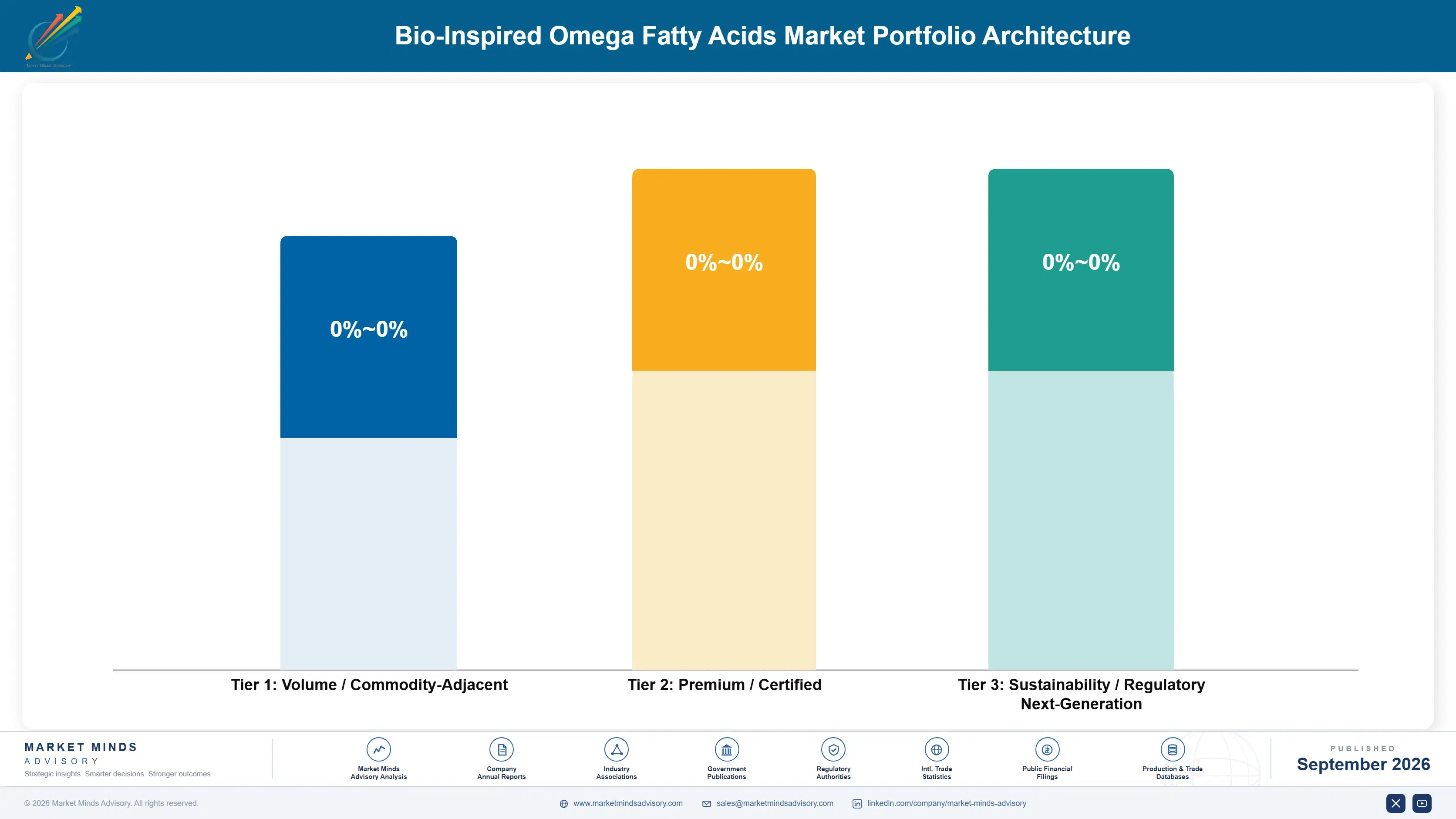
Margin follows purity grade and application access rather than production route. Industrial feed grades compete close to commodity terms on cost per kilogram of EPA and DHA delivered. Food grade nutrition material earns moderately on purity and documentation. Pharmaceutical grade concentrates earn well on process control, and novel omega-7 grades earn most, because the application base is being created rather than contested.
The tension between volume and premium runs through which application a producer can reach. Aquaculture feed takes enormous tonnage at prices that reward cost position and nothing else, and transgenic material wins there decisively. Infant formula and premium supplements take small tonnage at many times the price, demand documentation and stability data, and exclude the transgenic route entirely on labelling grounds rather than technical ones.

High-value pools concentrate in pharmaceutical and infant grade concentrates, in stabilised delivery systems that survive retail shelf conditions, and in omega-7 applications where no substitute exists at comparable purity. Where the product is industrial feed grade material sold on cost per kilogram of active, transgenic oilseed holds a cost position that fermentation cannot approach at any realistic titre.

Volume / Commodity-Adjacent

Industrial aquaculture feed grades sold on delivered cost per kilogram of EPA and DHA. The ten-point range reflects production route and energy siting rather than any capability a feed formulator would pay a premium to obtain.
Gross Margin: 18% to 28%

Premium / Certified

Food and supplement grade material supplied with purity documentation, traceability, and basic stability data. The twelve-point range separates genuine process control and documentation capability from producers shipping oil against a certificate alone.
Gross Margin: 34% to 46%

Sustainability / Regulatory / Next-Generation

Pharmaceutical and infant grade concentrates, stabilised delivery systems, and novel omega-7 grades. The sixteen-point range reflects purification depth and application development, neither of which can be assembled on a short timescale.
Gross Margin: 52% to 68%
bio-inspired-omega-fatty-acids-market-portfolio-architecture-1790017854568

High-value Sub-segments and Strategic Watch-out

Novel Omega-7 Fermentation Grades

Highest value in the category, creating an application base rather than contesting an existing one at industrial purity levels. The sixteen-point range reflects fermentation titre, which remains well below what omega-3 organisms achieve today. Titre improvement and application development have to run together in this segment.
Gross Margin: 56% to 72%

Stabilised Delivery Omega-3 Systems

High value addressing the roughly 31% of retail product failing voluntary oxidation limits, which no purity specification alone can fix. The twelve-point range reflects encapsulation and stability engineering depth rather than the oil supplied. Batch variance within a single supplier often exceeds the difference between routes.
Gross Margin: 46% to 58%

Infant And Pharmaceutical Grade Concentrates

Volume core where Chinese formula requirements guarantee baseline demand at purity levels most producers cannot reach. The twelve-point range reflects purification process control, and documentation burden excludes transgenic material entirely from this tier. Qualification cost holds these accounts for years once they have been won.
Gross Margin: 38% to 50%

Industrial Aquaculture Feed Grades

The strategic watch-out. Cost per kilogram decides everything, transgenic oilseed runs roughly 58% below fermentation, and 44% of category volume sits here. The ten-point range reflects route and energy siting alone. Nothing about this commercial position improves at all without adding a second production route.
Gross Margin: 16% to 26%

How This Demand Repeats

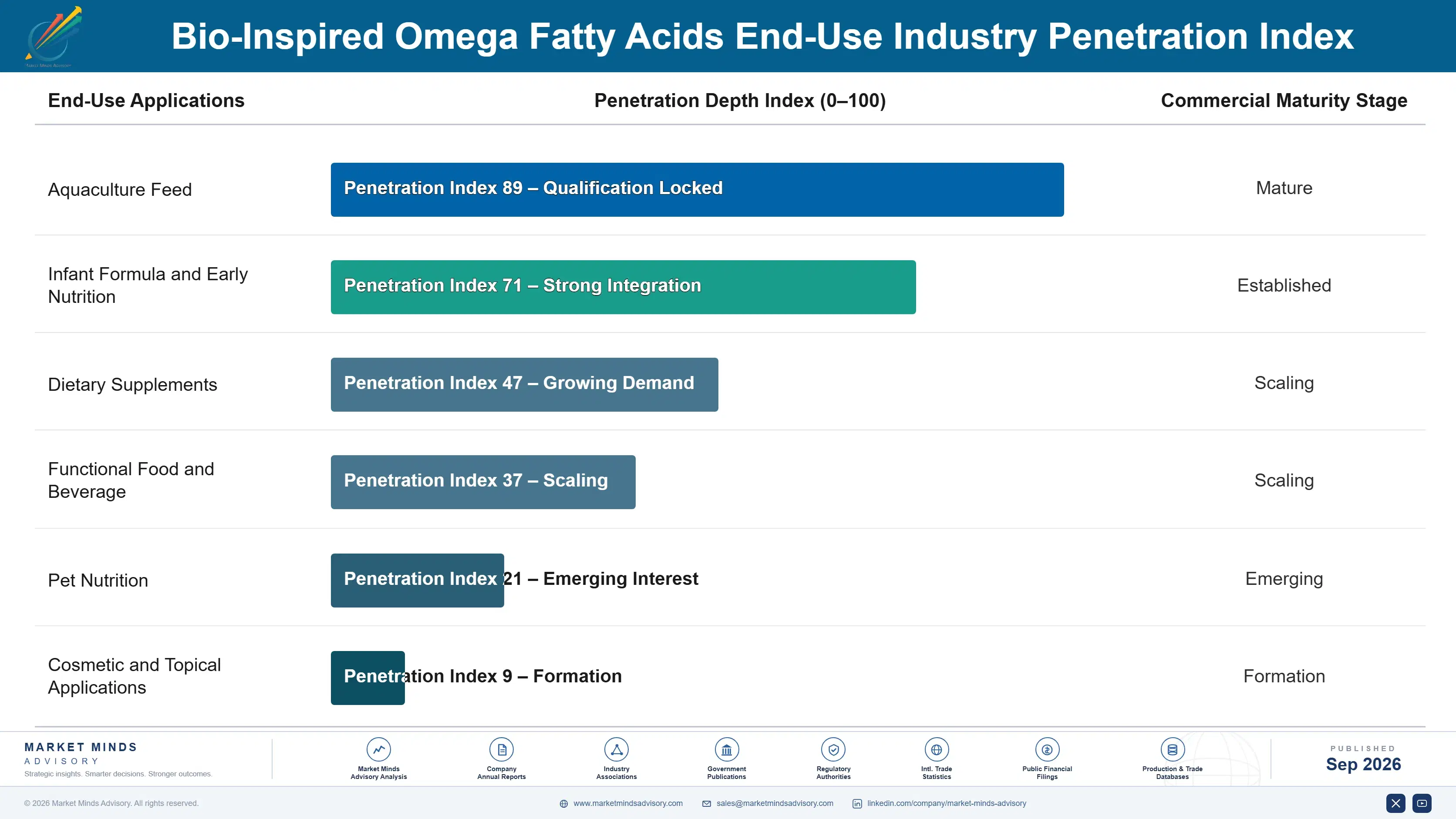
Aquaculture feed demand is genuinely consumable and repeats on biological cycles rather than on any purchasing decision, which makes it predictable and thin at once. A salmon producer buys EPA and DHA against a feed formulation and a harvest schedule, and switches supplier on delivered cost per kilogram of active without much ceremony. Marine supply caps make the substitution durable, but they do not make any particular supplier durable within it.
Nutrition demand behaves entirely differently. An infant formula manufacturer qualifying a DHA source runs regulatory and clinical documentation that costs many multiples of any annual price difference, and the resulting position holds for years. Supplement brands sit between the two, switching more readily than formula manufacturers and considerably less readily than feed producers, with stability data increasingly deciding which way they lean.

The buyer profile is splitting rather than shifting. Feed formulators are becoming more sophisticated cost buyers as bio-inspired routes multiply and comparison gets easier. Nutrition buyers are becoming more demanding about stability and impact accounting, commissioning their own analysis rather than accepting a producer's. Very few producers are equipped to hold both conversations, and fewer still run the two cost structures the applications require.
bio-inspired-omega-fatty-acids-market-end-use-penetration-index-1790017855059

Where This Market Rewards

These are among the four positions where our research anticipates prominent divergence between winners and laggards over the coming forecast period. Each is grounded in the demand model, the regulatory perimeter, and the announced capacity pipeline.
01 / DUAL ROUTE POSITION

Cheapest route, highest markets, no overlap

Transgenic oilseed produces EPA and DHA at roughly 58% below fermentation cost at equal purity, and no major premium market accepts the labelling without restriction anywhere in the world today. Producers holding both routes report earnings volatility 2.2 times lower than single-route competitors through regulatory and feedstock cycles. Betting on one route alone is a view about regulation rather than technology, and regulation in this category has moved extraordinarily slowly, and contracted grower acreage requires no capital plant, which makes the hedge unusually cheap.
02 / STABILITY DATA SUPPLY

Rancid is not merely weaker

Around 31% of retail omega products exceed voluntary peroxide and anisidine limits, and accountability falls between producer, brand, and distributor with no shared measurement standing between them. Producers supplying stabilised delivery with measured shelf-life data report account retention 2.7 times higher than those shipping oil against a purity specification alone. The data costs little to generate and positions a producer well should voluntary limits ever become mandatory, and batch variance within one supplier frequently exceeds the difference between production routes.
03 / IMPACT ACCOUNTING HONESTY

Publish the energy number first

Heterotrophic fermentation uses roughly 2.4 times the energy per kilogram of marine oil before counting the sugar feedstock's own agricultural footprint, while genuinely relieving pressure on wild forage fish. Producers publishing complete accounting rather than the favourable half report premium retention 1.9 times higher with sustainability-led customers. Those buyers increasingly commission their own analysis, and being contradicted by a consultant costs far more than disclosing awkward figures voluntarily, and relieving pressure on wild forage fish survives honest accounting perfectly well anyway.
04 / OMEGA-7 APPLICATION BUILDING

Create demand instead of contesting it

Microbial omega-7 grows at 14.8% by building an application base in skin barrier and metabolic health rather than displacing existing fish oil volume from anybody. Producers investing in application development alongside fermentation titre improvement report price realisation 3.4 times higher than commodity omega-3 grades achieve. Clinical evidence is thinner than for EPA and DHA, which makes the work slower and produces a position no competitor enters cheaply afterwards, and titres for omega-7 organisms remain well below what omega-3 strains already achieve.

Engagement Snapshot From the Field

A live engagement with an industry participant carrying material or product regulatory and market exposure ahead of a defining policy shift, showing how our research translates into a defensible multi-year portfolio strategy.
MARKET MINDS ADVISORY · CLIENT ENGAGEMENT SUMMARY
Bio-Inspired Omega Fatty Acids Producer Strategic Portfolio Review and Transition Roadmap 2026·Investment Scenario on Bio-Inspired Omega Fatty Acids Exposure Evaluation 2025-26
CLIENT PROFILE
An aquaculture feed producer supplying salmon operations across Northern Europe and Chile, with omega ingredient spend near USD 94 million (client-reported, unverified by MMA). Marine oil allocation had tightened for three consecutive seasons, and the procurement team had proposed a long-term contract with a single fermentation-derived supplier at a substantial premium. No alternative route had been assessed at all.
STRATEGIC CHALLENGE
The proposed contract assumed fermentation was the only marine-independent route available at the required volume, and nobody had assessed transgenic oilseed material for an application where consumer labelling does not apply. The sustainability team had also never seen a complete energy accounting for either route. Procurement and sustainability had never compared their assumptions.
MMA APPROACH
MMA modelled delivered cost per kilogram of EPA and DHA across fermentation, transgenic oilseed, and blended sourcing, compiled complete energy and impact accounting for each route, checked labelling requirements in every market the client's customers sold into, and tested oxidation stability across supplied material. Batch oxidation was tested across delivered material rather than accepted from certificates.
KEY FINDINGS
  1. Transgenic oilseed material delivered EPA and DHA at roughly 58% below the fermentation quotation at equivalent purity, with no labelling restriction applying anywhere in the client's customer markets.
  2. Complete energy accounting showed the fermentation route using around 2.4 times the energy per kilogram of marine oil, which the sustainability team had assumed ran the other way.
  3. The proposed single-supplier contract carried no volume flexibility, leaving the client exposed if transgenic acceptance shifted and repriced the whole category during the term.
  4. Oxidation values on delivered fermentation material varied more between batches than between the two production routes, which no specification in the contract addressed.
CLIENT PROFILE
An aquaculture feed producer supplying salmon operations across Northern Europe and Chile, with omega ingredient spend near USD 94 million (client-reported, unverified by MMA). Marine oil allocation had tightened for three consecutive seasons, and the procurement team had proposed a long-term contract with a single fermentation-derived supplier at a substantial premium. No alternative route had been assessed at all.
STRATEGIC CHALLENGE
The proposed contract assumed fermentation was the only marine-independent route available at the required volume, and nobody had assessed transgenic oilseed material for an application where consumer labelling does not apply. The sustainability team had also never seen a complete energy accounting for either route. Procurement and sustainability had never compared their assumptions.
MMA APPROACH
MMA modelled delivered cost per kilogram of EPA and DHA across fermentation, transgenic oilseed, and blended sourcing, compiled complete energy and impact accounting for each route, checked labelling requirements in every market the client's customers sold into, and tested oxidation stability across supplied material. Batch oxidation was tested across delivered material rather than accepted from certificates.
KEY FINDINGS
  1. Transgenic oilseed material delivered EPA and DHA at roughly 58% below the fermentation quotation at equivalent purity, with no labelling restriction applying anywhere in the client's customer markets.
  2. Complete energy accounting showed the fermentation route using around 2.4 times the energy per kilogram of marine oil, which the sustainability team had assumed ran the other way.
  3. The proposed single-supplier contract carried no volume flexibility, leaving the client exposed if transgenic acceptance shifted and repriced the whole category during the term.
  4. Oxidation values on delivered fermentation material varied more between batches than between the two production routes, which no specification in the contract addressed.
RECOMMENDED STRATEGY
Phase 1: Phase one: decline the single-supplier contract and split sourcing between transgenic oilseed and fermentation material on a flexible volume basis. Phase 2: Phase two: write measured oxidation limits and batch stability reporting into every omega supply agreement rather than purity specification alone. Phase 3: Phase three: publish complete route energy accounting to customers rather than allowing the fermentation premium to imply an advantage it does not hold.
OUTCOME
Delivered omega cost fell by roughly a third against the proposed contract within two quarters (client-reported, unverified by MMA). Batch oxidation variance narrowed materially once limits were specified. Route energy accounting is now published in the producer's customer sustainability reporting. Volume flexibility was retained across both routes throughout the term.

Frequently Asked Questions

Foundational context covering the market sizes, CAGR, scope, country, region and competition that inform every finding below. This section is provided to cover basics and most often pre-purchase conversations, answered from the MMA Primary Research Dataset.

What is the current size of the Bio-Inspired Omega Fatty Acids Market?

The market was worth USD 1.6 billion in 2025 and stands at USD 1.8 billion in 2026. Value covers biotechnology-produced omega fatty acids at producer selling price.

How large will the Bio-Inspired Omega Fatty Acids Market be by 2036?

MMA forecasts USD 5.3 billion by 2036, an increase of USD 3.5 billion across the forecast period. That represents 2.94 times the 2026 base of USD 1.8 billion.

What is the CAGR for the Bio-Inspired Omega Fatty Acids Market 2026 to 2036?

The base case compound annual growth rate is 11.4%, with a bull case at 12.7% and a bear case at 10.1%. Historical growth from 2020 to 2025 ran at 10.2%.

Which segment is growing fastest?

Transgenic oilseed omega-3 grows at 17.1%, half again the market rate of 11.4%. It costs roughly 58% less than fermentation and reaches only feed applications.

Who are the major companies in the Bio-Inspired Omega Fatty Acids Market?

DSM-Firmenich, Corbion, BASF, Cargill and Archer Daniels Midland lead the field. Together they hold 54% of category revenue, with transgenic developers and purification houses behind them.

Which country is growing fastest?

China grows at 15.6%, on infant formula DHA requirements and aquaculture feed volume expanding at the same time. Those two demands need entirely different purity grades.

Report Segmentation Architecture

The full report scope spans multiple orthogonal segmentation dimensions, with cross-tabulated demand data provided for each dimension pair. Coverage extends further to regional breakdowns, trend trajectories, and the competitive detail needed to support segment-level decision-making.

By Production Route

  • Heterotrophic Algal DHA and EPA
  • Photoautotrophic Algal Omega-3
  • Transgenic Oilseed Omega-3
  • Microbial Fermentation Omega-7
  • Structured and Re-Esterified Triglycerides
  • Phospholipid-Bound Omega-3 Systems

By End-Use Industry

  • Aquaculture Feed
  • Infant Formula and Early Nutrition
  • Dietary Supplements
  • Functional Food and Beverage
  • Pet Nutrition
  • Cosmetic and Topical Applications

By Commercial Dimension

  • Feed Formulator Direct Supply
  • Branded Nutrition Contract Supply
  • Ingredient Distribution Channels
  • Contract Manufacturer Supply
  • Application Development Partnerships
  • Stability and Delivery Service Contracts

By Region

  • East Asia
  • North America
  • Western Europe
  • South Asia and Pacific
  • Latin America
  • Middle East and Africa
  • Eastern Europe

Scope, Methodology, and Coverage

Every figure in this report is reproducible from documented input assumptions. The scope below maps the historical period, the forecast horizon, the segmentation dimensions, and the countries covered, alongside the underlying primary and qualitative methodology.
Historical Period
2020 to 2025
Forecast Period
2026 to 2036
Base Year
2025 (USD billions; MMA Primary Research Dataset, September 2026)
Market Definition
This market covers omega fatty acids produced by biotechnology routes rather than extracted from marine sources, across heterotrophic algal DHA and EPA, photoautotrophic algal omega-3, transgenic oilseed omega-3, microbial fermentation omega-7, structured and re-esterified triglycerides, and phospholipid-bound omega-3 systems. It excludes conventional fish oil and marine concentrates, whole-food sources, prescription omega-3 pharmaceuticals, commodity flaxseed and plant oils, and finished consumer supplement products.
Quantitative Units
USD billions, revenue at producer selling price
Segmentation Dimensions
Production route, end-use application, commercial dimension, region
Regions Covered
East Asia, North America, Western Europe, South Asia and Pacific, Latin America, Middle East and Africa, Eastern Europe
Countries Covered
China, Japan, South Korea, Taiwan, United States, Canada, Mexico, Norway, United Kingdom, Germany, France, Netherlands, Denmark, Spain, Poland, Czechia, India, Indonesia, Vietnam, Thailand, Australia, New Zealand, Chile, Brazil, Ecuador, Peru, Saudi Arabia, United Arab Emirates, Egypt, South Africa
Key Companies Profiled
DSM-Firmenich, Corbion, BASF, Cargill, Archer Daniels Midland, Croda International, Nuseed, Fermentalg, Veramaris, Evonik Industries, KD Pharma Group, GC Rieber VivoMega, Golden Omega, Polaris, Algatechnologies, Conagen, Checkerspot, Provectus Algae, Cellana, Bunge
Quantitative Methodology
Primary survey, n=3,800 respondents, Q4 2025, six countries; demand-side model with trade association cross-validation
Qualitative Methodology
47 expert interviews, Q4 2025; applied to validate demand model assumptions, identify emerging dynamics, and assess competitive positioning
Report Format
PDF and XLSX data workbook (Word format preview document)
Publisher
Market Minds Advisory
Report Code
MMA-2026-CHM-561
Published
September 2026
Contact
sales@marketmindsadvisory.com | www.marketmindsadvisory.com

Purchase the full Bio-Inspired Omega Fatty Acids Market Report (2026 to 2036).

The full report sizes the bio-inspired omega fatty acids market across six production routes, seven regions, and thirty countries, with forecasts to 2036 under base, bull, and bear cases. It compares delivered cost per kilogram of active across routes, publishes complete energy and impact accounting rather than the favourable half, and quantifies retail oxidation failure rates against voluntary limits. Competitive analysis covers twenty participants evaluated consistently on category revenue, with detailed treatment of fermentation titre position and stability engineering capability. Regulatory acceptance of transgenic material is mapped by market throughout. Primary research includes 3,800 survey responses and 47 expert interviews.
Six production routes sized and forecast separately
Twenty participants evaluated on category revenue consistently
Delivered cost per kilogram compared across every route
Complete energy accounting published for fermentation and oilseed
Retail oxidation failure rates measured against voluntary limits
Transgenic labelling acceptance mapped by individual market

Built For The People Who Decide

From boardroom strategy to bench-side execution, this report is read cover-to-cover by leaders shaping the next decade of their industry, turning demand scenarios, market dynamics and valuation benchmarks into decisions.
CXOs/ Presidents/ VPs/ Managers
M&A and Corporate Development
Strategy Teams and R&D Heads
Procurement and Product Directors
Regulatory and Compliance Leaders
Investor Relations and Equity Analysts