Market Minds Advisory
Bio-Based Polyol Market

Bio-Based Polyol Market: Vegetable Oil Chemistry Displacing Petroleum In Foam And Coatings

Mattress foam, insulation, and coatings all run on polyol chemistry, and soybean, castor, and palm oil derivatives are displacing petroleum grades faster than the vegetable oil supply chain feeding them was ever designed to scale.

Lead Analyst

Bilal Shaikh

Published

September 2026

Make Smarter Decisions with Customized Research Insights

Request a free sample report and evaluate market opportunities, growth trends, and competitive dynamics relevant to your business needs.

2025 MARKET VALUE$2.4BMarket Size 2025
2036 FORECAST VALUE$5.9BBase Case , 2026 to 2036
CAGR 2026 TO 20368.5 %Bull 9.7% / Bear 7.3%
INCREMENTAL OPPORTUNITY$3.3BNet 10- year value creation
EXPANSION MULTIPLE2.26x2036 value over 2026 base
Strategic Levers
M&A Pipeline
Regional Outlook
Country Rankings
Competitive Intelligence
Segmental Deep-dive
Call-Us : 91 93563 13602

Executive Snapshot and Market Trajectory

Bio-based polyols have shifted from a sustainability alternative to a specified formulation input, because foam and coatings manufacturers now qualify bio-content polyols on performance parity with petroleum grades rather than treating them as a premium substitution. Buyers increasingly lock in supply contracts before a product reformulation is even finalised. today.
Commercial demand concentrates around rigid and flexible foam, coatings, and elastomer applications, where bio-content specification increasingly ties directly to a customer's own regulatory fee exposure and brand sustainability commitments. Recycled and bio-based glycol polyols are pulling ahead of oil-derived grades as formulators seek feedstock options less exposed to agricultural commodity price swings. North America leads deployment volume on its established soy polyol base, with East Asia close behind on expanding foam manufacturing capacity.
Competitive character splits between diversified chemical majors bundling bio-based grades into wider polyol portfolios and specialist oleochemical producers selling purpose-engineered formulations built around a single feedstock. Regulatory pressure is the defining constant here: extended producer responsibility rules and carbon disclosure requirements increasingly reward documented bio-content, pushing formulators toward certified renewable-content polyols over conventional petroleum grades across nearly every major jurisdiction. That trend spans nearly every major regulated market today.
Market Definition
The bio-based polyol market covers polyols derived from renewable feedstocks, including soybean, castor, palm, and rapeseed oils and recycled or bio-based glycols, used as raw material inputs for polyurethane foam, coatings, adhesives, sealants, and elastomers. It excludes petroleum-based polyols and excludes finished polyurethane products sold downstream.
Base Year Value
$2.4B in 2025 (MMA Primary Research Dataset, August 2026)
Forecast Period
2026 to 2036, eleven discrete annual values
CAGR
8.5% base case. Bull 9.7%. Bear 7.3%.
Fastest Growth Segment
Recycled and Bio-Based Glycol Polyols: 11.5% CAGR
Fastest Growth Country
India: 10.2% CAGR
Fastest Growth Region
South Asia and Pacific: 10.5% CAGR
Largest Region
North America: 27% of 2025 global value
Market Leaders
Cargill, Dow, BASF, Covestro, Emery Oleochemicals. Source: MMA Analysis based on company annual reports.
Primary Survey
n=3,800 procurement and R&D decision-makers, Q4 2025, six countries
Methodology
Demand-side build-up, cross-validated against public data, 47 expert interviews

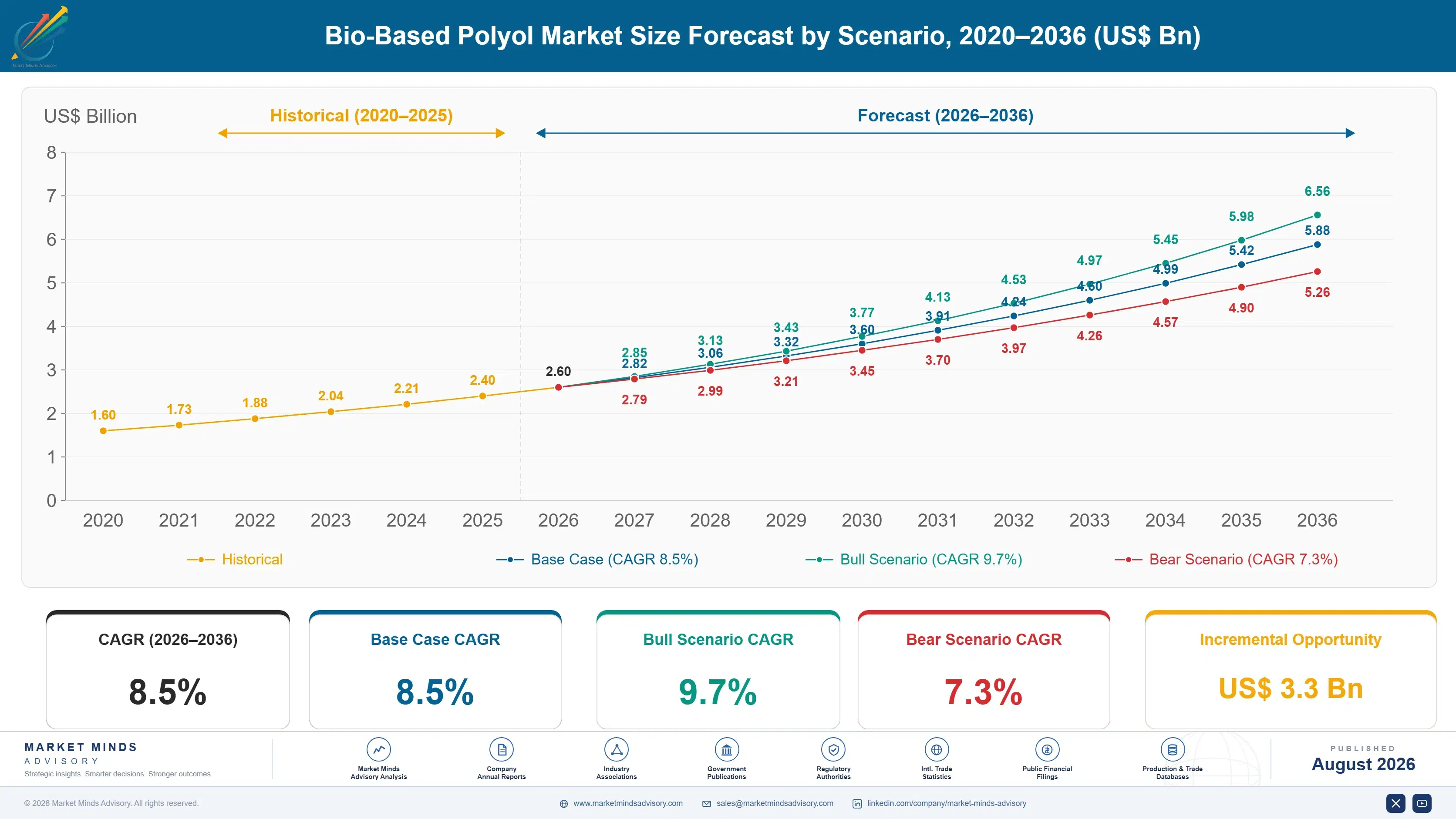
Bio-Based Polyol Market Forecast Scenarios

bio-based-polyol-market-size-forecast-scenario-1787302918107
Between 2020 and 2025 the market grew at a 7.7% historical CAGR, anchored by soy polyol adoption in North American flexible foam applications that pioneered commercial-scale bio-content specification. Growth was steady across most of the period. Coatings and elastomer adoption only gained real momentum from 2023 onward. Manufacturers largely treated bio-content as a niche premium option rather than a mainstream formulation choice.
The base case carries the market to an 8.5% CAGR through 2036 on three mechanisms. First, building material carbon disclosure requirements in multiple jurisdictions push insulation and coatings manufacturers toward documented bio-content formulations. Second, castor and palm oil polyol capacity investment in South Asia and Southeast Asia converts feedstock advantage into finished polyol export volume. Third, brand owner sustainability commitments increasingly specify renewable-content thresholds that push formulators toward bio-based grades across their full product portfolio.
The bull case reaches 9.7% if carbon disclosure and building material regulation expands faster than currently modelled, pulling formulator specification decisions forward across a compressed compliance timeline. The bear case falls to 7.3% if vegetable oil feedstock price volatility discourages formulators from committing to bio-based grades at scale. That volatility is already visible in extended qualification hesitancy across several regional formulators.

Why Bio-Content Became A Formulation Specification

Three forces converge on bio-based polyol demand at once. Building material carbon disclosure requirements push insulation and coatings manufacturers toward documented bio-content formulations. Castor and palm oil polyol capacity investment in South Asia converts feedstock advantage into finished export volume. And brand owner sustainability commitments increasingly specify renewable-content thresholds across product portfolios. That convergence is reshaping capital investment decisions across t
MARKET CONCENTRATIONCR5: 36%Diversified chemical majors and oleochemical specialists split roughly a third
AVERAGE SELLING PRICEUSD 2,100 to 3,800 per tonnePricing spans standard soy grades to certified castor formulations
TOP PRODUCING COUNTRY SHAREIndia: 24% of castor oil supplyCastor cultivation concentrates feedstock production across regional clusters
CAPACITY UTILISATION66 to 74%Certified production lines run consistently near committed capacity
INPUT COST SHARE45 to 55% of COGSVegetable oil feedstock dominates recurring raw material spending
PRODUCT DEVELOPMENT CYCLE12 to 20 monthsFormulation qualification runs considerably longer than standard resins
Commercially, the market behaves like specialised formulation chemistry rather than commodity polyol. Buyers specify by bio-content percentage, hydroxyl value, and mechanical performance rather than by price alone, because an underperforming formulation fails foam density or coating adhesion testing in ways that cost far more than the polyol itself. That specification discipline protects margin for producers with genuine oleochemical engineering depth and keeps generic petrochemical polyol makers from moving into performance-critical bio-content contracts.
Over the next decade, feedstock diversification becomes the real differentiator. Recycled and bio-based glycol polyols are closing the volume gap with vegetable-oil-derived grades as formulators seek options less exposed to agricultural commodity price swings. Producers that combine reliable multi-feedstock supply with proven mechanical performance, rather than single-oil expertise alone, will capture the brand-owner contracts increasingly dominating new specification spending.
"A mattress buyer never asks whether the foam came from soybeans, but the brand owner writing the sustainability report absolutely does, and that gap between end-consumer indifference and brand-level scrutiny is exactly what has scaled this category."
Director, Sustainable Chemical Intermediates Practice · MMA Sustainable Chemical

Market Trends

Building Carbon Disclosure Rules Push Insulation Toward Bio-Content

Building material carbon disclosure requirements in multiple jurisdictions increasingly require documented embodied carbon data for insulation and construction materials, and bio-based rigid foam polyols carry a meaningfully lower carbon footprint than petroleum grades in third-party life-cycle assessments that specifiers now request routinely. That documentation requirement has converted bio-content specification from a marketing claim into a data point that architects and building certification bodies actively verify before approving a project's sustainability rating. Cargill and BASF have both expanded documented life-cycle assessment support specifically to serve customers navigating these disclosure requirements. That requirement is reshaping specification well before construction begins.
Market Impact: Requires 20-40% bio-content on many
Castor Oil Capacity Investment Converts Feedstock Into Export Volume

India's dominant position in global castor oil production, concentrated in Gujarat, is increasingly converting into finished polyol export capacity as domestic producers integrate forward from raw oil supply into higher-value formulated products rather than exporting unprocessed oil alone. That forward integration captures considerably more value per tonne of castor oil than raw feedstock export ever could, and it has attracted direct investment from global chemical majors seeking secured access to castor-derived chemistry. Jayant Agro-Organics and Godrej Industries have both expanded formulated polyol capacity specifically to capture this higher-value export opportunity.
Market Impact: Cuts regulatory fee exposure 15-25%

Market Opportunities and Growth Drivers

Brand Owner Sustainability Commitments Specify Renewable Content

Consumer brand owners across furniture, bedding, and automotive interiors increasingly publish renewable-content targets that flow directly into their foam and coatings supplier specifications, converting what was once a supplier's independent material choice into an explicit customer requirement written into sourcing contracts. That specification pressure has moved bio-content polyol adoption from an opportunistic cost decision into a standing procurement requirement that suppliers must satisfy to retain the relationship at all, regardless of any short-term feedstock price advantage petroleum grades might otherwise offer. Formulators increasingly build bio-content targets into development from the earliest stage.
Market Impact: Compresses margin 12-20% during spi

Extended Producer Responsibility Fees Reward Documented Bio-Content

Extended producer responsibility regulations in multiple jurisdictions increasingly tie packaging and material fees directly to documented bio-based content, giving manufacturers a direct financial incentive to specify bio-based polyol formulations over conventional petroleum alternatives wherever mechanical performance allows the substitution. That regulatory linkage has turned bio-content specification from a marketing decision into a line item that finance teams track alongside material cost, since documented content percentage now directly affects a product's regulatory fee exposure. Manufacturers are increasingly requiring third-party bio-content certification from polyol suppliers as a standing condition of the supply relationship itself.
Market Impact: Excludes 15-25% of high-spec applic

Market Restraints and Challenges

Vegetable Oil Price Volatility Complicates Long-Term Contracts

Vegetable oil feedstock pricing moves with broader agricultural commodity markets and weather-driven harvest variability, and polyol producers with fixed-price supply contracts to foam and coatings manufacturers cannot always pass through sudden feedstock cost spikes quickly, the root cause being that many supply contracts lock pricing for periods that do not match agricultural commodity volatility. That mismatch compresses margin sharply during feedstock price spikes, particularly for smaller producers without the purchasing scale to hedge across multiple growing seasons. Producers are responding by shortening contract pricing windows where customer relationships allow and by diversifying feedstock sourcing across multiple oil types.
Market Impact: Cuts embodied carbon 20-30% per uni

Performance Gaps Limit Certain High-Specification Applications

Bio-based polyols can exhibit different reactivity and mechanical performance characteristics than petroleum grades in certain high-specification rigid foam and coating applications, the root cause being that vegetable oil molecular structure differs meaningfully from petroleum-derived polyether backbones in ways that affect cure behaviour and long-term dimensional stability. That performance gap has kept bio-based grades out of certain demanding applications where formulators cannot risk a specification failure regardless of the sustainability benefit involved. Producers are responding with hybrid formulations that blend bio-based and petroleum polyols to balance performance against renewable content targets.
Market Impact: Adds 2-3 export facilities annually
3 additional market trends, 3 additional growth drivers, and 2 additional restraints and challenges are covered in the full report. Contact sales@marketmindsadvisory.com to access the complete intelligence.

Segment CAGR and Growth Architecture

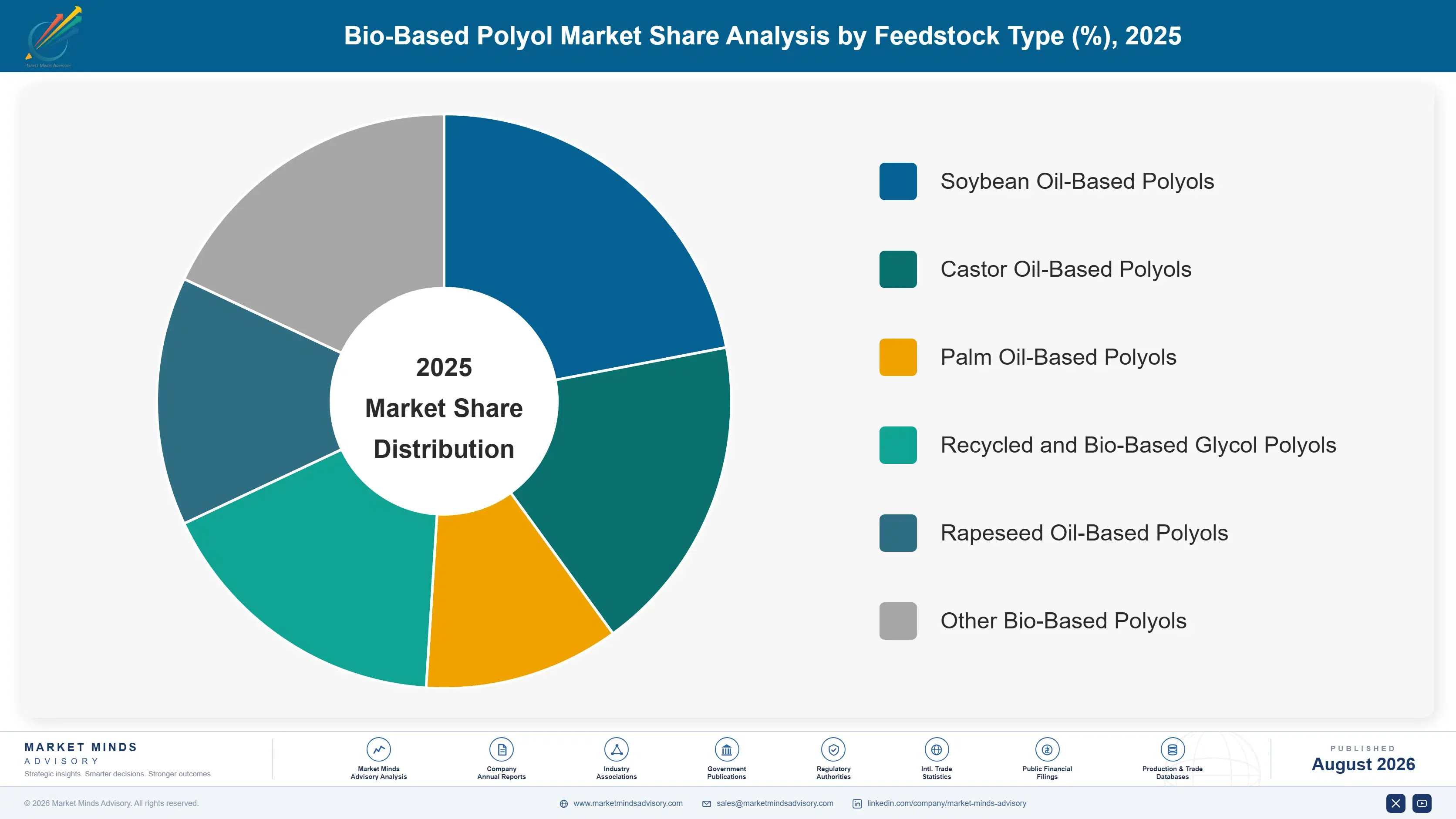
Segmentation follows feedstock type, the single material logic that determines cost structure, regional supply availability, and mechanical performance profile. Soybean, castor, palm, rapeseed, and recycled glycol polyols each carry genuinely distinct sourcing economics and are evaluated consistently throughout this report. Underlying petroleum polyols and finished polyurethane products sit outside this hierarchy entirely. each dimension.
bio-based-polyol-market-market-share-analysis-1787302918638

Recycled and Bio-Based Glycol Polyols

Recycled and bio-based glycol polyols grow fastest at 11.5%, about 1.35 times the market's 8.5% overall rate, as formulators seek feedstock options less exposed to the agricultural commodity price swings that vegetable-oil-derived grades carry inherently. These polyols draw on recycled polyethylene terephthalate and bio-based glycol streams rather than seasonal crop harvests, giving formulators a supply profile that behaves more like an industrial input than an agricultural commodity subject to weather risk. Several specialty chemical producers have expanded recycled-content polyol capacity specifically to serve customers seeking supply stability alongside sustainability credentials. Adoption is concentrated first among large brand owners managing feedstock risk across a diversified supplier base, and is now spreading into mid-sized formulators as capacity scales.
CAGR 11.5%

Castor Oil-Based Polyols

Castor oil-based polyols grow second-fastest at 10.0%, holding a genuine performance advantage in rigid foam and coating applications where castor's naturally hydroxylated molecular structure delivers reactivity characteristics that other vegetable oils require additional processing to match. India's dominant position in global castor cultivation gives regional producers a genuine feedstock cost advantage that formulators sourcing from further afield cannot easily replicate. Jayant Agro-Organics and Godrej Industries have both expanded formulated castor polyol capacity specifically to capture export demand from global coatings and elastomer manufacturers. Adoption is fastest among formulators prioritising natural reactivity performance over the lowest possible feedstock cost alternative available. Adoption remains fastest in India's domestic formulation base given established regional castor processing infrastructure.
CAGR 10.0%
Full segment breakdown across 6 segments available in the complete report.

Regional Architecture and Country Demand Map

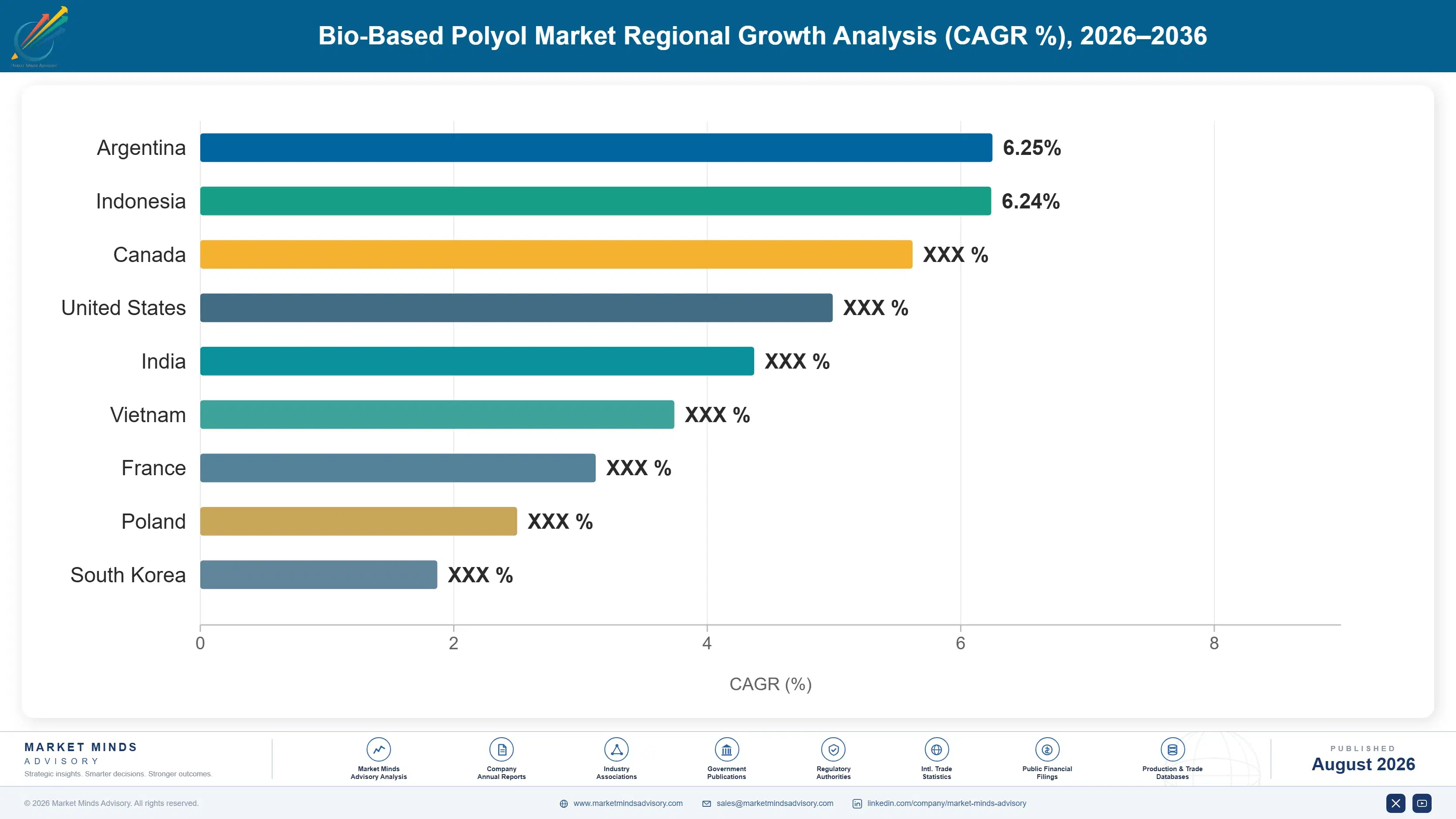
Global demand concentrates where polyol formulation expertise and feedstock supply run deepest. North America leads on its established soy base, East Asia follows on expanding foam capacity, and South Asia and Pacific adds meaningful demand behind both leaders. Western Europe adds meaningful demand behind both leaders.

North America

The United States drives regional demand through its established soy polyol base, where Cargill and Dow pioneered commercial-scale bio-content specification and continue holding deep incumbency across flexible foam manufacturer contracts. Building material carbon disclosure requirements adopted in several states add a further demand layer, pushing insulation manufacturers toward documented bio-content rigid foam formulations. Canada contributes a smaller layer through coatings applications tied to its domestic construction and industrial markets. Growth of 9.3% tracks carbon disclosure regulation expansion and brand owner sustainability commitments more than any single facility announcement. Domestic soybean supply gives the region a durable cost advantage few competing regions can match. That advantage keeps import competition genuinely limited across most standard foam-grade applications.
Share: 27% | CAGR: 9.3% (2026 to 2036)

Western Europe

Germany, France, and the Netherlands anchor demand through packaging and construction material regulation that increasingly favours documented bio-content formulations across coatings and insulation applications. Arkema and BASF both hold genuine home-market advantage across German and French formulator accounts, competing on certification depth against imported Asian polyol grades. Rapeseed oil cultivation gives the region a distinct regional feedstock advantage that few competing markets can replicate at comparable scale. Growth of 7.2% reflects the region's mature regulatory framework, sitting below the global rate even as it remains a technical leader in coatings-grade formulation depth. Building material carbon disclosure requirements continue tightening steadily under the EU's broader sustainability framework. Rapeseed processing infrastructure continues expanding gradually across several member states.
Share: 22% | CAGR: 7.2% (2026 to 2036)
Regional intelligence for 5 additional markets available in the complete report: East Asia, South Asia and Pacific, Latin America, Middle East and Africa, Eastern Europe. Contact sales@marketmindsadvisory.com.
bio-based-polyol-market-country-cagr-analysis-1787302919152

Where Bio-Based Polyol Producers Can Defend Margin

Formulation budgets are shifting earlier into product design and toward producers who can guarantee both feedstock diversity and documented certification. The four levers below capture revenue before a reformulation locks its material list rather than after, and each rewards producers who can prove supply reliability credibly across a customer's full product portfolio. That reliability increasingly wins the largest contracts outright.

Bundle Formulation Support Into Product Redesign Contracts

Bio-content specification increasingly happens during product reformulation design rather than during later sourcing, when foam density targets and cure chemistry are already fixed and costly to change. Producers that place formulation chemists inside customer product design teams from the outset capture the full specification scope across every product variant rather than competing for a smaller substitution order later. Cargill reports that products bundling formulation support into initial redesign carry order values roughly 25% higher than late-stage sourcing contracts on comparable product lines. Early involvement also cuts the requalification risk that late-stage substitution otherwise carries across the product line.
Market Impact: Lifts contract value roughly 25% ve

Diversify Across Multiple Feedstocks To Reduce Commodity Risk

Formulators awarding large, multi-year supply contracts increasingly favour producers who can substitute between soy, castor, and recycled glycol feedstocks if any single agricultural commodity experiences a price spike or harvest shortfall, rather than depending entirely on one crop's availability. Producers offering validated multi-feedstock formulations capture these risk-conscious contracts that single-feedstock competitors cannot credibly bid for, protecting roughly 80% of committed supply against any single crop's volatility. Emery Oleochemicals has pursued exactly this diversification strategy since 2023. That protection is now a genuine selling point during platform-level supplier evaluations across the industry today.
Market Impact: Protects roughly 80% of all supply

Build Documented Life-Cycle Assessment Capability For Disclosure Rules

Building material carbon disclosure requirements increasingly require documented, third-party-verified life-cycle assessment data before manufacturers can claim reduced embodied carbon, and producers that provide this documentation directly capture a genuine competitive advantage over those leaving the assessment burden to the customer. Building certified life-cycle assessment capability into standard product offerings removes a real adoption barrier for the roughly 30 to 40% of customers weighing bio-based specification against disclosure compliance requirements. BASF has built dedicated life-cycle assessment support specifically to capture this documentation-driven demand. That documentation edge often decides which supplier wins customers most sensitive to disclosure requirements.
Market Impact: Cuts customer disclosure compliance

Target Brand Owner Direct Specification Relationships

Consumer brand owners increasingly specify bio-content thresholds directly in their own material standards rather than leaving formulation selection to individual contract manufacturers, which shifts the purchasing decision upstream to a small number of brand sustainability and procurement teams. Securing direct specification status with major consumer brands delivers volume across an entire product portfolio that no number of individual contract manufacturer orders can match. Dow has pursued exactly this brand-direct approach with several furniture and bedding companies since 2023. That direct relationship now spans a meaningful share of Dow's total portfolio revenue.
Market Impact: Locks in demand across a brand's fu

Who Controls the Margin Pool

Concentration sits at CR5 36%, moderate for a category split between diversified chemical majors and specialist oleochemical producers. Cargill and Dow lead on breadth, bundling bio-based grades into wider polyol portfolio offerings, while the gap to specialists like Emery Oleochemicals and Jayant Agro-Organics is more about single-feedstock engineering depth than manufacturing scale. All participants are assessed on one consistent basis, bio-based polyol revenue.
Current competitive activity runs across three dimensions. Product development concentrates on multi-feedstock diversification to close the supply reliability gap with single-crop dependent producers. Documentation investment focuses on life-cycle assessment certification rather than production scale alone. And account structure centres on brand-direct specification agreements rather than one-off contract manufacturer orders, a shift that rewards producers with genuine formulation engineering capability.

Emerging pressure comes from Indian and Southeast Asian producers scaling behind domestic castor and palm oil feedstock advantage, winning price-sensitive standard formulation business that global incumbents once assumed was theirs by default. Rankings will shift toward producers who combine multi-feedstock diversification with proven life-cycle documentation, since that combination is what large brand owners and formulators are now specifying by default. Single-feedstock producers without a credible diversification roadmap face the sharpest erosion over the coming decade.
bio-based-polyol-market-company-positioning-matrix-1787302919672

Competitive Moat and Risk Dimensions

CARGILL

Moat: Deep integrated soy supply base

Cargill draws on its parent company's massive integrated agricultural supply chain, giving it a genuine cost and reliability advantage in soy-based formulations that standalone oleochemical producers without comparable upstream agricultural access cannot easily replicate. That upstream access is difficult for standalone oleochemical producers to replicate quickly at comparable scale.
CARGILL

Risk: Castor and palm competition

Cargill's soy-centric formulations face genuine competition from castor and palm-derived grades in applications where those feedstocks deliver superior performance, leaving it more exposed than diversified rivals to formulators switching feedstock for technical reasons. That switching risk grows as castor and palm formulations continue improving on documented performance data.
EMERY OLEOCHEMICALS

Moat: Multi-feedstock formulation depth

Emery Oleochemicals has invested in formulation expertise across castor, palm, and other vegetable oils rather than committing to a single feedstock, giving it a genuine flexibility advantage that single-crop-focused competitors cannot match when customers seek supply diversification. That flexibility is difficult for single-crop competitors to replicate without years of comparable formulation investment.
EMERY OLEOCHEMICALS

Risk: Smaller scale than diversified majors

Emery Oleochemicals's smaller overall scale relative to Cargill and BASF sometimes limits its ability to compete for the very largest brand-direct specification contracts, leaving room for better-capitalised diversified majors to win the biggest portfolio-wide agreements. That scale gap is widening as brand owners increasingly consolidate purchasing across fewer, larger supplier relationships.

Players Tracked

Prominent Players

Cargill
Dow
BASF
Covestro
Emery Oleochemicals

Other Key Players

Jayant Agro-Organics Ltd
Arkema S.A.
Vertellus Holdings
BioBased Technologies LLC
Urethane Soy Systems Company
Godrej Industries Limited
NOF Corporation
Kukdo Chemical Co. Ltd
Stepan Company
Huntsman Corporation
Perstorp Holding AB
IOI Oleochemical Sdn Bhd
KLK OLEO
Wilmar International Limited
Croda International Plc

Recent Developments

APRIL 2025

Cargill launches high-bio-content BiOH polyol grade

Cargill introduced a new high-bio-content BiOH polyol grade specifically formulated for rigid foam insulation applications, targeting customers navigating building material carbon disclosure requirements. This was an organic product launch rather than an acquisition, extending Cargill's rigid foam coverage into higher bio-content territory. across multiple regional building product lines directly.
Signal: Incumbents are pushing bio-content percent
OCTOBER 2025

Emery Oleochemicals acquires specialty castor derivatives producer

Emery Oleochemicals completed the acquisition of a specialty castor oil derivatives producer based in India with established formulation capability. The deal brought proprietary castor processing technology in-house, expanding Emery Oleochemicals's feedstock diversification considerably beyond its prior palm-focused product range. across its broader palm-focused formulation range directly.
Signal: Feedstock diversification is becoming a ge
JULY 2025

BASF signs supply agreement with major mattress foam manufacturer

BASF entered a multi-year supply agreement to provide bio-based polyol across a major mattress foam manufacturer's multiple production facilities. The agreement was a commercial supply contract, not a joint venture or equity transaction, covering formulation supply across the manufacturer's full facility portfolio. across the manufacturer's full facility portfolio directly.
Signal: Multi-year, multi-facility supply agreemen

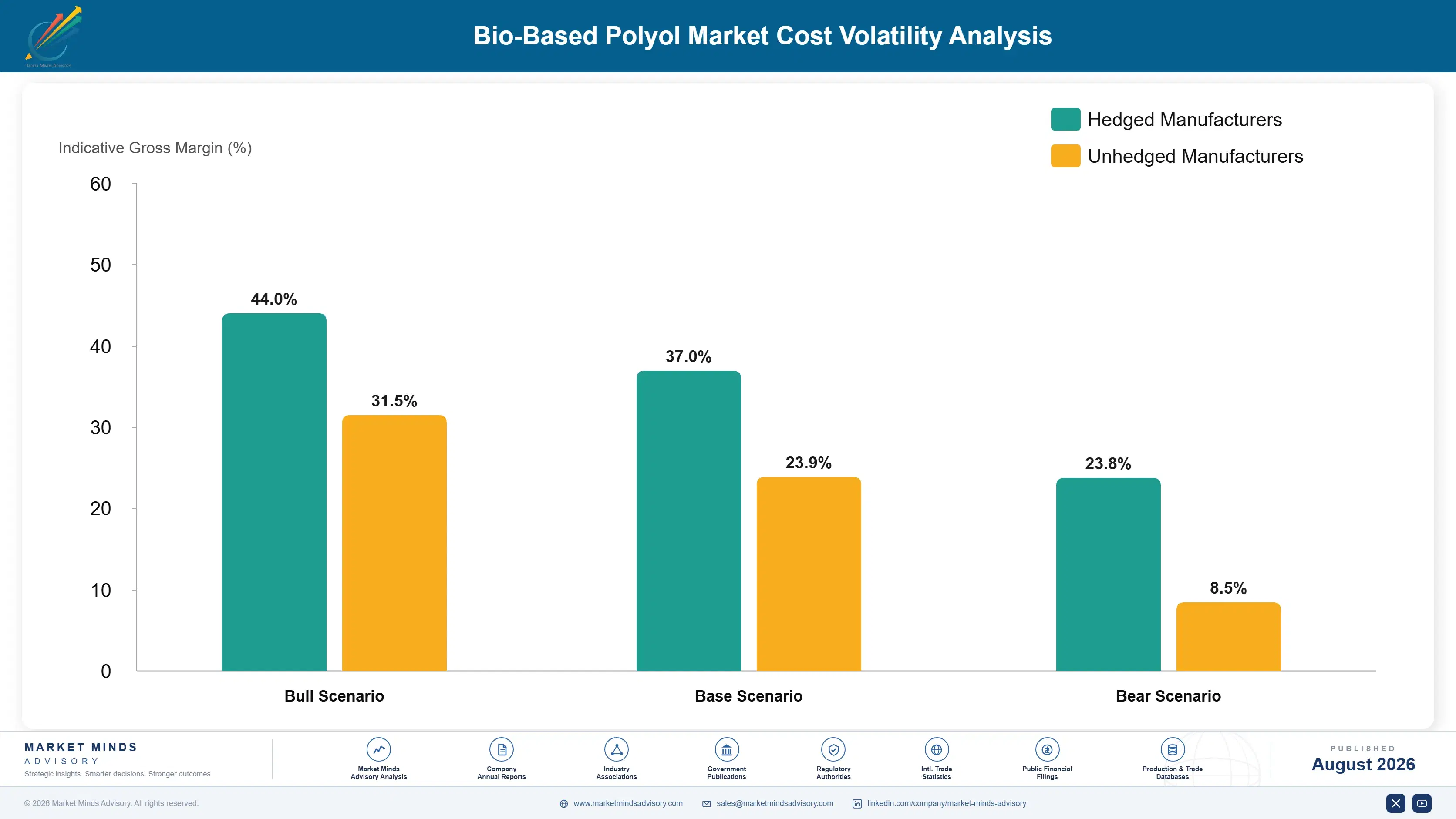
Vegetable Oil Feedstock Cost Exposure

Vegetable oil feedstock, soybean, castor, or palm oil depending on formulation, runs 45 to 55% of COGS, sourced from agricultural growers and processors whose output varies with harvest yield and weather conditions year to year. Processing and catalyst costs add a further 15 to 20%, with logistics and packaging accounting for most of the remainder across standard and specialty polyol grades alike.
The vegetable oil price spike running through 2021 and 2022 hit polyol production cost directly, since soybean and palm oil pricing moved sharply during that period alongside broader agricultural commodity inflation tied to weather disruption and demand recovery. USDA data recorded soybean oil prices reaching multi-year highs across 2022, and Cargill's 2022 Annual Report disclosed elevated input costs across its agricultural supply chain and industrial segment.

Exposure varies sharply by player type. Vertically integrated majors like Cargill source feedstock through their own agricultural supply relationships, insulating them from the worst spot-market volatility, while smaller producers depend on third-party oil brokers and absorb price spikes directly into thinner margins. Geography matters too, since producers near cultivation regions face less transport cost exposure than those importing feedstock across longer supply chains.
bio-based-polyol-market-cost-volatility-analysis-1787302919867

Lock Feedstock Supply Through Multi-Year Grower Contracts

Fixed-volume, multi-year procurement contracts with growers and processors smooth feedstock costs across harvest cycles. Several producers moved a majority of their vegetable oil purchasing onto contract pricing rather than spot markets after the 2021 volatility exposed their exposure directly. Several negotiated favourable terms directly ahead of the next growing season. harvest cycles. across multiple growing seasons.

Diversify Feedstock Type To Reduce Single-Crop Dependence

Producers qualifying formulations against multiple oil types, soy, castor, and palm rather than one alone, reduce exposure to a single crop's harvest volatility. Several producers adopted this diversification as standard practice after supply shortfalls exposed how concentrated their sourcing genuinely was. That diversification has reduced single-crop exposure across the largest producers' output. today. across all regions.

Shift Product Mix Toward Recycled Glycol Alternatives

Recycled and bio-based glycol polyols reduce agricultural commodity price exposure over time, giving producers a durable way to cut input cost volatility while strengthening their supply diversification positioning simultaneously across their broader product portfolio. Several producers have already shifted meaningfully since regulatory momentum accelerated recently. Certification bodies have generally approved this route without extensive additional testing requirements.

Portfolio Architecture for Margin Defence

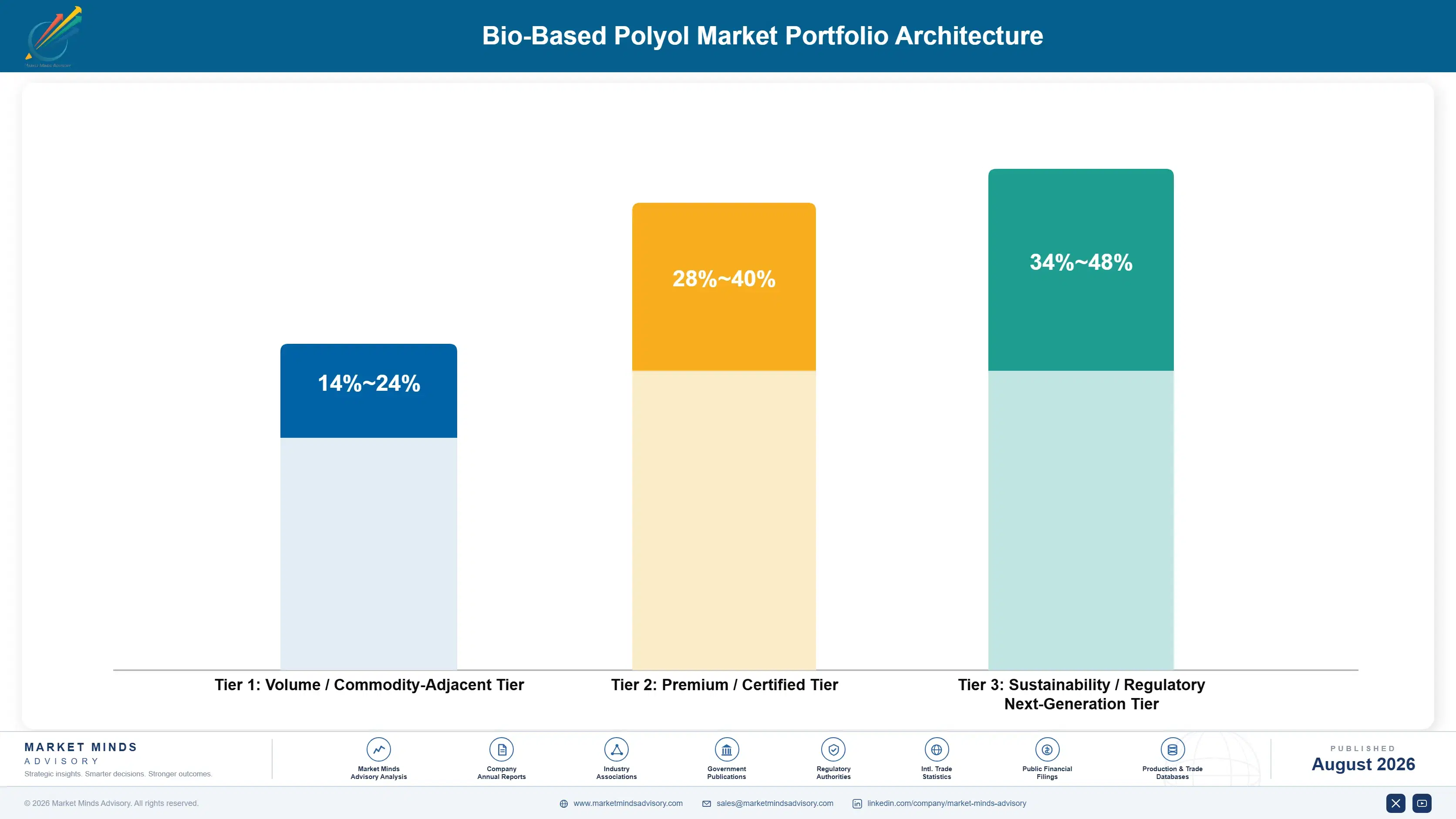
The portfolio splits into three tiers with real margin separation, and the gap between tiers has widened as feedstock diversification becomes a genuine differentiator rather than an add-on feature. Volume-tier standard soy polyol competes on price against generic petroleum alternatives and earns modestly. Premium castor and certified multi-feedstock formulations earn considerably more because they solve a genuine performance and documentation problem that customers cannot engineer around cheaply
The tension is between standard foam volume and per-formulation certified margin. Producers selling standard soy polyol in bulk push hard on unit price, while brand owners standardising on certified multi-feedstock supply agreements pay for documentation reliability and performance consistency rather than negotiating down to the last dollar on every tonne. Producers serving both buyer types run genuinely different sales motions under one brand.

High-value pools concentrate in castor and recycled glycol formulations sold with life-cycle documentation and brand-direct specification agreements, where switching cost is highest and price sensitivity lowest. Legacy standard soy polyol business remains large in volume but persistently thin in margin, as producers across multiple regions continue pressuring price across most standard formulation tenders globally. Producers without a credible diversification roadmap risk being confined to the volume tier permanently.

Volume / Commodity-Adjacent Tier

Standard soy polyol sold into general foam manufacturing channels, priced against generic petroleum alternatives. Margin stays thin because buyers negotiate primarily on cost per tonne. Buyers rarely differentiate between producers on anything beyond delivery speed and price.
Gross Margin: 14-24%

Premium / Certified Tier

Castor and multi-feedstock formulations sold into brand owners requiring documented performance and supply diversification. Buyers pay for reliability and consistency rather than for feedstock alone. Delivery timelines and documented performance matter as much as the feedstock specification itself.
Gross Margin: 28-40%

Sustainability / Regulatory / Next-Generation Tier

Certified life-cycle documented formulations and recycled glycol grades sold into disclosure-sensitive customers. Margin reflects both documentation scarcity and specification premium. Few producers currently combine both elements convincingly at meaningful commercial scale.
Gross Margin: 34-48%
bio-based-polyol-market-portfolio-architecture-1787302920392

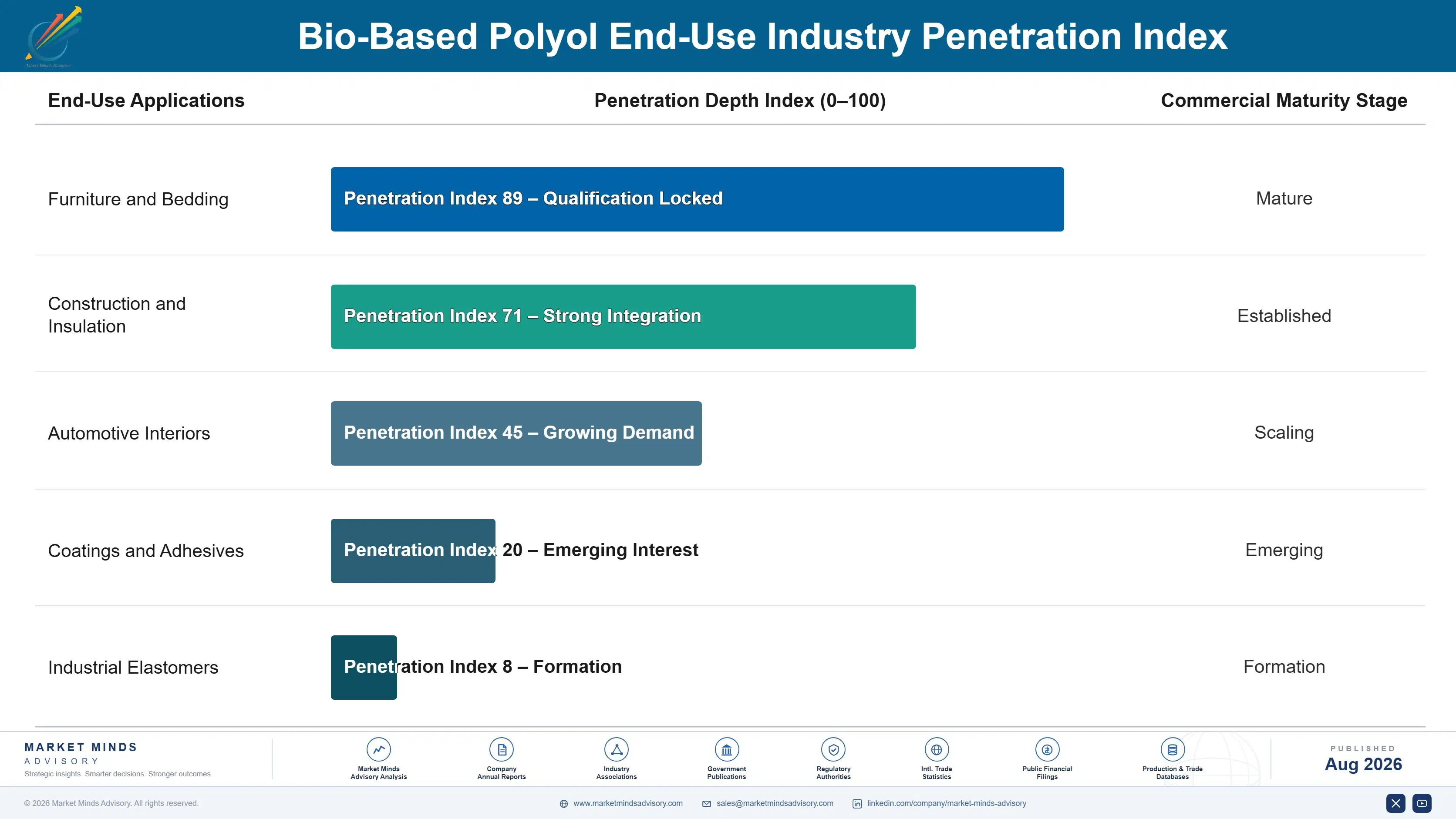
Brand-Anchored Recurring Specification Demand

Demand behaves like an annuity once a producer wins a brand owner's specification, because product formulation contracts run across multiple years and rarely change mid-cycle given the cost of requalification testing across an entire product line. That specification persistence, plus the underlying replacement demand it eventually triggers, gives producers a predictable revenue tail well beyond the original formulation win, converting a single design decision into years of recurring supply volum
Adoption depth varies sharply by end-use vertical. Furniture and bedding manufacturers adopt fastest and deepest once a brand specification is confirmed, since renewable content targets are locked into product standards from the design stage onward. Construction and coatings follow closely on carbon disclosure timelines. Automotive and industrial adopt more selectively, often driven by specific supplier qualification thresholds rather than broad category conversion across an entire product line.

Buyer profiles are shifting generationally. Procurement once sat with purchasing teams evaluating polyol cost per tonne; it now increasingly involves sustainability and product engineering leaders who specify bio-content and documentation requirements before a single formulation is selected. That shift moves the real purchasing decision earlier into the design cycle and rewards producers who can prove supply reliability credibly.
bio-based-polyol-market-end-use-penetration-index-1787302920881

Where Bio-Based Polyol Value Concentrates

These are among the four positions where our research anticipates prominent divergence between winners and laggards over the coming forecast period. Each is grounded in the demand model, the regulatory perimeter, and the announced capacity pipeline.
01 / FEEDSTOCK DIVERSIFICATION STRATEGY

Multi-Feedstock Supply Now Decides Long-Run Category Position

Recycled and bio-based glycol polyols are growing at 11.5%, about 1.35 times the market's 8.5% overall rate, and that gap is widening as formulators seek supply less exposed to agricultural commodity volatility than single-crop grades carry inherently. Producers still anchored on soy alone risk losing the fastest-growing, most resilient segment to rivals who have already diversified across multiple feedstocks. The window to build credible multi-feedstock capability is closing within this forecast period, not the next one, and latecomers will find the largest brand contracts already claimed by faster-moving rivals.
02 / DOCUMENTATION COMPLIANCE STRATEGY

Life-Cycle Documentation Is Becoming Table Stakes

Brand owners and building material specifiers increasingly refuse to award formulation contracts to producers without demonstrated life-cycle assessment documentation, since regulatory disclosure requirements now depend directly on that verified data. Producers who build this documentation capability capture specification wins and pricing power that undocumented competitors simply cannot credibly bid for. Those without a credible documentation platform will find themselves excluded from the largest disclosure-sensitive contracts entirely, regardless of formulation quality, price competitiveness, or prior customer relationship history built over time.
03 / BRAND-DIRECT SPECIFICATION CHANNEL

Direct Brand Relationships Will Outgrow Contract Manufacturer Sales

Consumer brand owners are increasingly folding bio-content specification into corporate material standards rather than leaving formulation selection to individual contract manufacturers, concentrating real purchasing power in a small number of brand-level decisions that smaller producers cannot easily access at scale. Producers who secure brand-direct specification status capture volume across an entire product portfolio that no number of individual contract manufacturer orders can replicate. Those still selling purely through converters risk being locked out of this fastest-growing channel entirely, regardless of feedstock cost.
04 / REGIONAL FEEDSTOCK PRICING

Indian And Southeast Asian Scale Will Keep Pressuring Global Pricing

India's castor cultivation dominance and Southeast Asian palm oil abundance have scaled regional producers fast enough to win price-sensitive standard formulation tenders that global incumbents once assumed were theirs by default, and that pricing pressure is starting to spread into broader regional procurement decisions as well. Producers competing purely on price against fast-scaling regional entrants will struggle to hold margin over any meaningful time horizon. The more durable response is competing on documentation depth and multi-feedstock diversification, categories where regional entrants still visibly lag behind global incumbents.

Engagement Snapshot From the Field

A live engagement with an industry participant carrying material or product regulatory and market exposure ahead of a defining policy shift, showing how our research translates into a defensible multi-year portfolio strategy.
MARKET MINDS ADVISORY · CLIENT ENGAGEMENT SUMMARY
Bio-Based Polyol Producer Strategic Portfolio Review and Transition Roadmap 2026·Investment Scenario on Bio-Based Polyol Exposure Evaluation 2025-26
CLIENT PROFILE
A major furniture and bedding brand owner approached MMA after a soybean harvest shortfall threatened supply continuity for a foam formulation representing a meaningful share of its mattress product line. The client reported the affected product line represented a substantial portion of category revenue, with no qualified backup formulation in place at the time of the shortfall (client-reported, unverified by MMA).
STRATEGIC CHALLENGE
The client had specified soy-based polyol exclusively across its foam supply chain without qualifying an alternative feedstock formulation, assuming soybean supply would remain stable given its scale as a major agricultural commodity. The harvest shortfall exposed how concentrated that single-feedstock dependency actually was, with limited time to qualify an alternative before existing inventory ran out.
MMA APPROACH
MMA benchmarked castor and recycled glycol polyol alternatives against the client's existing soy-based formulation specifications, identifying which alternatives could be qualified fastest without compromising foam density and durability requirements. We evaluated three qualified alternative suppliers on formulation compatibility and supply capacity, and modelled the requalification timeline against the client's remaining soy inventory runway.
KEY FINDINGS
  1. A castor-based alternative formulation could be qualified and validated within the client's remaining inventory runway, avoiding a production gap that a slower-qualifying alternative would have caused.
  2. The client's remaining soy inventory provided a narrower buffer than internal planning had assumed, confirming the urgency of the requalification timeline directly.
  3. Two of three alternative suppliers evaluated could deliver validated formulations within the compressed qualification window; the third required a longer testing cycle regardless of price offered.
  4. Diversifying to a dual soy-castor formulation strategy going forward reduced the client's exposure to any single crop's harvest variability considerably (client-reported, unverified by MMA).
CLIENT PROFILE
A major furniture and bedding brand owner approached MMA after a soybean harvest shortfall threatened supply continuity for a foam formulation representing a meaningful share of its mattress product line. The client reported the affected product line represented a substantial portion of category revenue, with no qualified backup formulation in place at the time of the shortfall (client-reported, unverified by MMA).
STRATEGIC CHALLENGE
The client had specified soy-based polyol exclusively across its foam supply chain without qualifying an alternative feedstock formulation, assuming soybean supply would remain stable given its scale as a major agricultural commodity. The harvest shortfall exposed how concentrated that single-feedstock dependency actually was, with limited time to qualify an alternative before existing inventory ran out.
MMA APPROACH
MMA benchmarked castor and recycled glycol polyol alternatives against the client's existing soy-based formulation specifications, identifying which alternatives could be qualified fastest without compromising foam density and durability requirements. We evaluated three qualified alternative suppliers on formulation compatibility and supply capacity, and modelled the requalification timeline against the client's remaining soy inventory runway.
KEY FINDINGS
  1. A castor-based alternative formulation could be qualified and validated within the client's remaining inventory runway, avoiding a production gap that a slower-qualifying alternative would have caused.
  2. The client's remaining soy inventory provided a narrower buffer than internal planning had assumed, confirming the urgency of the requalification timeline directly.
  3. Two of three alternative suppliers evaluated could deliver validated formulations within the compressed qualification window; the third required a longer testing cycle regardless of price offered.
  4. Diversifying to a dual soy-castor formulation strategy going forward reduced the client's exposure to any single crop's harvest variability considerably (client-reported, unverified by MMA).
RECOMMENDED STRATEGY
Phase 1: Phase 1 (0 to 2 months): Qualify a castor-based alternative formulation as a validated backup to the primary soy specification. Phase 2: Phase 2 (2 to 6 months): Transition a meaningful share of production volume to the dual-feedstock formulation strategy., validating performance across the client's full mattress line. Phase 3: Phase 3 (6 to 18 months): Fold multi-feedstock qualification into the corporate standard for all future product line formulations., reviewing results at each annual product refresh cycle.
OUTCOME
The client avoided a production gap during the soybean shortfall and has since maintained dual-qualified formulations across its full mattress product line. The multi-feedstock qualification approach has been extended to two additional product categories using the same risk mitigation framework (client-reported, unverified by MMA). Leadership now treats dual-feedstock qualification as a standing risk management requirement.

Frequently Asked Questions

Foundational context covering the market sizes, CAGR, scope, country, region and competition that inform every finding below. This section is provided to cover basics and most often pre-purchase conversations, answered from the MMA Primary Research Dataset.

What is the current size of the Bio-Based Polyol Market?

The market was valued at USD 2.4 billion in 2025, with demand heavily concentrated in flexible and rigid foam, coatings, and elastomer applications globally today.

How large will the Bio-Based Polyol Market be by 2036?

The market is projected to reach USD 5.88 billion by 2036, an expansion multiple of 2.26 times its 2026 value. Feedstock diversification drives much of that growth.

What is the CAGR for the Bio-Based Polyol Market 2026 to 2036?

The base case CAGR is 8.5%, with a bull case of 9.7% and a bear case of 7.3%. The range reflects uncertainty around vegetable oil feedstock price volatility.

Which segment is growing fastest?

Recycled and bio-based glycol polyols grow fastest at 11.5%, about 1.35 times the overall market rate, as formulators seek supply less exposed to commodity volatility.

Who are the major companies in the Bio-Based Polyol Market?

Cargill, Dow, BASF, Covestro, and Emery Oleochemicals lead the market at CR5 36%, reflecting genuine oleochemical engineering depth across this broader specialty materials category overall.

Which country is growing fastest?

India grows fastest at 10.2%, driven by castor oil cultivation dominance converting into finished polyol export capacity. The United States remains the largest market by volume.

Report Segmentation Architecture

The full report scope spans multiple orthogonal segmentation dimensions, with cross-tabulated demand data provided for each dimension pair. Coverage extends further to regional breakdowns, trend trajectories, and the competitive detail needed to support segment-level decision-making.

By Feedstock Type

  • Soybean Oil-Based Polyols
  • Castor Oil-Based Polyols
  • Palm Oil-Based Polyols
  • Recycled and Bio-Based Glycol Polyols
  • Rapeseed Oil-Based Polyols
  • Other Bio-Based Polyols

By End-Use Industry

  • Furniture and Bedding
  • Construction and Insulation
  • Automotive Interiors
  • Coatings and Adhesives
  • Industrial Elastomers

By Commercial Dimension

  • Product Redesign Specification Contracts
  • Standard Formulation Sales
  • Certified Life-Cycle Documented Supply
  • Brand-Direct Specification Agreements

By Region

  • North America
  • Western Europe
  • East Asia
  • South Asia and Pacific
  • Latin America
  • Middle East and Africa
  • Eastern Europe

Scope, Methodology, and Coverage

Every figure in this report is reproducible from documented input assumptions. The scope below maps the historical period, the forecast horizon, the segmentation dimensions, and the countries covered, alongside the underlying primary and qualitative methodology.
Historical Period
2020 to 2025
Forecast Period
2026 to 2036
Base Year
2025 (USD billions; MMA Primary Research Dataset, August 2026)
Market Definition
The bio-based polyol market comprises polyols derived from renewable feedstocks, including soybean, castor, palm, and rapeseed oils and recycled or bio-based glycols, used as raw material inputs for polyurethane foam, coatings, adhesives, sealants, and elastomers. Petroleum-based polyols are excluded, as are finished polyurethane products sold downstream of the polyol itself.
Quantitative Units
USD billions (current prices); formulated polyol volume in tonnes where applicable
Segmentation Dimensions
By Feedstock Type; By End-Use Industry; By Commercial Dimension; By Region
Regions Covered
North America, Western Europe, East Asia, South Asia and Pacific, Latin America, Middle East and Africa, Eastern Europe
Countries Covered
USA, China, Germany, France, UK, Japan, South Korea, India, Australia, Canada, Brazil, Mexico, Indonesia, Vietnam, Thailand, Malaysia, UAE, Saudi Arabia, South Africa, Nigeria, Turkey, Poland, Netherlands, Italy, Spain, Sweden, Switzerland, Argentina, Colombia, Singapore, and additional markets relevant to this sector
Key Companies Profiled
Cargill, Dow, BASF, Covestro, Emery Oleochemicals, Jayant Agro-Organics Ltd, Arkema S.A., Vertellus Holdings, BioBased Technologies LLC, Urethane Soy Systems Company, Godrej Industries Limited, NOF Corporation, Kukdo Chemical Co. Ltd, Stepan Company, Huntsman Corporation, Perstorp Holding AB, IOI Oleochemical Sdn Bhd, KLK OLEO, Wilmar International Limited, Croda International Plc
Quantitative Methodology
Primary survey, n=3,800 respondents, Q4 2025, six countries; demand-side model with trade association cross-validation
Qualitative Methodology
47 expert interviews, Q4 2025; applied to validate demand model assumptions, identify emerging dynamics, and assess competitive positioning
Report Format
PDF and XLSX data workbook (Word format preview document)
Publisher
Market Minds Advisory
Report Code
MMA-2026-CHM-104
Published
August 2026
Contact
sales@marketmindsadvisory.com | www.marketmindsadvisory.com

Purchase the full Bio-Based Polyol Market Report (2026 to 2036).

The full MMA Bio-Based Polyol report sizes the market across six feedstock types, five end-use industries, four commercial dimensions, and seven regions through 2036. It profiles twenty participants on a consistent bio-based polyol revenue basis, scoring each on feedstock diversification, documentation depth, and brand-direct delivery capability. Scenario models quantify how building material carbon disclosure, brand owner sustainability commitments, and vegetable oil feedstock volatility move both demand and realised pricing. The report also includes delivered-cost modelling by feedstock type and a brand-specification benchmarking tool built for formulation, sustainability, and procurement teams.
Feedstock type cost and performance benchmarking
Building carbon disclosure compliance tracking model
Multi-feedstock supply chain risk assessment framework
Brand owner sustainability commitment demand model
Component and materials supply chain risk screen
Life-cycle assessment documentation revenue forecasting model

Built For The People Who Decide

From boardroom strategy to bench-side execution, this report is read cover-to-cover by leaders shaping the next decade of their industry, turning demand scenarios, market dynamics and valuation benchmarks into decisions.
CXOs/ Presidents/ VPs/ Managers
M&A and Corporate Development
Strategy Teams and R&D Heads
Procurement and Product Directors
Regulatory and Compliance Leaders
Investor Relations and Equity Analysts