Market Minds Advisory
Binoculars and Mounting Solutions Market

Binoculars and Mounting Solutions Market: Thermal Displacement, Tremor Limits, And An Accessory Nobody Counts

The binocular is the last optical instrument a phone has not replaced, and the growth in it has nothing to do with glass. A thermal pair costs fourteen times a good one.

Lead Analyst

David Horsley

Published

September 2026

Make Smarter Decisions with Customized Research Insights

Request a free sample report and evaluate market opportunities, growth trends, and competitive dynamics relevant to your business needs.

2025 MARKET VALUE$2.6BMarket Size 2025
2036 FORECAST VALUE$4.8BBase Case , 2026 to 2036
CAGR 2026 TO 20365.8 %Bull 7.0% / Bear 4.6%
INCREMENTAL OPPORTUNITY$2.1BNet 10- year value creation
EXPANSION MULTIPLE1.76x2036 value over 2026 base
Strategic Levers
M&A Pipeline
Regional Outlook
Country Rankings
Competitive Intelligence
Segmental Deep-dive
Call-Us : 91 93563 13602

Executive Snapshot and Market Trajectory

No phone gives you eight times magnification through glass, which is why this category survived when every other consumer optic did not. The growth, though, is thermal rather than optical. The market reaches USD 2.6 billion in 2025 and grows at 5.8%. Optical volume has been flat for years.
Thermal imaging binoculars grow fastest at 13.4%, about 2.31 times the market rate, because a hunter or a security operator paying to see a warm body at four hundred metres in the dark is buying a capability no optical instrument offers at any price. North America holds 32% of value on hunting, birding, and marine demand together. Western Europe takes 24% and East Asia 22%. Regional weight follows outdoor participation rather than income.
Concentration sits at 38%, split awkwardly between premium European brands selling optical quality and Asian manufacturers selling volume. Competition has moved to sensor sourcing and warranty terms rather than to glass, which is where the incumbents built their reputations. Mounting hardware attaches to only 23% of instruments sold despite being necessary above twelve times magnification, and almost nobody treats that gap as the commercial opportunity it plainly is.
Market Definition
The binoculars and mounting solutions market covers binocular optical instruments of all types, including optical, image-stabilised, digital night vision, and thermal imaging, together with the tripods, adapters, harnesses, and vehicle and marine mounts sold to support them. Monoculars, spotting scopes, riflescopes, standalone rangefinders, cameras, and general photographic tripods not sold for optical instrument use are excluded.
Base Year Value
$2.6B in 2025 (MMA Primary Research Dataset, August 2026)
Forecast Period
2026 to 2036, eleven discrete annual values
CAGR
5.8% base case. Bull 7.0%. Bear 4.6%.
Fastest Growth Segment
Thermal Imaging Binoculars: 13.4% CAGR
Fastest Growth Country
India: 8.4% CAGR
Fastest Growth Region
South Asia and Pacific: 7.8% CAGR
Largest Region
North America: 32% of 2025 global value
Market Leaders
Carl Zeiss, Swarovski Optik, Nikon, Vortex Optics, Leica Camera. Source: MMA Primary Research Dataset, July 2026.
Primary Survey
n=3,800 procurement and R&D decision-makers, Q4 2025, six countries
Methodology
Demand-side build-up, cross-validated against public data, 47 expert interviews

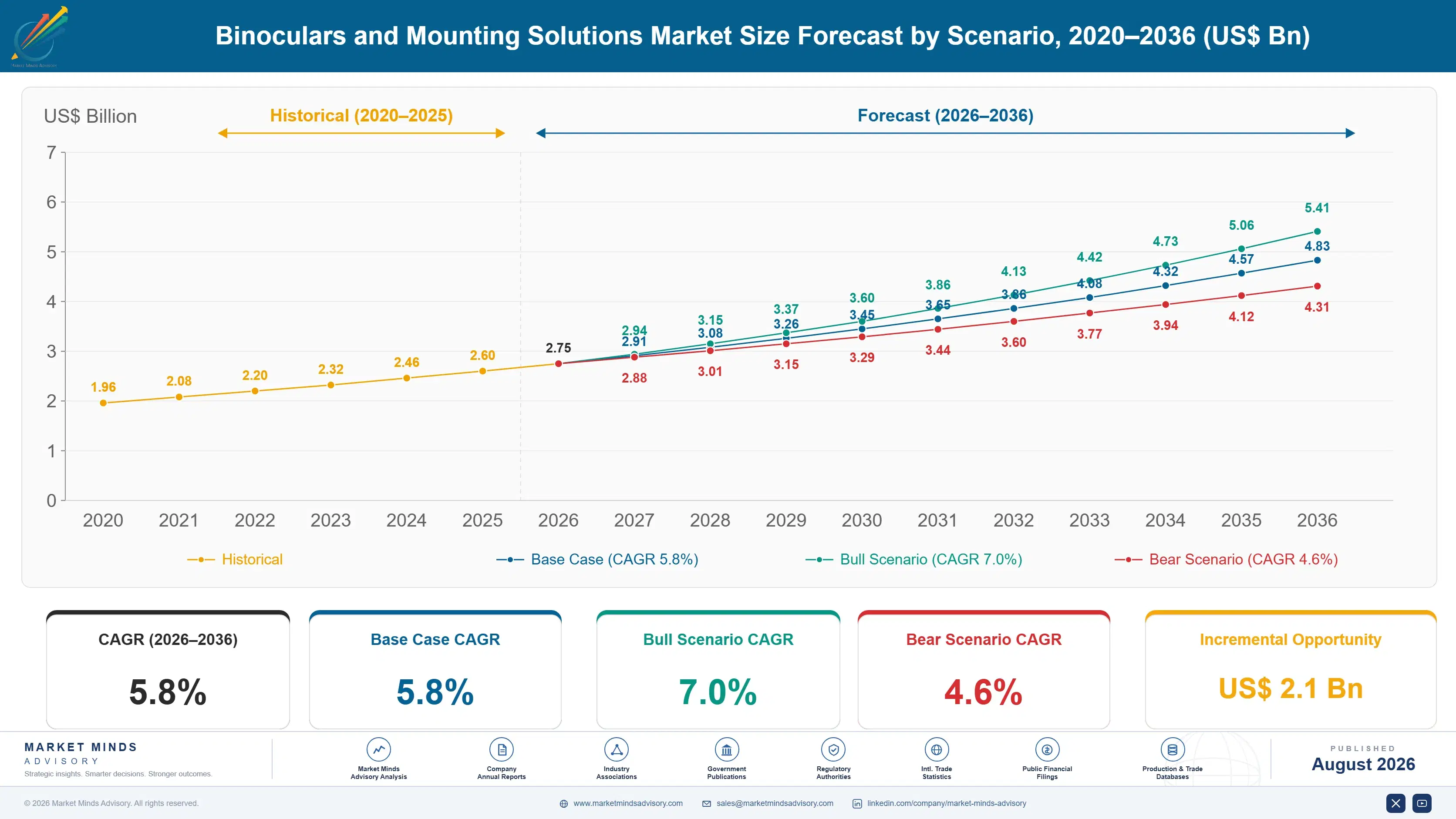
Binoculars and Mounting Solutions Market Forecast Scenarios

binoculars-and-mounting-solutions-market-size-forecast-scenario-1787333490717
Between 2020 and 2025 the optical half of this market barely moved and the thermal half multiplied. Uncooled sensor prices fell far enough that a thermal binocular reached a hunting budget rather than a defence one, and Chinese manufacturers did most of that. Optical binocular unit sales stayed flat against a mature installed base. A 4.7% historical CAGR is one small category growing fast inside one large category standing still.
Three mechanisms carry the 5.8% base case. Thermal sensor cost decline continues as Chinese manufacturers scale, which keeps moving the technology down price brackets it could not previously reach. Hunting regulation is the second and cuts both ways, since several jurisdictions now permit thermal for specific species and others prohibit it entirely. And image stabilisation reached a price where marine and astronomy buyers can now get high magnification without any mount at all.
The 7.0% bull case turns on thermal reaching a mainstream outdoor price bracket, which would put it in front of buyers who currently never consider it. The 4.6% bear case is hunting regulation tightening across major European and American jurisdictions at once. Both scenarios concern thermal, and the optical half of the market barely moves in either.

Two Markets Sharing One Product Name

Blended selling price sits at USD 218 and describes almost nothing, because this category contains a forty dollar porro prism pair and a six thousand dollar thermal instrument under the same name. The optical half is mature, replacement-driven, and priced on glass quality and brand. The thermal half is a sensor business where the buyer wants detection range and nobody discusses coatings at all. Averaging them produces a number no participant recognises.
TOP FIVE CONCENTRATION38%Premium European brands and Asian volume makers split the field
AVERAGE SELLING PRICEUSD 218Blended across optical, digital, and thermal instrument categories
THERMAL PRICE MULTIPLE14 timesThermal instrument price against a comparable premium optical pair
MOUNT ATTACHMENT RATE23%Share of instruments sold with dedicated mounting hardware attached
REPLACEMENT CYCLE LENGTH9 to 14 yearsInterval between purchase and replacement among regular users
LEADING PRODUCER SHARE46%Manufacturing concentrates where optical assembly labour is cheapest
Above roughly twelve times magnification a handheld binocular becomes unusable, because hand tremor moves the image faster than the eye can compensate. That is a physical limit rather than a design failing, and it is why marine, astronomy, and long-range observation all need either a mount or image stabilisation. Mounts attach to only 23% of instruments sold, which suggests a great many buyers own high-power binoculars they cannot properly use.
Replacement runs on a nine to fourteen year cycle for regular users and effectively never for occasional ones, since a well-made optical binocular outlives its owner. Thermal behaves differently: sensor resolution improves fast enough that a five year old instrument feels obsolete, which gives that half of the market a replacement rhythm the optical half has never had.
"Somebody buys a pair of fifteen by seventy binoculars for astronomy, takes them outside, cannot hold them still, and concludes the binoculars are poor. They are not. They needed a mount and nobody in the transaction mentioned it. That failure is worth more than most product development budgets."
Senior Analyst, Optical Instruments Practice · MMA Technology Practice &mi

Market Trends

Thermal Sensor Cost Decline Opens Consumer Price Brackets

An uncooled microbolometer that cost several thousand dollars a decade ago now costs a fraction of that, and Chinese sensor manufacturers drove most of the decline by building volume for security and automotive applications. A thermal binocular consequently reached a hunting budget rather than a defence one, and the category grew at rates the optical half has never seen. Each further step down in sensor cost opens a new bracket of buyers who previously never considered the technology. Detection range and resolution, not optical quality, decide what a customer buys once they are in that bracket.
Market Impact: Rules vary across 27 EU states
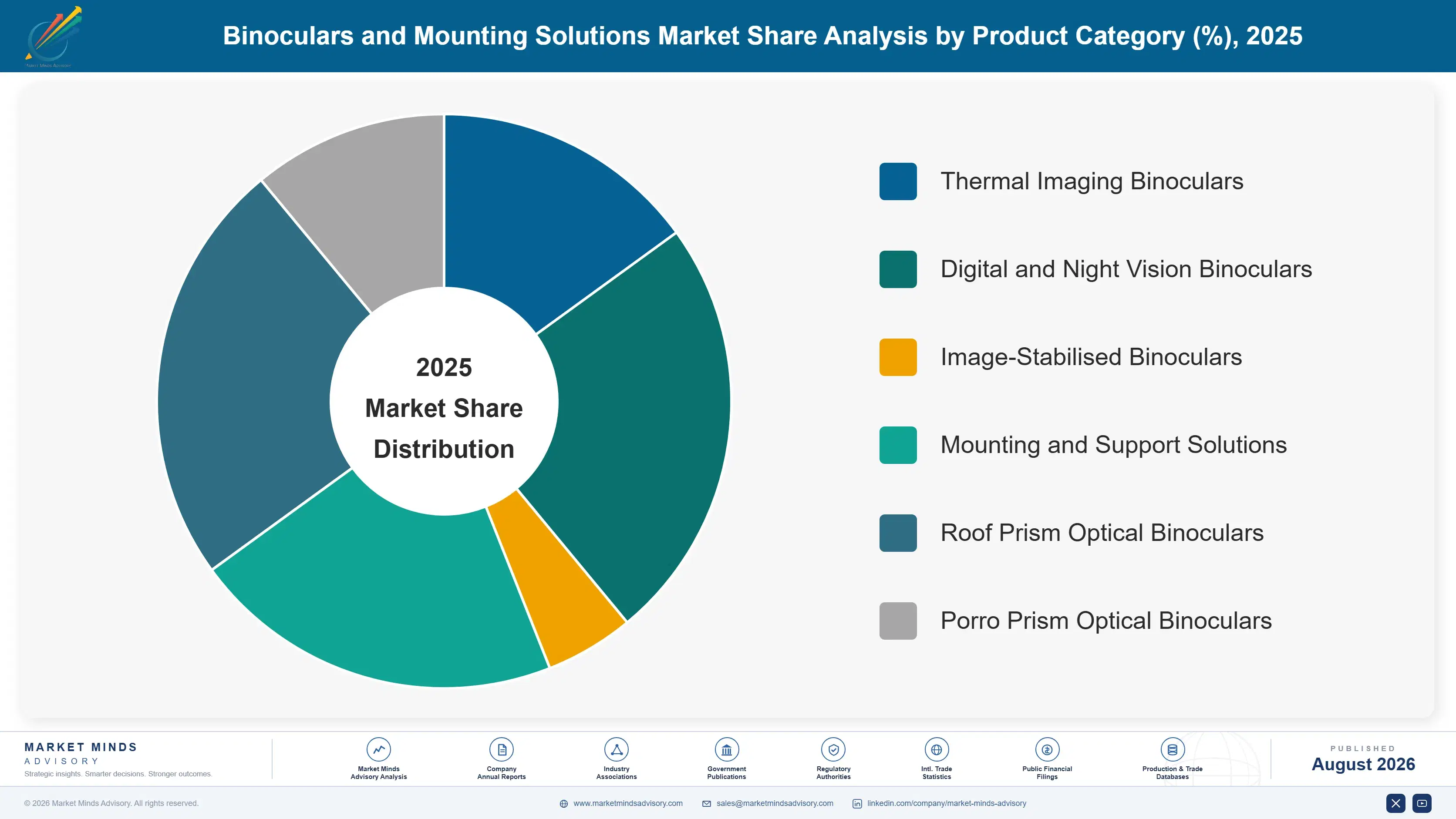
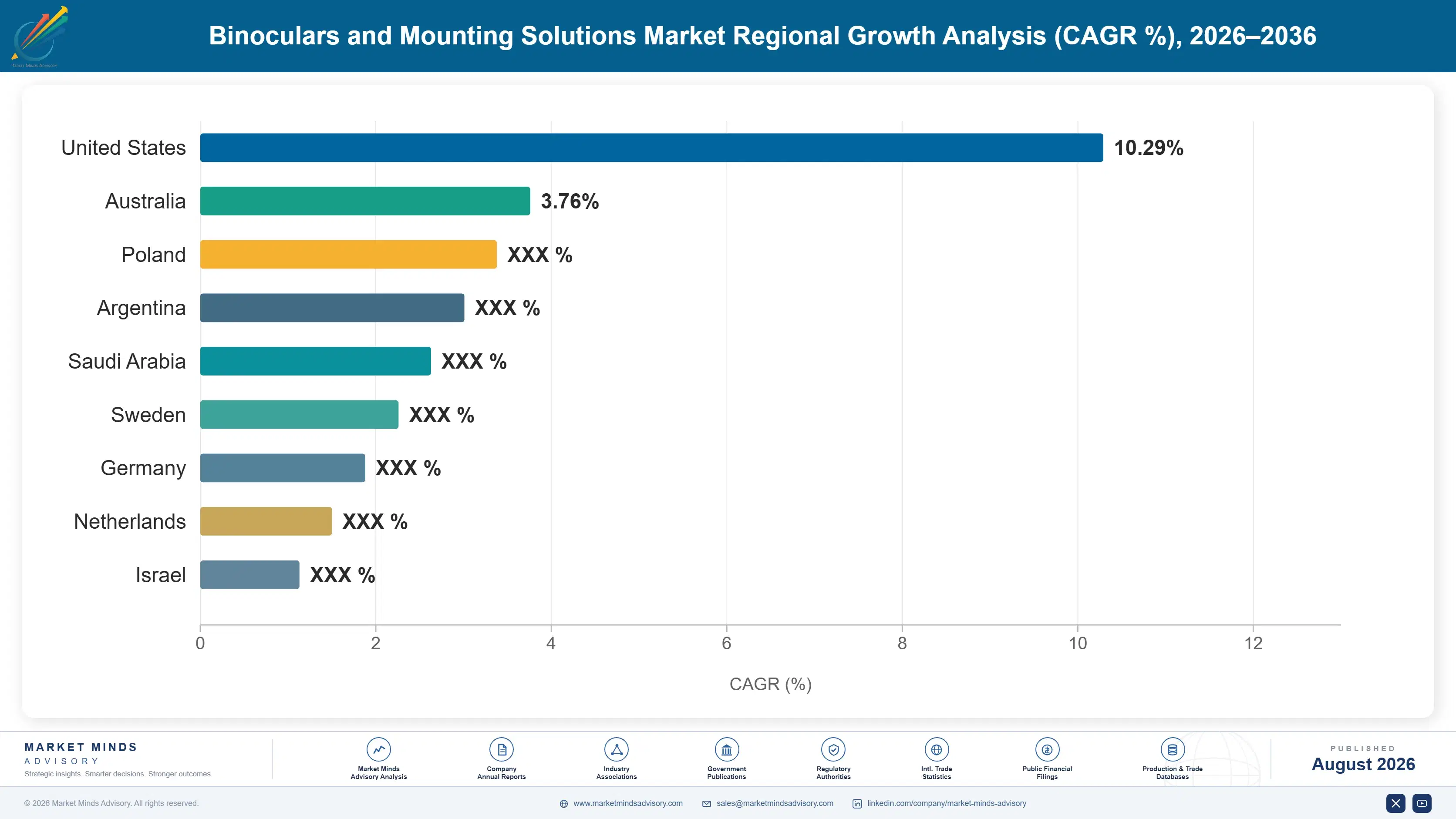
Image Stabilisation Removes The Hand Tremor Ceiling

Hand tremor makes any binocular above roughly twelve times magnification unusable without support, which capped what a handheld instrument could sensibly offer for a century. Optical and electronic stabilisation now hold the image steady enough that sixteen and eighteen times instruments work handheld, and the price has fallen from professional to serious enthusiast levels. Marine users benefit most, since a boat deck removes any possibility of using a mount. Astronomy and long-range terrestrial observation follow behind. The technology sells a capability rather than an improvement, which is a much easier commercial argument to make.
Market Impact: Birders upgrade across 3 price brac

Market Opportunities and Growth Drivers

Hunting Regulation Decides Thermal Demand Jurisdiction By Jurisdiction

Thermal imaging is permitted for wild boar management in several European states, restricted for other species in the same states, and prohibited outright in others, with American rules varying by state and by species in much the same way. That produces a demand map drawn entirely by legislation rather than by preference or income. A single regulatory change can double or eliminate a national market inside a season, which makes forecasting unusually dependent on reading statute rather than survey data. Suppliers who track legislative calendars position inventory ahead of demand that competitors discover afterwards.
Market Impact: Replacement runs 9 to 14 years

Birding Participation Sustains The Optical Volume Base

Recreational birdwatching grew substantially through the pandemic and much of that participation held afterwards, which matters because birders replace instruments more often than casual owners and trade upward through price brackets over time. A serious birder typically moves from an entry pair to a mid-range roof prism instrument and eventually to a premium European one across a decade of participation. That progression is the entire premium optical business case, and it depends on retaining participants rather than on recruiting new ones. Optics brands supporting birding organisations understand this considerably better than their retail partners do.
Market Impact: Sensors from under 5 suppliers

Market Restraints and Challenges

Optical Binocular Demand Is Replacement Only In Developed Markets

A well-made optical binocular has no consumable parts, no electronics, and no meaningful wear mechanism, so it lasts decades and frequently passes to a second owner. The root cause is simply that the product is good, which is an awkward problem to have. Commercially it means developed market optical demand is replacement and gifting rather than growth, and premium brands compete for a fixed pool of upgraders. Suppliers are mitigating with warranty programmes that build brand preference across generations, with accessory attachment, and by pushing into thermal where the replacement rhythm is faster.
Market Impact: Sensor cost down 80% in decade

Chinese Sensor Supply Concentrates Thermal Risk Uncomfortably

Most uncooled microbolometer sensors reaching consumer price points come from a small number of Chinese manufacturers, and Western brands assembling thermal binoculars are buying the component that determines their product's performance from suppliers who also sell finished instruments. The root cause is that Western sensor makers priced for defence and never chased the volume. Commercially this leaves brand owners with limited pricing power and an export control exposure they do not control. Mitigation is limited to dual sourcing where alternatives exist and to differentiating on software, ergonomics, and warranty instead.
Market Impact: Usable magnification rises past 12x
4 additional market trends, 2 additional growth drivers, and 3 additional restraints and challenges are covered in the full report. Contact sales@marketmindsadvisory.com to access the complete intelligence.

Segment CAGR and Growth Architecture

Segmentation follows product category, meaning what a buyer actually purchases as a distinct item, because a thermal instrument and a porro prism pair share a name and nothing else commercially. Prism configuration is used only to divide the conventional optical instruments, and mounting hardware sits as its own category because it is bought separately and by different people entirely.
binoculars-and-mounting-solutions-market-market-share-analysis-1787333491267

Thermal Imaging Binoculars

Thermal grows fastest at 13.4%, about 2.31 times the market rate, and it is not really an optical product at all. The buyer wants detection range in darkness, and no amount of glass quality delivers that at any price, which removes the entire basis on which premium optical brands compete. Uncooled sensor cost decline is what moved the technology from defence budgets into hunting ones, and each further step down opens a new bracket. Chinese sensor manufacturers supply most of what reaches consumer prices, which leaves Western brands assembling around a component they do not control. Software, ergonomics, and warranty are what remains to differentiate on. Nothing about that resembles the optical business.
CAGR 13.4%

Digital and Night Vision Binoculars

Digital and night vision instruments grow at 9.2%, occupying the space between conventional optics and thermal at a fraction of thermal prices. Image intensification and low-light digital sensors both work by amplifying available light rather than detecting heat, which means they show detail and recognisable shapes where thermal shows a signature. Wildlife observation, security patrol, and recreational night use all prefer that. Recording capability matters more here than in any other category, since buyers expect to keep and share what they saw. The segment is squeezed from above by falling thermal prices and from below by improving low-light performance in ordinary cameras. It is a genuinely uncomfortable position to hold for long.
CAGR 9.2%
Full segment breakdown across 7 segments available in the complete report.

Regional Architecture and Country Demand Map

Regional shares track outdoor participation and hunting culture rather than income or population. North America leads on hunting, birding, and marine demand together, Western Europe on birding and premium optical purchasing, and East Asia on manufacturing alongside a growing domestic base. Legislation moves thermal demand more than anything commercial.

North America

North America holds 32% of value, the largest share anywhere, because three separate demand pools overlap here in a way they do not elsewhere. Hunting participation supports both premium optical and thermal instruments, birding sustains steady mid-range volume, and marine use drives image-stabilised demand along both coasts. State-level thermal regulation varies enormously and creates pockets of demand that appear and disappear with legislative sessions. Vortex and other American brands compete on lifetime warranty terms that European premium makers have been reluctant to match. Growth at 5.6% sits close to the global rate, held there by a mature optical base. Three overlapping demand pools is a structure no other region has. Legislative sessions matter as much as retail seasons here.
Share: 32% | CAGR: 5.6% (2026 to 2036)

East Asia

Manufacturing and domestic demand both sit behind East Asia's 22% of value. Chinese and Japanese factories assemble the majority of instruments sold worldwide, including most private label volume for Western retail brands, and Chinese manufacturers supply nearly all the uncooled sensors that made consumer thermal possible. Japanese brands hold precision optical and image stabilisation positions built on camera engineering. Domestic birding and outdoor participation is growing from a small base, particularly in China and South Korea. Growth at 6.6% exceeds the global rate on domestic demand rather than on export volume, which has become harder against tariffs. Domestic participation is the interesting change rather than the manufacturing. Sensor supply concentrates here almost entirely.
Share: 22% | CAGR: 6.6% (2026 to 2036)
Regional intelligence for 5 additional markets available in the complete report: Western Europe, South Asia and Pacific, Latin America, Middle East and Africa, Eastern Europe. Contact sales@marketmindsadvisory.com.
binoculars-and-mounting-solutions-market-country-cagr-analysis-1787333491798

Where Optics Margin Actually Sits

Four levers matter here, and improving the glass is not one of them, because optical quality at the premium end reached diminishing returns years ago. Thermal sensor sourcing, mount attachment, warranty positioning, and regulatory tracking decide outcomes instead. A brand competing on coatings against another brand with equally good coatings is having an argument the buyer cannot resolve.

Attach A Mount To Every High-Power Instrument Sold

Only 23% of instruments ship with mounting hardware, yet anything above twelve times magnification is physically unusable handheld, which means a large share of buyers own an instrument they cannot properly use and blame the optics. Bundling a tripod adapter and recommending a head at the point of sale costs almost nothing, raises transaction value, and prevents the dissatisfaction that stops a customer upgrading later. Mounting hardware also carries better margin than the instrument in many cases. Most brands treat it as a third-party accessory problem and hand away both the revenue and the customer experience.
Market Impact: Only 23% of instruments currently a

Secure Thermal Sensor Supply Before Competitors Do

Consumer-price uncooled sensors come from fewer than 5 manufacturers, nearly all Chinese, and several of them sell finished thermal binoculars in direct competition with the brands they supply. A Western brand without contracted volume is a residual customer in a shortage and a price taker at all times. Multi-year supply agreements, dual sourcing where a second option exists, and joint development on sensor specification each cost commitment before the volume justifies it. The alternative is discovering during an allocation that your supplier prioritised its own product line, which several brands have already discovered.
Market Impact: Fewer than 5 consumer sensor suppli

Sell The Warranty, Not The Specification

A buyer cannot evaluate optical quality in a shop and knows it, which is why comparison shopping in this category collapses into brand reputation and price. An unconditional lifetime warranty resolves that uncertainty in one sentence and has taken Vortex from nothing to a leading position in North America on essentially that argument. It costs perhaps 3% of revenue in claims against a marketing effect no advertising budget buys. European premium brands have resisted it because their products rarely fail, which misses that the promise sells the product rather than the repairs.
Market Impact: Warranty claims cost roughly 3% of

Track Hunting Legislation, Not Just Consumer Demand

Thermal demand in any jurisdiction is created or destroyed by statute rather than by preference, and those statutes move on legislative calendars that are public years ahead. A supplier reading committee schedules knows which markets are opening and can position inventory and dealer relationships before demand appears. One German state permitting thermal for boar management can shift 40% of national demand, which no promotional campaign has ever matched. Most brands in this category still forecast from last season's sell-through, which in a legislated demand pool is close to forecasting backwards.
Market Impact: One state rule shifts 40% of nation

Who Controls the Margin Pool

Concentration sits at 38% for the top five, and the field splits awkwardly rather than cleanly. European premium brands compete on optical quality, Asian manufacturers supply the volume brackets and most private label production, and thermal specialists occupy a category the optical incumbents entered late. The gap between leaders and challengers is warranty terms and sensor access rather than glass. All participants here are assessed on one basis, revenue from binocular instruments and dedicate
Competition runs on four lines. Warranty terms decide mid-market purchases where the buyer cannot evaluate optics and knows it. Sensor supply decides who can build thermal at all and at what price. Brand heritage still decides the premium optical bracket, though it does nothing in thermal. Price decides entry volume, and Chinese manufacturing sets that level for everybody.

Two pressures will shift positions. Chinese thermal specialists sell finished instruments alongside the sensors they supply to Western brands, which is a supplier and a competitor in one relationship. Meanwhile American brands built on warranty rather than heritage keep taking mid-market share from European names. Positions favour whoever holds contracted sensor supply alongside a warranty proposition, and the premium optical houses hold neither.
binoculars-and-mounting-solutions-market-company-positioning-matrix-1787333492314

Competitive Moat and Risk Dimensions

CARL ZEISS

Moat: Optical heritage and premium position

Zeiss holds a century of optical reputation that genuinely converts into price premium in the birding and hunting brackets where buyers can afford to care about coatings and edge sharpness. Manufacturing and glass expertise remain difficult to replicate. Brand association with medical and industrial optics reinforces the consumer proposition in a way pure sporting brands cannot manufacture.
CARL ZEISS

Risk: Heritage counts nothing in thermal

Optical reputation does not transfer to a category where the buyer wants detection range and the sensor determines it, which puts Zeiss in the same position as a new entrant on the fastest-growing segment. Sensor sourcing depends on suppliers who compete downstream. The premium optical base it dominates is mature, replacement-driven, and growing at less than half the market rate.
VORTEX OPTICS

Moat: Unconditional warranty and dealer reach

Vortex built a leading North American position largely on an unconditional lifetime warranty that resolves the one thing a buyer cannot evaluate in a shop. That promise costs a few points of revenue in claims and buys brand preference no advertising budget purchases. Dealer relationships across hunting and outdoor retail run deep, and the range spans entry to enthusiast.
VORTEX OPTICS

Risk: Thin outside North America

The warranty proposition works best where distribution and service infrastructure support it, which is why the position is far weaker in Europe and Asia than the brand's American standing suggests. Manufacturing is outsourced, which limits control over cost and sensor access. Premium European buyers remain resistant to an American brand without optical heritage, and that resistance has not softened much.

Players Tracked

Prominent Players

Carl Zeiss
Swarovski Optik
Nikon
Vortex Optics
Leica Camera

Other Key Players

Canon
OM Digital Solutions
Bushnell
Steiner Optik
Kowa
Fujifilm
Celestron
Maven Outdoor Equipment
Yukon Advanced Optics
Teledyne FLIR
HIKMICRO
InfiRay
Meopta
Manfrotto
Vanguard

Recent Developments

MARCH 2025

Consumer thermal binocular prices reach a new bracket

Thermal binocular models entered price brackets previously occupied only by premium optical instruments, driven by continued uncooled sensor cost decline from Chinese manufacturers. These were product introductions rather than commercial transactions, and they put thermal in front of buyers who had never previously considered the technology at all.
Signal: Each price bracket that thermal reaches co
SEPTEMBER 2024

European states widen thermal permissions for boar management

Additional German states and neighbouring jurisdictions extended permission for thermal imaging in wild boar management while maintaining prohibitions for other species. These were regulatory changes rather than commercial events, and they create national demand pools that appear on a legislative timetable rather than a commercial one.
Signal: A statute passed in one state moves more u
JULY 2024

Image-stabilised models extend into enthusiast price brackets

Several manufacturers introduced image-stabilised binoculars at prices well below the professional bracket the technology previously occupied, targeting marine and astronomy users who need it most directly. These were product launches rather than transactions, and they sell a genuine capability rather than an incremental improvement over conventional optical instruments.
Signal: Selling a capability is a far easier comme

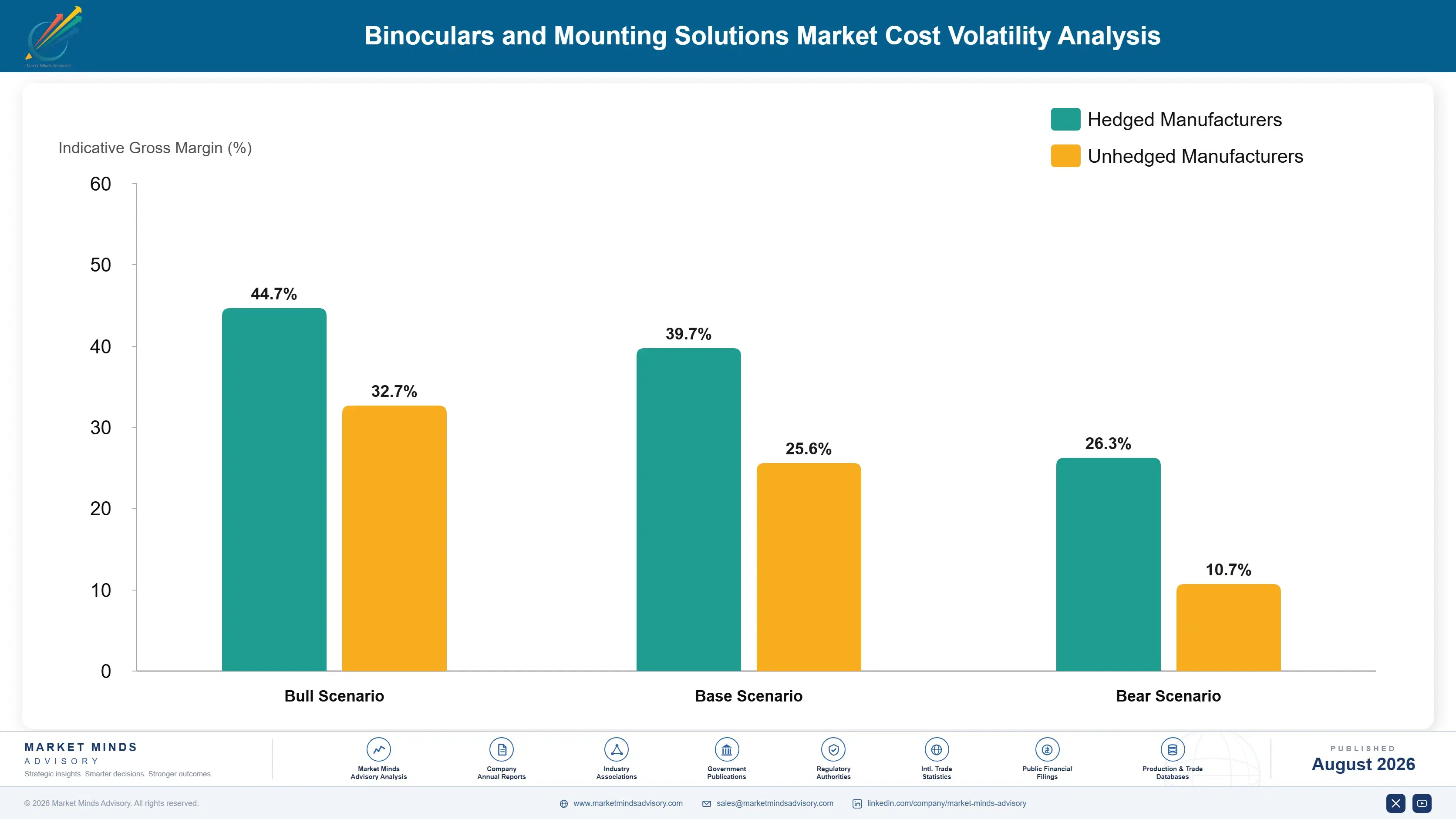
Glass, Sensors, Housings, And Freight

Cost structure diverges completely between the two halves. Optical glass, prisms, and multi-coating carry 28% to 40% of a conventional instrument's cost, from a small set of German, Japanese, and Chinese glass makers. Magnesium and polymer housings with armouring add 14% to 22%. On thermal instruments the uncooled sensor alone runs 42% to 58%, which changes the product economics entirely and leaves everything else as detail.
Optical glass and coating material prices rose through 2021 and 2022 as European energy costs hit glass melting and Chinese export controls tightened on rare earth elements, and the IEA documented the energy constraint. Assembly labour in Japan and China rose alongside it. Carl Zeiss and Canon both disclosed input cost pressure across that period. Premium brands absorbed more than volume brands could, because their buyers notice price less.

Each range above exceeds three points because a porro prism instrument and a thermal binocular share only the strap. Exposure separates by product mix. An optical-weighted brand carries glass and coating risk with several suppliers to choose from. A thermal-weighted brand carries sensor exposure to fewer than five suppliers, most of them competitors. Chinese assemblers hold labour and component proximity no Western manufacturer reaches.
binoculars-and-mounting-solutions-market-cost-volatility-analysis-1787333492512

Contract sensor volume before the allocation arrives

Uncooled sensors reaching consumer prices come from fewer than five manufacturers who also sell finished instruments, which makes an uncontracted brand the residual customer in a shortage. Multi-year volume agreements cost commitment against demand not yet materialised. They also mean production continues during an allocation, which in a category growing at 13.4% decides who holds share.

Qualify a second glass source for every premium line

Optical glass and coating materials come from a narrow set of specialist makers, and switching means revalidating the whole optical prescription rather than swapping a component. That work takes months and cannot be compressed. Doing it while supply is comfortable costs engineering time only, and the alternative is a premium line unable to ship during a materials shortage nobody predicted.

Design housings around one platform across the range

Housings and armouring carry 14% to 22% of optical instrument cost and are largely common across configurations if a brand designs them that way. Most do not, because each model was developed separately and nobody owned tooling. Consolidating onto shared chassis platforms costs one redesign cycle and permanently improves both tooling amortisation and purchasing scale on every unit sold.

Portfolio Architecture for Margin Defence

Three tiers sit inside this category and behave almost independently. Entry optical instruments form the volume tier, assembled in Asia and sold on price through general retail where brand carries little weight. Premium optical and image-stabilised instruments earn considerably more, because the buyer pays for glass quality and reputation and can tell the difference. Thermal and digital night vision price highest, though the margin sits with whoever owns the sensor rather than the brand on the h
The tension is between optical volume that holds shelf space and thermal growth that holds the future. Entry optical keeps a brand in general retail and funds distribution overhead. Thermal grows at nine times the porro prism rate but hands most value to a sensor supplier who competes downstream. Brands built on optical heritage find the second business unfamiliar, and thermal brands cannot charge premium optical prices.

High-value pools concentrate where the buyer cannot substitute: premium optical instruments where reputation carries price power, image-stabilised models solving a physical limit nothing else addresses, mounting hardware attached at point of sale, and thermal where contracted sensor supply exists. The commodity end is entry porro prism binoculars sold on price, where Chinese assembly sets the level.

Volume / Commodity-Adjacent Tier

Entry optical binoculars and basic mounting hardware sold on price through general and outdoor retail. The range is wide because own-brand and private label programmes carry entirely different economics on physically similar product.
Gross Margin: 18-32%

Premium / Certified Tier

Premium roof prism optical instruments and image-stabilised models sold on glass quality, reputation, and capability. The range is wide because European heritage brands hold pricing that Asian premium makers of equal optical quality cannot command.
Gross Margin: 38-56%

Sustainability / Regulatory / Next-Generation Tier

Thermal imaging and digital night vision instruments plus the software and recording features around them. The range is wide because the sensor is bought rather than made and contracted supply produces very different cost positions between brands.
Gross Margin: 30-52%
binoculars-and-mounting-solutions-market-portfolio-architecture-1787333493012

High-value Sub-segments and Strategic Watch-out

Thermal Imaging Binoculars

High value and high growth at 13.4%, the fastest segment, because detection range in darkness is a capability no optical instrument delivers at any price. Sensor supply from fewer than five manufacturers, several of them downstream competitors, is the binding commercial constraint rather than demand.
Gross Margin: 30-52%

Digital and Night Vision Binoculars

High value with strong growth at 9.2%, sitting between conventional optics and thermal at a fraction of thermal pricing and showing detail where thermal shows only a signature. Squeezed from above by falling thermal prices and from below by improving low-light camera performance. A narrowing space to occupy.
Gross Margin: 30-52%

Roof Prism Optical Binoculars

The volume core by value at 4.3%, carrying premium birding and hunting demand where optical quality still commands genuine price power. Replacement runs past a decade and the installed base is mature, so growth depends on upgraders rather than on new participants entering. Upgraders are the whole business case.
Gross Margin: 38-56%

Porro Prism Optical Binoculars

The strategic watch-out at 1.6%, holding entry price brackets and gift purchasing where nobody compares specifications and price is the only variable. Chinese assembly sets the level, no brand defends a position, and the tier exists mainly to hold retail shelf space. Shelf presence is the only argument.
Gross Margin: 18-32%

How Buyers Actually Commit Here

Demand commits at first serious purchase and then repeats slowly, because a good optical instrument lasts a decade or more and the owner rarely regrets it. A birder or hunter who bought well upgrades within the same brand, since the purchase was hard to evaluate and turning out right builds unusual loyalty. That gives premium brands an annuity measured in decades. Thermal breaks the pattern, replacing on sensor obsolescence rather than wear.
Stickiness varies with how much the buyer knows. Serious birders stick hardest, because they compare carefully and return to a brand that delivered. Hunters stick nearly as hard, weighted toward warranty and durability rather than optical subtlety. Marine and astronomy users stick through capability, since few instruments solve their specific problem. Casual and gift buyers stick least, buying whatever the retailer stocks.

The buyer has shifted from a specialist retailer conversation to an online comparison the brand does not participate in. Twenty years ago a shop assistant explained the difference between two instruments. Now a buyer reads reviews, watches comparison videos, and arrives at checkout already decided. Brands funding retail training over reviewer relationships support a channel that stopped deciding years ago.
binoculars-and-mounting-solutions-market-end-use-penetration-index-1787333493502

Our Call On Binoculars

These are among the four positions where our research anticipates prominent divergence between winners and laggards over the coming forecast period. Each is grounded in the demand model, the regulatory perimeter, and the announced capacity pipeline.
01 / MOUNT ATTACHMENT DISCIPLINE

Sell the mount with the instrument, always

Any binocular above twelve times magnification is physically unusable handheld because hand tremor moves the image faster than the eye compensates, yet only 23% of instruments ship with mounting hardware attached to the sale. The buyer who gets home, cannot hold the image steady, and concludes the optics are poor will not upgrade within that brand and frequently not within the category. Bundling an adapter and recommending a head costs almost nothing, raises transaction value, and prevents a disappointment that removes a customer permanently.
02 / THERMAL SENSOR ACCESS

Contract the sensor or leave the segment

Uncooled sensors at consumer prices come from fewer than five manufacturers, most of them Chinese and several selling finished thermal binoculars in direct competition with the brands they supply. A brand without contracted volume is a residual customer during any allocation and a price taker permanently, which is an untenable position in a segment growing at 13.4%. Multi-year supply agreements cost commitment ahead of demand, and the alternative is discovering mid-season that your supplier served its own product line first.
03 / WARRANTY AS PROPOSITION

Promise more than the specification sheet does

A buyer cannot evaluate optical quality standing in a shop or scrolling a website, which collapses comparison shopping into reputation and price and leaves an enormous gap for anybody willing to remove the uncertainty instead. An unconditional lifetime warranty does that in one sentence, costs roughly 3% of revenue in claims, and built a leading North American position for a brand with no optical heritage whatever. European houses have resisted because their products rarely fail, which mistakes what the promise is actually selling.
04 / LEGISLATIVE DEMAND TRACKING

Read the statute before the sell-through data

Thermal demand in any jurisdiction exists or does not exist according to hunting legislation, and those statutes move on public legislative calendars visible years ahead of the season they affect. A supplier tracking those committee schedules positions inventory and dealer relationships before demand appears, while competitors discover the same change from their order book afterwards. Most brands in this category still forecast from last season's sell-through, which in a demand pool created entirely by statute is close to forecasting backwards.

Engagement Snapshot From the Field

A live engagement with an industry participant carrying material or product regulatory and market exposure ahead of a defining policy shift, showing how our research translates into a defensible multi-year portfolio strategy.
MARKET MINDS ADVISORY · CLIENT ENGAGEMENT SUMMARY
Binoculars and Mounting Solutions Producer Strategic Portfolio Review and Transition Roadmap 2026·Investment Scenario on Binoculars and Mounting Solutions Exposure Evaluation 2025-26
CLIENT PROFILE
A European premium optics brand with roughly USD 140 million in annual revenue engaged MMA after two thermal product launches failed to reach a fifth of forecast volume (client-reported, unverified by MMA). The company held an outstanding reputation in birding and hunting optics built across decades, and management could not understand why that reputation delivered nothing whatever in the thermal category.
STRATEGIC CHALLENGE
Marketing wanted a larger launch budget and better placement. Engineering wanted to improve the optical path around the sensor. Neither had asked thermal buyers what they had actually compared before purchasing. The board needed a position on whether to continue investing in thermal before committing the next development cycle and its associated tooling.
MMA APPROACH
MMA surveyed 260 recent thermal binocular purchasers on what they compared, in what order, and how much brand entered the decision at all. We mapped the client's sensor sourcing position against the four suppliers serving consumer price points. We then modelled three routes: continued thermal investment, licensed sensor partnership with contracted volume, and withdrawal to concentrate on premium optical and mounting attachment.
KEY FINDINGS
  1. Detection range and sensor resolution were the first two comparison criteria for 78% of buyers, and optical brand reputation ranked below price and below warranty terms (client-reported, unverified by MMA).
  2. The client bought sensors on spot terms from a supplier selling competing finished instruments, which left it paying more and receiving allocation last during any shortage.
  3. Mount attachment across the client's own premium optical range ran below 15%, well under the category average, representing revenue it was already entitled to and not collecting.
  4. Buyers who had purchased the client's optical instruments showed no measurable preference for its thermal products, which contradicted the entire launch strategy.
CLIENT PROFILE
A European premium optics brand with roughly USD 140 million in annual revenue engaged MMA after two thermal product launches failed to reach a fifth of forecast volume (client-reported, unverified by MMA). The company held an outstanding reputation in birding and hunting optics built across decades, and management could not understand why that reputation delivered nothing whatever in the thermal category.
STRATEGIC CHALLENGE
Marketing wanted a larger launch budget and better placement. Engineering wanted to improve the optical path around the sensor. Neither had asked thermal buyers what they had actually compared before purchasing. The board needed a position on whether to continue investing in thermal before committing the next development cycle and its associated tooling.
MMA APPROACH
MMA surveyed 260 recent thermal binocular purchasers on what they compared, in what order, and how much brand entered the decision at all. We mapped the client's sensor sourcing position against the four suppliers serving consumer price points. We then modelled three routes: continued thermal investment, licensed sensor partnership with contracted volume, and withdrawal to concentrate on premium optical and mounting attachment.
KEY FINDINGS
  1. Detection range and sensor resolution were the first two comparison criteria for 78% of buyers, and optical brand reputation ranked below price and below warranty terms (client-reported, unverified by MMA).
  2. The client bought sensors on spot terms from a supplier selling competing finished instruments, which left it paying more and receiving allocation last during any shortage.
  3. Mount attachment across the client's own premium optical range ran below 15%, well under the category average, representing revenue it was already entitled to and not collecting.
  4. Buyers who had purchased the client's optical instruments showed no measurable preference for its thermal products, which contradicted the entire launch strategy.
RECOMMENDED STRATEGY
Phase 1: Phase 1 (0 to 8 months): Halt further thermal development spend and open contracted volume discussions with two sensor manufacturers. Phase 2: Phase 2 (8 to 20 months): Launch a mount attachment programme across the premium optical range with dealer training and bundled adapters. Phase 3: Phase 3 (20 to 36 months): Re-enter thermal only on contracted supply, positioned on ergonomics and warranty rather than on optical heritage.
OUTCOME
The board paused thermal development and funded the mount attachment programme instead, which the commercial director described as the only recommendation nobody had argued against. Attachment rates roughly doubled within three quarters at unchanged instrument pricing, and one sensor supply agreement has since been signed (client-reported, unverified by MMA). Thermal re-entry remains scheduled rather than committed.

Frequently Asked Questions

Foundational context covering the market sizes, CAGR, scope, country, region and competition that inform every finding below. This section is provided to cover basics and most often pre-purchase conversations, answered from the MMA Primary Research Dataset.

What is the current size of the Binoculars and Mounting Solutions Market?

The global market is valued at USD 2.6 billion in 2025, covering optical, image-stabilised, digital night vision, and thermal binoculars with their dedicated mounting hardware. Monoculars, spotting scopes, and riflescopes are excluded.

How large will the Binoculars and Mounting Solutions Market be by 2036?

The market is forecast to reach USD 4.83 billion by 2036 in the base case, about 1.76 times the 2026 level. That represents incremental value of roughly USD 2.08 billion.

What is the CAGR for the Binoculars and Mounting Solutions Market 2026 to 2036?

The market grows at a 5.8% CAGR in the base case, with bull and bear scenarios at 7.0% and 4.6%. The spread turns almost entirely on thermal pricing and on hunting regulation.

Which segment is growing fastest?

Thermal imaging binoculars grow fastest at 13.4%, about 2.31 times the overall rate, because detection range in darkness is a capability optics cannot deliver. Digital and night vision instruments follow at 9.2%.

Who are the major companies in the Binoculars and Mounting Solutions Market?

Leading participants include Carl Zeiss, Swarovski Optik, Nikon, Vortex Optics, and Leica Camera. Concentration sits at roughly 38%, split between European premium brands and Asian volume manufacturers.

Which country is growing fastest?

India grows fastest at an 8.4% CAGR, driven by expanding wildlife tourism and birding participation from a low base. China follows on domestic outdoor participation and manufacturing scale.

Report Segmentation Architecture

The full report scope spans multiple orthogonal segmentation dimensions, with cross-tabulated demand data provided for each dimension pair. Coverage extends further to regional breakdowns, trend trajectories, and the competitive detail needed to support segment-level decision-making.

By Product Category

  • Thermal Imaging Binoculars
  • Digital and Night Vision Binoculars
  • Image-Stabilised Binoculars
  • Mounting and Support Solutions
  • Roof Prism Optical Binoculars
  • Porro Prism Optical Binoculars

By End-Use Industry

  • Hunting and Wildlife Management
  • Birding and Nature Observation
  • Marine and Boating
  • Astronomy and Sky Observation
  • Security Surveillance and Search

By Distribution Channel

  • Specialist Optics Retail
  • Outdoor and Sporting Goods Chains
  • Direct to Consumer Online
  • General and Mass Retail

By Region

  • North America
  • East Asia
  • Western Europe
  • South Asia and Pacific
  • Latin America
  • Middle East and Africa
  • Eastern Europe

Scope, Methodology, and Coverage

Every figure in this report is reproducible from documented input assumptions. The scope below maps the historical period, the forecast horizon, the segmentation dimensions, and the countries covered, alongside the underlying primary and qualitative methodology.
Historical Period
2020 to 2025
Forecast Period
2026 to 2036
Base Year
2025 (USD billions; MMA Primary Research Dataset, August 2026)
Market Definition
The binoculars and mounting solutions market comprises the manufacture and sale of binocular optical instruments and the dedicated support hardware sold with or for them, valued at manufacturer selling prices to specialist retailers, outdoor chains, online sellers, and direct consumers. It spans porro prism and roof prism conventional optical instruments, image-stabilised binoculars, digital and image-intensified night vision binoculars, and uncooled thermal imaging binoculars, together with tripods and heads sold for optical use, tripod adapters, parallelogram and pillar mounts, harnesses and chest carriers, window and vehicle mounts, and marine and digiscoping adapters. Monoculars and single-eyepiece devices, spotting scopes, riflescopes and weapon-mounted optics, standalone laser rangefinders, cameras and camera lenses, microscopes and telescopes, and general photographic tripods not sold for optical instrument support are excluded. Repair, refurbishment, and collimation services sold independently sit outside scope.
Quantitative Units
USD billions (current prices); volume in millions of instruments shipped
Segmentation Dimensions
By Product Category; By End-Use Industry; By Distribution Channel; By Region
Regions Covered
North America, East Asia, Western Europe, South Asia and Pacific, Latin America, Middle East and Africa, Eastern Europe
Countries Covered
USA, Canada, Mexico, Germany, Austria, Switzerland, UK, France, Italy, Spain, Netherlands, Sweden, Norway, Japan, China, South Korea, Taiwan, India, Australia, New Zealand, Indonesia, Thailand, Vietnam, Brazil, Costa Rica, Ecuador, Peru, Colombia, Argentina, South Africa, Kenya, Tanzania, Botswana, Saudi Arabia, United Arab Emirates, Poland, Czechia, Hungary, Romania, and additional markets relevant to this sector
Key Companies Profiled
Carl Zeiss, Swarovski Optik, Nikon, Vortex Optics, Leica Camera, Canon, OM Digital Solutions, Bushnell, Steiner Optik, Kowa, Fujifilm, Celestron, Maven Outdoor Equipment, Yukon Advanced Optics, Teledyne FLIR, HIKMICRO, InfiRay, Meopta, Manfrotto, Vanguard
Quantitative Methodology
Primary survey, n=3,800 respondents, Q4 2025, six countries; demand-side model with trade association cross-validation
Qualitative Methodology
47 expert interviews, Q4 2025; applied to validate demand model assumptions, identify emerging dynamics, and assess competitive positioning
Report Format
PDF and XLSX data workbook (Word format preview document)
Publisher
Market Minds Advisory
Report Code
MMA-2026-TEC-477
Published
August 2026
Contact
sales@marketmindsadvisory.com | www.marketmindsadvisory.com

Purchase the full Binoculars and Mounting Solutions Market Report (2026 to 2036).

The full MMA Binoculars and Mounting Solutions report sizes the market across six product categories, five end-use segments, four distribution channels, and seven regions through 2036. It profiles 20 participants on a consistent basis of instrument and mounting hardware revenue, scoring each on thermal sensor access, warranty proposition, optical brand equity, and mount attachment performance. Scenario models quantify how thermal sensor pricing, hunting legislation, and outdoor participation move both volume and achievable margin. The report also includes hunting regulation tracking by jurisdiction, thermal sensor supplier mapping, mount attachment benchmarking by brand, and a purchase decision survey covering recent thermal and optical buyers.
Six-category and four-channel market sizing to 2036
Twenty-participant benchmark on instrument and mounting revenue
Hunting regulation tracking by jurisdiction and species
Thermal sensor supplier mapping and capacity assessment
Mount attachment rate benchmarking across major brands
Purchase decision survey covering thermal and optical buyers

Built For The People Who Decide

From boardroom strategy to bench-side execution, this report is read cover-to-cover by leaders shaping the next decade of their industry, turning demand scenarios, market dynamics and valuation benchmarks into decisions.
CXOs/ Presidents/ VPs/ Managers
M&A and Corporate Development
Strategy Teams and R&D Heads
Procurement and Product Directors
Regulatory and Compliance Leaders
Investor Relations and Equity Analysts