Market Minds Advisory
Bi-Metal Cans Market

Bi-Metal Cans Market: Cost Logic Meets Recycling Policy Pressure

Aluminum price volatility and import tariffs are pushing beverage brands back toward cheaper steel-bodied bi-metal cans, even as recyclers warn that mixed-metal construction complicates single-stream sorting and threatens the closed-loop recycling claims brand owners need.

Lead Analyst

Bilal Shaikh

Published

August 2026

Make Smarter Decisions with Customized Research Insights

Request a free sample report and evaluate market opportunities, growth trends, and competitive dynamics relevant to your business needs.

2025 MARKET VALUE$2.8BMarket Size 2025
2036 FORECAST VALUE$5.0BBase Case , 2026 to 2036
CAGR 2026 TO 20365.4 %Bull 6.6% / Bear 4.2%
INCREMENTAL OPPORTUNITY$2.0BNet 10- year value creation
EXPANSION MULTIPLE1.69x2036 value over 2026 base
Strategic Levers
M&A Pipeline
Regional Outlook
Country Rankings
Competitive Intelligence
Segmental Deep-dive
Call-Us : 91 93563 13602

Executive Snapshot and Market Trajectory

Bi-metal cans, steel bodies paired with aluminum easy-open ends, are gaining renewed commercial relevance as beverage brands facing aluminum price volatility and import tariffs rediscover a construction format that trades a small weight penalty for meaningfully lower and more stable input cost, particularly across price-sensitive emerging beverage markets.
Beverage cans grow fastest at 7.8%, roughly 1.44 times the overall rate, as India's steel-abundant, aluminum-import-dependent economy keeps favoring bi-metal construction over all-aluminum alternatives that dominate Western markets. South Asia and Pacific holds an outsized 15% regional share for a category this size, well above the typical band for the region, reflecting India's position as the world's largest single bi-metal beverage can market by a considerable margin.
Competitive intensity centers on roughly half the market held by five global can makers, with Crown Holdings and Ball Corporation leading on manufacturing scale and beverage brand relationships respectively. Recycling policy pressure compounds the picture, since mixed-metal construction complicates the single-stream sorting infrastructure many municipalities have built around pure aluminum or pure steel recovery, forcing manufacturers to defend the format's genuine cost advantage against a mounting sustainability credibility challenge specifically for the category.
Market Definition
The bi-metal cans market covers rigid metal containers constructed with a steel or tinplate body combined with an aluminum end, or the reverse configuration, used across beverage, aerosol, food, paint, and pet food packaging applications. It excludes monolithic all-aluminum cans, all-steel three-piece cans, and non-metal packaging formats such as glass, plastic, or composite cartons.
Base Year Value
$2.8B in 2025 (MMA Primary Research Dataset, August 2026)
Forecast Period
2026 to 2036, eleven discrete annual values
CAGR
5.4% base case. Bull 6.6%. Bear 4.2%.
Fastest Growth Segment
Beverage Cans: 7.8% CAGR
Fastest Growth Country
India: 11.5% CAGR
Fastest Growth Region
South Asia and Pacific: 7.4% CAGR
Largest Region
East Asia: 27% of 2025 global value
Market Leaders
Crown Holdings, Ball Corporation, CANPACK, Ardagh Group, Hindustan Tin Works. Source: MMA Analysis based on company annual reports.
Primary Survey
n=3,800 procurement and R&D decision-makers, Q4 2025, six countries
Methodology
Demand-side build-up, cross-validated against public data, 47 expert interviews

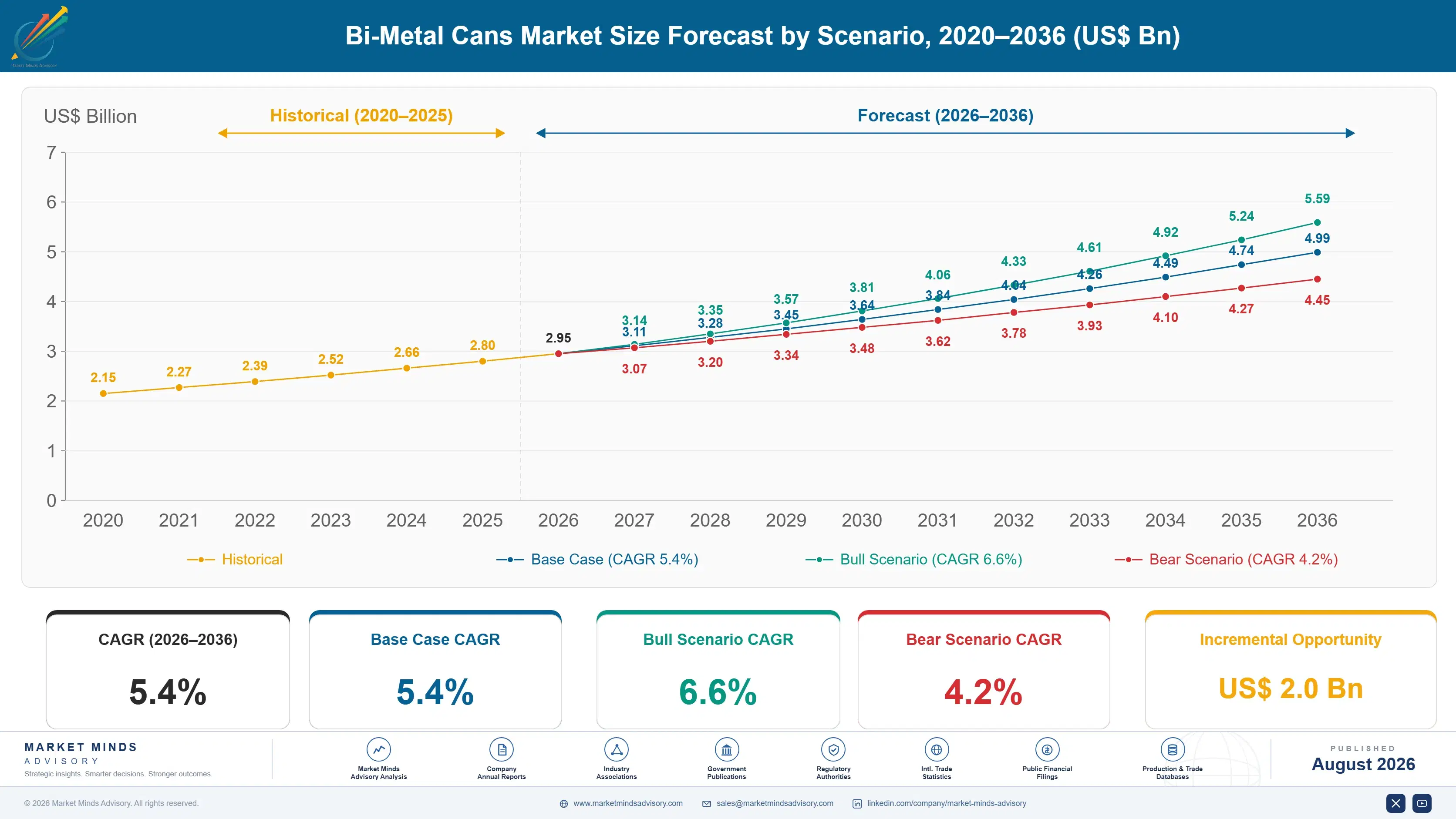
Bi-Metal Cans Market Forecast Scenarios

bi-metal-cans-market-size-forecast-scenario-1787300672680
Between 2020 and 2025 the market grew at roughly 4.6% annually, held back early by pandemic-era beverage foodservice disruption before accelerating as aluminum prices spiked sharply in 2021 and 2022, pushing several Indian and Southeast Asian beverage fillers to convert or expand bi-metal production lines rather than absorb rising all-aluminum can costs. Growth moderated somewhat as aluminum prices eased into 2023 and 2024.
The base case carries the market to 5.4% annual growth through three mechanisms. First, India's beverage consumption keeps expanding faster than domestic aluminum smelting capacity, sustaining the cost logic that favors bi-metal construction. Second, aerosol and personal care manufacturers across emerging markets increasingly specify bi-metal cans for cost reasons similar to those driving beverage adoption. Third, Southeast Asian and African beverage markets are beginning to follow India's bi-metal adoption pattern as their own aluminum import dependence increases.
The bull case, 6.6%, assumes aluminum price volatility persists or worsens due to trade policy disruption, pulling additional beverage fillers across Southeast Asia and Africa toward bi-metal conversion faster than planned. The bear case, 4.2%, assumes aluminum prices stabilize and recycling policy pressure against mixed-metal construction intensifies enough to slow new bi-metal adoption in markets still deciding between formats.

Cost Logic Meets Recycling Policy Pressure

Three forces converge on this market simultaneously. Aluminum price volatility keeps making steel-bodied construction commercially attractive wherever beverage margins are thin and volume is high. India's beverage market keeps expanding faster than domestic aluminum supply, sustaining the underlying cost logic regardless of global commodity cycles. And recycling policy pressure keeps building against mixed-metal formats as municipalities and brand owners face tightening packaging sustainability
MARKET CONCENTRATIONCR5: 52%Top five can makers hold slightly more than half share
AVERAGE UNIT COST SAVINGS8% to 15% vs all-aluminumSavings vary by regional aluminum and steel pricing
TOP PRODUCING COUNTRYIndia: 33% of outputDomestic bi-metal beverage can demand anchors most production
CAPACITY UTILIZATION77%Bi-metal production lines run comfortably above regional average
METAL COST SHARE58% of COGSCombined steel and aluminum input costs dominate total spending
RECYCLING RECOVERY RATE41% globallyMixed-metal construction still complicates standard sorting facility recovery
Commercially, this market behaves like a regional cost-arbitrage business layered onto a global commodity trade. Can makers compete on metal sourcing efficiency and manufacturing flexibility as much as on price, since beverage fillers increasingly demand the ability to switch between bi-metal and all-aluminum formats as relative commodity pricing shifts. That sourcing flexibility, more than brand recognition, increasingly separates competitive can makers from single-format specialists.
Over the next decade expect continued regional bifurcation between markets favoring bi-metal on cost grounds and markets favoring all-aluminum on recycling simplicity grounds across every major economy. India's beverage boom will keep anchoring global bi-metal volume for the foreseeable future. And recycling technology investment, more than manufacturing cost alone, will increasingly determine whether mixed-metal formats retain long-term commercial viability worldwide.
"Bi-metal cans exist because aluminum is expensive in the wrong places. The moment that stops being true in India, this entire category has a genuine problem."
Director, Packaging and Materials Practice · MMA Packaging Practice &middo

Market Trends

Aluminum Price Volatility Sustains Bi-Metal Cost Logic

Aluminum prices have swung significantly across recent years, driven by energy cost volatility affecting smelting operations, trade policy actions including tariffs on imported aluminum, and shifting demand from electric vehicle and construction sectors competing for the same primary metal supply. Beverage fillers in aluminum-import-dependent markets like India have responded by expanding bi-metal production capacity, since steel bodies sourced from domestic mills insulate can cost from aluminum-specific volatility entirely. Several Southeast Asian beverage markets are now evaluating similar conversions as their own aluminum import costs climb, extending a cost logic that originated in India to comparable emerging economies elsewhere.
Market Impact: Anchors 33% of global bi-metal output
Recyclers Push Back On Mixed-Metal Can Construction

Recycling industry associations in several developed markets have raised concerns that bi-metal cans complicate the eddy current and optical sorting systems most material recovery facilities built specifically around single-metal aluminum or steel recovery streams. Some municipalities report meaningfully lower effective recovery rates for bi-metal formats compared with all-aluminum cans processed through the same facility, creating tension with brand owners who need to substantiate recyclability claims for regulatory and consumer-facing sustainability reporting purposes. Manufacturers are responding by developing easier-to-separate end and body designs, though widespread facility retrofit investment remains the larger unresolved industry-wide challenge specifically in mature recycling markets.
Market Impact: Adds 6.5% aerosol segment growth

Market Opportunities and Growth Drivers

India's Beverage Market Keeps Outgrowing Aluminum Supply

India's carbonated soft drink and beer consumption keeps expanding faster than domestic aluminum smelting capacity can economically supply, sustaining durable demand for bi-metal construction that uses domestically abundant steel for the can body while limiting aluminum use to the easy-open end alone. Hindustan Tin Works and several regional can makers have expanded bi-metal production capacity to serve this demand, and industry estimates suggest bi-metal formats now account for a majority share of India's total beverage can volume, a position unmatched elsewhere globally. This dynamic gives India outsized influence over global bi-metal demand trends.
Market Impact: Cuts effective recycling rates by 15%

Aerosol Manufacturers Adopt Bi-Metal For Cost Savings

Personal care and household aerosol manufacturers across price-sensitive emerging markets increasingly specify bi-metal construction for the same cost reasons driving beverage adoption, since aerosol cans require similar pressure-resistant body construction that steel provides at meaningfully lower cost than aluminum in most regional markets outside North America and Western Europe. Growing personal care consumption across South Asia, Southeast Asia, and parts of Africa is expanding the addressable aerosol can market at a pace that outstrips overall packaging industry growth, giving bi-metal aerosol formats a genuine volume growth opportunity independent of the beverage segment's own India-specific dynamics entirely.
Market Impact: Limits addressable share to 15%

Market Restraints and Challenges

Mixed-Metal Construction Complicates Recycling Sorting Systems

Bi-metal cans require separating steel and aluminum components before either material can be effectively recycled into new metal stock, a separation step most existing material recovery facilities were not originally designed to perform efficiently at scale. The root cause is infrastructure mismatch: recycling sorting technology developed around single-metal aluminum and steel recovery streams rather than anticipating mixed-metal packaging becoming commercially significant. The commercial impact falls hardest on brand owners marketing sustainability claims, since bi-metal cans achieve measurably lower effective recycling rates than all-aluminum alternatives. Some manufacturers are responding by redesigning ends for easier manual or automated separation.
Market Impact: Cuts unit cost 8% to 15%

All-Aluminum Cans Dominate Mature Western Beverage Markets

North American and Western European beverage markets have standardized almost entirely on all-aluminum can construction, leaving bi-metal formats with essentially no addressable volume in the world's most valuable beverage packaging markets by unit value. The root cause is historical: aluminum infrastructure, recycling systems, and brand specifications were established decades ago before bi-metal's cost advantage became relevant in price-sensitive emerging economies. The commercial impact caps bi-metal's total addressable market meaningfully below what beverage volume alone would suggest, concentrating the format's relevance in a specific subset of emerging markets. Manufacturers are responding by focusing investment where the format's cost logic applies.
Market Impact: Cuts recovery rates up to 20%
3 additional market trends, 2 additional growth drivers, and 4 additional restraints and challenges are covered in the full report. Contact sales@marketmindsadvisory.com to access the complete intelligence.

Segment CAGR and Growth Architecture

Segmentation follows application, the single classification logic that determines can geometry, pressure rating, and metal composition ratio. Beverage, aerosol, food, paint, pet food, and specialty promotional cans each demand distinct body-to-end material ratios and manufacturing tolerances, so commercial position tracks end-use packaging requirement rather than can size or brand ownership specifically across every producing region tracked.
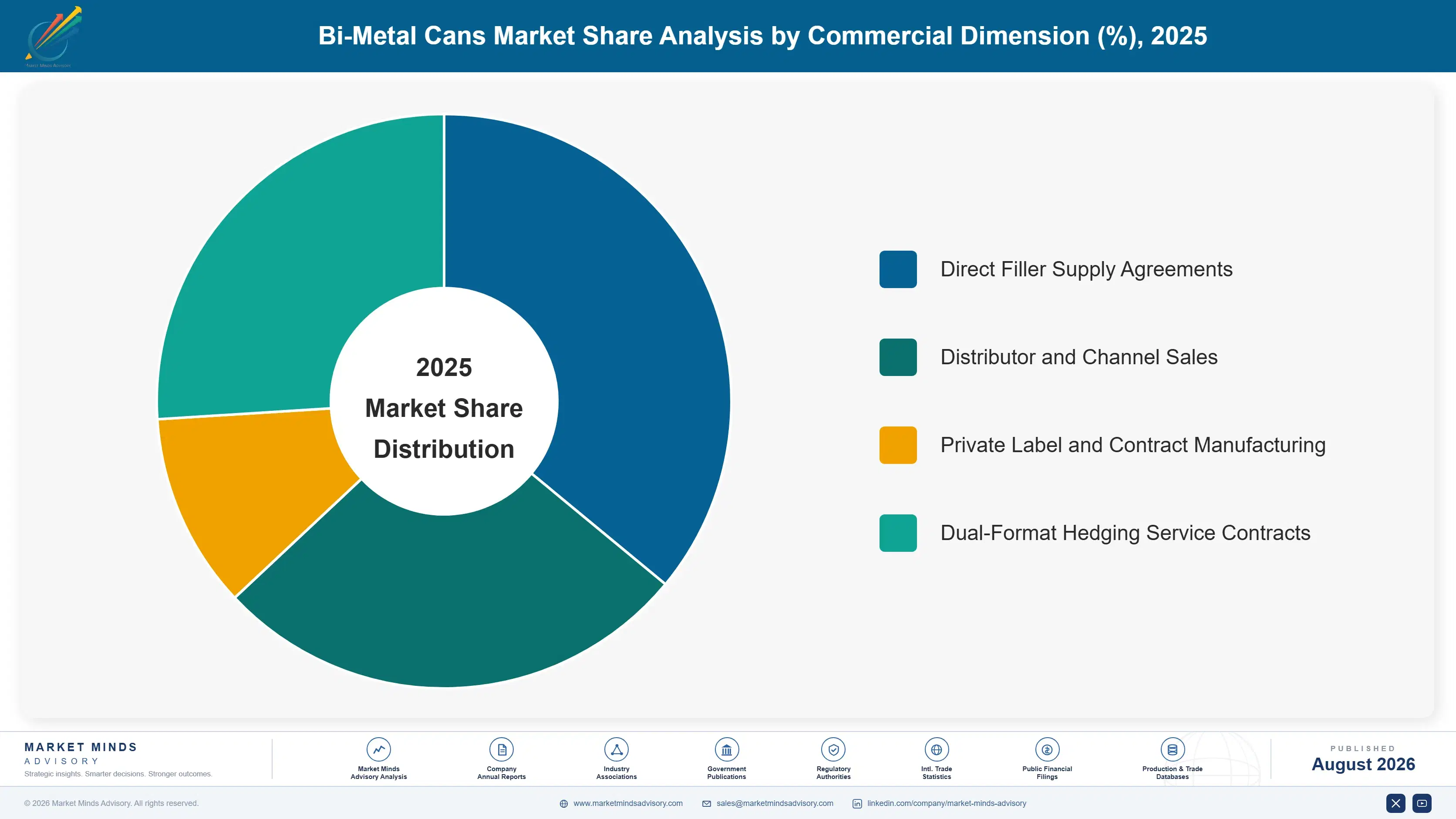
bi-metal-cans-market-market-share-analysis-1787300673216

Beverage Cans

Beverage cans grow fastest at 7.8%, roughly 1.44 times the overall market rate, as India's steel-abundant, aluminum-import-dependent economy keeps favoring bi-metal construction for carbonated soft drinks and beer over the all-aluminum format that dominates Western markets. These cans pair a tinplate or steel body, sourced from domestic mills at meaningfully lower cost than imported aluminum, with an aluminum easy-open end that preserves the drinking experience consumers expect. Hindustan Tin Works and several regional Indian can makers lead this segment, while Crown Holdings and Ball Corporation both maintain bi-metal production capacity specifically to serve Indian and Southeast Asian beverage fillers. Growth here concentrates overwhelmingly in markets where aluminum import dependence makes the cost logic genuinely compelling rather than spreading evenly worldwide.
CAGR 7.8%

Aerosol Cans

Aerosol cans grow second-fastest at 6.5%, about 1.20 times the overall rate, as personal care and household product manufacturers across price-sensitive emerging markets increasingly specify bi-metal construction for the same cost logic driving beverage adoption. These cans require pressure-resistant body construction that steel provides reliably at lower cost than aluminum across most markets outside North America and Western Europe, where aluminum aerosol cans remain standard. Trivium Packaging and several regional Asian and African can makers lead this segment's production, competing on pressure rating consistency and valve compatibility as much as on raw cost. Growing personal care consumption across South Asia, Southeast Asia, and parts of Africa continues expanding this segment's addressable base at a pace outstripping general packaging industry growth.
CAGR 6.5%
Full segment breakdown across 6 segments available in the complete report.

Regional Architecture and Country Demand Map

South Asia and Pacific posts an outsized 15% share for its typical band, reflecting India's global dominance in bi-metal beverage cans specifically. East Asia leads overall at 27% on broad metal packaging manufacturing scale. North America, Western Europe, Latin America, the Middle East, and Eastern Europe complete a global distribution.

North America

Established all-aluminum beverage can infrastructure, more than bi-metal demand, defines North America's 23% share, with bi-metal formats concentrated almost entirely in aerosol and specialty food packaging rather than beverage applications specifically. Crown Holdings and Ball Corporation both run significant bi-metal aerosol can production for personal care and household chemical customers across the United States and Canada. The region's beverage industry remains essentially closed to bi-metal formats, since recycling infrastructure and brand specifications were built around all-aluminum construction decades ago and show no sign of reversing. Mexico's beverage market shows modest bi-metal interest tied to regional aluminum cost dynamics. Growth of 4.8% reflects steady aerosol demand more than any beverage-segment catalyst.
Share: 23% | CAGR: 4.8% (2026 to 2036)

Western Europe

Germany and the United Kingdom anchor this region's demand, both hosting aerosol and specialty food can manufacturing that uses bi-metal construction selectively rather than as a beverage packaging default. Trivium Packaging and Massilly Group both run substantial European bi-metal aerosol production, competing on pressure rating consistency and regulatory compliance for personal care and household chemical applications. The region's 19% share, near the lower half of its typical band, reflects the same all-aluminum beverage dominance seen in North America, with bi-metal relevance concentrated in aerosol and paint can applications across most national markets. Growth of 3.9%, the softest pace among the seven regions tracked, reflects this mature, narrowly defined addressable market overall.
Share: 19% | CAGR: 3.9% (2026 to 2036)
Regional intelligence for 5 additional markets available in the complete report: East Asia, South Asia and Pacific, Latin America, Middle East and Africa, Eastern Europe. Contact sales@marketmindsadvisory.com.
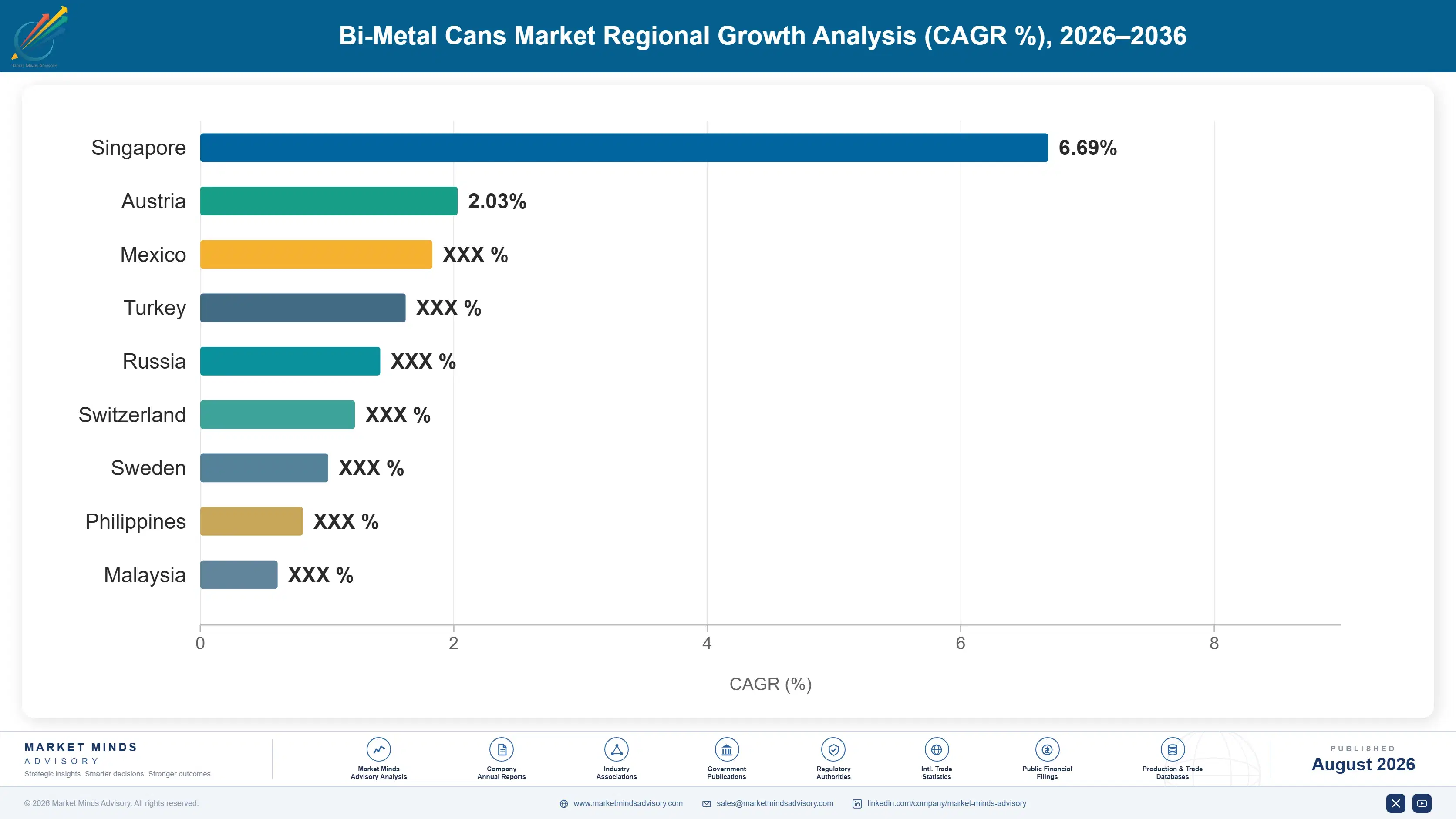
bi-metal-cans-market-country-cagr-analysis-1787300673723

How Can Makers Can Defend Bi-Metal Margin

Margin increasingly depends on metal sourcing flexibility and format-switching capability rather than manufacturing scale alone, as beverage fillers demand the option to shift between bi-metal and all-aluminum construction as commodity pricing moves. The four levers below target sourcing, service, and recyclability revenue that bi-metal can makers have historically left underexploited, converting a cost-arbitrage sale into a defensible position.

Offer Dual-Format Manufacturing Flexibility To Fillers

Can makers who build production lines capable of switching between bi-metal and all-aluminum construction let beverage fillers hedge against commodity price swings without committing to a single format years in advance. Crown Holdings and Ball Corporation both report that dual-format capability increasingly determines which large beverage contracts they can even bid for, independent of raw manufacturing cost. Building this flexibility requires meaningful upfront capital investment, often exceeding $20 million per converted production line, but manufacturers who complete it early lock in multi-year filler relationships before flexibility becomes table stakes rather than a genuine differentiator.
Market Impact: Wins multi-year contracts worth over $10 million annually

Develop Recyclable End Designs That Separate Easily

Manufacturers who redesign bi-metal can ends and bodies for easier automated or manual separation at recycling facilities capture a genuine competitive advantage as brand owners increasingly screen suppliers on substantiated recyclability performance rather than marketing claims alone. Ball Corporation and several specialty design firms have developed separable-end technologies that improve effective recycling recovery rates by roughly 12% compared with standard bi-metal construction, giving brand owners a defensible sustainability claim competitors using older designs cannot match. This design investment costs more per unit upfront, but manufacturers who complete it early capture premium positioning with sustainability-conscious brand owners.
Market Impact: Improves recycling recovery rates by roughly 12% overall

Bundle Metal Price Hedging Services With Supply Contracts

Can makers increasingly offer metal price hedging arrangements, locking beverage fillers into predictable per-unit pricing across multi-year contracts regardless of underlying aluminum and steel commodity volatility, rather than passing spot price movements directly through to customers. This service model captures a 3% to 6% hedging premium that generalist commodity can suppliers competing purely on spot pricing cannot offer, since it requires meaningful treasury and risk management capability most smaller regional manufacturers lack entirely. Larger can makers with sophisticated commodity hedging desks capture this premium consistently, while smaller manufacturers without comparable capability lose contract bids to competitors offering genuine price stability.
Market Impact: Captures 3% to 6% annual hedging premium revenue

Expand Regional Manufacturing Near Emerging Beverage Markets

Import tariffs and shipping cost on cans manufactured outside the destination market have risen enough that regional manufacturing, closer to fast-growing emerging beverage markets across Southeast Asia and Africa, increasingly beats import economics even at somewhat higher local labor cost. Can makers building production capacity in Vietnam, Indonesia, and parts of Africa, rather than exporting from India or China, cut landed cost by 10% to 15% while shortening lead times that matter increasingly to beverage fillers managing seasonal demand swings. This shift requires upfront capital, but manufacturers who move early capture share from competitors dependent on longer import chains.
Market Impact: Cuts landed import costs by 10% to 15%

Who Controls the Margin Pool

Five can makers control roughly half of global bi-metal shipment volume, a moderately concentrated picture for a packaging category. Crown Holdings and Ball Corporation both lead on manufacturing scale, though their bi-metal exposure concentrates in aerosol and specialty applications rather than India's beverage-dominated volume base. Shipment volume, the basis used throughout this assessment, favors makers with the broadest production footprint.
Competitive activity currently runs across three dimensions. Can makers race to build dual-format manufacturing flexibility before rivals lock in filler contracts that increasingly demand the option to switch formats as commodity pricing shifts. Recyclability design investment has become a genuine differentiator, as brand owners increasingly screen suppliers on substantiated sustainability performance. Indian domestic manufacturers are expanding capacity aggressively to defend home-market share.

Pressure is building from two directions that could reshuffle rankings within the decade. Southeast Asian and African regional manufacturers, absent from the key player list, are scaling bi-metal capacity to replicate India's cost-driven adoption pattern. All-aluminum can makers, technically outside this market but competing for the same packaging budget, are proving recycling simplicity can outweigh bi-metal's cost advantage where sustainability regulation tightens fastest, forcing bi-metal specialists to decide whether to defend cost positioning or invest in recyclability instead.
bi-metal-cans-market-company-positioning-matrix-1787300674242

Competitive Moat and Risk Dimensions

CROWN HOLDINGS, INC.

Moat: Broadest Global Manufacturing Footprint

Crown Holdings operates can manufacturing facilities across more countries than any single competitor, giving it the regional production flexibility to serve both India's beverage-driven bi-metal demand and mature market aerosol applications from the same global platform. That footprint breadth lets it bid on multinational beverage and personal care contracts that narrower regional specialists cannot match on geographic coverage.
CROWN HOLDINGS, INC.

Risk: Regional Commodity Price Exposure

Crown Holdings' broad geographic footprint means it carries simultaneous exposure to steel and aluminum price movements across multiple regional markets, complicating centralized hedging strategy compared with competitors focused narrowly on a single format or region. A sharp commodity move in any major market can compress margin faster than pricing adjustments can offset.
BALL CORPORATION

Moat: Deep Beverage Brand Relationships

Ball Corporation holds long-standing relationships with major global beverage brands built primarily around all-aluminum can supply, giving it a natural entry point when those same brands evaluate bi-metal conversion in price-sensitive emerging markets. That existing relationship depth shortens the sales cycle competitors without comparable brand access must otherwise build from scratch.
BALL CORPORATION

Risk: Limited India-Specific Manufacturing Scale

Ball Corporation's bi-metal manufacturing presence in India, the market that defines this category's largest addressable volume, remains smaller than several dedicated domestic Indian can makers who built capacity specifically around the country's bi-metal beverage demand years earlier, a gap that will take sustained investment to close.

Key Players

Crown Holdings, Inc.
Ball Corporation
CANPACK S.A.
Ardagh Group S.A.
Hindustan Tin Works Ltd.

Others

Silgan Holdings Inc.
CPMC Holdings Limited
Nampak Ltd.
Toyo Seikan Group Holdings, Ltd.
Kian Joo Can Factory Berhad
Trivium Packaging B.V.
Massilly Group
Mauser Packaging Solutions
Greif Inc.
Envases Universales de Mexico S.A.
COFCO Packaging Co., Ltd.
Huayang Metal Packaging Co., Ltd.
Kaira Can Company Ltd.
Baosteel Packaging Co., Ltd.
Universal Can Corporation

Recent Developments

MARCH 2025

Crown Holdings Expands Bi-Metal Production Capacity In Vietnam

Crown Holdings expanded bi-metal can production capacity at an existing Vietnamese facility, aiming to serve growing Southeast Asian beverage demand following aluminum import cost increases across the region. The expansion adds meaningful annual capacity without requiring an entirely new greenfield manufacturing site or additional land.
Signal: Signals established global can makers are extending India's bi-metal adoption pattern into comparable Southeast Asian beverage markets.
JULY 2025

Hindustan Tin Works And A Regional Filler Sign Long-Term Agreement

Hindustan Tin Works signed a multi-year supply agreement with a major Indian beverage filler to provide bi-metal cans across an expanded product portfolio. The agreement was structured as a direct supply contract rather than any joint venture or equity arrangement between the two companies involved.
Signal: Signals domestic Indian manufacturers are securing long-term volume commitments ahead of global competitor expansion plans across the region.
NOVEMBER 2025

Ball Corporation Introduces Easier-To-Separate Bi-Metal End Design

Ball Corporation introduced a redesigned bi-metal can end intended to improve automated separation performance at standard material recovery facilities across major recycling markets worldwide. The launch represents an organic product development initiative rather than an acquisition or licensing arrangement with any external technology provider involved.
Signal: Signals established manufacturers are investing organically in recyclability improvements rather than waiting for regulatory mandate to arrive.

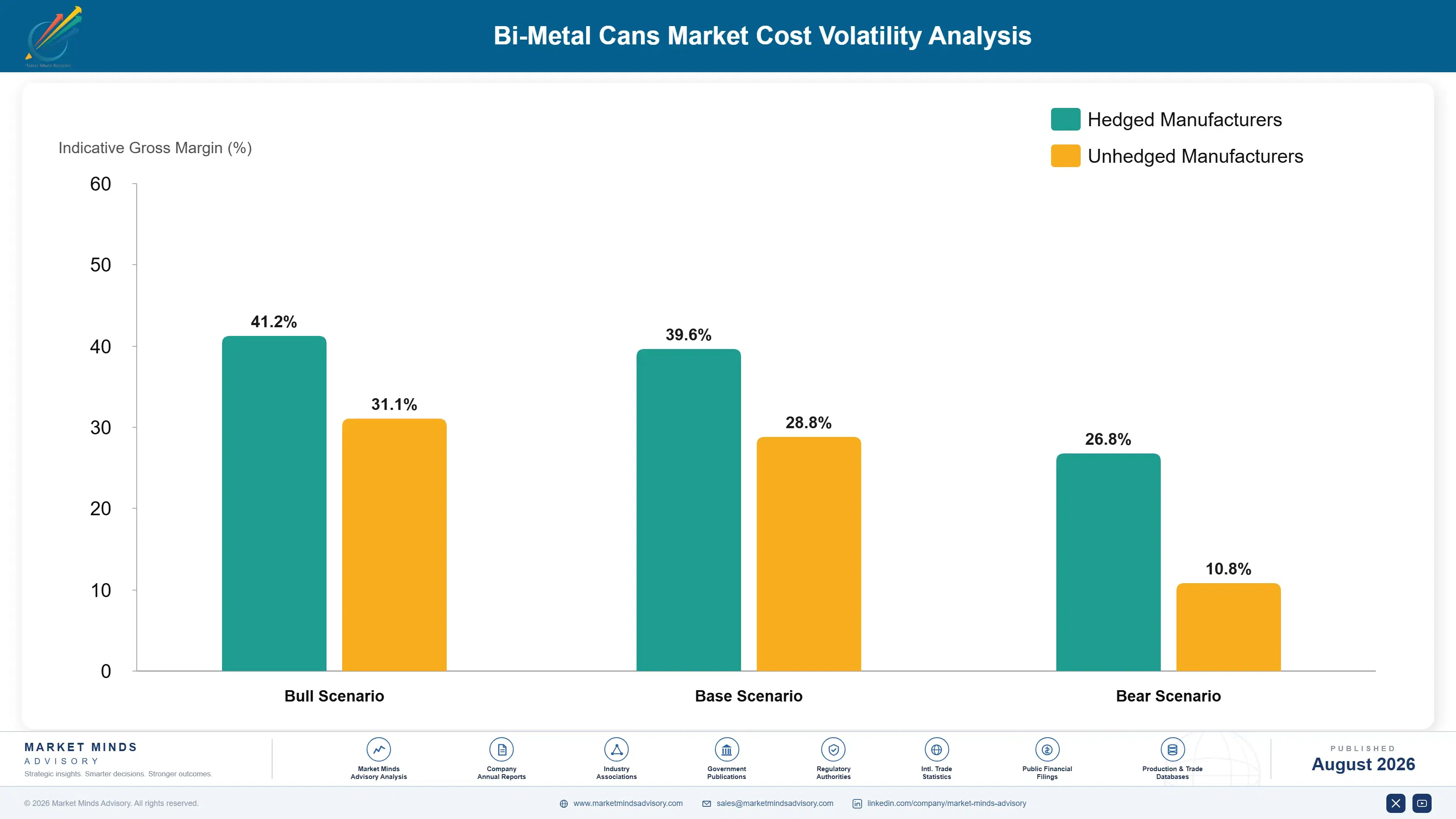
What Actually Drives Bi-Metal Can Cost

Combined steel and aluminum input costs account for roughly 58% of total production cost, with steel typically representing the larger share given bi-metal construction's body-to-end material ratio. Steel is sourced primarily from domestic mills in producing regions like India and China, while aluminum for can ends often relies on a mix of domestic and imported supply depending on regional smelting capacity.
Aluminum prices spiked sharply in 2021 and 2022 as global energy cost volatility disrupted smelting operations and trade policy actions added tariff costs in several major markets simultaneously. Crown Holdings' 2022 annual report cited elevated aluminum costs as a direct pressure on margins that year, and several can makers reported similar pressure, pushing beverage fillers in aluminum-import-dependent markets toward accelerated bi-metal conversion until pricing eased into 2023.

Smaller regional can makers carry the sharpest exposure, since they lack the purchase volume to negotiate long-term steel and aluminum supply contracts that Crown Holdings and Ball Corporation secure directly with mills and smelters. Geographic exposure varies too: Indian manufacturers sourcing domestic steel face lower input cost volatility than manufacturers dependent on imported aluminum, a gap that widens whenever global aluminum prices spike against relatively stable domestic steel pricing.
bi-metal-cans-market-cost-volatility-analysis-1787300674438

Lock Multi-Year Steel And Aluminum Supply Agreements

Can makers with sufficient purchase volume are negotiating multi-year supply agreements directly with steel mills and aluminum smelters, trading pricing flexibility for guaranteed allocation during industry-wide commodity shortages. This approach favors the largest manufacturers disproportionately, since minimum volume commitments required for favorable terms sit well beyond what smaller regional producers can commit to reliably given typical purchase volumes.

Build Dual-Format Manufacturing To Hedge Commodity Risk

Some manufacturers now build production lines capable of switching between bi-metal and all-aluminum construction, letting them shift material sourcing toward whichever metal is currently cheaper rather than depending on a single fixed format, trading some manufacturing complexity for meaningfully improved commodity cost flexibility across changing market conditions and evolving regional demand patterns over time.

Source Steel And Aluminum From Regional Domestic Mills

Sourcing steel and aluminum from domestic regional mills, as Indian manufacturers do extensively, cuts import cost and currency exposure even when global commodity benchmark prices move sharply, shortening the exposed portion of the input cost structure meaningfully for regionally integrated manufacturers across most major producing markets tracked in this year's full report and analysis.

Portfolio Architecture for Margin Defence

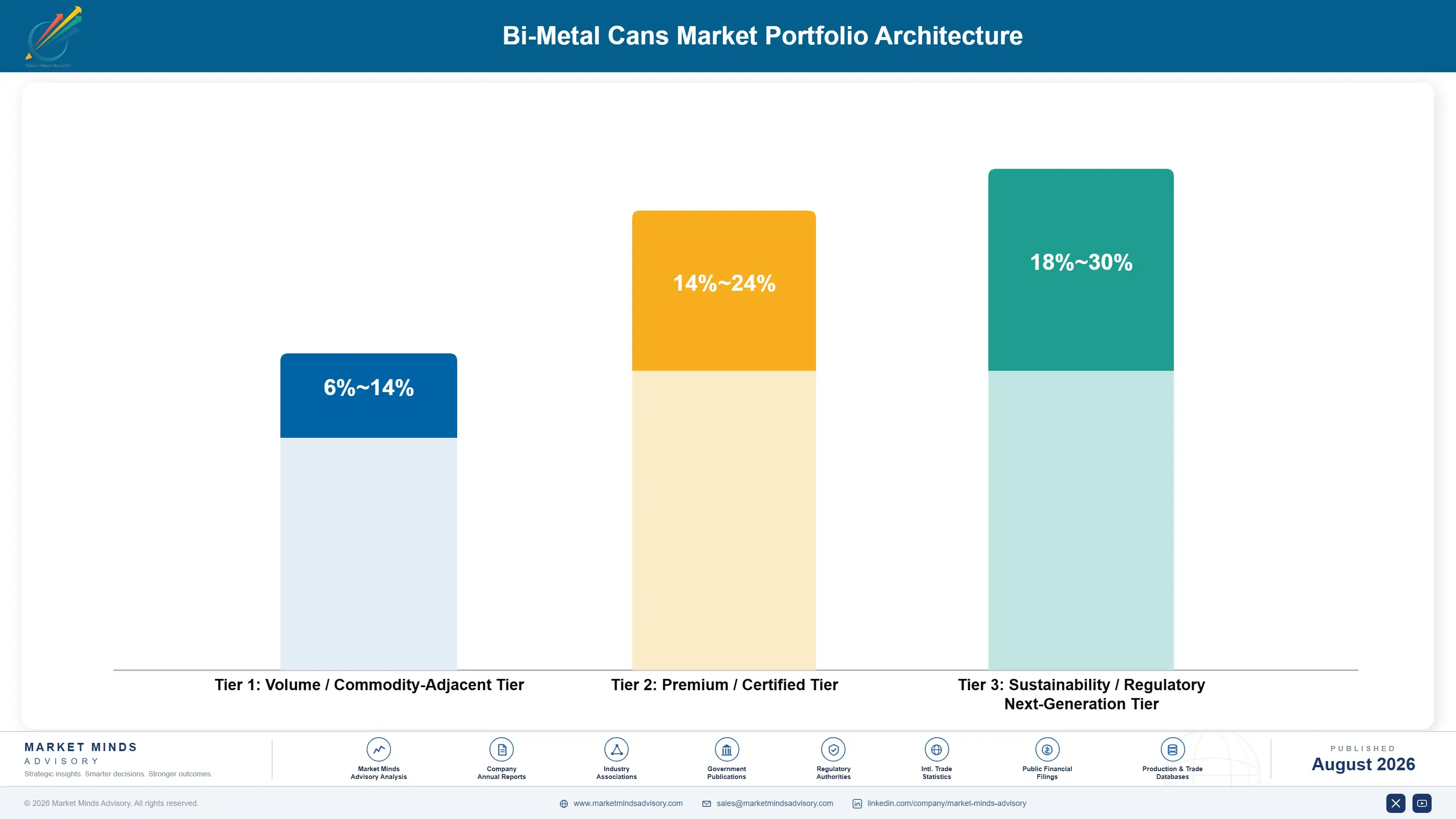
The portfolio splits into three tiers with margin separation. Volume-tier products, standard bi-metal beverage cans sold on cost-arbitrage logic into price-sensitive Indian and Southeast Asian markets, compete hard and earn modestly. Premium certified products, covering aerosol and food cans meeting stricter pressure and regulatory specifications, earn more because technical performance and brand relationships support pricing. Next-generation recyclable-design bi-metal cans occupy the top tier,
The tension here is familiar to any regional cost-arbitrage business riding a commodity spread: volume beverage cans fund the manufacturing scale and distribution relationships premium products depend on, yet volume growth alone cannot fund the recyclability design investment next-generation cans require. Manufacturers leaning too heavily into premium positioning risk losing the manufacturing scale that makes market entry viable in price-sensitive channels, while pure volume players cede that segment to rivals.

High-value pools concentrate where technical specification depth, brand relationships, and recyclability credentials intersect: aerosol and specialty food applications serving brand owners willing to pay for verified performance. That intersection is still a minority of volume globally but expanding quickly, which is why the next-generation tier grows fastest even while representing a modest share of volume today.

Volume / Commodity-Adjacent Tier

Standard bi-metal beverage cans sold largely on cost-arbitrage logic into price-sensitive Indian and Southeast Asian beverage markets, competing directly against all-aluminum alternatives on landed cost alone across most price bands.
Gross Margin: 6%-14%

Premium / Certified Tier

Aerosol and specialty food cans meeting stricter pressure rating and regulatory specifications, sold to personal care and household chemical manufacturers willing to pay for technical performance and reliability across markets.
Gross Margin: 14%-24%

Sustainability / Regulatory / Next-Generation Tier

Recyclable-design bi-metal cans representing the sustainability and documentation frontier, priced at a premium justified by improved recovery rate performance and verified environmental claims across every producing region tracked worldwide today.
Gross Margin: 18%-30%
bi-metal-cans-market-portfolio-architecture-1787300674926

High-value Sub-segments and Strategic Watch-out

Beverage Cans

The fastest-growing segment by volume, expanding at 7.8% as India's beverage market keeps outgrowing domestic aluminum supply. Manufacturers with dedicated Indian production capacity capture the majority of this segment's growth ahead of global entrants still building local presence, distribution relationships, regional trust, and manufacturing scale.
Gross Margin: 6%-14%

Aerosol Cans

High value with strong growth as personal care manufacturers specify bi-metal construction across price-sensitive emerging markets, though overall expansion trails beverage cans since aerosol volume growth moves more gradually than India's beverage boom specifically across most regional producing markets, application categories, and buyer segments tracked here.
Gross Margin: 14%-24%

Food Cans

The volume core in mature markets, covering established processed food packaging demand worldwide, generating steady but thin margins under intensifying competition from all-aluminum and non-metal packaging alternatives across most regions tracked in this year's full segmentation, competitive, and regional review process across every product category evaluated.
Gross Margin: 10%-18%

Paint and Industrial Chemical Cans

The strategic watch-out, as industrial buyers increasingly favor plastic and composite containers over metal cans for many chemical applications, leaving this category shrinking steadily even as total packaging volume keeps expanding across most markets tracked in this year's full competitive, regional, and application-level report overall.
Gross Margin: 8%-16%

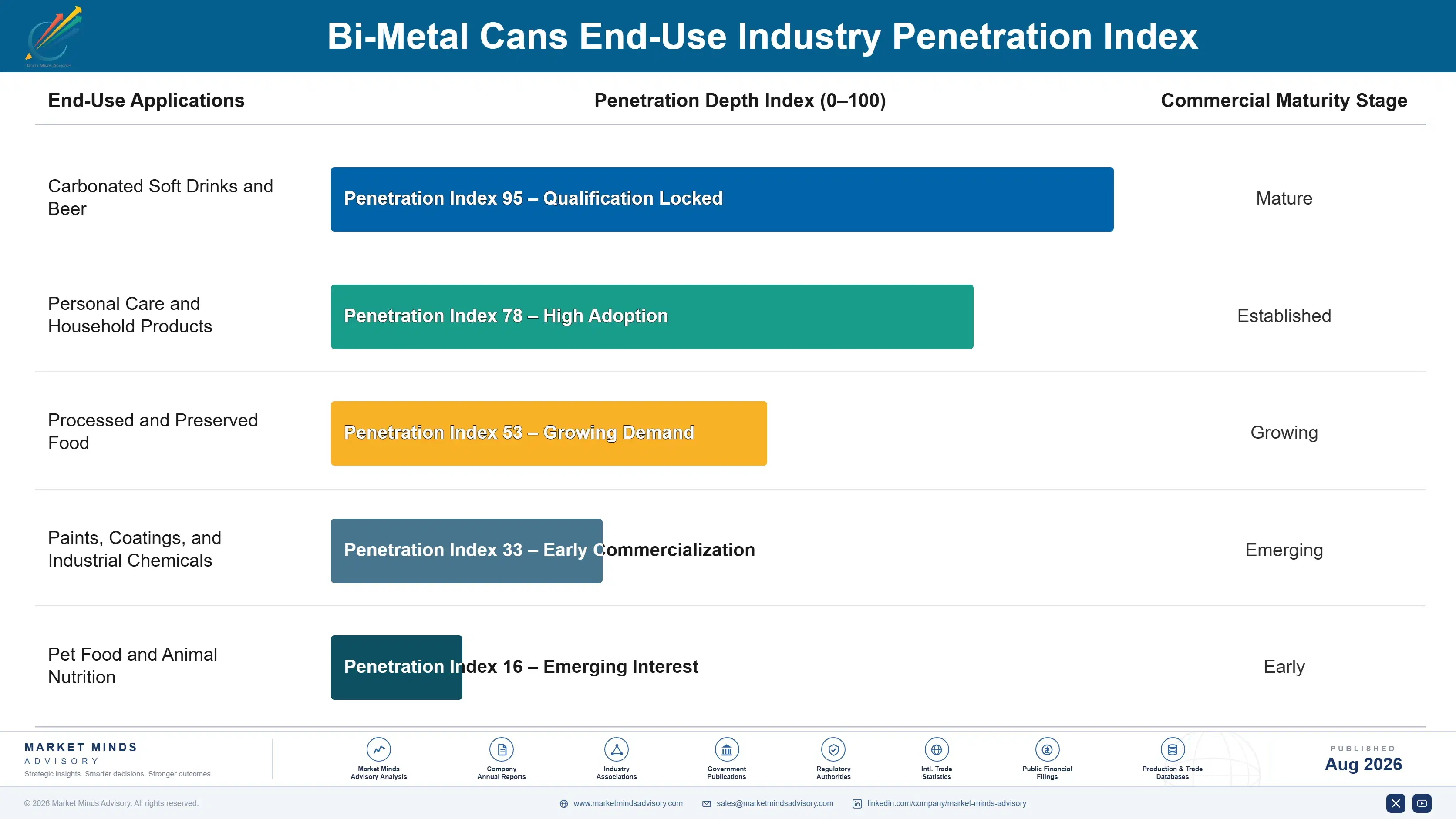
How Bi-Metal Can Demand Actually Commits

Demand here commits through recurring beverage and consumer product fill cycles rather than one-time capital purchases. A beverage filler or aerosol manufacturer that adopts bi-metal construction typically signs a multi-year can supply agreement covering continuous production line output, since packaging is consumed continuously rather than installed once. That recurring-purchase structure, more than any single commodity price event, makes this market behave like a packaging consumables annuity
Adoption depth varies sharply by market maturity. Indian and Southeast Asian beverage fillers adopt bi-metal fastest, since the cost logic is immediate given domestic steel abundance and aluminum import dependence. North American and Western European fillers show essentially no adoption, since established all-aluminum infrastructure and recycling systems make conversion commercially irrational regardless of any theoretical cost advantage. Aerosol manufacturers occupy a middle position, adopting selectively based on regional pricing.

Younger procurement managers at beverage fillers and aerosol manufacturers increasingly model total landed cost and commodity price sensitivity directly rather than relying on historical format precedent that previous purchasing generations accepted without regular reassessment. That shift is pushing can makers toward more transparent cost modeling, even though long-term supply contracts remain the actual purchasing mechanism for most transactions today.
bi-metal-cans-market-end-use-penetration-index-1787300675414

Where This Market Rewards Flexibility

These are among the four positions where our research anticipates prominent divergence between winners and laggards over the coming forecast period. Each is grounded in the demand model, the regulatory perimeter, and the announced capacity pipeline.
01 / DUAL-FORMAT MANUFACTURING STRATEGY

Winners will offer format flexibility before rivals commit

Manufacturing scale alone no longer separates leading can makers, since most competitors can eventually match a given production capacity within a few capital cycles. What actually separates winners is the ability to offer beverage fillers genuine dual-format flexibility between bi-metal and all-aluminum construction, because fillers increasingly demand that optionality rather than committing to a single format years in advance. Manufacturers building this flexibility early, rather than treating it as a costly afterthought, will out-earn single-format rivals over the coming decade.
02 / EMERGING MARKET MANUFACTURING FOOTPRINT

Regional production presence will decide Southeast Asian expansion

Trade cost and lead time, not raw manufacturing cost alone, increasingly determine which can makers can compete profitably as Southeast Asian and African beverage markets begin replicating India's bi-metal adoption pattern. Manufacturers who build regional production capacity early will capture cost advantages that purely import-dependent competitors cannot match, regardless of how competitive their underlying unit economics might otherwise appear on paper. Those relying entirely on exports from India or China will find themselves increasingly undercut on landed cost within this decade.
03 / RECYCLABILITY DESIGN INVESTMENT

Sustainability credentials will matter more than raw cost alone

Manufacturers still competing purely on bi-metal's cost advantage are leaving durable brand relationships on the table that recyclability-focused design investment already captures successfully for sustainability-forward competitors across major regional markets and buyer segments. These improved recovery rate credentials persist independent of the commodity price cycles that otherwise define this market's cost-arbitrage-driven revenue pattern industry-wide. Companies that build genuine recyclability design capability early will earn materially more brand trust over a decade than those still competing only on landed cost alone.
04 / INDIA MARKET CONCENTRATION RISK

Diversification beyond India will matter more than deeper penetration

Even where India's beverage market keeps expanding favorably, single-country concentration risk caps how defensible any manufacturer's long-term position actually is, since a shift in Indian aluminum policy or domestic smelting capacity could compress the format's core cost advantage relatively quickly. Manufacturers who diversify bi-metal capacity into Southeast Asia and Africa early will reduce this concentration risk ahead of competitors still dependent overwhelmingly on Indian volume alone. This diversification will matter more to long-term resilience than any single India-specific growth initiative.

Engagement Snapshot From the Field

A live engagement with an industry participant carrying material or product regulatory and market exposure ahead of a defining policy shift, showing how our research translates into a defensible multi-year portfolio strategy.
MARKET MINDS ADVISORY · CLIENT ENGAGEMENT SUMMARY
Bi-Metal Cans Producer Strategic Portfolio Review and Transition Roadmap 2026·Investment Scenario on Bi-Metal Cans Exposure Evaluation 2025-26
CLIENT PROFILE
A regional beverage filler operating across several Southeast Asian markets approached MMA while evaluating whether to convert its remaining all-aluminum production lines to bi-metal construction following sustained aluminum import cost increases. The client reported annual can procurement spend near USD 60 million, with roughly 45% of volume still running on all-aluminum lines at the time of the engagement (client-reported, unverified by MMA).
STRATEGIC CHALLENGE
Leadership believed bi-metal conversion would meaningfully cut input cost, but nobody had modeled the capital cost of converting existing production lines against projected aluminum price trajectories, nor assessed whether regional recycling infrastructure could support bi-metal's sustainability claims to the client's own retail customers, partners, and end consumers across every market served.
MMA APPROACH
MMA modeled landed cost under both formats across five-year aluminum price scenarios, benchmarked line conversion capital costs against comparable regional filler transitions, and interviewed sustainability leads at three retail customers on their actual tolerance for bi-metal packaging given regional recycling infrastructure limitations, timelines, and planned investment commitments over the period.
KEY FINDINGS
  1. Bi-metal conversion broke even against continued all-aluminum operation within roughly 22 months at the client's current volume, even under a moderate aluminum price recovery scenario (client-reported, unverified by MMA).
  2. Two of the client's five largest retail customers expressed genuine reservations about bi-metal packaging given limited regional recycling infrastructure, a risk the client's own team had underweighted.
  3. A partial conversion, covering roughly 60% of volume rather than full conversion, balanced cost savings against retail customer sustainability concerns more effectively than an all-or-nothing approach.
  4. Regional recycling infrastructure investment was already planned by a government partner, suggesting the sustainability objection would likely diminish within the client's own conversion timeline.
CLIENT PROFILE
A regional beverage filler operating across several Southeast Asian markets approached MMA while evaluating whether to convert its remaining all-aluminum production lines to bi-metal construction following sustained aluminum import cost increases. The client reported annual can procurement spend near USD 60 million, with roughly 45% of volume still running on all-aluminum lines at the time of the engagement (client-reported, unverified by MMA).
STRATEGIC CHALLENGE
Leadership believed bi-metal conversion would meaningfully cut input cost, but nobody had modeled the capital cost of converting existing production lines against projected aluminum price trajectories, nor assessed whether regional recycling infrastructure could support bi-metal's sustainability claims to the client's own retail customers, partners, and end consumers across every market served.
MMA APPROACH
MMA modeled landed cost under both formats across five-year aluminum price scenarios, benchmarked line conversion capital costs against comparable regional filler transitions, and interviewed sustainability leads at three retail customers on their actual tolerance for bi-metal packaging given regional recycling infrastructure limitations, timelines, and planned investment commitments over the period.
KEY FINDINGS
  1. Bi-metal conversion broke even against continued all-aluminum operation within roughly 22 months at the client's current volume, even under a moderate aluminum price recovery scenario (client-reported, unverified by MMA).
  2. Two of the client's five largest retail customers expressed genuine reservations about bi-metal packaging given limited regional recycling infrastructure, a risk the client's own team had underweighted.
  3. A partial conversion, covering roughly 60% of volume rather than full conversion, balanced cost savings against retail customer sustainability concerns more effectively than an all-or-nothing approach.
  4. Regional recycling infrastructure investment was already planned by a government partner, suggesting the sustainability objection would likely diminish within the client's own conversion timeline.
RECOMMENDED STRATEGY
Phase 1: Phase 1 (0 to 6 months): Convert 60% of production lines to bi-metal, prioritizing lines serving customers without expressed sustainability reservations. Phase 2: Phase 2 (6 to 18 months): Monitor retail customer response and regional recycling infrastructure progress before committing to further conversion. Phase 3: Phase 3 (18 to 36 months): Complete conversion of remaining lines once recycling infrastructure and customer sentiment support full transition.
OUTCOME
The client proceeded with the partial conversion, achieving projected cost savings on schedule while avoiding the customer relationship risk MMA had flagged. The client reported the phased approach preserved all five major retail relationships while cutting can procurement cost by approximately 9% blended across its full production volume (client-reported, unverified by MMA).

Frequently Asked Questions

Foundational context covering the market sizes, CAGR, scope, country, region and competition that inform every finding below. This section is provided to cover basics and most often pre-purchase conversations, answered from the MMA Primary Research Dataset.

What is the current size of the Bi-Metal Cans Market?

The market stood at USD 2.8 billion in 2025, based on MMA Primary Research Dataset findings. India's beverage sector remains the single largest demand driver globally.

How large will the Bi-Metal Cans Market be by 2036?

MMA projects the market will reach USD 4.99 billion by 2036 under the base case scenario, representing roughly 1.69 times the 2026 opening value across the eleven-year forecast period.

What is the CAGR for the Bi-Metal Cans Market 2026 to 2036?

The base case CAGR is 5.4% annually. MMA's bull scenario reaches 6.6% while the bear scenario, reflecting aluminum price stabilization, runs closer to 4.2% across the forecast window.

Which segment is growing fastest?

Beverage cans lead at 7.8% CAGR, roughly 1.44 times the overall market rate, as India's steel-abundant economy keeps favoring bi-metal construction over all-aluminum alternatives industry-wide.

Who are the major companies in the Bi-Metal Cans Market?

Crown Holdings, Ball Corporation, CANPACK, Ardagh Group, and Hindustan Tin Works lead the market, together controlling an estimated 52% of global shipment volume on a consistent basis.

Which country is growing fastest?

India posts the fastest national growth at 11.5% CAGR, driven by its dominant position in global bi-metal beverage can consumption and domestic manufacturing capacity expansion.

Report Segmentation Architecture

The full report scope spans multiple orthogonal segmentation dimensions, with cross-tabulated demand data provided for each dimension pair. Coverage extends further to regional breakdowns, trend trajectories, and the competitive detail needed to support segment-level decision-making.

By Application

  • Beverage Cans
  • Aerosol Cans
  • Food Cans
  • Paint and Industrial Chemical Cans
  • Pet Food Cans
  • Specialty and Promotional Cans

By End-Use Industry

  • Carbonated Soft Drinks and Beer
  • Personal Care and Household Products
  • Processed and Preserved Food
  • Paints, Coatings, and Industrial Chemicals
  • Pet Food and Animal Nutrition

By Commercial Dimension

  • Direct Filler Supply Agreements
  • Distributor and Channel Sales
  • Private Label and Contract Manufacturing
  • Dual-Format Hedging Service Contracts

By Region

  • North America
  • Western Europe
  • East Asia
  • South Asia and Pacific
  • Latin America
  • Middle East and Africa
  • Eastern Europe

Scope, Methodology, and Coverage

Every figure in this report is reproducible from documented input assumptions. The scope below maps the historical period, the forecast horizon, the segmentation dimensions, and the countries covered, alongside the underlying primary and qualitative methodology.
Historical Period
2020 to 2025
Forecast Period
2026 to 2036
Base Year
2025 (USD billions; MMA Primary Research Dataset, August 2026)
Market Definition
The bi-metal cans market covers rigid metal containers constructed with a steel or tinplate body combined with an aluminum end, or the reverse configuration, used across beverage, aerosol, food, paint, and pet food packaging applications. It excludes monolithic all-aluminum cans, all-steel three-piece cans, and non-metal packaging formats such as glass, plastic, or composite cartons.
Quantitative Units
USD billions (current prices); unit shipment volume in billions of cans where applicable
Segmentation Dimensions
By Application; By End-Use Industry; By Commercial Dimension; By Region
Regions Covered
North America, Western Europe, East Asia, South Asia and Pacific, Latin America, Middle East and Africa, Eastern Europe
Countries Covered
USA, China, Germany, France, UK, Japan, South Korea, India, Australia, Canada, Brazil, Mexico, Indonesia, Vietnam, Thailand, Malaysia, UAE, Saudi Arabia, South Africa, Nigeria, Turkey, Poland, Netherlands, Italy, Spain, Sweden, Switzerland, Argentina, Colombia, Singapore, and additional markets relevant to this sector
Key Companies Profiled
Crown Holdings, Inc., Ball Corporation, CANPACK S.A., Ardagh Group S.A., Hindustan Tin Works Ltd., Silgan Holdings Inc., CPMC Holdings Limited, Nampak Ltd., Toyo Seikan Group Holdings, Ltd., Kian Joo Can Factory Berhad, Trivium Packaging B.V., Massilly Group, Mauser Packaging Solutions, Greif Inc., Envases Universales de Mexico S.A., COFCO Packaging Co., Ltd., Huayang Metal Packaging Co., Ltd., Kaira Can Company Ltd., Baosteel Packaging Co., Ltd., Universal Can Corporation
Quantitative Methodology
Primary survey, n=3,800 respondents, Q4 2025, six countries; demand-side model with trade association cross-validation
Qualitative Methodology
47 expert interviews, Q4 2025; applied to validate demand model assumptions, identify emerging dynamics, and assess competitive positioning
Report Format
PDF and XLSX data workbook (Word format preview document)
Publisher
Market Minds Advisory
Report Code
MMA-2026-PAC-127
Published
August 2026
Contact
sales@marketmindsadvisory.com | www.marketmindsadvisory.com

Purchase the full Bi-Metal Cans Market Report (2026 to 2036).

The full MMA Bi-Metal Cans report sizes the market across six application categories, five end-use verticals, four commercial channels, and seven regions through 2036. It profiles 20 participants on a consistent shipment volume basis, scoring the top five on manufacturing footprint, dual-format flexibility, and recyclability design capability. Scenario models quantify how aluminum price volatility, Indian beverage growth, and recycling policy pressure move both demand and realizable pricing. The report also includes delivered-cost modelling by application category, a regional aluminum and steel price tracker, and a competitive benchmarking tool built for manufacturer strategy, filler procurement, and investor due diligence teams.
Six-category application segmentation with regional cross-tabulation
Aluminum and steel price tracker across twelve major markets
Competitive benchmarking on consistent shipment volume basis
Delivered-cost modelling by application category and region
Scenario models for commodity volatility and recycling policy
Dual-format manufacturing flexibility analysis by producer

Built For The People Who Decide

From boardroom strategy to bench-side execution, this report is read cover-to-cover by leaders shaping the next decade of their industry, turning demand scenarios, market dynamics and valuation benchmarks into decisions.
CXOs/ Presidents/ VPs/ Managers
M&A and Corporate Development
Strategy Teams and R&D Heads
Procurement and Product Directors
Regulatory and Compliance Leaders
Investor Relations and Equity Analysts