Market Minds Advisory
Beverage Emulsion Market

Beverage Emulsion Market: Clean-Label Reformulation and Functional Beverage Demand

Beverage manufacturers are reformulating cloud and flavor emulsions around clean-label gum acacia and modified starch systems just as functional beverage volumes accelerate, forcing suppliers to defend stability performance without synthetic emulsifiers or premium pricing headroom.

Lead Analyst

Lisa Gevelber

Published

September 2026

Make Smarter Decisions with Customized Research Insights

Request a free sample report and evaluate market opportunities, growth trends, and competitive dynamics relevant to your business needs.

2025 MARKET VALUE$4.2BMarket Size 2025
2036 FORECAST VALUE$8.7BBase Case , 2026 to 2036
CAGR 2026 TO 20366.8 %Bull 8.0% / Bear 5.5%
INCREMENTAL OPPORTUNITY$4.2BNet 10- year value creation
EXPANSION MULTIPLE1.93x2036 value over 2026 base
Strategic Levers
M&A Pipeline
Regional Outlook
Country Rankings
Competitive Intelligence
Segmental Deep-dive
Call-Us : 91 93563 13602

Executive Snapshot and Market Trajectory

Clean-label reformulation is reshaping beverage emulsion demand faster than volume growth alone would suggest, as bottlers swap synthetic weighting agents and preservatives for plant-derived gum systems that must match shelf stability across nine-month distribution cycles without added cost, a constraint tightening supplier margins across the category.
Functional and fortified beverages are pulling emulsion demand toward vitamin and nutrient delivery systems, the fastest-growing segment as brands add omega-3, vitamin D, and adaptogenic actives to mainstream soft drinks and ready-to-drink teas. East Asia has become the largest consuming region, anchored by China's expanding functional beverage manufacturing base and Japan's mature nutraceutical beverage culture, while North America follows closely on premium natural-emulsifier reformulation spend.
Competitive intensity centers on five global flavor and ingredient houses that control formulation know-how and emulsifier stability testing capacity, leaving mid-sized regional suppliers to compete on price and delivery speed. Regulatory pressure is accelerating the shift away from synthetic emulsifiers as the European Union reviews additive approvals, while enzymatic modification technology is letting suppliers replicate synthetic stability performance using starch and gum acacia at commercially viable cost, narrowing the gap that once protected incumbents.
Market Definition
The beverage emulsion market covers oil-in-water emulsion systems, including flavor emulsions, cloud emulsions, color emulsions, and weighting agents, formulated for incorporation into soft drinks, juices, dairy alternatives, and functional beverages. It excludes standalone flavor compounds, dry powder premixes, and packaging or bottling equipment.
Base Year Value
$4.2B in 2025 (MMA Primary Research Dataset, August 2026)
Forecast Period
2026 to 2036, eleven discrete annual values
CAGR
6.8% base case. Bull 8.0%. Bear 5.5%.
Fastest Growth Segment
Vitamin and Nutrient Delivery Emulsions: 9.8% CAGR
Fastest Growth Country
China: 8.4% CAGR
Fastest Growth Region
South Asia and Pacific: 8.8% CAGR
Largest Region
East Asia: 29% of 2025 global value
Market Leaders
Givaudan, IFF, DSM-Firmenich, Kerry Group, Sensient Technologies. Source: MMA Analysis based on company annual reports.
Primary Survey
n=3,800 procurement and R&D decision-makers, Q4 2025, six countries
Methodology
Demand-side build-up, cross-validated against public data, 47 expert interviews

Beverage Emulsion Market Forecast Scenarios

beverage-emulsion-market-trends-growth-insights-size-forecast-scenario-1787463474734
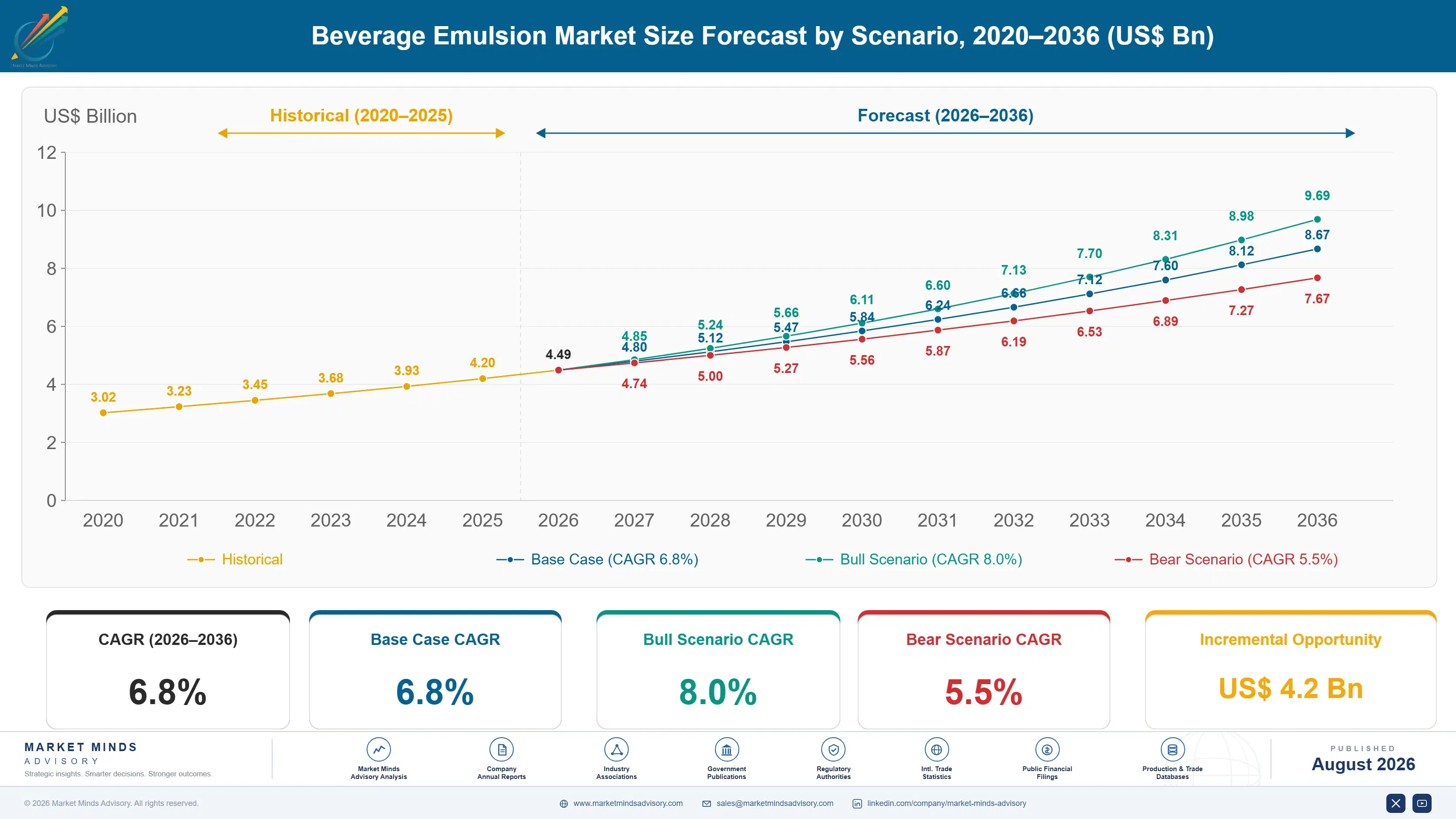
Between 2020 and 2025 the market grew at an estimated 5.8% historical CAGR, held back early by pandemic-era bottling disruption and 2022 gum acacia supply shortages out of Sudan that forced several suppliers to ration allocation among key accounts, before functional beverage launches and accelerating clean-label reformulation programs restored momentum through 2024 and into 2025, a recovery pattern consistent with the broader specialty ingredient category.
The base case assumes 6.8% CAGR through 2036, driven by three mechanisms: continued substitution of synthetic weighting agents with plant-derived systems across North American and European bottling lines under tightening retailer procurement scorecards, rapid functional beverage proliferation in East Asia as domestic manufacturers scale fortified ready-to-drink tea and water production, and rising co-manufacturer demand for pre-stabilized emulsion systems that shorten formulation cycles for private-label beverage brands entering crowded ready-to-drink categories across multiple continents simultaneously.
The bull case, at 8.0%, hinges on faster-than-expected adoption of enzymatically modified starch systems that let suppliers hit clean-label claims without losing shelf stability. The bear case, at 5.5%, reflects a scenario where gum acacia sourcing constraints from Sudan and Chad persist, forcing reformulation delays and margin compression across mid-sized suppliers unable to secure alternative hydrocolloid supply.

Reformulation Economics and Functional Beverage Pull

Beverage emulsion demand now converges around three forces: clean-label reformulation mandates from retailers, functional beverage proliferation, and bottler consolidation that concentrates purchasing power among fewer but larger accounts. Suppliers that can deliver stable, natural-origin systems at synthetic-equivalent cost are capturing share fastest, while those still reliant on synthetic-only portfolios are losing shelf space with each contract renewal cycle.
CR5 CONCENTRATION38%top five suppliers control formulation and stability testing capacity
AVERAGE SELLING PRICEUSD 8.40/kgpremium clean-label systems typically command a notable price premium
TOP PRODUCING COUNTRY SHAREChina, 24%leads global functional beverage emulsion manufacturing volume by far
CAPACITY UTILISATION76%reflects tight gum acacia and starch input availability
TRADE INTENSITY41%cross-border ingredient trade supports multinational bottler supply chains
FEEDSTOCK COST SHARE52%gum acacia and vegetable oil dominate input cost structure
Commercially, the category behaves less like a commodity ingredient and more like a formulation service. Buyers pay for stability testing, shelf-life validation, and co-development support alongside the emulsion itself, which is why the largest suppliers extend technical service teams directly into bottler product development groups, embedding themselves early enough in the innovation cycle to shape final formulation specifications rather than simply responding to a finished technical brief after the fact.
Over the next decade, enzymatic starch modification, algae-derived emulsifiers, and precision fermentation-based stabilizers will determine which suppliers can hold margin as synthetic alternatives face regulatory and consumer pressure across major bottling markets. Suppliers slow to commercialize these technologies risk ceding premium accounts to faster-moving rivals within the next five years, particularly in premium functional beverage and clean-label categories where technical differentiation commands the clearest price premium.
"The suppliers winning share right now aren't the cheapest ones. They're the ones who can tell a bottler exactly how a reformulated emulsion behaves at month seven on a warm truck in Guangzhou."
Director, Food and Beverage Ingredients Practice · MMA Agriculture and Food Ingredients Practice · August 2026

Market Trends

Clean-Label Reformulation Across Major Bottling Lines

Major beverage manufacturers are removing brominated vegetable oil and synthetic emulsifiers from flagship product lines following state-level restrictions in California and a broader FDA review of food additive status. Reformulation programs launched across more than 40 national beverage brands since 2023 now specify gum acacia, modified starch, or sucrose ester systems as default weighting agents. Suppliers that pre-validated clean-label replacements against existing shelf-stability protocols have captured reformulation contracts fastest, while those still testing alternatives have lost shelf space during the transition window, a pattern likely to repeat as additional states introduce comparable restrictions through 2027.
Market Impact: Shifts 18% of private-label volume
Functional Beverage Fortification Expands Emulsion Complexity

Fortified beverages carrying omega-3, vitamin D, probiotic, or adaptogenic actives require emulsion systems engineered for taste-masking and bioavailability, not simply cloud or color stability. Global functional beverage launches quantified by category tracking rose from roughly 1,800 in 2021 to over 3,200 in 2025, each requiring bespoke emulsion formulation work. This has pushed technical service revenue per account higher for suppliers able to combine flavor masking, nutrient stability, and shelf-life validation in a single engagement, while commodity-grade emulsion suppliers without fortification expertise are increasingly excluded from functional beverage RFPs entirely, a pattern suppliers expect to intensify through 2027.
Market Impact: Adds 210 million USD regional demand

Market Opportunities and Growth Drivers

Retailer Clean-Label Procurement Mandates Reshape Qualification

Large grocery retailers across North America and Western Europe have introduced supplier scorecards that penalize synthetic emulsifier use, with several major chains now requiring disclosure of weighting agent origin on private-label beverage contracts renewed since 2024. This has pushed co-manufacturers to demand pre-qualified clean-label emulsion systems from suppliers before contract renewal, compressing supplier qualification timelines from an industry-typical eighteen months to under nine. Suppliers unable to meet accelerated qualification windows have lost private-label volume to competitors carrying pre-validated natural-origin emulsion portfolios, reshaping which companies win renewal cycles across mainstream beverage categories.
Market Impact: Raises input cost 22% during disruption

Ready-to-Drink Category Expansion in East Asia

Ready-to-drink tea, coffee, and functional water launches across China, Japan, and South Korea grew unit volume by an estimated 14% between 2023 and 2025, each requiring cloud and flavor emulsion systems calibrated for regional taste profiles and packaging formats including retort-stable pouches. Domestic Chinese beverage manufacturers have scaled emulsion procurement volumes accordingly, drawing multinational suppliers to expand regional production capacity rather than serve the market through import alone. This regional manufacturing shift is compressing lead times for East Asian bottlers while creating fresh capacity competition among suppliers seeking co-located production near major bottling hubs.
Market Impact: Cuts shelf stability by 6 months

Market Restraints and Challenges

Gum Acacia Supply Concentration in Sudan and Chad

More than 70% of global gum acacia supply originates in Sudan and Chad, a concentration that produced severe price volatility and shipment delays following 2023 to 2024 regional conflict disruption to export corridors. The root cause is decades of underinvestment in alternative Acacia senegal cultivation regions, leaving buyers with few diversification options despite years of awareness. Suppliers have responded by qualifying East African and Indian gum acacia sources and increasing use of modified starch blends as partial substitutes, but full substitution remains technically limited for high-stability applications, so exposure to Sudanese supply persists across the category through the forecast period.
Market Impact: Adds 340 million USD reformulation-driven volume

Emulsion Stability Trade-Offs Under Clean-Label Constraints

Removing synthetic emulsifiers and preservatives frequently shortens shelf-stable cloud and color retention from twelve months to as few as six under warm-climate distribution conditions, a technical limitation rooted in the weaker interfacial stabilization natural gums provide compared with synthetic alternatives. This creates real commercial friction for bottlers serving hot climates or long-haul export routes. Suppliers are mitigating the gap through enzymatic starch modification and encapsulation technology that improves natural emulsifier performance, though these approaches currently add 8 to 15% to formulation cost relative to synthetic baselines, keeping full parity years away for cost-sensitive private-label accounts.
Market Impact: Adds 6 points to segment CAGR
3 additional market trends, 3 additional growth drivers, and 4 additional restraints and challenges are covered in the full report. Contact sales@marketmindsadvisory.com to access the complete intelligence.

Segment CAGR and Growth Architecture

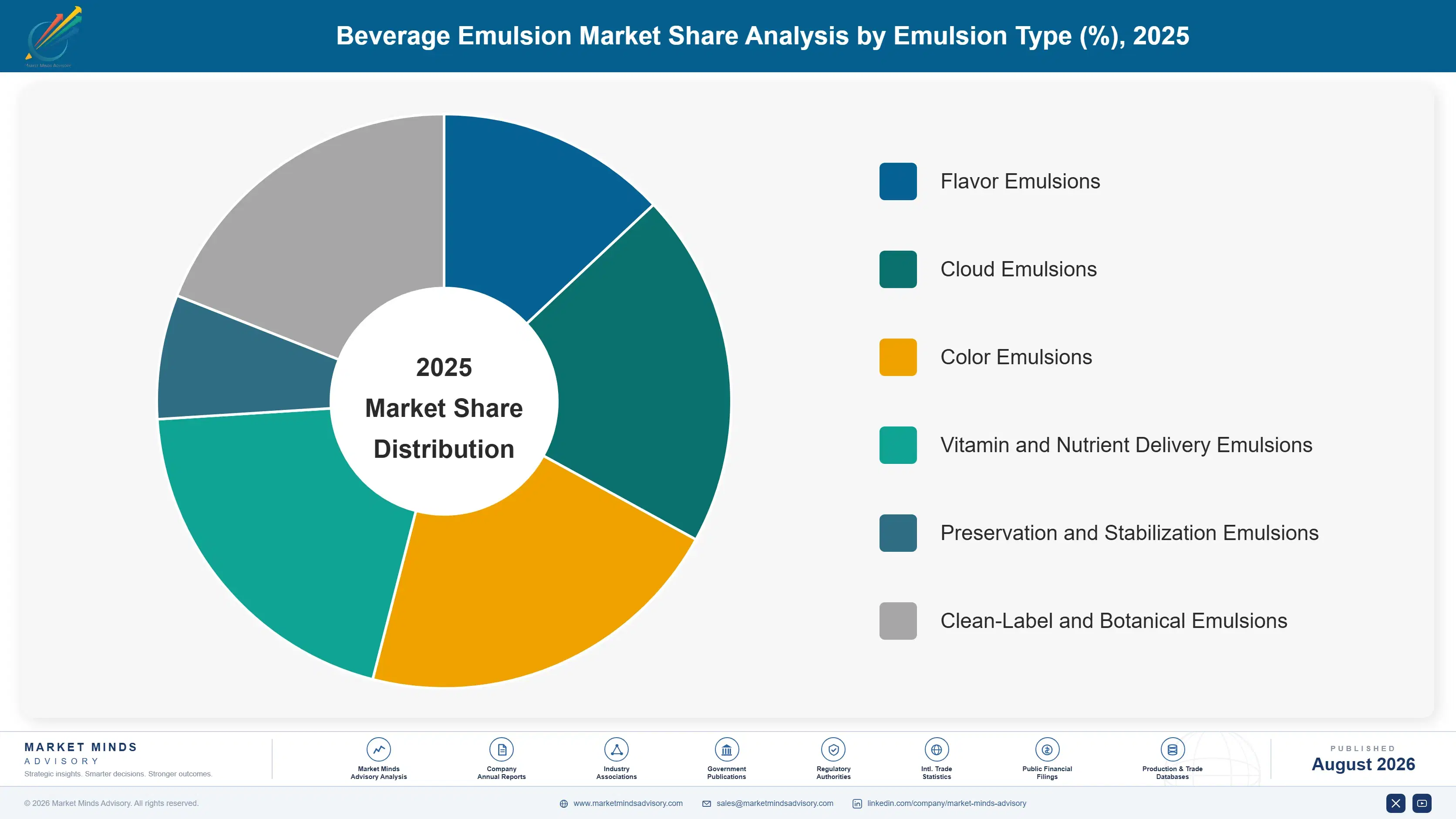
Segmentation follows emulsion function within beverage formulation, the same classification bottlers themselves use for procurement, technical qualification, and formulation risk assessment, spanning flavor, cloud, color, nutrient delivery, preservation and stabilization, and clean-label botanical systems across six functional categories that map directly onto how suppliers organize their application laboratories and technical service teams across every major account.
beverage-emulsion-market-trends-growth-insights-market-share-analysis-1787463475266

Vitamin and Nutrient Delivery Emulsions

Nutrient delivery emulsions engineered to mask the taste of omega-3, vitamin D, and probiotic actives while maintaining bioavailability represent the fastest-growing functional category, expanding as fortified beverage launches multiply across mainstream soft drink and ready-to-drink tea portfolios. Formulation complexity is materially higher than standard cloud or flavor emulsions, since nutrient actives often degrade under standard pasteurization, requiring bespoke encapsulation. Suppliers with dedicated nutrient stability laboratories are capturing disproportionate share of this segment, commanding average selling prices roughly 60% above standard flavor emulsion systems. Demand concentrates among premium and functional beverage brands in East Asia, North America, and Western Europe, with adoption spreading fastest among beverage co-manufacturers serving private-label fortified water and tea programs.
CAGR 9.8%

Clean-Label and Botanical Emulsions

Clean-label emulsion systems built on gum acacia, sucrose esters, and botanical extracts are expanding rapidly as bottlers respond to retailer procurement mandates and state-level synthetic additive restrictions across North America. This segment overlaps functionally with cloud and weighting agent applications but is defined by input sourcing, since buyers qualify suppliers on natural-origin certification rather than technical performance alone. Reformulation contracts awarded since 2023 have concentrated among suppliers that pre-validated botanical systems against existing shelf-stability benchmarks, giving early movers a multi-year qualification advantage over competitors completing stability testing. Growth is fastest in North America and Western Europe, where regulatory and retailer pressure is most advanced, though East Asian premium brands are adopting botanical positioning for differentiation.
CAGR 8.6%
Full segment breakdown across 6 segments available in the complete report.

Regional Architecture and Country Demand Map

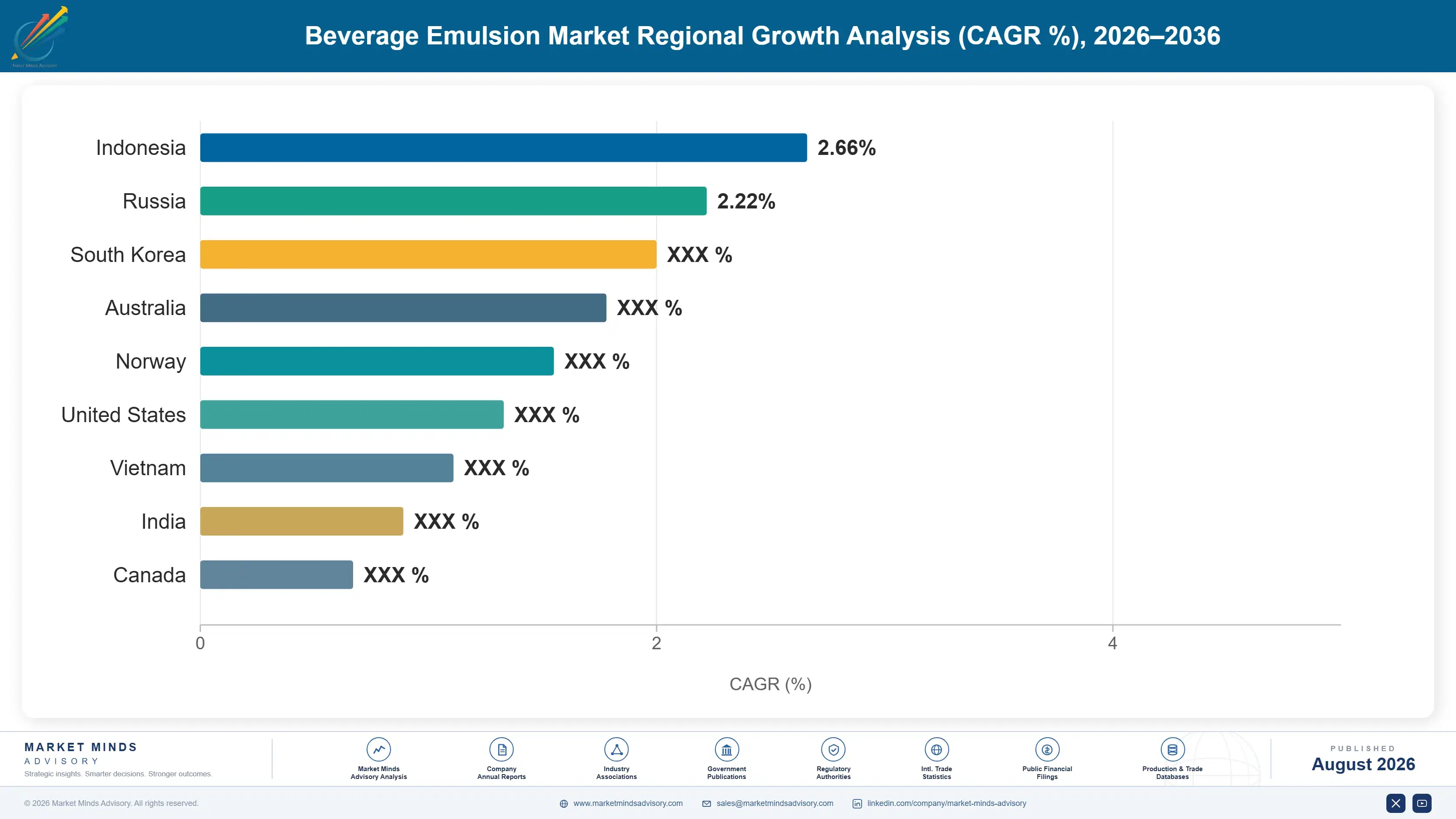
East Asia leads global consumption on sheer functional beverage manufacturing scale, followed closely by North America's premium reformulation spend and Western Europe's regulatory-driven clean-label transition, with South Asia and Pacific the fastest-expanding region on rapid ready-to-drink category growth across India, Southeast Asia, and Vietnam's expanding bottling sectors.

North America

United States bottlers drive regional demand through aggressive clean-label reformulation, with more than 40 national beverage brands removing synthetic weighting agents since 2023 following California's food additive restrictions and retailer procurement scorecards. Functional beverage launches carrying vitamin, probiotic, and adaptogenic actives have multiplied across grocery and convenience channels, pulling nutrient-delivery emulsion demand well above category average. Canada's smaller but growing functional water segment adds incremental volume. Private-label co-manufacturers account for a rising share of qualification activity as retailers push supplier scorecards down through their supply chains, compressing qualification timelines and rewarding suppliers carrying pre-validated natural-origin emulsion portfolios over those still completing stability testing on synthetic alternatives. This dynamic is most pronounced among grocery chains in California.
Share: 25% | CAGR: 6.3% (2026 to 2036)

Western Europe

Regulatory pressure defines the European market more than any other region, as the European Food Safety Authority's ongoing additive review pushes bottlers toward gum acacia and modified starch systems ahead of anticipated restrictions. Germany and France lead reformulation volume given their large private-label beverage sectors, while the United Kingdom's soft drink industry continues adjusting formulations following earlier sugar and additive levies. Nordic markets show disproportionate demand for botanical and organic-certified emulsion systems tied to premium positioning. Supplier qualification cycles in the region run longer than in North America because European bottlers require additional documentation for natural-origin claims, favoring established suppliers with deep regulatory affairs capability over newer entrants lacking dossier experience.
Share: 20% | CAGR: 5.3% (2026 to 2036)
Regional intelligence for 5 additional markets available in the complete report: East Asia, South Asia and Pacific, Latin America, Middle East and Africa, Eastern Europe. Contact sales@marketmindsadvisory.com.
beverage-emulsion-market-trends-growth-insights-country-cagr-analysis-1787463475777

Where Beverage Emulsion Suppliers Can Capture Margin

Suppliers are shifting from selling emulsion volume to selling formulation outcomes, bundling stability testing, regulatory documentation, and co-development work into contracts that command materially higher margin than commodity ingredient supply alone. The levers below reflect where technical service depth, manufacturing footprint, and proprietary formulation technology translate most directly into account-level pricing power across bottler and co-manufacturer relationships.

Bundled Formulation and Stability Testing Services

Suppliers that package shelf-life validation, sensory testing, and regulatory documentation alongside emulsion supply are capturing 15 to 20% higher account-level margin than those selling ingredient volume alone, since bottlers increasingly outsource formulation risk rather than build internal testing capability. This shift favors suppliers with dedicated application laboratories over smaller regional producers lacking testing infrastructure. Kerry Group and Givaudan have both expanded dedicated beverage application centers since 2023 specifically to capture this bundled service revenue, positioning technical service capacity as a qualification prerequisite for major bottler accounts rather than an optional add-on to core ingredient supply.
Market Impact: Lifts account-level margin by roughly 15 to 20 percent

Pre-Validated Clean-Label Reformulation Kits for Rapid Qualification

Offering pre-validated drop-in replacement formulations for common synthetic emulsifier applications lets suppliers compress bottler qualification timelines from 18 months to under 9, directly winning reformulation contracts ahead of competitors still completing individual stability testing. This lever works because retailer scorecards now penalize slow reformulation, making speed to qualification a commercial differentiator rather than simply a technical one. Suppliers offering these kits report reformulation contract win rates roughly double those quoting custom formulation from scratch, since bottlers facing compressed compliance deadlines prioritize proven systems over bespoke development regardless of marginal performance differences.
Market Impact: Roughly doubles reformulation contract win rate to 40%

Regional Manufacturing Co-Location Near Bottling Hubs

Establishing production capacity directly adjacent to major bottling clusters in Guangdong, Sao Paulo, or the American Midwest cuts logistics lead time from roughly 3 weeks to 2 days, a decisive advantage for bottlers running just-in-time production schedules that cannot absorb import delays. Suppliers with co-located capacity also reduce exposure to the ocean freight volatility that disrupted emulsion supply chains repeatedly between 2021 and 2023. This lever requires meaningful capital investment, which is why it remains concentrated among the five largest global suppliers rather than mid-sized regional players still serving customers through centralized production and export.
Market Impact: Cuts lead time from 3 weeks to 2 days

Nutrient Encapsulation Technology Licensing for Regional Formulators

Suppliers holding proprietary encapsulation technology for masking nutrient actives in fortified beverages are increasingly licensing that technology to smaller regional formulators rather than serving every account directly, generating royalty revenue with minimal incremental production investment. This approach lets technology leaders capture value across a far broader customer base than direct supply alone would reach, particularly in fragmented markets like South Asia and Latin America where local suppliers understand regional taste preferences better than multinationals. Early licensing programs launched since 2024 report royalty margins exceeding typical ingredient supply margins by a wide multiple.
Market Impact: Adds royalty revenue at 8 to 12% margin

Who Controls the Margin Pool

The top five suppliers hold an estimated 38% combined share on a revenue basis, a moderate concentration that leaves meaningful room for mid-sized challengers, particularly in clean-label and regional flavor-matching niches where global players move slower than local specialists who understand regional taste preferences and regulatory nuance more intimately than distant corporate technical teams.
Current competitive activity centers on three dimensions: expanding beverage-dedicated application laboratories, racing to pre-validate clean-label reformulation systems ahead of tightening regulation, and building regional production capacity closer to major bottling clusters to compress lead times against import-dependent competitors, a race that increasingly determines which suppliers win multi-year reformulation contracts.

Pressure is building from ingredient technology entrants applying precision fermentation and enzymatic modification to emulsifier production, threatening to undercut established suppliers on natural-origin cost structure within the next several years. Regional Asian and Latin American suppliers are also gaining share in domestic reformulation contracts where local taste-matching expertise and faster qualification cycles matter more than global brand reputation, gradually eroding the advantage multinational suppliers have historically held on technical scale alone, a shift accelerating fastest in East Asian and Latin American reformulation and private-label contracts.
beverage-emulsion-market-trends-growth-insights-company-positioning-matrix-1787463476297

Competitive Moat and Risk Dimensions

GIVAUDAN

Moat: Deep formulation co-development capacity

Givaudan operates dedicated beverage application centers across multiple regions, giving it formulation know-how and stability testing throughput that smaller suppliers cannot easily replicate, particularly for complex nutrient-delivery and clean-label reformulation projects requiring extensive iterative testing cycles. This scale advantage compounds over time as each completed project deepens the company's proprietary formulation database.
GIVAUDAN

Risk: Raw material cost exposure

Heavy reliance on gum acacia and specialty vegetable oil inputs leaves Givaudan exposed to the same Sudan and Chad supply concentration affecting the broader industry, with limited ability to pass through sudden cost spikes on fixed-price multi-year bottler contracts, a constraint that periodically compresses margin during acute disruption windows.
IFF

Moat: Integrated ingredient portfolio breadth

Following its DuPont Nutrition and Biosciences integration, IFF combines emulsion systems with enzymes, cultures, and functional ingredients under one commercial relationship, letting it bundle formulation solutions that narrower competitors serving only emulsions cannot match on scope. This breadth is particularly valuable for large multinational bottlers seeking to consolidate ingredient sourcing across fewer strategic suppliers.
IFF

Risk: Ongoing integration complexity

Merging distinct legacy commercial and technical organizations has created documented account service inconsistency in some regions, creating an opening for more focused competitors to win accounts specifically on responsiveness and dedicated technical support during the transition period. Several regional accounts have already shifted volume to smaller rivals citing slower response times during the integration.

Players Tracked

Prominent Players

Givaudan
IFF
DSM-Firmenich
Kerry Group
Sensient Technologies

Other Key Players

ADM
Cargill
Symrise
Doehler
Tate and Lyle
Ingredion
Ashland
CP Kelco
Corbion
Kalsec
FONA International
Bell Flavors and Fragrances
AAK AB
Robertet
T. Hasegawa

Recent Developments

MARCH 2025

Givaudan Expands Beverage Emulsion Capacity in Singapore

Givaudan completed an expansion of its Singapore beverage application and manufacturing facility, adding dedicated clean-label emulsion production lines to serve growing Southeast Asian ready-to-drink demand and shorten regional lead times for bottler customers across the Asia-Pacific corridor, with the expanded facility scheduled to reach full production capacity by early 2026.
Signal: Signals multinational suppliers increasingly prioritizing Southeast Asian co-located capacity investment over centralized export-based supply models going forward.
SEPTEMBER 2024

IFF Completes Divestiture of Non-Core Flavor Assets

IFF divested a portfolio of non-core flavor manufacturing assets to a private equity buyer as part of its post-merger portfolio rationalization, redirecting capital toward its beverage-focused nutrition and emulsion technology platforms following the DuPont integration, part of a broader effort to sharpen the company's focus on higher-margin functional beverage segments.
Signal: Indicates continued post-merger portfolio focus toward higher-margin functional beverage formulation segments over legacy commodity flavor lines.
JANUARY 2026

Kerry Group Launches Clean-Label Cloud Emulsion Platform

Kerry Group launched a new gum acacia-free cloud emulsion platform using enzymatically modified starch, targeting bottlers seeking clean-label claims without the shelf-stability compromises typically associated with acacia-alternative systems in warm-climate distribution, positioning the platform as a direct response to persistent Sudanese gum acacia supply disruption affecting the broader category.
Signal: Reflects growing supplier investment in reducing gum acacia dependency amid persistent Sudan and Chad supply risk.

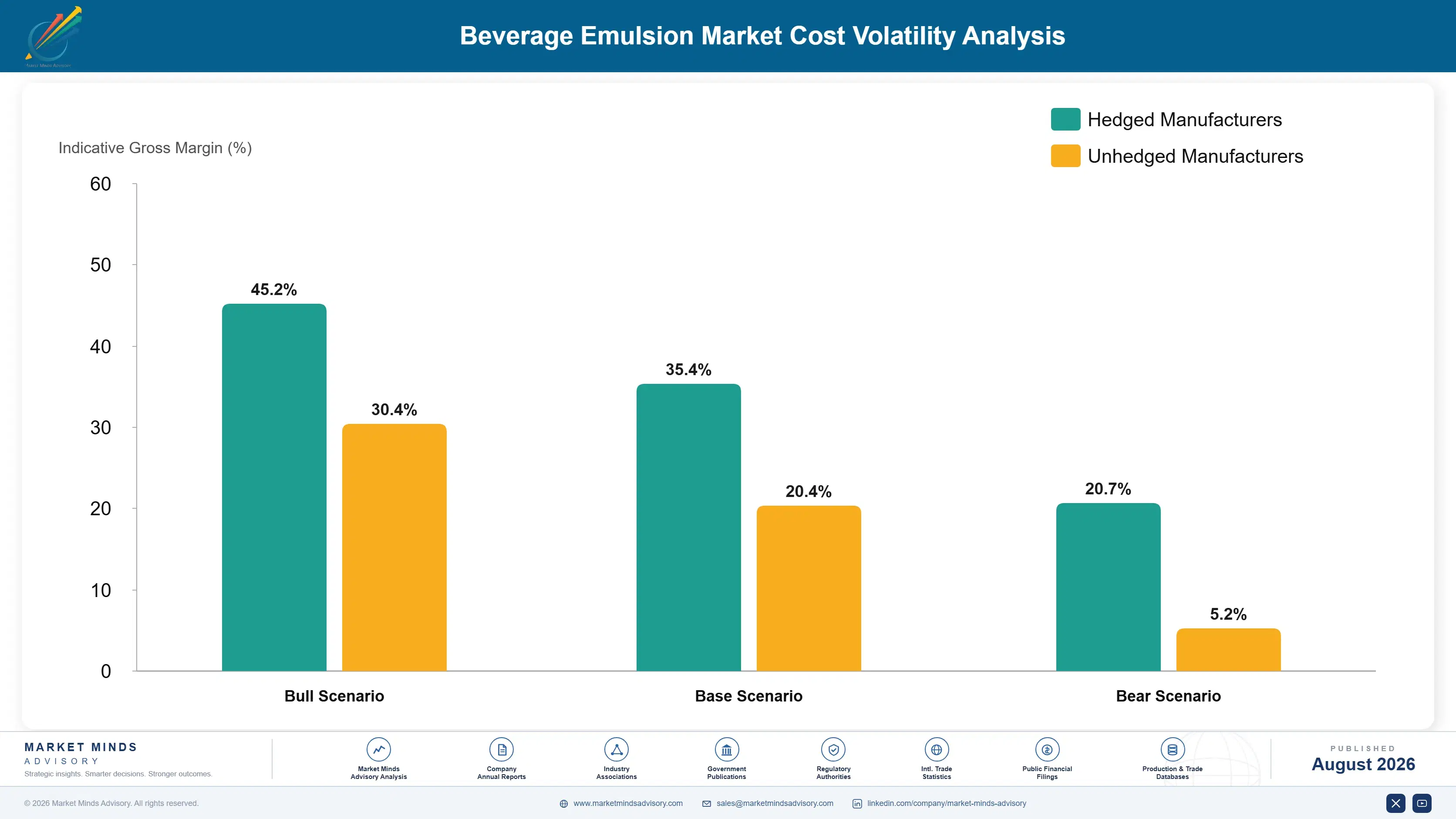
Gum Acacia and Vegetable Oil Cost Exposure

Gum acacia and specialty vegetable oils together represent roughly 52% of cost of goods sold for a typical beverage emulsion formulation, with gum acacia alone accounting for close to a quarter of input cost despite representing a smaller share of formulation weight, reflecting its supply concentration premium relative to more broadly sourced vegetable oil inputs used across the rest of the formulation.
Gum acacia prices rose an estimated 35% between late 2023 and mid-2024 following export disruption tied to conflict in Sudan, the source of more than 70% of global supply, according to trade data tracked through United Nations Comtrade and corroborated by supplier annual report commentary on input cost pressure during the period, with several major suppliers citing the disruption explicitly in quarterly earnings commentary as a material cost headwind.

Larger suppliers with diversified sourcing across Sudan, Chad, and emerging Indian gum acacia production absorb volatility more effectively than smaller regional formulators dependent on single-origin supply contracts. This creates a lasting cost disadvantage for smaller players during disruption periods, pushing some toward increased use of modified starch blends despite the technical stability trade-offs those alternatives carry in warm-climate applications.
beverage-emulsion-market-trends-growth-insights-cost-volatility-analysis-1787463476492

Multi-Origin Gum Acacia Sourcing Diversification

Suppliers are qualifying East African and Indian gum acacia origins alongside traditional Sudanese supply, reducing single-country concentration risk even though full substitution remains limited by quality consistency differences across origins. Several major suppliers have committed multi-year investment toward expanding qualified acreage in Kenya and Tanzania specifically to reduce dependency on the Sudan-Chad corridor over the next several years.

Modified Starch and Sucrose Ester Substitution

Partial substitution with modified starch and sucrose ester systems reduces gum acacia dependency for less demanding applications, freeing constrained acacia supply for high-stability uses where alternatives underperform technically. This approach has already cut acacia consumption per formulated liter by a meaningful margin among suppliers that adopted blended systems early, easing exposure during the most recent Sudanese export disruption.

Long-Term Supply Contracts With Origin Cooperatives

Several suppliers have signed multi-year supply agreements directly with Sudanese and Chadian producer cooperatives, locking in volume and partially insulating pricing from spot market volatility during acute disruption periods. These direct-sourcing arrangements also give suppliers earlier visibility into harvest conditions and export corridor disruption, letting technical teams adjust formulation blends proactively rather than reactively once shortages already affect production.

Portfolio Architecture for Margin Defence

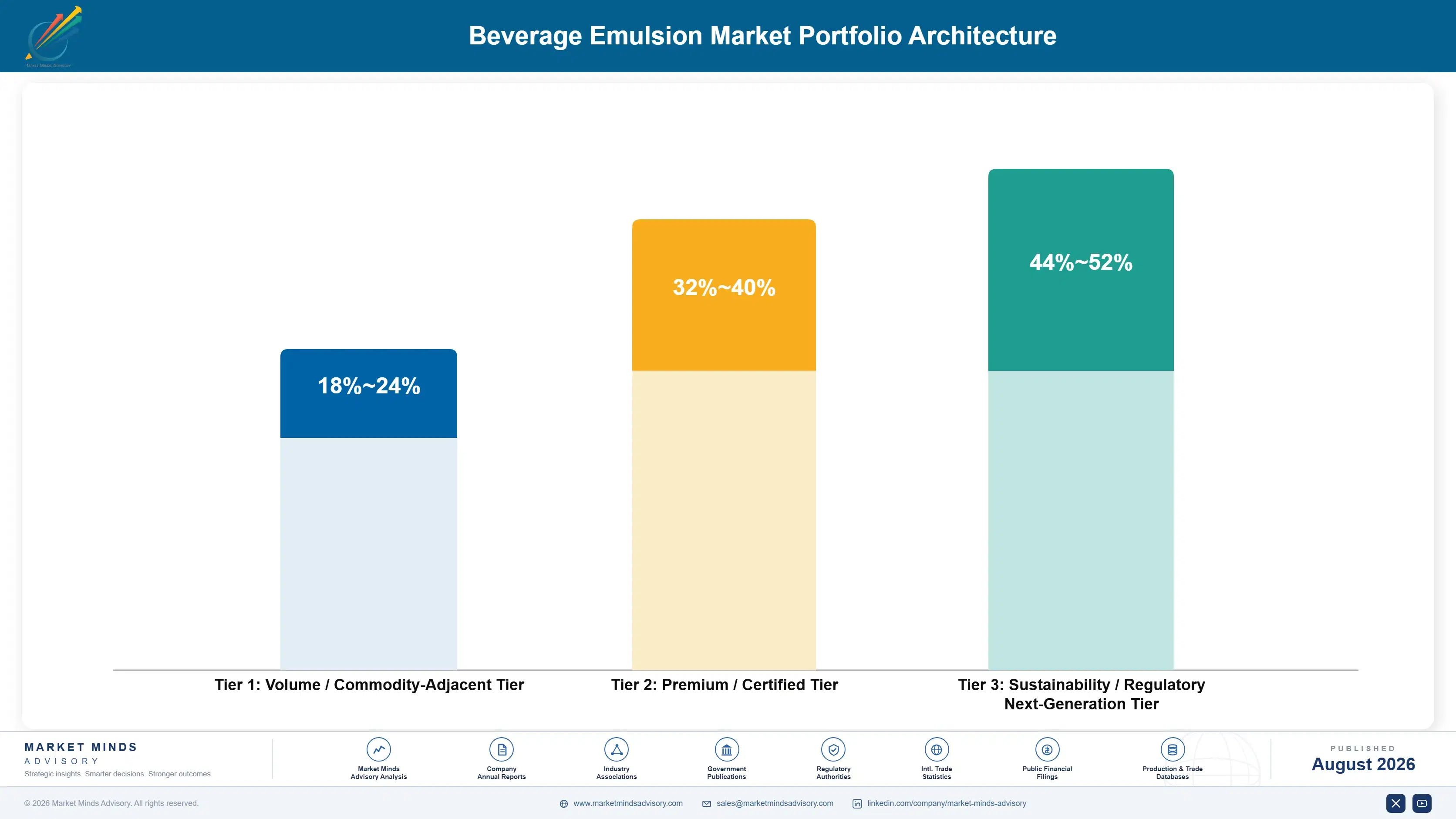
The portfolio splits across three tiers with materially different margin economics: volume-grade synthetic and commodity emulsions carrying thin margins under intense price competition, certified clean-label systems commanding a meaningful premium, and next-generation nutrient-delivery or precision-fermentation systems capturing the highest margins currently available in the category, a spread wide enough that portfolio mix now matters more to supplier profitability than raw production volume. Buyers increasingly treat tier selection as a strategic sourcing decision rather than a simple cost trade-off.
The volume versus premium tension is acute right now because retailer clean-label mandates are compressing the addressable market for commodity synthetic emulsions faster than suppliers can shift capacity toward certified alternatives, leaving some producers holding underutilized synthetic production lines that cannot be repurposed quickly given the specialized equipment certified systems typically require.

High-value margin pools concentrate specifically in nutrient-delivery emulsions for functional beverages and clean-label systems carrying third-party natural certification, both of which command premium pricing tied to technical complexity and documentation rather than raw ingredient cost alone, a dynamic that rewards suppliers investing early in application science over those competing purely on scale. Suppliers that under-invest in this tier now will find it considerably harder to re-enter once certification barriers compound.

Volume / Commodity-Adjacent Tier

Standard synthetic and semi-synthetic cloud and flavor emulsions sold primarily on price into mainstream carbonated soft drink and juice applications, facing intense competitive pressure from clean-label alternatives and carrying thin, increasingly squeezed margins industry-wide.
Gross Margin: 18%-24%

Premium / Certified Tier

Clean-label, natural-origin, and third-party certified emulsion systems commanding premium pricing tied to documentation, regulatory compliance support, and validated shelf-stability performance across demanding warm-climate and long-haul distribution scenarios that commodity systems cannot reliably match.
Gross Margin: 32%-40%

Sustainability / Regulatory / Next-Generation Tier

Nutrient-delivery, precision-fermentation, and algae-derived emulsion systems serving functional beverage and fortification applications at the highest technical complexity and margin, commanding premium pricing tied to encapsulation science few competitors currently possess at commercial scale.
Gross Margin: 44%-52%
beverage-emulsion-market-trends-growth-insights-portfolio-architecture-1787463476988

High-value Sub-segments and Strategic Watch-out

Nutrient Delivery Emulsions

Highest-value, fastest-growing segment driven by functional beverage fortification trends, commanding premium pricing on encapsulation and bioavailability technology that competitors cannot easily replicate quickly, since building comparable formulation science typically requires several years of dedicated laboratory investment and accumulated application testing data across multiple beverage categories and regional taste profiles.
Gross Margin: 46%-54%

Certified Clean-Label Cloud Systems

High-value segment growing steadily as retailer procurement mandates expand, with margin supported by documentation and qualification barriers rather than raw technical complexity alone, favoring suppliers with established regulatory affairs capability and multi-year track records securing natural-origin certification across major Western retail accounts in both North America and Western Europe.
Gross Margin: 34%-40%

Standard Flavor and Color Emulsions

Volume core of the category, serving mainstream carbonated soft drink and juice applications with stable but thin margins under sustained price competition among suppliers, where scale and manufacturing efficiency matter more than formulation sophistication for winning and retaining large-volume private-label contracts across mature Western and East Asian bottling markets.
Gross Margin: 20%-26%

Synthetic Weighting Agent Systems

Strategic watch-out segment facing steady, accelerating decline as regulatory restrictions and retailer mandates hasten synthetic emulsifier phase-out across major bottling markets through the forecast period, leaving suppliers reliant on this tier exposed to shrinking addressable volume and thinning margin over time as bottlers complete their clean-label transition programs.
Gross Margin: 16%-22%

Recurring Formulation Contracts and Switching Costs

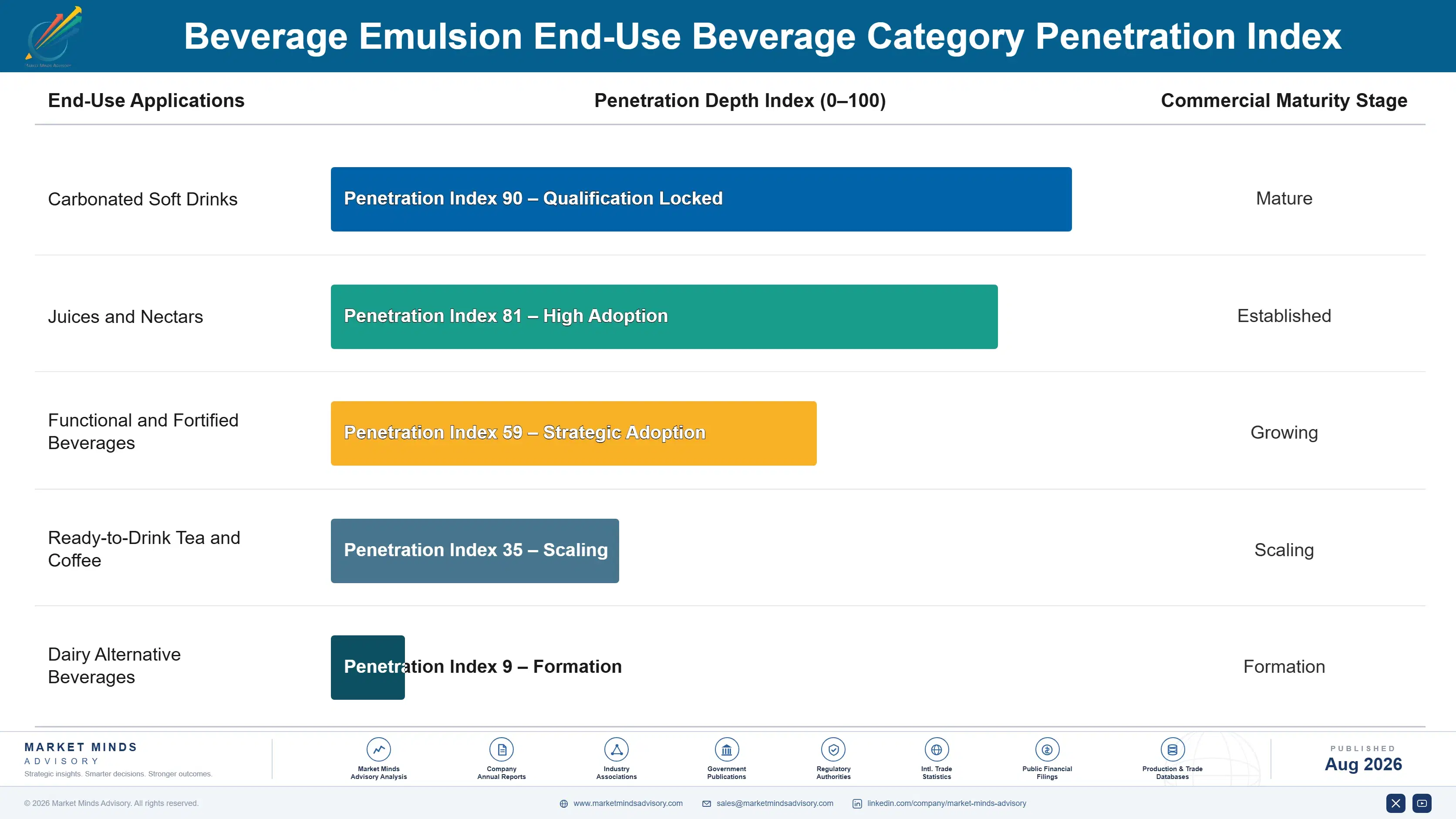
Beverage emulsion demand behaves like an annuity once a supplier wins a formulation slot, since bottlers rarely re-qualify emulsion systems mid-production run given the cost and risk of shelf-life revalidation, giving incumbent suppliers multi-year revenue visibility on won accounts, a dynamic that makes initial contract wins disproportionately valuable relative to their first-year revenue alone. Renewal cycles typically span three to five years, and suppliers who lose a slot rarely regain it quickly.
Adoption depth varies sharply by end-use vertical: carbonated soft drinks show the deepest, most entrenched supplier relationships given decades-long formulation stability, while emerging functional beverage categories remain more contestable as brands actively experiment with new nutrient-delivery suppliers during early product development phases, when switching costs remain low and formulation specifications have not yet been locked into production. Established categories, by contrast, see supplier switching concentrated almost entirely around retailer-driven reformulation mandates.

A generational shift in buyer profiles is underway as younger beverage brand founders, often building direct-to-consumer functional beverage lines, prioritize clean-label sourcing transparency and speed to market over the decades-long supplier relationships that defined procurement at legacy carbonated soft drink companies, a shift that favors nimble regional suppliers able to move faster than established multinational technical organizations.
beverage-emulsion-market-trends-growth-insights-end-use-penetration-index-1787463477475

Priorities for Beverage Emulsion Suppliers

These are among the four positions where our research anticipates prominent divergence between winners and laggards over the coming forecast period. Each is grounded in the demand model, the regulatory perimeter, and the announced capacity pipeline.
01 / CLEAN-LABEL INVESTMENT PRIORITY

Accelerate natural-origin qualification ahead of regulation

Suppliers still relying primarily on synthetic emulsifier portfolios face a rapidly shrinking addressable market as retailer procurement scorecards, state-level regulatory review, and shifting consumer preference all tighten simultaneously across major bottling markets. The window to pre-validate clean-label alternatives against existing shelf-stability benchmarks is narrowing quickly as faster-moving competitors capture reformulation contracts ahead of suppliers still completing internal testing cycles. Suppliers that delay this investment risk losing multi-year private-label relationships to faster-moving rivals carrying pre-validated natural-origin portfolios into every renewal negotiation.
02 / SOURCING DIVERSIFICATION STRATEGY

Reduce Sudan and Chad gum acacia concentration risk

Single-origin gum acacia dependency has produced repeated price shocks and export disruption over the past several years, directly compressing margins for suppliers that lack diversified sourcing relationships across multiple growing regions. Qualifying East African and Indian gum acacia origins, alongside greater use of starch-based partial substitution, reduces exposure meaningfully without requiring suppliers to abandon acacia-based systems entirely. Suppliers that fail to diversify remain persistently vulnerable to the next regional disruption event, a risk that has already cost some competitors major private-label contracts.
03 / FUNCTIONAL FORMULATION CAPABILITY

Build nutrient-delivery expertise ahead of fortification growth

Nutrient-delivery emulsions represent the fastest-growing and highest-margin segment in the category, but they require encapsulation and bioavailability expertise that most commodity-focused suppliers currently lack entirely, particularly around nutrient stability validation work. Building this capability now positions suppliers to capture premium functional beverage accounts before the segment fully matures and margins inevitably compress under intensifying competitive pressure from new entrants. Late entrants will face steeper technical catch-up costs and longer qualification timelines, arriving after early movers have already locked in the accounts that matter most.
04 / REGIONAL CAPACITY PLACEMENT

Prioritize East Asian and South Asian production co-location

Regional manufacturing scale in China and rapid category growth in India and Southeast Asia together make co-located production increasingly decisive for lead time performance and overall cost competitiveness. Suppliers still serving these markets through centralized export face a growing cost and speed disadvantage against regionally established competitors already operating co-located capacity closer to major bottling clusters. Capital committed to regional capacity now compounds advantage steadily as ready-to-drink category volume continues expanding across East Asia and South Asia and Pacific through the forecast period.

Engagement Snapshot From the Field

A live engagement with an industry participant carrying material or product regulatory and market exposure ahead of a defining policy shift, showing how our research translates into a defensible multi-year portfolio strategy.
MARKET MINDS ADVISORY · CLIENT ENGAGEMENT SUMMARY
Beverage Emulsion Producer Strategic Portfolio Review and Transition Roadmap 2026·Investment Scenario on Beverage Emulsion Exposure Evaluation 2025-26
CLIENT PROFILE
The client is a mid-sized regional beverage co-manufacturer serving private-label carbonated soft drink and functional water programs for several North American grocery retail chains, with reported annual beverage output exceeding 400 million liters (client-reported, unverified by MMA) across three production facilities prior to engaging MMA for reformulation strategy support ahead of a compressed retailer compliance deadline affecting several of its largest contracts.
STRATEGIC CHALLENGE
Facing retailer clean-label procurement mandates with an eighteen-month compliance deadline, the client's existing emulsion supplier had not yet validated natural-origin replacement systems, risking loss of several major private-label contracts representing a significant share of total production volume if reformulation could not be completed on schedule, a risk compounded by the client's limited internal formulation testing capacity.
MMA APPROACH
MMA conducted a supplier capability assessment across five candidate emulsion suppliers, benchmarking clean-label reformulation timelines, stability testing throughput, and regional production capacity, then facilitated a structured qualification process that compressed the client's typical supplier evaluation timeline substantially against historical qualification cycles, drawing on MMA's primary survey and expert interview data to benchmark timelines against comparable regional co-manufacturers.
KEY FINDINGS
  1. Only two of five evaluated suppliers had pre-validated clean-label cloud emulsion systems ready for immediate stability testing, sharply narrowing the client's viable supplier options from the outset.
  2. Switching to a pre-validated system reduced projected qualification timeline from an estimated sixteen months to under seven months across affected product lines.
  3. Gum acacia sourcing diversification among finalist suppliers correlated strongly with the pricing stability commitments the client required for its multi-year private-label contract terms.
  4. Bundled stability testing and regulatory documentation services materially reduced the client's internal quality assurance burden during the entire reformulation transition period overall.
CLIENT PROFILE
The client is a mid-sized regional beverage co-manufacturer serving private-label carbonated soft drink and functional water programs for several North American grocery retail chains, with reported annual beverage output exceeding 400 million liters (client-reported, unverified by MMA) across three production facilities prior to engaging MMA for reformulation strategy support ahead of a compressed retailer compliance deadline affecting several of its largest contracts.
STRATEGIC CHALLENGE
Facing retailer clean-label procurement mandates with an eighteen-month compliance deadline, the client's existing emulsion supplier had not yet validated natural-origin replacement systems, risking loss of several major private-label contracts representing a significant share of total production volume if reformulation could not be completed on schedule, a risk compounded by the client's limited internal formulation testing capacity.
MMA APPROACH
MMA conducted a supplier capability assessment across five candidate emulsion suppliers, benchmarking clean-label reformulation timelines, stability testing throughput, and regional production capacity, then facilitated a structured qualification process that compressed the client's typical supplier evaluation timeline substantially against historical qualification cycles, drawing on MMA's primary survey and expert interview data to benchmark timelines against comparable regional co-manufacturers.
KEY FINDINGS
  1. Only two of five evaluated suppliers had pre-validated clean-label cloud emulsion systems ready for immediate stability testing, sharply narrowing the client's viable supplier options from the outset.
  2. Switching to a pre-validated system reduced projected qualification timeline from an estimated sixteen months to under seven months across affected product lines.
  3. Gum acacia sourcing diversification among finalist suppliers correlated strongly with the pricing stability commitments the client required for its multi-year private-label contract terms.
  4. Bundled stability testing and regulatory documentation services materially reduced the client's internal quality assurance burden during the entire reformulation transition period overall.
RECOMMENDED STRATEGY
Phase 1: Phase 1 (Months 1 to 2): Complete supplier capability benchmarking and shortlist finalists based on clean-label readiness and sourcing diversification. Phase 2: Phase 2 (Months 3 to 5): Run parallel stability testing and sensory validation against existing retailer specification benchmarks for finalist systems. Phase 3: Phase 3 (Months 6 to 7): Execute phased production line conversion and finalize long-term supply agreement with selected reformulation partner.
OUTCOME
The client completed reformulation across all affected private-label product lines within the retailer compliance deadline, retaining contracts reported to represent a majority of the client's total private-label volume (client-reported, unverified by MMA), while establishing a diversified two-supplier sourcing structure reducing future disruption risk across its full private-label production portfolio going forward.

Frequently Asked Questions

Foundational context covering the market sizes, CAGR, scope, country, region and competition that inform every finding below. This section is provided to cover basics and most often pre-purchase conversations, answered from the MMA Primary Research Dataset.

What is the current size of the Beverage Emulsion Market?

The global beverage emulsion market is valued at approximately USD 4.2 billion in 2025. This figure covers flavor, cloud, color, and nutrient-delivery emulsion systems used across beverage formulation.

How large will the Beverage Emulsion Market be by 2036?

The market is projected to reach approximately USD 8.7 billion by 2036 under the base case scenario. This reflects sustained clean-label reformulation and functional beverage fortification demand.

What is the CAGR for the Beverage Emulsion Market 2026 to 2036?

The base case CAGR is 6.8% across the 2026 to 2036 forecast period, reflecting steady clean-label reformulation momentum. Bull and bear scenarios range from 5.5% to 8.0% depending on reformulation pace and gum acacia supply stability.

Which segment is growing fastest?

Vitamin and nutrient delivery emulsions are the fastest-growing segment at a 9.8% CAGR. This reflects rapid fortified beverage launches carrying omega-3, vitamin D, and adaptogenic actives.

Who are the major companies in the Beverage Emulsion Market?

Leading suppliers include Givaudan, IFF, DSM-Firmenich, Kerry Group, and Sensient Technologies. These five companies hold an estimated 38% combined market share on a revenue basis.

Which country is growing fastest?

China leads growth at an estimated 8.4% CAGR, driven by expanding functional beverage manufacturing scale. Ready-to-drink tea and functional water categories are the primary growth engines.

Report Segmentation Architecture

The full report scope spans multiple orthogonal segmentation dimensions, with cross-tabulated demand data provided for each dimension pair. Coverage extends further to regional breakdowns, trend trajectories, and the competitive detail needed to support segment-level decision-making.

By Emulsion Type

  • Flavor Emulsions
  • Cloud Emulsions
  • Color Emulsions
  • Vitamin and Nutrient Delivery Emulsions
  • Preservation and Stabilization Emulsions
  • Clean-Label and Botanical Emulsions

By End-Use Beverage Category

  • Carbonated Soft Drinks
  • Juices and Nectars
  • Functional and Fortified Beverages
  • Ready-to-Drink Tea and Coffee
  • Dairy Alternative Beverages

By Commercial Dimension

  • Brand-Owned Manufacturing
  • Private-Label Co-Manufacturing
  • Direct Bottler Supply
  • Distributor and Broker Supply

By Region

  • North America
  • Western Europe
  • East Asia
  • South Asia and Pacific
  • Latin America
  • Middle East and Africa
  • Eastern Europe

Scope, Methodology, and Coverage

Every figure in this report is reproducible from documented input assumptions. The scope below maps the historical period, the forecast horizon, the segmentation dimensions, and the countries covered, alongside the underlying primary and qualitative methodology.
Historical Period
2020 to 2025
Forecast Period
2026 to 2036
Base Year
2025 (USD billions; MMA Primary Research Dataset, August 2026)
Market Definition
This report covers oil-in-water emulsion systems formulated for beverage applications, including flavor, cloud, color, weighting agent, and nutrient-delivery emulsions. It excludes standalone flavor compounds, dry powder beverage premixes, and beverage packaging or processing equipment.
Quantitative Units
USD billions (current prices); metric tons for volume-based segment analysis
Segmentation Dimensions
By Emulsion Type; By End-Use Beverage Category; By Commercial Dimension; By Region
Regions Covered
North America, Western Europe, East Asia, South Asia and Pacific, Latin America, Middle East and Africa, Eastern Europe
Countries Covered
USA, China, Germany, France, UK, Japan, South Korea, India, Australia, Canada, Brazil, Mexico, Indonesia, Vietnam, Thailand, Malaysia, UAE, Saudi Arabia, South Africa, Nigeria, Turkey, Poland, Netherlands, Italy, Spain, Sweden, Switzerland, Argentina, Colombia, Singapore, and additional markets relevant to this sector
Key Companies Profiled
Givaudan, IFF, DSM-Firmenich, Kerry Group, Sensient Technologies, ADM, Cargill, Symrise, Doehler, Tate and Lyle, Ingredion, Ashland, CP Kelco, Corbion, Kalsec, FONA International, Bell Flavors and Fragrances, AAK AB, Robertet, T. Hasegawa
Quantitative Methodology
Primary survey, n=3,800 respondents, Q4 2025, six countries; demand-side model with trade association cross-validation
Qualitative Methodology
47 expert interviews, Q4 2025; applied to validate demand model assumptions, identify emerging dynamics, and assess competitive positioning
Report Format
PDF and XLSX data workbook (Word format preview document)
Publisher
Market Minds Advisory
Report Code
MMA-2026-AGR-101
Published
August 2026
Contact
sales@marketmindsadvisory.com | www.marketmindsadvisory.com

Purchase the full Beverage Emulsion Market Report (2026 to 2036).

The full report delivers a complete quantitative and qualitative assessment of the global beverage emulsion market across all six functional segments and seven regions. It includes detailed supplier profiles covering formulation capability, production capacity, and regulatory positioning for the twenty companies profiled. Analysts provide scenario-adjusted forecasts through 2036 alongside input cost sensitivity modeling tied to gum acacia and vegetable oil price volatility. Buyers receive access to underlying primary survey and expert interview data supporting all quantitative claims. The report also flags out-of-band regional shares and segmentation judgment calls explicitly, giving buyers full visibility into every assumption behind the forecast.
Segment-level forecasts through 2036 across all six categories
Seven-region demand, pricing, and CAGR breakdown tables
Twenty-company competitive profiling with moat and risk analysis
Gum acacia supply risk assessment and mitigation pathways
Clean-label reformulation tracker across major bottling markets
Quarterly market update subscription option for ongoing monitoring

Built For The People Who Decide

From boardroom strategy to bench-side execution, this report is read cover-to-cover by leaders shaping the next decade of their industry, turning demand scenarios, market dynamics and valuation benchmarks into decisions.
CXOs/ Presidents/ VPs/ Managers
M&A and Corporate Development
Strategy Teams and R&D Heads
Procurement and Product Directors
Regulatory and Compliance Leaders
Investor Relations and Equity Analysts