Market Minds Advisory
Beverage Clouding Agent Market

Beverage Clouding Agent Market: Clean Label Pressure Meets Citrus Emulsion Economics

Citrus and functional drink manufacturers are rebuilding cloud emulsion formulas around plant-derived gums as legacy weighting agents face growing regulatory and retailer scrutiny across North America, Western Europe, and East Asia bottling lines.

Lead Analyst

Lisa Gevelber

Published

September 2026

Make Smarter Decisions with Customized Research Insights

Request a free sample report and evaluate market opportunities, growth trends, and competitive dynamics relevant to your business needs.

2025 MARKET VALUE$0.8BMarket Size 2025
2036 FORECAST VALUE$1.7BBase Case , 2026 to 2036
CAGR 2026 TO 20366.9 %Bull 8.1% / Bear 5.7%
INCREMENTAL OPPORTUNITY$0.8BNet 10- year value creation
EXPANSION MULTIPLE1.95x2036 value over 2026 base
Strategic Levers
M&A Pipeline
Regional Outlook
Country Rankings
Competitive Intelligence
Segmental Deep-dive
Call-Us : 91 93563 13602

Executive Snapshot and Market Trajectory

Beverage clouding agents sit at USD 0.8 billion in 2025, a small ingredient category now carrying outsized formulation risk as bottlers replace ester gum and brominated vegetable oil chemistries under mounting retailer clean label pressure across major North American and European grocery accounts and beyond.
Natural and plant-derived systems grow fastest at 10.8%, about 1.57 times the overall 6.9% rate, as juice and functional drink brands reformulate around gum acacia and pectin-based emulsions to satisfy tightening retailer specification changes rolling out steadily across multiple overlapping markets. East Asia anchors demand on citrus ready-to-drink tea and juice manufacturing scale, while India posts the quickest national growth as contract bottling capacity expands rapidly to serve a large, increasingly health-conscious urban consumer base.
Competition stays fragmented across ingredient houses with no single formulator commanding the category outright, and the gap between the leading supplier and mid-tier challengers remains narrow at this stage of the reformulation cycle. Regulatory scrutiny of brominated vegetable oil in the United States, alongside expanding retailer mandates across Western markets, is reshaping which chemistries survive commercially past 2028 and which fade into niche legacy volume.
Market Definition
The beverage clouding agent market covers emulsion and dispersion systems that impart visual opacity and mouthfeel to citrus juices, functional drinks, and flavored beverages, including weighting agents, starches, gums, resins, and plant-derived alternatives. It excludes beverage flavors, colors, and preservatives sold as standalone ingredients.
Base Year Value
$0.8B in 2025 (MMA Primary Research Dataset, August 2026)
Forecast Period
2026 to 2036, eleven discrete annual values
CAGR
6.9% base case. Bull 8.1%. Bear 5.7%.
Fastest Growth Segment
Natural and Plant-Derived Clouding Agents: 10.8% CAGR
Fastest Growth Country
India: 9.9% CAGR
Fastest Growth Region
South Asia and Pacific: 9.2% CAGR
Largest Region
East Asia: 29% of 2025 global value
Market Leaders
Cargill, Kerry Group, Tate and Lyle, Ingredion, Sensient Technologies. Source: MMA Analysis based on company annual reports.
Primary Survey
n=3,800 procurement and R&D decision-makers, Q4 2025, six countries
Methodology
Demand-side build-up, cross-validated against public data, 47 expert interviews

Beverage Clouding Agent Market Forecast Scenarios

beverage-clouding-agent-market-trends-size-forecast-scenario-1787462034699
Between 2020 and 2025 the category grew near 5.9% annually as juice reformulation activity ran alongside pandemic-driven demand swings for packaged beverages worldwide. Weighting agent volumes held broadly steady through the period even as early retailer clean label commitments began appearing across North America and Western Europe, quietly setting the stage for the current reformulation cycle that followed.
The base case carries the market to 6.9% through 2036 on three mechanisms. First, functional and fortified RTD beverage launches keep multiplying across East Asia and South Asia, each requiring a stable cloud system. Second, retailers in North America and Europe continue tightening ingredient lists, pushing formulators toward gum and pectin chemistries priced above legacy weighting agents. Third, capacity additions among contract beverage manufacturers in India and Southeast Asia lift underlying emulsion volume regardless of which chemistry wins.
The bull case reaches 8.1% if a coordinated regulatory phase-out of brominated vegetable oil forces faster reformulation spend across multiple markets simultaneously. The bear case falls to 5.7% if bottlers delay reformulation and stretch existing weighting agent inventories past current retailer deadlines, a pattern already visible among mid-sized regional bottlers reluctant to absorb higher natural ingredient costs.

Reformulation Economics Behind an Overlooked Ingredient Category

Beverage clouding agents rarely draw attention outside formulation labs, yet they decide whether a juice or functional drink looks the way consumers expect on a store shelf. Three forces now converge on that quiet category. Retailer ingredient policies are tightening faster than regulators are acting, functional and fortified drink launches keep multiplying across Asia, and citrus supply volatility is pushing formulators to hedge against any single chemistry.
MARKET CONCENTRATIONCR5: 44%Moderately fragmented across many specialty beverage ingredient formulators globally
AVERAGE SELLING PRICEUSD 3.80 to 6.20/kgReflects chemistry complexity and natural sourcing premium costs
TOP PRODUCING REGION SHAREEast Asia: 29%Anchored by citrus and functional drink bottling scale
CAPACITY UTILISATION72% to 80%Specialty emulsion lines run below commodity ingredient plants
FEEDSTOCK SHARE OF COGS38% to 46%Gum resin and citrus oil pricing drives input volatility
REFORMULATION CYCLE LENGTH18 to 30 monthsTime bottlers typically need to requalify a new emulsion system
Commercially the market behaves like a specialty chemical niche wearing a food ingredient label. Formulators sell technical service alongside the emulsion itself, since a poorly matched cloud system separates or fades within weeks of bottling. That service intensity keeps margins healthier than the ingredient's small headline value would suggest, and it raises switching costs once a bottler has qualified a supplier's system against its specific beverage matrix.
Over the next decade, brominated vegetable oil's regulatory trajectory in the United States will settle which chemistries formulators standardize around, while Asian bottling capacity growth decides where volume actually lands. Neither force moves quickly, which is precisely why incumbents with qualified natural alternatives already on shelf hold a real head start over the next reformulation wave.
"Nobody buys a clouding agent for the agent itself. They buy the guarantee that a bottle of orange drink still looks like orange drink after six months on a truck." The category rewards whoever solves that boring problem most reliably, not whoever markets the loudest."
Director, Food and Beverage Ingredients Practice · MMA Food and Beverage Ingredients Practice · August 2026

Market Trends

Retailers Codify Clean Label Ingredient Lists Ahead of Regulators

Major North American and Western European grocery chains have written brominated vegetable oil and several synthetic weighting agents out of private label specifications ahead of any federal mandate, following California's 2023 state-level ban on the ingredient in food and beverages. Formulators supplying private label bottlers must requalify emulsion systems against retailer deadlines that arrive faster than typical multi-year regulatory phase-outs. This compresses the reformulation timeline for suppliers still selling legacy chemistries, forcing parallel investment in natural alternatives even where national regulation has not yet moved. Suppliers who delay risk losing shelf space before any law forces the change.
Market Impact: Forces reformulation across 60% of SKUs
Functional and Fortified RTD Beverage Launches Multiply Across Asia

Ready-to-drink tea, functional water, and fortified juice launches have expanded sharply across China, India, and Southeast Asia, each new formulation requiring a clouding system matched to its specific protein, vitamin, or botanical load. Contract beverage manufacturers in these markets increasingly specify natural gum-based systems from launch rather than retrofitting later, since regional consumers associate visible cloudiness with perceived freshness in juice-style drinks. That preference differs from Western markets, where clarity sometimes signals purity instead. Ingredient suppliers building formulation libraries tuned to Asian fortified beverage matrices are capturing a disproportionate share of new product development briefs.
Market Impact: Adds 15 new bottling lines annually

Market Opportunities and Growth Drivers

United States Regulatory Scrutiny of Brominated Vegetable Oil Intensifies

The Food and Drug Administration proposed revoking authorization for brominated vegetable oil in food and beverages, following state-level bans in California and similar legislative activity in other states. Beverage makers relying on the ingredient for citrus cloud stability now face a defined reformulation deadline rather than an open-ended compliance question. Ester gum, sucrose acetate isobutyrate, and glycerol ester of wood rosin are the most common direct substitutes, though each carries different cost and stability tradeoffs that formulators are still resolving batch by batch. The shift forces near-term ingredient qualification spend across the entire domestic citrus beverage supply chain.
Market Impact: Adds 15% to 25% to cost

Asian Bottling Capacity Expansion Lifts Underlying Emulsion Volume

Contract beverage manufacturing capacity has expanded steadily across India, Vietnam, and Indonesia as multinational and regional beverage brands localize production closer to fast-growing consumer bases. Each new bottling line represents incremental clouding agent demand regardless of which specific chemistry wins the broader reformulation debate, since visual opacity remains a functional requirement across nearly every citrus and functional drink format sold in these markets. Ingredient suppliers with regional technical service teams are winning qualification work ahead of global competitors managing the region remotely. That local presence increasingly decides which supplier gets first look at new production lines.
Market Impact: Input cost swings up to 30%

Market Restraints and Challenges

Natural Alternatives Carry Persistent Stability and Cost Tradeoffs

Gum acacia, pectin, and modified starch systems that qualify as clean label frequently underperform legacy weighting agents on shelf-life stability, particularly in beverages exposed to temperature swings during distribution. The root cause is chemical: weighting agents are engineered to match citrus oil density, while natural gums rely on viscosity and particle suspension that degrade faster under heat. This forces formulators into costlier stabilizer blends or shorter shelf-life claims, raising total ingredient cost above the headline price of the alternative. Several suppliers now blend small ester gum fractions with natural gums to close the stability gap without abandoning clean label claims.
Market Impact: Cuts reformulation timelines by 18 months

Citrus Oil Price Volatility Complicates Weighting Agent Sourcing

Weighting agents derived from citrus oil byproducts and wood rosin face the same supply shocks affecting global citrus production, including Florida's ongoing citrus greening disease outbreak and periodic Brazilian orange crop shortfalls. The root cause is a persistent dependence on a commodity input formulators do not control and cannot easily substitute without changing the emulsion's chemistry. Beverage makers absorb this volatility through periodic cost spikes that are hard to pass through to retail pricing given existing shelf contracts. Some formulators are exploring algae-derived oil substitutes to decouple cost from citrus crop cycles, though none has reached commercial scale.
Market Impact: Adds 40,000 tonnes of new demand
3 additional market trends, 2 additional growth drivers, and 4 additional restraints and challenges are covered in the full report. Contact sales@marketmindsadvisory.com to access the complete intelligence.

Segment CAGR and Growth Architecture

Segmentation follows formulation chemistry, a single technical dimension shared across every clouding system sold into beverage manufacturing worldwide today. Each chemistry carries distinct stability, regulatory, and cost characteristics, so commercial position tracks the underlying emulsion system itself rather than the beverage category it serves or the specific bottler purchasing and requalifying it each cycle.
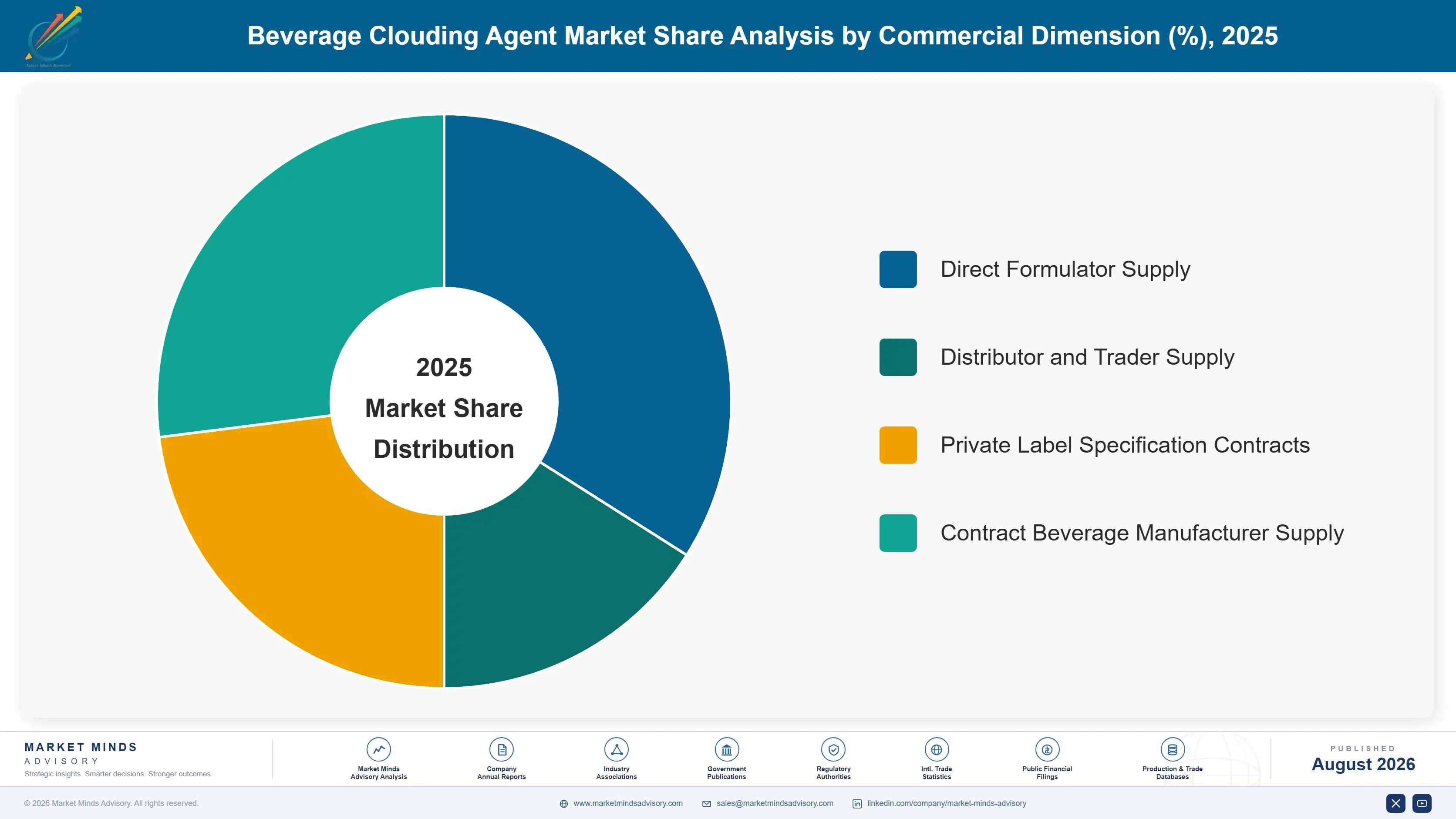
beverage-clouding-agent-market-trends-market-share-analysis-1787462035287

Natural and Plant-Derived Clouding Agents

Natural and plant-derived systems, built around gum acacia, pectin, and modified starch, grow fastest at 10.8%, about 1.57 times the overall 6.9% rate, as retailer clean label mandates push formulators away from weighting agents and synthetic resins. Adoption concentrates first in private label juice and functional drink lines, where retailers control the specification directly rather than leaving chemistry choice to the beverage brand. Formulators supplying this segment increasingly bundle stabilizer blends alongside the base gum to close the stability gap against legacy chemistries, since a natural claim that fails on shelf life loses the retailer relationship fast. Growth is capacity-constrained near term, since qualified natural gum supply has not scaled as quickly as demand.
CAGR 10.8%

Gum-Based Clouding Agents

Gum-based systems, distinct from the plant-derived natural category in that they include both natural and lightly modified cellulose gums, grow at 7.6% as they serve as a middle path between full weighting agent replacement and premium natural claims. Formulators favor modified cellulose gums where a clean label claim is not commercially required but customers still want to avoid synthetic weighting agents for cost or supply reasons. This segment benefits from broader raw material availability than fully natural gums, since cellulose sourcing does not compete directly with food-grade gum acacia supply. Beverage makers in markets without strict retailer mandates, particularly Latin America and Eastern Europe, are adopting gum-based systems as a lower-risk transition step.
CAGR 7.6%
Full segment breakdown across 6 segments available in the complete report.

Regional Architecture and Country Demand Map

East Asia leads on citrus and functional drink bottling scale, followed closely by North America and Western Europe, where retailer reformulation mandates concentrate near-term switching activity. South Asia and Pacific posts the fastest regional growth as bottling capacity expands rapidly across India and Southeast Asia.

North America

Retailer clean label mandates hit hardest here, since major grocery chains have written brominated vegetable oil out of private label specifications ahead of any federal ban, forcing bottlers to requalify emulsion systems on retailer timelines rather than regulatory ones. The United States accounts for most regional volume, concentrated among citrus juice and carbonated soft drink bottlers serving national retail accounts. Reformulation spend is running well ahead of the rest of the world, and suppliers who qualified natural alternatives early are winning share from incumbents still selling legacy weighting agent chemistries. Canada follows similar retailer dynamics at smaller scale, while Mexican bottlers move more slowly given lighter retailer pressure and continued reliance on lower-cost weighting agent imports.
Share: 23% | CAGR: 6.2% (2026 to 2036)

Western Europe

Germany, France, and the United Kingdom drive regional demand through established juice and soft drink manufacturing bases operating under some of the strictest food additive regulation globally. European Food Safety Authority reviews of several legacy weighting agents have pushed formulators toward gum and starch-based systems well ahead of comparable moves in other regions. Growth trails the global average because the reformulation cycle here is largely complete, with most major bottlers having already transitioned away from synthetic chemistries over the past decade. Remaining demand growth comes mostly from smaller regional beverage brands still catching up to multinational formulation standards, plus modest volume growth in functional drink categories gaining share across Northern Europe.
Share: 19% | CAGR: 5.3% (2026 to 2036)
Regional intelligence for 5 additional markets available in the complete report: East Asia, South Asia and Pacific, Latin America, Middle East and Africa, Eastern Europe. Contact sales@marketmindsadvisory.com.
beverage-clouding-agent-market-trends-country-cagr-analysis-1787462035811

Where Clouding Agent Suppliers Can Defend Margin

Reformulation pressure is a genuine margin opportunity for suppliers positioned well ahead of it, not merely a compliance cost to absorb quietly. The four moves below target the exact points where formulators pay for certainty, technical service, and supply resilience rather than for the raw ingredient itself, and each is already visible in how leading suppliers price today.

Bundle Technical Reformulation Service With Ingredient Supply

Bottlers requalifying against retailer clean label deadlines need formulation support more than they need a cheaper gum, since a failed reformulation risks a recalled or visibly separated product on shelf. Suppliers offering embedded application labs and rapid stability testing capture reformulation projects at prices 20% to 30% above standalone ingredient sales, because the service compresses a bottler's own qualification timeline by months. This model also raises switching costs meaningfully, since a bottler that has run a full reformulation cycle with one supplier's technical team rarely restarts that process for a marginal price difference elsewhere.
Market Impact: Lifts realized pricing by 20% to 30% per project

Develop Hybrid Natural and Synthetic Stability Blends

Pure natural gum systems still underperform legacy weighting agents on shelf stability in many beverage matrices, leaving an opening for hybrid blends that combine a small synthetic stabilizer fraction with a majority natural gum base. These blends let formulators claim substantial clean label progress without accepting the full stability risk of an all-natural system, a middle path more than 60% of major retailers surveyed now accept for private label specifications. Suppliers who commercialize validated hybrid blends ahead of competitors capture reformulation projects from bottlers unwilling to risk a full natural transition on their flagship SKUs.
Market Impact: Adds an estimated 8 to 12 percentage points of margin

Secure Long-Term Gum Acacia Supply Contracts

Natural gum demand is growing faster than qualified gum acacia supply can scale, creating periodic sourcing tightness that squeezes suppliers without secured raw material access. Formulators who lock multi-year supply agreements directly with Sudanese and Chadian gum acacia cooperatives, bypassing intermediate traders, protect margin against the price spikes of up to 30% that have periodically hit spot buyers over the past several years. This also gives suppliers a credible traceability story to offer retailers increasingly interested in raw material provenance alongside the clean label claim itself, a growing purchasing criterion across nearly every major account.
Market Impact: Reduces raw material cost volatility by roughly 15%

Build Formulation Libraries for Asian Fortified Beverage Matrices

Functional and fortified drink launches across China, India, and Southeast Asia each require clouding systems matched to specific protein, vitamin, or botanical loads that differ meaningfully from Western citrus juice formulations. Suppliers that pre-build tested formulation libraries for these specific matrices win new product development briefs faster than the roughly 15 competitors typically bidding on a given regional contract, since contract beverage manufacturers in the region often work on compressed launch timelines that leave little room for open-ended formulation trials. This positions suppliers ahead of the region's continued bottling capacity growth rather than reacting to it.
Market Impact: Captures about 25% more new formulation briefs annually

Who Controls the Margin Pool

Concentration sits at a moderate CR5 of 44%, with the top five ingredient houses holding roughly comparable positions rather than one dominant leader. The gap between Cargill, the largest supplier by beverage revenue, and the next tier of challengers is narrow, reflecting a category where technical service matters more than raw scale. All participants are assessed on one basis: annual revenue attributable to beverage clouding product lines.
Current competitive activity runs along three lines. Reformulation service capability now differentiates suppliers more than base chemistry, since bottlers value whoever can requalify a formula fastest against a retailer deadline. Raw material integration matters increasingly as natural gum sourcing tightens, favoring suppliers with direct grower relationships over those buying through traders. Regional technical presence in Asia has become a real competitive battleground as bottling capacity outpaces staffing at global suppliers.

Emerging pressure comes from mid-sized regional formulators in India and Southeast Asia building credible natural gum expertise close to the fastest-growing bottling capacity, threatening the technical service advantage global incumbents have relied on. Rankings over the next five years will likely shift toward whichever suppliers commercialize validated hybrid stability blends first, since that innovation addresses the natural segment's biggest unresolved weakness.
beverage-clouding-agent-market-trends-company-positioning-matrix-1787462036347

Competitive Moat and Risk Dimensions

CARGILL

Moat: Integrated raw material sourcing

Cargill's direct relationships across citrus byproduct, starch, and gum supply chains give it cost and reliability advantages that smaller formulators buying through traders cannot easily replicate. That integration also supports faster reformulation turnaround, since raw material substitution decisions happen inside one organization rather than across multiple supplier negotiations.
CARGILL

Risk: Commodity exposure across inputs

The same raw material breadth that supports Cargill's sourcing advantage also exposes it to simultaneous price swings across citrus, starch, and gum commodities, complicating margin stability during periods when several input categories move against the company at once. Diversification does not fully offset this correlated exposure.
KERRY GROUP

Moat: Broad formulation application expertise

Kerry's Taste and Nutrition platform gives it formulation expertise spanning far beyond clouding agents into the broader beverage matrix, letting it solve stability problems that narrower ingredient suppliers cannot address in isolation. That breadth wins complex reformulation projects where clouding chemistry interacts with flavor and fortification systems.
KERRY GROUP

Risk: Portfolio complexity dilutes focus

Operating across a very wide ingredient portfolio means beverage clouding agents compete internally for investment and technical resources against larger Kerry business lines, occasionally slowing the company's response to fast-moving reformulation opportunities that a more narrowly focused competitor could capture first and defend more aggressively.

Players Tracked

Prominent Players

Cargill
Kerry Group
Tate and Lyle
Ingredion
Sensient Technologies

Other Key Players

Archer Daniels Midland
Dohler Group
Kalsec
Givaudan
Foodchem International
Corbion
DSM-Firmenich
BASF
Nexira
CP Kelco
Fiberstar
Fuerst Day Lawson
Silvateam
AIDP Inc
Univar Solutions

Recent Developments

MARCH 2025

Tate and Lyle Forms Joint Venture for Bio-Based Emulsion Development

Tate and Lyle entered a joint venture with a plant biotechnology firm to co-develop fermentation-derived gum alternatives targeting beverage clouding applications. The venture combines Tate and Lyle's formulation and commercial reach with the partner's fermentation technology, aiming to cut dependence on gum acacia sourcing. Pilot production targets late 2026.
Signal: A direct response to natural gum supply tightness, not a broader ingredient diversification move by either partner.
JULY 2025

Kerry Group Acquires Specialty Emulsion Formulator

Kerry Group acquired a mid-sized European specialty emulsion formulator to strengthen its clean label clouding system portfolio ahead of accelerating retailer reformulation deadlines. The acquired company brought proprietary hybrid stability blend technology that Kerry lacked internally. Integration is expected to complete within twelve months of close.
Signal: Signals that hybrid stability technology, not raw manufacturing scale, is now the acquisition target ingredient houses actually want.
NOVEMBER 2025

Sensient Technologies Expands Natural Emulsion Capacity in Indonesia

Sensient Technologies commissioned a new natural cloud emulsion production line in Indonesia to serve growing regional bottling demand without exporting from existing Western facilities. The expansion is organic capacity growth rather than an acquisition or partnership, funded from Sensient's own capital budget. Full production ramp is expected by mid-2026.
Signal: Confirms that global suppliers now view regional Asian production capacity as necessary infrastructure, not an optional expansion.

Citrus Byproduct and Gum Resin Cost Exposure

Citrus oil byproducts and wood rosin derivatives together account for roughly 30% of cost of goods sold for weighting agent producers, sourced from Brazilian and Florida citrus operations and Southern United States pine resin suppliers. Natural gum producers face a comparably sized exposure, with gum acacia sourced almost entirely from Sudan and Chad accounting for 25% to 35% of cost for natural manufacturers.
Florida's ongoing citrus greening disease outbreak has cut state orange production by more than 70% from peak levels over the past decade, according to USDA crop reports, tightening supply of citrus oil byproducts used in weighting agent manufacture. Brazilian crop shortfalls compounded the squeeze, pushing weighting agent input costs up sharply during 2023 and 2024 before partially stabilizing as buyers shifted sourcing toward alternative growing regions.

Exposure varies sharply by player type. Vertically integrated suppliers with direct grower relationships absorb volatility more smoothly than formulators buying through spot traders, who face sudden margin compression between contract negotiations. Geography matters too: European formulators pay a landed cost premium on gum acacia versus suppliers with direct African sourcing, while Asian formulators benefit from newer supply deals negotiated after the worst of the price spike had passed.
beverage-clouding-agent-market-trends-cost-volatility-analysis-1787462036543

Diversify Citrus Byproduct Sourcing Beyond Florida and Brazil

Formulators are qualifying citrus oil byproduct supply from Mexican and Mediterranean growing regions to reduce dependence on the two markets most exposed to disease and weather shocks. This adds supplier qualification cost upfront but meaningfully smooths input price volatility across a full crop cycle, giving procurement teams a genuine fallback option when either primary source falters.

Negotiate Multi-Year Gum Acacia Supply Agreements

Direct multi-year contracts with Sudanese and Chadian gum cooperatives, bypassing intermediate traders, lock in pricing terms and protect against the spot market spikes that have periodically hit unsecured spot buyers over recent years. This requires closer supplier relationship management but delivers meaningfully more predictable input costs across budgeting cycles and multi-year capital planning horizons.

Develop Fermentation-Based Gum Alternatives

Several formulators are now investing in fermentation-derived gum substitutes that would decouple natural clouding system cost entirely from African gum acacia harvest cycles. Commercial scale remains several years away, but early movers are positioning technical capability ahead of the next major sourcing disruption likely to hit the broader category eventually, well before rivals respond.

Portfolio Architecture for Margin Defence

The portfolio splits into three tiers with meaningful margin separation tied directly to formulation complexity rather than raw material cost alone. Commodity weighting agent chemistries compete mainly on price and delivery reliability, while certified clean label systems command a durable premium tied to retailer specification requirements rather than any inherent cost advantage in the underlying gum or resin itself.
The tension between volume and premium is sharpening as retailer mandates expand the addressable market for natural systems faster than gum acacia supply can scale, forcing suppliers to choose between chasing volume with stretched raw material sourcing or protecting margin with tighter, better-supplied allocations. Suppliers that manage this tension well are the ones securing long-term raw material contracts ahead of demand growth rather than reacting to shortages after they appear.

High-value margin pools concentrate specifically in hybrid stability blends and in regional formulation services for Asian fortified beverage launches, both of which combine technical differentiation with genuine scarcity of qualified competitors. Pure commodity weighting agent supply, by contrast, is becoming a slow-declining volume base rather than a growth or margin opportunity for most participants going forward.

Volume / Commodity-Adjacent Tier

Legacy weighting agents and standard starch-based systems sold primarily on price and delivery reliability into bottlers not yet under significant retailer reformulation pressure, particularly across Latin America, Eastern Europe, and parts of the Middle East and Africa.
Gross Margin: 18-28%

Premium / Certified Tier

Clean label gum and pectin-based systems qualified against specific retailer specifications, commanding durable price premiums tied to certification and technical service rather than raw ingredient cost, concentrated among private label accounts in North America and Western Europe.
Gross Margin: 32-45%

Sustainability / Regulatory / Next-Generation Tier

Hybrid stability blends and emerging fermentation-derived gum alternatives targeting the unresolved stability gap in fully natural systems, representing the newest and fastest-evolving corner of the portfolio as suppliers race toward validated commercial formulations.
Gross Margin: 38-52%
beverage-clouding-agent-market-trends-portfolio-architecture-1787462037037

High-value Sub-segments and Strategic Watch-out

Hybrid Natural-Synthetic Stability Blends

High value and high growth, directly addressing the natural reformulation segment's core stability weakness. Suppliers that commercialize validated hybrid blends first are capturing outsized share of new retailer-mandated reformulation projects across North America and Western Europe, ahead of slower-moving competitors still selling pure natural systems today.
Gross Margin: 38-52%

Asian Fortified Beverage Formulation Services

High value with moderate growth, tied to expanding contract beverage manufacturing capacity across India, Vietnam, and Indonesia today. Regional technical service presence increasingly decides which supplier wins new formulation briefs from multinational brands localizing production closer to fast-growing regional consumer markets across the wider region.
Gross Margin: 30-40%

Standard Gum-Based Clouding Systems

The volume core, serving bottlers transitioning away from weighting agents without pursuing full natural certification just yet. Steady growth tracks broader packaged beverage volume rather than any specific regulatory catalyst, keeping this segment a reliable but comparatively low-margin base for most suppliers operating in it.
Gross Margin: 24-34%

Legacy Weighting Agent Chemistries

The strategic watch-out, facing accelerating regulatory and retailer pressure across North America and much of Western Europe today. Remaining demand concentrates in markets with lighter reformulation urgency, a shrinking base over the forecast period as clean label mandates keep steadily expanding their reach further outward.
Gross Margin: 18-26%

Qualification Cycles and Formulation Lock-In

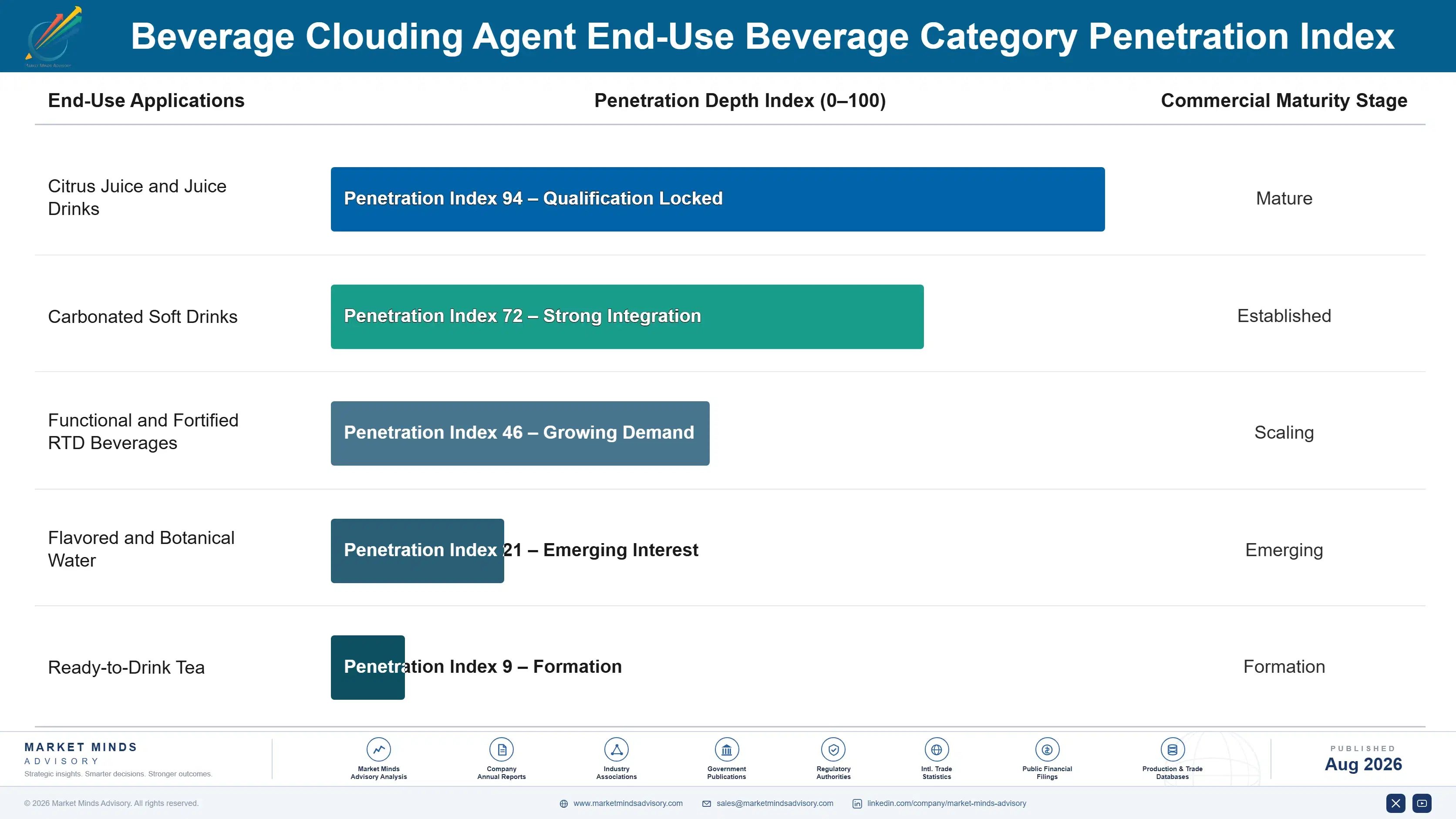
Demand compounds through qualification lock-in rather than repeat purchasing. Once a bottler validates a clouding system against its beverage matrix, switching means repeating a stability and sensory process that typically runs 18 to 30 months. That lock-in makes formulations closer to an annuity than a spot sale, since a bottler rarely revisits a working system absent a retailer mandate or a real cost spike.
Adoption depth varies sharply by end-use vertical. Citrus juice bottlers, the category's oldest base, show the deepest lock-in, often running one qualified chemistry for a decade absent regulatory pressure. Functional and fortified RTD brands behave differently, reformulating as they launch new variants, creating more frequent but smaller qualification opportunities for suppliers with fast turnaround capability. Carbonated soft drink bottlers sit between the two, updating formulas mainly during recipe refreshes.

Generational buyer shifts are reshaping who makes these decisions. Formulation authority is moving from centralized global sourcing teams toward regional innovation groups closer to fast-growing Asian bottling capacity, rewarding suppliers with strong local presence over those managing relationships from headquarters. Younger brand teams entering functional beverage categories weigh clean label perception more heavily than legacy sourcing managers did, accelerating natural adoption independent of any retailer mandate.
beverage-clouding-agent-market-trends-end-use-penetration-index-1787462037528

Where Clouding Agent Suppliers Should Focus

These are among the four positions where our research anticipates prominent divergence between winners and laggards over the coming forecast period. Each is grounded in the demand model, the regulatory perimeter, and the announced capacity pipeline.
01 / REFORMULATION DEADLINE TIMING

Move Ahead of Retailer Deadlines, Not Regulatory Ones

Retailer clean label mandates are arriving faster than federal regulatory action on brominated vegetable oil, and suppliers waiting for a formal ban will miss the private label reformulation window entirely, ceding qualified volume to faster-moving rivals. The bottlers requalifying earliest are locking in supplier relationships for the next decade of qualified volume, regardless of how the federal process eventually resolves. Suppliers should treat major retailer specification changes as the real deadline driving investment, not the slower federal regulatory timeline that follows well behind commercial practice.
02 / RAW MATERIAL SUPPLY SECURITY

Secure Gum Acacia Supply Before Demand Outpaces It

Natural gum demand is scaling faster than qualified gum acacia supply from Sudan and Chad, creating a sourcing bottleneck that will worsen before fermentation-based alternatives reach commercial scale at any meaningful volume. Suppliers without direct grower relationships face growing margin risk from spot price spikes during periods of tight supply, particularly when several buyers compete for the same limited harvest. Locking multi-year agreements now, ahead of the next demand surge, protects both margin and delivery reliability against competitors still buying through intermediate traders.
03 / REGIONAL TECHNICAL PRESENCE

Build Technical Service Capacity in India and Southeast Asia

Bottling capacity expansion across India, Vietnam, and Indonesia is outpacing the regional technical service footprint of most global ingredient suppliers, leaving a real gap that regional formulators are already beginning to fill with locally built expertise. New bottling lines typically need on-site formulation support during startup, favoring whichever supplier already has people on the ground rather than managing the relationship remotely from a distant headquarters. Suppliers that invest in regional application labs now will capture new formulation briefs that remote account management cannot realistically win.
04 / HYBRID FORMULATION INNOVATION

Close the Natural Stability Gap Before Competitors Do

Fully natural clouding systems still underperform legacy weighting agents on shelf stability, and the supplier that commercializes a validated hybrid blend first will capture reformulation projects from bottlers unwilling to risk their flagship products on unproven natural chemistry. This is a narrow window, since several suppliers are pursuing similar hybrid approaches simultaneously and racing toward the same retailer approval milestones on comparable timelines. Whoever reaches retailer-approved status first sets the technical benchmark that competitors then have to match rather than define on their own terms.

Engagement Snapshot From the Field

A live engagement with an industry participant carrying material or product regulatory and market exposure ahead of a defining policy shift, showing how our research translates into a defensible multi-year portfolio strategy.
MARKET MINDS ADVISORY · CLIENT ENGAGEMENT SUMMARY
Beverage Clouding Agent Producer Strategic Portfolio Review and Transition Roadmap 2026·Investment Scenario on Beverage Clouding Agent Exposure Evaluation 2025-26
CLIENT PROFILE
A regional citrus juice bottler supplying private label accounts across three major North American grocery chains approached MMA after receiving formal notice that its retail partners would remove brominated vegetable oil from private label specifications within eighteen months. The client reported annual beverage ingredient spend near USD 40 million and operated four bottling facilities, none of which had previously reformulated a flagship citrus product line (client-reported, unverified by MMA).
STRATEGIC CHALLENGE
Management needed to requalify its core orange and grapefruit juice formulations against tight retailer deadlines while avoiding any visible change in product appearance that could trigger consumer complaints. Internal formulation staff had never managed a full reformulation project at this scale, and initial vendor quotes for natural gum systems carried stability guarantees the client's technical team could not independently verify.
MMA APPROACH
MMA benchmarked three candidate suppliers' hybrid stability blend technologies against the client's specific beverage matrices under accelerated shelf-life testing conditions. We modeled total reformulation cost across each option, including requalification testing, packaging line adjustments, and projected shelf-life impact. We also assessed each supplier's raw material sourcing security to flag which vendors carried meaningful gum acacia supply risk over a multi-year contract horizon.
KEY FINDINGS
  1. The lowest-quoted supplier carried unhedged gum acacia sourcing risk that could raise delivered pricing by an estimated 18% within two years absent a locked contract (client-reported, unverified by MMA).
  2. A hybrid stability blend from the second-ranked supplier matched the client's existing shelf-life specification within a narrow, statistically insignificant margin during accelerated testing.
  3. Reformulating all four facilities simultaneously would have exceeded the client's technical staff capacity, risking quality failures and inconsistent results during the transition window.
  4. Retailer deadlines carried informal flexibility of roughly three months for bottlers who could demonstrate active, well-documented reformulation progress toward eventual full compliance.
CLIENT PROFILE
A regional citrus juice bottler supplying private label accounts across three major North American grocery chains approached MMA after receiving formal notice that its retail partners would remove brominated vegetable oil from private label specifications within eighteen months. The client reported annual beverage ingredient spend near USD 40 million and operated four bottling facilities, none of which had previously reformulated a flagship citrus product line (client-reported, unverified by MMA).
STRATEGIC CHALLENGE
Management needed to requalify its core orange and grapefruit juice formulations against tight retailer deadlines while avoiding any visible change in product appearance that could trigger consumer complaints. Internal formulation staff had never managed a full reformulation project at this scale, and initial vendor quotes for natural gum systems carried stability guarantees the client's technical team could not independently verify.
MMA APPROACH
MMA benchmarked three candidate suppliers' hybrid stability blend technologies against the client's specific beverage matrices under accelerated shelf-life testing conditions. We modeled total reformulation cost across each option, including requalification testing, packaging line adjustments, and projected shelf-life impact. We also assessed each supplier's raw material sourcing security to flag which vendors carried meaningful gum acacia supply risk over a multi-year contract horizon.
KEY FINDINGS
  1. The lowest-quoted supplier carried unhedged gum acacia sourcing risk that could raise delivered pricing by an estimated 18% within two years absent a locked contract (client-reported, unverified by MMA).
  2. A hybrid stability blend from the second-ranked supplier matched the client's existing shelf-life specification within a narrow, statistically insignificant margin during accelerated testing.
  3. Reformulating all four facilities simultaneously would have exceeded the client's technical staff capacity, risking quality failures and inconsistent results during the transition window.
  4. Retailer deadlines carried informal flexibility of roughly three months for bottlers who could demonstrate active, well-documented reformulation progress toward eventual full compliance.
RECOMMENDED STRATEGY
Phase 1: Phase 1 (0 to 4 months): Select the hybrid blend supplier and lock a three-year gum acacia supply agreement directly through the supplier's contracted growers. Phase 2: Phase 2 (4 to 12 months): Reformulate and requalify two facilities first, using documented progress to request retailer deadline flexibility for the remainder. Phase 3: Phase 3 (12 to 18 months): Complete reformulation across remaining facilities and formalize retailer-facing documentation of the clean label transition.
OUTCOME
The client completed reformulation across all four facilities within the extended eighteen-month window without triggering a single formal retailer non-compliance notice. Locking the gum acacia supply agreement early avoided an estimated USD 2.1 million in projected cost exposure from the sourcing risk MMA identified during the assessment (client-reported, unverified by MMA).

Frequently Asked Questions

Foundational context covering the market sizes, CAGR, scope, country, region and competition that inform every finding below. This section is provided to cover basics and most often pre-purchase conversations, answered from the MMA Primary Research Dataset.

What is the current size of the Beverage Clouding Agent Market?

The market stood at approximately USD 0.8 billion in 2025, according to MMA's primary research dataset. This reflects global demand across citrus, functional, and flavored beverage formulation.

How large will the Beverage Clouding Agent Market be by 2036?

MMA projects the market will reach approximately USD 1.67 billion by 2036 under the base case scenario. This represents roughly 1.95 times the 2026 market entry value.

What is the CAGR for the Beverage Clouding Agent Market 2026 to 2036?

The base case CAGR is 6.9%, with a bull case of 8.1% and a bear case of 5.7%. The range reflects uncertainty around the pace of brominated vegetable oil regulatory action.

Which segment is growing fastest?

Natural and plant-derived clouding agents grow fastest at 10.8%, about 1.57 times the overall market rate. Retailer clean label mandates are the primary driver of this segment's acceleration.

Who are the major companies in the Beverage Clouding Agent Market?

Leading suppliers include Cargill, Kerry Group, Tate and Lyle, Ingredion, and Sensient Technologies. These five companies together hold an estimated 44% of the market on a beverage ingredient revenue basis.

Which country is growing fastest?

India posts the fastest national growth at 9.9% CAGR, driven by rapidly expanding contract beverage manufacturing capacity. This outpaces the broader South Asia and Pacific regional average.

Report Segmentation Architecture

The full report scope spans multiple orthogonal segmentation dimensions, with cross-tabulated demand data provided for each dimension pair. Coverage extends further to regional breakdowns, trend trajectories, and the competitive detail needed to support segment-level decision-making.

By Formulation Chemistry

  • Weighting Agent-Based Emulsions
  • Starch-Based Clouding Agents
  • Gum-Based Clouding Agents
  • Resin-Based Clouding Agents
  • Natural and Plant-Derived Clouding Agents
  • Synthetic Polymer-Based Clouding Agents

By End-Use Beverage Category

  • Citrus Juice and Juice Drinks
  • Carbonated Soft Drinks
  • Functional and Fortified RTD Beverages
  • Flavored and Botanical Water
  • Ready-to-Drink Tea

By Commercial Dimension

  • Direct Formulator Supply
  • Distributor and Trader Supply
  • Private Label Specification Contracts
  • Contract Beverage Manufacturer Supply

By Region

  • North America
  • Western Europe
  • East Asia
  • South Asia and Pacific
  • Latin America
  • Middle East and Africa
  • Eastern Europe

Scope, Methodology, and Coverage

Every figure in this report is reproducible from documented input assumptions. The scope below maps the historical period, the forecast horizon, the segmentation dimensions, and the countries covered, alongside the underlying primary and qualitative methodology.
Historical Period
2020 to 2025
Forecast Period
2026 to 2036
Base Year
2025 (USD billions; MMA Primary Research Dataset, August 2026)
Market Definition
The beverage clouding agent market comprises emulsion and dispersion ingredient systems formulated to impart visual opacity and mouthfeel stability to citrus, functional, and flavored beverages, spanning weighting agents, starches, gums, resins, and plant-derived alternatives. It excludes beverage flavors, colors, sweeteners, and preservatives sold as standalone ingredient categories.
Quantitative Units
USD billions (current prices); metric tonnes of clouding agent volume where applicable
Segmentation Dimensions
By Formulation Chemistry; By End-Use Beverage Category; By Commercial Dimension; By Region
Regions Covered
North America, Western Europe, East Asia, South Asia and Pacific, Latin America, Middle East and Africa, Eastern Europe
Countries Covered
USA, China, Germany, France, UK, Japan, South Korea, India, Australia, Canada, Brazil, Mexico, Indonesia, Vietnam, Thailand, Malaysia, UAE, Saudi Arabia, South Africa, Nigeria, Turkey, Poland, Netherlands, Italy, Spain, Sweden, Switzerland, Argentina, Colombia, Singapore, and additional markets relevant to this sector
Key Companies Profiled
Cargill, Kerry Group, Tate and Lyle, Ingredion, Sensient Technologies, Archer Daniels Midland, Dohler Group, Kalsec, Givaudan, Foodchem International, Corbion, DSM-Firmenich, BASF, Nexira, CP Kelco, Fiberstar, Fuerst Day Lawson, Silvateam, AIDP Inc, Univar Solutions
Quantitative Methodology
Primary survey, n=3,800 respondents, Q4 2025, six countries; demand-side model with trade association cross-validation
Qualitative Methodology
47 expert interviews, Q4 2025; applied to validate demand model assumptions, identify emerging dynamics, and assess competitive positioning
Report Format
PDF and XLSX data workbook (Word format preview document)
Publisher
Market Minds Advisory
Report Code
MMA-2026-CHM-118
Published
August 2026
Contact
sales@marketmindsadvisory.com | www.marketmindsadvisory.com

Purchase the full Beverage Clouding Agent Market Report (2026 to 2036).

The full MMA Beverage Clouding Agent report sizes the market across six formulation chemistries, five end-use beverage categories, and seven regions through 2036. It profiles 20 participants on a consistent beverage ingredient revenue basis, scoring each on raw material security, formulation breadth, and regional technical service presence. Scenario models quantify how brominated vegetable oil regulatory action and retailer clean label mandates move reformulation demand and pricing. The report also includes delivered ingredient cost modeling, a gum acacia supply risk screen, and a hybrid stability blend adoption forecast built for formulation, procurement, and category management teams.
Six-chemistry segmentation with detailed growth forecasts
Gum acacia supply risk assessment model
Retailer clean label deadline tracking tool
Hybrid stability blend adoption forecast model
Regional bottling capacity demand mapping tool
Twenty-company competitive benchmarking scorecard and moat assessment

Built For The People Who Decide

From boardroom strategy to bench-side execution, this report is read cover-to-cover by leaders shaping the next decade of their industry, turning demand scenarios, market dynamics and valuation benchmarks into decisions.
CXOs/ Presidents/ VPs/ Managers
M&A and Corporate Development
Strategy Teams and R&D Heads
Procurement and Product Directors
Regulatory and Compliance Leaders
Investor Relations and Equity Analysts