Market Minds Advisory
Beverage Acidulants Market

Beverage Acidulants Market: Reformulation, Sugar Reduction, and Feedstock Risk Through 2036

Beverage manufacturers are shifting acidulant blends toward malic and lactic acid as sugar-reduction reformulation accelerates, while phosphoric acid faces regulatory scrutiny and citric acid producers absorb corn feedstock cost swings across Chinese capacity.

Lead Analyst

Lisa Gevelber

Published

September 2026

Make Smarter Decisions with Customized Research Insights

Request a free sample report and evaluate market opportunities, growth trends, and competitive dynamics relevant to your business needs.

2025 MARKET VALUE$3.4BMarket Size 2025
2036 FORECAST VALUE$6.7BBase Case , 2026 to 2036
CAGR 2026 TO 20366.4 %Bull 7.7% / Bear 5.1%
INCREMENTAL OPPORTUNITY$3.1BNet 10- year value creation
EXPANSION MULTIPLE1.86x2036 value over 2026 base
Strategic Levers
M&A Pipeline
Regional Outlook
Country Rankings
Competitive Intelligence
Segmental Deep-dive
Call-Us : 91 93563 13602

Executive Snapshot and Market Trajectory

Beverage formulators are re-weighting acid blends as sugar-reduction reformulation collides with consumer demand for cleaner labels, pushing malic and lactic acid ahead of legacy citric-heavy profiles across carbonates, functional waters, ready-to-drink teas, and fermented drink lines worldwide this product cycle and the overall notably currently typically consistently next.
Sports and functional beverage lines are the clearest growth channel, with brand owners in North America and East Asia rewriting acid systems to mask stevia and allulose bitterness in newly launched SKUs across several major retail categories. Citric acid still anchors volume, but its share of new launches is falling as malic acid captures share in low-sugar carbonates and lactic acid gains ground in fermented lines.
Five producers control less than half of global capacity, leaving a fragmented tail of regional fermentation and mineral-acid plants to compete on logistics and contract terms rather than scale alone. Phosphoric acid faces tightening review in several jurisdictions over bone-health research, and that regulatory overhang is now shaping ingredient substitution decisions inside major bottler R&D pipelines, forcing even conservative formulators to keep a backup acid system on file for every cola-adjacent product line.
Market Definition
The beverage acidulants market covers citric, malic, phosphoric, tartaric, lactic, and ascorbic acid sold as functional additives for pH control, flavor modulation, and preservation in carbonated soft drinks, juices, sports drinks, and fermented beverages. It excludes acidulants used solely in food, pharmaceutical, or industrial applications.
Base Year Value
$3.4B in 2025 (MMA Primary Research Dataset, August 2026)
Forecast Period
2026 to 2036, eleven discrete annual values
CAGR
6.4% base case. Bull 7.7%. Bear 5.1%.
Fastest Growth Segment
Malic Acid: 9.5% CAGR
Fastest Growth Country
India: 9.6% CAGR
Fastest Growth Region
South Asia and Pacific: 8.6% CAGR
Largest Region
East Asia: 29% of 2025 global value
Market Leaders
Cargill, ADM, Jungbunzlauer, Corbion, Tate and Lyle. Source: MMA Analysis based on company annual reports.
Primary Survey
n=3,800 procurement and R&D decision-makers, Q4 2025, six countries
Methodology
Demand-side build-up, cross-validated against public data, 47 expert interviews

Beverage Acidulants Market Forecast Scenarios

beverage-acidulants-market-trends-growth-size-forecast-scenario-1787461372599
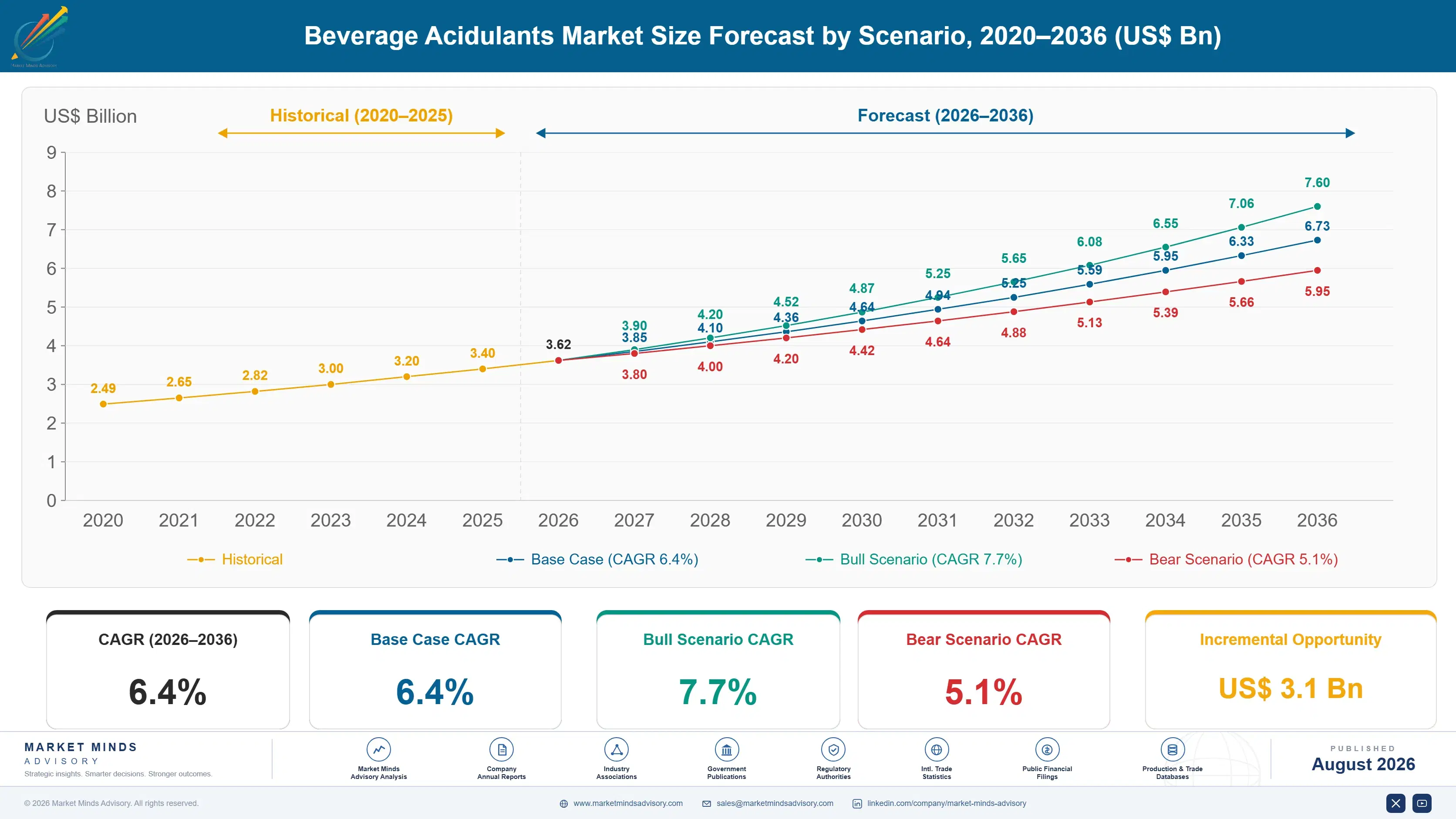
Between 2020 and 2025 the market grew at roughly 5.3 percent a year, held back early on by pandemic-era bottling disruptions and a slow return of on-premise beverage channels, before sugar-reduction reformulation and functional drink launches pushed volumes back onto a steeper track through 2024 and 2025 as bottlers cleared pandemic-era inventory backlogs and resumed capital spending on reformulation programs they had shelved.
The base case assumes 6.4 percent annual growth to 2036, built on three mechanisms: continued reformulation away from phosphoric acid in cola-adjacent categories as regulatory scrutiny persists, expanding malic and lactic acid use in sports and probiotic drinks as brand owners chase functional positioning, and steady capacity additions from Chinese fermentation producers keeping input costs from constraining bottler adoption of higher-cost specialty acid blends across mainstream product lines. Together these mechanisms sustain volume growth well above underlying beverage consumption trends.
A bull case near 7.7 percent depends on faster stevia and allulose adoption forcing acid-blend redesigns across the industry's largest bottlers sooner than currently planned. The bear case near 5.1 percent assumes corn feedstock inflation squeezes fermentation margins enough that producers ration capacity rather than expand it, slowing the specialty acid transition bottlers overall need.

Reformulation Pressure and Fermentation Capacity Economics

Acidulant demand now tracks reformulation cycles more closely than beverage volume growth itself. As bottlers cut added sugar, they lean harder on acid systems to preserve mouthfeel and mask sweetener aftertaste, turning what was once a commodity input into a formulation lever that brand owners actively specify rather than leave to contract manufacturers further down the supply chain, a shift that has quietly rewritten purchasing authority inside several major beverage companies.
PRODUCER CONCENTRATIONCR5 42%top five producers hold less than half global capacity
AVERAGE SELLING PRICE$1,450/tonneblended average selling price across citric and malic acid
CHINA PRODUCTION SHARE58%share of global citric acid fermentation output based here
CAPACITY UTILISATION81%average operating rate across major fermentation facilities worldwide today
TRADE INTENSITY47%share of volume crossing a border before final beverage use
FEEDSTOCK COST SHARE38% of COGScorn and molasses feedstock cost burden within total production cost
Commercially, the market splits between bulk citric acid sold on multi-year contracts to major bottlers and a faster-growing specialty tier of malic, lactic, and blended acid systems sold with technical formulation support attached. Margins concentrate in the specialty tier, where producers bundle application labs with the ingredient sale itself, a model that commodity-only suppliers without in-house sensory science teams have struggled to replicate at comparable scale.
Over the next decade, feedstock geography and regulatory review of phosphoric acid will do more to reshape competitive position than any single new product launch, favoring producers with diversified acid portfolios over single-molecule specialists that cannot pivot quickly when one acid category loses favor with regulators or overall notably bottlers.
"The acidulant aisle used to be an afterthought on the formulation sheet. Now it's the line item R&D teams argue about longest, because getting the sour-to-sweet balance wrong kills a reformulated product faster than the sugar cut itself."
Director, Food and Beverage Ingredients Practice · MMA Food and Beverage Ingredients Practice · August 2026

Market Trends

Sugar Reduction Reformulation Reshapes Acid Blend Selection

Regulatory sugar taxes now cover more than 50 countries, and bottlers responding to UK, Mexican, and South African levies have reformulated over 1,200 SKUs since 2021 to cut added sugar while preserving perceived sourness and mouthfeel. Malic acid's smoother, less bitter sour profile compared with citric acid makes it the preferred partner for stevia and allulose systems, and formulation labs at three of the five largest bottlers have shifted default acid ratios toward malic-heavy blends in newly launched low-sugar carbonate lines over the past two product cycles, a pattern MMA expects to continue through 2028.
Market Impact: Secures demand behind 20% sugar cuts
Functional and Probiotic Beverage Growth Lifts Lactic Acid Demand

Kombucha, probiotic soda, and fermented functional drinks grew from a niche category into a segment exceeding 8 billion dollars in annual retail sales across North America and East Asia, and each of these formats relies on lactic acid both as a fermentation byproduct and as a standalone acidulant added to stabilize flavor across batches. Corbion and Galactic have each announced fermentation capacity additions since 2024 specifically citing beverage customer demand rather than their traditional food and industrial base, signaling that lactic acid is graduating from a secondary acidulant into a primary specification across an expanding set of beverage categories.
Market Impact: Landed cost down 8% since 2023

Market Opportunities and Growth Drivers

Bottler Reformulation Contracts Lock In Multi-Year Acid Demand

Major bottlers have signed multi-year acidulant supply agreements tied directly to reformulation roadmaps, with at least four global beverage companies committing to cut average added sugar per serving by 20 percent before 2030 under public health pledges filed with national regulators. Meeting those targets without losing shelf appeal requires acid system redesign at a pace that outstrips ordinary contract renewal cycles, and producers who can deliver custom-blended acid systems alongside sweetener transition support are winning multi-year volume commitments that lock out smaller regional suppliers unable to match the technical service layer.
Market Impact: Phosphoric acid growth capped near 3.8%

Fermentation Capacity Expansion Lowers Landed Cost in Key Markets

Chinese producers added an estimated 400,000 tonnes of citric and lactic acid fermentation capacity between 2023 and 2025, and that expansion has pulled average landed cost for importing bottlers down by roughly 8 percent even after accounting for freight and tariff exposure across major trade lanes. Cheaper bulk citric acid frees formulation budget for the pricier specialty acids that reformulation demands, effectively subsidizing the shift toward malic and lactic acid blends without bottlers having to absorb a net increase in total acidulant spend per unit of beverage produced across their portfolios.
Market Impact: Margin swings near 30% in spikes

Market Restraints and Challenges

Regulatory Review of Phosphoric Acid Clouds Long-Term Demand

Bone-health and kidney-function research linking high phosphoric acid intake to cola consumption has drawn formal review requests in at least three national health agencies since 2023, and the underlying cause is decades of cola formulations relying on phosphoric acid as the cheapest available acidulant for that flavor category. The commercial impact is already visible in reformulation briefs that specifically exclude phosphoric acid from new product development, and producers are mitigating exposure by shifting phosphoric acid capacity toward industrial and fertilizer-grade phosphate applications where regulatory pressure is absent, rather than betting on beverage-grade demand recovering.
Market Impact: Malic acid demand up 9.5% CAGR

Corn Feedstock Volatility Compresses Fermentation Margins

Citric and lactic acid fermentation depends on corn-derived dextrose feedstock, and corn price swings of more than 30 percent within single crop years since 2021 trace back to weather variability and competing demand from ethanol and animal feed markets. The commercial impact falls hardest on mid-sized fermentation producers without long-term feedstock hedges, compressing their margins during price spikes while larger players with grain-trading arms absorb the swing more comfortably. Mitigation efforts include multi-year feedstock supply contracts and a slow pivot toward cassava and sugarcane substrates in Southeast Asian capacity investments.
Market Impact: Lactic acid volume grows 8.2% CAGR
3 additional market trends, 3 additional growth drivers, and 3 additional restraints and challenges are covered in the full report. Contact sales@marketmindsadvisory.com to access the complete intelligence.

Segment CAGR and Growth Architecture

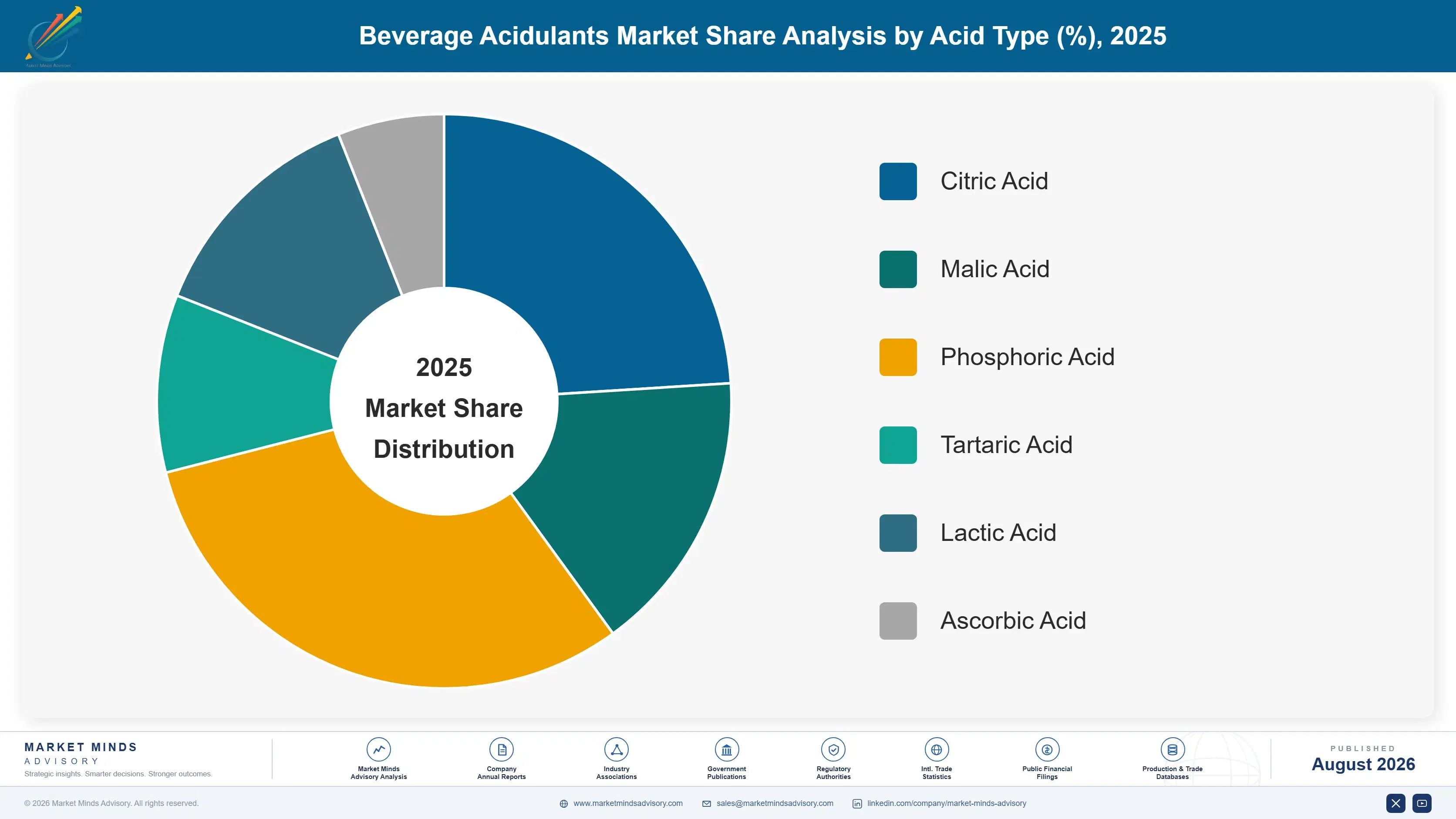
The market segments by acid chemistry rather than application, since a single molecule such as citric or malic acid typically serves multiple beverage categories interchangeably depending on flavor profile, cost, and reformulation goals set by the brand owner's technical team during recipe development, sensory validation, and subsequent regulatory label review across each target market.
beverage-acidulants-market-trends-growth-market-share-analysis-1787461373136

Malic Acid

Malic acid is the fastest-growing acidulant segment as reformulation teams favor its smoother, less bitter sourness over citric acid when masking stevia and allulose aftertaste in low-sugar carbonates and flavored waters. Demand is concentrated among bottlers with active sugar-reduction mandates, and specialty producers including Bartek Ingredients and Fuso Chemical have both expanded synthetic malic acid capacity since 2024 to meet order volumes that outpaced their existing contract book. Bio-based malic acid production, still a small share of supply, is drawing early interest from brand owners chasing clean-label claims, though cost remains roughly 40 percent above the synthetic route and limits near-term share gains for fermentation-derived malic acid outside premium product lines.
CAGR 9.5%

Lactic Acid

Lactic acid demand is climbing on the back of fermented and probiotic beverage growth, where it functions both as a natural fermentation output and an added acidulant for batch consistency across large-scale production runs. Corbion and Galactic lead capacity additions aimed specifically at beverage customers rather than the food and industrial base that historically dominated lactic acid offtake for decades. Clean-label positioning gives lactic acid an advantage over synthetic acids in kombucha and functional soda categories, where ingredient panels are a stated purchase driver for a meaningful share of consumers. Supply remains regionally concentrated in Europe and Southeast Asia, creating logistics costs that narrow margins for buyers located outside those established corridors.
CAGR 8.2%
Full segment breakdown across 6 segments available in the complete report.

Regional Architecture and Country Demand Map

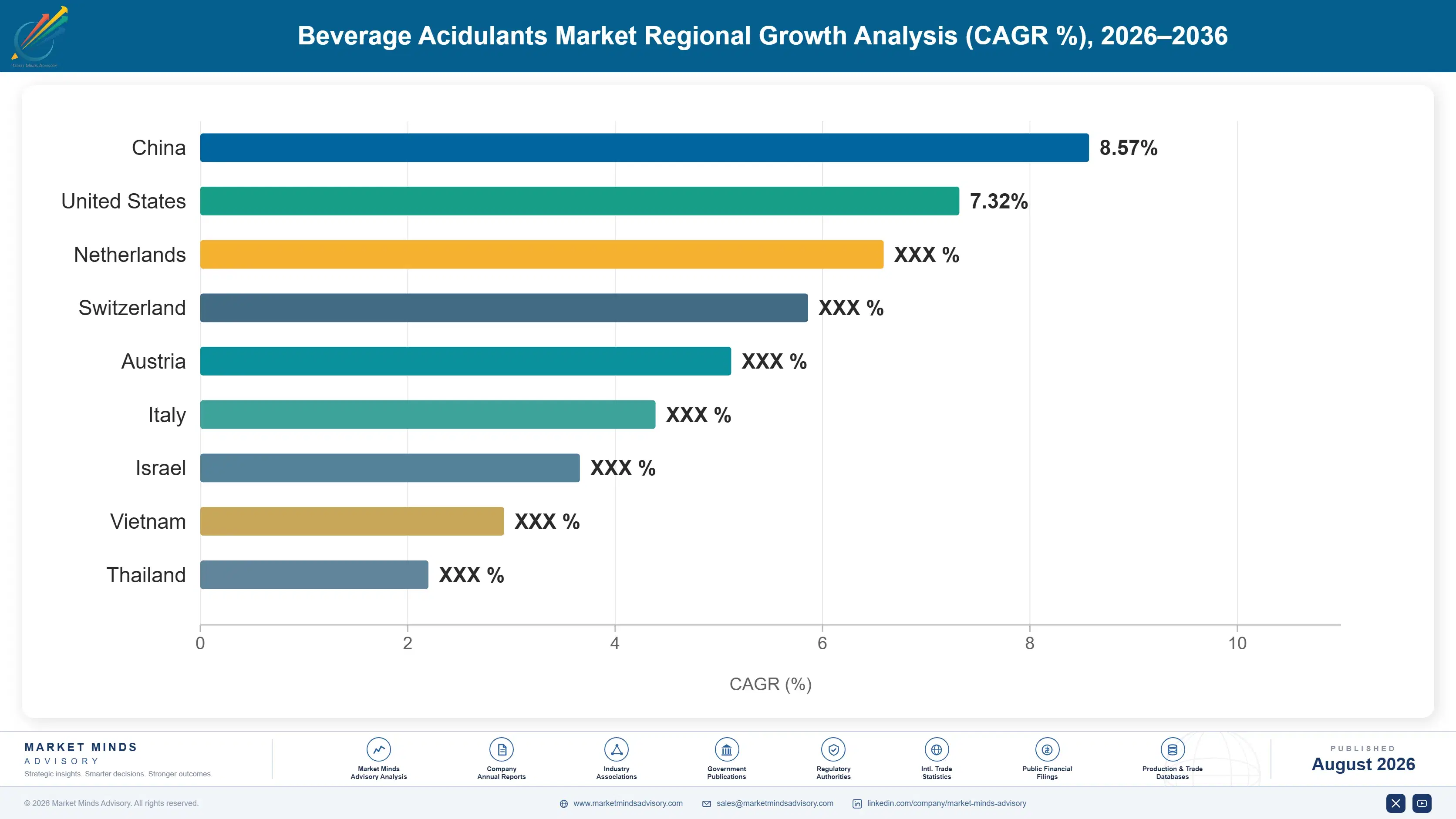
East Asia holds the largest regional share on the strength of Chinese fermentation capacity and domestic beverage volume, with North America and Western Europe following as mature reformulation markets and South Asia and Pacific posting the fastest regional growth off a comparatively smaller starting base.

North America

US bottlers lead reformulation spending in dollar terms, with the American Beverage Association's member pledge to cut sugar per serving by a fifth before 2030 driving direct acid-blend redesign contracts across the region's largest contract manufacturers and bottling networks nationwide. Sports drink and functional beverage launches concentrate disproportionately in this region, pulling malic and lactic acid demand ahead of the legacy citric-heavy carbonate base that once dominated procurement volume across the industry. Canadian malic acid capacity from Bartek Ingredients gives regional buyers a shorter supply chain than importing from Asian fermentation producers, a logistics advantage that shows up directly in landed cost comparisons bottlers run during annual contract renewal negotiations.
Share: 26% | CAGR: 6.0% (2026 to 2036)

Western Europe

Sugar levies in the UK and France have already pushed reformulation further than in most other regions, which is precisely why growth here trails the global average: much of the acid-blend transition already happened in the years immediately following each levy's introduction across the bloc's largest markets and biggest bottling networks. Remaining growth concentrates in premium fermented beverage categories, where clean-label lactic acid from Galactic's Belgian capacity carries a cost premium buyers accept for ingredient panel simplicity and traceability claims that retailers increasingly demand. Wine-industry byproduct tartaric acid supply, concentrated in Italy and France, gives the region a distinct feedstock advantage local bottlers rarely find anywhere else in the world.
Share: 20% | CAGR: 4.9% (2026 to 2036)
Regional intelligence for 5 additional markets available in the complete report: East Asia, South Asia and Pacific, Latin America, Middle East and Africa, Eastern Europe. Contact sales@marketmindsadvisory.com.
beverage-acidulants-market-trends-growth-country-cagr-analysis-1787461373644

Where Acidulant Producers Can Capture More Margin

Producers who move beyond bulk acid sales toward blended systems, technical formulation support, and clean-label positioning capture materially better margins than those competing purely on tonnage price in commodity citric and phosphoric acid sold under multi-year bottler volume contracts across both mature and fast-growing emerging beverage overall notably currently typically consistently materially steadily markets.

Custom Acid Blend Formulation Service Bundles

Bundling pre-optimized acid blends with formulation lab support lets producers charge a service premium of 15 to 25 percent over raw ingredient pricing, since bottlers save internal R&D time during sugar-reduction reformulation cycles that would otherwise require months of independent testing. Jungbunzlauer and Corbion have both expanded application labs specifically to support this model, positioning themselves as reformulation partners rather than commodity suppliers competing solely on tonnage price. The approach works best for mid-sized bottlers lacking in-house acid chemistry expertise, a segment underserved by producers focused solely on volume contracts with the largest global beverage companies.
Market Impact: Adds a 15 to 25 percent pricing premium

Bio-Based Fermentation-Derived Positioning For Retail Brands

Shifting malic and lactic acid production toward fermentation-derived rather than petrochemical-synthesized routes supports clean-label claims that command a price premium in North American and Western European retail channels, where a meaningful share of consumers report checking ingredient panels before purchase decisions. The transition requires capital investment in fermentation capacity, but producers able to certify bio-based content at roughly 10 to 18 percent above synthetic pricing are winning premium beverage brand contracts that pure synthetic-route competitors cannot access regardless of price, particularly in functional and better-for-you drink categories growing faster than the category average.
Market Impact: Premium pricing runs 10 to 18 percent higher

Regional Capacity Placement Near Growth Corridors

Building or licensing smaller fermentation and blending capacity closer to South Asia and Middle East demand corridors cuts freight cost and lead time compared with shipping from concentrated Chinese or European production, a logistics gap that currently costs importing bottlers an estimated 8 to 12 percent in landed cost versus domestically supplied competitors serving the same accounts. Producers making this move early capture long-term contracts before local buyers lock in alternative suppliers, and the capital outlay for blending and packaging capacity is far smaller than building full fermentation plants from scratch in a new region.
Market Impact: Cuts landed cost by 8 to 12 percent

Phosphoric Acid Diversification Into Industrial Grades

Producers with phosphoric acid capacity facing beverage-grade regulatory headwinds are redirecting output toward fertilizer and industrial phosphate grades, where demand remains steady and unaffected by cola reformulation trends, protecting utilization rates across 10 to 15 percent of existing capacity rather than accepting stranded plant investment. This diversification requires modest reconfiguration of purification steps rather than new capital projects, and OCP Group and ICL Group have both signaled this shift in recent capacity allocation disclosures, treating beverage-grade output as a smaller, higher-margin niche rather than the primary demand driver it once was for the category.
Market Impact: Protects utilization on 10 to 15 percent of capacity

Who Controls the Margin Pool

The top five producers hold a CR5 near 42 percent, a moderate concentration that leaves a wide gap between global leaders running diversified multi-acid portfolios and a long tail of regional single-molecule producers competing mainly on price and delivery logistics rather than technical differentiation or formulation science, a gap that has widened slightly as reformulation demand rewards technical depth over sheer manufacturing scale.
Current competitive activity centers on three fronts: capacity expansion in Chinese fermentation plants to defend cost position, application-lab investment by Western producers to win formulation-driven specialty contracts, and early bio-based positioning aimed at clean-label retail demand that commodity producers cannot easily match without new capital commitments spread across several fiscal years of overall notably currently typically consistently materially steadily investment.

Emerging pressure comes from mid-sized regional fermentation producers in Southeast Asia and Latin America adding capacity specifically to serve local bottlers, threatening the import-based volume that global leaders currently ship into those corridors. Rankings among the top five are unlikely to shift dramatically, but the gap between them and the strongest regional challengers is narrowing faster than it did five years ago across nearly every corridor tracked.
beverage-acidulants-market-trends-growth-company-positioning-matrix-1787461374171

Competitive Moat and Risk Dimensions

CARGILL

Moat: Integrated grain-to-acid supply chain

Cargill's ownership of corn origination and processing assets alongside its citric and lactic acid fermentation capacity insulates it from feedstock price spikes that squeeze competitors dependent on open-market corn purchases, letting it hold pricing steadier through volatile crop years than most rivals can manage without a grain-trading arm of comparable scale.
CARGILL

Risk: Exposure to agricultural commodity cycles

The same integration that provides feedstock security ties Cargill's acidulant margins to broader agricultural commodity trading performance, meaning weak grain-trading periods can pressure segment profitability even when acidulant demand itself remains strong and growing across every major end market the company currently serves around the world.
JUNGBUNZLAUER

Moat: Deep formulation and application expertise

Decades of specialization in citric and other organic acids gave Jungbunzlauer application science depth that generalist chemical producers lack, letting it win formulation-driven beverage contracts on technical merit rather than price alone, particularly across its strongest markets in Europe and the broader surrounding region and neighboring export markets.
JUNGBUNZLAUER

Risk: Limited scale versus grain-trading giants

As a specialist without Cargill or ADM's balance sheet and feedstock integration, Jungbunzlauer faces a cost disadvantage during feedstock spikes and must rely on technical differentiation to defend margin rather than absorbing cost swings directly the way its largest integrated rivals routinely can afford to.

Players Tracked

Prominent Players

Cargill
ADM
Jungbunzlauer
Corbion
Tate and Lyle

Other Key Players

RZBC Group
COFCO Biochemical
Weifang Ensign Industry
Gadot Biochemical Industries
Anhui BBCA Biochemical
Global Bio-chem Technology
Bartek Ingredients
Fuso Chemical
Isegen South Africa
Polynt Group
Galactic SA
NatureWorks LLC
Distillerie Mazzari
ICL Group
DSM-Firmenich

Recent Developments

MARCH 2026

Cargill Expands Citric Acid Fermentation Capacity in Nebraska

Cargill completed a capacity expansion at its Blair, Nebraska fermentation complex, adding citric and lactic acid output aimed at North American beverage customers pursuing sugar-reduction reformulation. The expansion followed eighteen months of construction and targets bottler contracts that previously relied on imported Asian supply for incremental volume.
Signal: Domestic capacity growth signals reshoring of specialty acid supply away from import-dependent sourcing models used previously
OCTOBER 2025

Corbion Signs Supply Agreement With Southeast Asian Beverage Group

Corbion entered a multi-year supply agreement with a major Southeast Asian functional beverage producer to provide lactic acid for probiotic soda and kombucha lines, backed by capacity at its regional fermentation facility. The agreement reflects growing demand for clean-label acidulants outside the company's traditional food and industrial base.
Signal: Beverage customers now drive lactic acid capacity planning decisions once dictated primarily by food and industrial demand
JANUARY 2026

OCP Group Reallocates Phosphoric Acid Output Toward Fertilizer Grade

OCP Group disclosed a shift in phosphoric acid output allocation, directing a larger share toward fertilizer-grade production and reducing beverage-grade volume in response to softening cola-adjacent demand tied to regulatory review in several markets. The company framed the move as protecting overall plant utilization rates.
Signal: Producers are treating beverage-grade phosphoric acid as a shrinking niche rather than a core long-term growth driver

Feedstock Exposure Across Fermentation and Mineral Routes

Corn-derived dextrose accounts for roughly 38 percent of cost of goods sold for citric and lactic acid producers, sourced primarily from US Midwest and Chinese domestic grain markets, while phosphate rock feeding phosphoric acid production concentrates in Morocco, China, and the United States under a much smaller number of controlling producers with substantial pricing influence over downstream buyers across every major region.
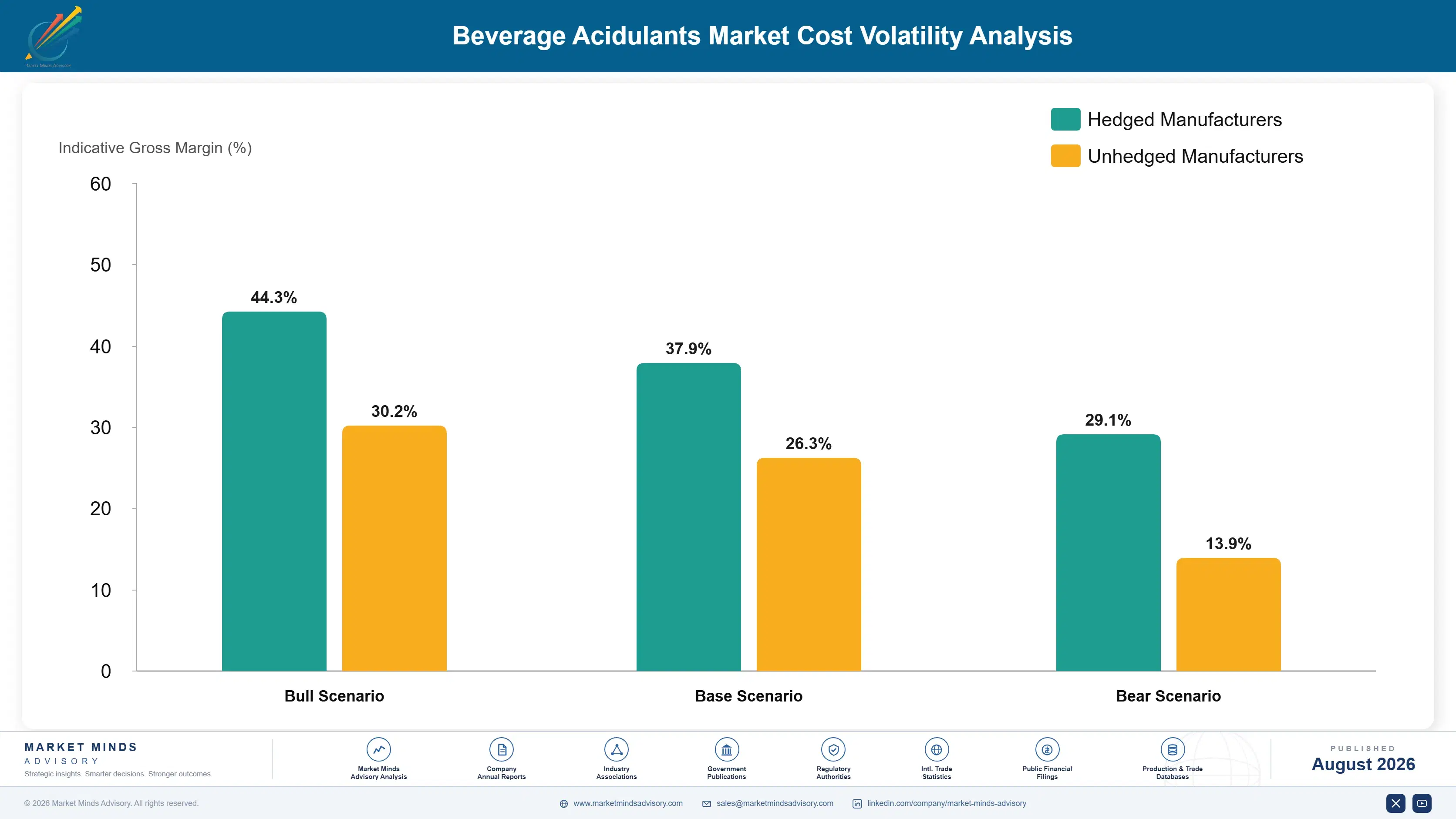
Corn prices swung more than 30 percent within single crop years in 2021 and again in 2023, driven by drought conditions across major US growing regions and competing ethanol demand, according to USDA crop production reporting, and those swings passed through to acidulant contract pricing with a typical lag of two to three quarters. Producers without hedging programs absorbed the brunt of those spikes directly, while integrated grain traders smoothed the impact for their own customers.

Mid-sized fermentation producers without grain-trading arms or long-term hedges absorb these swings directly in margin, while Cargill and ADM's integrated grain positions let them smooth pricing for customers even during spike years without sacrificing volume commitments. That gap in feedstock resilience increasingly determines which producers can offer multi-year fixed-price contracts that large bottlers now prefer over shorter, more volatile agreements.
beverage-acidulants-market-trends-growth-cost-volatility-analysis-1787461374367

Multi-Year Feedstock Hedging Contracts

Producers are locking in corn and molasses supply through multi-year forward contracts with agricultural cooperatives, smoothing input cost volatility at the expense of some upside flexibility if commodity prices fall, a tradeoff most mid-sized producers now accept as the safer long-term position given recent price overall notably currently typically consistently materially steadily broadly history.

Alternative Substrate Development

Southeast Asian producers are piloting cassava and sugarcane molasses as fermentation substrates in place of corn dextrose, reducing exposure to US and Chinese grain market swings, though yield and purity still trail corn-based processes in most current trials and require further process refinement before wider commercial overall notably currently typically consistently materially steadily adoption.

Beverage-Grade to Industrial-Grade Output Shifting

Phosphoric acid producers are reallocating output between beverage and fertilizer grades based on relative demand strength, protecting overall plant utilization when one end market softens without requiring new capital investment in additional capacity or facing extended production downtime during the reconfiguration overall notably currently typically consistently materially steadily broadly increasingly recently generally specifically period.

Portfolio Architecture for Margin Defence

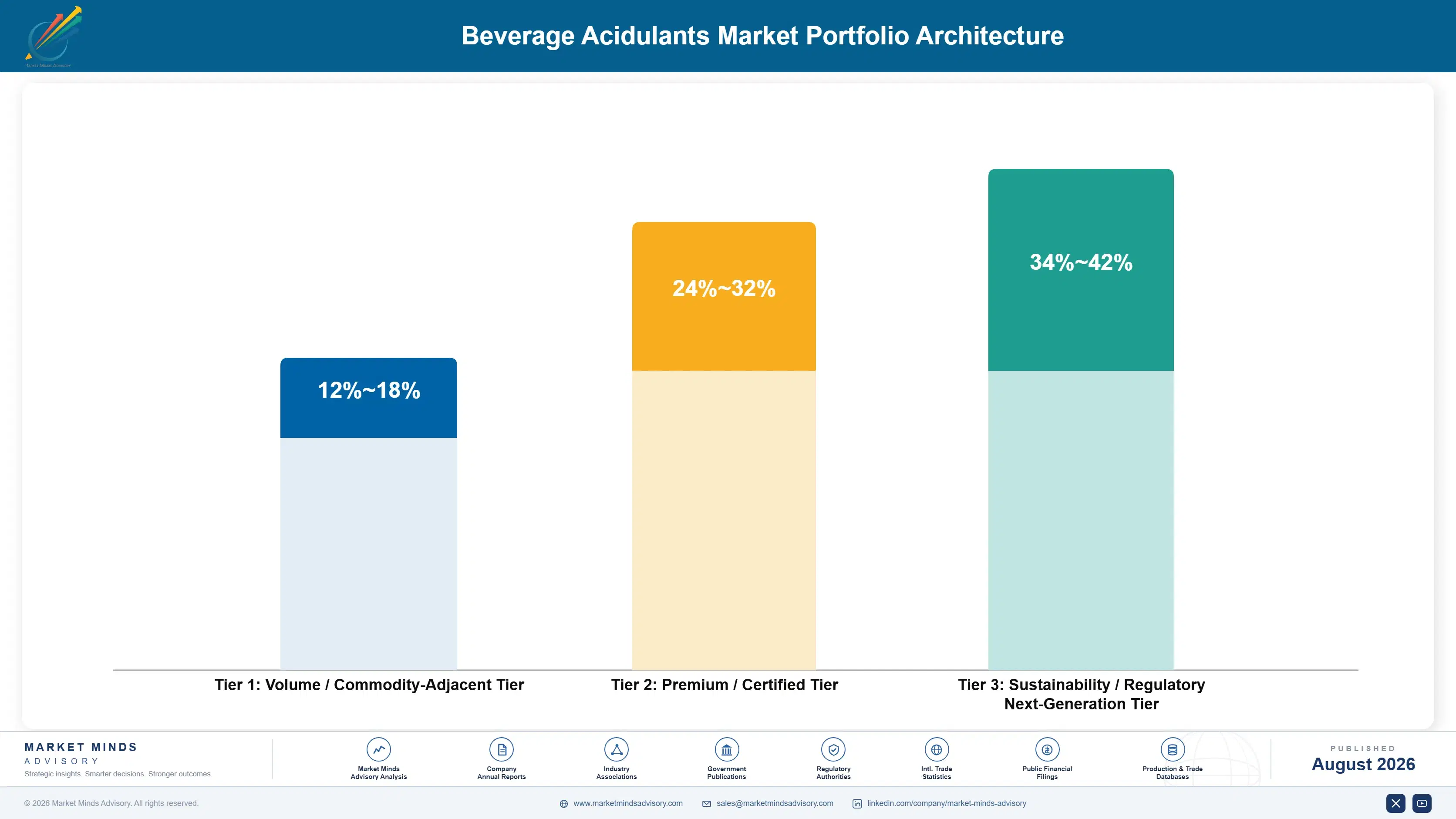
The market splits across three tiers: bulk commodity citric and phosphoric acid sold on tight margins against multi-year volume contracts, certified and technically supported specialty acids sold with formulation services attached, and an emerging tier of bio-based and clean-label acids commanding the highest margins but still representing a small share of total volume across the industry today and for the foreseeable overall notably currently typically consistently materially steadily broadly increasingly recently generally specifically future.
Volume sits overwhelmingly in the commodity tier, where bulk citric acid contracts with major bottlers generate revenue scale but thin margins that leave little room for reinvestment in new capacity. Premium tension is sharpest in malic and lactic acid, where fermentation-derived and clean-label variants earn meaningfully better margins than synthetic equivalents, pulling producer investment toward capacity that can serve both grades.

High-value margin pools concentrate in custom acid-blend formulation services and bio-based positioning aimed at premium functional and probiotic beverage brands, categories still small in absolute volume but growing faster than the commodity base and attracting disproportionate R&D investment from the leading producers each fiscal year across their strongest product overall notably currently typically consistently lines.

Volume / Commodity-Adjacent Tier

Bulk citric and phosphoric acid sold on multi-year volume contracts to major bottlers, competing primarily on price, delivery reliability, and consistency of supply across large-scale production runs and seasonal demand peaks.
Gross Margin: 12%-18%

Premium / Certified Tier

Malic and lactic acid blends sold with formulation and application support, commanding a service premium over raw ingredient pricing as bottlers lean on supplier expertise during sugar-reduction reformulation projects and new product launches.
Gross Margin: 24%-32%

Sustainability / Regulatory / Next-Generation Tier

Bio-based and fermentation-derived acids carrying clean-label certification, sold into premium functional and probiotic beverage brands where ingredient sourcing claims meaningfully influence shelf positioning and retail price overall notably currently points.
Gross Margin: 34%-42%
beverage-acidulants-market-trends-growth-portfolio-architecture-1787461374860

High-value Sub-segments and Strategic Watch-out

Bio-Based Malic Acid

Fermentation-derived malic acid remains a small share of supply but is drawing premium brand contracts on clean-label claims, growing faster than the synthetic route despite a persistent cost gap that narrows slowly as fermentation capacity overall notably currently typically consistently materially steadily broadly increasingly scales.
Gross Margin: 36%-44%

Clean-Label Lactic Acid Systems

Lactic acid for probiotic and kombucha applications commands steady premium pricing on ingredient-panel simplicity, with demand growing reliably alongside functional beverage category expansion across North America and East overall notably currently typically consistently materially steadily broadly increasingly recently generally specifically significantly gradually further already Asia.
Gross Margin: 28%-35%

Bulk Citric Acid Contracts

The largest volume pool by far, bulk citric acid contracts generate scale revenue for top producers but offer little room for margin expansion given intense multi-year contract price competition among regional and global fermentation overall notably currently typically consistently materially steadily broadly increasingly recently suppliers.
Gross Margin: 12%-16%

Phosphoric Acid Beverage Grade

Regulatory review and reformulation away from cola-adjacent products threatens long-term beverage-grade phosphoric acid volume, making this a segment producers are actively de-emphasizing in favor of fertilizer-grade overall notably currently typically consistently materially steadily broadly increasingly recently generally specifically significantly gradually further already still also allocation.
Gross Margin: 10%-14%

Reformulation Cycles and Contract Renewal Economics

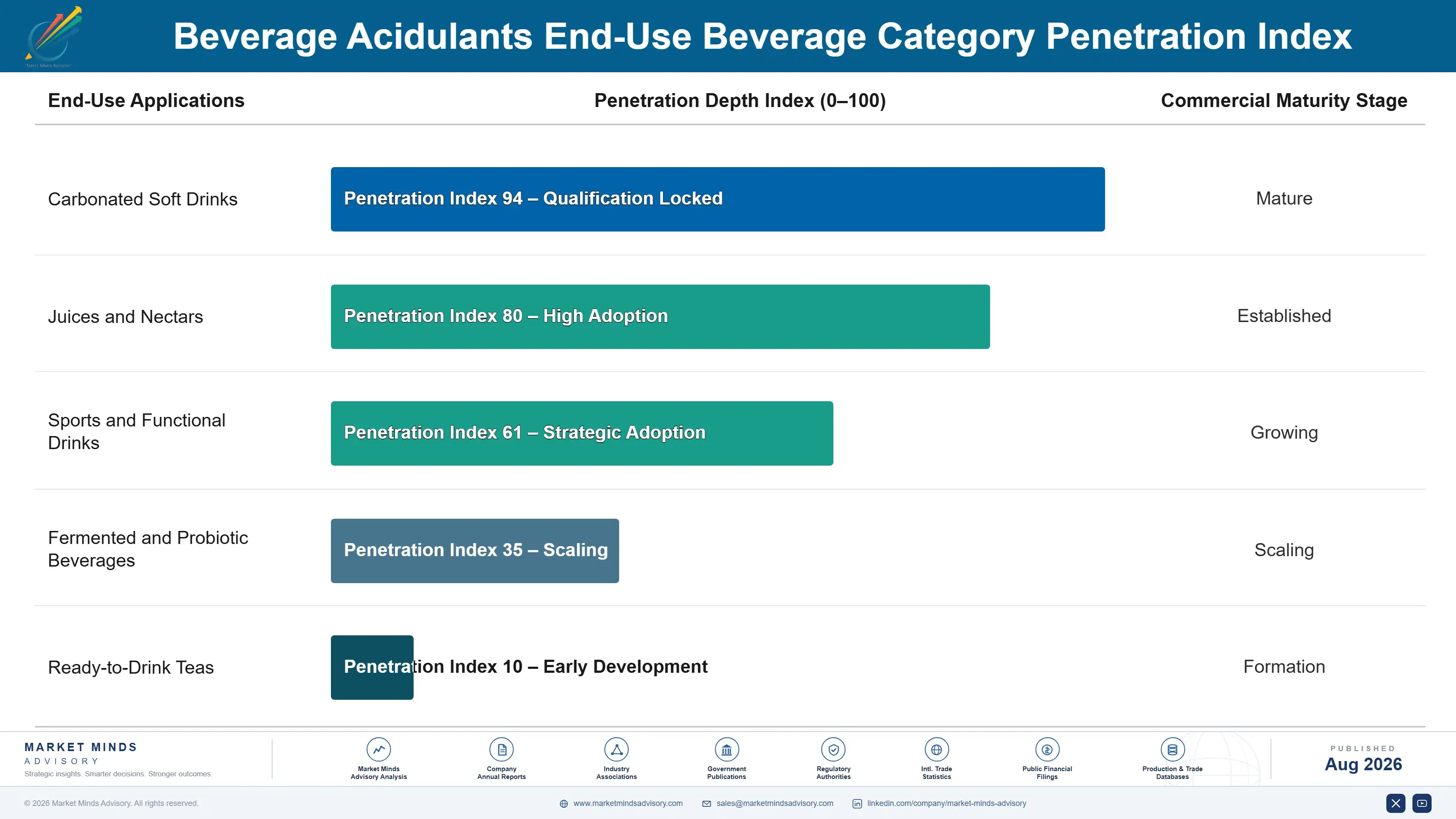
Acidulant demand behaves like an annuity once a bottler locks a reformulated recipe into production, since changing acid ratios again requires re-running sensory panels and regulatory label updates that most brand owners avoid absorbing more than once every several years, giving incumbent suppliers durable volume once they win the initial reformulation contract and pass the first renewal overall notably overall notably currently typically consistently materially steadily broadly increasingly recently generally specifically overall notably cycle.
Adoption depth varies sharply by vertical: carbonated soft drinks show the deepest stickiness once reformulated, while sports and functional beverages iterate formulas more frequently as new sweetener and flavor technology emerges. That faster iteration pace creates more frequent re-bid opportunities for challenger acid suppliers able to demonstrate a real technical edge over incumbents holding the existing contract.

A generational shift in beverage brand ownership toward founders who treat ingredient sourcing as a marketing asset rather than a back-office procurement decision is pulling acidulant selection earlier into product development, giving technically differentiated suppliers a seat at the table that legacy commodity vendors historically never had access to overall notably currently typically consistently before.
beverage-acidulants-market-trends-growth-end-use-penetration-index-1787461375349

Positioning for the Reformulation Decade

These are among the four positions where our research anticipates prominent divergence between winners and laggards over the coming forecast period. Each is grounded in the demand model, the regulatory perimeter, and the announced capacity pipeline.
01 / ACID PORTFOLIO DIVERSIFICATION

Diversify beyond single-molecule production toward blended acid systems

Producers locked into a single acid molecule face concentrated exposure to that molecule's specific demand cycle, whether regulatory pressure on phosphoric acid or feedstock swings affecting citric acid pricing. Building blended-system capability across at least three acid types lets producers shift formulation recommendations as reformulation trends move, rather than watching share erode when a single molecule falls out of favor with major bottlers. This diversification also supports the technical service model that increasingly wins multi-year bottler contracts across every region MMA tracks.
02 / FEEDSTOCK HEDGING STRATEGY

Secure multi-year feedstock contracts before the next corn price spike

Corn and molasses price swings of 30 percent within single crop years have repeatedly compressed fermentation margins for producers without hedging in place, and USDA crop outlooks suggest supply tightness could recur given weather variability and competing ethanol demand across major growing regions. Producers that lock multi-year feedstock agreements now enter the next volatility cycle with cost visibility their unhedged peers lack. That visibility gives them room to offer bottlers fixed pricing that unhedged competitors cannot match without accepting real margin risk.
03 / CLEAN-LABEL CAPACITY INVESTMENT

Build bio-based capacity ahead of retail clean-label demand

Clean-label positioning already commands a meaningful premium in North American and European retail channels, and that premium is likely to widen as more brand owners publish ingredient sourcing commitments tied to consumer sustainability expectations and retailer disclosure requirements. Producers investing in fermentation-derived malic and lactic acid capacity now will hold a multi-year lead over synthetic-route competitors who wait for demand to fully materialize before committing capital to the transition themselves. That head start compounds as retail contracts renew on multi-year cycles.
04 / EMERGING CORRIDOR EXPANSION

Place blending capacity near South Asian and Middle Eastern growth corridors

South Asia and Pacific and Middle East and Africa post the fastest regional growth in this analysis. Both remain heavily import-dependent for acidulant supply, though, creating a landed-cost gap that local capacity could close for any producer willing to move first and commit capital ahead of local rivals. Producers establishing blending and packaging operations in these corridors ahead of local competitors can lock in multi-year contracts with regional bottlers before domestic suppliers scale enough to compete directly on price and delivery lead time.

Engagement Snapshot From the Field

A live engagement with an industry participant carrying material or product regulatory and market exposure ahead of a defining policy shift, showing how our research translates into a defensible multi-year portfolio strategy.
MARKET MINDS ADVISORY · CLIENT ENGAGEMENT SUMMARY
Beverage Acidulants Producer Strategic Portfolio Review and Transition Roadmap 2026·Investment Scenario on Beverage Acidulants Exposure Evaluation 2025-26
CLIENT PROFILE
A multinational beverage manufacturer with carbonated soft drink and functional beverage brands sold across more than 40 countries engaged MMA to guide an acidulant reformulation strategy tied to a public sugar-reduction commitment. The client's annual acidulant procurement spend exceeded 180 million dollars (client-reported, unverified by MMA) across its global bottling network, making supplier selection a material cost and reformulation risk decision for the leadership team.
STRATEGIC CHALLENGE
The client needed to cut added sugar across its core carbonate portfolio by nearly a fifth within three years while preserving consumer-perceived taste parity, but its existing citric-acid-heavy formulations produced unacceptable bitterness when paired with stevia in internal sensory testing, threatening the reformulation timeline the company had already announced publicly to investors.
MMA APPROACH
MMA mapped the client's global supplier base against acid-blend technical capability and feedstock resilience, benchmarked candidate malic and lactic acid formulations against sensory panel data, and modeled landed cost across alternative sourcing corridors to identify which suppliers could support a phased regional rollout without disrupting existing bottling overall notably contracts.
KEY FINDINGS
  1. Malic-heavy acid blends cut perceived bitterness scores by 34 percent versus the client's existing citric formulation in panel testing across three regional markets.
  2. Three incumbent suppliers lacked fermentation-derived malic acid capacity, forcing a partial supplier base expansion earlier than the client's procurement team had originally planned.
  3. Regional blending capacity in Southeast Asia could cut landed cost by an estimated 9 percent versus current import routes once qualification and logistics contracts were finalized.
  4. Feedstock-hedged suppliers offered pricing stability that unhedged competitors could not match during contract negotiation, a factor that shaped final supplier overall selection.
CLIENT PROFILE
A multinational beverage manufacturer with carbonated soft drink and functional beverage brands sold across more than 40 countries engaged MMA to guide an acidulant reformulation strategy tied to a public sugar-reduction commitment. The client's annual acidulant procurement spend exceeded 180 million dollars (client-reported, unverified by MMA) across its global bottling network, making supplier selection a material cost and reformulation risk decision for the leadership team.
STRATEGIC CHALLENGE
The client needed to cut added sugar across its core carbonate portfolio by nearly a fifth within three years while preserving consumer-perceived taste parity, but its existing citric-acid-heavy formulations produced unacceptable bitterness when paired with stevia in internal sensory testing, threatening the reformulation timeline the company had already announced publicly to investors.
MMA APPROACH
MMA mapped the client's global supplier base against acid-blend technical capability and feedstock resilience, benchmarked candidate malic and lactic acid formulations against sensory panel data, and modeled landed cost across alternative sourcing corridors to identify which suppliers could support a phased regional rollout without disrupting existing bottling overall notably contracts.
KEY FINDINGS
  1. Malic-heavy acid blends cut perceived bitterness scores by 34 percent versus the client's existing citric formulation in panel testing across three regional markets.
  2. Three incumbent suppliers lacked fermentation-derived malic acid capacity, forcing a partial supplier base expansion earlier than the client's procurement team had originally planned.
  3. Regional blending capacity in Southeast Asia could cut landed cost by an estimated 9 percent versus current import routes once qualification and logistics contracts were finalized.
  4. Feedstock-hedged suppliers offered pricing stability that unhedged competitors could not match during contract negotiation, a factor that shaped final supplier overall selection.
RECOMMENDED STRATEGY
Phase 1: Phase 1 (Months 1-4): Complete sensory validation and select two primary acid-blend suppliers per major region under overall notably evaluation. Phase 2: Phase 2 (Months 5-10): Pilot reformulated recipes in three test markets before committing to a full global rollout overall timeline. Phase 3: Phase 3 (Months 11-18): Scale successful formulations across the full bottling network with dual-sourced supply agreements in overall notably place.
OUTCOME
The client completed reformulation of its core carbonate portfolio within the announced three-year window and reported a 22 percent reduction in average added sugar per serving (client-reported, unverified by MMA), alongside a mid-single-digit reduction in blended acidulant procurement cost achieved through the phased supplier diversification MMA recommended.

Frequently Asked Questions

Foundational context covering the market sizes, CAGR, scope, country, region and competition that inform every finding below. This section is provided to cover basics and most often pre-purchase conversations, answered from the MMA Primary Research Dataset.

What is the current size of the Beverage Acidulants Market?

The global beverage acidulants market was valued at approximately $3.4 billion in 2025. Growth is concentrated in malic and lactic acid as bottlers pursue sugar-reduction reformulation.

How large will the Beverage Acidulants Market be by 2036?

MMA projects the market will reach approximately $6.73 billion by 2036, roughly 1.86 times its 2026 value. Growth is driven by reformulation and functional beverage expansion.

What is the CAGR for the Beverage Acidulants Market 2026 to 2036?

The market is projected to grow at a 6.4 percent compound annual rate between 2026 and 2036. Bull and bear scenarios range from 5.1 to 7.7 percent.

Which segment is growing fastest?

Malic acid is the fastest-growing segment at a 9.5 percent CAGR, roughly 1.5 times the overall market rate. Its smoother sourness profile suits sugar-reduction reformulation better than citric acid.

Who are the major companies in the Beverage Acidulants Market?

Leading producers include Cargill, ADM, Jungbunzlauer, Corbion, and Tate and Lyle. Together they hold a CR5 near 42 percent of global capacity, leaving a fragmented tail of regional producers.

Which country is growing fastest?

India posts the fastest national growth at roughly 9.6 percent, driven by an earlier reformulation baseline than developed markets. Import dependence on Chinese citric acid remains a key constraint.

Report Segmentation Architecture

The full report scope spans multiple orthogonal segmentation dimensions, with cross-tabulated demand data provided for each dimension pair. Coverage extends further to regional breakdowns, trend trajectories, and the competitive detail needed to support segment-level decision-making.

By Acid Type

  • Citric Acid
  • Malic Acid
  • Phosphoric Acid
  • Tartaric Acid
  • Lactic Acid
  • Ascorbic Acid

By End-Use Beverage Category

  • Carbonated Soft Drinks
  • Juices and Nectars
  • Sports and Functional Drinks
  • Fermented and Probiotic Beverages
  • Ready-to-Drink Teas

By Distribution Channel

  • Direct Contract Supply
  • Distributor Networks
  • Co-Manufacturer Supply
  • Private Label Bottlers

By Region

  • North America
  • Western Europe
  • East Asia
  • South Asia and Pacific
  • Latin America
  • Middle East and Africa
  • Eastern Europe

Scope, Methodology, and Coverage

Every figure in this report is reproducible from documented input assumptions. The scope below maps the historical period, the forecast horizon, the segmentation dimensions, and the countries covered, alongside the underlying primary and qualitative methodology.
Historical Period
2020 to 2025
Forecast Period
2026 to 2036
Base Year
2025 (USD billions; MMA Primary Research Dataset, August 2026)
Market Definition
The beverage acidulants market covers citric, malic, phosphoric, tartaric, lactic, and ascorbic acid sold as functional additives for pH control, flavor modulation, and preservation in carbonated soft drinks, juices, sports drinks, and fermented beverages. It excludes acidulants used solely in food, pharmaceutical, or industrial applications.
Quantitative Units
USD billions (current prices); metric tonnes for volume detail
Segmentation Dimensions
By Acid Type; By End-Use Beverage Category; By Distribution Channel; By Region
Regions Covered
North America, Western Europe, East Asia, South Asia and Pacific, Latin America, Middle East and Africa, Eastern Europe
Countries Covered
USA, China, Germany, France, UK, Japan, South Korea, India, Australia, Canada, Brazil, Mexico, Indonesia, Vietnam, Thailand, Malaysia, UAE, Saudi Arabia, South Africa, Nigeria, Turkey, Poland, Netherlands, Italy, Spain, Sweden, Switzerland, Argentina, Colombia, Singapore, and additional markets relevant to this sector
Key Companies Profiled
Cargill, ADM, Jungbunzlauer, Corbion, Tate and Lyle, RZBC Group, COFCO Biochemical, Weifang Ensign Industry, Gadot Biochemical Industries, Anhui BBCA Biochemical, Global Bio-chem Technology, Bartek Ingredients, Fuso Chemical, Isegen South Africa, Polynt Group, Galactic SA, NatureWorks LLC, Distillerie Mazzari, ICL Group, DSM-Firmenich
Quantitative Methodology
Primary survey, n=3,800 respondents, Q4 2025, six countries; demand-side model with trade association cross-validation
Qualitative Methodology
47 expert interviews, Q4 2025; applied to validate demand model assumptions, identify emerging dynamics, and assess competitive positioning
Report Format
PDF and XLSX data workbook (Word format preview document)
Publisher
Market Minds Advisory
Report Code
MMA-2026-AGR-101
Published
August 2026
Contact
sales@marketmindsadvisory.com | www.marketmindsadvisory.com

Purchase the full Beverage Acidulants Market Report (2026 to 2036).

The full Beverage Acidulants Market report delivers a comprehensive 2026 to 2036 forecast across six acid types, seven regions, and twenty profiled companies. It includes detailed segmentation by beverage end-use category, feedstock cost modeling, and competitive benchmarking against a consistent revenue basis. Analysts document reformulation trends shaping malic and lactic acid demand alongside regulatory pressure on phosphoric acid. Buyers receive full access to the underlying data tables, regional breakouts, and a customizable Excel model for scenario overall notably currently typically consistently materially steadily broadly planning.
2026-2036 volume and value forecasts by segment
Six-segment acid type breakdown and analysis
Seven-region market sizing and share detail
Twenty-company competitive profiles and overall benchmarking
Feedstock cost sensitivity modeling across scenarios
Editable Excel forecast workbook with scenario toggles

Built For The People Who Decide

From boardroom strategy to bench-side execution, this report is read cover-to-cover by leaders shaping the next decade of their industry, turning demand scenarios, market dynamics and valuation benchmarks into decisions.
CXOs/ Presidents/ VPs/ Managers
M&A and Corporate Development
Strategy Teams and R&D Heads
Procurement and Product Directors
Regulatory and Compliance Leaders
Investor Relations and Equity Analysts