Market Minds Advisory
Beta-Glucans Market

Beta-Glucans Market: Immune Bioactives Meet Commodity Fiber

Beta-glucan demand is splitting between commodity oat fiber for cholesterol claims and premium yeast-derived immune formulations, forcing ingredient suppliers to choose between scale manufacturing and high-margin bioactive purity as retailers tighten clean-label sourcing audits.

Lead Analyst

Lisa Gevelber

Published

September 2026

Make Smarter Decisions with Customized Research Insights

Request a free sample report and evaluate market opportunities, growth trends, and competitive dynamics relevant to your business needs.

2025 MARKET VALUE$1.1BMarket Size 2025
2036 FORECAST VALUE$2.6BBase Case , 2026 to 2036
CAGR 2026 TO 20367.6 %Bull 8.8% / Bear 6.4%
INCREMENTAL OPPORTUNITY$1.3BNet 10- year value creation
EXPANSION MULTIPLE2.08x2036 value over 2026 base
Strategic Levers
M&A Pipeline
Regional Outlook
Country Rankings
Competitive Intelligence
Segmental Deep-dive
Call-Us : 91 93563 13602

Executive Snapshot and Market Trajectory

Formulators are reformulating around beta-glucan's dual identity: a cholesterol-lowering fiber under regulatory health claims and an immune-modulating bioactive commanding premium pricing. That split is reshaping procurement, pushing buyers toward traceable oat and yeast supply chains rather than generic polysaccharide blends sold on fiber content alone, not verified bioactive potency.
Immune-health positioning now drives most new product launches, with yeast beta-1,3/1,6-glucan capturing share in sports nutrition, gummies, and pet supplements faster than oat beta-glucan's traditional cardiovascular claim. East Asia has become the manufacturing center of gravity, home to the fermentation and extraction capacity feeding both regional nutraceutical brands and export contracts. North America remains the largest single consumption market, absorbing roughly a quarter of global volume through dietary supplements and fortified foods.
Competition is fragmenting rather than consolidating: five suppliers hold under forty percent combined share, leaving room for regional fermentation specialists to underprice multinational blenders on yeast-derived material. Clean-label pressure and third-party purity verification are becoming the real differentiator, not price per kilogram. Regulators in the European Union and United States are also tightening substantiation requirements for immune-health claims, raising documentation and compliance costs across the supply base.
Market Definition
The beta-glucans market covers polysaccharide fiber ingredients derived from oat, barley, yeast, mushroom, and algae sources, sold for cholesterol-management food claims, immune-support supplements, and functional beverage fortification. It excludes generic dietary fiber blends that do not isolate or standardize beta-glucan content, and excludes pharmaceutical-grade glucan used exclusively in prescription immunotherapy.
Base Year Value
$1.1B in 2025 (MMA Primary Research Dataset, August 2026)
Forecast Period
2026 to 2036, eleven discrete annual values
CAGR
7.6% base case. Bull 8.8%. Bear 6.4%.
Fastest Growth Segment
Fermentation-Derived Beta-Glucans: 11.2% CAGR
Fastest Growth Country
China: 9.6% CAGR
Fastest Growth Region
South Asia and Pacific: 9.6% CAGR
Largest Region
East Asia: 30% of 2025 global value
Market Leaders
Cargill, Kerry Group, Angel Yeast, DSM-Firmenich, and Tate and Lyle lead global supply. Source: MMA Analysis based on company annual reports.
Primary Survey
n=3,800 procurement and R&D decision-makers, Q4 2025, six countries
Methodology
Demand-side build-up, cross-validated against public data, 47 expert interviews

Beta-Glucans Market Forecast Scenarios

beta-glucans-market-trends-growth-insights-size-forecast-scenario-1787462680965
Between 2020 and 2025, beta-glucan demand grew at an estimated 6.4% annually as pandemic-era immune-health awareness pulled yeast-derived glucan into mainstream supplement aisles faster than oat fiber's slower cardiovascular-claim adoption. Supply was constrained early by limited fermentation capacity, and several ingredient houses expanded extraction lines in Denmark, China, and the American Midwest to keep pace with reformulation requests from branded supplement manufacturers.
MMA's base case projects 7.6% annual growth to 2036 on three mechanisms: continued conversion of generic fiber claims into standardized beta-glucan labeling under FDA and EFSA health-claim rules, expansion of yeast fermentation capacity across East Asian contract manufacturers serving both domestic and export nutraceutical brands, and growing inclusion of oat and barley beta-glucan in plant-based dairy and bakery reformulations seeking texture and fiber fortification without synthetic gums. Pet supplement formulators are adding a fourth, smaller growth channel.
A bull catalyst comes from China's National Health Commission expanding approved beta-glucan health-claim categories, potentially pulling in over a hundred new domestic product launches within two years. The bear risk sits with raw material volatility: baker's yeast feedstock and oat crop pricing swings could compress supplier margins enough to slow the capacity expansion several contract manufacturers have already committed to.

Demand Bifurcation Between Fiber Claims and Immune Bioactives

Beta-glucan sits at the intersection of two very different buyer logics. Food formulators want a cheap, functional fiber that qualifies for cholesterol-lowering health claims under established regulatory frameworks. Supplement and nutraceutical brands want a bioactive polysaccharide with documented immune-modulation data they can put on a bottle. Ingredient suppliers increasingly have to run two separate go-to-market strategies rather than one blended pitch.
MARKET CONCENTRATION38%Top five suppliers hold well under half the market
AVERAGE SELLING PRICE$18.40/kgYeast-derived material commands a steep premium over oat fiber
TOP PRODUCING COUNTRYChinaLeads global fermentation and extraction capacity for glucan ingredients
CAPACITY UTILIZATION76%Fermentation lines run near ceiling during peak launch seasons
FEEDSTOCK COST SHARE31% of COGSOat and yeast feedstock dominate total production cost structure
TRADE INTENSITY42% exportedNearly half of finished ingredient volume crosses a border
Commercially, the market behaves like a specialty chemical business layered onto an agricultural commodity. Oat and barley beta-glucan pricing tracks grain harvests and milling capacity, while yeast and mushroom-derived material prices track fermentation throughput and purification yield. Buyers that lock in multi-year supply contracts with fermentation specialists are insulating themselves from the harvest-driven volatility that still hits oat-based suppliers every crop cycle.
Over the next decade, expect purity verification and third-party testing to matter more than raw tonnage. Retailers in North America and the European Union are pushing suppliers toward certificates of analysis for exact beta-1,3/1,6-glucan content, not just total polysaccharide weight, and that documentation burden will likely squeeze out smaller regional processors that cannot afford accredited lab testing on every batch they ship, particularly private-label supplement co-packers.
"Everyone selling beta-glucan wants to be a bioactive supplier now, but most of them are still shipping commodity fiber with a health-claim sticker on it. The suppliers who invest in real potency documentation will own the next decade of this category."
Director, Food and Nutraceutical Ingredients Practice · MMA Food Ingredients and Nutraceuticals Practice · August 2026

Market Trends

Immune-Health Reformulation Accelerates Yeast Beta-Glucan Demand

Consumer brands are reformulating immune-support gummies, sports nutrition powders, and pet supplements around yeast-derived beta-1,3/1,6-glucan, moving away from generic zinc and vitamin C blends that no longer differentiate on shelf. Angel Yeast and Kerry Group have both expanded fermentation capacity in the past eighteen months specifically to supply this category, and at least four global supplement brands have relaunched flagship immune products with yeast glucan as the headline active ingredient rather than a supporting one. Retail data suggests these reformulated products are commanding shelf prices twelve to eighteen percent above prior formulations.
Market Impact: Adds 200+ cholesterol-claim SKU launches

Retailers Mandate Certified Beta-Glucan Potency Testing

Major North American and European retailers are now requiring certificates of analysis confirming exact beta-1,3/1,6-glucan content before accepting new supplement SKUs, a shift from the total-polysaccharide labeling that dominated the category through 2023. The change follows independent lab testing that found several branded products contained less than half their labeled active glucan content. Suppliers with in-house accredited testing capability, including Tate and Lyle and DSM-Firmenich, are winning reformulation contracts specifically because they can guarantee potency consistency batch to batch, while smaller regional processors are losing shelf placements they held for years.
Market Impact: Opens 12 new Chinese product launches

Market Opportunities and Growth Drivers

FDA and EFSA Expand Approved Cholesterol Health Claims

The US FDA and European Food Safety Authority both maintain approved health claims linking oat and barley beta-glucan consumption to reduced LDL cholesterol, provided products deliver at least three grams of beta-glucan daily. Food manufacturers are using this established claim to fortify breakfast cereals, bread, and beverage lines without the regulatory uncertainty that surrounds newer immune-health positioning. More than two hundred new SKUs carrying the cholesterol claim launched across North America and the European Union in 2025 alone, and cereal makers report the claim measurably lifts trial purchase rates among health-conscious shoppers over forty-five.
Market Impact: Adds 22% oat concentrate cost

China Expands Approved Functional Food Ingredient List

China's National Health Commission added yeast beta-glucan to its approved list of new food ingredients in 2024, opening a domestic functional food and beverage market that previously required case-by-case regulatory approval for every product launch. Domestic manufacturers including Angel Yeast have since scaled fermentation capacity specifically to serve this newly accessible market, and at least a dozen Chinese functional beverage brands launched beta-glucan fortified products within a year of approval. Industry contacts expect the approved ingredient list to expand further to cover mushroom-derived glucan sources within the next two years, extending the addressable domestic category.
Market Impact: Adds $400K average substantiation cost

Market Restraints and Challenges

Oat Crop Volatility Squeezes Fiber Ingredient Margins

Oat beta-glucan pricing tracks North American and Nordic oat harvests directly, and root causes trace to concentrated growing regions in Saskatchewan, Manitoba, and Finland where a single poor season can cut milling-grade oat supply by a fifth. The 2023 harvest shortfall pushed oat beta-glucan concentrate prices up roughly twenty-two percent within two quarters, compressing margins for suppliers locked into fixed-price cereal contracts. Several processors are now diversifying into barley-derived beta-glucan and signing multi-year forward contracts with growers to smooth future price swings. Climate variability has raised the odds of below-trend Saskatchewan yields, adding a slower cost creep beneath seasonal swings.
Market Impact: Adds 18% shelf-price premium capture

Immune-Health Claim Substantiation Raises Compliance Costs

Unlike the FDA-approved cholesterol claim, immune-health positioning for yeast beta-glucan lacks a standardized regulatory pathway in the United States or European Union, so brands must commission their own clinical substantiation before using immune-support language. The root cause is that beta-glucan's immune mechanism varies meaningfully by molecular weight and branching structure, meaning claims validated for one supplier's material do not automatically transfer to another's. Substantiation studies commonly cost between two hundred thousand and six hundred thousand dollars per product, pricing smaller brands out of the immune-health category entirely. Larger suppliers mitigate this by publishing shared clinical dossiers customers can license directly.
Market Impact: Cuts reformulation lead time 30%
3 additional market trends, 3 additional growth drivers, and 3 additional restraints and challenges are covered in the full report. Contact sales@marketmindsadvisory.com to access the complete intelligence.

Segment CAGR and Growth Architecture

Beta-glucan is segmented by source, the classification that determines both production economics and go-to-market positioning: oat, barley, yeast, mushroom, algae, and fermentation-derived material each carry distinct extraction processes, purity profiles, and target applications, from cholesterol-claim food fortification through immune-support supplementation, making source the only dimension that avoids overlapping downstream application categories, a sourcing choice buyers lock in for years.
beta-glucans-market-trends-growth-insights-market-share-analysis-1787462681507

Fermentation-Derived Beta-Glucans

Fermentation-derived beta-glucan, produced through engineered microbial strains rather than extraction from yeast cell walls, is the smallest source category today but the fastest-growing. Precision fermentation allows producers to target specific molecular weight and branching ratios that correlate with stronger immune-modulation data, addressing the potency inconsistency that has dogged conventional yeast extraction. DSM-Firmenich and several biotech-backed startups have moved fermentation-derived material from pilot to commercial scale over the past two years, and at least three supplement brands have already reformulated flagship immune products around this input to claim superior, batch-consistent potency. Production costs remain thirty to forty percent above conventional yeast extraction, but that premium is narrowing as fermentation titers improve and contract manufacturers scale batch sizes.
CAGR 11.2%

Algae-Derived Beta-Glucans

Algae-derived beta-glucan, extracted primarily from Euglena gracilis and select microalgae strains, is scaling from a niche premium ingredient into a mainstream immune and skin-health input as cultivation costs fall. Producers in Japan and, increasingly, Southeast Asia have expanded photobioreactor capacity specifically for this segment, drawn by beta-glucan yields that outperform yeast extraction on a per-hectare basis once cultivation matures past pilot scale. Cosmetic and topical formulators have adopted algae-derived material faster than food and supplement brands, citing its additional antioxidant carotenoid content as a formulation advantage beyond glucan content alone. Price remains a barrier: algae-derived beta-glucan trades at roughly double the cost of oat concentrate, and adoption outside premium skincare and specialty supplements is still limited.
CAGR 10.5%
Full segment breakdown across 6 segments available in the complete report.

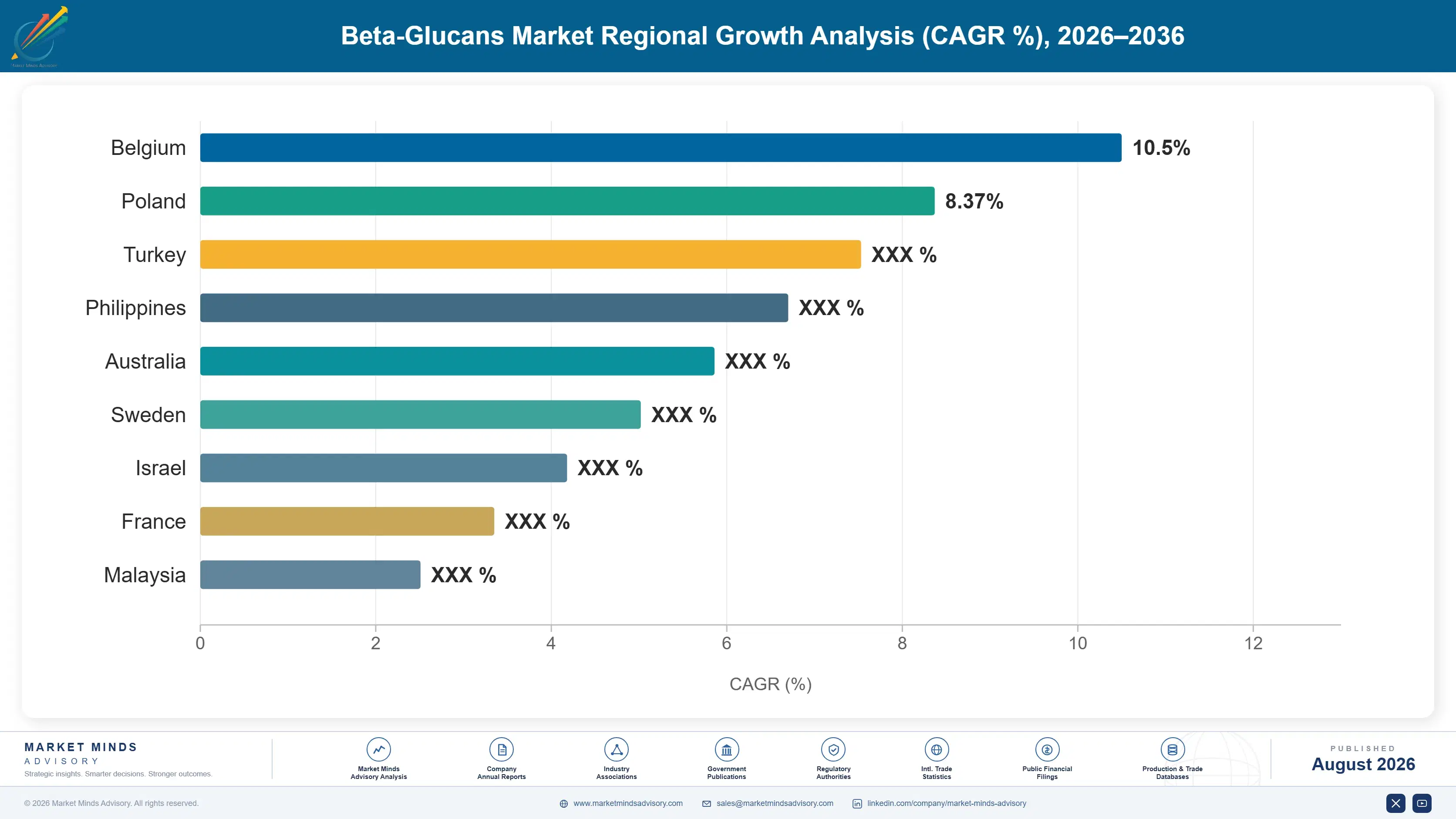
Regional Architecture and Country Demand Map

Beta-glucan production and consumption concentrate in East Asia and North America, with East Asia's fermentation manufacturing base now outpacing North America's larger consumption volume, while Western Europe holds a stable share anchored in Nordic oat processing and established cholesterol-claim retail categories, with the remaining five regions splitting the rest.

North America

The United States and Canada anchor the region's beta-glucan demand through two distinct channels: a mature cholesterol-claim food fortification category built on decades of FDA-approved oat labeling, and a rapidly expanding dietary supplement channel absorbing imported yeast and fermentation-derived material. Canadian oat milling, concentrated in Saskatchewan and Manitoba, supplies feedstock to domestic and export concentrate producers, giving North America a rare combination of raw material access and finished-product consumption scale. US e-commerce supplement brands are the fastest-adopting customer segment for certified-potency yeast glucan, often reformulating flagship immune products within months of a competitor's launch. Mexico's growing packaged food sector adds incremental fortification demand, though most beta-glucan concentrate there is still imported rather than domestically processed.
Share: 26% | CAGR: 8.3% (2026 to 2036)

Western Europe

Nordic oat processing gives Western Europe a production advantage that predates the current immune-health boom by decades, with Finland and Sweden supplying much of the milling-grade oat feeding EU beta-glucan concentrate plants. EFSA's long-standing cholesterol health claim, in place since 2010, gives European food manufacturers a stable regulatory basis for cereal, bread, and beverage fortification that newer immune-health claims elsewhere lack. Germany and France anchor consumption on the food-fortification side, while the United Kingdom's supplement retail channel increasingly favors yeast-derived material imported from Asian fermentation specialists. Growth here trails the global average because the cholesterol-claim category is already mature and largely saturated among core retail categories, a maturity gap that shows up clearly in slower per-capita category growth.
Share: 20% | CAGR: 6.2% (2026 to 2036)
Regional intelligence for 5 additional markets available in the complete report: East Asia, South Asia and Pacific, Latin America, Middle East and Africa, Eastern Europe. Contact sales@marketmindsadvisory.com.
beta-glucans-market-trends-growth-insights-country-cagr-analysis-1787462682051

Where Beta-Glucan Suppliers Can Capture More Margin

Margin capture in beta-glucan increasingly depends on documentation and formulation support rather than raw tonnage sold. Suppliers that can prove potency, secure premium health claims, and co-develop finished formulations with brand customers are commanding better pricing than those competing purely on cost per kilogram shipped. That shift rewards vertically integrated suppliers over pure commodity blenders.

Potency-Verified Certification Programs for Premium Positioning

Suppliers that launch third-party potency certification programs, verifying exact beta-1,3/1,6-glucan content batch by batch, are capturing premium pricing from brands under increasing retailer scrutiny over label accuracy. DSM-Firmenich's certified potency program, introduced in 2024, reportedly commands a 15 to 20 percent price premium over uncertified material from comparable fermentation sources, and the company has since expanded the program to cover its full yeast and algae-derived product lines. Smaller suppliers lacking accredited in-house testing capability are outsourcing certification to third-party labs to remain competitive on reformulation contracts, adding cost but preserving access to premium accounts that now require documentation before purchase.
Market Impact: Commands a 15 to 20 percent price premium consistently

Co-Development Contracts With Immune-Health Supplement Brands

Ingredient suppliers that embed formulation scientists directly into brand customers' product development teams are converting single-order transactions into multi-year exclusive supply agreements. Kerry Group's co-development model, which pairs technical formulation support with supply commitments, has extended average customer contract length from roughly 18 months to over 3 years on immune-health accounts. This approach also raises switching costs meaningfully: brands that have jointly developed a formulation around one supplier's specific glucan profile face real reformulation cost and lost time to market if they switch, which locks in volume during the exact period new capacity investments need predictable demand.
Market Impact: Extends average contract length to over 3 years

Regional Fermentation Capacity Near Fast-Growing Demand Centers

Building fermentation and extraction capacity closer to fast-growing demand centers is cutting logistics costs and lead times enough to win contracts on responsiveness alone. Angel Yeast's expansion of a second fermentation facility in Southeast Asia, completed in 2025, cut delivery times to regional customers from roughly 6 weeks to under 2, a difference that matters to brands running frequent limited-edition product launches. Suppliers serving South Asia and Pacific markets from East Asian hubs face similar pressure to localize, since import duties and shipping delays currently add 8 to 12 percent to landed ingredient cost.
Market Impact: Cuts regional delivery lead times by roughly 60 percent

Bundled Formulation and Regulatory Filing Support Services

Bundling regulatory filing support, including health-claim substantiation dossiers and country-specific ingredient approval documentation, alongside the ingredient sale differentiates suppliers targeting smaller brands that lack in-house regulatory teams. Tate and Lyle's bundled offering, which includes pre-packaged EFSA and FDA claim documentation with every yeast beta-glucan order above a minimum volume threshold, has shortened customer time-to-market by several months on new launches. This service layer raises realized pricing by roughly 8 to 10 percent, since smaller brands otherwise face substantiation costs exceeding $200,000 per product if they commission that research independently, especially for early-stage brands entering premium retail.
Market Impact: Raises effective ingredient pricing by 8 to 10 percent

Who Controls the Margin Pool

Five suppliers hold under forty percent of global beta-glucan capacity on a production-volume basis, leaving the market meaningfully more fragmented than most specialty food ingredient categories. The gap between the largest player and the fifth-ranked challenger is narrow, roughly eight percentage points of estimated capacity share, which keeps pricing competitive even among established suppliers.
Current competitive activity centers on three fronts: potency certification programs to win reformulation contracts, geographic capacity expansion to serve East Asian and Southeast Asian demand growth closer to source, and vertical integration into fermentation feedstock supply to reduce exposure to raw material price swings. Angel Yeast and Kerry Group have both announced capacity expansions in the past year specifically targeting immune-health supplement demand rather than the more mature cholesterol-claim food category.

Emerging pressure is coming from biotech-backed fermentation specialists entering with engineered strains that promise more consistent molecular weight profiles than conventional yeast extraction, threatening to erode the cost advantage established suppliers hold on commodity material. Rankings could shift meaningfully over the next three years if even one of these newer entrants achieves commercial-scale production costs competitive with incumbent yeast extraction, since documented potency consistency is becoming the primary purchase criterion for premium supplement brands.
beta-glucans-market-trends-growth-insights-company-positioning-matrix-1787462682596

Competitive Moat and Risk Dimensions

CARGILL

Moat: Scaled Multi-Source Supply Network

Cargill sources beta-glucan across oat, barley, and yeast simultaneously, giving it the flexibility to redirect customers toward whichever source is least affected by current price or supply volatility. That multi-source flexibility is difficult for single-source fermentation specialists to replicate, and it lets Cargill offer supply continuity guarantees smaller competitors cannot match during harvest shortfalls or fermentation capacity constraints.
CARGILL

Risk: Slower Immune-Health Category Pivot

Cargill's scale and legacy in oat and barley concentrate has made it slower to pivot toward the faster-growing immune-health yeast and fermentation-derived categories than smaller, specialized competitors. Its yeast beta-glucan product line remains a smaller share of its beta-glucan portfolio than at Kerry Group or Angel Yeast, a gap that could cost share as immune-health demand keeps outpacing cholesterol-claim volume.
ANGEL YEAST

Moat: Lowest-Cost Yeast Fermentation Scale

Angel Yeast operates some of the largest yeast fermentation capacity globally, built originally for the baking yeast business, giving it a cost structure for yeast beta-glucan extraction that pure-play nutraceutical ingredient suppliers cannot match. That scale advantage lets the company underprice Western competitors on commodity yeast glucan while still expanding into higher-margin certified potency lines.
ANGEL YEAST

Risk: Limited Western Brand Recognition

Despite its cost advantage, Angel Yeast has limited direct brand recognition among North American and European supplement formulators accustomed to buying from Cargill, Kerry Group, or DSM-Firmenich. The company relies heavily on distributor relationships and private-label supply arrangements to reach Western customers, a setup that caps its ability to capture the pricing premium that comes with direct, certified-potency customer relationships.

Players Tracked

Prominent Players

Cargill
Kerry Group
Angel Yeast
DSM-Firmenich
Tate and Lyle

Other Key Players

Ingredion
ADM
Lantmannen
Ceapro
Biothera Pharmaceuticals
Lallemand
Kemin Industries
Grain Millers Inc
AIDP Inc
Gnosis by Lesaffre
Naturex
Sensus
Roquette
Nutriati
Glanbia Nutritionals

Recent Developments

MARCH 2025

Angel Yeast Commissions Second Fermentation Facility

Angel Yeast commissioned a new yeast fermentation and beta-glucan extraction facility in Southeast Asia in March 2025, adding capacity specifically to serve regional immune-health supplement demand without relying on exports from its primary Chinese production base, cutting delivery times to regional customers substantially for faster regional replenishment.
Signal: Signals East Asian producers are localizing capacity near demand rather than centralizing production and exporting globally to every market.
SEPTEMBER 2024

DSM-Firmenich Launches Certified Potency Program

DSM-Firmenich launched a third-party certified potency verification program for its yeast and algae-derived beta-glucan lines in September 2024, guaranteeing exact beta-1,3/1,6-glucan content on every shipment and responding directly to retailer concerns over inconsistent labeled potency across the broader supplement ingredient category, a response retailers welcomed publicly.
Signal: Signals potency documentation is becoming a purchase requirement rather than an optional marketing claim for premium accounts.
JANUARY 2025

China Approves Yeast Beta-Glucan as Novel Food Ingredient

China's National Health Commission formally approved yeast-derived beta-glucan as a recognized new food ingredient in January 2025, opening a domestic functional food and beverage market previously closed to standardized health-claim marketing and prompting at least a dozen domestic brand launches within the following year across major coastal cities.
Signal: Signals China's functional food regulatory environment is opening faster than expected, creating new export and domestic demand simultaneously.

Feedstock Exposure Across Oat and Yeast Supply

Raw feedstock, oat and barley grain for extraction-based material and molasses-based substrate for yeast fermentation, accounts for roughly thirty-one percent of total production cost across the industry. Oat and barley supply originates predominantly from Canada, the United States, and the Nordic region, while fermentation substrate sourcing is more geographically distributed, tracking global sugar and molasses markets rather than any single agricultural region.
The 2023 Canadian Prairie oat harvest came in roughly eighteen percent below the five-year average due to drought conditions across Saskatchewan and Manitoba, according to Cargill's 2023 annual report, pushing milling-grade oat prices up sharply within a single crop cycle. Ingredient suppliers with fixed-price customer contracts absorbed most of the resulting margin compression, since reformulating cereal and bakery products to reduce oat beta-glucan content is not commercially viable mid-contract.

Smaller regional processors that source oat and barley from a single growing region carry meaningfully more cost exposure than diversified multinational suppliers like Cargill or Ingredion, which can shift sourcing across Canadian, American, and Nordic supply when one region underperforms. Yeast fermentation specialists face a different exposure profile, tied to molasses and sugar feedstock pricing rather than grain harvests, giving them a partial natural hedge against oat-specific volatility.
beta-glucans-market-trends-growth-insights-cost-volatility-analysis-1787462682794

Diversify Oat and Barley Sourcing Across Regions

Suppliers are qualifying oat and barley supply from Canada, the Nordic region, and Australia simultaneously rather than relying on a single growing area, reducing the odds that one poor harvest disrupts total feedstock availability. This diversification adds logistics cost but has measurably reduced price volatility for suppliers that implemented it before the 2023 harvest shortfall.

Forward-Contract Molasses and Sugar Feedstock

Yeast fermentation specialists are locking in multi-year forward contracts for molasses and sugar substrate pricing, insulating fermentation input costs from the spot market volatility that has affected other agricultural commodities. This approach requires meaningful working capital commitment but has kept fermentation-based production costs more stable than extraction-based alternatives since 2023 across most major global producers today.

Expand In-House Accredited Potency Testing

Investing in accredited in-house testing laboratories reduces reliance on costly third-party certification while still meeting retailer demands for verified beta-1,3/1,6-glucan content documentation. Suppliers that built this capability early are now winning reformulation contracts faster than competitors still waiting on external lab turnaround times that regularly stretch beyond several weeks, in some cases exceeding a full month.

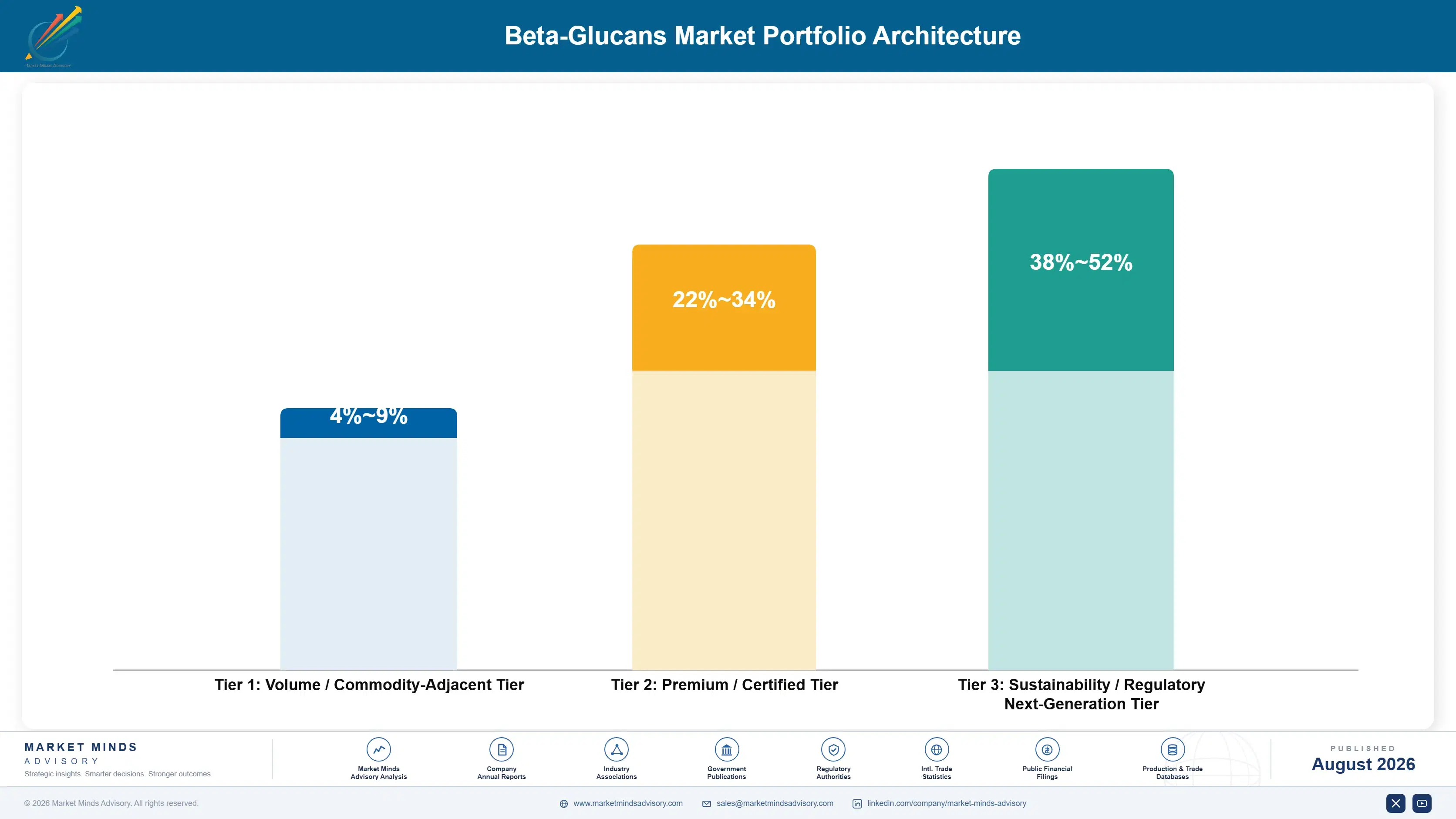
Portfolio Architecture for Margin Defence

Beta-glucan suppliers operate a three-tier portfolio spanning commodity oat and barley concentrate sold largely on cost per kilogram, certified and branded yeast material commanding premium pricing on documented potency, and next-generation fermentation or algae-derived material positioned for the highest-margin immune and skin-health applications. Gross margins vary enormously across these tiers, from thin single digits on commodity oat concentrate to well above forty percent on certified fermentation-derived material sold directly into premium supplement brands.
The volume versus premium tension is sharpening as more suppliers chase immune-health margins, but commodity oat and barley concentrate still represents the majority of total shipped volume and remains essential for maintaining plant utilization and covering fixed fermentation and extraction costs. Suppliers that abandon commodity volume too quickly in pursuit of premium accounts risk underutilizing capacity built for scale.

High-value margin pools concentrate specifically in certified-potency immune-health formulations sold directly to branded supplement companies, and in fermentation-derived material supplying biotech-forward formulators willing to pay for documented, batch-consistent molecular profiles. Commodity cholesterol-claim food fortification remains the volume anchor but carries the thinnest margins in the entire category, squeezed further by private-label competition, particularly across mainstream retail channels.

Volume / Commodity-Adjacent Tier

Oat and barley beta-glucan concentrate sold primarily on cost per kilogram into cereal, bread, and beverage fortification, where cholesterol-claim labeling is well established and price competition among suppliers is intense.
Gross Margin: 4-9%

Premium / Certified Tier

Yeast-derived beta-1,3/1,6-glucan carrying third-party potency certification, sold into immune-health supplement, sports nutrition, and pet supplement brands willing to pay for documented, batch-consistent active content increasingly required by retailers before accepting new SKUs.
Gross Margin: 22-34%

Sustainability / Regulatory / Next-Generation Tier

Fermentation-engineered and algae-derived beta-glucan positioned for superior molecular consistency and additional bioactive content, targeting biotech-forward supplement brands and premium skincare formulators willing to pay the highest per-kilogram prices in the category.
Gross Margin: 38-52%
beta-glucans-market-trends-growth-insights-portfolio-architecture-1787462683294

High-value Sub-segments and Strategic Watch-out

Fermentation-Derived Immune Formulations

Engineered fermentation strains delivering documented, batch-consistent molecular weight profiles are capturing premium pricing from immune-health supplement brands willing to pay for potency guarantees conventional yeast extraction cannot reliably match, and capacity is scaling quickly from a small base as biotech-backed entrants commercialize new proprietary strains.
Gross Margin: 38-52%

Certified Yeast Sports Nutrition Formulations

Certified-potency yeast beta-glucan aimed at sports nutrition and recovery formulations is growing steadily as brands add immune-support claims alongside existing performance positioning, commanding solid but not top-tier margins across most branded accounts Adoption is broadening fastest among protein powder and recovery drink brands seeking a secondary immune-health claim.
Gross Margin: 22-30%

Commodity Cereal and Bakery Fortification

Oat and barley beta-glucan sold into mainstream cereal and bakery fortification remains the category's volume core, anchored by long-standing cholesterol health claims but facing intense price competition and thin single-digit margins Most suppliers defend this tier on production scale and long-standing customer contracts rather than product differentiation.
Gross Margin: 4-9%

Unverified Total-Polysaccharide Blends

Generic blends labeled by total polysaccharide content rather than isolated beta-1,3/1,6-glucan content face rising delisting risk as retailers tighten certificate-of-analysis requirements, making this a segment suppliers should actively exit Several regional processors still selling on this basis have already lost shelf placements at major retail chains in 2025.
Gross Margin: 2-6%

Beta-Glucan's Annuity Economics and Buyer Lock-In

Beta-glucan behaves like an annuity ingredient once it clears a brand's formulation and regulatory approval process, because reformulating around a different fiber or bioactive source triggers new label claims, new clinical substantiation in some cases, and new supply qualification work that most brands would rather avoid. That inertia gives incumbent suppliers multi-year revenue visibility once they win a formulation slot, particularly in the cholesterol-claim food category where reformulation cycles run five years or longer.
Adoption depth varies sharply by end-use vertical. Dietary supplement brands adopt and reformulate around new beta-glucan sources relatively quickly, chasing the latest immune-health positioning, while packaged food manufacturers move much more slowly given the cost and regulatory friction of reformulating an established SKU with fixed health-claim labeling already printed on retail packaging running through existing inventory.

Generational buyer shifts are visible mainly in the supplement channel, where younger, digitally native brand founders favor fermentation-derived and algae-based material specifically for its sustainability positioning, while legacy food manufacturers remain anchored to established oat and barley suppliers with decades-long, high-trust commercial relationships built well before the current immune-health wave began across most major consumer markets globally.
beta-glucans-market-trends-growth-insights-end-use-penetration-index-1787462683784

Where Beta-Glucan Value Will Concentrate

These are among the four positions where our research anticipates prominent divergence between winners and laggards over the coming forecast period. Each is grounded in the demand model, the regulatory perimeter, and the announced capacity pipeline.
01 / POTENCY CERTIFICATION INVESTMENT

Certified potency documentation will separate winners from commoditized suppliers

Retailers across North America and the European Union increasingly require certificates of analysis confirming exact glucan content before accepting new supplement SKUs, and that requirement will not reverse. Suppliers without accredited in-house or third-party testing capability risk losing access to the highest-margin immune-health accounts within two to three years, regardless of how competitive their raw material pricing looks today relative to certified competitors. MMA recommends investing in certification capability now, before documentation becomes table stakes rather than a premium differentiator worth a price advantage.
02 / FERMENTATION CAPACITY LOCALIZATION

Localize fermentation capacity near fastest-growing East Asian demand

East Asia has become the beta-glucan industry's manufacturing center of gravity, and suppliers still exporting from distant hubs are losing ground to localized competitors. Angel Yeast's recent Southeast Asian facility expansion cut regional delivery times from six weeks to under two, an advantage that matters more to brand customers than marginal cost savings. MMA recommends suppliers without East Asian capacity evaluate localization now, since the window to build relationships with fast-scaling domestic Chinese and Korean brands is narrowing quickly across the region's largest urban centers.
03 / IMMUNE-HEALTH CLAIM SUBSTANTIATION

Commission independent clinical substantiation before immune-health claims launch

Immune-health claims for beta-glucan lack the standardized regulatory pathway the cholesterol claim enjoys, exposing brands making unsupported immune claims to real regulatory and reputational risk. Substantiation studies typically cost two hundred thousand to six hundred thousand dollars per product, a real barrier for smaller brands but one worth budgeting for given rising retailer scrutiny. MMA recommends brands entering this category commission substantiation early rather than reactively, since regulatory attention to immune-health claims is intensifying across North American and European markets.
04 / FERMENTATION TECHNOLOGY INVESTMENT

Back fermentation-derived glucan technology ahead of scale-up

Fermentation-derived beta-glucan is growing roughly 1.5 times faster than the overall market, since engineered strains deliver more consistent potency than conventional yeast extraction reliably can, particularly for premium immune-health formulations. Production costs remain thirty to forty percent above conventional extraction today, but that gap is narrowing as fermentation titers improve and batch scale increases. MMA recommends buyers and investors evaluate fermentation-derived exposure now, before the cost gap closes and early partnerships become far more expensive to establish across the category.

Engagement Snapshot From the Field

A live engagement with an industry participant carrying material or product regulatory and market exposure ahead of a defining policy shift, showing how our research translates into a defensible multi-year portfolio strategy.
MARKET MINDS ADVISORY · CLIENT ENGAGEMENT SUMMARY
Beta-Glucans Producer Strategic Portfolio Review and Transition Roadmap 2026·Investment Scenario on Beta-Glucans Exposure Evaluation 2025-26
CLIENT PROFILE
The client is a mid-sized North American dietary supplement brand generating an estimated ninety million dollars in annual revenue (client-reported, unverified by MMA), with a product portfolio concentrated in immune-health gummies and powders. The brand had built its flagship immune product around a single yeast beta-glucan supplier for over five years and faced growing retailer pressure to provide third-party potency verification the incumbent supplier could not reliably deliver consistently.
STRATEGIC CHALLENGE
Two major retail chains informed the client that continued shelf placement for its flagship immune product required certificates of analysis confirming exact beta-1,3/1,6-glucan content, a documentation standard its existing supplier could not consistently meet. The client faced a choice between reformulating around a new, certified supplier under a tight timeline or risking delisting from its two largest retail accounts within a single fiscal quarter.
MMA APPROACH
MMA conducted a structured supplier evaluation across five certified potency providers, benchmarking testing methodology, batch consistency data, and pricing against the client's existing formulation and retailer-mandated documentation timeline. The engagement included direct supplier reference calls with two comparable-sized supplement brands and a formulation feasibility review to confirm the recommended replacement material would not require full product reformulation or new label claims.
KEY FINDINGS
  1. The incumbent supplier's potency documentation covered total polysaccharide content rather than isolated beta-1,3/1,6-glucan content, a gap that had gone unnoticed for over three years of continuous supply.
  2. Switching to a certified fermentation-derived supplier added roughly twelve percent to per-kilogram ingredient cost but eliminated the delisting risk entirely within the retailer's required documentation window.
  3. Two of the five evaluated suppliers could not provide batch-level certificates of analysis within the timeline the client's retail partners required, disqualifying them despite competitive pricing.
  4. The client's existing product formulation required no reformulation to accommodate the new supplier's material, avoiding additional label claim substantiation costs entirely (client-reported, unverified by MMA).
CLIENT PROFILE
The client is a mid-sized North American dietary supplement brand generating an estimated ninety million dollars in annual revenue (client-reported, unverified by MMA), with a product portfolio concentrated in immune-health gummies and powders. The brand had built its flagship immune product around a single yeast beta-glucan supplier for over five years and faced growing retailer pressure to provide third-party potency verification the incumbent supplier could not reliably deliver consistently.
STRATEGIC CHALLENGE
Two major retail chains informed the client that continued shelf placement for its flagship immune product required certificates of analysis confirming exact beta-1,3/1,6-glucan content, a documentation standard its existing supplier could not consistently meet. The client faced a choice between reformulating around a new, certified supplier under a tight timeline or risking delisting from its two largest retail accounts within a single fiscal quarter.
MMA APPROACH
MMA conducted a structured supplier evaluation across five certified potency providers, benchmarking testing methodology, batch consistency data, and pricing against the client's existing formulation and retailer-mandated documentation timeline. The engagement included direct supplier reference calls with two comparable-sized supplement brands and a formulation feasibility review to confirm the recommended replacement material would not require full product reformulation or new label claims.
KEY FINDINGS
  1. The incumbent supplier's potency documentation covered total polysaccharide content rather than isolated beta-1,3/1,6-glucan content, a gap that had gone unnoticed for over three years of continuous supply.
  2. Switching to a certified fermentation-derived supplier added roughly twelve percent to per-kilogram ingredient cost but eliminated the delisting risk entirely within the retailer's required documentation window.
  3. Two of the five evaluated suppliers could not provide batch-level certificates of analysis within the timeline the client's retail partners required, disqualifying them despite competitive pricing.
  4. The client's existing product formulation required no reformulation to accommodate the new supplier's material, avoiding additional label claim substantiation costs entirely (client-reported, unverified by MMA).
RECOMMENDED STRATEGY
Phase 1: Phase 1 (Weeks 1 to 4): Benchmark five certified potency suppliers against documentation timeline, pricing, and batch consistency data relevant to the retailer requirement. Phase 2: Phase 2 (Weeks 5 to 8): Confirm formulation feasibility with the top two suppliers and negotiate transition pricing and documentation delivery timelines. Phase 3: Phase 3 (Weeks 9 to 14): Execute supplier transition, submit updated certificates of analysis to both retail accounts, and retain shelf placement.
OUTCOME
The client retained shelf placement at both retail accounts and avoided an estimated eleven million dollars in annual revenue exposure from potential delisting (client-reported, unverified by MMA). The new supplier relationship also opened a path to a third retail account that had previously declined the client's product specifically over documentation concerns.

Frequently Asked Questions

Foundational context covering the market sizes, CAGR, scope, country, region and competition that inform every finding below. This section is provided to cover basics and most often pre-purchase conversations, answered from the MMA Primary Research Dataset.

What is the current size of the Beta-Glucans Market?

The global beta-glucans market is valued at approximately $1.15 billion in 2025. Growth is being driven by rising immune-health supplement demand alongside established cholesterol-management food applications.

How large will the Beta-Glucans Market be by 2036?

MMA projects the market will reach approximately $2.57 billion by 2036, more than doubling from its 2026 base value. Fermentation-derived and yeast-based material will account for a growing share of that expansion.

What is the CAGR for the Beta-Glucans Market 2026 to 2036?

The market is expected to grow at a compound annual growth rate of 7.6% between 2026 and 2036. Bull and bear scenarios range from 6.4% to 8.8% depending on regulatory and raw material conditions.

Which segment is growing fastest?

Fermentation-derived beta-glucan is the fastest-growing segment, expanding at roughly 11.2% annually, about 1.5 times the overall market rate. Engineered fermentation strains deliver more consistent potency than conventional yeast extraction.

Who are the major companies in the Beta-Glucans Market?

Cargill, Kerry Group, Angel Yeast, DSM-Firmenich, and Tate and Lyle lead global supply on a production-volume basis. The top five suppliers together hold under forty percent of global capacity.

Which country is growing fastest?

China is growing fastest, driven by its 2024 approval of yeast beta-glucan as a recognized food ingredient and rapid domestic functional beverage launches. Regional fermentation capacity expansion is reinforcing this growth.

Report Segmentation Architecture

The full report scope spans multiple orthogonal segmentation dimensions, with cross-tabulated demand data provided for each dimension pair. Coverage extends further to regional breakdowns, trend trajectories, and the competitive detail needed to support segment-level decision-making.

By Source Type

  • Oat-Derived Beta-Glucan
  • Barley-Derived Beta-Glucan
  • Yeast-Derived Beta-Glucan
  • Mushroom-Derived Beta-Glucan
  • Algae-Derived Beta-Glucan
  • Fermentation-Derived Beta-Glucan

By End-Use Industry

  • Dietary Supplements
  • Functional Food and Beverage
  • Bakery and Cereal
  • Animal and Pet Nutrition
  • Cosmetics and Personal Care

By Commercial Dimension

  • Certified Potency Material
  • Standard Grade Material
  • Private Label Supply
  • Direct Brand Partnership

By Region

  • North America
  • Western Europe
  • East Asia
  • South Asia and Pacific
  • Latin America
  • Middle East and Africa
  • Eastern Europe

Scope, Methodology, and Coverage

Every figure in this report is reproducible from documented input assumptions. The scope below maps the historical period, the forecast horizon, the segmentation dimensions, and the countries covered, alongside the underlying primary and qualitative methodology.
Historical Period
2020 to 2025
Forecast Period
2026 to 2036
Base Year
2025 (USD billions; MMA Primary Research Dataset, August 2026)
Market Definition
The beta-glucans market covers polysaccharide fiber ingredients derived from oat, barley, yeast, mushroom, and algae sources, sold for cholesterol-management food claims, immune-support supplements, and functional beverage fortification. It excludes generic dietary fiber blends that do not isolate or standardize beta-glucan content, and excludes pharmaceutical-grade glucan used exclusively in prescription immunotherapy.
Quantitative Units
USD billions (current prices); metric tons of beta-glucan concentrate where applicable
Segmentation Dimensions
By Source Type; By End-Use Industry; By Commercial Dimension; By Region
Regions Covered
North America, Western Europe, East Asia, South Asia and Pacific, Latin America, Middle East and Africa, Eastern Europe
Countries Covered
USA, China, Germany, France, UK, Japan, South Korea, India, Australia, Canada, Brazil, Mexico, Indonesia, Vietnam, Thailand, Malaysia, UAE, Saudi Arabia, South Africa, Nigeria, Turkey, Poland, Netherlands, Italy, Spain, Sweden, Switzerland, Argentina, Colombia, Singapore, and additional markets relevant to this sector
Key Companies Profiled
Cargill, Kerry Group, Angel Yeast, DSM-Firmenich, Tate and Lyle, Ingredion, ADM, Lantmannen, Ceapro, Biothera Pharmaceuticals, Lallemand, Kemin Industries, Grain Millers Inc, AIDP Inc, Gnosis by Lesaffre, Naturex, Sensus, Roquette, Nutriati, Glanbia Nutritionals
Quantitative Methodology
Primary survey, n=3,800 respondents, Q4 2025, six countries; demand-side model with trade association cross-validation
Qualitative Methodology
47 expert interviews, Q4 2025; applied to validate demand model assumptions, identify emerging dynamics, and assess competitive positioning
Report Format
PDF and XLSX data workbook (Word format preview document)
Publisher
Market Minds Advisory
Report Code
MMA-2026-AGR-101
Published
August 2026
Contact
sales@marketmindsadvisory.com | www.marketmindsadvisory.com

Purchase the full Beta-Glucans Market Report (2026 to 2036).

This report delivers a complete assessment of the global beta-glucans market across all major source categories, end-use industries, and geographic regions through 2036. It includes detailed competitive profiling of twenty companies, segmentation analysis distinguishing oat, barley, yeast, mushroom, algae, and fermentation-derived material, and regional demand modeling across all seven MMA-covered geographies. Buyers will find quantified forecasts for market size, segment growth rates, and regional CAGR alongside qualitative analysis of certification trends, regulatory claim substantiation requirements, and raw material cost exposure. A dedicated revenue lever framework identifies four specific commercial actions suppliers can take to capture margin in the shifting immune-health category.
Twenty-company competitive profiling with moat and risk analysis
Seven-region demand model with justified share and CAGR bands
Source-based segmentation across six MECE beta-glucan categories
Quantified revenue lever framework for margin capture strategies
Input cost exposure analysis by feedstock and geography
Anonymized case study on supplier certification transition strategy

Built For The People Who Decide

From boardroom strategy to bench-side execution, this report is read cover-to-cover by leaders shaping the next decade of their industry, turning demand scenarios, market dynamics and valuation benchmarks into decisions.
CXOs/ Presidents/ VPs/ Managers
M&A and Corporate Development
Strategy Teams and R&D Heads
Procurement and Product Directors
Regulatory and Compliance Leaders
Investor Relations and Equity Analysts