Market Minds Advisory
Benzyl Alcohol Market

Benzyl Alcohol Market: Pharmaceutical Certification, Paraben Substitution, and Feedstock Risk Through 2036

Paraben substitution in personal care, injectable diluent demand from expanding biologics manufacturing, and tightening toluene feedstock supply are reshaping how producers price and allocate benzyl alcohol volumes worldwide through 2036.

Lead Analyst

Lisa Gevelber

Published

September 2026

Make Smarter Decisions with Customized Research Insights

Request a free sample report and evaluate market opportunities, growth trends, and competitive dynamics relevant to your business needs.

2025 MARKET VALUE$0.5BMarket Size 2025
2036 FORECAST VALUE$1.1BBase Case , 2026 to 2036
CAGR 2026 TO 20366.8 %Bull 8.0% / Bear 5.6%
INCREMENTAL OPPORTUNITY$0.5BNet 10- year value creation
EXPANSION MULTIPLE1.93x2036 value over 2026 base
Strategic Levers
M&A Pipeline
Regional Outlook
Country Rankings
Competitive Intelligence
Segmental Deep-dive
Call-Us : 91 93563 13602

Executive Snapshot and Market Trajectory

Benzyl alcohol has quietly shifted from a commodity industrial solvent into a formulation-critical input, as cosmetics chemists swap parabens for it under tightening preservative rules and injectable drug manufacturers lean hard on its pharmaceutical diluent grade for new biologic and generic launches entering the market this decade.
Pharmaceutical-grade demand now commands premium pricing over industrial solvent grade, widening the margin spread between the two qualities year over year. Personal care reformulation away from parabens has pulled meaningful volume into cosmetics preservation, concentrated among contract manufacturers across East Asia and among specialty formulators serving European and North American brand owners chasing clean-label claims on retail packaging and ingredient disclosure statements filed with regulators.
Supply sits with a handful of toluene-chlorination and benzaldehyde-reduction producers, so buyers holding multi-year contracts fare noticeably better than spot purchasers whenever feedstock prices swing without warning. Regulatory scrutiny of preservative systems under evolving cosmetics ingredient rules in the European Union and the United States is steering formulators toward benzyl alcohol as a durable substitute rather than a passing novelty, reshaping who wins the next contract cycle and which suppliers hold pricing power.
Market Definition
The benzyl alcohol market covers the aromatic alcohol produced via toluene chlorination-hydrolysis or benzaldehyde reduction routes, sold across pharmaceutical excipient, personal care preservation, coatings, industrial intermediate, food flavoring, and agrochemical formulation applications. It excludes downstream esters such as benzyl acetate or benzyl benzoate, which are treated as separate chemical markets.
Base Year Value
$0.5B in 2025 (MMA Primary Research Dataset, August 2026)
Forecast Period
2026 to 2036, eleven discrete annual values
CAGR
6.8% base case. Bull 8.0%. Bear 5.6%.
Fastest Growth Segment
Pharmaceutical Excipient and Injectable Diluent Use: 9.6% CAGR
Fastest Growth Country
India: 10.4% CAGR
Fastest Growth Region
South Asia and Pacific: 8.9% CAGR
Largest Region
East Asia: 29% of 2025 global value
Market Leaders
Emerald Kalama Chemical, Novapex SAS, KH Neochem Co Ltd, Merck KGaA, Shandong Kaisheng New Materials Co Ltd. Source: MMA Analysis based on company annual reports and disclosed production capacity.
Primary Survey
n=3,800 procurement and R&D decision-makers, Q4 2025, six countries
Methodology
Demand-side build-up, cross-validated against public data, 47 expert interviews

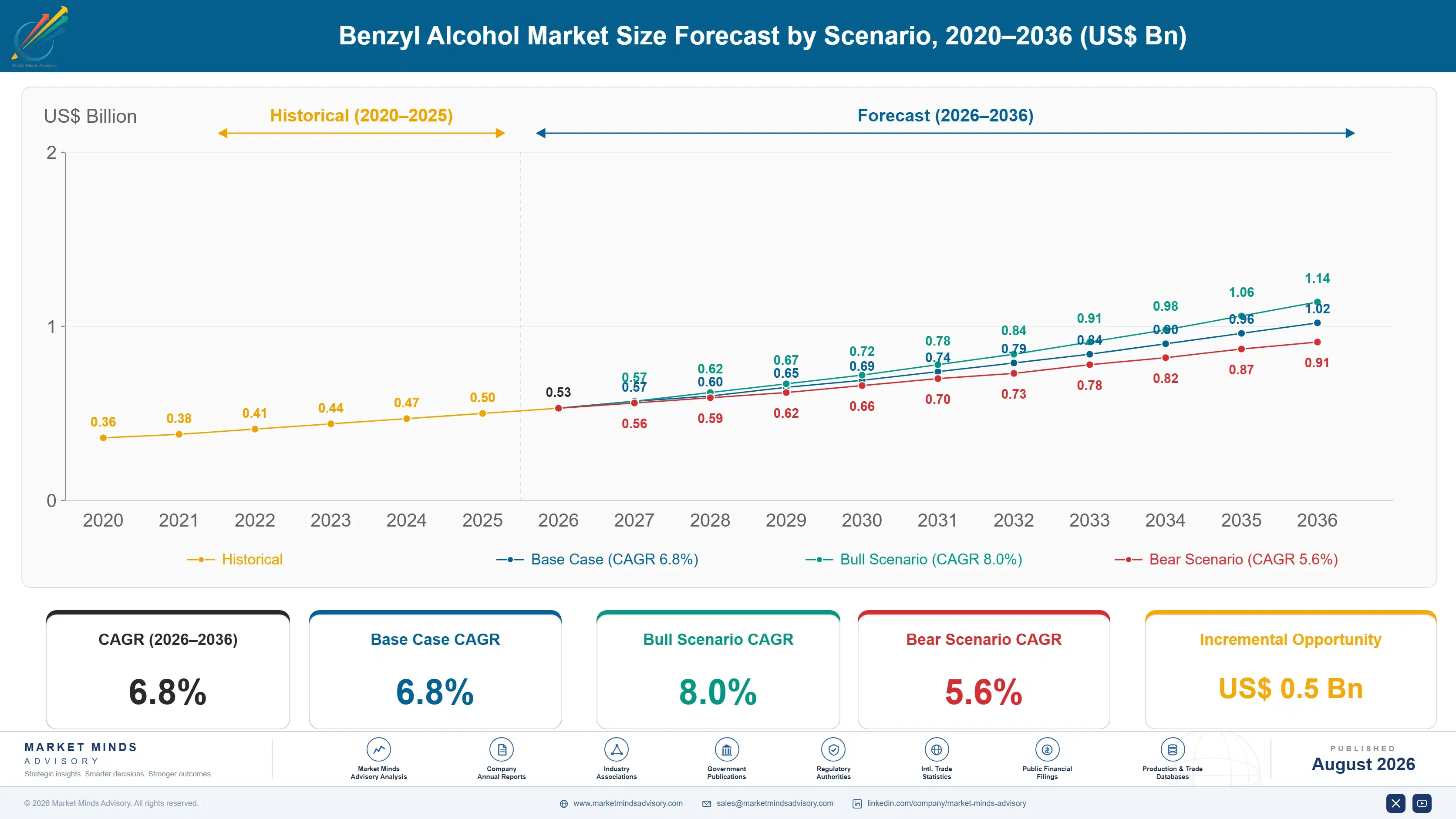
Benzyl Alcohol Market Forecast Scenarios

benzyl-alcohol-market-trends-growth-insights-size-forecast-scenario-1787461687790
Between 2020 and 2025, benzyl alcohol demand grew steadily rather than dramatically, recovering from pandemic-era plant shutdowns and then benefiting from a wave of paraben-free product relaunches across cosmetics brands. Producers ran plants near capacity for most of 2024 as pharmaceutical excipient orders layered on top of existing industrial solvent demand, at a historical CAGR of roughly 6.0 percent.
MMA's base case projects 6.8 percent CAGR through 2036, anchored in three commercial mechanisms: continued paraben substitution across personal care formulations in regulated markets, expanding injectable and biologic drug pipelines that require pharmaceutical-diluent grade material, and steady replacement demand from coatings and industrial solvent applications that have not yet found a comparably priced chemical substitute. Contract manufacturing capacity additions across East Asia support this trajectory without requiring dramatic new plant investment.
The bull case rests on accelerated cosmetics reformulation mandates in the European Union pushing brand owners toward benzyl alcohol faster than currently modeled, alongside broader biologics manufacturing capacity coming online. The bear case centers on a credible synthetic preservative alternative gaining regulatory approval and undercutting benzyl alcohol on cost, or a toluene supply shock from refinery rationalization compressing margins across the value chain.

Three Grades, Three Buyers, One Molecule

Benzyl alcohol sits at the intersection of three demand pools that rarely move together: industrial solvent buyers who treat it as a commodity input, personal care formulators who treat it as a functional preservative worth paying up for, and pharmaceutical manufacturers who treat it as a regulated excipient with strict purity and documentation requirements that shape which suppliers even qualify to bid.
MARKET CONCENTRATION (CR5)38%Top five producers hold considerable pricing influence globally
AVERAGE SELLING PRICE SPREAD$1,450/tonne (pharma grade)Pharmaceutical grade commands substantial premium over industrial grade
TOP PRODUCING COUNTRY SHAREChina, 34%Single country supplies well over a third of output
CAPACITY UTILIZATION81%Producers run plants near full operating capacity currently
TRADE INTENSIVENESS42%Notable share of annual output crosses international borders
FEEDSTOCK SHARE OF COGS58%Toluene input costs dominate total production cost structure
That split creates unusual pricing behavior across the value chain. Industrial grade trades close to other aromatic solvents on a cost-plus basis, while pharmaceutical grade carries a persistent premium tied to validation costs, batch documentation, and impurity limits that few converters can meet economically at small scale, which keeps that tier a distinct pool set apart from commodity material even when volumes are modest.
Capacity is concentrated among a small number of toluene-integrated producers, which keeps supply relatively tight even as downstream demand diversifies into new applications each year. Buyers increasingly favor suppliers who can certify both grades from the same facility, since dual qualification shortens audit cycles, reduces the number of vendor relationships procurement teams must manage, and gives buyers leverage during contract renewal negotiations.
"Buyers keep asking for a cheaper substitute, but nobody has qualified one at scale. The real story here is pricing power quietly moving toward whoever controls pharmaceutical-grade documentation, not whoever runs the biggest reactor."
Director, Specialty Chemicals Practice · MMA Chemicals and Materials Practice · August 2026

Market Trends

EU Cosmetics Regulation Steers Formulators Toward Approved Preservatives

The European Union's Cosmetics Regulation lists benzyl alcohol under Annex V as a permitted preservative up to a one percent concentration limit, at the same time several legacy paraben compounds face tightening restriction and consumer pushback across major retail chains and e-commerce platforms. Formulators reworking existing product lines toward compliant, retailer-accepted preservative systems have made benzyl alcohol one of the few drop-in options that meets both regulatory approval and marketing claims around paraben-free labeling, without requiring a full stability re-validation of the finished cosmetic formula in most documented supplier cases.
Market Impact: Adds 60 kilotonnes of qualified capacity

Injectable Biologics Pipeline Expansion Lifts Diluent Grade Demand

Fill-finish capacity for injectable biologics and generics has expanded across contract manufacturing hubs in North America, Western Europe, and increasingly India, and benzyl alcohol remains a standard bacteriostatic diluent and preservative in multi-dose vials. As biologic approvals climb and multi-dose formats gain share over single-dose presentations for cost reasons, demand for pharmaceutical-grade material carrying full USP and EP compendial documentation has grown faster than the broader industrial solvent category, pulling qualified production capacity away from lower-margin buyers and tightening allocation for smaller formulators during peak seasonal filling runs across several regulated markets.
Market Impact: Adds 7 percent to coatings-grade offtake

Market Opportunities and Growth Drivers

Contract Manufacturing Expansion Across Indian Pharmaceutical Excipient Supply

India's production-linked incentive scheme for bulk drugs and key starting materials has drawn new investment into excipient manufacturing, including benzyl alcohol purification lines that serve both domestic generics makers and export customers in regulated markets. Local capacity additions cut lead times for Indian formulators who previously imported pharmaceutical-grade material from Europe and Japan, and several plants have begun pursuing US and European regulatory filings alongside domestic approvals, positioning India to capture a meaningfully larger share of qualified pharmaceutical-grade supply over the next decade as those pending filings clear final review.
Market Impact: Cuts producer margins by 4 points

Coatings Industry Solvent Reformulation Away From Higher-VOC Options

Volatile organic compound limits tightening across paint and coatings regulations in the European Union and several US states have pushed formulators toward lower-VOC solvent blends, and benzyl alcohol's relatively low volatility makes it a useful coalescing aid in waterborne coatings systems. Coatings producers substituting it for higher-VOC glycol ethers gain compliance headroom without reformulating entire binder chemistries, and several major architectural paint brands have already qualified benzyl alcohol grades for use across exterior facades and industrial maintenance coating lines sold in multiple regional markets worldwide today and into the next cycle.
Market Impact: Delays new entrants by 20 months

Market Restraints and Challenges

Toluene Feedstock Price Volatility Squeezes Producer Margins Regularly

Benzyl alcohol production routes through toluene chlorination or benzaldehyde reduction, both of which trace cost back to refinery-grade toluene, whose price tracks crude oil and aromatics cracking margins rather than benzyl alcohol's own end-use demand. The root cause is a dependence on a petrochemical byproduct stream producers do not control, so when refinery utilization drops during maintenance turnarounds, toluene tightens and benzyl alcohol producers absorb margin compression until they can pass costs through, a lag some are addressing through longer-dated toluene hedging contracts and dual-sourcing agreements with independent aromatics traders.
Market Impact: Adds 9 percent to cosmetics-grade demand

Slow Qualification Cycles Limit New Entrant Market Access

Pharmaceutical-grade benzyl alcohol requires compendial documentation, impurity profiling, and customer-specific validation runs that typically take eighteen to twenty four months before a new production line can ship qualified material to a drug manufacturer. That qualification lag is rooted in how conservatively pharmaceutical procurement teams treat excipient supplier changes, since any swap risks triggering a costly regulatory re-filing on the finished drug product. The commercial effect is that incumbent, already-qualified producers keep pricing power even when new capacity comes online elsewhere, though some buyers now co-fund qualification runs to speed new supplier approval.
Market Impact: Lifts pharma-grade volume by 12 percent
3 additional market trends, 3 additional growth drivers, and 4 additional restraints and challenges are covered in the full report. Contact sales@marketmindsadvisory.com to access the complete intelligence.

Segment CAGR and Growth Architecture

MMA segments the benzyl alcohol market by end-use application rather than by production route, since buyers across pharmaceutical, personal care, coatings, industrial, food, and agrochemical uses purchase against entirely different specification, purity, and documentation requirements even when the underlying molecule delivered to each of them is chemically identical in every meaningful respect that matters to a buyer.
benzyl-alcohol-market-trends-growth-insights-market-share-analysis-1787461688320

Pharmaceutical Excipient and Injectable Diluent Use

Pharmaceutical excipient and injectable diluent use is the fastest-growing segment, expanding at 9.6 percent annually as biologics and generic injectable pipelines widen and multi-dose vial formats gain share over single-dose presentations for cost reasons. Suppliers into this segment must carry USP and EP compendial certification, batch-level impurity documentation, and validated manufacturing processes that few converters maintain, which keeps qualified capacity scarce relative to demand growth across regulated markets. Contract manufacturers serving biologics fill-finish operations in North America, Western Europe, and India increasingly specify this grade by name in procurement contracts, and pricing sits meaningfully above industrial solvent grade as a result of that documentation burden and multi-year qualification cost most converters cannot absorb.
CAGR 9.6%

Personal Care and Cosmetics Preservation

Personal care and cosmetics preservation ranks second at 8.7 percent CAGR, driven by paraben substitution across leave-on and rinse-off formulations sold in the European Union, United States, and increasingly East Asian retail markets. Benzyl alcohol's Annex V approval under EU cosmetics rules and its long-established safety record make it one of the few drop-in replacements that avoids a full stability re-validation of existing formulas already sitting on retail shelf. Formulators serving mass-market and prestige brands alike have adopted it at scale, and demand now extends beyond leave-on skincare into rinse-off shampoo, conditioner, and liquid soap systems as brand owners standardize preservative platforms across their entire global product portfolios and private-label supply chains.
CAGR 8.7%
Full segment breakdown across 6 segments available in the complete report.

Regional Architecture and Country Demand Map

Demand for benzyl alcohol spreads across seven regions unevenly, weighted heavily toward East Asia's chemical manufacturing base and its dominant personal-care contract production footprint, while North America and Western Europe carry the bulk of pharmaceutical-grade and regulation-driven cosmetics demand at meaningfully smaller overall volumes each year.

North America

Injectable biologics fill-finish capacity concentrated in the United States drives a disproportionate share of pharmaceutical-grade benzyl alcohol demand relative to the region's population, since multi-dose vial formats used across generic and biosimilar launches specify it as a standard bacteriostatic diluent. Major personal care conglomerates headquartered in the region have also committed publicly to paraben-free reformulation timelines across mass-market and prestige brand portfolios, lifting cosmetics-grade offtake steadily each year. Coatings demand grows more slowly, tracking construction and industrial maintenance spending, but volatile organic compound limits tightening across several states nudge some formulators toward benzyl alcohol as a coalescing aid. Supply relies partly on regional toluene-chlorination capacity and partly on imports from Western European and Asian producers.
Share: 23% | CAGR: 6.4% (2026 to 2036)

Western Europe

Regulation shapes demand here more directly than anywhere else, since the European Union's Cosmetics Regulation explicitly names benzyl alcohol under Annex V as an approved preservative, giving formulators legal certainty that some alternative preservatives lack. Germany and France host significant coatings and industrial chemical manufacturing that consumes industrial-grade material, while pharmaceutical fill-finish operations across Ireland, Germany, and Switzerland pull pharmaceutical-grade volume for biologics exported worldwide. Energy costs tied to natural gas pricing have pressured regional toluene-chlorination margins more than in other regions, pushing some producers to shift marginal volume toward benzaldehyde-reduction routes. Import reliance on East Asian material has grown modestly as a result, even as regional demand itself continues to expand steadily each year.
Share: 19% | CAGR: 5.3% (2026 to 2036)
Regional intelligence for 5 additional markets available in the complete report: East Asia, South Asia and Pacific, Latin America, Middle East and Africa, Eastern Europe. Contact sales@marketmindsadvisory.com.
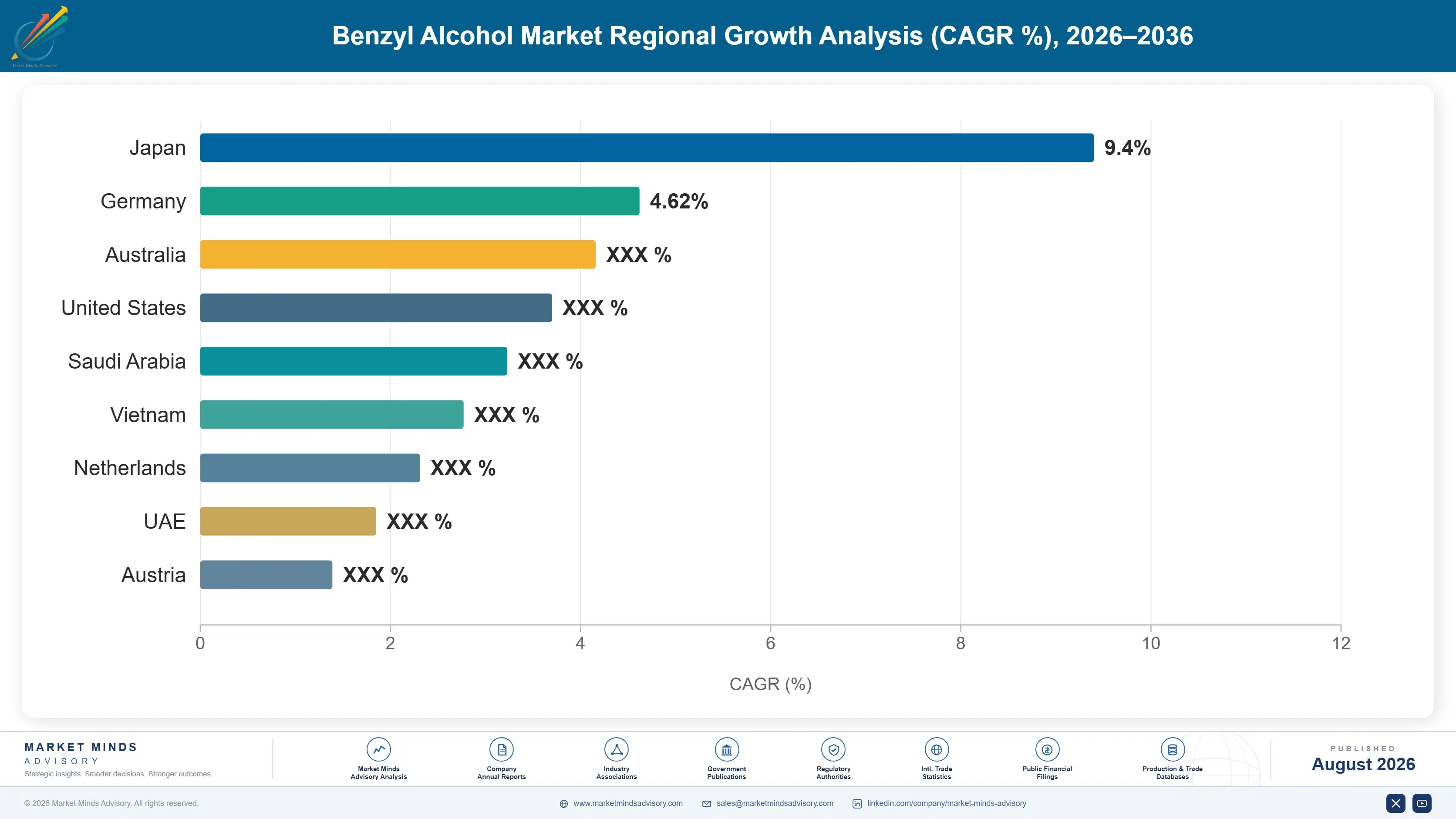
benzyl-alcohol-market-trends-growth-insights-country-cagr-analysis-1787461688834

Where Margin Concentrates Across the Value Chain

Producers capture the widest margins by moving volume up the documentation ladder rather than by adding raw capacity, since pharmaceutical-grade qualification, dual-grade facility certification, feedstock cost protection, and geographic footprint diversification into lower-cost qualified regions each defend pricing power far more durably than simply running existing reactors harder every single quarter of the year.

Pharmaceutical Compendial Certification Across Existing Production Lines

Producers that invest in USP and EP compendial certification for existing toluene-chlorination or benzaldehyde-reduction lines can redirect volume from industrial-grade sales, priced near commodity aromatic solvents, into pharmaceutical-grade sales that carry a premium often exceeding 35 percent per tonne shipped. The certification process typically takes twelve to eighteen months and requires dedicated batch documentation and impurity testing infrastructure, but converters who complete it gain access to biologics fill-finish customers who rarely switch suppliers once qualified, locking in multi-year contracts that smooth out the industrial-grade spot price volatility affecting uncertified competitors.
Market Impact: Lifts blended producer margin by roughly 8 points

Dual-Grade Facility Qualification Serving Both Buyer Types

Running a single facility qualified to ship both industrial and pharmaceutical grade material lets producers shift output mix toward whichever grade commands the better price in a given quarter, without the sunk cost of building a second dedicated production line. Roughly 60 percent of new capacity announced since 2023 has targeted this dual-grade design specifically, according to disclosed investment filings. Buyers value dual-qualified suppliers too, since consolidating industrial and pharmaceutical purchases with one vendor simplifies audits, and that switching cost advantage lets dual-grade producers negotiate longer contract terms than single-grade competitors typically manage to secure.
Market Impact: Adds pricing flexibility worth 5 to 7 points

Long-Term Toluene Feedstock Hedging and Dual Sourcing

Producers who lock in toluene supply through multi-year offtake agreements with refiners, rather than buying spot each quarter, insulate roughly 70 percent of their feedstock cost base from the aromatics cracking margin swings that periodically compress industry-wide profitability. Dual-sourcing across two or more refineries in different regions adds further protection against localized turnaround disruptions. This approach costs more during periods of falling toluene prices, since hedged buyers miss out on spot discounts, but it dramatically smooths quarter-to-quarter margin volatility, which matters more to producers serving contracted pharmaceutical customers who expect stable, predictable annual pricing.
Market Impact: Stabilizes producer margin within a tight 3 point band

Geographic Expansion Into India-Based Excipient Manufacturing

Producers establishing or licensing production in India gain access to lower conversion costs and to production-linked incentive subsidies covering up to 40 percent of qualifying capital expenditure on new excipient manufacturing lines. That cost base lets India-based capacity compete on price for export markets while still meeting the documentation standards required for pharmaceutical-grade certification in the United States and Europe. Producers who moved early are now capturing share from European converters facing higher energy costs, and several have announced plans to double qualified export capacity within the next few years as global demand accelerates.
Market Impact: Cuts conversion cost by up to 22 percent

Who Controls the Margin Pool

Ranked by estimated annual production capacity, the top five benzyl alcohol producers together hold a CR5 near 38 percent, a moderately concentrated field rather than an oligopoly. The gap between the largest producer and the next tier of challengers is real but not overwhelming, since mid-sized Chinese and Indian converters have added capacity fast enough to close distance on historical leaders in recent years.
Competitive activity currently plays out along three dimensions: compendial certification breadth, since producers holding both USP and EP approval across multiple sites serve a wider customer base than single-site competitors; feedstock integration, where producers with captive toluene supply weather price swings better than converters buying merchant feedstock; and geographic reach, as several producers now maintain qualified capacity on two continents specifically to reduce customer exposure to regional disruption.

Emerging pressure comes from Indian converters expanding under production-linked incentive support, qualifying pharmaceutical-grade material faster than most incumbents anticipated and undercutting on price for export customers. Rankings by capacity could shift meaningfully within three to four years if even one or two of these entrants complete US and European regulatory filings, letting them compete directly for contracts currently reserved for longer-established, already-qualified suppliers.
benzyl-alcohol-market-trends-growth-insights-company-positioning-matrix-1787461689356

Competitive Moat and Risk Dimensions

EMERALD KALAMA CHEMICAL

Moat: Integrated Toluene Chlorination Capacity

Emerald Kalama Chemical operates dedicated toluene-chlorination capacity integrated with downstream benzyl chloride and benzyl alcohol production, giving it feedstock cost visibility that merchant converters lack. That integration, combined with decades of pharmaceutical-grade compendial certification history, has secured long-term supply contracts with several major biologics fill-finish operators who value continuity over switching for marginal price differences.
EMERALD KALAMA CHEMICAL

Risk: Single-Region Manufacturing Concentration

Production remains concentrated at a small number of North American sites, leaving the company more exposed than geographically diversified rivals to any single regulatory, labor, or feedstock disruption at those facilities. A prolonged outage at its primary site would force customers toward alternate suppliers faster than the company could requalify replacement capacity elsewhere.
KH NEOCHEM CO LTD

Moat: Japanese Pharmaceutical Grade Reputation

KH Neochem has built a reputation among Japanese and broader Asian pharmaceutical customers for exceptionally consistent impurity profiles, letting it command premium pricing on pharmaceutical-grade material even against lower-cost regional competitors. That trust, accumulated over many qualification cycles, makes customers reluctant to requalify an alternate supplier purely to save on unit cost.
KH NEOCHEM CO LTD

Risk: Limited Industrial Grade Scale

Because the company has historically prioritized pharmaceutical-grade volume over industrial-grade scale, it lacks the cost base to compete aggressively for large industrial solvent contracts against bigger integrated producers. That leaves it more dependent on the pharmaceutical segment holding its growth rate than diversified competitors with broader end-market exposure.

Players Tracked

Prominent Players

Emerald Kalama Chemical
Novapex SAS
KH Neochem Co Ltd
Merck KGaA
Shandong Kaisheng New Materials Co Ltd

Other Key Players

Eastman Chemical Company
INEOS Group
Solvay SA
Lanxess AG
Mitsubishi Gas Chemical Company
Anhui Bayi Chemical Co Ltd
Jiangsu Yabang Dyestuff Co Ltd
Longkou Keda Chemical Co Ltd
Vizag Chemical International
Otto Chemie Pvt Ltd
Hunan Er-Kang Pharmaceutical Co Ltd
Foshan Chancheng Chemical Co Ltd
Yangzhou Chenhua New Material Co Ltd
Shandong Bangya Chemical Co Ltd
Wuhan Youji Industries Co Ltd

Recent Developments

MARCH 2026

Emerald Kalama Chemical Expands Kalama Site Capacity

Emerald Kalama Chemical commissioned additional toluene-chlorination capacity at its Kalama, Washington facility, aimed primarily at meeting growing pharmaceutical excipient demand from North American and European biologics fill-finish customers requiring dedicated, dual-certified production lines to support new injectable drug launches expected over the coming several years.
Signal: Signals continued reinvestment in integrated feedstock capacity rather than reliance on merchant toluene purchasing for future demand growth.
JULY 2025

Novapex Signs Multi-Year European Supply Agreement

Novapex SAS signed a multi-year supply agreement with a major European personal care formulator to provide paraben-free preservative-grade benzyl alcohol across several manufacturing sites, replacing a prior multi-supplier sourcing arrangement the formulator had maintained previously for cost and redundancy reasons across its European production network.
Signal: Indicates formulators increasingly prefer single dual-qualified suppliers over multi-vendor sourcing to simplify audit and regulatory filing burdens.
NOVEMBER 2025

KH Neochem Renews Chiba Food Grade Certification

KH Neochem Co Ltd renewed food-grade certification for its Chiba manufacturing facility, extending its ability to supply flavor and fragrance carrier grade benzyl alcohol to Japanese and export food formulators through the current five-year compliance cycle without any interruption to existing customer supply commitments across the region.
Signal: Confirms continued diversification beyond pharmaceutical grade into adjacent food-grade certification revenue streams for the broader company.

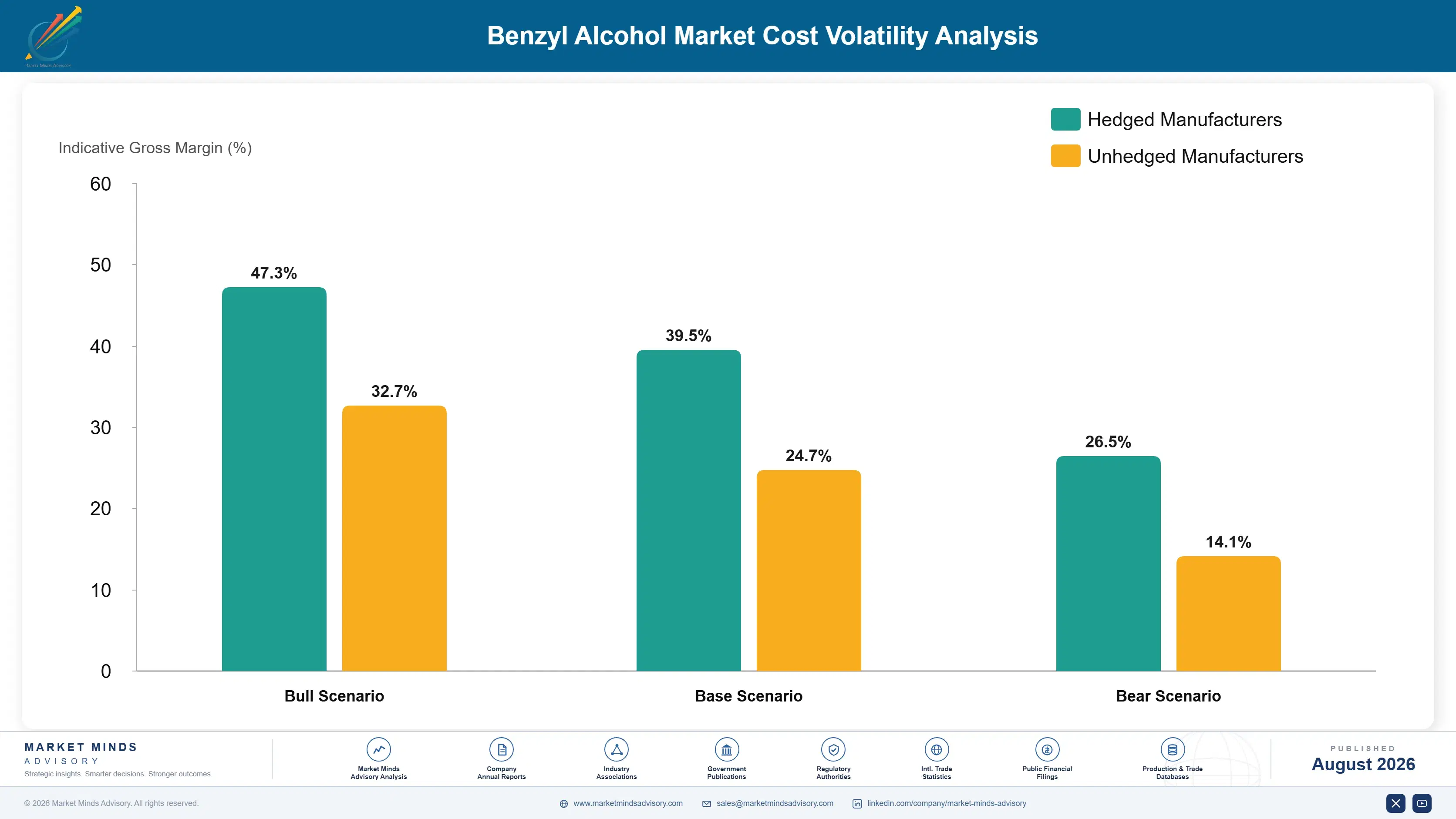
Toluene Exposure Sets the Cost Floor

Toluene feedstock, sourced from refinery aromatics streams and, to a lesser degree, petrochemical crackers, accounts for roughly 58 percent of benzyl alcohol's cash cost of goods sold across both production routes. Most producers buy toluene from regional refiners rather than producing it captively, leaving cost exposure tied closely to crude oil pricing and refinery aromatics extraction margins.
The IEA's 2024 oil market report noted refinery aromatics yields tightened during several turnaround-heavy quarters, pushing toluene prices up by more than 20 percent within a single quarter as refiners prioritized gasoline blending components over aromatics extraction. Benzyl alcohol producers without hedged supply passed roughly half of that increase through to industrial-grade customers within two quarters, while pharmaceutical-grade contracts absorbed more of the increase internally before the next renewal cycle arrived.

Producers without captive toluene supply or long-dated hedges face a persistent cost disadvantage against integrated competitors, since spot purchases expose them fully to short-term price spikes integrated rivals largely avoid. This falls hardest on smaller Chinese and Indian converters buying merchant feedstock, while European and North American incumbents with legacy refinery relationships maintain comparatively stable input costs through volatile quarters.
benzyl-alcohol-market-trends-growth-insights-cost-volatility-analysis-1787461689550

Multi-Year Toluene Offtake Agreements With Regional Refiners

Producers are increasingly negotiating multi-year toluene offtake agreements directly with regional refiners rather than buying on the spot market each quarter. These agreements typically fix a formula-based price tied to a benchmark aromatics index, smoothing quarter-to-quarter cost swings and giving producers a defensible basis for offering pharmaceutical customers longer, more stable contract pricing terms in return.

Dual Sourcing Across Independent Regional Aromatics Traders

Maintaining relationships with two or more independent aromatics traders across different regions protects producers against localized refinery turnarounds or feedstock allocation disruptions. While dual sourcing adds modest administrative overhead and occasionally forgoes the single best spot price available, it meaningfully reduces the odds of an unplanned production halt tied to a single supplier's disruption.

Benzaldehyde Reduction Route as a Feedstock Hedge

Producers with flexibility to shift production between toluene-chlorination and benzaldehyde-reduction routes can arbitrage between two different feedstock cost curves rather than remaining fully exposed to a single one. This flexibility requires dual-route capital investment upfront, but it lets producers route volume toward whichever feedstock proves cheaper in a given quarter, protecting blended margins overall.

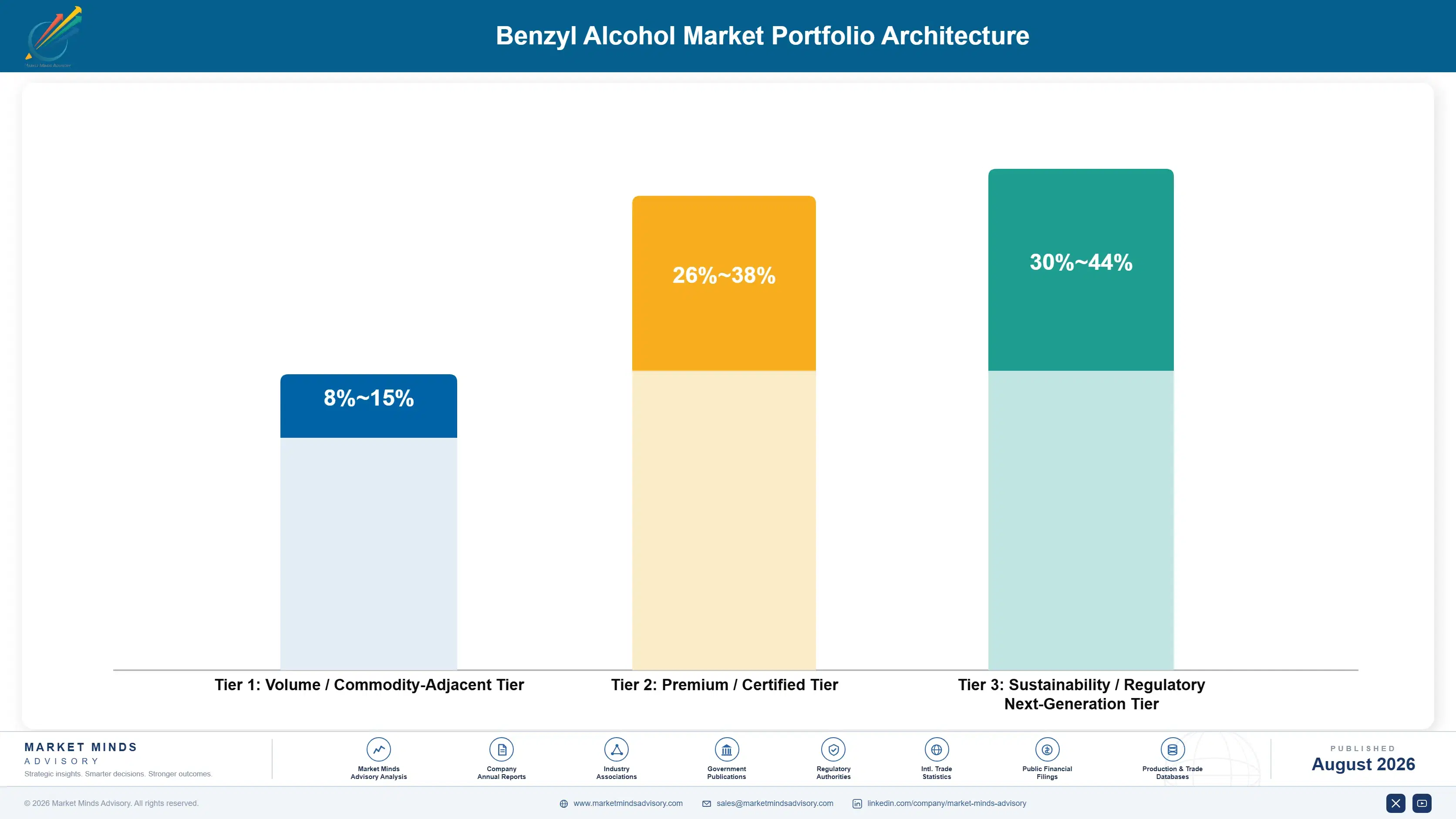
Portfolio Architecture for Margin Defence

Benzyl alcohol's portfolio splits cleanly into three margin tiers that track documentation burden rather than production volume alone. Commodity-adjacent industrial grade competes almost entirely on price against other aromatic solvents, while premium certified grade earns a durable markup tied to compendial approval, and a smaller next-generation tier tied to sustainability credentials is only now beginning to command its own distinct pricing.
The tension between volume and premium tiers plays out directly in capital allocation decisions, since converting existing capacity toward pharmaceutical-grade certification sacrifices industrial-grade throughput in the near term for a considerably higher margin later on. Producers that hesitate to make that trade risk ceding the fastest-growing, highest-margin segment to competitors willing to absorb the qualification cost and multi-year timeline upfront instead.

High-value margin pools concentrate almost entirely in pharmaceutical excipient and injectable diluent grade, where documentation barriers keep new entrants out considerably longer than in any other tier of the portfolio. Personal care preservation grade sits in between, commanding a moderate premium tied to regulatory approval rather than technical difficulty, while industrial and agrochemical grades remain firmly commodity-priced regardless of end use or region.

Volume / Commodity-Adjacent Tier

Industrial solvent and general chemical intermediate grade, sold largely on commodity aromatic solvent pricing with minimal documentation requirements, competing on delivery reliability and cost against other aromatic solvents in thin, cyclical margins that track feedstock cost swings closely each quarter.
Gross Margin: 8%-15%

Premium / Certified Tier

Compendial-certified pharmaceutical excipient and cosmetics preservation grade, carrying validated impurity documentation and multi-jurisdiction regulatory approval that commands a durable price premium over industrial grade across most customer segments, sustained by high switching costs once a supplier qualifies.
Gross Margin: 26%-38%

Sustainability / Regulatory / Next-Generation Tier

Sustainability-oriented and next-generation grades, including bio-based toluene alternatives and lower-carbon production routes still emerging from pilot scale, priced at a speculative premium ahead of proven commercial volume, appealing chiefly to brand owners pursuing supply chain decarbonization commitments.
Gross Margin: 30%-44%
benzyl-alcohol-market-trends-growth-insights-portfolio-architecture-1787461690051

High-value Sub-segments and Strategic Watch-out

Pharmaceutical Excipient and Injectable Diluent Grade

Pharmaceutical excipient and injectable diluent grade combines the fastest segment CAGR at 9.6 percent with the highest achievable margin in the portfolio, protected by compendial certification barriers that take years to replicate and that very few converters ever complete successfully at meaningful commercial scale worldwide.
Gross Margin: 30%-38%

Personal Care and Cosmetics Preservation Grade

Personal care and cosmetics preservation grade grows at 8.7 percent and commands a solid premium tied to Annex V regulatory approval, though competitive intensity is rising steadily as more converters pursue paraben-substitution certification to capture the same reformulation wave across global brand portfolios and private label lines.
Gross Margin: 26%-32%

Industrial Solvent and Coatings Grade

Industrial solvent and coatings grade remains the volume anchor of the portfolio, growing near the overall market average with thin, cyclical margins that leave little room for differentiation beyond reliable delivery, competitive price, and consistent product quality across every single shipment and every contract renewal.
Gross Margin: 8%-13%

Agrochemical Formulation Aid Grade

Agrochemical formulation aid grade warrants a strategic watch, since its slow 5.1 percent growth rate and persistently thin margin leave it vulnerable to substitution by cheaper solvents if agrochemical formulators ever standardize on a lower-cost alternative carrier across their entire broader global product registration portfolios.
Gross Margin: 7%-11%

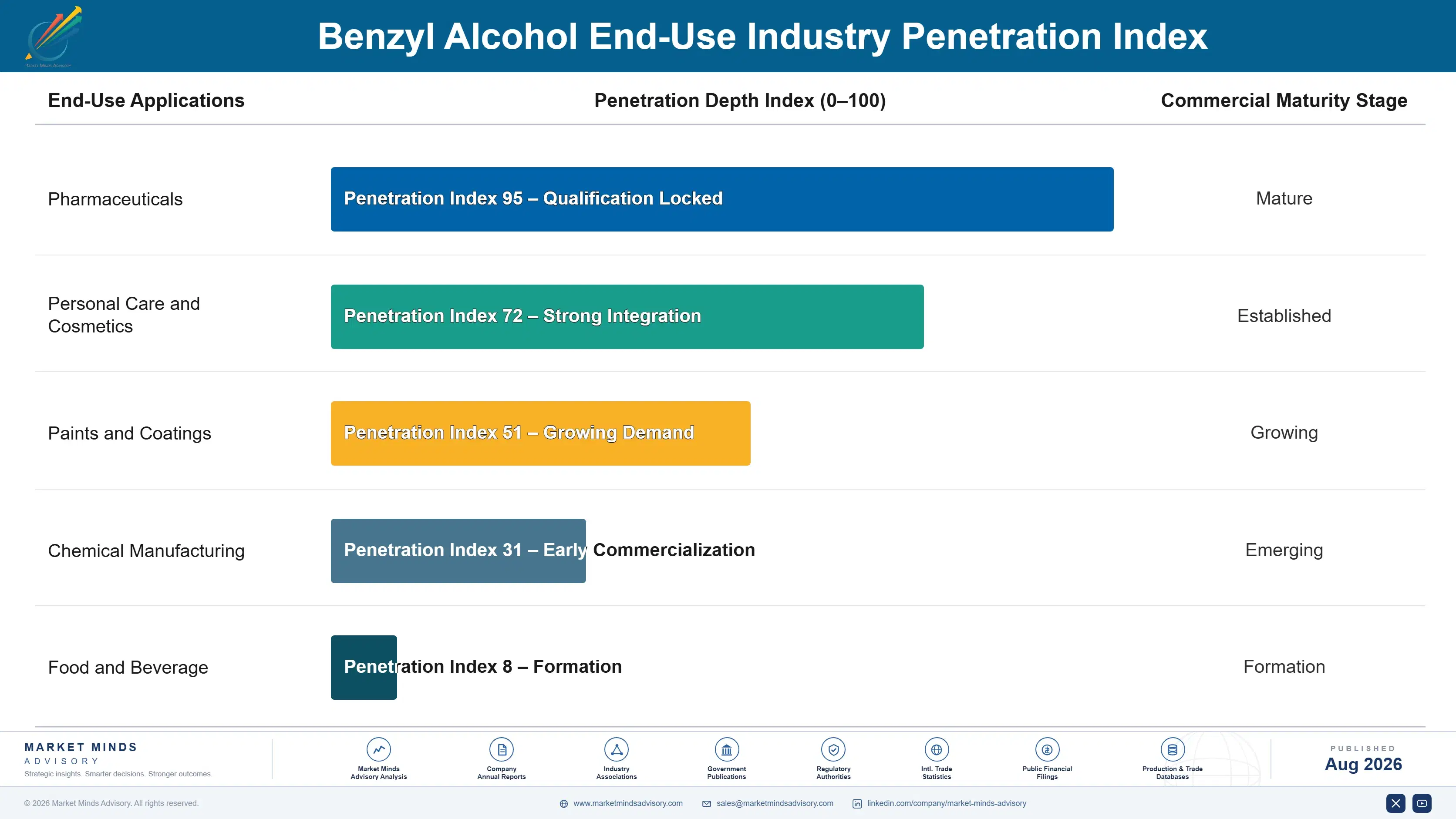
Why Qualified Supply Stays Sticky

Once a pharmaceutical or personal care customer qualifies a benzyl alcohol supplier, that relationship behaves like an annuity rather than a transactional purchase. Requalifying an alternate source means re-running stability studies, refiling regulatory paperwork in some cases, and absorbing months of validation cost, so buyers tolerate modest price increases from an incumbent supplier rather than restart that process for marginal savings elsewhere.
Stickiness varies sharply by end-use vertical. Pharmaceutical customers rarely switch suppliers once compendial qualification is complete, since any change risks triggering costly regulatory amendments on the finished drug product itself. Personal care formulators switch somewhat more readily, particularly for private-label products without prestige branding at stake. Industrial and coatings buyers show the least stickiness of all, since specification requirements are looser and price competition dominates purchasing decisions almost entirely.

A generational shift is also underway among buyers themselves. Younger procurement teams at both pharmaceutical and consumer brands increasingly demand supply chain transparency and sustainability documentation alongside traditional price and quality metrics, favoring suppliers who can demonstrate feedstock traceability. This is a gradual change rather than an abrupt one, but it is steering incremental volume toward producers investing early in documentation and lower-carbon production credentials.
benzyl-alcohol-market-trends-growth-insights-end-use-penetration-index-1787461690540

Where MMA Sees the Advantage

These are among the four positions where our research anticipates prominent divergence between winners and laggards over the coming forecast period. Each is grounded in the demand model, the regulatory perimeter, and the announced capacity pipeline.
01 / PHARMACEUTICAL GRADE CERTIFICATION PRIORITY

Certify existing lines for compendial pharmaceutical grade before competitors do

Pharmaceutical excipient demand is growing at 9.6 percent annually while compendial certification barriers keep new supply scarce relative to the pipeline of biologics and generic injectable launches coming online. Producers who complete USP and EP compendial certification on existing toluene-chlorination or benzaldehyde-reduction lines within the next two to three years will capture premium pricing and multi-year contracts before Indian entrants close the qualification gap entirely. Waiting risks ceding this highest-margin segment permanently to faster-moving competitors already investing in documentation infrastructure and audit-ready facilities today.
02 / GEOGRAPHIC FOOTPRINT DIVERSIFICATION PUSH

Establish qualified capacity in India ahead of incentive scheme deadlines

India's production-linked incentive scheme rewards early movers with meaningful capital expenditure support for new excipient manufacturing lines that meet pharmaceutical-grade documentation standards. Producers who establish qualified capacity there now gain a durable cost advantage over European rivals facing higher energy costs, while positioning themselves to serve both domestic Indian generics makers and demanding export markets in the United States and Europe. Delaying this move risks losing the subsidy window entirely and ceding early-mover cost advantages to regional competitors who act first.
03 / FEEDSTOCK HEDGING STRATEGY

Lock in multi-year toluene supply before the next volatility cycle hits

Toluene accounts for 58 percent of cash cost and tracks refinery aromatics margins that have swung more than 20 percent within a single quarter in recent years across multiple regions. Producers still buying on the spot market absorb that volatility directly, while integrated or hedged competitors pass through only a fraction of it to customers and protect contracted pharmaceutical pricing more effectively. Locking in multi-year offtake agreements now, before the next turnaround-driven price spike, would meaningfully reduce margin variability across future reporting quarters and contract cycles.
04 / PERSONAL CARE REFORMULATION CAPTURE

Deepen ties with cosmetics formulators riding the paraben substitution wave

Paraben substitution is pulling meaningful volume into cosmetics-grade benzyl alcohol at 8.7 percent annual growth, and brand owners across both mass-market and prestige tiers are still finalizing which suppliers will anchor their reformulated product lines for the coming decade. Producers who deepen technical support relationships with major formulators now, well ahead of final supplier lock-in decisions, stand to secure multi-year volume commitments across entire portfolios. Competitors who wait risk entering a shortlist that has already effectively closed for this cycle.

Engagement Snapshot From the Field

A live engagement with an industry participant carrying material or product regulatory and market exposure ahead of a defining policy shift, showing how our research translates into a defensible multi-year portfolio strategy.
MARKET MINDS ADVISORY · CLIENT ENGAGEMENT SUMMARY
Benzyl Alcohol Producer Strategic Portfolio Review and Transition Roadmap 2026·Investment Scenario on Benzyl Alcohol Exposure Evaluation 2025-26
CLIENT PROFILE
The client, a mid-size European personal care ingredient formulator supplying private-label cosmetics brands across the region, generated approximately 180 million euros in annual revenue (client-reported, unverified by MMA) and had relied on a single benzyl alcohol supplier for over a decade across its preservative-grade purchasing needs for multiple leave-on and rinse-off product lines sold regionally.
STRATEGIC CHALLENGE
Facing rising paraben-substitution demand from its own major retail customers, the client needed to secure a second qualified benzyl alcohol source within twelve months without disrupting existing product stability filings, while separately assessing whether pharmaceutical-grade material offered a viable upgrade path for a premium skincare line currently under internal development.
MMA APPROACH
MMA conducted a supplier landscape assessment across five qualified producers, benchmarking compendial certification status, feedstock integration, and regional logistics costs. The team then modeled requalification timelines and stability testing requirements under each candidate supplier, and facilitated introductory technical calls between the client's regulatory affairs team and two shortlisted producers meeting the sourcing criteria.
KEY FINDINGS
  1. A single-supplier dependency exposed the client to a documented 18 percent input cost increase during the prior year's toluene feedstock volatility episode across Europe.
  2. Two of the five shortlisted producers offered dual-grade qualification that would let the client source both preservative and pharmaceutical grade from a single facility.
  3. Requalification timelines ranged from nine to fourteen months depending on whether existing stability data could be partially reused across the new supplier relationship.
  4. The premium skincare line's projected initial volume was too small to justify pharmaceutical-grade sourcing independently without pooling demand across several existing product lines first.
CLIENT PROFILE
The client, a mid-size European personal care ingredient formulator supplying private-label cosmetics brands across the region, generated approximately 180 million euros in annual revenue (client-reported, unverified by MMA) and had relied on a single benzyl alcohol supplier for over a decade across its preservative-grade purchasing needs for multiple leave-on and rinse-off product lines sold regionally.
STRATEGIC CHALLENGE
Facing rising paraben-substitution demand from its own major retail customers, the client needed to secure a second qualified benzyl alcohol source within twelve months without disrupting existing product stability filings, while separately assessing whether pharmaceutical-grade material offered a viable upgrade path for a premium skincare line currently under internal development.
MMA APPROACH
MMA conducted a supplier landscape assessment across five qualified producers, benchmarking compendial certification status, feedstock integration, and regional logistics costs. The team then modeled requalification timelines and stability testing requirements under each candidate supplier, and facilitated introductory technical calls between the client's regulatory affairs team and two shortlisted producers meeting the sourcing criteria.
KEY FINDINGS
  1. A single-supplier dependency exposed the client to a documented 18 percent input cost increase during the prior year's toluene feedstock volatility episode across Europe.
  2. Two of the five shortlisted producers offered dual-grade qualification that would let the client source both preservative and pharmaceutical grade from a single facility.
  3. Requalification timelines ranged from nine to fourteen months depending on whether existing stability data could be partially reused across the new supplier relationship.
  4. The premium skincare line's projected initial volume was too small to justify pharmaceutical-grade sourcing independently without pooling demand across several existing product lines first.
RECOMMENDED STRATEGY
Phase 1: Phase 1 (Months 1 to 3): Complete a full supplier landscape assessment and shortlist two dual-grade qualified candidate producers for engagement. Phase 2: Phase 2 (Months 4 to 9): Run parallel stability testing and requalification documentation work with the top-ranked shortlisted supplier candidate. Phase 3: Phase 3 (Months 10 to 12): Finalize dual-sourcing contract terms and integrate volume forecasting fully across both newly qualified supplier relationships.
OUTCOME
The client signed a dual-sourcing agreement within eleven months, reducing single-supplier exposure and securing pharmaceutical-grade access for future line extensions without launching a dedicated qualification project of its own. Reported procurement cost volatility fell by approximately 30 percent (client-reported, unverified by MMA) across the following two purchasing cycles.

Frequently Asked Questions

Foundational context covering the market sizes, CAGR, scope, country, region and competition that inform every finding below. This section is provided to cover basics and most often pre-purchase conversations, answered from the MMA Primary Research Dataset.

What is the current size of the Benzyl Alcohol Market?

MMA estimates the global benzyl alcohol market at 0.52 billion US dollars in 2025, spanning pharmaceutical, personal care, coatings, industrial, food, and agrochemical applications worldwide across all producing and consuming regions.

How large will the Benzyl Alcohol Market be by 2036?

MMA projects the market to reach approximately 1.07 billion US dollars by 2036, up from 0.56 billion in 2026, as pharmaceutical excipient and cosmetics preservation demand continues expanding faster than industrial-grade volume.

What is the CAGR for the Benzyl Alcohol Market 2026 to 2036?

The base case CAGR is 6.8 percent for 2026 to 2036. Bull and bear scenarios range between 8.0 percent and 5.6 percent depending on regulatory and feedstock outcomes.

Which segment is growing fastest?

Pharmaceutical excipient and injectable diluent use is the fastest-growing segment at 9.6 percent CAGR, roughly 1.4 times the overall market rate, driven by expanding biologics and generic injectable manufacturing capacity.

Who are the major companies in the Benzyl Alcohol Market?

Leading producers include Emerald Kalama Chemical, Novapex SAS, KH Neochem Co Ltd, Merck KGaA, and Shandong Kaisheng New Materials Co Ltd, together holding an estimated CR5 near 38 percent of production capacity.

Which country is growing fastest?

India is the fastest-growing country market at approximately 10.4 percent CAGR, supported by production-linked incentive investment in excipient manufacturing and rapidly expanding domestic generics export capacity.

Report Segmentation Architecture

The full report scope spans multiple orthogonal segmentation dimensions, with cross-tabulated demand data provided for each dimension pair. Coverage extends further to regional breakdowns, trend trajectories, and the competitive detail needed to support segment-level decision-making.

By Application Type

  • Pharmaceutical Excipient and Injectable Diluent
  • Personal Care and Cosmetics Preservation
  • Paints and Coatings Solvent
  • Industrial Chemical Intermediate
  • Food-Grade Flavoring and Fragrance Carrier
  • Agrochemical Formulation Aid

By End-Use Industry

  • Pharmaceuticals
  • Personal Care and Cosmetics
  • Paints and Coatings
  • Chemical Manufacturing
  • Food and Beverage

By Commercial Dimension

  • Direct Producer Sales
  • Distributor Sales
  • Contract Manufacturing Supply
  • Merchant Spot Sales

By Region

  • North America
  • Western Europe
  • East Asia
  • South Asia and Pacific
  • Latin America
  • Middle East and Africa
  • Eastern Europe

Scope, Methodology, and Coverage

Every figure in this report is reproducible from documented input assumptions. The scope below maps the historical period, the forecast horizon, the segmentation dimensions, and the countries covered, alongside the underlying primary and qualitative methodology.
Historical Period
2020 to 2025
Forecast Period
2026 to 2036
Base Year
2025 (USD billions; MMA Primary Research Dataset, August 2026)
Market Definition
The benzyl alcohol market covers the aromatic alcohol produced via toluene chlorination-hydrolysis or benzaldehyde reduction routes, sold across pharmaceutical excipient, personal care preservation, coatings, industrial intermediate, food flavoring, and agrochemical formulation applications. It excludes downstream esters such as benzyl acetate or benzyl benzoate, which are treated as separate chemical markets.
Quantitative Units
USD billions (current prices); metric tonnes for volume-based segment analysis
Segmentation Dimensions
By Application Type; By End-Use Industry; By Commercial Dimension; By Region
Regions Covered
North America, Western Europe, East Asia, South Asia and Pacific, Latin America, Middle East and Africa, Eastern Europe
Countries Covered
USA, China, Germany, France, UK, Japan, South Korea, India, Australia, Canada, Brazil, Mexico, Indonesia, Vietnam, Thailand, Malaysia, UAE, Saudi Arabia, South Africa, Nigeria, Turkey, Poland, Netherlands, Italy, Spain, Sweden, Switzerland, Argentina, Colombia, Singapore, and additional markets relevant to this sector
Key Companies Profiled
Emerald Kalama Chemical, Novapex SAS, KH Neochem Co Ltd, Merck KGaA, Shandong Kaisheng New Materials Co Ltd, Eastman Chemical Company, INEOS Group, Solvay SA, Lanxess AG, Mitsubishi Gas Chemical Company, Anhui Bayi Chemical Co Ltd, Jiangsu Yabang Dyestuff Co Ltd, Longkou Keda Chemical Co Ltd, Vizag Chemical International, Otto Chemie Pvt Ltd, Hunan Er-Kang Pharmaceutical Co Ltd, Foshan Chancheng Chemical Co Ltd, Yangzhou Chenhua New Material Co Ltd, Shandong Bangya Chemical Co Ltd, Wuhan Youji Industries Co Ltd
Quantitative Methodology
Primary survey, n=3,800 respondents, Q4 2025, six countries; demand-side model with trade association cross-validation
Qualitative Methodology
47 expert interviews, Q4 2025; applied to validate demand model assumptions, identify emerging dynamics, and assess competitive positioning
Report Format
PDF and XLSX data workbook (Word format preview document)
Publisher
Market Minds Advisory
Report Code
MMA-2026-CHM-101
Published
August 2026
Contact
sales@marketmindsadvisory.com | www.marketmindsadvisory.com

Purchase the full Benzyl Alcohol Market Report (2026 to 2036).

This report gives procurement, strategy, and investment teams a full commercial picture of the global benzyl alcohol market through 2036. It covers segmentation by end-use application, all seven regional markets with detailed demand mechanisms, and a competitive assessment of twenty producers evaluated on estimated production capacity. Readers get quantified trend, driver, and restraint analysis, feedstock cost exposure modeling, and portfolio margin architecture across three pricing tiers. A dedicated revenue lever framework and anonymized case study translate the analysis into specific, actionable sourcing and investment decisions.
Twenty-company competitive benchmarking on production capacity basis
Seven-region demand architecture with quantified growth mechanisms
Segment-level CAGR modeling across six MECE application categories
Feedstock cost exposure and volatility mitigation playbook
Three-tier portfolio margin architecture and pricing analysis
Anonymized client case study with recommended sourcing strategy

Built For The People Who Decide

From boardroom strategy to bench-side execution, this report is read cover-to-cover by leaders shaping the next decade of their industry, turning demand scenarios, market dynamics and valuation benchmarks into decisions.
CXOs/ Presidents/ VPs/ Managers
M&A and Corporate Development
Strategy Teams and R&D Heads
Procurement and Product Directors
Regulatory and Compliance Leaders
Investor Relations and Equity Analysts