Market Minds Advisory
Belgium POS Terminals Market

Belgium POS Terminals Market: Domestic Scheme Economics, Estate Contracts and the Hardware That May Disappear

A hardware business quietly becoming a subscription business, in a country where a domestic debit scheme still carries most transactions and a 2022 law obliged every merchant to accept something electronic.

Lead Analyst

Published

September 2026

Make Smarter Decisions with Customized Research Insights

Request a free sample report and evaluate market opportunities, growth trends, and competitive dynamics relevant to your business needs.

2025 MARKET VALUE$0.4BMarket Size 2025
2036 FORECAST VALUE$0.9BBase Case , 2026 to 2036
CAGR 2026 TO 20368.2 %Bull 9.4% / Bear 7.0%
INCREMENTAL OPPORTUNITY$0.5BNet 10- year value creation
EXPANSION MULTIPLE2.21x2036 value over 2026 base
Strategic Levers
M&A Pipeline
Regional Outlook
Country Rankings
Competitive Intelligence
Segmental Deep-dive
Call-Us : 91 93563 13602

Executive Snapshot and Market Trajectory

Belgium obliged every business to offer at least one electronic payment method from July 2022, which converted terminal acceptance from a commercial decision into a legal requirement. The installed base near 312,000 devices reflects that obligation more than any enthusiasm on the merchant side.
The commercial value has moved off the hardware entirely. A countertop terminal is now a low-margin commodity assembled in Asia, while the recurring estate contract, at roughly EUR 22 per device each month across a 5.8 year replacement cycle, is where the return actually sits. Whoever holds that contract holds the merchant relationship, the certification obligation and the upgrade decision together. The hardware manufacturers gave that position away and mostly have not noticed yet.
A domestic scheme complicates matters usefully. Bancontact still carries around 61% of Belgian card transactions on economics that differ from the international networks, so an acquirer without proper domestic acceptance is not genuinely competitive here whatever its European scale. That protects incumbents. Tap to phone, growing at 12.3%, threatens to remove the device from small merchants completely. Incumbency here is genuinely real, and it is not at all permanent.
Market Definition
Revenue from payment acceptance devices deployed in Belgium, comprising hardware sale and rental, terminal estate management, certification and maintenance services, and software acceptance licensing on general-purpose devices. Card scheme fees, interchange, merchant service charges, e-commerce gateway revenue and electronic cash register hardware that performs no payment acceptance function are all excluded from scope.
Base Year Value
$0.4B in 2025 (MMA Primary Research Dataset, August 2026)
Forecast Period
2026 to 2036, eleven discrete annual values
CAGR
8.2% base case. Bull 9.4%. Bear 7.0%.
Fastest Growth Segment
Software-Based Tap to Phone: 12.3% CAGR
Fastest Growth Country
India: 10.2% CAGR
Fastest Growth Region
South Asia and Pacific: 10.2% CAGR
Largest Region
Western Europe: 90% of 2025 global value
Market Leaders
Worldline, CCV, Nexi, Adyen and Ingenico lead on installed terminal estate and attached service revenue in Belgium. Source: company annual reports and MMA Primary Research Dataset, July 2026.
Primary Survey
n=3,800 procurement and R&D decision-makers, Q4 2025, six countries
Methodology
Demand-side build-up, cross-validated against public data, 47 expert interviews

Belgium POS Terminals Market Forecast Scenarios

belgium-pos-terminals-market-size-forecast-scenario-1787917199148
The 2020 to 2025 period was shaped by two forces arriving close together. Pandemic conditions pushed contactless acceptance from convenience to expectation, lifting the contactless share of point of sale payments toward 78%, and then the July 2022 electronic payment obligation brought a long tail of small merchants into acceptance who had previously refused. Revenue compounded near 6.8% across the period, held back by hardware price deflation.
Three mechanisms carry the base case. Estate contracts continue migrating from hardware sale toward monthly subscription, which raises recognised revenue per device even as device prices fall. Unattended acceptance expands across parking, fuel, transport and vending, where each installation carries higher service value than a countertop unit. And integrated Android terminals replace single-function devices as merchants consolidate till, loyalty and payment onto one screen with one support contract behind it.
The bull catalyst is unattended and self-service deployment accelerating faster than expected, since those devices carry premium service economics and long replacement cycles. The bear risk is tap to phone displacing hardware at the small merchant end faster than subscription revenue replaces it, which would remove the installed base that estate contracts are priced against in the first place.

The Device Is Commodity, The Contract Is Not

Terminal hardware in Belgium is manufactured almost entirely in Asia, certified against European scheme requirements, and sold into a market where five participants hold roughly 79% of the estate. Price competition on the device has run a decade with predictable results. What has not commoditised is the estate contract: the monthly fee, the certification obligation, the maintenance response and the merchant relationship attached to all three.
MARKET CONCENTRATION CR579%Share of installed terminal estate held by leaders
INSTALLED TERMINAL BASE312,000Active payment acceptance devices deployed across the country
AVERAGE MONTHLY RENTALEUR 22Terminal service fee charged per device each month
DOMESTIC SCHEME SHARE61%Card transactions routed through the national debit scheme
TERMINAL REPLACEMENT CYCLE5.8 yearsTypical working life before a device is replaced
CONTACTLESS TRANSACTION SHARE78%Point of sale payments completed without inserting a card
The July 2022 obligation to offer at least one electronic payment method changed the shape of the merchant base considerably. Small traders who had accepted cash only, and who would never have installed a terminal on commercial grounds, entered acceptance because the law required it. Those merchants take low transaction volumes, want the cheapest possible device, and are precisely the population tap to phone will eventually serve better than hardware.
Bancontact is the feature that distinguishes this market from its neighbours. Around 61% of card transactions route through the domestic scheme rather than the international networks, on economics that differ meaningfully, and merchants expect acceptance as a baseline rather than as a feature. An international acquirer arriving with European scale and no proper domestic scheme integration finds that scale does not help very much.
"Everybody in Belgian acceptance talks about the terminal. The terminal is a certified plastic box worth less every year. The contract underneath it renews for six years and nobody switches, which is the only part of this business that has ever made money."
Director, European Payments Infrastructure Practice · MMA Technology and Payments Infrastructure Practice · August 2026

Market Trends

Estate Contracts Replace Hardware Sale Economics Entirely

Terminal providers have shifted almost completely from selling devices to renting them under multi-year service agreements, and the reason is straightforward: a device sold once at declining prices produces nothing afterward, while a device rented at roughly EUR 22 monthly across a 5.8 year cycle produces predictable recurring revenue. Merchants prefer it because certification updates, replacement and support are included rather than invoiced separately. The consequence is that estate ownership rather than manufacturing capability now determines who earns anything in Belgian acceptance. Manufacturing capability has stopped mattering nearly as much as it once did.
Market Impact: Added 34,000 merchants to acceptance

Unattended Acceptance Expands Beyond Fuel And Parking

Vending, transport ticketing, electric vehicle charging, laundry, car wash and increasingly retail self-checkout are all deploying unattended terminals, and each installation carries service economics well above a countertop device. The units are ruggedised, remotely managed, certified to stricter tamper standards and replaced less frequently, so the contract value per device is higher and the support cost lower. Deployment growth runs at 10.4% annually. The constraint is integration work, since every unattended application requires bespoke work that a retail counter installation never does. That integration work is the whole barrier to entry here.
Market Impact: Lifts revenue 40% per device

Market Opportunities and Growth Drivers

Legal Acceptance Obligation Brought Cash Only Traders In

Belgian law has required businesses to offer at least one electronic payment method since July 2022, which removed the option of refusing cards entirely and pulled a long tail of small traders into acceptance. Market stalls, hairdressers, small hospitality and independent retail all entered a market they had previously declined on cost grounds. Those merchants generate low transaction volume and want the cheapest available acceptance, so they expanded the installed base considerably without expanding revenue proportionally at any point. Nobody in this industry describes that outcome as a triumph of selling.
Market Impact: Grows at 12.3% annually

Integrated Android Terminals Consolidate Merchant Systems

Merchants running separate till, loyalty, inventory and payment systems increasingly want one device and one support contract instead, and Android-based smart terminals supply exactly that by hosting business applications alongside the payment kernel. Providers earn more per device, retain merchants longer because switching means migrating software as well as hardware, and gain a channel for selling additional services. The trade is complexity, since every hosted application must be certified and maintained. That work is real and most providers underestimated it substantially. Certification of hosted applications is a recurring obligation, not a one-time cost.
Market Impact: Forces replacement every 5.8 years

Market Restraints and Challenges

Tap To Phone Threatens The Small Merchant Hardware Base

Software acceptance on a standard smartphone removes the device from the transaction entirely, and it grows at 12.3% against a market rate of 8.2%. The root cause is scheme certification of software-based contactless acceptance, which eliminated the technical argument for dedicated hardware at low volumes. Commercially it targets exactly the merchants the 2022 obligation brought in, who never wanted a terminal anyway. Providers mitigate by offering it themselves rather than losing the relationship, bundling it with acquiring, and accepting lower revenue per merchant to retain the account. Nobody wants that trade at all.
Market Impact: Converts 87% of estate to subscription

Certification Obligations Accumulate Across Every Deployed Device

Each terminal in an estate must remain certified against scheme requirements, security standards and national scheme rules, and those requirements change on a schedule the provider does not control. The root cause is a certification regime designed around security rather than around operational cost. A large estate of ageing devices therefore carries a recurring obligation that grows with age and eventually forces replacement regardless of whether the hardware still functions. Mitigation runs through remote update capability, fleet standardisation and planned rather than reactive replacement cycles. Perfectly working hardware gets replaced anyway.
Market Impact: Grows unattended deployment 10.4%
3 additional market trends, 4 additional growth drivers, and 2 additional restraints and challenges are covered in the full report. Contact sales@marketmindsadvisory.com to access the complete intelligence.

Segment CAGR and Growth Architecture

Segmentation follows terminal form factor, since that determines certification path, service cost, contract value and replacement cycle across the whole Belgian estate. Six form factors describe the market completely, running from the countertop devices that still dominate installed volume through to software acceptance that dispenses with dedicated hardware altogether, which is where the growth now sits.
belgium-pos-terminals-market-market-share-analysis-1787917199678

Software-Based Tap to Phone

The fastest form factor grows at 12.3%, half again the market rate of 8.2%, and it grows by removing hardware rather than by selling it. Scheme certification of software-based contactless acceptance on standard smartphones eliminated the technical case for a dedicated device at low transaction volumes, and the merchants it suits best are precisely those the 2022 legal obligation brought into acceptance unwillingly. Revenue per merchant is a fraction of a rented terminal. The commercial logic for providers is defensive rather than expansionary: offering it retains a relationship that would otherwise leave entirely, and declining to offer it simply hands that account straight to somebody else who will do it.
CAGR 12.3%

Unattended and Kiosk Terminals

Unattended acceptance grows at 10.4% and carries the best economics of any hardware category in the market. Parking, fuel, vending, transport ticketing, electric vehicle charging and retail self-checkout all deploy ruggedised devices certified to stricter tamper standards, managed remotely and replaced less often than counter equipment. Contract value per device runs well above a countertop unit while support cost runs below it, which is an unusually favourable combination. The barrier is integration: each application requires bespoke engineering against a different host system, so providers without genuine integration capability cannot compete for the work at any price they would accept. That barrier is engineering rather than capital, which is why it holds.
CAGR 10.4%
Full segment breakdown across 6 segments available in the complete report.

Regional Architecture and Country Demand Map

This is a Belgian market and effectively all revenue is earned domestically. Other regions appear as terminal manufacturing origin, component supply, certification authority and the group structures of the European payment companies operating here, none of which represent any acceptance revenue earned within Belgium itself at all.

North America

Share sits far below the standard band because acceptance revenue is earned where the terminal stands, and every terminal counted here stands in Belgium. The connections run through scheme rules and technology. Visa and Mastercard certification requirements originating in North American organisations determine what a Belgian terminal must support and when it must be replaced. Several providers license terminal management platforms and tokenisation services from United States vendors. Tap to phone specifications were also driven substantially by North American scheme programmes before European providers adopted them at any scale. None of that appears in the revenue counted here, which measures only what is earned from terminals standing on Belgian premises.
Share: 3% | CAGR: 7.6% (2026 to 2036)

Western Europe

Effectively the whole market sits here, far above the standard band, for the definitional reason that this report measures Belgian acceptance revenue. Around 312,000 devices generate it across a merchant base that the July 2022 electronic payment obligation expanded considerably. Worldline, Nexi, CCV and Adyen are all European-headquartered, so pricing, product roadmap and estate strategy are decided in Paris, Milan, Utrecht and Amsterdam. European instant payment regulation and digital euro preparation will both reshape acceptance requirements from outside the country entirely. A provider in Brussels therefore builds its roadmap around decisions taken elsewhere and regulation drafted elsewhere, which is an ordinary position for a small European market and an uncomfortable one to plan against.
Share: 90% | CAGR: 6.8% (2026 to 2036)
Regional intelligence for 5 additional markets available in the complete report: East Asia, South Asia and Pacific, Latin America, Middle East and Africa, Eastern Europe. Contact sales@marketmindsadvisory.com.
belgium-pos-terminals-market-country-cagr-analysis-1787917200211

Where Terminal Estate Margin Sits

Four levers work on contract value and estate cost rather than on hardware price, which has deflated for a decade and will continue to. Subscription conversion, unattended integration capability, domestic scheme depth and planned replacement discipline each address something a provider genuinely controls in this particular market. Device price is not on that list at all.

Convert Remaining Hardware Sales To Estate Subscription

A terminal sold outright produces nothing after the invoice, while the same device rented at roughly EUR 22 monthly across a 5.8 year cycle produces recurring revenue several times the original hardware margin. Providers who completed the conversion report revenue per device 3.4 times higher across the asset life than those still selling. Merchants accept it readily because certification, replacement and support are included rather than billed separately. The obstacle is working capital, since the provider funds the device and recovers it monthly, which smaller participants frequently cannot finance. Merchants rarely object.
Market Impact: Raises revenue per device by around 3.4 times

Build Integration Capability For Unattended Deployment

Unattended terminals carry contract value well above countertop units with lower support cost, and the segment grows at 10.4%. What blocks entry is integration engineering: every parking system, fuel forecourt, vending controller and charging network presents a different host interface requiring bespoke work. Providers holding genuine integration teams win contracts at margins 12 to 18 points above their retail estate, because the customer is buying a working system rather than a certified box. Building the capability takes eighteen months and most competitors have decided the retail estate is easier. Eighteen months is the cost.
Market Impact: Earns 15 points above the retail estate margin

Deepen Domestic Scheme Handling Beyond Basic Acceptance

Bancontact carries around 61% of Belgian card transactions, and providers treating it as one more supported scheme miss what merchants actually want: proper reconciliation, dispute handling and settlement reporting aligned to domestic practice rather than international defaults. Providers offering genuine domestic depth retain merchants at rates roughly 9 points above those offering acceptance alone. It is unglamorous product work with no international reuse, which is exactly why pan-European competitors keep declining to do it and keep losing Belgian accounts as a direct consequence. None of that product work travels anywhere else.
Market Impact: Improves merchant retention by roughly 9 full points

Replace Estate On Schedule Rather Than On Failure

Certification obligations accumulate against ageing devices and eventually force replacement regardless of whether the hardware still works, so an estate replaced reactively generates emergency logistics cost, merchant disruption and unplanned capital calls. Providers running planned rolling replacement against a 5.8 year cycle report field service costs 20% to 28% below reactive peers, with better merchant satisfaction alongside. The discipline requires accurate estate age data, which sounds trivial and which a surprising number of providers simply do not maintain to any useful standard. Reactive replacement is a choice disguised as bad luck.
Market Impact: Cuts total field service cost by around 24%

Who Controls the Margin Pool

Concentration is high. Five participants hold around 79% of the installed terminal estate, and the leading position rests on estate ownership and bank distribution relationships rather than on any manufacturing capability. Worldline holds the largest position, strengthened by its acquisition of Ingenico in 2020. Below them sit software-led providers and independent sales organisations competing for the small merchant tail the 2022 obligation created.
Competition runs on three dimensions. Estate contract terms are the first, since whoever holds the monthly agreement holds the merchant. Integration capability is the second, and it decides who can compete for unattended and Android deployments rather than only for countertop replacement. Domestic scheme depth is the third, separating providers that genuinely handle Bancontact reconciliation and disputes from those merely accepting transactions.

Pressure arrives from software, not from hardware competitors. Tap to phone reaches small merchants without any device, and payment platforms bundle acceptance into offerings that make the terminal an accessory. Instant payment regulation and digital euro preparation will meanwhile require estate-wide changes nobody budgeted for. Rankings shift against providers holding neither integration capability nor domestic scheme depth, since both are what remains defensible.
belgium-pos-terminals-market-company-positioning-matrix-1787917200736

Competitive Moat and Risk Dimensions

WORLDLINE

Moat: Estate scale and bank distribution

Worldline holds the largest deployed estate in Belgium alongside acquiring relationships with major domestic banks, which supplies merchant reach no competitor can replicate through direct sales. The Ingenico acquisition added terminal engineering and certification capability to that distribution. Rebuilding an equivalent position would require both a manufacturing capability and bank channel access that are no longer available to acquire.
WORLDLINE

Risk: Legacy estate certification burden

A large installed base of ageing devices carries recurring certification and replacement obligations that scale with estate size rather than with revenue, and those obligations fall due whether or not the merchant relationship is profitable. Smaller competitors deploying newer fleets carry considerably less of that burden. Scale in this business is an asset and a liability at the same time.
CCV

Moat: Benelux integration and unattended depth

CCV built genuine integration engineering for unattended applications across parking, fuel and vending, and holds domestic scheme handling depth that pan-European competitors have consistently declined to develop. That combination wins the highest-margin deployments in the market. The capability took years to assemble and cannot be bought, since no target holds both the Benelux domestic depth and the integration teams.
CCV

Risk: Limited scale against consolidators

Operating primarily across Benelux markets means research, certification and platform costs are spread across a smaller estate than pan-European consolidators enjoy, which matters increasingly as instant payment and digital euro requirements arrive. Those obligations cost roughly the same regardless of estate size. A specialist position is defensible commercially and expensive to maintain technically.

Players Tracked

Prominent Players

Worldline
CCV
Nexi
Adyen
Ingenico

Other Key Players

Verifone
PAX Technology
Castles Technology
SumUp
Zettle by PayPal
myPOS
Viva Wallet
Mollie
Bancontact Payconiq Company
KBC Bank
BNP Paribas Fortis
ING Belgium
Belfius Bank
Lightspeed
Sepay

Recent Developments

JULY 2022

Electronic payment acceptance became a legal obligation

Belgian law began requiring every business to offer customers at least one electronic payment method, ending the option of accepting cash exclusively. This was legislation enacted by the state rather than any commercial arrangement between providers, and it brought a long tail of small traders into terminal acceptance quickly.
Signal: Legislation expanded the installed base far faster than a decade of commercial selling had ever managed.
OCTOBER 2020

Worldline completed its acquisition of Ingenico

Worldline completed the acquisition of Ingenico, combining acquiring and terminal manufacturing capability within one group and reshaping supply relationships across European acceptance markets including Belgium. This was an acquisition rather than a merger or joint venture, and it consolidated estate ownership alongside device engineering capability.
Signal: Combining device manufacture with estate ownership removed a supplier that competitors had relied upon for hardware.
JANUARY 2025

Instant payment obligations reached euro area providers

European instant payment regulation required payment service providers in the euro area to receive instant euro credit transfers, with sending obligations following later in the year. This was regulatory implementation rather than any commercial agreement, and it began reshaping settlement expectations that acceptance infrastructure must eventually support.
Signal: Settlement expectations are changing underneath an estate that was never designed around instant availability at all.

What A Deployed Terminal Costs

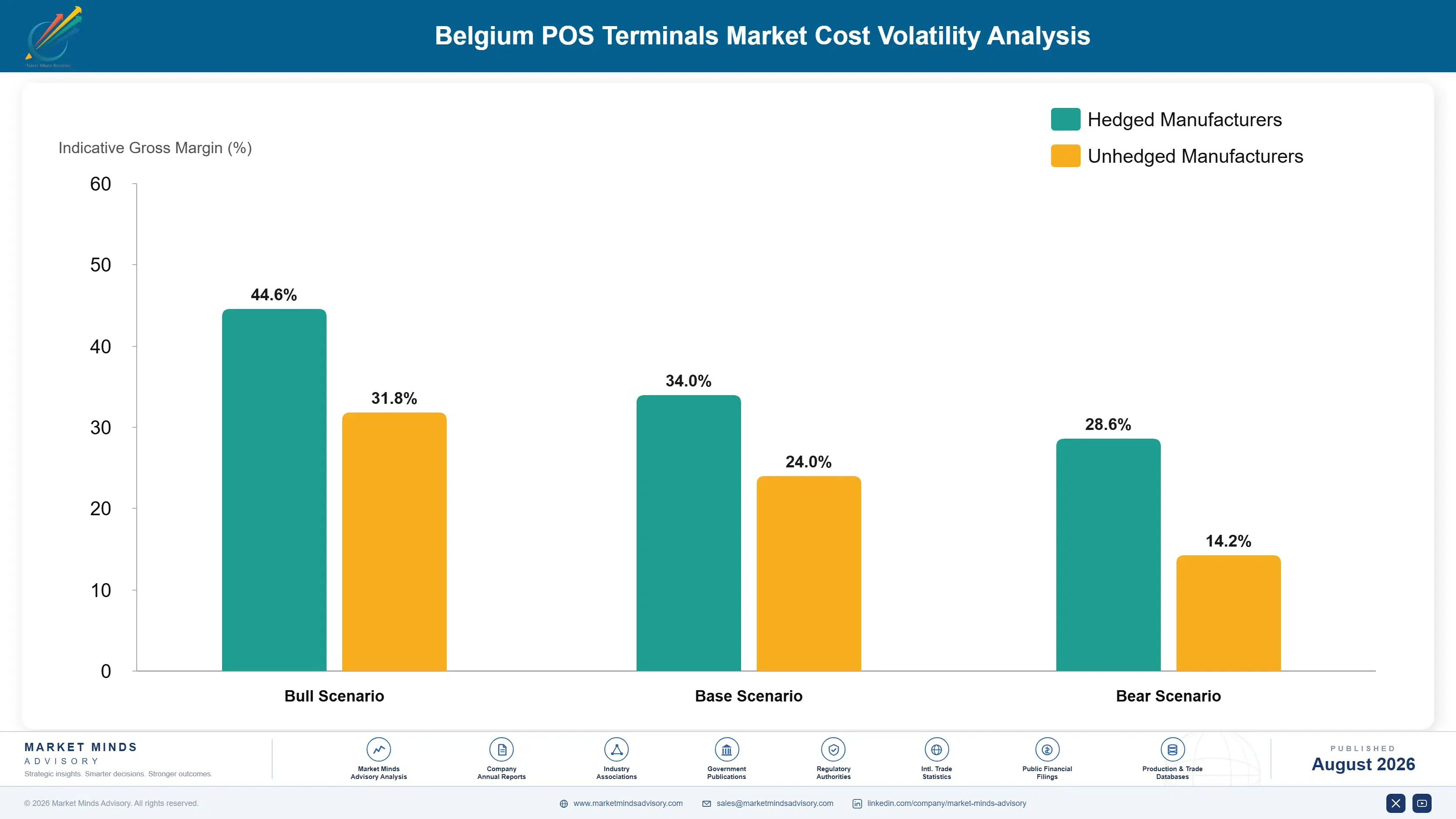
Cost divides into four components across a deployed estate. Hardware acquisition accounts for roughly 34% of lifetime device cost and is sourced almost entirely from Chinese and Taiwanese manufacturers. Field service, installation and replacement logistics run near 26%, certification and compliance engineering near 22%, and merchant support with helpdesk operations account for the remaining 18% across a typical Belgian deployment.
The 2021 to 2023 semiconductor shortage showed how quickly the hardware component behaves under stress. Secure element and cellular module availability collapsed, lead times extended from weeks to several quarters, and replacement programmes across Belgium were delayed while certified devices remained unavailable at any price. Worldline and Nexi both discussed component availability constraints across that period in their annual reporting. Providers holding buffer inventory kept deploying while competitors could not.

Exposure varies by estate age and by scale, and that variation decides competitiveness. Providers carrying large legacy fleets face certification and replacement obligations that scale with device count rather than with revenue, so an ageing estate becomes progressively more expensive to hold. Pan-European consolidators spread certification engineering across many markets, while Benelux specialists carry comparable obligations against a smaller base entirely.
belgium-pos-terminals-market-cost-volatility-analysis-1787917200933

Remote update capability across the deployed fleet

Estates supporting remote software and certification updates avoid field visits that dominate compliance cost, and the saving grows with every scheme requirement change. Devices without that capability must be visited or replaced individually. Providers that standardised early on remotely manageable fleets now absorb regulatory change at a fraction of the cost their competitors face.

Fleet standardisation to reduce certification surface

Every distinct device model in an estate carries its own certification obligation against every scheme requirement change, so a fleet of four models costs materially less to maintain than one of twelve. Consolidation requires accepting compromise on merchant-specific preferences. Most providers accumulated model variety through acquisition and have never seriously addressed the resulting overhead.

Planned rolling replacement against certification schedules

Replacing devices on a planned cycle aligned to certification expiry avoids emergency logistics, merchant disruption and unplanned capital calls that reactive replacement guarantees. The requirement is accurate estate age and certification data maintained continuously. A surprising number of providers cannot produce that data reliably, which forces them into reactive replacement by default every time.

Portfolio Architecture for Margin Defence

The estate portfolio separates by contract value per device rather than by hardware specification. Countertop and portable terminals in ordinary retail form the volume core: high device counts, standardised certification, competitive monthly pricing and margins compressed by five providers pursuing the same merchant base. They exist because scale in certification, logistics and helpdesk depends entirely on volume, not because any individual contract earns much.
Margin concentrates where integration work creates a barrier. Unattended deployments and integrated Android estates both require engineering that a countertop installation does not, and the customer is buying a working system rather than a certified box. Contract values run well above retail while support costs run below. The tension is that these deployments are slower to win, longer to implement and smaller in device count than the volume estate they sit alongside.

The highest-value pool is the one that may erase its own hardware. Software acceptance carries excellent margin per merchant served but a fraction of the revenue a rented device generates, so growth there is defensive. Providers offer it to retain relationships rather than to expand them, which is an uncomfortable position to occupy deliberately.

Volume / Commodity-Adjacent

Countertop and portable terminals in ordinary retail and hospitality. Range spans six points because subscription-converted estates earn materially more across asset life than those still selling hardware outright to merchants.
Gross Margin: 12-18%

Premium / Certified

Integrated Android terminals hosting business applications alongside payment, sold with multi-year support. Range spans eight points because hosted application certification cost varies enormously with how many software partners a provider actually supports.
Gross Margin: 26-34%

Sustainability / Regulatory / Next-Generation

Unattended, kiosk and software-based acceptance. Range spans twelve points because unattended integration work earns well while tap to phone earns excellent margin on very little revenue per individual merchant served.
Gross Margin: 30-42%
belgium-pos-terminals-market-portfolio-architecture-1787917201449

High-value Sub-segments and Strategic Watch-out

Software-Based Tap To Phone

High value and high growth at 12.3%, serving the small merchants the 2022 obligation brought into acceptance unwillingly. Margin per merchant is excellent and revenue per merchant is small, which makes the growth defensive rather than expansionary. Providers offer it purely to keep the account.
Gross Margin: 34-42%

Unattended and Kiosk Terminals

High value with moderate growth at 10.4%, covering parking, fuel, vending, transport and charging deployments. The seven point range reflects integration capability, since providers without engineering teams cannot compete for this work at all. Engineering teams remain the entire barrier to entry in this segment.
Gross Margin: 28-35%

Countertop Terminal Estate

The volume core and the reason certification, logistics and helpdesk scale exists at all. Every provider competes for it, monthly pricing is transparent, and merchants switch rarely enough that incumbency remains worth more than price. Incumbency is quietly worth more than price in this layer.
Gross Margin: 12-18%

Legacy Terminal Certification Debt

The strategic watch-out rather than a growth pool. Ageing devices accumulate certification obligations that scale with device count rather than revenue, and providers carrying large legacy fleets face replacement costs nobody has properly provisioned against. The obligation arrives whether the merchant is profitable or not.
Gross Margin: Variable

Why Terminal Contracts Renew Themselves

Estate contracts produce annuity economics that require almost nothing from the provider once signed. A device rented monthly across a 5.8 year replacement cycle generates predictable revenue regardless of transaction volume, competitive activity or merchant satisfaction, and switching means renegotiating acquiring, retraining staff and physically replacing equipment during trading hours. That friction is worth considerably more to a Belgian provider than any acquisition campaign it could realistically run.
Stickiness varies sharply by merchant type and the averages hide it. Large retail chains negotiate hard, run competitive tenders and move estates when terms justify it. Small independent merchants, particularly those the 2022 obligation brought in, almost never switch because the effort exceeds any saving available. Unattended deployments are the stickiest of all, since replacing a terminal integrated into a parking system means re-engineering the host integration entirely.

Merchant profiles are shifting in ways that favour software over hardware. Newer small businesses increasingly expect acceptance to arrive through a phone or an existing commerce platform rather than through a dedicated device delivered by an engineer. Established merchants keep their terminals and replace them on schedule. No Belgian provider currently serves both expectations with equal conviction.
belgium-pos-terminals-market-end-use-penetration-index-1787917202140

Where Belgian Acceptance Margin Concentrates

These are among the four positions where our research anticipates prominent divergence between winners and laggards over the coming forecast period. Each is grounded in the demand model, the regulatory perimeter, and the announced capacity pipeline.
01 / ESTATE SUBSCRIPTION CONVERSION

Rent the device, never sell it outright again

A terminal sold outright produces nothing after the invoice clears, while the identical device rented at roughly EUR 22 monthly across a 5.8 year cycle produces recurring revenue several times the original hardware margin available. Providers who completed the conversion report revenue per device around 3.4 times higher across the full asset life than those still selling. The obstacle is working capital rather than merchant resistance, since the provider funds each device and recovers the cost only gradually over years.
02 / UNATTENDED INTEGRATION ENGINEERING

Integration teams win the deployments hardware alone cannot

Unattended terminals carry contract value well above countertop units while carrying lower support cost, and the segment grows at 10.4% annually across parking, fuel, vending, transport and charging applications. What blocks entry here is engineering, since every host system presents a different interface requiring genuinely bespoke integration engineering work. Providers holding those teams win contracts at margins 12 to 18 points above their retail estate, because the customer is purchasing a working system rather than merely a certified plastic box.
03 / DOMESTIC SCHEME DEPTH

Bancontact handling separates local providers from European ones

The domestic scheme still carries around 61% of all Belgian card transactions, and providers treating it as merely one more supported network miss almost everything that merchants genuinely want from it. Proper reconciliation, dispute handling and settlement reporting aligned to domestic practice lift merchant retention roughly nine points above bare acceptance alone. It is unglamorous product work with no international reuse whatsoever, which is precisely why pan-European competitors keep declining to do it and keep losing Belgian accounts as a result.
04 / PLANNED REPLACEMENT DISCIPLINE

Replace on certification schedule, not on device failure

Certification obligations accumulate against ageing devices and eventually force their replacement whether or not the hardware still works properly, so a reactively managed estate generates emergency logistics, merchant disruption and unplanned capital calls in every single year. Providers running a planned rolling replacement against the 5.8 year cycle report field service costs running 20% to 28% below their reactive peers. The only requirement is accurate estate age data, which a surprising number of providers simply cannot produce reliably at all.

Engagement Snapshot From the Field

A live engagement with an industry participant carrying material or product regulatory and market exposure ahead of a defining policy shift, showing how our research translates into a defensible multi-year portfolio strategy.
MARKET MINDS ADVISORY · CLIENT ENGAGEMENT SUMMARY
Belgium POS Terminals Producer Strategic Portfolio Review and Transition Roadmap 2026·Investment Scenario on Belgium POS Terminals Exposure Evaluation 2025-26
CLIENT PROFILE
An independent payment terminal provider operating across Belgian retail and hospitality, holding a mid-market estate position built largely through bank referral and direct sales. The business had grown device count consistently since the 2022 acceptance obligation while contribution per device fell every year, and management attributed that decline to competitive pricing rather than to anything within its own operating structure.
STRATEGIC CHALLENGE
The board could not establish whether the declining contribution came from hardware price competition, from an ageing estate carrying certification cost, or from a merchant mix skewed toward the smallest traders. It also needed to decide whether to offer tap to phone, which would cannibalise rented terminals, or to decline it and risk losing those accounts entirely.
MMA APPROACH
MMA rebuilt contribution economics device by device, attributing hardware, field service, certification and support cost to each model and merchant cohort, then modelled the estate under planned versus reactive replacement across the certification schedule. Expert interviews with unattended system integrators, scheme certification bodies and merchant acquirers established what capability and pricing were genuinely achievable at the client's scale.
KEY FINDINGS
  1. Devices older than five years generated negative contribution once certification and field service costs were properly attributed, and they represented 29% of the deployed estate.
  2. The estate contained eleven distinct device models, each carrying separate certification obligations against every scheme requirement change the provider had no ability to influence.
  3. Merchants acquired after the 2022 obligation generated 38% lower monthly revenue than the pre-existing base while consuming almost identical helpdesk and field service resource.
  4. No unattended deployments existed anywhere in the estate, despite three integrator partners actively seeking a terminal provider willing to build the host integration capability.
CLIENT PROFILE
An independent payment terminal provider operating across Belgian retail and hospitality, holding a mid-market estate position built largely through bank referral and direct sales. The business had grown device count consistently since the 2022 acceptance obligation while contribution per device fell every year, and management attributed that decline to competitive pricing rather than to anything within its own operating structure.
STRATEGIC CHALLENGE
The board could not establish whether the declining contribution came from hardware price competition, from an ageing estate carrying certification cost, or from a merchant mix skewed toward the smallest traders. It also needed to decide whether to offer tap to phone, which would cannibalise rented terminals, or to decline it and risk losing those accounts entirely.
MMA APPROACH
MMA rebuilt contribution economics device by device, attributing hardware, field service, certification and support cost to each model and merchant cohort, then modelled the estate under planned versus reactive replacement across the certification schedule. Expert interviews with unattended system integrators, scheme certification bodies and merchant acquirers established what capability and pricing were genuinely achievable at the client's scale.
KEY FINDINGS
  1. Devices older than five years generated negative contribution once certification and field service costs were properly attributed, and they represented 29% of the deployed estate.
  2. The estate contained eleven distinct device models, each carrying separate certification obligations against every scheme requirement change the provider had no ability to influence.
  3. Merchants acquired after the 2022 obligation generated 38% lower monthly revenue than the pre-existing base while consuming almost identical helpdesk and field service resource.
  4. No unattended deployments existed anywhere in the estate, despite three integrator partners actively seeking a terminal provider willing to build the host integration capability.
RECOMMENDED STRATEGY
Phase 1: Phase one: consolidate the estate from eleven device models toward four, retiring the oldest fleet on a planned schedule aligned to certification expiry. Phase 2: Phase two: launch tap to phone for the smallest merchant cohort, accepting lower revenue per account rather than losing those relationships to software competitors. Phase 3: Phase three: build host integration capability for unattended deployment, beginning with the three integrator partners already actively seeking a provider.
OUTCOME
The client reported contribution per device improving 21% within five quarters (client-reported, unverified by MMA), with roughly two thirds attributable to fleet consolidation and planned replacement. Tap to phone retained 84% of the smallest merchant cohort. The first unattended contracts were signed in the fourth quarter at margins well above the retail estate.

Frequently Asked Questions

Foundational context covering the market sizes, CAGR, scope, country, region and competition that inform every finding below. This section is provided to cover basics and most often pre-purchase conversations, answered from the MMA Primary Research Dataset.

What is the current size of the Belgium POS Terminals Market?

The market is valued at USD 0.4 billion in 2025, measured as revenue from payment acceptance devices deployed in Belgium including hardware, rental and estate services. Around 312,000 devices are installed.

How large will the Belgium POS Terminals Market be by 2036?

MMA forecasts USD 0.95 billion by 2036, up from USD 0.43 billion in 2026. That represents incremental revenue of USD 0.52 billion and an expansion multiple of 2.21 times.

What is the CAGR for the Belgium POS Terminals Market 2026 to 2036?

The base case CAGR is 8.2%, with a bull case of 9.4% and a bear case of 7.0%. Subscription conversion and unattended deployment supply most of that growth.

Which segment is growing fastest?

Software-based tap to phone grows at 12.3%, half again the market rate of 8.2%. It expands by removing hardware rather than selling it, serving the smallest merchants best.

Who are the major companies in the Belgium POS Terminals Market?

Worldline, CCV, Nexi, Adyen and Ingenico lead on installed terminal estate and attached service revenue, holding around 79% between them across the whole Belgian market.

Which country is growing fastest?

India grows fastest at 10.2%, reflecting expanding platform development, certification testing and helpdesk operations run for European providers. No acceptance revenue at all is earned there.

Report Segmentation Architecture

The full report scope spans multiple orthogonal segmentation dimensions, with cross-tabulated demand data provided for each dimension pair. Coverage extends further to regional breakdowns, trend trajectories, and the competitive detail needed to support segment-level decision-making.

By Terminal Type

  • Countertop Terminals
  • Portable and Wireless Terminals
  • Mobile mPOS Dongles
  • Integrated Smart Android Terminals
  • Unattended and Kiosk Terminals
  • Software-Based Tap to Phone

By End-Use Industry

  • Food Retail and Grocery
  • Hospitality and Restaurants
  • Specialist Retail
  • Fuel and Convenience
  • Transport and Parking
  • Public Sector and Healthcare

By Commercial Dimension

  • Bank Referred Distribution
  • Direct Acquirer Sales
  • Independent Sales Organisations
  • Software Partner Channels
  • Terminal-as-a-Service Subscription
  • Direct Online Self-Service

By Region

  • North America
  • Western Europe
  • East Asia
  • South Asia and Pacific
  • Latin America
  • Middle East and Africa
  • Eastern Europe

Scope, Methodology, and Coverage

Every figure in this report is reproducible from documented input assumptions. The scope below maps the historical period, the forecast horizon, the segmentation dimensions, and the countries covered, alongside the underlying primary and qualitative methodology.
Historical Period
2020 to 2025
Forecast Period
2026 to 2036
Base Year
2025 (USD billions; MMA Primary Research Dataset, August 2026)
Market Definition
Revenue from payment acceptance devices deployed in Belgium, spanning countertop, portable, mobile, integrated Android, unattended and software-based acceptance, and comprising hardware sale and rental, estate management, certification, maintenance and merchant support services. Card scheme fees, interchange, merchant service charges, e-commerce gateway revenue and electronic cash register hardware performing no payment acceptance function are excluded from scope entirely.
Quantitative Units
USD billions, terminal and estate service revenue
Segmentation Dimensions
Terminal form factor, end-use industry, commercial distribution dimension, region
Regions Covered
North America, Western Europe, East Asia, South Asia and Pacific, Latin America, Middle East and Africa, Eastern Europe
Countries Covered
Belgium, with manufacturing, certification and operations exposure across East Asia, North America, South Asia and Pacific and Eastern Europe
Key Companies Profiled
Worldline, CCV, Nexi, Adyen, Ingenico, Verifone, PAX Technology, SumUp, myPOS, Bancontact Payconiq Company
Quantitative Methodology
Primary survey, n=3,800 respondents, Q4 2025, six countries; demand-side model with trade association cross-validation
Qualitative Methodology
47 expert interviews, Q4 2025; applied to validate demand model assumptions, identify emerging dynamics, and assess competitive positioning
Report Format
PDF and XLSX data workbook (Word format preview document)
Publisher
Market Minds Advisory
Report Code
MMA-2026-TEC-401
Published
August 2026
Contact
sales@marketmindsadvisory.com | www.marketmindsadvisory.com

Purchase the full Belgium POS Terminals Market Report (2026 to 2036).

The full report treats Belgian point of sale terminals as an estate contract business rather than a hardware one, and shows where margin survives a decade of device price deflation. It models contribution per device across hardware, field service, certification and support, quantifying what an ageing fleet actually costs to hold. Segment analysis covers all six form factors with particular attention to unattended integration economics and to tap to phone as a defensive rather than expansionary move. Competitive assessment ranks twenty participants on installed estate and attached service revenue. Regional coverage addresses manufacturing origin, certification authority and offshore operations as the forces setting Belgian cost and deployment timelines.
Six form factor segmentation with growth rates
Contribution per device across full asset life
Twenty participant assessment on installed estate
Certification cost against fleet model variety
Unattended integration margin against retail estate
Domestic scheme depth impact on merchant retention

Built For The People Who Decide

From boardroom strategy to bench-side execution, this report is read cover-to-cover by leaders shaping the next decade of their industry, turning demand scenarios, market dynamics and valuation benchmarks into decisions.
CXOs/ Presidents/ VPs/ Managers
M&A and Corporate Development
Strategy Teams and R&D Heads
Procurement and Product Directors
Regulatory and Compliance Leaders
Investor Relations and Equity Analysts