Market Minds Advisory
Beetroot Powder Market

Beetroot Powder Market: Natural Colour and Nitrate Nutrition Reshape Ingredient Sourcing

Clean-label reformulation is displacing synthetic azo dyes across processed food and beverage lines, while nitrate-rich beetroot powder gains ground in sports nutrition, pushing buyers toward long-term supply contracts as beet acreage tightens.

Lead Analyst

Lisa Gevelber

Published

September 2026

Make Smarter Decisions with Customized Research Insights

Request a free sample report and evaluate market opportunities, growth trends, and competitive dynamics relevant to your business needs.

2025 MARKET VALUE$1.1BMarket Size 2025
2036 FORECAST VALUE$2.3BBase Case , 2026 to 2036
CAGR 2026 TO 20366.9 %Bull 8.2% / Bear 5.6%
INCREMENTAL OPPORTUNITY$1.1BNet 10- year value creation
EXPANSION MULTIPLE1.92x2036 value over 2026 base
Strategic Levers
M&A Pipeline
Regional Outlook
Country Rankings
Competitive Intelligence
Segmental Deep-dive
Call-Us : 91 93563 13602

Executive Snapshot and Market Trajectory

Food manufacturers are swapping synthetic red and purple dyes for beetroot-derived betalains faster than beet processors can add drying capacity, turning what was once a niche colorant into a supply-constrained ingredient category almost overnight, forcing procurement teams across three continents to rewrite sourcing plans mid-year with little notice.
Sports nutrition brands have pushed standardized nitrate extract into pre-workout and endurance formats, a segment now expanding well ahead of the wider category as clinical dosing data accumulates across strength and recovery use cases. East Asian food manufacturers, reformulating against domestic natural-colorant rules, have become the single largest buying bloc, absorbing volume once destined primarily for European retailers and confectionery makers who now compete for the same constrained supply lines each harvest cycle.
Processing capacity sits with a handful of specialist dehydrators, so contract terms, not brand marketing, decide who gets allocation during harvest shortfalls each season. Regulatory pressure on synthetic azo dyes in China and the European Union is colliding with an athletic performance research base that keeps widening nitrate's clinical use case well beyond endurance sport into strength recovery and general wellness positioning across retail nutrition chains.
Market Definition
The beetroot powder market covers dehydrated, freeze-dried, and extract-based beetroot ingredients sold as food colorant, nitrate supplement, or functional food input across food, beverage, and nutraceutical manufacturing. It excludes fresh and canned beetroot sold for direct culinary retail, and excludes unprocessed raw beet sold to sugar refiners.
Base Year Value
$1.1B in 2025 (MMA Primary Research Dataset, August 2026)
Forecast Period
2026 to 2036, eleven discrete annual values
CAGR
6.9% base case. Bull 8.2%. Bear 5.6%.
Fastest Growth Segment
Standardized Nitrate and Betalain Extract Powder: 10.2% CAGR
Fastest Growth Country
India: 9.4% CAGR
Fastest Growth Region
South Asia and Pacific: 8.8% CAGR
Largest Region
East Asia: 29% of 2025 global value
Market Leaders
GNT Group, Sensient Technologies, Doehler Group, Van Drunen Farms, Kanegrade. Source: MMA Analysis based on company annual reports.
Primary Survey
n=3,800 procurement and R&D decision-makers, Q4 2025, six countries
Methodology
Demand-side build-up, cross-validated against public data, 47 expert interviews

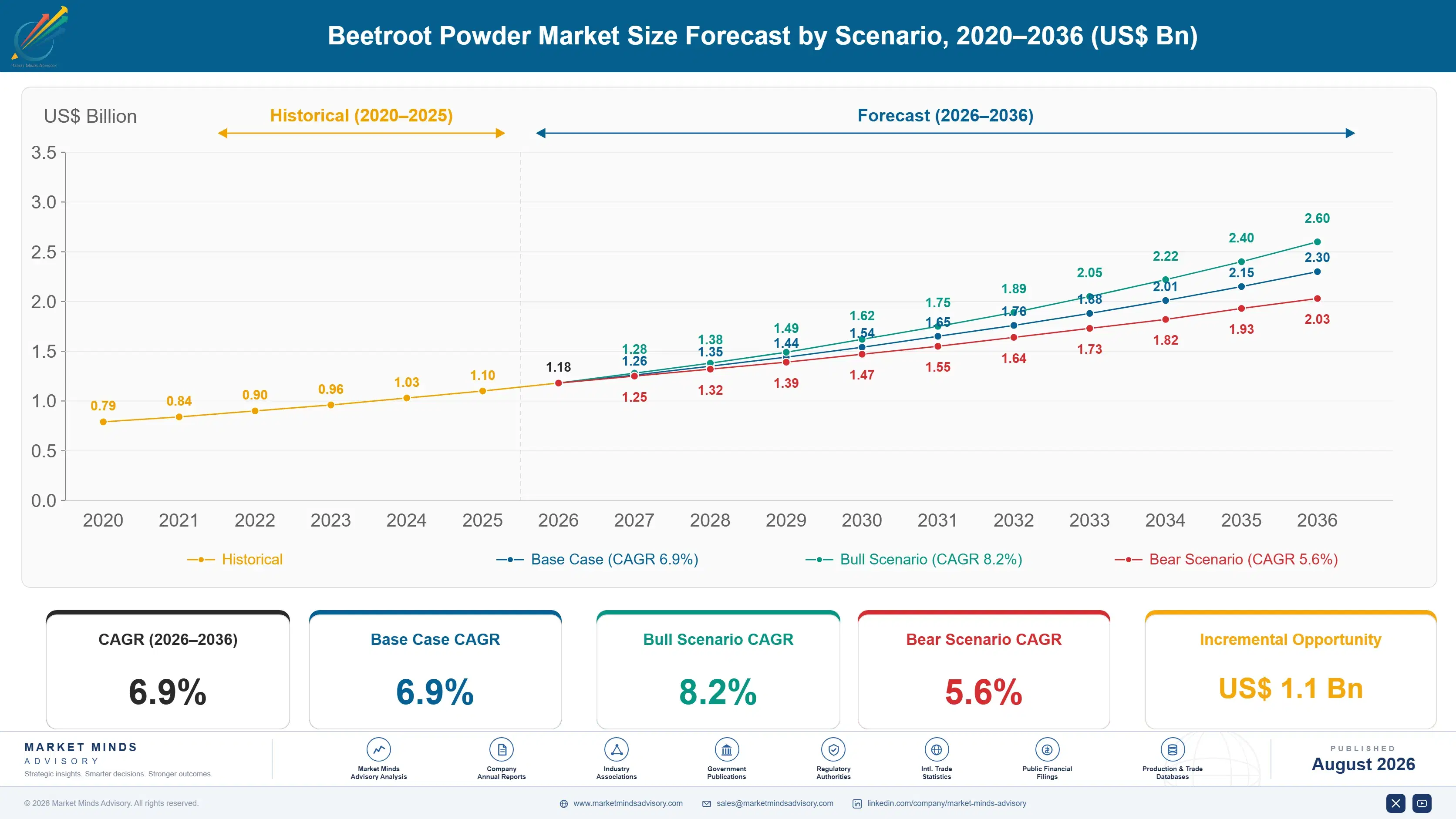
Beetroot Powder Market Forecast Scenarios

beetroot-powder-market-trends-growth-size-forecast-scenario-1787463325944
Beet processing volumes climbed steadily between 2020 and 2025 as clean-label reformulation gathered pace across packaged food, though drying capacity additions lagged demand for three consecutive years running. Growers responded with modest acreage gains rather than the step change buyers actually needed, leaving processors managing allocation manually through most of that period across nearly every market.
The base case assumes continued azo dye substitution across China and the European Union, expanding sports nutrition adoption of standardized nitrate extract, and steady capacity investment by the five largest dehydrators working in parallel. Together these three mechanisms lift throughput enough to keep pace with demand without materially compressing processor margins, assuming beet acreage expands roughly in line with contracted volumes rather than reacting to spot market price swings each harvest season.
A bull case builds on the European Union finalizing a stricter azo dye phase-out that forces faster reformulation timelines than most processors currently plan capacity around. The bear risk is a poor beet harvest during a peak growing year, which would ration allocation toward existing supply contracts and stall new customer entry altogether until the following season's crop comes in.

Demand Convergence Across Colour and Nutrition

Beetroot powder sits at the intersection of two demand curves that used to move independently: natural colorant substitution in packaged food, and nitrate-driven sports nutrition growth. Both now compete for the same upstream drying and standardization capacity, which is why lead times, rather than price alone, have become the binding constraint facing new formulation buyers entering the category for the first time this decade.
DEHYDRATOR CONCENTRATION5 firms, 61%share of standardized output controlled by top processors
AVERAGE SELLING PRICE$8.40/kgdelivered basis price for food-grade spray-dried powder today
TOP PRODUCING COUNTRY SHARERussia, 22%share of global raw beet tonnage processed annually
CAPACITY UTILISATION84%average utilisation rate across dedicated beet dehydration lines
TRADE INTENSITY38% cross-bordershare of finished powder volume traded across borders
FEEDSTOCK COST SHARE46% of COGSshare of production cost attributable to raw beet input
Commercially, the category behaves like a specialty ingredient rather than a bulk commodity. Five processors control most standardized-grade output, and long-term supply contracts, not spot purchasing, determine who gets priority allocation during a short beet harvest year. Buyers who signed multi-year agreements before 2024 remain largely insulated from this year's allocation squeeze affecting newcomers, a gap that keeps widening as institutional and supplement demand both accelerate.
Over the next decade, betalain extraction technology and nitrate concentration methods will matter more than raw planted acreage, since yield-per-hectare gains achieved through extraction chemistry are outpacing whatever gains growers can realistically achieve simply by planting more beets each season across the main growing regions worldwide, a reversal from how the category competed a decade ago.
"Buyers keep asking for a colour, and what they actually need is a drying contract. The nitrate story only works if someone locked in beet acreage two seasons ago."
Director, Food and Nutrition Ingredients Practice · MMA Food Ingredients and Nutraceuticals Practice · August 2026

Market Trends

Azo dye substitution accelerates under revised food-safety rules

China's revised national food additive standard has narrowed permitted synthetic red and purple azo dyes across confectionery and beverage categories since 2024, pushing major domestic manufacturers toward betalain-based alternatives sourced from beetroot processing plants. European Union reviews of comparable colorants are following a broadly similar trajectory, with several member states already restricting classroom and school-catering use ahead of any formal Union-wide rule taking effect. Processors report reformulation inquiries have roughly tripled since the Chinese standard took effect, concentrated heavily among beverage and confectionery manufacturers seeking qualified supply within twelve months rather than the eighteen months buyers previously budgeted for.
Market Impact: Adds institutional demand worth $70 million
Clinical nitrate dosing research expands sports nutrition use cases

Peer-reviewed exercise physiology research published through 2024 and 2025 has extended documented nitrate benefits beyond endurance running into strength-sport recovery and, more tentatively, cognitive performance under sustained physical exertion. Supplement brands have responded by adding standardized nitrate extract to pre-workout and recovery formats that previously relied on caffeine and creatine alone for their core positioning. Because clinical dosing requires a guaranteed nitrate concentration rather than a general beetroot ingredient claim, this trend favors the handful of processors capable of standardized extraction over spray-dried commodity powder suppliers, reshaping which players capture the fastest-growing slice of category demand.
Market Impact: Grows supplement channel volume 11%

Market Opportunities and Growth Drivers

National school meal programs mandate natural colorants

India's Ministry of Women and Child Development and several Chinese provincial education bureaus have issued procurement rules since 2023 restricting synthetic dyes in school meal and anganwadi feeding programs, creating a captive institutional demand channel for beetroot-derived color and natural pigments generally. These programs collectively serve well over 100 million children daily, and supply contracts run on multi-year public tender cycles that reward processors able to guarantee consistent betalain concentration at scale. Ingredient buyers serving institutional foodservice have begun securing dedicated tonnage against these tenders more than a year ahead of each contract renewal date.
Market Impact: Adds 3-5 month lead times

Endurance sport participation growth widens nitrate supplement base

Marathon, triathlon, and amateur cycling event registrations across North America, Western Europe, and East Asia have grown for five consecutive years through 2025, expanding the addressable consumer base for nitrate-based performance supplements well beyond competitive athletes into casual fitness participants. Retail nutrition chains have responded by adding standardized beetroot extract capsules and shot formats to mainstream shelf sets rather than confining them to specialty sport-nutrition aisles. This mainstreaming shortens the path from clinical research to shelf placement, and several major retailers now stock at least two competing nitrate-extract brands where one, or none, existed five years earlier.
Market Impact: Excludes 18% of addressable volume

Market Restraints and Challenges

Beet acreage growth lags reformulation-driven demand

Sugar beet and table beet acreage expanded only modestly between 2020 and 2025, because farmers weigh beet economics against competing row crops season by season rather than committing to multi-year expansion. The root cause is that beet remains a rotation crop for most growers, not a primary revenue driver, so acreage decisions respond slowly to demand signals from processors. The commercial impact shows up as allocation rationing during below-average harvest years, with new customers waiting behind existing contract holders. Processors are mitigating this by signing multi-year acreage agreements with growers and by qualifying secondary regions in Eastern Europe.
Market Impact: Adds 9% annual reformulation volume

Betalain color stability limits use in high-heat processing

Betalain pigments degrade above roughly 60 degrees Celsius and under prolonged light exposure, which restricts beetroot-derived color from retort-sterilized and high-temperature baked categories where synthetic azo dyes hold a clear advantage. The root cause lies in the pigment's chemical structure, which lacks the thermal resilience synthetic azo compounds and some anthocyanin alternatives offer under sustained heat. The commercial impact concentrates reformulation gains in ambient and refrigerated categories while leaving thermally demanding segments underserved. Suppliers are exploring encapsulation and co-pigmentation techniques with citric acid and antioxidant carriers to extend thermal tolerance, though none has yet matched azo dye performance at scale.
Market Impact: Lifts extract-grade demand 4 points
3 additional market trends, 4 additional growth drivers, and 3 additional restraints and challenges are covered in the full report. Contact sales@marketmindsadvisory.com to access the complete intelligence.

Segment CAGR and Growth Architecture

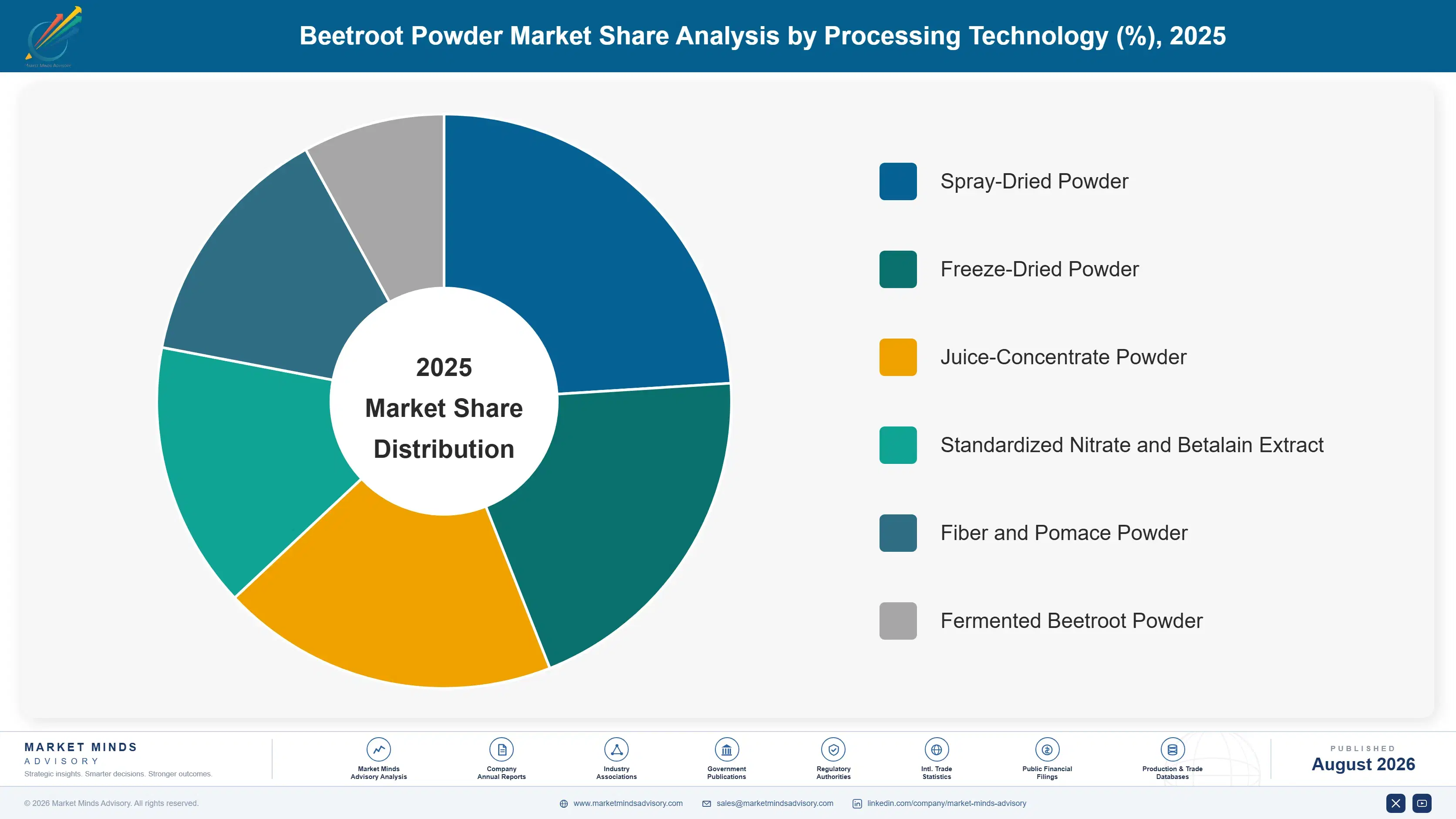
Segmentation follows processing technology, since the method used to dry, standardize, or extract beetroot determines nitrate retention, color intensity, and which end-use category a given batch can ultimately serve, far more than any downstream application label placed on the finished packaged product ever actually does across the category as a whole, from bulk food color through to clinical-grade extract.
beetroot-powder-market-trends-growth-market-share-analysis-1787463326493

Standardized Nitrate and Betalain Extract Powder

This segment isolates and concentrates nitrate and betalain content to a guaranteed potency, serving sports nutrition brands and clinical-adjacent supplement formats that require batch-to-batch dosing consistency for defensible label claims. Extraction requires chromatographic or membrane-separation equipment that only a handful of processors operate at commercial scale today, which keeps margins well above spray-dried commodity powder across the category. Demand is growing at roughly 1.48 times the category average rate, driven by pre-workout and recovery formats moving from specialty retail into mainstream nutrition chains nationwide. Buyers increasingly specify nitrate content in milligrams per serving rather than requesting beetroot powder generically, forcing suppliers without standardization capability out of this specific slice of demand even as they retain colorant business elsewhere.
CAGR 10.2%

Freeze-Dried Beetroot Powder

Freeze-drying preserves nitrate and betalain content more completely than spray-drying, at a cost premium that specialty nutrition and premium natural-food brands have shown consistent willingness to pay for years. The process runs considerably slower and consumes far more energy than spray-drying, which caps how quickly capacity can scale even as underlying demand keeps growing steadily. Manufacturers position freeze-dried powder as the ingredient of choice for products marketed on nutrient retention claims rather than color alone, including smoothie mixes, superfood blends, and premium infant nutrition lines sold at a real price premium. Growth here trails the standardized extract segment but comfortably outpaces spray-dried commodity powder, supported by clean-label formulators who want a single-ingredient nutrition story without a separate extraction step.
CAGR 9.1%
Full segment breakdown across 6 segments available in the complete report.

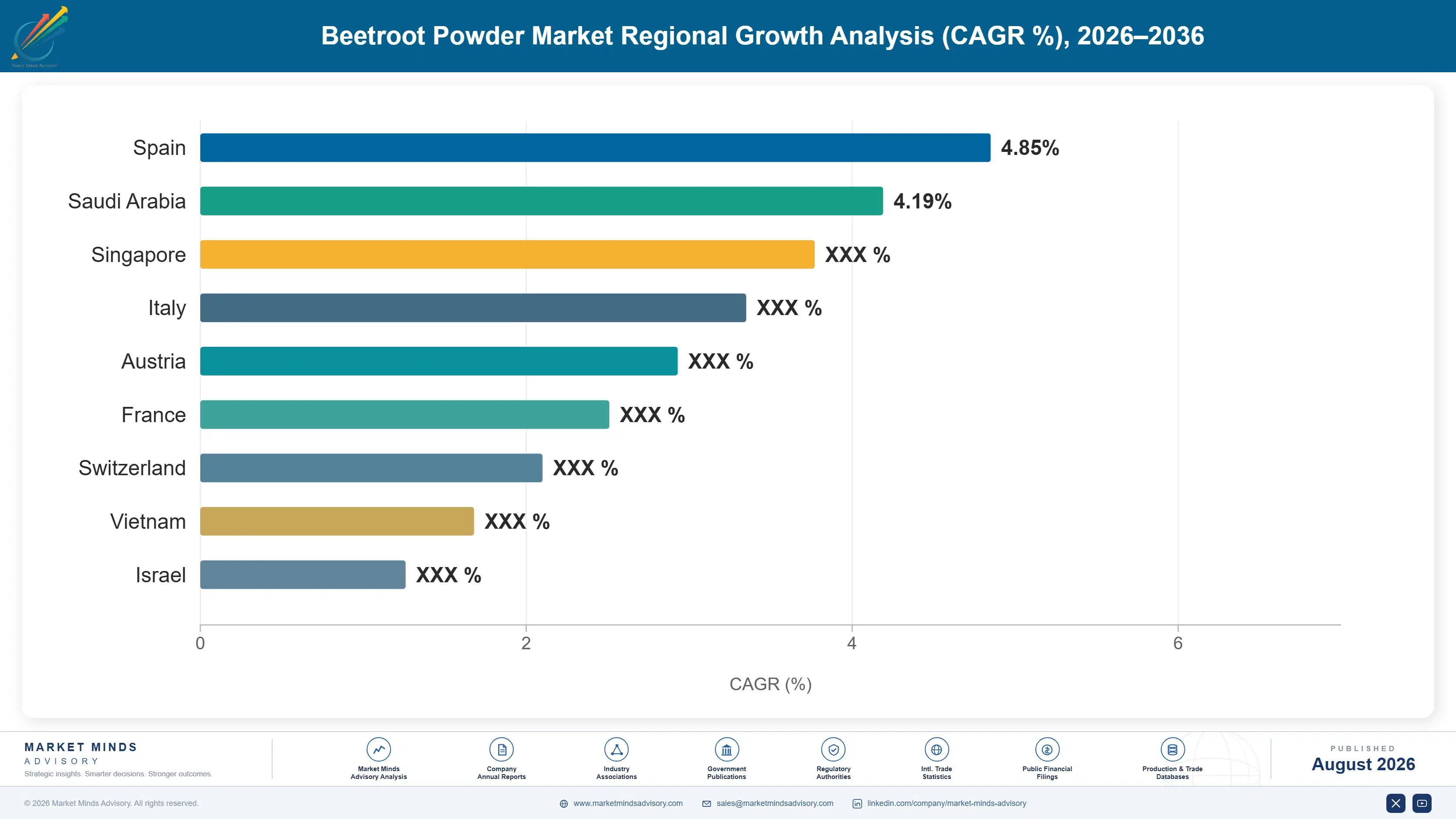
Regional Architecture and Country Demand Map

East Asian reformulation against domestic natural-colorant rules has made it the largest buying region, ahead of North America's expanding supplement channel and Western Europe's legacy processing base, with South Asia and Pacific growing fastest off a considerably smaller starting base across the wider category overall.

East Asia

China's narrowed national food additive standard has made betalain-based color a near-mandatory substitute for restricted synthetic dyes across confectionery, beverage, and bakery categories since 2024, and domestic manufacturers have absorbed volume quickly enough to make East Asia the single largest buying region in the category worldwide. Japanese and South Korean supplement brands have separately driven standardized nitrate extract demand higher, adding a second, largely independent growth channel layered on top of colorant substitution across the wider region. Processors serving this region increasingly locate blending and standardization facilities within China itself to shorten lead times against tender-driven institutional procurement cycles, rather than shipping finished powder from European dehydrators the way the category did through most of the 2010s.
Share: 29% | CAGR: 8.0% (2026 to 2036)

North America

United States sports nutrition retail has mainstreamed standardized nitrate extract well beyond specialty stores, with major national chains now stocking beetroot-based pre-workout and recovery formats that barely existed on general nutrition shelves just five years earlier. Clean-label reformulation among mid-tier packaged food brands, responding to retailer-level synthetic dye phase-out commitments rather than any federal mandate, adds a second demand channel running parallel to the supplement business. Canadian beet growers supply a meaningful share of regional raw material, which insulates North American processors somewhat from the acreage volatility affecting European supply chains, though extraction capacity itself remains concentrated among a small number of specialist firms serving the entire region, from national retailers down to smaller regional supplement brands alike.
Share: 24% | CAGR: 7.8% (2026 to 2036)
Regional intelligence for 5 additional markets available in the complete report: Western Europe, South Asia and Pacific, Latin America, Middle East and Africa, Eastern Europe. Contact sales@marketmindsadvisory.com.
beetroot-powder-market-trends-growth-country-cagr-analysis-1787463327017

Where Beetroot Ingredient Margins Concentrate

Margin in this category sits with extraction technology and contract structure rather than raw beet ownership, so processors capture the most value by moving customers up the standardization curve and locking multi-year acreage agreements well ahead of anticipated demand growth each coming harvest season across every region the category serves today, from commodity color through clinical-grade extract.

Standardization Capability as a Pricing Gate

Processors able to guarantee nitrate content in milligrams per serving, rather than sell generic beetroot powder, capture roughly 40% higher per-kilogram pricing from sports nutrition customers who need dosing consistency to support their label claims. Building chromatographic or membrane-separation extraction lines requires capital most mid-sized dehydrators have not yet committed to, which keeps this pricing gate open to only five or six global suppliers today. Customers increasingly write standardization requirements directly into supply contracts, effectively excluding non-standardized suppliers from the fastest-growing slice of demand regardless of their existing spray-drying capacity or general price competitiveness in the wider market.
Market Impact: Commands a 40% premium over commodity grade today

Multi-Year Grower Contracts to Secure Acreage

Signing beet growers to three- to five-year acreage agreements, sometimes with an equipment or financing component attached, has let a handful of processors lock in supply while competitors ration allocation during short harvests each season. This approach adds upfront cost equivalent to roughly 6% of feedstock spend but removes the worst allocation risk during below-average growing years, letting contracted processors onboard new customers that competitors must turn away entirely. Processors without direct grower relationships increasingly find themselves buying beet on the spot market at a real premium precisely when demand runs highest across the category.
Market Impact: Cuts harvest shortfall allocation risk by roughly 30%

Institutional Tender Wins in Public Feeding

Winning multi-year public procurement tenders for school meal and public feeding programs in India and China delivers volume predictability that consumer retail demand simply cannot match, since these contracts typically run two to three years with clearly defined annual tonnage commitments. Suppliers who invest in tender-compliance documentation and consistent betalain concentration testing capture a disproportionate share of this channel, which now represents a meaningful and steadily growing part of total category demand worth roughly $70 million annually. The tradeoff is thinner per-unit margin than supplement-grade sales, offset by contracted volume certainty that smooths production planning considerably.
Market Impact: Adds about $70 million in contracted annual volume

Encapsulation Research to Access Thermal Categories

Co-pigmentation and encapsulation techniques that extend betalain's heat and light stability open retort-sterilized and baked-good categories currently closed to beetroot-derived color entirely, a segment worth an estimated 18% of total colorant-addressable volume across the wider market. Processors investing in this research ahead of competitors stand to capture meaningful early category-entry advantages once formulations prove stable at commercial scale and pass customer trials successfully. Development timelines run two to three years before results reach customer trials, and early movers are partnering with academic food-science departments to accelerate stability testing rather than running the entire program in-house alone.
Market Impact: Opens access to an 18% volume pool overall

Who Controls the Margin Pool

The top five processors hold roughly 61% of standardized-grade beetroot ingredient revenue, leaving a long tail of smaller regional dehydrators to compete mainly on spray-dried commodity powder pricing alone. The gap between leaders and challengers rests squarely on extraction technology access, not on brand recognition or general marketing spend across the category.
Current competitive activity centers on three moves: expanding standardization capacity to capture sports nutrition pricing power, signing multi-year grower contracts to secure acreage well ahead of anticipated demand, and pursuing institutional tender wins across India and China's large public feeding programs. Smaller players without extraction capability increasingly position themselves around organic certification instead of competing head-on for extract-grade business.

Emerging pressure comes from Chinese domestic ingredient suppliers building standardization capacity specifically to serve local reformulation demand rather than exporting finished powder abroad, which could erode the European export processing model that has dominated global supply for roughly a decade now. Encapsulation technology able to open thermal-processing categories to beetroot color represents the next genuine rank-shifting opportunity in this category, and whichever processor commercializes it first at real scale stands to gain share fastest across every region.
beetroot-powder-market-trends-growth-company-positioning-matrix-1787463327547

Competitive Moat and Risk Dimensions

GNT GROUP B.V.

Moat: Vertically integrated EXBERRY supply chain

GNT controls beet cultivation, drying, and standardization end to end through its EXBERRY brand, giving it consistent betalain concentration that competitors sourcing beet on the open market struggle to match batch to batch. This integration shortens qualification time considerably for large packaged food customers running global reformulation programs across multiple markets on tight retailer deadlines.
GNT GROUP B.V.

Risk: Single-crop agronomic concentration

Because GNT's model depends heavily on directly contracted beet acreage concentrated in a handful of growing regions, a poor harvest or a plant disease outbreak there would hit the company considerably harder than competitors who source more opportunistically across multiple regions and crop varieties each season, spreading the same underlying weather risk.
SENSIENT TECHNOLOGIES CORPORATION

Moat: Diversified multi-category ingredient platform

Sensient sells beetroot-derived color alongside a broad flavor and colorant portfolio, letting it bundle beetroot ingredients into existing customer relationships across food, beverage, and personal care categories rather than selling the ingredient as a standalone product that requires entirely new account acquisition and separate sales cycles.
SENSIENT TECHNOLOGIES CORPORATION

Risk: Commodity cost pass-through lag

Sensient's broad customer contracts typically fix pricing for twelve months at a time, which means a sharp beet cost spike during a short harvest hits company margin immediately while management waits for the next annual contract cycle to pass those higher costs through to customers across its portfolio.

Players Tracked

Prominent Players

GNT Group B.V.
Sensient Technologies Corporation
Doehler Group
Van Drunen Farms
Kanegrade Ltd

Other Key Players

FutureCeuticals Inc.
Nordic Beet Processing ApS
Farbest Brands
AIDP Inc.
Synthite Industries Ltd.
Vidya Herbs Pvt. Ltd.
Naturalin Bio-Resources Co. Ltd.
Shaanxi Undersun Biomedtech Co. Ltd.
Xi'an Sost Biotech Co. Ltd.
HuNan Nutramax Inc.
Organic Herb Inc.
NOW Health Group Inc.
Suedzucker AG
Herbo Nutra
Layn Natural Ingredients Corp.

Recent Developments

JULY 2025

GNT Group Expands EXBERRY Standardization Capacity in the Netherlands

GNT Group commissioned an additional betalain standardization line at its Dutch facility, adding guaranteed-potency extract capacity aimed at sports nutrition customers across Europe and North America. The expansion followed two years of allocation constraints during below-average beet harvests that had left contracted customers waiting for paid volume.
Signal: Signals leaders are investing ahead of demand rather than rationing existing capacity across their customer base
MARCH 2026

Sensient Technologies Acquires Regional Natural Colorant Producer

Sensient Technologies acquired a mid-sized European natural colorant producer specializing in beetroot and vegetable-derived pigments, adding meaningful dehydration capacity and an established grower network across Eastern Europe. The deal extends Sensient's feedstock access well beyond its existing Western European supply base and diversifies harvest risk.
Signal: Points to consolidation as mid-sized regional producers seek scale to compete on standardization capability alone going forward
NOVEMBER 2025

Doehler Group Forms Joint Venture for Asian Extraction Facility

Doehler Group and a Chinese ingredient manufacturer formed a joint venture to build a standardized nitrate extraction facility inside China, aimed at serving domestic reformulation demand without importing finished powder from European dehydrators as before. Construction is expected to complete within roughly two years of signing.
Signal: Confirms European exporters are localizing production rather than ceding Chinese demand fully to domestic rivals now

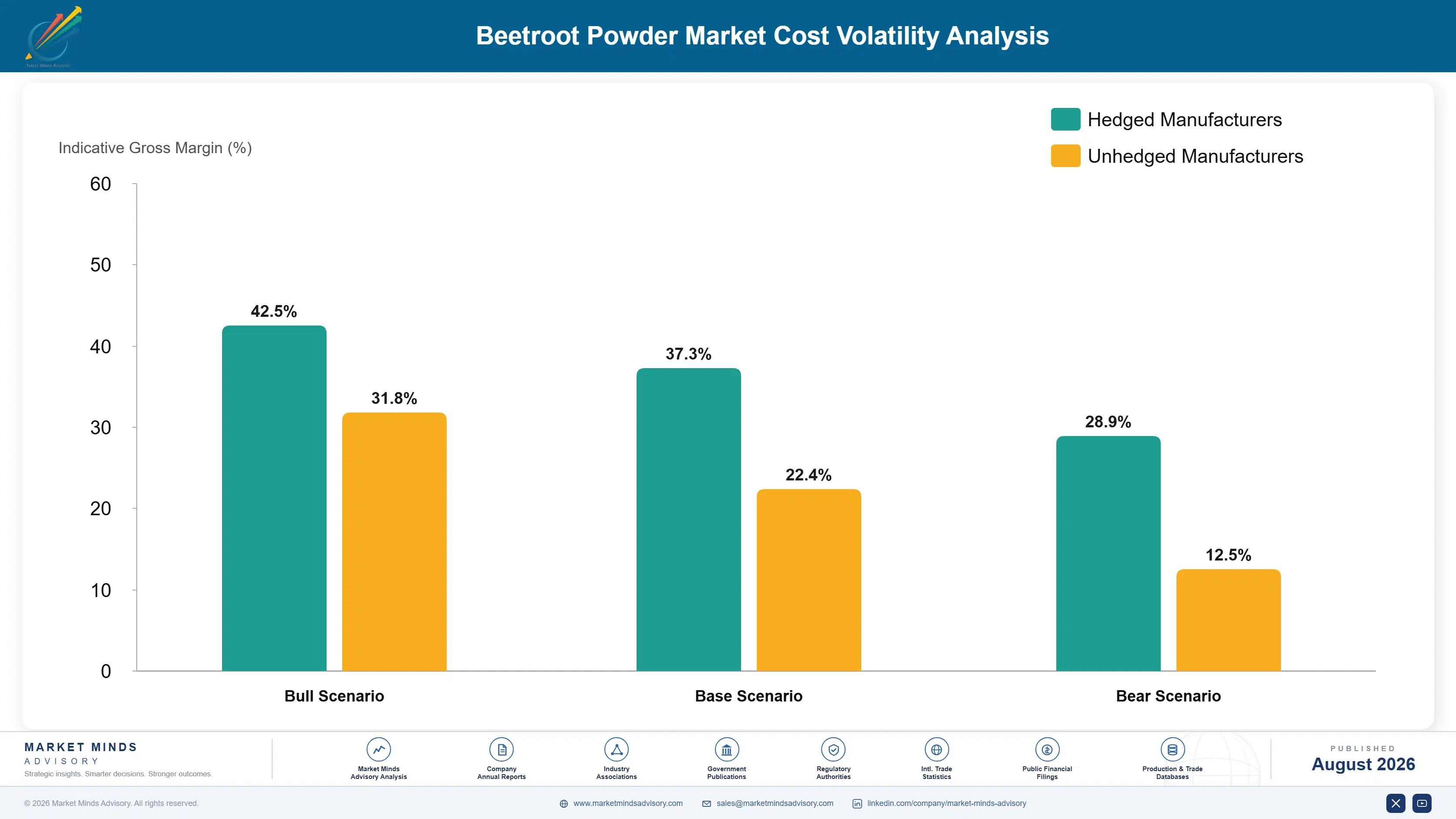
Beet Feedstock and Energy Cost Exposure

Raw beet accounts for roughly 46% of production cost for standardized-grade powder, with drying energy a further 22%, making the category unusually exposed to two volatile inputs simultaneously across every processing region. Beet supply concentrates in Russia, Germany, France, and the United States, so regional harvest quality drives cost more than any global commodity benchmark actually does.
A poor 2023 harvest across several major European beet-growing regions, linked to summer drought conditions documented in European Commission agricultural monitoring reports, pushed spot beet prices sharply higher through early 2024. Processors without multi-year grower contracts absorbed the increase directly and immediately, while those holding locked acreage agreements passed through only modest cost increases to customers, illustrating how contract structure now matters roughly as much as harvest volume itself in this category.

The competitive disadvantage falls hardest on mid-sized dehydrators buying beet on the spot market rather than under contract, since they face the same energy inflation as larger rivals without the acreage security to smooth raw material cost. Exposure also varies by geography: European processors carry a higher energy cost share of COGS than counterparts in regions with cheaper industrial power, a gap spot-market buyers cannot easily close.
beetroot-powder-market-trends-growth-cost-volatility-analysis-1787463327746

Multi-Year Grower Acreage Agreements

Locking beet supply under three- to five-year contracts with defined pricing formulas shields processors from spot market spikes during poor harvests, at the modest cost of somewhat higher average pricing in strong harvest years, when spot beet would otherwise have been cheaper to buy on the open market from independent growers without any contract commitment attached to that season's crop.

Secondary Growing Region Qualification

Qualifying beet supply from Eastern European or North American growing regions alongside a primary source meaningfully diversifies harvest risk, since adverse weather patterns rarely hit multiple distant growing regions in the same season with equal severity or timing, softening the worst-case supply shock a single-region grower base would otherwise face during a genuinely poor year.

On-Site Renewable Power for Drying Operations

Several processors have added solar or biomass generation capacity at their dehydration sites to reduce exposure to grid electricity price swings, which matters considerably given how large a share of total production cost drying energy actually represents across the category and how volatile that cost has proven to be in recent years across most major producing regions.

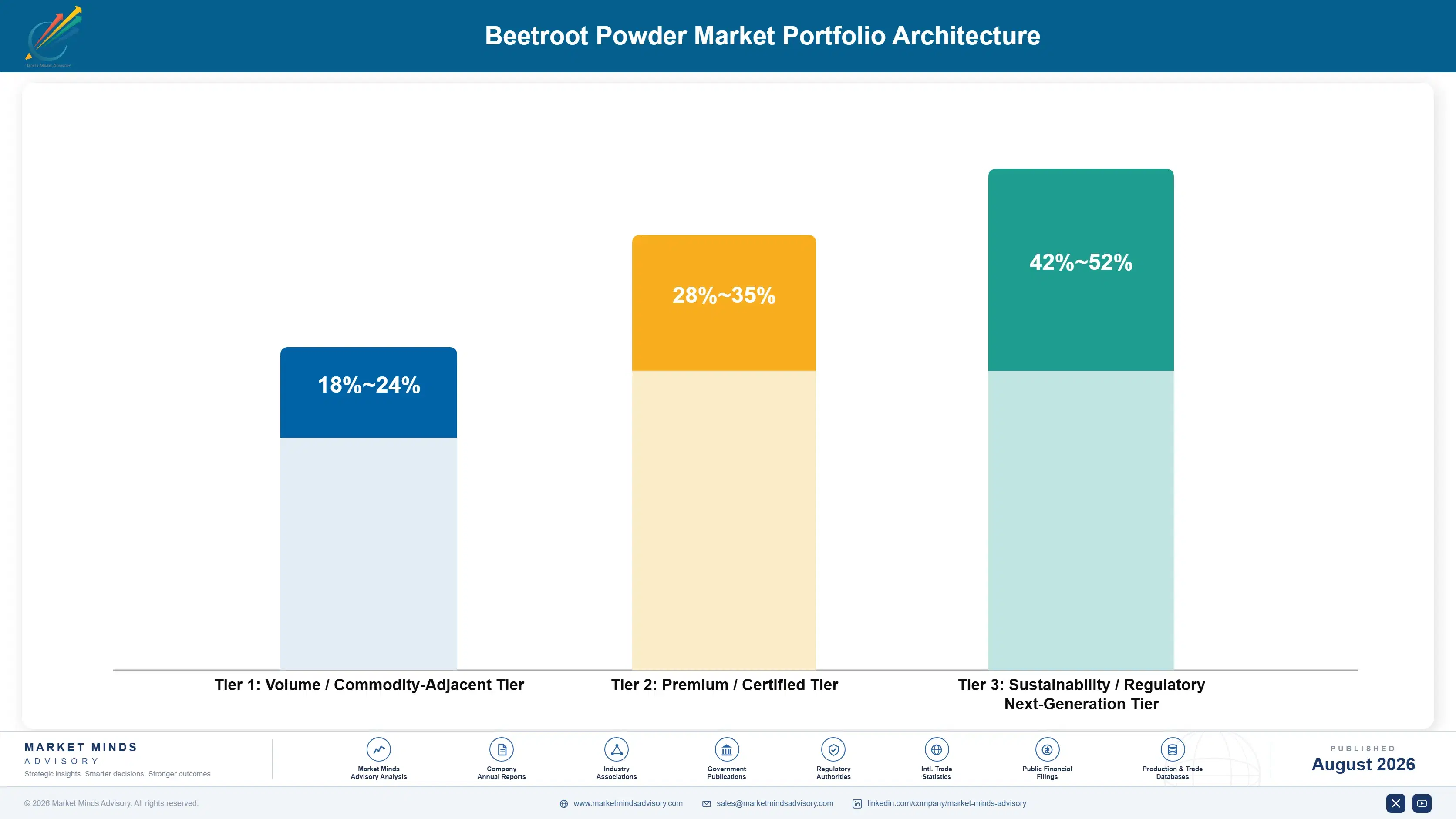
Portfolio Architecture for Margin Defence

Three tiers separate this market clearly: commodity spray-dried powder sold largely on price, certified organic or non-GMO powder carrying a moderate premium, and standardized nitrate or betalain extract sold against guaranteed potency specifications for demanding sports nutrition and clinical-adjacent customers. Gross margin widens sharply moving from the first tier through to the third, roughly tripling along the way across the full category, rewarding processors that invest in extraction technology early.
Volume sits overwhelmingly in the commodity tier, where thin margins reward scale and contract efficiency rather than technical differentiation of any real kind. Premium tiers carry the tension every ingredient supplier eventually faces: chasing volume growth in commodity grade risks diluting the technical reputation that earns extract-grade pricing from sports nutrition and clinical-adjacent customers who pay specifically for guaranteed batch-to-batch consistency rather than price alone.

High-value margin pools concentrate in standardized extract sold to supplement brands and in institutional tender contracts carrying multi-year volume guarantees, while commodity spray-dried powder remains fundamentally a scale business better suited to processors holding the lowest feedstock cost position in the wider market across every region served, particularly where energy costs run low.

Volume / Commodity-Adjacent Tier

Spray-dried beetroot powder sold into general food coloring and bulk nutrition applications worldwide, priced mainly on feedstock cost and processing scale rather than any real technical differentiation between competing suppliers in the category today.
Gross Margin: 18-24%

Premium / Certified Tier

Organic-certified and non-GMO verified beetroot powder serving clean-label retail brands willing to pay a documented sourcing premium over standard commodity grade material sold at scale to bulk buyers across the industry.
Gross Margin: 28-35%

Sustainability / Regulatory / Next-Generation Tier

Standardized nitrate and betalain extract sold against guaranteed potency specifications for supplement and clinical-adjacent formulation requiring strict batch-to-batch consistency across every production run, commanding the widest margin of any tier in the category.
Gross Margin: 42-52%
beetroot-powder-market-trends-growth-portfolio-architecture-1787463328248

High-value Sub-segments and Strategic Watch-out

Standardized Nitrate Extract for Sports Nutrition

This segment combines the fastest unit growth in the category with the widest margin, as supplement brands pay a real premium for guaranteed nitrate concentration in every batch. Processors with chromatographic extraction capability are best positioned, though capacity additions require multi-year lead time to reach commercial scale.
Gross Margin: 45-52%

Institutional Tender Supply for Public Feeding Programs

Multi-year public procurement contracts in India and China deliver strong volume predictability and moderate but stable margin, rewarding suppliers who invest early in tender compliance documentation and consistent quality testing over those chasing higher-margin retail business exclusively across smaller accounts each renewal cycle without that groundwork already in place.
Gross Margin: 24-30%

Spray-Dried Commodity Powder for General Food Color

The volume core of the category, sold mainly on price and delivery reliability into bulk food and beverage manufacturing, where feedstock cost efficiency rather than technical differentiation determines which supplier ultimately wins repeat business from large-volume buyers each contract renewal cycle, regardless of brand reputation or marketing spend.
Gross Margin: 18-22%

Thermally Stable Encapsulated Betalain Color

Encapsulation technology aimed at retort-sterilized and baked categories remains commercially unproven at scale, making this a genuine watch-out: whichever supplier commercializes stable thermal performance first could open an 18% volume pool currently closed to the category entirely, reshaping competitive share almost overnight once formulations pass customer trials.
Gross Margin: unproven

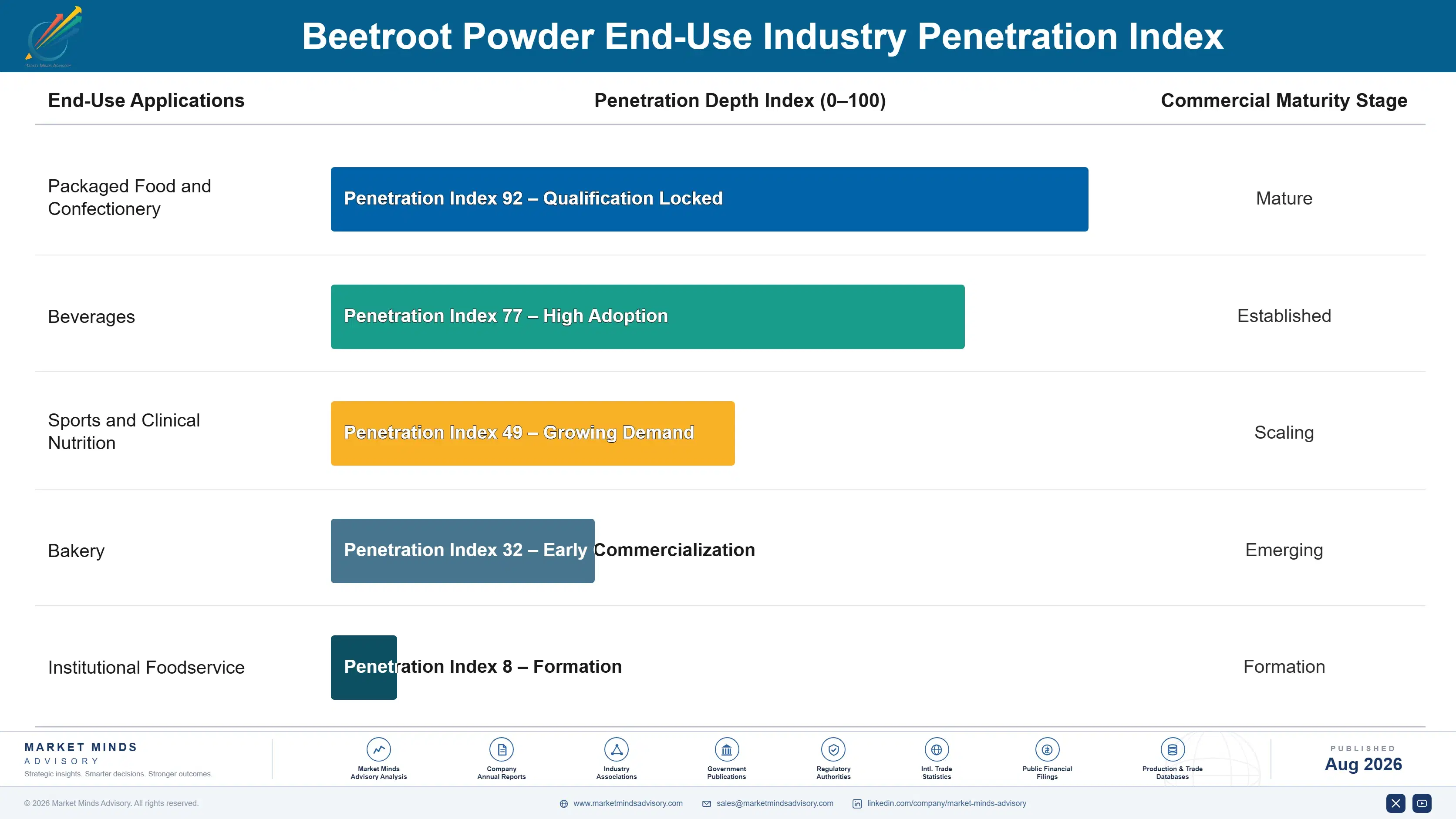
How Beetroot Ingredient Demand Repeats

Supply contracts in this category function closer to annuities than one-off purchase orders, since large packaged food and supplement customers rarely re-qualify a new beetroot ingredient supplier mid-formulation, given the considerable cost and time required to re-run stability and label-compliance testing from the start each time a switch is even considered seriously by a brand's procurement team. Once qualified, a supplier tends to hold that shelf position for several product refresh cycles running.
Adoption runs deepest in sports nutrition and institutional feeding, where reformulation is driven by binding regulation or specific product claims rather than discretionary brand preference, and shallowest in categories like retort-sterilized food, where betalain's thermal instability still blocks a full switch away from synthetic dye across most of the category's higher-heat processing lines. Bakery sits somewhere in between, adopting selectively depending on the specific bake temperature a given product line requires.

A generational shift is visible in purchasing behavior itself: younger procurement managers at packaged food companies increasingly treat clean-label sourcing as a default requirement rather than a marketing add-on, meaningfully changing how reformulation projects get greenlit and budgeted internally across large organizations. This shift is accelerating decision timelines that once took years to complete.
beetroot-powder-market-trends-growth-end-use-penetration-index-1787463328739

Where Beetroot Ingredient Bets Should Go

These are among the four positions where our research anticipates prominent divergence between winners and laggards over the coming forecast period. Each is grounded in the demand model, the regulatory perimeter, and the announced capacity pipeline.
01 / EXTRACTION CAPACITY INVESTMENT

Invest in standardization capability before competitors close the gap

Standardized nitrate and betalain extract commands roughly 40% higher pricing than commodity powder, yet only a handful of processors currently operate the chromatographic or membrane-separation equipment this requires at commercial scale. Buyers increasingly write standardization requirements directly into supply contracts, closing out non-standardized suppliers from the fastest-growing demand segment entirely across every major market this report tracks in detail. Processors that build this capability now capture durable pricing power that competitors cannot easily replicate within a normal multi-year capital investment cycle.
02 / GROWER CONTRACT STRATEGY

Lock multi-year beet acreage ahead of the next harvest shortfall

Acreage growth has lagged reformulation-driven demand for five consecutive years running, and allocation during short harvests goes to contracted buyers first every single season without exception anywhere in the category. Processors without direct grower relationships are left buying beet on the spot market precisely when prices spike hardest and margins compress fastest across the board. Securing three- to five-year acreage agreements now, even at a modest premium over prevailing spot pricing, removes the single largest supply risk facing this category through the full forecast period.
03 / INSTITUTIONAL CHANNEL EXPANSION

Pursue public feeding program tenders in India and China directly

School meal and anganwadi procurement rules restricting synthetic dyes have created sustained, multi-year institutional demand serving well over 100 million children daily across both India and China combined. These tenders reward suppliers who invest early in compliance documentation and consistent quality testing over those chasing retail business exclusively without that groundwork already in place ahead of the tender cycle. Winning even a modest share of this channel delivers volume predictability that meaningfully offsets thinner per-unit margin against supplement-grade sales elsewhere in the portfolio.
04 / THERMAL STABILITY R&D

Fund encapsulation research to access heat-processed categories

Betalain's instability above 60 degrees Celsius currently excludes beetroot color from roughly 18% of colorant-addressable volume across retort-sterilized and baked categories worldwide. Encapsulation and co-pigmentation research could close this gap, and whichever processor commercializes stable thermal performance first gains a meaningful head start before rivals can replicate the underlying formulation work at commercial scale across multiple product categories. Early academic partnerships offer a faster, lower-cost path to proof of concept than pursuing purely in-house development alone from a standing start.

Engagement Snapshot From the Field

A live engagement with an industry participant carrying material or product regulatory and market exposure ahead of a defining policy shift, showing how our research translates into a defensible multi-year portfolio strategy.
MARKET MINDS ADVISORY · CLIENT ENGAGEMENT SUMMARY
Beetroot Powder Producer Strategic Portfolio Review and Transition Roadmap 2026·Investment Scenario on Beetroot Powder Exposure Evaluation 2025-26
CLIENT PROFILE
The client is a mid-sized natural beverage manufacturer in North America generating approximately $180 million in annual revenue (client-reported, unverified by MMA), producing functional juice and wellness shot products sold through natural grocery and mainstream retail channels. The company had relied on a single spray-dried beetroot powder supplier for five years and faced a reformulation deadline tied to a major retail partner's synthetic additive phase-out commitment.
STRATEGIC CHALLENGE
The client needed to add standardized nitrate content to an existing wellness shot line within nine months to meet a retailer shelf-reset deadline, but its incumbent supplier offered only commodity-grade spray-dried powder without any guaranteed potency, risking the very label claims the reformulation was meant to support and validate at launch.
MMA APPROACH
MMA mapped the standardized extract supplier landscape, evaluated five processors against nitrate concentration consistency and delivery lead time, and modeled contract structures balancing price against allocation security during the client's peak production season, which coincided closely with historically tighter beet harvest periods across the European supply base feeding most North American buyers.
KEY FINDINGS
  1. The incumbent supplier's spray-dried powder could not meet the guaranteed nitrate concentration the client's new label claim required for launch approval that year, forcing an unplanned supplier search.
  2. Two of the five evaluated processors offered standardized extract capacity with lead times comfortably inside the client's nine-month launch deadline window, versus the other three.
  3. A three-year acreage-linked contract priced only 6% above prevailing spot averages while removing allocation risk entirely for the client's production planning cycle.
  4. Switching suppliers required re-running stability testing from scratch, adding roughly ten weeks to the original reformulation project timeline the client had budgeted for.
CLIENT PROFILE
The client is a mid-sized natural beverage manufacturer in North America generating approximately $180 million in annual revenue (client-reported, unverified by MMA), producing functional juice and wellness shot products sold through natural grocery and mainstream retail channels. The company had relied on a single spray-dried beetroot powder supplier for five years and faced a reformulation deadline tied to a major retail partner's synthetic additive phase-out commitment.
STRATEGIC CHALLENGE
The client needed to add standardized nitrate content to an existing wellness shot line within nine months to meet a retailer shelf-reset deadline, but its incumbent supplier offered only commodity-grade spray-dried powder without any guaranteed potency, risking the very label claims the reformulation was meant to support and validate at launch.
MMA APPROACH
MMA mapped the standardized extract supplier landscape, evaluated five processors against nitrate concentration consistency and delivery lead time, and modeled contract structures balancing price against allocation security during the client's peak production season, which coincided closely with historically tighter beet harvest periods across the European supply base feeding most North American buyers.
KEY FINDINGS
  1. The incumbent supplier's spray-dried powder could not meet the guaranteed nitrate concentration the client's new label claim required for launch approval that year, forcing an unplanned supplier search.
  2. Two of the five evaluated processors offered standardized extract capacity with lead times comfortably inside the client's nine-month launch deadline window, versus the other three.
  3. A three-year acreage-linked contract priced only 6% above prevailing spot averages while removing allocation risk entirely for the client's production planning cycle.
  4. Switching suppliers required re-running stability testing from scratch, adding roughly ten weeks to the original reformulation project timeline the client had budgeted for.
RECOMMENDED STRATEGY
Phase 1: Phase 1 (Months 1-2): Qualify two standardized extract suppliers in parallel against nitrate potency and delivery lead time metrics closely. Phase 2: Phase 2 (Months 3-5): Negotiate a three-year acreage-linked supply contract with the selected processor well ahead of the harvest season. Phase 3: Phase 3 (Months 6-9): Run stability testing and label-claim validation while transitioning production fully off the incumbent supplier's existing line.
OUTCOME
The client launched its reformulated wellness shot line one month behind the original retailer deadline but with a validated nitrate claim on pack, and reported the new supply contract cut per-unit ingredient cost variance by roughly 30% over the following two quarters (client-reported, unverified by MMA), crediting the acreage-linked contract structure directly for the improvement.

Frequently Asked Questions

Foundational context covering the market sizes, CAGR, scope, country, region and competition that inform every finding below. This section is provided to cover basics and most often pre-purchase conversations, answered from the MMA Primary Research Dataset.

What is the current size of the Beetroot Powder Market?

The global beetroot powder market is valued at approximately $1.2 billion in 2026. This covers dehydrated, freeze-dried, and extract-based beetroot ingredients sold for colorant and nutrition applications worldwide.

How large will the Beetroot Powder Market be by 2036?

MMA projects the market will reach approximately $2.3 billion by 2036. Growth is driven primarily by clean-label colorant substitution and expanding sports nutrition adoption of standardized nitrate extract.

What is the CAGR for the Beetroot Powder Market 2026 to 2036?

The market is forecast to grow at a compound annual rate of 6.9% between 2026 and 2036. Bull and bear scenarios range from 8.2% down to 5.6% depending on regulatory and harvest outcomes.

Which segment is growing fastest?

Standardized nitrate and betalain extract powder is growing fastest, at roughly 1.48 times the category average rate. Sports nutrition brands are driving this segment as clinical dosing research expands nitrate's use cases further.

Who are the major companies in the Beetroot Powder Market?

Leading suppliers include GNT Group, Sensient Technologies, Doehler Group, Van Drunen Farms, and Kanegrade. Together the top five processors hold roughly 61% of standardized-grade revenue.

Which country is growing fastest?

India is the fastest-growing country market, expanding at approximately 9.4% annually. Institutional demand from school meal and anganwadi procurement rules restricting synthetic dyes is the primary driver.

Report Segmentation Architecture

The full report scope spans multiple orthogonal segmentation dimensions, with cross-tabulated demand data provided for each dimension pair. Coverage extends further to regional breakdowns, trend trajectories, and the competitive detail needed to support segment-level decision-making.

By Processing Technology

  • Spray-Dried Powder
  • Freeze-Dried Powder
  • Juice-Concentrate Powder
  • Standardized Nitrate and Betalain Extract
  • Fiber and Pomace Powder
  • Fermented Beetroot Powder

By End-Use Industry

  • Packaged Food and Confectionery
  • Beverages
  • Sports and Clinical Nutrition
  • Bakery
  • Institutional Foodservice

By Commercial Dimension

  • Retail Branded
  • Private Label
  • Institutional Tender Supply
  • Business-to-Business Ingredient Contracts

By Region

  • North America
  • Western Europe
  • East Asia
  • South Asia and Pacific
  • Latin America
  • Middle East and Africa
  • Eastern Europe

Scope, Methodology, and Coverage

Every figure in this report is reproducible from documented input assumptions. The scope below maps the historical period, the forecast horizon, the segmentation dimensions, and the countries covered, alongside the underlying primary and qualitative methodology.
Historical Period
2020 to 2025
Forecast Period
2026 to 2036
Base Year
2025 (USD billions; MMA Primary Research Dataset, August 2026)
Market Definition
The beetroot powder market covers dehydrated, freeze-dried, and extract-based beetroot ingredients sold as food colorant, nitrate supplement, or functional food input across food, beverage, and nutraceutical manufacturing. It excludes fresh and canned beetroot sold for direct culinary retail, and excludes unprocessed raw beet sold to sugar refiners.
Quantitative Units
USD billions (current prices); metric tons processed
Segmentation Dimensions
By Processing Technology; By End-Use Industry; By Commercial Dimension; By Region
Regions Covered
North America, Western Europe, East Asia, South Asia and Pacific, Latin America, Middle East and Africa, Eastern Europe
Countries Covered
USA, China, Germany, France, UK, Japan, South Korea, India, Australia, Canada, Brazil, Mexico, Indonesia, Vietnam, Thailand, Malaysia, UAE, Saudi Arabia, South Africa, Nigeria, Turkey, Poland, Netherlands, Italy, Spain, Sweden, Switzerland, Argentina, Colombia, Singapore, and additional markets relevant to this sector
Key Companies Profiled
GNT Group B.V., Sensient Technologies Corporation, Doehler Group, Van Drunen Farms, Kanegrade Ltd, FutureCeuticals Inc., Nordic Beet Processing ApS, Farbest Brands, AIDP Inc., Synthite Industries Ltd., Vidya Herbs Pvt. Ltd., Naturalin Bio-Resources Co. Ltd., Shaanxi Undersun Biomedtech Co. Ltd., Xi'an Sost Biotech Co. Ltd., HuNan Nutramax Inc., Organic Herb Inc., NOW Health Group Inc., Suedzucker AG, Herbo Nutra, Layn Natural Ingredients Corp.
Quantitative Methodology
Primary survey, n=3,800 respondents, Q4 2025, six countries; demand-side model with trade association cross-validation
Qualitative Methodology
47 expert interviews, Q4 2025; applied to validate demand model assumptions, identify emerging dynamics, and assess competitive positioning
Report Format
PDF and XLSX data workbook (Word format preview document)
Publisher
Market Minds Advisory
Report Code
MMA-2026-AGR-401
Published
August 2026
Contact
sales@marketmindsadvisory.com | www.marketmindsadvisory.com

Purchase the full Beetroot Powder Market Report (2026 to 2036).

The full report delivers a complete analysis of the beetroot powder market across all seven regions and six processing-technology segments. It includes detailed competitive profiles of twenty processors alongside proprietary MMA survey data drawn from 3,800 respondents and 47 expert interviews conducted during the fourth quarter of 2025. Ten-year forecast models are built under base, bull, and bear scenarios, with full regional share and growth breakdowns included throughout. A standalone section analyzes input cost exposure and margin architecture across three distinct product tiers. Buyers also receive segment-level CAGR detail extending well beyond the two segments highlighted in this summary.
Full seven-region market sizing and forecast tables
Complete six-segment processing technology breakdown detail
Twenty-company competitive profiles and moat analysis
Primary survey data collected across six countries
Input cost and feedstock exposure modeling detail
Portfolio tier margin benchmarking by segment type

Built For The People Who Decide

From boardroom strategy to bench-side execution, this report is read cover-to-cover by leaders shaping the next decade of their industry, turning demand scenarios, market dynamics and valuation benchmarks into decisions.
CXOs/ Presidents/ VPs/ Managers
M&A and Corporate Development
Strategy Teams and R&D Heads
Procurement and Product Directors
Regulatory and Compliance Leaders
Investor Relations and Equity Analysts