Market Minds Advisory
Beet Sugar Market

Beet Sugar Market: Refining Margins, Specialty Grades, and the Post-Quota Competitive Reset

Beet sugar producers face a widening split between commodity refined output and specialty, organic, and liquid formats as European quota reform, Black Sea competition, and food reformulation pressure reshape margin capture across the value chain.

Lead Analyst

Lisa Gevelber

Published

September 2026

Make Smarter Decisions with Customized Research Insights

Request a free sample report and evaluate market opportunities, growth trends, and competitive dynamics relevant to your business needs.

2025 MARKET VALUE$34.0BMarket Size 2025
2036 FORECAST VALUE$53.4BBase Case , 2026 to 2036
CAGR 2026 TO 20364.2 %Bull 5.6% / Bear 2.8%
INCREMENTAL OPPORTUNITY$18.0BNet 10- year value creation
EXPANSION MULTIPLE1.51x2036 value over 2026 base
Strategic Levers
M&A Pipeline
Regional Outlook
Country Rankings
Competitive Intelligence
Segmental Deep-dive
Call-Us : 91 93563 13602

Executive Snapshot and Market Trajectory

Beet sugar remains the backbone of European and North American sweetener supply, but growers and refiners are absorbing thinner margins as cane-derived imports undercut price and processors redirect capacity toward organic, liquid, and specialty grades that carry premium contracts with food and beverage manufacturers.
Demand growth concentrates in liquid beet sugar for beverage processors seeking easier handling and in organic beet sugar tied to clean-label reformulation across bakery and confectionery. Western Europe and East Asia together account for the largest processing volumes, while Egypt's national self-sufficiency program and China's Xinjiang expansion are adding new capacity outside the traditional Franco-German production core, shifting where incremental tonnage originates over the next decade and well beyond.
Competitive intensity is rising as cooperative structures like Tereos and Cristal Union defend farmer-owned supply against listed players such as Südzücker that fund specialty diversification through Beneo and AGRANA. Regulatory pressure from European sugar tax reviews and reformulation targets pushes refiners to differentiate on functional attributes instead of competing purely on tonnage, and Black Sea beet plus Thai cane imports keep base pricing under sustained pressure across most import-exposed markets this entire cycle.
Market Definition
This report covers the global market for beet-derived sucrose across refined, raw, organic, liquid, and powdered grades sold into food, beverage, and industrial end-uses. It excludes cane sugar, high-fructose corn syrup, and non-nutritive sweeteners, and treats beet pulp and molasses as co-product revenue rather than core market volume.
Base Year Value
$34.0B in 2025 (MMA Primary Research Dataset, August 2026)
Forecast Period
2026 to 2036, eleven discrete annual values
CAGR
4.2% base case. Bull 5.6%. Bear 2.8%.
Fastest Growth Segment
Organic Beet Sugar: 7.5% CAGR
Fastest Growth Country
Egypt: 8.5% CAGR
Fastest Growth Region
South Asia and Pacific: 6.2% CAGR
Largest Region
Western Europe: 25% of 2025 global value
Market Leaders
Südzücker AG, Tereos SA, Nordzucker AG, AB Sugar (British Sugar), American Crystal Sugar Company. Source: MMA Analysis based on company annual reports.
Primary Survey
n=3,800 procurement and R&D decision-makers, Q4 2025, six countries
Methodology
Demand-side build-up, cross-validated against public data, 47 expert interviews

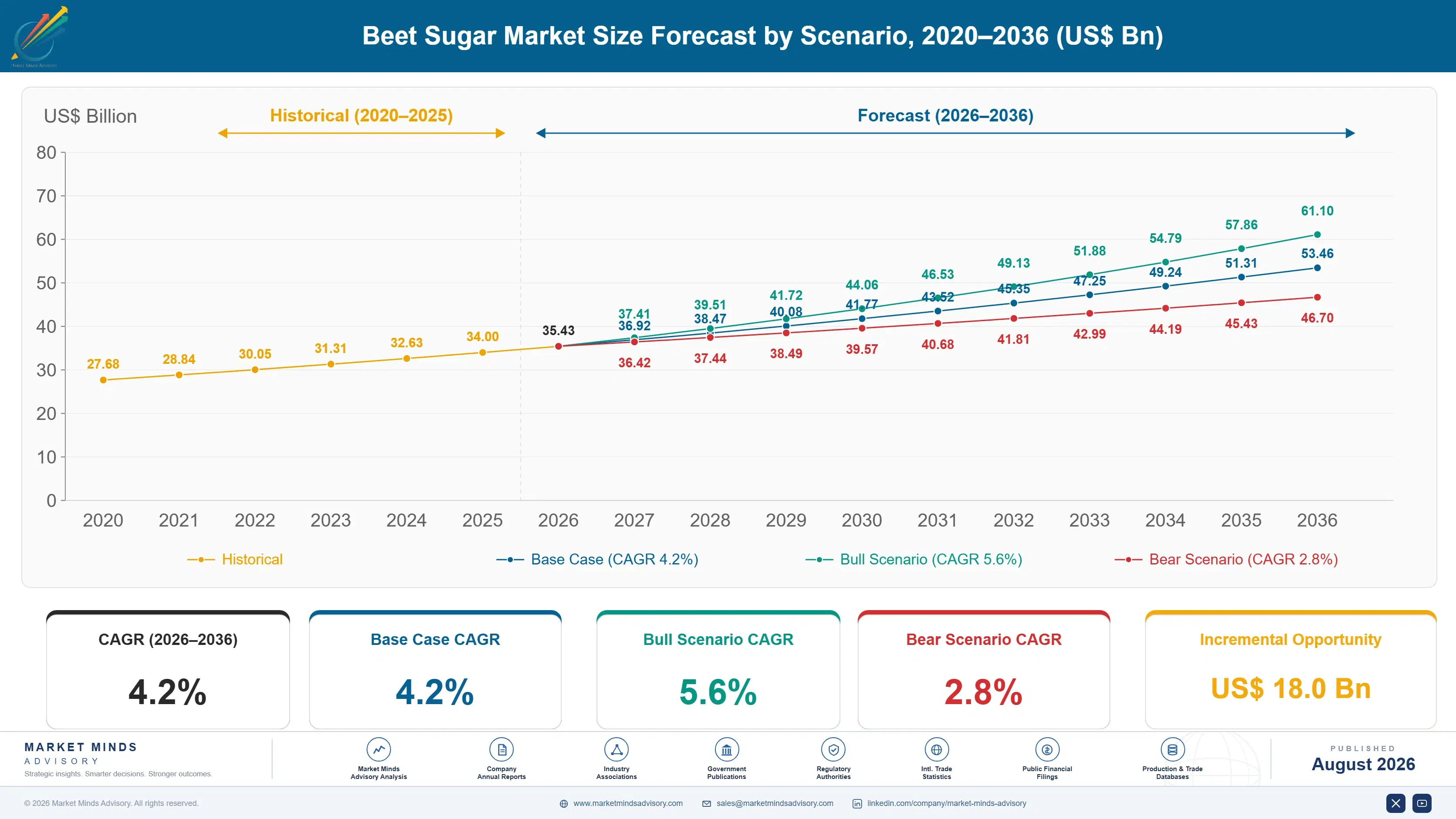
Beet Sugar Market Forecast Scenarios

beet-sugar-market-trends-growth-size-forecast-scenario-1787462190624
Beet sugar output grew unevenly between 2020 and 2025 as EU quota abolition, drought-hit campaigns in France and Germany, and volatile world sugar prices alternately compressed and restored refiner margins. A historical CAGR of 3.4% masks two poor harvest years followed by a 2024 price recovery that let cooperatives rebuild reserves and restart deferred capacity investment across several plants.
The base case assumes 4.2% annual growth through 2036, driven by three mechanisms: continued substitution of liquid beet sugar into beverage manufacturing where handling costs matter, expansion of organic-certified acreage under EU Farm to Fork contracts, and Egypt's Delta Sugar Company program reducing import dependence through new refining capacity. Together these push beet sugar's share of processor sourcing higher even as total sweetener demand growth stays flat across mature Western markets.
A bull scenario assumes a sustained rally in raw sugar prices lifts beet economics and accelerates specialty conversion, pushing growth toward 5.6%. The bear case turns on renewed Black Sea beet and Thai cane exports flooding European and Asian ports, compressing base pricing and cutting grower payments enough that acreage exits accelerate, dragging growth down toward roughly 2.8% across the weakest campaigns.

Refining Economics and the Specialty Conversion Curve

Beet sugar sits inside a global sweetener market where cane supplies roughly eighty percent of volume, leaving beet producers to compete on quality, traceability, and proximity rather than scale. Europe's post-quota liberalization removed production caps in 2017, exposing growers directly to world price swings for the first time in decades and forcing consolidation among smaller cooperatives that lacked balance sheet room to absorb consecutive bad harvests.
MARKET CONCENTRATION (CR5)38%Top five producers hold meaningful but not dominant share
AVERAGE SELLING PRICE$612 per tonneRefined white sugar benchmark price across major export markets
TOP PRODUCING COUNTRY SHAREFrance, 17%Single largest national beet sugar production base globally
CAPACITY UTILIZATION RATE81%Refiners run campaigns near full seasonal processing capacity
TRADE INTENSITY22% cross-borderShare of global beet sugar output crossing national borders
FEEDSTOCK COST SHARE58% of COGSSugar beet root purchases dominate total production cost base
Commercially, the market splits between bulk refined sugar sold on tight contracts to food manufacturers and a growing specialty tier, organic, liquid, and functional grades, that carries meaningfully better margins. Processors with integrated specialty units, Südzücker's Beneo among them, capture disproportionate profit even where their tonnage share stays flat, while pure commodity refiners depend almost entirely on campaign yield and world price timing.
Over the next decade, capacity additions concentrate outside the traditional Franco-German core as Egypt, China, and India build beet processing to cut import bills. Reformulation pressure and sugar tax regimes in parts of Europe will keep total consumption growth modest, pushing producers to defend margin through grade mix rather than volume expansion across most mature Western markets this decade.
"The beet sugar producers that win the next decade aren't the ones growing the most beet. They're the ones that stopped selling it as a commodity years ago."
Director, Agricultural Commodities Practice · MMA Agriculture & Food Ingredients Practice · August 2026

Market Trends

EU Farm to Fork Organic Acreage Targets

The European Union's Farm to Fork strategy targets twenty-five percent of agricultural land under organic management by 2030, and beet growers in France, Germany, and Austria are converting rotation acreage to qualify for premium offtake contracts. Processors including Südzücker and Cristal Union have signed multi-year organic beet supply agreements that lock in acreage ahead of demand, since organic beet requires a three-year transition period before certification. This regulatory timeline is compressing the window for new entrants to capture the organic premium, concentrating early-mover advantage among cooperatives that started transition acreage before 2023.
Market Impact: Cuts import volume by 1.2Mt
Liquid Sugar Adoption in Beverage Manufacturing

Beverage bottlers across North America and Western Europe are converting from dry refined sugar to liquid beet sugar to cut handling costs and dissolve time in high-speed filling lines. American Crystal Sugar and Nordzucker have both added dedicated liquid sugar rail terminals near bottling clusters since 2023, and liquid format now represents a meaningfully larger share of new supply contracts signed with carbonated soft drink and ready-to-drink tea producers than it did five years earlier, reflecting a genuine format shift rather than a temporary substitution driven by price alone in a market previously dominated almost entirely by dry sugar delivery.
Market Impact: Adds 3-4% retail price premium

Market Opportunities and Growth Drivers

Egypt's National Beet Sugar Self-Sufficiency Program

Egypt's Ministry of Supply has backed Delta Sugar Company and the Egyptian Sugar and Integrated Industries Company in expanding beet refining capacity as part of a program to cut raw sugar imports that once exceeded a million tonnes annually. New beet acreage in the Nile Delta and West Delta regions is replacing imported cane raws with domestically grown beet, supported by guaranteed farmer pricing that has pulled acreage away from competing crops. The program has already shifted Egypt from a net sugar importer toward near self-sufficiency within a single decade.
Market Impact: Cuts refiner margin 200 basis points

Reformulation Demand for Traceable Clean-Label Sugar

Food and beverage manufacturers reformulating for clean-label claims increasingly specify beet sugar for its non-GMO positioning in markets where cane sugar carries perceived biotechnology associations, even though most commercial beet seed itself is genetically modified in North America. Brand owners in bakery and confectionery are requesting supply chain traceability back to specific growing regions, pushing processors to invest in digital batch tracking. This demand is strongest in premium private label lines across German and Benelux retail, where retailers pay a measurable premium for verified regional sourcing across most premium private label ranges.
Market Impact: Shrinks acreage 2-3% annually

Market Restraints and Challenges

Black Sea and Thai Cane Import Competition

Beet sugar producers in Western Europe and North America compete against landed Black Sea beet sugar and Thai raw cane that clear customs at prices European campaigns often cannot match after accounting for labor, energy, and land rent. The root cause is a persistent cost gap in field labor and energy tariffs between Western Europe and lower-cost exporting regions. The commercial impact shows up as margin compression during years when world prices dip, forcing marginal cooperatives to idle plants. Processors mitigate exposure through retailer supply contracts and by shifting mix toward specialty grades that imports cannot easily replicate.
Market Impact: Adds 480,000 tonnes organic capacity

Land Competition From Alternative Rotation Crops

Sugar beet competes for rotation acreage against wheat, oilseed rape, and increasingly solar leasing income in parts of Germany and France, where landowners can earn steadier returns without harvest and price risk. The root cause is that beet requires intensive labor and specialized harvest equipment that smaller farms increasingly find hard to justify against simpler, less volatile crops. Acreage has contracted in some traditional growing regions as a result, tightening feedstock supply for nearby processing plants. Cooperatives are responding with higher guaranteed minimum prices and multi-year contracts to hold acreage before further attrition sets in.
Market Impact: Adds 6% annual volume share
3 additional market trends, 4 additional growth drivers, and 2 additional restraints and challenges are covered in the full report. Contact sales@marketmindsadvisory.com to access the complete intelligence.

Segment CAGR and Growth Architecture

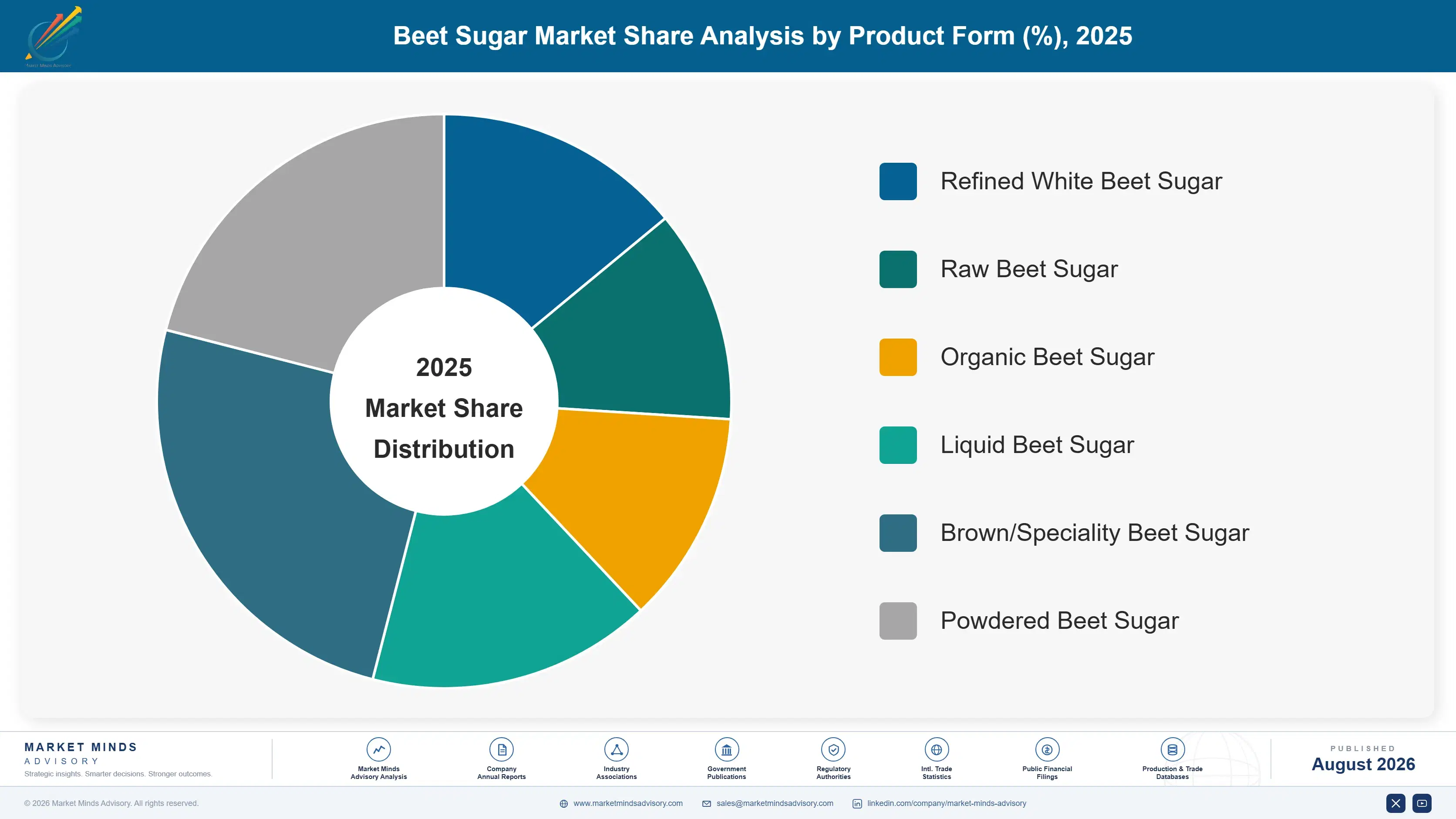
MMA segments the beet sugar market by product form rather than end-use, since processing technology and certification requirements, not the buyer's industry, determine cost structure and margin. This lens separates refined, raw, and specialty grades that share the same beet feedstock but diverge sharply in processing investment, certification cost, and price realization across food, beverage, and industrial buyers.
beet-sugar-market-trends-growth-market-share-analysis-1787462191158

Organic Beet Sugar

Organic beet sugar is the fastest-growing product form, expanding as European retailers and confectionery brands lock in certified supply ahead of Farm to Fork acreage targets. Conversion requires a three-year transition period during which yields typically run lower than conventional beet, so processors that started transition acreage early hold a durable cost advantage over later entrants. Südzücker, Cristal Union, and Pfeifer & Langen have each expanded dedicated organic processing lines since 2023 rather than co-processing on conventional equipment, since even trace cross-contamination can void certification. Demand concentrates in Germany, the Netherlands, and Scandinavia, where private-label organic bakery and confectionery lines pay a durable premium over conventional refined sugar, and buyers increasingly demand full farm-to-plant traceability documentation before signing multi-year contracts.
CAGR 7.5%

Liquid Beet Sugar

Liquid beet sugar is the second-fastest segment, pulled by beverage manufacturers converting filling lines away from dry sugar handling to cut dissolve time and reduce dust and storage costs. American Crystal Sugar and Nordzucker have both invested in dedicated liquid terminals near bottling clusters, and contracts increasingly specify delivered concentration and clarity rather than simple tonnage. Ready-to-drink tea, flavored water, and craft beverage producers are the primary adopters, since their smaller batch sizes make dry sugar handling comparatively expensive per unit produced. Growth concentrates in North America and Western Europe where bottling density is highest, though rail logistics constraints around inland plants limit how quickly liquid capacity can scale to meet contracted demand from newer regional bottlers.
CAGR 6.3%
Full segment breakdown across 6 segments available in the complete report.

Regional Architecture and Country Demand Map

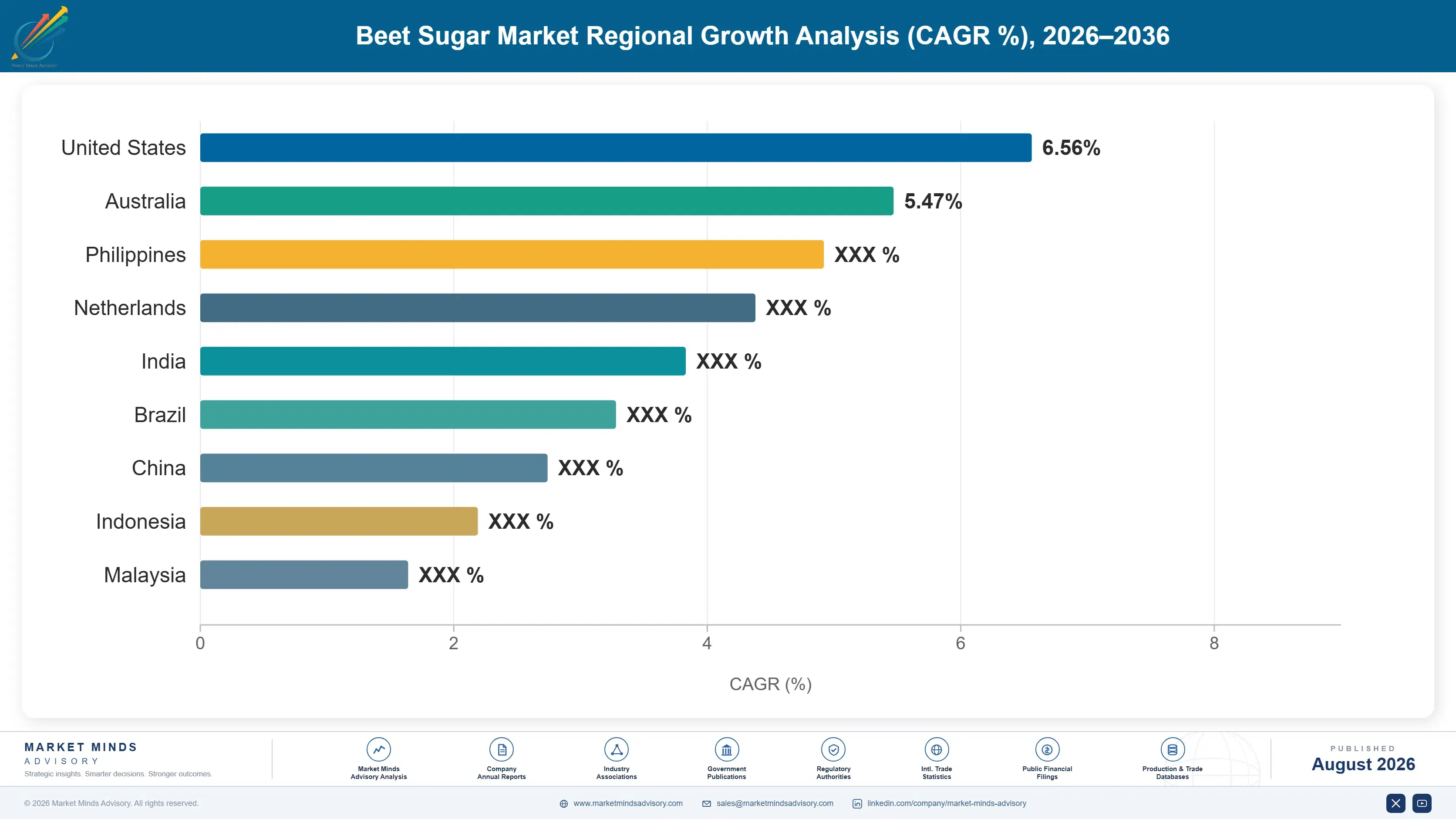
Beet sugar production concentrates across Western Europe's Franco-German core, Eastern Europe's large Russian and Polish campaigns, and North America's upper Midwest cooperatives, while East Asia, South Asia, Egypt, and Latin America add smaller but faster-growing volumes as governments pursue import substitution and food security goals.

North America

American Crystal Sugar, Michigan Sugar, Western Sugar Cooperative, and Minn-Dak Farmers Cooperative anchor a beet sugar base concentrated in the Red River Valley, the Great Lakes region, and the Rocky Mountain states. Growers there operate under federal sugar program price supports and marketing allotments that shelter domestic campaigns from the sharpest world price swings, giving cooperatives more predictable planning horizons than counterparts in deregulated markets. Liquid sugar conversion is advancing fastest here, driven by proximity to major beverage bottling clusters in the Midwest and by rail infrastructure investment completed since 2023. Grower consolidation continues as smaller family farms exit ahead of retiring equipment, concentrating acreage among larger cooperative members with deeper capital access.
Share: 22% | CAGR: 4.5% (2026 to 2036)

Western Europe

France and Germany still anchor global beet sugar output, but post-quota price exposure since 2017 has forced real consolidation among smaller cooperatives unable to absorb consecutive weak harvests. Südzücker, Tereos, Cristal Union, and Pfeifer & Langen dominate a processing base that increasingly competes on organic certification and specialty grades rather than tonnage, since Farm to Fork acreage targets reward early transition to certified organic supply. Energy costs tied to European gas markets remain a persistent input pressure on refining margins, pushing some plants toward biomass and campaign efficiency investment. Growth here trails the global average because acreage is essentially fixed and volume gains depend almost entirely on yield and grade mix rather than expansion.
Share: 25% | CAGR: 2.7% (2026 to 2036)
Regional intelligence for 5 additional markets available in the complete report: East Asia, South Asia and Pacific, Latin America, Middle East and Africa, Eastern Europe. Contact sales@marketmindsadvisory.com.
beet-sugar-market-trends-growth-country-cagr-analysis-1787462191682

Grade Mix and Specialty Contract Capture

Beet sugar processors extract more value from existing beet supply by shifting output mix rather than expanding acreage, since land and campaign length are largely fixed. The levers below concentrate on capturing premium contracts, reducing energy exposure, and monetizing co-products that many refiners still treat as waste rather than revenue streams worth defending each campaign.

Organic Certification Ahead of Competitors' Transition Timelines

Processors that began organic transition acreage before 2023 are now selling certified supply into a market where certified organic beet sugar commands a price premium of roughly 30 to 40% over conventional refined sugar, since the three-year transition window prevents late movers from catching up quickly. Südzücker and Cristal Union locked in multi-year offtake agreements with confectionery brands during this window, securing volume before competitors could offer certified tonnage. Processors without early transition acreage now face a multi-year wait before they can compete for the same premium contracts, cementing a durable first-mover advantage in this specific grade.
Market Impact: Adds a 30 to 40% price premium overall

Co-Product Monetization Through Beet Pulp and Molasses

Beet pulp pellets sold as livestock feed and molasses sold into yeast, ethanol, and specialty food applications together can add meaningfully to processor revenue per tonne of beet processed, yet many mid-sized cooperatives still price these outputs as disposal cost recovery rather than genuine product lines. American Crystal Sugar and Nordzucker both run dedicated co-product sales teams that price pulp and molasses against feed and industrial benchmarks rather than as sugar refining byproducts. Processors that professionalize co-product marketing capture an estimated 8 to 12% additional revenue per tonne of beet processed compared to those that treat it as an afterthought.
Market Impact: Adds 8 to 12% revenue per tonne processed

Liquid Format Conversion for Beverage Contract Retention

Converting a portion of dry refining capacity to liquid output lets processors sign multi-year supply contracts with beverage bottlers who increasingly specify liquid delivery to cut their own handling costs, and these contracts run longer and carry fewer renegotiation clauses than standard dry sugar agreements. The capital cost of adding liquid storage and blending infrastructure at an existing plant runs into the tens of millions of dollars, but American Crystal Sugar and Nordzucker have both recovered that investment within roughly 4 to 5 years through locked-in bottler volume. Processors without liquid capacity lose renewal bids to converted competitors nearby.
Market Impact: Cuts customer contract churn by roughly 15 to 20%

Traceability Systems for Premium Retail Private Label

Retailers in Germany, the Netherlands, and Scandinavia increasingly require batch-level traceability back to specific growing regions before awarding private-label organic and specialty sugar contracts, and processors that invested early in digital tracking systems now win a disproportionate share of these tenders. Südzücker and Pfeifer & Langen have both built farm-to-plant tracking covering the majority of their organic supply, a capability that took roughly 2 years and meaningful system investment to implement fully across multiple growing regions. Processors still relying on paper-based regional certificates are increasingly excluded from the highest-margin retail tenders regardless of the underlying sugar quality.
Market Impact: Wins roughly 20 to 25% more private label tenders

Who Controls the Margin Pool

CR5 in beet sugar sits near 38%, reflecting a market still shaped by national cooperative structures rather than global consolidation. Südzücker leads on scale and specialty diversification, with Tereos close behind through its cooperative supply base, while the gap to mid-tier challengers like Nordzucker and Pfeifer & Langen stays wide enough that further consolidation looks likely before the next campaign cycle ends.
Current competitive activity centers on three fronts: organic acreage transition timed to Farm to Fork targets, liquid format investment near beverage bottling clusters, and co-product monetization through dedicated pulp and molasses sales units. Cooperatives with cash reserves built during the 2024 price recovery are moving fastest on all three, while smaller regional players without capital access risk falling behind on certification and traceability requirements retailers now require.

Emerging pressure comes from outside the traditional European core: Egypt's Delta Sugar Company and China's COFCO Tunhe are both scaling capacity fast enough to shift where incremental global tonnage originates over the next decade. Russian producers Rusagro and Prodimex continue expanding despite trade rerouting since 2022, and their growing scale could eventually challenge Western European cooperatives on cost even without matching their specialty portfolios if world sugar prices stay soft.
beet-sugar-market-trends-growth-company-positioning-matrix-1787462192206

Competitive Moat and Risk Dimensions

SÜDZÜCKER AG

Moat: Vertically Integrated Specialty Portfolio

Südzücker's ownership of Beneo and its early organic and functional ingredient investments let it capture margin beyond raw refining, insulating group profitability from world sugar price swings that hit pure commodity refiners hardest. This diversification also gives the company negotiating leverage with retailers seeking single-supplier access across conventional, organic, and functional sugar lines at once.
SÜDZÜCKER AG

Risk: Legacy EU Cost Base

Südzücker's plants carry higher European labor and energy costs than emerging beet producers in Egypt or China, leaving group margins exposed whenever world prices dip and specialty premiums cannot fully offset commodity losses. Consolidating or closing underperforming conventional plants carries real social and political cost in France and Germany, slowing needed restructuring.
TEREOS SA

Moat: Cooperative Farmer Supply Security

As a farmer-owned cooperative, Tereos secures beet supply through member commitments rather than open market purchasing, giving it more predictable campaign volumes than investor-owned competitors during years when acreage tightens. This structure also aligns grower and processor incentives around long-term yield investment rather than short-term price arbitrage.
TEREOS SA

Risk: Cooperative Capital Constraints

Tereos's cooperative ownership limits its ability to raise external equity quickly for capacity expansion or specialty diversification compared to listed peers like Südzücker, forcing heavier reliance on retained earnings and debt during downturns. This can slow its response when competitors move fast on organic or liquid format investment.

Players Tracked

Prominent Players

Südzücker AG
Tereos SA
Nordzucker AG
AB Sugar (British Sugar)
American Crystal Sugar Company

Other Key Players

Royal Cosun
Pfeifer & Langen
AGRANA Beteiligungs-AG
Krajowa Spółka Cukrowa
Prodimex Group
Rusagro Group
Delta Sugar Company
COFCO Tunhe
Inner Mongolia Hengfeng Sugar
Michigan Sugar Company
Western Sugar Cooperative
Minn-Dak Farmers Cooperative
Amalgamated Sugar Company
Suiker Unie
Cristal Union

Recent Developments

MARCH 2025

Südzücker Expands Organic Processing Line at Zeitz Plant

Südzücker completed a capacity expansion of dedicated organic beet processing lines at its Zeitz facility in Germany, adding separate handling equipment to prevent cross-contamination with conventional beet campaigns. The expansion supports multi-year organic supply contracts signed with confectionery and bakery brands ahead of EU Farm to Fork acreage deadlines.
Signal: Confirms organic conversion has moved from pilot scale to committed multi-year capacity investment among leading European processors.
SEPTEMBER 2025

Tereos Signs Multi-Year Liquid Sugar Supply Agreement

Tereos signed a multi-year supply agreement to deliver liquid beet sugar to a major European beverage bottling group, requiring investment in dedicated liquid storage and blending capacity at two French plants. The agreement reflects growing bottler preference for liquid delivery over dry sugar to cut handling and dissolve time costs.
Signal: Signals liquid format is becoming a contractual requirement rather than an optional format for large beverage buyers.
JANUARY 2026

Delta Sugar Company Completes Nile Delta Refinery Expansion

Egypt's Delta Sugar Company completed an expansion of beet refining capacity in the Nile Delta region, part of the national program to reduce raw sugar import dependence. The expansion processes additional locally grown beet acreage that previously required export or went unprocessed during peak harvest.
Signal: Confirms Egypt's beet self-sufficiency program is shifting from acreage expansion toward matching refining capacity with harvested volume.

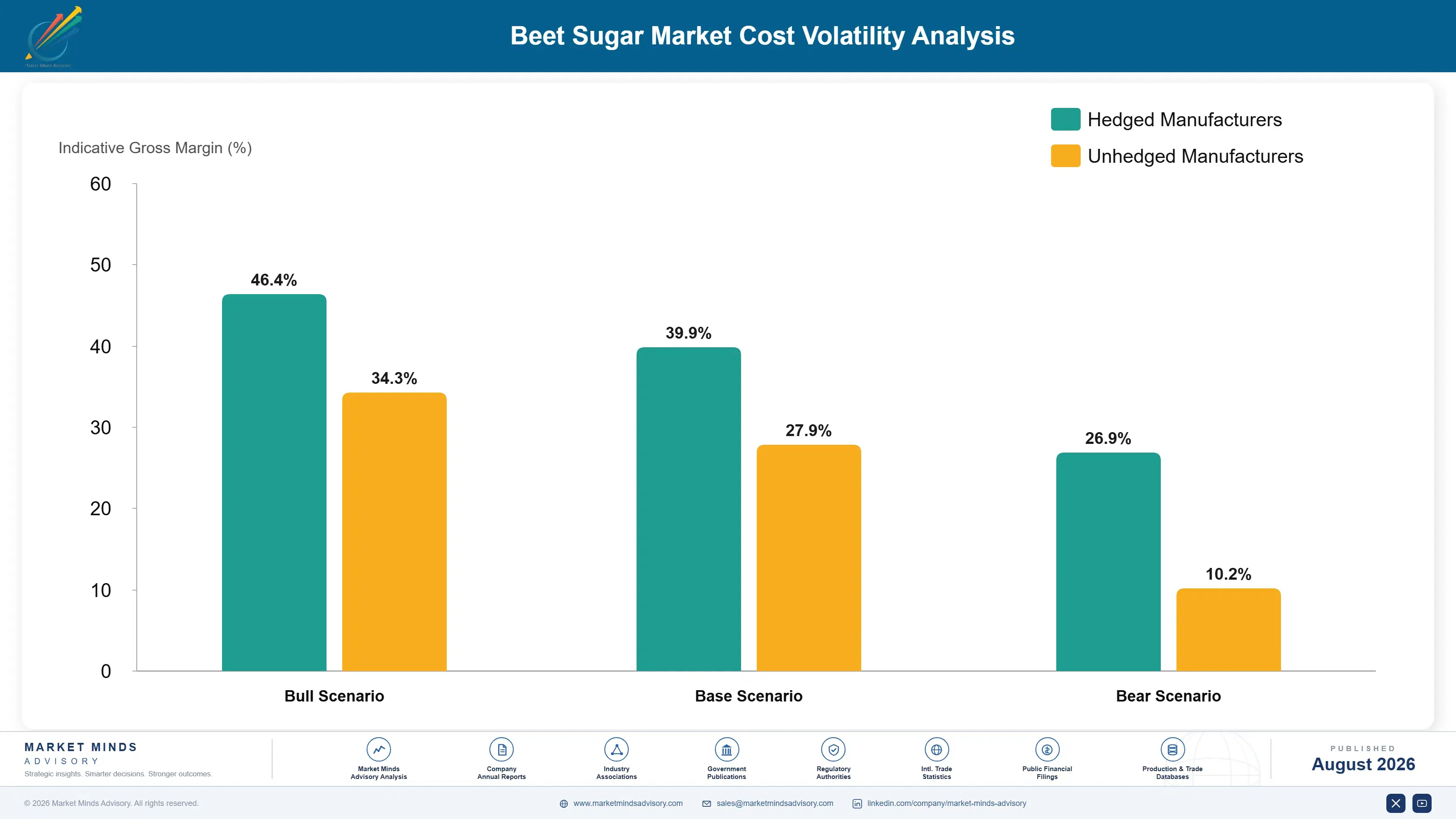
Feedstock and Energy Cost Pressure

Sugar beet root purchases account for roughly 58% of processor cost of goods sold, sourced almost entirely from domestic contracted growers rather than imported feedstock. Energy for extraction and crystallization, primarily natural gas and increasingly biomass, adds a further meaningful share of COGS, concentrated in European plants exposed to continental gas pricing rather than the more insulated North American cooperatives.
European natural gas prices spiked sharply following supply disruption after 2022, and the IEA's subsequent market reports documented sustained volatility in industrial gas costs across German and French manufacturing through 2023 and 2024. Beet processors running energy-intensive extraction campaigns absorbed meaningfully higher per-tonne processing costs during this period. Südzücker's own annual report disclosed energy cost increases as a specific drag on refining segment margins across this period.

Exposure varies sharply by geography and plant age: North American cooperatives running on cheaper domestic natural gas face materially lower energy cost pressure than European peers, while older European plants with less efficient extraction equipment absorb the heaviest impact. Smaller, undercapitalized cooperatives without cash reserves to invest in biomass conversion or efficiency retrofits face a genuine competitive disadvantage against larger, better-capitalized processors during sustained energy price spikes.
beet-sugar-market-trends-growth-cost-volatility-analysis-1787462192403

Biomass Conversion for Extraction and Crystallization Energy

Several European cooperatives are converting extraction and crystallization boilers from natural gas to biomass, often sourced from beet pulp byproduct itself, cutting exposure to volatile continental gas pricing. The conversion requires meaningful upfront capital but pays back through insulation from the sharpest seasonal price spikes documented in recent IEA industrial energy reporting each winter.

Multi-Year Fixed-Price Energy Hedging Contracts

Larger processors including Südzücker and Nordzucker increasingly lock in multi-year fixed-price energy contracts ahead of campaign season rather than buying on the spot market, trading some upside flexibility for predictable per-tonne processing cost. Smaller cooperatives without the balance sheet to commit to multi-year volumes remain more exposed to spot price spikes during winter campaigns.

Grower Price Formulas Tied to World Sugar Prices

Some cooperatives now link grower payment formulas partly to world raw sugar prices rather than fixed contracts, sharing feedstock cost risk more evenly between grower and processor. This reduces the processor's exposure to root price spikes during tight harvest years, though it also means growers absorb more downside during price collapses across weaker campaign years.

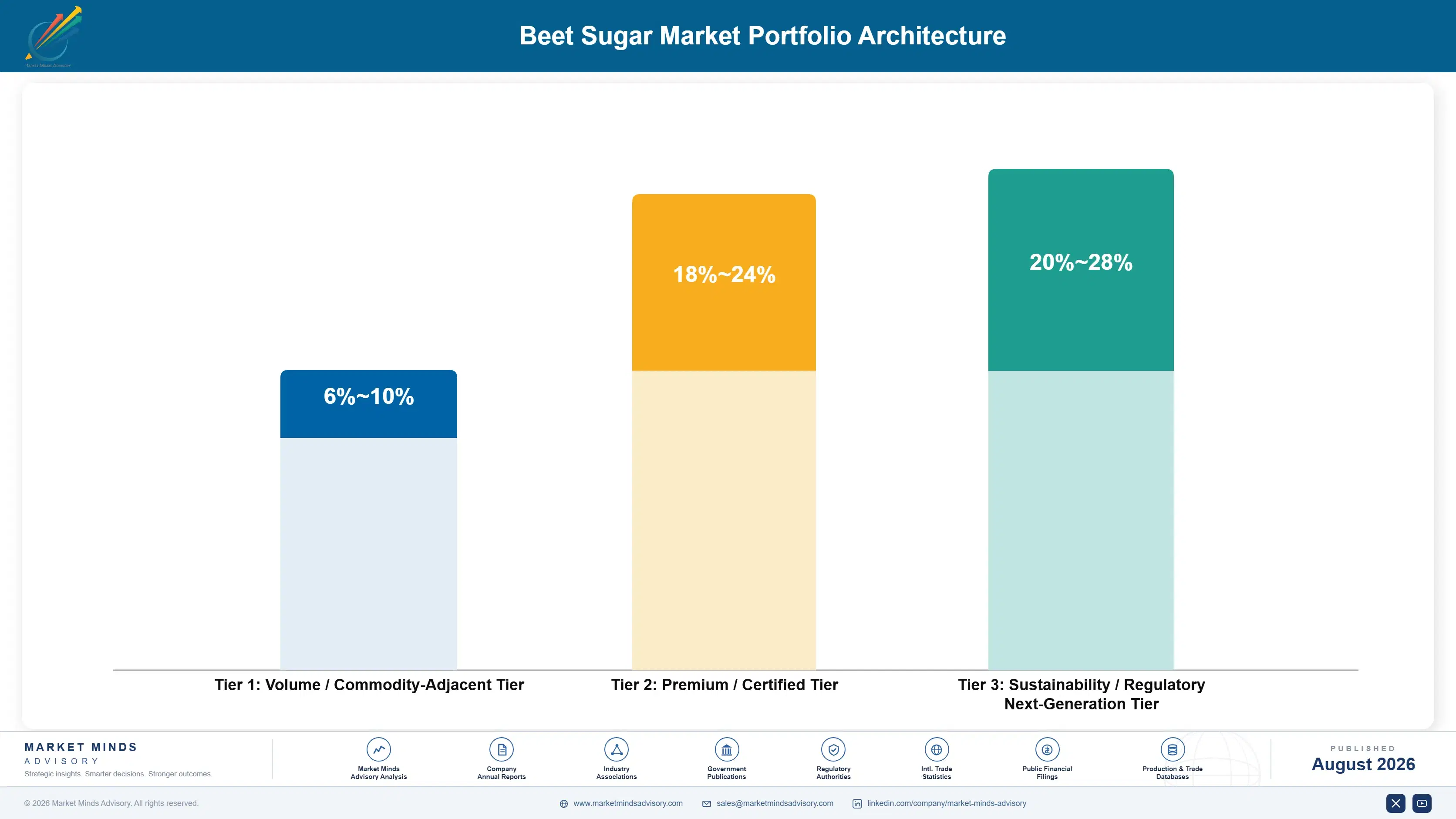
Portfolio Architecture for Margin Defence

Beet sugar portfolios split across three tiers with sharply different margin economics: a volume tier selling refined and raw sugar on tight commodity contracts, a premium tier built on organic and liquid specialty grades, and an emerging sustainability tier tied to regenerative acreage and full traceability documentation that retailers are only beginning to pay a defined premium for.
The tension between volume and premium runs deep in how cooperatives allocate scarce beet acreage: every hectare converted to organic production is a hectare unavailable for conventional supply, forcing processors to forecast premium demand years ahead given the three-year transition window. Get the allocation wrong and a cooperative either misses premium contracts or overproduces certified beet into an undersupplied conventional market, eroding margin either way regardless of which mistake gets made.

High-value margin pools concentrate overwhelmingly in organic and liquid specialty grades sold directly to confectionery brands and beverage bottlers under multi-year contracts, not in spot commodity tonnage. Processors that built specialty capacity early, Südzücker and Cristal Union among them, now capture a share of total portfolio profit well above their share of total tonnage sold in most recent campaign years.

Volume / Commodity-Adjacent Tier

Refined and raw beet sugar sold on annual or multi-year tonnage contracts to industrial food manufacturers and bulk distributors, priced close to world raw sugar benchmarks with thin processing margin above campaign cost.
Gross Margin: 6-10%

Premium / Certified Tier

Organic-certified and liquid format beet sugar sold under multi-year contracts to confectionery, bakery, and beverage brands, commanding meaningful price premiums over conventional grades in exchange for certification, traceability, and supply consistency guarantees.
Gross Margin: 18-24%

Sustainability / Regulatory / Next-Generation Tier

Regenerative-acreage and full farm-to-plant traceable beet sugar aimed at retailers and brands with public sustainability commitments, still a small volume tier but growing as EU disclosure rules push buyers to document supply chain origin more rigorously.
Gross Margin: 20-28%
beet-sugar-market-trends-growth-portfolio-architecture-1787462192910

High-value Sub-segments and Strategic Watch-out

Organic Beet Sugar (High-Value, High-Growth)

Organic beet sugar combines the fastest unit growth in the market with meaningfully above-average margins, making it the single most attractive segment for processors with transition acreage already in place. Retailer demand for certified private label continues to outpace available certified supply across Germany, the Netherlands, and Scandinavia.
Gross Margin: 18-24%

Liquid Beet Sugar (High-Value, Moderate-Growth)

Liquid beet sugar carries better margin than dry commodity sugar and continues gaining share among beverage bottlers, though growth is more moderate than organic since it depends on bottler capital cycles for conversion. Processors near bottling clusters hold a durable logistics advantage over more distant competitors.
Gross Margin: 14-18%

Refined White Beet Sugar (Volume Core)

Refined white sugar remains the largest single product form by tonnage and the backbone of processor cash flow, even though margin sits well below the specialty tiers. Nearly every cooperative depends on this volume base to fund specialty conversion investment elsewhere in the portfolio each campaign year.
Gross Margin: 6-10%

Raw Beet Sugar (Strategic Watch-Out)

Raw beet sugar sold for further refining elsewhere carries the thinnest margin in the portfolio and faces the most direct competition from imported raw cane, making it the segment most exposed to being squeezed out if import competition intensifies further in the years directly ahead.
Gross Margin: 3-6%

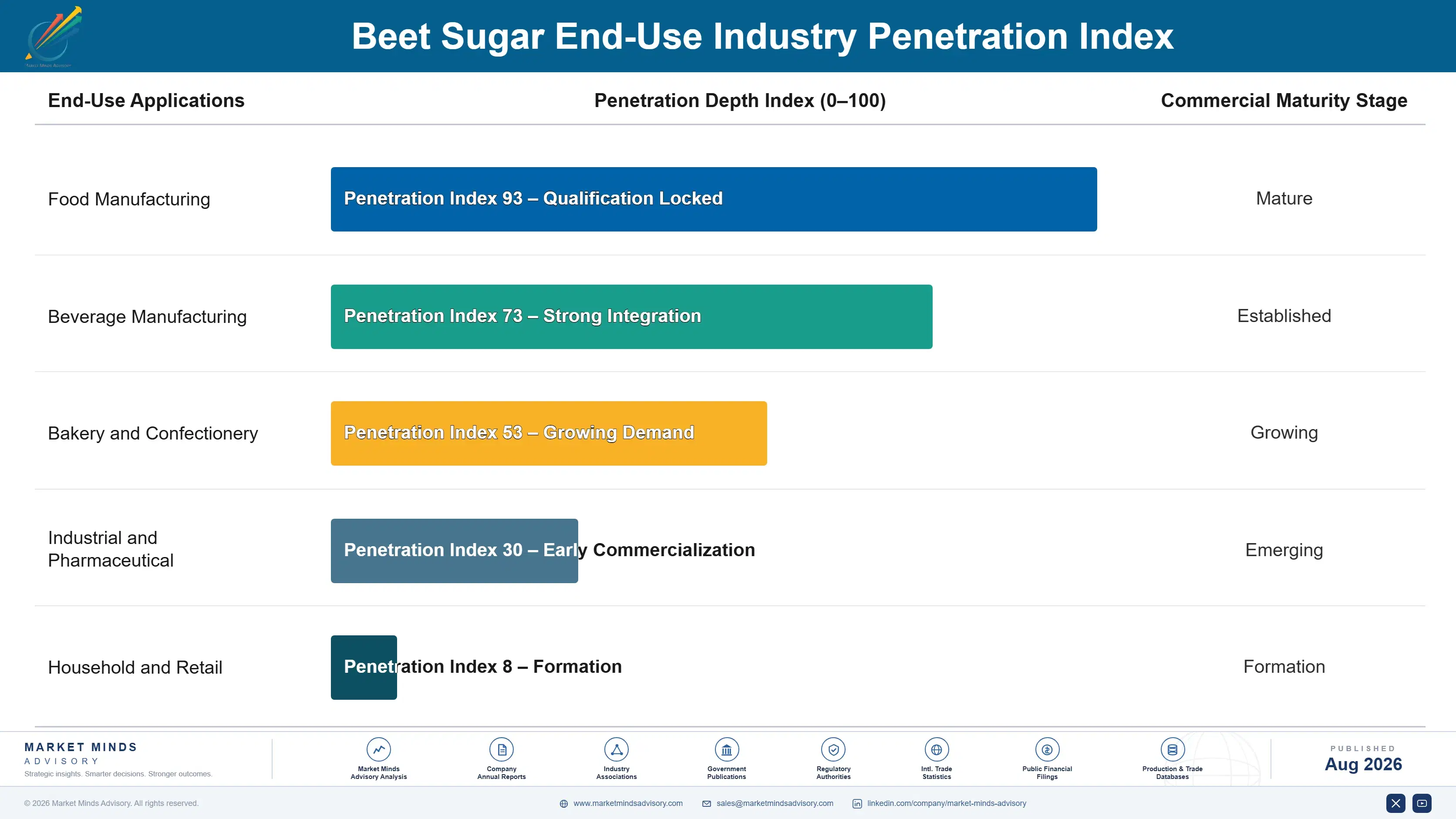
Contract Cycles and Buyer Loyalty

Beet sugar demand runs on annual and multi-year supply contracts rather than spot transactions for most industrial volume, giving processors revenue visibility a full campaign cycle ahead. Confectionery and bakery brands in particular sign multi-year agreements tied to specific certified supply, since reformulating a recipe around a different sugar source carries real product testing cost that most brands would rather avoid.
Adoption depth varies sharply by end-use vertical: beverage bottlers converting to liquid format tend to commit hardest once converted, since reverting to dry handling means idling capital equipment, while bakery and confectionery buyers stay more willing to shift suppliers if a competitor offers a meaningfully better certified price. Industrial buyers using sugar as a minor recipe input show the least loyalty of any vertical, switching readily on price alone.

A generational shift is underway among buyers too: younger procurement teams at major food and beverage brands increasingly weight traceability and certification documentation alongside price in ways their predecessors did not, rewarding processors that invested early in digital supply chain tracking regardless of whether the underlying sugar differs chemically from conventional grades in any noticeable way.
beet-sugar-market-trends-growth-end-use-penetration-index-1787462193400

Where Beet Sugar Margin Concentrates

These are among the four positions where our research anticipates prominent divergence between winners and laggards over the coming forecast period. Each is grounded in the demand model, the regulatory perimeter, and the announced capacity pipeline.
01 / SPECIALTY CONVERSION TIMING

Early organic transition acreage now locks in years of premium access

Processors that began organic transition acreage before 2023 now hold certified supply that competitors cannot quickly replicate, since the three-year transition window is fixed regardless of how much capital a late mover commits. This timing advantage matters more than raw scale, because retailers in Germany, the Netherlands, and Scandinavia are already contracting certified volume years ahead of harvest. Cooperatives without early transition acreage face a wait before they can compete meaningfully for the same premium contracts, cementing today's leaders in place through the next transition cycle.
02 / ENERGY COST RESILIENCE

European plants without energy hedges face a widening cost gap

Beet processors running older, gas-intensive extraction equipment in continental Europe face a widening cost disadvantage against North American cooperatives on cheaper domestic gas and against processors that locked in multi-year fixed-price energy contracts ahead of recent volatility across European gas markets. This gap shows up directly in campaign-level processing cost per tonne, not just in headline energy prices reported each quarter. Cooperatives that delay biomass conversion or hedging investment risk ceding cost leadership to better-capitalized competitors within the next several campaign cycles that follow.
03 / GEOGRAPHIC CAPACITY SHIFT

Egypt and China are where the next decade's incremental tonnage originates

Egypt's national self-sufficiency program and China's Xinjiang beet expansion are adding processing capacity faster than any traditional European or North American region, even though both remain smaller in absolute output than France or Russia today. This capacity is government-backed rather than purely market-driven, making it comparatively resilient to short-term world price swings that might otherwise slow private investment. Processors and input suppliers that build relationships in these regions now will be better positioned than those waiting for the shift to show up clearly in trade data.
04 / CO-PRODUCT REVENUE DISCIPLINE

Pulp and molasses monetization separates disciplined operators from the rest

Processors that treat beet pulp and molasses as genuine product lines with dedicated sales teams capture measurably more revenue per tonne of beet processed than cooperatives still pricing them as disposal cost recovery. This gap compounds across every campaign, since co-product revenue helps fund the capital investment needed for organic and liquid conversion elsewhere in the portfolio. Cooperatives that professionalize co-product sales now will have more capital available for specialty investment than peers still treating pulp and molasses as an afterthought.

Engagement Snapshot From the Field

A live engagement with an industry participant carrying material or product regulatory and market exposure ahead of a defining policy shift, showing how our research translates into a defensible multi-year portfolio strategy.
MARKET MINDS ADVISORY · CLIENT ENGAGEMENT SUMMARY
Beet Sugar Producer Strategic Portfolio Review and Transition Roadmap 2026·Investment Scenario on Beet Sugar Exposure Evaluation 2025-26
CLIENT PROFILE
The client is a mid-sized European beet sugar cooperative processing beet from several thousand member growers across two countries, with production concentrated in conventional refined sugar sold on annual industrial contracts. Revenue exceeded $600 million in the most recent campaign year (client-reported, unverified by MMA), though margins had compressed steadily as world sugar prices softened and larger competitors captured organic and liquid contract share the cooperative had not pursued.
STRATEGIC CHALLENGE
The cooperative's member growers had not begun organic transition acreage, leaving it entirely excluded from an increasingly important premium contract category that competitors had already locked up years in advance. Leadership needed to decide how quickly to commit acreage to transition, and how to fund the multi-year revenue gap during the required three-year certification window without straining member finances.
MMA APPROACH
MMA benchmarked the cooperative's cost structure against organic-converted peers, modeled the multi-year revenue gap during transition, and evaluated three acreage conversion paths ranging from conservative to aggressive against member grower cash flow tolerance. The analysis incorporated co-product revenue optimization and liquid format feasibility alongside the organic transition question, since all three levers drew on the same limited pool of capital.
KEY FINDINGS
  1. The cooperative's energy cost per tonne ran meaningfully above better-hedged European peers, eroding conventional segment margin before any organic transition investment was even considered.
  2. Co-product revenue from pulp and molasses was priced well below what comparable cooperatives achieved through dedicated sales teams, leaving meaningful revenue on the table each campaign.
  3. Member grower cash flow could support a moderate, phased organic transition covering roughly a quarter of acreage without requiring external financing beyond existing credit facilities.
  4. Competitors that began organic transition earlier already held multi-year contracts with the cooperative's largest historical customers, narrowing the window to recapture that specific volume.
CLIENT PROFILE
The client is a mid-sized European beet sugar cooperative processing beet from several thousand member growers across two countries, with production concentrated in conventional refined sugar sold on annual industrial contracts. Revenue exceeded $600 million in the most recent campaign year (client-reported, unverified by MMA), though margins had compressed steadily as world sugar prices softened and larger competitors captured organic and liquid contract share the cooperative had not pursued.
STRATEGIC CHALLENGE
The cooperative's member growers had not begun organic transition acreage, leaving it entirely excluded from an increasingly important premium contract category that competitors had already locked up years in advance. Leadership needed to decide how quickly to commit acreage to transition, and how to fund the multi-year revenue gap during the required three-year certification window without straining member finances.
MMA APPROACH
MMA benchmarked the cooperative's cost structure against organic-converted peers, modeled the multi-year revenue gap during transition, and evaluated three acreage conversion paths ranging from conservative to aggressive against member grower cash flow tolerance. The analysis incorporated co-product revenue optimization and liquid format feasibility alongside the organic transition question, since all three levers drew on the same limited pool of capital.
KEY FINDINGS
  1. The cooperative's energy cost per tonne ran meaningfully above better-hedged European peers, eroding conventional segment margin before any organic transition investment was even considered.
  2. Co-product revenue from pulp and molasses was priced well below what comparable cooperatives achieved through dedicated sales teams, leaving meaningful revenue on the table each campaign.
  3. Member grower cash flow could support a moderate, phased organic transition covering roughly a quarter of acreage without requiring external financing beyond existing credit facilities.
  4. Competitors that began organic transition earlier already held multi-year contracts with the cooperative's largest historical customers, narrowing the window to recapture that specific volume.
RECOMMENDED STRATEGY
Phase 1: Phase 1 (Year 1): Professionalize co-product sales through a dedicated pulp and molasses commercial team, funding early organic transition costs from improved co-product margin. Phase 2: Phase 2 (Years 2 to 3): Convert roughly a quarter of member acreage to organic transition, prioritizing growers closest to completing certification requirements first. Phase 3: Phase 3 (Years 3 to 4): Pursue multi-year organic and liquid supply contracts with regional bottlers and confectionery brands using newly certified volume as leverage.
OUTCOME
Within two campaign cycles, co-product revenue per tonne improved meaningfully and organic-certified acreage reached roughly a quarter of total member land. The cooperative signed its first multi-year organic supply agreement with a regional confectionery brand during the transition window itself (client-reported, unverified by MMA), narrowing the gap to earlier-moving competitors faster than leadership had expected.

Frequently Asked Questions

Foundational context covering the market sizes, CAGR, scope, country, region and competition that inform every finding below. This section is provided to cover basics and most often pre-purchase conversations, answered from the MMA Primary Research Dataset.

What is the current size of the Beet Sugar Market?

The global beet sugar market was valued at approximately $34.0 billion in 2025. This covers refined, raw, organic, liquid, and powdered beet sugar sold into food, beverage, and industrial end-uses.

How large will the Beet Sugar Market be by 2036?

MMA projects the market will reach approximately $53.4 billion by 2036, up from roughly $35.4 billion in 2026. That represents an expansion multiple of about 1.51 times over the ten-year forecast period.

What is the CAGR for the Beet Sugar Market 2026 to 2036?

The base case CAGR is 4.2% annually, with a bull scenario near 5.6% and a bear scenario near 2.8%. This range reflects sensitivity to world sugar prices and Black Sea and Thai import competition.

Which segment is growing fastest?

Organic beet sugar is the fastest-growing segment, expanding at roughly 7.5% annually, about 1.8 times the overall market's pace. Liquid beet sugar follows as the second-fastest segment at approximately 6.3% annually.

Who are the major companies in the Beet Sugar Market?

Leading players include Südzücker AG, Tereos SA, Nordzucker AG, AB Sugar (British Sugar), and American Crystal Sugar Company. Together these five hold an estimated 38% combined market concentration.

Which country is growing fastest?

Egypt is the fastest-growing national market, expanding near 8.5% annually as its Delta Sugar Company-led self-sufficiency program adds refining capacity. China's Xinjiang region follows closely as a second emerging growth center.

Report Segmentation Architecture

The full report scope spans multiple orthogonal segmentation dimensions, with cross-tabulated demand data provided for each dimension pair. Coverage extends further to regional breakdowns, trend trajectories, and the competitive detail needed to support segment-level decision-making.

By Product Form

  • Refined White Beet Sugar
  • Raw Beet Sugar
  • Organic Beet Sugar
  • Liquid Beet Sugar
  • Brown/Speciality Beet Sugar
  • Powdered Beet Sugar

By End-Use Industry

  • Food Manufacturing
  • Beverage Manufacturing
  • Bakery and Confectionery
  • Industrial and Pharmaceutical
  • Household and Retail

By Commercial Dimension

  • Direct Contract Supply
  • Retail Private Label
  • Distributor and Wholesale
  • Export Trading

By Region

  • North America
  • Western Europe
  • East Asia
  • South Asia and Pacific
  • Latin America
  • Middle East and Africa
  • Eastern Europe

Scope, Methodology, and Coverage

Every figure in this report is reproducible from documented input assumptions. The scope below maps the historical period, the forecast horizon, the segmentation dimensions, and the countries covered, alongside the underlying primary and qualitative methodology.
Historical Period
2020 to 2025
Forecast Period
2026 to 2036
Base Year
2025 (USD billions; MMA Primary Research Dataset, August 2026)
Market Definition
This report defines the beet sugar market as beet-derived sucrose in refined, raw, organic, liquid, and powdered form sold into food, beverage, and industrial end-uses globally. It excludes cane sugar, high-fructose corn syrup, and non-nutritive sweeteners, and treats beet pulp and molasses as co-product revenue outside the core market sizing.
Quantitative Units
USD billions (current prices); metric tonnes sugar equivalent where cited
Segmentation Dimensions
By Product Form; By End-Use Industry; By Commercial Dimension; By Region
Regions Covered
North America, Western Europe, East Asia, South Asia and Pacific, Latin America, Middle East and Africa, Eastern Europe
Countries Covered
USA, China, Germany, France, UK, Japan, South Korea, India, Australia, Canada, Brazil, Mexico, Indonesia, Vietnam, Thailand, Malaysia, UAE, Saudi Arabia, South Africa, Nigeria, Turkey, Poland, Netherlands, Italy, Spain, Sweden, Switzerland, Argentina, Colombia, Singapore, and additional markets relevant to this sector
Key Companies Profiled
Südzücker AG, Tereos SA, Nordzucker AG, AB Sugar (British Sugar), American Crystal Sugar Company, Royal Cosun, Pfeifer & Langen, AGRANA Beteiligungs-AG, Krajowa Spółka Cukrowa, Prodimex Group, Rusagro Group, Delta Sugar Company, COFCO Tunhe, Inner Mongolia Hengfeng Sugar, Michigan Sugar Company, Western Sugar Cooperative, Minn-Dak Farmers Cooperative, Amalgamated Sugar Company, Suiker Unie, Cristal Union
Quantitative Methodology
Primary survey, n=3,800 respondents, Q4 2025, six countries; demand-side model with trade association cross-validation
Qualitative Methodology
47 expert interviews, Q4 2025; applied to validate demand model assumptions, identify emerging dynamics, and assess competitive positioning
Report Format
PDF and XLSX data workbook (Word format preview document)
Publisher
Market Minds Advisory
Report Code
MMA-2026-AGR-101
Published
August 2026
Contact
sales@marketmindsadvisory.com | www.marketmindsadvisory.com

Purchase the full Beet Sugar Market Report (2026 to 2036).

The full Beet Sugar Market report delivers detailed sizing and forecasts across all six product-form segments, all seven world regions, and twenty profiled companies through 2036. It includes granular regional data tables, competitive benchmarking on a consistent revenue basis, and input cost sensitivity modeling tied to European energy markets. Subscribers receive access to the underlying primary survey dataset (n=3,800 respondents, Q4 2025, six countries) and qualitative expert interview findings (n=47 interviews, Q4 2025). The report also includes segment-level margin analysis and a portfolio tiering framework analysts can apply directly to company assessments.
Full segmentation across six product-form categories
Seven-region market sizing with growth forecasts
Twenty-company competitive benchmarking on consistent basis
Input cost sensitivity modeling tied to energy markets
Access to primary survey dataset of 3,800 respondents
Portfolio tiering framework for margin benchmarking

Built For The People Who Decide

From boardroom strategy to bench-side execution, this report is read cover-to-cover by leaders shaping the next decade of their industry, turning demand scenarios, market dynamics and valuation benchmarks into decisions.
CXOs/ Presidents/ VPs/ Managers
M&A and Corporate Development
Strategy Teams and R&D Heads
Procurement and Product Directors
Regulatory and Compliance Leaders
Investor Relations and Equity Analysts