Market Minds Advisory
Beet Pulp Market

Beet Pulp Market: The Byproduct Premium: How Biogas And Pectin Buyers Are Repricing A Sugar Mill Leftover

Beet pulp shifts from a low-value sugar refining byproduct into a priced dairy and ruminant feed ingredient, as fiber economics, biogas co-digestion demand, and pectin extraction interest pull value out of a stream refiners discarded.

Lead Analyst

Lisa Gevelber

Published

September 2026

Make Smarter Decisions with Customized Research Insights

Request a free sample report and evaluate market opportunities, growth trends, and competitive dynamics relevant to your business needs.

2025 MARKET VALUE$3.8BMarket Size 2025
2036 FORECAST VALUE$6.0BBase Case , 2026 to 2036
CAGR 2026 TO 20364.2 %Bull 5.4% / Bear 3.0%
INCREMENTAL OPPORTUNITY$2.0BNet 10- year value creation
EXPANSION MULTIPLE1.51x2036 value over 2026 base
Strategic Levers
M&A Pipeline
Regional Outlook
Country Rankings
Competitive Intelligence
Segmental Deep-dive
Call-Us : 91 93563 13602

Executive Snapshot and Market Trajectory

Beet pulp has quietly moved from a near-free byproduct refiners once struggled to dispose of into a fiber ingredient dairy nutritionists specify by name, as digestibility data and biogas co-digestion economics both put a genuine price on what used to be sugar mill waste.
The market stands at USD 3.8 billion in 2025 and reaches USD 5.98 billion by 2036 at a 4.2% CAGR. Pet food ingredient use grows fastest at 7.8%, about 1.86 times the overall rate, as premium pet brands specify beet pulp for digestible fiber content. Western Europe holds 26% of value on French, German, and Dutch processing scale, while Eastern Europe's Russian and Polish beet belt supplies enormous raw tonnage at lower value density.
Concentration sits at 40%, held by sugar refining majors for whom beet pulp is a co-product rather than a primary business line, which shapes pricing behavior considerably. Feed formulators increasingly specify beet pulp by fiber digestibility rather than treating it as generic roughage, and pectin extractors are starting to compete with feed buyers for the same raw stream entirely, a tension that barely existed a decade ago.
Market Definition
The beet pulp market covers dried, pressed, and molassed beet pulp derived from sugar beet processing, valued at the point of sale as animal feed, industrial pectin feedstock, or biogas substrate. It excludes raw sugar beet root sales, refined sugar and sugar beet molasses sold as a standalone sweetener, and finished pet food or compound feed products beyond the beet pulp ingredient itself.
Base Year Value
$3.8B in 2025 (MMA Primary Research Dataset, August 2026)
Forecast Period
2026 to 2036, eleven discrete annual values
CAGR
4.2% base case. Bull 5.4%. Bear 3.0%.
Fastest Growth Segment
Pet Food Ingredient Grade: 7.8% CAGR
Fastest Growth Country
Poland: 7.4% CAGR
Fastest Growth Region
South Asia and Pacific: 6.4% CAGR
Largest Region
Western Europe: 26% of 2025 global value
Market Leaders
Sudzucker AG, Tereos, Nordzucker, British Sugar, American Crystal Sugar Company. Source: MMA Analysis based on company annual reports.
Primary Survey
n=3,800 procurement and R&D decision-makers, Q4 2025, six countries
Methodology
Demand-side build-up, cross-validated against public data, 47 expert interviews

Beet Pulp Market Forecast Scenarios

beet-pulp-market-size-forecast-scenario-1787463213225
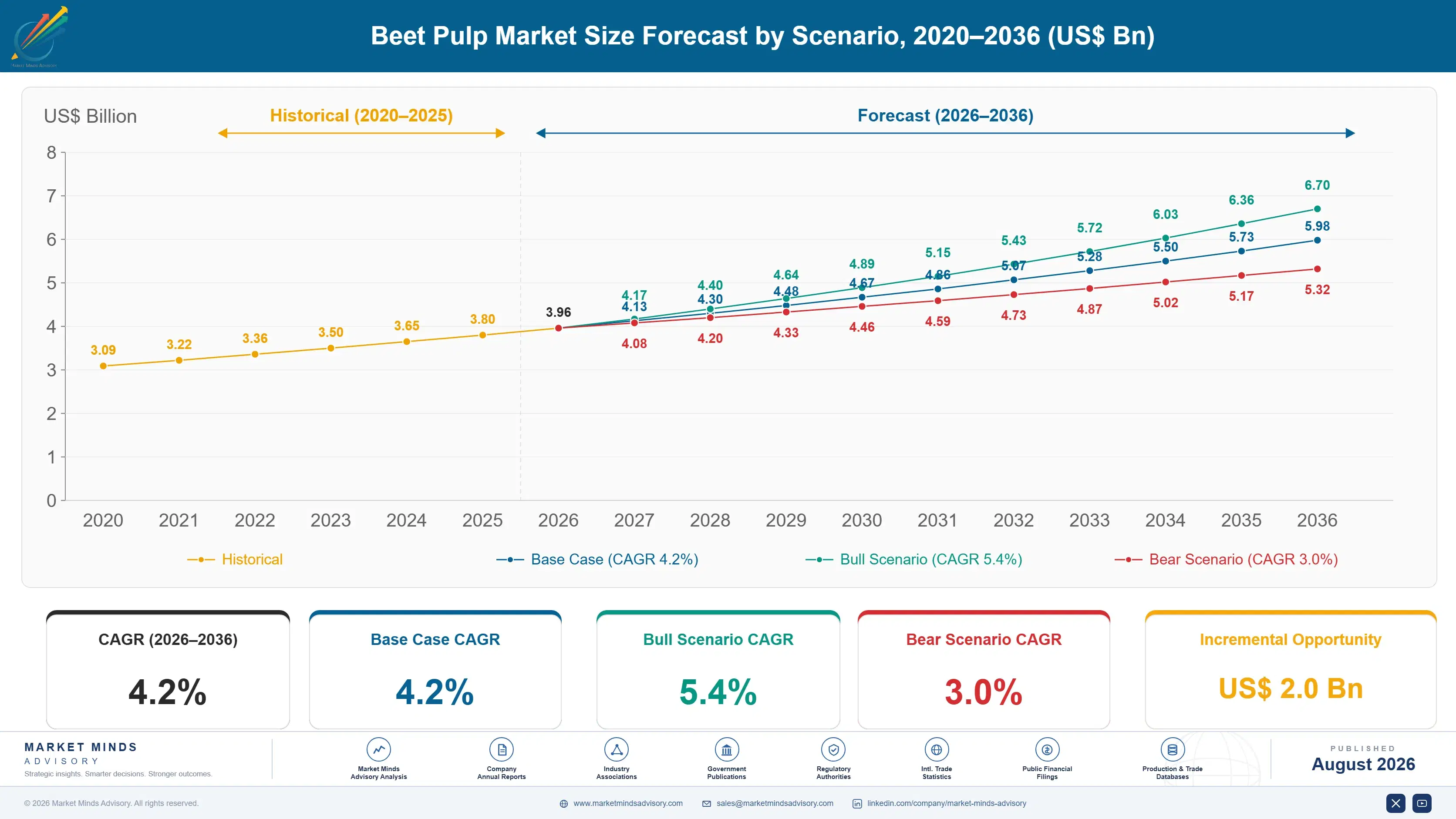
Beet pulp compounded near 3.8% from 2020 to 2025, tracking closely with sugar beet planted area and processing volume across the European Union, Russia, and the United States. Feed cost inflation after 2021 pushed livestock producers toward economical fiber sources, lifting beet pulp demand modestly faster than sugar output itself grew genuinely across the period.
Three mechanisms carry the base case to 4.2%. First, dairy and beef feed formulators are substituting beet pulp for higher-cost forage and grain as a digestible fiber source, a swap that needs no new equipment. Second, anaerobic digestion operators are contracting pressed beet pulp as biogas feedstock, competing directly with feed buyers for the same tonnage. Third, food ingredient companies are extracting beet pectin as a citrus pectin alternative, pulling a small but growing share of the raw stream into higher-value industrial use.
The bull case at 5.4% assumes biogas and pectin extraction demand both scale faster than expected, pulling raw tonnage away from feed use and lifting prices across all beet pulp forms. The bear case at 3.0% assumes European sugar beet acreage keeps contracting under quota reform and weather losses, shrinking the raw byproduct base regardless of how strong downstream demand becomes.

Why A Byproduct Now Carries A Price Floor

Three forces meet in beet pulp today. Feed cost inflation makes an inexpensive, digestible fiber source genuinely attractive to dairy and beef formulators who once treated it as filler. Anaerobic digestion operators want pressed pulp specifically for biogas feedstock, competing directly with feed buyers for the same tonnage. And food ingredient companies are extracting beet pectin as a genuine citrus pectin alternative, pulling raw material toward higher-value industrial use entirely.
MARKET CONCENTRATIONCR5: 40%Sugar refining majors treat pulp as secondary output
FEED SUBSTITUTION PRICE RATIO60% to 80% of alfalfa hay costCheaper fiber source keeps dairy rations cost competitive
TOP PRODUCING COUNTRY SHARERussia: ~19% of global tonnageRaw beet tonnage concentrates far from processing value
PELLETIZING CAPACITY UTILISATION72% to 84%Drying and pelletizing lines run near seasonal capacity
FEEDSTOCK SHARE OF COGSNear 0% (byproduct input)Raw pulp costs little; drying energy dominates instead
PECTIN EXTRACTION YIELD SHARE15% to 20% of dry matterOnly a fraction of pulp converts to industrial pectin
The commercial character remains closer to agricultural commodity trade than to specialty ingredients, since beet pulp still moves mostly in bulk pellet form priced against other roughage. Yet a genuine premium segment is emerging wherever a buyer needs a specific attribute: low sugar content for equine feed, high fiber digestibility for dairy rations, or pectin-extractable dry matter for food ingredient processors paying considerably more per tonne.
The next decade turns on how much raw tonnage biogas and pectin extraction pull away from feed use. Sugar beet acreage itself is roughly fixed by quota history and rotation economics, so growth in downstream demand increasingly means competing for the same fixed byproduct stream rather than any expansion of supply.
"Everyone used to think of beet pulp as what was left over after the sugar left. Now three different buyers want the same tonne for three different reasons, and none of them are talking to each other yet."
Director, Agricultural Byproducts and Feed Ingredients Practice · MMA Agriculture / Animal Feed and Industrial Byproduct Ingredients Practice · August 2026

Market Trends

Biogas Operators Compete Directly With Feed Buyers For Pulp

Anaerobic digestion facilities across Germany, France, and the Netherlands increasingly contract pressed beet pulp directly from sugar factories as biogas feedstock, valuing it for methane yield rather than nutritional content. This has introduced a new buyer into a market that historically had one customer type, livestock feed compounders, and pricing now reflects competing end uses rather than a single feed-value benchmark. German biogas capacity expansion under renewable energy support schemes has been the most visible driver, with several sugar factories now selling a meaningful share of pressed pulp output directly to adjacent digestion plants rather than drying it for feed.
Market Impact: Cuts ration cost 20% to 30%
Beet Pectin Emerges As A Citrus Pectin Alternative

Food ingredient companies are extracting pectin from beet pulp as a domestically sourced alternative to citrus pectin, which depends heavily on imported orange and lemon peel from a concentrated set of tropical growing regions. Beet pectin carries different gelling characteristics that suit some applications better than others, so it is emerging as a complement rather than a full substitute across most food formulations. Cosun Beet Company has been the most visible commercial developer of beet pectin extraction technology, building dedicated processing capacity in the Netherlands to serve European food and beverage manufacturers seeking a non-tropical, traceable pectin source.
Market Impact: Adds 15% to pressed pulp pricing

Market Opportunities and Growth Drivers

Dairy Formulators Substitute Beet Pulp For Costlier Forage

Feed cost inflation since 2021 has pushed dairy and beef cattle nutritionists to substitute dried beet pulp for a meaningful share of alfalfa hay and grain, since it delivers comparable digestible fiber at a considerably lower delivered cost per tonne across most feed-deficit regions. American Crystal Sugar and Western Sugar Cooperative both report growing contract volume directly with large dairy operations across the American Midwest, a shift from the historic pattern of selling into commodity feed channels through intermediaries. The substitution needs no new equipment or reformulation risk beyond standard nutritionist review.
Market Impact: Caps supply growth under 1% annually

Anaerobic Digestion Demand Pulls Pressed Pulp Into Biogas

European renewable energy targets have made biogas from agricultural residue an investable asset class, and pressed beet pulp is an attractive feedstock because it arrives already wet, requires no pre-treatment, and delivers strong methane yield per tonne compared with dedicated energy crops. German and French sugar factories increasingly locate anaerobic digestion capacity adjacent to processing plants, capturing pressed pulp before it would otherwise be dried for feed at additional energy cost. The mechanism competes directly with dairy and beef feed demand for the same tonnage, which is steadily lifting the price floor under pulp that historically had almost none.
Market Impact: Cuts premium eligible share by 25%

Market Restraints and Challenges

Sugar Beet Acreage Is Fixed By Quota And Rotation

Beet pulp supply is a function of how much sugar beet gets processed, and that acreage is constrained by EU quota history, crop rotation agronomics, and competition from more profitable row crops in some regions. The root cause is that no one grows sugar beet for its pulp; pulp is a co-product whose volume nobody can expand independently of sugar market economics. The impact is a hard ceiling on raw tonnage regardless of how strong feed, biogas, or pectin demand becomes. Some processors are responding by improving pulp yield per tonne of beet processed rather than trying to grow acreage.
Market Impact: Diverts 20% of pulp to biogas

Nutritional Variability Limits Premium Feed Positioning

Beet pulp's fiber and sugar content varies by beet variety, growing season, and how much sugar extraction leaves behind, making it harder to sell as a specified premium ingredient the way single-source grain products are marketed. The root cause is agronomic: sugar beet breeding optimizes for sugar yield, not pulp composition, since pulp has been an afterthought in variety selection. The impact falls hardest on pectin extractors and premium pet food formulators who need tighter specification tolerances than bulk livestock feed buyers require. Some processors are responding by blending lots across harvests and investing in near-infrared testing to certify batches.
Market Impact: Yields 15% to 20% pectin content
4 additional market trends, 3 additional growth drivers, and 3 additional restraints and challenges are covered in the full report. Contact sales@marketmindsadvisory.com to access the complete intelligence.

Segment CAGR and Growth Architecture

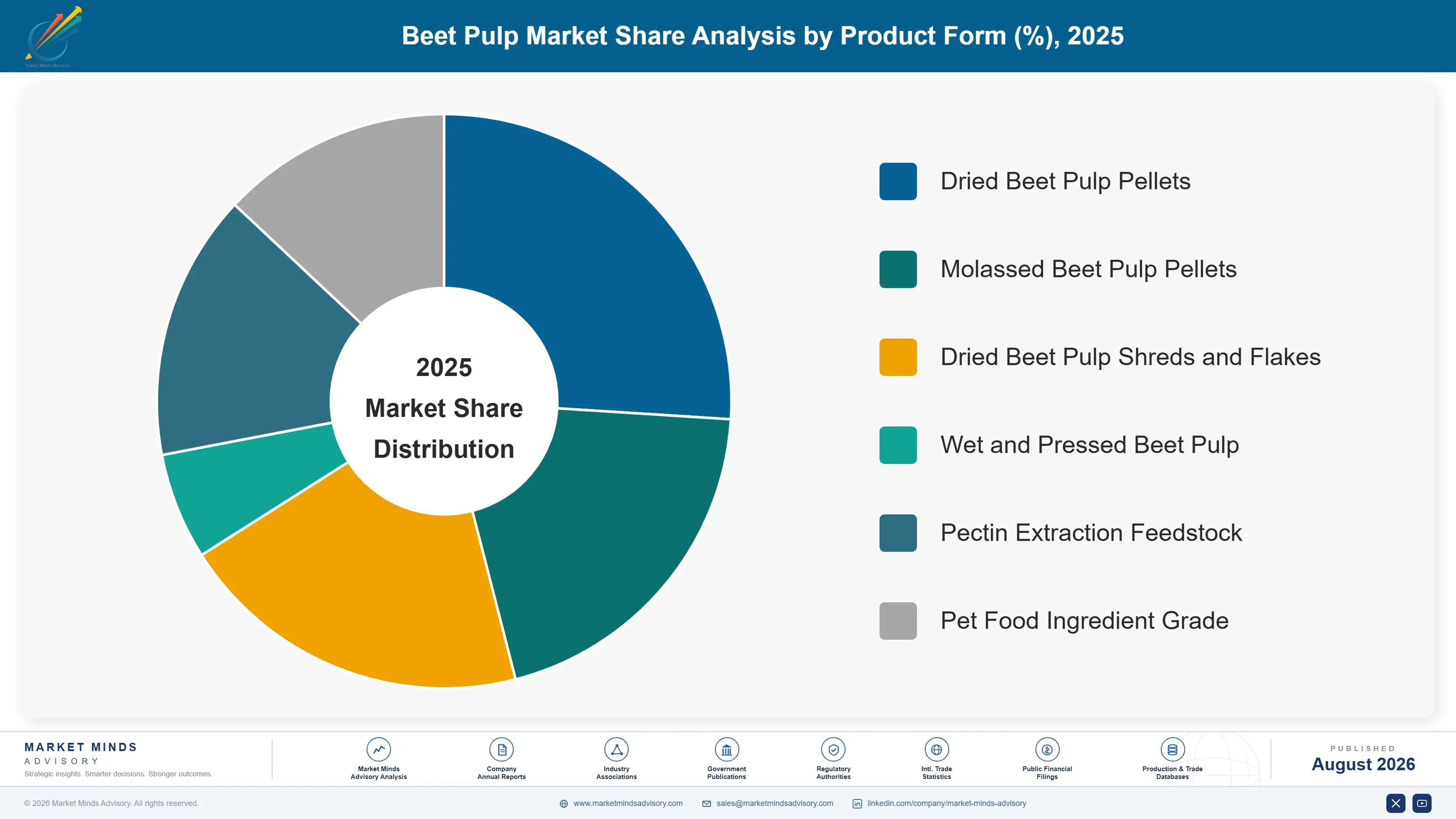
Segmentation follows product form, the single classification logic separating how beet pulp is processed and sold: dried, molassed, pressed, or diverted into pectin extraction and pet food ingredient use. Each form carries a distinct moisture content, shelf life, and buyer type. End-use industry and distribution channel are treated separately within the framework rather than folded into this hierarchy.
beet-pulp-market-market-share-analysis-1787463213753

Pet Food Ingredient Grade

Beet pulp used as a pet food ingredient grows fastest at 7.8%, about 1.86 times the overall 4.2% rate, as premium and functional dog food brands specify it by name for digestible fiber content supporting stool quality and gut health. Formulators favor beet pulp partly on cost and partly on a decades-long safety and palatability record most novel fiber ingredients lack. The segment remains small in absolute tonnage relative to livestock feed, but pet food buyers pay considerably more per tonne, since they specify tighter particle size, color, and sugar content tolerances than bulk feed compounders ask for. Mars Petcare and Nestle Purina both list beet pulp on premium formula labels, pulling specification standards upward across the supplying industry.
CAGR 7.8%

Pectin Extraction Feedstock

Beet pulp diverted into pectin extraction grows second-fastest at 6.9%, roughly 1.64 times the overall rate, as food and beverage manufacturers seek a non-tropical, traceable alternative to citrus pectin sourced from concentrated tropical growing regions. Beet pectin carries different gelling characteristics than citrus pectin, which limits it to specific applications rather than universal substitution, but those applications are growing steadily across European and North American clean-label formulations. Cosun Beet Company operates the most visible dedicated extraction capacity, processing beet pulp for pectin yield rather than drying it for feed. The economics depend on extraction technology cost, since only 15% to 20% of dry matter converts to usable pectin, leaving the remainder for feed or biogas use regardless of investment.
CAGR 6.9%
Full segment breakdown across 6 segments available in the complete report.

Regional Architecture and Country Demand Map

Western Europe leads on French, German, and Dutch processing and pelletizing scale, while Eastern Europe's Russian and Polish beet belt supplies the largest raw tonnage at lower value density. North America and East Asia diverge sharply on whether domestic sugar production runs on beet or cane.

North America

American Crystal Sugar and Western Sugar Cooperative anchor North America's 22% share, sitting at the floor of the 22 to 32% band, built on beet processing concentrated across Minnesota, North Dakota, Idaho, and the Great Plains rather than spread evenly nationwide. Dairy operations across the Upper Midwest and Pacific Northwest are the primary buyers, substituting beet pulp for higher-cost alfalfa hay as feed costs rose after 2021. Domestic sugar beet acreage has stayed roughly flat under quota and rotation constraints, so growth here tracks how much of the fixed byproduct stream shifts from export and industrial use toward higher-value domestic dairy contracts. Growth of 4.6% reflects steady substitution demand rather than any expansion of the underlying beet processing base.
Share: 22% | CAGR: 4.6% (2026 to 2036)

Western Europe

France, Germany, Belgium, and the Netherlands give Western Europe the largest single share at 26%, the top of the band, reflecting a beet processing base built over a century of EU sugar quota-supported cultivation and export-grade pellet manufacturing. Sudzucker, Tereos, and Cristal Union operate extensive pelletizing capacity built to serve export markets alongside domestic feed demand. Cosun Beet Company's pectin operations in the Netherlands add a second demand channel competing for the same raw tonnage. Growth of 2.9%, among the slowest of the seven, reflects a mature market where beet acreage is fixed and further gains depend on shifting tonnage toward higher-value pectin and biogas use rather than volume expansion.
Share: 26% | CAGR: 2.9% (2026 to 2036)
Regional intelligence for 5 additional markets available in the complete report: East Asia, South Asia and Pacific, Latin America, Middle East and Africa, Eastern Europe. Contact sales@marketmindsadvisory.com.
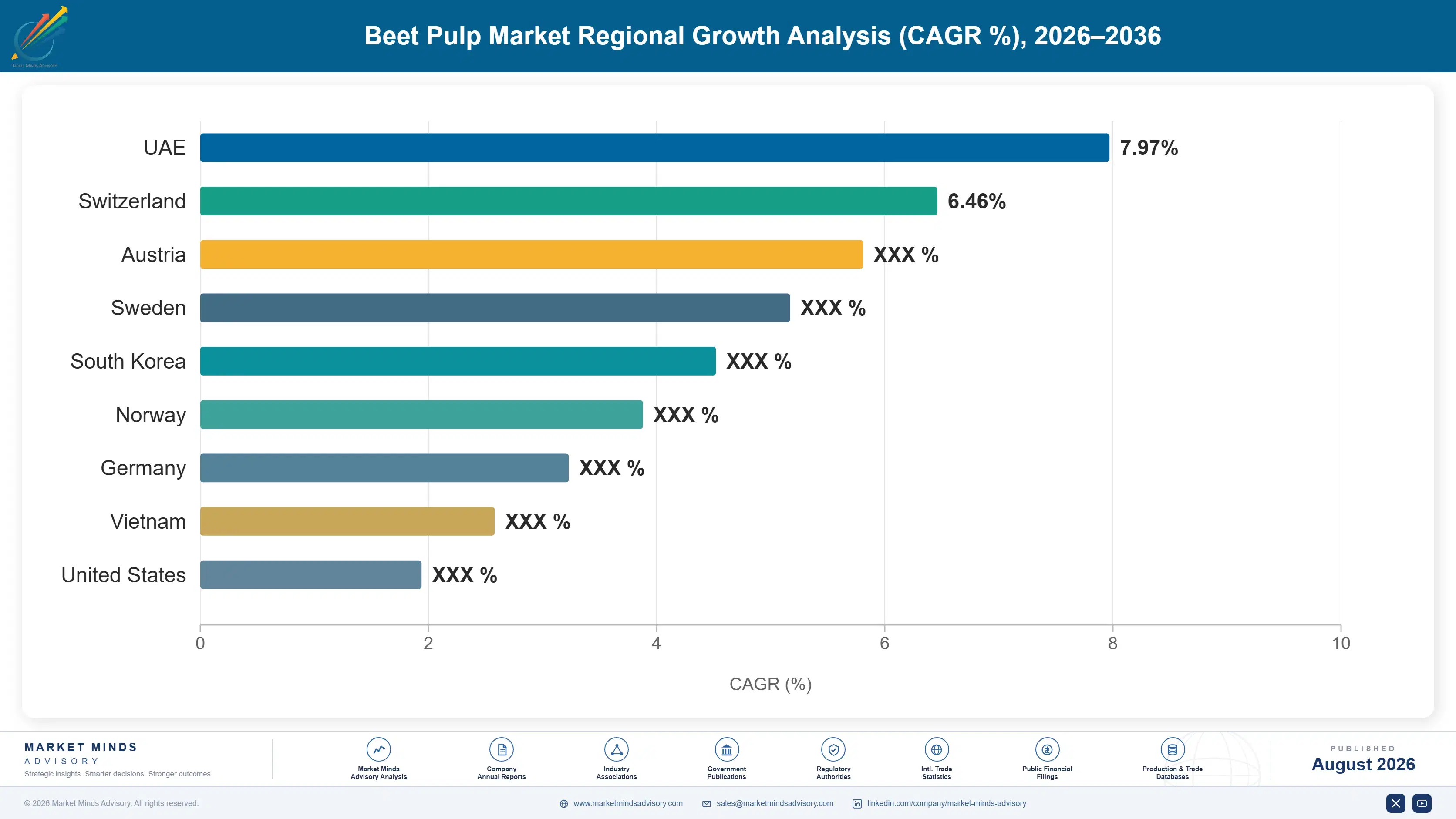
beet-pulp-market-country-cagr-analysis-1787463214276

Where Beet Pulp Sellers Capture More Value

Selling raw pressed pulp at commodity feed prices leaves real money on the table, since biogas operators, pectin extractors, and premium pet food formulators will all pay more for the same tonnage under the right conditions. The four moves below focus on drying discipline, buyer diversification, specification testing, and direct contracting that bypass commodity feed intermediaries entirely.

Sell Wet Pulp Directly To Adjacent Biogas Plants

Drying pressed beet pulp for feed consumes real energy cost that biogas buyers do not require, since anaerobic digesters want it wet and unprocessed. Selling pressed pulp directly to an adjacent digestion facility avoids drying energy cost entirely while capturing a price that increasingly competes with dried feed pellet value per tonne. German sugar factories co-located with biogas plants report processing cost running 12% to 18% below those still drying their full pressed pulp output for feed. The constraint is physical: this only works where a digestion facility sits close enough to receive wet pulp before it spoils.
Market Impact: Diverts up to 30% of pressed pulp tonnage

Certify Pulp Batches For Pectin-Grade Specification

Pectin extractors and premium pet food formulators need tighter dry matter, sugar residue, and particle consistency specifications than bulk livestock feed buyers require, and processors able to certify batches against those specifications command a genuine premium over undifferentiated pulp. Near-infrared testing at the drying stage lets a processor sort output into feed-grade and higher-specification pectin-grade or premium pet food-grade streams, typically 20% to 30% of total volume, rather than selling everything at one blended price. Cosun Beet Company built its pectin business on this discipline. The testing investment is modest relative to the price differential it captures.
Market Impact: Commands a 15% to 25% pectin-grade price premium

Contract Directly With Large Dairy Operations

Selling through commodity feed intermediaries captures a smaller share of delivered value than contracting directly with large dairy cooperatives and feedlots willing to commit to multi-year volume agreements. American Crystal Sugar and Western Sugar Cooperative have both expanded direct contracting with Midwest dairy operations, cutting out a distribution layer and capturing the 10% to 15% margin that previously went to feed brokers. Direct contracts also give processors demand visibility that supports drying and storage planning across a seasonal harvest, reducing the risk of producing pellets nobody committed to buy. The approach requires sales investment few smaller processors have made.
Market Impact: Cuts broker margin by roughly 10% to 15%

Expand Pet Food-Grade Output Where Specification Allows

Pet food formulators pay considerably more per tonne than livestock feed buyers for beet pulp meeting tighter particle size and sugar content specifications, yet most processors direct the bulk of output toward lower-value bulk feed channels by default. Building dedicated pet food-grade processing lines, even for 5% to 10% of total capacity, captures meaningfully higher margin on that portion of output without requiring any change to upstream processing. Mars Petcare and Nestle Purina both source certified beet pulp under long-term agreements rewarding processors able to meet specification. The capacity investment is small relative to feed-grade drying infrastructure already in place.
Market Impact: Commands a 30% to 50% pet food-grade premium

Who Controls the Margin Pool

Concentration sits at 40%, held by sugar refining majors for whom beet pulp is a co-product rather than a primary line, which keeps pricing more conservative than in categories built around a dedicated ingredient. All participants are assessed on one basis: attributable dried and pressed pulp volume sold into feed, biogas, and industrial channels.
Competition runs along three lines. First, drying and pelletizing scale, since larger processors spread fixed energy cost across greater tonnage and hold price below smaller regional competitors. Second, buyer diversification, as processors selling into feed, biogas, and pectin channels simultaneously capture more value per tonne than those dependent on one buyer type. Third, specification capability, where near-infrared testing increasingly separates premium suppliers from undifferentiated bulk sellers.

Pressure is building from two directions. Biogas operators are bidding pressed pulp away from feed channels in parts of Germany and France, forcing compounders to pay more for shrinking available tonnage. Meanwhile Eastern European processors, backed by Russia's raw beet tonnage, are exporting dried pellets into Western European feed markets at costs domestic processors struggle to match. Rankings should favor participants with diversified buyer relationships over those still selling everything as undifferentiated bulk feed pellets.
beet-pulp-market-company-positioning-matrix-1787463214795

Competitive Moat and Risk Dimensions

SUDZUCKER AG

Moat: Largest European processing footprint

Sudzucker operates the largest beet processing network in Europe, spanning Germany, France, Belgium, and Poland, which gives it scale to serve feed, biogas, and export pellet markets simultaneously from the same raw tonnage base. That footprint lets it shift output toward whichever channel pays best in a given season.
SUDZUCKER AG

Risk: Exposed to EU sugar policy

Sudzucker's beet processing economics remain tightly linked to European Union sugar market regulation and support levels, which have shifted meaningfully since 2017 quota liberalization. Any further policy change affecting beet acreage economics flows directly through to pulp volume and pricing, a dependency smaller diversified competitors do not carry to the same degree.
TEREOS

Moat: Integrated pectin extraction capability

Tereos has invested in pectin extraction and higher-value ingredient processing alongside traditional feed pellet production, capturing margin further up the value chain than processors selling only bulk dried pulp. This diversification reduces its dependence on livestock feed pricing cycles that squeeze single-channel competitors hardest during downturns.
TEREOS

Risk: Cooperative structure limits capital speed

As a farmer-owned cooperative, Tereos faces governance and capital allocation processes slower than investor-owned rivals when funding large processing or extraction capacity investments. That structure has occasionally left it responding to biogas and pectin demand shifts after more nimbly capitalized competitors had already moved decisively.

Players Tracked

Prominent Players

Sudzucker AG
Tereos
Nordzucker
British Sugar
American Crystal Sugar Company

Other Key Players

Cristal Union
Pfeifer & Langen
Agrana
Royal Cosun
Michigan Sugar Company
Western Sugar Cooperative
Minn-Dak Farmers Cooperative
The Amalgamated Sugar Company
Suedzucker Polska
Krajowa Spolka Cukrowa
Turkiye Seker Fabrikalari
Sucden
Nordic Sugar
COFCO Tunhe
Belarusian Sugar Company

Recent Developments

MARCH 2024

Cosun Beet Company expands pectin extraction capacity in the Netherlands

Cosun Beet Company announced an organic expansion of its beet pectin extraction line at its Dutch facility, adding capacity to meet demand from European food and beverage manufacturers seeking non-tropical pectin sourcing. This was an organic expansion funded from existing cooperative operations, not an acquisition or joint venture.
Signal: Capacity investment in pectin extraction shows processors chasing higher-value industrial demand rather than staying a pure feed ingredient supplier.
NOVEMBER 2023

Sudzucker's BENEO unit expands beet ingredient processing in Belgium

Sudzucker's ingredient subsidiary BENEO announced continued investment in its Belgian beet processing facility, expanding capacity for functional ingredients derived from sugar beet alongside standard pulp and pellet output. This was an organic capacity expansion within an existing subsidiary relationship, not a new acquisition or joint venture.
Signal: Ingredient-grade investment inside a traditional beet processor signals the category moving beyond commodity feed pellets toward specialty output.
JULY 2024

American Crystal Sugar expands direct dairy contracting programme

American Crystal Sugar Company expanded its direct pressed and dried beet pulp supply contracts with Upper Midwest dairy cooperatives, reducing reliance on commodity brokers for a growing share of its pulp output. This was an organic commercial expansion of existing operations, not an acquisition or joint venture.
Signal: Direct dairy contracting that bypasses brokers signals processors capturing distribution margin previously ceded entirely to intermediaries.

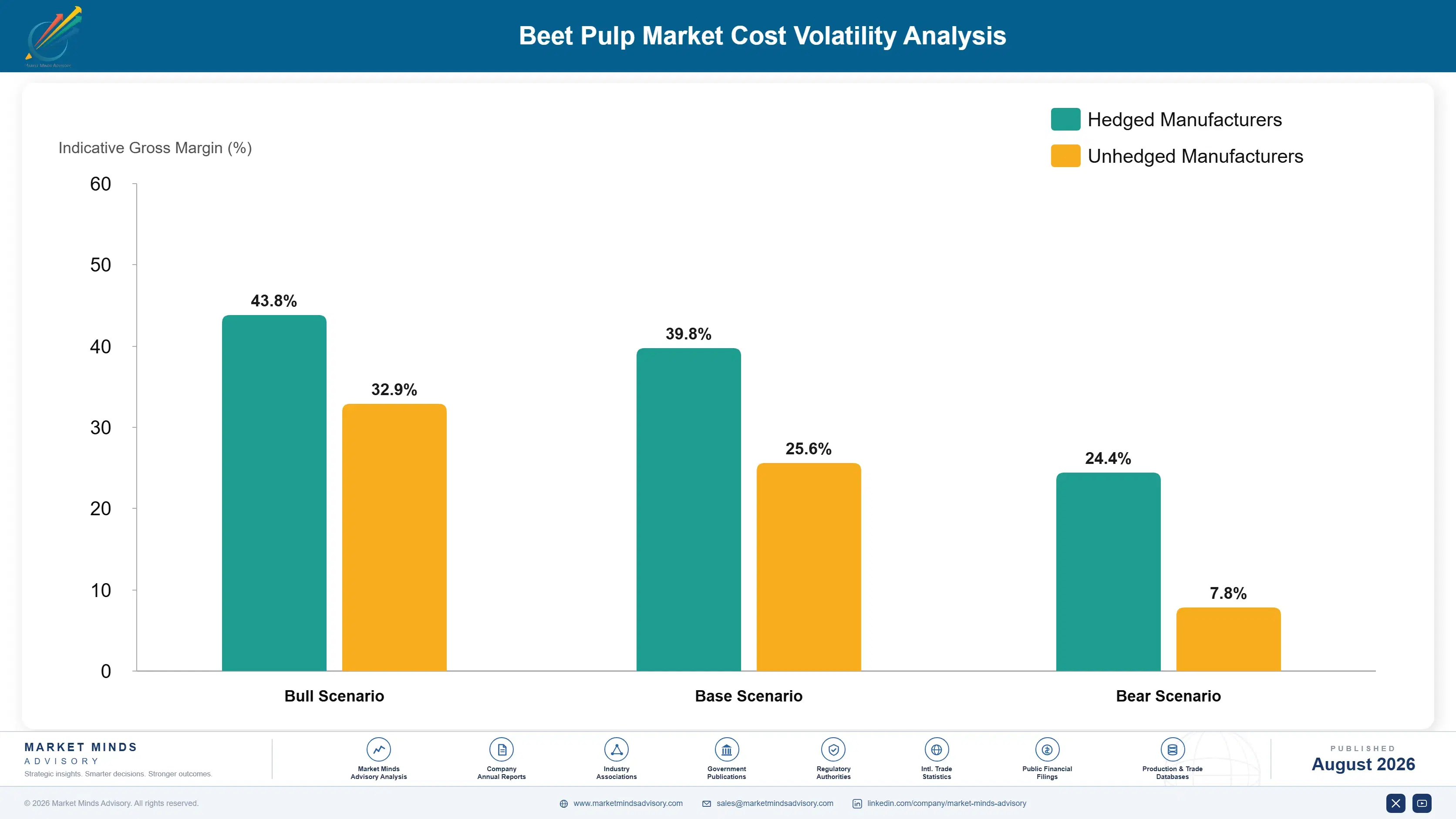
Drying Energy And Beet Acreage Exposure

Beet pulp itself carries almost no feedstock cost, since it arrives as a byproduct of sugar extraction already paid for by the sugar revenue stream. Drying and pelletizing energy instead dominates cost structure, running 55% to 70% of processing cost, sourced from natural gas and electricity supplied to factories concentrated across the European beet belt, the American Midwest, and Russia's black soil growing region.
European natural gas prices spiked sharply through 2022 following disruption of Russian pipeline supply, and sugar beet processors, whose drying runs intensively during the autumn campaign, faced some of the sharpest energy cost increases of any European agricultural processing sector. Sudzucker's 2022 Annual Report documented materially higher energy cost passing through to pelletizing operations, with several smaller processors temporarily cutting drying volume and selling more pulp wet rather than absorbing full drying cost.

Exposure separates processors by energy source and contract structure rather than by scale alone. Processors with long-term fixed-price gas contracts or on-site biogas generation from pressed pulp absorbed the 2022 spike far better than those buying spot gas. Eastern European and Russian processors, generally facing lower domestic energy cost, held a landed cost advantage over Western European competitors throughout the crisis.
beet-pulp-market-cost-volatility-analysis-1787463214990

Contract drying energy on long-term fixed-price terms

Spot natural gas exposure hit Western European processors hardest during the 2022 price spike, while competitors holding multi-year fixed-price supply contracts absorbed the shock considerably better across their full campaign. Locking energy pricing ahead of the autumn drying campaign converts the largest cost line into a plannable one rather than a seasonal gamble on volatile gas markets.

Generate on-site biogas from a share of pressed pulp

Diverting a modest share of pressed pulp into on-site anaerobic digestion generates biogas that can offset a meaningful share of drying energy needs each season, reducing exposure to external gas markets considerably. Several German processors have already adopted this approach, converting what would otherwise be a pure cost exposure into a genuine partial energy hedge.

Sell more volume wet or pressed during energy spikes

Selling pressed pulp wet to nearby biogas or feed buyers during periods of high drying energy cost avoids that cost entirely, at the expense of some value per tonne relative to dried pellets. Processors with flexible drying schedules can shift volume between wet and dried sale depending on which economics favor them in a given season.

Portfolio Architecture for Margin Defence

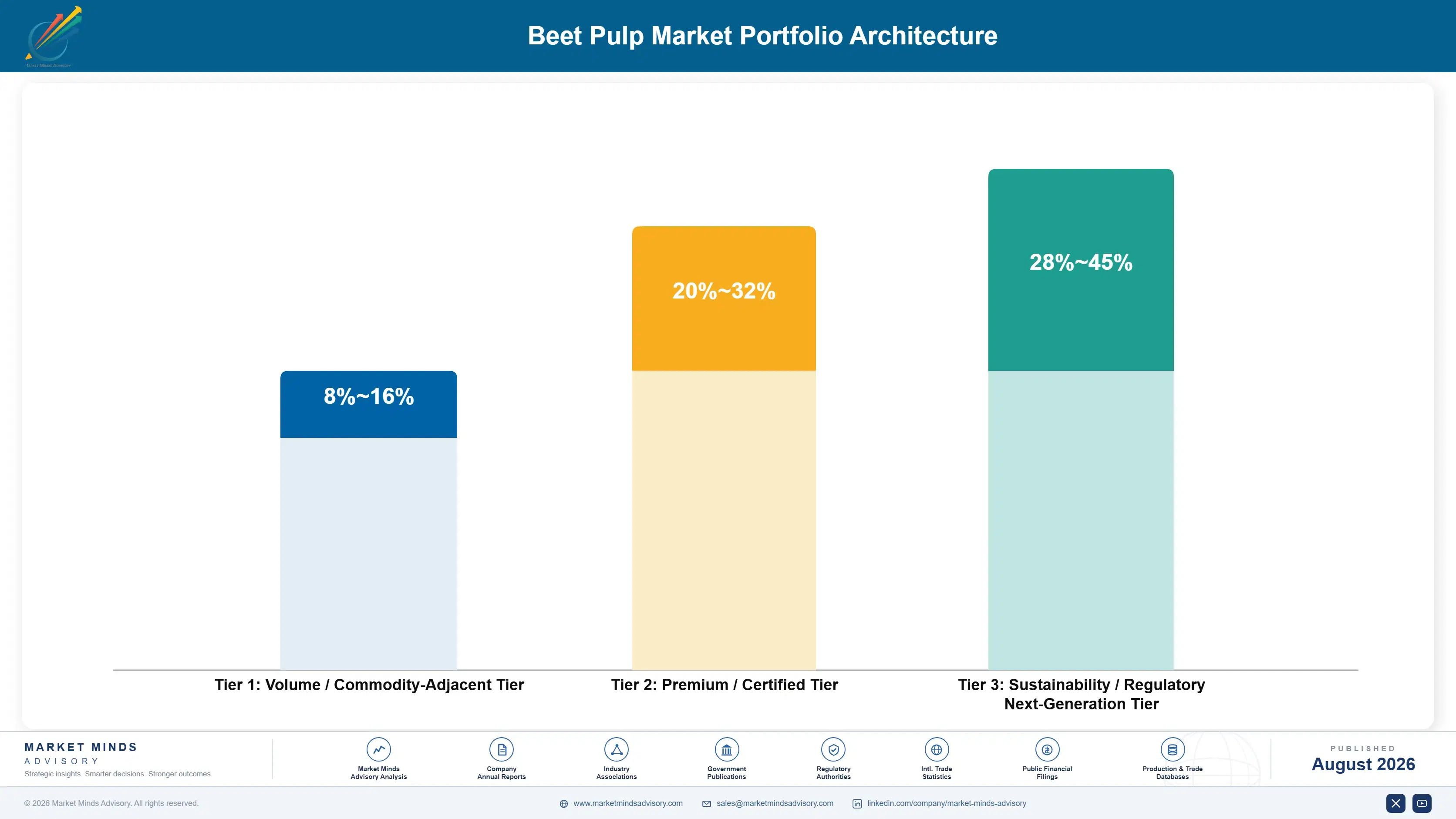
The portfolio splits into three tiers by how much processing and specification separate a batch from raw byproduct. Bulk dried or pressed pulp sold as generic livestock feed competes almost entirely on price against other roughage. Specification-certified pulp sold into premium pet food or dairy ration channels earns considerably more. Pectin-grade and biogas-optimized pulp sit at the top, priced against industrial ingredient and renewable energy economics rather than feed benchmarks.
The tension runs between volume that keeps drying lines running through a short autumn campaign season and margin that rewards specification investment. Bulk feed sales absorb most output and fund plant operations but earn thin margins that barely cover drying energy cost in a high-gas-price year. Premium and industrial-grade volume carries the returns but depends on testing infrastructure and buyer relationships smaller processors often lack. Producers weighting entirely toward bulk feed carry real exposure to energy cost swings.

High-value pools concentrate wherever a buyer needs a specific attribute: pectin-grade dry matter content, pet food-grade particle and sugar specification, or biogas-ready wet pulp delivered on a tight schedule. Generic bulk feed pellets sold into commodity livestock channels compete on price alone and generally earn the thinnest margin across the category.

Volume / Commodity-Adjacent Tier

Bulk dried and pressed beet pulp sold as generic livestock feed, priced against alfalfa hay and other roughage on a fiber-content basis. Margins stay thin because drying energy cost consumes most of the price premium over unprocessed byproduct.
Gross Margin: 8-16%

Premium / Certified Tier

Specification-certified pulp sold into premium pet food and dairy ration channels, commanding a real premium because buyers pay for consistent particle size, sugar content, and digestibility documentation rather than generic fiber alone.
Gross Margin: 20-32%

Sustainability / Regulatory / Next-Generation Tier

Pectin-grade and biogas-optimized pulp sold into industrial ingredient extraction or renewable energy generation, priced against specialty ingredient and energy economics given the genuine processing investment required to reach this grade.
Gross Margin: 28-45%
beet-pulp-market-portfolio-architecture-1787463215487

High-value Sub-segments and Strategic Watch-out

Pet Food Ingredient Grade

High value and the fastest growth at 7.8%, driven by premium pet food brands specifying beet pulp by name for digestible fiber content supporting gut health. Mars Petcare and Nestle Purina both source it under long-term agreements rewarding processors able to meet tight specification consistently.
Gross Margin: 30-50%

Pectin Extraction Feedstock

High value with strong growth at 6.9%, serving food and beverage manufacturers seeking a non-tropical, traceable alternative to citrus pectin sourced from concentrated tropical growing regions. Cosun Beet Company leads dedicated extraction capacity, though only 15% to 20% of dry matter converts to usable pectin.
Gross Margin: 28-45%

Dried Beet Pulp Pellets

The volume core at 3.6% growth, the slowest of the six segments, built on decades of established livestock feed demand and export pellet infrastructure across Europe and North America alike. Growth now tracks broader feed market expansion rather than outpacing it meaningfully at all today.
Gross Margin: 8-16%

Molassed Beet Pulp Pellets

The strategic watch-out at 3.2% growth, constrained by sugar-reduction feed trends and rising molasses input cost that squeeze margin on an otherwise mature, low-differentiation product. Gradual substitution by plain dried pulp across most Western feed markets is steadily eroding what was once the category's default bulk form entirely.
Gross Margin: 10-18%

Why Beet Pulp Contracts Stay Sticky

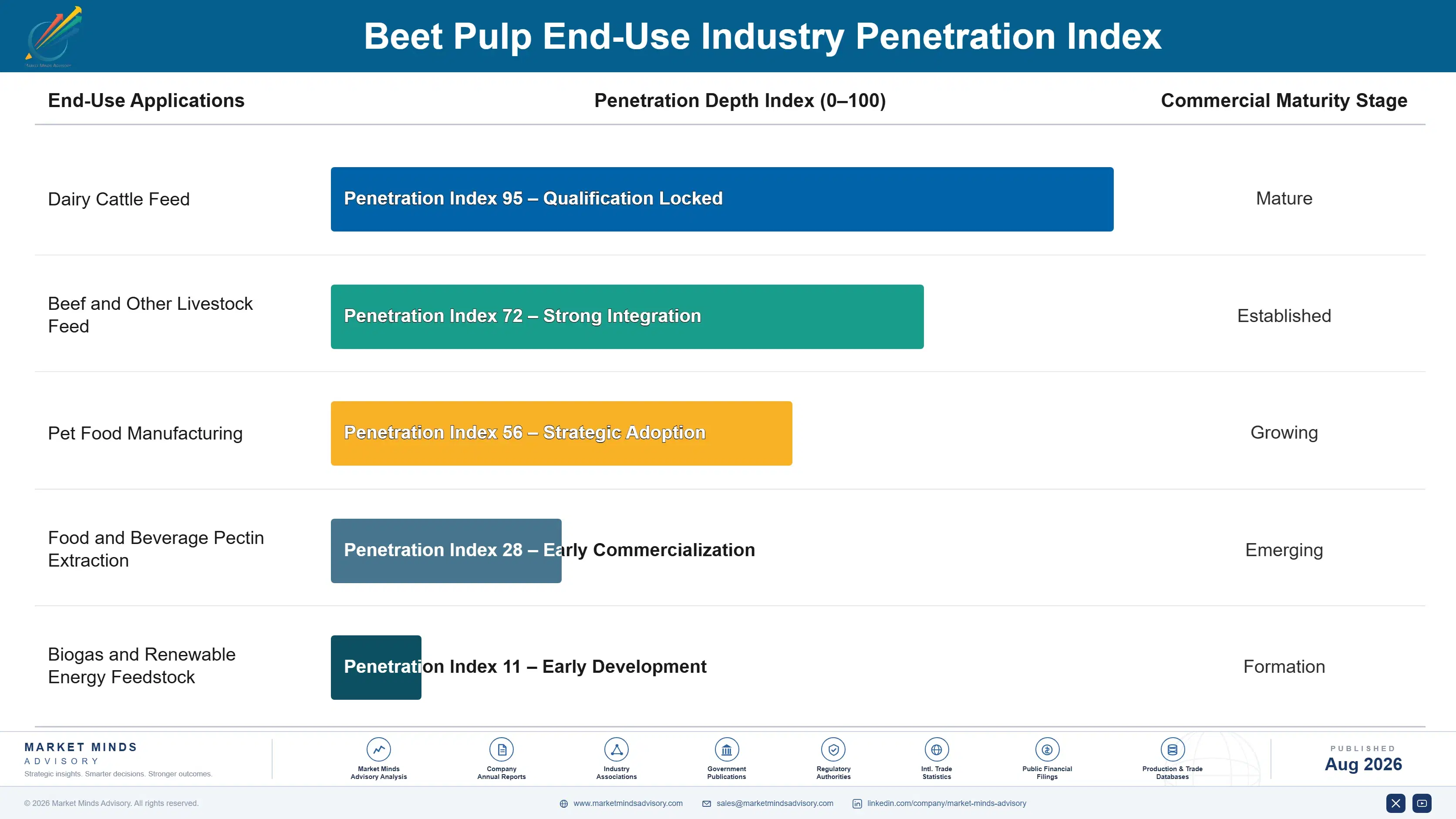
A dairy or pet food formulator who validates a ration around a specific processor's beet pulp specification rarely switches suppliers casually, since doing so means re-running palatability and digestibility testing and risking a nutrition label change. That switching cost behaves like an annuity for incumbent processors holding a certified relationship, converting a single qualification win into years of recurring volume rather than a one-time spot sale.
Adoption depth varies by vertical. Livestock feed adopted deepest and earliest, since beet pulp has decades of established use and nutritionist familiarity behind it. Pet food formulation follows with tighter specification requirements but comparably durable relationships once qualified. Pectin extraction and biogas use are earlier-stage, with buyers still qualifying multiple suppliers rather than committing to single-source contracts. Mainstream human food applications beyond pectin remain shallow, held back by limited consumer awareness of beet pulp as an ingredient.

Buyer profiles have shifted from feed brokers trading pulp as undifferentiated commodity toward nutritionists and procurement specialists who specify it by digestibility and particle characteristics directly. Younger sustainability-focused buyers increasingly value beet pulp's byproduct-valorization story alongside its nutritional profile, a framing that barely existed when the category was still being sold purely on price.
beet-pulp-market-end-use-penetration-index-1787463215974

Our Call On Beet Pulp

These are among the four positions where our research anticipates prominent divergence between winners and laggards over the coming forecast period. Each is grounded in the demand model, the regulatory perimeter, and the announced capacity pipeline.
01 / BYPRODUCT SUPPLY IS FIXED

Three buyers now compete for one fixed tonnage

Beet pulp supply tracks sugar beet acreage exactly, and that acreage is essentially fixed by quota history, crop rotation agronomics, and competition from more profitable row crops in most growing regions. Feed compounders, biogas operators, and pectin extractors are now bidding for the same physical tonnage rather than each drawing from separate supply. Processors should treat buyer diversification and specification testing as the primary strategy for capturing this fixed-supply dynamic, since expanding raw tonnage itself is simply not an available lever.
02 / BIOGAS SETS NEW FLOOR

Pressed pulp increasingly prices against energy, not feed

German and French biogas operators are contracting pressed beet pulp directly from sugar factories, valuing it for methane yield rather than nutritional content, which is steadily lifting the price floor under a byproduct that historically had almost none at all. Feed compounders can no longer assume pulp availability at pure commodity feed pricing in regions with meaningful digestion capacity nearby. Processors located near biogas infrastructure should actively price pressed pulp against energy value rather than defaulting to legacy feed-only benchmarks that no longer hold.
03 / EASTERN EUROPE LEADS VOLUME

Russia's raw beet tonnage reshapes where value actually sits

Russia's position among the world's largest sugar beet producers by raw tonnage gives Eastern Europe 20% of category value, far above what its processing sophistication or export infrastructure alone would suggest. Western European processors still lead on pelletizing scale, specification capability, and pectin extraction value-add, so the region's real strength is volume rather than margin. Buyers seeking lowest delivered cost per tonne should look toward Russian and Polish supply, while buyers needing certified specification should still look toward Western European processors.
04 / SPECIFICATION TESTING CAPTURES PREMIUM

Certified batches earn considerably more than bulk pellets

Pectin extractors and premium pet food formulators pay considerably more per tonne for beet pulp meeting tighter dry matter, sugar residue, and particle consistency specifications than bulk livestock feed buyers ever require of a supplier. Near-infrared testing at the drying stage lets a processor sort output into differentiated grades rather than selling everything at one blended commodity price. Processors without testing infrastructure should treat it as a near-term capital priority, since the price differential it captures easily justifies the modest investment required to build it.

Engagement Snapshot From the Field

A live engagement with an industry participant carrying material or product regulatory and market exposure ahead of a defining policy shift, showing how our research translates into a defensible multi-year portfolio strategy.
MARKET MINDS ADVISORY · CLIENT ENGAGEMENT SUMMARY
Beet Pulp Producer Strategic Portfolio Review and Transition Roadmap 2026·Investment Scenario on Beet Pulp Exposure Evaluation 2025-26
CLIENT PROFILE
A European dairy cooperative feed procurement group representing several hundred member farms engaged MMA while reassessing its roughage sourcing strategy amid rising alfalfa hay and grain costs. The client reported annual feed procurement spend near USD 340 million and sourced beet pulp from four regional processors under short-term spot contracts, with leadership seeking a lower-cost, reliably available fiber alternative (client-reported, unverified by MMA).
STRATEGIC CHALLENGE
Management could not determine whether to commit to multi-year direct contracts with a smaller number of processors or continue spot purchasing across several suppliers for pricing flexibility. Direct contracts promised price stability and supply certainty but risked losing negotiating leverage, while spot purchasing left the cooperative exposed to seasonal price spikes during the autumn processing campaign when energy costs and biogas demand both peak simultaneously.
MMA APPROACH
MMA modeled delivered cost under both strategies across a five-year horizon, incorporating processor-level drying energy exposure, historical spot price volatility during the autumn campaign, and competing biogas and pectin demand at each candidate processor's facilities. We benchmarked contract terms across six regional processors and assessed which held the energy hedging and buyer diversification that would keep pricing most stable for the cooperative.
KEY FINDINGS
  1. Spot purchasing exposed the cooperative to price spikes averaging 18% above contracted rates during three of the past five autumn campaigns (client-reported, unverified by MMA).
  2. Two of six processors screened held on-site biogas generation from their own pressed pulp, insulating them from the energy volatility that drove spot price spikes elsewhere.
  3. Multi-year direct contracts with two processors would have saved roughly USD 6 million annually against historical spot purchasing costs (client-reported, unverified by MMA).
  4. Processors without energy hedging showed a much wider bid-price range during the 2022 gas crisis than those holding fixed-price supply contracts throughout that period.
CLIENT PROFILE
A European dairy cooperative feed procurement group representing several hundred member farms engaged MMA while reassessing its roughage sourcing strategy amid rising alfalfa hay and grain costs. The client reported annual feed procurement spend near USD 340 million and sourced beet pulp from four regional processors under short-term spot contracts, with leadership seeking a lower-cost, reliably available fiber alternative (client-reported, unverified by MMA).
STRATEGIC CHALLENGE
Management could not determine whether to commit to multi-year direct contracts with a smaller number of processors or continue spot purchasing across several suppliers for pricing flexibility. Direct contracts promised price stability and supply certainty but risked losing negotiating leverage, while spot purchasing left the cooperative exposed to seasonal price spikes during the autumn processing campaign when energy costs and biogas demand both peak simultaneously.
MMA APPROACH
MMA modeled delivered cost under both strategies across a five-year horizon, incorporating processor-level drying energy exposure, historical spot price volatility during the autumn campaign, and competing biogas and pectin demand at each candidate processor's facilities. We benchmarked contract terms across six regional processors and assessed which held the energy hedging and buyer diversification that would keep pricing most stable for the cooperative.
KEY FINDINGS
  1. Spot purchasing exposed the cooperative to price spikes averaging 18% above contracted rates during three of the past five autumn campaigns (client-reported, unverified by MMA).
  2. Two of six processors screened held on-site biogas generation from their own pressed pulp, insulating them from the energy volatility that drove spot price spikes elsewhere.
  3. Multi-year direct contracts with two processors would have saved roughly USD 6 million annually against historical spot purchasing costs (client-reported, unverified by MMA).
  4. Processors without energy hedging showed a much wider bid-price range during the 2022 gas crisis than those holding fixed-price supply contracts throughout that period.
RECOMMENDED STRATEGY
Phase 1: Phase 1 (0 to 3 months): Shift 60% of annual volume to multi-year fixed-price contracts with the two processors holding on-site biogas energy hedging. Phase 2: Phase 2 (3 to 9 months): Retain 40% spot purchasing capacity across remaining processors to preserve negotiating leverage and seasonal flexibility. Phase 3: Phase 3 (9 to 18 months): Reassess contract mix annually against realized energy cost volatility and processor-level biogas hedging expansion.
OUTCOME
The cooperative implemented the recommended contract mix ahead of the following autumn campaign. Realized feed cost volatility fell meaningfully against the prior three-year average, and the client reported the multi-year contracting shift saved approximately USD 5.4 million in its first full year, close to the modeled estimate (client-reported, unverified by MMA).

Frequently Asked Questions

Foundational context covering the market sizes, CAGR, scope, country, region and competition that inform every finding below. This section is provided to cover basics and most often pre-purchase conversations, answered from the MMA Primary Research Dataset.

What is the current size of the Beet Pulp Market?

The beet pulp market reached USD 3.8 billion in 2025. Demand is driven by dairy and beef feed formulators, biogas operators, and food ingredient companies all competing for the same fixed byproduct tonnage.

How large will the Beet Pulp Market be by 2036?

The market is projected to reach USD 5.98 billion by 2036, an increase of USD 2.02 billion over the 2026 base as biogas and pectin extraction demand pull raw tonnage toward higher-value use.

What is the CAGR for the Beet Pulp Market 2026 to 2036?

The market is projected to grow at a 4.2% CAGR between 2026 and 2036, with a bull case of 5.4% and a bear case of 3.0% depending on European beet acreage trends.

Which segment is growing fastest?

Beet pulp used as a pet food ingredient grows fastest at a 7.8% CAGR, about 1.86 times the overall market rate, as premium dog food brands specify it by name for fiber content.

Who are the major companies in the Beet Pulp Market?

Leading processors include Sudzucker AG, Tereos, Nordzucker, British Sugar, and American Crystal Sugar Company, assessed on attributable dried and pressed beet pulp volume sold across feed, biogas, and industrial channels.

Which country is growing fastest?

Poland grows fastest among tracked countries as processors expand biogas co-digestion and export-grade pelletizing capacity faster than the wider Eastern European region's Russian-tonnage-dominated average growth rate.

Report Segmentation Architecture

The full report scope spans multiple orthogonal segmentation dimensions, with cross-tabulated demand data provided for each dimension pair. Coverage extends further to regional breakdowns, trend trajectories, and the competitive detail needed to support segment-level decision-making.

By Product Form

  • Dried Beet Pulp Pellets
  • Molassed Beet Pulp Pellets
  • Dried Beet Pulp Shreds and Flakes
  • Wet and Pressed Beet Pulp
  • Pectin Extraction Feedstock
  • Pet Food Ingredient Grade

By End-Use Industry

  • Dairy Cattle Feed
  • Beef and Other Livestock Feed
  • Pet Food Manufacturing
  • Food and Beverage Pectin Extraction
  • Biogas and Renewable Energy Feedstock

By Distribution Channel

  • Direct Mill Contracting
  • Commodity Feed Broker Channels
  • Export Pellet Trade
  • Industrial Ingredient Supply Agreements

By Region

  • North America
  • Western Europe
  • East Asia
  • South Asia and Pacific
  • Latin America
  • Middle East and Africa
  • Eastern Europe

Scope, Methodology, and Coverage

Every figure in this report is reproducible from documented input assumptions. The scope below maps the historical period, the forecast horizon, the segmentation dimensions, and the countries covered, alongside the underlying primary and qualitative methodology.
Historical Period
2020 to 2025
Forecast Period
2026 to 2036
Base Year
2025 (USD billions; MMA Primary Research Dataset, August 2026)
Market Definition
The beet pulp market comprises dried, pressed, and molassed beet pulp derived from sugar beet processing, valued at the point of sale as animal feed, industrial pectin extraction feedstock, or biogas substrate. It excludes raw sugar beet root sales, refined sugar and beet molasses sold as a standalone sweetener, and finished pet food or compound feed products beyond the beet pulp ingredient itself.
Quantitative Units
USD billions (current prices); pulp volume in million metric tonnes where applicable
Segmentation Dimensions
By Product Form; By End-Use Industry; By Distribution Channel; By Region
Regions Covered
North America, Western Europe, East Asia, South Asia and Pacific, Latin America, Middle East and Africa, Eastern Europe
Countries Covered
USA, China, Germany, France, UK, Japan, South Korea, India, Australia, Canada, Brazil, Mexico, Indonesia, Vietnam, Thailand, Malaysia, UAE, Saudi Arabia, South Africa, Nigeria, Turkey, Poland, Netherlands, Italy, Spain, Sweden, Switzerland, Argentina, Colombia, Singapore, and additional markets relevant to this sector
Key Companies Profiled
Sudzucker AG, Tereos, Nordzucker, British Sugar, American Crystal Sugar Company, Cristal Union, Pfeifer & Langen, Agrana, Royal Cosun, Michigan Sugar Company, Western Sugar Cooperative, Minn-Dak Farmers Cooperative, The Amalgamated Sugar Company, Suedzucker Polska, Krajowa Spolka Cukrowa, Turkiye Seker Fabrikalari, Sucden, Nordic Sugar, COFCO Tunhe, Belarusian Sugar Company
Quantitative Methodology
Primary survey, n=3,800 respondents, Q4 2025, six countries; demand-side model with trade association cross-validation
Qualitative Methodology
47 expert interviews, Q4 2025; applied to validate demand model assumptions, identify emerging dynamics, and assess competitive positioning
Report Format
PDF and XLSX data workbook (Word format preview document)
Publisher
Market Minds Advisory
Report Code
MMA-2026-AGR-102
Published
August 2026
Contact
sales@marketmindsadvisory.com | www.marketmindsadvisory.com

Purchase the full Beet Pulp Market Report (2026 to 2036).

The full MMA Beet Pulp report sizes the market across six product forms, five end-use industries, four distribution channels, and seven regions through 2036. It profiles 20 processors on a consistent basis of attributable dried and pressed pulp volume, scoring each on drying energy exposure, buyer diversification, and specification testing capability. Scenario models quantify how biogas competition, pectin extraction economics, and European beet acreage trends move both volume and achievable price. The report also includes a processor-level energy hedging screen, a buyer-channel value comparison across feed, biogas, and pectin use, and a direct-contracting versus spot-purchasing decision framework for procurement and sourcing teams.
Six-form and four-channel market sizing to 2036
Twenty-processor benchmark on attributable pulp volume
Processor-level drying energy hedging exposure screen
Buyer-channel value comparison across feed and biogas
Pectin extraction economics versus citrus pectin sourcing
Direct-contracting versus spot-purchasing decision framework guide

Built For The People Who Decide

From boardroom strategy to bench-side execution, this report is read cover-to-cover by leaders shaping the next decade of their industry, turning demand scenarios, market dynamics and valuation benchmarks into decisions.
CXOs/ Presidents/ VPs/ Managers
M&A and Corporate Development
Strategy Teams and R&D Heads
Procurement and Product Directors
Regulatory and Compliance Leaders
Investor Relations and Equity Analysts