Market Minds Advisory
Beer Market

Beer Market: Premiumisation, Moderation and Category Reinvention Through 2036

Volume growth has stalled across mature drinking markets even as premiumisation, non-alcoholic innovation and flavored malt formats pull revenue higher, forcing brewers to defend margin through mix as younger drinkers reshape the category.

Lead Analyst

Lisa Gevelber

Published

September 2026

Make Smarter Decisions with Customized Research Insights

Request a free sample report and evaluate market opportunities, growth trends, and competitive dynamics relevant to your business needs.

2025 MARKET VALUE$412.5BMarket Size 2025
2036 FORECAST VALUE$655.5BBase Case , 2026 to 2036
CAGR 2026 TO 20364.3 %Bull 5.6% / Bear 3.0%
INCREMENTAL OPPORTUNITY$225.2BNet 10- year value creation
EXPANSION MULTIPLE1.52x2036 value over 2026 base
Strategic Levers
M&A Pipeline
Regional Outlook
Country Rankings
Competitive Intelligence
Segmental Deep-dive
Call-Us : 91 93563 13602

Executive Snapshot and Market Trajectory

Overall beer volume is flat to declining across most mature drinking markets, yet category revenue keeps climbing steadily as brewers push premiumisation, craft positioning and non-alcoholic innovation to offset shrinking case counts among younger, moderation-minded consumers rethinking daily drinking habits and overall alcohol occasions.
Non-alcoholic and low-alcohol beer now represents the single fastest-growing corner of the category, concentrated among urban consumers in Western Europe and North America who want the ritual of drinking without the alcohol content, while flavored and hard-seltzer-adjacent malt beverages pull younger drinkers away from traditional lager toward lighter, sweeter, more experimental formats sold through the same distribution channels brewers already control across grocery, convenience and on-premise accounts.
Consolidation among global brewing groups continues even as regional and craft players carve out defensible premium niches around provenance, ingredients and flavor, and regulatory pressure over alcohol marketing and health labeling is tightening steadily across the European Union and several Asian markets, pushing multinational brewers to diversify revenue toward non-alcoholic and adjacent beverage categories that carry fewer marketing restrictions and meaningfully faster underlying growth prospects than core beer volume delivers today across most mature markets.
Market Definition
The beer market covers all fermented malt beverages including lager, ale, stout, flavored malt beverages and non-alcoholic or low-alcohol beer sold through retail, on-premise and e-commerce channels. It excludes wine, spirits, hard seltzer made without a malt base, and cider unless malt-based.
Base Year Value
$412.5B in 2025 (MMA Primary Research Dataset, August 2026)
Forecast Period
2026 to 2036, eleven discrete annual values
CAGR
4.3% base case. Bull 5.6%. Bear 3.0%.
Fastest Growth Segment
Non-Alcoholic and Low-Alcohol Beer: 11.5% CAGR
Fastest Growth Country
India: 7.8% CAGR
Fastest Growth Region
South Asia and Pacific: 6.4% CAGR
Largest Region
East Asia: 29% of 2025 global value
Market Leaders
Anheuser-Busch InBev, Heineken, Carlsberg Group, Molson Coors Beverage Company, China Resources Beer. Source: MMA Analysis based on company annual reports.
Primary Survey
n=3,800 procurement and R&D decision-makers, Q4 2025, six countries
Methodology
Demand-side build-up, cross-validated against public data, 47 expert interviews

Beer Market Forecast Scenarios

beer-market-size-forecast-scenario-1787461881031
Between 2020 and 2025 the category weathered pandemic on-premise closures followed by an uneven recovery, with volume in mature markets never fully returning to pre-pandemic levels even as premiumisation and price increases kept revenue growing steadily through the recovery period across most major drinking markets globally, particularly in North America and Western Europe where on-premise accounts recovered slowest.
The base case assumes continued premiumisation across mature markets, accelerating non-alcoholic beer penetration as brewing technology improves taste parity with full-strength beer, and rising per-capita consumption across South Asia and parts of Africa as disposable income grows and formal retail distribution expands beyond traditional informal channels, offsetting continued volume softness in the largest historically mature beer-drinking nations including Germany, the United Kingdom and the United States through the forecast period.
A bull scenario hinges on non-alcoholic beer achieving genuine mainstream taste parity faster than expected, pulling moderation-minded drinkers back into the category rather than losing them entirely to cannabis beverages or outright abstinence; the bear case centers on accelerating health-driven alcohol avoidance among younger cohorts eroding volume faster than premiumisation and non-alcoholic growth combined can offset it across most markets.

Premiumisation Economics in a Volume-Constrained Category

Three forces are reshaping category economics at once: a persistent, decade-long decline in per-capita volume among core mature-market drinkers, premiumisation that keeps revenue growing even as case counts shrink year after year, and a genuine technology breakthrough in non-alcoholic brewing that finally makes moderation formats taste close enough to full-strength beer to win repeat purchase rather than a single curious trial from a health-conscious consumer looking for an alternative.
AVERAGE SELLING PRICE$1.85/literblended retail price across all beer formats globally sold
TOP PRODUCER SHAREChina 22%share of global beer production volume brewed domestically
CAPACITY UTILISATION71%average brewery utilisation rate across major producing regions
TRADE INTENSITY18%share of global beer volume crossing a border before sale
COGS FEEDSTOCK SHARE38%malt, hops and packaging cost share of total production
CR5 CONCENTRATION44%combined production share held by the five largest brewers
Commercially, the category increasingly rewards brands that can command a price premium through craft positioning, provenance storytelling or flavor innovation, while mainstream mass-market lager brands fight an increasingly difficult battle against private-label and value-tier competition squeezing their historical volume base in supermarkets and convenience channels across nearly every mature drinking market, from Germany to the United States and beyond into emerging retail formats.
Over the next decade, brewing technology investment in non-alcoholic fermentation, packaging innovation reducing carbon footprint, and direct-to-consumer sales channels will keep separating brewers with genuine innovation budgets from regional players competing purely on distribution scale and shelf presence rather than product differentiation, flavor innovation or the brand equity built over decades of marketing investment.
"The brewers doing well aren't selling more beer, they're selling the same beer for more money or a different beer entirely to someone who used to skip the category."
Director, Beverage and Consumer Packaged Goods Practice · MMA Agriculture Practice · August 2026

Market Trends

Non-Alcoholic Brewing Technology Reaches Taste Parity

Advances in dealcoholization and cold-filtration technology have narrowed the taste gap between non-alcoholic beer and full-strength beer to the point that blind taste tests now show minimal preference difference among casual drinkers, a genuine shift from the thin, watery non-alcoholic beers of a decade ago. Major brewers have committed over 2 billion dollars combined to dedicated non-alcoholic brewing lines since 2022, and non-alcoholic beer now represents roughly 4 percent of total category volume in Western Europe, up from under 1 percent in 2018, with continued share gains expected as taste parity keeps improving.
Market Impact: Adds 20 percent local capacity
Flavored Malt Beverages Capture Younger Drinker Occasions

Flavored and hard-seltzer-adjacent malt beverages are winning drinking occasions that traditional lager and ale have historically owned, particularly among drinkers under thirty who find flavored formats more approachable than bitter or heavy traditional beer styles. Brewers have responded by launching dozens of flavored malt brand extensions since 2023, using existing distribution relationships to gain shelf space quickly rather than building entirely new brands from scratch at greater expense. Category volume in flavored malt beverages grew roughly 14 percent in 2024 alone, outpacing every other beer subsegment by a wide margin.
Market Impact: Commands 30 to 50 percent premium

Market Opportunities and Growth Drivers

India Formal Retail Expansion Widens Beer Access

India's beer market is expanding as state-level licensing reform gradually widens formal retail access beyond the restrictive permit systems that historically confined beer sales to a narrow set of licensed outlets. Per-capita consumption remains far below regional peers like Vietnam and China, leaving substantial room for volume growth as urbanization continues and disposable income rises across the country's expanding middle class. International brewers have increased local production capacity by roughly 20 percent since 2023 to capture this opening, betting on India becoming one of the fastest-growing large beer markets globally over the coming decade.
Market Impact: Cuts under-30 consumption 15 percent

Craft and Independent Brewery Premiumisation Lifts Category Value

Craft and independent breweries continue commanding price premiums of 30 to 50 percent over mainstream lager brands, and larger brewing groups have responded by acquiring or launching craft-styled sub-brands to capture that premium without ceding the segment entirely to independents operating outside their portfolios. This premiumisation is lifting average category revenue per liter even as overall volume stagnates across most mature markets, giving brewers with strong craft portfolios meaningfully better margin trajectories than those relying solely on mainstream lager brands now facing sustained value-tier and private-label pricing pressure at retail everywhere.
Market Impact: Prices swing 25 percent

Market Restraints and Challenges

Health-Driven Moderation Erodes Core Volume Among Young Adults

Alcohol consumption among adults under thirty has declined markedly across the United States, United Kingdom and Australia over the past decade, driven by heightened health awareness, social media visibility of moderation culture, and competition from cannabis products in markets where it is legal. The root cause is a generational shift in attitudes toward alcohol rather than a temporary economic or pandemic effect, meaning the decline is unlikely to reverse on its own. Brewers are mitigating the impact by investing heavily in non-alcoholic and low-alcohol product lines to retain these consumers within the category rather than losing them to abstinence entirely.
Market Impact: Adds 2 billion dollars brewing investment

Barley and Hop Price Volatility Pressures Brewing Margins

Barley and hop prices swung more than 25 percent between 2022 and 2024 on drought conditions across major growing regions in Europe and North America, squeezing margins for brewers without multi-year agricultural supply contracts locked in ahead of the volatility. The underlying cause is growing climate variability affecting barley-growing regions that have historically offered stable, predictable yields. Larger brewing groups are mitigating exposure through direct grower contracts and geographic diversification of hop sourcing across the United States, Germany and Australia, while smaller regional brewers remain more exposed to spot-market pricing swings.
Market Impact: Grows 14 percent volume in 2024
4 additional market trends, 3 additional growth drivers, and 4 additional restraints and challenges are covered in the full report. Contact sales@marketmindsadvisory.com to access the complete intelligence.

Segment CAGR and Growth Architecture

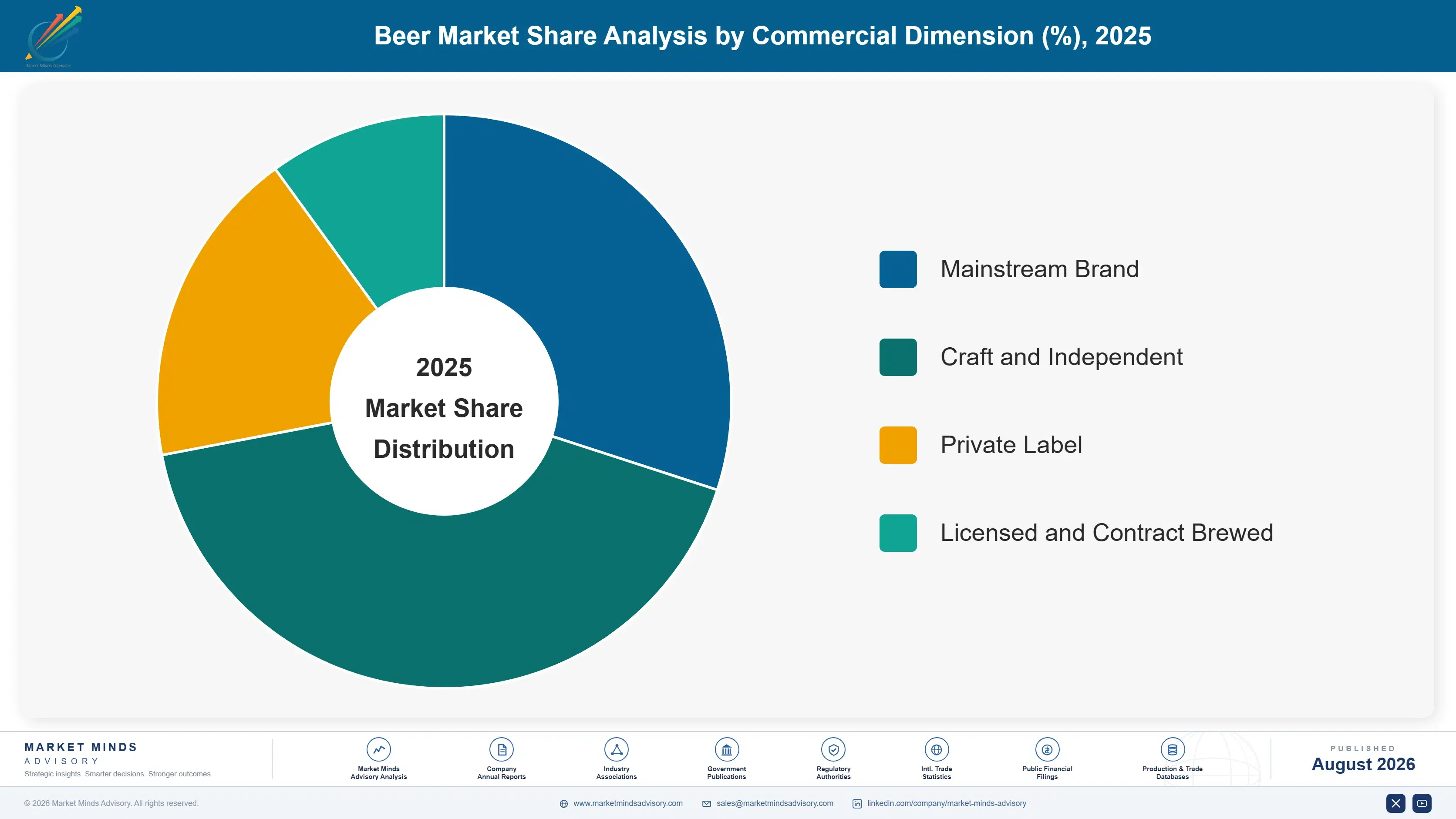
Segmentation follows beer product type and brewing format rather than distribution channel, since brewing process, ingredient cost structure and regulatory classification differ meaningfully across lager, ale, stout, flavored malt beverages and non-alcoholic formats even when every one of them sells through identical retail, e-commerce and on-premise channels to broadly the same consumer base nationwide.
beer-market-market-share-analysis-1787461881581

Non-Alcoholic and Low-Alcohol Beer

Non-alcoholic and low-alcohol beer is the fastest-growing format in the category by a wide margin, driven by genuine brewing technology improvement that has finally closed most of the taste gap with full-strength beer. Western Europe leads adoption, with Germany and the United Kingdom seeing the deepest retail penetration, while North American growth is accelerating from a smaller base as major brewers expand dedicated production lines. The format still carries a price premium over mainstream lager despite lower alcohol content and lower excise tax exposure, reflecting brand investment and marketing spend rather than ingredient cost. Younger drinkers cite moderation as the primary purchase driver, positioning the format for continued above-category growth through the forecast period.
CAGR 11.5%

Flavored Malt Beverages

Flavored malt beverages are pulling younger drinkers away from traditional lager and ale by offering lighter, sweeter flavor profiles closer to what hard seltzer and ready-to-drink cocktails already established as preferred among this demographic. Major brewers are using existing distribution relationships to launch flavored extensions of established brands rather than building standalone brands from scratch, accelerating time to shelf considerably. Growth is concentrated in North America and parts of Western Europe, where hard seltzer first proved consumer appetite for flavored, lower-bitterness alcoholic beverages. Margins on flavored malt beverages currently exceed traditional lager, though intensifying competition from new entrants is expected to compress that premium somewhat over the coming several years.
CAGR 8.9%
Full segment breakdown across 6 segments available in the complete report.

Regional Architecture and Country Demand Map

East Asia leads on production and consumption volume, anchored by China's status as the world's single largest beer market. North America and Western Europe drive category revenue through premiumisation, while South Asia and Pacific offers the fastest per-capita growth as formal retail distribution expands there.

North America

North America combines large absolute volume with the deepest premiumisation and craft brewing culture of any major region, giving brewers meaningfully higher average revenue per liter than volume-led markets elsewhere. The United States hosts thousands of independent craft breweries alongside the major multinational groups, creating intense competition for shelf space and on-premise tap handles in most metropolitan markets and suburban retail corridors alike. Non-alcoholic beer and flavored malt beverages are both growing fastest here among younger drinkers seeking alternatives to traditional lager and heavier ale styles. Canada's smaller market mirrors similar trends at a reduced scale, with provincial regulatory differences complicating national distribution strategies for brewers operating across multiple provinces simultaneously.
Share: 24% | CAGR: 5.5% (2026 to 2036)

Western Europe

Western Europe pairs the deepest craft and provenance culture in the category with the fastest non-alcoholic beer adoption globally, led by Germany's brewing heritage and the United Kingdom's cask ale and craft scene. Regulatory scrutiny of alcohol marketing is tightening across several member states, pushing major brewers to diversify portfolios toward non-alcoholic and low-alcohol formats carrying fewer advertising restrictions on traditional media. Belgium and the Netherlands contribute outsized export volume relative to domestic market size, drawing on strong international brand recognition built over generations of continuous export activity across dozens of destination markets. Overall volume continues declining gradually even as revenue holds steady through consistent premiumisation across most retail and on-premise channels.
Share: 20% | CAGR: 2.7% (2026 to 2036)
Regional intelligence for 5 additional markets available in the complete report: East Asia, South Asia and Pacific, Latin America, Middle East and Africa, Eastern Europe. Contact sales@marketmindsadvisory.com.
beer-market-country-cagr-analysis-1787461882101

Where Brewers Can Defend Margin

Margin defense in beer increasingly depends on mix management and format innovation rather than pure volume growth, since brewers that shift revenue deliberately toward premium, craft and non-alcoholic formats consistently outperform peers still chasing case count in a shrinking core segment, and that performance gap keeps widening every single year across most mature markets.

Expand Non-Alcoholic Production Capacity Ahead of Demand

Brewers that invested early in dedicated non-alcoholic brewing lines are capturing outsized share of a format growing well above category average, commanding price parity or better with full-strength beer despite lower excise tax exposure in most jurisdictions. Building this capacity ahead of confirmed demand carries real execution risk, but brewers who waited are now several years behind on securing the specialized dealcoholization equipment needed, facing 18-month-plus lead times on new installations while early movers already capture a growing 4 percent category share and continue to widen that lead each quarter.
Market Impact: Already captures a growing 4 percent category share

Launch Flavored Extensions of Established Core Brands

Rather than building standalone flavored malt beverage brands from scratch, brewers extending existing trusted brand names into flavored formats reach shelf placement roughly 40 percent faster and at meaningfully lower marketing cost than a new brand launch would require from an unproven name lacking distributor relationships and consumer awareness. This approach uses existing distributor relationships and consumer trust simultaneously, converting brand equity built over decades into rapid expansion within a fast-growing adjacent format without the years of brand-building a standalone launch would otherwise demand from a brewer's marketing budget and patience.
Market Impact: Reaches shelf placement roughly 40 percent faster than average

Acquire or Launch New Craft-Styled Sub-Brands

Major brewing groups are acquiring independent craft breweries or launching craft-styled sub-brands internally to capture the 30 to 50 percent price premium craft beer commands over mainstream lager without ceding the entire premium segment to independents operating outside their existing portfolios and distribution networks entirely. This strategy lets large brewers use existing distribution scale to accelerate a craft sub-brand's growth well beyond what an independent operator could realistically achieve on its own, while preserving enough brand separation that consumers continue perceiving genuine craft authenticity rather than corporate ownership behind the label.
Market Impact: Commands a 30 to 50 percent price premium

Build Direct-to-Consumer and Taproom Revenue Channels

Brewery taprooms and direct-to-consumer shipping generate gross margins of 60 percent or higher compared with 35 to 40 percent through traditional wholesale distribution, giving brewers with taproom infrastructure a meaningfully more profitable revenue stream even at fairly modest volume levels and limited geographic reach in a single state. Regulatory changes in several United States states have expanded direct shipping permissions since 2023, opening a channel previously unavailable to most breweries outside their home state and creating new growth headroom for brewers willing to invest in direct consumer relationships and dedicated taproom hospitality staff.
Market Impact: Delivers a 60 percent gross margin in taprooms

Who Controls the Margin Pool

Concentration is meaningful on a production volume basis, with the top five brewing groups holding a combined 44 percent of global output, though the gap between the largest group and the fifth-ranked challenger remains wide given Anheuser-Busch InBev's scale advantage over even its closest global peers. Regional champions in China and India remain outside the top five despite substantial domestic volume, reflecting how fragmented production still is outside the largest consolidated markets.
Current competitive activity centers on three fronts: non-alcoholic brewing capacity buildout among the largest groups racing to capture a fast-growing format, craft brand acquisition aimed at capturing premium pricing without ceding the segment to independents, and flavored malt beverage brand extensions launched rapidly to compete with hard seltzer for younger drinking occasions. Several brewers have also begun investing in direct-to-consumer and taproom infrastructure to capture higher-margin revenue.

Emerging pressure comes from craft and independent brewers defending premium positioning against large-group sub-brands that mimic craft aesthetics without full craft economics, a tension that could erode consumer trust in craft positioning broadly if handled poorly. Beverage conglomerates outside traditional brewing, particularly in cannabis-adjacent and ready-to-drink cocktail categories, represent a longer-term competitive threat for younger drinking occasions beer has historically owned.
beer-market-company-positioning-matrix-1787461882621

Competitive Moat and Risk Dimensions

ANHEUSER-BUSCH INBEV

Moat: Unmatched Global Distribution Scale

Anheuser-Busch InBev's unmatched global distribution scale and portfolio breadth across virtually every price tier let it defend volume in mature markets while funding non-alcoholic and craft acquisitions that smaller rivals cannot match without comparable balance sheet capacity or cross-market cash flow generated from its most profitable regional operations.
ANHEUSER-BUSCH INBEV

Risk: Debt-Constrained Strategic Flexibility

Heavy debt load carried from the SABMiller acquisition constrains capital available for aggressive non-alcoholic and craft expansion relative to less-leveraged competitors, and mainstream lager brands central to its portfolio face the steepest volume erosion among younger, moderation-minded drinkers across its largest historical markets in the Americas.
HEINEKEN

Moat: Premium Non-Alcoholic Credibility

Heineken's global premium brand positioning and strong non-alcoholic portfolio, anchored by Heineken 0.0, give it credibility with moderation-minded drinkers that mainstream competitors are still building, while its joint ventures across Asia and Africa provide local production scale without the full cost of outright acquisition in each market.
HEINEKEN

Risk: Narrowing Premium Price Gap

Heineken's premium positioning depends on maintaining price gaps over value-tier competitors that are narrowing as private-label and regional lager brands improve quality, and its concentrated Western European revenue base faces the steepest volume decline of any major consuming region, pressuring blended margins over the coming several years.

Players Tracked

Prominent Players

Anheuser-Busch InBev
Heineken
Carlsberg Group
Molson Coors Beverage Company
China Resources Beer

Other Key Players

Asahi Group Holdings
Kirin Holdings
Tsingtao Brewery
Constellation Brands
Diageo
Boston Beer Company
Suntory Holdings
Yanjing Brewery
San Miguel Corporation
Sapporo Holdings
Grupo Petropolis
United Breweries
Duvel Moortgat
Compania Cervecerias Unidas
Radeberger Gruppe

Recent Developments

MARCH 2025

Anheuser-Busch InBev Opens Non-Alcoholic Brewing Facility in Belgium

Anheuser-Busch InBev opened a dedicated non-alcoholic brewing facility in Belgium adding significant annual capacity for its Corona Cero and Budweiser Zero lines, its largest single non-alcoholic investment to date as it races to close the capacity gap with Heineken's more established non-alcoholic portfolio and market position across Western Europe.
Signal: Signals accelerating capital commitment toward non-alcoholic brewing as a genuine growth priority rather than a side project.
NOVEMBER 2024

Heineken Acquires Controlling Stake in Vietnamese Craft Brewery

Heineken acquired a controlling stake in a fast-growing Vietnamese craft brewery, gaining direct access to Southeast Asia's highest per-capita beer consumption market and an established local production and distribution network it previously lacked entirely outside its existing joint venture partnerships across the wider Southeast Asian region.
Signal: Signals Heineken deepening direct ownership in high-growth Southeast Asian markets rather than relying solely on joint ventures.
JULY 2025

Molson Coors Signs Flavored Malt Beverage Co-Packing Agreement

Molson Coors signed a multi-year flavored malt beverage co-packing agreement with a major beverage brand, committing dedicated production lines at its United States facilities in exchange for guaranteed annual volume, an unusual cross-category arrangement that neither company had previously disclosed publicly at this financial scale.
Signal: Signals traditional brewers increasingly manufacturing on behalf of adjacent beverage brands rather than competing directly against them.

Barley, Hop and Packaging Cost Exposure

Barley malt, hops and packaging materials together represent roughly 38 percent of finished beer cost of goods sold, with barley sourced predominantly from France, Germany, Australia and Canada and hops concentrated in the United States, Germany and smaller specialty growing regions across Central Europe. Aluminum and glass packaging add a further meaningful cost share, with can pricing particularly sensitive to global aluminum market movements.
Barley and hop prices swung more than 25 percent between 2022 and 2024 according to European Commission agricultural market reporting, driven by drought conditions across major growing regions in France and Germany that reduced yields significantly during consecutive poor harvest seasons, squeezing brewing margins industry-wide during the affected years and forcing several regional brewers to raise retail prices mid-cycle, straining relationships with major retail accounts.

Large brewing groups with multi-year agricultural supply contracts and geographically diversified sourcing across several continents absorb volatility far more comfortably than smaller regional and craft brewers who typically buy on shorter contracts or spot markets, creating a durable cost advantage that compounds during periods of sustained agricultural price volatility across major growing regions and widens further during consecutive poor harvest years.
beer-market-cost-volatility-analysis-1787461882816

Multi-Year Agricultural Supply Contracting

Leading brewers lock in two to three year barley and hop purchase agreements at fixed or capped pricing directly with growers in France, Germany and the United States, insulating margin from the spot-market swings that hit smaller regional and craft brewers hardest during 2022 and 2023 harvest shortfalls and subsequent price spikes across the affected growing regions.

Geographic Diversification of Hop and Barley Sourcing

Sourcing barley and hops across France, Germany, Australia, Canada and the United States simultaneously reduces exposure to any single region's harvest failure, currency swing or trade policy shift, a strategy the largest brewing groups have pursued for decades while independent brewers remain concentrated in local suppliers and correspondingly exposed to regional weather shocks and pricing spikes.

Packaging Material Substitution and Lightweighting

Several brewers are reducing aluminum can weight and increasing recycled glass content to cut packaging cost exposure to volatile commodity metal markets, a mitigation that also supports sustainability marketing claims increasingly valued by younger, environmentally conscious drinkers across mature markets and premium retail channels worldwide, further reinforcing brand positioning at the point of sale.

Portfolio Architecture for Margin Defence

Portfolio economics split into three tiers with sharply different gross margin profiles: mainstream value-tier and commodity-adjacent lager competes almost entirely on price and shelf presence, premium and certified craft-styled beer commands a meaningful markup tied to provenance and flavor, and next-generation non-alcoholic and functional formats carry the highest margins in the category despite carrying no alcohol excise tax burden at all in most jurisdictions worldwide.
The tension between volume and premium tiers is intensifying as private-label and value-tier beer erode mainstream lager's historical volume base in supermarkets and convenience channels, forcing established brewers to defend margin through craft sub-brands and non-alcoholic innovation rather than relying on scale advantages that value-tier competitors are increasingly capable of matching at meaningfully lower cost structures across most mature retail markets today.

High-value margin pools concentrate overwhelmingly in non-alcoholic beer and premium craft formats, where brand equity, provenance and taste innovation matter more than raw production scale, giving smaller specialized brewers genuine room to compete on margin even without matching the volume of global brewing groups that continue to dominate mainstream lager distribution across most retail and on-premise channels worldwide.

Volume / Commodity-Adjacent Tier

Mainstream and value-tier lager sold largely on price and shelf presence into supermarket and convenience channels, facing intensifying private-label competition and minimal formulation differentiation between competing brands within the segment.
Gross Margin: 22-30%

Premium / Certified Tier

Craft-styled and provenance-driven premium beer carrying flavor differentiation and brand storytelling, sold into on-premise and specialty retail channels willing to pay a meaningful markup over mainstream lager pricing for genuine authenticity.
Gross Margin: 36-44%

Sustainability / Regulatory / Next-Generation Tier

Non-alcoholic, low-alcohol and functional beer formats representing the newest and fastest-growing portion of the category, commanding correspondingly higher margins despite carrying no alcohol excise tax burden in most jurisdictions worldwide.
Gross Margin: 40-48%
beer-market-portfolio-architecture-1787461883311

High-value Sub-segments and Strategic Watch-out

Non-Alcoholic and Low-Alcohol Beer

Non-alcoholic and low-alcohol beer, growing fastest and commanding the highest margins in the category as brewing technology closes the taste gap with full-strength beer and moderation-minded drinkers seek alternatives that preserve the social ritual of drinking without the alcohol content itself, particularly across Western Europe.
Gross Margin: 42-50%

Flavored Malt Beverages

Flavored malt beverages competing directly with hard seltzer for younger drinking occasions, expanding steadily as brewers use existing distribution relationships to launch flavored extensions of established core brands quickly rather than building entirely new standalone brands from scratch at considerably greater marketing expense and risk.
Gross Margin: 34-42%

Mainstream Value-Tier Lager

Mainstream value-tier lager sold into supermarket and convenience channels, providing steady but low-margin volume that underwrites brewer fixed costs even as growth and pricing power both remain limited across the segment relative to premium and non-alcoholic tiers steadily gaining share across most global consumption regions today.
Gross Margin: 20-26%

Traditional Ale and Stout Styles

Traditional heavier ale and stout styles facing gradual substitution as younger drinkers favor lighter, more approachable flavor profiles across most retail and on-premise drinking occasions; brewers concentrated here without a portfolio diversification plan risk meaningful share loss within the coming decade as preferences continue shifting.
Gross Margin: 26-32%

Habitual Consumption and Shifting Loyalty

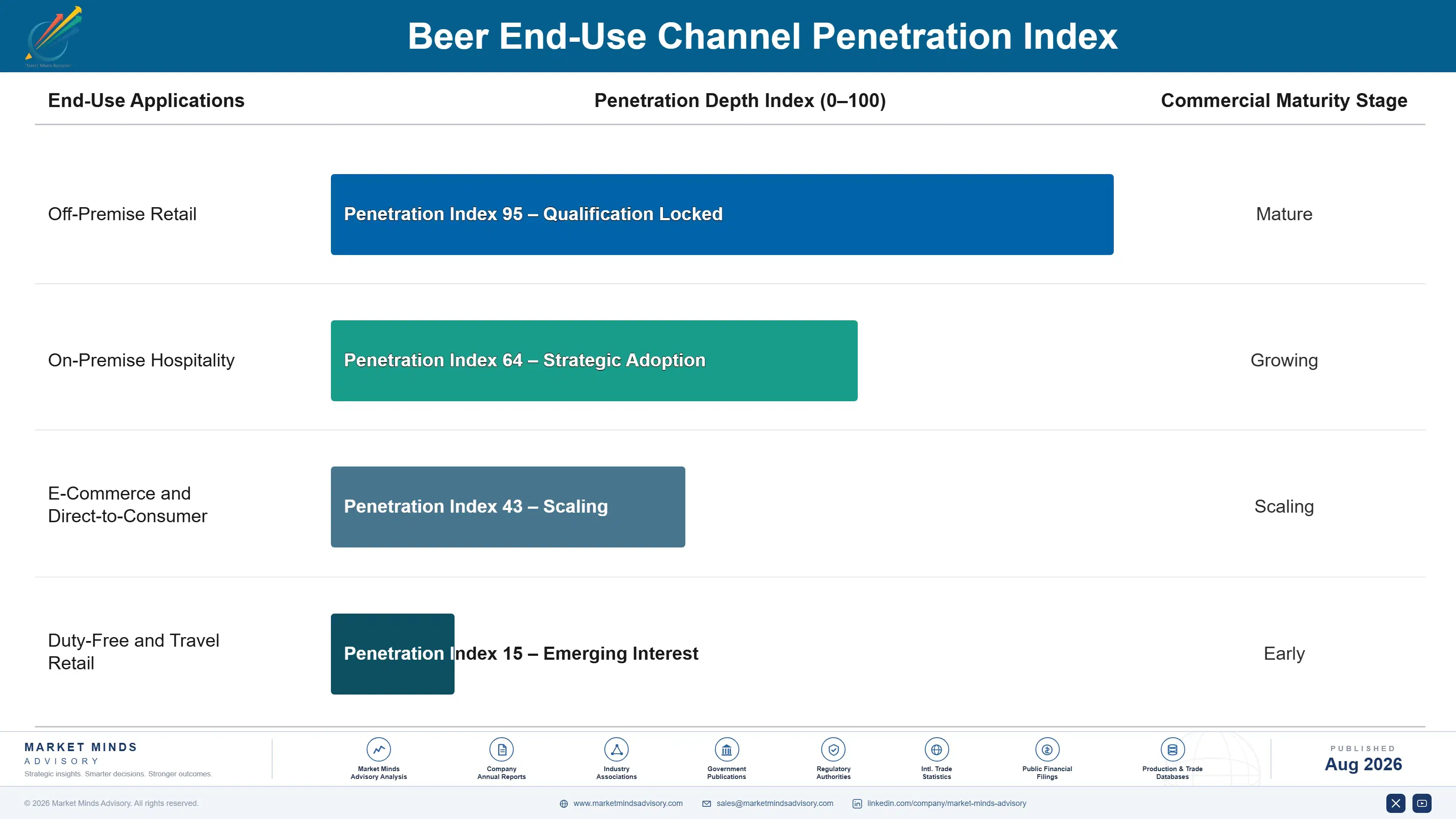
Beer purchasing behaves less like a subscription than most categories in this portfolio, since brand loyalty is real but switching cost is low, giving brewers thinner revenue predictability than annuity-style categories and forcing continuous marketing investment to defend share of throat rather than relying on durable lock-in from a signed contract, exclusive licensing deal or a long customer qualification process that would otherwise deter a competitor from winning the account.
Adoption depth varies sharply by end-use occasion: on-premise and social drinking occasions still favor established, trusted brands where a server or bartender's recommendation carries real weight with an undecided customer, while at-home and convenience-driven purchasing increasingly rewards value and novelty, pulling volume toward private-label and flavored formats that on-premise venues rarely stock in meaningful depth or variety.

A generational shift in buyer profiles is underway as younger drinkers favor moderation, flavor experimentation and lower alcohol content over the traditional mainstream lager loyalty that defined prior generations, forcing brewers to build entirely new brand relationships from the ground up rather than simply retaining existing drinkers as they age into higher-income, more settled purchasing patterns typical of earlier consumer cohorts.
beer-market-end-use-penetration-index-1787461883797

Where Brewers Should Focus Investment

These are among the four positions where our research anticipates prominent divergence between winners and laggards over the coming forecast period. Each is grounded in the demand model, the regulatory perimeter, and the announced capacity pipeline.
01 / NON-ALCOHOLIC CAPACITY INVESTMENT

Build Dealcoholization Capacity Ahead of Demand

Brewers still relying on outsourced or minimal non-alcoholic production are ceding a fast-growing, high-margin format to competitors who invested early in dedicated dealcoholization equipment, and the capacity gap keeps widening each quarter. The taste gap with full-strength beer has closed enough that repeat purchase is now realistic rather than a single curious trial from a moderation-minded drinker. Building this capacity now, even before demand fully confirms itself, is cheaper than the multi-year catch-up smaller brewers face once category leaders have already locked in supplier relationships and shelf space.
02 / CRAFT SUB-BRAND PORTFOLIO STRATEGY

Acquire Rather Than Build New Craft Positioning

Large brewing groups attempting to build craft credibility organically consistently underperform those acquiring established independent breweries with genuine local reputation already intact and a loyal regional following. The premium craft commands over mainstream lager depends heavily on perceived authenticity that a corporate-launched brand struggles to replicate convincingly no matter how much marketing budget is behind it. Acquisition preserves that authenticity while providing distribution scale the independent brewery could never achieve alone, a combination that consistently outperforms organic craft brand-building over time.
03 / FLAVORED BEVERAGE BRAND EXTENSION

Extend Trusted Core Brands Into Flavored Formats

Standalone flavored malt beverage brand launches take years to build the trust and distribution that an established core brand already carries with retailers and consumers across most retail channels. Extending a trusted existing brand name into flavored formats reaches shelf placement significantly faster and at meaningfully lower marketing cost than building recognition from zero with an unproven name. Brewers that delay this extension risk losing younger drinking occasions permanently to hard seltzer and ready-to-drink cocktail brands that moved first and locked in early loyalty among the same demographic.
04 / AGRICULTURAL FEEDSTOCK HEDGING

Lock Multi-Year Barley and Hop Contracts

Barley and hop price volatility has already squeezed margins at brewers without forward purchasing agreements in place, and the pattern is likely to repeat as climate variability continues affecting major growing regions in France and Germany each harvest season. Brewers that lock in geographically diversified, multi-year agricultural contracts protect margin predictability that increasingly matters to retail partners negotiating long-term pricing. Those same retail partners are now favoring suppliers who can demonstrate sourcing discipline over ones exposed to spot-market volatility on core agricultural inputs.

Engagement Snapshot From the Field

A live engagement with an industry participant carrying material or product regulatory and market exposure ahead of a defining policy shift, showing how our research translates into a defensible multi-year portfolio strategy.
MARKET MINDS ADVISORY · CLIENT ENGAGEMENT SUMMARY
Beer Producer Strategic Portfolio Review and Transition Roadmap 2026·Investment Scenario on Beer Exposure Evaluation 2025-26
CLIENT PROFILE
The client is a mid-sized regional brewing group generating approximately 340 million dollars in annual revenue (client-reported, unverified by MMA), operating six breweries across the United States Midwest and competing primarily in mainstream lager and emerging craft-adjacent segments against both global brewing groups and smaller independent craft operators in its core markets, with distribution spanning eleven states.
STRATEGIC CHALLENGE
The client's core mainstream lager brands were losing volume to both value-tier private-label competitors and premium craft alternatives simultaneously, compressing margin from both directions while the company lacked a clear non-alcoholic or flavored malt beverage strategy to capture growth in the category's fastest-expanding formats and retain increasingly moderation-minded younger regional drinkers.
MMA APPROACH
MMA conducted a portfolio and margin analysis across the client's twelve core brands, benchmarking price positioning, distribution reach and format coverage against both global brewing groups and successful regional craft operators, then modeled the revenue and margin impact of reallocating marketing investment toward non-alcoholic and flavored format launches across the client's existing distribution footprint.
KEY FINDINGS
  1. The client had zero non-alcoholic offerings in its portfolio despite the format growing at more than double the client's core mainstream lager volume decline rate.
  2. Three of twelve core brands were steadily losing share to private-label competitors priced roughly 15 percent below the client's equivalent mainstream products.
  3. Flavored malt beverage extensions of the client's two strongest regional brands could realistically reach retail distribution within approximately six months given existing brewery capacity.
  4. Taproom and direct-to-consumer channels represented under 3 percent of total revenue despite carrying gross margins roughly double what traditional wholesale distribution typically delivers.
CLIENT PROFILE
The client is a mid-sized regional brewing group generating approximately 340 million dollars in annual revenue (client-reported, unverified by MMA), operating six breweries across the United States Midwest and competing primarily in mainstream lager and emerging craft-adjacent segments against both global brewing groups and smaller independent craft operators in its core markets, with distribution spanning eleven states.
STRATEGIC CHALLENGE
The client's core mainstream lager brands were losing volume to both value-tier private-label competitors and premium craft alternatives simultaneously, compressing margin from both directions while the company lacked a clear non-alcoholic or flavored malt beverage strategy to capture growth in the category's fastest-expanding formats and retain increasingly moderation-minded younger regional drinkers.
MMA APPROACH
MMA conducted a portfolio and margin analysis across the client's twelve core brands, benchmarking price positioning, distribution reach and format coverage against both global brewing groups and successful regional craft operators, then modeled the revenue and margin impact of reallocating marketing investment toward non-alcoholic and flavored format launches across the client's existing distribution footprint.
KEY FINDINGS
  1. The client had zero non-alcoholic offerings in its portfolio despite the format growing at more than double the client's core mainstream lager volume decline rate.
  2. Three of twelve core brands were steadily losing share to private-label competitors priced roughly 15 percent below the client's equivalent mainstream products.
  3. Flavored malt beverage extensions of the client's two strongest regional brands could realistically reach retail distribution within approximately six months given existing brewery capacity.
  4. Taproom and direct-to-consumer channels represented under 3 percent of total revenue despite carrying gross margins roughly double what traditional wholesale distribution typically delivers.
RECOMMENDED STRATEGY
Phase 1: Phase 1 (Months 1 to 4): Launch non-alcoholic and flavored extensions of the client's two strongest existing regional brands quickly. Phase 2: Phase 2 (Months 5 to 10): Reallocate marketing spend away from declining mainstream lager brands toward the newly launched format extensions. Phase 3: Phase 3 (Months 11 to 18): Expand taproom and direct-to-consumer infrastructure across all six existing brewery locations statewide and regionally.
OUTCOME
Within eighteen months the client's non-alcoholic and flavored extensions reached 7 percent of total revenue, offsetting continued mainstream lager volume decline (client-reported, unverified by MMA). Blended gross margin improved as taproom revenue share roughly doubled, though mainstream lager volume continued declining at a slower but still meaningful rate.

Frequently Asked Questions

Foundational context covering the market sizes, CAGR, scope, country, region and competition that inform every finding below. This section is provided to cover basics and most often pre-purchase conversations, answered from the MMA Primary Research Dataset.

What is the current size of the Beer Market?

The global beer market reached an estimated 412.5 billion dollars in 2025. Revenue growth continues even as volume stagnates, driven by premiumisation and non-alcoholic format innovation across mature drinking markets.

How large will the Beer Market be by 2036?

MMA projects the market will reach approximately 655.5 billion dollars by 2036, growing roughly 1.5 times from its 2026 base. Non-alcoholic and flavored formats are expected to drive most of that incremental growth.

What is the CAGR for the Beer Market 2026 to 2036?

The market is forecast to grow at a 4.3 percent compound annual rate between 2026 and 2036. Bull-case scenarios reach 5.6 percent if non-alcoholic beer achieves faster mainstream taste parity than currently expected.

Which segment is growing fastest?

Non-alcoholic and low-alcohol beer leads at an 11.5 percent CAGR, roughly 2.7 times the overall market rate. Improving brewing technology and moderation trends among younger drinkers are the primary drivers behind that lead.

Who are the major companies in the Beer Market?

Leading brewers include Anheuser-Busch InBev, Heineken, Carlsberg Group, Molson Coors and China Resources Beer. Together they hold roughly 44 percent of global production, competing on distribution scale and premiumisation strategy.

Which country is growing fastest?

India leads country-level growth at a 7.8 percent CAGR, driven by formal retail licensing reform and rising disposable income. Vietnam and China follow closely given their large existing consumption bases and continued urbanization.

Report Segmentation Architecture

The full report scope spans multiple orthogonal segmentation dimensions, with cross-tabulated demand data provided for each dimension pair. Coverage extends further to regional breakdowns, trend trajectories, and the competitive detail needed to support segment-level decision-making.

By Beer Product Format

  • Lager
  • Ale
  • Stout and Porter
  • Flavored Malt Beverages
  • Non-Alcoholic and Low-Alcohol Beer
  • Craft and Specialty Beer

By End-Use Channel

  • Off-Premise Retail
  • On-Premise Hospitality
  • E-Commerce and Direct-to-Consumer
  • Duty-Free and Travel Retail

By Commercial Dimension

  • Mainstream Brand
  • Craft and Independent
  • Private Label
  • Licensed and Contract Brewed

By Region

  • North America
  • Western Europe
  • East Asia
  • South Asia and Pacific
  • Latin America
  • Middle East and Africa
  • Eastern Europe

Scope, Methodology, and Coverage

Every figure in this report is reproducible from documented input assumptions. The scope below maps the historical period, the forecast horizon, the segmentation dimensions, and the countries covered, alongside the underlying primary and qualitative methodology.
Historical Period
2020 to 2025
Forecast Period
2026 to 2036
Base Year
2025 (USD billions; MMA Primary Research Dataset, August 2026)
Market Definition
The beer market comprises all fermented malt beverages including lager, ale, stout, flavored malt beverages and non-alcoholic or low-alcohol beer sold through retail, on-premise and e-commerce channels. It excludes wine, spirits, hard seltzer made without a malt base, and cider unless malt-based.
Quantitative Units
USD billions (current prices); hectoliters for volume-referenced segments
Segmentation Dimensions
By Beer Product Format; By End-Use Channel; By Commercial Dimension; By Region
Regions Covered
North America, Western Europe, East Asia, South Asia and Pacific, Latin America, Middle East and Africa, Eastern Europe
Countries Covered
USA, China, Germany, France, UK, Japan, South Korea, India, Australia, Canada, Brazil, Mexico, Indonesia, Vietnam, Thailand, Malaysia, UAE, Saudi Arabia, South Africa, Nigeria, Turkey, Poland, Netherlands, Italy, Spain, Sweden, Switzerland, Argentina, Colombia, Singapore, and additional markets relevant to this sector
Key Companies Profiled
Anheuser-Busch InBev, Heineken, Carlsberg Group, Molson Coors Beverage Company, China Resources Beer, Asahi Group Holdings, Kirin Holdings, Tsingtao Brewery, Constellation Brands, Diageo, Boston Beer Company, Suntory Holdings, Yanjing Brewery, San Miguel Corporation, Sapporo Holdings, Grupo Petropolis, United Breweries, Duvel Moortgat, Compania Cervecerias Unidas, Radeberger Gruppe
Quantitative Methodology
Primary survey, n=3,800 respondents, Q4 2025, six countries; demand-side model with trade association cross-validation
Qualitative Methodology
47 expert interviews, Q4 2025; applied to validate demand model assumptions, identify emerging dynamics, and assess competitive positioning
Report Format
PDF and XLSX data workbook (Word format preview document)
Publisher
Market Minds Advisory
Report Code
MMA-2026-AGR-102
Published
August 2026
Contact
sales@marketmindsadvisory.com | www.marketmindsadvisory.com

Purchase the full Beer Market Report (2026 to 2036).

The full report delivers detailed segment-level sizing across all six beer product formats, country-level forecasts for thirty markets, and a competitive benchmarking module covering all twenty profiled brewers on a single consistent production volume basis. It includes primary survey data from 3,800 respondents across six countries alongside 47 qualitative expert interviews conducted in the fourth quarter of 2025. Analysts provide a standalone non-alcoholic and craft premiumisation tracker covering major consuming markets worldwide in depth. Clients also receive quarterly update briefings through the twelve months following publication.
Segment-level sizing across six beer product formats
Country-level forecasts spanning thirty individual markets
Competitive benchmarking across twenty profiled global brewers
Standalone non-alcoholic and craft premiumisation tracker
Quarterly post-publication analyst update briefings included
Primary survey and expert interview datasets

Built For The People Who Decide

From boardroom strategy to bench-side execution, this report is read cover-to-cover by leaders shaping the next decade of their industry, turning demand scenarios, market dynamics and valuation benchmarks into decisions.
CXOs/ Presidents/ VPs/ Managers
M&A and Corporate Development
Strategy Teams and R&D Heads
Procurement and Product Directors
Regulatory and Compliance Leaders
Investor Relations and Equity Analysts