Market Minds Advisory
Beef Concentrate Market

Beef Concentrate Market: A Shrinking Herd, a Rising Bid, and the By-Product That Stopped Behaving Like One

Beef concentrate supply is set by cattle inventories rather than by ingredient demand, and with the American herd at a multi-decade low, buyers in soup, pet food, and culture media are bidding against each other.

Lead Analyst

Lisa Gevelber

Published

September 2026

Make Smarter Decisions with Customized Research Insights

Request a free sample report and evaluate market opportunities, growth trends, and competitive dynamics relevant to your business needs.

2025 MARKET VALUE$2.4BMarket Size 2025
2036 FORECAST VALUE$4.6BBase Case , 2026 to 2036
CAGR 2026 TO 20366.1 %Bull 7.3% / Bear 4.9%
INCREMENTAL OPPORTUNITY$2.1BNet 10- year value creation
EXPANSION MULTIPLE1.84x2036 value over 2026 base
Strategic Levers
M&A Pipeline
Regional Outlook
Country Rankings
Competitive Intelligence
Segmental Deep-dive
Call-Us : 91 93563 13602

Executive Snapshot and Market Trajectory

Beef concentrate is a by-product that stopped behaving like one. Output depends on how many cattle are slaughtered, not on how much extract the soup, pet food, and culture media industries want, and those two curves have moved in opposite directions since 2022. Buyers now compete for tonnage.
Commercial power has shifted to whoever controls raw trimmings and bones at the abattoir gate. The USDA recorded the smallest American cattle inventory in more than seven decades at the start of 2025, and Australian and Brazilian volumes cannot fully offset it. Freeze-dried concentrate grows fastest at 9.2%, roughly 1.51 times the market, because pet food palatants and premium broth brands pay for flavour retention. East Asia holds 30% of demand.
Concentration is moderate rather than tight, with the top five holding about 38% of output. Meat processors integrating forward compete with flavour houses integrating backward, and neither group has won. Regulation shapes the edges: EU Regulation 1069/2009 governs animal by-product handling, and residual TSE concerns keep beef-derived peptones out of several biopharmaceutical applications entirely. Halal and kosher certification decides who can sell into Gulf and Southeast Asian accounts. Neither certification transfers automatically between production plants.
Market Definition
This report covers concentrated beef-derived savoury ingredients produced from bovine meat, trimmings, and bones, supplied as paste and jelly extract, spray-dried powder, liquid concentrate, granulated and cube formats, frozen blocks, and freeze-dried concentrate. Buyers include soup and sauce manufacturers, bouillon producers, savoury flavour houses, pet food formulators, and microbiological culture media suppliers. Finished retail bouillon, gelatine, collagen peptides, rendered fats and tallow, and non-bovine meat concentrates fall outside scope.
Base Year Value
$2.4B in 2025 (MMA Primary Research Dataset, August 2026)
Forecast Period
2026 to 2036, eleven discrete annual values
CAGR
6.1% base case. Bull 7.3%. Bear 4.9%.
Fastest Growth Segment
Freeze-Dried Beef Concentrate: 9.2% CAGR
Fastest Growth Country
Vietnam: 8.9% CAGR
Fastest Growth Region
South Asia and Pacific: 8.3% CAGR
Largest Region
East Asia: 30% of 2025 global value
Market Leaders
Kerry Group, Symrise, Ajinomoto Co., Darling Ingredients, Proliant Meat Ingredients. Source: MMA Analysis based on company annual reports.
Primary Survey
n=3,800 procurement and R&D decision-makers, Q4 2025, six countries
Methodology
Demand-side build-up, cross-validated against public data, 47 expert interviews

Beef Concentrate Market Forecast Scenarios

beef-concentrate-market-trends-growth-insights-size-forecast-scenario-1787462503699
Between 2020 and 2025 the market grew on price, not on volume. Pandemic demand for shelf-stable soup and bouillon lifted offtake, then drought across the American Southwest and parts of Australia forced herd liquidation, briefly flooding trimmings supply before tightening it severely. The 5.0% historical CAGR conceals a violent middle: 2022 and 2023 saw concentrate prices move by double digits in both directions inside twelve months.
The 6.1% base case rests on three mechanisms. Pet food premiumisation keeps pulling beef palatants and freeze-dried concentrate into higher-priced formats, and that demand is largely insensitive to ingredient cost. Clean-label reformulation in soups and sauces moves volume from yeast extract and hydrolysed vegetable protein back toward genuine beef stock, which carries a better declaration. And the American herd rebuild will take four to six years, keeping raw material tight across most of the forecast period.
The 7.3% bull case assumes pet food and premium broth demand hold while herd rebuilding stalls, pushing realised prices well above trend. The 4.9% bear case is a substitution story: yeast extract and fermentation-derived savoury compounds keep improving, and cost-driven reformulation moves bouillon and instant noodle volume away from genuine beef extract permanently. Herd rebuild timing decides which.

Why Supply, Not Demand, Sets Price

Three forces converge on this market, and only one of them is demand. Cattle inventories set the ceiling on how much extract can physically exist, and those inventories answer to drought, feed cost, and cow-calf economics rather than to the soup industry. Pet food and premium broth demand keeps rising regardless.
TOP-FIVE CONCENTRATION38%Share of global beef concentrate output held collectively
AVERAGE SELLING PRICE$11.40/kgBlended dry-basis price across paste and powder formats
CATTLE HERD INDEX86.7M headUnited States cattle inventory at multi-decade cyclical low
RAW MATERIAL SHARE58%Beef trimmings and bones as proportion of production cost
CAPACITY UTILISATION74%Average plant loading across concentrating and drying assets
TRADE INTENSITY51%Portion of output crossing a border before final use
That combination produces an unusual commercial character. Producers with contracted access to trimmings and bones at slaughterhouse level earn well and sleep soundly; those buying on open market absorb every cattle cycle in full. The processing step itself, evaporation, hydrolysis, and drying, is not technically demanding and confers little advantage. What confers advantage is a signed relationship with a packer, plus certification that survives an audit in Riyadh, Jakarta, or Tokyo.
The next decade tests whether beef extract keeps its declaration premium. Yeast extract and fermentation-derived savoury compounds now deliver comparable umami intensity at a third of the cost, and formulators reach for them whenever the label allows it. Beef concentrate holds where the word beef must appear on the front of the pack, in pet food where palatability is measured empirically, and in culture media where the specification predates the alternatives.
"The processing plant is not the asset in this business. The asset is a twenty-year handshake with a packer that guarantees first call on fresh bones, and no amount of capital expenditure substitutes for it."
Director, Protein Ingredients Practice · MMA Food Ingredients / Animal Protein Processing Practice · August 2026

Market Trends

Pet Food Palatants Absorb Premium Concentrate Volume

Pet food humanisation has changed who bids highest for beef concentrate. Palatability coatings on dry kibble and topical applications on premium wet formats both use freeze-dried and high-solids beef concentrate, and pet food formulators tolerate ingredient costs that human soup manufacturers reject outright. American and European premium pet food volumes have grown steadily through 2024 and 2025, and manufacturers increasingly specify single-origin bovine material with full traceability. That specification narrows the qualified supplier list sharply and supports pricing well above the bouillon-grade benchmark, which is why the freeze-dried segment compounds at 9.2%.
Market Impact: Returns 14% of displaced volume

Culture Media Buyers Demand Documented BSE-Free Origin

Microbiological peptones and growth media derived from bovine material remain widely used in vaccine production, diagnostics, and industrial fermentation, but the qualification bar has risen. Buyers require country-of-origin documentation, abattoir-level traceability, and compliance with European Medicines Agency guidance on transmissible spongiform encephalopathy risk. Material from countries with negligible BSE risk status commands a clear premium, and suppliers unable to document the chain simply do not get audited in. The result is a two-tier market where identical chemistry sells at very different prices depending on paperwork quality. Requalifying a media supplier is rarely worth the effort for buyers.
Market Impact: Adds 31,000 tonnes annual demand

Market Opportunities and Growth Drivers

Clean-Label Reformulation Returns Volume to Genuine Beef Stock

Soup, sauce, and ready-meal manufacturers spent two decades replacing beef extract with hydrolysed vegetable protein and yeast extract on cost grounds. Retailer clean-label specifications have partly reversed that. Aldi, Lidl, Tesco, and several American grocers now restrict hydrolysed proteins and added glutamate in own-brand ranges, which pushes formulators back toward recognisable beef stock declarations. The switch costs more per batch but survives the retailer audit, and it lets the front of pack carry a claim that shoppers understand. Volume returning through this route is modest but reliably priced. Cost per serving rises, and retailers accept it.
Market Impact: Constrains 18% of requested volume

Bouillon Consumption Grows Across Asian and African Markets

Bouillon cubes and powdered stock remain everyday cooking staples across West Africa, Southeast Asia, and much of East Asia, and packaged penetration keeps rising with urbanisation and formal retail expansion. Nigerian, Indonesian, and Vietnamese consumption has grown consistently, and local manufacturers increasingly buy imported beef concentrate rather than compounding from flavourings alone, because consumers detect the difference. Halal certification is a hard gate in most of these markets. Suppliers holding recognised halal accreditation at plant level access demand that certified competitors cannot serve at any price. Accreditation is audited at plant level, not asserted on paperwork.
Market Impact: Costs 3x less per kilogram

Market Restraints and Challenges

Herd Contraction Caps Physical Availability Regardless of Demand

Beef concentrate cannot be manufactured to order. Trimmings and bones arrive as a fixed proportion of carcasses processed, so output tracks slaughter volume with no elasticity whatsoever. The root cause is cow-calf economics: sustained drought across the American Southwest and high feed costs pushed producers to liquidate breeding stock, and rebuilding a herd takes four to six years from the decision to retain heifers. Participants respond by contracting multi-origin supply across Australia, Brazil, Uruguay, and Argentina, by shifting product mix toward higher-yield formats, and by blending with poultry and pork bases where declarations permit.
Market Impact: Absorbs 22% of premium output

Yeast Extract Substitution Undercuts Beef on Cost

Yeast extract and fermentation-derived savoury compounds deliver much of the umami intensity buyers want at roughly a third of the delivered cost, and they arrive without herd cycles, halal complications, or BSE documentation. The root cause is simple economics: fermentation capacity scales with demand while cattle do not. Instant noodle, snack seasoning, and industrial sauce manufacturers have already moved substantial volume. Beef suppliers counter by selling on declaration value rather than taste alone, by targeting pet food and culture media where substitution is blocked, and by offering blended systems that retain a genuine beef claim at lower inclusion.
Market Impact: Commands 40% documentation premium
3 additional market trends, 2 additional growth drivers, and 4 additional restraints and challenges are covered in the full report. Contact sales@marketmindsadvisory.com to access the complete intelligence.

Segment CAGR and Growth Architecture

Segmentation follows physical form as sold, a single commercial logic that buyers themselves use when tendering. Form determines shelf life, dosing method, flavour retention, and freight cost per unit of solids, so competitive position tracks format rather than the animal or the abattoir behind it. End-use industries and channel structures sit in the framework as separate dimensions entirely.
beef-concentrate-market-trends-growth-insights-market-share-analysis-1787462504286

Freeze-Dried Beef Concentrate

Freeze drying preserves volatile aroma compounds that spray drying destroys, and buyers who can measure that difference pay for it. Growth of 9.2%, roughly 1.51 times the market, comes almost entirely from premium pet food palatants and from human broth and seasoning brands positioning on ingredient quality. Unit costs run three to four times spray-dried equivalents because the process is slow and energy-intensive, so the segment stays small in tonnage while carrying disproportionate value. Capacity is limited and largely North American and European, with qualified freeze-drying assets booked well ahead. New entrants face a capital barrier rather than a technical one, and existing operators have shown little appetite for adding lines speculatively.
CAGR 9.2%

Liquid Beef Concentrate

Liquid concentrate suits industrial kitchens, foodservice sauce production, and the chef-style stock brands that have grown across European and North American retail. It dissolves without reconstitution error, carries a cleaner declaration than cube formats, and avoids the flavour flattening that drying imposes. Growth of 7.6% follows foodservice recovery and premium retail broth expansion rather than any technical change. The commercial constraint is freight: liquid concentrate ships water, so economics collapse beyond roughly a thousand kilometres unless solids content is pushed high enough to risk crystallisation. That physics keeps the segment regional, which favours mid-sized producers with local plants over the global majors. Freight economics rather than formulation skill define the competitive boundary in this segment.
CAGR 7.6%
Full segment breakdown across 6 segments available in the complete report.

Regional Architecture and Country Demand Map

East Asia takes the largest share at 30%, reflecting entrenched savoury seasoning use across Japan, China, and Korea. North America and Western Europe follow on pet food and premium broth demand, while South Asia and Pacific grows fastest as packaged bouillon penetration rises across Southeast Asian markets.

North America

Pet food is the defining demand mechanism here, not soup. American and Canadian premium pet food manufacturers buy the highest grades of freeze-dried and high-solids beef concentrate for palatability coatings, and they specify single-origin traceable material that few suppliers can document. Human food demand is flat: bouillon consumption per capita has drifted downward for years, and clean-label reformulation returns only part of it. The region is also the swing supply source, so USDA cattle inventory readings move regional pricing within days of publication. Mexican demand grows faster than the regional average on packaged seasoning expansion, and cross-border processing arrangements route substantial trimmings volume southward for concentration. Regional growth of 5.4% therefore depends on pet food mix.
Share: 24% | CAGR: 5.4% (2026 to 2036)

Western Europe

Regulation and certification govern participation across Western Europe. Regulation (EC) No 1069/2009 sets handling and traceability rules for category three animal by-products, and any material entering food or feed must document its route from abattoir to concentrate. Demand splits between industrial soup and sauce manufacture in Germany, France, and the Netherlands, and a growing premium broth category in the United Kingdom and Scandinavia. Growth of 4.4% reflects a mature base rather than weakness. Dutch and Danish processors serve as regional concentration hubs, drawing raw material from across the union. Private-label pressure caps pricing on bouillon-grade material while premium and pet food grades hold their margins. Certification audits are the practical barrier to new entrants here.
Share: 20% | CAGR: 4.4% (2026 to 2036)
Regional intelligence for 5 additional markets available in the complete report: East Asia, South Asia and Pacific, Latin America, Middle East and Africa, Eastern Europe. Contact sales@marketmindsadvisory.com.
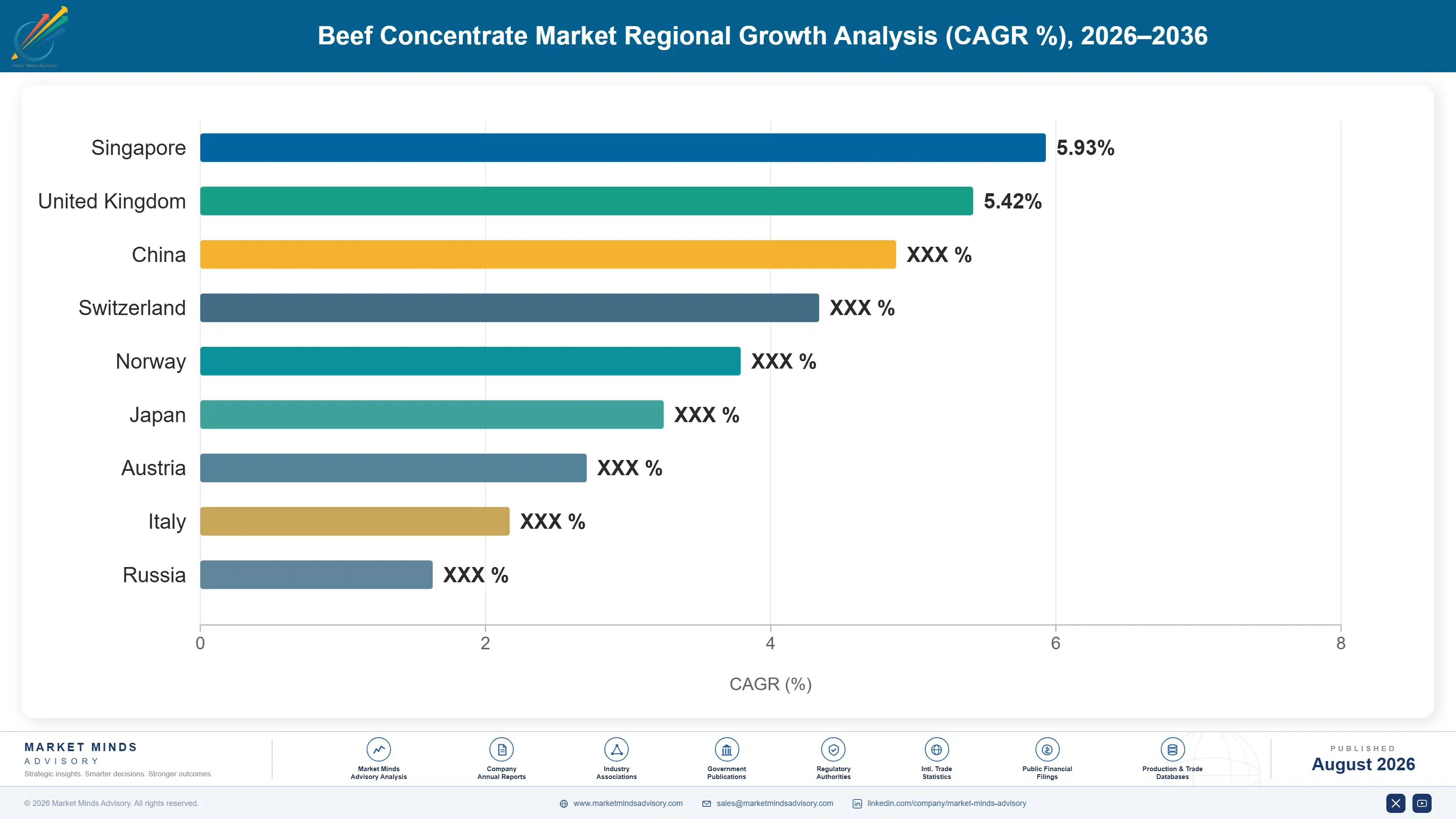
beef-concentrate-market-trends-growth-insights-country-cagr-analysis-1787462504792

Where Beef Concentrate Margin Actually Sits

Nobody earns a premium for evaporating stock. The four moves below shift revenue toward positions that competitors cannot copy quickly: contracted raw material access, certification depth, format conversion into freeze-dried value, and the traceability documentation that culture media and premium pet food buyers now treat as the product itself. None of the four requires new chemistry.

Contract Trimmings Access Directly at Abattoir Level

Open-market buying exposes a concentrator to the full amplitude of the cattle cycle, which over 2022 to 2024 meant input cost swings above 40%. Multi-year supply agreements with packers, priced on a formula rather than spot, convert that volatility into a manageable band. The counterparty wants volume certainty and waste reduction, so terms are achievable. Producers holding contracted access across three or more packers show input cost variance roughly half that of spot buyers, and they keep drying assets loaded when competitors idle lines waiting for material. Packers value the predictability more than the price.
Market Impact: Halves input cost variance across 3 sourcing origins

Build Freeze-Drying Capacity Ahead of Pet Food Demand

Freeze-dried concentrate earns three to four times the price of spray-dried equivalent and grows at 9.2% while the market grows at 6.1%. Qualified capacity is scarce, booked ahead, and capital-intensive at roughly $18 million for a commercial line. That barrier is exactly why the pricing holds. Producers who add capacity now, with premium pet food volume contracted in advance rather than speculatively, capture a segment where buyers measure palatability empirically and switch suppliers reluctantly once a formulation performs in feeding trials. Speculative capacity additions have simply not been the pattern in this segment.
Market Impact: Captures 9.2% segment growth at 3x unit pricing

Certify Every Plant for Halal and Kosher Simultaneously

Halal accreditation opens Indonesian, Malaysian, Gulf, and West African demand that uncertified suppliers cannot serve at any discount. Kosher certification adds American and European institutional accounts. Running both at plant level costs perhaps $200,000 in initial audit and system work plus ongoing supervision, which is trivial against the addressable demand it releases. The certification also functions as a quality signal in markets where it is not legally required, and buyers increasingly treat dual accreditation as evidence that traceability systems will survive their own audits. Two audits a year keep both accreditations current.
Market Impact: Opens roughly 15% of additional addressable regional demand

Package Origin Traceability as a Documented Product Attribute

Culture media and premium pet food buyers are purchasing paperwork as much as protein. Abattoir-level traceability, country-of-origin certification, and documented compliance with European Medicines Agency guidance on transmissible spongiform encephalopathy risk together support a premium of roughly 30% to 40% over undifferentiated material of identical composition. Building the documentation chain requires system investment rather than plant investment, and once established it applies across the whole output. Suppliers without it are effectively excluded from the highest-value accounts regardless of product quality. Most independents have not built it, which is precisely why it still pays.
Market Impact: Supports a 30 to 40% documented price premium

Who Controls the Margin Pool

The top five hold roughly 38% of global output, measured consistently here as beef concentrate production capacity in dry-solids equivalent. That is moderate concentration by ingredient standards, and the gap between leaders and challengers reflects raw material access rather than processing skill. Kerry and Symrise buy through contracted packer relationships across multiple continents; regional concentrators buy locally and live with whatever the cattle cycle delivers.
Competitive activity currently runs along three lines. Backward integration is the first, with flavour and ingredient groups securing abattoir-level supply agreements that were previously informal. Certification depth is the second, as halal, kosher, and traceability accreditation decide access to entire regions. The third is format investment, particularly freeze-drying capacity aimed at premium pet food, where a handful of producers have committed capital while most have waited.

Pressure is arriving from two directions. Meat processors including JBS and Marfrig are integrating forward into concentration rather than selling trimmings, which removes raw material from the merchant market and compresses independent concentrators. Simultaneously, yeast extract producers are taking industrial seasoning volume on cost. Rankings will shift among mid-sized independents lacking either contracted supply or a defensible premium format position.
beef-concentrate-market-trends-growth-insights-company-positioning-matrix-1787462505314

Key Players

Kerry Group
Symrise
Ajinomoto Co.
Darling Ingredients
Proliant Meat Ingredients

Others

Essentia Protein Solutions
Griffith Foods
Nikken Foods
Kohjin Life Sciences
Hormel Foods
JBS S.A.
Marfrig Global Foods
Titan Biotech
Foodchem International
Bovi-Tek
Savoury Systems International
Ruitenberg Ingredients
Sokol & Company
Shandong Tianbo Food Ingredients
Vion Food Group

Trimmings, Bones, and Herd Cycles

Raw bovine material runs 58% of cost of goods, sourced from abattoirs in the United States, Brazil, Australia, Argentina, and across the European Union. Thermal energy for evaporation and drying takes a further 16%, drawn from natural gas in Europe and North America and increasingly from grid electricity in Asian plants. Labour, packaging, certification, and cold chain absorb the balance.
The 2022 to 2024 period delivered the sharpest input shock in decades. USDA cattle inventory reporting confirmed sustained herd liquidation under drought pressure across the Southwest, and lean beef trimmings prices reached record levels through 2024 and into 2025. European gas prices, tracked by the IEA through the same window, compounded the effect for evaporation-heavy operations. Several independent concentrators idled capacity rather than process at negative margin.

Exposure differs sharply by player type and geography. Integrated producers with packer contracts absorbed the squeeze inside formula pricing bands. Independent concentrators buying spot trimmings passed costs through late, lost accounts to substitutes, and in several cases shut lines. South American operators, sitting next to abundant slaughter volume and cheaper energy, held cost position best and took export share into East Asian and European accounts during the window.
beef-concentrate-market-trends-growth-insights-cost-volatility-analysis-1787462505509

Formula-priced multi-year packer agreements across three origins

Contract trimmings and bones from packers in North America, South America, and Oceania simultaneously, priced on published cattle benchmarks rather than negotiated spot. Cycles in these regions rarely align, so the blended input cost moves within a band roughly half as wide as any single origin delivers. Packers accept it because it guarantees offtake for material they would otherwise render.

Energy contracting matched to evaporation and drying load profiles

Concentration is energy-intensive and the load is predictable, which makes it well suited to fixed-price or hedged supply rather than spot exposure. European operators caught by the 2022 gas spike learned this expensively. Matching contract structure to the actual seasonal load profile, rather than to an annual average, avoids paying peak rates during the autumn processing surge.

Species blending where declarations and certification permit

Poultry and pork bases cost materially less than bovine material and perform acceptably in many industrial applications. Where the label does not require a pure beef declaration, blended systems protect margin during trimmings squeezes without losing the account. The approach fails in premium pet food and culture media, so it must be applied deliberately by segment.

Portfolio Architecture for Margin Defence

Three tiers separate on certification and format rather than on chemistry. Bouillon-grade paste and cube concentrate competes against yeast extract on delivered cost and earns 14% to 22%. Certified premium material carrying halal, kosher, and full traceability documentation earns 28% to 38%, because buyers are purchasing audit survival alongside flavour. Freeze-dried pet food and culture media grades earn most, and the gap between tiers has widened since 2022.
The tension is between plant loading and mix. Bouillon-grade volume keeps evaporators and spray dryers running at the utilisation that fixed-cost recovery demands, but it is the volume most exposed to substitution and the least able to absorb trimmings inflation. Several European independents have discovered that holding it at any price merely converts a cattle cycle into an insolvency. Others use it deliberately as ballast, priced to cover marginal cost, while premium formats carry the overhead.

High-value pools concentrate where substitution is physically blocked. Pet food palatability is measured in feeding trials that yeast extract fails, culture media specifications name bovine peptones explicitly, and premium retail broth sells on the word beef appearing first. Those three positions are worth defending with capital.
beef-concentrate-market-trends-growth-insights-portfolio-architecture-1787462506010

Why Bouillon Contracts Rarely Move

Beef concentrate revenue behaves as an annuity once a specification is signed. A soup recipe, a bouillon cube formula, or a pet food palatant coating stays fixed for years, because reformulation means new sensory validation, new shelf-life data, and in pet food a fresh round of feeding trials. Typical account tenure runs six to nine years, and the initial qualification effort is what buys that decade of unremarkable monthly shipments.
Stickiness varies considerably by vertical. Culture media accounts are the most durable of all, since changing a bovine peptone source inside a validated fermentation process can trigger regulatory requalification that nobody undertakes voluntarily. Pet food premium tiers come next, protected by feeding trial data. Industrial seasoning and instant noodle accounts churn fastest, because procurement there compares delivered cost against yeast extract every year and switches without much sentiment.

Buyer profiles have changed since 2020. Quality and regulatory affairs now attend supplier reviews alongside procurement, and questions about abattoir traceability and certification validity arrive before pricing is discussed. Suppliers selling on flavour performance alone increasingly find the conversation ends early. Certification validity dates are now checked at renewal as a matter of routine.
beef-concentrate-market-trends-growth-insights-end-use-penetration-index-1787462506500

Where We Would Place Capital

These are among the four positions where our research anticipates prominent divergence between winners and laggards over the coming forecast period. Each is grounded in the demand model, the regulatory perimeter, and the announced capacity pipeline.
01 / RAW MATERIAL CONTRACTING

Secure packer agreements across three continents before the next cycle

Input cost swings above 40% between 2022 and 2024 separated producers who survived from those who idled lines, and the difference was contracted access rather than operating skill or plant efficiency. Formula-priced multi-year agreements with packers in North America, South America, and Oceania cut blended input variance roughly in half, because those cattle cycles rarely move together and drought rarely lands everywhere at once. Packers accept the structure willingly since it guarantees offtake for material otherwise destined for rendering at materially lower value.
02 / FREEZE-DRYING CAPACITY COMMITMENT

Add premium format capacity while pet food demand outruns supply

Freeze-dried concentrate compounds at 9.2%, roughly 1.51 times the market, and earns three to four times the price of spray-dried equivalent because premium pet food buyers measure palatability empirically in feeding trials rather than asserting it in a specification. Qualified capacity is booked ahead, and the roughly $18 million capital requirement for a commercial line is precisely what keeps pricing durable over time. Commit against contracted pet food volume rather than speculatively, and the payback comfortably survives a downturn in human savoury demand.
03 / CERTIFICATION PORTFOLIO DEPTH

Treat halal and kosher accreditation as market access, not compliance

Halal certification gates Indonesian, Malaysian, Gulf, and West African demand entirely, and no discount substitutes for it when a buyer cannot legally accept uncertified material at any price. Running halal and kosher accreditation together at plant level costs around $200,000 initially plus ongoing supervision, which is negligible against the roughly 15% of additional addressable demand it releases. Dual accreditation also signals traceability discipline in markets where neither is legally required, shortening audits and measurably improving win rates on institutional tenders.
04 / COMMODITY TIER DISCIPLINE

Price bouillon-grade volume as ballast, never as margin

Standard paste, cube, and spray-dried powder now compete head-on with yeast extract at roughly a third of the delivered cost, and that gap will not close because fermentation capacity scales with demand while cattle herds do not. Holding this volume keeps evaporators and dryers loaded, which matters a great deal for fixed-cost recovery, but pricing it as though it carries margin invites insolvency during the next trimmings squeeze. Cover marginal cost, protect utilisation, and let freeze-dried and certified formats carry the overhead and the growth expectation.

Engagement Snapshot From the Field

A live engagement with an industry participant carrying material or product regulatory and market exposure ahead of a defining policy shift, showing how our research translates into a defensible multi-year portfolio strategy.
MARKET MINDS ADVISORY · CLIENT ENGAGEMENT SUMMARY
Beef Concentrate Producer Strategic Portfolio Review and Transition Roadmap 2026·Investment Scenario on Beef Concentrate Exposure Evaluation 2025-26
CLIENT PROFILE
A privately held North American beef concentrate producer operating two evaporation and spray-drying plants with annual revenue near USD 240 million (client-reported, unverified by MMA). The business had grown supplying bouillon-grade paste and powder to industrial soup and seasoning manufacturers, buying trimmings almost entirely on the open market from regional packers within a single sourcing radius, with no long-term supply agreements in place at all.
STRATEGIC CHALLENGE
Trimmings costs rose sharply through 2023 and 2024 as the American herd contracted, and the company's largest seasoning customer began qualifying yeast extract as a partial replacement. Margin on bouillon-grade volume had fallen below 8%, one drying line was running at 51% utilisation, and management could not tell which accounts were profitable at prevailing input costs.
MMA APPROACH
MMA rebuilt account-level profitability using actual delivered input costs rather than standard costing, then modelled substitution risk for each customer against yeast extract economics at three trimmings price scenarios. Supply options were assessed across South American and Oceanian packers on landed cost, certification status, and contract availability. Findings were tested against 47 expert interviews conducted during Q4 2025.
KEY FINDINGS
  1. Four of the eleven largest accounts were loss-making at prevailing trimmings costs once freight and certification overhead were correctly allocated to each customer.
  2. Yeast extract substitution risk was concentrated in industrial seasoning, representing 44% of volume but only 19% of contribution margin across the full customer book.
  3. Australian and Uruguayan trimmings, landed and duty-paid, priced below domestic material for eight of the preceding twelve months, yet no sourcing relationship existed.
  4. Neither plant held halal accreditation, excluding the company from Southeast Asian and Gulf demand that regional competitors were serving at materially better margins.
CLIENT PROFILE
A privately held North American beef concentrate producer operating two evaporation and spray-drying plants with annual revenue near USD 240 million (client-reported, unverified by MMA). The business had grown supplying bouillon-grade paste and powder to industrial soup and seasoning manufacturers, buying trimmings almost entirely on the open market from regional packers within a single sourcing radius, with no long-term supply agreements in place at all.
STRATEGIC CHALLENGE
Trimmings costs rose sharply through 2023 and 2024 as the American herd contracted, and the company's largest seasoning customer began qualifying yeast extract as a partial replacement. Margin on bouillon-grade volume had fallen below 8%, one drying line was running at 51% utilisation, and management could not tell which accounts were profitable at prevailing input costs.
MMA APPROACH
MMA rebuilt account-level profitability using actual delivered input costs rather than standard costing, then modelled substitution risk for each customer against yeast extract economics at three trimmings price scenarios. Supply options were assessed across South American and Oceanian packers on landed cost, certification status, and contract availability. Findings were tested against 47 expert interviews conducted during Q4 2025.
KEY FINDINGS
  1. Four of the eleven largest accounts were loss-making at prevailing trimmings costs once freight and certification overhead were correctly allocated to each customer.
  2. Yeast extract substitution risk was concentrated in industrial seasoning, representing 44% of volume but only 19% of contribution margin across the full customer book.
  3. Australian and Uruguayan trimmings, landed and duty-paid, priced below domestic material for eight of the preceding twelve months, yet no sourcing relationship existed.
  4. Neither plant held halal accreditation, excluding the company from Southeast Asian and Gulf demand that regional competitors were serving at materially better margins.
RECOMMENDED STRATEGY
Phase 1: Phase 1 (months one to five): exit the four loss-making accounts deliberately and negotiate formula-priced trimmings agreements with two South American packers. Phase 2: Phase 2 (months six to fourteen): obtain halal accreditation at both plants and qualify the underloaded drying line for certified export-grade production. Phase 3: Phase 3 (months fifteen to twenty-eight): commission a freeze-drying line against contracted premium pet food volume rather than speculative demand assumptions.
OUTCOME
The producer exited three of the four loss-making accounts and reported blended gross margin improving from 11% to 19% within fourteen months (client-reported, unverified by MMA). Halal accreditation completed at the first plant opened two Southeast Asian accounts. The freeze-drying investment has been approved and is scheduled for commissioning during 2027.

Frequently Asked Questions

Foundational context covering the market sizes, CAGR, scope, country, region and competition that inform every finding below. This section is provided to cover basics and most often pre-purchase conversations, answered from the MMA Primary Research Dataset.

What is the current size of the Beef Concentrate Market?

The market was valued at USD 2.4 billion in 2025, rising to an estimated USD 2.5 billion in 2026. East Asia accounts for the largest regional share at 30% of global demand.

How large will the Beef Concentrate Market be by 2036?

MMA forecasts USD 4.6 billion by 2036 under the base case, an expansion multiple of 1.84 times the 2026 level. Incremental value creation across the period reaches USD 2.1 billion.

What is the CAGR for the Beef Concentrate Market 2026 to 2036?

The base case CAGR is 6.1%, with a bull case of 7.3% and a bear case of 4.9%. Historical growth between 2020 and 2025 ran at 5.0%, carried largely by price rather than volume.

Which segment is growing fastest?

Freeze-dried beef concentrate, at 9.2%, roughly 1.51 times the overall market rate. Growth comes from premium pet food palatants and from broth brands that pay for aroma retention.

Who are the major companies in the Beef Concentrate Market?

Kerry Group, Symrise, Ajinomoto, Darling Ingredients, and Proliant Meat Ingredients lead, holding roughly 38% of global output between them. JBS, Marfrig, and Griffith Foods follow closely.

Which country is growing fastest?

Vietnam, at 8.9%, driven by packaged bouillon and seasoning penetration alongside rapid growth in prepared food manufacturing. Growth reflects volume expansion rather than premiumisation of existing demand.

Report Segmentation Architecture

The full report scope spans multiple orthogonal segmentation dimensions, with cross-tabulated demand data provided for each dimension pair. Coverage extends further to regional breakdowns, trend trajectories, and the competitive detail needed to support segment-level decision-making.

By Product Form

  • Paste and Jelly Beef Extract
  • Spray-Dried Beef Powder
  • Liquid Beef Concentrate
  • Granulated and Cube Formats
  • Frozen Concentrate Blocks
  • Freeze-Dried Beef Concentrate

By End-Use Industry

  • Soups, Sauces and Ready Meals
  • Bouillon and Seasoning Manufacture
  • Pet Food and Palatants
  • Microbiological Culture Media
  • Foodservice and Industrial Kitchens

By Commercial Dimension

  • Global Food Manufacturers
  • Regional and Private-Label Producers
  • Contract Manufacturers and Co-Packers
  • Distributors and Ingredient Traders

By Region

  • North America
  • Western Europe
  • East Asia
  • South Asia and Pacific
  • Latin America
  • Middle East and Africa
  • Eastern Europe

Scope, Methodology, and Coverage

Every figure in this report is reproducible from documented input assumptions. The scope below maps the historical period, the forecast horizon, the segmentation dimensions, and the countries covered, alongside the underlying primary and qualitative methodology.
Historical Period
2020 to 2025
Forecast Period
2026 to 2036
Base Year
2025 (USD billions; MMA Primary Research Dataset, August 2026)
Market Definition
The market comprises concentrated savoury ingredients derived from bovine meat, trimmings, and bones, supplied as paste and jelly extract, spray-dried powder, liquid concentrate, granulated and cube formats, frozen blocks, and freeze-dried concentrate. Buyers span soup and sauce manufacture, bouillon and seasoning production, pet food palatants, and microbiological culture media. Finished retail bouillon products, gelatine, collagen peptides, rendered tallow, and concentrates derived from poultry, pork, fish, or plant sources fall outside scope.
Quantitative Units
USD billions (current prices); tonnes dry-solids equivalent; USD per kilogram average selling price
Segmentation Dimensions
By Product Form; By End-Use Industry; By Commercial Dimension; By Region
Regions Covered
North America, Western Europe, East Asia, South Asia and Pacific, Latin America, Middle East and Africa, Eastern Europe
Countries Covered
USA, China, Germany, France, UK, Japan, South Korea, India, Australia, Canada, Brazil, Mexico, Indonesia, Vietnam, Thailand, Malaysia, UAE, Saudi Arabia, South Africa, Nigeria, Turkey, Poland, Netherlands, Italy, Spain, Sweden, Switzerland, Argentina, Colombia, Singapore, and additional markets relevant to this sector
Key Companies Profiled
Kerry Group, Symrise, Ajinomoto Co., Darling Ingredients, Proliant Meat Ingredients, Essentia Protein Solutions, Griffith Foods, Nikken Foods, Kohjin Life Sciences, Hormel Foods, JBS S.A., Marfrig Global Foods, Titan Biotech, Foodchem International, Bovi-Tek, Savoury Systems International, Ruitenberg Ingredients, Sokol & Company, Shandong Tianbo Food Ingredients, Vion Food Group
Quantitative Methodology
Primary survey, n=3,800 respondents, Q4 2025, six countries; demand-side model with trade association cross-validation
Qualitative Methodology
47 expert interviews, Q4 2025; applied to validate demand model assumptions, identify emerging dynamics, and assess competitive positioning
Report Format
PDF and XLSX data workbook (Word format preview document)
Publisher
Market Minds Advisory
Report Code
MMA-2026-AGR-142
Published
August 2026
Contact
sales@marketmindsadvisory.com | www.marketmindsadvisory.com

Purchase the full Beef Concentrate Market Report (2026 to 2036).

The full report sizes beef concentrate demand across six product forms and seven regions with 2026 to 2036 forecasts under base, bull, and bear cases. It models raw material availability against cattle inventory cycles in the United States, Brazil, Australia, and Argentina, showing where physical supply constrains growth. Competitive profiles cover twenty producers assessed consistently on dry-solids production capacity, contracted raw access, and certification depth. Substitution analysis quantifies yeast extract encroachment by end-use vertical. Commercial guidance addresses packer contracting, freeze-drying investment cases, certification portfolios, and commodity tier pricing discipline.
Six product forms sized and forecast separately
Cattle inventory cycles modelled against concentrate availability
Twenty producer profiles on consistent capacity basis
Yeast extract substitution risk quantified by vertical
Halal and kosher certification access mapped regionally
Freeze-drying capacity investment cases and payback benchmarks

Built For The People Who Decide

From boardroom strategy to bench-side execution, this report is read cover-to-cover by leaders shaping the next decade of their industry, turning demand scenarios, market dynamics and valuation benchmarks into decisions.
CXOs/ Presidents/ VPs/ Managers
M&A and Corporate Development
Strategy Teams and R&D Heads
Procurement and Product Directors
Regulatory and Compliance Leaders
Investor Relations and Equity Analysts