Market Minds Advisory
Beauty Supplement Market

Beauty Supplement Market: Clinical Substantiation and Cross-Border Beauty-From-Within Demand

South Korean and Japanese beauty supplement science is colliding with Western wellness retail expansion just as regulators tighten health-claim substantiation, forcing brands to prove collagen bioavailability rather than rely on ingredient-list marketing alone.

Lead Analyst

Lisa Gevelber

Published

September 2026

Make Smarter Decisions with Customized Research Insights

Request a free sample report and evaluate market opportunities, growth trends, and competitive dynamics relevant to your business needs.

2025 MARKET VALUE$6.8BMarket Size 2025
2036 FORECAST VALUE$18.3BBase Case , 2026 to 2036
CAGR 2026 TO 20369.4 %Bull 10.6% / Bear 8.2%
INCREMENTAL OPPORTUNITY$10.8BNet 10- year value creation
EXPANSION MULTIPLE2.46x2036 value over 2026 base
Strategic Levers
M&A Pipeline
Regional Outlook
Country Rankings
Competitive Intelligence
Segmental Deep-dive
Call-Us : 91 93563 13602

Executive Snapshot and Market Trajectory

Clinical substantiation is becoming the dividing line in beauty supplements, as regulators in the United States and European Union scrutinize collagen and skin-health claims that brands built entire product lines around without rigorous trial data behind them, a gap increasingly exposed by consumer-facing efficacy comparison platforms.
Collagen peptide and ceramide-based skin barrier formulations are pulling category growth fastest, as consumers shift spending from topical skincare toward ingestible actives marketed on clinically measured skin elasticity and hydration outcomes. East Asia remains the largest and most sophisticated consuming region, anchored by Japan's decades-old beauty-from-within culture and South Korea's rapidly scaling domestic supplement manufacturing base, while China's expanding middle class is adding meaningful incremental volume across e-commerce channels.
Competitive intensity spans both directions: legacy Japanese and Korean cosmetics conglomerates with decades of dermatological research compete against fast-moving direct-to-consumer brands that iterate formulations quarterly based on social media efficacy feedback. Regulatory pressure is accelerating fastest in the European Union, where new health-claim substantiation rules are forcing reformulation, while personalized nutrition technology, including at-home skin microbiome testing, is beginning to let brands tailor supplement blends to individual biomarker profiles rather than one-size-fits-all formulas.
Market Definition
The beauty supplement market covers oral ingestible products, including capsules, powders, and functional beverages, formulated with collagen, hyaluronic acid, ceramides, antioxidants, or probiotics marketed specifically for skin, hair, and nail health outcomes. It excludes topical cosmetics, dermatological pharmaceuticals, and general multivitamin products without a beauty-specific claim.
Base Year Value
$6.8B in 2025 (MMA Primary Research Dataset, August 2026)
Forecast Period
2026 to 2036, eleven discrete annual values
CAGR
9.4% base case. Bull 10.6%. Bear 8.2%.
Fastest Growth Segment
Ceramide and Lipid Barrier Supplements: 12.8% CAGR
Fastest Growth Country
China: 11.2% CAGR
Fastest Growth Region
South Asia and Pacific: 11.4% CAGR
Largest Region
East Asia: 30% of 2025 global value
Market Leaders
Shiseido, Amway, Suntory Wellness, Fancl Corporation, Herbalife. Source: MMA Analysis based on company annual reports.
Primary Survey
n=3,800 procurement and R&D decision-makers, Q4 2025, six countries
Methodology
Demand-side build-up, cross-validated against public data, 47 expert interviews

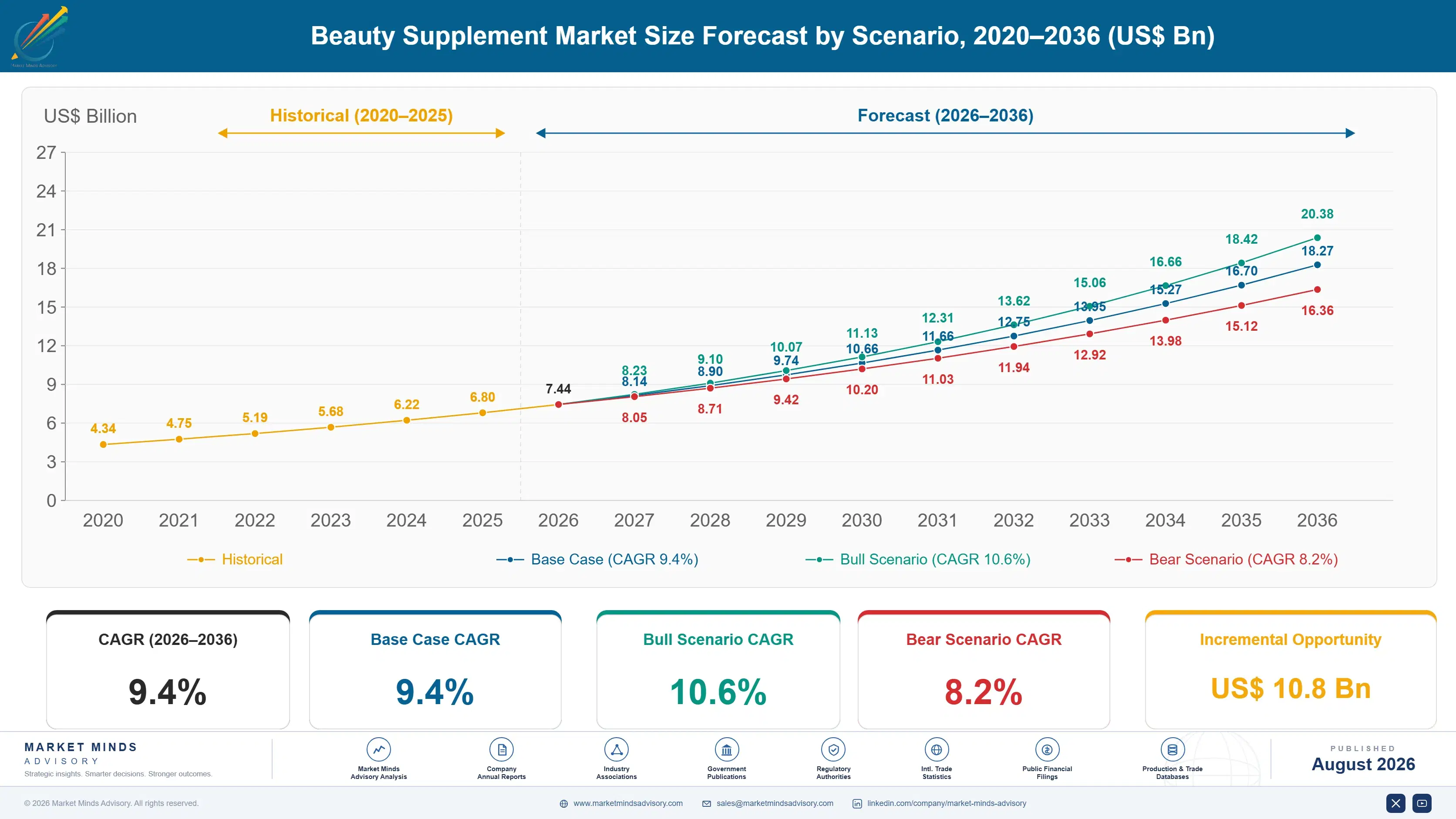
Beauty Supplement Market Forecast Scenarios

beauty-supplement-market-size-forecast-scenario-1787463456442
Between 2020 and 2025 the market grew at an estimated 8.4% historical CAGR, accelerating sharply after 2021 as pandemic-era wellness spending shifted from general immunity supplements toward skin and appearance-focused formulations, with South Korean and Japanese brands expanding aggressively into Southeast Asian and North American e-commerce channels through 2023 and into 2025, a pace few adjacent nutraceutical categories matched over the same period.
The base case assumes 9.4% CAGR through 2036, driven by three mechanisms: continued clinical substantiation investment that lets brands command premium pricing on proven formulations, rapid retail expansion of Korean and Japanese beauty supplement brands into North American and European specialty and mass retail channels, and rising adoption of personalized nutrition platforms that match supplement blends to individual skin biomarker and microbiome test results rather than generic formulations sold identically across every consumer segment.
The bull case, at 10.6%, hinges on faster mainstream Western adoption of ingestible beauty products currently concentrated among early-adopter consumers. The bear case, at 8.2%, reflects a scenario where tightening European Union and United States health-claim enforcement forces costly reformulation and clinical trial investment that smaller direct-to-consumer brands cannot afford, pushing consolidation among under-capitalized regional brands unable to absorb the compliance cost.

Clinical Substantiation and Cross-Border Retail Dynamics

Beauty supplement demand now converges around three forces: clinical substantiation requirements tightening in major regulatory markets, cross-border e-commerce expansion that lets Korean and Japanese brands reach Western consumers directly, and ingredient innovation moving beyond collagen toward ceramides, postbiotics, and skin microbiome actives. Brands that can prove measurable skin outcomes through published clinical data are capturing premium shelf space fastest, while unsubstantiated collagen-only product lines face growing retailer delisting risk across specialty beauty retail channels.
CR5 CONCENTRATION28%top five brands hold meaningful but fragmented market share
AVERAGE SELLING PRICEUSD 42/unitpremium clinically substantiated formulations command notably higher retail pricing
TOP PRODUCING COUNTRY SHAREJapan, 21%leads global beauty supplement manufacturing on legacy formulation expertise
CAPACITY UTILISATION71%reflects rapid new product launch cycles across major brands
TRADE INTENSITY38%cross-border e-commerce drives significant international ingredient and product flows
FEEDSTOCK COST SHARE44%marine collagen and specialty actives dominate total formulation cost
Commercially, the category increasingly resembles a pharmaceutical-adjacent business rather than a simple wellness product line. Leading brands fund double-blind clinical trials, publish results in peer-reviewed dermatology journals, and build regulatory affairs teams to defend health claims across multiple jurisdictions simultaneously, a level of investment smaller direct-to-consumer entrants struggle to match without venture funding or a major retail partner's backing.
Over the next decade, personalized nutrition technology, novel postbiotic actives, and stricter global health-claim enforcement will jointly determine which brands can defend premium pricing as the category matures beyond its current early-adopter base into genuine mainstream wellness retail, a transition Japanese and Korean brands are positioned to lead given their decades of formulation and clinical trial experience already banked.
"Collagen alone doesn't win shelf space anymore. The brands pulling ahead are the ones publishing actual skin elasticity data instead of just prettier packaging."
Director, Beauty and Personal Care Nutrition Practice · MMA Healthcare and Consumer Nutrition Practice · August 2026

Market Trends

European Union Health-Claim Substantiation Rules Tighten

The European Food Safety Authority has intensified scrutiny of beauty and skin-health claims attached to ingestible supplements, rejecting several previously accepted collagen and hyaluronic acid claims pending additional randomized controlled trial evidence since 2023. Brands selling into the European Union now face substantially longer product launch timelines as regulatory affairs teams compile clinical dossiers before packaging can carry specific skin-outcome language. Suppliers and brand owners that pre-invested in clinical trial infrastructure ahead of the tightened standard are capturing reformulation-driven market share from competitors still scrambling to commission trials, a gap expected to widen further as enforcement intensifies through 2027.
Market Impact: Grows cross-border volume 60% since 2022
Postbiotic and Skin Microbiome Ingredient Innovation

Ingredient innovation is moving decisively beyond first-generation collagen peptides toward postbiotic ferments and skin microbiome-targeted actives that claim to support the skin barrier from within rather than simply supplying structural protein building blocks. Japanese and Korean ingredient suppliers have launched more than a dozen new postbiotic actives since 2023, each requiring its own clinical substantiation work before major brands will commit to formulation. Early clinical data suggests measurable improvements in skin hydration and barrier function within eight to twelve weeks of consistent use, giving brands a differentiated efficacy claim increasingly difficult for collagen-only competitors lacking comparable microbiome research investment.
Market Impact: Commands 30 to 50% price premium

Market Opportunities and Growth Drivers

Cross-Border E-Commerce Expansion Into Western Markets

Korean and Japanese beauty supplement brands have expanded aggressively into United States and European e-commerce channels since 2022, using platforms including Amazon, TikTok Shop, and direct-to-consumer subscription models to bypass traditional retail gatekeeping entirely. Cross-border shipment volume for beauty supplements originating in South Korea grew by an estimated 60% between 2022 and 2025, as Western consumers increasingly discover K-beauty ingestible brands through social media influencer content rather than in-store discovery. This channel shift is compressing the advantage previously held by established Western wellness retailers with physical shelf space, forcing many to stock Asian imports or risk losing relevance.
Market Impact: Adds 6 to 9 months delay

Clinical Trial Investment Enables Premium Pricing Power

Brands that fund double-blind, placebo-controlled clinical trials for their flagship collagen or ceramide formulations are commanding retail prices 30 to 50% above unsubstantiated competitors carrying similar ingredient lists, based on retail pricing analysis across major specialty beauty channels in the United States, Japan, and South Korea. This premium reflects genuine consumer willingness to pay for proven efficacy rather than marketing claims alone, particularly among higher-income consumers who have already tried multiple unsubstantiated products without visible results. The investment required, often several million dollars per trial, has become a meaningful barrier separating well-capitalized brands from smaller entrants.
Market Impact: Raises acquisition cost 25 to 40%

Market Restraints and Challenges

Regulatory Fragmentation Across Major Consumer Markets

Beauty supplement health claims permitted in Japan and South Korea frequently cannot be used verbatim in the European Union or United States, where regulators apply materially different evidentiary standards for skin-outcome language. The root cause is that no harmonized global standard exists for cosmetic-adjacent ingestible claims, leaving each brand to fund separate regional clinical and regulatory affairs work for the same underlying formulation. This duplication raises launch cost and timeline meaningfully for brands expanding across regions simultaneously. Some suppliers mitigate the friction by designing modular formulations with region-specific claim language built in from the outset.
Market Impact: Adds 8 to 14 months

Efficacy Skepticism Among Mainstream Western Consumers

Mainstream Western consumers remain skeptical of ingestible beauty claims, with survey data showing many still doubt oral supplements can measurably affect skin appearance compared with topical alternatives they can see working directly. This skepticism traces to years of unsubstantiated marketing across the broader nutraceutical industry, which conditioned consumers to distrust ingredient-list health claims generally. The commercial impact is a longer conversion funnel and higher customer acquisition cost for Western entrants compared with Japan and South Korea, where beauty-from-within culture is already established. Brands are mitigating this through influencer-led before-and-after content and money-back efficacy guarantees.
Market Impact: Adds 12 new SKUs annually
3 additional market trends, 3 additional growth drivers, and 4 additional restraints and challenges are covered in the full report. Contact sales@marketmindsadvisory.com to access the complete intelligence.

Segment CAGR and Growth Architecture

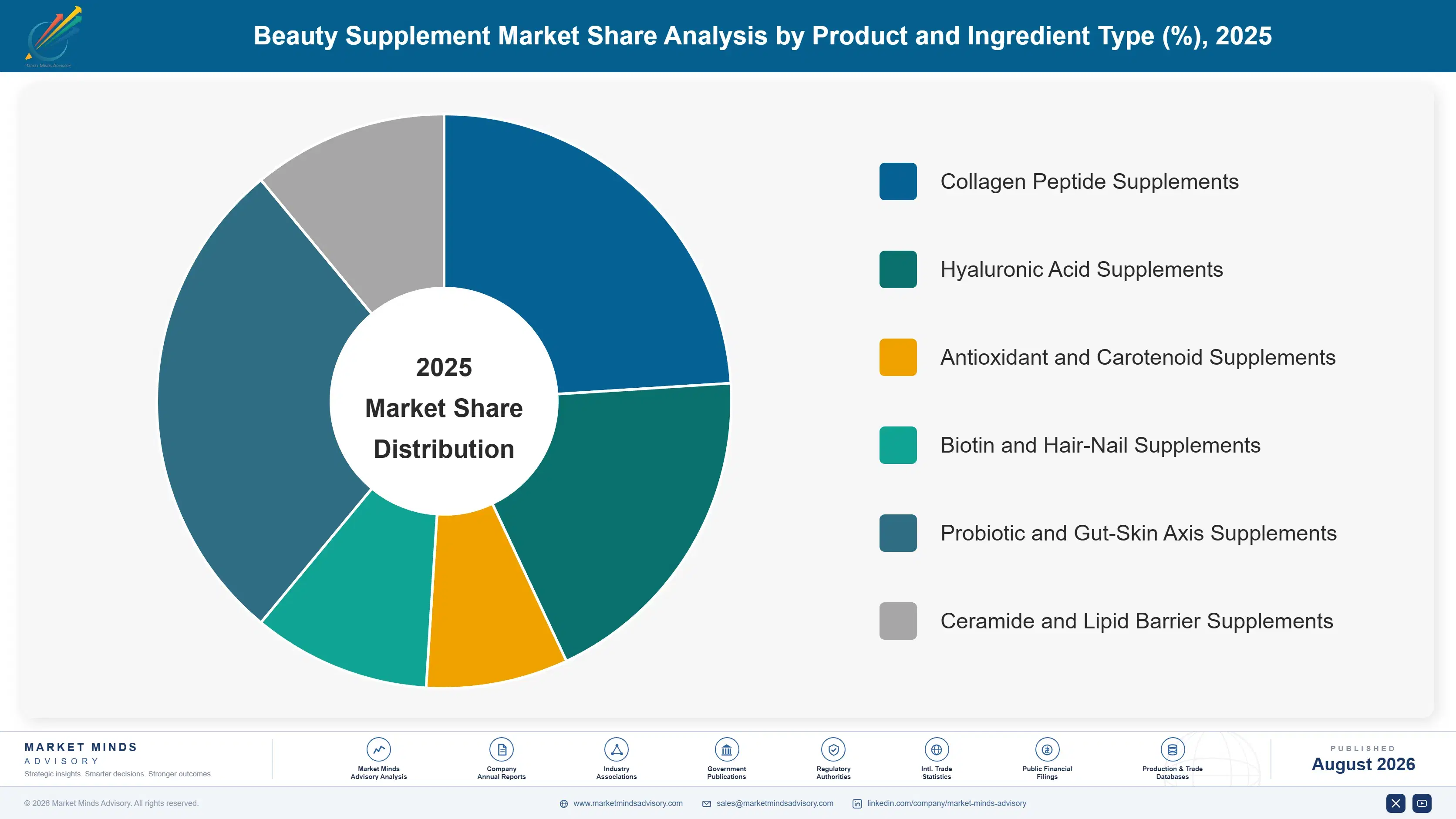
Segmentation follows product and ingredient type, the classification retailers and regulators both use to categorize beauty supplement claims and formulation risk, spanning collagen peptide, hyaluronic acid, antioxidant and carotenoid, biotin and hair-nail, probiotic and gut-skin axis, and ceramide and lipid barrier systems across six distinct formulation categories that map directly onto how brands organize research and clinical trial investment.
beauty-supplement-market-market-share-analysis-1787463456983

Ceramide and Lipid Barrier Supplements

Ceramide and lipid barrier supplements represent the fastest-growing category as skin barrier science gains mainstream credibility, with dermatologists increasingly validating the connection between ingestible lipid actives and measurable improvements in transepidermal water loss and skin hydration. Formulation complexity is substantial, since ceramide bioavailability depends heavily on delivery system technology, particularly liposomal or nanoemulsion encapsulation, that most legacy supplement manufacturers have not yet mastered at commercial scale. Suppliers with proprietary delivery technology are capturing disproportionate share and premium pricing, commanding average selling prices well above standard collagen formulations. Demand concentrates among Japanese and South Korean brands first, with adoption spreading fastest into premium Western direct-to-consumer channels as consumers seek differentiated actives beyond commoditized collagen peptide products.
CAGR 12.8%

Probiotic and Gut-Skin Axis Supplements

Probiotic and gut-skin axis supplements are expanding rapidly as clinical research increasingly links gut microbiome composition to visible skin inflammation, acne, and barrier function outcomes, giving brands a scientifically credible new angle beyond direct topical or connective-tissue ingredient claims. This segment overlaps conceptually with general digestive health probiotics but is defined specifically by skin-outcome marketing and clinical substantiation targeting dermatological rather than digestive endpoints, requiring brands to commission separate skin-focused clinical trials. Early entrants that pre-validated skin-specific probiotic strains against digestive-only competitors have captured a multi-year formulation advantage. Growth is fastest in East Asia and increasingly in North America, where wellness-focused consumers already comfortable with probiotic supplementation are receptive to skin-specific extensions of a category they already trust.
CAGR 11.6%
Full segment breakdown across 6 segments available in the complete report.

Regional Architecture and Country Demand Map

East Asia leads global consumption on Japan's mature beauty-from-within culture and South Korea's rapidly scaling brand exports, followed by North America's premium wellness retail spend and Western Europe's tightening regulatory transition, with South Asia and Pacific expanding fastest on rising Indian and Southeast Asian premium beauty retail adoption.

North America

United States consumers drive the bulk of regional demand, with premium wellness retailers and specialty beauty chains increasingly dedicating shelf space to clinically substantiated collagen, ceramide, and probiotic-based ingestible products as mainstream awareness of beauty-from-within positioning grows steadily beyond the early-adopter consumer base that first embraced the category. Direct-to-consumer subscription brands have proliferated rapidly across social media and e-commerce channels, often undercutting traditional specialty retail pricing while building loyal repeat-purchase customer bases through influencer partnerships and visible before-and-after content campaigns. Canada contributes a smaller but steadily growing share, mirroring United States retail trends with a modest lag. Regulatory scrutiny from the Food and Drug Administration over health claims is reshaping how brands market efficacy, pushing many toward conservative, substantiated language.
Share: 24% | CAGR: 8.6% (2026 to 2036)

Western Europe

Germany and France anchor regional demand through well-established pharmacy and drugstore retail channels that have long carried dermo-cosmetic ingestible products alongside topical skincare, giving beauty supplements a distribution advantage most other regions lack. The United Kingdom's specialty wellness retail sector has expanded rapidly, particularly for ceramide and probiotic formulations targeting ingredient-literate consumers who research clinical backing before purchase. Nordic markets show disproportionate demand for sustainably sourced marine collagen, reflecting broader regional consumer preference for traceable, certified ingredient sourcing. The European Food Safety Authority's tightening health-claim substantiation requirements are reshaping product launch timelines across the region, favoring established brands with existing clinical trial infrastructure over newer entrants still building regulatory affairs capability.
Share: 19% | CAGR: 7.9% (2026 to 2036)
Regional intelligence for 5 additional markets available in the complete report: East Asia, South Asia and Pacific, Latin America, Middle East and Africa, Eastern Europe. Contact sales@marketmindsadvisory.com.
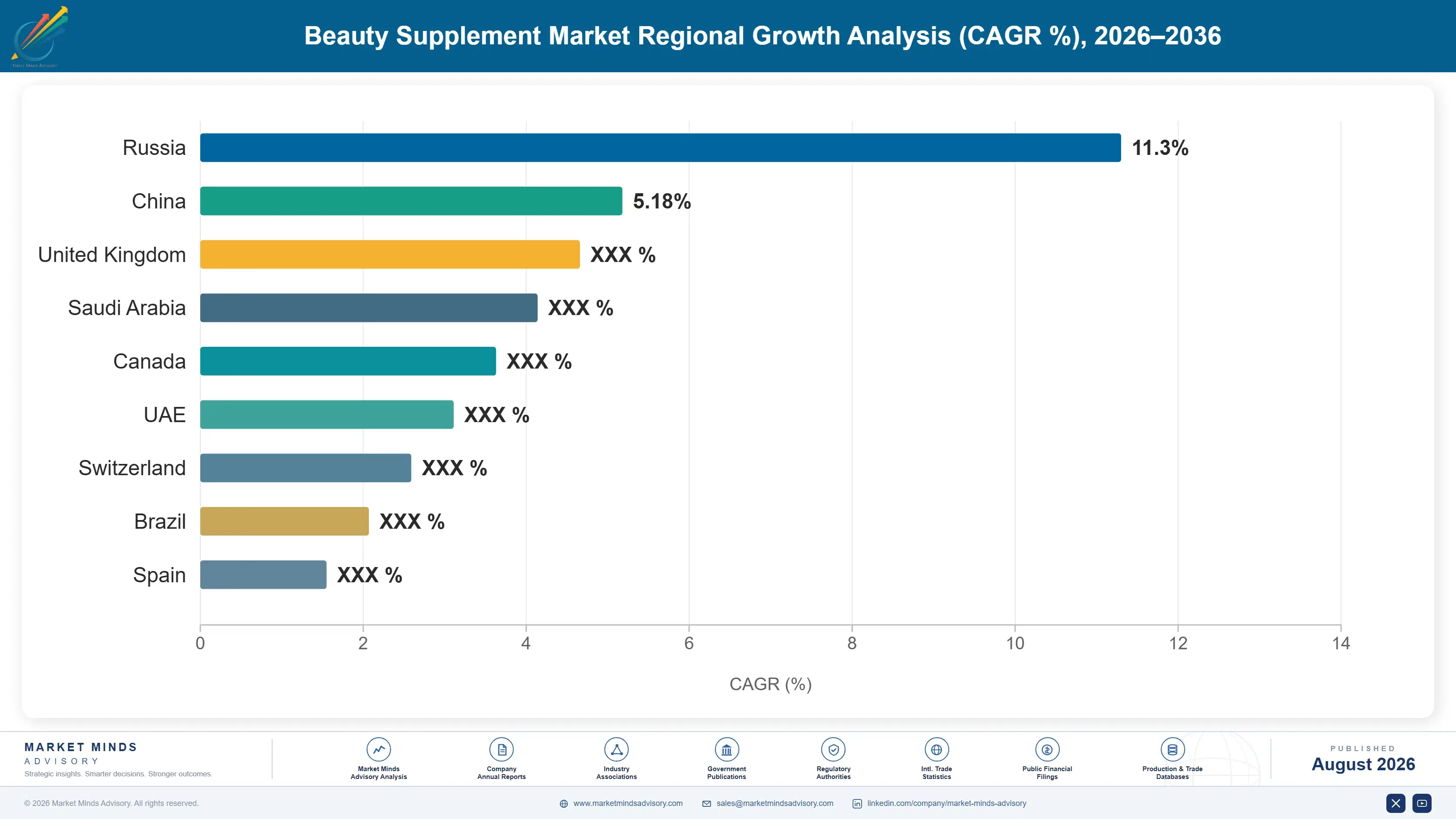
beauty-supplement-market-country-cagr-analysis-1787463457516

Where Beauty Supplement Brands Can Defend Margin

Brands are shifting from ingredient-list marketing toward clinically substantiated efficacy claims, investing in trial infrastructure, personalized formulation technology, and cross-border distribution capability that together determine which companies can defend premium pricing as the category matures beyond early-adopter consumers into genuine mainstream wellness retail, a transition rewarding depth of clinical investment over marketing spend alone.

Clinical Trial Investment for Premium Claim Substantiation

Brands that fund double-blind clinical trials for flagship formulations capture 30 to 50% higher retail pricing than unsubstantiated competitors, since specialty beauty retailers increasingly require published efficacy data before granting premium shelf placement. This investment, often several million dollars per completed trial program, functions as a durable moat smaller direct-to-consumer entrants cannot easily replicate. Brands that completed trials early are now reformulating claims language across every regional market simultaneously, extracting additional value from a single research investment. Ingredient suppliers are increasingly bundling clinical and regulatory affairs services to help mid-sized brands access this capability without building internal infrastructure.
Market Impact: Lifts retail pricing by 30 to 50 percent

Cross-Border Direct-to-Consumer Channel Expansion Into Western Markets

Korean and Japanese brands bypassing traditional Western retail gatekeeping through Amazon, TikTok Shop, and direct subscription models have grown cross-border shipment volume by an estimated 60% since 2022, capturing customer relationships and pricing power that would otherwise flow through retail intermediaries taking substantial margin. This channel strategy generates first-party purchase and repeat-use data that brands feed into formulation and marketing decisions, a feedback loop traditional wholesale distribution never provided. Brands executing this lever well are building loyal subscription bases with lower customer acquisition cost as repeat purchase rates climb, though early acquisition spend remains substantial for smaller entrants.
Market Impact: Grows cross-border shipment volume by roughly 60 percent

Personalized Formulation Technology and Biomarker Testing

At-home skin microbiome and biomarker testing kits are letting brands move beyond one-size-fits-all formulations toward personalized supplement blends matched to individual skin barrier function, hydration, and inflammation markers, commanding subscription pricing 25 to 40% above standard formulations. Early personalization programs launched since 2024 report meaningfully higher customer retention than standard subscription offerings, since consumers who receive personalized recommendations perceive higher value and stronger brand loyalty. This lever requires meaningful upfront investment in testing partnerships and data infrastructure, concentrating early adoption among well-capitalized brands rather than smaller entrants, though testing costs are declining as diagnostic technology matures.
Market Impact: Commands a 25 to 40 percent subscription premium

Regional Regulatory Affairs and Modular Claim Design

Brands designing modular formulations with region-specific claim language built in from initial development are cutting regional launch timelines by an estimated 6 to 9 months compared with competitors handling regulatory affairs market by market sequentially. This approach requires meaningful upfront regulatory affairs investment and close coordination between formulation science and legal teams, a capability currently concentrated among the largest, most established beauty supplement companies. Brands that master this lever can launch simultaneously across the European Union, United States, and East Asia rather than sequentially, capturing first-mover advantage in emerging categories like postbiotic and ceramide actives.
Market Impact: Cuts regional launch timeline by 6 to 9 months

Who Controls the Margin Pool

The top five brands hold an estimated 28% combined share on a revenue basis, reflecting the category's mix of legacy Japanese and Korean cosmetics conglomerates and a large, growing population of direct-to-consumer challenger brands. The gap between established leaders and fast-scaling challengers is narrower than in most consumer categories, since digital distribution lets well-funded newcomers reach meaningful scale within a few years rather than the decade legacy brand-building historically required.
Current competitive activity centers on three dimensions: racing to complete clinical substantiation trials ahead of regulatory enforcement, expanding cross-border e-commerce distribution to capture Western demand, and building personalized nutrition and biomarker testing capability to differentiate beyond commoditized collagen formulations. Brands that move first on all three fronts are pulling ahead of slower-moving legacy competitors relying on ingredient reputation and brand recognition alone.

Pressure is building from ingredient technology entrants developing novel postbiotic and ceramide delivery systems that could allow smaller, nimble brands to leapfrog established players on efficacy claims without their decades of accumulated experience. Regional Southeast Asian and Latin American brands are gaining share in domestic markets where local taste, packaging, and pricing preferences favor regional players over multinational entrants, eroding the advantage global brand recognition alone once provided.
beauty-supplement-market-company-positioning-matrix-1787463458039

Competitive Moat and Risk Dimensions

SHISEIDO

Moat: Decades of dermatological research

Shiseido operates one of the industry's largest dermatological research organizations, built over more than a century of topical and, more recently, ingestible skincare formulation work, giving it clinical trial infrastructure and accumulated skin-outcome data that newer entrants cannot replicate quickly regardless of available capital or ingredient sourcing relationships.
SHISEIDO

Risk: Slower digital-native brand response

Shiseido's scale and legacy retail relationships create organizational inertia that slows its response to fast-moving direct-to-consumer trends, leaving openings for nimbler digital-native brands to capture younger consumers first through social media channels Shiseido has been slower to fully embrace commercially, a gap smaller rivals are actively exploiting through faster product iteration cycles.
AMWAY

Moat: Global direct-selling distribution network

Amway's decades-old direct-selling network spans more than one hundred countries, giving its Nutrilite beauty supplement lines distribution reach and personal relationship-driven trust that e-commerce-only competitors struggle to replicate, particularly in markets where consumers still prefer purchasing through a known personal contact rather than an anonymous online storefront.
AMWAY

Risk: Direct-selling model reputational exposure

The direct-selling model underlying Amway's distribution carries persistent reputational association with multi-level marketing criticism in several Western markets, creating a trust barrier among younger, digitally native consumers who increasingly prefer transparent e-commerce brands over relationship-based direct sales regardless of underlying product quality, a perception gap Amway's marketing has struggled to close among skeptical younger buyers.

Players Tracked

Prominent Players

Shiseido
Amway
Suntory Wellness
Fancl Corporation
Herbalife

Other Key Players

Nestle Health Science
Glanbia
GNC Holdings
DSM-Firmenich
BASF
Nu Skin Enterprises
Blackmores
H and H Group
The Bountiful Company
Otsuka Pharmaceutical
Kao Corporation
Meiji Holdings
Lonza
Gelita AG
Rousselot

Recent Developments

JUNE 2025

Shiseido Launches Clinically Validated Ceramide Supplement Line

Shiseido launched a new ceramide-based ingestible supplement line backed by a published double-blind clinical trial demonstrating measurable improvements in skin barrier function within eight weeks, positioning the launch as a direct response to growing consumer demand for scientifically substantiated skin-health claims beyond standard collagen formulations.
Signal: Signals established beauty conglomerates accelerating clinical investment to defend premium positioning against emerging direct-to-consumer challengers across every major retail channel.
NOVEMBER 2024

Amway Expands Nutrilite Production Capacity in China

Amway completed an expansion of Nutrilite production capacity at its Wuxi, China manufacturing facility, adding dedicated beauty supplement production lines to serve growing domestic demand and reduce reliance on imported finished product across its direct-selling distribution network, with the expanded lines scheduled to reach full operational capacity during 2026.
Signal: Reflects continued multinational investment in Chinese domestic manufacturing capacity to capture rising beauty supplement demand across China's expanding middle class.
FEBRUARY 2026

Suntory Wellness Takes Minority Equity Stake in Postbiotic Startup

Suntory Wellness took a minority equity stake in a Japanese postbiotic ingredient startup developing skin-microbiome actives, gaining early access to proprietary fermentation technology without pursuing a full acquisition, a structure letting Suntory evaluate commercial potential before committing further capital toward a potential future majority acquisition.
Signal: Indicates established brands favoring minority equity stakes over outright acquisition to access early-stage ingredient innovation without full integration risk.

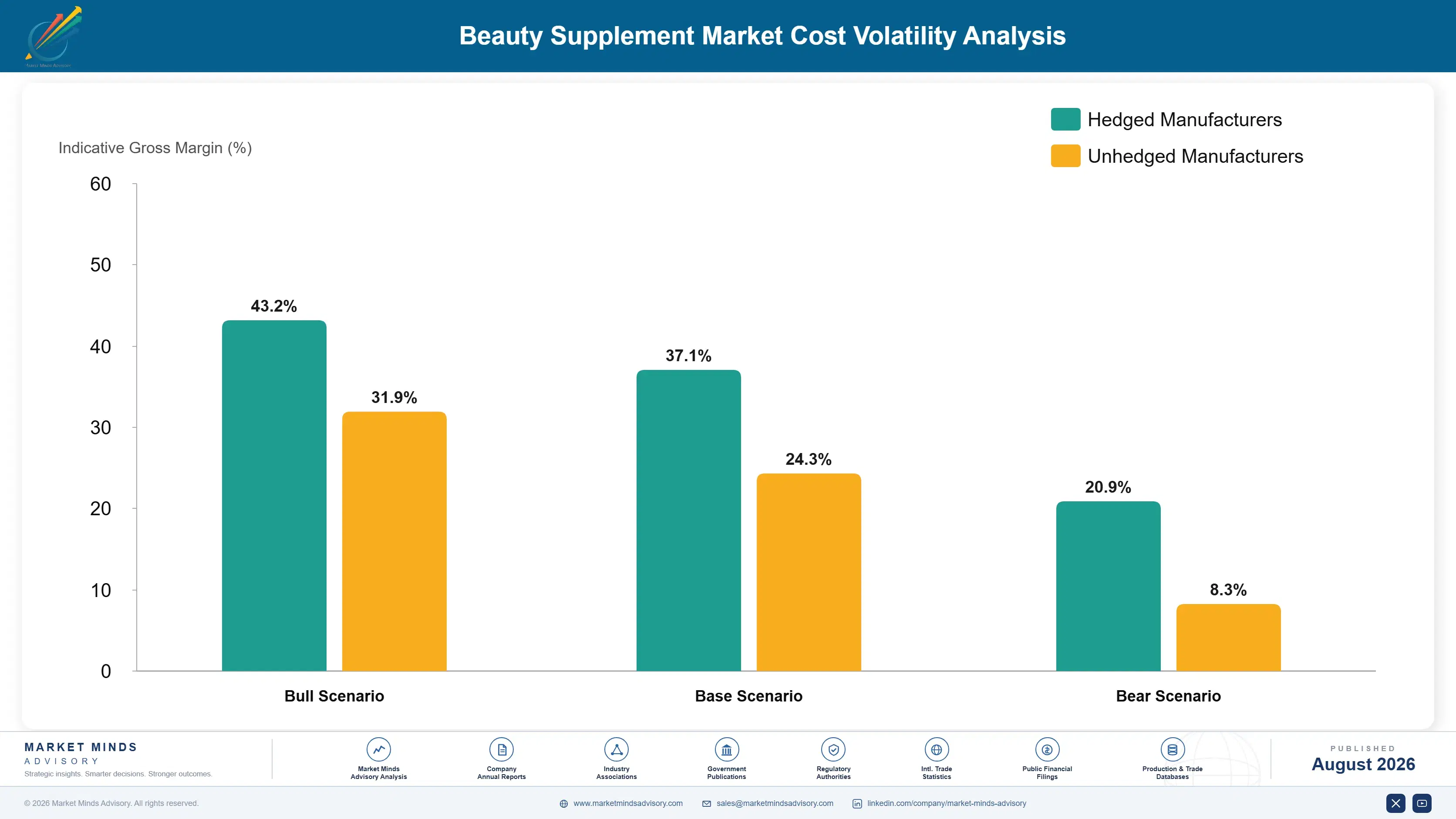
Marine Collagen and Specialty Actives Exposure

Marine and bovine collagen peptides together with specialty actives such as ceramides and postbiotic ferments represent roughly 44% of cost of goods sold for a typical beauty supplement formulation, with collagen alone accounting for close to a quarter of total input cost given the extraction and purification processes required to achieve pharmaceutical-grade purity for ingestible applications across major product lines.
Marine collagen prices rose an estimated 28% between 2023 and 2024 following reduced fish processing byproduct availability tied to lower wild-catch quotas in several major fishing regions, according to trade and supply chain commentary tracked through national fisheries statistical offices and corroborated by supplier annual report disclosures citing input cost pressure on collagen-based product lines during the period, with several brands citing the disruption explicitly in quarterly investor commentary as a material margin headwind.

Larger, well-capitalized brands with diversified collagen sourcing across marine, bovine, and increasingly plant-based or fermentation-derived alternatives absorb volatility more effectively than smaller brands dependent on single-source supply contracts. This creates a lasting cost disadvantage for smaller entrants during disruption periods, pushing some toward alternative protein sourcing despite the technical reformulation work required to match established collagen bioavailability claims.
beauty-supplement-market-cost-volatility-analysis-1787463458233

Diversified Collagen Sourcing Across Marine and Bovine Origins

Brands are qualifying multiple collagen origins, including marine, bovine, and fermentation-derived alternatives, reducing single-source concentration risk even though full substitution requires separate clinical substantiation work since bioavailability and absorption characteristics differ meaningfully across collagen source types and cannot be assumed equivalent without dedicated testing, a process several leading brands have already begun ahead of anticipated future supply disruption.

Fermentation-Derived Collagen Alternative Development

Several ingredient suppliers are investing in precision fermentation technology to produce collagen-identical proteins without animal or marine sourcing entirely, offering long-term price stability once production scales, though current fermentation-derived collagen remains meaningfully more expensive than traditional extraction methods at present commercial volumes, a gap expected to narrow steadily as fermentation facilities scale toward full commercial output over the coming years.

Long-Term Supply Contracts With Processing Partners

Several brands have signed multi-year supply agreements directly with fish processing and bovine hide byproduct suppliers, locking in volume and partially insulating pricing from spot market volatility during acute disruption periods tied to fishing quota changes or processing capacity constraints affecting the broader industry, giving contracted brands materially more predictable input costs than competitors relying on spot market purchasing alone.

Portfolio Architecture for Margin Defence

The portfolio splits across three tiers with materially different margin economics: volume-grade unsubstantiated collagen and basic vitamin formulations carrying thin margins under intense price competition from generic supplement manufacturers, certified clinically substantiated systems commanding a meaningful premium, and next-generation personalized or postbiotic-based systems capturing the highest margins currently available in the category, a spread wide enough that clinical investment strategy now matters more to brand profitability than raw manufacturing scale. Brands increasingly treat tier positioning as a deliberate strategic choice rather than an inherited legacy from their founding product line.
The volume versus premium tension is acute right now because retailer shelf space increasingly favors substantiated claims, compressing the addressable market for generic, unsubstantiated formulations faster than smaller brands can fund the clinical investment needed to move upmarket, leaving many holding aging product lines with declining retail relevance.

High-value margin pools concentrate specifically in ceramide and postbiotic formulations carrying published clinical substantiation and in personalized nutrition subscription programs, both of which command premium pricing tied to research investment and data infrastructure rather than raw ingredient cost alone, rewarding brands that invested early in science over those competing purely on marketing spend.

Volume / Commodity-Adjacent Tier

Standard, largely unsubstantiated collagen and basic vitamin formulations sold primarily on price and brand recognition into mass retail and drugstore channels, facing intense competitive pressure from clinically substantiated alternatives and carrying thin, squeezed margins.
Gross Margin: 14%-20%

Premium / Certified Tier

Clinically substantiated formulations carrying published trial data and third-party quality certification, commanding premium pricing tied to documentation, regulatory compliance support, and validated efficacy claims across major specialty beauty retail channels.
Gross Margin: 30%-38%

Sustainability / Regulatory / Next-Generation Tier

Personalized nutrition, postbiotic, and ceramide-based systems serving biomarker-matched and next-generation skin barrier applications at the highest technical complexity, clinical investment, and margin currently available across the category, reflecting the substantial research investment these formulations require before commercial launch.
Gross Margin: 42%-50%
beauty-supplement-market-portfolio-architecture-1787463458725

High-value Sub-segments and Strategic Watch-out

Ceramide and Postbiotic Formulations

Highest-value, fastest-growing segment driven by skin barrier science credibility, commanding premium pricing on delivery technology and clinical substantiation that competitors cannot easily replicate quickly, since building comparable formulation science and trial data typically requires several years of dedicated research investment across multiple biomarker endpoints tracked over time.
Gross Margin: 44%-52%

Personalized Nutrition Subscription Programs

High-value segment growing steadily as biomarker testing technology matures, with margin supported by data infrastructure and subscription retention rather than raw technical complexity alone, favoring brands with established testing partnerships and multi-year customer relationship data across broad geographic subscriber bases spanning multiple regulatory jurisdictions and language markets simultaneously.
Gross Margin: 36%-44%

Standard Collagen Peptide Formulations

Volume core of the category, serving mainstream mass retail and drugstore applications with stable but thin margins under sustained price competition among suppliers, where manufacturing scale and cost efficiency matter more than formulation sophistication for winning large-volume private-label contracts across mature Western and East Asian retail markets alike.
Gross Margin: 18%-24%

Unsubstantiated Legacy Vitamin Blends

Strategic watch-out segment facing steady, accelerating decline as retailer shelf space and regulatory scrutiny both favor substantiated alternatives, leaving suppliers reliant on this tier exposed to shrinking addressable volume and thinning margin as brands complete their clinical substantiation transition programs across every major regulatory jurisdiction over the coming decade.
Gross Margin: 10%-16%

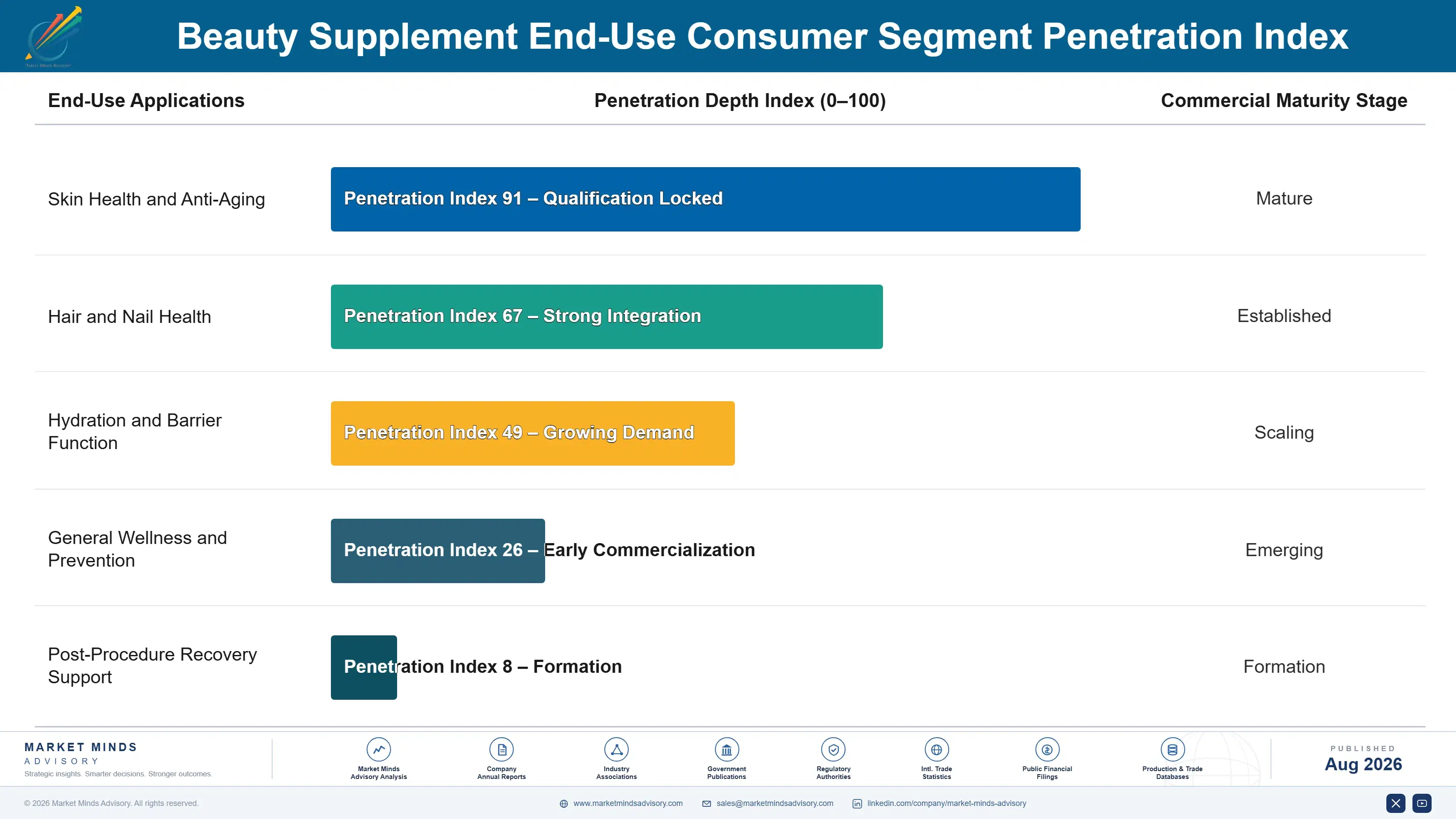
Repeat Purchase Cycles and Brand Loyalty

Beauty supplement demand behaves like a subscription annuity once a brand wins a consumer's trust, since visible efficacy over eight to twelve weeks of consistent use drives strong repeat purchase behavior that rarely churns unless a competitor offers a genuinely differentiated claim, giving brands with proven formulations multi-year customer lifetime value well above typical wellness product categories. Customer acquisition remains the primary cost hurdle, but retention economics turn favorable quickly once trial periods pass, typically within the first two to three purchase cycles for well-formulated products.
Adoption depth varies sharply by end-use vertical: collagen and general skin-health formulations show the broadest, most established consumer base given decades of category awareness, while emerging postbiotic and personalized nutrition categories remain more contestable as brands actively compete for early-adopter consumers willing to try genuinely new formulation approaches during this formative category-building phase that typically spans a brand's first several years in market.

A generational shift in buyer profiles is underway as younger consumers, increasingly comfortable purchasing supplements through social media and direct-to-consumer platforms, prioritize published clinical data and transparent ingredient sourcing over the brand heritage and in-store trust relationships that defined purchasing decisions for older generations of beauty supplement consumers.
beauty-supplement-market-end-use-penetration-index-1787463459216

Priorities for Beauty Supplement Brands

These are among the four positions where our research anticipates prominent divergence between winners and laggards over the coming forecast period. Each is grounded in the demand model, the regulatory perimeter, and the announced capacity pipeline.
01 / CLINICAL SUBSTANTIATION PRIORITY

Fund clinical trials before regulatory enforcement tightens further

Brands still relying on ingredient-list marketing without published clinical data face a rapidly shrinking addressable market as European Union and United States regulators tighten health-claim substantiation requirements simultaneously across major consumer markets. The window to complete double-blind trials ahead of stricter enforcement is narrowing quickly, and brands that delay risk losing premium shelf placement to faster-moving competitors already publishing efficacy data. Early clinical investment also compounds commercially, since substantiated claims can be reused across every regional market without separate reformulation work.
02 / SOURCING DIVERSIFICATION STRATEGY

Diversify collagen sourcing beyond single-origin marine supply

Single-source marine collagen dependency has produced repeated price shocks tied to fishing quota changes over the past several years, directly compressing margins for brands without diversified sourcing across marine, bovine, and fermentation-derived alternatives. Qualifying multiple collagen origins reduces exposure meaningfully, though full substitution requires separate clinical substantiation work since bioavailability differs across source types and cannot simply be assumed equivalent. Brands that fail to diversify remain persistently vulnerable to the next fishing quota disruption or processing capacity constraint affecting their primary supplier.
03 / PERSONALIZATION TECHNOLOGY INVESTMENT

Build biomarker testing capability ahead of mainstream adoption

Personalized nutrition and biomarker-matched formulations represent the segment with the strongest emerging margin profile, but they require testing partnerships and data infrastructure that most brands currently lack entirely, particularly around skin microbiome and biomarker validation work. Building this capability now positions brands to capture premium subscription accounts before the segment fully matures and margins inevitably compress under intensifying competitive pressure from fast-following entrants. Brands that wait will face steeper technical catch-up costs, arriving after early movers have already locked in the most loyal subscriber relationships.
04 / REGIONAL REGULATORY COORDINATION

Design modular formulations for simultaneous multi-region launch

Regulatory fragmentation across the European Union, United States, and East Asia makes simultaneous multi-region launch increasingly decisive for competitive positioning and total addressable market capture within a single formulation development cycle. Brands still handling regulatory affairs market by market sequentially face a growing speed disadvantage against competitors already designing modular formulations with region-specific claim language built in from the outset. Capital committed to regulatory affairs capability now compounds advantage steadily as clinical substantiation requirements continue tightening across every major consumer market through the forecast period.

Engagement Snapshot From the Field

A live engagement with an industry participant carrying material or product regulatory and market exposure ahead of a defining policy shift, showing how our research translates into a defensible multi-year portfolio strategy.
MARKET MINDS ADVISORY · CLIENT ENGAGEMENT SUMMARY
Beauty Supplement Producer Strategic Portfolio Review and Transition Roadmap 2026·Investment Scenario on Beauty Supplement Exposure Evaluation 2025-26
CLIENT PROFILE
The client is a venture-backed direct-to-consumer beauty supplement brand selling collagen and ceramide formulations primarily through subscription e-commerce channels across the United States and Canada, with reported annual revenue exceeding 60 million USD (client-reported, unverified by MMA) prior to engaging MMA for clinical substantiation and regulatory strategy support ahead of anticipated Food and Drug Administration health-claim enforcement affecting several flagship product lines.
STRATEGIC CHALLENGE
Facing tightening Food and Drug Administration scrutiny of unsubstantiated skin-health claims, the client's flagship collagen line lacked published clinical trial data supporting its marketing language, risking forced reformulation or claim removal that could meaningfully reduce conversion rates across its primary subscription acquisition channels if substantiation could not be completed before enforcement action began.
MMA APPROACH
MMA conducted a competitive clinical substantiation benchmarking exercise across ten comparable direct-to-consumer beauty supplement brands, assessing trial design, published outcome measures, and claims language defensibility, then facilitated introductions to two contract research organizations experienced in dermatological outcome trials to accelerate the client's own trial design and regulatory affairs process substantially.
KEY FINDINGS
  1. Only three of ten benchmarked competitors had completed published clinical trials for their flagship formulations, revealing a meaningful substantiation gap across the broader direct-to-consumer beauty supplement category overall.
  2. Contract research organization trial timelines ranged from four to nine months depending on study design complexity, directly shaping the client's go-to-market timeline for reformulated marketing claims.
  3. Competitors that had already completed trials commanded meaningfully higher subscription conversion rates, correlating clinical substantiation investment directly with measurable acquisition funnel performance improvements.
  4. Claims language defensibility varied significantly even among substantiated competitors, highlighting the importance of conservative, precisely worded marketing copy aligned tightly with actual trial outcome data.
CLIENT PROFILE
The client is a venture-backed direct-to-consumer beauty supplement brand selling collagen and ceramide formulations primarily through subscription e-commerce channels across the United States and Canada, with reported annual revenue exceeding 60 million USD (client-reported, unverified by MMA) prior to engaging MMA for clinical substantiation and regulatory strategy support ahead of anticipated Food and Drug Administration health-claim enforcement affecting several flagship product lines.
STRATEGIC CHALLENGE
Facing tightening Food and Drug Administration scrutiny of unsubstantiated skin-health claims, the client's flagship collagen line lacked published clinical trial data supporting its marketing language, risking forced reformulation or claim removal that could meaningfully reduce conversion rates across its primary subscription acquisition channels if substantiation could not be completed before enforcement action began.
MMA APPROACH
MMA conducted a competitive clinical substantiation benchmarking exercise across ten comparable direct-to-consumer beauty supplement brands, assessing trial design, published outcome measures, and claims language defensibility, then facilitated introductions to two contract research organizations experienced in dermatological outcome trials to accelerate the client's own trial design and regulatory affairs process substantially.
KEY FINDINGS
  1. Only three of ten benchmarked competitors had completed published clinical trials for their flagship formulations, revealing a meaningful substantiation gap across the broader direct-to-consumer beauty supplement category overall.
  2. Contract research organization trial timelines ranged from four to nine months depending on study design complexity, directly shaping the client's go-to-market timeline for reformulated marketing claims.
  3. Competitors that had already completed trials commanded meaningfully higher subscription conversion rates, correlating clinical substantiation investment directly with measurable acquisition funnel performance improvements.
  4. Claims language defensibility varied significantly even among substantiated competitors, highlighting the importance of conservative, precisely worded marketing copy aligned tightly with actual trial outcome data.
RECOMMENDED STRATEGY
Phase 1: Phase 1 (Months 1 to 2): Complete competitive substantiation benchmarking and select a contract research organization experienced in dermatological outcome trials. Phase 2: Phase 2 (Months 3 to 7): Execute double-blind clinical trial while simultaneously revising marketing claims language to conservative, defensible interim positioning. Phase 3: Phase 3 (Months 8 to 9): Launch reformulated marketing claims backed by published trial data across all subscription acquisition channels simultaneously.
OUTCOME
The client completed its clinical trial and published results ahead of anticipated enforcement action, reporting a meaningful improvement in subscription conversion rate after relaunching substantiated marketing claims (client-reported, unverified by MMA), while establishing regulatory affairs infrastructure supporting future formulation launches without repeating the full benchmarking process.

Frequently Asked Questions

Foundational context covering the market sizes, CAGR, scope, country, region and competition that inform every finding below. This section is provided to cover basics and most often pre-purchase conversations, answered from the MMA Primary Research Dataset.

What is the current size of the Beauty Supplement Market?

The global beauty supplement market is valued at approximately USD 6.8 billion in 2025. This figure covers ingestible collagen, ceramide, probiotic, and antioxidant products marketed specifically for skin, hair, and nail health.

How large will the Beauty Supplement Market be by 2036?

The market is projected to reach approximately USD 18.3 billion by 2036 under the base case scenario. This reflects sustained clinical substantiation investment and cross-border e-commerce expansion.

What is the CAGR for the Beauty Supplement Market 2026 to 2036?

The base case CAGR is 9.4% across the 2026 to 2036 forecast period, reflecting accelerating clinical investment. Bull and bear scenarios range from 8.2% to 10.6% depending on regulatory enforcement pace.

Which segment is growing fastest?

Ceramide and lipid barrier supplements are the fastest-growing segment at a 12.8% CAGR. This reflects growing dermatological credibility for ingestible skin barrier actives beyond standard collagen formulations.

Who are the major companies in the Beauty Supplement Market?

Leading companies include Shiseido, Amway, Suntory Wellness, Fancl Corporation, and Herbalife. These five companies hold an estimated 28% combined market share on a revenue basis.

Which country is growing fastest?

China leads growth at an estimated 11.2% CAGR, driven by expanding middle-class beauty retail spending. Rising e-commerce penetration is the primary growth mechanism behind this expansion.

Report Segmentation Architecture

The full report scope spans multiple orthogonal segmentation dimensions, with cross-tabulated demand data provided for each dimension pair. Coverage extends further to regional breakdowns, trend trajectories, and the competitive detail needed to support segment-level decision-making.

By Product and Ingredient Type

  • Collagen Peptide Supplements
  • Hyaluronic Acid Supplements
  • Antioxidant and Carotenoid Supplements
  • Biotin and Hair-Nail Supplements
  • Probiotic and Gut-Skin Axis Supplements
  • Ceramide and Lipid Barrier Supplements

By End-Use Consumer Segment

  • Skin Health and Anti-Aging
  • Hair and Nail Health
  • Hydration and Barrier Function
  • General Wellness and Prevention
  • Post-Procedure Recovery Support

By Commercial Dimension

  • Direct-to-Consumer Subscription
  • Specialty Beauty Retail
  • Mass Retail and Drugstore
  • Direct-Selling Distribution

By Region

  • North America
  • Western Europe
  • East Asia
  • South Asia and Pacific
  • Latin America
  • Middle East and Africa
  • Eastern Europe

Scope, Methodology, and Coverage

Every figure in this report is reproducible from documented input assumptions. The scope below maps the historical period, the forecast horizon, the segmentation dimensions, and the countries covered, alongside the underlying primary and qualitative methodology.
Historical Period
2020 to 2025
Forecast Period
2026 to 2036
Base Year
2025 (USD billions; MMA Primary Research Dataset, August 2026)
Market Definition
This report covers oral ingestible products, including capsules, powders, and functional beverages, formulated with collagen, hyaluronic acid, ceramides, antioxidants, or probiotics marketed specifically for skin, hair, and nail health outcomes. It excludes topical cosmetics, dermatological pharmaceuticals, and general multivitamin products without a beauty-specific claim.
Quantitative Units
USD billions (current prices); unit volume for select segment analysis
Segmentation Dimensions
By Product and Ingredient Type; By End-Use Consumer Segment; By Commercial Dimension; By Region
Regions Covered
North America, Western Europe, East Asia, South Asia and Pacific, Latin America, Middle East and Africa, Eastern Europe
Countries Covered
USA, China, Germany, France, UK, Japan, South Korea, India, Australia, Canada, Brazil, Mexico, Indonesia, Vietnam, Thailand, Malaysia, UAE, Saudi Arabia, South Africa, Nigeria, Turkey, Poland, Netherlands, Italy, Spain, Sweden, Switzerland, Argentina, Colombia, Singapore, and additional markets relevant to this sector
Key Companies Profiled
Shiseido, Amway, Suntory Wellness, Fancl Corporation, Herbalife, Nestle Health Science, Glanbia, GNC Holdings, DSM-Firmenich, BASF, Nu Skin Enterprises, Blackmores, H and H Group, The Bountiful Company, Otsuka Pharmaceutical, Kao Corporation, Meiji Holdings, Lonza, Gelita AG, Rousselot
Quantitative Methodology
Primary survey, n=3,800 respondents, Q4 2025, six countries; demand-side model with trade association cross-validation
Qualitative Methodology
47 expert interviews, Q4 2025; applied to validate demand model assumptions, identify emerging dynamics, and assess competitive positioning
Report Format
PDF and XLSX data workbook (Word format preview document)
Publisher
Market Minds Advisory
Report Code
MMA-2026-HLT-201
Published
August 2026
Contact
sales@marketmindsadvisory.com | www.marketmindsadvisory.com

Purchase the full Beauty Supplement Market Report (2026 to 2036).

The full report delivers a complete quantitative and qualitative assessment of the global beauty supplement market across all six product segments and seven regions. It includes detailed brand and supplier profiles covering clinical substantiation capability, distribution strategy, and regulatory positioning for the twenty companies profiled. Analysts provide scenario-adjusted forecasts through 2036 alongside input cost sensitivity modeling tied to marine collagen and specialty active price volatility. Buyers receive access to underlying primary survey and expert interview data supporting all quantitative claims. The report also flags out-of-band regional shares and segmentation judgment calls explicitly, giving buyers full visibility into every assumption behind the forecast.
Segment-level forecasts through 2036 across all six categories
Seven-region demand, pricing, and CAGR breakdown tables
Twenty-company competitive profiling with moat and risk analysis
Marine collagen supply risk assessment and mitigation pathways
Clinical substantiation tracker across major regulatory jurisdictions
Quarterly market update subscription option for ongoing monitoring

Built For The People Who Decide

From boardroom strategy to bench-side execution, this report is read cover-to-cover by leaders shaping the next decade of their industry, turning demand scenarios, market dynamics and valuation benchmarks into decisions.
CXOs/ Presidents/ VPs/ Managers
M&A and Corporate Development
Strategy Teams and R&D Heads
Procurement and Product Directors
Regulatory and Compliance Leaders
Investor Relations and Equity Analysts