Market Minds Advisory
Bean Flour Market

Bean Flour Market: Pulse Protein Demand Reshapes a Legacy Commodity Ingredient

Plant protein formulators and gluten-free bakers are pulling pea, chickpea, and lentil flour away from their commodity roots as milling capacity concentrates in Canada, India, and China to meet diverging demand.

Lead Analyst

Lisa Gevelber

Published

September 2026

Make Smarter Decisions with Customized Research Insights

Request a free sample report and evaluate market opportunities, growth trends, and competitive dynamics relevant to your business needs.

2025 MARKET VALUE$3.4BMarket Size 2025
2036 FORECAST VALUE$6.7BBase Case , 2026 to 2036
CAGR 2026 TO 20366.4 %Bull 7.7% / Bear 5.1%
INCREMENTAL OPPORTUNITY$3.1BNet 10- year value creation
EXPANSION MULTIPLE1.86x2036 value over 2026 base
Strategic Levers
M&A Pipeline
Regional Outlook
Country Rankings
Competitive Intelligence
Segmental Deep-dive
Call-Us : 91 93563 13602

Executive Snapshot and Market Trajectory

Bean flour reached USD 3.4 billion globally in 2025, a legacy pantry commodity now splitting into two distinct businesses: high-protein pea and chickpea flour feeding formulated food manufacturing, and traditional gram, lentil, and mung bean flours still sold largely as an everyday kitchen staple across much of Asia.
Pea flour grows fastest at 9.8%, about 1.53 times the overall 6.4% rate, as plant protein and gluten-free formulators specify it directly rather than as a filler ingredient buried in a longer label. East Asia leads on sheer milling volume tied to mung bean starch and noodle production, while India posts the quickest national growth on expanding chickpea flour processing capacity serving both domestic besan demand and food manufacturing exports abroad.
Competition remains fragmented at a CR5 of 38%, split between global ingredient majors chasing plant protein formulation contracts and hundreds of small regional mills still serving traditional culinary demand across South Asia and East Asia. Canadian and French pea fractionation capacity additions, alongside India's chickpea processing modernization, are the two forces that will decide where the next decade of margin actually lands across this bifurcating category.
Market Definition
The bean flour market covers milled and processed flour derived from pulses and legumes, including chickpea, pea, lentil, fava bean, mung bean, and kidney or black bean flours, sold for culinary, bakery, and formulated food ingredient use. It excludes whole or split pulses sold unmilled and isolated pulse protein concentrates sold as standalone protein ingredients.
Base Year Value
$3.4B in 2025 (MMA Primary Research Dataset, August 2026)
Forecast Period
2026 to 2036, eleven discrete annual values
CAGR
6.4% base case. Bull 7.7%. Bear 5.1%.
Fastest Growth Segment
Pea Flour: 9.8% CAGR
Fastest Growth Country
India: 8.9% CAGR
Fastest Growth Region
South Asia and Pacific: 8.7% CAGR
Largest Region
East Asia: 28% of 2025 global value
Market Leaders
Ingredion, Archer Daniels Midland, Roquette, AGT Foods, Puris Proteins. Source: MMA Analysis based on company annual reports.
Primary Survey
n=3,800 procurement and R&D decision-makers, Q4 2025, six countries
Methodology
Demand-side build-up, cross-validated against public data, 47 expert interviews

Bean Flour Market Forecast Scenarios

bean-flour-market-size-forecast-scenario-1787462016327
Between 2020 and 2025 the market grew near 5.4% annually, carried mostly by steady traditional culinary demand in South Asia and East Asia while plant protein applications were still a minor share of total volume. Pea flour capacity additions in Canada began accelerating late in the period as protein formulators started specifying it directly rather than sourcing isolated protein alone.
The base case carries the market to 6.4% through 2036 on three mechanisms. First, plant protein and meat alternative formulators keep expanding pea and chickpea flour specifications well beyond their original filler role. Second, gluten-free bakery demand across North America and Western Europe sustains a durable premium for chickpea and lentil flour blends used in bread and snack applications. Third, India's chickpea processing capacity keeps modernizing, lifting domestic besan volume and export capability into Gulf and Southeast Asian markets.
The bull case reaches 7.7% if meat alternative reformulation accelerates broadly and pulls pea flour demand well ahead of current capacity additions across Canada and France. The bear case falls to 5.1% if plant-based meat category growth continues cooling from its earlier peak, a pattern already visible in several markets, leaving newly built fractionation capacity underutilized longer than producers planned.

A Commodity Splitting Into Two Different Businesses

Bean flour has quietly become two markets sharing one name. On one side sits a genuine commodity, ground pulses sold by weight into traditional kitchens across South Asia, East Asia, and parts of Africa, priced close to the underlying crop. On the other sits a formulated food ingredient, where pea and chickpea flour compete directly against isolated proteins and specialty starches on functional performance rather than price.
MARKET CONCENTRATIONCR5: 38%Fragmented across global majors and regional traditional mills
AVERAGE SELLING PRICEUSD 0.85 to 2.40/kgReflects wide gap between commodity and protein grades
TOP PRODUCING REGION SHAREEast Asia: 28%Anchored by mung bean starch and noodle processing
CAPACITY UTILISATION68% to 78%Newer pea fractionation lines still ramping toward full output
FEEDSTOCK SHARE OF COGS55% to 65%Raw pulse procurement dominates total milling cost structure
TRADE INTENSITYRoughly 30% of volume exportedReflects concentrated growing regions serving distant demand centers
That split shows up clearly in margin structure. Commodity-grade flour trades on thin, crop-cycle-driven margins typical of any ground pulse product, while protein-grade pea and chickpea flour, milled to tighter particle size and protein specifications, commands pricing closer to a specialty ingredient. Buyers in the two segments rarely overlap, and mills increasingly specialize in one grade rather than serving both.
Over the next decade, the direction of plant protein and meat alternative category growth will decide how much of the market's expansion concentrates in the protein-grade segment versus the slower-growing traditional culinary base. Producers who built dedicated pea and chickpea processing lines ahead of this split are positioned to capture disproportionate share of the higher-margin business regardless of which pace scenario plays out.
"Half this market is still sold the way it was sold fifty years ago, by the sack, for cooking. The other half is competing with soy isolate on a formulation spec sheet. Whoever tries to run one strategy across both halves ends up serving neither well."
Director, Agricultural Ingredients Practice · MMA Food and Agricultural Ingredients Practice · August 2026

Market Trends

Plant Protein Formulators Specify Pea Flour Directly

Meat alternative and protein-fortified food manufacturers increasingly specify pea flour as a functional ingredient in its own right rather than as a cheap filler blended alongside isolated pea protein. This shift follows several years of formulation work establishing that pea flour contributes texture and emulsification properties isolated protein alone cannot replicate at comparable cost. Canadian and French pea processors have responded by building dedicated food-grade milling lines separate from their protein isolate operations, a capital commitment that would not have made sense five years ago. The change elevates pea flour into a primary product line with its own specifications.
Market Impact: Commands a 35% to 50% premium
India Modernizes Chickpea Flour Processing at Industrial Scale

India's besan and chickpea flour processing sector has moved steadily from small-scale traditional mills toward larger, more consistent industrial processing, driven by branded packaged food companies requiring tighter quality specifications than traditional supply chains could reliably guarantee. This modernization is expanding both domestic packaged besan volume and India's capacity to export chickpea flour into Gulf and Southeast Asian markets with growing South Asian diaspora populations. Processors investing in modern dehulling and milling equipment are capturing share from smaller traditional operators unable to meet the consistency branded food manufacturers now require.
Market Impact: Cuts formulation cost by 12%

Market Opportunities and Growth Drivers

Gluten-Free Bakery Demand Sustains Chickpea and Lentil Flour Premiums

Gluten-free bread, snack, and pasta manufacturers across North America and Western Europe rely heavily on chickpea and lentil flour blends to replicate wheat flour's binding and texture properties, a use case that commands durable pricing above traditional culinary-grade flour. Regulatory labeling requirements in the United States and European Union have made gluten-free certification a meaningful commercial differentiator, pushing bakery manufacturers toward suppliers who can guarantee consistent allergen-free processing. This demand has proven more resilient through recent food inflation cycles than several other specialty bakery categories, since gluten-free consumers show low price sensitivity for products meeting specific dietary needs.
Market Impact: Excludes about 25% of applications

Meat Alternative Reformulation Pulls Pea Flour Beyond Filler Status

Meat alternative manufacturers reformulating their product lines after several years of category growth volatility are increasingly turning to pea flour for its combined protein, fiber, and binding contribution, replacing blends that previously relied more heavily on isolated soy or pea protein alone. This reformulation trend reduces total ingredient cost per unit while often improving texture scores in consumer testing, a combination that has accelerated adoption faster than earlier plant protein cycles. Ingredient suppliers with established food-grade pea flour capacity are winning reformulation projects from manufacturers seeking to rebuild margin after the category's earlier pricing pressure.
Market Impact: Costs can swing 25% per season

Market Restraints and Challenges

Off-Flavor and Beany Notes Limit Broader Food Applications

Pea and chickpea flour carry natural off-flavor compounds, often described as beany or grassy, that limit their use in applications where a neutral taste profile matters, such as beverages or delicately flavored baked goods. The root cause is enzymatic activity in the raw legume that standard milling does not fully deactivate, requiring additional processing steps such as heat treatment or enzyme inhibition to mask it effectively. This restricts pea and chickpea flour to formulations where other flavors can dominate, narrowing the addressable application set versus neutral wheat or rice flour. Processors now license flavor-masking technology to reach previously inaccessible categories.
Market Impact: Adds 180,000 tonnes of new demand

Raw Pulse Price Volatility Squeezes Milling Margins

Raw pulse prices, particularly for peas and chickpeas, swing significantly with growing season weather in key producing regions such as the Canadian prairies and Indian subcontinent, and mills generally cannot pass these swings through to buyers quickly given existing contracts. The root cause is the sector's continued reliance on rain-fed cultivation with limited irrigation buffering in several major growing areas, leaving yields exposed to a single poor season. This periodically compresses milling margins sharply, particularly for smaller regional processors lacking the balance sheet to hedge forward pulse purchases well ahead of need.
Market Impact: Lifts India processing capacity 22%
3 additional market trends, 3 additional growth drivers, and 4 additional restraints and challenges are covered in the full report. Contact sales@marketmindsadvisory.com to access the complete intelligence.

Segment CAGR and Growth Architecture

Segmentation follows legume source, a single agronomic and functional dimension shared across every flour category sold into global food manufacturing worldwide today. Each pulse carries distinct protein content, flavor profile, and processing requirements, so commercial position tracks the underlying crop itself rather than the end application, geography, or buyer type it ultimately serves in the market.
bean-flour-market-market-share-analysis-1787462016888

Pea Flour

Pea flour grows fastest at 9.8%, about 1.53 times the overall 6.4% rate, as plant protein and meat alternative formulators specify it directly for its combined protein, fiber, and binding contribution rather than treating it as a byproduct of protein isolate extraction. Canadian and French processors have built dedicated food-grade milling capacity separate from their isolate operations, reflecting genuine confidence in demand durability beyond a single product cycle. Growth concentrates most heavily in North America and Western Europe, where formulated food manufacturers dominate the buyer base, though Asian plant protein manufacturers are beginning to specify pea flour too. Capacity has scaled quickly enough that utilization sits below more mature flour categories, giving buyers real negotiating leverage on price.
CAGR 9.8%

Chickpea Flour

Chickpea flour grows at 8.1% on two distinct demand streams: traditional besan consumption across South Asia and the Middle East, and a growing gluten-free bakery and snack application base across North America and Western Europe. India dominates production and consumption by a wide margin, and its ongoing shift from small traditional mills toward industrial processing is expanding both domestic quality consistency and export capability. Western demand growth, while smaller in absolute volume, carries meaningfully higher margin given gluten-free certification premiums and lower price sensitivity among that buyer base. Processors serving both demand streams simultaneously, rather than choosing one, are best positioned to capture the segment's full growth given how differently the two buyer bases behave commercially.
CAGR 8.1%
Full segment breakdown across 6 segments available in the complete report.

Regional Architecture and Country Demand Map

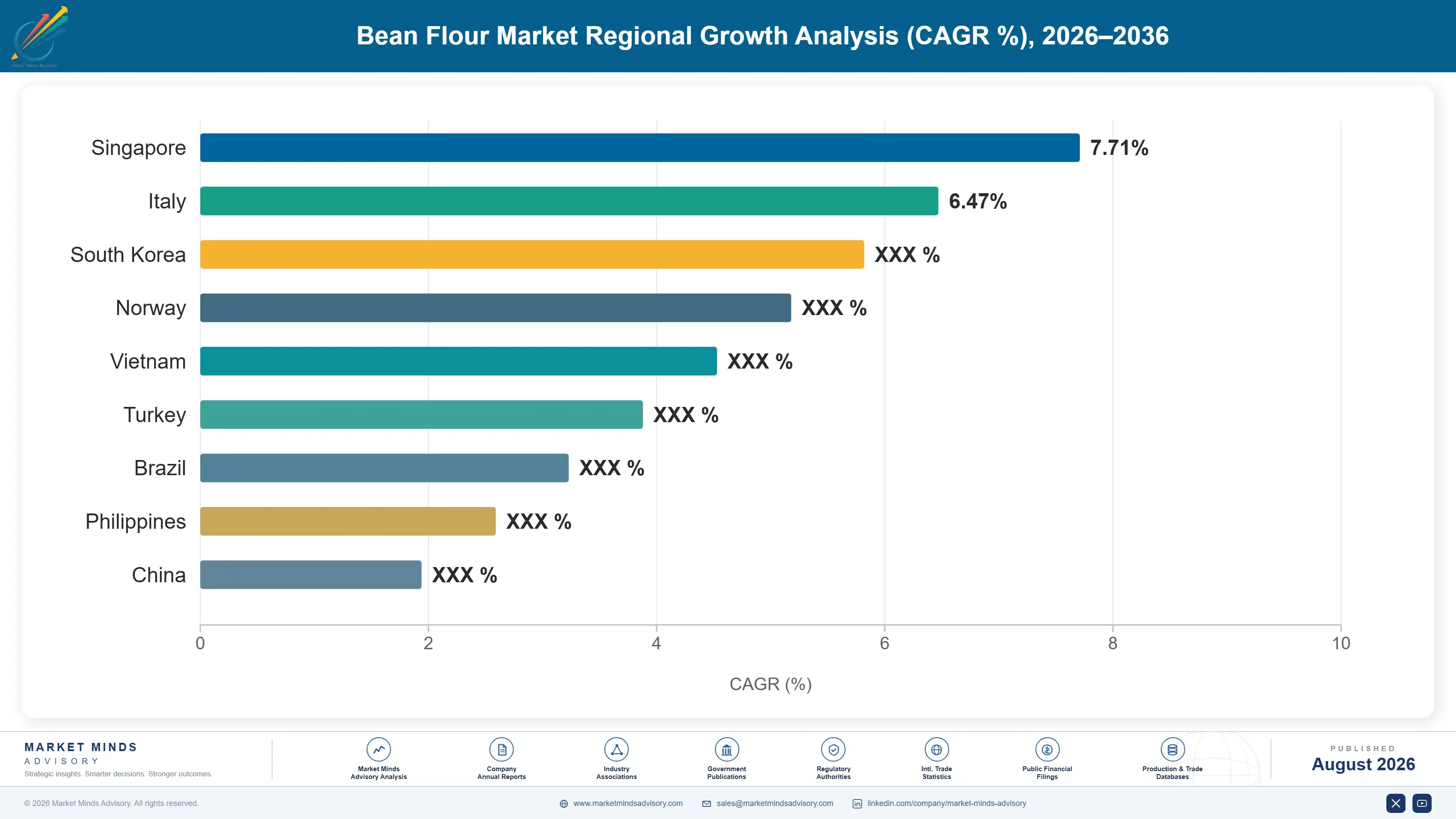
East Asia leads on mung bean starch and noodle processing volume, with North America and South Asia following closely behind at meaningful scale. South Asia and Pacific posts the fastest regional growth as India's chickpea processing capacity continues to modernize and steadily expand across the country.

North America

Canada anchors regional demand as the world's largest pea processing base, with Saskatchewan and Manitoba milling capacity feeding both protein isolate extraction and the growing food-grade pea flour segment directly. The United States contributes the larger consumption base, driven by gluten-free bakery manufacturers and a fast-expanding meat alternative sector that increasingly specifies pea flour in reformulated product lines. Growth here outpaces most mature regions specifically because food-grade pea flour capacity, a relatively new production category, keeps scaling faster than broader agricultural ingredient markets typically do. Mexico contributes a smaller, traditionally oriented market centered on culinary bean and lentil flour used in regional cuisine and household cooking rather than formulated food manufacturing applications.
Share: 22% | CAGR: 7.0% (2026 to 2036)

Western Europe

France holds the region's most significant pea processing capacity, anchored by Roquette's fractionation facilities that increasingly separate food-grade flour output from protein isolate extraction as a distinct commercial product line in its own right today. Germany and the United Kingdom drive regional consumption through gluten-free bakery manufacturing and a growing plant-based food sector that has matured faster here than in most other regions globally. Growth trails the global average as the region's plant protein category, an early mover globally, has already captured much of its near-term addressable reformulation opportunity. Southern European markets add modest demand tied to traditional chickpea and fava bean culinary use, particularly across Spain, Italy, and Greece.
Share: 19% | CAGR: 4.9% (2026 to 2036)
Regional intelligence for 5 additional markets available in the complete report: East Asia, South Asia and Pacific, Latin America, Middle East and Africa, Eastern Europe. Contact sales@marketmindsadvisory.com.
bean-flour-market-country-cagr-analysis-1787462017397

Capturing Margin as Bean Flour Bifurcates

The commodity and formulated-ingredient halves of this market reward completely different strategies, and few processors succeed by pursuing both at once. The four moves below target the specific points where processors can shift volume toward the higher-margin, formulated side without abandoning the stable base that traditional commodity culinary demand still reliably provides across South Asia.

Build Dedicated Food-Grade Pea Flour Milling Lines

Processors still milling pea flour as a secondary output of protein isolate extraction leave meaningful margin on the table compared to dedicated food-grade lines built specifically for formulated food manufacturers today. Roquette and Puris have both invested in separate food-grade capacity, capturing pricing 30% to 45% above commodity-grade flour sold as an isolate byproduct stream today. This requires real capital commitment and formulation support capability, but it converts a byproduct stream into a primary product line with its own customer relationships, pricing power, and long-term specification control over the account.
Market Impact: Captures 30% to 45% pricing premium over byproduct flour

License Flavor-Masking Technology for Neutral Applications

Off-flavor compounds in pea and chickpea flour currently exclude roughly 25% of potential food applications, particularly beverages and delicately flavored products where a genuinely neutral taste profile is essential to consumer acceptance and repeat purchase behavior over time. Processors that license proprietary enzyme inhibition or heat treatment technology to mask these compounds open genuinely new addressable categories rather than simply competing harder within the existing base. Early movers in flavor-masked pea flour are already winning formulation trials with beverage manufacturers that previously rejected pulse flour entirely on taste grounds alone.
Market Impact: Opens an estimated 25% of previously excluded applications

Secure Multi-Year Grower Contracts to Smooth Cost Volatility

Raw pulse price swings of up to 25% within a single growing season squeeze milling margins hardest for processors without secured supply, particularly smaller regional operators lacking balance sheet capacity to hedge forward against a poor harvest season. Larger processors locking multi-year contracts directly with pea and chickpea growers in Canada and India protect margin predictability and can offer downstream customers more stable pricing than smaller unhedged competitors. This also strengthens grower relationships during periods of tight supply, when contracted volume gets priority over spot market buyers scrambling for allocation.
Market Impact: Reduces margin volatility by an estimated 18% annually

Expand Industrial Chickpea Processing Capacity Across India

India's ongoing shift from small traditional mills toward industrial-scale chickpea processing is creating a genuine capacity gap that branded packaged food companies are willing to pay a premium to fill, given their need for consistent quality specifications traditional supply chains cannot reliably guarantee. Processors investing early in modern dehulling and milling equipment are capturing share from smaller operators at a rate exceeding 20% annually in served accounts, while also building the export capability needed to serve Gulf and Southeast Asian markets. This positions early movers ahead of what remains a multi-year modernization cycle.
Market Impact: Captures share gains exceeding 20% of served accounts

Who Controls the Margin Pool

Concentration sits at a fragmented CR5 of 38%, split between global ingredient majors pursuing formulated food contracts and hundreds of regional mills still serving traditional culinary demand with little overlap between buyer bases. The gap between Ingredion, the largest formulated-ingredient supplier, and the next tier of specialized processors is narrow. All participants are assessed on one basis: annual revenue attributable to bean and pulse flour product lines.
Current competitive activity runs along three lines. Dedicated food-grade pea flour capacity has become the clearest differentiator among global suppliers, separating those investing ahead of formulator demand from those treating flour as a protein extraction byproduct. Industrial processing modernization in India is reshaping the competitive base for chickpea flour, favoring processors with capital to invest in quality control. Flavor-masking technology licensing is emerging as a differentiator for suppliers targeting neutral-flavor applications.

Emerging pressure comes from mid-sized Indian and Canadian processors building formulation-grade capability close to their raw material base, threatening the advantage global majors held through distribution reach alone. Rankings over the next five years will likely shift toward whichever suppliers combine secured multi-year grower contracts with dedicated food-grade processing capacity, since that addresses both the sector's margin volatility and formulation quality demands.
bean-flour-market-company-positioning-matrix-1787462017927

Competitive Moat and Risk Dimensions

INGREDION

Moat: Broad formulation and distribution reach

Ingredion's global distribution network and deep formulation support capability let it win large multinational food manufacturer contracts that smaller regional processors cannot realistically service across multiple geographies at once. That breadth also supports faster new product development cycles for customers launching in several markets simultaneously.
INGREDION

Risk: Limited direct growing region control

Unlike vertically integrated processors closer to Canadian pea or Indian chickpea growing regions, Ingredion sources a significant share of volume through intermediate supply chains, exposing it more directly to raw pulse price volatility that has periodically squeezed processor margins across the sector in recent growing seasons.
ROQUETTE

Moat: Pea fractionation technology leadership

Roquette's fractionation technology, originally developed for protein isolate extraction, gives it a genuine head start in producing food-grade pea flour with consistent functional properties that newer entrants have not yet matched at comparable scale. This technical depth increasingly differentiates it in formulation-intensive customer relationships and contract renewals.
ROQUETTE

Risk: Plant Protein Demand Exposure

Roquette's substantial capital investment in pea processing capacity assumes continued plant protein and meat alternative category growth, and a sustained slowdown in that broader category would leave meaningful capacity underutilized, pressuring returns on recently commissioned fractionation facilities across its European and North American plant network.

Players Tracked

Prominent Players

Ingredion
Archer Daniels Midland
Roquette
AGT Foods
Puris Proteins

Other Key Players

Cargill
Bunge
Emsland Group
Vestkorn Milling
Batory Foods
Best Cooking Pulses
Diefenbaker Spice and Pulse
Parrheim Foods
Anchor Ingredients
Woodland Foods
Suminter India Organics
Shandong Jianyuan Group
Sotexpro
Nutriati
Vippy Industries

Recent Developments

FEBRUARY 2025

Roquette Commissions Expanded Food-Grade Pea Flour Line in France

Roquette commissioned a new food-grade pea flour production line at its Vic-sur-Aisne facility, separate from its existing protein isolate extraction capacity. The expansion targets formulated food manufacturers directly rather than serving as a byproduct stream. This was an organic capacity expansion funded from Roquette's own capital budget.
Signal: Confirms food-grade pea flour is now a standalone product line, not an isolate extraction byproduct stream.
JUNE 2025

Puris Proteins and a Regional Grower Cooperative Form Supply Joint Venture

Puris Proteins entered a joint venture with a Midwest pea grower cooperative to secure multi-year raw material supply directly from contracted farms. The venture combines Puris's processing capability with the cooperative's grower relationships, aiming to reduce exposure to spot market pea price volatility. Initial contracted acreage covers several thousand hectares.
Signal: Signals that raw material supply security, not processing technology alone, is now a primary competitive battleground.
OCTOBER 2025

AGT Foods Acquires Indian Chickpea Processing Facility

AGT Foods acquired a mid-sized chickpea processing facility in Madhya Pradesh, India, to expand its industrial-scale flour capacity in the country's largest chickpea growing region. The acquisition brought established grower relationships and existing processing infrastructure that AGT Foods lacked domestically. Integration is expected to complete within nine months of close.
Signal: Confirms global processors now see Indian chickpea capacity as a direct acquisition target, not a supply relationship.

Raw Pulse Procurement and Growing Season Risk

Raw pulse procurement accounts for 55% to 65% of cost of goods sold across bean flour processors, sourced from Canadian prairie pea and lentil growers, Indian chickpea growing regions, and smaller volumes from French and Chinese production. This concentration leaves the entire sector exposed to localized weather shocks that can affect a large share of global supply.
The 2021 Canadian prairie drought, documented in Statistics Canada agricultural production reports, cut pea and lentil yields sharply across Saskatchewan and Alberta, pushing raw pulse prices up by more than 40% within a single growing season. Processors without secured multi-year contracts absorbed the bulk of that spike directly, since most milling contracts do not allow rapid pass-through of raw material cost increases. Prices partially normalized over the following two seasons.

Exposure varies by processor scale and contract structure. Larger processors with multi-year grower agreements absorb weather-driven price swings more smoothly than smaller regional mills buying on the spot market, who face sudden margin compression during poor seasons. Geography matters too: Indian chickpea processors face somewhat different risk given partial irrigation buffering, while Canadian pea processors remain more exposed to rain-fed cultivation variability.
bean-flour-market-cost-volatility-analysis-1787462018125

Lock Multi-Year Grower Contracts Across Key Growing Regions

Processors securing multi-year supply agreements directly with Canadian and Indian growers protect against the spot price spikes that have periodically hit unsecured buyers during poor growing seasons across recent years. This requires closer grower relationship management and often upfront financing support but delivers meaningfully more predictable input costs across full budgeting and planning cycles.

Diversify Sourcing Across Multiple Growing Regions

Processors qualifying supply from both Canadian and French pea growing regions, or both Indian and Australian chickpea sources, reduce dependence on any one single region's weather outcome in a given growing season each and every year. This adds supplier qualification complexity but meaningfully smooths aggregate input cost volatility across a full multi-year capital planning horizon.

Invest in Irrigation-Buffered Grower Partnerships

Some processors are now co-investing in irrigation infrastructure with key growers across historically rain-fed regions, reducing yield variability at the source rather than simply hedging its financial consequences after the fact each and every growing season. This raises upfront capital commitment but addresses the root cause directly rather than just its downstream symptoms over time.

Portfolio Architecture for Margin Defence

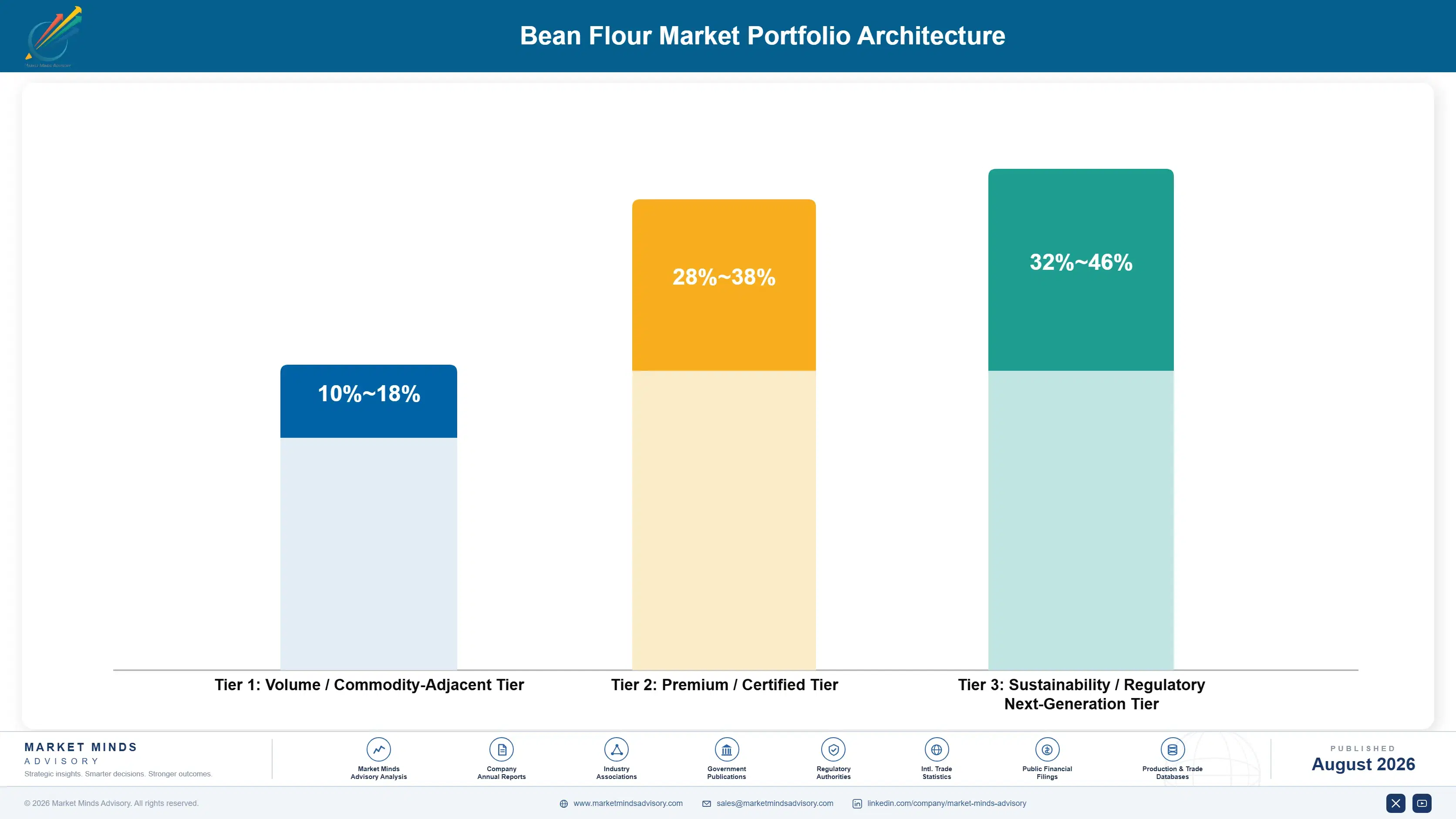
The portfolio splits into three tiers with wide margin separation tracking the commodity-to-formulated-ingredient divide running through this entire market. Traditional culinary-grade flour competes on price and reliability within thin, crop-cycle-driven margins, while formulated food-grade pea and chickpea flour commands pricing closer to a specialty protein ingredient given its functional performance requirements and certification standards.
The tension between volume and premium is sharpening as formulated food-grade demand grows faster than traditional culinary demand, pulling processor investment and grower contracting priority toward the higher-margin segment even though it remains the smaller of the two by absolute volume today. Processors that maintain a foothold in both segments preserve optionality, while those chasing only the formulated side risk losing the stable cash flow that traditional culinary demand still reliably provides.

High-value margin pools concentrate specifically in dedicated food-grade pea flour and in flavor-masked formulations opening previously inaccessible neutral-flavor applications, both requiring real capital investment well ahead of confirmed demand. Traditional commodity culinary flour, by contrast, remains a large but slow-growing volume base offering thin, stable margins rather than genuine expansion opportunity for most processors going forward into the next decade.

Volume / Commodity-Adjacent Tier

Traditional culinary-grade bean and pulse flour sold primarily on price into South Asian, East Asian, and African household and food service demand, priced close to the underlying raw pulse cost.
Gross Margin: 10-18%

Premium / Certified Tier

Gluten-free certified chickpea and lentil flour blends serving bakery and snack manufacturers across North America and Western Europe, commanding durable premiums tied closely to certification and consistent quality specifications throughout.
Gross Margin: 28-38%

Sustainability / Regulatory / Next-Generation Tier

Dedicated food-grade pea flour and flavor-masked formulations targeting plant protein and previously inaccessible neutral-flavor applications, representing the newest and highest-investment corner of the portfolio as processors race toward validated commercial specifications.
Gross Margin: 32-46%
bean-flour-market-portfolio-architecture-1787462018634

High-value Sub-segments and Strategic Watch-out

Dedicated Food-Grade Pea Flour

High value and high growth, capturing pricing well above byproduct-grade flour as plant protein formulators specify it directly rather than accepting it as an extraction leftover from isolate production. Processors investing in separate food-grade milling lines are winning the sector's fastest-growing formulation contracts across North America and Western Europe.
Gross Margin: 32-46%

Certified Gluten-Free Chickpea and Lentil Blends

High value with moderate growth, serving bakery manufacturers across North America and Western Europe who require dependable, consistently certified supply for every single production run they carefully schedule. Certification and consistent supply increasingly decide which processor wins long-term formulation contracts in this segment over time.
Gross Margin: 28-38%

Traditional South Asian Culinary Flour

The volume core, anchored by India's massive besan consumption base spanning hundreds of millions of households nationwide every single day without exception or seasonal variation. Steady growth tracks population and packaged food penetration rather than any specific formulation trend or premium pricing opportunity emerging soon.
Gross Margin: 10-18%

Commodity Byproduct-Grade Pea Flour

The strategic watch-out, facing steady margin compression as dedicated food-grade lines capture the formulation demand this byproduct stream once served almost by default across the industry for many years running. Remaining volume increasingly competes purely on price against newer, better-specified alternatives now entering the category.
Gross Margin: 8-14%

Two Buyer Bases, Two Purchasing Rhythms

Demand architecture here splits sharply along the market's commodity and formulated-ingredient divide. Traditional culinary buyers, largely households and food service operators across South Asia and East Asia, purchase in a steady, repeat pattern tracking population and cooking habit rather than any product cycle. Formulated food manufacturers behave completely differently, committing to multi-year supply agreements tied to specific product launches that lock in volume for the life of that product line.
Adoption depth varies sharply by end-use vertical. Plant protein and meat alternative manufacturers show the deepest formulation lock-in, since reformulating around a different flour source requires repeating sensory and functional testing that can run many months. Gluten-free bakery manufacturers show similarly durable commitment once a blend is certified. Traditional culinary buyers show essentially no lock-in, switching between suppliers and even between pulse types based on price and availability alone.

Generational buyer shifts are most visible in the formulated segment, where food technologists now hold formulation authority once split more evenly with cost-focused procurement teams. Younger formulation teams entering plant protein categories weigh functional performance and clean label positioning more heavily than legacy procurement did, favoring processors investing in dedicated food-grade capacity over those selling byproduct-grade flour on price alone.
bean-flour-market-end-use-penetration-index-1787462019130

Where Processors Should Focus Next

These are among the four positions where our research anticipates prominent divergence between winners and laggards over the coming forecast period. Each is grounded in the demand model, the regulatory perimeter, and the announced capacity pipeline.
01 / PRODUCT LINE SEPARATION

Split Food-Grade Capacity From Byproduct Milling

Processors still selling pea flour as a secondary output of protein isolate extraction are leaving meaningful margin on the table compared to dedicated food-grade lines built specifically for formulated food manufacturers. Roquette and Puris have both proven this model, capturing pricing well above commodity byproduct flour through separate specification and customer relationships. Processors without dedicated capacity should treat this as an urgent capital allocation decision, not a future consideration, since formulator demand is already scaling faster than most byproduct-grade capacity can profitably serve.
02 / GROWER CONTRACT SECURITY

Lock Multi-Year Pulse Supply Before Volatility Returns

Raw pulse prices have swung by more than 40% within single growing seasons during past weather shocks, and processors without secured multi-year grower contracts absorb that volatility directly against thin milling margins. Larger processors are already locking supply agreements across Canadian and Indian growing regions, leaving smaller unhedged competitors increasingly exposed during the next poor season. Securing contracted supply now, ahead of the next weather disruption, protects margin predictability that downstream formulated food customers increasingly expect as a baseline requirement.
03 / INDIAN PROCESSING MODERNIZATION

Invest Ahead of India's Industrial Processing Shift

India's ongoing transition from small traditional mills toward industrial-scale chickpea processing is creating a genuine capacity gap that branded packaged food companies are willing to pay a premium to fill, given their need for consistency traditional supply chains cannot reliably guarantee. Processors investing early in modern dehulling and milling equipment are capturing meaningful share from smaller operators unable to meet that consistency bar. This modernization cycle will run for years, rewarding whoever builds credible scale early rather than waiting for the opportunity to fully mature first.
04 / FLAVOR TECHNOLOGY INVESTMENT

License Flavor-Masking to Reach Neutral-Flavor Categories

Off-flavor compounds currently exclude roughly a quarter of potential food applications for pea and chickpea flour, particularly beverages and delicately flavored products requiring a genuinely neutral taste profile for consumer acceptance and repeat purchase. Processors licensing proprietary flavor-masking technology open real new addressable categories rather than competing harder within an already-served base. Early movers in flavor-masked pea flour are already winning formulation trials with beverage manufacturers that previously rejected pulse flour outright, a meaningful head start competitors will need years to close.

Engagement Snapshot From the Field

A live engagement with an industry participant carrying material or product regulatory and market exposure ahead of a defining policy shift, showing how our research translates into a defensible multi-year portfolio strategy.
MARKET MINDS ADVISORY · CLIENT ENGAGEMENT SUMMARY
Bean Flour Producer Strategic Portfolio Review and Transition Roadmap 2026·Investment Scenario on Bean Flour Exposure Evaluation 2025-26
CLIENT PROFILE
A North American plant-based meat alternative manufacturer approached MMA while reformulating its flagship product line to reduce cost after several years of category pricing pressure across the industry. The client reported annual revenue near USD 210 million and sourced pea protein isolate and pea flour from three separate suppliers across its production facilities (client-reported, unverified by MMA).
STRATEGIC CHALLENGE
Management needed to cut ingredient cost meaningfully without sacrificing the texture and protein content that had become central to the brand's positioning against competing plant-based products. Internal formulation teams disagreed on whether shifting toward a higher pea flour ratio, and away from costlier isolated protein, would meet consumer taste expectations at the scale required for national retail distribution.
MMA APPROACH
MMA benchmarked delivered cost and functional performance across five candidate pea flour suppliers, including both dedicated food-grade processors and byproduct-grade sellers, under the client's specific formulation parameters. We modeled total reformulation cost including requalification testing and projected consumer sensory impact based on comparable published reformulation cases. We also assessed each supplier's raw material contract security given recent pulse price volatility.
KEY FINDINGS
  1. A dedicated food-grade pea flour supplier priced only 8% above the cheapest byproduct-grade option while delivering meaningfully better sensory scores in blind testing (client-reported, unverified by MMA).
  2. Two of the three incumbent suppliers carried unsecured spot market pulse purchasing, exposing the client to the same seasonal price volatility that had squeezed its own margins previously.
  3. Shifting the isolate-to-flour ratio moderately, rather than dramatically, preserved protein claims on packaging while still delivering meaningful cost reduction across the full product line.
  4. Reformulation and requalification across the client's three production facilities required roughly five months longer than the client's original internal timeline had assumed.
CLIENT PROFILE
A North American plant-based meat alternative manufacturer approached MMA while reformulating its flagship product line to reduce cost after several years of category pricing pressure across the industry. The client reported annual revenue near USD 210 million and sourced pea protein isolate and pea flour from three separate suppliers across its production facilities (client-reported, unverified by MMA).
STRATEGIC CHALLENGE
Management needed to cut ingredient cost meaningfully without sacrificing the texture and protein content that had become central to the brand's positioning against competing plant-based products. Internal formulation teams disagreed on whether shifting toward a higher pea flour ratio, and away from costlier isolated protein, would meet consumer taste expectations at the scale required for national retail distribution.
MMA APPROACH
MMA benchmarked delivered cost and functional performance across five candidate pea flour suppliers, including both dedicated food-grade processors and byproduct-grade sellers, under the client's specific formulation parameters. We modeled total reformulation cost including requalification testing and projected consumer sensory impact based on comparable published reformulation cases. We also assessed each supplier's raw material contract security given recent pulse price volatility.
KEY FINDINGS
  1. A dedicated food-grade pea flour supplier priced only 8% above the cheapest byproduct-grade option while delivering meaningfully better sensory scores in blind testing (client-reported, unverified by MMA).
  2. Two of the three incumbent suppliers carried unsecured spot market pulse purchasing, exposing the client to the same seasonal price volatility that had squeezed its own margins previously.
  3. Shifting the isolate-to-flour ratio moderately, rather than dramatically, preserved protein claims on packaging while still delivering meaningful cost reduction across the full product line.
  4. Reformulation and requalification across the client's three production facilities required roughly five months longer than the client's original internal timeline had assumed.
RECOMMENDED STRATEGY
Phase 1: Phase 1 (0 to 3 months): Select the dedicated food-grade pea flour supplier and begin sensory and functional requalification testing. Phase 2: Phase 2 (3 to 8 months): Roll out the reformulated recipe across production facilities sequentially, starting with the highest-volume site. Phase 3: Phase 3 (8 to 14 months): Renegotiate remaining supplier contracts to include multi-year pulse price protection terms across the full portfolio.
OUTCOME
The client completed reformulation across all three facilities within the extended fourteen-month timeline, achieving a reported cost reduction of approximately 11% per unit while maintaining protein content claims on packaging. The revised formulation also improved blind taste test scores relative to the prior recipe (client-reported, unverified by MMA).

Frequently Asked Questions

Foundational context covering the market sizes, CAGR, scope, country, region and competition that inform every finding below. This section is provided to cover basics and most often pre-purchase conversations, answered from the MMA Primary Research Dataset.

What is the current size of the Bean Flour Market?

The market stood at approximately USD 3.4 billion in 2025, according to MMA's primary research dataset. This reflects global demand across both traditional culinary and formulated food-grade applications.

How large will the Bean Flour Market be by 2036?

MMA projects the market will reach approximately USD 6.73 billion by 2036 under the base case scenario. This represents roughly 1.86 times the 2026 market entry value.

What is the CAGR for the Bean Flour Market 2026 to 2036?

The base case CAGR is 6.4%, with a bull case of 7.7% and a bear case of 5.1%. The range reflects uncertainty around plant-based meat category growth.

Which segment is growing fastest?

Pea flour grows fastest at 9.8%, about 1.53 times the overall market rate. Plant protein and meat alternative formulators specifying it directly are the primary driver.

Who are the major companies in the Bean Flour Market?

Leading suppliers include Ingredion, Archer Daniels Midland, Roquette, AGT Foods, and Puris Proteins. These five companies together hold an estimated 38% of the market on a pulse flour revenue basis.

Which country is growing fastest?

India posts the fastest national growth at 8.9% CAGR, driven by rapid industrial modernization of chickpea flour processing. This outpaces the broader South Asia and Pacific regional average.

Report Segmentation Architecture

The full report scope spans multiple orthogonal segmentation dimensions, with cross-tabulated demand data provided for each dimension pair. Coverage extends further to regional breakdowns, trend trajectories, and the competitive detail needed to support segment-level decision-making.

By Legume Source

  • Chickpea Flour
  • Pea Flour
  • Lentil Flour
  • Fava Bean Flour
  • Mung Bean Flour
  • Black Bean and Kidney Bean Flour

By End-Use Industry

  • Bakery and Gluten-Free Foods
  • Plant Protein and Meat Alternatives
  • Traditional Culinary and Household Use
  • Snack Food Manufacturing
  • Animal and Pet Feed

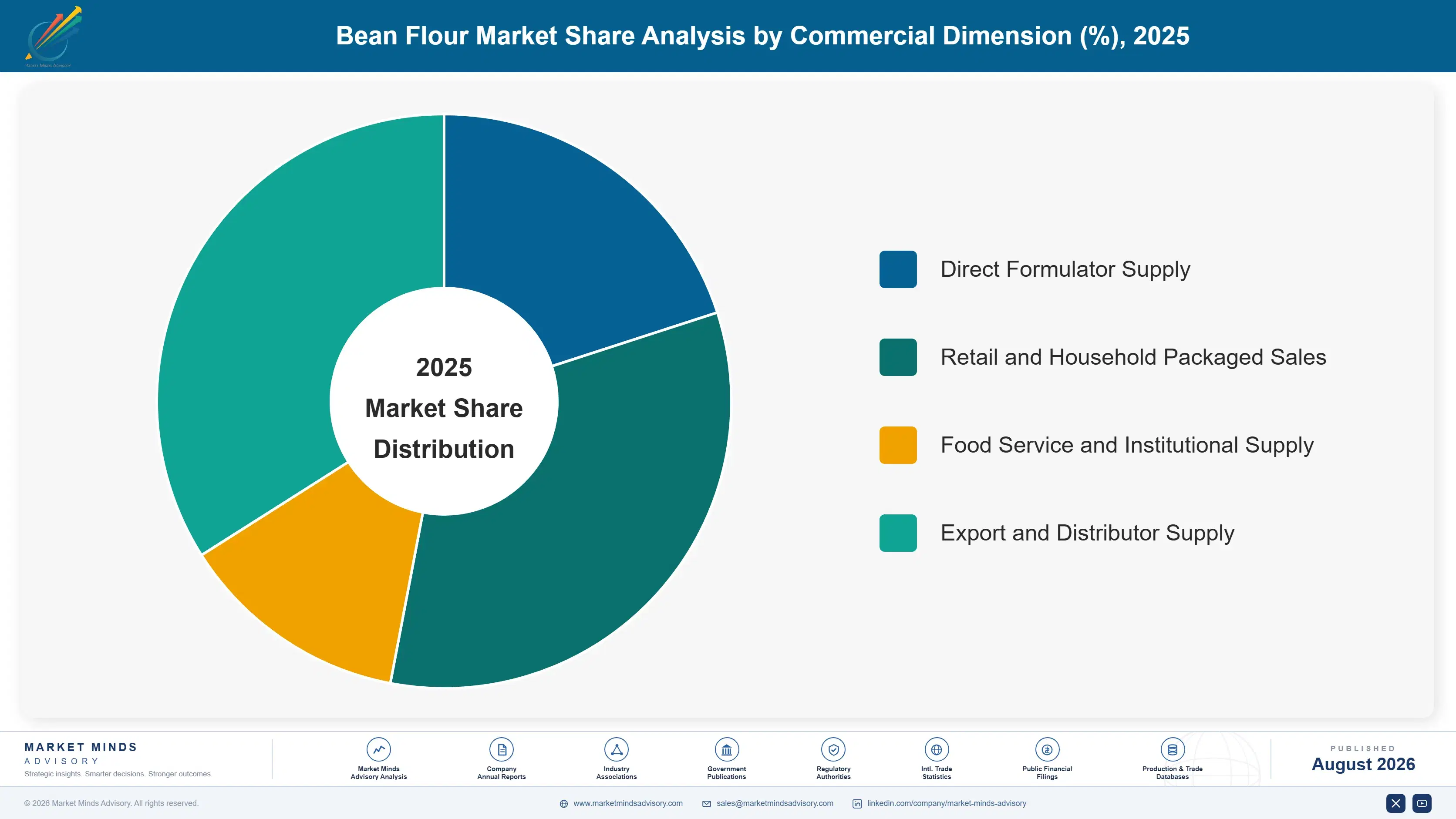
By Commercial Dimension

  • Direct Formulator Supply
  • Retail and Household Packaged Sales
  • Food Service and Institutional Supply
  • Export and Distributor Supply

By Region

  • North America
  • Western Europe
  • East Asia
  • South Asia and Pacific
  • Latin America
  • Middle East and Africa
  • Eastern Europe

Scope, Methodology, and Coverage

Every figure in this report is reproducible from documented input assumptions. The scope below maps the historical period, the forecast horizon, the segmentation dimensions, and the countries covered, alongside the underlying primary and qualitative methodology.
Historical Period
2020 to 2025
Forecast Period
2026 to 2036
Base Year
2025 (USD billions; MMA Primary Research Dataset, August 2026)
Market Definition
The bean flour market comprises milled and processed flour derived from pulses and legumes, including chickpea, pea, lentil, fava bean, mung bean, and kidney or black bean flours, sold for culinary, bakery, and formulated food ingredient use. It excludes whole or split pulses sold unmilled and isolated pulse protein concentrates sold as standalone protein ingredients.
Quantitative Units
USD billions (current prices); metric tonnes of bean flour volume where applicable
Segmentation Dimensions
By Legume Source; By End-Use Industry; By Commercial Dimension; By Region
Regions Covered
North America, Western Europe, East Asia, South Asia and Pacific, Latin America, Middle East and Africa, Eastern Europe
Countries Covered
USA, China, Germany, France, UK, Japan, South Korea, India, Australia, Canada, Brazil, Mexico, Indonesia, Vietnam, Thailand, Malaysia, UAE, Saudi Arabia, South Africa, Nigeria, Turkey, Poland, Netherlands, Italy, Spain, Sweden, Switzerland, Argentina, Colombia, Singapore, and additional markets relevant to this sector
Key Companies Profiled
Ingredion, Archer Daniels Midland, Roquette, AGT Foods, Puris Proteins, Cargill, Bunge, Emsland Group, Vestkorn Milling, Batory Foods, Best Cooking Pulses, Diefenbaker Spice and Pulse, Parrheim Foods, Anchor Ingredients, Woodland Foods, Suminter India Organics, Shandong Jianyuan Group, Sotexpro, Nutriati, Vippy Industries
Quantitative Methodology
Primary survey, n=3,800 respondents, Q4 2025, six countries; demand-side model with trade association cross-validation
Qualitative Methodology
47 expert interviews, Q4 2025; applied to validate demand model assumptions, identify emerging dynamics, and assess competitive positioning
Report Format
PDF and XLSX data workbook (Word format preview document)
Publisher
Market Minds Advisory
Report Code
MMA-2026-AGR-205
Published
August 2026
Contact
sales@marketmindsadvisory.com | www.marketmindsadvisory.com

Purchase the full Bean Flour Market Report (2026 to 2036).

The full MMA Bean Flour report sizes the market across six legume sources, five end-use industries, and seven regions through 2036. It profiles 20 participants on a consistent pulse flour revenue basis, scoring each on grower contract security, food-grade processing capacity, and formulation support capability. Scenario models quantify how plant protein category growth and Indian processing modernization move demand and pricing across both commodity and formulated-ingredient segments. The report also includes delivered cost modeling by growing region, a raw pulse price volatility screen, and a food-grade capacity investment tracker built for procurement, formulation, and category strategy teams.
Six-legume segmentation with detailed growth forecasts
Raw pulse price volatility risk assessment
India chickpea processing modernization tracking tool
Food-grade versus byproduct flour margin model
Regional milling capacity investment mapping tool
Twenty-company competitive benchmarking scorecard and assessment

Built For The People Who Decide

From boardroom strategy to bench-side execution, this report is read cover-to-cover by leaders shaping the next decade of their industry, turning demand scenarios, market dynamics and valuation benchmarks into decisions.
CXOs/ Presidents/ VPs/ Managers
M&A and Corporate Development
Strategy Teams and R&D Heads
Procurement and Product Directors
Regulatory and Compliance Leaders
Investor Relations and Equity Analysts