Market Minds Advisory
Bead Winding Machine Market

Bead Winding Machine Market: Precision Winding and Radial Tire Capacity Strategy

Tire manufacturers are upgrading legacy single-head bead winding lines to automated CNC-controlled machines as radial tire demand, EV-specific tire specifications, and new Asian capacity investment push winding precision to the center of planning.

Lead Analyst

David Horsley

Published

August 2026

Make Smarter Decisions with Customized Research Insights

Request a free sample report and evaluate market opportunities, growth trends, and competitive dynamics relevant to your business needs.

2025 MARKET VALUE$0.4BMarket Size 2025
2036 FORECAST VALUE$0.8BBase Case , 2026 to 2036
CAGR 2026 TO 20366.2 %Bull 7.4% / Bear 4.9%
INCREMENTAL OPPORTUNITY$0.4BNet 10- year value creation
EXPANSION MULTIPLE1.82x2036 value over 2026 base
Strategic Levers
M&A Pipeline
Regional Outlook
Country Rankings
Competitive Intelligence
Segmental Deep-dive
Call-Us : 91 93563 13602

Executive Snapshot and Market Trajectory

Bead winding machines have moved from a commodity tire plant fixture into a precision-engineered production bottleneck. Tire makers increasingly specify CNC-controlled, servo-driven winding heads because bead uniformity now directly affects high-speed radial tire quality and warranty claim rates, and legacy single-head machines can no longer keep pace with changeover requirements.
Automatic CNC-controlled bead winding machines are growing fastest, pulled by tire manufacturers' need for faster changeover between bead sizes and tighter dimensional tolerance on radial and EV-specific tire lines, expanding roughly 58% faster than the category average. East Asia retains the largest regional share, supported by China's dominant tire manufacturing base, expanding capacity investment across Southeast Asia, and the region's deep concentration of specialized machine tool suppliers.
Competitive intensity centers on winding precision and automation depth rather than machine count alone. VMI Group and Mitsubishi Heavy Industries are racing regional Chinese specialists to bundle servo control, vision-based inspection, and automated splice detection into single validated production cells. Regulatory pressure, particularly expanding tire labeling and rolling resistance standards in the EU and China, is pulling upgrade demand forward faster than machine failure rates alone would explain across most tire manufacturing categories.
Market Definition
The Bead Winding Machine market covers automated and semi-automated machinery used to wind steel bead wire into the reinforcing bead cores that anchor pneumatic tires to wheel rims, including single-head, multi-head, and CNC-controlled winding systems sold to tire manufacturers and tire machinery integrators. It excludes bead wire production equipment, general rubber extrusion machinery, and tire building machines not specifically configured for bead core winding.
Base Year Value
$0.4B in 2025 (MMA Primary Research Dataset, August 2026)
Forecast Period
2026 to 2036, eleven discrete annual values
CAGR
6.2% base case. Bull 7.4%. Bear 4.9%.
Fastest Growth Segment
Automatic CNC-Controlled Bead Winding Machines: 9.8% CAGR
Fastest Growth Country
India: 9.4% CAGR
Fastest Growth Region
South Asia and Pacific: 8.3% CAGR
Largest Region
East Asia: 30% of 2025 global value
Market Leaders
VMI Group B.V., Mitsubishi Heavy Industries Machinery Systems Ltd., Herbert Maschinenbau GmbH & Co. KG, Qingdao Yiyang Tyre Machinery Manufacturing Co. Ltd., Kobelco Machinery Engineering Co. Ltd. Source: MMA Analysis based on company annual reports.
Primary Survey
n=3,800 procurement and R&D decision-makers, Q4 2025, six countries
Methodology
Demand-side build-up, cross-validated against public data, 47 expert interviews

Bead Winding Machine Market Forecast Scenarios

bead-winding-machine-market-size-forecast-scenario-1787301964574
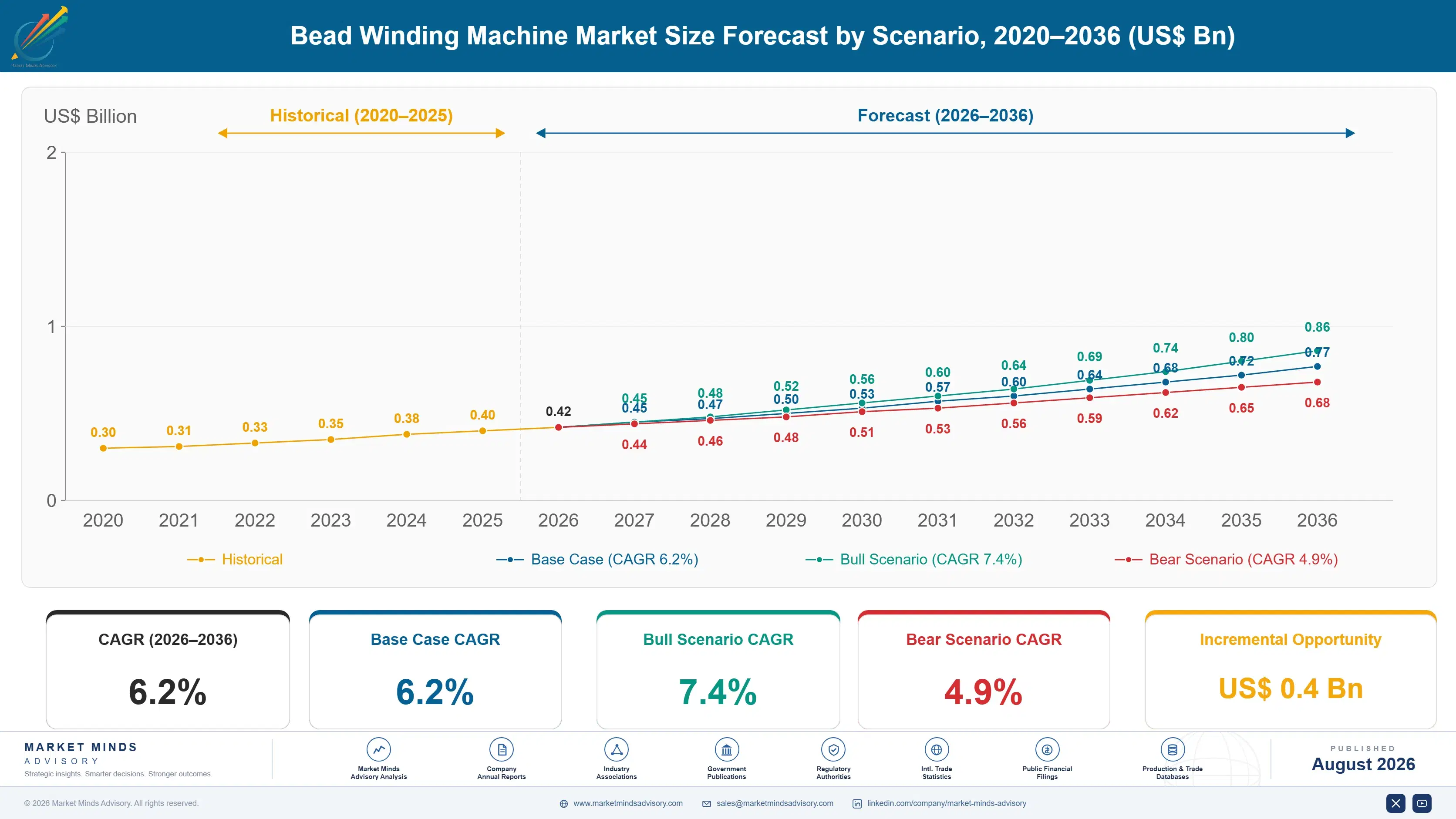
Bead winding machine demand grew steadily through 2020 to 2025, slowed in 2020 as tire manufacturers paused capital spending during the pandemic, then accelerated as Asian tire capacity expansion resumed and radial tire penetration continued rising in previously bias-ply markets. CNC-controlled machine adoption accelerated faster than the category as EV-specific tire specifications tightened bead uniformity requirements, producing a historical CAGR of 5.3% that understates the acceleration underway.
The base case assumes 6.2% annual growth through 2036, driven by three mechanisms. First, radial tire penetration continues expanding in markets still transitioning from bias-ply construction, requiring precision winding capability legacy machines cannot deliver. Second, new tire manufacturing capacity across India, Southeast Asia, and China requires new winding line installations rather than retrofits. Third, EV-specific tire specifications with tighter tolerances are pulling forward replacement of older single-head machines that cannot meet updated quality requirements.
The bull case assumes faster Asian tire capacity expansion and accelerated EV tire specification adoption pull growth toward 7.4%. The bear case centers on slower tire industry capital spending and continued reliance on refurbished legacy machines in cost-constrained markets, pulling growth down toward 4.9% if global tire production capacity investment disappoints relative to current manufacturer expansion announcements.

Precision Winding and Radial Tire Capacity Economics

Bead winding machine selection has become a production flexibility decision as much as a precision one. Tire manufacturers increasingly specify CNC-controlled machines with automated changeover because bead size variety and radial construction requirements now directly affect production line throughput and scrap rates that plant managers track closely.
CR5 CONCENTRATION41%Reflects moderate consolidation among global bead winding machine makers
CNC MACHINE PRICE PREMIUM45-65%Premium buyers pay over standard single-head winding machines
CHINA MANUFACTURING SHARE29%Share of global bead winding machine production located there
WINDING ACCURACY IMPROVEMENT35-50%Typical dimensional tolerance improvement from CNC machine conversion
SERVO COMPONENT COST SHARE32-42%Portion of machine cost tied to servo and control systems
AVERAGE MACHINE CHANGEOVER TIME15-40 minutesTypical time required to switch between different bead sizes
China generates roughly 29% of global bead winding machine production, reflecting both its dominant tire manufacturing base and its deep concentration of specialized machine tool suppliers relative to other regions still importing most winding equipment. Machine builders price accordingly, charging meaningfully more for fully automated CNC packages sold into premium radial and EV tire production lines than into cost-constrained regions still relying primarily on manual single-head machines.
The next decade will reward machine builders that integrate servo control, vision inspection, and automated splice detection into single validated production cells faster than those still selling standalone winding heads. Regulatory pressure, more than raw winding speed, will set the pace of CNC conversion in cost-constrained tire plants still running legacy single-head machines. Expect changeover time to keep shrinking as automated bead-size switching replaces manual tooling changes, compressing machine builder service margins even as total category revenue expands steadily across nearly every major tire market.
"A tire plant doesn't buy a bead winder because the old one broke, it buys one because the old one can't hold tolerance on the new EV tire spec the OEM just approved. That's a different sales conversation than it was a decade ago."
Director, Industrial Machinery and Automation Practice · MMA Construction and In

Market Trends

CNC-Controlled Winding Heads Replace Manual Changeover Systems

Tire manufacturers increasingly specify CNC-controlled bead winding machines with programmable changeover capability, since manual tooling changes between bead sizes can take hours on legacy single-head machines while automated systems complete the same changeover in minutes. This changeover speed advantage matters more as manufacturers run smaller production batches across a wider range of bead sizes to serve both traditional and EV-specific tire specifications on the same line. Machine builders are responding by embedding vision-based inspection and automated splice detection directly into standard CNC configurations rather than offering them as aftermarket upgrades, reducing scrap rates for manufacturers converting to the new equipment.
Market Impact: Adds order backlogs 2-4 quarters lo
EV-Specific Tire Specifications Tighten Bead Tolerance Requirements

Electric vehicle tires carry higher load ratings and different sidewall stiffness requirements than conventional tires, and several tire OEMs have introduced tighter bead dimensional tolerance specifications to support the heavier vehicle weight and higher torque loads EV powertrains transmit through the bead. Tire manufacturers supplying EV-specific lines report that legacy single-head winding machines struggle to hold the tightened tolerance consistently across high-volume runs, forcing conversion to CNC-controlled equipment sooner than their normal replacement cycle would require. Machine builders with validated EV-tire-grade winding capability are winning specification share disproportionately as OEM qualification programs expand.
Market Impact: Drives radial conversion demand 20-

Market Opportunities and Growth Drivers

Asian Tire Manufacturing Capacity Expansion Drives Equipment Orders

Tire manufacturers are announcing new production capacity across India, Vietnam, Thailand, and China to serve both domestic vehicle production growth and export demand, and each new tire plant requires a full complement of bead winding machines installed from scratch rather than retrofitted. India's tire industry alone has announced multiple new manufacturing facilities in recent years, with each new plant requiring dozens of winding machines across several production lines. Machine builders report order backlogs extending into multi-quarter waits as new plant construction timelines compress the window between order placement and required equipment delivery.
Market Impact: Raises capital cost by 45-65%

Radial Tire Penetration Growth Requires Precision Winding Upgrades

Markets still transitioning from bias-ply to radial tire construction, particularly in parts of South Asia, Africa, and Latin America, are driving new demand for precision bead winding equipment that bias-ply-oriented legacy machines cannot adequately support. Radial tire construction requires tighter bead dimensional consistency than bias-ply tires to maintain proper belt and carcass geometry, making winding precision a direct input into radial tire quality. Tire manufacturers converting lines from bias-ply to radial construction typically replace their entire bead winding equipment base rather than retrofitting machines engineered for looser bias-ply tolerance requirements.
Market Impact: Extends delivery lead times 3-5 mon

Market Restraints and Challenges

High Capital Cost Slows Smaller Manufacturer Adoption

CNC-controlled bead winding machines carry capital costs that can exceed the annual equipment budget of many smaller regional tire manufacturers, and financing options remain limited since specialized tire machinery lacks the resale market depth that helps lenders value collateral for more established equipment categories. The root cause is that bead winding machines are highly specialized, since a used machine's value depends heavily on compatibility with a buyer's specific tire size range and configuration. Smaller manufacturers unable to justify full CNC conversion are responding by retrofitting existing single-head machines with servo control upgrades rather than replacing entire production lines.
Market Impact: Cuts changeover time by 60-80%

Servo Component Supply Constraints Extend Delivery Lead Times

Servo motors, controllers, and precision drive components account for 32 to 42% of bead winding machine cost, and supply constraints for these components during 2021 and 2022 extended machine builder delivery lead times meaningfully across most major manufacturing regions. The root cause is that precision servo components require specialized semiconductor content that competes for the same limited manufacturing capacity as components used across a much broader range of industrial automation equipment. Machine builders are responding by qualifying multiple servo suppliers and redesigning certain configurations to use more widely available alternatives.
Market Impact: Tightens bead tolerance by 35-50%
3 additional market trends, 3 additional growth drivers, and 2 additional restraints and challenges are covered in the full report. Contact sales@marketmindsadvisory.com to access the complete intelligence.

Segment CAGR and Growth Architecture

This report segments the bead winding machine market by machine type across single-head machines, multi-head and multi-spindle machines, automatic CNC-controlled machines, hexagonal bead winding machines, programmable servo-driven machines, and manual semi-automatic machines. Machine type was chosen over end-use tire category because purchasing and specification decisions follow winding automation capability rather than the specific tire size being produced.
bead-winding-machine-market-market-share-analysis-1787301965122

Automatic CNC-Controlled Bead Winding Machines

Automatic CNC-controlled bead winding machines are the fastest-growing category at 9.8% annually, roughly 58% faster than the market average. Radial tire precision requirements and EV-specific tolerance specifications are the primary demand drivers, since CNC control delivers the dimensional consistency that bias-ply-era single-head machines cannot reliably match across high-volume production runs. Tire manufacturers converting to CNC systems report meaningfully faster changeover between bead sizes, letting a single production line serve a broader range of tire specifications without dedicated tooling for each size. VMI Group and Mitsubishi Heavy Industries lead this category, with vision-based inspection and automated splice detection increasingly differentiating premium CNC configurations from basic automated machines on defect detection accuracy and production data integration.
CAGR 9.8%

Programmable Servo-Driven Winding Machines

Programmable servo-driven winding machines, the second-fastest category at 8.6% annually, benefit from their ability to deliver much of the precision and changeover flexibility of full CNC systems at a meaningfully lower capital cost, making them an attractive intermediate option for manufacturers not yet ready for full CNC conversion. Mid-tier tire manufacturers in Southeast Asia and Latin America are adopting servo-driven machines as a bridge technology, capturing most of the quality benefit of full CNC systems. Machine builders report servo-driven configurations increasingly specified for retrofit projects, since existing single-head frames can sometimes be upgraded with servo control rather than requiring complete replacement. This pathway is expanding the addressable market to manufacturers who could not otherwise justify full expenditure.
CAGR 8.6%
Full segment breakdown across 6 segments available in the complete report.

Regional Architecture and Country Demand Map

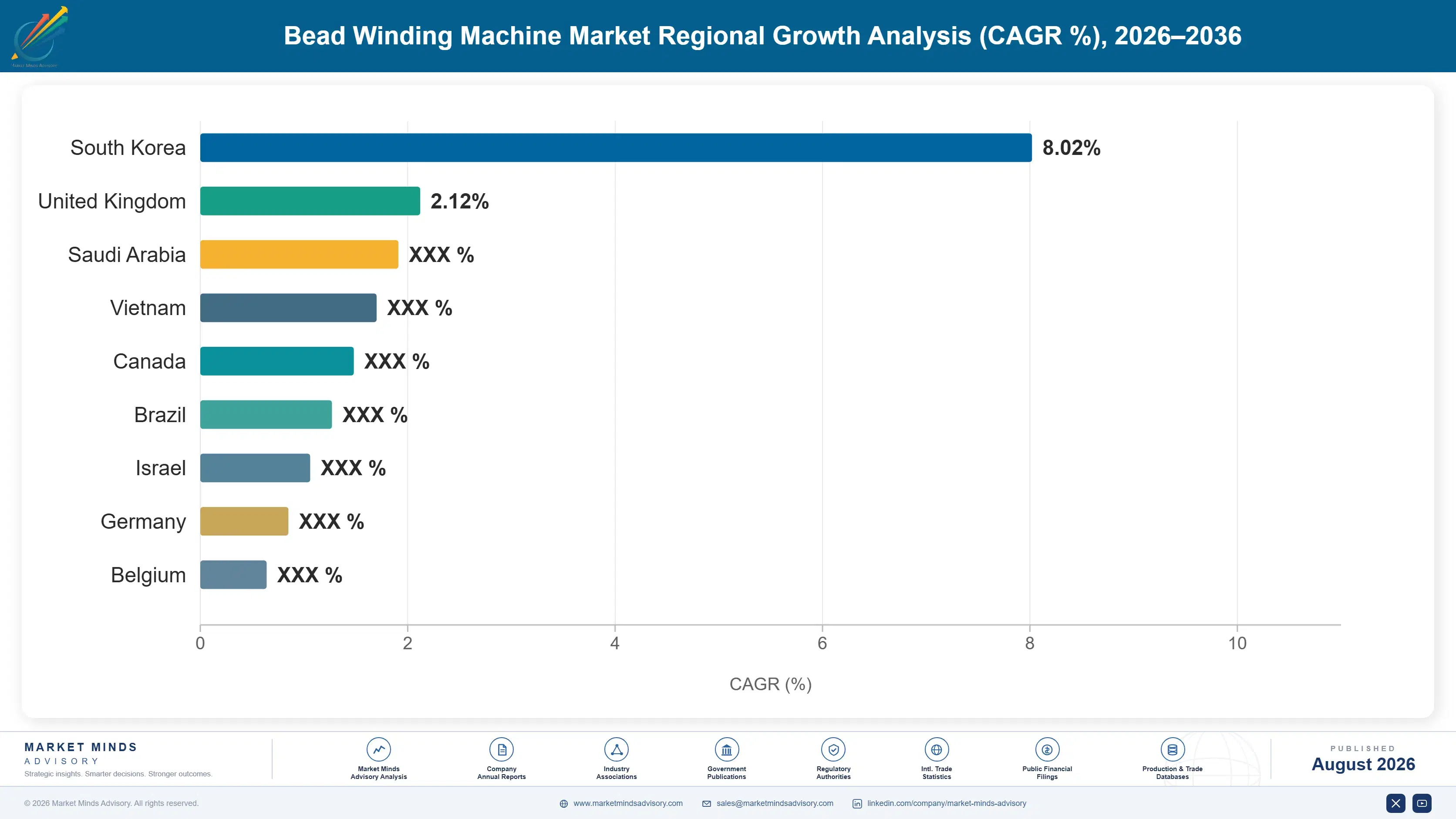
East Asia retains the largest regional share on China's tire manufacturing scale, with South Asia and Pacific expanding fastest as India's tire capacity investment accelerates. North America and Western Europe follow behind, while Latin America, the Middle East and Africa, and Eastern Europe remain earlier-stage markets.

North America

US tire manufacturers are gradually converting legacy single-head machines to CNC-controlled systems, driven primarily by EV-specific tire specification requirements from vehicle OEMs rather than broader capacity expansion, since US tire production capacity has grown only modestly in recent years. Mexico's tire manufacturing sector, boosted by nearshoring investment and proximity to the US market, is generating meaningful new equipment demand tied to new and expanding production facilities. Canada's tire manufacturing base remains comparatively small, generating limited independent demand beyond occasional replacement equipment purchases. Regional machine builders and distributors increasingly compete on service and rapid parts availability rather than price alone, given the relatively small number of tire manufacturing customers across the region.
Share: 22% | CAGR: 5.6% (2026 to 2036)

Western Europe

Germany and France host meaningful bead winding machine manufacturing capacity and serve as the primary source of premium CNC-controlled equipment for European tire manufacturers, even as much of the region's own tire production capacity has consolidated or relocated to lower-cost markets in recent years. Germany's precision machine tool engineering tradition gives it particular strength in servo-driven and CNC-controlled machine categories specifically, supporting both domestic demand and meaningful export volume. The UK's tire manufacturing base remains limited, generating modest independent equipment demand relative to its role as a machine tool export market. Southern European markets including Spain and Italy host smaller tire production facilities generating steady but limited replacement equipment demand.
Share: 19% | CAGR: 4.6% (2026 to 2036)
Regional intelligence for 5 additional markets available in the complete report: East Asia, South Asia and Pacific, Latin America, Middle East and Africa, Eastern Europe. Contact sales@marketmindsadvisory.com.
bead-winding-machine-market-country-cagr-analysis-1787301965653

Where Bead Winding Machine Margins Concentrate

Margin in this market increasingly sits in servo control systems, automated inspection technology, and service contracts rather than the base mechanical winding frame alone. Four levers explain most of the gap between machine builders still competing purely on unit price and those capturing recurring revenue across the full equipment lifecycle from installation through ongoing operation.

Bundling Servo Control and Vision Inspection Systems

Machine builders offering integrated packages that bundle servo control, vision-based inspection, and automated splice detection into a single validated production cell command 45 to 65% price premiums over standalone single-head machines, since tire manufacturers increasingly value reduced scrap rates and faster changeover over marginal component-level cost savings. This bundling also reduces the specialized engineering hours builders need per installation, since pre-engineered packages require less custom integration work than specifying components independently for each production line. Machine builders without bundling capability increasingly lose specification to competitors offering validated packages, particularly on new plant construction projects with compressed commissioning timelines.
Market Impact: Commands a 45-65% premium over stan

Monetizing Predictive Maintenance Software Subscriptions Directly

Machine builders increasingly bundle cloud-based predictive maintenance software subscriptions with equipment sales, charging tire manufacturers an ongoing per-machine fee for vibration monitoring, servo performance data, and maintenance scheduling layered on top of the physical machine sale. This subscription revenue carries margins closer to enterprise software than industrial machinery, and attachment rates are rising above 35% on new CNC installations as manufacturers increasingly view predictive maintenance as essential given how directly unplanned downtime affects production line throughput. Machine builders with the most capable monitoring platforms report meaningfully higher customer retention across their installed base.
Market Impact: Monitoring subscription attachment

Expanding Service and Spare Parts Contracts

Tire manufacturers increasingly purchase multi-year service and spare parts contracts alongside machine installation, since maintaining winding precision requires periodic calibration and component replacement that many manufacturers lack the in-house specialized expertise to perform independently. These service contracts carry margins meaningfully above the equipment sale itself, and machine builders with dedicated field service organizations report renewal rates above 55% as manufacturers increasingly value guaranteed response times to minimize production line downtime. Machine builders without extensive service infrastructure are increasingly losing installed-base service revenue to independent machinery service companies specializing in multi-vendor tire equipment maintenance.
Market Impact: Service contract renewal rates now

Winning New Plant Construction Specifications Early

Machine builders that engage tire manufacturers early in new plant construction planning, before formal equipment specifications are finalized, capture disproportionate specification share since early engagement lets them influence technical requirements toward their own machine capabilities rather than competing purely on price against a fixed specification written by a competitor. This early engagement advantage compounds across a manufacturer's broader capacity expansion program, since builders that win early plant orders build reference installations and customer relationships that support winning subsequent plant orders. Machine builders without dedicated development resources increasingly lose roughly 20% of available specification value to competitors with more proactive relationships.
Market Impact: Captures a 20%+ share of new plant

Who Controls the Margin Pool

CR5 concentration sits at 41%, reflecting moderate consolidation among established machine builders. VMI Group and Mitsubishi Heavy Industries lead on installation scale and tire manufacturer relationships, but the gap to Chinese regional specialists including Qingdao Yiyang remains meaningful, since machine assembly itself requires less capital intensity than precision component manufacturing, letting smaller specialists compete effectively on price.
Competitive activity plays out on three fronts. Pre-engineered production cell bundling is the most visible, with nearly every major builder now offering validated servo-vision-inspection configurations. Predictive maintenance software is the second front, where VMI Group and Mitsubishi Heavy Industries use their cloud platform investment to differentiate beyond machine hardware alone. New plant construction specification is the third front, where builders compete for early manufacturer engagement that determines specification advantage across an entire capacity expansion program.

Pressure is building from two directions rankings have not caught up with. Chinese domestic builders including Qingdao Yiyang have moved from budget alternatives into genuine technical competitors on CNC-controlled machines, taking share from established Japanese and European suppliers in price-sensitive expansion markets. Indian machine builders are simultaneously expanding domestic manufacturing capability to serve the country's own growing tire industry, reducing historical dependence on imported equipment.
bead-winding-machine-market-company-positioning-matrix-1787301966181

Competitive Moat and Risk Dimensions

VMI GROUP B.V.

Moat: Broadest Tire Machinery Product Portfolio

VMI Group's position as a full-line tire manufacturing equipment supplier, spanning bead winding through tire building and curing, gives it cross-selling access to tire manufacturer capital budgets that pure-play bead winding specialists cannot match, letting it win integrated production line orders spanning multiple equipment categories simultaneously.
VMI GROUP B.V.

Risk: Premium Pricing Limits Access

VMI Group's premium positioning and full-line engineering overhead translate into pricing that smaller regional tire manufacturers increasingly find difficult to justify relative to competitively priced Chinese alternatives offering comparable core winding functionality without the broader integrated production line capability those larger manufacturers actually require today.
MITSUBISHI HEAVY INDUSTRIES MACHINERY SYSTEMS LTD.

Moat: Deep Precision Engineering Heritage

Mitsubishi Heavy Industries' decades of precision machine tool engineering experience give its CNC-controlled bead winding machines a dimensional accuracy reputation that newer Chinese competitors, despite closing the price gap significantly, have not yet fully matched in the eyes of the most demanding premium tire manufacturers worldwide.
MITSUBISHI HEAVY INDUSTRIES MACHINERY SYSTEMS LTD.

Risk: Slower Cost-Competitive Product Response

Mitsubishi Heavy Industries has moved more slowly than Chinese competitors to develop lower-cost machine configurations for price-sensitive expansion markets, leaving it more exposed to losing volume specification share in Southeast Asia and India to competitors offering adequate precision at meaningfully lower capital cost and delivery lead time.

Players Tracked

Prominent Players

VMI Group B.V.
Mitsubishi Heavy Industries Machinery Systems Ltd.
Herbert Maschinenbau GmbH & Co. KG
Qingdao Yiyang Tyre Machinery Manufacturing Co. Ltd.
Kobelco Machinery Engineering Co. Ltd.

Other Key Players

Zhengzhou Yushun Machinery Co. Ltd.
Guangdong Xingyang Technology Co. Ltd.
Shandong Sun Rain Rubber Machinery Co. Ltd.
Qingdao Sunny Machinery Co. Ltd.
Bartell Machinery Systems LLC
Wuxi Boteng Machinery Co. Ltd.
Jiaozuo Zhongli Rubber Machinery Co. Ltd.
Guilin Rubber Machinery Co. Ltd.
Qingdao Free Trade Zone Guangyi Rubber Machinery Co. Ltd.
Yanzhou Fuyuan Machinery Manufacturing Co. Ltd.
Techman Trading Corporation Ltd.
Bhilwara Technologies Pvt. Ltd.
Multitech Industries Pvt. Ltd.
Shandong Kaideli Rubber Machinery Co. Ltd.
Qingdao Keyuan Rubber Machinery Co. Ltd.

Recent Developments

FEBRUARY 2025

VMI Group Expands Bead Winding Machine Production Capacity

VMI Group completed an organic capacity expansion at its bead winding machine manufacturing facility to add dedicated CNC-controlled production lines, responding to rising demand from Asian tire manufacturers and shorter delivery lead times requested across India and Southeast Asian markets currently expanding their production capacity aggressively.
Signal: Signals VMI Group is committing manufactur
JUNE 2025

Mitsubishi Heavy Industries Acquires Predictive Maintenance Software Startup

Mitsubishi Heavy Industries acquired a specialist predictive maintenance and vibration monitoring software startup to strengthen its machine monitoring platform's analytics capability and reduce unplanned downtime for tire manufacturer customers, adding software engineering talent it previously lacked in-house for rapid feature development and faster commercial deployment across its portfolio.
Signal: Indicates machine builders are increasingl
OCTOBER 2025

Herbert Maschinenbau Signs Supply Agreement With Indian Tire Manufacturer

Herbert Maschinenbau signed a multi-year supply agreement with a major Indian tire manufacturer to provide bead winding machines and technical support across the manufacturer's new production facility expansion program, replacing a prior project-by-project procurement approach with a single qualified supplier relationship covering multiple new plants.
Signal: Confirms that expanding tire manufacturers

Servo and Precision Component Exposure

Servo motors, controllers, and precision drive components account for 32 to 42% of bead winding machine manufacturing cost, with steel frames, winding heads, and mechanical hardware making up most of the remainder. Servo and control components are sourced from a concentrated group of major automation suppliers, while steel frames and mechanical hardware draw on a broader, more fragmented industrial fabrication supply base.
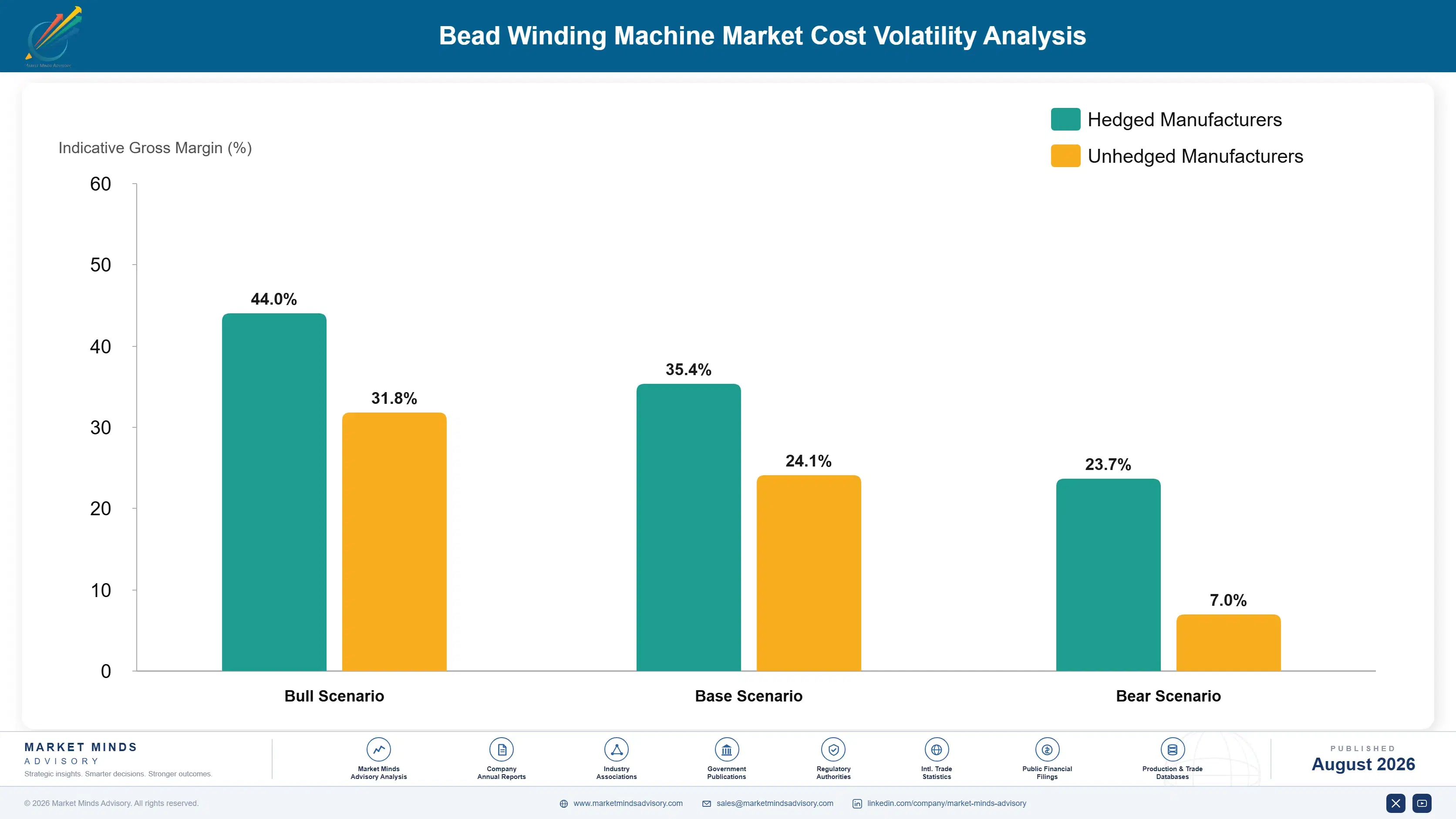
Servo motor and precision component prices rose more than 22% within three quarters during 2021 as broader semiconductor supply chain disruption spilled into industrial automation component availability, according to company annual report disclosures from major machine builders. That constraint forced several builders to extend delivery lead times and, in some cases, substitute alternative servo component models mid-project, an unusual compromise for equipment where precision component specification typically requires extensive advance validation.

Scale builders like VMI Group and Mitsubishi Heavy Industries negotiate servo and component supply contracts across their full global equipment portfolio, giving them better pricing than smaller regional specialists buying components at lower volumes. Builders with long-standing servo supplier relationships carry a durable cost and availability advantage over competitors relying on spot-market purchasing, reshaping which builders can credibly commit to new plant construction delivery timelines.
bead-winding-machine-market-cost-volatility-analysis-1787301966375

Qualifying Multiple Servo Component Suppliers

Machine builders are qualifying servo and control component suppliers across multiple regions rather than relying on a single automation brand, reducing exposure to any single supplier's capacity constraints or allocation decisions during shortages. This adds design and certification complexity but has measurably reduced delivery delays passed through to tire manufacturer customers during recent semiconductor supply disruptions.

Locking Multi-Year Servo Component Supply Agreements

Larger machine builders are negotiating multi-year fixed-price servo and control component supply agreements directly with automation suppliers, trading some upside if prices fall for protection against sudden spikes tied to broader semiconductor market volatility. Smaller builders without comparable purchasing volume typically cannot access these terms and remain more exposed to spot component pricing swings throughout the year.

Building Component Inventory Buffer Stock

Several machine builders are maintaining larger buffer inventory of critical servo and control components rather than ordering strictly against confirmed customer orders, trading working capital investment for delivery reliability during supply disruptions. Smaller builders without comparable working capital access typically cannot pursue this path and remain more exposed to component availability and pricing constraints.

Portfolio Architecture for Margin Defence

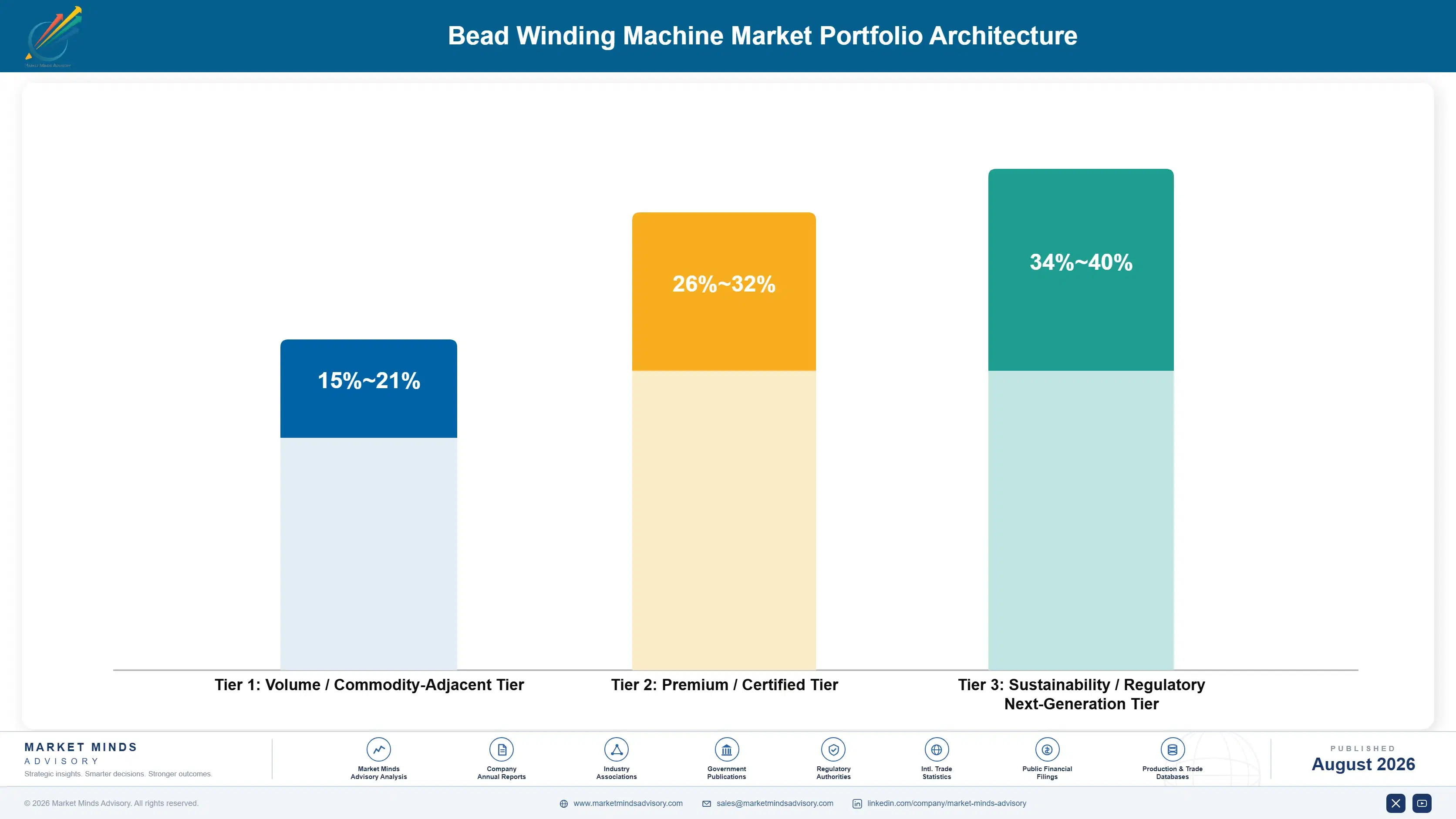
Portfolio economics split into three tiers. Volume commodity-adjacent machines, primarily manual and basic single-head configurations, run on thin margins driven by intense price competition among regional builders and increasingly capable Chinese component suppliers. Premium and certified machines, carrying CNC control and validated precision performance data, command meaningfully better margins because manufacturers pay for reduced scrap rates and faster changeover capability.
The tension between volume and premium runs deep, since cost-constrained regional manufacturers want the lowest acquisition cost per machine while premium radial and EV-tire-oriented manufacturers increasingly demand the precision capability that only CNC-tier configurations deliver consistently. VMI Group and Mitsubishi Heavy Industries manage this by maintaining separate standard and premium product lines, letting manufacturers choose configuration based on their specific tire specification requirements, regulatory exposure, and available budget.

High-value pools concentrate in CNC-controlled and servo-driven machines, where precision engineering and software capability both support pricing power that ordinary mechanical winding equipment cannot replicate. Capital is flowing fastest into vision inspection technology and predictive maintenance software development, as builders race to establish the technology position that will define premium competitiveness through the next decade across every major regional market worldwide.

Volume / Commodity-Adjacent Tier

Manual and basic single-head winding machines without servo control or automated changeover capability, priced primarily on unit cost and competing mainly on delivery speed and basic reliability across high-volume, price-sensitive tire manufacturing applications.
Gross Margin: 15-21%

Premium / Certified Tier

CNC-controlled machines bundled with validated precision performance data and service contracts that radial and EV-tire manufacturers value for reduced scrap rates and predictable long-term production quality across their full operating life.
Gross Margin: 26-32%

Sustainability / Regulatory / Next-Generation Tier

Fully automated CNC platforms with vision inspection and predictive maintenance capability addressing tightening tire quality standards, where software capability and early-mover advantage both support the strongest pricing power in the category currently.
Gross Margin: 34-40%
bead-winding-machine-market-portfolio-architecture-1787301966879

How Bead Winding Demand Recurs

Bead winding machine demand carries a genuine annuity quality through service contracts, spare parts, and predictive maintenance subscriptions layered on top of the initial machine sale. Tire manufacturers require ongoing calibration and component replacement to maintain winding precision regardless of capital spending cycles, and service contract renewal rates above 55% give machine builders a recurring revenue stream that persists independent of new machine sales cycles.
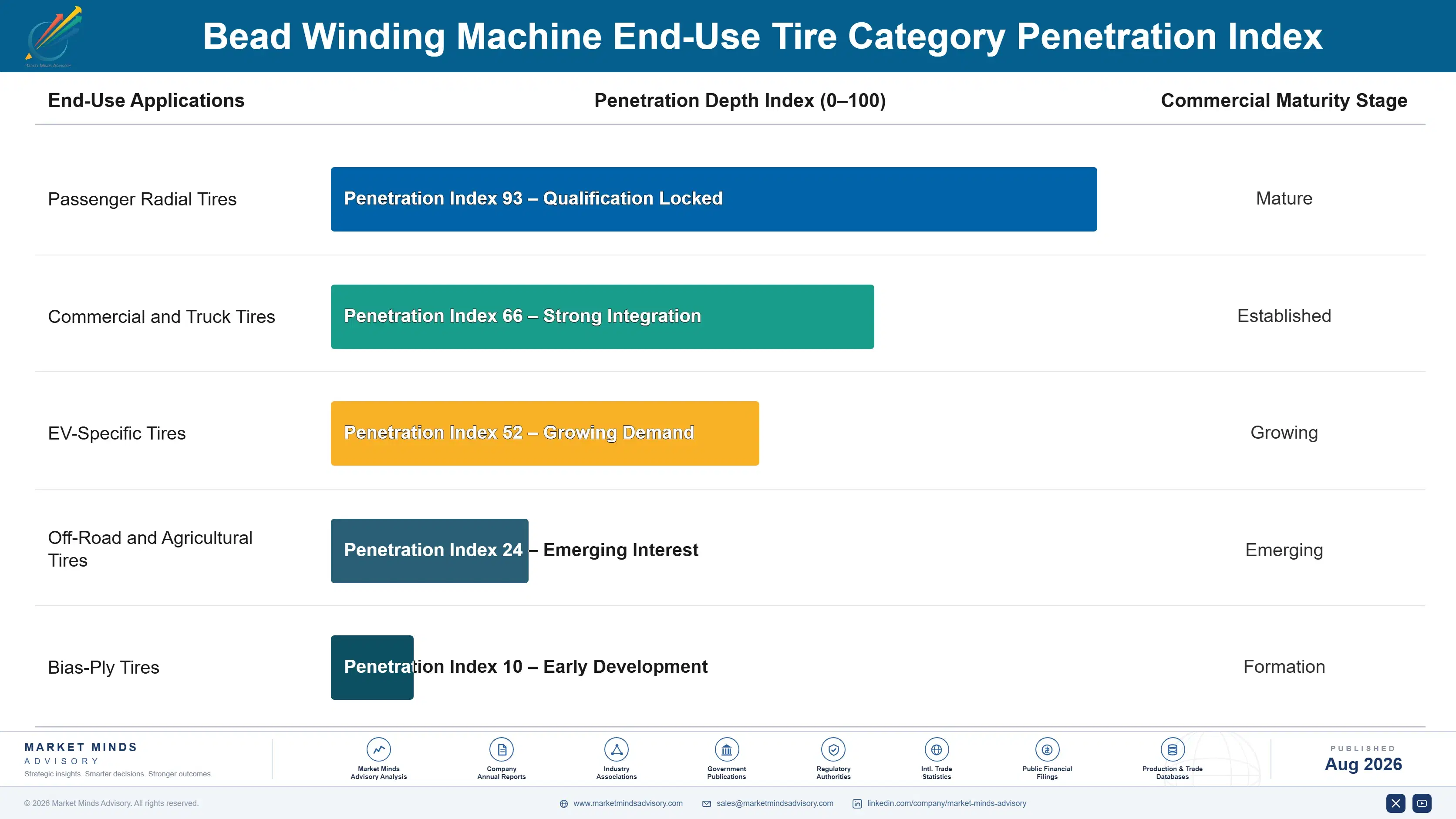
Adoption depth varies meaningfully by tire category. Radial passenger and EV-specific tire production shows the deepest CNC adoption, since precision and changeover flexibility requirements are both most demanding there. Commercial and truck tire production shows growing but more varied adoption, tracking sector-specific capital investment cycles more closely. Bias-ply and off-road tire production remains earlier-stage, since manual and basic single-head technique still dominates those lower-volume, more price-sensitive applications.

A younger generation of tire plant engineers, trained on servo-driven automation and data-driven quality control rather than manual machine tending routines, is accelerating demand for CNC-controlled winding platforms. That generational shift is reshaping which machine builders even get invited into new plant construction capital equipment evaluation processes in the first place, and which get quietly excluded.
bead-winding-machine-market-end-use-penetration-index-1787301967370

What Wins in Bead Winding Machines

These are among the four positions where our research anticipates prominent divergence between winners and laggards over the coming forecast period. Each is grounded in the demand model, the regulatory perimeter, and the announced capacity pipeline.
01 / CNC PRECISION INVESTMENT

Invest in CNC precision engineering before it becomes standard equipment

Machine builders that invest in CNC precision engineering ahead of it becoming standard equipment capture premium pricing and EV-tire specification access before that becomes a baseline market expectation rather than a differentiator. Waiting until CNC becomes standard means competing for tire manufacturer capital budgets against builders that built their precision engineering reputation years earlier, at a moment when demand is accelerating across the entire category simultaneously. Early movers are also better positioned to win new plant construction specifications that increasingly specify CNC compatibility as an evaluation criterion.
02 / NEW PLANT ENGAGEMENT TIMING

Engage manufacturers early in new plant construction planning cycles

Machine builders that engage tire manufacturers early in new plant construction planning capture disproportionate specification share since early engagement lets them influence technical requirements before a competitor writes a fixed specification favoring their own products. Waiting until formal specifications are published means competing purely on price against requirements a competitor may have already shaped in their own favor. The window to establish these early relationships narrows as capacity expansion programs mature and manufacturers develop established vendor relationships that become harder to displace over subsequent expansion phases.
03 / PREDICTIVE MAINTENANCE INVESTMENT

Build proprietary monitoring software rather than relying on third parties

Machine builders that build proprietary predictive maintenance software capture recurring subscription revenue that persists independent of new machine sales cycles, unlike those relying on third-party monitoring platforms that capture much of that margin instead. VMI Group's and Mitsubishi Heavy Industries' monitoring subscription attachment rates above 35% demonstrate how sticky this revenue becomes once manufacturers build maintenance workflows around a specific platform's dashboard and alerting configuration. The window for proprietary monitoring software to function as genuine differentiation narrows as third-party platforms become more capable and cheaper to integrate.
04 / COST-COMPETITIVE PRODUCT STRATEGY

Develop lower-cost configurations to compete in price-sensitive expansion markets

Machine builders that develop lower-cost CNC configurations for price-sensitive expansion markets in India and Southeast Asia capture volume specification share that premium-only product lines cannot access, protecting market position as Chinese competitors close the precision gap while maintaining meaningfully lower pricing. Builders that rely exclusively on premium-tier products risk ceding entire expansion markets to competitors offering adequate precision at more accessible capital cost. The window to develop this cost-competitive positioning narrows as expansion markets mature and vendor relationships solidify around early entrants.

Engagement Snapshot From the Field

A live engagement with an industry participant carrying material or product regulatory and market exposure ahead of a defining policy shift, showing how our research translates into a defensible multi-year portfolio strategy.
MARKET MINDS ADVISORY · CLIENT ENGAGEMENT SUMMARY
Bead Winding Machine Producer Strategic Portfolio Review and Transition Roadmap 2026·Investment Scenario on Bead Winding Machine Exposure Evaluation 2025-26
CLIENT PROFILE
The client is an Indian tire manufacturer operating 3 production facilities with plans for a fourth, currently producing more than 12 million tires annually with an aging bead winding equipment base averaging 14 years old, and evaluating an equipment modernization capital budget exceeding INR 4.2 billion (client-reported, unverified by MMA). The manufacturer was evaluating vendor selection and machine tier standardization ahead of its planned capacity expansion.
STRATEGIC CHALLENGE
The client needed to determine which bead winding machine configuration and vendor would deliver sufficient precision and changeover flexibility to support both its existing radial passenger tire lines and planned EV-specific tire production, given budget constraints that made full CNC conversion across all facilities simultaneously financially impractical within the current capital planning cycle.
MMA APPROACH
MMA conducted a facility-by-facility analysis correlating current machine condition, production mix, and planned EV tire specification requirements against available machine tier options and financing structures. The engagement combined primary interviews with the client's production engineers and comparative benchmarking against peer Indian tire manufacturers that had already begun CNC conversion programs.
KEY FINDINGS
  1. Roughly 45% of the client's existing bead winding machines could not reliably hold the dimensional tolerance required for the planned EV-specific tire production line without significant retrofit investment.
  2. CNC conversion at the client's highest-volume facility alone would generate enough scrap rate reduction savings to justify the equipment investment within approximately three years.
  3. Servo-driven retrofit of existing single-head machines at secondary facilities offered meaningfully better near-term return on investment than full CNC replacement given the client's budget constraints.
  4. Peer benchmarking showed manufacturers that phased CNC conversion by production line priority achieved better overall program returns than those attempting uniform facility-wide conversion.
CLIENT PROFILE
The client is an Indian tire manufacturer operating 3 production facilities with plans for a fourth, currently producing more than 12 million tires annually with an aging bead winding equipment base averaging 14 years old, and evaluating an equipment modernization capital budget exceeding INR 4.2 billion (client-reported, unverified by MMA). The manufacturer was evaluating vendor selection and machine tier standardization ahead of its planned capacity expansion.
STRATEGIC CHALLENGE
The client needed to determine which bead winding machine configuration and vendor would deliver sufficient precision and changeover flexibility to support both its existing radial passenger tire lines and planned EV-specific tire production, given budget constraints that made full CNC conversion across all facilities simultaneously financially impractical within the current capital planning cycle.
MMA APPROACH
MMA conducted a facility-by-facility analysis correlating current machine condition, production mix, and planned EV tire specification requirements against available machine tier options and financing structures. The engagement combined primary interviews with the client's production engineers and comparative benchmarking against peer Indian tire manufacturers that had already begun CNC conversion programs.
KEY FINDINGS
  1. Roughly 45% of the client's existing bead winding machines could not reliably hold the dimensional tolerance required for the planned EV-specific tire production line without significant retrofit investment.
  2. CNC conversion at the client's highest-volume facility alone would generate enough scrap rate reduction savings to justify the equipment investment within approximately three years.
  3. Servo-driven retrofit of existing single-head machines at secondary facilities offered meaningfully better near-term return on investment than full CNC replacement given the client's budget constraints.
  4. Peer benchmarking showed manufacturers that phased CNC conversion by production line priority achieved better overall program returns than those attempting uniform facility-wide conversion.
RECOMMENDED STRATEGY
Phase 1: Phase 1 (Months 1-3): Prioritize CNC conversion at the highest-volume facility identified through the scrap rate reduction and payback analysis. Phase 2: Phase 2 (Months 4-14): Retrofit secondary facility machines with servo control upgrades, sequencing rollout by production line priority and available capital. Phase 3: Phase 3 (Months 15-24): Evaluate conversion performance against scrap rate and changeover time assumptions, then finalize remaining facility upgrade timelines.
OUTCOME
The client's phased conversion program reduced scrap rates at the priority facility meaningfully within the first operating year, exceeding its internal base case projection (client-reported, unverified by MMA). Sequencing conversion by production line priority rather than uniform facility-wide investment reduced total capital deployment meaningfully compared to the client's original modernization plan.

Frequently Asked Questions

Foundational context covering the market sizes, CAGR, scope, country, region and competition that inform every finding below. This section is provided to cover basics and most often pre-purchase conversations, answered from the MMA Primary Research Dataset.

What is the current size of the Bead Winding Machine Market?

The market was valued at US$0.42 billion in 2025 and is projected to reach US$0.45 billion in 2026 as radial tire penetration and Asian capacity expansion continue accelerating.

How large will the Bead Winding Machine Market be by 2036?

MMA projects the market will reach US$0.82 billion by 2036, roughly 1.82 times its 2026 value, driven by CNC conversion and new tire plant construction.

What is the CAGR for the Bead Winding Machine Market 2026 to 2036?

The market is projected to grow at a 6.2% CAGR between 2026 and 2036, with a bull case of 7.4% and a bear case of 4.9%.

Which segment is growing fastest?

Automatic CNC-controlled bead winding machines are the fastest-growing segment at 9.8% annually, roughly 58% faster than the category average, driven by radial tire precision and EV tolerance requirements.

Who are the major companies in the Bead Winding Machine Market?

Leading manufacturers include VMI Group, Mitsubishi Heavy Industries, Herbert Maschinenbau, Qingdao Yiyang, and Kobelco, which together hold roughly two-fifths of category revenue on a disclosed-revenue basis.

Which country is growing fastest?

India leads country-level growth at an estimated 9.4% annually, supported by rapidly expanding tire manufacturing capacity investment across multiple new production facilities being built nationwide.

Report Segmentation Architecture

The full report scope spans multiple orthogonal segmentation dimensions, with cross-tabulated demand data provided for each dimension pair. Coverage extends further to regional breakdowns, trend trajectories, and the competitive detail needed to support segment-level decision-making.

By Machine Type

  • Single-Head Winding Machines
  • Multi-Head and Multi-Spindle Machines
  • Automatic CNC-Controlled Machines
  • Hexagonal Bead Winding Machines
  • Programmable Servo-Driven Machines
  • Manual Semi-Automatic Machines

By End-Use Tire Category

  • Passenger Radial Tires
  • Commercial and Truck Tires
  • EV-Specific Tires
  • Off-Road and Agricultural Tires
  • Bias-Ply Tires

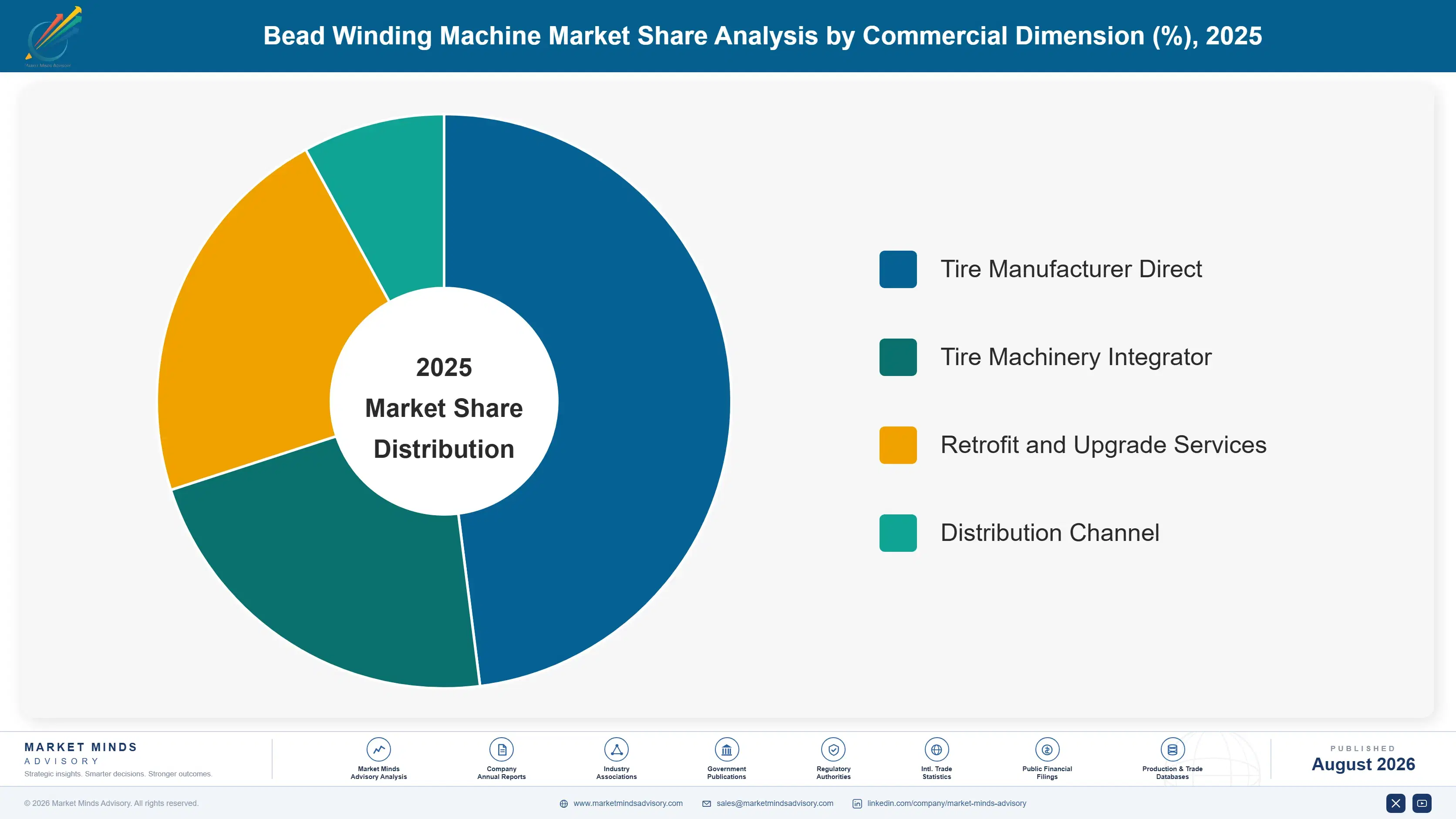
By Commercial Dimension

  • Tire Manufacturer Direct
  • Tire Machinery Integrator
  • Retrofit and Upgrade Services
  • Distribution Channel

By Region

  • North America
  • Western Europe
  • East Asia
  • South Asia and Pacific
  • Latin America
  • Middle East and Africa
  • Eastern Europe

Scope, Methodology, and Coverage

Every figure in this report is reproducible from documented input assumptions. The scope below maps the historical period, the forecast horizon, the segmentation dimensions, and the countries covered, alongside the underlying primary and qualitative methodology.
Historical Period
2020 to 2025
Forecast Period
2026 to 2036
Base Year
2025 (USD billions; MMA Primary Research Dataset, August 2026)
Market Definition
The Bead Winding Machine market covers automated and semi-automated machinery used to wind steel bead wire into the reinforcing bead cores that anchor pneumatic tires to wheel rims, including single-head, multi-head, and CNC-controlled winding systems sold to tire manufacturers and tire machinery integrators. It excludes bead wire production equipment, general rubber extrusion machinery, and tire building machines not specifically configured for bead core winding.
Quantitative Units
USD billions (current prices); unit shipments in hundreds where disclosed by segment
Segmentation Dimensions
By Machine Type; By End-Use Tire Category; By Commercial Dimension; By Region
Regions Covered
North America, Western Europe, East Asia, South Asia and Pacific, Latin America, Middle East and Africa, Eastern Europe
Countries Covered
USA, China, Germany, France, UK, Japan, South Korea, India, Australia, Canada, Brazil, Mexico, Indonesia, Vietnam, Thailand, Malaysia, UAE, Saudi Arabia, South Africa, Nigeria, Turkey, Poland, Netherlands, Italy, Spain, Sweden, Switzerland, Argentina, Colombia, Singapore, and additional markets relevant to this sector
Key Companies Profiled
VMI Group B.V., Mitsubishi Heavy Industries Machinery Systems Ltd., Herbert Maschinenbau GmbH & Co. KG, Qingdao Yiyang Tyre Machinery Manufacturing Co. Ltd., Kobelco Machinery Engineering Co. Ltd., Zhengzhou Yushun Machinery Co. Ltd., Guangdong Xingyang Technology Co. Ltd., Shandong Sun Rain Rubber Machinery Co. Ltd., Qingdao Sunny Machinery Co. Ltd., Bartell Machinery Systems LLC, Wuxi Boteng Machinery Co. Ltd., Jiaozuo Zhongli Rubber Machinery Co. Ltd., Guilin Rubber Machinery Co. Ltd., Qingdao Free Trade Zone Guangyi Rubber Machinery Co. Ltd., Yanzhou Fuyuan Machinery Manufacturing Co. Ltd.
Quantitative Methodology
Primary survey, n=3,800 respondents, Q4 2025, six countries; demand-side model with trade association cross-validation
Qualitative Methodology
47 expert interviews, Q4 2025; applied to validate demand model assumptions, identify emerging dynamics, and assess competitive positioning
Report Format
PDF and XLSX data workbook (Word format preview document)
Publisher
Market Minds Advisory
Report Code
MMA-2026-CON-122
Published
August 2026
Contact
sales@marketmindsadvisory.com | www.marketmindsadvisory.com

Purchase the full Bead Winding Machine Market Report (2026 to 2036).

The full report delivers a complete quantitative and qualitative assessment of the bead winding machine market through 2036, including machine-type and country-level forecasts across all seven MMA-tracked regions. It profiles the twenty leading manufacturers shaping competitive dynamics, with detailed moat and risk analysis for the top two players and a full development timeline of recent corporate activity. The report includes primary survey data from 3,800 respondents and 47 expert interviews conducted in Q4 2025, alongside a dedicated input cost and tire capacity expansion analysis. Buyers receive segmentation, regional, and competitive datasets formatted for direct integration into internal strategic planning models.
Machine-type and regional forecasts through 2036 inclusive
Competitive profiles of twenty leading global manufacturers
Primary survey data from 3,800 global respondents
Expert interview insights from 47 industry practitioners
Input cost and tire capacity expansion risk analysis
Editable data tables for internal strategic modeling

Built For The People Who Decide

From boardroom strategy to bench-side execution, this report is read cover-to-cover by leaders shaping the next decade of their industry, turning demand scenarios, market dynamics and valuation benchmarks into decisions.
CXOs/ Presidents/ VPs/ Managers
M&A and Corporate Development
Strategy Teams and R&D Heads
Procurement and Product Directors
Regulatory and Compliance Leaders
Investor Relations and Equity Analysts