Market Minds Advisory
BBQ Charcoal Market

BBQ Charcoal Market: Premiumisation and Sustainable Feedstock Sourcing

Backyard grilling culture keeps North America the largest charcoal market, but premium hardwood lump and flavour-infused briquettes are pulling category growth away from commodity bags as retailers reward traceable, sustainably sourced feedstock.

Lead Analyst

Bilal Shaikh

Published

September 2026

Make Smarter Decisions with Customized Research Insights

Request a free sample report and evaluate market opportunities, growth trends, and competitive dynamics relevant to your business needs.

2025 MARKET VALUE$5.4BMarket Size 2025
2036 FORECAST VALUE$8.9BBase Case , 2026 to 2036
CAGR 2026 TO 20364.6 %Bull 5.8% / Bear 3.4%
INCREMENTAL OPPORTUNITY$3.2BNet 10- year value creation
EXPANSION MULTIPLE1.57x2036 value over 2026 base
Strategic Levers
M&A Pipeline
Regional Outlook
Country Rankings
Competitive Intelligence
Segmental Deep-dive
Call-Us : 91 93563 13602

Executive Snapshot and Market Trajectory

Grilling habits formed during recent years of increased at-home cooking have stuck, and retailers report steady unit growth even as households trade up from commodity briquettes toward premium hardwood lump charcoal carrying clearer sourcing claims printed directly on the bag itself. Momentum looks durable.
Premiumisation is the defining commercial story: flavour-infused and single-origin hardwood charcoal is growing far faster than the category average, concentrated heavily in North American and Western European markets where consumers pay up for smoke character and traceable sourcing, while coconut shell charcoal exports from Indonesia and the Philippines are reshaping who supplies the category's fastest-growing feedstock segment worldwide across nearly every major importing market tracked closely by manufacturers and retailers alike this year.
Twenty-eight percent combined share among the five largest producers leaves this a genuinely fragmented category compared to most consumer fuel products, with regional hardwood specialists and import brands competing hard on origin story and burn-time claims across nearly every retail channel. Sustainability certification is becoming a genuine differentiator as retailers scrutinise deforestation-linked sourcing more closely than in prior years, reshaping shelf-space decisions across mainstream and specialty retail channels alike.
Market Definition
The BBQ charcoal market covers lump charcoal, briquette charcoal, coconut shell charcoal, extruded log charcoal, and flavour-infused charcoal products sold for outdoor grilling, smoking, and barbecue use by residential and foodservice buyers. It excludes industrial and metallurgical charcoal, activated carbon, and biochar sold for soil amendment or filtration purposes.
Base Year Value
$5.4B in 2025 (MMA Primary Research Dataset, August 2026)
Forecast Period
2026 to 2036, eleven discrete annual values
CAGR
4.6% base case. Bull 5.8%. Bear 3.4%.
Fastest Growth Segment
Flavoured and Infused Charcoal: 7.8% CAGR
Fastest Growth Country
Indonesia: 7.5% CAGR
Fastest Growth Region
South Asia and Pacific: 6.6% CAGR
Largest Region
North America: 30% of 2025 global value
Market Leaders
Kingsford, Royal Oak, Duraflame, Weber-Stephen Products, and Jealous Devil. Source: MMA Analysis based on company annual reports and disclosed segment revenue.
Primary Survey
n=3,800 procurement and R&D decision-makers, Q4 2025, six countries
Methodology
Demand-side build-up, cross-validated against public data, 47 expert interviews

BBQ Charcoal Market Forecast Scenarios

bbq-charcoal-market-size-forecast-scenario-1787302857737
Between 2020 and 2025 the market grew at roughly 3.8% a year, a pace lifted early by pandemic-era outdoor cooking demand before settling into steadier growth as elevated grilling frequency proved durable rather than a temporary pandemic habit that would fade once restaurants reopened fully across most major markets tracked by MMA's research team across the full study period.
The base case assumes 4.6% annual growth through 2036, driven by three commercial mechanisms operating together: continued premiumisation toward flavour-infused and single-origin hardwood charcoal carrying higher margins, coconut shell charcoal export growth from Southeast Asian producers meeting rising demand in cost-conscious markets, and retailer-driven sustainability certification requirements reshaping which suppliers win shelf space at major grocery chains across several importing regions across North America, Europe, and East Asia. Foodservice adoption adds a smaller but complementary fourth growth channel worth watching closely.
A bull case near 5.9% follows if sustainability certification becomes a purchase-decisive factor across enough major retail chains to accelerate the shift away from uncertified commodity imports faster than currently expected by most forecasters. A bear case near 3.3% follows instead if grilling frequency reverts toward pre-pandemic norms as households return to more varied weeknight cooking routines across the region.

Premiumisation Inside a Fragmented Commodity Category

Three forces converge on charcoal purchasing decisions this decade: sustained elevated grilling frequency that has proven far stickier than early analysts expected across most major consumer markets, a widening premiumisation gap between commodity briquettes and traceable hardwood lump charcoal, and growing retailer scrutiny of feedstock sourcing amid deforestation concerns tied to some imported charcoal supply chains still being addressed today. Manufacturers that read this shift early are alre
MARKET CONCENTRATIONCR5 28%share held by top five producers by disclosed revenue
AVERAGE SELLING PRICE$0.85-$3.20 per lbrange spans commodity briquette to premium hardwood lump
TOP PRODUCING COUNTRYUSA, 29% shareof global charcoal production output measured by volume
CAPACITY UTILISATION68%average utilisation rate across surveyed manufacturing facilities today
IMPORT PENETRATION31%share of North American volume met through imported charcoal
SEASONAL DEMAND SWING3.4xpeak summer volume relative to winter month sales
Commercial character has shifted from pure commodity retail toward brand-differentiated positioning built around origin story, wood species, and burn characteristics, with premium producers increasingly selling directly to consumers online rather than relying solely on grocery and hardware store shelf space that commodity brands still depend on heavily for most of their annual sales volume across the category. This shift is most visible among younger grilling households discovering brands online.
Over the next decade, sustainability certification, flavour innovation, and coconut shell charcoal's cost advantage will keep reshaping which producers win shelf space, particularly as major retailers tighten sourcing requirements following consumer pressure around deforestation-linked hardwood harvesting in several exporting countries whose forestry practices remain under closer scrutiny than before. Certification-first retailers are shaping category norms broadly.
"Charcoal used to be the thing you grabbed without reading the bag. Now the wood species and the sourcing claim printed on the front are doing as much selling as the price tag ever did."
Director, Consumer Fuel Products Practice · MMA Consumer Fuel Products Practice

Market Trends

Flavour-Infused Charcoal Moves From Niche to Mainstream Shelf Space

Charcoal infused with mesquite, hickory, and applewood chips, once confined to specialty grilling retailers, is now appearing on mainstream grocery and warehouse club shelves as major producers expand flavoured product lines to capture premium pricing. Consumer research commissioned by several manufacturers shows shoppers willing to pay a meaningful premium for flavour claims even when blind taste tests show smaller differences than marketing suggests. Three of the five largest producers launched new flavoured charcoal lines between 2023 and 2025, and retail scanner data shows the segment's growth consistently outpacing standard briquette sales.
Market Impact: Sustains 3.2 percent baseline volum

Coconut Shell Charcoal Exports Reshape Cost-Tier Supply

Coconut shell charcoal from Indonesia and the Philippines is displacing traditional hardwood briquettes in cost-conscious retail channels, offering longer burn time and lower ash output at a price point competitive with commodity wood briquettes. Indonesian export volume has climbed steadily as processors invest in cleaner-burning production methods that meet import requirements in North American and European markets more consistently than in prior years. Retailers report coconut shell charcoal's private-label growth outpacing branded hardwood briquettes in value-tier grocery channels, a shift that is reshaping which suppliers win shelf placement at major retail chains across several importing countries simultaneously.
Market Impact: Adds 2.4 percent certified-tier dem

Market Opportunities and Growth Drivers

Elevated Grilling Frequency Proving Durable Post-Pandemic

US Census Bureau consumer expenditure data shows outdoor cooking equipment and fuel spending remaining well above pre-2020 levels even as broader discretionary spending patterns normalised across most other categories tracked. Manufacturers report households that adopted more frequent grilling during the pandemic have largely maintained that habit rather than reverting fully to prior cooking patterns, sustaining charcoal volume at a higher baseline than industry forecasters had originally projected for the current decade. Foodservice adoption is adding a second growth channel, as more restaurants incorporate wood-fired and charcoal-grilled items onto menus to capture consumer demand for smoke-forward flavour profiles.
Market Impact: Compresses premium margins by 6 per

Retailer Sustainability Certification Requirements Now Expanding

Major North American and European grocery chains are increasingly requiring Forest Stewardship Council or equivalent sustainability certification before granting shelf space to hardwood charcoal brands, responding to consumer and NGO pressure around deforestation linked to uncertified charcoal sourcing in some exporting regions. Certified producers report certification becoming a genuine competitive advantage in retailer negotiations, even where certified product carries a modest cost premium over uncertified alternatives competing for the same shelf space. Smaller producers without certification budget face growing exclusion risk as more retailers adopt sourcing policies that formerly certified-only premium brands pioneered years earlier.
Market Impact: Erodes 4 percent of occasion share

Market Restraints and Challenges

Hardwood Feedstock Cost Volatility Squeezes Premium Margins

Hardwood feedstock prices have climbed unevenly across major sourcing regions as competition for the same timber grows from furniture, flooring, and biomass energy producers bidding for similar wood species used in premium charcoal production. The root cause is that charcoal producers compete for feedstock against industries with considerably deeper purchasing budgets, leaving smaller charcoal producers price-takers rather than price-setters in regional timber markets. Producers are mitigating this by diversifying into secondary wood species and expanding coconut shell sourcing as a lower-volatility feedstock alternative that does not compete directly against furniture-grade hardwood demand in the same markets.
Market Impact: Adds 7.8 percent segment growth yea

Grilling Equipment Shift Toward Gas and Pellet Alternatives

Gas grills and wood pellet smokers continue capturing a share of outdoor cooking occasions that would otherwise use charcoal, particularly among younger buyers who value the convenience and consistent temperature control these alternatives offer over traditional charcoal cooking methods. The root cause is genuine convenience advantage these alternatives hold for weeknight cooking occasions where charcoal's longer preparation time is a real deterrent for time-pressed households. Charcoal producers are mitigating this by emphasising flavour differentiation and premium positioning that gas cooking cannot replicate, rather than competing directly on convenience against equipment charcoal fundamentally cannot match.
Market Impact: Lifts import share 9 pct
3 additional market trends, 4 additional growth drivers, and 2 additional restraints and challenges are covered in the full report. Contact sales@marketmindsadvisory.com to access the complete intelligence.

Segment CAGR and Growth Architecture

Segmentation follows product type and feedstock, the dimension that determines burn characteristics, price tier, and which retail channel a given charcoal product typically reaches, since feedstock choice drives both cost structure and consumer-facing sourcing claims across the category today, more than any other single factor considered carefully by most buyers browsing crowded retail shelves each season.
bbq-charcoal-market-market-share-analysis-1787302858268

Flavoured and Infused Charcoal

Flavoured charcoal is pulling ahead as producers expand wood-chip infused product lines to capture premium pricing that standard briquettes and even plain hardwood lump cannot command on their own. Consumers increasingly treat flavour claims as a genuine purchase driver, and retail scanner data shows willingness to pay a meaningful premium even where blind taste testing suggests smaller sensory differences than marketing implies to shoppers browsing the shelf. Growth concentrates in North American and Western European grocery channels first, where premiumisation has advanced furthest. Manufacturers including Kingsford and Royal Oak have expanded flavoured lines to meet this demand, and the segment's growth consistently outpaces every other category tracked across the wider industry this decade.
CAGR 7.8%

Coconut Shell Charcoal

Coconut shell charcoal is the second-fastest category, favoured for its longer burn time, lower ash output, and increasingly competitive cost position against traditional hardwood briquettes in value-tier retail channels across several importing markets. Indonesian and Philippine processors have invested in cleaner production methods that meet import and sustainability requirements more consistently than in prior years, opening broader retail access across North America and Europe that was previously limited. Growth concentrates in private-label and value-tier grocery placement first, where cost advantage matters more to shoppers than brand story or sourcing narrative that drives premium hardwood purchasing decisions. Exporters are scaling production capacity specifically to meet rising demand from importing retailers seeking a lower-cost alternative to domestic hardwood briquette supply.
CAGR 7.2%
Full segment breakdown across 6 segments available in the complete report.

Regional Architecture and Country Demand Map

North America remains the largest market on sustained grilling culture and elevated post-pandemic cooking frequency, while South Asia and Pacific grows fastest as coconut shell charcoal export capacity expands. Western Europe and East Asia both show steady premiumisation-driven demand growth. Latin America shows steady, culturally rooted growth.

North America

Sustained elevated grilling frequency following the pandemic-era outdoor cooking boom is the dominant demand mechanism here, with US Census Bureau consumer expenditure data showing outdoor cooking fuel spending remaining well above pre-2020 levels even as other discretionary categories normalised. Kingsford and Royal Oak together command a large share of domestic retail shelf space, though premium hardwood specialists including Jealous Devil and Fogo are winning meaningful share in specialty and warehouse club channels. Import penetration from coconut shell charcoal exporters is rising fastest in value-tier grocery placement, where cost-conscious shoppers are less attached to domestic hardwood brand loyalty than premium segment buyers. Growth here outpaces most other developed markets given the sheer scale of the region's backyard grilling culture.
Share: 30% | CAGR: 5.0% (2026 to 2036)

Western Europe

Premiumisation is the dominant demand mechanism across Germany, France, and the UK, where sustainability-conscious consumers increasingly favour Forest Stewardship Council certified hardwood charcoal over uncertified imports amid growing NGO and media scrutiny of deforestation-linked sourcing in some exporting countries. Growth trails the global average because grilling frequency, while elevated versus a decade ago, has not accelerated at the same pace seen in North America and East Asia recently. German and UK retailers lead the region in requiring sustainability certification as a shelf-space condition, pushing uncertified competitors toward smaller specialty and discount retail channels rather than mainstream grocery placement across most Western European markets today. Certification is increasingly table stakes rather than a differentiator at the region's largest chains.
Share: 22% | CAGR: 3.0% (2026 to 2036)
Regional intelligence for 5 additional markets available in the complete report: East Asia, South Asia and Pacific, Latin America, Middle East and Africa, Eastern Europe. Contact sales@marketmindsadvisory.com.
bbq-charcoal-market-country-cagr-analysis-1787302858785

Premium Tiers, Certification, and Direct Channels

Producers are shifting revenue toward premium flavoured and certified hardwood tiers along with direct-to-consumer sales channels, capturing more margin per bag rather than competing purely on the shelf price of commodity briquettes sold through traditional grocery retail across most mainstream markets today, a shift reshaping category economics broadly across nearly every major retail channel tracked.

Direct-to-Consumer Recurring Subscription Charcoal Delivery Programme

Premium producers including Jealous Devil and Fogo now offer direct-to-consumer subscription programmes delivering hardwood lump charcoal on a recurring schedule, bypassing traditional retail margin entirely while building brand loyalty among frequent grillers who value consistent supply without repeated store trips. This channel captures retail margin producers previously shared with grocery and hardware retailers, with subscription customers reporting meaningfully higher annual spend than comparable one-time retail purchasers tracked across the same period. Early data suggests subscription programmes add roughly 24% to average customer lifetime value compared to single-purchase retail customers buying the same premium product.
Market Impact: Adds roughly 24 percent in customer

Sustainability Certification as a Retail Negotiation Asset

Producers investing early in Forest Stewardship Council or equivalent certification are using that credential as leverage in retail shelf-space negotiations, winning placement ahead of uncertified competitors as major grocery chains tighten sourcing policy requirements. This lever converts a compliance cost into a genuine competitive advantage, with certified producers reporting shelf-space wins at retailers that previously favoured lower-priced uncertified alternatives. Certified producers report retail contract value rising by roughly 15% following certification, as retailers consolidate purchasing toward fewer, more defensible suppliers across the category. This shift has proven durable even as certification costs have risen modestly across the industry.
Market Impact: Grows retail contract value by roug

Flavour Line Extensions Sold at Premium Price Points

Producers are expanding flavoured and wood-species-specific charcoal lines priced meaningfully above standard briquettes, capturing incremental margin from consumers willing to pay for smoke character claims even where blind testing suggests smaller sensory differences than marketing implies. This lever requires minimal capital investment relative to new production capacity, since flavour infusion adds a processing step to existing manufacturing lines rather than requiring entirely new facilities to be built. Producers report flavoured lines carrying gross margins roughly 18% higher than standard briquette equivalents. This margin gain has held steady across two full grilling seasons since the flavoured lines first launched broadly.
Market Impact: Adds 18 percent gross margin per un

Private-Label Coconut Shell Supply Contracting Deals

Coconut shell processors are signing multi-year private-label supply agreements directly with major grocery chains, securing predictable volume commitments in exchange for the cost advantage retailers pass through to value-conscious shoppers in their store-brand charcoal offering. This lever trades brand visibility for volume certainty, letting processors invest confidently in production capacity expansion knowing demand is contractually secured rather than dependent on spot-market retail orders that fluctuate with each grilling season. Processors report private-label contracts adding roughly 20% to annual export volume. This trend is expected to continue as more retailers seek predictable, contractually secured charcoal supply.
Market Impact: Adds roughly 20 percent to export v

Who Controls the Margin Pool

Five producers hold a combined 28% of revenue on a consistent company-disclosed segment revenue basis, a genuinely fragmented concentration level that leaves considerable room for regional hardwood specialists and coconut shell importers competing on origin story and price rather than attempting to out-scale category leaders directly on retail distribution alone across most channels. No single producer commands anything close to majority share nationally.
Current competitive activity centres on three fronts at once: flavoured and premium hardwood line expansion racing to capture premiumisation-driven margin across mainstream retail, sustainability certification investment aimed at winning retail shelf-space negotiations with major chains, and coconut shell import capacity expansion targeting value-tier grocery placement across North American and European markets simultaneously this year. Each front requires meaningfully different capital and capability investment from producers.

Pressure is building steadily from Indonesian and Philippine coconut shell exporters moving up the value chain from unbranded bulk supply toward certified, retailer-branded private-label products, a shift that could compress pricing meaningfully for mid-tier hardwood briquette producers competing in the same value-conscious retail channels where cost sensitivity runs highest among shoppers today across nearly every major grocery chain tracked. Established Western hardwood brands are watching this shift closely and adjusting strategy accordingly.
bbq-charcoal-market-company-positioning-matrix-1787302859303

Competitive Moat and Risk Dimensions

KINGSFORD PRODUCTS COMPANY

Moat: Category-defining brand recognition

Kingsford's brand recognition in North America is difficult for any competitor to match, built over decades as the category-defining name most shoppers associate with charcoal grilling itself, giving it durable shelf-space priority at major retailers that newer entrants struggle to displace regardless of product quality.
KINGSFORD PRODUCTS COMPANY

Risk: Premium segment share erosion risk

Kingsford's core strength lies in mainstream briquettes, leaving it more exposed than specialist hardwood brands to the premiumisation trend pulling category growth toward flavoured and single-origin lump charcoal, categories where smaller specialist producers increasingly command stronger brand credibility among discerning grilling enthusiasts across specialty retail channels.
ROYAL OAK ENTERPRISES

Moat: Broad multi-channel retail distribution

Royal Oak's distribution reach spans grocery, warehouse club, and hardware retail channels more broadly than most specialist competitors, giving it shelf presence across a wider range of shopping occasions and letting it capture both commodity and mid-tier premium purchases within the same retail footprint nationwide.
ROYAL OAK ENTERPRISES

Risk: Coconut shell import cost pressure

Royal Oak's domestic hardwood cost base leaves it more exposed to feedstock price volatility than importers sourcing lower-cost coconut shell charcoal, creating margin pressure in value-tier retail channels where private-label coconut shell alternatives increasingly compete directly against Royal Oak's standard briquette offering across major grocery chains nationwide.

Players Tracked

Prominent Players

Kingsford Products Company
Royal Oak Enterprises LLC
Duraflame Inc.
Weber-Stephen Products LLC
Jealous Devil

Other Key Players

Fogo Charcoal LLC
Rockwood Charcoal Co.
Wicked Good Charcoal
B&B Charcoal Inc.
Cowboy Charcoal Company
Original Charcoal Co.
King's Charcoal Ltd.
PT Sumber Anugerah Sejahtera
Binchotan Carbon Co.
Lazzari Fuel Company
Prasan Charcoal Co.
Coshell Products Inc.
Charcoal House LLC
Green Leaf Charcoal
Heat Beads Pty Ltd.

Recent Developments

APRIL 2025

Kingsford launches expanded flavoured charcoal line

Kingsford introduced an expanded range of wood-chip infused charcoal products across mesquite, hickory, and applewood variants, targeting premium shelf placement at major grocery chains as the company works to capture margin from the category's fastest-growing flavoured segment. Early consumer response has already exceeded internal sales projections company-wide.
Signal: Signals the category leader is prioritisin
NOVEMBER 2024

Royal Oak signs multi-year coconut shell supply agreement

Royal Oak signed a multi-year supply agreement with an Indonesian coconut shell charcoal processor, securing a lower-cost feedstock source to support its value-tier private-label offerings at major grocery chains facing growing price competition. Analysts see the deal as a template other domestic producers may follow.
Signal: Shows established domestic producers hedgi
JULY 2025

Jealous Devil expands direct-to-consumer subscription programme

Jealous Devil expanded its direct-to-consumer subscription delivery programme nationally, following strong early results in regional test markets that showed subscription customers spending meaningfully more annually than comparable one-time retail purchasers. The expansion follows a full year of consistently positive regional pilot performance data collected across several major markets.
Signal: Confirms premium producers see direct chan

Hardwood Feedstock and Transport Exposure

Hardwood timber feedstock accounts for roughly 34% of unit cost of goods sold for premium lump charcoal, sourced primarily from domestic US forestry operations and Latin American hardwood suppliers, while transport and logistics costs add another 21%, reflecting charcoal's relatively low value-to-weight ratio compared to many other consumer products moving through the same distribution channels.
Ocean freight rate volatility during 2021 and 2022 significantly raised landed costs for coconut shell charcoal importers, and US Census Bureau trade data showed import volumes dipping temporarily as some retailers delayed restocking until freight rates normalised, a disruption several importers cited directly in company communications to retail partners during that period across multiple import channels and shipping routes tracked. Rates have since normalised, but the episode reshaped inventory planning industry-wide.

Domestic hardwood producers avoided the worst of the freight volatility that hit coconut shell importers hardest, giving North American lump charcoal brands a temporary cost advantage during the disruption period. Producers without long-term shipping contracts remain most exposed to future volatility affecting import-dependent supply chains broadly. This dynamic is expected to persist through the next several years of continued trade volatility.
bbq-charcoal-market-cost-volatility-analysis-1787302859499

Multi-Year Hardwood Timber Supply Agreements

Larger producers are locking multi-year supply agreements with forestry operations to secure predictable feedstock pricing, insulating margins from the kind of spot-market timber price volatility that has increasingly squeezed smaller competitors without similar contract coverage across the industry, according to several producer annual reports reviewed. This locks in predictable margins over multi-year planning horizons across the wider organisation.

Diversified Ocean Freight Contracting

Coconut shell importers are diversifying ocean freight contracts across multiple carriers and routes rather than depending on a single shipping relationship, reducing exposure to the kind of freight rate spikes that disrupted import volumes during the 2021 to 2022 disruption period still referenced across the industry today. This diversification spans production facilities across several countries and shipping lanes.

Secondary Wood Species Qualification

Producers are qualifying secondary hardwood species as feedstock alternatives to reduce dependence on the specific wood types facing the steepest competition from furniture and flooring manufacturers, broadening the feedstock base available during periods of elevated primary-species pricing across several major sourcing regions simultaneously this year. This flexibility has already paid off during one recent period of elevated pricing.

Portfolio Architecture for Margin Defence

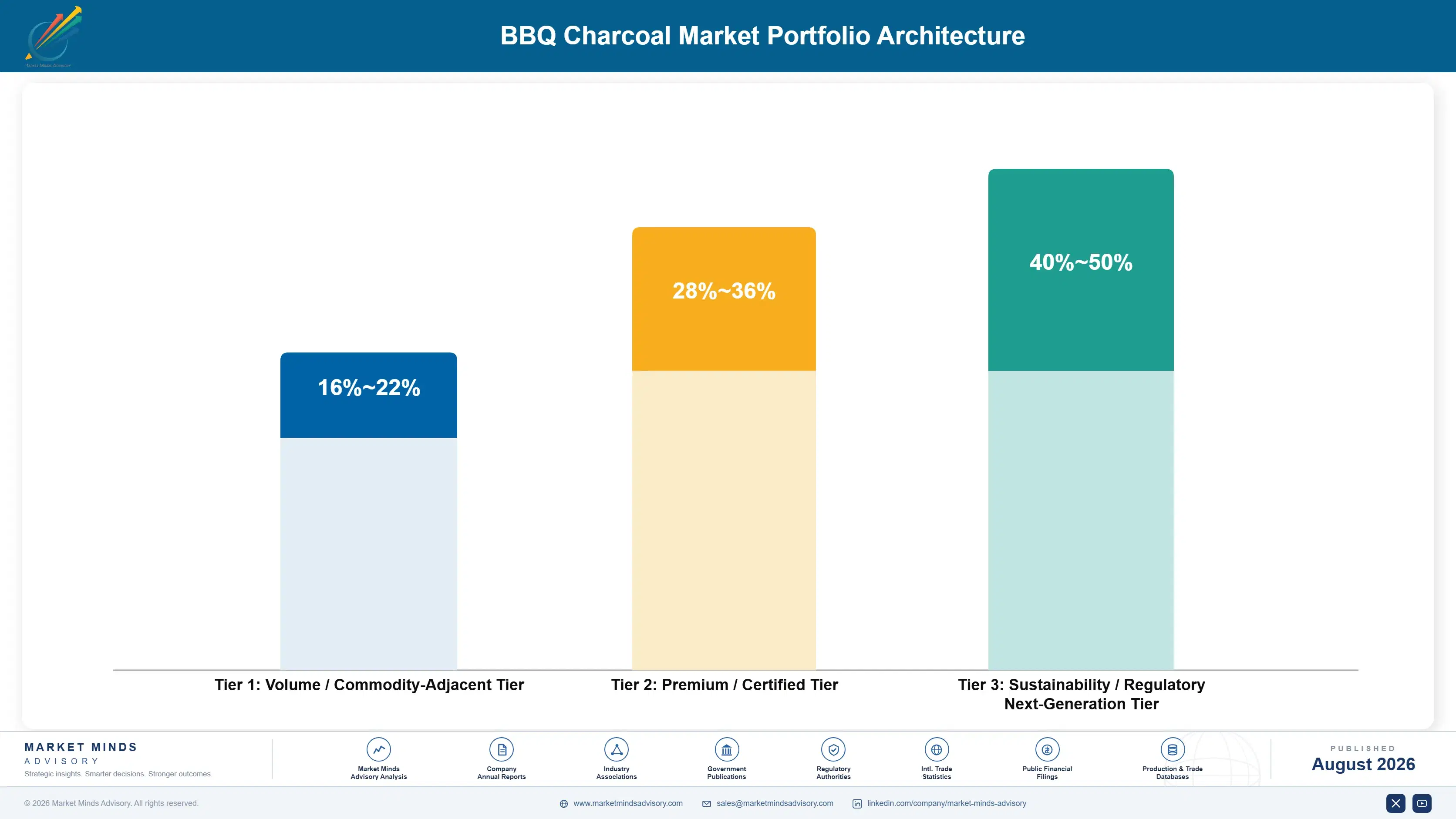
The portfolio splits into three tiers running from commodity briquettes sold largely on price, through certified hardwood lump and coconut shell charcoal carrying sustainability and burn-quality credentials, up to next-generation flavoured and single-origin charcoal aimed at consumers pursuing premium grilling experiences and willing to pay well above category-average pricing across every major retail channel tracked. Margins widen as certification and flavour differentiation increase.
Volume tier products still account for the largest unit shipment count overall but generate the thinnest margins of the three tiers by a wide margin, while premium hardwood and flavoured products, though a smaller share of total bags sold, generate a disproportionate share of category profit as consumers pay up for sourcing credentials and flavour differentiation across specialty and direct-to-consumer retail channels alike. This dynamic mirrors patterns seen across many other premiumising consumer categories in recent years.

The highest-value pools concentrate in flavoured and single-origin hardwood charcoal sold through specialty and direct-to-consumer channels, where margins run highest and buyers stay least price-sensitive, followed closely by certified sustainable hardwood sold through major grocery chains now requiring credentials as a shelf-space condition across most mainstream markets today. Direct-to-consumer producers capture a disproportionate share of this value pool.

Volume / Commodity-Adjacent Tier

Standard briquette charcoal sold largely on price through mainstream grocery and hardware retail channels carrying minimal sourcing or sustainability credentials attached to the product packaging or marketing. Margins stay thin here across nearly every regional market this year.
Gross Margin: 16-22%

Premium / Certified Tier

Certified hardwood lump and coconut shell charcoal carrying sustainability credentials, sold through grocery chains requiring certification as a shelf-space condition for continued product placement. Margins improve meaningfully once certification credentials are attached to a project.
Gross Margin: 28-36%

Sustainability / Regulatory / Next-Generation Tier

Flavoured and single-origin hardwood charcoal sold through specialty and direct-to-consumer channels to premium grilling enthusiasts seeking differentiated products and sourcing transparency. Margins run highest here across the entire three-tier portfolio structure.
Gross Margin: 40-50%
bbq-charcoal-market-portfolio-architecture-1787302860001

Seasonal Repurchase and Loyalty Formation

Demand behaves as a strongly seasonal repurchase pattern rather than a one-time durable purchase, with grilling households buying charcoal repeatedly across the warmer months and brand loyalty forming through repeated satisfactory burn experience rather than a single initial purchase decision made once and rarely revisited afterward across an entire multi-year household relationship with a given brand. This rewards consistent quality over one-time promotional pricing.
Adoption depth varies sharply by household type: frequent grillers who cook outdoors weekly or more often show strong premium brand loyalty and willingness to pay for flavour and sourcing credentials, while occasional grillers buying only a few times per season remain considerably more price-sensitive and switch between commodity brands opportunistically based on shelf promotion and seasonal discounting patterns. Retailers increasingly tailor promotional calendars around these two distinct household purchasing behaviours.

A generational shift is underway in the buyer profile itself, as younger grilling households increasingly discover charcoal brands through social media content and online reviews rather than in-store browsing alone, reshaping which producers win first-purchase consideration among newer entrants to outdoor cooking as a hobby across both suburban and urban household segments today. Producers investing in social content and influencer partnerships are capturing this shift fastest.
bbq-charcoal-market-end-use-penetration-index-1787302860546

Where Category Value Concentrates Next

These are among the four positions where our research anticipates prominent divergence between winners and laggards over the coming forecast period. Each is grounded in the demand model, the regulatory perimeter, and the announced capacity pipeline.
01 / PREMIUMISATION GROWTH TIMING

Flavoured charcoal margin gains will keep outpacing volume growth

Producers investing in flavoured and single-origin hardwood lines are capturing margin growth considerably faster than the category's overall unit volume expansion, since consumers consistently show willingness to pay a meaningful premium for smoke character and sourcing story regardless of blind taste-test results. Competitors still competing purely on commodity briquette price are ceding this fast-growing margin pool entirely to manufacturers who invested early in flavour line development. Expect flavoured segment revenue to keep growing meaningfully faster than standard briquette sales through the remainder of the forecast period.
02 / CERTIFICATION SHELF LEVERAGE

Sustainability credentials are becoming a genuine shelf-space gatekeeper

Major grocery chains are increasingly requiring sustainability certification before granting shelf space to hardwood charcoal brands, converting what was once a marketing differentiator into a genuine competitive necessity for producers hoping to maintain mainstream retail placement going forward across most developed markets. Producers without certification budget face growing exclusion risk as more retailers adopt policies pioneered by premium brands years earlier. This dynamic will keep favouring certified producers over uncertified competitors across the next several forecast years ahead, particularly at large national grocery chains.
03 / COCONUT SHELL SCALING

Southeast Asian export capacity will keep compressing value-tier pricing

Indonesian and Philippine coconut shell processors are scaling export capacity specifically to meet rising demand from value-tier retailers seeking a lower-cost alternative to domestic hardwood briquettes. This trend will keep compressing pricing for mid-tier hardwood producers competing in the same cost-conscious retail channels across several importing markets simultaneously. This gap will narrow somewhat as domestic producers diversify into secondary wood species, but coconut shell's cost advantage will likely persist through most of the current forecast period across major importing markets tracked closely.
04 / CONVENIENCE SUBSTITUTION DEFENSE

Gas and pellet alternatives require sharper flavour-based differentiation

Charcoal continues losing some outdoor cooking occasions to gas grills and pellet smokers among convenience-focused younger buyers, a substitution risk that pure commodity charcoal brands cannot counter through price competition alone against fundamentally more convenient cooking equipment available at similar price points. Producers emphasising flavour differentiation that gas cooking genuinely cannot replicate are proving more resilient against this substitution trend than commodity-focused competitors. Expect flavour-forward marketing to become an increasingly necessary defensive strategy across the broader charcoal category over time.

Engagement Snapshot From the Field

A live engagement with an industry participant carrying material or product regulatory and market exposure ahead of a defining policy shift, showing how our research translates into a defensible multi-year portfolio strategy.
MARKET MINDS ADVISORY · CLIENT ENGAGEMENT SUMMARY
BBQ Charcoal Producer Strategic Portfolio Review and Transition Roadmap 2026·Investment Scenario on BBQ Charcoal Exposure Evaluation 2025-26
CLIENT PROFILE
The client operates a regional grocery chain with 340 stores across the southeastern United States, generating annual charcoal category revenue of approximately $48 million (client-reported, unverified by MMA) across private-label and branded charcoal offerings. Leadership faced mounting pressure from corporate sustainability commitments requiring the chain to phase out uncertified hardwood charcoal suppliers within an eighteen-month window.
STRATEGIC CHALLENGE
The client's existing private-label charcoal supplier could not provide sustainability certification within the required timeline, and switching suppliers risked disrupting a category that generated meaningful seasonal profit during peak grilling months. Leadership needed a sourcing transition plan that would meet the certification deadline without losing shelf-space momentum built over several years with the existing supplier relationship.
MMA APPROACH
MMA's team evaluated certified hardwood and coconut shell suppliers against the client's volume requirements, price-tier positioning, and seasonal delivery reliability needs across the full private-label category. The analysis modelled a phased transition timeline that would meet the certification deadline while testing consumer response to reformulated private-label packaging before committing to a full chain-wide rollout across all store locations.
KEY FINDINGS
  1. A blended sourcing strategy combining certified domestic hardwood and coconut shell charcoal could meet the certification deadline while holding private-label pricing within two percent of prior levels.
  2. Test-market consumer response to reformulated certified packaging showed no measurable sales decline, based on scanner data collected across a representative sample of pilot store locations.
  3. Coconut shell blending reduced total feedstock cost by an estimated 11%, based on supplier quotes gathered during the sourcing evaluation phase of the engagement.
  4. A phased eighteen-month rollout sequenced by regional distribution centre minimised supply disruption risk compared to a single simultaneous chain-wide supplier transition attempted all at once.
CLIENT PROFILE
The client operates a regional grocery chain with 340 stores across the southeastern United States, generating annual charcoal category revenue of approximately $48 million (client-reported, unverified by MMA) across private-label and branded charcoal offerings. Leadership faced mounting pressure from corporate sustainability commitments requiring the chain to phase out uncertified hardwood charcoal suppliers within an eighteen-month window.
STRATEGIC CHALLENGE
The client's existing private-label charcoal supplier could not provide sustainability certification within the required timeline, and switching suppliers risked disrupting a category that generated meaningful seasonal profit during peak grilling months. Leadership needed a sourcing transition plan that would meet the certification deadline without losing shelf-space momentum built over several years with the existing supplier relationship.
MMA APPROACH
MMA's team evaluated certified hardwood and coconut shell suppliers against the client's volume requirements, price-tier positioning, and seasonal delivery reliability needs across the full private-label category. The analysis modelled a phased transition timeline that would meet the certification deadline while testing consumer response to reformulated private-label packaging before committing to a full chain-wide rollout across all store locations.
KEY FINDINGS
  1. A blended sourcing strategy combining certified domestic hardwood and coconut shell charcoal could meet the certification deadline while holding private-label pricing within two percent of prior levels.
  2. Test-market consumer response to reformulated certified packaging showed no measurable sales decline, based on scanner data collected across a representative sample of pilot store locations.
  3. Coconut shell blending reduced total feedstock cost by an estimated 11%, based on supplier quotes gathered during the sourcing evaluation phase of the engagement.
  4. A phased eighteen-month rollout sequenced by regional distribution centre minimised supply disruption risk compared to a single simultaneous chain-wide supplier transition attempted all at once.
RECOMMENDED STRATEGY
Phase 1: Phase 1 (Months 1-6): Pilot the blended certified sourcing strategy across forty stores in one regional distribution zone to validate consumer response. Phase 2: Phase 2 (Months 7-14): Expand the certified blend to all remaining distribution zones, sequencing rollout to minimise supply disruption risk. Phase 3: Phase 3 (Months 15-18): Complete the transition chain-wide and formally retire the uncertified supplier relationship ahead of the corporate deadline.
OUTCOME
The client met its corporate sustainability deadline two months ahead of schedule and reported (client-reported, unverified by MMA) private-label charcoal category revenue holding flat through the transition period with no measurable customer pushback recorded. Total feedstock cost came in below the original budget estimate due to the coconut shell blending strategy adopted during the phased rollout.

Frequently Asked Questions

Foundational context covering the market sizes, CAGR, scope, country, region and competition that inform every finding below. This section is provided to cover basics and most often pre-purchase conversations, answered from the MMA Primary Research Dataset.

What is the current size of the BBQ Charcoal Market?

The global BBQ charcoal market reached an estimated $5.4 billion in 2025, based on MMA's primary research dataset and company-disclosed segment revenue across the five largest producers tracked.

How large will the BBQ Charcoal Market be by 2036?

The market is projected to reach approximately $8.86 billion by 2036, roughly 1.57 times its 2026 value under MMA's base-case forecast scenario for the coming decade.

What is the CAGR for the BBQ Charcoal Market 2026 to 2036?

The base-case compound annual growth rate is 4.6%, with a bull case near 5.8% and a bear case near 3.4% depending on sustainability certification adoption and grilling frequency trends.

Which segment is growing fastest?

Flavoured and infused charcoal is the fastest-growing segment at a 7.8% CAGR, roughly 1.7 times the overall market rate, driven by premiumisation and rising consumer willingness to pay for smoke character.

Who are the major companies in the BBQ Charcoal Market?

Kingsford, Royal Oak, Duraflame, Weber-Stephen Products, and Jealous Devil are the five largest producers by disclosed segment revenue, together holding a combined 28% share of the global category on a consistent basis.

Which country is growing fastest?

Indonesia is the fastest-growing major market at an estimated 7.5% CAGR, driven primarily by coconut shell charcoal export capacity expansion serving North American and European retailers.

Report Segmentation Architecture

The full report scope spans multiple orthogonal segmentation dimensions, with cross-tabulated demand data provided for each dimension pair. Coverage extends further to regional breakdowns, trend trajectories, and the competitive detail needed to support segment-level decision-making.

By Product Type and Feedstock

  • Lump Charcoal (Hardwood)
  • Briquette Charcoal
  • Coconut Shell Charcoal
  • Extruded Log Charcoal
  • Flavoured and Infused Charcoal
  • Instant-Light Charcoal

By End-Use Application

  • Residential Grilling
  • Foodservice and Restaurant
  • Catering and Events
  • Camping and Outdoor Recreation
  • Shisha and Tobacco Heating

By Commercial Dimension

  • Grocery and Mass Retail Channel
  • Warehouse Club Channel
  • Direct-to-Consumer Subscription
  • Private-Label Supply Agreement

By Region

  • North America
  • Western Europe
  • East Asia
  • South Asia and Pacific
  • Latin America
  • Middle East and Africa
  • Eastern Europe

Scope, Methodology, and Coverage

Every figure in this report is reproducible from documented input assumptions. The scope below maps the historical period, the forecast horizon, the segmentation dimensions, and the countries covered, alongside the underlying primary and qualitative methodology.
Historical Period
2020 to 2025
Forecast Period
2026 to 2036
Base Year
2025 (USD billions; MMA Primary Research Dataset, August 2026)
Market Definition
The BBQ charcoal market covers lump charcoal, briquette charcoal, coconut shell charcoal, extruded log charcoal, and flavour-infused charcoal products sold for outdoor grilling, smoking, and barbecue use by residential and foodservice buyers. Industrial and metallurgical charcoal, activated carbon, and biochar sold for soil amendment or filtration purposes are excluded from this scope.
Quantitative Units
USD billions (current prices); metric tonnes shipped where disclosed
Segmentation Dimensions
By Product Type and Feedstock; By End-Use Application; By Commercial Dimension; By Region
Regions Covered
North America, Western Europe, East Asia, South Asia and Pacific, Latin America, Middle East and Africa, Eastern Europe
Countries Covered
USA, China, Germany, France, UK, Japan, South Korea, India, Australia, Canada, Brazil, Mexico, Indonesia, Vietnam, Thailand, Malaysia, UAE, Saudi Arabia, South Africa, Nigeria, Turkey, Poland, Netherlands, Italy, Spain, Sweden, Switzerland, Argentina, Colombia, Singapore, and additional markets relevant to this sector
Key Companies Profiled
Kingsford Products Company, Royal Oak Enterprises LLC, Duraflame Inc., Weber-Stephen Products LLC, Jealous Devil, Fogo Charcoal LLC, Rockwood Charcoal Co., Wicked Good Charcoal, B&B Charcoal Inc., Cowboy Charcoal Company, Original Charcoal Co., King's Charcoal Ltd., PT Sumber Anugerah Sejahtera, Binchotan Carbon Co., Lazzari Fuel Company, Prasan Charcoal Co., Coshell Products Inc., Charcoal House LLC, Green Leaf Charcoal, Heat Beads Pty Ltd.
Quantitative Methodology
Primary survey, n=3,800 respondents, Q4 2025, six countries; demand-side model with trade association cross-validation
Qualitative Methodology
47 expert interviews, Q4 2025; applied to validate demand model assumptions, identify emerging dynamics, and assess competitive positioning
Report Format
PDF and XLSX data workbook (Word format preview document)
Publisher
Market Minds Advisory
Report Code
MMA-2026-ENE-124
Published
August 2026
Contact
sales@marketmindsadvisory.com | www.marketmindsadvisory.com

Purchase the full BBQ Charcoal Market Report (2026 to 2036).

The full BBQ Charcoal Market report delivers detailed segmentation by product type, end-use application, and commercial channel across all seven world regions through 2036. It includes company-level competitive profiles for all twenty companies profiled, covering flavour innovation, certification status, and feedstock sourcing strategy in depth. Regional chapters detail country-level grilling culture, import dependence, and retailer certification requirements for each of the seven regions covered in the report. A dedicated input cost chapter tracks hardwood feedstock and freight exposure alongside mitigation strategies used by leading producers today.
Full seven-region data tables and CAGR breakdowns
Twenty-company competitive profiles and moat analysis
Sustainability certification adoption tracker included here
Input cost exposure and mitigation playbook detailed
Segment-level growth and margin forecasts provided
Editable data appendix in spreadsheet format

Built For The People Who Decide

From boardroom strategy to bench-side execution, this report is read cover-to-cover by leaders shaping the next decade of their industry, turning demand scenarios, market dynamics and valuation benchmarks into decisions.
CXOs/ Presidents/ VPs/ Managers
M&A and Corporate Development
Strategy Teams and R&D Heads
Procurement and Product Directors
Regulatory and Compliance Leaders
Investor Relations and Equity Analysts