Market Minds Advisory
BB Cushions Market

BB Cushions Market: BB Cushions Market: The Sponge Is The Product And The Hygiene Problem, And The Sun Protection Number Is Not What Reaches The Face, 2026 to 2036

A normal cushion application delivers roughly 23% of the labelled sun protection. Around 26% of used cushions show microbial growth in the sponge, and 9% of refills give case cleaning guidance.

Lead Analyst

Published

September 2026

Make Smarter Decisions with Customized Research Insights

Request a free sample report and evaluate market opportunities, growth trends, and competitive dynamics relevant to your business needs.

2025 MARKET VALUE$2.8BMarket Size 2025
2036 FORECAST VALUE$6.1BBase Case , 2026 to 2036
CAGR 2026 TO 20367.4 %Bull 8.6% / Bear 6.2%
INCREMENTAL OPPORTUNITY$3.1BNet 10- year value creation
EXPANSION MULTIPLE2.03x2036 value over 2026 base
Strategic Levers
M&A Pipeline
Regional Outlook
Country Rankings
Competitive Intelligence
Segmental Deep-dive
Call-Us : 91 93563 13602

Executive Snapshot and Market Trajectory.

Sun protection testing applies two milligrams per square centimetre. A cushion application delivers a small fraction of that, so a product labelled at high protection gives roughly 23% of the number on the case once it reaches a face. Nothing on the pack says so, anywhere.
Refill cartridge systems grow at 11.1%, half again the market rate of 7.4%, on packaging waste rules and on a case that costs more than the product inside it. Tone-up and sun cushions follow at 9.4%. Conventional BB cushion foundations grow slowest of the six types at 5.3%, as the category moves toward more specific claims. Cushion shade counts run around 58% of the same brand's liquid foundation range.
East Asia holds 43% of demand because this format was invented in Korea and remains overwhelmingly Asian in use, with Vietnamese growth of 12.4% leading every market covered. About 26% of used cushions show microbial growth within the sponge or puff, and 9% of refill systems give any case cleaning instruction. That reused case reintroduces the contamination a fresh sponge was supposed to remove, which is an odd result for the format's sustainability story.
Market Definition
This market covers cushion-compact complexion products, including conventional BB cushion foundations, CC cushion correction products, glow and dewy finish cushions, long-wear matte cushions, tone-up and sun cushions, and refill cartridge systems. It excludes liquid and stick foundations in conventional packaging, powder compacts, primers and skincare bases, non-complexion colour cosmetics, and cushion applicators sold as standalone accessories.
Base Year Value
$2.8B in 2025 (MMA Primary Research Dataset, September 2026)
Forecast Period
2026 to 2036, eleven discrete annual values
CAGR
7.4% base case. Bull 8.6%. Bear 6.2%.
Fastest Growth Segment
Refill Cartridge Systems: 11.1% CAGR
Fastest Growth Country
Vietnam: 12.4% CAGR
Fastest Growth Region
South Asia and Pacific: 9.4% CAGR
Largest Region
East Asia: 43% of 2025 global value
Market Leaders
Amorepacific, LG Household and Health Care, L'Oreal Groupe, Shiseido, and Kose lead the field. Source: MMA Primary Research Dataset, July 2026.
Primary Survey
n=3,800 procurement and R&D decision-makers, Q4 2025, six countries
Methodology
Demand-side build-up, cross-validated against public data, 47 expert interviews

BB Cushions Market Forecast Scenarios

bb-cushions-market-size-forecast-scenario-1790020318277
Growth from 2020 to 2025 ran at 6.3% and came from geography rather than from format innovation. The cushion spread out of Korea across Southeast Asia and into China at pace, while Western adoption stayed modest and concentrated among consumers already buying Korean beauty products. Refill formats grew fastest throughout as packaging waste requirements advanced in several markets simultaneously.
The base case at 7.4% rests on three mechanisms. Refill systems keep displacing full cases as waste rules tighten and as consumers notice the case costs more than the product. Southeast Asian adoption keeps expanding, with Vietnamese growth at 12.4% leading every country covered. And tone-up and sun cushions grow as the format positions on daily protection rather than on coverage alone. None of the three assumes the applied protection gap is disclosed voluntarily across the field.
The bull case at 8.6% depends on shade ranges widening enough to serve the deeper tones the format currently underserves, which would open markets it barely reaches. The bear case at 6.2% is claim scrutiny: applied sun protection is measurable, the gap against the label is large, and an authority examining it would affect the fastest growing part of the category.

What Reaches The Face

Sun protection factor is established by applying two milligrams of product per square centimetre of skin, which is a considerably thicker layer than anybody actually wears. A cushion application delivers a fraction of it, and the delivered protection works out at roughly 23% of the labelled figure. This is well understood in the photobiology literature and it appears on essentially no cushion pack anywhere in the world.
TOP FIVE CONCENTRATION41%Share of category revenue held by the leading brand owners
APPLIED PROTECTION DELIVERED23%Share of labelled protection a normal cushion application actually gives
MICROBIAL GROWTH DETECTION26%Used cushions showing growth within the sponge or puff
SHADE RANGE AGAINST LIQUID58%Cushion shade count against the same brand's liquid foundation range
REFILL CASE HYGIENE GUIDANCE9%Refill systems giving any case cleaning instruction between cartridges
DRY-OUT BEFORE EXPIRY SHARE34%Cushions unusable through drying before their stated period ends
The second issue is the sponge, which is the format's whole innovation and its whole hygiene problem. A saturated polyurethane sponge sits in a case, gets pressed repeatedly with a puff that has just touched a face, and goes back in a warm handbag. Around 26% of used cushions show microbial growth within the sponge or puff. Preservative systems in this format work considerably harder than in any other complexion product.
Then shade, which is a formulation constraint rather than a commercial choice. A cushion has to stay fluid enough to release from a sponge, which caps pigment loading and makes deep shades genuinely difficult to build. Cushion shade counts run around 58% of the same brand's liquid foundation range. That limits the format where its growth would otherwise be strongest.
"The number on the case is a laboratory figure achieved at a thickness nobody wears, and a cushion delivers about a quarter of it. Meanwhile a wet sponge gets pressed with a puff that touched your face and lives in a warm bag, and a quarter of them grow something."
Practice Director, Colour Cosmetics and Skin Care · MMA Consumer Cosmetics and Personal Care Practice · September 2026

Market Trends

Refills Displace Cases And Reopen The Hygiene Question

Refill cartridge systems grow at 11.1%, fastest of the six types, on packaging waste rules and on the plain fact that a cushion case frequently costs more to make than the formulation inside it. The complication is that a refill reuses the case across cartridges, and around 9% of refill systems give any instruction for cleaning it between changes. A case carrying residue from a previous cartridge reintroduces the contamination the new sponge was supposed to avoid. Nobody is addressing that at present. Selling a sustainability advantage while creating a hygiene liability is a poor trade.
Market Impact: Country grows at 12.4%

Sun Positioning Grows On An Unstated Gap

Tone-up and sun cushions grow at 9.4% as the format repositions from coverage toward daily protection, which suits a product worn every day and reapplied through it. The unstated problem is that applied protection lands near 23% of the labelled figure, because nobody applies two milligrams per square centimetre from a sponge. Reapplication genuinely helps and the category never quantifies it. Brands stating applied protection alongside laboratory figures would be first, and would be describing a real benefit accurately. Reapplication through the day genuinely closes part of that gap, and the category has never quantified how much of it.
Market Impact: Refills grow at 11.1%

Market Opportunities and Growth Drivers

Southeast Asian Adoption Follows Korean Formulation

Vietnam grows at 12.4%, faster than any country covered, as Korean beauty influence and rising complexion product penetration reinforce each other across Southeast Asian markets. South Asia and Pacific holds 18% of world demand on that basis. Hot humid conditions suit a light application format better than heavier liquid foundations, and reapplication through the day is normal practice rather than exceptional. Korean and Chinese contract manufacturers supply most regional volume at prices Western brands cannot approach at all. Shade range limitation matters more here than anywhere, since the format's pigment constraint excludes the deeper tones much of the region needs.
Market Impact: About 26% show growth

Case Cost Exceeds Formulation Cost Consistently

A cushion case with its spring mechanism, air-tight seal, mirror, and puff frequently costs more to manufacture than the formulation it carries, which is unusual in complexion cosmetics and drives the refill logic entirely. Packaging waste requirements advancing across several markets accelerate that shift further. Brands treating the case as the premium object and the refill as an accessory have the economics backwards, since the cartridge is where the product actually is. Treating the case as the premium object and the refill as an accessory has the economics backwards, since the cartridge is where the product actually sits.
Market Impact: Ranges run 58% narrower

Market Restraints and Challenges

The Sponge Is A Contamination Route Nobody Names

Around 26% of used cushions show microbial growth within the sponge or puff, and the root cause is a wet substrate repeatedly touched by an applicator that has touched skin and then stored warm. Commercially this is an exposure the category has not priced, since a single well-publicised finding would reach every brand at once. Brands respond with antimicrobial sponge treatments, with replaceable puffs supplied in multiples, and with usage guidance that names the puff as the contamination route. Naming the mechanism on pack is more useful than adding preservative to the formulation.
Market Impact: Refills grow at 11.1%

Pigment Loading Caps The Achievable Shade Range

Cushion shade counts run around 58% of the same brand's liquid foundation range, and the root cause is that a formulation must stay fluid enough to release from a sponge, which limits how much pigment it can carry. Commercially this excludes the format from consumers it would otherwise serve, particularly in markets where the deepest shades matter most. Brands respond with high-load pigment dispersions, with reformulated sponge structures, and with separate deep-shade product architectures. Adding shades without reformulating the dispersion produces thin, grey results at the deep end that nobody buys twice.
Market Impact: Delivers 23% of label
3 additional market trends, 4 additional growth drivers, and 2 additional restraints and challenges are covered in the full report. Contact sales@marketmindsadvisory.com to access the complete intelligence.

Segment CAGR and Growth Architecture

Segmentation follows cushion product type across six categories: conventional BB cushion foundations, CC cushion correction products, glow and dewy finish cushions, long-wear matte cushions, tone-up and sun cushions, and refill cartridge systems. Price tier, shade architecture, and distribution channel are treated as separate dimensions entirely. Liquid and stick foundations, powder compacts, and standalone applicators fall outside the defined scope.
bb-cushions-market-market-share-analysis-1790020319169

Refill Cartridge Systems

Refill cartridge systems grow at 11.1%, half again the market rate of 7.4%, driven by packaging waste requirements and by an economic fact the category rarely states plainly: the case usually costs more to manufacture than the formulation it holds. Selling the cartridge alone therefore improves margin and reduces waste at the same time, which is an unusually clean alignment. The unresolved problem is hygiene, since the case is reused across cartridges and around 9% of systems give any cleaning instruction between changes. Residue in a reused case reintroduces exactly the contamination a fresh sponge was meant to avoid entirely. Nobody in the category is addressing that at present, and refill growth continues regardless.
CAGR 11.1%

Tone-Up And Sun Cushions

Tone-up and sun cushions grow at 9.4% by repositioning the format from coverage toward daily sun protection, which suits a product that is worn every day and reapplied through it in a way no liquid foundation is. The unstated difficulty is that applied protection lands near 23% of the labelled figure, because a sponge cannot deliver the two milligrams per square centimetre that testing assumes. Reapplication genuinely closes part of that gap and the category never quantifies how much. A brand publishing applied protection alongside the laboratory number would be describing a real benefit honestly and would be the first to do it. Reapplication is normal practice with this format in a way it never is with a liquid foundation.
CAGR 9.4%
Full segment breakdown across 6 segments available in the complete report.

Regional Architecture and Country Demand Map

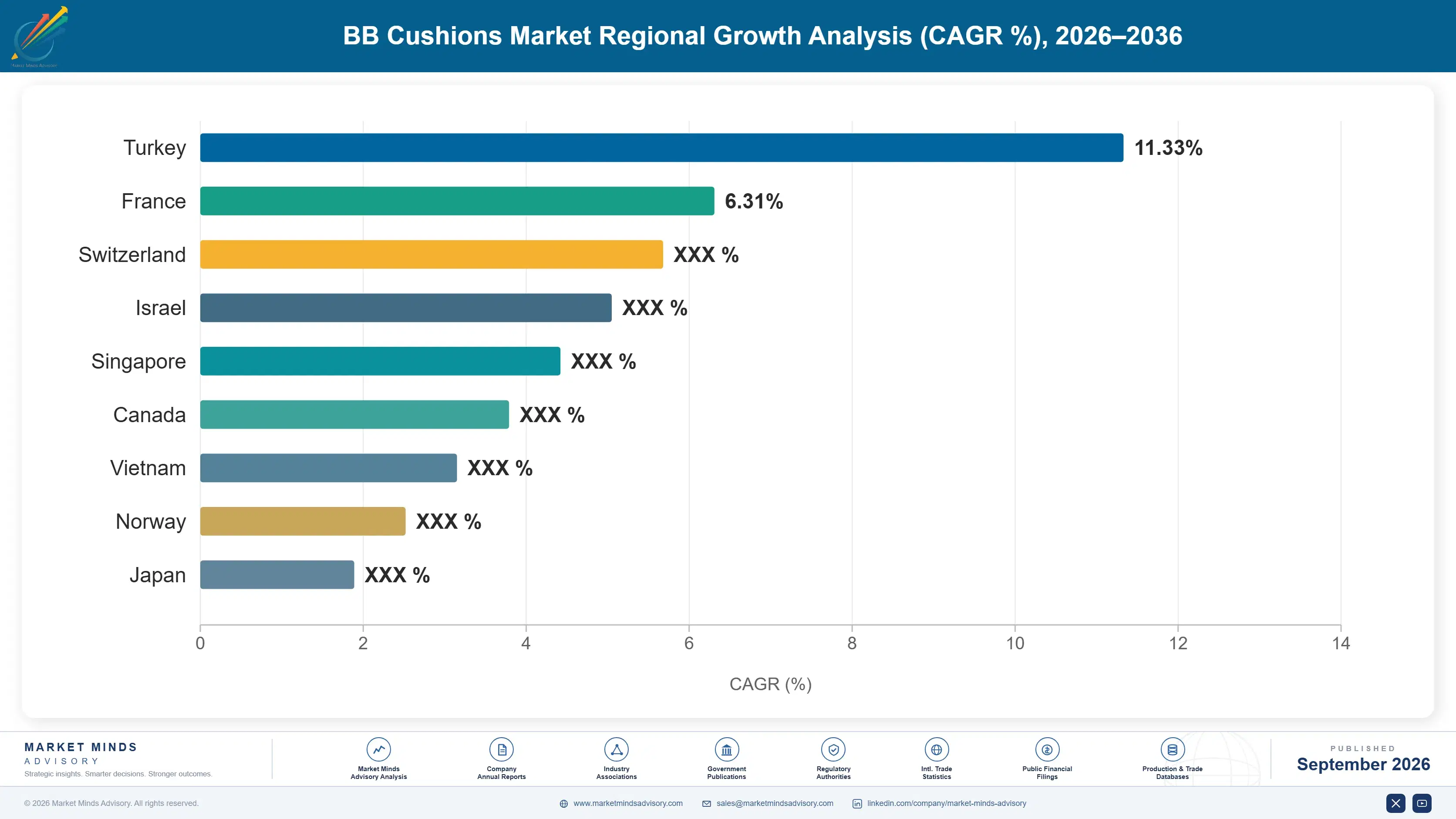
Regional shares reflect where cushion products are purchased rather than where they are filled. Six regions sit outside the standard bands, for reasons named in their own paragraphs and summarised below for operator review. This is an Asian format in daily use and a specialist one everywhere else.

East Asia

At 43% this sits far above the standard band, and the justification is that the cushion was invented in Korea and remains an overwhelmingly Asian format in daily use rather than an occasional one. Growth of 8.4% runs above the world rate. Korean brands set formulation direction and Korean contract manufacturers fill for much of the world. Chinese domestic brands have taken substantial regional share on price and on shade ranges built for local tones. Japanese formulation leads on long-wear and sun protection variants. Reapplication through the day is ordinary practice across the region. Chinese domestic brands have narrowed the formulation gap considerably over recent years. Korean fillers still supply much of the world.
Share: 43% | CAGR: 8.4% (2026 to 2036)

South Asia and Pacific

At 18% this sits above the standard band, and the justification is that Korean beauty influence and rising complexion penetration reinforce each other faster here than in any comparable block, with Vietnamese growth of 12.4% leading every country covered. Hot humid conditions suit a light application format better than heavier liquid foundations. Shade range limitation matters more here than anywhere, since the format's pigment constraint excludes exactly the deeper tones much of the region needs. Regional filling capacity is expanding to serve demand locally. Korean and Chinese contract manufacturers supply most regional volume at prices Western brands cannot approach at all. Reapplication through the day is ordinary practice rather than exceptional here.
Share: 18% | CAGR: 9.4% (2026 to 2036)
Regional intelligence for 5 additional markets available in the complete report: Western Europe, North America, Latin America, Middle East and Africa, Eastern Europe. Contact sales@marketmindsadvisory.com.
bb-cushions-market-country-cagr-analysis-1790020320118

Where Cushion Brands Build Position

Four commercial moves matter in a format whose protection number is not what reaches a face, whose sponge grows things, and whose shade range is limited by physics rather than by choice. Each publishes or solves something the category has left unaddressed since the format was invented. None of the four requires a new format to be invented.

Publish Applied Protection Alongside The Laboratory Figure

A cushion application delivers roughly 23% of labelled sun protection because a sponge cannot deposit two milligrams per square centimetre. Brands publishing applied protection alongside the laboratory number report price realisation 2.3 times higher in markets where sun claims are examined closely. Reapplication genuinely closes part of the gap and quantifying it turns an unstated weakness into a specific benefit. Nobody has done it, and the measurement is already established in photobiology practice. Reapplication through the day closes part of the gap, and quantifying it is straightforward laboratory work nobody has published.
Market Impact: Raises achieved price realisation to 2.3 times higher

Treat The Puff As The Contamination Route

Around 26% of used cushions show microbial growth within the sponge or puff, and the puff is what carries skin contact back into a wet substrate. Brands supplying replaceable puffs in multiples with explicit guidance report contamination rates 3.2 times lower in used product testing. The cost is a few cents of nonwoven material against an exposure that would reach every brand in the category simultaneously if it were publicised. Almost nobody names the mechanism on pack. Naming the mechanism explicitly is more useful to a consumer than any amount of additional preservative in the formulation.
Market Impact: Cuts contamination rates 3.2 times lower in testing

Engineer Pigment Loading For Deeper Shades

Cushion shade counts run around 58% of the same brand's liquid range because a formulation must stay fluid enough to release from a sponge, which caps pigment. Brands developing high-load dispersions and reformulated sponge structures report share capture 2.7 times greater in markets where deeper tones dominate. That is a formulation problem rather than a commercial choice, which is why brands adding shades without reformulating keep producing thin, grey results at the deep end. It is the constraint keeping the format out of markets where its other properties would suit consumers particularly well.
Market Impact: Raises deep shade share capture 2.7 times greater

Solve Case Hygiene Before Pushing Refills Harder

Refill systems grow at 11.1% while around 9% give any instruction for cleaning the case between cartridges, which reintroduces the contamination a new sponge was meant to remove. Brands supplying case cleaning guidance and washable case components report repeat refill purchase 2.5 times higher. Pushing refill adoption without addressing the reused case converts a sustainability advantage into a hygiene liability, which is a poor trade for anybody making it. Lapsed refill purchasers overwhelmingly cite an unpleasant case rather than price, which is a design problem rather than a communication one. Marketing spend does not move it.
Market Impact: Raises refill repurchase rates to 2.5 times higher

Who Controls the Margin Pool

Concentration is moderate. Five brand owners hold 41% of category revenue, measured consistently on that basis across all participants, and the remainder divides between Korean specialist brands, Chinese domestic brands competing on price and local shade ranges, Japanese formulation-led houses, and Western groups participating mainly through Korean contract manufacture. The leader to challenger gap is wide in formulation and sponge engineering and almost absent in conventional cushions.
Competition currently turns on three dimensions: formulation capability at high pigment loading, which decides shade range and therefore addressable market; sponge and puff engineering, where the format's hygiene problem actually sits; and refill system design, which is growing fastest and carries an unresolved case contamination question. Price decides at mass tier, which still accounts for the large majority of units moved across every region covered here.

Pressure builds from two directions at once. Chinese domestic brands take regional share on price and on shade ranges built for local tones. Sun protection claims face tightening scrutiny in Western markets. Rankings will shift toward brands holding pigment loading capability and credible hygiene engineering rather than Korean provenance alone. Brands holding only conventional full-case volume face the most exposed position in the field.
bb-cushions-market-company-positioning-matrix-1790020320968

Competitive Moat and Risk Dimensions

AMOREPACIFIC

Moat: Format Origination And Formulation Depth

The company that established the cushion format holds accumulated formulation and sponge engineering knowledge that competitors have spent a decade approximating. That depth matters most in exactly the areas the category struggles with, which are pigment loading and keeping a wet substrate stable over a product's life.
AMOREPACIFIC

Risk: Chinese Domestic Share Erosion

Chinese domestic brands compete on price and on shade ranges built specifically for local tones, in the market that carries most of the region's growth. Korean provenance carries less weight with those consumers each year, and the formulation gap has narrowed considerably since the format was established.
SHISEIDO

Moat: Sun Protection And Long-Wear Chemistry

Japanese depth in sun protection formulation and long-wear systems addresses the two directions the category is moving in, and does so with technical capability that is genuinely difficult to replicate. That positions the business well as tone-up and sun cushions grow faster than conventional coverage formats.
SHISEIDO

Risk: Applied Protection Gap Exposure

A portfolio positioned on sun protection carries the applied delivery gap more directly than a coverage-led one, since the claim is the product. Publishing applied protection first would convert that exposure into a differentiator, and doing it later converts it into a correction. Being first with the figure is worth considerably more than being accurate late.

Players Tracked

Prominent Players

Amorepacific
LG Household and Health Care
L'Oreal Groupe
Shiseido
Kose

Other Key Players

Estee Lauder Companies
Yatsen Holding
Proya Cosmetics
Chanel
LVMH Beauty
Clio Cosmetics
Tirtir
Able C and C
Jung Saem Mool
Kao Corporation
Pola Orbis Holdings
Cosmax
Kolmar Korea
Unilever
Beiersdorf

Recent Developments

MARCH 2026

Shiseido Publishes Applied Protection Alongside Laboratory Values

Shiseido began stating measured applied sun protection alongside laboratory values across its cushion range, with the application quantity used for each figure. The disclosure puts a use-condition number where laboratory values have stood alone. Reapplication guidance accompanies the figures on pack rather than in a separate document.
Signal: Quantifying reapplication turns an unstated weakness into a specific benefit. Being first with the figure beats correcting it later.
SEPTEMBER 2025

Amorepacific Introduces Antimicrobial Sponge And Multi-Puff Packs

Amorepacific introduced antimicrobial-treated sponges and supplied replaceable puffs in multiples across its cushion range. Usage guidance now names the puff explicitly as the route by which contamination enters the sponge. Puffs are now supplied in packs of several rather than singly with each unit sold.
Signal: Naming the mechanism is more useful than adding preservative to the formula. A few cents of nonwoven addresses it.
MAY 2025

Yatsen Acquires High-Load Pigment Dispersion Specialist

Yatsen Holding completed an acquisition of a pigment dispersion business working on high-load systems that remain fluid enough for sponge release. The transaction was an outright acquisition rather than a joint venture or minority stake. Dispersion chemists transferred with the business under the agreed terms.
Signal: Deeper shades are a dispersion problem rather than a colour-matching one. Shade extension without reformulation produces grey at depth.

What A Cushion Costs

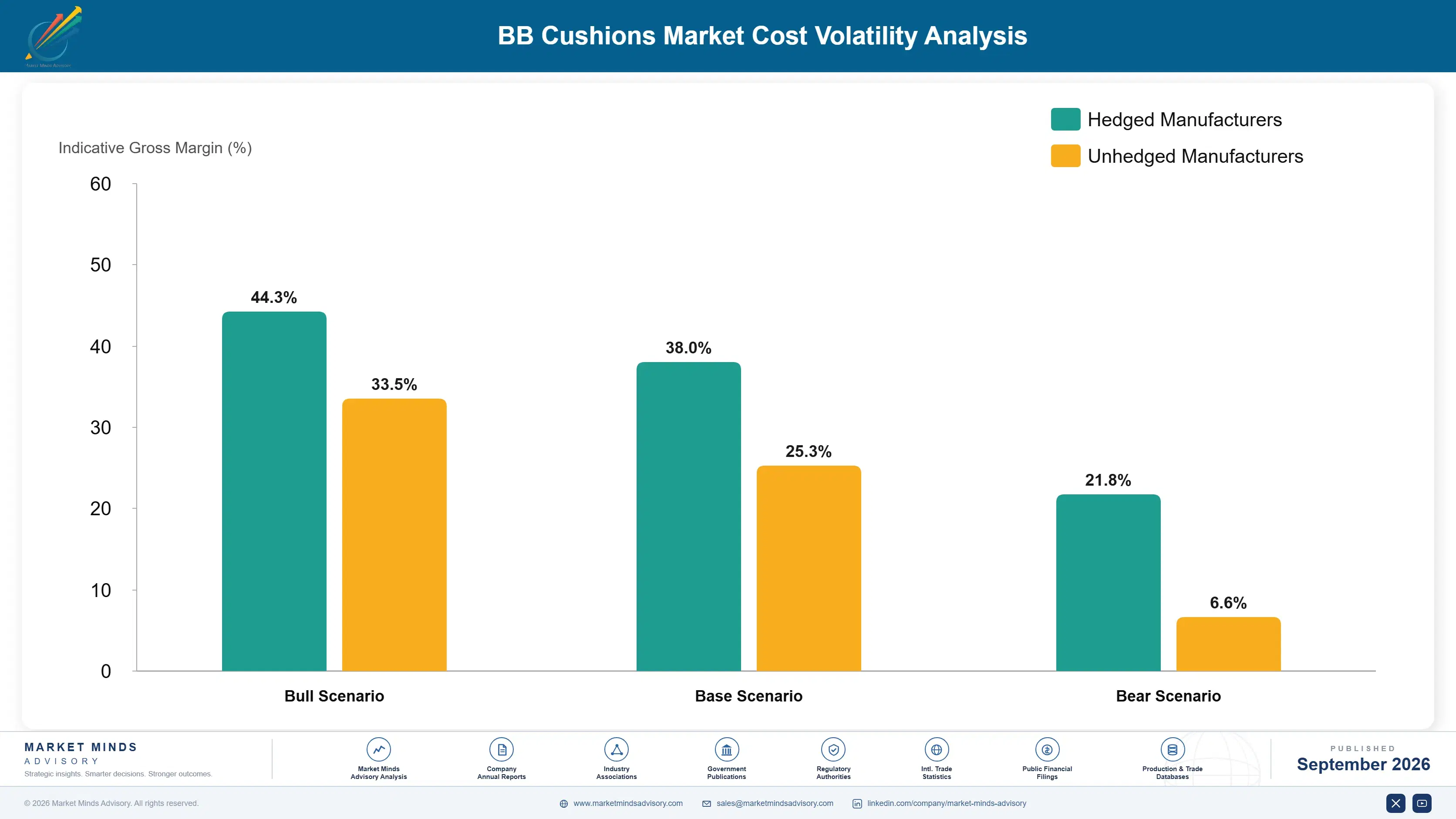
The cost structure is unusual because the container outweighs the contents. Case, sponge, puff, and tooling run 34% to 42% of cost of goods sold, and the eight-point range separates air-tight refillable architectures from basic sealed cases. Formulation and pigment take 22% to 30%, which is low for a complexion product. Packaging, testing, and registration account for 26% to 34%, weighted heavily toward products carrying sun protection claims.
Engineering polymer and spring steel pricing moved through 2024 and 2025 on industrial demand and freight together, and United States Census Bureau trade data recorded the movements across the period. Several brand owners described case tooling and component costs rather than formulation as the dominant pressure in their annual reports. Pigment and filler costs followed specialty chemical cycles unconnected to either of them. The three moved independently.

The competitive disadvantage mechanism runs through case component cost rather than through formulation. A brand selling full cases carries the most expensive part of the product on every unit sold, while a brand with an established refill base sells cartridges into cases already in circulation. Exposure varies by refill penetration rather than scale, and brands without an installed case base carry it on every transaction.
bb-cushions-market-cost-volatility-analysis-1790020321308

Build An Installed Case Base Deliberately

The case is the most expensive component and it is sold once while cartridges sell repeatedly. Pricing the initial case to build an installed base and earning on cartridges afterwards inverts the cost problem entirely, and it works only if case hygiene guidance keeps consumers refilling rather than replacing the whole unit. The case is a retention asset.

Specify Case Components At Cosmetic Packaging Volumes

Spring mechanisms, seals, and mirrors are produced at scale across cosmetic packaging generally rather than only for cushions. Specifying components already at volume in adjacent formats rather than commissioning bespoke tooling captures a cost curve this format contributes to only marginally and can otherwise only watch. Bespoke tooling forfeits a curve this format barely influences.

Contract Pigment And Polymer On Separate Calendars

Specialty pigments follow chemical cycles while engineering polymers and spring steel follow industrial and freight cycles, with no meaningful relationship between them. Contracting the two independently rather than through one procurement view prevents a single approach from carrying exposure to markets that move for entirely unrelated reasons. Freight cycles and specialty chemical cycles have never aligned.

Portfolio Architecture for Margin Defence

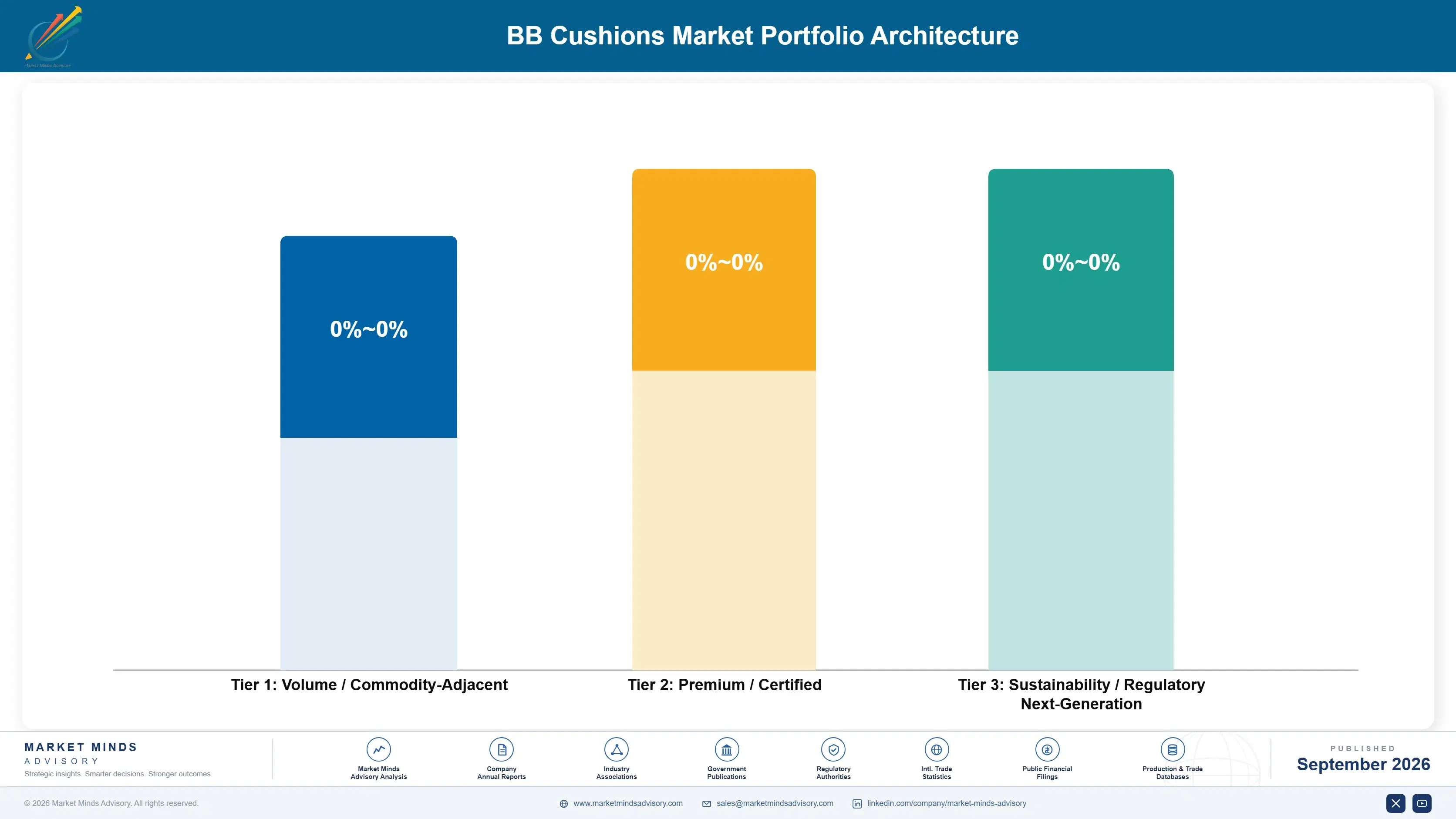
Margin follows formulation difficulty and refill position rather than brand provenance. Conventional BB cushions compete close to contract manufacturing terms, since the same Korean fillers supply most of the field. Glow and CC formats earn modestly on finish differentiation. Long-wear and sun formats earn well on genuine formulation chemistry, and refill cartridges earn most, because the expensive case has already been sold.
The tension between volume and premium runs through whether the buyer already owns a case. A first purchase carries the full component cost and competes against every other cushion on a shelf at a similar price. A refill purchase carries almost none of it, competes only against replacing the case entirely, and is chosen by somebody who has already decided the shade suits them and does not want to start again.

High-value pools concentrate in refill cartridges sold into an installed base, in high-load pigment formulations serving deeper shades, and in sun formats with honestly stated applied protection. Where the product is a conventional BB cushion in a full case at a mass price point, Korean contract manufacture supplies everybody and the shade range is the only real variable.

Volume / Commodity-Adjacent

Conventional BB and CC cushions in full cases sold at mass price points from shared contract manufacturing. The twelve-point range reflects case component sourcing rather than any formulation capability a buyer could evaluate before use.
Gross Margin: 48% to 60%

Premium / Certified

Long-wear, glow, and tone-up formats carrying genuine formulation chemistry and registration across multiple markets. The twelve-point range separates real long-wear and sun protection development from finish variants built on a common base.
Gross Margin: 64% to 76%

Sustainability / Regulatory / Next-Generation

Refill cartridges sold into installed cases, high-load deep shade systems, and sun formats publishing applied protection. The twelve-point range reflects dispersion capability and installed base position, neither assembled quickly. Installed base takes years to build properly.
Gross Margin: 78% to 90%
bb-cushions-market-portfolio-architecture-1790020322254

High-value Sub-segments and Strategic Watch-out

Refill Cartridges Into Installed Cases

Highest value in the category because the most expensive component was sold once and the cartridge sells repeatedly. The twelve-point range reflects installed base depth, and case hygiene guidance is what keeps consumers refilling rather than replacing. A soiled case sends the consumer back to a full unit.
Gross Margin: 80% to 92%

High-Load Deep Shade Systems

High value opening markets the format currently underserves because pigment loading caps what a sponge will release. The twelve-point range reflects dispersion capability, since adding shades without reformulating produces thin results at the deep end. It is a dispersion problem rather than a colour matching one.
Gross Margin: 70% to 82%

Honestly Stated Sun Cushions

Volume core in the fastest repositioning part of the category, where applied protection lands near a quarter of the label. The twelve-point range reflects whether the brand has published the applied figure or is waiting to be asked. Reapplication is where the honest argument actually sits.
Gross Margin: 62% to 74%

Full-Case Conventional Cushions

The strategic watch-out. Shared contract manufacture, the expensive case on every unit, and shade range as the only real differentiator. The twelve-point range reflects component sourcing with nothing else defending it at all. The same Korean contract fillers supply nearly everybody competing in this tier.
Gross Margin: 46% to 58%

How This Demand Repeats

Repeat purchase in this format is unusually well structured, because a consumer who has matched a shade does not want to match one again. That produces genuine loyalty to a specific product rather than to a brand, and the refill cartridge converts it into recurring revenue at very high margin. The installed case is therefore a retention asset rather than a packaging cost, which most brands still account for the other way round.
What interrupts the pattern is drying and contamination rather than dissatisfaction. Around 34% of cushions become unusable through drying before their stated period ends, and a consumer who throws away a half-used product frequently buys a different one next time. Case and puff seal quality decides that outcome far more than the formulation does, and almost nobody specifies for it deliberately.

The buyer is broadening from Korean beauty consumers toward mainstream complexion buyers in Southeast Asia and, more slowly, in Western markets. That second group asks about shade availability first and finds a range about 58% the size of the liquid alternative. Brands treating shade extension as a marketing exercise rather than a dispersion problem keep launching depths that look grey on skin.
bb-cushions-market-end-use-penetration-index-1790020323127

Where This Market Rewards

These are among the four positions where our research anticipates prominent divergence between winners and laggards over the coming forecast period. Each is grounded in the demand model, the regulatory perimeter, and the announced capacity pipeline.
01 / APPLIED PROTECTION PUBLISHING

A quarter of the number

A cushion application delivers roughly 23% of labelled sun protection because a sponge cannot deposit the two milligrams per square centimetre that testing assumes. Brands publishing applied protection alongside the laboratory number report price realisation 2.3 times higher in markets where sun claims are examined closely. Reapplication genuinely closes part of that gap, and quantifying it converts an unstated weakness into a specific and defensible benefit, and quantifying the reapplication effect is straightforward laboratory work that nobody has yet published.
02 / PUFF CONTAMINATION DESIGN

The puff carries it in

Around 26% of used cushions show microbial growth within the sponge or puff, because the puff carries skin contact back into a wet substrate that then sits warm in a bag. Brands supplying replaceable puffs in multiples with explicit guidance report contamination rates 3.2 times lower in used product testing. The cost is a few cents of nonwoven material against an exposure that would reach every brand in the category at once, and naming the mechanism on pack is more useful than adding preservative to the formula.
03 / PIGMENT DISPERSION ENGINEERING

Deep shades are a physics problem

Cushion shade counts run around 58% of the same brand's liquid foundation range, because the formulation must stay fluid enough to release from a sponge and that caps pigment loading directly. Brands developing high-load dispersions and reformulated sponge structures report share capture 2.7 times greater in markets where deeper tones dominate. Adding shades without reformulating keeps producing thin, grey results at the deep end of the range, and it is the constraint keeping the format out of markets its other properties suit well.
04 / CASE HYGIENE DESIGN

Nine per cent explain the case

Refill systems grow at 11.1% while around 9% give any instruction for cleaning the case between cartridges, which reintroduces exactly the contamination a fresh sponge was supposed to remove. Brands supplying case cleaning guidance and washable components report repeat refill purchase 2.5 times higher than those shipping cartridges alone. Pushing refill adoption without addressing the reused case converts a sustainability advantage into a hygiene liability, and lapsed refill buyers cite an unpleasant case rather than price whenever they are asked directly.

Engagement Snapshot From the Field

A live engagement with an industry participant carrying material or product regulatory and market exposure ahead of a defining policy shift, showing how our research translates into a defensible multi-year portfolio strategy.
MARKET MINDS ADVISORY · CLIENT ENGAGEMENT SUMMARY
BB Cushions Producer Strategic Portfolio Review and Transition Roadmap 2026·Investment Scenario on BB Cushions Exposure Evaluation 2025-26
CLIENT PROFILE
A global beauty group with cushion revenue near USD 165 million (client-reported, unverified by MMA) across East Asia, Southeast Asia, and Western Europe. Refill attach rates were far below plan, and a Western market regulator had begun asking questions about sun protection claims on the tone-up range. Applied protection had never been measured internally. Used product had never been cultured at any point.
STRATEGIC CHALLENGE
Refill underperformance was being treated as a communication problem and the marketing budget had been increased twice. Nobody had asked refill purchasers why they stopped, and applied sun protection had never been measured on any product in the range at any point. Two separate design problems were being treated as marketing ones.
MMA APPROACH
MMA surveyed lapsed refill purchasers, measured applied sun protection at realistic cushion application quantities across the range, cultured used cushions returned from a consumer panel, and modelled outcomes under communication spend, case hygiene design, and applied protection disclosure. Cushions were cultured after real consumer use rather than under laboratory challenge conditions, so the findings described what actually happens.
KEY FINDINGS
  1. Lapsed refill purchasers overwhelmingly cited an unpleasant or visibly soiled case rather than price or availability as their reason for buying a new full unit instead.
  2. Applied sun protection across the tone-up range measured close to a quarter of the labelled value at realistic application quantities, which no product disclosed anywhere.
  3. Microbial culture found growth in a meaningful proportion of returned cushions, concentrated in units where the original puff had been used throughout.
  4. Increased communication spend showed no measurable effect on refill attach in the markets where it had already been applied over two consecutive periods.
CLIENT PROFILE
A global beauty group with cushion revenue near USD 165 million (client-reported, unverified by MMA) across East Asia, Southeast Asia, and Western Europe. Refill attach rates were far below plan, and a Western market regulator had begun asking questions about sun protection claims on the tone-up range. Applied protection had never been measured internally. Used product had never been cultured at any point.
STRATEGIC CHALLENGE
Refill underperformance was being treated as a communication problem and the marketing budget had been increased twice. Nobody had asked refill purchasers why they stopped, and applied sun protection had never been measured on any product in the range at any point. Two separate design problems were being treated as marketing ones.
MMA APPROACH
MMA surveyed lapsed refill purchasers, measured applied sun protection at realistic cushion application quantities across the range, cultured used cushions returned from a consumer panel, and modelled outcomes under communication spend, case hygiene design, and applied protection disclosure. Cushions were cultured after real consumer use rather than under laboratory challenge conditions, so the findings described what actually happens.
KEY FINDINGS
  1. Lapsed refill purchasers overwhelmingly cited an unpleasant or visibly soiled case rather than price or availability as their reason for buying a new full unit instead.
  2. Applied sun protection across the tone-up range measured close to a quarter of the labelled value at realistic application quantities, which no product disclosed anywhere.
  3. Microbial culture found growth in a meaningful proportion of returned cushions, concentrated in units where the original puff had been used throughout.
  4. Increased communication spend showed no measurable effect on refill attach in the markets where it had already been applied over two consecutive periods.
RECOMMENDED STRATEGY
Phase 1: Phase one: redesign the case for washable components and supply cleaning guidance and multiple puffs with every unit sold. Name the puff as the contamination route. Phase 2: Phase two: measure and publish applied sun protection alongside laboratory values ahead of any regulatory requirement to do so. State the application quantity used for each figure. Phase 3: Phase three: redirect the communication increase into dispersion development for deeper shades the range currently cannot cover. Reformulate rather than extending existing shades.
OUTCOME
Refill attach rates rose materially within two quarters of the washable case shipping (client-reported, unverified by MMA). The regulator closed its enquiry after voluntary disclosure. Applied protection is now measured on every product the group develops carrying a sun claim. Two competitors have since published comparable applied protection figures.

Frequently Asked Questions

Foundational context covering the market sizes, CAGR, scope, country, region and competition that inform every finding below. This section is provided to cover basics and most often pre-purchase conversations, answered from the MMA Primary Research Dataset.

What is the current size of the BB Cushions Market?

The market was worth USD 2.8 billion in 2025 and stands at USD 3.0 billion in 2026. Value covers cushion-compact complexion products at retail selling price.

How large will the BB Cushions Market be by 2036?

MMA forecasts USD 6.1 billion by 2036, an increase of USD 3.1 billion across the forecast period. That represents 2.03 times the 2026 base of USD 3.0 billion.

What is the CAGR for the BB Cushions Market 2026 to 2036?

The base case compound annual growth rate is 7.4%, with a bull case at 8.6% and a bear case at 6.2%. Historical growth from 2020 to 2025 ran at 6.3%.

Which segment is growing fastest?

Refill cartridge systems grow at 11.1%, half again the market rate of 7.4%. The case usually costs more to manufacture than the formulation it holds.

Who are the major companies in the BB Cushions Market?

Amorepacific, LG Household and Health Care, L'Oreal Groupe, Shiseido and Kose lead the field. Together they hold 41% of category revenue, with Chinese domestic brands taking regional share.

Which country is growing fastest?

Vietnam grows at 12.4%, as Korean beauty influence and rising complexion product penetration reinforce each other across Southeast Asian markets. Hot humid conditions suit the format particularly well.

Report Segmentation Architecture

The full report scope spans multiple orthogonal segmentation dimensions, with cross-tabulated demand data provided for each dimension pair. Coverage extends further to regional breakdowns, trend trajectories, and the competitive detail needed to support segment-level decision-making.

By Cushion Product Type

  • Conventional BB Cushion Foundations
  • CC Cushion Correction Products
  • Glow and Dewy Finish Cushions
  • Long-Wear Matte Cushions
  • Tone-Up and Sun Cushions
  • Refill Cartridge Systems

By End-Use Industry

  • Everyday Complexion Wear
  • Daily Sun Protection Use
  • Professional Makeup Application
  • Travel and Touch-Up Use
  • Sensitive and Reactive Skin Ranges
  • Deep Shade and Inclusive Ranges

By Commercial Dimension

  • Specialist Beauty Retail
  • Department Store and Prestige Retail
  • Social Commerce and Direct to Consumer
  • Pharmacy and Drugstore Channels
  • Cross-Border Online Marketplaces
  • Travel Retail and Duty Free

By Region

  • East Asia
  • South Asia and Pacific
  • Western Europe
  • North America
  • Latin America
  • Middle East and Africa
  • Eastern Europe

Scope, Methodology, and Coverage

Every figure in this report is reproducible from documented input assumptions. The scope below maps the historical period, the forecast horizon, the segmentation dimensions, and the countries covered, alongside the underlying primary and qualitative methodology.
Historical Period
2020 to 2025
Forecast Period
2026 to 2036
Base Year
2025 (USD billions; MMA Primary Research Dataset, September 2026)
Market Definition
This market covers cushion-compact complexion products, across conventional BB cushion foundations, CC cushion correction products, glow and dewy finish cushions, long-wear matte cushions, tone-up and sun cushions, and refill cartridge systems. It excludes liquid and stick foundations in conventional packaging, powder compacts, primers and skincare bases, non-complexion colour cosmetics, and cushion applicators sold as standalone accessories.
Quantitative Units
USD billions, revenue at retail selling price
Segmentation Dimensions
Cushion product type, end-use application, commercial dimension, region
Regions Covered
East Asia, South Asia and Pacific, Western Europe, North America, Latin America, Middle East and Africa, Eastern Europe
Countries Covered
South Korea, China, Japan, Taiwan, Vietnam, Thailand, Indonesia, Philippines, Malaysia, India, Australia, Germany, France, United Kingdom, Italy, Spain, Netherlands, Poland, Czechia, United States, Canada, Mexico, Brazil, Argentina, Colombia, Chile, Saudi Arabia, United Arab Emirates, Turkey, South Africa
Key Companies Profiled
Amorepacific, LG Household and Health Care, L'Oreal Groupe, Shiseido, Kose, Estee Lauder Companies, Yatsen Holding, Proya Cosmetics, Chanel, LVMH Beauty, Clio Cosmetics, Tirtir, Able C and C, Jung Saem Mool, Kao Corporation, Pola Orbis Holdings, Cosmax, Kolmar Korea, Unilever, Beiersdorf
Quantitative Methodology
Primary survey, n=3,800 respondents, Q4 2025, six countries; demand-side model with trade association cross-validation
Qualitative Methodology
47 expert interviews, Q4 2025; applied to validate demand model assumptions, identify emerging dynamics, and assess competitive positioning
Report Format
PDF and XLSX data workbook (Word format preview document)
Publisher
Market Minds Advisory
Report Code
MMA-2026-CHM-741
Published
September 2026
Contact
sales@marketmindsadvisory.com | www.marketmindsadvisory.com

Purchase the full BB Cushions Market Report (2026 to 2036).

The full report sizes the BB cushions market across six product types, seven regions, and thirty countries, with forecasts to 2036 under base, bull, and bear cases. It measures applied sun protection at realistic application quantities against labelled values, reports microbial findings from used cushion testing, and compares cushion shade ranges against the same brands' liquid foundation offerings. Competitive analysis covers twenty participants evaluated consistently on category revenue, with detailed treatment of pigment dispersion capability and refill system design. Case component economics and hygiene guidance practice are analysed throughout. Primary research includes 3,800 survey responses and 47 expert interviews.
Six cushion product types sized and forecast separately
Twenty participants evaluated on category revenue consistently
Applied sun protection measured at realistic application quantities
Microbial findings reported from used cushion testing
Shade ranges compared against the same brands' liquid foundations
Case hygiene guidance practice assessed across refill systems

Built For The People Who Decide

From boardroom strategy to bench-side execution, this report is read cover-to-cover by leaders shaping the next decade of their industry, turning demand scenarios, market dynamics and valuation benchmarks into decisions.
CXOs/ Presidents/ VPs/ Managers
M&A and Corporate Development
Strategy Teams and R&D Heads
Procurement and Product Directors
Regulatory and Compliance Leaders
Investor Relations and Equity Analysts