Market Minds Advisory
BB Cream Market

BB Cream Market: BB Cream Market. Skincare-Makeup Hybrids Redraw the Complexion Category.

Multifunctional skincare-makeup hybrids are reshaping complexion product spending, as reformulation toward SPF protection and skin-barrier ingredients pulls BB cream demand away from traditional foundation toward a genuinely dual-purpose daily product category.

Lead Analyst

Published

September 2026

Make Smarter Decisions with Customized Research Insights

Request a free sample report and evaluate market opportunities, growth trends, and competitive dynamics relevant to your business needs.

2025 MARKET VALUE$6.8BMarket Size 2025
2036 FORECAST VALUE$14.9BBase Case , 2026 to 2036
CAGR 2026 TO 20367.4 %Bull 8.7% / Bear 6.1%
INCREMENTAL OPPORTUNITY$7.6BNet 10- year value creation
EXPANSION MULTIPLE2.04x2036 value over 2026 base
Strategic Levers
M&A Pipeline
Regional Outlook
Country Rankings
Competitive Intelligence
Segmental Deep-dive
Call-Us : 91 93563 13602

Executive Snapshot and Market Trajectory.

Reformulation toward SPF protection and skin-barrier ingredients is turning BB cream from a simple foundation substitute into a genuinely dual-purpose skincare-makeup product driving repeat daily purchase behavior across most major beauty markets worldwide today, reshaping how brands position and market this fast-changing category entirely across nearly every price segment.
SPF-enhanced, skin-barrier formulations are pulling growth well ahead of standard full-coverage BB creams, as dermatologist-backed ingredient claims increasingly determine purchase decisions among younger buyers entering the category through social media and influencer channels worldwide and across most demographics. East Asia anchors both manufacturing innovation and the deepest consumption base, with South Korea's product development cycle setting formulation trends that competitors elsewhere spend years catching up to replicate at comparable quality and price.
Competitive intensity concentrates among Korean conglomerates and global beauty majors simultaneously, each pursuing different playbooks: Korean players lead on ingredient innovation and rapid product launches, while multinational competitors apply broader distribution networks and stronger brand recognition outside East Asia to defend share. Regulatory scrutiny of SPF labeling accuracy across multiple jurisdictions is pushing smaller independent brands toward third-party testing partnerships they previously avoided across most jurisdictions today.
Market Definition
The BB Cream Market covers blemish balm creams combining skincare benefits, SPF protection, and light-to-medium coverage foundation in a single daily-use product. It excludes CC creams, standalone SPF moisturizers, and traditional full-coverage foundation without integrated skincare claims.
Base Year Value
$6.8B in 2025 (MMA Primary Research Dataset, September 2026)
Forecast Period
2026 to 2036, eleven discrete annual values
CAGR
7.4% base case. Bull 8.7%. Bear 6.1%.
Fastest Growth Segment
SPF-Enhanced Skin-Barrier BB Creams: 10.5% CAGR
Fastest Growth Country
Indonesia: 11.4% CAGR
Fastest Growth Region
South Asia and Pacific: 9.7% CAGR
Largest Region
East Asia: 34% of 2025 global value
Market Leaders
AmorePacific Corporation, LG Household and Health Care Ltd, L'Oreal SA, Shiseido Company Limited, The Estee Lauder Companies Inc. Source: MMA Analysis, company annual reports.
Primary Survey
n=3,800 procurement and R&D decision-makers, Q4 2025, six countries
Methodology
Demand-side build-up, cross-validated against public data, 47 expert interviews

BB Cream Market Forecast Scenarios

bb-cream-market-size-forecast-scenario-1790023795397
BB cream volume grew steadily through the historical period as K-beauty routines gained global visibility through social media platforms and influencer marketing campaigns, with formulation innovation accelerating noticeably after 2022 as SPF and skin-barrier claims became standard rather than premium differentiators across most major brands worldwide and across nearly every price tier available in the market today.
The base case assumes continued formulation innovation, expanding SPF regulatory compliance investment, and rising demand from younger buyers treating BB cream as a genuine skincare step rather than pure makeup applied purely for cosmetic effect. Three mechanisms drive the forecast specifically: dermatologist and influencer endorsement widening mainstream adoption considerably, Korean brand expansion into new export markets accelerating distribution reach, and reformulation toward multifunctional claims justifying premium pricing across most major retail channels globally.
A bull scenario turns on major skincare brands successfully repositioning BB cream as a core dermatological product category rather than a cosmetics subcategory, substantially expanding addressable spend across every major regional market. The bear risk centers on regulatory tightening around SPF labeling accuracy raising compliance cost meaningfully, which could compress margins for smaller independent brands lacking dedicated testing infrastructure and regulatory expertise.

Skincare Claims Redefine Complexion Product Value

BB cream economics increasingly track skincare product logic rather than traditional cosmetics pricing, as ingredient sourcing cost and clinical substantiation investment now meaningfully influence retail price beyond simple brand positioning and marketing spend across most major markets today and across nearly every price tier. That shift is compressing the historical gap between premium and mass-market complexion products for formulations carrying comparable active ingredients and clinical backing.
MARKET CONCENTRATIONCR5 34%top five companies hold combined global revenue share
AVERAGE RETAIL PRICE$18.50typical per-unit price across mass and premium tiers
TOP PRODUCING COUNTRYSouth Korea 29%leads global manufacturing and formulation innovation historically by far
SPF COMPLIANCE RATE68%share of listed products meeting stated SPF claims accurately
E-COMMERCE SALES SHARE41%transactions completed through online and direct-to-consumer retail channels
REFORMULATION CYCLE LENGTH22 monthsaverage time between major product formulation updates industry-wide
Manufacturing economics favor Korean producers with established ingredient supply chains and rapid product development cycles, letting them iterate formulations faster than multinational competitors dependent on centralized global product pipelines and longer approval processes across multiple regulatory jurisdictions worldwide and beyond. Scale and formulation speed both matter here, since trend-responsive product launches capture disproportionate early market share before competitors can respond meaningfully.
The next decade will likely see BB cream increasingly marketed alongside dermatological skincare lines rather than cosmetics counters, as regulatory scrutiny of SPF and active ingredient claims pushes the category toward pharmaceutical-adjacent positioning and testing standards, narrowing the gap between cosmetics and clinical skincare formulation requirements considerably over the coming years and across most major markets worldwide and beyond.
"BB cream stopped being a makeup category the day SPF compliance testing became a purchase decision factor. That's a skincare company's problem now, not a cosmetics one."
Practice Lead, Beauty and Personal Care Practice · MMA Beauty and Personal Care Chemicals Practice · September 2026

Market Trends

SPF Reformulation Becomes Category Baseline Standard

Broad-spectrum SPF 30 or higher has moved from a premium differentiator to a baseline expectation across most new BB cream launches, driven by dermatologist advocacy and growing consumer awareness of daily sun protection needs beyond dedicated sunscreen products. Reformulation to meet this standard requires meaningful investment in UV filter technology and clinical testing, raising the entry barrier for smaller independent brands that previously competed primarily on shade range and price. Established players with existing SPF testing infrastructure from adjacent skincare lines hold a genuine reformulation speed advantage over cosmetics-only competitors entering the category.
Market Impact: Lifts premium segment price 22%
Social Commerce Accelerates Korean Brand Global Reach

Livestream shopping and short-form video platforms have compressed the time between Korean product launch and global consumer awareness from roughly a year to a matter of weeks, letting smaller Korean independent brands reach international buyers directly without traditional retail distribution deals or intermediary partnerships of any kind. This channel shift favors brands with strong visual product storytelling and influencer relationships over those relying solely on established department store or drugstore placement. Multinational competitors are responding by building dedicated social commerce teams rather than routing all digital spend through traditional e-commerce advertising channels.
Market Impact: Grows export volume 18% annually

Market Opportunities and Growth Drivers

Skin-Barrier Ingredient Demand Pulls Premium Pricing Higher

Consumers increasingly research ceramide, niacinamide, and hyaluronic acid content before purchase, treating BB cream ingredient lists with the same scrutiny previously reserved for dedicated skincare serums and moisturizers sold separately across most retail channels. Brands that reformulate with clinically substantiated active ingredients command meaningful price premiums over standard formulations lacking comparable claims, particularly among buyers aged twenty-five to forty who have grown accustomed to ingredient transparency from broader skincare shopping habits. This shift is pulling category average selling prices upward faster than unit volume growth alone would suggest across most major markets.
Market Impact: Erodes brand trust by 11%

Korean Export Infrastructure Expands Distribution Reach

Korean cosmetics export infrastructure has matured considerably over the past decade, with dedicated logistics and regulatory compliance services now widely available to smaller independent brands that previously lacked the resources to navigate international market entry alone or affordably at scale. This infrastructure maturity has compressed the time needed for a domestic Korean brand to establish meaningful international retail presence, opening the category to a wider range of competitors beyond the largest conglomerates. Export volume growth has consistently outpaced domestic Korean consumption growth over the past several years and continues accelerating steadily.
Market Impact: Excludes 19% of buyer segments

Market Restraints and Challenges

SPF Labeling Accuracy Faces Growing Regulatory Scrutiny

Independent testing has repeatedly found meaningful gaps between labeled and actual SPF protection levels across a portion of BB cream products, particularly among smaller brands lacking dedicated testing budgets comparable to major conglomerates. The root cause traces to inconsistent third-party testing standards across different manufacturing regions rather than deliberate misrepresentation in most cases, though the commercial impact on brand trust is identical regardless of intent. Larger players are responding by publishing third-party test results proactively, while smaller brands increasingly pool testing costs through industry consortiums to close the credibility gap.
Market Impact: Lifts average unit price 15%

Shade Range Limitations Constrain Addressable Market

Many BB cream formulations still launch with narrower shade ranges than competing foundation products, rooted in the category's origin as a lighter-coverage product optimized for a smaller set of skin tones common in its founding market. This limitation constrains addressable market size in regions with more diverse skin tone distribution, particularly across parts of South Asia, Africa, and Latin America where available shades frequently underserve local consumers. Several major brands are expanding shade ranges substantially in response, though catalog rebuilding takes considerable time and testing investment to execute properly across every region.
Market Impact: Cuts launch-to-market time 60%
4 additional market trends, 3 additional growth drivers, and 3 additional restraints and challenges are covered in the full report. Contact sales@marketmindsadvisory.com to access the complete intelligence.

Segment CAGR and Growth Architecture

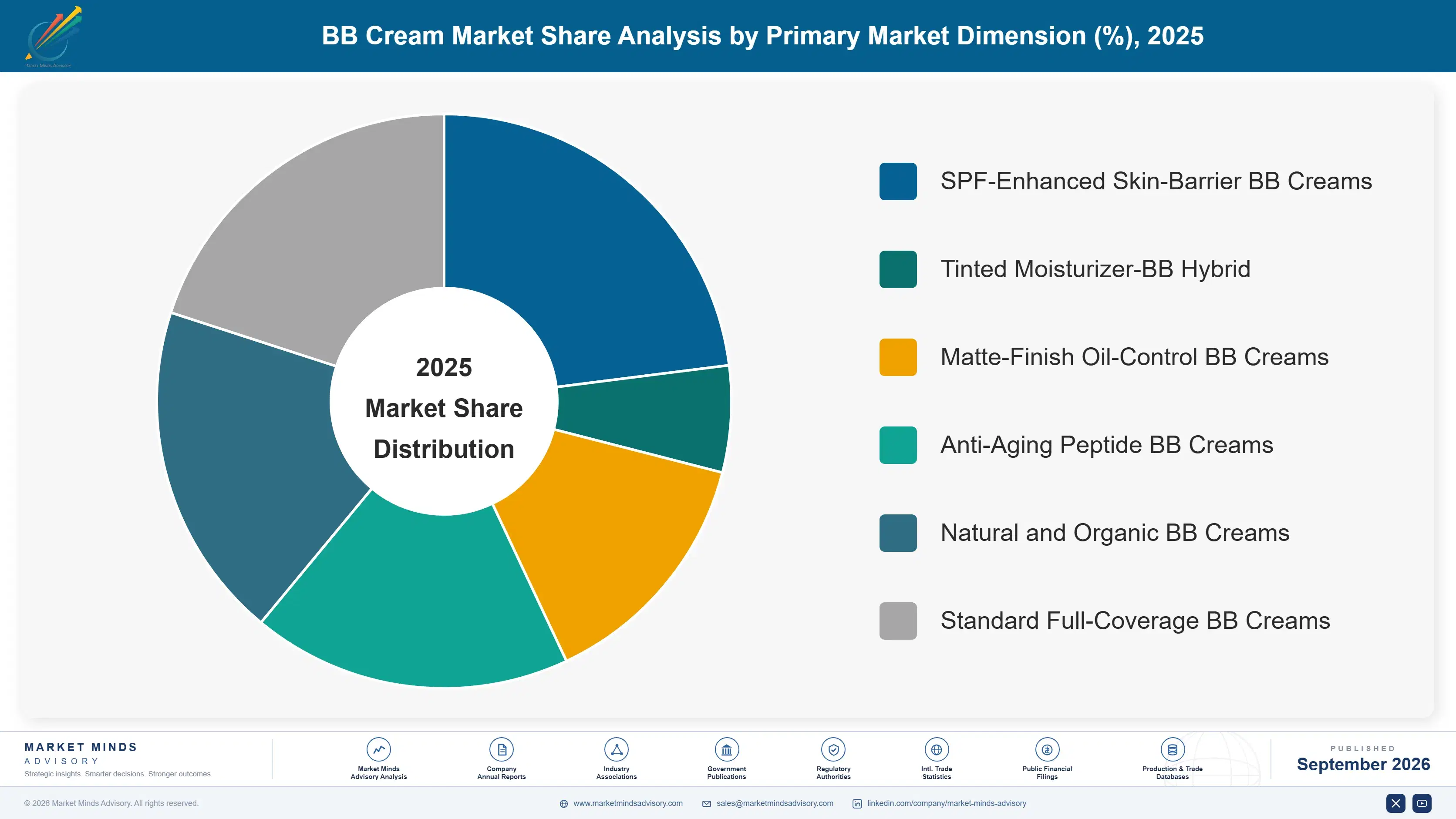
Segmentation follows formulation type and functional benefit, the dimension buyers actually use to compare products and brands use to differentiate reformulations across the entire category landscape and price spectrum. Six categories span the range from standard coverage to advanced dermatological positioning, reflecting how far the category has moved beyond simple cosmetics classification over the past several years.
bb-cream-market-market-share-analysis-1790023795966

SPF-Enhanced Skin-Barrier BB Creams

SPF-enhanced, skin-barrier BB creams combine broad-spectrum sun protection with ceramide, niacinamide, or hyaluronic acid actives, positioning the product as a genuine daily skincare step rather than pure cosmetics applied purely for appearance and coverage. This segment commands the strongest price premiums in the category, since clinical substantiation and dermatologist endorsement both justify pricing well above standard formulations available at mass retail outlets nationwide and abroad. Brands with existing skincare research infrastructure hold a meaningful reformulation speed advantage here, since developing credible clinical claims requires testing capability many pure cosmetics competitors lack entirely. Growth here consistently outpaces every other segment in the category by a wide and growing margin each year.
CAGR 10.5%

Tinted Moisturizer-BB Hybrid

Tinted moisturizer-BB hybrids blend the lighter texture and skincare positioning of tinted moisturizer with BB cream broader coverage range, appealing strongly to buyers who find traditional BB cream too heavy for daily wear throughout a full working day, evening commute, or extended social occasion. This hybrid format has grown fastest among younger buyers prioritizing a natural finish over full coverage, particularly in warmer climates where lighter formulations perform better throughout the day and across longer wear periods without frequent touch-ups. Brand positioning here increasingly borrows skincare marketing language rather than traditional cosmetics messaging, reflecting the broader shift toward skin-first product design across the entire category and buyer base worldwide today.
CAGR 9.0%
Full segment breakdown across 6 segments available in the complete report.

Regional Architecture and Country Demand Map

Regional distribution mirrors K-beauty formulation and cultural origin closely, with East Asia anchoring both innovation and the deepest consumption base, well ahead of North America and Western Europe, which trail on both dimensions considerably despite strong brand recognition and steadily growing retail presence in both regions.

North America

North America represents the largest Western market for BB cream, driven substantially by K-beauty's crossover into mainstream drugstore and prestige retail over the past decade and beyond. American consumers show strong appetite for the SPF-forward, skin-barrier positioning that Korean brands pioneered, with domestic beauty conglomerates increasingly launching comparable formulations to defend shelf space and consumer loyalty against fast-moving challengers. E-commerce penetration runs higher here than in most regions, letting smaller independent Korean brands reach American buyers directly without traditional department store distribution deals or intermediary partnerships of any kind. Growth trails East Asia meaningfully, reflecting the category's later cultural adoption curve relative to its origin market and slower mainstream retail acceptance historically.
Share: 22% | CAGR: 7.9% (2026 to 2036)

Western Europe

Western Europe's BB cream market centers on prestige and pharmacy-channel distribution, with French and German consumers showing particular preference for dermatologically-tested formulations over purely cosmetic positioning and marketing claims alone across most price segments. Regulatory standards around SPF claims and cosmetic ingredient safety run considerably stricter here than in most regions, favoring established multinational players with existing compliance infrastructure over smaller independent entrants lacking dedicated regulatory teams and testing budgets. K-beauty penetration has grown steadily but remains less pronounced than in North America, reflecting a more conservative beauty retail culture historically centered on domestic and French luxury brands with long-standing consumer loyalty across most major national markets and retail channels.
Share: 18% | CAGR: 5.9% (2026 to 2036)
Regional intelligence for 5 additional markets available in the complete report: East Asia, South Asia and Pacific, Latin America, Middle East and Africa, Eastern Europe. Contact sales@marketmindsadvisory.com.
bb-cream-market-country-cagr-analysis-1790023796508

Ways Brands Can Expand Skincare-Adjacent Margin

Margin expansion in BB cream increasingly follows skincare category logic rather than traditional cosmetics playbooks, since clinical substantiation and ingredient sourcing now drive pricing power as much as brand marketing spend does across nearly every major price tier. Four distinct levers address this shift from different commercial angles across the product and channel relationship.

Clinical Substantiation Investment for Premium Claims

Brands that fund independent clinical testing for skin-barrier and SPF claims can command price premiums averaging 25% over comparable formulations lacking third-party substantiation, since buyers increasingly research ingredient efficacy before purchase rather than trusting marketing copy alone or packaging claims at face value. This investment carries meaningful upfront cost but pays back through both premium pricing and reduced regulatory risk exposure as SPF labeling scrutiny intensifies across major markets. Established skincare divisions within larger conglomerates hold a natural advantage here, since testing infrastructure already exists and can be shared across product lines.
Market Impact: Lifts premium pricing by roughly 25% overall today

Shade Range Expansion for Underserved Markets

Expanding shade ranges to properly serve deeper skin tones opens an estimated 19% more addressable market share in regions where existing formulations underserve local consumers, particularly across South Asia, Africa, and Latin America where demand is growing quickly and steadily. Brands that invested early in comprehensive shade matching report capturing meaningfully higher share in these previously underserved segments compared to competitors offering narrower ranges. This expansion requires genuine formulation and marketing investment rather than simply adding shade numbers, since undertone accuracy matters as much as depth range for buyer satisfaction.
Market Impact: Opens up 19% more addressable market share overall

Social Commerce and Direct-to-Consumer Channel Development

Building dedicated livestream and short-form video commerce capability lets brands capture margin previously lost to retail intermediaries and channel partners, while also cutting the launch-to-market timeline by roughly 60%, a gap that increasingly determines competitive success in fast-moving beauty trends and shifting consumer preferences across every major demographic group and geography. Brands with strong social commerce infrastructure report meaningfully higher direct-to-consumer margin than those relying primarily on traditional retail distribution and wholesale relationships alone. This channel also generates real-time consumer feedback that shortens future formulation development cycles considerably across most product lines.
Market Impact: Cuts launch-to-market time by nearly 60% overall today

Subscription Reformulation Bundles for Repeat Buyers

Offering subscription bundles that automatically deliver updated formulations as skincare needs change seasonally creates recurring revenue while deepening consumer data collection on ingredient preferences and reformulation response over time and across every changing season fully. Brands piloting this model report subscription consignors showing roughly 30% higher lifetime value than one-time purchasers, since the subscription relationship itself builds habitual purchase behavior that resists competitive switching pressure over the long run and across market cycles. This approach also smooths demand forecasting considerably, reducing inventory risk across seasonal formulation transitions and regional launches.
Market Impact: Lifts consignor lifetime value by roughly 30% overall

Who Controls the Margin Pool

The BB Cream Market carries a CR5 near 34%, moderate-high concentration reflecting Korean conglomerate scale and global beauty major reach combined across nearly every major regional market and price tier available today. AmorePacific and LG Household and Health Care lead by a meaningful margin domestically, though L'Oreal and Shiseido hold comparable global distribution advantages that narrow the gap internationally considerably.
Current competitive activity centers on SPF and skin-barrier reformulation investment, shade range expansion into underserved markets, and social commerce channel build-out that increasingly determines launch speed and competitive positioning across every major region. Players increasingly differentiate through clinical substantiation depth rather than price alone, since ingredient transparency has become table stakes across most major retail channels and buyer demographics worldwide.

Emerging pressure comes from independent Korean brands using social commerce to reach international buyers directly, bypassing the distribution advantages that previously protected larger conglomerates from smaller, more agile competitors entirely and permanently in most cases. Rankings could shift meaningfully if these independent brands continue converting social media visibility into sustained international retail presence over the next several years, particularly across price-sensitive younger buyer segments worldwide.
bb-cream-market-company-positioning-matrix-1790023797033

Competitive Moat and Risk Dimensions

AMOREPACIFIC CORPORATION

Moat: Formulation Research and Development Depth

AmorePacific operates one of the industry's largest dedicated skincare research facilities, giving it formulation speed and clinical substantiation depth that competitors without comparable research infrastructure struggle to match across new product categories and regions. This depth compounds further as its published clinical data builds cumulative credibility with dermatologists and regulators over time.
AMOREPACIFIC CORPORATION

Risk: Heavy Domestic Market Dependence

A substantial share of AmorePacific's revenue still concentrates in South Korea and China, leaving the company more exposed to regional demand softness or regulatory shifts than competitors with more geographically diversified revenue bases across multiple continents and consumer segments. This concentration became especially visible during recent Chinese consumer spending slowdowns.
L'OREAL SA

Moat: Global Distribution Scale

L'Oreal's extensive multi-brand portfolio and established retail relationships across mass and prestige channels worldwide give it distribution reach that Korean-origin competitors typically need years to build in any single new international market they enter. This scale advantage extends to negotiating power with major retail chains that smaller competitors cannot access.
L'OREAL SA

Risk: Slower Trend Response Speed

L'Oreal's larger organizational structure and centralized product development process moves more slowly than nimble Korean independent brands, risking share loss in fast-moving beauty trends where social-media-driven demand shifts within weeks rather than seasons. Bridging this speed gap has required significant internal restructuring of product approval processes.

Players Tracked

Prominent Players

AmorePacific Corporation
LG Household and Health Care Ltd
L'Oreal SA
Shiseido Company Limited
The Estee Lauder Companies Inc

Other Key Players

Beiersdorf AG
Kao Corporation
Unilever PLC
Able C&C Co Ltd
Innisfree Corporation
Have and Be Co Ltd
COSRX Inc
Clio Cosmetics Corporation
Etude Corporation
Banila Co Ltd
Nature Republic Co Ltd
Tonymoly Co Ltd
Skin79 Co Ltd
Chanel SA
Christian Dior SE

Recent Developments

FEBRUARY 2026

AmorePacific Launches Dermatologist-Tested SPF 50 BB Cream Line

AmorePacific launched a new BB cream line carrying dermatologist-tested SPF 50 protection and ceramide-based skin-barrier claims, targeting the fastest-growing segment of the category with clinical substantiation data published alongside the product launch across its primary retail and e-commerce channels domestically and internationally this quarter and the next.
Signal: Signals major Korean conglomerates racing to lead SPF-forward reformulation well ahead of smaller independent competitors industry-wide.
OCTOBER 2025

L'Oreal Acquires Minority Stake in Korean Independent Beauty Brand

L'Oreal acquired a minority equity stake in a fast-growing independent Korean BB cream brand, gaining early access to its formulation pipeline and social commerce distribution network while leaving the brand's existing management team and day-to-day operations largely intact under the terms of the agreement reached between both parties.
Signal: Signals multinational majors increasingly investing in Korean innovation rather than competing directly against independent brands outright.
JUNE 2025

Shiseido Expands Shade Range to Twenty-Four Options Globally

Shiseido expanded its flagship BB cream line's shade range from twelve to twenty-four options globally, following extensive consumer research identifying underserved skin tones across South Asia, Africa, and Latin America markets where consumer demand had been growing steadily for several years running and continues to grow.
Signal: Signals shade inclusivity becoming a genuine competitive battleground across the entire category industry-wide and globally today.

Managing Active Ingredient and SPF Filter Cost

Active skincare ingredients and UV filter compounds together represent roughly 30% to 40% of total cost of goods sold for BB cream manufacturers, a meaningfully higher share than traditional cosmetics carry given the category's dual skincare-makeup positioning. Ingredient sourcing concentrates among specialty chemical suppliers based primarily in South Korea, Japan, and Western Europe, with limited substitution flexibility for the most specialized actives.
A notable volatility event occurred when global titanium dioxide supply tightened significantly in 2024 due to production disruptions at major Chinese suppliers, according to industry trade reporting on cosmetics raw material markets and specialty chemical supply chains worldwide, pushing UV filter costs meaningfully higher across the entire category and forcing several mid-tier brands to delay planned SPF reformulation launches until pricing stabilized several months later.

Smaller independent brands face disproportionate cost exposure here, since they lack the purchasing volume needed to negotiate favorable long-term ingredient supply contracts that larger conglomerates secure routinely across multiple supplier relationships and geographic regions. This creates a genuine competitive disadvantage for independents attempting SPF reformulation without the balance sheet strength to absorb input cost volatility over extended periods.
bb-cream-market-cost-volatility-analysis-1790023797230

Diversify UV Filter Supplier Base

Sourcing UV filter compounds from multiple suppliers across different regions and continents reduces exposure to any single supply disruption or geopolitical event, letting brands maintain production continuity during localized shortages that would otherwise halt reformulated SPF product lines entirely and delay planned launches by several months at minimum, eroding competitive position considerably over time.

Lock In Multi-Year Ingredient Contracts

Negotiating multi-year supply agreements with key ingredient suppliers well ahead of anticipated demand growth locks in favorable pricing before volatility hits the broader specialty chemical market, giving brands with sufficient scale and creditworthiness meaningful cost predictability over multi-year planning horizons that smaller, less established competitors typically cannot access as easily or affordably at comparable terms.

Pool Purchasing Through Industry Consortiums

Smaller independent brands increasingly pool ingredient purchasing through informal industry consortiums organized around shared sourcing needs and regional proximity, achieving volume pricing much closer to what larger conglomerates negotiate individually while still preserving each brand independent formulation and marketing control over the final product and its overall market positioning strategy going forward each year.

Portfolio Architecture for Margin Defence

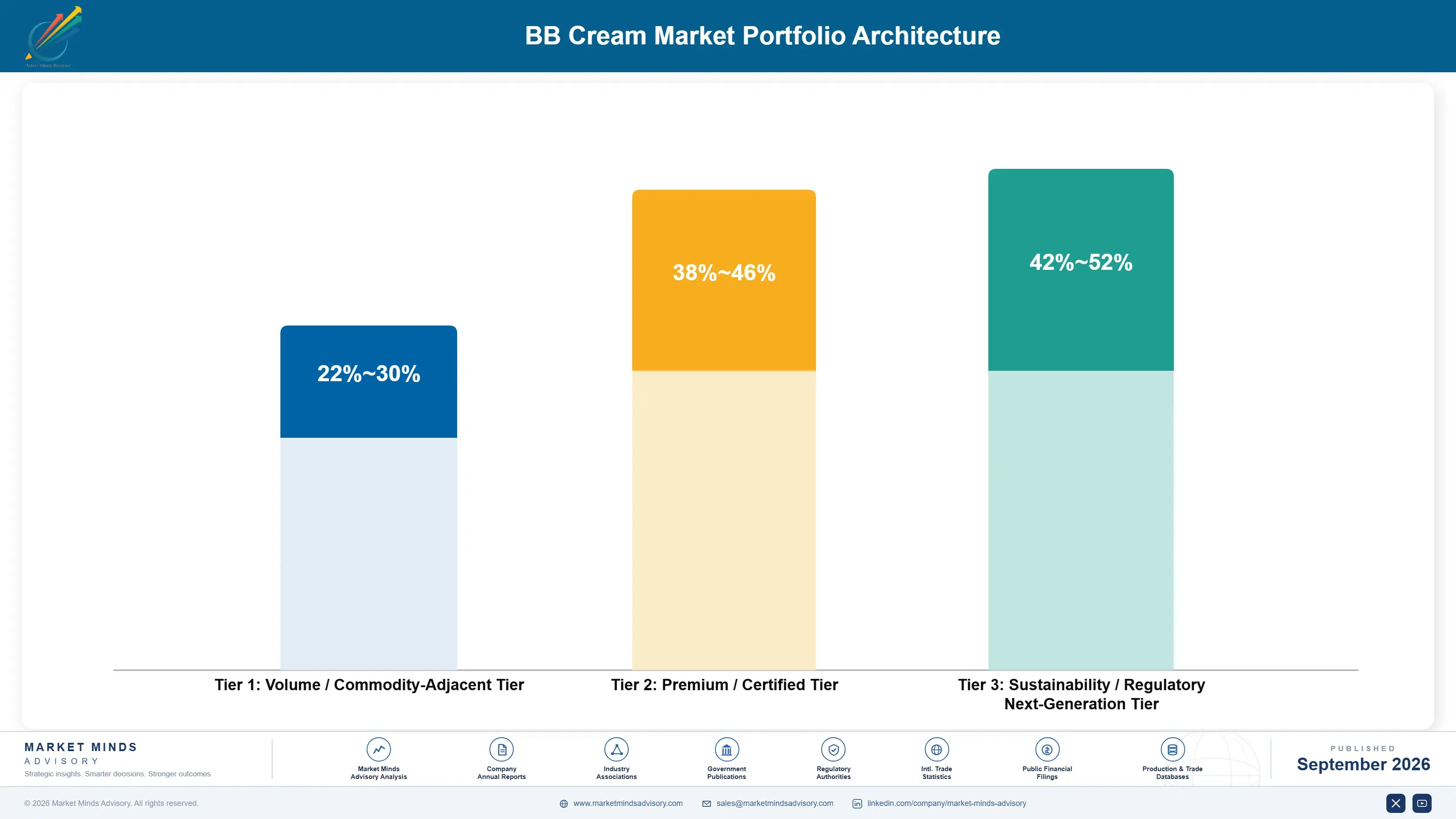
Portfolio economics split across three tiers by clinical substantiation depth and ingredient sophistication rather than simple price point, since a mid-priced formulation with genuine SPF and skin-barrier claims can command margins rivaling far pricier standard products lacking comparable testing and evidence entirely. Volume-tier BB cream carries thin per-unit margins offset by high transaction counts across most mainstream drugstore listings nationwide and internationally, a pattern consistent across nearly every market.
Premium and certified tiers carry meaningfully higher margins justified by clinical testing investment and ingredient sourcing cost, creating real tension with volume-tier economics that depend on shelf turnover speed rather than per-unit margin to sustain overall profitability across the full product range. Brands increasingly segment product lines internally to serve both models without compromising either positioning, building distinct formulation, testing, and marketing teams for each tier separately.

High-value margin pools concentrate in dermatologically-tested, skin-barrier formulations, where clinical substantiation commands premium pricing unmatched anywhere else in the category, well above what standard coverage-only formulations can support even at meaningfully higher volume across comparable transaction counts and price points throughout the year and across most major retail channels worldwide and beyond.

Volume / Commodity-Adjacent Tier

Standard-coverage BB creams with basic SPF and minimal clinical substantiation, competing mainly on price and shade availability at mass drugstore and grocery retail outlets nationwide, targeting price-sensitive buyers making their first purchase in the category.
Gross Margin: 22%-30%

Premium / Certified Tier

Clinically-tested formulations with documented SPF accuracy and ceramide or niacinamide actives, targeting buyers seeking measurable quality assurance beyond basic drugstore alternatives sold broadly, willing to pay meaningfully more for verified claims.
Gross Margin: 38%-46%

Sustainability / Regulatory / Next-Generation Tier

Dermatologist-developed, clean-formulation BB creams meeting the strictest emerging ingredient transparency and sustainability standards available in the market today, targeting affluent, values-driven consumers and premium export channels seeking maximum credibility and supporting documentation.
Gross Margin: 42%-52%
bb-cream-market-portfolio-architecture-1790023797729

High-value Sub-segments and Strategic Watch-out

Dermatologist-Endorsed Clinical Formulations

Clinically-substantiated formulations endorsed by dermatologists command the highest margins in the category as buyers pay significant premiums for verified efficacy claims, representing the fastest-growing high-value niche within the broader premium tier and drawing significant brand investment from every major conglomerate active in the category today.
Gross Margin: 44%-52%

Social Commerce Direct-to-Consumer Lines

Products developed specifically for livestream and short-form video commerce channels command strong margins through direct consumer relationships, generating solid per-unit value with steady growth as brands expand dedicated social commerce product lines beyond traditional retail distribution and into new international markets over time and across regions.
Gross Margin: 36%-44%

Standard Drugstore Coverage Formulations

The largest unit-volume segment by far, standard drugstore formulations generate steady revenue at thinner margins, forming the foundation of category economics even as growth concentrates in higher-margin clinical and premium tiers positioned well above this core segment across nearly every major retail channel worldwide and beyond.
Gross Margin: 22%-28%

UV Filter Supply Volatility Exposure

Rising UV filter and specialty chemical input cost volatility represents a genuine strategic watch-out, since sustained price spikes could compress premium-tier margins meaningfully if smaller brands cannot secure the supplier diversification that larger competitors maintain consistently across every major market and price tier today and going forward.
Gross Margin: N/A

Repeat Purchase Economics Across Skin Types

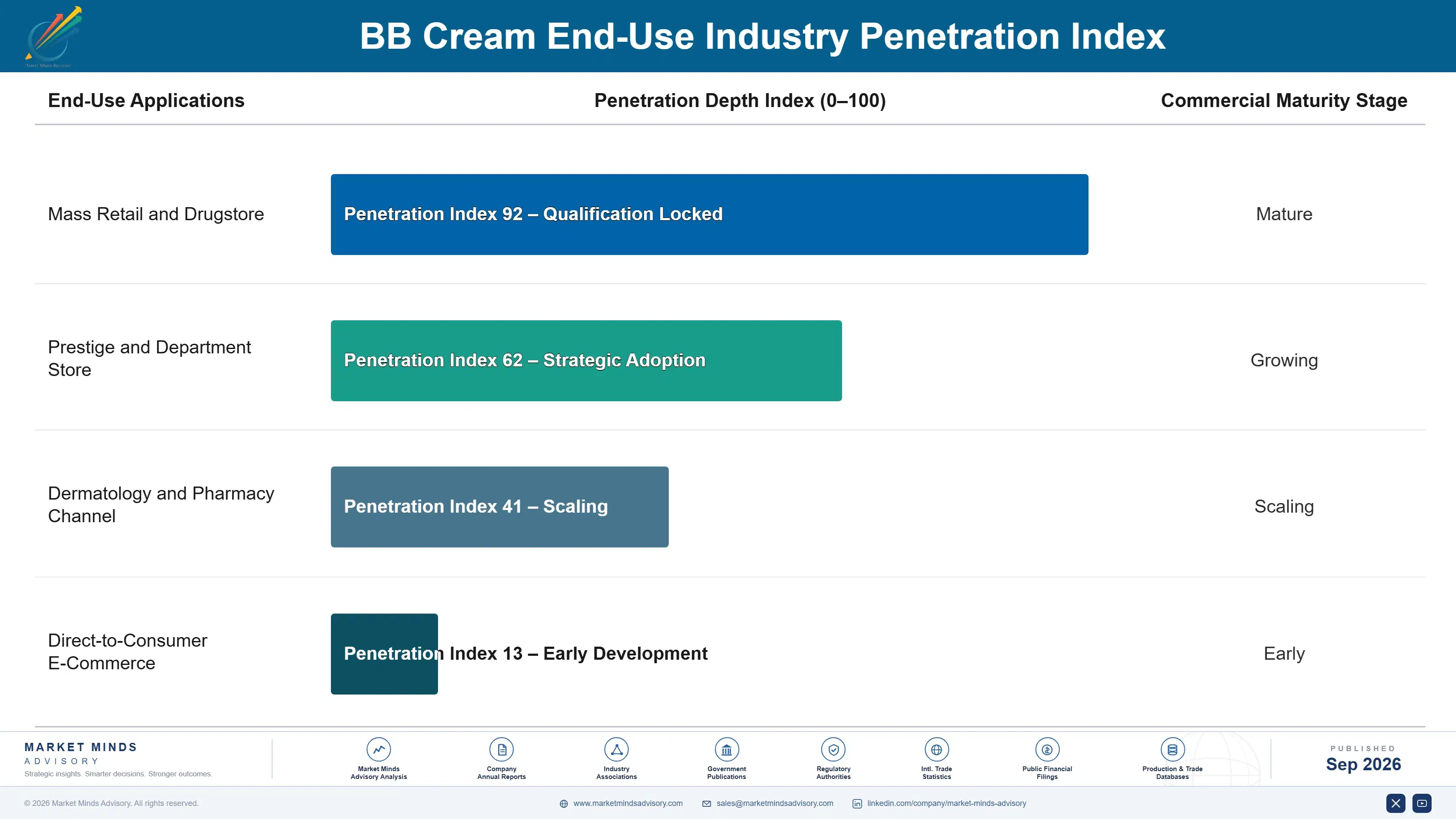
BB cream carries a genuine repeat-purchase annuity, with average replacement cycles of one to two months for daily users, far shorter than most cosmetics categories, generating a steadier recurring revenue stream than one-time purchase products provide across the buyer's ongoing daily skincare and makeup routine over time and across seasons, climates, and personal life stages generally.
Adoption depth varies sharply by end-use vertical: buyers with sensitive or acne-prone skin engage most deeply with ingredient research before each purchase, often switching formulations seasonally based on climate and skin condition changes throughout the year and across major life events. Casual buyers seeking simple coverage transact more routinely without deep ingredient scrutiny, treating BB cream as a straightforward cosmetics purchase rather than a genuine skincare decision requiring research or consultation.

Generational buyer shifts favor ingredient-literate younger consumers who research formulations extensively via social media before purchase, contrasting with older buyers who weight brand trust and formulation consistency more heavily than ingredient novelty or trend appeal alone in most cases. This split is gradually reshaping how brands design product marketing and packaging across different age cohorts and channels worldwide today.
bb-cream-market-end-use-penetration-index-1790023798223

Where BB Cream Brands Should Focus

These are among the four positions where our research anticipates prominent divergence between winners and laggards over the coming forecast period. Each is grounded in the demand model, the regulatory perimeter, and the announced capacity pipeline.
01 / CLINICAL SUBSTANTIATION PRIORITY

Invest in dermatologist-backed clinical testing infrastructure now

Clinical substantiation is becoming the category's defining differentiator, and brands that build genuine testing infrastructure now will hold a meaningful pricing and trust advantage as buyer ingredient literacy continues rising across most major markets and demographics over the coming years and beyond current trends. Waiting until competitors establish credible clinical claims first costs considerably more in lost premium positioning than proactive investment does today. Smaller brands should seriously consider shared testing consortiums rather than building standalone laboratories entirely alone and unassisted.
02 / SHADE RANGE INVESTMENT

Expand shade ranges to capture underserved global markets

Brands that invest in comprehensive shade matching across deeper skin tones gain meaningful access to South Asian, African, and Latin American demand that narrower-range competitors currently underserve entirely across most price tiers and retail channels worldwide today. This positioning also reduces reputational risk as consumer scrutiny of inclusivity gaps continues intensifying across social media and traditional press coverage worldwide. Brands delaying this investment risk ceding these fast-growing markets permanently to more responsive competitors already expanding aggressively into the same territory.
03 / SOCIAL COMMERCE SPEED

Build dedicated social commerce capability to compress launch timelines

Launch-to-market speed increasingly determines competitive success as trend cycles compress from years to weeks across social commerce platforms and demographics worldwide and across most price segments and geographies today. Brands that build dedicated livestream and short-form video commerce capability capture disproportionate early visibility for new formulations, while those relying solely on traditional retail distribution cycles steadily lose ground over an extended period. This shift favors organizationally nimble independent brands over larger conglomerates with slower internal approval processes and decision chains.
04 / EAST ASIA MANUFACTURING TIES

Deepen Korean manufacturing partnerships to access formulation innovation

Korean formulation innovation continues to set category trends that competitors elsewhere spend years catching up to replicate at comparable quality and price point across most product lines and price tiers today. Brands without direct manufacturing or licensing relationships in South Korea risk permanently trailing the innovation curve on ingredient actives and texture technology development. Establishing these partnerships early, even through minority equity stakes, provides durable competitive access that other market entry strategies simply cannot replicate at comparable speed or cost.

Engagement Snapshot From the Field

A live engagement with an industry participant carrying material or product regulatory and market exposure ahead of a defining policy shift, showing how our research translates into a defensible multi-year portfolio strategy.
MARKET MINDS ADVISORY · CLIENT ENGAGEMENT SUMMARY
BB Cream Producer Strategic Portfolio Review and Transition Roadmap 2026·Investment Scenario on BB Cream Exposure Evaluation 2025-26
CLIENT PROFILE
The client is a mid-sized independent Korean BB cream brand with growing international e-commerce sales but limited traditional retail distribution outside its home market and region. Revenue growth had accelerated through social commerce channels, prompting leadership to seek an outside assessment of whether to pursue formal retail partnerships or continue prioritizing direct-to-consumer digital expansion strategies.
STRATEGIC CHALLENGE
Leadership needed to decide whether to invest limited capital in traditional retail distribution partnerships across North America and Europe or continue scaling social commerce and direct-to-consumer channels, without clear visibility into which approach would sustain growth most efficiently given the brand's current organizational capacity, financial resources, and available management bandwidth.
MMA APPROACH
MMA combined primary survey data across international BB cream buyers with a competitive benchmarking exercise against five comparable independent Korean brands that had pursued different expansion strategies over recent years. The team modeled both retail partnership and continued direct-to-consumer paths against projected customer acquisition cost and margin retention over a three-year horizon.
KEY FINDINGS
  1. Direct-to-consumer customer acquisition cost had risen 28% over eighteen months as social commerce advertising costs increased sharply across most platforms and channels.
  2. Comparable brands pursuing retail partnerships showed 24% higher three-year revenue growth than those remaining purely direct-to-consumer focused throughout the entire study period.
  3. Retail partnership margins ran meaningfully thinner, roughly 15 percentage points below direct-to-consumer margins, given standard wholesale pricing structures used across most retailers.
  4. Brand awareness among non-Korean buyers grew twice as fast following retail partnership launches compared to social commerce alone during the same period.
CLIENT PROFILE
The client is a mid-sized independent Korean BB cream brand with growing international e-commerce sales but limited traditional retail distribution outside its home market and region. Revenue growth had accelerated through social commerce channels, prompting leadership to seek an outside assessment of whether to pursue formal retail partnerships or continue prioritizing direct-to-consumer digital expansion strategies.
STRATEGIC CHALLENGE
Leadership needed to decide whether to invest limited capital in traditional retail distribution partnerships across North America and Europe or continue scaling social commerce and direct-to-consumer channels, without clear visibility into which approach would sustain growth most efficiently given the brand's current organizational capacity, financial resources, and available management bandwidth.
MMA APPROACH
MMA combined primary survey data across international BB cream buyers with a competitive benchmarking exercise against five comparable independent Korean brands that had pursued different expansion strategies over recent years. The team modeled both retail partnership and continued direct-to-consumer paths against projected customer acquisition cost and margin retention over a three-year horizon.
KEY FINDINGS
  1. Direct-to-consumer customer acquisition cost had risen 28% over eighteen months as social commerce advertising costs increased sharply across most platforms and channels.
  2. Comparable brands pursuing retail partnerships showed 24% higher three-year revenue growth than those remaining purely direct-to-consumer focused throughout the entire study period.
  3. Retail partnership margins ran meaningfully thinner, roughly 15 percentage points below direct-to-consumer margins, given standard wholesale pricing structures used across most retailers.
  4. Brand awareness among non-Korean buyers grew twice as fast following retail partnership launches compared to social commerce alone during the same period.
RECOMMENDED STRATEGY
Phase 1: Phase one: pursue a limited retail partnership pilot with one mid-tier North American beauty retailer chain first before expanding further. Phase 2: Phase two: maintain direct-to-consumer social commerce investment in parallel rather than shifting entirely toward traditional retail distribution channels alone immediately. Phase 3: Phase three: expand successful retail partnerships to additional regions while preserving the direct-to-consumer margin advantages gained earlier in the process.
OUTCOME
Within twelve months of the pilot retail partnership launch, the client reported (client-reported, unverified by MMA) a 21% increase in overall brand awareness among non-Korean buyers and meaningfully improved customer acquisition efficiency. The client subsequently expanded the partnership model to two additional North American retailers while maintaining its direct-to-consumer channel investment.

Frequently Asked Questions

Foundational context covering the market sizes, CAGR, scope, country, region and competition that inform every finding below. This section is provided to cover basics and most often pre-purchase conversations, answered from the MMA Primary Research Dataset.

What is the current size of the BB Cream Market?

The BB Cream Market was valued at 6.8 billion dollars in 2025. This figure reflects global retail and e-commerce sales across all formulation tiers and channels.

How large will the BB Cream Market be by 2036?

The market is projected to reach 14.9 billion dollars by 2036. This represents roughly a 2.04 times expansion from 2026 value over the ten-year forecast period.

What is the CAGR for the BB Cream Market 2026 to 2036?

The market is forecast to grow at a 7.4% compound annual rate between 2026 and 2036. Growth is faster in SPF-enhanced and skin-barrier segments than in standard formulations.

Which segment is growing fastest?

SPF-Enhanced Skin-Barrier BB Creams are growing fastest, at a 10.5% CAGR. That is roughly 1.4 times the overall market growth rate through the full 2036 forecast horizon.

Who are the major companies in the BB Cream Market?

Major companies include AmorePacific Corporation, LG Household and Health Care Ltd, L'Oreal SA, Shiseido Company Limited, and The Estee Lauder Companies Inc, together holding a moderate revenue share.

Which country is growing fastest?

Indonesia is the fastest-growing country market, expanding at an 11.4% CAGR. Rising disposable income and social-commerce-driven K-beauty discovery are the primary growth drivers there today.

Report Segmentation Architecture

The full report scope spans multiple orthogonal segmentation dimensions, with cross-tabulated demand data provided for each dimension pair. Coverage extends further to regional breakdowns, trend trajectories, and the competitive detail needed to support segment-level decision-making.

By Primary Market Dimension

  • SPF-Enhanced Skin-Barrier BB Creams
  • Tinted Moisturizer-BB Hybrid
  • Matte-Finish Oil-Control BB Creams
  • Anti-Aging Peptide BB Creams
  • Natural and Organic BB Creams
  • Standard Full-Coverage BB Creams

By End-Use Industry

  • Mass Retail and Drugstore
  • Prestige and Department Store
  • Dermatology and Pharmacy Channel
  • Direct-to-Consumer E-Commerce

By Commercial Dimension

  • Social Commerce Platform
  • Traditional Retail Wholesale
  • Subscription Direct-to-Consumer
  • Cross-Border Export

By Region

  • North America
  • Western Europe
  • East Asia
  • South Asia and Pacific
  • Latin America
  • Middle East and Africa
  • Eastern Europe

Scope, Methodology, and Coverage

Every figure in this report is reproducible from documented input assumptions. The scope below maps the historical period, the forecast horizon, the segmentation dimensions, and the countries covered, alongside the underlying primary and qualitative methodology.
Historical Period
2020 to 2025
Forecast Period
2026 to 2036
Base Year
2025 (USD billions; MMA Primary Research Dataset, September 2026)
Market Definition
The BB Cream Market covers blemish balm creams combining skincare benefits, SPF protection, and light-to-medium coverage foundation in a single daily-use product. It excludes CC creams, standalone SPF moisturizers, and traditional full-coverage foundation without integrated skincare claims.
Quantitative Units
USD billions (current prices); unit shipment volume in millions where applicable
Segmentation Dimensions
By Formulation Type and Benefit; By End-Use Industry; By Commercial Dimension; By Region
Regions Covered
North America, Western Europe, East Asia, South Asia and Pacific, Latin America, Middle East and Africa, Eastern Europe
Countries Covered
USA, China, Germany, France, UK, Japan, South Korea, India, Australia, Canada, Brazil, Mexico, Indonesia, Vietnam, Thailand, Malaysia, UAE, Saudi Arabia, South Africa, Nigeria, Turkey, Poland, Netherlands, Italy, Spain, Sweden, Switzerland, Argentina, Colombia, Singapore, and additional markets relevant to this sector
Key Companies Profiled
AmorePacific Corporation, LG Household and Health Care Ltd, L'Oreal SA, Shiseido Company Limited, The Estee Lauder Companies Inc, Beiersdorf AG, Kao Corporation, Unilever PLC, Able C&C Co Ltd, Innisfree Corporation, Have and Be Co Ltd, COSRX Inc, Clio Cosmetics Corporation, Etude Corporation, Banila Co Ltd, Nature Republic Co Ltd, Tonymoly Co Ltd, Skin79 Co Ltd, Chanel SA, Christian Dior SE
Quantitative Methodology
Primary survey, n=3,800 respondents, Q4 2025, six countries; demand-side model with trade association cross-validation
Qualitative Methodology
47 expert interviews, Q4 2025; applied to validate demand model assumptions, identify emerging dynamics, and assess competitive positioning
Report Format
PDF and XLSX data workbook (Word format preview document)
Publisher
Market Minds Advisory
Report Code
MMA-2026-CHM-206
Published
September 2026
Contact
sales@marketmindsadvisory.com | www.marketmindsadvisory.com

Purchase the full BB Cream Market Report (2026 to 2036).

This report provides a comprehensive assessment of the global BB Cream Market, covering market sizing, segmentation, regional dynamics, and competitive positioning through 2036. It draws on primary survey data across 3,800 respondents in six countries and 47 expert interviews conducted in Q4 2025, combined with company disclosures and MMA proprietary analysis across every major formulation category. The report is designed to support strategic decisions on clinical substantiation investment, channel strategy, and competitive positioning across the forecast period. Readers gain a clear view of where margin pools concentrate and how reformulation economics are likely to shift.
Detailed segmentation by formulation type and benefit
Seven-region market sizing with growth forecasts
Competitive benchmarking of twenty leading companies
Ingredient cost and supply chain risk analysis
Revenue lever and margin expansion strategies
Anonymized client case study with outcomes

Built For The People Who Decide

From boardroom strategy to bench-side execution, this report is read cover-to-cover by leaders shaping the next decade of their industry, turning demand scenarios, market dynamics and valuation benchmarks into decisions.
CXOs/ Presidents/ VPs/ Managers
M&A and Corporate Development
Strategy Teams and R&D Heads
Procurement and Product Directors
Regulatory and Compliance Leaders
Investor Relations and Equity Analysts