Market Minds Advisory
Bay Leaf Market

Bay Leaf Market: Culinary Demand, Extract Value-Add, and Origin Concentration Through 2036

Bay leaf demand is splitting between traditional whole-leaf culinary trade concentrated in Mediterranean and South Asian kitchens and a faster-growing essential oil and extract segment feeding nutraceutical and cosmetic formulators seeking natural eugenol-rich botanical inputs.

Lead Analyst

Lisa Gevelber

Published

September 2026

Make Smarter Decisions with Customized Research Insights

Request a free sample report and evaluate market opportunities, growth trends, and competitive dynamics relevant to your business needs.

2025 MARKET VALUE$0.8BMarket Size 2025
2036 FORECAST VALUE$1.6BBase Case , 2026 to 2036
CAGR 2026 TO 20366.8 %Bull 8.0% / Bear 5.5%
INCREMENTAL OPPORTUNITY$0.8BNet 10- year value creation
EXPANSION MULTIPLE1.93x2036 value over 2026 base
Strategic Levers
M&A Pipeline
Regional Outlook
Country Rankings
Competitive Intelligence
Segmental Deep-dive
Call-Us : 91 93563 13602

Executive Snapshot and Market Trajectory

Bay leaf is shedding its identity as a static pantry commodity as extract and essential oil buyers bid up prices for the same eugenol-rich leaves that home cooks have used unchanged for generations, splitting the category into two demand tracks moving at very different speeds and margins and margin pools.
Whole and ground leaf still moves the largest volume through Mediterranean and South Asian culinary channels, but essential oil and oleoresin buyers, drawn by nutraceutical and cosmetic formulation interest in natural antimicrobial and antioxidant compounds, are willing to pay a sharp premium over raw leaf pricing today. That premium is pulling processing investment toward extraction capacity in origin countries rather than simple grading sheds.
Supply stays concentrated in a handful of origin countries where climate and centuries of cultivation knowledge favor bay laurel and Indian bay leaf trees, leaving buyers exposed to weather-driven harvest swings no diversified sourcing strategy has fully solved yet. Traders and processors compete less on brand and more on certification, traceability, and consistent essential oil content across harvest seasons, since the underlying leaf itself is nearly impossible to tell apart once dried.
Market Definition
The bay leaf market covers dried whole leaves, ground powder, crushed flakes, essential oil, and oleoresin extract derived from Laurus nobilis and Cinnamomum tamala sold for culinary, nutraceutical, and cosmetic applications. It excludes unrelated culinary herbs and other laurel family botanicals not marketed as bay leaf.
Base Year Value
$0.8B in 2025 (MMA Primary Research Dataset, August 2026)
Forecast Period
2026 to 2036, eleven discrete annual values
CAGR
6.8% base case. Bull 8.0%. Bear 5.5%.
Fastest Growth Segment
Bay Leaf Essential Oil: 10.5% CAGR
Fastest Growth Country
India: 9.5% CAGR
Fastest Growth Region
South Asia and Pacific: 8.8% CAGR
Largest Region
Western Europe: 26% of 2025 global value
Market Leaders
McCormick and Company, Olam Group, Kerry Group, Sensient Technologies, Synthite Industries. Source: MMA Analysis based on company annual reports.
Primary Survey
n=3,800 procurement and R&D decision-makers, Q4 2025, six countries
Methodology
Demand-side build-up, cross-validated against public data, 47 expert interviews

Bay Leaf Market Forecast Scenarios

bay-leaf-market-2024-2034-trends-growth-insights-size-forecast-scenario-1787461353713
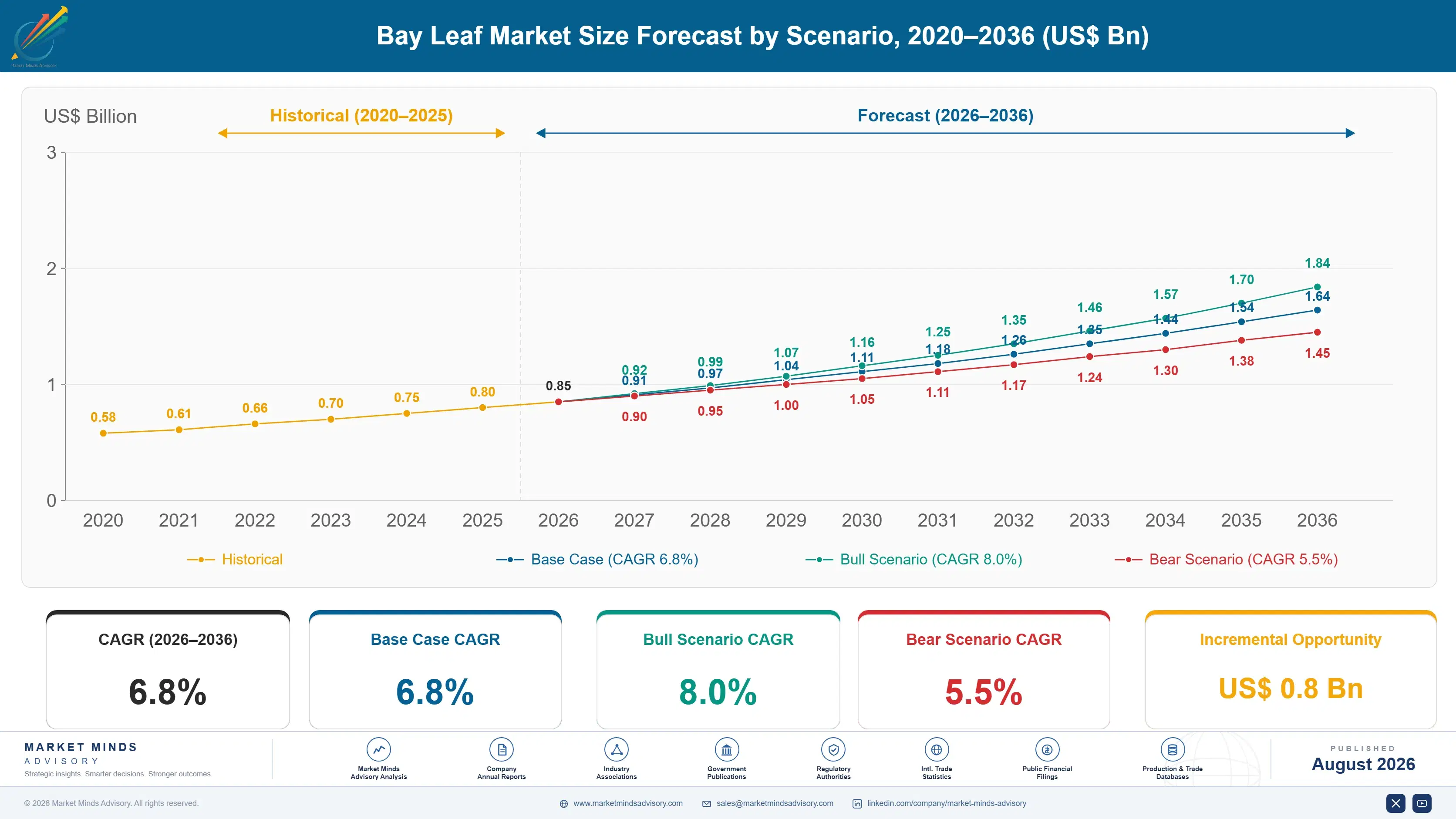
Between 2020 and 2025 the market grew at roughly 5.8 percent a year, with pandemic era home cooking demand briefly lifting whole-leaf retail sales before food-service channels reopened and extraction buyers began scaling nutraceutical and cosmetic ingredient orders through the back half of the period, once initial supply chain disruptions eased across the main origin countries and their logistics networks.
The base case assumes 6.8 percent annual growth to 2036, built on three mechanisms: expanding essential oil and oleoresin demand from nutraceutical and personal care formulators, steady culinary volume growth tracking population and packaged food expansion across South Asia, and gradual premiumization of retail spice packaging in North America and Western Europe that lifts average selling price even where volume growth is modest. Together these three mechanisms push growth above simple population-driven demand.
A bull case near 8.0 percent depends on nutraceutical formulators accelerating adoption of bay leaf extract faster than currently planned across their innovation pipelines and product roadmaps. The bear case near 5.5 percent assumes recurring drought in key origin regions constrains harvest volume enough that buyers substitute toward alternative botanicals rather than absorbing sustained price increases.

Origin Concentration and the Extract Value Premium

Bay leaf remains one of the few global spice categories still harvested almost entirely by hand, and that labor dependence shapes cost structure more than any processing technology decision a buyer or trader can make today. As extraction buyers enter the category, they are layering a second, higher-margin demand curve on top of a centuries-old culinary trade that never previously needed to think about essential oil content specifications at all.
PRODUCER CONCENTRATIONCR5 28%top five hold a modest share of global trade
AVERAGE SELLING PRICE$8.20/kgblended price across whole leaf and powder forms
TURKEY EXPORT SHARE34%share of global bay leaf export volume originating here
EXTRACTION YIELD RATE1.8%average essential oil yield from dried leaf mass
TRADE INTENSITY61%share of volume crossing a border before final use
HARVEST LABOR COST SHARE42% of COGSmanual harvesting and sorting labor cost burden share
Commercially, the market splits between bulk whole-leaf and powder trade sold largely on price and grade consistency, and a smaller but faster-growing extract tier sold on eugenol content and certification documentation. Margins concentrate in the extract tier, where processors with in-house distillation capacity capture value that pure leaf traders pass through to buyers almost entirely untouched year after year without exception.
Over the next decade, climate resilience in origin countries and extraction capacity investment will matter more to competitive position than retail branding, since the raw material itself is difficult to differentiate once dried and graded to standard export specifications that buyers on every continent now expect suppliers to meet consistently and reliably every single season.
"Bay leaf used to be the spice nobody argued about. Now formulators are asking for eugenol assay certificates on the same leaf their grandmother tossed into a stew, and that gap is where the money in this category actually sits."
Director, Spice and Botanical Ingredients Practice · MMA Food and Beverage Ingredients Practice · August 2026

Market Trends

Nutraceutical Extract Demand Pulls Bay Leaf Upmarket

Nutraceutical formulators have increased bay leaf extract purchase orders by an estimated 40 percent since 2022 as eugenol and related compounds draw interest for antioxidant and blood-sugar-support supplement claims backed by early clinical research. Synthite Industries and Kancor Ingredients have both expanded oleoresin extraction lines specifically to serve this buyer group rather than the traditional flavor and seasoning trade that historically dominated their order books. The shift is drawing processing investment toward origin countries where fresh leaf is available year-round, reducing the transport losses that degrade essential oil content in leaves shipped whole before extraction.
Market Impact: Bulk contracts cover 45% of demand
Retail Spice Premiumization Lifts Average Selling Price

Organic and single-origin certification now covers a meaningfully larger share of retail bay leaf SKUs in North America and Western Europe than five years ago, with certified products commanding a price premium of 25 to 35 percent over conventional bulk leaf sold under private label. Frontier Co-op and McCormick and Company have both expanded certified organic sourcing programs directly with Turkish and Indian growers, locking in supply ahead of retailers that have not yet secured comparable grower relationships. This premiumization trend is lifting blended average selling price even in years when raw volume growth stays modest across the category.
Market Impact: New channel worth 8% volume

Market Opportunities and Growth Drivers

Packaged Food Expansion Across South Asia Lifts Bulk Volume

India's packaged and ready-to-eat food sector has grown at a double-digit pace over the past several years, and bay leaf remains a standard ingredient in the spice blends underpinning a large share of that category's flavor profiles. Regional manufacturers including major masala blend producers have expanded procurement contracts directly with growers to secure consistent supply as their own production volumes scale. This growth in industrial buying is shifting a larger share of total bay leaf demand away from small traditional retail sachets toward bulk contracts negotiated annually with food manufacturers rather than spot-market spice traders.
Market Impact: Labor shortages cut yield 15%

Natural Preservative Interest Broadens Food Industry Use

Food manufacturers seeking to replace synthetic preservatives with natural alternatives have identified bay leaf extract's antimicrobial properties as a viable option for extending shelf life in sauces, marinades, and processed meat products without triggering clean-label consumer concerns. Several European food manufacturers have piloted bay leaf oleoresin blends in reformulated product lines since 2023, and early results have encouraged wider trials across additional product categories. This natural preservative angle gives extract producers a second demand channel beyond flavor and nutraceutical use that scarcely existed as a commercial category a decade earlier.
Market Impact: Drought years cut yield 20%

Market Restraints and Challenges

Manual Harvest Dependence Limits Supply Elasticity

Bay leaf harvesting remains almost entirely manual because mechanical methods damage the leaf structure needed for both culinary appearance standards and essential oil retention, and the underlying cause is that no commercially viable mechanical harvester has yet matched hand-picking quality at scale. The commercial impact shows up whenever labor availability tightens in origin countries during harvest season, since supply cannot expand quickly to meet demand spikes the way mechanized crops can. Producers are mitigating exposure through multi-year grower contracts that guarantee harvest labor availability well ahead of each peak season.
Market Impact: Extract orders up roughly 40%

Climate Variability in Origin Regions Threatens Consistency

Drought conditions in Turkey and parts of the Mediterranean basin have reduced harvest volumes in multiple recent seasons, and the underlying cause traces to shifting rainfall patterns affecting bay laurel cultivation regions that have relied on consistent seasonal moisture for generations of growers. The commercial impact falls hardest on buyers without diversified origin sourcing, who face sharper price spikes and potential quality inconsistency when a single region underperforms badly. Mitigation efforts include expanding cultivation into new growing regions in Eastern Europe and diversifying grower relationships across several countries at once.
Market Impact: Certified SKUs carry 25-35% premium
3 additional market trends, 3 additional growth drivers, and 3 additional restraints and challenges are covered in the full report. Contact sales@marketmindsadvisory.com to access the complete intelligence.

Segment CAGR and Growth Architecture

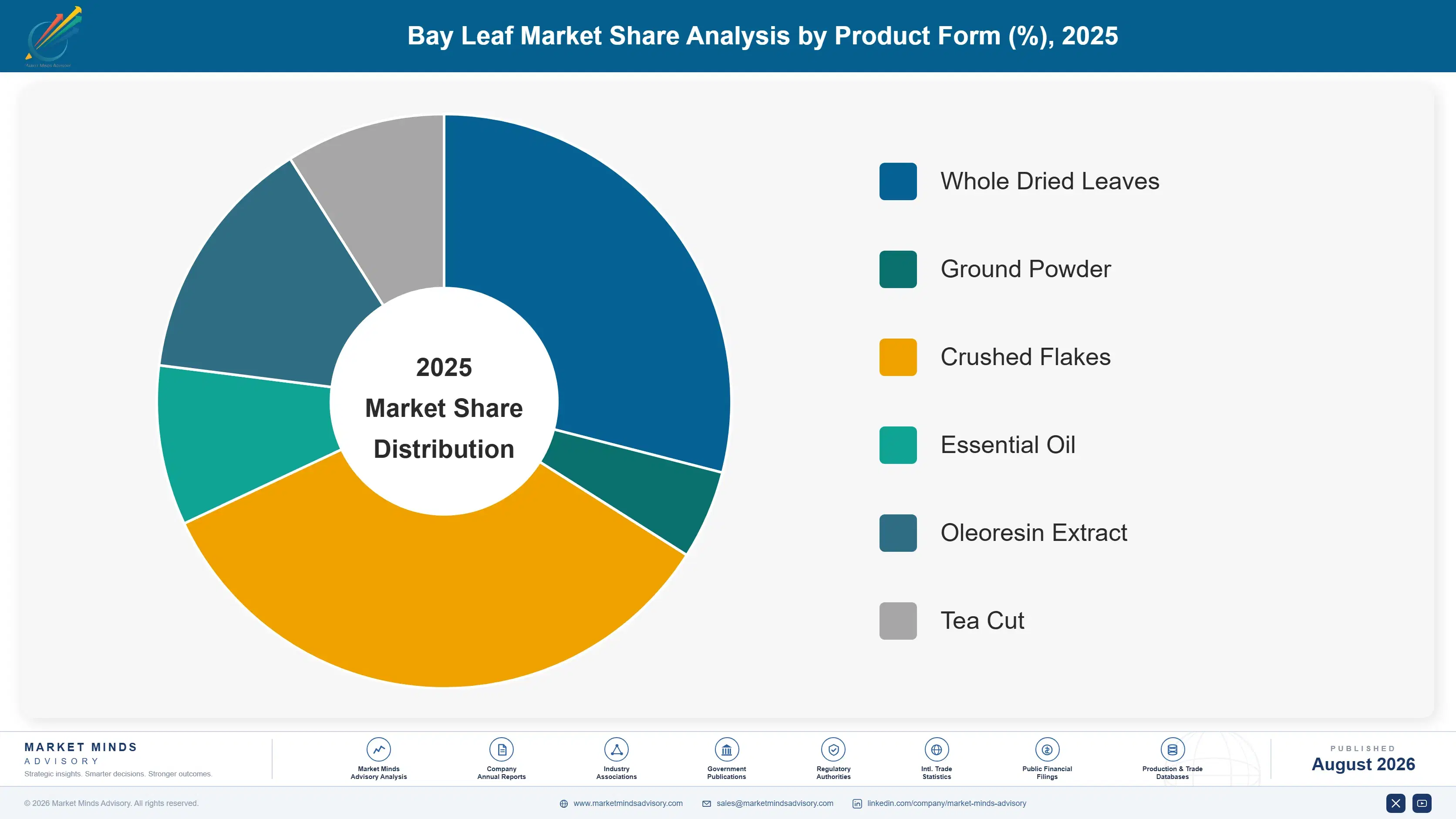
The market segments by product form rather than botanical species, since whole leaf, powder, flakes, essential oil, and oleoresin extract each serve distinct buyer groups with different quality specifications, price sensitivity, and end-use requirements across culinary, nutraceutical, and cosmetic applications that MMA analysts track separately across every major region covered in this report each year.
bay-leaf-market-2024-2034-trends-growth-insights-market-share-analysis-1787461354240

Bay Leaf Essential Oil

Bay leaf essential oil is the fastest-growing segment as nutraceutical and cosmetic formulators seek concentrated eugenol-rich extracts for antioxidant, antimicrobial, and fragrance applications that whole leaf cannot deliver in a standardized, assayable form. Demand is concentrated among specialty ingredient buyers rather than traditional food manufacturers, and distillation capacity remains limited to a handful of processors including Synthite Industries and Kancor Ingredients who have invested in origin-based extraction to preserve volatile compound content that degrades during long-distance leaf transport. Pricing runs several multiples above raw leaf on a per-kilogram basis, reflecting both the yield loss inherent in distillation and the certification testing that nutraceutical buyers require before accepting any given shipment.
CAGR 10.5%

Bay Leaf Oleoresin Extract

Oleoresin extract demand is climbing as food manufacturers explore natural preservative and flavor-intensification applications that require a more concentrated, standardized input than dried leaf can reliably provide across production batches. European reformulation projects moving away from synthetic preservatives have become an important demand driver alongside the nutraceutical buyers who dominated early extract adoption. Supply remains concentrated among Indian processors with existing spice oleoresin infrastructure built originally for other botanicals, giving them a cost advantage over new entrants who would need to build extraction capacity from scratch. Certification and consistent assay results across harvest seasons remain the primary competitive differentiator among the small group of established suppliers active in the category today.
CAGR 9.2%
Full segment breakdown across 6 segments available in the complete report.

Regional Architecture and Country Demand Map

Western Europe holds the largest regional share on the strength of Mediterranean culinary tradition and premium retail spice demand, with East Asia and North America following as processed-food and retail markets and South Asia and Pacific posting the fastest regional growth off a large existing culinary base.

North America

US and Canadian retail spice sales have shifted noticeably toward organic and single-origin bay leaf over the past several years, with McCormick and Company and Frontier Co-op both expanding certified sourcing programs to meet demand from health-conscious home cooks willing to pay a premium for traceable, non-irradiated leaf. Food-service demand remains steady but unremarkable, tracking overall restaurant industry growth rather than any category-specific trend of its own. Nutraceutical extract buyers based in the United States are a small but fast-growing demand pocket, sourcing bay leaf oleoresin directly from Indian processors rather than through the traditional spice import channels that historically dominated this trade for decades before extraction buyers ever entered the picture.
Share: 22% | CAGR: 6.8% (2026 to 2036)

Western Europe

Bay laurel is native to the Mediterranean basin, and Italy, Spain, France, Greece, and Portugal together account for the deepest per-capita culinary usage of any region tracked in this analysis, giving Western Europe its leading share despite relatively modest population growth compared with faster-growing regions elsewhere in the world. Retail premiumization is advancing furthest here as well, with organic certification now standard across a meaningful share of supermarket private label spice lines rather than a niche positioning reserved for specialty retailers alone. Domestic cultivation in Southern Europe supplements imports from Turkey, giving regional buyers a shorter, more traceable supply chain than most other markets can currently access at comparable cost and reliability.
Share: 26% | CAGR: 5.3% (2026 to 2036)
Regional intelligence for 5 additional markets available in the complete report: East Asia, South Asia and Pacific, Latin America, Middle East and Africa, Eastern Europe. Contact sales@marketmindsadvisory.com.
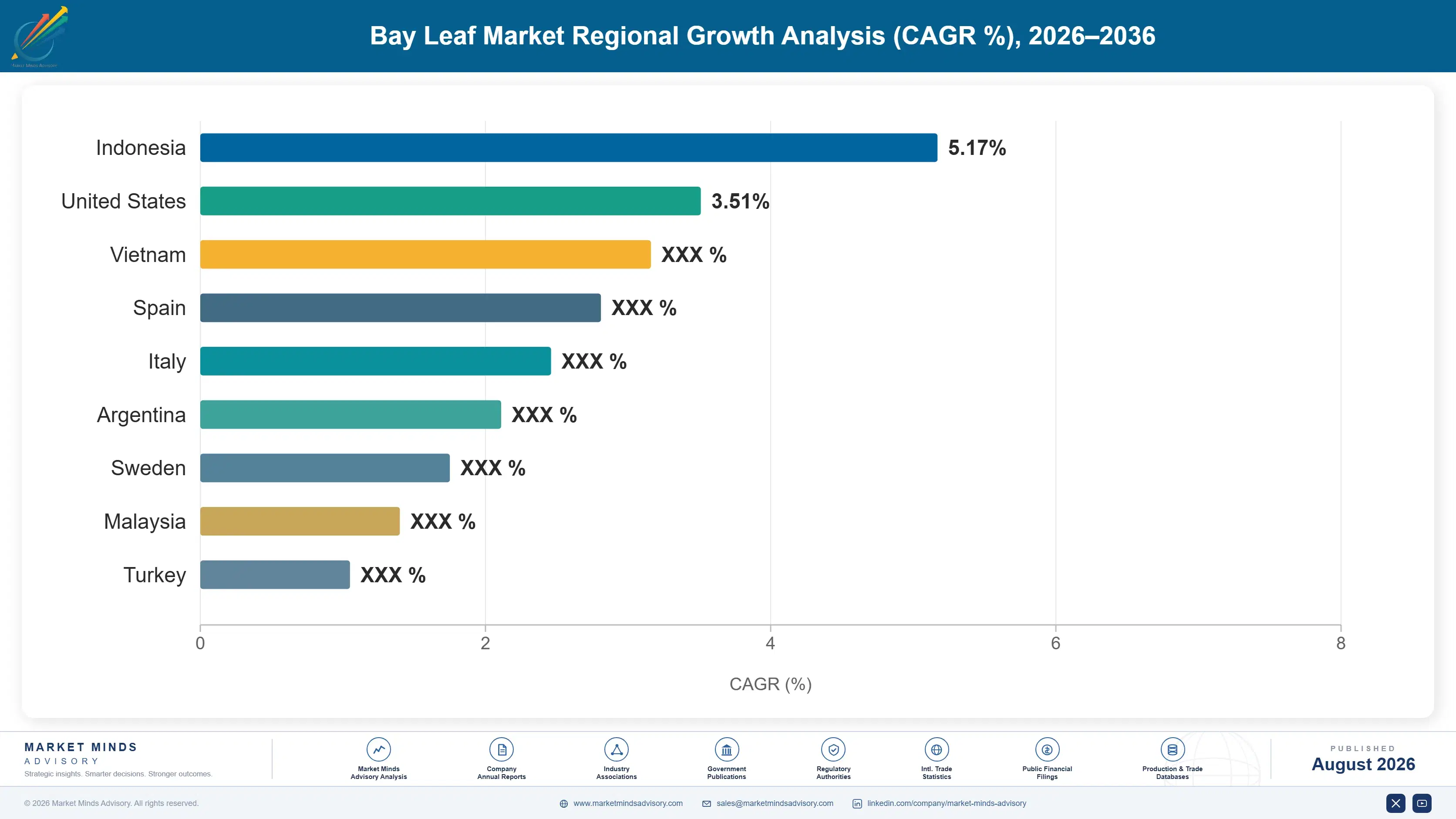
bay-leaf-market-2024-2034-trends-growth-insights-country-cagr-analysis-1787461354746

Where Bay Leaf Traders Can Capture More Value

Traders and processors who move beyond raw leaf trading toward extraction, certification, and direct grower relationships capture materially better margins than those competing purely on bulk price in a category where the underlying botanical input is difficult to differentiate once it has already been dried and graded to standard export specification each season and harvest cycle.

Origin-Based Essential Oil Extraction Capacity Investment

Building distillation capacity near fresh-harvest origin regions rather than shipping dried whole leaf for extraction elsewhere preserves volatile eugenol content that degrades during long-distance transport, letting origin-based processors charge a premium of roughly 20 to 30 percent over oil extracted from aged or improperly stored leaf. Synthite Industries and Kancor Ingredients have both prioritized this model, and their origin proximity gives them a quality advantage that extraction facilities located in importing countries cannot replicate regardless of equipment quality. The capital outlay for small to mid-scale distillation units is modest relative to the margin uplift available to early movers.
Market Impact: Adds a 20 to 30 percent oil premium

Direct Grower Contracts With Certification Support

Establishing multi-year direct contracts with growers, paired with organic and traceability certification support, locks in supply ahead of competitors while capturing the 25 to 35 percent retail price premium that certified product commands in North American and Western European markets. Frontier Co-op's grower partnership model in Turkey demonstrates the approach, giving the company supply security that spot-market buyers lack during tight harvest years. The investment required is primarily relationship and certification cost rather than capital equipment, making this an accessible lever even for mid-sized trading firms without extraction infrastructure of their own.
Market Impact: Captures a 25 to 35 percent price premium

Natural Preservative Partnership And Reformulation Development

Partnering directly with food manufacturers on natural preservative reformulation projects gives extract producers a foothold in a demand channel worth an estimated 8 percent of total extract volume today but growing faster than traditional flavor and nutraceutical use as clean-label reformulation spreads across processed food categories worldwide and across multiple product lines. This requires technical application support beyond simply supplying oleoresin, but producers willing to invest in food scientist relationships are winning multi-year supply agreements that commodity-only suppliers cannot access without building similar technical capability of their own from the ground up.
Market Impact: Channel already worth 8 percent of extract volume

Climate-Resilient Cultivation Diversification Across New Regions

Expanding grower relationships into new cultivation regions in Eastern Europe and diverse microclimates within existing origin countries reduces exposure to the single-region drought risk that has cut regional harvest yield by as much as 20 percent in recent bad years for the trade as a whole. Traders who diversify sourcing ahead of the next climate shock can offer buyers supply continuity guarantees that concentrated single-origin competitors cannot match, winning multi-year contracts with risk-averse food manufacturers in exchange for a modest price premium over spot-market alternatives available elsewhere in the trade.
Market Impact: Cuts single-origin drought exposure by 20 percent overall

Who Controls the Margin Pool

CR5 sits near 28 percent, one of the more fragmented structures in this analyst's coverage, reflecting a trade still dominated by small and mid-sized origin traders rather than vertically integrated global processors of scale. The gap between the largest diversified ingredient companies and the long tail of regional traders is wide on distribution reach but surprisingly narrow on raw leaf sourcing cost itself.
Current competitive activity centers on three fronts: extraction capacity investment by Indian oleoresin processors to capture nutraceutical demand, certified organic sourcing programs by North American and European retail-facing companies, and early natural preservative partnership pilots between extract producers and food manufacturers seeking clean-label reformulation options across multiple product categories and several regional markets simultaneously, each moving at its own pace.

Emerging pressure comes from Eastern European growers experimenting with bay laurel cultivation as a climate-diversification play, potentially challenging Turkey's long-standing dominance of raw leaf export volume within the next decade or two. Rankings among the largest diversified ingredient companies are unlikely to shift quickly, but origin-level trading relationships stay more exposed to disruption than the branded retail tier of this market as a whole.
bay-leaf-market-2024-2034-trends-growth-insights-company-positioning-matrix-1787461355264

Competitive Moat and Risk Dimensions

MCCORMICK AND COMPANY

Moat: Retail brand distribution scale

McCormick's retail shelf presence across North American and European grocery chains gives it distribution reach that smaller origin traders cannot replicate, letting it capture premium retail pricing on certified bay leaf even when its underlying sourcing cost sits close to the industry average for comparable grades.
MCCORMICK AND COMPANY

Risk: Limited origin-level cost control

As a branded distributor rather than a vertically integrated grower, McCormick depends on third-party sourcing relationships for raw leaf, exposing it to origin-country price swings that vertically integrated extraction processors are better positioned to absorb internally without passing the added cost through to customers right away.
SYNTHITE INDUSTRIES

Moat: Origin-based extraction infrastructure

Synthite's extraction facilities located near Indian growing regions preserve essential oil quality that leaf shipped abroad for processing cannot match, giving it a durable quality edge with nutraceutical buyers who specify eugenol content directly in their purchase agreements at every single contract renewal cycle. each time.
SYNTHITE INDUSTRIES

Risk: Concentrated single-country sourcing

Heavy reliance on Indian-grown leaf leaves Synthite more exposed to domestic weather and labor disruptions than competitors sourcing across multiple origin countries at the same time, a concentration risk that becomes far more visible during poor harvest years across the wider region. every season indeed.

Players Tracked

Prominent Players

McCormick and Company
Olam Group
Kerry Group
Sensient Technologies
Synthite Industries

Other Key Players

Kancor Ingredients
Döhler Group
Frontier Co-op
Nedspice
AVT Natural Products
Robertet
Ungerer and Company
Griffith Foods
Everest Spices
MDH Spices
Kalsec
Naturex
Symrise
Firmenich
Universal Oleoresins

Recent Developments

FEBRUARY 2026

Synthite Industries Expands Bay Leaf Distillation Capacity

Synthite Industries completed an expansion of its bay leaf oleoresin distillation capacity at its South Indian facility, adding output aimed at nutraceutical customers whose order volumes had outpaced the company's existing production capability. The expansion followed roughly a year of dedicated capacity planning and permitting work.
Signal: Extraction capacity growth signals nutraceutical demand is now large enough to justify dedicated standalone plant investment
SEPTEMBER 2025

Frontier Co-op Signs Multi-Year Grower Agreement in Turkey

Frontier Co-op entered a multi-year direct sourcing agreement with Turkish bay leaf growers covering certified organic supply, securing volume ahead of competing buyers as retail demand for traceable, single-origin spice continues to expand steadily across its cooperative membership base nationwide this fiscal year. overall too.
Signal: Retail buyers are locking in grower relationships years ahead of contract renewal to secure certified organic supply
MAY 2025

Kancor Ingredients Partners With European Food Manufacturer

Kancor Ingredients entered a supply and technical development agreement with a European food manufacturer to pilot bay leaf oleoresin as a natural preservative in reformulated sauce and marinade products, marking an early commercial test of this use case well outside traditional nutraceutical channels entirely. overall.
Signal: Natural preservative applications are moving from pilot testing toward early commercial supply agreements with major manufacturers

Harvest Labor and Origin Concentration Exposure

Manual harvest labor accounts for roughly 42 percent of cost of goods sold for whole leaf and powder products, concentrated in Turkey and India where hand-picking remains the only viable harvest method available at commercial scale today, while extraction energy and equipment costs make up a larger share of cost structure for essential oil and oleoresin producers instead.
Drought conditions across Turkey's growing regions reduced harvest volumes by an estimated 15 to 20 percent in two recent seasons, according to Turkish agriculture ministry reporting, and that shortfall passed through to global spot pricing within a single trading quarter given how concentrated export supply remains in this one origin country overall. Buyers without diversified sourcing relationships absorbed the sharpest price increases during those shortfall periods and into the following planting season.

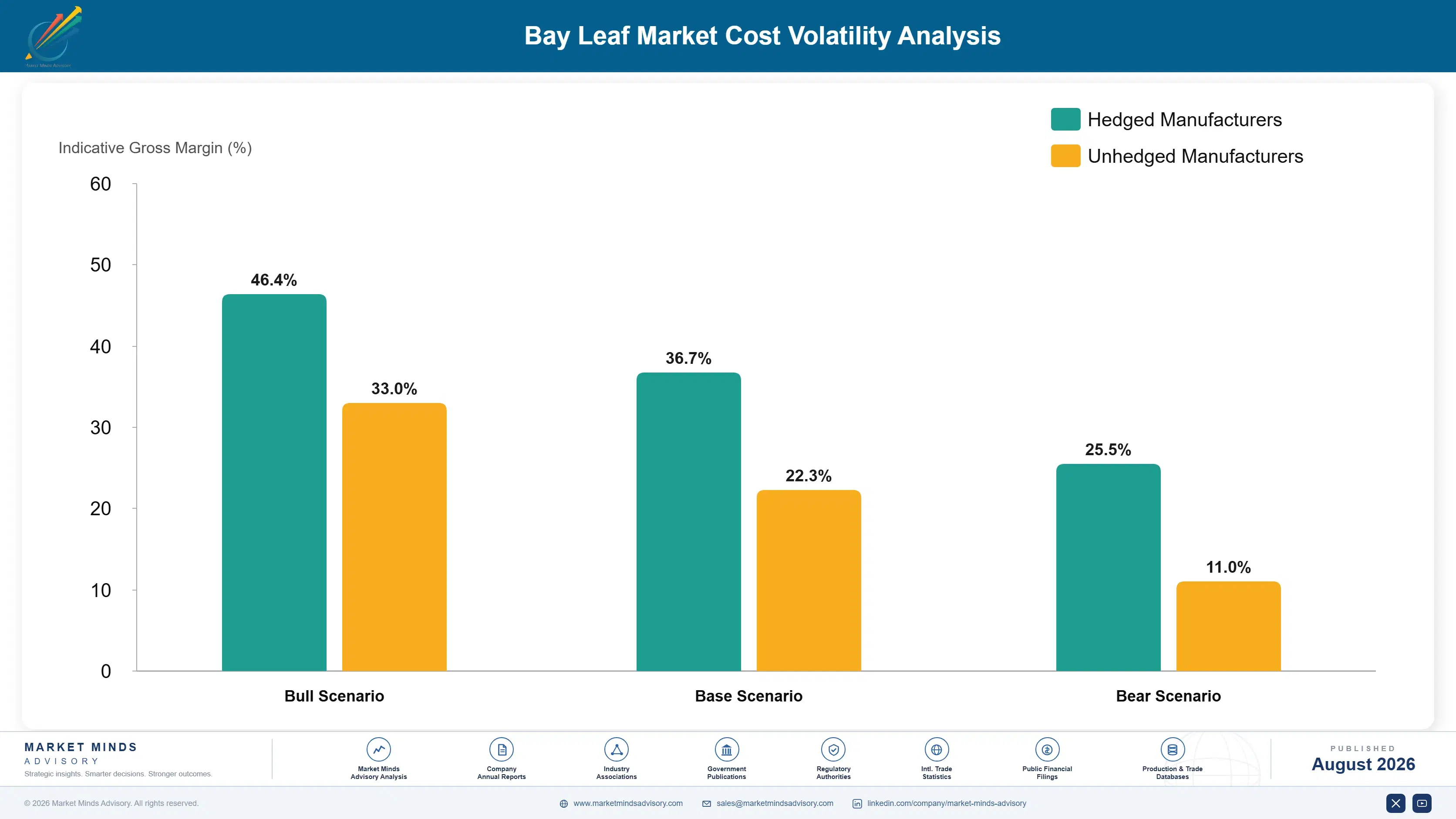
Small origin traders without forward contracts or diversified grower relationships absorb harvest volatility directly in margin, while larger processors with multi-year grower agreements and geographic diversification smooth pricing for their downstream customers instead of passing on the full swing. That gap in sourcing resilience increasingly separates suppliers who can offer multi-year fixed pricing from those who cannot.
bay-leaf-market-2024-2034-trends-growth-insights-cost-volatility-analysis-1787461355459

Multi-Year Grower Contracts With Price Floors

Processors are now locking in multi-year supply agreements with growers that include price floor and price ceiling mechanisms together, smoothing volatility for both sides while reducing the spot market exposure that hurt many buyers during recent drought driven shortfalls in Turkish supply and adjacent origin regions that feed the very same downstream buyer contracts each season.

Geographic Sourcing Diversification

Buyers are actively developing secondary sourcing relationships in India, in Eastern Europe, and in North Africa in order to reduce dependence on Turkish supply alone, though quality consistency across these newer growing regions still trails established origin areas in most current assessments MMA analysts have reviewed across multiple recent harvest seasons and buying cycles this year.

Buffer Inventory Management

Larger buyers are holding much bigger buffer inventories than historical norms in order to smooth through harvest season volatility, accepting higher working capital costs in exchange for solid protection against the sharp spot price spikes that hit unhedged buyers the hardest during shortfall years across the whole trade and its many downstream customers worldwide.

Portfolio Architecture for Margin Defence

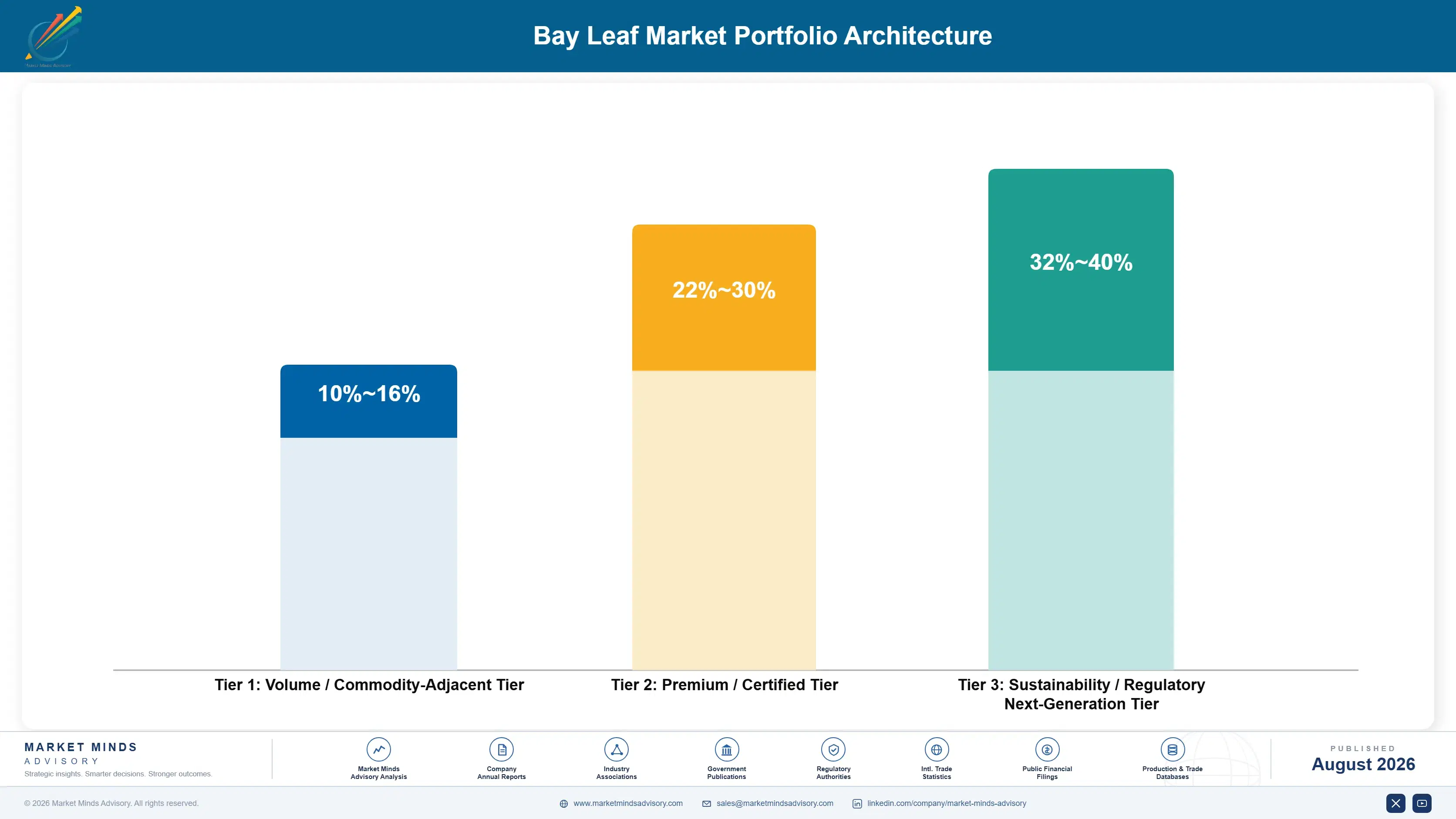
The market splits across three tiers: bulk commodity whole leaf and powder sold on thin margins against price and grade consistency, certified organic and single-origin product commanding a retail premium, and an emerging tier of essential oil and oleoresin extract sold into nutraceutical and cosmetic channels at the highest margins in the category by a considerable distance over the other two tiers combined.
Volume sits overwhelmingly in the commodity tier, where bulk leaf and powder contracts generate trading scale but thin margins that leave little room for reinvestment in certification or extraction capability of any kind. Premium tension is sharpest between certified retail product and extract, where processors increasingly choose which higher-margin tier to invest in rather than trying to serve both equally well at once each fiscal year.

High-value margin pools concentrate in essential oil and oleoresin extract sold to nutraceutical and cosmetic formulators, a small share of total volume but growing faster than the commodity base and attracting disproportionate processing investment from the leading Indian extraction companies each year without exception so far, a pattern MMA expects to persist through the entire forecast period ahead.

Volume / Commodity-Adjacent Tier

Bulk whole leaf and ground powder sold on price and grade consistency to food manufacturers and to retail private label buyers across every major market this analysis covers in real depth today.
Gross Margin: 10%-16%

Premium / Certified Tier

Organic and single origin certified bay leaf sold at a retail premium to health conscious consumers and specialty grocery channels across North America, Europe, and increasingly East Asia as well this decade.
Gross Margin: 22%-30%

Sustainability / Regulatory / Next-Generation Tier

Essential oil and oleoresin extract sold into nutraceutical and cosmetic formulation channels at the category highest achievable margins, reflecting genuine scarcity of extraction capacity across the entire global supplier base today.
Gross Margin: 32%-40%
bay-leaf-market-2024-2034-trends-growth-insights-portfolio-architecture-1787461355958

High-value Sub-segments and Strategic Watch-out

Nutraceutical-Grade Extract

Extract sold to nutraceutical formulators commands the category highest margins by a wide margin and is growing the fastest as clinical interest in eugenol compounds expands steadily across many supplement categories worldwide, drawing new processing investment from every major Indian producer each passing calendar year.
Gross Margin: 34%-40%

Certified Organic Retail Leaf

Organic certified whole leaf and ground powder commands steady premium pricing in North American and European retail channels alike, growing reliably as certification coverage expands across private label lines and specialty grocery chains each and every successive calendar year without any real meaningful exception at all.
Gross Margin: 24%-30%

Bulk Commodity Powder

The largest volume pool by far in this category, bulk powder contracts generate scale revenue for traders but offer very little margin expansion room given intense price competition across origin countries and trading houses competing hard for the exact same retail and food service buyers.
Gross Margin: 10%-14%

Eastern European Emerging Cultivation

New cultivation regions opening up in Eastern Europe could eventually challenge Turkish supply dominance over the next full decade, a real shift in growing geography worth monitoring closely for its sourcing strategy and pricing implications across the whole trade and its many major global buyers.
Gross Margin: 14%-20%

Grower Relationships and Formulation Lock-In

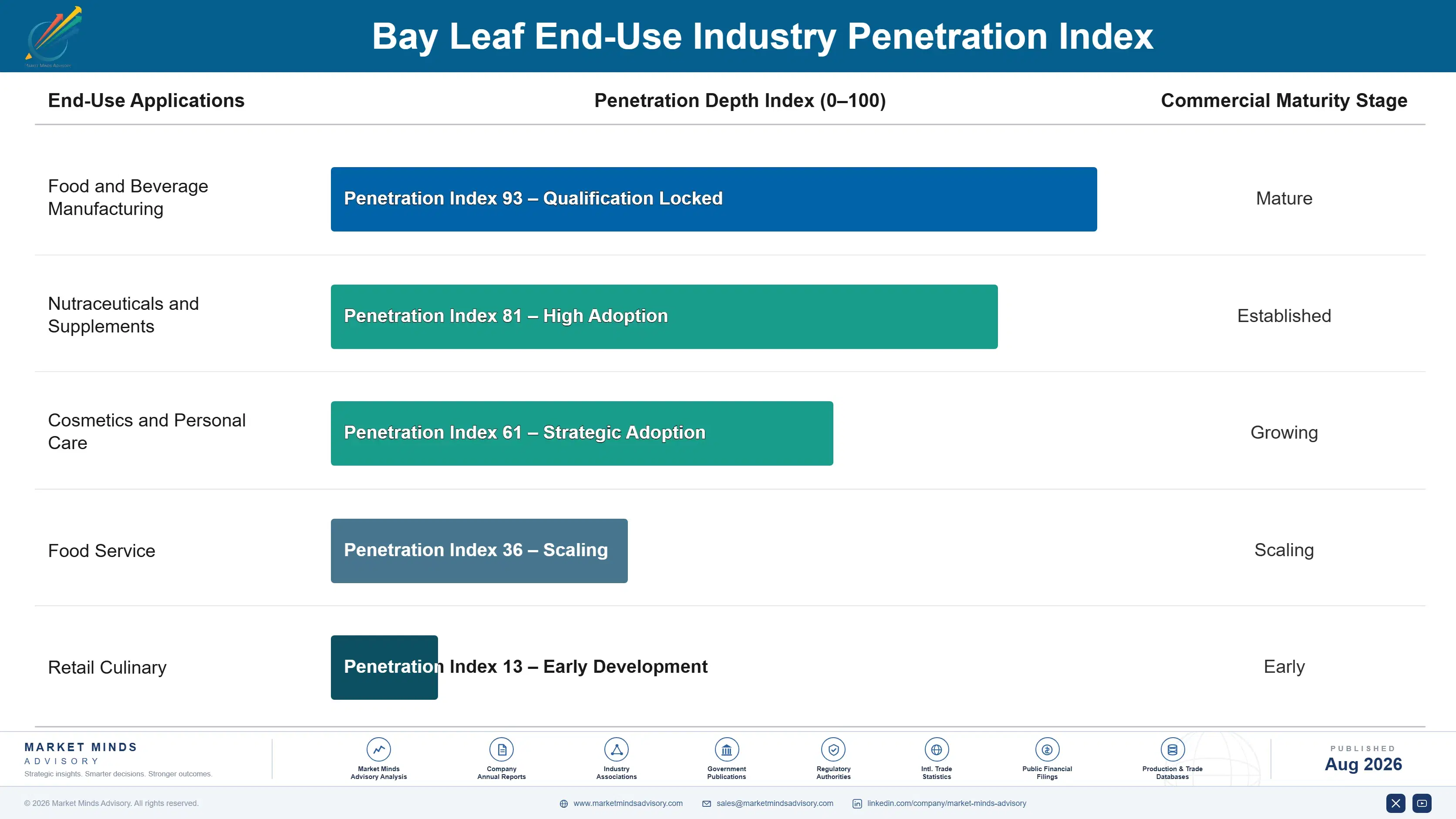
Extract demand behaves like an annuity once a nutraceutical or cosmetic formulator qualifies a specific supplier's eugenol assay and certification documentation, since requalifying a new supplier requires repeating clinical or regulatory testing that most formulators avoid unless supply is disrupted, giving incumbent extract suppliers durable multi-year relationships most challengers struggle to break into without a real, demonstrable quality edge over the incumbent's existing supply.
Adoption depth varies quite a bit by vertical: nutraceutical formulators show the deepest supplier stickiness given testing and documentation requirements, while food manufacturers using bulk leaf switch suppliers more readily based on price alone since quality specifications remain comparatively loose across most commodity grade culinary applications sold at scale to retailers, distributors, and food service operators across every single region this report covers in detail.

A generational shift among younger home cooks toward transparent, single-origin ingredient sourcing is pulling retail buying decisions away from anonymous bulk spice toward branded, traceable product, giving certified suppliers a growing seat at the retail buying table that commodity-only traders historically never had access to at all until fairly recently, and are still adjusting to today.
bay-leaf-market-2024-2034-trends-growth-insights-end-use-penetration-index-1787461356443

Positioning Across the Value Chain

These are among the four positions where our research anticipates prominent divergence between winners and laggards over the coming forecast period. Each is grounded in the demand model, the regulatory perimeter, and the announced capacity pipeline.
01 / EXTRACTION CAPACITY INVESTMENT

Invest in origin-based distillation ahead of nutraceutical demand growth

Nutraceutical extract orders have grown an estimated 40 percent since 2022, and processors without origin based distillation capacity of their own are steadily losing quality sensitive customers to Synthite Industries and Kancor Ingredients, both of which preserve eugenol content that leaf shipped abroad for processing simply cannot match. Building distillation capacity near fresh harvest regions requires only modest capital relative to the margin uplift available in this premium tier. Processors that move now will hold a multi-year quality advantage over any competitor who waits for demand to fully materialize.
02 / ORIGIN SOURCING DIVERSIFICATION

Diversify origin sourcing before the next Turkish drought cycle

Drought has cut Turkish harvest volumes by 15 to 20 percent in multiple recent seasons, a shortfall large enough on its own to move global spot pricing noticeably. Because export supply remains so heavily concentrated in this single origin country, another poor season would again squeeze buyers who lack diversified sourcing relationships already in place well ahead of time. Developing secondary supply in India, in Eastern Europe, and in North Africa now gives buyers a continuity guarantee that single-origin competitors simply cannot promise their own customers.
03 / ORGANIC CERTIFICATION INVESTMENT

Build organic certification ahead of continued retail premiumization

Certified organic bay leaf already commands a 25 to 35 percent retail premium over conventional bulk product sold under ordinary private label lines. That premium gap is likely to widen further still as more retailers publish sourcing transparency commitments tied directly to consumer expectations around traceability and verified origin. Suppliers investing in grower certification programs right now, following the model Frontier Co-op has already established across Turkey, will hold a multi-year lead over any competitor who waits for retail demand to fully materialize first.
04 / PRESERVATIVE CHANNEL ENTRY STRATEGY

Pursue natural preservative partnerships before the channel matures

Natural preservative applications already represent an estimated 8 percent of total extract volume across the category's leading suppliers today. Clean-label reformulation pressure across processed food categories suggests this particular channel will keep expanding faster than traditional flavor and nutraceutical use over the next several years. Extract producers willing to invest in food scientist relationships and technical application support, following Kancor Ingredients' early pilot model closely, can secure multi-year supply agreements before larger flavor houses commit comparable resources of their own.

Engagement Snapshot From the Field

A live engagement with an industry participant carrying material or product regulatory and market exposure ahead of a defining policy shift, showing how our research translates into a defensible multi-year portfolio strategy.
MARKET MINDS ADVISORY · CLIENT ENGAGEMENT SUMMARY
Bay Leaf Producer Strategic Portfolio Review and Transition Roadmap 2026·Investment Scenario on Bay Leaf Exposure Evaluation 2025-26
CLIENT PROFILE
A mid-sized nutraceutical ingredient formulator supplying eugenol based antioxidant supplement brands across North America and Western Europe engaged MMA to redesign its bay leaf extract sourcing strategy following a supply disruption during a poor Turkish harvest season. The client's annual bay leaf extract procurement spend exceeded 12 million dollars (client-reported, unverified by MMA) last year, making supplier concentration a material operational risk for its senior leadership team and board.
STRATEGIC CHALLENGE
The client sourced nearly all of its bay leaf oleoresin from a single Turkish intermediary and faced a six week supply gap when a drought shortened harvest forced that intermediary to ration allocation among its various buyers, threatening the client's own production schedule and forcing costly spot market purchases at prices well above its normal negotiated contract rate.
MMA APPROACH
MMA mapped alternative extraction suppliers across India, Turkey, and emerging Eastern European growing regions, benchmarked each candidate against eugenol assay consistency and the certification documentation the client's own regulatory team required, and modeled a dual sourcing structure that carefully balanced landed cost against real supply continuity across every scenario tested.
KEY FINDINGS
  1. Indian processors offered eugenol assay consistency comparable to the client's prior Turkish supplier at a modestly lower delivered cost per kilogram shipped.
  2. A dual sourcing structure spanning two origin countries would have prevented the six week production gap the client actually experienced last season.
  3. Certification documentation varied significantly across every candidate supplier, requiring additional diligence work before formal qualification could reasonably proceed on schedule as planned.
  4. Buffer inventory equivalent to six weeks of production meaningfully reduced the client's exposure to future single origin harvest disruptions going forward each year.
CLIENT PROFILE
A mid-sized nutraceutical ingredient formulator supplying eugenol based antioxidant supplement brands across North America and Western Europe engaged MMA to redesign its bay leaf extract sourcing strategy following a supply disruption during a poor Turkish harvest season. The client's annual bay leaf extract procurement spend exceeded 12 million dollars (client-reported, unverified by MMA) last year, making supplier concentration a material operational risk for its senior leadership team and board.
STRATEGIC CHALLENGE
The client sourced nearly all of its bay leaf oleoresin from a single Turkish intermediary and faced a six week supply gap when a drought shortened harvest forced that intermediary to ration allocation among its various buyers, threatening the client's own production schedule and forcing costly spot market purchases at prices well above its normal negotiated contract rate.
MMA APPROACH
MMA mapped alternative extraction suppliers across India, Turkey, and emerging Eastern European growing regions, benchmarked each candidate against eugenol assay consistency and the certification documentation the client's own regulatory team required, and modeled a dual sourcing structure that carefully balanced landed cost against real supply continuity across every scenario tested.
KEY FINDINGS
  1. Indian processors offered eugenol assay consistency comparable to the client's prior Turkish supplier at a modestly lower delivered cost per kilogram shipped.
  2. A dual sourcing structure spanning two origin countries would have prevented the six week production gap the client actually experienced last season.
  3. Certification documentation varied significantly across every candidate supplier, requiring additional diligence work before formal qualification could reasonably proceed on schedule as planned.
  4. Buffer inventory equivalent to six weeks of production meaningfully reduced the client's exposure to future single origin harvest disruptions going forward each year.
RECOMMENDED STRATEGY
Phase 1: Phase 1 (Months 1-3): Qualify two additional extraction suppliers across India and Eastern Europe against agreed technical and quality criteria. Phase 2: Phase 2 (Months 4-6): Establish dual sourcing supply contracts with volume splits weighted toward cost and overall delivery reliability jointly. Phase 3: Phase 3 (Months 7-12): Build a six week buffer inventory and monitor harvest conditions across all origin regions closely and consistently.
OUTCOME
The client completed supplier diversification within the recommended twelve month window and avoided a second production disruption during the following harvest season, reporting a 30 percent reduction in single origin supply risk exposure (client-reported, unverified by MMA) alongside modestly improved landed cost through the new competitive dual sourcing contract terms.

Frequently Asked Questions

Foundational context covering the market sizes, CAGR, scope, country, region and competition that inform every finding below. This section is provided to cover basics and most often pre-purchase conversations, answered from the MMA Primary Research Dataset.

What is the current size of the Bay Leaf Market?

The global bay leaf market was valued at approximately $0.8 billion in 2025. Growth is concentrated in essential oil and extract segments serving nutraceutical buyers worldwide.

How large will the Bay Leaf Market be by 2036?

MMA projects the market will reach approximately $1.64 billion by 2036, roughly 1.93 times its 2026 value. Growth is driven by extract demand and steady retail premiumization.

What is the CAGR for the Bay Leaf Market 2026 to 2036?

The market is projected to grow at a 6.8 percent compound annual rate between 2026 and 2036. Bull and bear scenarios range from 5.5 to 8.0 percent.

Which segment is growing fastest?

Bay leaf essential oil is the fastest growing segment at a 10.5 percent CAGR, roughly 1.5 times the overall market rate. Nutraceutical and cosmetic demand drives this gap.

Who are the major companies in the Bay Leaf Market?

Leading companies include McCormick and Company, Olam Group, Kerry Group, Sensient Technologies, and Synthite Industries. Together they hold a CR5 near 28 percent of the trade.

Which country is growing fastest?

India posts the fastest national growth at roughly 9.5 percent, supported by its dual role as both the largest producer and consumer. Domestic tej patta demand underpins this large base.

Report Segmentation Architecture

The full report scope spans multiple orthogonal segmentation dimensions, with cross-tabulated demand data provided for each dimension pair. Coverage extends further to regional breakdowns, trend trajectories, and the competitive detail needed to support segment-level decision-making.

By Product Form

  • Whole Dried Leaves
  • Ground Powder
  • Crushed Flakes
  • Essential Oil
  • Oleoresin Extract
  • Tea Cut

By End-Use Industry

  • Food and Beverage Manufacturing
  • Nutraceuticals and Supplements
  • Cosmetics and Personal Care
  • Food Service
  • Retail Culinary

By Distribution Channel

  • Direct Grower Contracts
  • Spice Trading Houses
  • Retail Private Label
  • Ingredient Distributors

By Region

  • North America
  • Western Europe
  • East Asia
  • South Asia and Pacific
  • Latin America
  • Middle East and Africa
  • Eastern Europe

Scope, Methodology, and Coverage

Every figure in this report is reproducible from documented input assumptions. The scope below maps the historical period, the forecast horizon, the segmentation dimensions, and the countries covered, alongside the underlying primary and qualitative methodology.
Historical Period
2020 to 2025
Forecast Period
2026 to 2036
Base Year
2025 (USD billions; MMA Primary Research Dataset, August 2026)
Market Definition
The bay leaf market covers dried whole leaves, ground powder, crushed flakes, essential oil, and oleoresin extract derived from Laurus nobilis and Cinnamomum tamala sold for culinary, nutraceutical, and cosmetic applications. It excludes unrelated culinary herbs and other laurel family botanicals not marketed as bay leaf.
Quantitative Units
USD billions (current prices); metric tonnes for volume detail
Segmentation Dimensions
By Product Form; By End-Use Industry; By Distribution Channel; By Region
Regions Covered
North America, Western Europe, East Asia, South Asia and Pacific, Latin America, Middle East and Africa, Eastern Europe
Countries Covered
USA, China, Germany, France, UK, Japan, South Korea, India, Australia, Canada, Brazil, Mexico, Indonesia, Vietnam, Thailand, Malaysia, UAE, Saudi Arabia, South Africa, Nigeria, Turkey, Poland, Netherlands, Italy, Spain, Sweden, Switzerland, Argentina, Colombia, Singapore, and additional markets relevant to this sector
Key Companies Profiled
McCormick and Company, Olam Group, Kerry Group, Sensient Technologies, Synthite Industries, Kancor Ingredients, Döhler Group, Frontier Co-op, Nedspice, AVT Natural Products, Robertet, Ungerer and Company, Griffith Foods, Everest Spices, MDH Spices, Kalsec, Naturex, Symrise, Firmenich, Universal Oleoresins
Quantitative Methodology
Primary survey, n=3,800 respondents, Q4 2025, six countries; demand-side model with trade association cross-validation
Qualitative Methodology
47 expert interviews, Q4 2025; applied to validate demand model assumptions, identify emerging dynamics, and assess competitive positioning
Report Format
PDF and XLSX data workbook (Word format preview document)
Publisher
Market Minds Advisory
Report Code
MMA-2026-AGR-102
Published
August 2026
Contact
sales@marketmindsadvisory.com | www.marketmindsadvisory.com

Purchase the full Bay Leaf Market Report (2026 to 2036).

The full Bay Leaf Market report delivers a comprehensive 2026 to 2036 forecast across six product forms, seven regions, and twenty profiled companies active in this trade. It includes detailed segmentation by end-use industry, harvest labor and origin cost modeling, and competitive benchmarking measured against a single consistent revenue basis throughout. Analysts document the extraction and certification trends that are reshaping value distribution across the entire category. Buyers receive full access to the underlying data tables, regional breakouts, and a customizable Excel model built for scenario planning.
2026-2036 volume and value forecasts by segment
Six-segment product form breakdown and detailed analysis
Seven-region market sizing and share detail
Twenty-company competitive profiles and full benchmarking
Harvest and origin cost sensitivity modeling included
Editable Excel forecast workbook with scenario toggles

Built For The People Who Decide

From boardroom strategy to bench-side execution, this report is read cover-to-cover by leaders shaping the next decade of their industry, turning demand scenarios, market dynamics and valuation benchmarks into decisions.
CXOs/ Presidents/ VPs/ Managers
M&A and Corporate Development
Strategy Teams and R&D Heads
Procurement and Product Directors
Regulatory and Compliance Leaders
Investor Relations and Equity Analysts