Market Minds Advisory
Bathroom Cabinets Market

Bathroom Cabinets Market: Bathroom Cabinets Market: Moisture, Certification and the Edges Nobody Seals

A furniture product sold into the wettest room in the house, where an unsealed edge swells irreversibly, and where adding a mirror and a light quietly turned it into a regulated electrical appliance.

Lead Analyst

Published

September 2026

Make Smarter Decisions with Customized Research Insights

Request a free sample report and evaluate market opportunities, growth trends, and competitive dynamics relevant to your business needs.

2025 MARKET VALUE$12.4BMarket Size 2025
2036 FORECAST VALUE$22.1BBase Case , 2026 to 2036
CAGR 2026 TO 20365.4 %Bull 6.6% / Bear 4.2%
INCREMENTAL OPPORTUNITY$9.1BNet 10- year value creation
EXPANSION MULTIPLE1.69x2036 value over 2026 base
Strategic Levers
M&A Pipeline
Regional Outlook
Country Rankings
Competitive Intelligence
Segmental Deep-dive
Call-Us : 91 93563 13602

Executive Snapshot and Market Trajectory.

This is a moisture engineering problem that the industry insists on treating as a furniture problem. Water finds the one unsealed edge, the board swells, and no amount of styling recovers a customer who watched a door bloat within a year of it first being fitted.
Integrated mirror and lighting cabinets grow at 8.1%, half again the market rate of 5.4%, and they now carry LED arrays, demisters and power outlets that pull the product under electrical safety regulation. East Asia holds 30% of demand, largely on Chinese renovation volume and the Guangdong manufacturing cluster that supplies most of the world regardless of whose brand appears on the door. That concentration matters more than anybody in this industry prices for.
Concentration is low at 19% and it stays low because a bathroom cabinet is easy to make badly and hard to make well, and the market has not yet found a way to tell buyers which is which. Renovation drives 68% of volume, which means the buyer is standing in a showroom comparing doors rather than reading a substrate specification. Nobody wins on the specification that they cannot see.
Market Definition
The bathroom cabinets market covers storage furniture manufactured for bathroom installation, spanning freestanding and wall-hung vanity units, under-sink cabinets, wall-mounted storage cabinets, tall and linen units, and mirror cabinets incorporating integrated lighting or demisting. Scope includes cabinets sold with or without a basin and countertop as a supplied unit. Excluded are standalone mirrors without storage, bathroom shelving and open racks, sanitaryware fixtures, shower enclosures, taps and brassware, and cabinetry manufactured for kitchen or general residential use.
Base Year Value
$12.4B in 2025 (MMA Primary Research Dataset, August 2026)
Forecast Period
2026 to 2036, eleven discrete annual values
CAGR
5.4% base case. Bull 6.6%. Bear 4.2%.
Fastest Growth Segment
Integrated Mirror and Lighting Cabinets: 8.1% CAGR
Fastest Growth Country
India: 7.6% CAGR
Fastest Growth Region
South Asia and Pacific: 7.6% CAGR
Largest Region
East Asia: 30% of 2025 global value
Market Leaders
Inter IKEA Group, Kohler, Masco Corporation, Fortune Brands Innovations and Roca Group. Source: MMA Analysis, July 2026.
Primary Survey
n=3,800 procurement and R&D decision-makers, Q4 2025, six countries
Methodology
Demand-side build-up, cross-validated against public data, 47 expert interviews

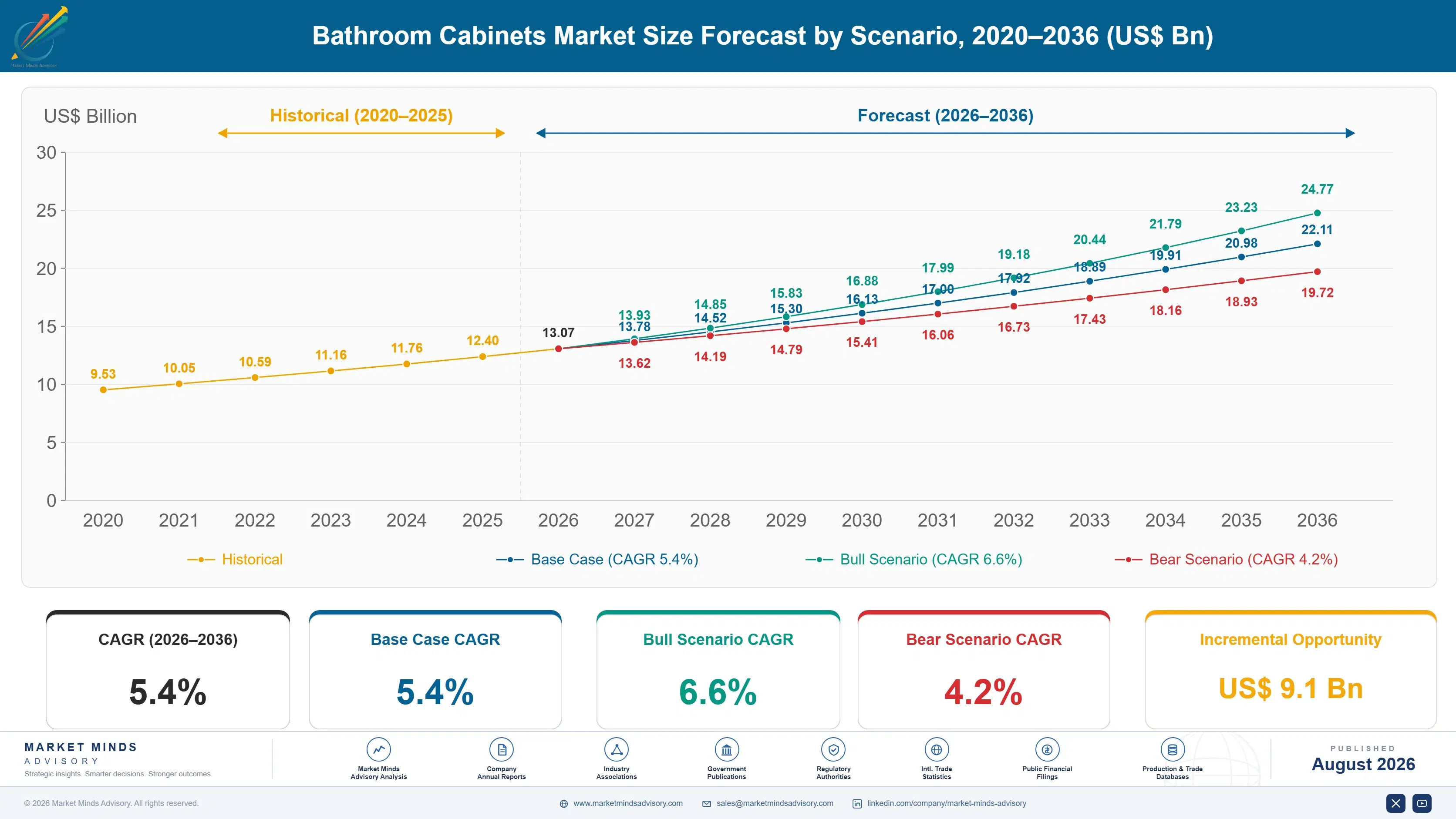
Bathroom Cabinets Market Forecast Scenarios

bathroom-cabinets-market-size-forecast-scenario-1788169576366
Between 2020 and 2025 the sector compounded at 4.4%, and the number sits on top of a violent cycle rather than a trend. Renovation demand surged through 2020 and 2021 as households redirected spending toward their homes, then fell away sharply as interest rates rose and discretionary refits were postponed. Manufacturers who added capacity at the peak spent the following two years running below break-even.
The 5.4% base case rests on three mechanisms. Mirror cabinets with integrated lighting and power are replacing plain mirrors at roughly three times the price, which lifts revenue without needing more bathrooms. Ageing housing stock in North America and Western Europe keeps generating replacement demand independent of new construction. And Asian renovation volume continues at a scale that alone moves the global figure. None of the three depends on interest rates falling, though a fall would help considerably.
The bull case at 6.6% turns on a housing transaction recovery, since a bathroom refit follows a house move more reliably than any other trigger in this category. The bear case at 4.2% is electrical: a tightening of safety requirements on integrated mirror cabinets would remove a large share of imported product from regulated markets almost overnight.

The Room That Destroys Furniture

Everything interesting about this product happens at the edges. Standard particleboard and MDF absorb water through any unsealed cut or drilled hole, and the swelling is permanent rather than something that dries out. Moisture-resistant substrate, sealed edge banding and finished cut-outs cost more and produce a cabinet that survives a decade. Nobody explains that difference at the point of sale, so the buyer pays for the door.
TOP FIVE CONCENTRATION19%Share held by the five largest bathroom cabinet makers
AVERAGE SELLING PRICEUSD 288Mean retail price across vanity and mirror cabinet formats
SUBSTRATE COST SHARE34% of COGSBoard and panel material as proportion of production cost
MOISTURE WARRANTY CLAIMS4.7%Share of units returned for swelling at edges and joints
RENOVATION DEMAND SHARE68%Portion of volume replacing existing units rather than new build
TRANSIT DAMAGE RATE3.9%Portion of shipped units arriving damaged at the customer
Adding a mirror and a light changed what this product is. An integrated mirror cabinet carries an LED array, a driver, a demister pad and a shaver socket, which brings it under electrical safety requirements and IP rating obligations that a plain cabinet never faced. Suppliers who can document compliance sell into regulated markets; those who cannot sell somewhere else. The price triples across that line.
Transit damage at 3.9% is the margin leak nobody discusses, and it is worse than the number suggests because a damaged vanity is a replacement rather than a repair. Cabinets are bulky, heavy, awkwardly shaped and increasingly sold online for home delivery by carriers who handle them like parcels. Packaging engineering earns more here than any product development, and hardly anybody staffs for it.
"The industry competes on door fronts and loses money on edges. Every warranty claim I have seen in twenty years traces to a cut somebody did not seal, and it is the cheapest problem in this business to fix."
Director, Building Products and Interior Fittings Practice · MMA Construction and Industrial Equipment Practice · August 2026

Market Trends

Mirror cabinets became regulated electrical products

An integrated mirror cabinet now typically carries an LED array, a driver, a demister pad and a socket, which places it inside electrical safety regulation and IP rating requirements that plain cabinetry never met. That changes who can supply it: a furniture manufacturer without electrical testing capability either buys a certified module or leaves the segment. The segment grows at 8.1% against a market rate of 5.4% and sells at roughly three times the price of the mirror it replaced. Regulation did more to create that margin than any design did.
Market Impact: Drives 68% of category volume

Wall-hung units are displacing freestanding vanities

Wall-hung floating vanities grow at 7.0% while freestanding units grow at 4.2%, and the reason is cleaning rather than aesthetics. A cabinet with no contact with the floor removes the seal line where water pools and where every freestanding unit eventually fails, and it makes the floor easy to mop. The trade is installation: a wall-hung unit needs a fixing into a load-bearing wall, which rules it out in older properties with hollow or damaged walls. That constraint is why the two formats will coexist rather than one replacing the other.
Market Impact: Supplies 30% of world demand

Market Opportunities and Growth Drivers

Ageing housing stock generates replacement demand independently

Renovation accounts for 68% of volume in this category, and the driver is not fashion but the age of the installed base. A bathroom fitted twenty years ago has a cabinet whose substrate has absorbed enough moisture to have failed at the joints, and replacement becomes unavoidable rather than discretionary. North American and Western European housing stock is old enough that this demand arrives regardless of construction activity or consumer confidence. It is the closest thing to an annuity that a building products category ever really gets to have anywhere.
Market Impact: Returns 4.7% of units

Chinese manufacturing scale sets the global cost floor

The Guangdong sanitaryware cluster around Foshan produces bathroom furniture at a cost and volume no other region approaches, and a large share of the cabinets sold under Western brand names originate there regardless of what the label says. That concentration keeps landed cost falling and gives Chinese producers development cycles measured in weeks. It also means a tariff action or a port disruption reprices the whole category at once, which several Western brands discovered when they had no qualified second source anywhere else in the world they could move to.
Market Impact: Damages 3.9% of shipments

Market Restraints and Challenges

Moisture failure at edges drives warranty claims

Warranty claims run at 4.7% and every one traces to water reaching an unsealed cut, a drilled hole or a chipped edge, after which particleboard or standard MDF swells permanently. The root cause is manufacturing economics: sealing every cut-out and using moisture-resistant board adds cost the buyer cannot see at the point of sale and therefore will not pay for. Commercial impact is severe because a swollen cabinet cannot be repaired, only replaced. Participants are responding with moisture-resistant substrate as standard, sealed edge banding on all six faces, PVC and aluminium carcasses, and extended warranties used as a selling point.
Market Impact: Prices 3x the plain mirror

Transit damage destroys margin on delivered orders

Roughly 3.9% of shipped units arrive damaged, and the figure rises sharply for online orders delivered by general parcel carriers rather than by two-person furniture crews. The root cause is geometry: a vanity unit is heavy, bulky and has corners and door fronts that mark on any impact, and standard packaging was designed for pallet handling rather than doorstep delivery. Commercial impact is a full replacement plus return freight on a product with no salvage value. Mitigation runs through heavier corner protection, flat-pack designs that reduce the damage surface, specialist delivery networks, and photographic proof of condition at handover.
Market Impact: Grows 7.0% against 4.2%
3 additional market trends, 4 additional growth drivers, and 2 additional restraints and challenges are covered in the full report. Contact sales@marketmindsadvisory.com to access the complete intelligence.

Segment CAGR and Growth Architecture

Segmentation follows cabinet product format, the dimension on which tooling, installation method and price point all operate together. Under-sink and freestanding units carry the volume at commodity prices. Mirror cabinets and wall-hung vanities carry the growth, because one added an electrical specification and the other solved the failure point every freestanding cabinet eventually reaches in the end.
bathroom-cabinets-market-market-share-analysis-1788169576922

Integrated Mirror and Lighting Cabinets

Integrated mirror and lighting cabinets grow at 8.1%, half again the market rate of 5.4%, and the growth came from turning a mirror into an appliance. LED arrays, drivers, demister pads and shaver sockets bring the product inside electrical safety regulation and IP rating requirements, which raises the cost of entry considerably and roughly triples the selling price against the plain mirror it replaced. Furniture manufacturers without electrical testing capability either buy certified modules or leave the segment entirely. That has quietly separated the field into suppliers who can document compliance for regulated markets and suppliers who sell wherever nobody asks for the paperwork. The second group is considerably larger than the first one is.
CAGR 8.1%

Wall-Hung Floating Vanity Units

Wall-hung floating vanities grow at 7.0% against 4.2% for freestanding units, and the mechanism is a maintenance argument rather than a styling one. Lifting the cabinet off the floor removes the seal line where water collects and where freestanding units fail first, and it leaves a floor that can be cleaned in one pass. The constraint is installation: a wall-hung unit carrying a stone top and a full basin needs a proper fixing, which older properties with plasterboard or damaged walls often cannot provide without additional work. That keeps the freestanding format alive in renovation markets with old housing stock, which is most of them. Nobody should model one format replacing the other entirely.
CAGR 7.0%
Full segment breakdown across 6 segments available in the complete report.

Regional Architecture and Country Demand Map

East Asia takes 30% and makes considerably more than that, since the Guangdong cluster supplies cabinets sold under brands from every other region. Western demand is renovation-driven and old-housing-driven; South Asian demand is new build. Those are different commercial problems entirely, and always have been.

East Asia

Manufacturing and consumption sit in the same place here, which no other region can say. The Foshan and Guangdong sanitaryware cluster produces bathroom furniture at volumes that set the world price, and a large share of what sells under European and American brand names is made within a few hours of it. Chinese domestic renovation demand runs alongside that at genuine scale, with apartment refurbishment cycles shorter than Western equivalents. Japanese and Korean demand is smaller and skews toward compact integrated units suited to limited bathroom footprints. The commercial consequence is that cost leadership and demand growth reinforce each other here in a way competitors elsewhere cannot construct at any price.
Share: 30% | CAGR: 6.4% (2026 to 2036)

North America

Housing age does the work here that new construction does elsewhere. A large share of the American housing stock carries bathrooms fitted twenty or more years ago, and the cabinets in them have reached the point where moisture damage forces replacement whether or not the household wanted a refit. That produces demand largely independent of interest rates, which is why the region held up better than Europe through the recent slowdown. Big-box retail and online delivery dominate distribution, which is also why transit damage is a bigger commercial problem here than anywhere else. Nobody has solved doorstep delivery of a vanity unit properly, and it shows plainly in the reviews.
Share: 25% | CAGR: 5.0% (2026 to 2036)
Regional intelligence for 5 additional markets available in the complete report: Western Europe, South Asia and Pacific, Latin America, Middle East and Africa, Eastern Europe. Contact sales@marketmindsadvisory.com.
bathroom-cabinets-market-country-cagr-analysis-1788169577444

Four Moves At The Edges

None of these four requires a new door front, which is where this industry spends most of its development budget. Each addresses something the buyer cannot see and the warranty department knows about: the substrate, the edge seal, the packaging and the electrical certification. All four are cheap relative to what they actually protect from failure.

Seal every edge and say so

Warranty claims run at 4.7% and almost all of them trace to water entering an unsealed cut, drilled hole or chipped edge. Moisture-resistant substrate with edge banding on all six faces adds roughly 8% to unit cost and removes most of that claim volume within one production run. The commercial half matters more: nobody currently tells the buyer which cabinets are built this way, so a supplier who publishes the specification and offers a ten year warranty against swelling has a claim that no competitor is currently contesting anywhere at all.
Market Impact: Removes most of a 4.7% warranty claim rate

Certify the electrical module for regulated markets

Integrated mirror cabinets carry LED arrays, drivers, demisters and sockets, which puts them inside electrical safety regulation and IP rating requirements. A furniture manufacturer without testing capability can buy a certified module rather than build the competence, at a cost the segment's pricing absorbs comfortably given it sells at roughly 3 times the plain mirror. The segment grows at 8.1% against a market rate of 5.4%. Suppliers who cannot document compliance are confined to markets where nobody checks, which is a shrinking commercial position. Very few of them have started the work.
Market Impact: Accesses the 8.1% growth segment in regulated markets

Engineer the packaging before the product

Transit damage at 3.9% is a full replacement plus return freight on a product with no salvage value, and it is rising because online orders reach doorsteps via general parcel carriers rather than furniture crews. Corner protection, edge armour and a carton designed for single-person handling cost a few dollars per unit against a replacement costing the entire margin. Very few manufacturers staff a packaging engineer at all. The ones who do report damage rates around a third of the sector average, which pays for the role many times over.
Market Impact: Cuts the 3.9% transit damage rate by two thirds

Qualify a nearshore factory before you need one

Chinese supply sets the cost floor in this category and also concentrates the risk, since a tariff action or port disruption reprices everything at once. Polish factories serve European buyers and Mexican factories serve American ones at costs within reach, and qualifying one costs a tooling programme and roughly 6 months of specification work. The value is optionality rather than saving, and it looks like wasted money right up until the quarter it does not. Several brands discovered they had no second source exactly when they most badly needed it.
Market Impact: Qualifies an alternative supply source within 6 months

Who Controls the Margin Pool

CR5 stands at 19%, measured on unit shipment volume rather than revenue, since no participant reports bathroom furniture separately from wider sanitaryware. That is low for a category with real scale economics, and the reason is that a bathroom cabinet is straightforward to make badly. The gap between the largest volume seller and the branded specialists is wide, but they are not competing for the same buyer.
Competition runs on three things and door design is not one. Landed cost decides the volume tier, and it is set in Guangdong regardless of where the brand sits. Electrical certification decides who can supply mirror cabinets into regulated markets. Substrate and edge specification decides who is selling to the same customer in ten years, though nobody competes on it because the buyer cannot see it.

Rankings will move on documentation rather than on product. A manufacturer holding electrical certification, published substrate specification and a qualified nearshore alternative competes on things a low-cost importer cannot assemble quickly. Several European and North American participants have started building that position, mostly in response to tariff exposure. The pressure now comes from procurement and compliance departments, which is not where this industry has looked for advantage.
bathroom-cabinets-market-company-positioning-matrix-1788169577963

Competitive Moat and Risk Dimensions

INTER IKEA GROUP

Moat: Flat-pack volume and price

Selling bathroom vanity units in flat-pack form at volumes no competitor approaches gives the group a manufacturing and freight cost position close to unassailable at the accessible end of this market. Flat-pack also cuts transit damage, since a boxed panel set survives handling that an assembled cabinet does not. Matching either advantage would require rebuilding a supply chain from scratch.
INTER IKEA GROUP

Risk: Assembly quality varies enormously

A flat-pack cabinet is assembled by the customer, and every drilled hole and edge left unsealed during that assembly becomes a moisture entry point the manufacturer never controlled. Warranty and review outcomes therefore depend on somebody else's work, which is an unusual exposure for a product sold on durability. Instruction quality and pre-sealed components help but cannot remove the risk.
KOHLER

Moat: Specified across the whole bathroom

Selling cabinetry alongside sanitaryware, brassware and shower systems lets the group win an entire bathroom specification rather than compete for one item, which is how architects and developers actually buy. Finish matching across a range is difficult to replicate for a cabinet-only manufacturer. The specification relationship also survives price competition in a way a retail shelf position never does.
KOHLER

Risk: Volume tier exposure limited

Positioning across the specified and premium end keeps the group away from the accessible volume that flat-pack and big-box retail capture, and in a category where 68% of demand is renovation that leaves much of the market unaddressed. Entering the volume tier means competing on landed cost against Chinese manufacturing, which is not a contest the brand position helps with.

Players Tracked

Prominent Players

Inter IKEA Group
Kohler
Masco Corporation
Fortune Brands Innovations
Roca Group

Other Key Players

Duravit
LIXIL Group
Toto
Villeroy and Boch
Geberit
JOMOO Kitchen and Bath
Arrow Home Group
Huida Sanitary Ware
American Woodmark
Foremost Groups
Bertch Cabinet
Strasser Woodenworks
Keuco
Burgbad
Cersanit

Recent Developments

FEBRUARY 2025

European retailers tightened electrical documentation on mirror cabinets

Several European home improvement retailers required full electrical safety documentation and IP rating evidence for every integrated mirror cabinet on their ranges, closing a gap that imported product had previously moved through. Suppliers without certification were delisted within a single buying cycle rather than given transition time.
Signal: Retail buyers are enforcing electrical regulation more effectively than the regulators themselves have ever managed to.
JUNE 2025

Kohler expanded North American bathroom furniture manufacturing capacity

Kohler brought additional bathroom furniture manufacturing capacity into operation in North America, an organic capacity expansion rather than any acquisition or joint venture. The investment reduces exposure to imported supply on a product line where tariff movement had repriced landed cost twice within three years without warning.
Signal: Nearshoring in this category is being driven by tariff risk rather than by any cost calculation.
OCTOBER 2025

Polish furniture producers won European bathroom cabinet supply agreements

Polish furniture manufacturers signed supply agreements with several Western European retailers for bathroom cabinet ranges, displacing imported volume on lead time rather than on price. These were supply agreements rather than acquisitions or joint ventures, and buyers cited delivery reliability and shorter replenishment cycles as the deciding factors.
Signal: Lead time has become a purchasing criterion that competes seriously with landed cost in this category.

Board, Hardware And Broken Corners

Board and panel material accounts for roughly 34% of cost of goods, hardware and hinges a further 13%, and packaging and freight around 16%. Particleboard and MDF come from regional producers close to the factory, since panel is expensive to ship relative to value. Hinges and drawer runners are dominated by a small number of European and Chinese suppliers.
European panel pricing gave this industry its clearest lesson. Wood-based panel producers absorbed severe energy cost increases through 2022, and the International Energy Agency documented the scale of the European industrial gas price movement across that period. Panel prices rose faster than cabinet manufacturers could reprice against retail contracts already agreed. Producers holding annual panel contracts came through it; spot buyers absorbed the whole move and several smaller manufacturers did not survive the year.

The disadvantage falls on scale rather than geography here. A large manufacturer contracts panel annually, buys hardware on volume terms and can absorb a bad quarter. A small producer buys panel on spot, sells to a retailer who fixed prices six months ago, and has nowhere to put the increase. Geography matters through freight, since panel travels badly and a factory far from a mill starts behind.
bathroom-cabinets-market-cost-volatility-analysis-1788169578158

Contract panel supply on annual volume terms

Panel is a third of cost of goods and it moves on energy prices that have nothing to do with bathrooms. Annual contracts with a regional mill cost a premium over the best spot price in a soft market and remove the largest uncontrolled line in the cost sheet. Manufacturers who held contracts through 2022 kept their retail agreements intact.

Specify moisture-resistant board as the standard substrate

Moisture-resistant board costs more than standard particleboard and removes the failure mode that produces almost every warranty claim in this category. The cost difference is small against a replacement unit plus freight, and it becomes a selling point once a supplier is willing to publish the specification. Most manufacturers still specify standard board and absorb the claims quietly instead.

Qualify a nearshore factory alongside the Asian one

Concentrating supply in one country is a tariff exposure rather than a cost advantage, and this category has been repriced twice by trade measures within three years. Polish and Mexican factories can take cabinet production at costs within reach, and qualifying one costs a tooling programme and half a year of specification work. Optionality looks expensive until it is not.

Portfolio Architecture for Margin Defence

Margin in this category follows specification depth rather than price point, which the retail shelf hides. Two vanity units at the same price can differ by 8% in cost and by an order of magnitude in warranty claims, and only one is still earning after the returns are counted. Manufacturers costing on delivered margin after claims and transit damage run a different portfolio.
Volume and premium pull against each other through the factory rather than the market. The accessible range fills the panel line and makes the annual mill contract worth signing, and that contract is what protects the premium range from spot pricing. Dropping volume raises material cost across everything. Running only volume means competing on landed cost against Guangdong, which is a contest with one outcome and no margin.

High-value pools sit in integrated mirror cabinets, in project specification supply and in certified electrical modules sold to other manufacturers. The third is the least obvious and possibly the most defensible: a furniture maker with electrical testing capability can supply certified modules to competitors who have none, at margins the finished cabinet never reaches. Very few have noticed they are sitting on that capability at all.

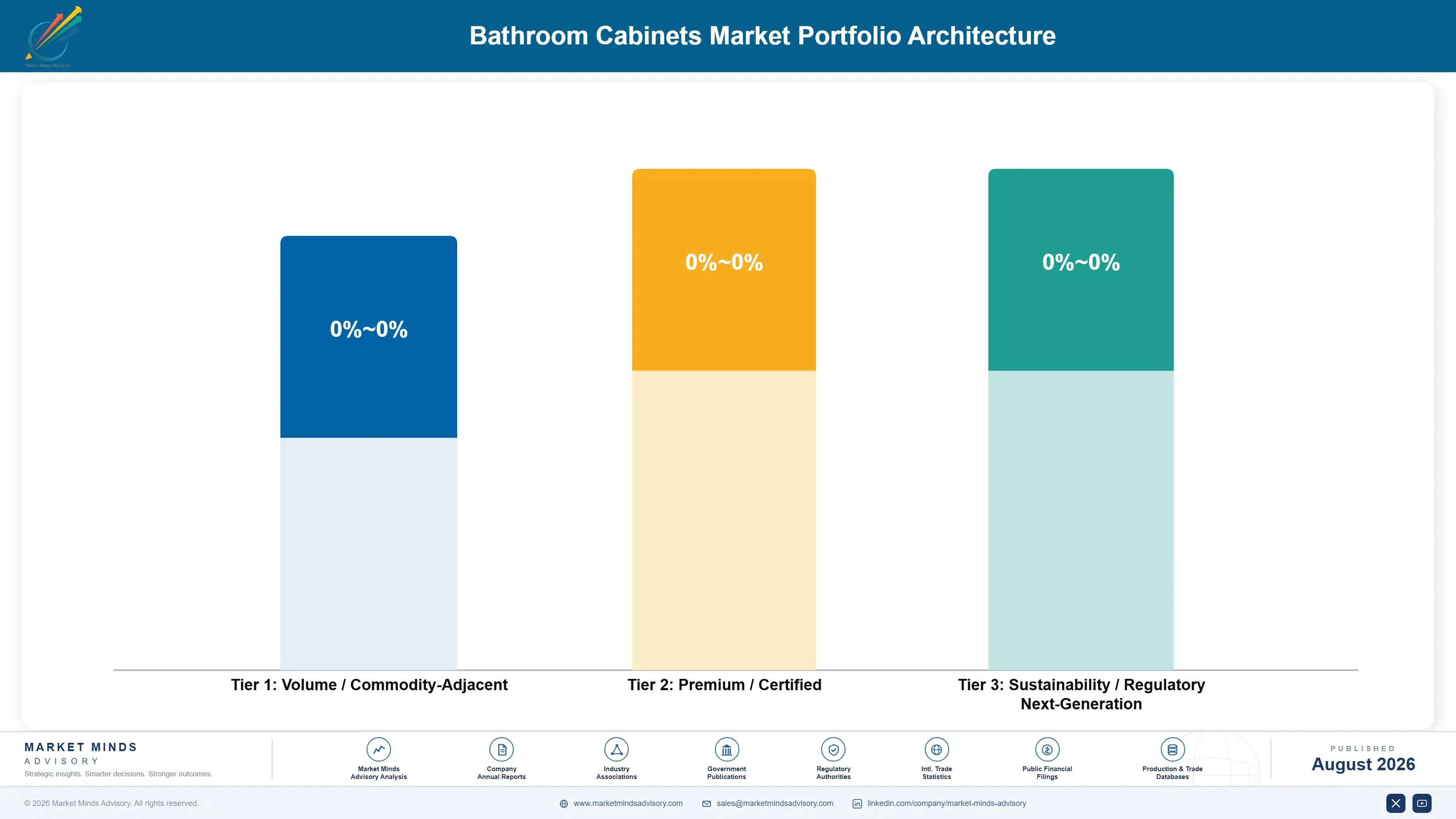
Volume / Commodity-Adjacent

Flat-pack and under-sink units sold through big-box retail and marketplaces at accessible price points. Competes on landed cost against near-identical imported product, and warranty claims absorb part of the nominal margin. The 9 point spread reflects how much volume is manufactured in-house rather than imported.
Gross Margin: 22 to 31%

Premium / Certified

Assembled vanity units and integrated mirror cabinets with moisture-resistant substrate and documented electrical certification. Specification rather than styling supports the price, and warranty claims run far below the volume tier. The 9 point spread reflects channel mix between retail and specification supply.
Gross Margin: 36 to 45%

Sustainability / Regulatory / Next-Generation

Certified electrical modules supplied to other manufacturers, project specification packages and formaldehyde-compliant panel ranges. Margins are high because certification is scarce rather than because volume is large. The 14 point spread separates finished product from component supply contracts.
Gross Margin: 42 to 56%
bathroom-cabinets-market-portfolio-architecture-1788169578670

High-value Sub-segments and Strategic Watch-out

Integrated Mirror and Lighting Cabinets

High value and high growth at 8.1%. Electrical content raises the barrier to entry and roughly triples the price against the plain mirror it replaced, with retail buyers now demanding documentation. The 8 point spread reflects whether the electrical module is made in house or bought certified.
Gross Margin: 44 to 52%

Wall-Hung Floating Vanity Units

High value with strong growth at 7.0%. Removing floor contact removes the seal line where freestanding units fail first, which is a maintenance argument buyers accept readily. The 8 point spread reflects whether the unit ships assembled or flat-packed for customer installation at home instead.
Gross Margin: 38 to 46%

Under-Sink and Freestanding Units

The volume core. It earns little after warranty claims and transit damage, but it fills the panel line and makes the annual mill contract worth signing for everything else. The 9 point spread reflects whether production is in-house or imported in as fully finished goods.
Gross Margin: 20 to 29%

Uncertified Imported Mirror Cabinets

The strategic watch-out. Retail buyers in regulated markets now demand electrical documentation before listing, and product without it is confined to channels where nobody asks. The 22 point spread reflects how much still clears through unregulated routes at close to full retail pricing levels anyway.
Gross Margin: 18 to 40%

Why Bathrooms Get Replaced

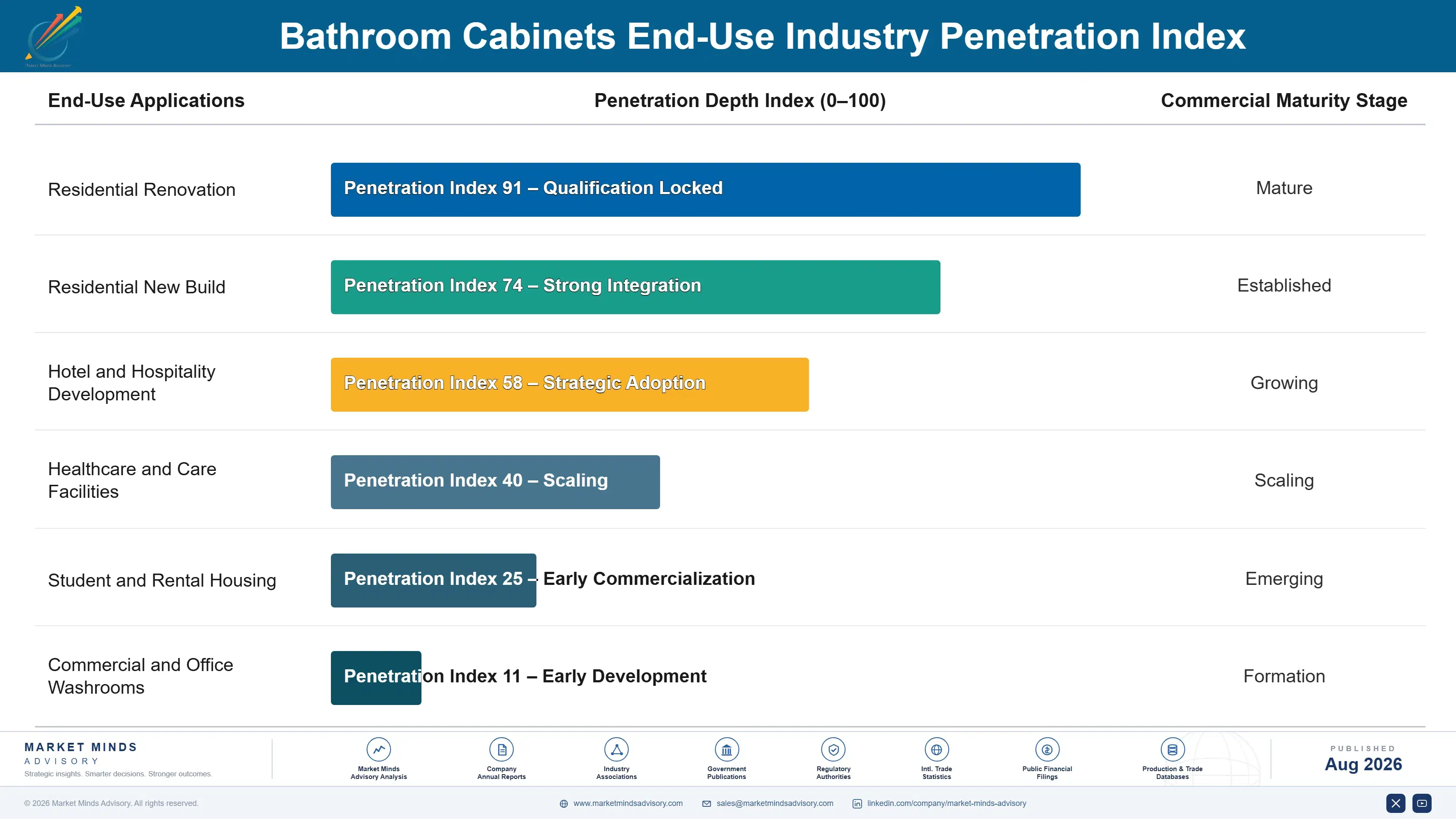
This is a replacement business and the trigger is failure rather than fashion. Renovation drives 68% of volume, and the cabinet being replaced has usually reached a point where swollen board or a failed hinge made the decision for the household. That produces demand that arrives regardless of consumer confidence, which is the closest thing to an annuity a building products category gets.
Stickiness barely exists at brand level and is absolute at channel level. A household replacing a bathroom cabinet after fifteen years has no memory of the old brand, and buys from whoever the fitter puts in front of them. That makes the trade relationship the durable asset rather than the consumer one. Manufacturers who market to households rather than to fitters are addressing the wrong customer.

Buyer profiles have shifted in a way that changes who the argument is with. The previous generation bought a bathroom cabinet from a showroom with a fitter who had opinions about substrate. The current buyer orders online from a photograph, assembles it themselves, and discovers the substrate eighteen months later when a door swells. That shift moved the durability conversation from before the sale to after it.
bathroom-cabinets-market-end-use-penetration-index-1788169579156

Where The Money Leaks

These are among the four positions where our research anticipates prominent divergence between winners and laggards over the coming forecast period. Each is grounded in the demand model, the regulatory perimeter, and the announced capacity pipeline.
01 / EDGE SEALING DISCIPLINE

Seal the edges and publish the specification

Warranty claims run at 4.7% and almost every one traces to water reaching an unsealed cut, drilled hole or chipped edge, after which the board swells permanently and the unit is scrap. Moisture-resistant substrate with banding on all six faces adds roughly 8% to unit cost and removes most of that claim volume inside one production run. Nobody currently tells the buyer which cabinets are built this way, which leaves the claim entirely uncontested on every single retail shelf anywhere.
02 / ELECTRICAL CERTIFICATION ACCESS

Certify the module or lose the regulated markets

Integrated mirror cabinets now carry LED arrays, drivers, demisters and sockets, which places them inside electrical safety regulation and IP rating requirements that plain cabinetry never faced. European retail buyers have begun delisting suppliers who cannot produce documentation, with a single buying cycle of notice rather than a transition period. The segment grows at 8.1% and sells at roughly three times the plain mirror, so the certification cost is trivially recovered within a single selling season almost anywhere it applies.
03 / PACKAGING ENGINEERING INVESTMENT

Design the carton before the cabinet

Transit damage at 3.9% is a full replacement plus return freight on a product with no salvage value at all, and it rises whenever online orders reach doorsteps by general parcel carrier. Corner protection, edge armour and a carton designed for single-person handling cost a few dollars against a replacement that consumes the entire unit margin. Manufacturers who staff a packaging engineer report damage rates around a third of the sector average, and hardly anybody in this industry does it.
04 / SUPPLY SOURCE OPTIONALITY

Qualify the second factory before the tariff lands

Guangdong sets the cost floor for this category and concentrates the risk in a single country, and tariff measures have repriced landed cost twice within three years without meaningful notice to anybody. Polish factories serve European buyers and Mexican factories serve American ones at costs within reach of the Chinese base. Qualifying one costs a tooling programme and around 6 months of specification work, which is cheap against having no alternative at all in the one quarter it really matters.

Engagement Snapshot From the Field

A live engagement with an industry participant carrying material or product regulatory and market exposure ahead of a defining policy shift, showing how our research translates into a defensible multi-year portfolio strategy.
MARKET MINDS ADVISORY · CLIENT ENGAGEMENT SUMMARY
Bathroom Cabinets Producer Strategic Portfolio Review and Transition Roadmap 2026·Investment Scenario on Bathroom Cabinets Exposure Evaluation 2025-26
CLIENT PROFILE
A European bathroom furniture manufacturer supplying home improvement retailers and specialist bathroom showrooms across nine countries, with annual revenue in the mid hundreds of millions of euros (client-reported, unverified by MMA). Around three quarters of its volume was manufactured under contract in China, and the business specified standard particleboard across most of its accessible range.
STRATEGIC CHALLENGE
Warranty claims had risen for three consecutive years while revenue stayed flat, and two retail customers had raised quality reviews. Separately, a tariff change had repriced the Chinese supply base twice with no warning. Management wanted to know whether the two problems were connected and what a defensible position would actually cost to build.
MMA APPROACH
MMA had returned units from four markets examined for failure mode and traced each back to substrate specification and factory of origin. Forty-seven expert interviews with retail buyers, panel suppliers, contract manufacturers in three countries and installation contractors established what specification change would cost, what documentation buyers would act on, and what nearshore qualification involved.
KEY FINDINGS
  1. Failures concentrated in two of the five contract factories and traced entirely to unsealed cut-outs around plumbing rather than to the board grade itself.
  2. Moving the whole accessible range to moisture-resistant board with six-face banding added roughly 8% to unit cost, well inside the claim saving.
  3. Every retail buyer interviewed said a published substrate specification and an extended swelling warranty would influence listing decisions, and none had been offered either.
  4. Two Polish factories could take a third of the volume at landed costs within a few points of the Chinese base, with materially shorter lead times.
CLIENT PROFILE
A European bathroom furniture manufacturer supplying home improvement retailers and specialist bathroom showrooms across nine countries, with annual revenue in the mid hundreds of millions of euros (client-reported, unverified by MMA). Around three quarters of its volume was manufactured under contract in China, and the business specified standard particleboard across most of its accessible range.
STRATEGIC CHALLENGE
Warranty claims had risen for three consecutive years while revenue stayed flat, and two retail customers had raised quality reviews. Separately, a tariff change had repriced the Chinese supply base twice with no warning. Management wanted to know whether the two problems were connected and what a defensible position would actually cost to build.
MMA APPROACH
MMA had returned units from four markets examined for failure mode and traced each back to substrate specification and factory of origin. Forty-seven expert interviews with retail buyers, panel suppliers, contract manufacturers in three countries and installation contractors established what specification change would cost, what documentation buyers would act on, and what nearshore qualification involved.
KEY FINDINGS
  1. Failures concentrated in two of the five contract factories and traced entirely to unsealed cut-outs around plumbing rather than to the board grade itself.
  2. Moving the whole accessible range to moisture-resistant board with six-face banding added roughly 8% to unit cost, well inside the claim saving.
  3. Every retail buyer interviewed said a published substrate specification and an extended swelling warranty would influence listing decisions, and none had been offered either.
  4. Two Polish factories could take a third of the volume at landed costs within a few points of the Chinese base, with materially shorter lead times.
RECOMMENDED STRATEGY
Phase 1: Phase one: move the entire accessible range to moisture-resistant board with sealed cut-outs, and exit the two failing contract factories. Phase 2: Phase two: publish the substrate specification and offer a ten year warranty against swelling, using both as the primary trade selling argument. Phase 3: Phase three: qualify both Polish factories for a third of volume, accepting a small cost premium for lead time and tariff protection.
OUTCOME
Within five quarters warranty claims had fallen by more than half and both retail customers expanded their listings after being shown the specification and warranty (client-reported, unverified by MMA). Polish production carried a third of volume by the end of the period, and a subsequent tariff change affected the business considerably less than it affected competitors.

Frequently Asked Questions

Foundational context covering the market sizes, CAGR, scope, country, region and competition that inform every finding below. This section is provided to cover basics and most often pre-purchase conversations, answered from the MMA Primary Research Dataset.

What is the current size of the Bathroom Cabinets Market?

The global bathroom cabinets market was valued at USD 12.4 billion in 2025, covering vanity units, storage cabinets and integrated mirror cabinets. The 2026 figure reaches USD 13.07 billion.

How large will the Bathroom Cabinets Market be by 2036?

MMA forecasts USD 22.12 billion by 2036, an increase of USD 9.05 billion over the 2026 base. That represents an expansion multiple of 1.69 times across the forecast period.

What is the CAGR for the Bathroom Cabinets Market 2026 to 2036?

The base case compound annual growth rate is 5.4%, with a bull case at 6.6% and a bear case at 4.2%. Historical growth between 2020 and 2025 ran at 4.4%.

Which segment is growing fastest?

Integrated mirror and lighting cabinets grow at 8.1%, half again the market rate of 5.4%, because electrical content roughly triples the price. Wall-hung floating vanities follow at 7.0%.

Who are the major companies in the Bathroom Cabinets Market?

Inter IKEA Group, Kohler, Masco Corporation, Fortune Brands Innovations and Roca Group lead on unit shipment volume, with combined CR5 of 19%. The field below them is fragmented.

Which country is growing fastest?

India grows fastest at 7.6%, driven by apartment completions where developers specify cabinets in bulk rather than households choosing them. South Asia and Pacific leads regionally at 7.6%.

Report Segmentation Architecture

The full report scope spans multiple orthogonal segmentation dimensions, with cross-tabulated demand data provided for each dimension pair. Coverage extends further to regional breakdowns, trend trajectories, and the competitive detail needed to support segment-level decision-making.

By Cabinet Product Format

  • Freestanding Vanity Units
  • Wall-Hung Floating Vanity Units
  • Under-Sink Storage Cabinets
  • Wall-Mounted Storage Cabinets
  • Tall and Linen Storage Cabinets
  • Integrated Mirror and Lighting Cabinets

By End-Use Industry

  • Residential Renovation
  • Residential New Build
  • Hotel and Hospitality Development
  • Healthcare and Care Facilities
  • Student and Rental Housing
  • Commercial and Office Washrooms

By Commercial Dimension

  • Big-Box Home Improvement Retail
  • Specialist Bathroom Showrooms
  • Online Marketplaces
  • Builder Merchant Supply
  • Project Specification Contracts
  • Private Label Manufacturing

By Region

  • North America
  • Western Europe
  • East Asia
  • South Asia and Pacific
  • Latin America
  • Middle East and Africa
  • Eastern Europe

Scope, Methodology, and Coverage

Every figure in this report is reproducible from documented input assumptions. The scope below maps the historical period, the forecast horizon, the segmentation dimensions, and the countries covered, alongside the underlying primary and qualitative methodology.
Historical Period
2020 to 2025
Forecast Period
2026 to 2036
Base Year
2025 (USD billions; MMA Primary Research Dataset, August 2026)
Market Definition
The bathroom cabinets market covers storage furniture manufactured for bathroom installation, spanning freestanding and wall-hung vanity units, under-sink cabinets, wall-mounted storage cabinets, tall and linen units, and mirror cabinets incorporating integrated lighting or demisting. Scope includes cabinets sold with or without a basin and countertop as a supplied unit. Excluded are standalone mirrors without storage, bathroom shelving and open racks, sanitaryware fixtures, shower enclosures, taps and brassware, and cabinetry manufactured for kitchen or general residential use.
Quantitative Units
USD billion, 2025 base year, 2026 to 2036 forecast period
Segmentation Dimensions
Cabinet product format, end-use industry, commercial channel, region
Regions Covered
North America, Western Europe, East Asia, South Asia and Pacific, Latin America, Middle East and Africa, Eastern Europe
Countries Covered
United States, Canada, Germany, France, United Kingdom, Italy, Spain, Poland, China, Japan, South Korea, India, Australia, Brazil, Mexico, Saudi Arabia, United Arab Emirates, South Africa
Key Companies Profiled
20 companies across sanitaryware groups, furniture manufacturers and contract producers
Quantitative Methodology
Primary survey, n=3,800 respondents, Q4 2025, six countries; demand-side model with trade association cross-validation
Qualitative Methodology
47 expert interviews, Q4 2025; applied to validate demand model assumptions, identify emerging dynamics, and assess competitive positioning
Report Format
PDF and XLSX data workbook (Word format preview document)
Publisher
Market Minds Advisory
Report Code
MMA-2026-CON-501
Published
August 2026
Contact
sales@marketmindsadvisory.com | www.marketmindsadvisory.com

Purchase the full Bathroom Cabinets Market Report (2026 to 2036).

The full MMA report on the bathroom cabinets market runs to detailed format and regional models across the 2026 to 2036 forecast period, with substrate and hardware cost benchmarks built by product type. It profiles 20 companies on a consistent unit shipment basis, covering sanitaryware groups, furniture manufacturers and the contract producers supplying both. Electrical certification requirements are mapped by market alongside the retail documentation standards now applied. Regional chapters cover the seven MMA regions with country-level detail on the eighteen markets surveyed. Primary research draws on a quantitative survey of 3,800 respondents across six countries and 47 expert interviews conducted in Q4 2025.
Substrate and hardware cost benchmarks by product type
Warranty claim analysis by construction and factory
Electrical certification requirements mapped across regulated markets
Twenty company profiles on consistent shipment volume basis
Nearshore manufacturing cost comparison across candidate countries
Seven regional chapters with eighteen country detail tables

Built For The People Who Decide

From boardroom strategy to bench-side execution, this report is read cover-to-cover by leaders shaping the next decade of their industry, turning demand scenarios, market dynamics and valuation benchmarks into decisions.
CXOs/ Presidents/ VPs/ Managers
M&A and Corporate Development
Strategy Teams and R&D Heads
Procurement and Product Directors
Regulatory and Compliance Leaders
Investor Relations and Equity Analysts