Market Minds Advisory
Basil Extract Market

Basil Extract Market: Culinary Staple Meets Pharma-Grade Extraction

Basil extract is diverging into cheap culinary oleoresin for food manufacturing and standardized bioactive extract for nutraceutical formulators, and processors serving only one side are losing ground to buyers demanding both from a certified source.

Lead Analyst

Lisa Gevelber

Published

September 2026

Make Smarter Decisions with Customized Research Insights

Request a free sample report and evaluate market opportunities, growth trends, and competitive dynamics relevant to your business needs.

2025 MARKET VALUE$0.4BMarket Size 2025
2036 FORECAST VALUE$0.9BBase Case , 2026 to 2036
CAGR 2026 TO 20367.3 %Bull 8.5% / Bear 6.1%
INCREMENTAL OPPORTUNITY$0.5BNet 10- year value creation
EXPANSION MULTIPLE2.02x2036 value over 2026 base
Strategic Levers
M&A Pipeline
Regional Outlook
Country Rankings
Competitive Intelligence
Segmental Deep-dive
Call-Us : 91 93563 13602

Executive Snapshot and Market Trajectory

Buyers are splitting basil extract sourcing between low-cost oleoresin for sauces and seasonings and standardized, assay-verified extract for supplements. That split forces processors to invest in analytical testing capability or accept commoditized pricing, since food and nutraceutical customers now audit suppliers against different quality benchmarks entirely.
Nutraceutical demand for basil's standardized bioactives is growing far faster than the flavor and fragrance category basil extract has traditionally served. Vietnam and India have emerged as the fastest-scaling supply origins, expanding contract processing capacity to serve both domestic traditional medicine manufacturers and export contracts to Western supplement brands. East Asia's extraction and formulation infrastructure gives it the largest regional share of global supply.
Competition remains fragmented across flavor houses, botanical extract specialists, and Indian contract processors, with the top five suppliers holding just over a third of global capacity. Robertet and Givaudan compete primarily on flavor-grade consistency for food and fragrance customers, while Synthite Industries and other Indian processors compete on price and volume for oleoresin. Regulatory pressure around pesticide residue testing in the European Union is raising compliance costs across the supply base, squeezing smaller processors hardest.
Market Definition
The basil extract market covers oleoresin, essential oil, standardized bioactive extract, and powdered dried extract derived from Ocimum basilicum and related basil species, sold into food and flavor, fragrance and cosmetics, and nutraceutical applications. It excludes fresh or dried whole basil leaf sold without extraction processing, and excludes basil-based finished consumer products such as packaged pesto or seasoning blends.
Base Year Value
$0.4B in 2025 (MMA Primary Research Dataset, August 2026)
Forecast Period
2026 to 2036, eleven discrete annual values
CAGR
7.3% base case. Bull 8.5%. Bear 6.1%.
Fastest Growth Segment
Standardized Bioactive Basil Extract: 10.6% CAGR
Fastest Growth Country
Vietnam: 10.1% CAGR
Fastest Growth Region
South Asia and Pacific: 9.4% CAGR
Largest Region
East Asia: 29% of 2025 global value
Market Leaders
Robertet, Givaudan, Symrise, IFF, and Synthite Industries lead global supply. Source: MMA Analysis based on company annual reports.
Primary Survey
n=3,800 procurement and R&D decision-makers, Q4 2025, six countries
Methodology
Demand-side build-up, cross-validated against public data, 47 expert interviews

Basil Extract Market Forecast Scenarios

basil-extract-market-trends-growth-size-forecast-scenario-1787462661475
Between 2020 and 2025, basil extract demand grew at an estimated 6.3% annually as clean-label food reformulation and pandemic-era interest in immune-supporting botanicals pulled standardized extract into new nutraceutical product categories. Indian and Vietnamese processors expanded contract extraction capacity through the period, though pesticide residue rejections at European ports disrupted export volumes for smaller suppliers lacking testing protocols.
MMA's base case projects 7.3% annual growth to 2036 on three mechanisms: expansion of standardized, assay-verified bioactive extract capacity to serve nutraceutical and anti-inflammatory supplement formulators, continued clean-label reformulation of packaged sauces and seasonings away from synthetic flavor compounds toward natural basil oleoresin, and growing contract manufacturing capacity in Vietnam and India serving Western supplement brands seeking lower-cost alternatives to European extraction facilities. Cosmetics formulators add a smaller fourth channel through natural skincare positioning.
A bull catalyst comes from the European Union potentially approving a new standardized basil extract health claim for digestive and anti-inflammatory support, which could pull dozens of new supplement launches into the category within three years. The bear risk is pesticide residue enforcement: a European rejection of Indian or Vietnamese basil oleoresin shipments could force testing overhauls across smaller processors unable to absorb the compliance expense.

Culinary Commodity Meets Standardized Bioactive Extract

Basil extract carries two entirely different value propositions depending on the buyer. Food and flavor companies want consistent, inexpensive oleoresin that behaves predictably in sauces, dressings, and seasoning blends. Nutraceutical and pharmaceutical formulators want standardized extract with verified ursolic acid and eugenol content they can cite in clinical dossiers. Few processors serve both markets equally well, and fewer still invest in the analytical infrastructure needed to try.
MARKET CONCENTRATION34%Top five suppliers hold roughly a third of the total
AVERAGE SELLING PRICE$32.50/kgStandardized bioactive grades command a steep quality premium
TOP PRODUCING COUNTRYIndiaLargest contract processing base for export oleoresin volume
CAPACITY UTILIZATION71%Extraction lines run seasonally tied to fresh leaf harvests
FEEDSTOCK COST SHARE38% of COGSFresh basil leaf dominates total extraction production costs
TRADE INTENSITY55% exportedMore than half of finished extract volume crosses borders
Production economics resemble specialty agriculture layered onto light industrial processing. Basil cultivation is seasonal and geographically concentrated in India, Egypt, and increasingly Vietnam, meaning extract pricing tracks harvest yields and weather conditions each season. Processors that contract-farm basil directly, rather than buying spot-market leaf, report materially more stable input costs and better control over the pesticide residue levels European buyers increasingly test for before accepting shipment.
Over the next decade, expect quality documentation and traceability to matter more than price per kilogram, particularly as European buyers tighten pesticide residue testing following several high-profile shipment rejections. Processors investing in assay-verified standardized extract and contract-farmed, traceable leaf supply are positioned to capture nutraceutical demand that generic oleoresin suppliers simply cannot access without that documentation in place.
"Half the basil extract industry still thinks it's selling a kitchen ingredient. The half that realizes it's selling a documented bioactive compound is the half capturing the margin."
Director, Botanical Extracts and Nutraceutical Ingredients Practice · MMA Food Ingredients and Botanical Extracts Practice · August 2026

Market Trends

Clean-Label Reformulation Drives Natural Oleoresin Demand

Packaged food manufacturers are replacing synthetic flavor compounds and artificial preservatives with natural basil oleoresin as clean-label reformulation accelerates across sauces, dressings, and seasoning blends sold in North American and European retail. Robertet and Givaudan have both reported double-digit growth in food-grade basil oleoresin orders over the past two years, driven by private-label retailers reformulating store-brand pasta sauce and salad dressing lines to remove synthetic additives. At least a dozen major packaged food brands have completed basil oleoresin reformulations since 2023, and industry contacts expect similar activity to continue as retailers extend clean-label requirements to adjacent categories.
Market Impact: Adds 150+ new EU SKU launches

Nutraceutical Brands Standardize Around Ursolic Acid Content

Supplement brands formulating anti-inflammatory and metabolic health products are increasingly specifying basil extract standardized to a minimum ursolic acid percentage, moving away from generic extract labeled only by total extract weight. This mirrors the potency standardization trend already established in turmeric and green tea extract categories. Indian and Vietnamese contract processors that can guarantee consistent ursolic acid content batch to batch are winning premium nutraceutical contracts, while processors without analytical testing capability are increasingly relegated to lower-margin food-grade oleoresin supply. At least three major US supplement brands have relaunched flagship anti-inflammatory products specifying standardized extract since 2024.
Market Impact: Absorbs 20%+ of prior export volume

Market Opportunities and Growth Drivers

EU Clean-Label Push Expands Natural Flavor Sourcing

European Union food labeling trends and several member states' restrictions on synthetic flavor additives are pushing packaged food manufacturers toward natural botanical extracts including basil oleoresin for savory flavor applications. The European Commission's ongoing review of synthetic flavoring substance approvals, expected to narrow the approved list further by 2027, is accelerating manufacturer interest in natural alternatives well ahead of any formal restriction taking effect. More than 150 new packaged food SKUs using natural basil flavor extract launched across the European Union in 2025, and food manufacturers report reformulation inquiries have roughly doubled since 2023.
Market Impact: Cost exporters over $5M in 2024

Rising Ayurvedic and Traditional Medicine Demand in India

India's domestic Ayurvedic and traditional medicine manufacturing sector, formally supported by government initiatives promoting traditional healthcare products, is driving substantial domestic basil extract demand independent of export markets. The Ministry of Commerce India has reported steady growth in registered Ayurvedic product manufacturers incorporating standardized tulsi and basil extract into respiratory and immune-support formulations. Domestic consumption now absorbs a meaningful share of Indian basil extract production that previously would have been directed entirely toward export, tightening available export volume for Western buyers and contributing to gradual price increases on internationally traded oleoresin.
Market Impact: Cuts leaf yields 20%+ in monsoons

Market Restraints and Challenges

Pesticide Residue Rejections Disrupt European Export Volumes

European Union pesticide residue limits for imported botanical extracts are stricter than in most basil-producing countries, and root causes trace to fragmented smallholder farming practices across India and Egypt where pesticide application is inconsistently documented or regulated. Several shipments of Indian basil oleoresin were rejected at European ports in 2024 after testing revealed residue levels above permitted thresholds, disrupting supply for food manufacturers. The rejections cost exporters several million dollars in destroyed or returned inventory. Larger processors are mitigating this by contract-farming basil directly under documented, audited pesticide protocols rather than buying from open-market smallholder aggregators.
Market Impact: Adds 12+ major brand reformulations

Seasonal Harvest Volatility Constrains Extract Supply

Basil is a seasonal annual crop with a harvest window concentrated in just a few months, and the root cause of supply volatility is that most processors still rely on spot-market leaf purchases from smallholder farmers rather than contracted, staggered planting schedules. A poor monsoon season in India can cut leaf yields by a fifth, tightening extract availability and pushing spot prices up within a single quarter. This volatility makes fixed-price supply contracts difficult for processors to offer nutraceutical customers. Some larger processors are mitigating the problem by contract-farming across staggered planting windows to smooth harvest timing.
Market Impact: Adds 3 major brand relaunches
3 additional market trends, 3 additional growth drivers, and 3 additional restraints and challenges are covered in the full report. Contact sales@marketmindsadvisory.com to access the complete intelligence.

Segment CAGR and Growth Architecture

Basil extract is segmented by extraction and processing method, the classification that determines cost structure, bioactive concentration, and target application: essential oil, oleoresin, CO2 extract, standardized bioactive extract, powdered dried extract, and water-soluble extract each serve distinct food, fragrance, or nutraceutical buyers, avoiding the overlap a plant-part or application-based split would create, a distinction buyers rarely revisit.
basil-extract-market-trends-growth-market-share-analysis-1787462662042

Standardized Bioactive Basil Extract

Standardized bioactive basil extract, assayed and guaranteed to a minimum ursolic acid or eugenol content rather than sold on total extract weight alone, is the fastest-growing segment as nutraceutical formulators mirror the potency standardization already common in turmeric and green tea extract categories. Indian and Vietnamese contract processors with analytical testing capability are capturing this demand fastest, since standardization requires consistent batch testing infrastructure most smallholder-supplied processors lack. At least three major US supplement brands have relaunched anti-inflammatory products specifying standardized basil extract since 2024, and industry contacts expect similar specification requirements to spread to additional botanical categories within the supplement industry over the next several years, reinforcing demand for this higher-margin, higher-documentation extract format.
CAGR 10.6%

CO2 Extract

Supercritical CO2 extraction, which avoids the solvent residues associated with conventional hexane or ethanol extraction methods, is scaling quickly as cosmetics and premium food formulators seek cleaner-label extraction claims. The process yields a more complete aromatic and bioactive profile than steam-distilled essential oil, commanding a meaningful price premium from formulators willing to pay for solvent-free positioning. Capital costs for CO2 extraction equipment remain a barrier to entry, concentrating this segment among larger, better-capitalized processors including Robertet and a handful of specialized European and Indian facilities. Adoption is accelerating fastest in premium cosmetics and high-end culinary oil applications, where solvent-free claims meaningfully affect purchase decisions and pricing power. Buyers increasingly ask for solvent testing documentation before committing to multi-year contracts.
CAGR 9.8%
Full segment breakdown across 6 segments available in the complete report.

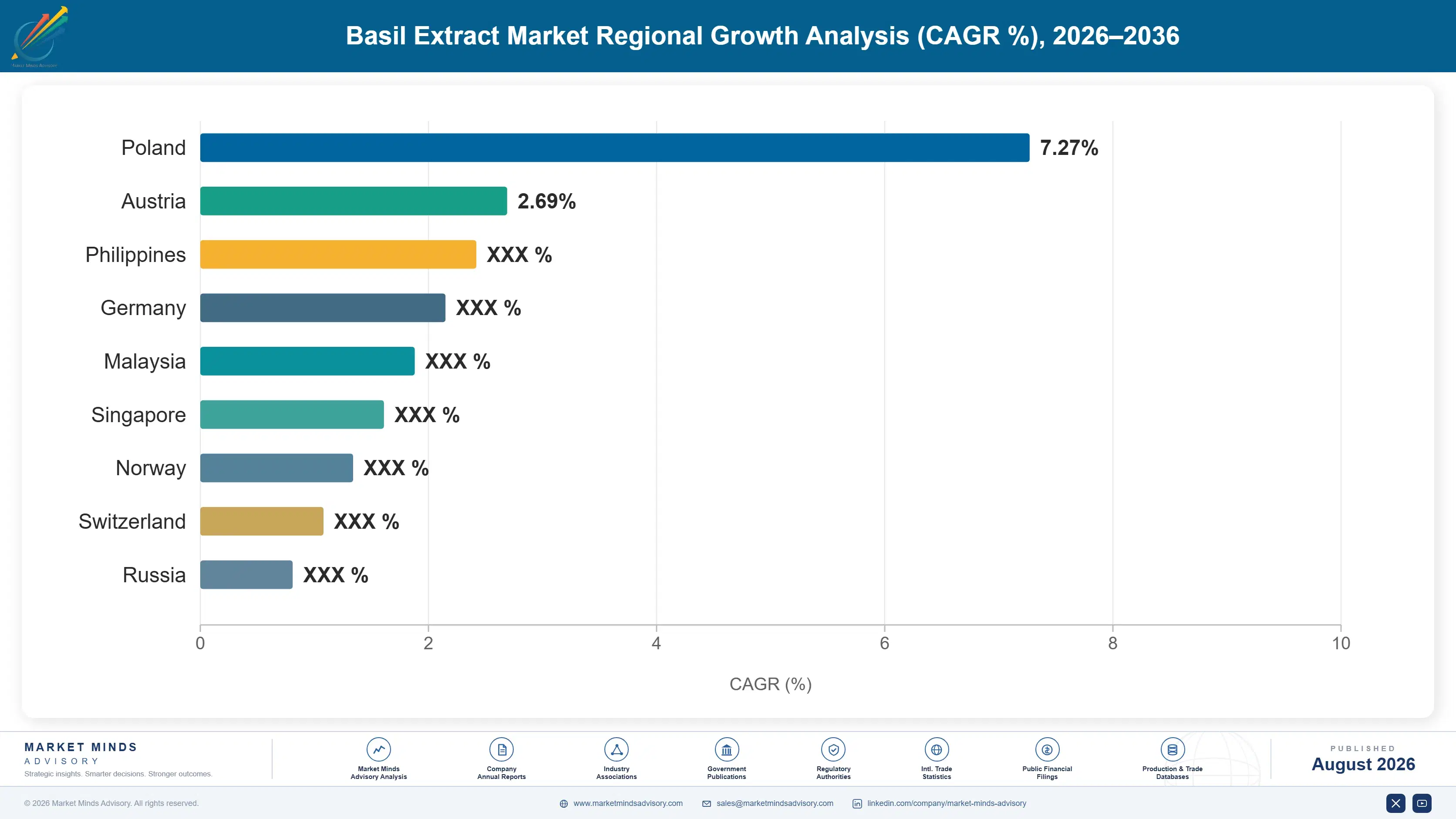
Regional Architecture and Country Demand Map

East Asia hosts the largest basil extract processing and formulation base, while South Asia supplies much of the raw cultivation and contract extraction volume feeding it. North America and Western Europe remain the largest consumption markets for both food-grade oleoresin and nutraceutical bioactive extract across both categories.

North America

The United States is the region's dominant consumer, absorbing basil extract through two channels: packaged food manufacturers reformulating sauces and seasonings under clean-label pressure, and a fast-growing dietary supplement sector specifying standardized anti-inflammatory basil extract. Nearly all US basil extract supply is imported, primarily from India and Vietnam, since domestic basil cultivation serves the fresh culinary herb market rather than industrial extraction. Canadian flavor houses re-export a modest volume of formulated basil-based flavor compounds into the US market. Mexico's growing packaged food sector is beginning to adopt natural basil flavor extract as clean-label reformulation trends spread beyond the United States into broader North American retail categories. US brand owners increasingly request country-of-origin documentation before finalizing new import contracts.
Share: 25% | CAGR: 7.9% (2026 to 2036)

Western Europe

France and Italy anchor Western European demand through established fragrance and culinary flavor industries, with Provence-region basil cultivation supplying a small but premium domestic extraction base alongside imported Indian and Egyptian oleoresin. The European Union's stringent pesticide residue testing regime, among the strictest globally, has pushed European buyers toward contract-farmed, traceable basil supply rather than open-market smallholder sourcing. Germany's flavor and fragrance manufacturing sector is a significant processor and re-exporter of finished basil-based flavor compounds to other European markets. Growth here trails the global average because European clean-label reformulation is already well advanced relative to other regions. Spain's smaller basil cultivation sector, concentrated in Andalusia, supplies a modest regional volume that supplements imported material during peak demand periods.
Share: 21% | CAGR: 5.9% (2026 to 2036)
Regional intelligence for 5 additional markets available in the complete report: East Asia, South Asia and Pacific, Latin America, Middle East and Africa, Eastern Europe. Contact sales@marketmindsadvisory.com.
basil-extract-market-trends-growth-country-cagr-analysis-1787462662573

Where Basil Extract Processors Can Capture Margin

Margin capture in basil extract increasingly depends on analytical documentation and traceable sourcing rather than raw export volume. Processors that can guarantee standardized bioactive content, verified pesticide-residue compliance, and contract-farmed leaf traceability are commanding meaningfully better pricing than those competing purely on cost per kilogram of oleoresin shipped. That shift favors vertically integrated processors over pure commodity exporters.

Standardized Bioactive Assay Certification for Buyers

Processors that certify basil extract to a guaranteed minimum ursolic acid or eugenol percentage, rather than selling on total extract weight, are capturing premium pricing from nutraceutical formulators under growing pressure to substantiate anti-inflammatory claims. Synthite Industries' standardized extract line, expanded in 2024, reportedly commands a 20 to 30 percent price premium over generic basil oleoresin sold without assay guarantees. Smaller Indian processors lacking in-house analytical testing capability are increasingly partnering with third-party labs to offer similar certification, adding cost but preserving access to nutraceutical accounts that now require documented potency before purchase.
Market Impact: Commands a 20 to 30 percent price premium

Contract-Farmed Traceable Leaf Supply for EU Compliance

Processors that contract-farm basil directly under documented, audited pesticide protocols, rather than buying from open-market smallholder aggregators, are avoiding the costly shipment rejections that hit several Indian exporters in 2024. Direct contract farming typically raises leaf procurement cost by 10 to 15 percent but eliminates the risk of a rejected shipment, which can destroy an entire container's value and disrupt customer relationships built over years. European buyers increasingly specify contract-farmed, traceable leaf origin as a purchase requirement rather than a preference, giving certified processors a durable pricing advantage over smallholder-supplied competitors.
Market Impact: Avoids shipment rejections that can cost over $5M

Supercritical CO2 Extraction for Premium Cosmetics Buyers

Investing in supercritical CO2 extraction equipment, which avoids the solvent residues of conventional hexane or ethanol extraction, lets processors serve premium cosmetics and high-end culinary oil buyers willing to pay for solvent-free positioning. Robertet's CO2 extraction line commands roughly double the price per kilogram of steam-distilled basil essential oil from comparable cultivation regions. Capital costs for CO2 extraction equipment typically exceed $2 million per processing line, a barrier that concentrates this higher-margin segment among larger, better-capitalized processors rather than smallholder-supplied regional aggregators competing purely on volume. Smaller processors without this capital access remain confined to lower-margin conventional extraction indefinitely.
Market Impact: Commands roughly 2x the price of steam-distilled oil

Bundled Regulatory Documentation for Smaller Brands

Bundling pesticide residue testing certificates and country-specific import documentation alongside the physical extract sale helps smaller food and supplement brands that lack in-house regulatory teams navigate European Union import requirements. Processors offering this bundled service report faster customer onboarding, often cutting new-account documentation timelines from several months to under 6 weeks. This service layer also raises effective per-kilogram pricing by an estimated 8 to 12 percent, since brands otherwise face compliance consulting costs that can run into the tens of thousands of dollars per shipment if handled independently. Smaller brands report this bundling alone justifies switching suppliers.
Market Impact: Raises effective pricing by 8 to 12 percent

Who Controls the Margin Pool

Five suppliers hold roughly a third of global basil extract capacity on a production-volume basis, leaving this market considerably more fragmented than most established flavor and fragrance categories. The gap between the largest flavor house and India's leading contract processors is narrow, since scale in raw extraction does not automatically translate into flavor-grade formulation expertise. That fragmentation keeps pricing competitive even among the largest suppliers.
Current competitive activity centers on three fronts: standardized bioactive certification to win nutraceutical contracts, contract farming investment to guarantee pesticide-compliant, traceable leaf supply for European buyers, and capital investment in supercritical CO2 extraction to serve premium cosmetics demand. Synthite Industries and Robertet have both announced capacity expansions in the past year targeting these higher-margin segments rather than commodity oleoresin.

Emerging pressure is coming from Vietnamese contract processors entering with lower labor costs and newly built analytical testing infrastructure, threatening India's traditional dominance in contract extraction volume. Rankings could shift meaningfully over the next several years if Vietnamese processors achieve the assay certification credibility that nutraceutical buyers currently associate mainly with established Indian and European suppliers. A single Vietnamese success story could accelerate that shift industry-wide within a few years.
basil-extract-market-trends-growth-company-positioning-matrix-1787462663101

Competitive Moat and Risk Dimensions

ROBERTET

Moat: Integrated Flavor Formulation Expertise

Robertet combines basil extraction with in-house flavor and fragrance formulation expertise, letting it sell finished flavor compounds rather than raw oleoresin to food and fragrance customers. That integration commands meaningfully higher margins than commodity extraction, and it gives Robertet direct customer relationships that pure extraction specialists in India and Vietnam typically lack.
ROBERTET

Risk: Higher European Cost Base

Robertet's European manufacturing base carries meaningfully higher labor and compliance costs than Indian or Vietnamese contract processors, limiting its ability to compete on price for commodity food-grade oleoresin. As nutraceutical buyers increasingly accept certified Asian-sourced standardized extract, Robertet's cost disadvantage on lower-margin volume could erode its traditional flavor-house positioning over time.
SYNTHITE INDUSTRIES

Moat: Largest Indian Contract Extraction Scale

Synthite Industries operates among the largest contract basil extraction capacity in India, giving it cost advantages on commodity oleoresin that smaller regional processors cannot match. Its scale also supports investment in analytical testing infrastructure that smaller Indian competitors lack, positioning it to capture standardized bioactive extract demand alongside its traditional commodity business.
SYNTHITE INDUSTRIES

Risk: Indian Pesticide Compliance Exposure

Synthite Industries sources meaningfully from open-market smallholder aggregators alongside its own contract farming, carrying residual exposure to the pesticide residue compliance failures that have triggered European shipment rejections industry-wide. A high-profile rejection tied to its supply chain could damage customer trust built over decades faster than its scale advantages could offset.

Players Tracked

Prominent Players

Robertet
Givaudan
Symrise
IFF
Synthite Industries

Other Key Players

Kalsec
Sabinsa
Indena
Martin Bauer Group
Ozone Naturals
Ultra International
Arjuna Natural
Universal Oleoresins
AOS Products
Berje Inc
Foodchem International
Katyani Exports
Fleurchem
Kanchan Aroma Ingredients
Now Health Group

Recent Developments

JUNE 2024

Synthite Industries Expands Standardized Extract Line

Synthite Industries expanded its standardized bioactive basil extract production line in June 2024, adding analytical testing capacity to guarantee minimum ursolic acid content on every batch shipped to nutraceutical customers, responding directly to growing demand for assay-verified anti-inflammatory formulation ingredients across its primary Indian manufacturing facilities.
Signal: Signals Indian processors are moving up the value chain into certified bioactive extract rather than commodity oleoresin.
NOVEMBER 2024

European Union Tightens Pesticide Residue Testing Requirements

European Union regulators tightened pesticide residue testing requirements for imported botanical extracts in November 2024, following several high-profile rejections of Indian basil oleoresin shipments earlier that year, raising compliance costs across the entire import supply chain for European food and fragrance buyers and prompting several exporters to reassess sourcing.
Signal: Signals compliance documentation is becoming a market access requirement rather than a competitive differentiator for exporters.
FEBRUARY 2025

Robertet Commissions New CO2 Extraction Facility

Robertet commissioned a new supercritical CO2 extraction facility in February 2025, expanding capacity specifically to serve premium cosmetics and high-end culinary oil buyers seeking solvent-free basil extract positioning ahead of growing demand from European skincare formulators and confirming the company's continued investment in higher-margin extraction technology.
Signal: Signals established flavor houses are investing in premium extraction technology to defend margin against Asian commodity competition.

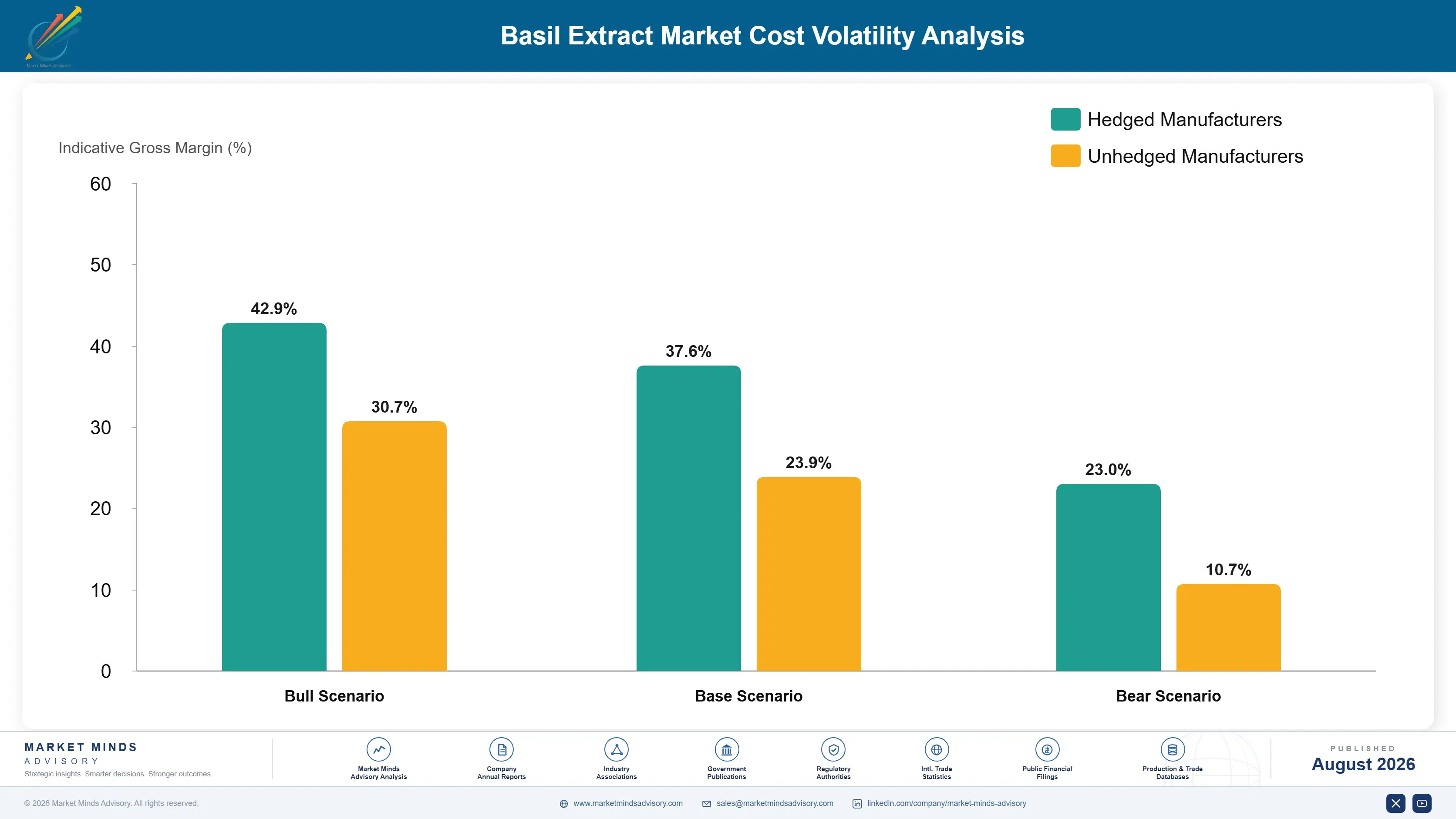
Basil Leaf and Labor Cost Exposure

Fresh basil leaf, the primary feedstock for oleoresin and essential oil extraction, accounts for roughly thirty-eight percent of total production cost across the industry. Leaf supply originates predominantly from India, Egypt, and increasingly Vietnam, where contract and smallholder farming coexist, and labor costs for hand-harvesting basil, which cannot be efficiently mechanized at scale, add a second significant cost component beyond raw leaf pricing itself.
Several Indian basil oleoresin shipments were rejected at European ports in 2024 after pesticide residue testing revealed levels above permitted thresholds, according to industry trade reporting and processor disclosures, disrupting supply for food manufacturers running just-in-time contracts. The rejections reportedly cost affected exporters several million dollars combined in destroyed or returned inventory, and buyers subsequently began requiring more extensive residue testing documentation before accepting new shipments.

Smaller processors sourcing leaf from open-market smallholder aggregators carry meaningfully more pesticide compliance and quality-consistency risk than larger, vertically integrated processors like Synthite Industries or Robertet that contract-farm directly under documented protocols. European buyers increasingly price this risk differential explicitly, paying a premium for traceable, contract-farmed material over open-market sourced oleoresin of otherwise similar quality and origin.
basil-extract-market-trends-growth-cost-volatility-analysis-1787462663300

Contract-Farm Basil Under Documented Pesticide Protocols

Processors are shifting away from open-market smallholder leaf purchases toward direct contract farming with documented, audited pesticide application protocols, reducing the compliance risk that triggered several 2024 European shipment rejections. This approach requires upfront investment in farmer relationships and monitoring infrastructure but has measurably reduced rejection rates for processors that implemented it before the regulatory tightening.

Diversify Leaf Sourcing Across India, Egypt, and Vietnam

Processors are qualifying basil leaf supply from India, Egypt, and Vietnam simultaneously rather than relying on a single growing region, reducing the odds that one poor monsoon season or regulatory disruption cuts total feedstock availability. This diversification adds logistics complexity but has kept extraction costs more stable for processors that adopted it early on.

Invest in In-House Pesticide Residue Testing Labs

Building in-house pesticide residue testing capability reduces reliance on slower third-party certification while still meeting European buyer documentation requirements before shipment. Processors that built this capability ahead of the 2024 enforcement tightening are now winning contracts faster than competitors still waiting on external lab turnaround times running several weeks and safeguarding against future compliance disruptions.

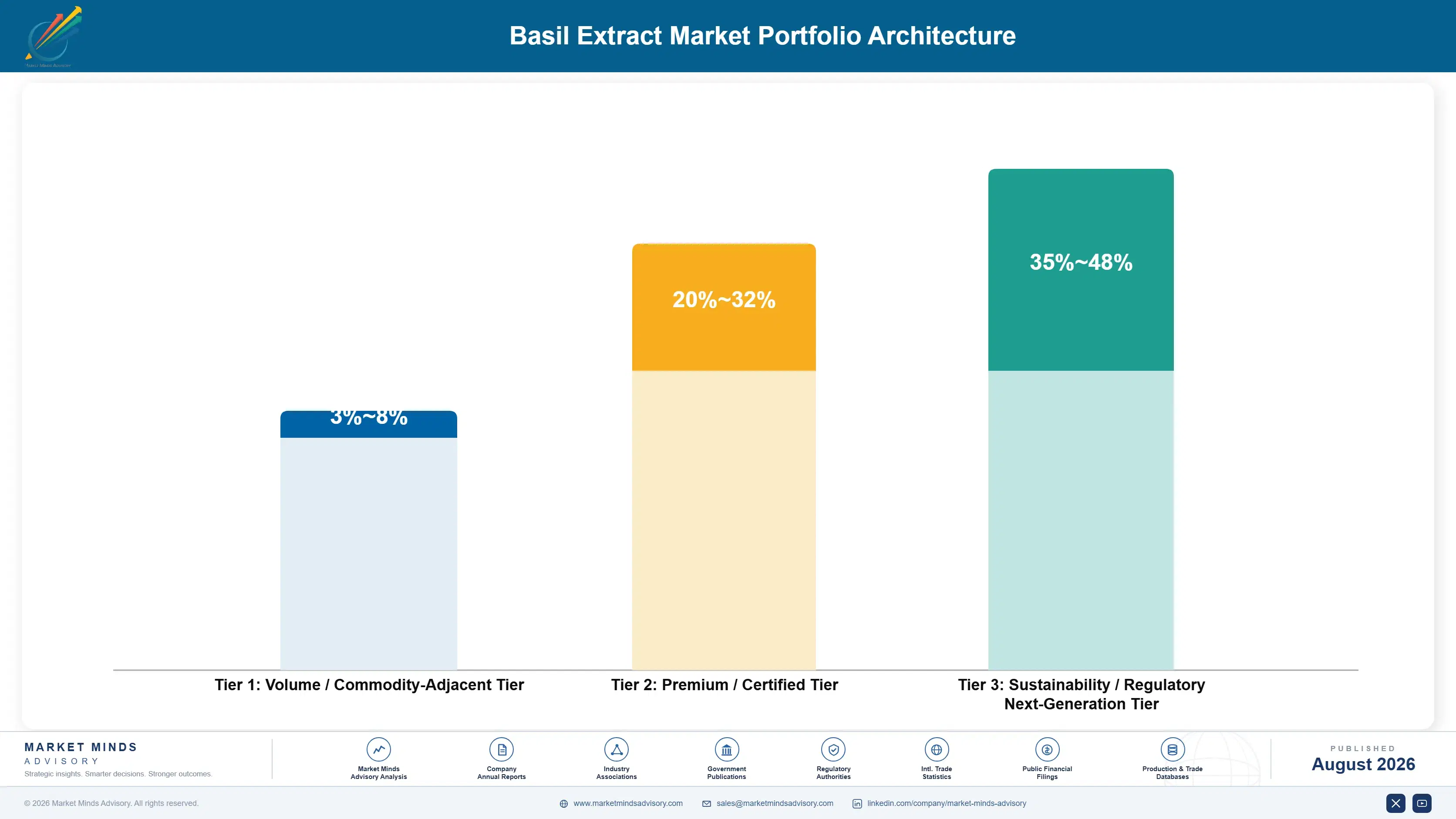
Portfolio Architecture for Margin Defence

Basil extract processors operate a three-tier portfolio spanning commodity oleoresin sold on cost per kilogram into mainstream food and flavor applications, certified standardized bioactive extract commanding premium pricing from nutraceutical formulators, and CO2-extracted or contract-farmed traceable material positioned for the highest-margin cosmetics and premium nutraceutical accounts. Gross margins vary sharply across these tiers, from thin single digits on commodity oleoresin to well above forty percent on certified CO2-extracted or standardized bioactive material.
The volume versus premium tension is intensifying as more processors chase nutraceutical margins, but commodity oleoresin still represents the majority of shipped volume and remains essential for covering fixed extraction costs and maintaining processing plant utilization across the industry's seasonal harvest cycle. Processors that pursue premium accounts too aggressively risk underutilizing extraction capacity sized for larger commodity volumes.

High-value margin pools concentrate specifically in standardized bioactive extract sold to nutraceutical formulators and CO2-extracted material supplying premium cosmetics brands willing to pay for documented potency and solvent-free positioning respectively. Commodity food-grade oleoresin remains the volume anchor but carries the thinnest margins, squeezed further by Vietnamese processors entering on price alone across nearly every commodity account.

Volume / Commodity-Adjacent Tier

Commodity basil oleoresin and essential oil sold primarily on cost per kilogram into mainstream sauces, seasonings, and fragrance compounding, where price competition among Indian and Vietnamese processors is intense and quality differentiation is limited.
Gross Margin: 3-8%

Premium / Certified Tier

Standardized bioactive extract certified to a guaranteed minimum ursolic acid or eugenol content, sold into nutraceutical and anti-inflammatory supplement formulations, increasingly required by brands facing retailer and regulatory documentation pressure.
Gross Margin: 20-32%

Sustainability / Regulatory / Next-Generation Tier

Supercritical CO2-extracted and contract-farmed, traceable material positioned for premium cosmetics, high-end culinary oil, and pesticide-compliance-sensitive European nutraceutical buyers willing to pay the category's highest per-kilogram prices Capital intensity keeps this tier concentrated among a handful of larger processors.
Gross Margin: 35-48%
basil-extract-market-trends-growth-portfolio-architecture-1787462663806

High-value Sub-segments and Strategic Watch-out

Standardized Bioactive Nutraceutical Extract

Assay-certified basil extract guaranteeing minimum ursolic acid or eugenol content is capturing premium nutraceutical pricing as anti-inflammatory supplement brands mirror the potency standardization already common in turmeric and green tea extract categories. Indian and Vietnamese processors with in-house testing infrastructure are best positioned to capture this demand as it scales.
Gross Margin: 20-32%

CO2-Extracted Premium Cosmetics Material

Solvent-free supercritical CO2 extraction is gaining share in premium skincare and high-end culinary oil applications as formulators pay for cleaner-label positioning, though capital costs keep this segment concentrated among larger processors like Robertet. Adoption is likely to broaden as extraction equipment costs gradually decline over the next several years.
Gross Margin: 35-48%

Commodity Food and Flavor Oleoresin

Standard oleoresin sold into mainstream sauces and seasonings remains the category's volume core, anchored by established flavor house relationships but facing intense price competition from Vietnamese processors entering the market on cost. Most incumbents defend share through long-standing customer relationships rather than active price competition.
Gross Margin: 3-8%

Uncertified Smallholder-Sourced Material

Basil extract sourced from open-market smallholder aggregators without documented pesticide protocols faces rising rejection risk as European buyers tighten residue testing, making this a segment processors should actively move away from. Several processors still selling on this basis have already lost major European accounts within the past year.
Gross Margin: 1-5%

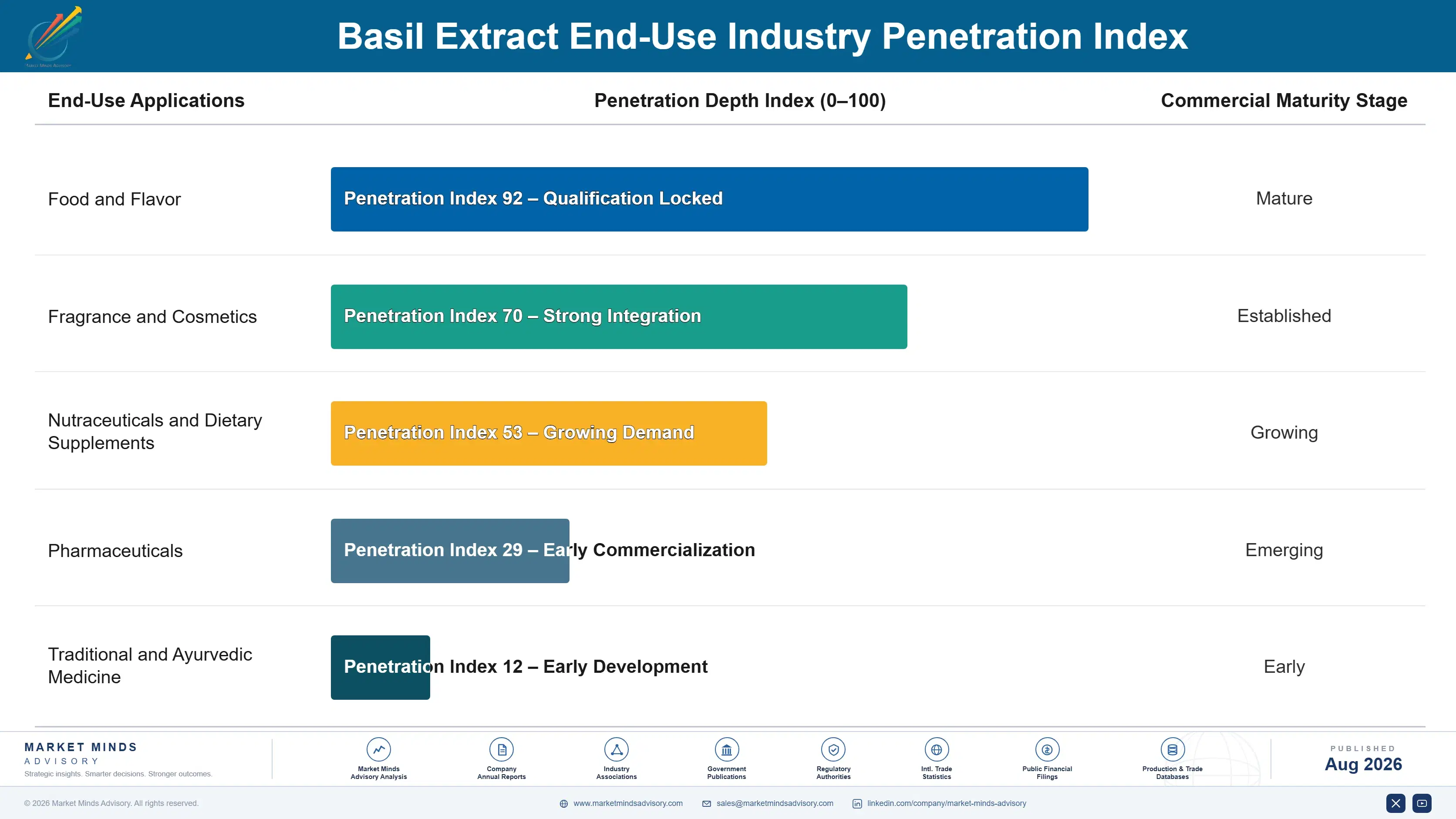
Basil Extract's Formulation Lock-In Economics

Basil extract behaves like an annuity ingredient once a formulator qualifies a supplier's material into a flavor compound or supplement formulation, because switching suppliers means requalifying flavor profile consistency or, for nutraceutical products, re-running bioactive content substantiation. That inertia gives incumbent processors multi-year revenue visibility, particularly with flavor houses that build proprietary compounds around a specific basil extract's aromatic profile. That lock-in can persist for a decade or more once a flavor house standardizes a signature blend around one supplier's material.
Adoption depth varies by end-use vertical. Nutraceutical brands reformulate around new, better-certified basil extract sources relatively quickly when documentation gaps emerge, while packaged food manufacturers move far more slowly given the cost of requalifying an established flavor compound already embedded across multiple retail SKUs and production lines. Contract manufacturers serving both channels increasingly maintain separate qualification pipelines to match each customer's pace.

Generational buyer shifts show up mainly in the supplement and cosmetics channels, where younger brand founders favor traceable, contract-farmed and CO2-extracted material specifically for its clean-label positioning, while legacy flavor houses remain anchored to established Indian smallholder supply chains built over decades of stable, lower-cost sourcing relationships and personal trust.
basil-extract-market-trends-growth-end-use-penetration-index-1787462664298

Where Basil Extract Value Will Concentrate

These are among the four positions where our research anticipates prominent divergence between winners and laggards over the coming forecast period. Each is grounded in the demand model, the regulatory perimeter, and the announced capacity pipeline.
01 / BIOACTIVE CERTIFICATION INVESTMENT

Standardized potency certification will separate premium from commodity suppliers

Nutraceutical formulators increasingly specify a guaranteed minimum ursolic acid or eugenol percentage rather than accepting generic extract sold on total weight, and that requirement is spreading fast across the anti-inflammatory supplement category. Processors without in-house or third-party analytical testing capability risk being relegated permanently to lower-margin commodity oleoresin supply, regardless of how competitive their raw leaf costs look today relative to certified competitors. MMA recommends investing in assay certification capability now, before standardized potency documentation becomes a baseline market access requirement rather than a premium differentiator.
02 / CONTRACT FARMING COMPLIANCE

Shift to contract-farmed leaf ahead of tighter EU enforcement

European Union pesticide residue enforcement tightened meaningfully in 2024 after several high-profile rejections of Indian basil oleoresin shipments, and further tightening is widely expected across the industry. Processors still relying on open-market smallholder aggregation carry real rejection risk that contract-farmed, documented supply chains have already largely eliminated for early-moving competitors. MMA recommends processors without contract farming infrastructure build it now, since the cost of a single rejected shipment can exceed the multi-year investment required to establish audited, traceable leaf supply.
03 / CO2 EXTRACTION CAPACITY

Build supercritical CO2 capacity for premium cosmetics demand

Supercritical CO2 extraction commands roughly double the price of steam-distilled basil essential oil among premium cosmetics and high-end culinary oil buyers seeking solvent-free positioning, and demand from this channel is growing faster than commodity flavor applications. Capital costs exceeding two million dollars per processing line have kept this segment concentrated among larger, better-capitalized processors, limiting competitive pressure on early movers for several more years. MMA recommends processors with sufficient capital evaluate CO2 extraction investment now, while the technology still commands a meaningful pricing premium over conventional extraction methods.
04 / VIETNAMESE SUPPLY DIVERSIFICATION

Diversify sourcing toward Vietnam ahead of Indian cost inflation

India's rising domestic Ayurvedic and traditional medicine demand is absorbing a growing share of domestic basil production, tightening export volume and contributing to gradual price increases for Western buyers reliant on Indian oleoresin. Vietnamese contract processors are scaling extraction capacity and analytical testing infrastructure quickly, offering a credible alternative sourcing base for buyers seeking to reduce dependence on a single origin country. MMA recommends buyers begin qualifying Vietnamese suppliers now, before Indian export tightening forces a rushed, less favorable transition under supply pressure.

Engagement Snapshot From the Field

A live engagement with an industry participant carrying material or product regulatory and market exposure ahead of a defining policy shift, showing how our research translates into a defensible multi-year portfolio strategy.
MARKET MINDS ADVISORY · CLIENT ENGAGEMENT SUMMARY
Basil Extract Producer Strategic Portfolio Review and Transition Roadmap 2026·Investment Scenario on Basil Extract Exposure Evaluation 2025-26
CLIENT PROFILE
The client is a mid-sized European packaged food manufacturer generating an estimated one hundred twenty million dollars in annual revenue (client-reported, unverified by MMA), with a product portfolio concentrated in premium pasta sauces and salad dressings. The client had sourced basil oleoresin from a single open-market Indian aggregator for over four years when a shipment was rejected at a European port for pesticide residue levels above permitted thresholds.
STRATEGIC CHALLENGE
The rejected shipment halted production of the client's flagship sauce line for nearly three weeks while the client sourced emergency replacement material at a significant price premium. Facing continued exposure to smallholder-sourced supply risk, the client needed to identify a contract-farmed, documented basil supplier capable of meeting European pesticide residue requirements without disrupting its existing flavor profile.
MMA APPROACH
MMA conducted a structured evaluation of contract-farmed basil suppliers across India, Egypt, and Vietnam, benchmarking pesticide compliance documentation, flavor profile consistency, and pricing against the client's existing formulation. The engagement included direct supplier facility assessments and a blind flavor-matching trial to confirm the recommended replacement material would not require reformulating the client's established sauce recipe.
KEY FINDINGS
  1. The incumbent aggregator could not provide documented pesticide application records for the specific smallholder farms supplying the rejected shipment, a gap that had persisted undetected for years.
  2. Switching to a contract-farmed Vietnamese supplier added roughly eight percent to per-kilogram leaf cost but eliminated the rejection risk that had disrupted production for three weeks.
  3. Two of the four evaluated suppliers could not match the client's existing flavor profile closely enough to avoid a costly product reformulation and relabeling process.
  4. The client's new supplier relationship also reduced average delivery lead time by roughly two weeks compared with the previous aggregator arrangement (client-reported, unverified by MMA).
CLIENT PROFILE
The client is a mid-sized European packaged food manufacturer generating an estimated one hundred twenty million dollars in annual revenue (client-reported, unverified by MMA), with a product portfolio concentrated in premium pasta sauces and salad dressings. The client had sourced basil oleoresin from a single open-market Indian aggregator for over four years when a shipment was rejected at a European port for pesticide residue levels above permitted thresholds.
STRATEGIC CHALLENGE
The rejected shipment halted production of the client's flagship sauce line for nearly three weeks while the client sourced emergency replacement material at a significant price premium. Facing continued exposure to smallholder-sourced supply risk, the client needed to identify a contract-farmed, documented basil supplier capable of meeting European pesticide residue requirements without disrupting its existing flavor profile.
MMA APPROACH
MMA conducted a structured evaluation of contract-farmed basil suppliers across India, Egypt, and Vietnam, benchmarking pesticide compliance documentation, flavor profile consistency, and pricing against the client's existing formulation. The engagement included direct supplier facility assessments and a blind flavor-matching trial to confirm the recommended replacement material would not require reformulating the client's established sauce recipe.
KEY FINDINGS
  1. The incumbent aggregator could not provide documented pesticide application records for the specific smallholder farms supplying the rejected shipment, a gap that had persisted undetected for years.
  2. Switching to a contract-farmed Vietnamese supplier added roughly eight percent to per-kilogram leaf cost but eliminated the rejection risk that had disrupted production for three weeks.
  3. Two of the four evaluated suppliers could not match the client's existing flavor profile closely enough to avoid a costly product reformulation and relabeling process.
  4. The client's new supplier relationship also reduced average delivery lead time by roughly two weeks compared with the previous aggregator arrangement (client-reported, unverified by MMA).
RECOMMENDED STRATEGY
Phase 1: Phase 1 (Weeks 1 to 3): Benchmark contract-farmed suppliers across India, Egypt, and Vietnam against pesticide documentation, pricing, and flavor consistency requirements. Phase 2: Phase 2 (Weeks 4 to 6): Conduct blind flavor-matching trials with the top two suppliers and confirm formulation compatibility without recipe changes. Phase 3: Phase 3 (Weeks 7 to 10): Execute supplier transition, formalize contract-farming documentation requirements, and resume full production volume across all affected product lines.
OUTCOME
The client resumed full production within ten weeks of the initial rejection and avoided an estimated four million dollars in annual revenue exposure from continued line disruption (client-reported, unverified by MMA). The new contract-farmed supplier relationship also gave the client documentation it could present proactively to European retail customers auditing pesticide compliance.

Frequently Asked Questions

Foundational context covering the market sizes, CAGR, scope, country, region and competition that inform every finding below. This section is provided to cover basics and most often pre-purchase conversations, answered from the MMA Primary Research Dataset.

What is the current size of the Basil Extract Market?

The global basil extract market is valued at approximately $0.42 billion in 2025. Growth is driven by clean-label food reformulation alongside rising nutraceutical demand for standardized bioactive extract.

How large will the Basil Extract Market be by 2036?

MMA projects the market will reach approximately $0.91 billion by 2036, roughly doubling from its 2026 base value. Standardized bioactive extract will account for a growing share of that expansion.

What is the CAGR for the Basil Extract Market 2026 to 2036?

The market is expected to grow at a compound annual growth rate of 7.3% between 2026 and 2036. Bull and bear scenarios range from 6.1% to 8.5% depending on regulatory and harvest conditions.

Which segment is growing fastest?

Standardized bioactive basil extract is the fastest-growing segment, expanding at roughly 10.6% annually, about 1.45 times the overall market rate. Nutraceutical formulators increasingly require guaranteed minimum bioactive content.

Who are the major companies in the Basil Extract Market?

Robertet, Givaudan, Symrise, IFF, and Synthite Industries lead global supply on a production-volume basis. The top five suppliers together hold roughly a third of global capacity.

Which country is growing fastest?

Vietnam is growing fastest, as contract processors build analytical testing infrastructure and capture nutraceutical and food-grade demand shifting away from India. Regional capacity expansion is reinforcing this growth.

Report Segmentation Architecture

The full report scope spans multiple orthogonal segmentation dimensions, with cross-tabulated demand data provided for each dimension pair. Coverage extends further to regional breakdowns, trend trajectories, and the competitive detail needed to support segment-level decision-making.

By Extraction Method

  • Essential Oil
  • Oleoresin
  • CO2 Extract
  • Standardized Bioactive Extract
  • Powdered Dried Extract
  • Water-Soluble Extract

By End-Use Industry

  • Food and Flavor
  • Fragrance and Cosmetics
  • Nutraceuticals and Dietary Supplements
  • Pharmaceuticals
  • Traditional and Ayurvedic Medicine

By Commercial Dimension

  • Certified Standardized Material
  • Standard Grade Material
  • Contract-Farmed Traceable Supply
  • Open-Market Sourced Supply

By Region

  • North America
  • Western Europe
  • East Asia
  • South Asia and Pacific
  • Latin America
  • Middle East and Africa
  • Eastern Europe

Scope, Methodology, and Coverage

Every figure in this report is reproducible from documented input assumptions. The scope below maps the historical period, the forecast horizon, the segmentation dimensions, and the countries covered, alongside the underlying primary and qualitative methodology.
Historical Period
2020 to 2025
Forecast Period
2026 to 2036
Base Year
2025 (USD billions; MMA Primary Research Dataset, August 2026)
Market Definition
The basil extract market covers oleoresin, essential oil, standardized bioactive extract, and powdered dried extract derived from Ocimum basilicum and related basil species, sold into food and flavor, fragrance and cosmetics, and nutraceutical applications. It excludes fresh or dried whole basil leaf sold without extraction processing, and excludes basil-based finished consumer products such as packaged pesto or seasoning blends.
Quantitative Units
USD billions (current prices); metric tons of basil extract where applicable
Segmentation Dimensions
By Extraction Method; By End-Use Industry; By Commercial Dimension; By Region
Regions Covered
North America, Western Europe, East Asia, South Asia and Pacific, Latin America, Middle East and Africa, Eastern Europe
Countries Covered
USA, China, Germany, France, UK, Japan, South Korea, India, Australia, Canada, Brazil, Mexico, Indonesia, Vietnam, Thailand, Malaysia, UAE, Saudi Arabia, South Africa, Nigeria, Turkey, Poland, Netherlands, Italy, Spain, Sweden, Switzerland, Argentina, Colombia, Singapore, and additional markets relevant to this sector
Key Companies Profiled
Robertet, Givaudan, Symrise, IFF, Synthite Industries, Kalsec, Sabinsa, Indena, Martin Bauer Group, Ozone Naturals, Ultra International, Arjuna Natural, Universal Oleoresins, AOS Products, Berje Inc, Foodchem International, Katyani Exports, Fleurchem, Kanchan Aroma Ingredients, Now Health Group
Quantitative Methodology
Primary survey, n=3,800 respondents, Q4 2025, six countries; demand-side model with trade association cross-validation
Qualitative Methodology
47 expert interviews, Q4 2025; applied to validate demand model assumptions, identify emerging dynamics, and assess competitive positioning
Report Format
PDF and XLSX data workbook (Word format preview document)
Publisher
Market Minds Advisory
Report Code
MMA-2026-AGR-102
Published
August 2026
Contact
sales@marketmindsadvisory.com | www.marketmindsadvisory.com

Purchase the full Basil Extract Market Report (2026 to 2036).

This report delivers a complete assessment of the global basil extract market across all major extraction methods, end-use industries, and geographic regions through 2036. It includes detailed competitive profiling of twenty companies, segmentation analysis distinguishing essential oil, oleoresin, CO2 extract, standardized bioactive extract, powdered extract, and water-soluble extract, and regional demand modeling across all seven MMA-covered geographies. Buyers will find quantified forecasts for market size, segment growth rates, and regional CAGR alongside qualitative analysis of pesticide compliance risk, contract farming trends, and bioactive standardization requirements. A dedicated revenue lever framework identifies four specific commercial actions processors can take to capture margin as nutraceutical demand accelerates.
Twenty-company competitive profiling with moat and risk analysis
Seven-region demand model with justified share and CAGR bands
Extraction-method segmentation across six MECE categories
Quantified revenue lever framework for margin capture strategies
Pesticide compliance and input cost exposure analysis
Anonymized case study on contract-farming supplier transition

Built For The People Who Decide

From boardroom strategy to bench-side execution, this report is read cover-to-cover by leaders shaping the next decade of their industry, turning demand scenarios, market dynamics and valuation benchmarks into decisions.
CXOs/ Presidents/ VPs/ Managers
M&A and Corporate Development
Strategy Teams and R&D Heads
Procurement and Product Directors
Regulatory and Compliance Leaders
Investor Relations and Equity Analysts