Market Minds Advisory
Korea Base Station Antenna Market

Korea Base Station Antenna Market: Korea Base Station Antenna Market: Site Scarcity, Tower Loading Limits and Three Operators Buying Together 2026 to 2036

Korea has three operators, dense cities and almost nowhere left to put an antenna. Weight and wind load on existing structures now decide product specifications more reliably than radio performance does.

Lead Analyst

Published

September 2026

Make Smarter Decisions with Customized Research Insights

Request a free sample report and evaluate market opportunities, growth trends, and competitive dynamics relevant to your business needs.

2025 MARKET VALUE$0.4BMarket Size 2025
2036 FORECAST VALUE$0.9BBase Case , 2026 to 2036
CAGR 2026 TO 20366.7 %Bull 7.9% / Bear 5.5%
INCREMENTAL OPPORTUNITY$0.4BNet 10- year value creation
EXPANSION MULTIPLE1.91x2036 value over 2026 base
Strategic Levers
M&A Pipeline
Regional Outlook
Country Rankings
Competitive Intelligence
Segmental Deep-dive
Call-Us : 91 93563 13602

Executive Snapshot and Market Trajectory.

Korea has three mobile operators, extremely dense cities and almost nowhere left to put an antenna. Weight and wind load on existing structures now decide product specifications more reliably than radio performance ever does in a tender. Around 73% of Korean sites already sit at or near capacity.
The market reaches USD 0.45 billion in 2026 and USD 0.87 billion by 2036, a 1.91 times expansion at 6.7% annually across Korean deployments. Multiband consolidation antennas grow at 10.1%, half again the market rate of 6.7%, because replacing four antennas with one is the only way to add bands on a full structure. Vietnam-sourced supply compounds fastest at 11.4%. Site acquisition takes around 14 months.
Five suppliers hold 81% of Korean base station antenna value, which is extremely high and reflects operator qualification rather than any radio design advantage. KMW, Ace Technologies, Kathrein, Ericsson and Samsung Electronics lead. Structural loading limits decide what an operator can physically deploy at a site. A multiband consolidation antenna typically replaces four legacy units, which is the only way to add bands to a structure already carrying everything it can safely hold.
Market Definition
This report covers base station antennas deployed across Korea: passive multiband macro antennas, active antenna units integrating radio and array, multiband consolidation antennas replacing multiple legacy units, small cell and street level antennas, in-building distributed antenna equipment, and the mounting, tilt control and site engineering hardware supplied with them. It excludes radio access network baseband equipment, transmission and backhaul systems, tower and mast structures, mobile handsets and customer premises equipment, and satellite ground terminals.
Base Year Value
$0.4B in 2025 (MMA Primary Research Dataset, September 2026)
Forecast Period
2026 to 2036, eleven discrete annual values
CAGR
6.7% base case. Bull 7.9%. Bear 5.5%.
Fastest Growth Segment
Multiband Consolidation Antennas: 10.1% CAGR
Fastest Growth Country
Vietnam: 11.4% CAGR
Fastest Growth Region
South Asia and Pacific: 8.7% CAGR
Largest Region
East Asia: 61% of 2025 global value
Market Leaders
KMW, Ace Technologies, Kathrein, Ericsson and Samsung Electronics lead on Korean base station antenna value. Source: MMA Analysis.
Primary Survey
n=3,800 procurement and R&D decision-makers, Q4 2025, six countries
Methodology
Demand-side build-up, cross-validated against public data, 47 expert interviews

Korea Base Station Antenna Market Forecast Scenarios

base-station-antenna-industry-analysis-in-korea-size-forecast-scenario-1790000777037
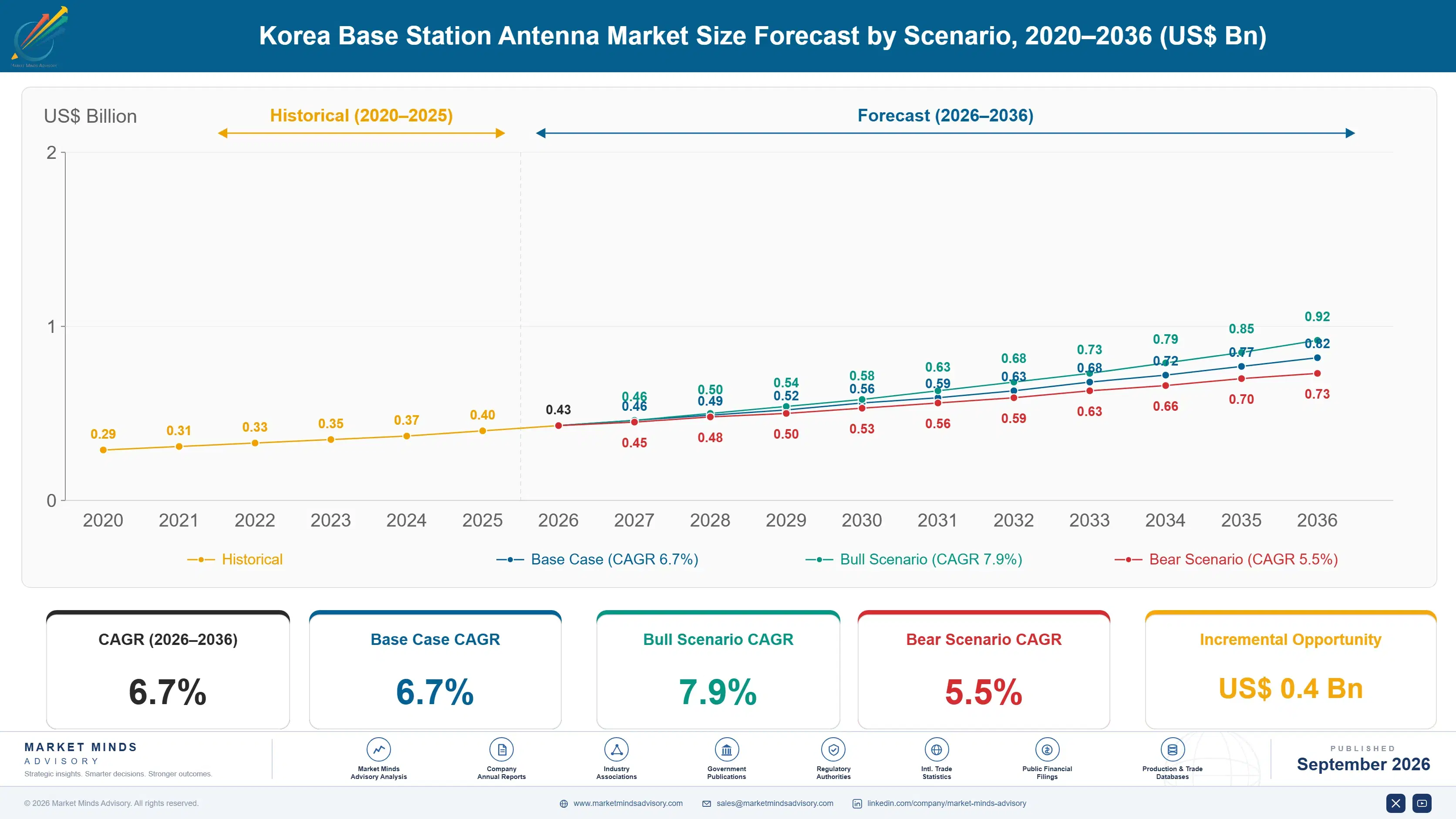
Between 2020 and 2025 the category compounded at 5.6%, driven by the fifth generation build rather than by any site expansion. Korean operators added bands and capacity onto structures they already held, because acquiring new rooftop and tower positions in dense cities had become slow and expensive. The result was a market where antenna count barely grew while the value of each unit rose considerably.
The base case holds 6.7% on three mechanisms. Multiband consolidation keeps replacing legacy units because operators cannot add bands to loaded structures any other way. Vietnam-based manufacturing keeps taking supply share from Korean and European plants at equivalent quality. And the fifth generation equipment installed from 2019 keeps approaching replacement across an installed base that was deployed unusually quickly and will therefore age together. Those three mechanisms run largely independently of one another.
The bull case at 7.9% assumes sixth generation trials require new higher frequency arrays that existing structures cannot host, forcing genuine site acquisition. The bear case at 5.5% is operator capital discipline, where three operators facing flat subscriber revenue extend equipment life and defer consolidation projects that carry no revenue benefit against their current network performance.

Nowhere Left To Mount

Physics rather than technology sets the constraint. Around 73% of Korean sites sit at or near structural weight and wind capacity, and securing a new urban rooftop position takes about 14 months when it is possible at all. An operator wanting to add a band therefore has one realistic option: remove antennas and replace them with fewer, heavier, more capable ones. Radio performance matters, and it matters second.
TOP FIVE CONCENTRATION81%Extremely high, reflecting operator qualification rather than radio design
LOADED STRUCTURE SHARE73%Existing sites at or near structural weight and wind capacity
SITE ACQUISITION PERIOD14 monthsTypical time to secure a new urban rooftop position
ANTENNAS REPLACED PER CONSOLIDATION4Legacy units removed for each multiband consolidation antenna installed
OPERATOR COUNT3Mobile network operators procuring antennas across the Korean market
EQUIPMENT SERVICE LIFE12 yearsTypical antenna service life before replacement rather than retuning
Consolidation is the whole growth story. A multiband consolidation antenna typically replaces four legacy units, which is the only way to add capability to a structure already carrying its limit. Multiband consolidation antennas grow at 10.1% against 6.7% for the market. Unit volumes barely move while value per unit rises, which is why a market with essentially flat antenna counts still compounds at a respectable rate.
Three buyers set everything. Korea has three mobile operators, and qualification with each is what determines whether a supplier competes at all. Five suppliers hold 81% of value on that basis, which is extremely high even by telecommunications standards. A supplier losing qualification at one operator loses a third of the addressable market immediately, with no smaller customers to fall back on anywhere.
"I have watched Korean operators reject antennas that performed better because the structural engineer said the rooftop would not take the weight. That is the actual purchasing criterion in this market and almost no supplier datasheet leads with mass and wind area."
Director, Wireless Infrastructure and Network Equipment Practice · MMA Technology Practice · September 2026

Market Trends

Structural Loading Decides What Operators Can Deploy

Around 73% of Korean sites sit at or near structural weight and wind capacity, and securing a new urban rooftop position takes about 14 months when it is achievable at all. An operator wanting to add a band therefore removes antennas rather than adding them, which makes mass and wind area the deciding specification. Suppliers whose datasheets lead with radio performance are answering the second question while a structural engineer answers the first one for them. Suppliers with domestic structural engineering presence resolve loading questions within a deployment schedule while distant competitors wait on headquarters for an answer.
Market Impact: Vietnam supply compounds at 11.4%

Consolidation Raises Unit Value Without Adding Volume

A multiband consolidation antenna typically replaces four legacy units, which is the only route to adding capability on a structure already at its limit. Multiband consolidation antennas grow at 10.1% against 6.7% for the market as a direct result. Antenna counts across Korea barely move while value per unit rises considerably, which is why a market with flat physical deployment still compounds at a respectable rate that volume figures entirely conceal. Operators facing flat subscriber revenue nonetheless approve these projects on operational grounds rather than on any capability argument the supplier presents.
Market Impact: Service life runs 12 years

Market Opportunities and Growth Drivers

Vietnam Manufacturing Displaces Korean And European Supply

Vietnam-sourced supply compounds at 11.4%, faster than any other origin serving Korean operators, because manufacturing cost sits materially below Korean and European plants at genuinely equivalent quality and qualification. Korean suppliers have themselves moved production there rather than losing the cost comparison entirely. Operators facing flat subscriber revenue across three competing networks apply that pressure directly, and antenna manufacturing has proved considerably easier to relocate than radio design work. Radio design has stayed where it was while assembly moved, which tells you which part of the product actually carries the differentiation.
Market Impact: Only 3 operators buy anything

Fifth Generation Equipment Ages Together Toward Replacement

Korean operators deployed fifth generation equipment unusually quickly from 2019, which means the installed base reaches a typical 12 year service life within a compressed window rather than spread across a decade. That creates a replacement wave larger than steady-state renewal would produce. Operators facing it are consolidating rather than replacing like for like, since the structures those antennas sit on have not gained any capacity in the meantime. Consolidation rather than like-for-like replacement is what those structures can physically accept when the wave arrives. Structures gained no capacity meanwhile.
Market Impact: Life stretches beyond 12 years

Market Restraints and Challenges

Three Buyers Leave No Fallback For Suppliers

Korea has three mobile operators and qualification with each determines whether a supplier competes at all, so losing one removes a third of the addressable market immediately. The root cause is that no smaller carriers, enterprise networks or regional operators exist to absorb displaced supply. Commercially this makes qualification loss close to fatal. Mitigation runs through multi-operator qualification maintained deliberately, through export supply from Korean plants, and through in-building and private network segments. None of those replaces a lost operator; they reduce how much a single qualification decision can destroy.
Market Impact: Some 73% of sites are loaded

Capital Discipline Defers Consolidation Without Revenue

Three operators competing for a saturated subscriber base face flat revenue, which makes consolidation projects delivering capability rather than income difficult to approve. The root cause is that consolidation improves what a network could carry rather than what subscribers currently pay for. Commercially this stretches replacement cycles. Mitigation runs through operational cost cases built on site rental and power, through phased consolidation at renewal points, and through vendor financing arrangements. Site rental, power and structural reinforcement avoided is the case that actually reaches an approval committee. Capability arguments reach nobody.
Market Impact: Each consolidation replaces 4 units
3 additional market trends, 4 additional growth drivers, and 2 additional restraints and challenges are covered in the full report. Contact sales@marketmindsadvisory.com to access the complete intelligence.

Segment CAGR and Growth Architecture

Segmentation follows antenna class and deployment context, since each carries quite different structural loading, qualification burden and operator buying behaviour. Six classes cover the market: multiband consolidation antennas, active antenna units, small cell and street level antennas, passive multiband macro antennas, in-building distributed antenna equipment, and mounting, tilt control and site engineering hardware. Operator and channel sit elsewhere.
base-station-antenna-industry-analysis-in-korea-market-share-analysis-1790000777570

Multiband Consolidation Antennas

Multiband consolidation antennas grow at 10.1%, half again the market rate of 6.7%, because around 73% of Korean sites sit at or near structural capacity and replacing four legacy units with one is the only way to add bands to a loaded structure. Site acquisition takes about 14 months when it is possible at all, which removes the obvious alternative. These units carry considerably higher value than the antennas they replace, so revenue grows while physical deployment counts across the country barely move at all. Value per unit rises steeply while physical antenna counts stay flat. Suppliers whose datasheets lead with array gain are answering the second question first, while a structural engineer settles the first one without them.
CAGR 10.1%

Active Antenna Units

Active antenna units compound at 8.4% because integrating radio and array reduces the cabling, connectors and separate radio housings that consume structural allowance on loaded sites. The mass advantage is real but partial, since these units are heavier individually than the passive antennas they displace and generate heat that rooftop installations must dissipate. Korean operators weigh those trade-offs site by site rather than standardising, which makes the segment grow steadily rather than displacing passive antennas outright. Thermal design for rooftop conditions is a genuine engineering constraint here, and suppliers who treat it as secondary find their units rejected at structural and thermal assessment together. Standardisation has not happened. Site by site assessment continues.
CAGR 8.4%
Full segment breakdown across 6 segments available in the complete report.

Regional Architecture and Country Demand Map

This is a Korea scoped report, so the regional table records where supplied antenna value originates rather than where it is deployed. East Asia holds 61% through Korean, Chinese and Japanese manufacturing and design. South Asia and Pacific supplies 17% through Vietnamese manufacturing. Western Europe holds 11%.

East Asia

East Asia accounts for 61% of supplied antenna value, far above the usual band because this is a Korea scoped report and KMW, Ace Technologies and Samsung Electronics all design and substantially manufacture within the region. Korean suppliers hold qualification with all three operators, which is the barrier that matters, and their domestic engineering proximity supports the site by site structural work Korean deployments require. Growth at 7.2% runs slightly above the domestic market rate as regional suppliers also capture share previously held by European manufacturers, which is a shift in origin rather than in demand. Local engineering proximity is what protects those positions rather than any pricing advantage, since manufacturing has largely moved elsewhere anyway.
Share: 61% | CAGR: 7.2% (2026 to 2036)

South Asia and Pacific

South Asia and Pacific accounts for 17% of supplied value, well above the usual band, because Vietnamese manufacturing now produces a growing share of antennas deployed in Korea at materially lower cost with genuinely equivalent quality. Vietnam-sourced supply compounds at 11.4%, faster than any other origin. Korean suppliers themselves moved production there rather than losing the cost comparison to competitors who had already relocated. Growth reflects manufacturing relocation rather than any design capability shifting to the region. Qualification travels with the supplier rather than the plant, which is why relocation has not cost anybody an operator approval. Design work has stayed where it was, which tells you which part of the product carries the differentiation.
Share: 17% | CAGR: 8.7% (2026 to 2036)
Regional intelligence for 5 additional markets available in the complete report: Western Europe, North America, Eastern Europe, Latin America, Middle East and Africa. Contact sales@marketmindsadvisory.com.
base-station-antenna-industry-analysis-in-korea-country-cagr-analysis-1790000778118

Where Antenna Tenders Are Won

Structural loading rather than radio performance decides what can be deployed, three operators leave suppliers no fallback, and consolidation is the only route to adding bands. The four levers below follow those conditions rather than any argument about array gain or beamforming capability. Each addresses a physical or commercial condition instead. Radio capability comes last.

Lead With Mass And Wind Area

Around 73% of Korean sites sit at or near structural capacity, and a structural engineer answers the deployment question before any radio engineer sees a datasheet. Suppliers leading with mass and wind loading reach the person who actually decides. Those leading with array gain are answering the second question first, and they lose tenders to antennas that perform worse but fit onto a rooftop that acquiring a replacement for takes 14 months. The datasheet has to answer the structural question first. Structural engineers read mass first. Radio engineers see it afterwards.
Market Impact: Fully 73% of all sites now sit loaded

Build The Consolidation Business Case On Sites

A consolidation antenna replaces 4 legacy units, and operators facing flat subscriber revenue struggle to approve projects delivering capability rather than income. The case that works is operational: site rental, power and structural reinforcement avoided. Suppliers presenting radio capability alone are asking a capital committee to fund something it cannot connect to revenue, while the operational case reaches a budget that is already under active scrutiny. Operational budgets are already under active scrutiny. Capital committees cannot connect capability to any revenue line, which is why consolidation projects stall on capability arguments and proceed on operational ones.
Market Impact: Each consolidation now removes a full 4 units

Hold Qualification At All Three Operators

Korea has 3 mobile operators and no smaller carriers to absorb displaced supply, so losing qualification at one removes a third of the addressable market with nowhere to redirect it. Maintaining qualification across all three is expensive and it is the only insurance available in this market. Suppliers treating one operator relationship as sufficient are running a concentration risk that a single specification change can realise immediately. A single specification change can realise that risk immediately. No smaller carriers exist to absorb displaced supply anywhere in the country. Insurance is the only word for it.
Market Impact: Only 3 operators buy anything at all here

Manufacture Where Cost Matches Operator Pressure

Vietnam-sourced supply compounds at 11.4% because manufacturing cost sits materially below Korean and European plants at equivalent quality and qualification. Three operators competing for a saturated subscriber base apply that pressure directly and consistently. Suppliers manufacturing entirely in high-cost locations are quoting against competitors who relocated years ago, including Korean suppliers who moved rather than lose the comparison on their own domestic ground. Korean suppliers moved production rather than lose the comparison on their own domestic ground, which tells you how decisive the cost gap has become in these tenders.
Market Impact: Vietnam supply now compounds at a full 11.4%

Who Controls the Margin Pool

Five suppliers hold 81% of Korean base station antenna value, which is extremely high even by telecommunications standards and reflects operator qualification rather than any radio design advantage. KMW, Ace Technologies, Kathrein, Ericsson and Samsung Electronics lead. All participants are assessed on Korean base station antenna value rather than on broader network equipment or electronics businesses they also operate. Concentration this extreme means any single qualification change moves share materially across the whole market.
Competition runs on structural fit and qualification position far more than on radio performance, which converges across serious suppliers. The second dimension is manufacturing cost location, since three operators facing flat subscriber revenue apply consistent pricing pressure and suppliers who relocated production years ago quote against a different cost base entirely. Radio performance competes a distant third behind both of those.

Pressure is emerging from system vendors bundling antennas with radio access equipment, which removes the separate tender. Rankings shift where consolidation projects proceed and where operators requalify supply, and the concentration means any single qualification change moves share materially. Specialist antenna suppliers carry the most exposure to that bundling. Concentration means a single requalification moves share materially.
base-station-antenna-industry-analysis-in-korea-company-positioning-matrix-1790000778644

Competitive Moat and Risk Dimensions

KMW

Moat: Domestic Qualification Depth

KMW holds qualification across all three Korean operators alongside domestic engineering proximity that supports the site by site structural work Korean deployments require. With around 73% of sites at structural capacity, that engineering support decides deployments more often than any datasheet comparison does. Competitors without local structural engineering presence answer questions slower than a Korean deployment schedule allows.
KMW

Risk: Domestic Market Concentration

A position built almost entirely on three Korean operators in a market where antenna counts barely grow leaves very little room for expansion and no cushion against a qualification loss. Export supply is the only genuine growth route available. Domestic qualification depth is a strong defensive position and not one that produces volume growth by itself.
ERICSSON

Moat: System Bundled Supply

Ericsson supplies antennas alongside radio access equipment, which removes the separate antenna tender wherever an operator buys the system from it. That bundling reaches the network procurement decision rather than competing within it. Specialist antenna suppliers must win a tender that bundled supply prevents from being run at all in the first place.
ERICSSON

Risk: Structural Engineering Depth

Bundled supply wins the commercial decision and still has to survive site by site structural assessment where around 73% of Korean positions sit at capacity. Local engineering responsiveness matters at that stage. Suppliers with domestic structural engineering presence resolve loading questions faster, which can reverse a bundling advantage at individual sites repeatedly across a deployment.

Players Tracked

Prominent Players

KMW
Ace Technologies
Kathrein
Ericsson
Samsung Electronics

Other Key Players

CommScope
Amphenol Antenna Solutions
Rosenberger
Comba Telecom
Tongyu Communication
Huawei Technologies
Nokia
ZTE Corporation
RFS Radio Frequency Systems
Alpha Wireless
JMA Wireless
Mobi Antenna
Grentech
Sunwave Communications
Ericsson Antenna Systems

Recent Developments

APRIL 2025

Operators Prioritise Consolidation Over New Site Acquisition

Korean operators prioritised multiband consolidation on existing structures over acquiring new urban positions, a deployment decision rather than any corporate transaction. Around 73% of sites sit at or near structural capacity and new rooftop acquisition takes about 14 months, which makes replacing antennas the only practical route to adding bands.
Signal: Structural capacity rather than radio capability is what actually gates Korean network expansion right now everywhere.
SEPTEMBER 2024

Vietnamese Manufacturing Takes Korean Antenna Supply Share

Antenna manufacturing for Korean operators shifted further toward Vietnamese plants including those operated by Korean suppliers, a sourcing development rather than any acquisition. Cost sits materially below Korean and European manufacturing at equivalent quality, and three operators facing flat subscriber revenue apply that pressure consistently.
Signal: Korean suppliers relocated production rather than lose the cost comparison on their own domestic ground entirely.
JULY 2025

System Vendors Bundle Antennas With Radio Access Equipment

Network system vendors expanded antenna supply bundled with radio access equipment in Korean operator contracts, a commercial packaging development rather than any corporate event. That removes the separate antenna tender wherever an operator buys the system, which specialist antenna suppliers cannot compete within because it never runs.
Signal: Bundling prevents the tender from running rather than winning it, which specialists cannot answer commercially at all.

What An Antenna Costs

Radiating elements, feed networks and phase shifters absorb roughly 38% of antenna cost, and multiband consolidation units carry considerably more of all three than the legacy antennas they replace. Radome, reflector and mechanical structure take around 24%, where weight reduction and cost pull against each other directly. Assembly and test absorb about 19%, with qualification testing taking the remaining balance.
Aluminium and copper input costs moved sharply through 2023 and 2024 while lightweight composite radome materials carried premiums that weight-constrained designs could not avoid. KMW Annual Report 2024 and Ericsson Annual Report 2024 both record materials cost and manufacturing location among principal operating variables. Suppliers manufacturing in Vietnam absorbed considerably less total cost pressure than those producing in Korea or Western Europe. Weight-constrained designs cannot avoid those premiums.

The competitive disadvantage mechanism is manufacturing location rather than materials price. A supplier producing in Vietnam carries a labour and overhead base that Korean or European plants cannot approach for a product where assembly is substantial and design converges. Exposure concentrates among European suppliers, since their differentiation rests on antenna engineering that Asian competitors have progressively matched while the cost gap has not narrowed at all.
base-station-antenna-industry-analysis-in-korea-cost-volatility-analysis-1790000778841

Manufacture In Vietnam Or Equivalent Cost Locations

Assembly and test absorb about 19% of antenna cost and mechanical structure a further 24%, both of which are labour intensive in ways radio design is not. Vietnamese manufacturing costs materially less at equivalent quality and qualification. Korean suppliers relocated rather than lose the comparison, and suppliers still producing entirely in high-cost locations are quoting against that decision every time.

Reduce Mass Before Reducing Component Cost

Radome, reflector and mechanical structure absorb around 24% of cost, and lightweight materials carry premiums that weight-constrained designs cannot avoid. With around 73% of Korean sites at structural capacity, mass reduction wins deployments that component savings never will. The trade favours spending on weight and recovering it through tenders rather than protecting the bill of materials.

Amortise Qualification Testing Across Antenna Families

Qualification testing recurs with every operator and every significant design change, and Korea's three operators each run their own programmes independently of one another. Designing families around common qualified platforms spreads that testing across many products. The architecture decision must be taken early, since retrofitting commonality into a shipped antenna range is not realistically achievable.

Portfolio Architecture for Margin Defence

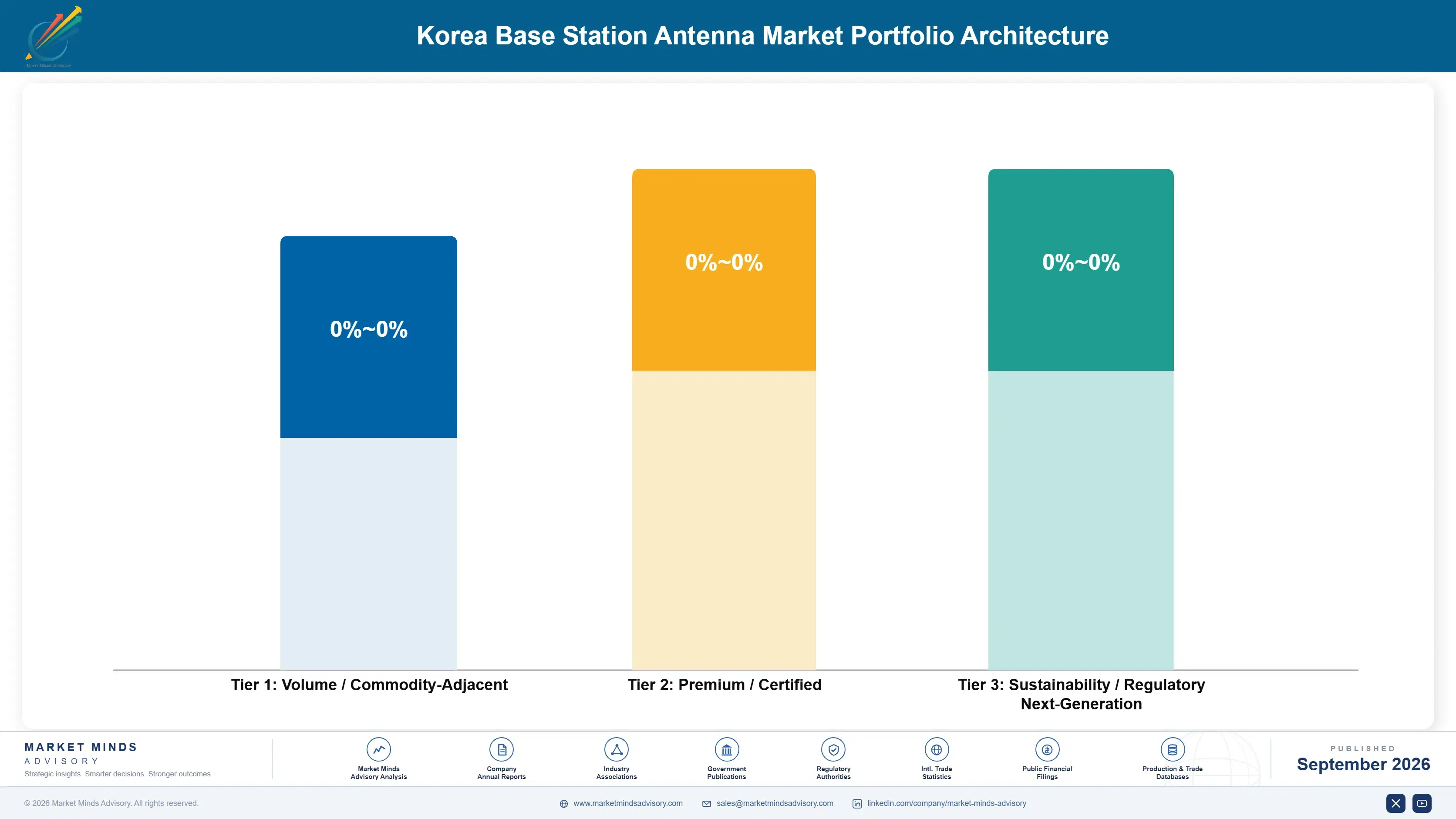
Margin architecture separates on loading difficulty rather than radio sophistication. Mounting and tilt control hardware earns least, since it is mechanical, commoditised and frequently specified on price. Passive macro and in-building antennas sit above on volume. Multiband consolidation, active antenna units and small cell antennas earn most, because each solves a loading or siting constraint that operators cannot resolve any other way.
The volume versus premium tension runs between passive replacement and consolidation, which reward opposite engineering priorities entirely. Passive replacement competes on manufacturing cost against relocated production. Consolidation competes on mass, band count and structural fit at considerably higher unit value. Suppliers optimising for manufacturing cost across both find their consolidation products carry the weight penalties that lose them the deployments. Most discover that during structural assessment.

High-value pools concentrate in consolidation antennas and in active units, and neither is reached through manufacturing capability. Consolidation requires multiband array engineering combined with mass discipline. Active units require radio integration and thermal design for rooftop conditions. Both explain why five suppliers hold 81% while the manufacturing behind them has largely relocated to lower cost locations across the region.

Volume / Commodity-Adjacent

Mounting brackets, tilt control units and site engineering hardware, mechanical products specified largely on price with almost no differentiation available to any supplier. The eleven point spread separates suppliers manufacturing in low-cost locations from those producing in Korea or Western Europe.
Gross Margin: 17% to 28%

Premium / Certified

Passive multiband macro antennas and in-building distributed antenna equipment, where volume economics and operator qualification determine selection rather than any engineering differentiation. The twelve point spread tracks manufacturing location and how much qualification testing each supplier amortises across families.
Gross Margin: 33% to 45%

Sustainability / Regulatory / Next-Generation

Multiband consolidation antennas, active antenna units and small cell and street level antennas, each solving a loading or siting constraint operators cannot resolve otherwise. The fifteen point spread reflects multiband array engineering combined with the mass discipline that loaded structures demand.
Gross Margin: 51% to 66%
base-station-antenna-industry-analysis-in-korea-portfolio-architecture-1790000779345

High-value Sub-segments and Strategic Watch-out

Multiband Consolidation Antennas

Grows at 10.1% because replacing four legacy units with one is the only route to adding bands on loaded structures. The fifteen point spread reflects mass discipline. Site acquisition taking around 14 months removes every obvious alternative for operators. Value per unit rises steeply. Counts stay flat.
Gross Margin: 51% to 66%

Active Antenna Units

Grows at 8.4% by reducing cabling, connectors and separate radio housings that consume structural allowance on loaded sites. The fifteen point spread reflects thermal design depth. Heat dissipation on rooftop installations remains a genuine engineering constraint. Operators weigh trade-offs site by site. Heat remains a constraint.
Gross Margin: 51% to 66%

Passive Multiband Macro Antennas

Grows at 4.6% on replacement demand across an installed base that ages together after rapid deployment. The twelve point spread reflects manufacturing location. Consolidation takes demand from this class rather than adding anything to it. Manufacturing cost decides these awards. Consolidation takes demand away. Ageing base drives it.
Gross Margin: 33% to 45%

Mounting And Tilt Control Hardware

Grows at 3.2%, slowest of the six classes, as mechanical products specified on price with essentially no differentiation possible. The eleven point spread reflects production cost base. Volume follows antenna deployment rather than driving any demand independently. Price is the entire argument here. Volume follows antenna shipments.
Gross Margin: 17% to 28%

Why Structures Decide Everything

The annuity here is the site position rather than any supply agreement. An antenna occupies structural allowance on a rooftop or tower for around 12 years, and around 73% of Korean sites are already at or near capacity. Whoever occupies that allowance holds it until replacement. Suppliers competing on radio performance are competing for a slot that a structural engineer has already decided the shape and weight of.
Depth varies by whether the supplier can answer loading questions locally. A deployment stalls when a structural assessment raises a question and the supplier cannot resolve it within the schedule. Domestic engineering presence turns that into a same-week answer while a distant competitor waits on headquarters. That responsiveness reverses bundling advantages at individual sites more often than any commercial arrangement anticipates.

The buyer has changed less than the constraint has. A radio planner evaluated coverage and capacity against a network design objective and still does. A structural engineer evaluates mass and wind area against what the building will carry. A capital committee evaluates whether consolidation delivers anything subscribers will pay for. The second and third buyers now say no more often than the first says yes.
base-station-antenna-industry-analysis-in-korea-end-use-penetration-index-1790000779839

What Wins Korean Deployments

These are among the four positions where our research anticipates prominent divergence between winners and laggards over the coming forecast period. Each is grounded in the demand model, the regulatory perimeter, and the announced capacity pipeline.
01 / LOADING SPECIFICATION LEADERSHIP

Put Weight Before Gain

Around 73% of Korean sites sit at or near structural weight and wind capacity, and a structural engineer answers the deployment question before any radio engineer opens a datasheet at all. Suppliers leading with mass and wind loading reach the person who genuinely decides what can be installed. Those leading with array gain lose tenders to antennas performing worse but fitting a rooftop whose replacement takes fourteen months to secure in a dense Korean city where positions are genuinely scarce.
02 / OPERATIONAL CASE CONSTRUCTION

Sell Sites Avoided, Not Bands Added

A consolidation antenna replaces four legacy units, and three operators facing flat subscriber revenue struggle to approve projects delivering network capability rather than any identifiable income. The case that actually works is operational: site rental, power consumption and structural reinforcement all avoided. Suppliers presenting radio capability alone are asking a capital committee to fund something it cannot connect to revenue anywhere on its own reporting or in its subscriber numbers against a saturated market that three operators already share between them.
03 / QUALIFICATION PORTFOLIO COVER

Stay Approved At Every Operator

Korea has three mobile operators and no smaller carriers, enterprise networks or regional players to absorb displaced supply when a qualification is lost. Losing one therefore removes a third of the addressable market immediately with nowhere at all to redirect the capacity. Maintaining qualification across all three is expensive and remains the only genuine insurance available to any supplier operating in this particular market at any point in the cycle against a concentration this extreme in an unusually narrow buyer base.
04 / PRODUCTION LOCATION DISCIPLINE

Build Where The Cost Pressure Points

Vietnam-sourced supply compounds at 11.4% because manufacturing cost sits materially below Korean and European plants at genuinely equivalent quality and operator qualification. Three operators competing across a saturated subscriber base apply that pricing pressure consistently and without much negotiation. Suppliers manufacturing entirely in high-cost locations quote against competitors who relocated years ago, including Korean suppliers who moved rather than lose domestically on cost against relocated competitors who moved production years ago and hold a materially lower cost base as a result.

Engagement Snapshot From the Field

A live engagement with an industry participant carrying material or product regulatory and market exposure ahead of a defining policy shift, showing how our research translates into a defensible multi-year portfolio strategy.
MARKET MINDS ADVISORY · CLIENT ENGAGEMENT SUMMARY
Korea Base Station Antenna Producer Strategic Portfolio Review and Transition Roadmap 2026·Investment Scenario on Korea Base Station Antenna Exposure Evaluation 2025-26
CLIENT PROFILE
An international antenna supplier holding qualification with two of three Korean operators and losing tenders it expected to win on radio performance comparisons. Management attributed the losses to pricing from Korean competitors and had approved a discount programme, without establishing at what stage the antennas were actually being rejected. Nobody had examined the rejection stage in the lost tenders at all.
STRATEGIC CHALLENGE
Sales wanted deeper discounting to match Korean competitors. Engineering wanted array performance investment to widen the technical margin. Nobody had examined the rejection stage in lost tenders, and a large consolidation programme at one operator was entering specification within the following quarter. Both proposals assumed the antennas were reaching commercial evaluation, which nobody had verified against the tender records.
MMA APPROACH
MMA reviewed lost tenders to establish where in evaluation the antennas were rejected, and compared mass and wind area against the winning products rather than radio specifications. We assessed the cost and timeline of qualification at the third operator. Work drew on 47 expert interviews conducted in Q4 2025 with operators, tower owners and antenna suppliers.
KEY FINDINGS
  1. Most lost tenders had been rejected at structural assessment, where the company's antennas exceeded loading allowance before radio performance was ever compared.
  2. Winning products were consistently lighter with smaller wind area, and several performed worse on the radio measures the company had been competing on.
  3. Absence at the third operator removed roughly a third of addressable demand, and qualification there would take around 18 months (client-reported, unverified by MMA).
  4. Discounting would have changed nothing at all, because rejection occurred well before commercial terms entered any evaluation the company had actually lost.
CLIENT PROFILE
An international antenna supplier holding qualification with two of three Korean operators and losing tenders it expected to win on radio performance comparisons. Management attributed the losses to pricing from Korean competitors and had approved a discount programme, without establishing at what stage the antennas were actually being rejected. Nobody had examined the rejection stage in the lost tenders at all.
STRATEGIC CHALLENGE
Sales wanted deeper discounting to match Korean competitors. Engineering wanted array performance investment to widen the technical margin. Nobody had examined the rejection stage in lost tenders, and a large consolidation programme at one operator was entering specification within the following quarter. Both proposals assumed the antennas were reaching commercial evaluation, which nobody had verified against the tender records.
MMA APPROACH
MMA reviewed lost tenders to establish where in evaluation the antennas were rejected, and compared mass and wind area against the winning products rather than radio specifications. We assessed the cost and timeline of qualification at the third operator. Work drew on 47 expert interviews conducted in Q4 2025 with operators, tower owners and antenna suppliers.
KEY FINDINGS
  1. Most lost tenders had been rejected at structural assessment, where the company's antennas exceeded loading allowance before radio performance was ever compared.
  2. Winning products were consistently lighter with smaller wind area, and several performed worse on the radio measures the company had been competing on.
  3. Absence at the third operator removed roughly a third of addressable demand, and qualification there would take around 18 months (client-reported, unverified by MMA).
  4. Discounting would have changed nothing at all, because rejection occurred well before commercial terms entered any evaluation the company had actually lost.
RECOMMENDED STRATEGY
Phase 1: Phase one: stop the discount programme entirely, since rejection occurred at structural assessment well before commercial terms were ever examined. Phase 2: Phase two: redirect the engineering investment from array performance toward mass and wind area reduction across the whole consolidation range. Phase 3: Phase three: begin qualification at the third operator immediately, since absence there removes roughly a third of all addressable demand.
OUTCOME
The supplier stopped discounting and redirected engineering toward mass reduction across its consolidation range (client-reported, unverified by MMA). Tender outcomes improved once the antennas cleared structural assessment, and qualification at the third operator was started. Loading specification is now checked before any tender response, which is the change that outlasted the engagement.

Frequently Asked Questions

Foundational context covering the market sizes, CAGR, scope, country, region and competition that inform every finding below. This section is provided to cover basics and most often pre-purchase conversations, answered from the MMA Primary Research Dataset.

What is the current size of the Korea Base Station Antenna Market?

Korean value reaches USD 0.45 billion in 2026, measured across six antenna and site hardware classes. The 2025 base was USD 0.42 billion on the same basis.

How large will the Korea Base Station Antenna Market be by 2036?

The market reaches USD 0.87 billion by 2036, an increase of USD 0.42 billion across the forecast period. That represents 1.91 times expansion from the 2026 base.

What is the CAGR for the Korea Base Station Antenna Market 2026 to 2036?

The base case runs at 6.7% annually, with a bull case at 7.9% if sixth generation arrays force new site acquisition and a bear case at 5.5% if operators defer consolidation projects.

Which segment is growing fastest?

Multiband consolidation antennas grow at 10.1%, half again the market rate of 6.7%. Replacing four legacy units with one is the only way to add bands to loaded structures.

Who are the major companies in the Korea Base Station Antenna Market?

KMW, Ace Technologies, Kathrein, Ericsson and Samsung Electronics lead on Korean antenna value, holding 81% between them. CommScope and Comba Telecom hold smaller positions in the market.

Which country is growing fastest?

Vietnam-sourced supply compounds fastest at 11.4%, because manufacturing cost sits materially below Korean and European plants at genuinely equivalent quality. Malaysia and India follow behind.

Report Segmentation Architecture

The full report scope spans multiple orthogonal segmentation dimensions, with cross-tabulated demand data provided for each dimension pair. Coverage extends further to regional breakdowns, trend trajectories, and the competitive detail needed to support segment-level decision-making.

By Antenna Class And Deployment Context

  • Multiband Consolidation Antennas
  • Active Antenna Units
  • Small Cell And Street Level Antennas
  • Passive Multiband Macro Antennas
  • In-Building Distributed Antenna Equipment
  • Mounting, Tilt Control And Site Engineering Hardware

By End-Use Industry

  • Mobile Network Operator Macro Networks
  • Urban Dense Coverage Deployments
  • Transport And Tunnel Coverage
  • Enterprise And Campus Private Networks
  • Public Venue And Stadium Coverage
  • Neutral Host And Tower Operations

By Commercial Dimension

  • Direct Operator Framework Supply
  • System Vendor Bundled Supply
  • Tower Company Procurement
  • Neutral Host Infrastructure Contracting
  • Original Equipment Manufacturer Supply
  • Engineering Contractor Specification

By Region

  • East Asia
  • South Asia and Pacific
  • Western Europe
  • North America
  • Eastern Europe
  • Latin America
  • Middle East and Africa

Scope, Methodology, and Coverage

Every figure in this report is reproducible from documented input assumptions. The scope below maps the historical period, the forecast horizon, the segmentation dimensions, and the countries covered, alongside the underlying primary and qualitative methodology.
Historical Period
2020 to 2025
Forecast Period
2026 to 2036
Base Year
2025 (USD billions; MMA Primary Research Dataset, September 2026)
Market Definition
This report covers base station antennas deployed across Korea: passive multiband macro antennas, active antenna units integrating radio and array, multiband consolidation antennas replacing multiple legacy units, small cell and street level antennas, in-building distributed antenna equipment, and the mounting, tilt control and site engineering hardware supplied with them. It excludes radio access baseband equipment, transmission and backhaul systems, tower and mast structures, handsets and customer premises equipment, and satellite ground terminals.
Quantitative Units
USD millions, Korean base station antenna value; antennas deployed; share of sites at structural capacity as a percentage; site acquisition periods in months; legacy units replaced per consolidation antenna; antenna service life in years.
Segmentation Dimensions
Antenna class and deployment context; end-use network type; commercial supply route; supplied value origin across seven regions.
Regions Covered
East Asia, South Asia and Pacific, Western Europe, North America, Eastern Europe, Latin America, Middle East and Africa
Countries Covered
South Korea, China, Japan, Taiwan, Vietnam, Malaysia, India, Singapore, Germany, Sweden, Finland, France, Italy, Poland, Czechia, Romania, United States, Canada, Brazil, United Arab Emirates.
Key Companies Profiled
KMW, Ace Technologies, Kathrein, Ericsson, Samsung Electronics, CommScope, Amphenol Antenna Solutions, Rosenberger, Comba Telecom, Tongyu Communication, Nokia, RFS Radio Frequency Systems, Alpha Wireless, JMA Wireless, Mobi Antenna.
Quantitative Methodology
Primary survey, n=3,800 respondents, Q4 2025, six countries; demand-side model with trade association cross-validation
Qualitative Methodology
47 expert interviews, Q4 2025; applied to validate demand model assumptions, identify emerging dynamics, and assess competitive positioning
Report Format
PDF and XLSX data workbook (Word format preview document)
Publisher
Market Minds Advisory
Report Code
MMA-2026-TEC-181
Published
September 2026
Contact
sales@marketmindsadvisory.com | www.marketmindsadvisory.com

Purchase the full Korea Base Station Antenna Market Report (2026 to 2036).

This report sizes the Korean base station antenna market from 2026 to 2036 across six antenna classes, six network types and seven supplied value origins. It explains why around 73% of Korean sites sitting at structural capacity makes mass and wind area the deciding specification rather than radio performance. Consolidation antennas replacing four legacy units each are analysed as the only route to adding bands on loaded structures. Three operators leaving no fallback for suppliers is examined as the concentration risk defining this market. Regional analysis explains where supplied antenna value originates.
Six antenna classes sized through to 2036
Structural loading quantified against deployment and site constraints
Consolidation economics analysed against operator capital discipline
Twenty named suppliers assessed on Korean antenna value
Four revenue levers with quantified commercial impact
Anonymised supplier market position engagement documented in full

Built For The People Who Decide

From boardroom strategy to bench-side execution, this report is read cover-to-cover by leaders shaping the next decade of their industry, turning demand scenarios, market dynamics and valuation benchmarks into decisions.
CXOs/ Presidents/ VPs/ Managers
M&A and Corporate Development
Strategy Teams and R&D Heads
Procurement and Product Directors
Regulatory and Compliance Leaders
Investor Relations and Equity Analysts