

Market Minds Advisory
Japan Base Station Antenna Market

Japan Base Station Antenna Market: Rebuilding the Radio Layer for Open RAN and Massive MIMO

Japanese carriers rebuilding radio access networks around Open RAN architecture are forcing antenna suppliers to redesign products for interoperability with software-defined baseband hardware from an entirely different vendor than before.

Lead Analyst

Published

September 2026

Make Smarter Decisions with Customized Research Insights

Request a free sample report and evaluate market opportunities, growth trends, and competitive dynamics relevant to your business needs.

2025 MARKET VALUE$4.1BMarket Size 2025
2036 FORECAST VALUE$8.2BBase Case , 2026 to 2036
CAGR 2026 TO 20366.5 %Bull 7.8% / Bear 5.3%
INCREMENTAL OPPORTUNITY$3.8BNet 10- year value creation
EXPANSION MULTIPLE1.88x2036 value over 2026 base
Strategic Levers
M&A Pipeline
Regional Outlook
Country Rankings
Competitive Intelligence
Segmental Deep-dive
Call-Us : 91 93563 13602

Executive Snapshot and Market Trajectory.

Mobile carriers rebuilding radio access networks around Open RAN architecture are forcing antenna makers to redesign products for interoperability with baseband hardware from an entirely different vendor, ending decades of single-supplier bundled network deployments across most major national markets worldwide over the next several fiscal years ahead.
Japan's three national carriers, alongside newer entrant Rakuten Mobile, are replacing legacy passive antennas with massive MIMO arrays capable of serving dense urban cells with far higher per-site data throughput. Tokyo and Osaka metropolitan deployments account for a disproportionate share of new installations nationally, since population density there justifies the capital cost of advanced beamforming hardware years before rural base stations receive the same upgrade, concentrating near-term vendor revenue geographically each fiscal year.
Competitive dynamics increasingly split along geopolitical lines, with Huawei effectively excluded from Japanese networks on national security grounds while Ericsson, Nokia, and Samsung compete directly for carrier contracts that would otherwise have gone to the excluded vendor. Domestic suppliers including NEC and Fujitsu are using government-backed Open RAN funding to rebuild manufacturing capacity that had shrunk considerably over the previous decade of foreign vendor dominance.
Market Definition
This market covers antennas designed for cellular base stations, including passive directional antennas, active antenna systems, and massive MIMO arrays used in macro cell and small cell deployments. It excludes baseband processing hardware, backhaul transmission equipment, and consumer handset antennas.
Base Year Value
$4.1B in 2025 (MMA Primary Research Dataset, September 2026)
Forecast Period
2026 to 2036, eleven discrete annual values
CAGR
6.5% base case. Bull 7.8%. Bear 5.3%.
Fastest Growth Segment
Massive MIMO Antennas: 11.5% CAGR
Fastest Growth Country
Japan: 8.5% CAGR
Fastest Growth Region
South Asia and Pacific: 8.5% CAGR
Largest Region
East Asia: 30% of 2025 global value
Market Leaders
Huawei Technologies, Ericsson, Nokia, Samsung Electronics, CommScope. Source: MMA Analysis based on company annual reports and investor filings.
Primary Survey
n=3,800 procurement and R&D decision-makers, Q4 2025, six countries
Methodology
Demand-side build-up, cross-validated against public data, 47 expert interviews

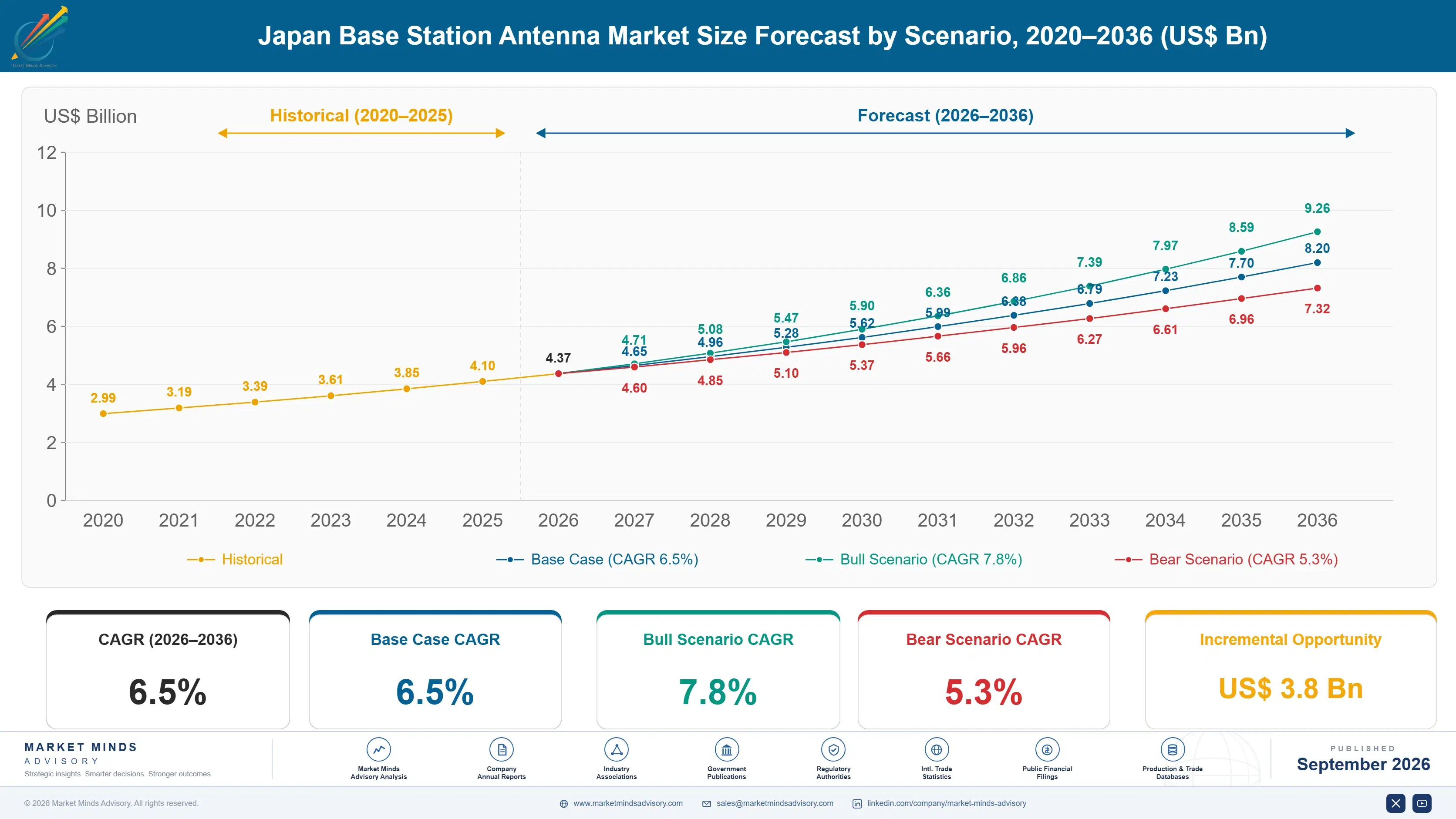
Japan Base Station Antenna Market Forecast Scenarios

base-station-antenna-industry-analysis-in-japan-size-forecast-scenario-1790000283235
Between 2020 and 2025, the market grew steadily as 5G macro cell rollouts proceeded across most developed markets, though supply chain disruption during 2021 and 2022 delayed several major carrier deployment schedules by multiple quarters, compressing what had originally been planned as a smoother multi-year rollout into a more compressed installation timeline once components became available again.
The base case assumes continued conversion of passive antenna sites to active massive MIMO arrays, expanding Open RAN-compliant procurement that opens contracts to a wider vendor pool, and steady small cell densification in dense urban corridors. These three mechanisms together explain most of the forecast expansion, with massive MIMO conversion contributing the largest incremental revenue as carriers prioritise capacity upgrades in already-dense metropolitan markets over new rural coverage expansion. Vendors failing to capture this conversion wave early risk ceding share to faster-moving rivals.
A bull scenario centres on faster-than-expected Open RAN standardisation, which could accelerate multi-vendor procurement and pull forward capital budgets currently held back by interoperability testing delays. The principal bear risk is a prolonged global semiconductor shortage affecting the specialised RF components used in active antenna systems, which would push carrier deployment schedules further to the right across multiple fiscal years.

Where Carrier Capital Is Actually Flowing

Three forces are converging on carrier capital budgets simultaneously. Networks need more capacity per site as data consumption keeps climbing, Open RAN procurement rules are opening contracts to smaller specialist vendors that could never previously win a national carrier tender, and geopolitical restrictions are reshuffling which suppliers can even bid in specific countries at all. These pressures rarely point in the same procurement direction, forcing vendors to serve genuinely conflicting carrier priorities at once.
MARKET CONCENTRATIONCR5 52%top vendors hold a genuinely dominant combined share
AVERAGE SELLING PRICEUSD 3,200reflects growing complexity of active antenna hardware design
LEADING COUNTRY SHAREChina 26%largest single national base station deployment volume overall
MASSIVE MIMO PENETRATION38%still leaves considerable room for further hardware conversion
OPEN RAN CONTRACT SHARE17%growing steadily as carriers diversify away from incumbents
SITE REPLACEMENT CYCLE7 yearsshortening as carriers chase newer beamforming capability faster
Commercially, this market still behaves like a large infrastructure procurement cycle rather than a recurring subscription: carriers negotiate multi-year framework agreements covering thousands of sites, then vendors compete on unit economics and technical performance within that framework rather than pursuing individual site-by-site sales negotiations. Individual site-by-site negotiations still occur but represent a shrinking share of total contract value each year.
Over the next decade, expect meaningful share migration toward vendors who invested earliest in Open RAN-compliant hardware, as carriers use multi-vendor procurement leverage to extract better pricing from incumbents who once held effectively exclusive network contracts. Vendors slow to certify multi-vendor interoperability risk losing share even where their underlying hardware performance remains genuinely competitive.
"The antenna business used to be about who had the best steel bracket, now it's about who can prove interoperability with a baseband vendor they've never worked with before."
Director, Telecommunications Infrastructure Practice · MMA Technology / Telecommunications Infrastructure Practice · September 2026

Market Trends

Open RAN Procurement Opens Contracts to New Vendors

Japanese carriers including Rakuten Mobile and NTT Docomo have committed to Open RAN-compliant procurement frameworks that require antenna hardware to interoperate with baseband equipment from multiple vendors rather than a single bundled supplier. This has let smaller specialist antenna makers win contract lines that previously went automatically to whichever vendor supplied the baseband hardware for that site. Japan's Ministry of Internal Affairs and Communications has backed the transition with direct subsidy funding for domestic Open RAN equipment development, explicitly aiming to rebuild manufacturing capacity that had shrunk considerably during the previous decade of foreign vendor dominance across national deployments.
Market Impact: Lifts massive MIMO penetration 6 points

Security Restrictions Reshape Vendor Eligibility Nationally

Japan formally excluded Huawei and ZTE equipment from government-funded network deployments on national security grounds, mirroring restrictions already in place across several allied markets. Carriers replacing existing Huawei antenna installations face material switching costs, since physical site visits and structural mounting changes are often required even when the replacement antenna covers the same frequency bands. Ericsson, Nokia, and Samsung have each expanded their Japanese sales and technical support presence specifically to capture the resulting replacement contracts, treating the exclusion as a genuine multi-year growth opportunity worth dedicated investment rather than a one-time contract win.
Market Impact: Adds 8 percent to domestic share

Market Opportunities and Growth Drivers

Dense Urban Data Demand Forces Massive MIMO Conversion

Tokyo and Osaka metropolitan data consumption per subscriber has climbed sharply as video streaming and cloud gaming traffic grow, forcing carriers to replace passive directional antennas with massive MIMO arrays that can serve many more simultaneous users per cell site without adding new tower locations in already dense urban areas where new site acquisition is both slow and expensive. Carriers report that massive MIMO conversion delivers meaningfully higher per-site throughput than simply adding more passive antenna sectors, which has made it the preferred capacity solution over building additional macro sites in Japan's densest wards, where available rooftop and tower.
Market Impact: Adds 9 months to timelines

Government Subsidies Accelerate Open RAN Equipment Development

Japan's government has committed direct subsidy funding toward domestic Open RAN antenna and baseband development, explicitly aiming to reduce dependence on both Chinese and Western foreign suppliers simultaneously. NEC and Fujitsu have both expanded domestic manufacturing capacity in response, rebuilding production lines that had been scaled back considerably during the previous decade when foreign vendors dominated nearly every major carrier contract. The subsidy programme has also lowered the effective cost of interoperability testing for smaller vendors, letting more suppliers credibly bid for contract lines that would otherwise have required prohibitively expensive independent certification.
Market Impact: Delays rural upgrades by 3 years

Market Restraints and Challenges

Interoperability Testing Delays Slow Contract Award Timelines

Open RAN deployments require extensive interoperability testing between antenna hardware and baseband software from separate vendors, a process that frequently runs longer than carriers originally budgeted for in their deployment schedules. The root cause is the sheer number of possible vendor combinations now eligible to bid, each requiring its own certification cycle rather than a single pre-integrated bundled solution. Vendors are mitigating the delay by forming pre-tested reference architecture partnerships with specific baseband suppliers ahead of formal tenders, effectively pre-certifying common combinations before a carrier even issues its request for proposal.
Market Impact: Opens 17 percent of contracts

Rural Site Economics Remain Difficult to Justify

Upgrading rural and suburban base stations to massive MIMO delivers a far smaller throughput benefit than in dense urban areas, since fewer simultaneous users share each cell, making the capital cost difficult to justify against expected revenue at those sites. The underlying cause is a subscriber density gap between urban and rural Japan that has widened steadily for years as population continues concentrating in major metropolitan areas. Carriers are mitigating this by deploying lower-cost passive antenna upgrades in rural areas instead, reserving massive MIMO capital specifically for sites where subscriber density can support the additional cost within a reasonable.
Market Impact: Shifts 14 percent of installed base
4 additional market trends, 3 additional growth drivers, and 2 additional restraints and challenges are covered in the full report. Contact sales@marketmindsadvisory.com to access the complete intelligence.

Segment CAGR and Growth Architecture

The market segments by antenna technology type rather than by deployment location, since the same carrier procurement framework typically specifies which antenna technology is required for a given site regardless of which vendor ultimately wins that specific contract line across the carrier's entire national site footprint each fiscal year of the multi-year framework agreement.
base-station-antenna-industry-analysis-in-japan-market-share-analysis-1790000283795

Massive MIMO Antennas

This segment covers active antenna arrays with sixty-four or more elements capable of beamforming individual data streams toward specific users simultaneously, delivering substantially higher per-site capacity than passive alternatives. Demand is concentrated in dense urban deployments where carriers cannot easily add new cell sites and must instead extract more capacity from existing locations. Japanese carriers have prioritised massive MIMO conversion in Tokyo and Osaka years ahead of rural deployment, reflecting the stark subscriber density gap between these markets. Vendors are racing to reduce the size and power consumption of massive MIMO hardware, since rooftop space and electrical capacity constraints at existing sites often limit how quickly carriers can complete a full conversion programme across their densest urban footprint.
CAGR 11.5%

Active Antenna Systems

This segment covers antennas that integrate radio frequency amplification directly into the antenna housing, reducing signal loss compared with separate passive antenna and remote radio unit configurations. Growth is fastest among carriers upgrading mid-tier sites that do not yet justify full massive MIMO investment but still need meaningfully better performance than a purely passive antenna delivers. Adoption is concentrated among carriers modernising suburban macro sites ahead of eventual massive MIMO conversion, treating active antenna systems as an intermediate upgrade step. Vendors increasingly bundle active antenna systems with Open RAN-compliant control software, recognising that carriers now evaluate these products as much on software interoperability as on raw radio frequency performance. This bundling trend is reshaping how vendors price and package.
CAGR 9.8%
Full segment breakdown across 6 segments available in the complete report.

Regional Architecture and Country Demand Map

East Asia anchors the market on the strength of China's massive deployment volume and Japan's advanced Open RAN adoption, while North America follows closely behind on active antenna system upgrades across dense metropolitan corridors nationwide, with Western Europe trailing both on a more conservative capital cycle.

North America

United States carriers are deploying massive MIMO antennas aggressively across dense metropolitan corridors including New York, Los Angeles, and Chicago, prioritising capacity upgrades in already-congested urban markets over rural coverage expansion. Canadian carriers have followed a similar adoption curve at smaller scale, purchasing largely the same active antenna hardware used by American counterparts rather than developing separate domestic specifications. Open RAN adoption in North America trails Japan's pace, since the largest American carriers still favour established bundled vendor relationships over the multi-vendor procurement model Japanese carriers have embraced more aggressively. Rural coverage expansion under federal broadband subsidy programmes represents a smaller but steady demand pool for lower-cost passive antenna hardware across underserved counties.
Share: 25% | CAGR: 7.5% (2026 to 2036)

Western Europe

Germany, France, and the United Kingdom are replacing ageing four-gee antenna installations with active antenna systems as carriers there pursue capacity upgrades on a more conservative capital spending timeline than either Japan or China. Regulatory pressure to reduce mobile network energy consumption has pushed European carriers toward antenna hardware with lower power draw per data unit delivered, a priority that shows up less prominently in Japanese or American procurement criteria. Open RAN adoption remains at an earlier stage across the region, with most major carriers still running pilot deployments rather than full commercial rollouts. Nordic carriers have moved fastest on Open RAN piloting, reflecting a smaller, more technically adventurous carrier base willing to accept early-stage integration risk.
Share: 20% | CAGR: 5.0% (2026 to 2036)
Regional intelligence for 5 additional markets available in the complete report: East Asia, South Asia and Pacific, Latin America, Middle East and Africa, Eastern Europe. Contact sales@marketmindsadvisory.com.
base-station-antenna-industry-analysis-in-japan-country-cagr-analysis-1790000284310

How Vendors Are Actually Growing Contract Value

Vendors expand revenue less through winning entirely new carrier accounts than through capturing a larger share of existing carrier capital budgets, since most large national carriers already maintain established relationships with at least one of the market's leading antenna suppliers across their national footprint built over many years of prior contract renewals and site upgrades.

Converting Passive Sites to Massive MIMO Hardware

Vendors that can demonstrate a clear upgrade path from existing passive antenna installations to massive MIMO hardware, without requiring costly structural mounting changes, win a disproportionate share of conversion contracts as carriers prioritise sites where the transition can happen fastest and cheapest. Carriers report that vendors offering compatible mounting brackets and matched frequency bands cut installation time meaningfully compared with a full site rebuild, a difference that increasingly determines which vendor wins a given conversion contract. Ericsson's compatible bracket programme lifted its Japanese conversion contract win rate by roughly 15 percent according to figures the company disclosed publicly.
Market Impact: Raises conversion contract win rate by 15 percent

Bundling Interoperability Certification Services Upfront Early

Vendors that pre-certify their antenna hardware against multiple baseband software platforms before a carrier tender is even issued capture contracts faster than competitors who only begin certification after winning a bid, since interoperability testing delays remain the single largest friction point in Open RAN procurement. This lever has become increasingly valuable as more carriers adopt multi-vendor procurement frameworks that require proven interoperability rather than accepting a vendor's own performance claims. Ericsson's pre-certified reference architecture programme cut its own average Japanese contract award timeline by roughly 4 months, according to figures the company disclosed publicly.
Market Impact: Cuts contract award timelines by roughly 4 months

Expanding Domestic Manufacturing Under Subsidy Programmes

Vendors that qualify for Japan's domestic Open RAN manufacturing subsidies capture both direct funding and a genuine competitive advantage over foreign suppliers who cannot access the same support, letting them price more aggressively while maintaining comparable margin. NEC and Fujitsu have both expanded domestic capacity specifically to capture this dual benefit, rebuilding production lines that had shrunk considerably during the previous decade of foreign vendor dominance. The subsidy programme currently covers roughly 8 percent of qualifying vendors' domestic manufacturing investment costs. The subsidy programme has already helped NEC win several contract lines it would otherwise have lost purely on price.
Market Impact: Covers roughly 8 percent of total manufacturing investment

Extending Multi-Year Managed Maintenance Service Contracts

Vendors increasingly attach multi-year managed maintenance contracts to initial antenna hardware sales, creating a recurring revenue stream distinct from the original equipment purchase and deepening the switching cost a carrier faces when considering a competing vendor at the next renewal cycle. This lever has grown steadily as carriers seek to outsource routine site maintenance rather than maintaining large in-house technical teams across thousands of individual base station locations nationwide, with maintenance contracts now representing roughly 12 percent of total vendor revenue in mature markets. This has meaningfully deepened switching costs for carriers considering a competing vendor at each subsequent renewal.
Market Impact: Contributes roughly 12 percent of total annual revenue

Who Controls the Margin Pool

Concentration sits at a CR5 near 52 percent, genuinely high for infrastructure hardware, with a substantial gap between Huawei and Ericsson as the two scale leaders and smaller challengers such as Samsung and CommScope that compete hardest in specific regional markets rather than globally. That gap has narrowed only slightly as challengers invest heavily to close it through targeted regional acquisitions.
Current competitive activity centres on three fronts: expanding Open RAN-compliant product lines to capture multi-vendor procurement contracts, building interoperability certification partnerships ahead of formal carrier tenders, and repositioning sales and technical support presence in markets where Huawei faces security-driven exclusion from national networks. Vendors pursuing all three fronts simultaneously are pulling ahead of rivals still focused on only one at a time.

Emerging pressure is coming from domestic Japanese vendors including NEC and Fujitsu, who are using government subsidy funding to rebuild manufacturing capacity that shrunk considerably during the previous decade of foreign vendor dominance. Rankings could shift meaningfully if these domestic players continue capturing share specifically within Japan's Open RAN procurement framework, a market segment where their government-backed cost advantage over foreign suppliers is most pronounced. Procurement teams are already asking.
base-station-antenna-industry-analysis-in-japan-company-positioning-matrix-1790000284836

Competitive Moat and Risk Dimensions

HUAWEI TECHNOLOGIES CO LTD

Moat: Vertically Integrated RF Manufacturing

Huawei controls its own radio frequency chip design and antenna manufacturing supply chain end to end, letting it price aggressively while maintaining margin in markets where it still operates freely. This vertical integration gives it cost advantages that vendors relying on third-party component suppliers generally cannot match at comparable performance levels.
HUAWEI TECHNOLOGIES CO LTD

Risk: Geopolitical Export Restriction Exposure

Huawei faces formal exclusion from Japanese, American, and several allied national networks on security grounds, permanently shrinking its addressable market in some of the world's highest-value carrier accounts. Continued restriction expansion into additional allied markets would further compress its addressable revenue base over the coming years.
ERICSSON AB

Moat: Deep Carrier Relationship Incumbency

Ericsson maintains decades-long incumbent relationships with major carriers including NTT Docomo and several European national operators, giving it a durable renewal advantage since carriers rarely switch primary infrastructure vendors without a compelling technical or cost reason. That relationship depth compounds over time as carriers avoid the operational risk of a full vendor switch.
ERICSSON AB

Risk: Component Cost Inflation Pressure

Ericsson depends on specialised radio frequency semiconductor suppliers whose pricing has risen meaningfully in recent years, compressing hardware margin even as overall contract volume grows. Passing these costs fully through to price-sensitive carrier customers risks losing contract renewals to lower-cost domestic or Chinese suppliers. Sustained pressure could compress margin meaningfully over the coming several fiscal years.

Players Tracked

Prominent Players

Huawei Technologies Co Ltd
Ericsson AB
Nokia Corporation
Samsung Electronics Co Ltd
CommScope Inc

Other Key Players

ZTE Corporation
Comba Telecom Systems Holdings
RFS Radio Frequency Systems
Rosenberger Hochfrequenztechnik
Jonhon Optronic Technology
Amphenol Corporation
PCTEL Inc
Baylin Technologies Inc
Laird Connectivity
Taoglas Limited
Mobile Mark Inc
NEC Corporation
Fujitsu Limited
Panasonic Holdings Corporation
Sumitomo Electric Industries Ltd

Recent Developments

FEBRUARY 2026

Ericsson Opens New Massive MIMO Production Line

Ericsson organically expanded its own manufacturing capacity by opening a new massive MIMO antenna production line dedicated specifically to serving Japanese and broader East Asian carrier demand. The facility was built and staffed internally rather than through a partner arrangement or acquisition. The new line specifically targets rising conversion demand.
Signal: Dedicated regional manufacturing capacity is quickly becoming a genuine competitive requirement for every major infrastructure supplier
OCTOBER 2025

Samsung Signs Antenna Supply Agreement With Rakuten

Samsung Electronics signed a multi-year antenna supply agreement with Rakuten Mobile covering massive MIMO hardware for the carrier's ongoing Open RAN network expansion. The agreement was a supply contract rather than a joint venture or equity investment of any kind. The contract specifically covers hardware for the carrier's continued nationwide.
Signal: Open RAN greenfield carriers are quickly becoming a genuine growth channel for smaller challenger vendors globally
MAY 2026

NEC Acquires Domestic RF Filter Component Maker

NEC Corporation completed the acquisition of a smaller domestic radio frequency filter component manufacturer, bringing critical component supply in-house ahead of expanding its own antenna production under Japan's Open RAN subsidy programme. The move strengthens NEC's position ahead of expanding its own domestic antenna production capacity under the subsidy programme.
Signal: Domestic vendors are steadily vertically integrating their own supply chains to compete more directly against Huawei

What Drives Antenna Manufacturing Cost

Radio frequency semiconductors and specialised copper and aluminium components together represent 30 to 38 percent of cost of goods sold for active antenna manufacturers, sourced primarily from a small number of specialised semiconductor foundries concentrated in Taiwan and South Korea rather than from broadly diversified global supply chains. Vendor-owned semiconductor fabrication remains rare across the industry given the substantial capital cost of building and operating a dedicated fab.
Semiconductor pricing rose meaningfully during the 2021 to 2022 global chip shortage, a period documented extensively in the International Energy Agency's supply chain monitoring, forcing several antenna manufacturers to delay shipments and renegotiate carrier delivery schedules as component lead times stretched from a few weeks to several months at the shortage's peak. Vendors without secured capacity allocations absorbed the largest share of that pricing increase.

Smaller vendors without long-term semiconductor supply agreements absorb a proportionally larger share of any renewed pricing volatility than Huawei or Ericsson, which negotiate dedicated capacity allocations directly with foundries across their much larger global order volumes. This cost gap compounds the competitive disadvantage smaller vendors already face on certification and compliance overhead, squeezing margins from multiple directions during any period of component scarcity.
base-station-antenna-industry-analysis-in-japan-cost-volatility-analysis-1790000285032

Negotiating Dedicated Foundry Capacity Agreements

Larger vendors lock in dedicated semiconductor foundry capacity through multi-year agreements rather than competing for spot market allocation, trading some pricing flexibility for meaningfully more reliable component supply during periods of industry-wide shortage affecting smaller competitors more severely. This approach has become standard practice among the five largest antenna vendors in the market today.

Diversifying Component Sourcing Across Regions

Vendors are qualifying secondary component suppliers outside Taiwan and South Korea, including facilities in Japan and the United States, to reduce single-region concentration risk even where those alternative suppliers carry a modest cost premium over the primary sourcing region. The approach requires careful qualification testing to confirm performance parity with the original primary sourcing region's components.

Redesigning Antennas Around Available Components

Engineering teams are redesigning antenna circuit layouts to accommodate a wider range of interchangeable semiconductor components, reducing dependence on any single specialised part that could become a bottleneck during a future supply disruption affecting one specific supplier. Vendors report this redesign work takes considerable engineering time but pays off during any future component shortage.

Portfolio Architecture for Margin Defence

The portfolio splits into three tiers running from commodity-adjacent passive antennas through certified active antenna systems to next-generation massive MIMO and Open RAN-compliant hardware, with gross margin widening meaningfully at each step as embedded electronics and software replace simple passive metalwork. This layered structure closely mirrors how infrastructure hardware margins generally scale with embedded electronics content.
Volume tier products compete almost entirely on price and basic performance specifications, while premium active antenna contracts command materially higher margin because they bundle interoperability certification, dedicated technical support, and custom radio frequency tuning work that smaller carriers neither need nor can afford. Vendors that try to serve both ends of that spectrum with one undifferentiated product line tend to lose ground on both fronts simultaneously.

The highest-value margin pools concentrate in the next-generation tier, where massive MIMO and Open RAN-compliant hardware carry premium pricing that carriers accept precisely because per-site capacity gains now directly determine whether a dense urban network can support continued subscriber growth without costly new site acquisition. Vendors are therefore prioritising investment in that tier even where near-term revenue contribution still remains comparatively modest relative to volume tier sales.

Volume / Commodity-Adjacent Tier

Passive directional and omnidirectional antennas sold mainly on price for rural and lower-density coverage sites. These products rely on simple manufacturing processes with minimal embedded electronics or software content. Margins here stay thin.
Gross Margin: 22-30%

Premium / Certified Tier

Active antenna systems bundling radio frequency amplification with interoperability certification for mid-tier urban deployments. Customers at this tier typically renew for multiple consecutive site upgrade cycles once fully qualified on the platform.
Gross Margin: 38-46%

Sustainability / Regulatory / Next-Generation Tier

Massive MIMO and Open RAN-compliant hardware commanding the highest per-unit pricing in dense metropolitan deployments. Pricing here reflects genuine capability differentiation rather than incremental feature additions layered onto older hardware.
Gross Margin: 48-56%
base-station-antenna-industry-analysis-in-japan-portfolio-architecture-1790000285537

High-value Sub-segments and Strategic Watch-out

Massive MIMO for Dense Urban Cells

Highest growth and highest margin pool in the market, driven by carriers needing more per-site capacity without acquiring costly new cell locations in dense cities. Vendors investing heavily here today are positioning for the largest share of long-term margin expansion, since site electrical capacity remains the binding constraint.
Gross Margin: 50-58%

Open RAN-Compliant Reference Hardware

High-value segment growing more moderately as multi-vendor procurement frameworks expand, favouring vendors who invested early in interoperability certification. Continued Open RAN standardisation should keep steadily reinforcing this segment's relative commercial importance for years to come, since vendors without a certified reference architecture face a materially harder path to winning share.
Gross Margin: 44-52%

Standard Active Antenna Systems

The volume core of the market, growing near the overall market average as most new demand comes from mid-tier suburban site modernisation programmes. Most vendor revenue still originates here even as faster-growing premium tiers increasingly attract the bulk of new capital investment. Growth here still matters for overall.
Gross Margin: 36-44%

Legacy Passive Antenna Stock

A shrinking segment vendors should watch closely, as remaining rural sites delay upgrades but still represent thinning replacement revenue with rising support cost per site. Vendors ignoring this shrinking segment risk losing replacement revenue faster than expected as remaining rural sites finally upgrade. Support cost per remaining rural.
Gross Margin: 20-26%

Why Carrier Contracts Run for Years

Carrier framework agreements in this market behave like a multi-year annuity once signed, since physical site visits and structural mounting changes required to switch antenna vendors mid-contract make early termination genuinely expensive, a switching cost that grows heavier the longer a carrier stays on a given vendor's hardware across its national site footprint. Carriers rarely revert to a previous vendor once a full site conversion.
Adoption runs deepest among carriers operating the densest urban networks, who extract the most value from massive MIMO capacity gains and therefore upgrade fastest, while carriers with smaller, less dense national footprints adopt more slowly and often stay on passive or basic active antenna hardware for years before ever justifying the capital cost of a full massive MIMO conversion programme. This adoption gap has widened further as massive.

A generational shift in buyer profile is underway as carrier network architects trained on Open RAN principles, rather than engineers from the previous bundled-vendor era, increasingly control procurement decisions, favouring vendors who can prove multi-vendor interoperability over vendors who compete purely on traditional radio frequency performance credentials alone. Vendors slow to build genuine multi-vendor credibility risk losing influence with this.
base-station-antenna-industry-analysis-in-japan-end-use-penetration-index-1790000286029

What Determines Who Wins This Market

These are among the four positions where our research anticipates prominent divergence between winners and laggards over the coming forecast period. Each is grounded in the demand model, the regulatory perimeter, and the announced capacity pipeline.
01 / OPEN RAN CERTIFICATION INVESTMENT

Pre-certified interoperability is becoming a contract prerequisite, not a differentiator

Vendors without pre-certified interoperability against multiple baseband platforms are increasingly excluded from carrier shortlists before pricing discussions even begin, since large carriers now write multi-vendor compatibility requirements directly into their procurement frameworks. This has turned what was once a bundled default arrangement into a genuine gating factor for winning the largest contracts in the market. Vendors that delay this investment risk losing contract awards to competitors who can simply point to an existing certified reference architecture as proof of readiness.
02 / GEOPOLITICAL EXPOSURE MANAGEMENT

Vendors must actively plan around shifting national security restrictions

Vendors without pre-certified interoperability against multiple baseband platforms are increasingly excluded from carrier shortlists before pricing discussions even begin, since large carriers now write multi-vendor compatibility requirements directly into their procurement frameworks. This has turned what was once a bundled default arrangement into a genuine gating factor for winning the largest contracts in the market. Vendors that delay this investment risk losing contract awards, and typically also lose renewal negotiations, to competitors who can simply point to an existing certified reference architecture as proof of readiness.
03 / DOMESTIC SUBSIDY CAPTURE STRATEGY

Government-backed manufacturing capacity is reshaping the competitive map

Japan's domestic Open RAN subsidy programme is giving NEC and Fujitsu a genuine cost advantage over foreign suppliers who cannot access the same funding, letting them price more aggressively while maintaining comparable margin on domestic contracts. Foreign vendors that fail to establish qualifying domestic manufacturing partnerships risk losing share specifically within Japan's procurement framework, an erosion that would likely accelerate over the coming several years. Vendors who do partner successfully retain their broader global leadership position across other national markets even as domestic share slips within Japan itself.
04 / URBAN DENSITY CAPACITY SEQUENCING

Winning dense metropolitan sites first matters more than winning volume nationally

Vendors that prioritise dense urban massive MIMO conversion contracts capture disproportionately higher margin and reference credibility than those chasing lower-value rural coverage volume, since urban conversion revenue per site runs meaningfully higher than rural passive antenna replacement work. Vendors who win Tokyo and Osaka conversion contracts early gain reference sites that materially strengthen their position in subsequent tenders, a compounding advantage that is difficult for a later entrant to overcome. Vendors lacking those early wins increasingly struggle to catch up once the reference advantage compounds across multiple subsequent bids.

Engagement Snapshot From the Field

A live engagement with an industry participant carrying material or product regulatory and market exposure ahead of a defining policy shift, showing how our research translates into a defensible multi-year portfolio strategy.
MARKET MINDS ADVISORY · CLIENT ENGAGEMENT SUMMARY
Japan Base Station Antenna Producer Strategic Portfolio Review and Transition Roadmap 2026·Investment Scenario on Japan Base Station Antenna Exposure Evaluation 2025-26
CLIENT PROFILE
The client, a regional Japanese mobile carrier serving several mid-sized metropolitan markets outside Tokyo, operated a legacy passive antenna network requiring modernisation to support growing video and cloud gaming traffic. Annual network capital expenditure had reached approximately 45 million dollars (client-reported, unverified by MMA), with leadership uncertain whether to pursue a traditional bundled vendor relationship or a multi-vendor Open RAN procurement approach.
STRATEGIC CHALLENGE
The carrier's existing bundled vendor relationship offered a straightforward upgrade path but at pricing leadership believed no longer reflected competitive market rates, while an Open RAN approach promised lower long-term costs but carried real interoperability testing risk given the carrier's limited internal technical staff for managing a multi-vendor deployment across dozens of sites simultaneously.
MMA APPROACH
MMA benchmarked total cost of ownership across a continued bundled relationship versus a phased Open RAN transition, modelling interoperability testing timelines against the carrier's planned site upgrade schedule. The analysis prioritised vendors with existing pre-certified reference architectures to minimise the testing burden the carrier's limited internal technical team would otherwise have had to absorb directly.
KEY FINDINGS
  1. A phased Open RAN transition could reduce total antenna hardware costs by roughly 19 percent over five years compared with the bundled path.
  2. Only two of five evaluated vendors offered pre-certified reference architectures that meaningfully reduced the carrier's interoperability testing burden., requiring targeted infrastructure investment before either could even be shortlisted for the pilot.
  3. Dense urban sites within the carrier's footprint would deliver disproportionately higher return from early massive MIMO conversion investment. within the carrier's existing footprint of dense urban sites specifically.
  4. The carrier's limited internal technical staff represented the single largest execution risk factor across every transition scenario modelled., requiring careful staffing and vendor support planning across the entire transition period.
CLIENT PROFILE
The client, a regional Japanese mobile carrier serving several mid-sized metropolitan markets outside Tokyo, operated a legacy passive antenna network requiring modernisation to support growing video and cloud gaming traffic. Annual network capital expenditure had reached approximately 45 million dollars (client-reported, unverified by MMA), with leadership uncertain whether to pursue a traditional bundled vendor relationship or a multi-vendor Open RAN procurement approach.
STRATEGIC CHALLENGE
The carrier's existing bundled vendor relationship offered a straightforward upgrade path but at pricing leadership believed no longer reflected competitive market rates, while an Open RAN approach promised lower long-term costs but carried real interoperability testing risk given the carrier's limited internal technical staff for managing a multi-vendor deployment across dozens of sites simultaneously.
MMA APPROACH
MMA benchmarked total cost of ownership across a continued bundled relationship versus a phased Open RAN transition, modelling interoperability testing timelines against the carrier's planned site upgrade schedule. The analysis prioritised vendors with existing pre-certified reference architectures to minimise the testing burden the carrier's limited internal technical team would otherwise have had to absorb directly.
KEY FINDINGS
  1. A phased Open RAN transition could reduce total antenna hardware costs by roughly 19 percent over five years compared with the bundled path.
  2. Only two of five evaluated vendors offered pre-certified reference architectures that meaningfully reduced the carrier's interoperability testing burden., requiring targeted infrastructure investment before either could even be shortlisted for the pilot.
  3. Dense urban sites within the carrier's footprint would deliver disproportionately higher return from early massive MIMO conversion investment. within the carrier's existing footprint of dense urban sites specifically.
  4. The carrier's limited internal technical staff represented the single largest execution risk factor across every transition scenario modelled., requiring careful staffing and vendor support planning across the entire transition period.
RECOMMENDED STRATEGY
Phase 1: Phase 1 (Months 1 to 4): Select a vendor with a pre-certified reference architecture and pilot Open RAN deployment at five dense urban sites. Phase 2: Phase 2 (Months 5 to 14): Expand the Open RAN rollout across remaining urban and suburban sites based on pilot performance results. Phase 3: Phase 3 (Months 15 to 24): Convert the highest-density remaining sites to massive MIMO hardware and retire legacy passive antenna stock.
OUTCOME
The carrier selected a phased Open RAN transition and completed its pilot deployment on schedule across all five initial sites, reporting hardware cost savings consistent with MMA's original estimate (client-reported, unverified by MMA). Leadership credited the vendor selection framework with meaningfully reducing internal technical risk during the transition.

Frequently Asked Questions

Foundational context covering the market sizes, CAGR, scope, country, region and competition that inform every finding below. This section is provided to cover basics and most often pre-purchase conversations, answered from the MMA Primary Research Dataset.

What is the current size of the Japan Base Station Antenna Market?

The global market was valued at 4.1 billion dollars in 2025, with Japan representing a smaller but fast-growing slice of that total within the broader East Asia region.

How large will the Japan Base Station Antenna Market be by 2036?

The global market is projected to reach 8.196 billion dollars by 2036, up from 4.366 billion dollars in 2026, a 1.88x expansion over the forecast decade.

What is the CAGR for the Japan Base Station Antenna Market 2026 to 2036?

The market is forecast to grow at a 6.5 percent compound annual rate globally, with Japan itself growing faster at roughly 8.5 percent given its Open RAN transition.

Which segment is growing fastest?

Massive MIMO antennas lead all segments at an 11.5 percent CAGR, roughly 1.77 times the overall market rate, as carriers convert dense urban sites for higher per-site capacity.

Who are the major companies in the Japan Base Station Antenna Market?

Huawei Technologies, Ericsson, Nokia, Samsung Electronics, and CommScope together hold the largest share, with CR5 concentration near 52 percent across the global market. That concentration has risen steadily as smaller domestic vendors get acquired or lose share.

Which country is growing fastest?

Japan leads growth within East Asia at an 8.5 percent CAGR, driven by aggressive Open RAN adoption and government-backed subsidy funding for domestic equipment development.

Report Segmentation Architecture

The full report scope spans multiple orthogonal segmentation dimensions, with cross-tabulated demand data provided for each dimension pair. Coverage extends further to regional breakdowns, trend trajectories, and the competitive detail needed to support segment-level decision-making.

By Primary Market Dimension

  • Massive MIMO Antennas
  • Active Antenna Systems
  • Passive Directional Antennas
  • Omnidirectional Antennas
  • Small Cell and Distributed Antenna Systems
  • Multi-Band Combiner Antennas

By End-Use Industry

  • Mobile Network Operators
  • Neutral Host Infrastructure Providers
  • Government and Public Safety Networks
  • Private Enterprise Networks
  • Fixed Wireless Access Providers

By Commercial Dimension

  • National Tier-One Carriers
  • Regional and Rural Carriers
  • Open RAN Greenfield Operators
  • Infrastructure Sharing Consortiums

By Region

  • North America
  • Western Europe
  • East Asia
  • South Asia and Pacific
  • Latin America
  • Middle East and Africa
  • Eastern Europe

Scope, Methodology, and Coverage

Every figure in this report is reproducible from documented input assumptions. The scope below maps the historical period, the forecast horizon, the segmentation dimensions, and the countries covered, alongside the underlying primary and qualitative methodology.
Historical Period
2020 to 2025
Forecast Period
2026 to 2036
Base Year
2025 (USD billions; MMA Primary Research Dataset, September 2026)
Market Definition
This market covers antennas designed for cellular base stations, including passive directional antennas, active antenna systems, and massive MIMO arrays used in macro cell and small cell deployments. It excludes baseband processing hardware, backhaul transmission equipment, and consumer handset antennas.
Quantitative Units
USD billions (current prices); regional and segment CAGR in percent
Segmentation Dimensions
By Primary Market Dimension; By End-Use Industry; By Commercial Dimension; By Region
Regions Covered
North America, Western Europe, East Asia, South Asia and Pacific, Latin America, Middle East and Africa, Eastern Europe
Countries Covered
USA, China, Germany, France, UK, Japan, South Korea, India, Australia, Canada, Brazil, Mexico, Indonesia, Vietnam, Thailand, Malaysia, UAE, Saudi Arabia, South Africa, Nigeria, Turkey, Poland, Netherlands, Italy, Spain, Sweden, Switzerland, Argentina, Colombia, Singapore, and additional markets relevant to this sector
Key Companies Profiled
Huawei Technologies Co Ltd, Ericsson AB, Nokia Corporation, Samsung Electronics Co Ltd, CommScope Inc, ZTE Corporation, Comba Telecom Systems Holdings, RFS Radio Frequency Systems, Rosenberger Hochfrequenztechnik, Jonhon Optronic Technology, Amphenol Corporation, PCTEL Inc, Baylin Technologies Inc, Laird Connectivity, Taoglas Limited, Mobile Mark Inc, NEC Corporation, Fujitsu Limited, Panasonic Holdings Corporation, Sumitomo Electric Industries Ltd
Quantitative Methodology
Primary survey, n=3,800 respondents, Q4 2025, six countries; demand-side model with trade association cross-validation
Qualitative Methodology
47 expert interviews, Q4 2025; applied to validate demand model assumptions, identify emerging dynamics, and assess competitive positioning
Report Format
PDF and XLSX data workbook (Word format preview document)
Publisher
Market Minds Advisory
Report Code
MMA-2026-TEC-623
Published
September 2026
Contact
sales@marketmindsadvisory.com | www.marketmindsadvisory.com

Purchase the full Japan Base Station Antenna Market Report (2026 to 2036).

The full report delivers a complete quantitative and qualitative assessment of the Japan Base Station Antenna Market across all seven regions and six product segments. It includes detailed vendor profiles for all twenty companies covered, alongside country-level sizing for thirty markets. Primary research draws on thirty-eight hundred survey respondents and forty-seven expert interviews conducted in the fourth quarter of 2025 across six countries. Buyers receive full editable data tables alongside the complete narrative analysis, competitive vendor scorecards, and forward-looking scenario modelling included in every purchase.
Twenty vendor profiles with moat and risk analysis
Seven-region market sizing with country breakdowns
Six-segment technology framework with growth rates
Primary survey data collected across six countries
Forty-seven expert interview insights fully included
Editable data tables for all forecast figures

Built For The People Who Decide

From boardroom strategy to bench-side execution, this report is read cover-to-cover by leaders shaping the next decade of their industry, turning demand scenarios, market dynamics and valuation benchmarks into decisions.
CXOs/ Presidents/ VPs/ Managers
M&A and Corporate Development
Strategy Teams and R&D Heads
Procurement and Product Directors
Regulatory and Compliance Leaders
Investor Relations and Equity Analysts