Market Minds Advisory
Basalt Fibre Market

Basalt Fibre Market: Corrosion Resistance as the Infrastructure Specification

Coastal and de-icing salt-exposed infrastructure now specifies basalt rebar over steel to eliminate corrosion-driven concrete failure, composite makers substitute basalt for glass fiber on cost, and producers without secure volcanic rock supply lose large contracts.

Lead Analyst

Bilal Shaikh

Published

September 2026

Make Smarter Decisions with Customized Research Insights

Request a free sample report and evaluate market opportunities, growth trends, and competitive dynamics relevant to your business needs.

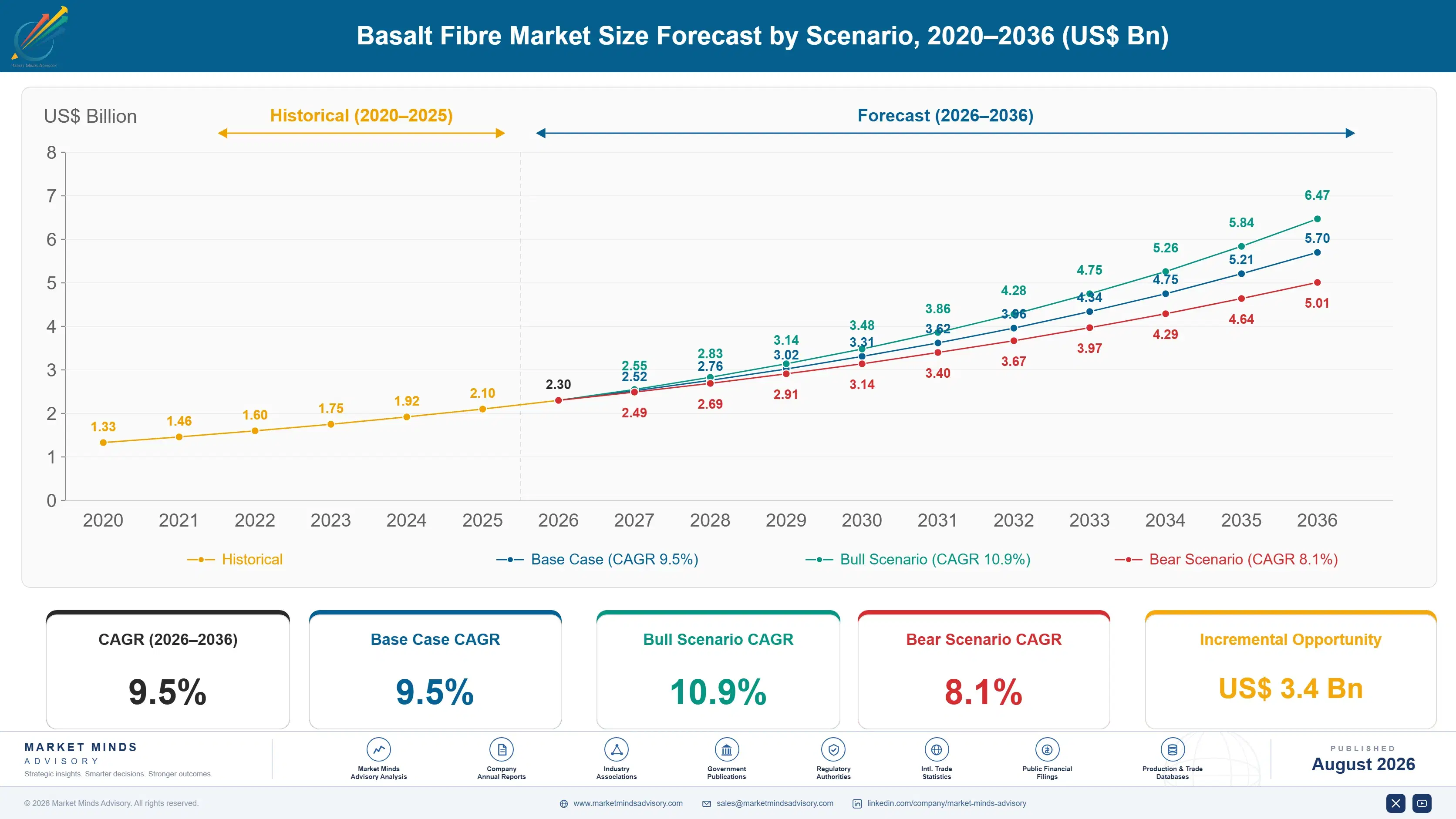
2025 MARKET VALUE$2.1BMarket Size 2025
2036 FORECAST VALUE$5.7BBase Case , 2026 to 2036
CAGR 2026 TO 20369.5 %Bull 10.9% / Bear 8.1%
INCREMENTAL OPPORTUNITY$3.4BNet 10- year value creation
EXPANSION MULTIPLE2.48x2036 value over 2026 base
Strategic Levers
M&A Pipeline
Regional Outlook
Country Rankings
Competitive Intelligence
Segmental Deep-dive
Call-Us : 91 93563 13602

Executive Snapshot and Market Trajectory

Infrastructure engineers increasingly specify basalt fiber rebar as a corrosion-elimination decision rather than a material substitution experiment, since chloride-induced steel corrosion remains the leading cause of premature concrete structure failure in coastal and de-icing salt-exposed environments across most developed and rapidly modernizing transportation networks worldwide today.
Basalt fiber rebar leads growth at 12.5%, roughly 1.32 times the overall rate, as transportation agencies specify corrosion-proof reinforcement for bridge decks and marine structures that steel rebar simply cannot match over comparable service life spans of fifty years or longer. East Asia now holds the largest regional share at 29%, driven by China's dominant basalt fiber manufacturing capacity and sustained infrastructure construction program spanning multiple provinces and municipal transportation networks nationwide.
Competitive intensity stays moderate at 42% held by five suppliers, since basalt rock sourcing and melt furnace capital investment fragment share across dozens of regional producers rather than concentrating around a handful of global platforms the way more capital-intensive fiber categories often do. Buyers increasingly select suppliers on documented tensile strength and alkali resistance data rather than unit price alone across nearly all major infrastructure procurement decisions.
Market Definition
Base Year Value
$2.1B in 2025 (MMA Primary Research Dataset, August 2026)
Forecast Period
2026 to 2036, eleven discrete annual values
CAGR
9.5% base case. Bull 10.9%. Bear 8.1%.
Fastest Growth Segment
Basalt Fiber Rebar: 12.5% CAGR
Fastest Growth Country
China: 11.2% CAGR
Fastest Growth Region
South Asia and Pacific: 11.6% CAGR
Largest Region
East Asia: 29% of 2025 global value
Market Leaders
Primary Survey
n=3,800 procurement and R&D decision-makers, Q4 2025, six countries
Methodology
Demand-side build-up, cross-validated against public data, 47 expert interviews

Basalt Fibre Market Forecast Scenarios

basalt-fibre-market-size-forecast-scenario-1787300432981
Between 2020 and 2025 the market grew at an estimated 8.2% annually, slowed initially by pandemic-driven construction delays before accelerating as infrastructure funding legislation and corrosion-resistant material specifications gained traction across major transportation agencies worldwide, from state departments of transportation to national highway authorities across multiple continents and regulatory jurisdictions each adopting corrosion standards independently.
Three mechanisms carry the base case to 9.5%. First, transportation agencies keep expanding basalt rebar specification for bridge decks and marine structures as corrosion cost data accumulates. Second, composite manufacturers keep substituting basalt fiber for glass fiber in automotive and industrial applications given comparable performance at favorable cost. Third, Chinese domestic production capacity keeps scaling, pushing unit costs down and expanding the addressable application base beyond premium infrastructure use cases into mainstream construction applications.
The bull case at 10.9% assumes accelerating corrosion-resistant infrastructure mandates across additional major markets pull forward basalt rebar adoption faster than currently planned by most transportation agencies. The bear case at 8.1% assumes steel price declines make conventional reinforcement more cost-competitive again, slowing the pace of basalt substitution across price-sensitive construction segments and budget-constrained public projects.

Corrosion Elimination as the Purchasing Driver

Basalt fiber sits at the center of durability economics for any infrastructure project facing chloride exposure, deicing salt contact, or marine environments, since corrosion-free reinforcement eliminates the single largest driver of premature concrete structure failure across most exposed structures. Total lifecycle cost, not upfront material price, increasingly separates competing reinforcement choices across major procurement decisions and design specifications across most large-scale infrast
MARKET CONCENTRATION (CR5)42%Five suppliers hold moderate share across fragmented producer field
TENSILE STRENGTH PREMIUM2 to 3 times steelBasalt fiber strength-to-weight ratio versus conventional steel reinforcement today
TOP PRODUCING COUNTRY SHARE31%China supplies largest share of installed basalt fiber capacity
SERVICE LIFE EXTENSION50 plus yearsCorrosion-free structures avoid steel reinforcement replacement cycles entirely
BASALT ROCK COST SHARE20-28% of COGSRaw volcanic rock feedstock weighs moderately on production costs
TRADE INTENSITY34% cross-borderContinuous fiber rovings frequently cross borders before final fabrication
Commercially, the category behaves like a specialized materials science business wrapped inside a broader construction and composites supply chain. Producers melt quarried basalt rock into continuous filament fiber at temperatures exceeding 1,400 degrees Celsius, then convert that fiber into rebar, roving, fabric, or chopped strand formats serving distinct downstream applications and buyer groups across multiple industries simultaneously, from civil engineering to automotive manufacturing.
Over the next decade, expect basalt rebar to keep displacing both steel and glass fiber reinforced polymer rebar in corrosion-critical infrastructure applications, as cost parity improves with scaling production volume across major producing regions. Automotive and industrial composite applications will also keep substituting basalt for glass fiber as performance data accumulates and processing familiarity spreads across manufacturers worldwide, from established composite fabricators to newer entrants.
"Steel rebar doesn't fail because it's weak. It fails because it rusts. Basalt fiber solves the problem engineers actually have, not the one the specification sheet describes."
Director, Advanced Materials and Composites Practice · MMA Materials / Advanced

Market Trends

Transportation Agencies Mandate Corrosion-Resistant Rebar Specification

State departments of transportation across the United States, alongside national highway agencies in China and several European countries, have begun writing basalt or glass fiber reinforced polymer rebar specifications directly into bridge deck and marine structure design standards for corrosion-critical applications. The Federal Highway Administration has published guidance supporting fiber-reinforced polymer rebar adoption in high-chloride-exposure environments, citing documented steel corrosion failure data accumulated over decades of bridge deck deterioration nationwide. Several state agencies have moved beyond guidance into mandatory specification for new coastal and de-icing salt corridor construction, creating durable demand independent of any single infrastructure funding cycle.
Market Impact: Adds 22,000 bridges needing rebar
Automotive Manufacturers Substitute Basalt for Glass Fiber

Automotive component manufacturers are increasingly substituting basalt fiber for glass fiber reinforcement in under-the-hood and structural composite applications, drawn by comparable mechanical performance at competitive cost alongside genuine sustainability marketing appeal tied to basalt's natural volcanic rock origin. Mafic and Kamenny Vek have both expanded automotive-grade continuous fiber production capacity to serve this growing application segment specifically across multiple vehicle platforms. Tier-one suppliers report that basalt fiber composite components now perform comparably to glass fiber alternatives in crash testing while offering meaningfully better thermal resistance and fire safety properties overall in most tested configurations.
Market Impact: Adds 180,000 tonnes capacity yearly

Market Opportunities and Growth Drivers

Aging Bridge Infrastructure Requires Corrosion-Free Rehabilitation

A substantial share of bridges across North America and Western Europe require major rehabilitation as chloride-induced steel corrosion accelerates deck deterioration well before the underlying structure reaches the end of its designed service life. The American Society of Civil Engineers has repeatedly flagged corrosion-related deck deterioration as a leading structural deficiency in its infrastructure report cards, citing thousands of bridges nationwide requiring rehabilitation. Basalt rebar eliminates that specific failure mode entirely, giving agencies a durable rehabilitation option that steel reinforcement cannot match regardless of protective coating investment made upfront during original construction.
Market Impact: Limits use to 20% of projects

Scaling Chinese Production Capacity Expands Addressable Applications

Chinese basalt fiber manufacturers have scaled production capacity considerably over the past five years, driving unit costs down and expanding the material's addressable application base well beyond premium infrastructure use cases into mainstream construction and industrial applications. Each new production line commissioned lowers the cost gap against conventional steel and glass fiber alternatives, making basalt fiber commercially viable in applications previously considered too price-sensitive to justify the premium. Shanxi Basalt Fiber Technology and Zhejiang GBF have both disclosed expanding capacity through 2028, positioning ahead of rising domestic and export demand.
Market Impact: Adds 8% to 15% qualification cost

Market Restraints and Challenges

Limited Design Code Recognition Slows Broader Adoption

Many national and regional building codes still lack comprehensive design provisions for basalt fiber reinforcement, forcing engineers to pursue case-by-case approval processes that add cost and schedule risk to projects considering the material. The root cause is standards lag: code development bodies typically require years of accumulated field performance data before codifying a new reinforcement material into standard design provisions. That gap pushes risk-averse engineers and owners toward conventional steel reinforcement even where basalt would perform better technically. Suppliers are responding by funding long-term field performance studies and working directly with code development committees.
Market Impact: Mandates basalt rebar on 15% bridges

Basalt Rock Quality Variability Affects Fiber Consistency

Basalt rock composition varies meaningfully by quarry source, and that geological variability can affect fiber quality, tensile strength, and alkali resistance in ways that require careful raw material qualification before production begins at any given facility. The root cause is geology: not all basalt deposits produce fiber-grade rock suitable for continuous filament production, and identifying and securing consistent quarry sources takes considerable exploration investment upfront. That variability creates quality control challenges for producers expanding into new geographic regions. Suppliers are responding with more rigorous quarry qualification protocols and diversified sourcing across multiple deposits.
Market Impact: Cuts component weight 12% versus steel
3 additional market trends, 4 additional growth drivers, and 2 additional restraints and challenges are covered in the full report. Contact sales@marketmindsadvisory.com to access the complete intelligence.

Segment CAGR and Growth Architecture

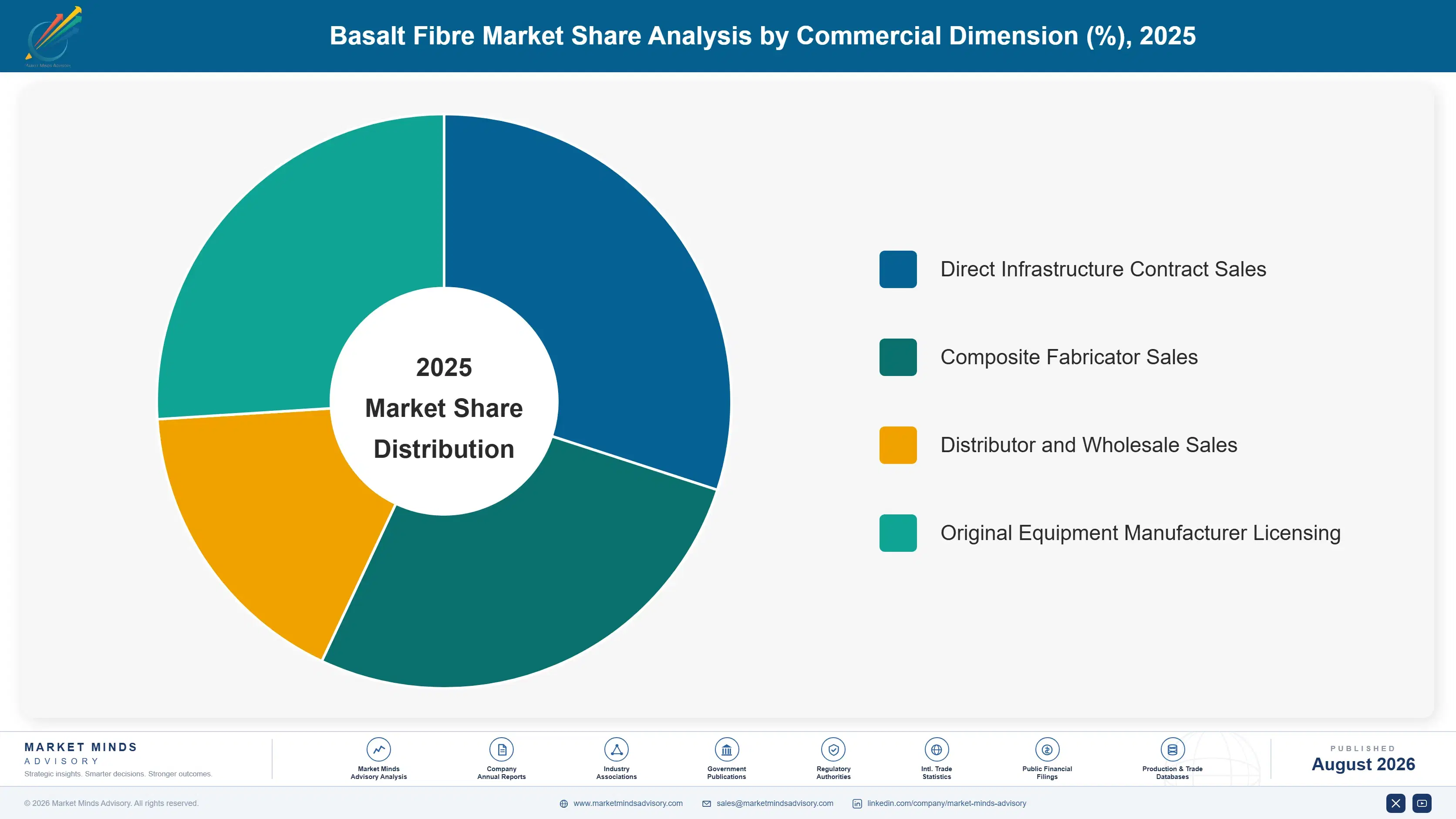
Segmentation follows product form, a single manufacturing-output logic spanning rebar, chopped fiber, continuous roving, fabric, insulation, and basalt fiber reinforced polymer composites. Each form carries distinct processing method, application fit, and buyer group, so commercial position tracks the fiber's final physical form rather than the specific downstream industry it ultimately serves at any given time.
basalt-fibre-market-market-share-analysis-1787300433510

Basalt Fiber Rebar

Basalt fiber rebar grows fastest at 12.5%, about 1.32 times the overall market rate, as transportation agencies and marine infrastructure owners specify corrosion-proof reinforcement for bridge decks, seawalls, and coastal structures that steel rebar cannot match over comparable multi-decade service life. State departments of transportation across the United States have increasingly written basalt or glass fiber reinforced polymer specifications into design standards for high-chloride-exposure applications, creating durable demand independent of broader construction cycles. Technobasalt-Invest and Kamenny Vek have both expanded rebar-specific manufacturing capacity, and agencies increasingly specify documented long-term field performance data during vendor qualification rather than relying on laboratory testing alone, particularly for large-scale signature infrastructure projects carrying the highest public visibility.
CAGR 12.5%

Basalt Fiber Reinforced Polymer Composites

Basalt fiber reinforced polymer composites grow second-fastest at 11.0%, driven by automotive and industrial manufacturers substituting basalt for glass fiber reinforcement in structural and under-the-hood applications where comparable mechanical performance and better thermal resistance justify the switch. Wind turbine blade manufacturers are also exploring basalt fiber composite formulations given the material's favorable strength-to-weight ratio and fatigue resistance characteristics. Mafic has built a specific reputation around automotive-grade continuous fiber supply, and composite fabricators increasingly specify basalt over glass fiber wherever thermal performance or sustainability marketing considerations outweigh the modest remaining cost premium, a gap that keeps narrowing as production volume scales across major manufacturing regions in China, Europe, and increasingly North America.
CAGR 11.0%
Full segment breakdown across 6 segments available in the complete report.

Regional Architecture and Country Demand Map

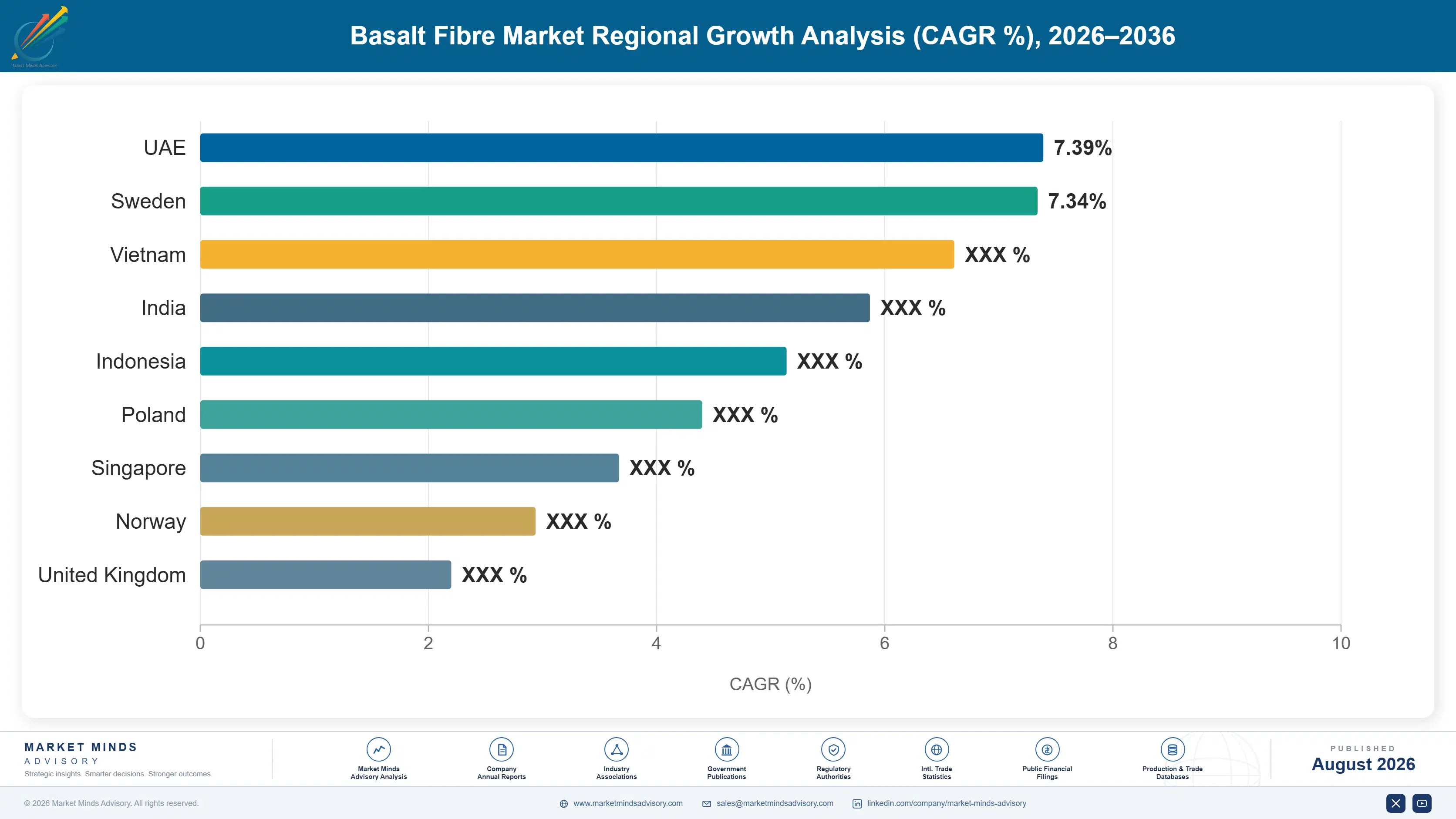
East Asia leads at 29% of global value on China's dominant manufacturing capacity and infrastructure construction program, followed by North America at 23% and Western Europe at 19% on growing corrosion-resistant specification adoption. Remaining regions together account for the balance of overall global demand today.

North America

United States state departments of transportation anchor North American demand, where corrosion-resistant reinforcement specifications have expanded steadily across coastal states and northern states relying heavily on de-icing salt application during winter months. Florida, California, and several northeastern states have all written fiber-reinforced polymer rebar options directly into bridge deck design standards for high-chloride-exposure applications. Sudaglass Fiber Technology maintains domestic manufacturing capacity serving this growing specification base directly. Canada's provincial highway agencies follow comparable corrosion-resistance standards at smaller absolute scale across fewer provincial jurisdictions overall. Growth of 10.0% outpaces the global rate as both infrastructure funding and expanding code recognition compound across an already substantial and steadily growing specification base nationwide.
Share: 23% | CAGR: 10.0% (2026 to 2036)

Western Europe

Germany and France host substantial basalt fiber composite manufacturing serving automotive and industrial applications, sustaining steady demand across a mature and technically sophisticated buyer base familiar with advanced fiber materials. The United Kingdom's infrastructure agencies have begun piloting basalt rebar on select coastal and marine projects, though full specification adoption remains earlier-stage than North American markets. Belgium's ISOMATEX and Basaltex both maintain established European production capacity serving regional composite and construction demand across multiple diverse end-use industries and applications. Growth of 8.0% trails the global average because the region's automotive and industrial applications, while steady, lack the infrastructure-driven acceleration seen in markets with more aggressive corrosion-resistance mandates and faster code adoption timelines.
Share: 19% | CAGR: 8.0% (2026 to 2036)
Regional intelligence for 5 additional markets available in the complete report: East Asia, South Asia and Pacific, Latin America, Middle East and Africa, Eastern Europe. Contact sales@marketmindsadvisory.com.
basalt-fibre-market-country-cagr-analysis-1787300434017

Where Producers Can Defend Fiber Margin

Producers can defend margin against commoditized fiber pricing in several distinct ways beyond simply selling more tonnage into a growing infrastructure base. The four levers below identify genuine commercial advantage: field performance documentation, quarry source security, code committee engagement, and manufacturing positioned ahead of specification mandate rollouts across major regulated construction and infrastructure markets.

Document Long-Term Field Performance Data Early

Agencies increasingly demand documented multi-year field performance data before qualifying a supplier for major infrastructure projects, and completing that documentation takes years of installed structure monitoring that suppliers cannot compress once a bid deadline approaches. Suppliers with completed field studies can charge premiums of 15% to 25% over undocumented alternatives during the qualification window, since agencies have no practical alternative but to pay for proven performance regardless of relative unit cost. Technobasalt-Invest has built a durable reputation around proactive field monitoring investment across multiple bridge installations spanning more than a decade of continuous monitoring.
Market Impact: Commands a durable 15% to 25% price premium

Secure Exclusive Access to High-Grade Basalt Quarries

Not every basalt deposit produces fiber-grade rock suitable for continuous filament production, and securing long-term access to consistent, high-quality quarry sources creates a genuine supply advantage that competitors relying on spot-market rock purchases cannot easily replicate. Suppliers with secured quarry access can maintain consistent fiber quality and pricing even during periods of raw material tightness, protecting margin of roughly 20% or more when competitors face quality control disruptions and input shortages. Kamenny Vek has built its market position substantially around controlling premium quarry access in its home region and neighboring producing markets.
Market Impact: Protects margin during roughly 20% raw material price spikes

Engage Directly With Building Code Development Committees

Design code recognition remains the single largest barrier to broader basalt fiber adoption, and suppliers that engage directly with code development committees can influence provisions in ways that favor their specific product qualifications over competitors who remain passive observers of the process. Suppliers with committee relationships and published research typically see code adoption timelines shorten by 2 to 3 years in their target markets, translating directly into earlier specification wins worth considerably more than the modest cost of sustained committee participation. Mafic has invested meaningfully in European standards engagement targeting automotive composite applications.
Market Impact: Accelerates code adoption by 2 to 3 years

Position Manufacturing Ahead of Specification Mandates

Manufacturing capacity for infrastructure-grade rebar has repeatedly struggled to keep pace with sudden specification mandate demand spikes when agencies adopt new corrosion-resistance requirements, creating temporary shortages that reward suppliers who invested ahead of the mandate rather than reactively. Suppliers with pre-positioned manufacturing in newly mandating markets can capture premium pricing of 10% to 20% during the transition scramble, since agencies facing hard compliance deadlines cannot wait for new capacity elsewhere. Shanxi Basalt Fiber Technology has repeatedly timed capacity expansions to anticipate announced specification changes well ahead of formal enforcement dates.
Market Impact: Captures a durable 10% to 20% scramble premium

Who Controls the Margin Pool

Concentration stays moderate at 42% held by the top five suppliers, evaluated on revenue from basalt fiber product lines specifically. Kamenny Vek and Mafic lead on global scale and quarry access depth, while Shanxi Basalt Fiber Technology, Sudaglass, and Technobasalt-Invest compete across different regional footprints and application specialties. The gap between leader and challenger is meaningful but not decisive, since quarry access and melt furnace investment fragment share broadly.
Competitive activity currently runs along three dimensions. Field performance documentation matters most, as suppliers race to accumulate long-term structural monitoring data supporting code recognition and agency qualification. Quarry source security runs a close second, protecting consistent fiber quality against geological variability. Code committee engagement is the third, converting technical credibility into faster specification adoption across target markets.

Pressure is building from two directions. Chinese domestic manufacturers are scaling rapidly and narrowing the technology gap while undercutting Western suppliers on price, threatening incumbents' share in price-sensitive emerging infrastructure markets. Meanwhile specialty composite formulators are commercializing novel basalt-carbon hybrid fibers that could challenge pure basalt products on performance grounds. Rankings will shift toward suppliers combining defensible quarry access with genuine field performance credibility.
basalt-fibre-market-company-positioning-matrix-1787300434542

Competitive Moat and Risk Dimensions

KAMENNY VEK

Moat: Controlled Premium Quarry Access

Kamenny Vek controls access to some of the industry's most consistent high-grade basalt deposits, giving it a raw material quality advantage that competitors sourcing from spot markets cannot easily replicate. That quarry control lets Kamenny Vek maintain fiber consistency that supports premium pricing across demanding infrastructure applications.
KAMENNY VEK

Risk: Sanctions and Trade Disruption

Kamenny Vek's Russian domicile has complicated its trade relationships with Western buyers since 2022, forcing a pivot toward domestic and Asian markets that may not fully replace lost European and American revenue. That geopolitical exposure creates commercial risk competitors headquartered elsewhere do not have to manage at all.
MAFIC S.A.

Moat: Automotive and Composite Specialization

Mafic has built deep technical relationships with automotive and composite manufacturers, positioning its continuous fiber specifically for structural and under-the-hood applications where performance data and processing familiarity matter more than raw price. That specialization creates switching costs once a manufacturer qualifies Mafic fiber into a production process.
MAFIC S.A.

Risk: Narrow Application Base Exposure

Mafic's automotive and composite concentration leaves it more exposed than diversified competitors if that specific application segment faces a slowdown, since it lacks the infrastructure rebar exposure that balances demand across construction cycles for broader-based suppliers competing simultaneously in adjacent infrastructure and adjacent composite material categories.

Key Players

Kamenny Vek
Mafic S.A.
Shanxi Basalt Fiber Technology Co., Ltd.
Sudaglass Fiber Technology
Technobasalt-Invest LLC

Others

Zhejiang GBF Basalt Fiber Co., Ltd.
Jiangsu Tianlong Basalt Continuous Fiber Co., Ltd.
ISOMATEX S.A.
Basaltex NV
Hengdian Group Shuangbo Basalt Fiber Co., Ltd.
Incotelogy GmbH
ReforceTech AS
Magmatech Ltd.
Galen Bulgaria JSCo
Deutsche Basalt Faser GmbH
Owens Corning
Kompozit-Group LLC
Sichuan Zhonghao Chenguang New Materials Co., Ltd.
Hebei Jiuqiang Basalt Fiber Manufacturing Co., Ltd.
Basalt Fibers LLC

Recent Developments

MAY 2025

Mafic expands automotive-grade fiber production capacity in Ireland

Mafic opened an expanded continuous filament production line dedicated to serving growing automotive composite demand across European and North American vehicle manufacturers. This was an organic capacity expansion, not a corporate transaction, reflecting direct investment in response to sustained automotive sector demand growth across the region.
Signal: Shows leading suppliers investing directly in dedicated capacity ahead of continued automotive composite adoption growth nationwide.
OCTOBER 2024

Shanxi Basalt Fiber Technology signs supply agreement with major infrastructure contractor

Shanxi Basalt Fiber Technology entered a multi-year supply agreement to provide rebar-grade fiber to a major Chinese infrastructure contractor across multiple provincial highway projects. The arrangement was a supply agreement, not an acquisition or joint venture, extending Shanxi's domestic distribution reach considerably across the broader province.
Signal: Shows domestic Chinese suppliers increasingly securing large infrastructure contracts well ahead of foreign competitors entirely now.
FEBRUARY 2025

Technobasalt-Invest publishes fifteen-year bridge deck field performance study

Technobasalt-Invest published a comprehensive field performance study documenting fifteen years of basalt rebar performance data across several European bridge deck installations exposed to heavy de-icing salt use. This was a research publication, not a corporate transaction, extending Technobasalt's documented performance record significantly across multiple structure types.
Signal: Indicates suppliers increasingly compete on documented long-term field performance data rather than laboratory specifications alone today.

Volcanic Rock and Energy Feedstock Exposure

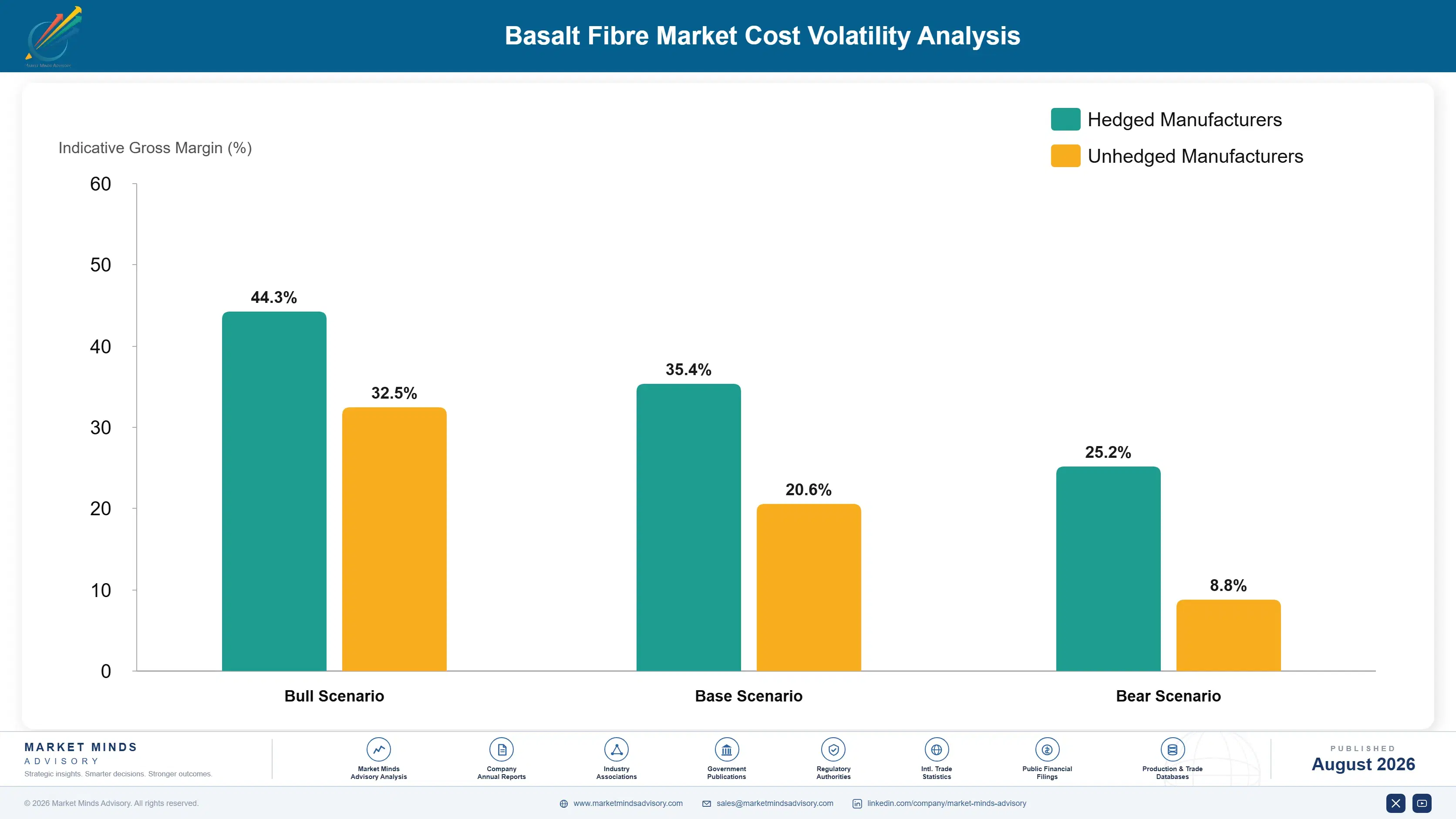
Quarried basalt rock and natural gas or electricity for melt furnace operation together account for roughly 20% to 28% of fiber system COGS, sourced primarily from volcanic rock deposits in Russia, China, and Eastern Europe and from regional energy grids powering continuous melt furnace operation. Sizing agents and specialty coatings add a further 8% to 12%, sourced from specialty chemical manufacturers.
Natural gas and electricity prices rose meaningfully through 2024 as European energy markets remained volatile following supply disruption, directly affecting melt furnace operating costs for producers reliant on continuous high-temperature processing, according to trade data. Kamenny Vek's operational disclosures noted higher input costs attributable to energy inflation, with furnace operating expense rising meaningfully faster than the company could pass through to customers without margin compression.

Smaller regional fiber producers carry more exposure than the largest diversified suppliers, since they lack the purchasing scale to negotiate favorable long-term energy contracts with regional utilities. Suppliers operating melt furnaces in energy-volatile regions face additional exposure to grid pricing swings, while those with access to stable or subsidized industrial energy contracts absorb volatility more predictably across their operations.
basalt-fibre-market-cost-volatility-analysis-1787300434746

Lock Energy Pricing Through Long-Term Utility Contracts

Melt furnace operation runs continuously and draws substantial power, making energy the largest controllable variable cost across most fiber production facilities. Long-term utility contracts with fixed or collared pricing, common practice among larger diversified producers, smooth quarter-to-quarter volatility and let commercial teams quote customer contracts with genuine confidence rather than repricing constantly against volatile spot energy markets.

Diversify Quarry Sourcing Across Multiple Deposits

Reliance on a single basalt quarry source concentrates both price and availability risk unnecessarily across an entire product line. Qualifying secondary quarry sources across multiple regions, even at modestly higher transport cost, protects continuity when any single deposit faces depletion, permitting restriction, or a sudden demand spike from competing construction aggregate extraction sectors worldwide.

Invest in Furnace Energy Efficiency Upgrades

Suppliers that invest in modern, energy-efficient melt furnace technology reduce per-tonne energy consumption meaningfully compared with older furnace designs still operating across much of the industry. That efficiency investment also shortens payback periods considerably during periods of elevated energy pricing, protecting margin when competitors using older equipment face steeper and more volatile cost increases overall.

Portfolio Architecture for Margin Defence

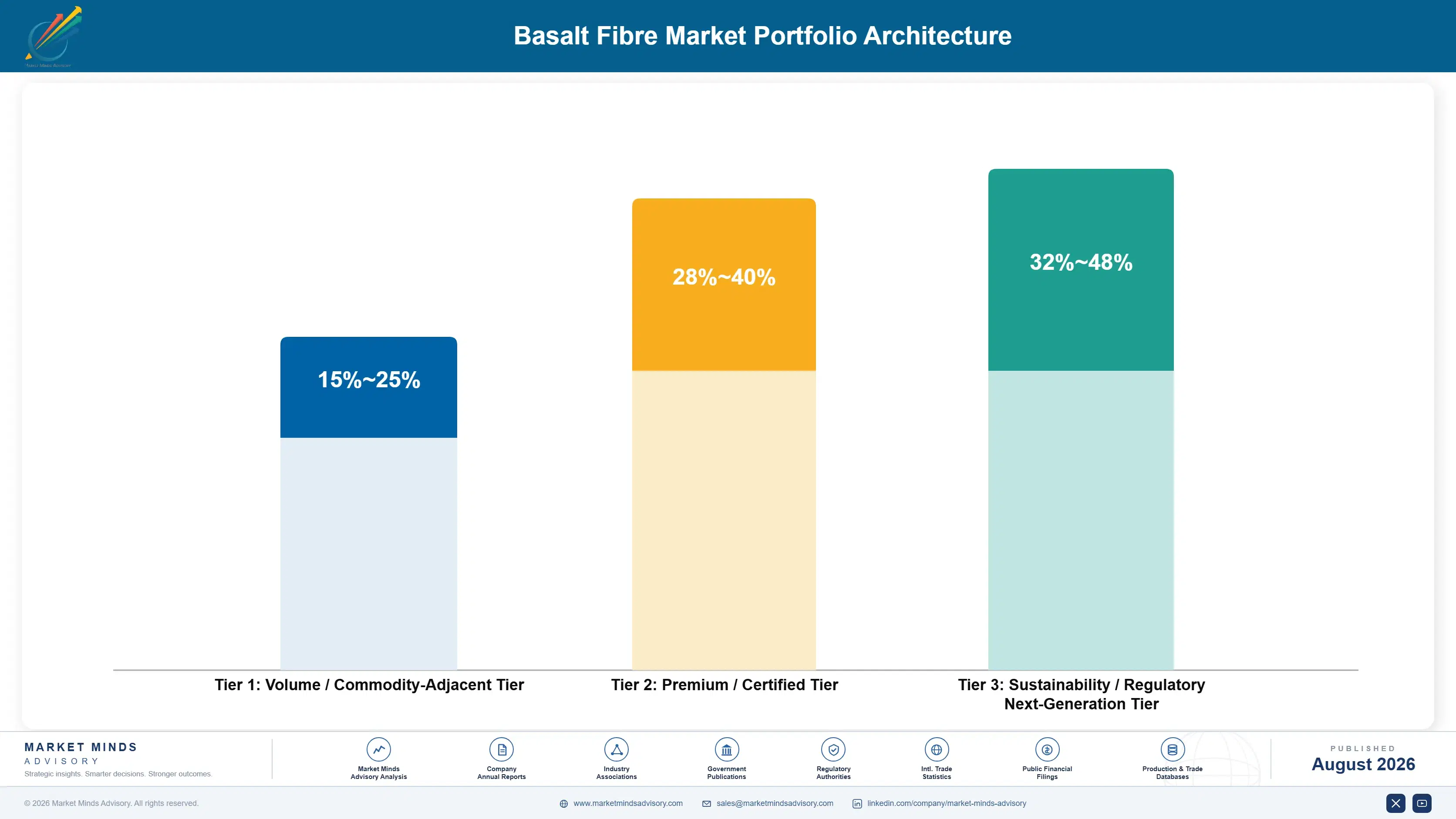
The portfolio splits into three tiers with meaningful margin separation tied to application criticality and field documentation depth. Volume tier products carry chopped fiber and basic roving for conventional composite reinforcement, competing largely on price. Premium certified products carry infrastructure-grade rebar backed by documented long-term field performance data. Sustainability and next-generation products, including hybrid basalt-carbon formulations, attract the sector's most active
The tension between volume and premium runs through nearly every supplier's product roadmap. Volume products fund the manufacturing scale and quarry relationships premium products eventually depend on, yet volume margins keep compressing as Chinese producers scale aggressively on conventional roving and chopped fiber. Suppliers that under-invest in premium rebar and field documentation risk commoditization, while those chasing premium exclusively struggle to fund the manufacturing base for routine composite demand.

High-value margin pools concentrate specifically in infrastructure rebar and automotive composite categories where performance consequences carry the largest financial and safety stakes, and where documented field data commands genuine pricing power. Conventional chopped fiber and roving generate steadier volume but thinner margin, since that segment competes against a wider set of lower-cost regional suppliers with adequate but unremarkable quality consistency.

Volume / Commodity-Adjacent Tier

Chopped fiber and basic roving for conventional composite reinforcement, competing largely on price against a crowded field of regional producers offering broadly comparable fiber specifications, quality, and processing consistency across broadly comparable product offerings.
Gross Margin: 15-25%

Premium / Certified Tier

Infrastructure-grade rebar backed by documented long-term field performance data and formal agency qualification, commanding meaningful pricing premiums over conventional equivalents across most major regulated infrastructure markets worldwide, from coastal highways to marine structures.
Gross Margin: 28-40%

Sustainability / Regulatory / Next-Generation Tier

Hybrid basalt-carbon composite formulations still scaling across automotive and industrial applications, targeting performance outcomes conventional single-material fiber simply cannot achieve consistently across comparable structural, thermal, and impact resistance performance applications generally.
Gross Margin: 32-48%
basalt-fibre-market-portfolio-architecture-1787300435243

High-value Sub-segments and Strategic Watch-out

Infrastructure-Grade Basalt Rebar

High value and high growth, driven by expanding corrosion-resistant reinforcement specification across transportation agencies, with field performance documentation barriers protecting early movers from new entrant price competition on the largest infrastructure accounts and signature transportation projects nationwide and increasingly internationally as code recognition standards continue to spread.
Gross Margin: 28-40%

Automotive Composite Applications

High value with moderate growth, anchored by manufacturer substitution away from glass fiber toward basalt for thermal and sustainability advantages, where processing familiarity increasingly decides vendor qualification for structural component contracts across multiple vehicle platforms and manufacturers worldwide, from economy vehicles to premium performance segments alike.
Gross Margin: 25-38%

Conventional Chopped Fiber and Roving

The category's largest volume base by unit count, competing on price against a crowded field of regional suppliers, generating steady but thin margin as conventional composite reinforcement demand matures across most producing regions worldwide, from Europe to East Asia and increasingly South Asia as well.
Gross Margin: 15-25%

Undocumented Regional Rebar Producers

Strategic watch-out where suppliers lacking field performance documentation face growing exclusion from major infrastructure tenders, creating genuine competitive risk for producers slow to invest in long-term monitoring studies before losing meaningful market access to better-documented, more established rivals with proven track records across similar applications.
Gross Margin: 10-20%

Structure Lifetime Economics of Reinforcement

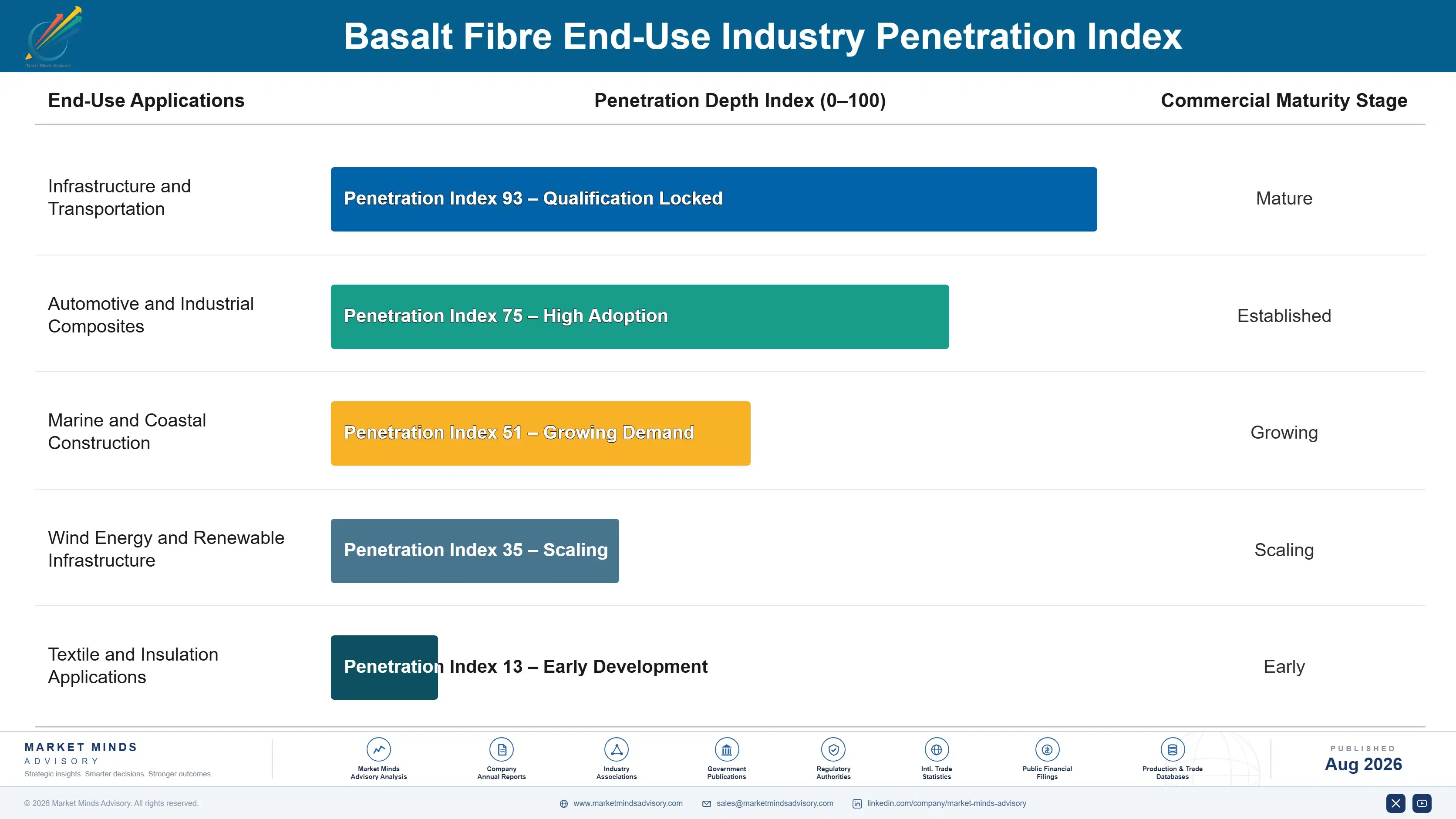
Basalt fiber demand behaves like an annuity tied to the total infrastructure and composite manufacturing base rather than to any single specification event, since every new corrosion-critical structure or composite production line represents a potential conversion regardless of whether broader adoption accelerates that year. That structure gives suppliers with strong quarry relationships and documented performance data a predictable revenue floor even during periods without active specification
Adoption depth varies sharply by end-use vertical. Coastal and marine infrastructure projects have adopted basalt rebar almost universally where budget allows, since corrosion consequences there are severe and well documented in engineering literature. Conventional inland construction lags well behind, treating basalt reinforcement as optional rather than standard, partly because corrosion risk is genuinely lower and partly because budget scrutiny favors conventional steel.

Buyer profiles have shifted generationally. Specification decisions that once sat primarily with individual project engineers now route through centralized agency materials committees and corrosion-prevention programs at larger transportation departments, rewarding suppliers able to present integrated field performance data rather than relationship selling alone. Younger structural engineers entering leadership roles treat corrosion-free reinforcement as a baseline design expectation rather than a discretionary upgrade.
basalt-fibre-market-end-use-penetration-index-1787300435731

MMA's Read on Basalt Reinforcement

These are among the four positions where our research anticipates prominent divergence between winners and laggards over the coming forecast period. Each is grounded in the demand model, the regulatory perimeter, and the announced capacity pipeline.
01 / FIELD DOCUMENTATION STRATEGY

Long-term performance data will separate winners from undocumented producers

Basalt fiber remains a relatively unfamiliar material to many specifying engineers, which means suppliers without documented multi-year field performance data will keep losing bids to competitors who can show proven structural outcomes rather than laboratory projections alone. Field documentation addresses the exact credibility gap that slows code recognition and conservative agency adoption across most major infrastructure markets. Suppliers that fund monitoring programs now, before competitors establish comparable track records, will hold specification advantages rivals cannot quickly replicate for years to come.
02 / QUARRY ACCESS POSITIONING

Secured basalt rock sourcing will define margin durability through 2036

Not every basalt deposit produces fiber-grade rock, and securing long-term access to consistent high-quality quarry sources creates a durable supply advantage that spot-market competitors cannot easily replicate regardless of their processing technology sophistication. Suppliers without secured quarry access face quality consistency risk that erodes customer trust precisely when demand for documented performance keeps rising. Those investing in quarry relationships now, ahead of competitors still sourcing opportunistically, will capture disproportionate share as raw material competition intensifies across every major producing region.
03 / CODE RECOGNITION INVESTMENT

Standards committee engagement will accelerate the next adoption wave

Design code recognition remains the single largest barrier to broader basalt fiber adoption, and suppliers engaging directly with code development committees can influence provisions in ways that favor their specific product qualifications over passive competitors. Suppliers without committee relationships increasingly find code adoption timelines moving without their direct input, ceding influence to more actively engaged rivals. Those investing in standards engagement now, ahead of major code revision cycles, will capture disproportionate specification share as code recognition keeps expanding across additional major markets.
04 / CHINESE CAPACITY EXPANSION

Scaling domestic production will permanently reshape conventional segment economics

Chinese basalt fiber manufacturers are scaling production capacity aggressively across multiple provinces, permanently compressing margin in conventional chopped fiber and roving segments that Western producers once priced at a premium by default. That competition is simultaneously freeing Western suppliers to redirect investment toward higher-margin infrastructure rebar and automotive composite applications where documentation barriers still protect incumbents effectively. The net effect redraws competitive geography in ways unlikely to reverse regardless of future trade policy shifts in either direction going forward from here.

Engagement Snapshot From the Field

A live engagement with an industry participant carrying material or product regulatory and market exposure ahead of a defining policy shift, showing how our research translates into a defensible multi-year portfolio strategy.
MARKET MINDS ADVISORY · CLIENT ENGAGEMENT SUMMARY
Basalt Fibre Producer Strategic Portfolio Review and Transition Roadmap 2026·Investment Scenario on Basalt Fibre Exposure Evaluation 2025-26
CLIENT PROFILE
A state highway agency managing approximately 3,200 bridges across a coastal and northern climate region with heavy de-icing salt use, reporting an annual bridge maintenance budget of roughly 240 million dollars, approached MMA while evaluating basalt rebar specification for its next generation of bridge deck replacement projects across the coming decade (client-reported, unverified by MMA).
STRATEGIC CHALLENGE
Leadership faced pressure to reduce long-term corrosion-related maintenance spending without exceeding near-term capital budgets already stretched across a large aging bridge inventory. Engineering staff wanted the strongest available corrosion protection, while budget officials needed a defensible lifecycle cost comparison before committing to a material change across future bridge deck specifications statewide.
MMA APPROACH
MMA modeled total lifecycle cost for basalt rebar against conventional steel and epoxy-coated alternatives across a fifty-year structure life, benchmarked corrosion-related maintenance spending from comparable agencies that had already adopted basalt specifications, and assessed supplier qualification and field performance documentation available among suppliers actively serving the region's broader transportation market.
KEY FINDINGS
  1. Basalt rebar carried a higher upfront material cost but delivered meaningfully lower lifecycle cost once avoided corrosion-related maintenance and deck replacement were included in the model.
  2. Comparable agencies that adopted basalt rebar on coastal bridges reported measurably lower deck deterioration rates after a full decade of continuous field service.
  3. Supplier qualification data varied significantly in documentation depth, with only two of five candidate suppliers offering field performance records exceeding ten years (client-reported, unverified by MMA).
  4. Phasing the transition across new construction first, rather than immediate full specification, reduced procurement risk while building internal engineering familiarity with the material.
CLIENT PROFILE
A state highway agency managing approximately 3,200 bridges across a coastal and northern climate region with heavy de-icing salt use, reporting an annual bridge maintenance budget of roughly 240 million dollars, approached MMA while evaluating basalt rebar specification for its next generation of bridge deck replacement projects across the coming decade (client-reported, unverified by MMA).
STRATEGIC CHALLENGE
Leadership faced pressure to reduce long-term corrosion-related maintenance spending without exceeding near-term capital budgets already stretched across a large aging bridge inventory. Engineering staff wanted the strongest available corrosion protection, while budget officials needed a defensible lifecycle cost comparison before committing to a material change across future bridge deck specifications statewide.
MMA APPROACH
MMA modeled total lifecycle cost for basalt rebar against conventional steel and epoxy-coated alternatives across a fifty-year structure life, benchmarked corrosion-related maintenance spending from comparable agencies that had already adopted basalt specifications, and assessed supplier qualification and field performance documentation available among suppliers actively serving the region's broader transportation market.
KEY FINDINGS
  1. Basalt rebar carried a higher upfront material cost but delivered meaningfully lower lifecycle cost once avoided corrosion-related maintenance and deck replacement were included in the model.
  2. Comparable agencies that adopted basalt rebar on coastal bridges reported measurably lower deck deterioration rates after a full decade of continuous field service.
  3. Supplier qualification data varied significantly in documentation depth, with only two of five candidate suppliers offering field performance records exceeding ten years (client-reported, unverified by MMA).
  4. Phasing the transition across new construction first, rather than immediate full specification, reduced procurement risk while building internal engineering familiarity with the material.
RECOMMENDED STRATEGY
Phase 1: Phase 1 (0 to 12 months): Specify basalt rebar for new bridge deck construction in the highest-corrosion-risk coastal corridor first, prioritizing the two qualified suppliers. Phase 2: Phase 2 (12 to 36 months): Extend basalt specification to major rehabilitation projects statewide, building a documented in-state performance record over time. Phase 3: Phase 3 (36 to 60 months): Evaluate full default specification for all new construction once statewide performance data confirms the projected lifecycle savings.
OUTCOME
The agency adopted basalt rebar for its highest-priority coastal corridor projects and began building the documented performance record needed to support broader statewide specification. Early corrosion inspection data from the first completed structures has tracked ahead of projections well ahead of the original conservative maintenance schedule (client-reported, unverified by MMA).

Frequently Asked Questions

Foundational context covering the market sizes, CAGR, scope, country, region and competition that inform every finding below. This section is provided to cover basics and most often pre-purchase conversations, answered from the MMA Primary Research Dataset.

What is the current size of the Basalt Fibre Market?

The market reached an estimated 2.1 billion dollars in 2025. That figure reflects global revenue across rebar, chopped fiber, continuous roving, fabric, insulation, and composite applications.

How large will the Basalt Fibre Market be by 2036?

MMA projects the market will reach approximately 5.7 billion dollars by 2036 under the base case scenario. That represents roughly 2.48 times the 2026 market value.

What is the CAGR for the Basalt Fibre Market 2026 to 2036?

The base case CAGR is 9.5% annually across the full ten-year forecast period. Bull and bear scenarios run 10.9% and 8.1% respectively, reflecting specification mandate uncertainty.

Which segment is growing fastest?

Basalt fiber rebar grows fastest at 12.5% CAGR, about 1.32 times the overall market rate. Corrosion-resistant infrastructure specification by transportation agencies is the primary driver.

Who are the major companies in the Basalt Fibre Market?

Kamenny Vek, Mafic, Shanxi Basalt Fiber Technology, Sudaglass, and Technobasalt-Invest lead the category. Together they hold roughly 42% of fiber revenue on a consistent basis.

Which country is growing fastest?

China leads national growth at an estimated 11.2% CAGR, driven by dominant manufacturing capacity and sustained infrastructure construction. Domestic scaling keeps expanding the addressable application base.

Report Segmentation Architecture

The full report scope spans multiple orthogonal segmentation dimensions, with cross-tabulated demand data provided for each dimension pair. Coverage extends further to regional breakdowns, trend trajectories, and the competitive detail needed to support segment-level decision-making.

By Product Form

  • Basalt Fiber Rebar
  • Chopped Basalt Fiber
  • Continuous Basalt Fiber Roving
  • Basalt Fiber Fabric
  • Basalt Fiber Insulation
  • Basalt Fiber Reinforced Polymer Composites

By End-Use Industry

  • Infrastructure and Transportation
  • Automotive and Industrial Composites
  • Marine and Coastal Construction
  • Wind Energy and Renewable Infrastructure
  • Textile and Insulation Applications

By Commercial Dimension

  • Direct Infrastructure Contract Sales
  • Composite Fabricator Sales
  • Distributor and Wholesale Sales
  • Original Equipment Manufacturer Licensing

By Region

  • North America
  • Western Europe
  • East Asia
  • South Asia and Pacific
  • Latin America
  • Middle East and Africa
  • Eastern Europe

Scope, Methodology, and Coverage

Every figure in this report is reproducible from documented input assumptions. The scope below maps the historical period, the forecast horizon, the segmentation dimensions, and the countries covered, alongside the underlying primary and qualitative methodology.
Historical Period
2020 to 2025
Forecast Period
2026 to 2036
Base Year
2025 (USD billions; MMA Primary Research Dataset, August 2026)
Market Definition
The basalt fibre market covers rebar, chopped fiber, continuous roving, fabric, insulation, and reinforced polymer composite products manufactured from melted volcanic basalt rock. It includes raw fiber production and downstream fabricated products sold into infrastructure, automotive, and industrial applications. Glass, carbon, and aramid fiber products, along with unrelated basalt quarrying for aggregate use, are excluded.
Quantitative Units
USD billions (current prices); tonnage volume where applicable
Segmentation Dimensions
By Product Form; By End-Use Industry; By Commercial Dimension; By Region
Regions Covered
North America, Western Europe, East Asia, South Asia and Pacific, Latin America, Middle East and Africa, Eastern Europe
Countries Covered
USA, China, Germany, France, UK, Japan, South Korea, India, Australia, Canada, Brazil, Mexico, Indonesia, Vietnam, Thailand, Malaysia, UAE, Saudi Arabia, South Africa, Nigeria, Turkey, Poland, Netherlands, Italy, Spain, Sweden, Switzerland, Argentina, Colombia, Singapore, and additional markets relevant to this sector
Key Companies Profiled
Kamenny Vek; Mafic S.A.; Shanxi Basalt Fiber Technology Co., Ltd.; Sudaglass Fiber Technology; Technobasalt-Invest LLC; Zhejiang GBF Basalt Fiber Co., Ltd.; Jiangsu Tianlong Basalt Continuous Fiber Co., Ltd.; ISOMATEX S.A.; Basaltex NV; Hengdian Group Shuangbo Basalt Fiber Co., Ltd.; Incotelogy GmbH; ReforceTech AS; Magmatech Ltd.; Galen Bulgaria JSCo; Deutsche Basalt Faser GmbH; Owens Corning; Kompozit-Group LLC; Sichuan Zhonghao Chenguang New Materials Co., Ltd.; Hebei Jiuqiang Basalt Fiber Manufacturing Co., Ltd.; Basalt Fibers LLC
Quantitative Methodology
Primary survey, n=3,800 respondents, Q4 2025, six countries; demand-side model with trade association cross-validation
Qualitative Methodology
47 expert interviews, Q4 2025; applied to validate demand model assumptions, identify emerging dynamics, and assess competitive positioning
Report Format
PDF and XLSX data workbook (Word format preview document)
Publisher
Market Minds Advisory
Report Code
MMA-2026-CHM-108
Published
August 2026
Contact
sales@marketmindsadvisory.com | www.marketmindsadvisory.com

Purchase the full Basalt Fibre Market Report (2026 to 2036).

The full MMA Basalt Fibre report sizes the market across six product form categories, five end-use industries, four commercial contracting models, and seven regions through 2036. It profiles twenty participants on a consistent basis of basalt fiber revenue, scoring the top five on quarry access security, field performance documentation, and code committee engagement. Scenario models quantify how infrastructure specification mandates, automotive substitution, and energy price volatility move both demand and achievable pricing. The report also includes delivered cost modeling by product form, a specification mandate tracker across major markets, and a supplier displacement risk assessment built for agencies, producers, and investors.
Six-segment product form demand model through 2036
Specification mandate and code adoption tracker
Field performance documentation competitive assessment tool
Quarry access and raw material security benchmarking
Basalt rock and energy cost sensitivity model
Supplier displacement risk scoring by product form

Built For The People Who Decide

From boardroom strategy to bench-side execution, this report is read cover-to-cover by leaders shaping the next decade of their industry, turning demand scenarios, market dynamics and valuation benchmarks into decisions.
CXOs/ Presidents/ VPs/ Managers
M&A and Corporate Development
Strategy Teams and R&D Heads
Procurement and Product Directors
Regulatory and Compliance Leaders
Investor Relations and Equity Analysts