Market Minds Advisory
Barrier Shrink Bags Market

Barrier Shrink Bags Market: Chlorine-Free Specification as the New Purchase Gate

Barrier shrink bags keep processed meat and cheese shelf-stable and leak-free during distribution, and food processors increasingly specify chlorine-free EVOH and bio-based films over legacy PVDC structures as retailers push recyclability commitments downstream.

Lead Analyst

Bilal Shaikh

Published

September 2026

Make Smarter Decisions with Customized Research Insights

Request a free sample report and evaluate market opportunities, growth trends, and competitive dynamics relevant to your business needs.

2025 MARKET VALUE$1.9BMarket Size 2025
2036 FORECAST VALUE$3.9BBase Case , 2026 to 2036
CAGR 2026 TO 20366.8 %Bull 8.0% / Bear 5.6%
INCREMENTAL OPPORTUNITY$1.9BNet 10- year value creation
EXPANSION MULTIPLE1.95x2036 value over 2026 base
Strategic Levers
M&A Pipeline
Regional Outlook
Country Rankings
Competitive Intelligence
Segmental Deep-dive
Call-Us : 91 93563 13602

Executive Snapshot and Market Trajectory

Meat processors are done defaulting to PVDC barrier film. Retailers and food safety regulators now push chlorine-free packaging specifications hard enough that processors are requalifying entire production lines around EVOH and bio-based alternatives, converting what was once a straightforward material substitution into a multi-year packaging engineering and food-safety validation program.
Bio-based and recyclable barrier films are pulling the market forward fastest, as brand owners under sustainability mandates favor mono-material and renewable-content structures over conventional multi-layer laminates wherever barrier performance allows it. East Asia now holds the largest share of global demand, driven by China's expanding processed meat and dairy industry and its retail-ready packaging modernization, while South Asia grows fastest as India's packaged food sector scales vacuum barrier packaging alongside a shift toward organized retail.
Consolidation is proceeding through acquisitions of specialty film converters rather than mega-mergers, as large packaging groups buy their way into EVOH and bio-based film technology they cannot develop fast enough internally. Competitive pressure is intensifying, since regional converters undercut Sealed Air and Amcor on price for commodity structures while food safety auditors demand tighter seal-integrity documentation, forcing smaller converters to prove validated performance data rather than cite decades of supply relationships.
Market Definition
The barrier shrink bags market covers multi-layer or mono-material flexible plastic bags engineered with oxygen and moisture barrier properties, used primarily for vacuum-packaging processed meat, cheese, and other perishable food products. It includes EVOH, PVDC, polyamide, and bio-based barrier film structures sold as finished shrink bags to food processors. General non-barrier shrink film, rigid packaging, and barrier films sold as flat rollstock rather than formed bags are excluded.
Base Year Value
$1.9B in 2025 (MMA Primary Research Dataset, August 2026)
Forecast Period
2026 to 2036, eleven discrete annual values
CAGR
6.8% base case. Bull 8.0%. Bear 5.6%.
Fastest Growth Segment
Bio-Based and Recyclable Barrier Shrink Bags: 10.5% CAGR
Fastest Growth Country
China: 11.8% CAGR
Fastest Growth Region
South Asia and Pacific: 8.9% CAGR
Largest Region
East Asia: 27% of 2025 global value
Market Leaders
Sealed Air Corporation, Amcor plc, Winpak Ltd., Coveris Holdings S.A., ProAmpac LLC. Source: MMA Analysis based on company annual reports.
Primary Survey
n=3,800 procurement and R&D decision-makers, Q4 2025, six countries
Methodology
Demand-side build-up, cross-validated against public data, 47 expert interviews

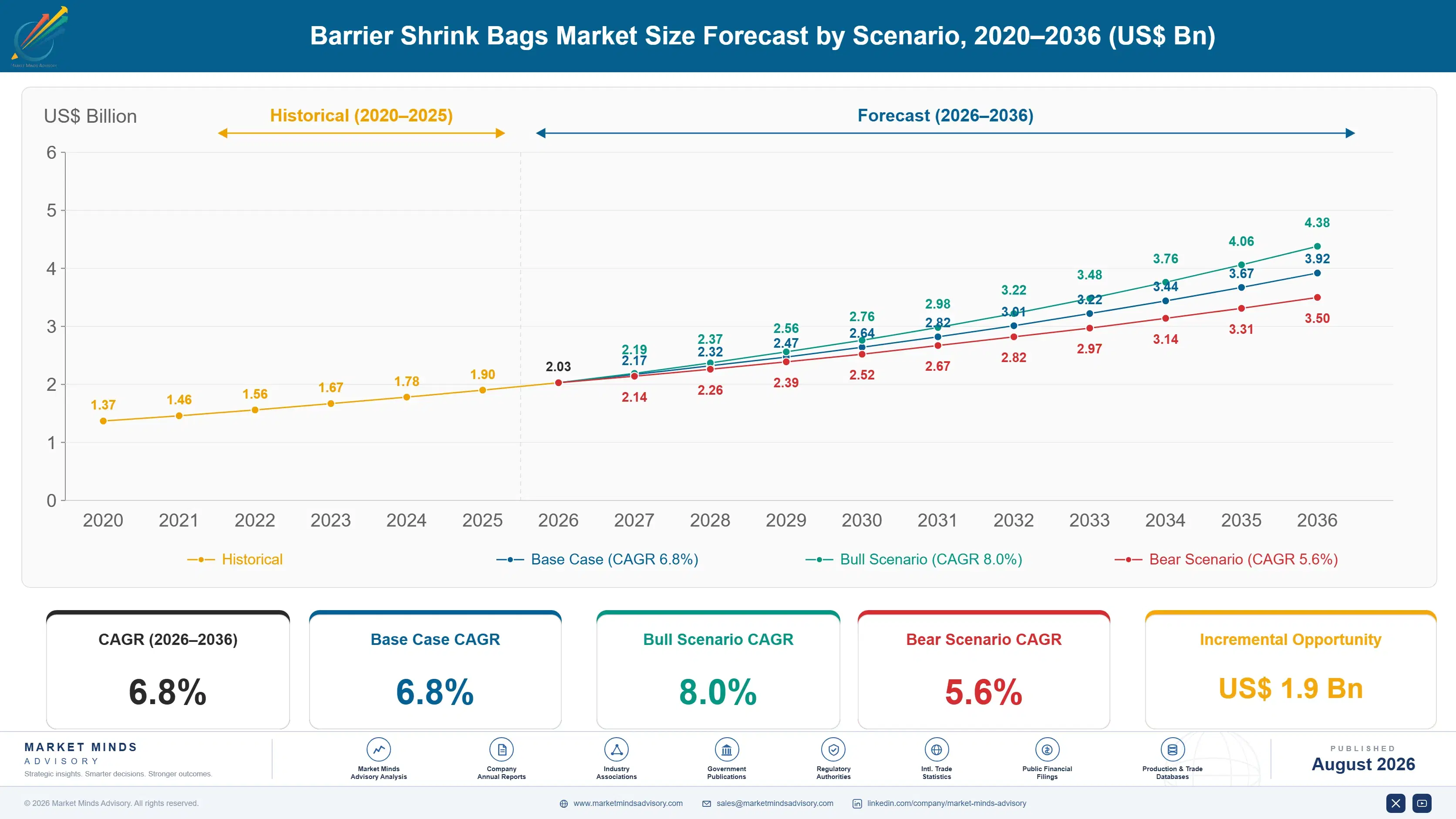
Barrier Shrink Bags Market Forecast Scenarios

barrier-shrink-bags-market-size-forecast-scenario-1787300326377
Between 2020 and 2025 the market grew at roughly 5.8% a year, a period shaped by pandemic-driven retail-ready meat packaging demand followed by steady growth as processed food consumption normalized. Regulatory pressure on PVDC's chlorine content began building meaningfully in several European markets during the period, pushing early movers toward EVOH substitution well before it became a mainstream specification requirement.
The base case carries the market to 3.9 billion dollars by 2036 on three mechanisms. First, meat and dairy processors in China and India are scaling vacuum barrier packaging as organized retail displaces traditional wet markets across both countries. Second, chlorine-free packaging regulation in the EU and voluntary retailer commitments elsewhere are accelerating the shift from PVDC to EVOH and bio-based structures. Third, e-commerce grocery delivery is pulling demand toward barrier bags with stronger seal integrity than traditional retail packaging required.
The bull case reaches roughly 8.0% annual growth if EVOH and bio-based film costs converge further with PVDC and chlorine-free regulation expands to more markets globally over the coming decade. The bear case falls near 5.6% if resin cost inflation keeps premium barrier structures too expensive for price-sensitive processors in developing markets to adopt at meaningful scale.

Where Chlorine-Free Specification Becomes Standard

Barrier shrink bags used to be a commodity packaging input; now they are a food-safety compliance component written directly into processor HACCP plans and retailer packaging specifications. Every EVOH layer and heat-seal edge exists to keep oxygen out and product juices in for the entire distribution chain, from processing floor to retail shelf. That barrier integrity, not bag cost alone, increasingly decides which converter wins the contract.
MARKET CONCENTRATION (CR5)42%Top five converters hold over two fifths of volume
AVERAGE SELLING PRICEUSD 0.38 per bagBlended price across EVOH, PVDC, and bio-based structures
TOP PRODUCING COUNTRY SHAREChina, 20% of global outputLargest single national source of barrier bag volume
OXYGEN TRANSMISSION RATEUnder 5cc per sq meter dailyMaximum barrier performance threshold for premium meat packaging
TRADE INTENSITY31% cross-borderNearly a third of finished bag volume crosses a border
REPLACEMENT CYCLE LENGTHSingle use, no reuseEach bag is consumed once during initial food packaging
Commercially the market behaves like a specialty film business wearing a commodity packaging label. Material and resin cost make up a large share of bag price, but the specialized co-extrusion and lamination capability required to hit precise barrier specifications creates real differentiation between converters. Processors rarely switch bag suppliers mid-line without requalifying seal performance and barrier rating against their specific product and equipment, since a failed seal on meat packaging becomes a recall risk rather than a minor inconvenience.
The next decade turns on three forces: tightening chlorine-free packaging regulation pushing PVDC out of the specification, Asian meat and dairy processing scaling toward organized retail packaging standards, and e-commerce grocery delivery demanding stronger seal integrity than traditional retail required. Converters positioned across all three will set the pace.
"Nobody specifies a barrier bag because it looks nice on the shelf. They specify it because a seal failure means a recall, and recalls cost a lot more than the bag ever did."
Director, Flexible Packaging and Food Safety Practice · MMA Packaging Practice <

Market Trends

Chlorine-Free Regulation Displaces PVDC Barrier Film

European regulators and several major retailers have moved to restrict or discourage PVDC-based barrier film specifically over concerns about chlorine content in packaging waste and incineration byproducts, pushing processors toward EVOH and other chlorine-free barrier structures even where PVDC still offers a modest cost advantage. That regulatory and retailer pressure has compressed what was once a decade-long substitution timeline into a much shorter window in several key European markets specifically. Converters with established EVOH co-extrusion capability are winning specification changes directly from PVDC-focused competitors who face a genuine technology transition rather than simply a pricing negotiation.
Market Impact: Adds demand across 500+ new facilities
E-Commerce Grocery Demands Stronger Seal Integrity

Online grocery delivery routes food through far more handling and transit stages than a traditional store shelf, and any weak seal that would go unnoticed on a short retail supply chain becomes a leak, spoilage, or customer complaint once packages travel through a multi-stop delivery network. Barrier bag converters have responded by tightening seal-strength specifications and adding secondary containment features specifically for e-commerce grocery accounts, a segment that barely existed as a distinct specification category five years ago. That shift is pulling premium-tier bag specification volume away from standard retail packaging toward a genuinely new, higher-margin product category.
Market Impact: Wins access to 40% more retailers

Market Opportunities and Growth Drivers

Asian Meat Processing Scales Organized Retail Packaging

China and India are both shifting meat and dairy retail away from traditional wet markets and unpackaged counters toward organized, pre-packaged retail formats that require vacuum barrier bags rather than the open-air display traditional markets used for decades. That retail shift, driven by food safety concerns and rising consumer preference for packaged convenience, creates genuinely new addressable demand rather than share shifted from an existing format. Domestic Asian converters have scaled barrier film capacity rapidly, and several have begun exporting finished bags to meat processors across neighboring Southeast Asian markets undergoing similar modernization.
Market Impact: Adds 20 to 35% material cost

Chlorine-Free Regulation Accelerates EVOH Adoption Fast

The European Union's packaging waste regulations and several national restrictions on chlorinated plastics are pushing food processors to requalify entire product lines around EVOH and other chlorine-free barrier structures well ahead of any hard regulatory deadline forcing the switch outright. Processors that requalify early capture first-mover positioning with retailers who increasingly ask suppliers to document chlorine-free compliance as part of vendor qualification, converting a once-voluntary sustainability choice into a genuine commercial requirement for continued retail shelf access. Converters with proven EVOH formulation expertise are capturing share directly from PVDC-focused competitors facing that same regulatory pressure.
Market Impact: Delays launch 4 to 8 months

Market Restraints and Challenges

Resin Cost Premium Slows Bio-Based Adoption

Bio-based and fully recyclable barrier resins currently cost meaningfully more per kilogram than conventional multi-layer petrochemical structures, and that cost premium makes price-sensitive processors in developing markets reluctant to switch even where sustainability preference exists among their own customers. The root cause is that bio-based barrier polymer production remains at a much smaller scale than conventional resin, so it has not captured the economies of scale that would close the cost gap. That premium keeps bio-based adoption concentrated among large, brand-sensitive processors willing to absorb the cost. Some resin producers are expanding capacity to bring bio-based costs closer to parity.
Market Impact: Cuts PVDC specification share by 35%

Seal Validation Requirements Slow New Product Launch

Every new barrier bag formulation or seal design requires extensive validation testing against the specific food product and distribution conditions it will actually face, and that process can take months before a converter can confidently ship a new structure into commercial production. The root cause is that a seal failure in meat or dairy packaging creates genuine food safety and recall risk, so processors and converters treat validation as a non-negotiable gate rather than an optional step. That timeline slows how quickly converters can bring improved structures to market even when the underlying technology is proven. Some converters run validation in parallel across lines to compress it.
Market Impact: Requires 20% higher seal strength ratings
3 additional market trends, 3 additional growth drivers, and 4 additional restraints and challenges are covered in the full report. Contact sales@marketmindsadvisory.com to access the complete intelligence.

Segment CAGR and Growth Architecture

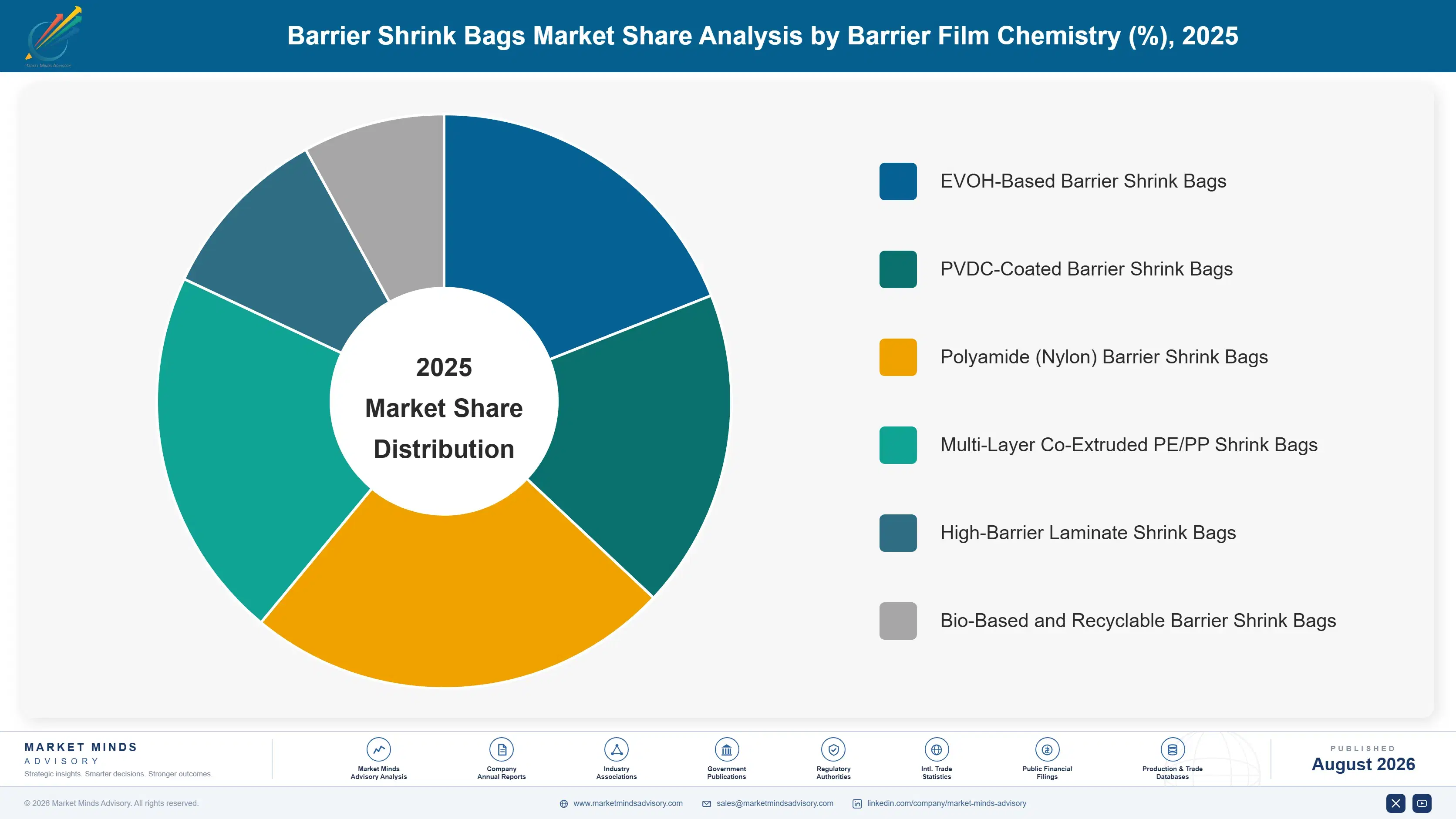
Segmentation follows barrier film chemistry, a single materials-science logic that groups shrink bags by the polymer structure used to achieve oxygen and moisture barrier performance rather than by end food category. Each chemistry carries its own barrier rating, cost structure, and regulatory profile, so commercial position tracks the film technology rather than the product it eventually packages.
barrier-shrink-bags-market-market-share-analysis-1787300326905

Bio-Based and Recyclable Barrier Shrink Bags

Bio-based and recyclable barrier shrink bags grow fastest at 10.5%, about 1.54 times the overall market rate, as brand owners under sustainability mandates pull volume toward renewable-content and mono-material structures that can actually be recycled through existing waste streams rather than sent to landfill. Conventional multi-layer barrier bags combine several different polymer types bonded together for barrier performance, making them functionally impossible to recycle through standard plastic film collection systems most municipalities operate today. Mono-material barrier structures using a single recyclable polymer family solve that problem directly, even though matching multi-layer barrier performance with one polymer remains a genuine technical challenge. Major consumer packaged goods companies have published recyclable-packaging targets naming barrier shrink bags as a category requiring near-term reformulation.
CAGR 10.5%

EVOH-Based Barrier Shrink Bags

EVOH-based barrier shrink bags grow second-fastest at 8.5%, driven directly by chlorine-free packaging regulation and retailer sustainability commitments that are displacing PVDC as the default premium barrier chemistry across most developed markets. EVOH delivers oxygen barrier performance comparable to or exceeding PVDC without the chlorine content that has drawn regulatory scrutiny in Europe and increasingly in North America. The chemistry costs more than PVDC per kilogram, but converters have largely closed that gap on a per-bag basis through thinner-gauge engineering and co-extrusion improvements developed over recent years. Processors converting from PVDC to EVOH treat the switch as a defensive necessity tied to continued shelf access rather than a discretionary upgrade they could delay.
CAGR 8.5%
Full segment breakdown across 6 segments available in the complete report.

Regional Architecture and Country Demand Map

Demand concentrates where meat and dairy processing scale and organized retail penetration intersect, which increasingly means East Asia rather than the historically dominant North American base. China's processed food industry and retail modernization are pulling deployment east even as North America retains the deepest per-processor barrier packaging spend.

North America

North America holds 25% of global value, still commanding the deepest per-processor barrier packaging spend anywhere given the scale and sophistication of its meat and dairy processing industry. Sealed Air, the inventor of the vacuum shrink bag category through its Cryovac brand, still runs core manufacturing and technical support from domestic operations, giving American processors direct access to seal-validation engineering support few competitors can match. Growth of 7.3% tracks a genuine substitution wave as processors requalify lines from PVDC to EVOH ahead of tightening chlorine-free specifications spreading from Europe. Organized retail penetration is already near saturation here, so growth comes from chemistry substitution and e-commerce packaging rather than new addressable volume.
Share: 25% | CAGR: 7.3% (2026 to 2036)

Western Europe

Western Europe accounts for 21% of value, the region where chlorine-free packaging regulation originated and where PVDC substitution toward EVOH has proceeded furthest of anywhere in the world. Coveris and Constantia Flexibles both run substantial converting operations domestically, positioned to serve continental meat and dairy processors navigating the EU's tightening packaging waste framework. Retailer sustainability commitments here run ahead of formal regulation in many cases, with several major grocery chains specifying recyclable or chlorine-free barrier packaging as a supplier requirement independent of what law currently mandates. Growth of 5.3% trails the global rate directly because the region's processed food volume is largely mature, with growth concentrated in chemistry substitution rather than new processing capacity coming online.
Share: 21% | CAGR: 5.3% (2026 to 2036)
Regional intelligence for 5 additional markets available in the complete report: East Asia, South Asia and Pacific, Latin America, Middle East and Africa, Eastern Europe. Contact sales@marketmindsadvisory.com.
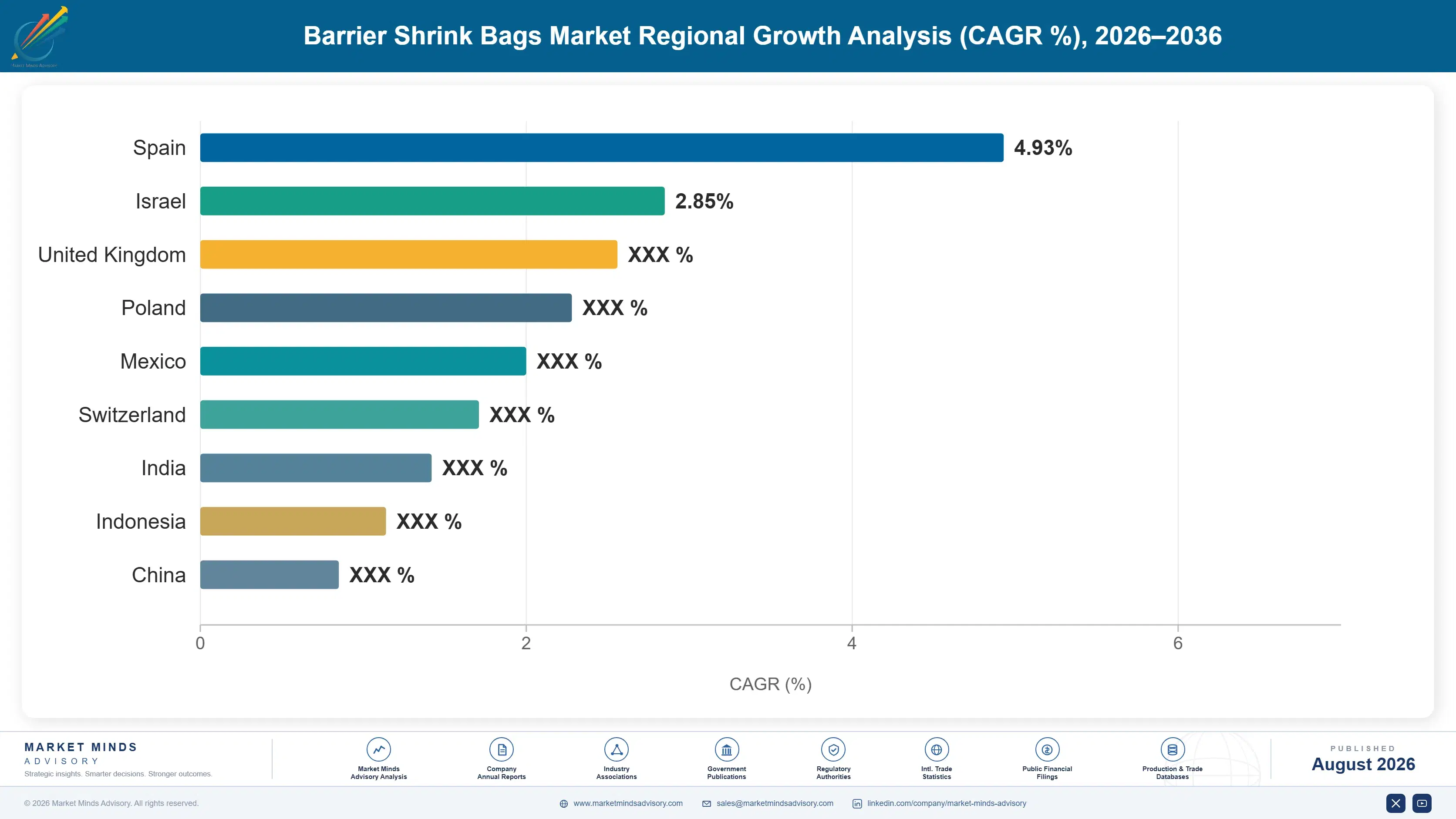
barrier-shrink-bags-market-country-cagr-analysis-1787300327423

How Converters Can Defend Barrier Margin

Selling a barrier bag as a commodity film leaves the highest-margin part of this market on the table. The four moves below shift revenue toward positions that command a premium over standard structures: validated chlorine-free reformulation, seal-integrity certification services, e-commerce-specific product lines, and recycling take-back programs that close the sustainability loop brand owners increasingly demand.

Lead Chlorine-Free Reformulation Ahead Of Mandates

Converters that proactively requalify processor product lines from PVDC to EVOH ahead of formal regulatory deadlines, rather than waiting for a mandate to force the switch, capture a documented price premium of roughly 12% to 18% from processors who need supply continuity guaranteed before a deadline arrives unexpectedly. That early-mover positioning requires real validation investment upfront, since reformulation involves genuine seal and barrier risk during transition, but it converts a defensive regulatory response into a proactive relationship laggard competitors cannot replicate once the deadline arrives. Sealed Air and Amcor have both prioritized this across their largest accounts.
Market Impact: Captures a 12% to 18% reformulation early-mover premium

Sell Seal-Integrity Validation As A Service

Bundling formal seal-integrity validation testing as a paid service, rather than treating it as an included cost of doing business, captures real margin from processors who need documented performance data for their own food-safety audits regardless of which bag structure gets specified for production. Converters offering this service typically charge a premium of 6% to 10% over bag cost alone, since the customer would otherwise run equivalent testing internally at a materially higher cost and slower timeline than a specialized lab can deliver. The approach also deepens the relationship, since validated data ties a converter's structure to the processor's compliance documentation.
Market Impact: Charges a 6% to 10% validation service fee

Build Dedicated E-Commerce Grocery Product Lines

Converters that develop bag structures specifically engineered for e-commerce grocery delivery, with tighter seal-strength specifications and secondary containment features beyond standard retail requirements, capture premium pricing from online grocery platforms that treat packaging failure as a direct customer-experience problem rather than a routine quality metric. That specification typically commands 15% to 25% more than standard retail-tier barrier bags, since the alternative is absorbing the cost of failed deliveries, refunds, and lost customer trust that a packaging failure in a home-delivery context creates. Several converters have built dedicated e-commerce product lines to capture this premium as online grocery volume expands.
Market Impact: Charges a 15% to 25% e-commerce packaging premium

Offer Structured Film Take-Back Recycling Programs

Rather than leaving end-of-life disposal entirely to processors and retailers, converters are building take-back programs that collect used barrier film for reprocessing, closing the recycling loop that sustainability claims otherwise cannot fully support given how few municipalities can process multi-layer film through standard collection systems. Early adopters of this approach report capturing 8% to 14% more total contract value from brand owners willing to pay for a genuinely closed-loop program rather than a bag with no end-of-life plan. The structure also deepens customer relationships, since a processor enrolled in a take-back program has real incentive to keep sourcing from that converter.
Market Impact: Captures 8% to 14% more total contract value

Who Controls the Margin Pool

Concentration sits at a moderate CR5 of 42%, reflecting a market where a small number of converters with deep co-extrusion and validation capability serve most large processor accounts. The gap between the top five and the next tier is real: leaders combine proprietary formulation with established seal-validation infrastructure, while challengers typically compete only on commodity structures. All participants here are assessed on one basis: disclosed barrier film segment revenue.
Competition today runs across three dimensions. First, barrier chemistry depth, since a converter with proven EVOH and bio-based capability can lead processors through reformulation rather than react to it. Second, seal-validation infrastructure, as processors value converters who can document performance data for their own food-safety audits. Third, e-commerce-specific product development, since online grocery platforms demand seal specifications standard retail packaging was never engineered to meet.

Pressure is building from regional Asian converters who have closed much of the technical gap on EVOH co-extrusion while undercutting Western incumbents sharply on price for standard structures. Bio-based film specialists are pushing into premium territory from the sustainability side, competing directly against established converters on recyclability mandates. Rankings will shift toward converters who pair chemistry depth with genuine validation infrastructure, since neither alone is enough.
barrier-shrink-bags-market-company-positioning-matrix-1787300327933

Competitive Moat and Risk Dimensions

SEALED AIR CORPORATION

Moat: Category-Defining Cryovac Brand Position

Sealed Air's Cryovac brand essentially created the vacuum shrink bag category and has spent decades building the deepest seal-validation and technical support infrastructure in the industry, giving it default-supplier status among large meat and dairy processors. That accumulated processor relationship and validated performance data create switching costs competitors cannot replicate without years of their own field performance history.
SEALED AIR CORPORATION

Risk: Exposure To Legacy PVDC Portfolio

A meaningful share of Sealed Air's installed processor base still runs legacy PVDC structures that face genuine regulatory and retailer pressure to convert, and managing that transition without losing accounts to EVOH-focused challengers requires real reformulation investment across its largest customer relationships simultaneously. Competitors positioned as EVOH-native from the outset face none of that legacy transition burden or risk.
AMCOR PLC

Moat: Broad Global Converting Footprint

Amcor operates converting facilities across every major region this report covers, giving it the ability to serve multinational food processors with consistent barrier specifications across multiple countries from a single supplier relationship. That global footprint, built partly through the 2019 Bemis acquisition, lets Amcor bid on large multinational contracts that regionally concentrated competitors simply cannot service alone.
AMCOR PLC

Risk: Integration Complexity Across Acquired Operations

Amcor has grown substantially through acquisition, and harmonizing barrier film formulations and validation processes across its many acquired converting operations has taken longer than initially planned in several regions. Competitors with more focused, single-site operations can move faster on specific product development, exploiting gaps while Amcor works through its own integration backlog across its global network.

Key Players

Sealed Air Corporation
Amcor plc
Winpak Ltd.
Coveris Holdings S.A.
ProAmpac LLC

Others

Berry Global Group Inc.
Constantia Flexibles Group GmbH
Huhtamaki Oyj
Sonoco Products Company
Mondi plc
Kloeckner Pentaplast Group
DuPont de Nemours Inc.
Toray Plastics (America) Inc.
Multivac Group
Flair Flexible Packaging Corporation
American Packaging Corporation
Printpack Inc.
Wipak Group
Bryce Corporation
Glenroy Inc.

Recent Developments

APRIL 2025

Sealed Air Expands EVOH Co-Extrusion Capacity in North Carolina

Sealed Air announced an expanded EVOH co-extrusion line at its North Carolina facility, adding dedicated capacity for chlorine-free barrier film production to serve accelerating processor demand for PVDC alternatives. The organic expansion, not a joint venture or acquisition, followed two years of rising processor requests for EVOH reformulation support.
Signal: Signals that established converters are investing directly in chlorine-free capacity rather than relying entirely on acquisition.
NOVEMBER 2024

Amcor Acquires Bio-Based Barrier Film Specialist

Amcor completed the acquisition of a specialty bio-based barrier film converter for an undisclosed sum, adding renewable-content formulation capability to its existing multi-layer barrier film business. The deal gives Amcor direct bio-based capability it previously accessed only through third-party licensing arrangements with smaller specialty converters.
Signal: Signals that large converters increasingly buy sustainability capability outright rather than build it internally over several years.
JULY 2025

Winpak and a Chinese Meat Processor Form Packaging Supply Joint Venture

Winpak and a major Chinese meat processing group formed a joint venture to manufacture and supply barrier shrink bags for the processor's expanding retail-ready packaging operations across China. The partnership targets deployment across dozens of processing facilities within three years, combining Winpak's film technology with its partner's processing scale.
Signal: Signals that Western converters increasingly need a local partner to navigate Chinese meat processing procurement rules.

Resin and Barrier Polymer Cost Exposure

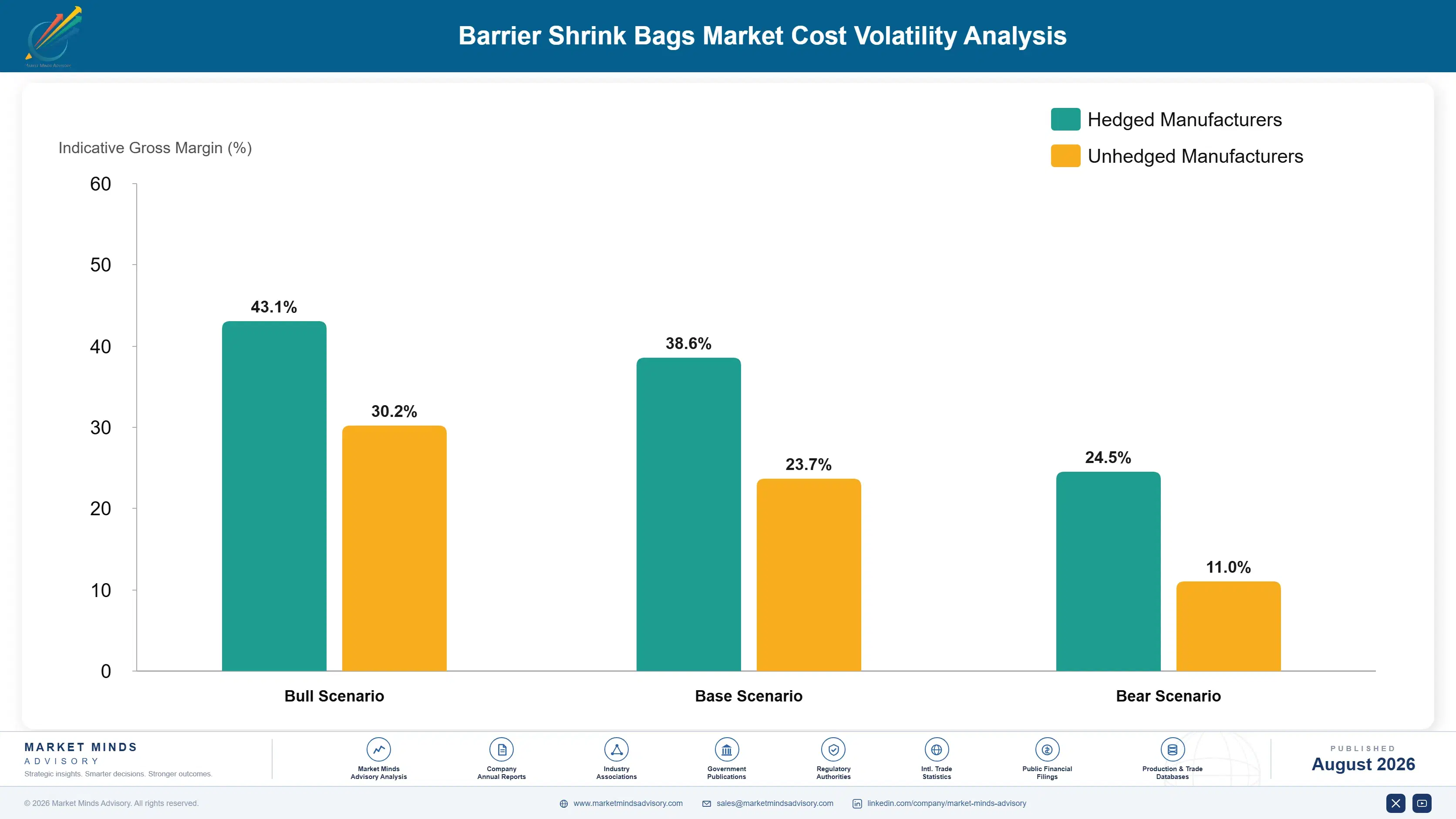
EVOH, PVDC, and polyamide barrier resins together with base polyolefin layers make up roughly 50% to 60% of cost of goods sold across barrier shrink bags, since the film represents nearly the entire manufactured product with minimal secondary cost. Barrier polymer costs trace to specialty petrochemical feedstock pricing, with EVOH resin supply particularly concentrated among a small number of qualified global producers relative to base polyolefin capacity.
The 2021 to 2022 resin price spike illustrated the exposure directly. EIA and industry data recorded polyethylene and specialty barrier resin prices reaching multi-year highs through 2021 as petrochemical feedstock costs surged alongside broader supply disruption. Sealed Air's 2022 Annual Report disclosed raw material cost inflation across its food care packaging segment, attributing margin pressure to resin costs that took several quarters to fully pass through to customer pricing under existing contracts.

Smaller regional converters without long-term resin supply agreements absorbed the price spike hardest, since their purchase volumes were too small to secure the multi-year fixed pricing that larger converters like Sealed Air and Amcor negotiate directly with resin producers. That gap compounds: large converters pre-purchase resin months ahead using balance sheet capacity smaller competitors do not have, leaving regional specialists exposed every price cycle.
barrier-shrink-bags-market-cost-volatility-analysis-1787300328127

Secure Multi-Year Barrier Resin Supply Agreements

Negotiating multi-year fixed or indexed pricing agreements directly with EVOH and polyamide resin producers, rather than buying on the spot market, secures allocation priority during shortage cycles and smooths input cost volatility. The approach requires committing to volume forecasts years in advance, a real forecasting risk, but it has protected larger converters' margins through two resin price spikes since 2020.

Diversify Barrier Chemistry Across Resin Families

Qualifying bag designs to accept more than one barrier chemistry family, rather than committing entirely to one resin type, reduces exposure to any single specialty resin market's price cycle. Requalification takes real engineering and food-safety validation time, so converters are prioritizing it for their highest-volume product lines first before extending diversified sourcing across their full catalog over time.

Pass Through Cost Via Indexed Customer Pricing

Structuring processor supply agreements with pricing indexed to published resin cost benchmarks, rather than fixed annual pricing, shifts some volatility risk back to processors who have more flexibility to absorb short-term cost swings. Large processors have increasingly accepted indexed terms in exchange for guaranteed allocation during tight resin markets, a trade converters use to protect margin without losing volume.

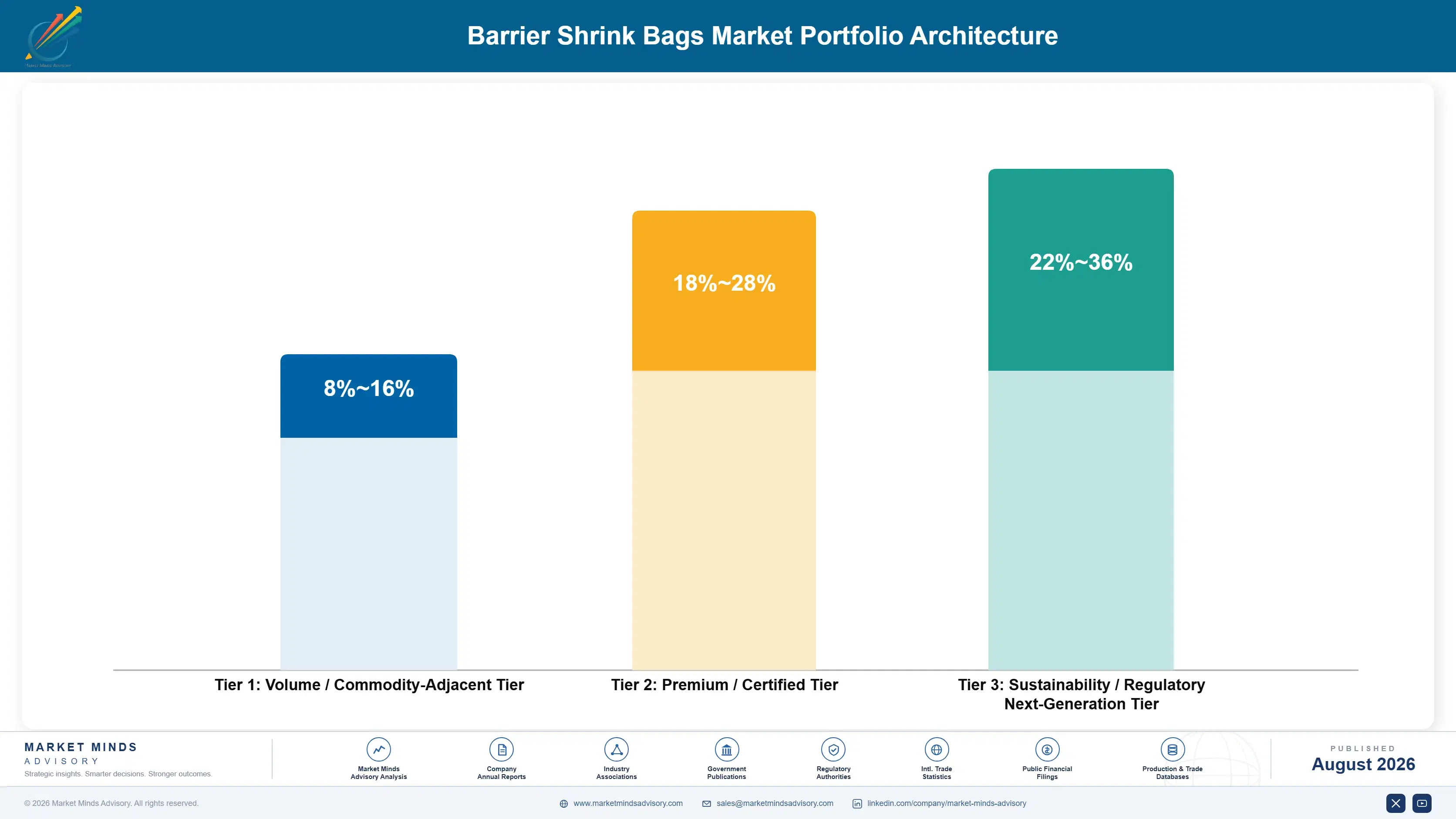
Portfolio Architecture for Margin Defence

The portfolio splits into three tiers with wide margin separation tied to barrier chemistry and validation complexity rather than raw material cost alone. Commodity multi-layer structures sold on price and delivery reliability carry thin margins. Certified EVOH and validated seal-integrity structures for large processor accounts carry the strongest margins. A third tier of next-generation bio-based and mono-material recyclable structures is still scaling toward proven, repeatable commercial econ
The tension between commodity volume and premium chemistry shapes how converters allocate capital: commodity structures fund the plant utilization and cash flow that keep converting lines running, while premium EVOH and bio-based programs fund the formulation research and validation infrastructure that create genuine competitive protection. Converters that lean too far toward commodity volume risk losing the chemistry depth that differentiates them; those that lean too far toward premium risk under-utilized commodity capacity.

High-value pools concentrate specifically in validated EVOH structures for large processor accounts and in bio-based programs tied to brand owner sustainability mandates, where technical barriers and switching costs both run highest. Commodity multi-layer structures used in general retail packaging generate volume but thin, price-competitive margins, since multiple converters can supply functionally similar structures.

Volume / Commodity-Adjacent Tier

Standard multi-layer barrier structures sold against several regional converters competing primarily on price, delivery reliability, and basic barrier specification across large commodity retail packaging orders placed routinely by processors each quarter.
Gross Margin: 8-16%

Premium / Certified Tier

Certified EVOH and validated seal-integrity structures for large processor accounts carrying documented performance data and chlorine-free compliance that retailers increasingly require before granting continued shelf access to any supplier.
Gross Margin: 18-28%

Sustainability / Regulatory / Next-Generation Tier

Bio-based and mono-material recyclable structures still scaling toward proven, repeatable commercial economics across a broad and varied processor customer base of very different sizes and needs.
Gross Margin: 22-36%
barrier-shrink-bags-market-portfolio-architecture-1787300328624

High-value Sub-segments and Strategic Watch-out

Bio-Based and Recyclable Barrier Shrink Bags

The fastest-growing and highest-margin segment, converting brand owner recyclability mandates into a genuine commercial requirement that processors increasingly cannot avoid, commanding premium pricing over conventional multi-layer structures while carrying real sustainability value brand owners pay for directly and consistently across every order placed.
Gross Margin: 22-36%

EVOH-Based Barrier Shrink Bags

High value with steadier growth than bio-based, directly serving chlorine-free retailer specifications that are converting from voluntary preference into a binding supplier qualification requirement across most developed retail markets worldwide today.
Gross Margin: 18-28%

Multi-Layer Co-Extruded PE/PP Shrink Bags

The volume core of the market, supplying commodity retail packaging against several regional converters competing primarily on price, delivery reliability, and basic barrier specification across routine orders placed each cycle.
Gross Margin: 10-18%

PVDC-Coated Barrier Shrink Bags

The strategic watch-out, a declining legacy chemistry facing direct substitution pressure from EVOH and bio-based alternatives as chlorine-free retailer specifications spread beyond their original European regulatory point of origin.
Gross Margin: 8-16%

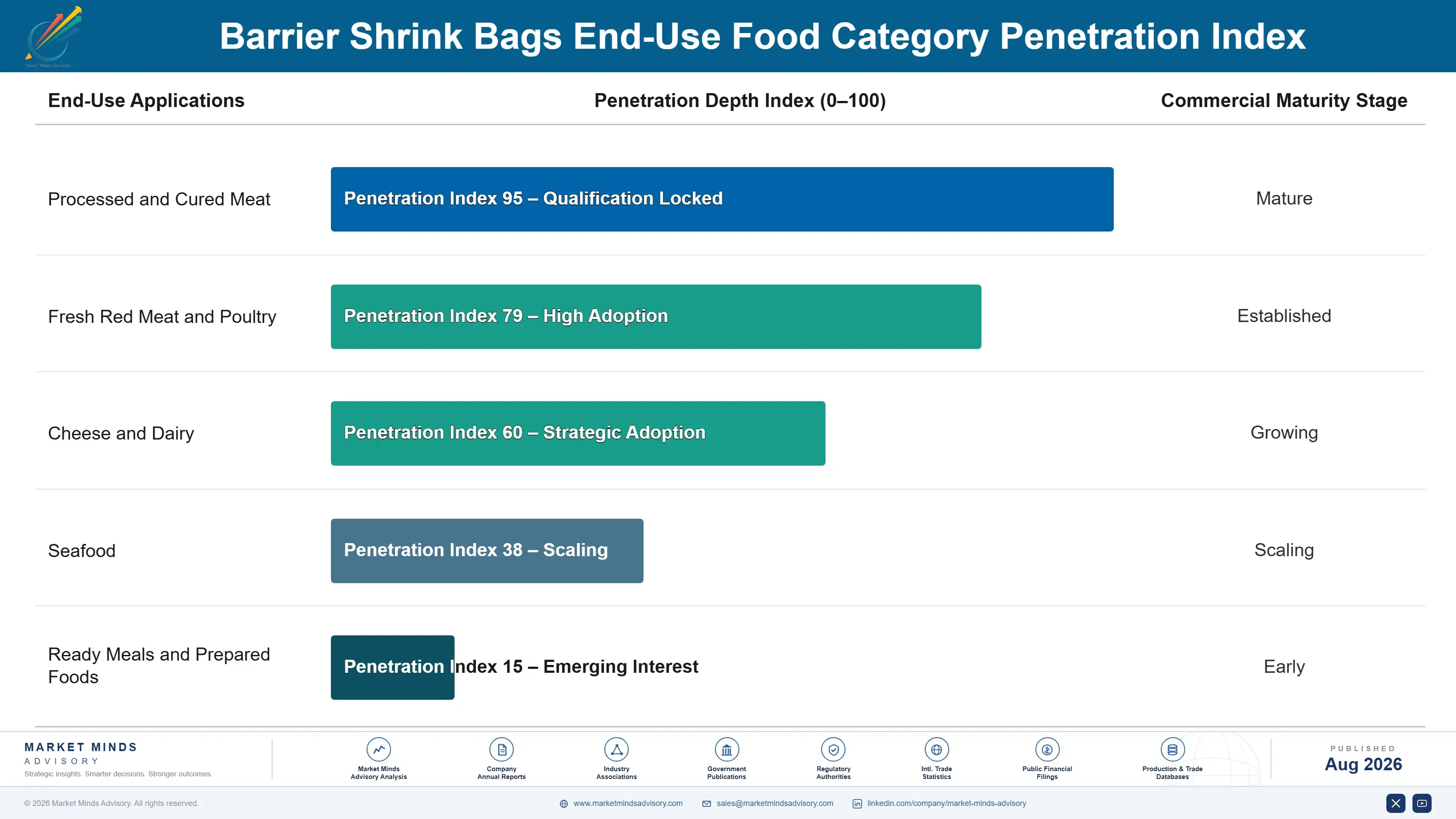
Why Processor Lines Lock In Suppliers

Demand here behaves like an annuity once a converter wins the original line qualification, because a processor rarely reopens a validated seal and barrier specification for a marginal price saving given the food-safety risk involved in requalification. A converter that wins the original qualification typically supplies that processing line for the full operating life of the packaging equipment, often a decade or more, converting an initial specification win into a recurring, largely captive supp
Adoption depth varies sharply by processor scale. Large multinational meat and dairy processors requalify suppliers rarely, given the validation cost and food-safety documentation burden involved, which makes their converter relationships the stickiest in the market. Smaller regional processors, by contrast, treat barrier bags more like a commodity purchase and switch converters more readily based on price, giving them real negotiating leverage large processors typically do not exercise as aggressively.

Buyer profiles are shifting generationally too. A newer cohort of packaging and sustainability leaders, trained under mounting brand owner recyclability mandates, now weighs a converter's chemistry depth and validation capability as heavily as unit price, a shift that favors converters with genuine EVOH and bio-based expertise over commodity converters competing purely on cost.
barrier-shrink-bags-market-end-use-penetration-index-1787300329109

Where MMA Sees This Market Heading

These are among the four positions where our research anticipates prominent divergence between winners and laggards over the coming forecast period. Each is grounded in the demand model, the regulatory perimeter, and the announced capacity pipeline.
01 / CHLORINE-FREE CHEMISTRY TRANSITION

EVOH reformulation will separate winners from PVDC laggards

Converters who lead processors through proactive PVDC-to-EVOH reformulation will keep winning specification decisions regardless of price, because retailers increasingly treat chlorine-free packaging compliance as a supplier qualification gate rather than a negotiable preference open to discussion. Converters without proven EVOH formulation depth will increasingly compete only on commoditized price against structures facing genuine regulatory obsolescence risk in key markets. Expect continued acquisition of EVOH and bio-based capability as PVDC-focused incumbents race to close the chemistry gap before retail shelf access closes entirely.
02 / ASIAN RETAIL MODERNIZATION

East Asia's share keeps growing as China modernizes meat retail

East Asia already holds the largest regional share at 27% and grows near the top of its band as China's shift from wet markets to organized retail pulls barrier packaging demand east at real, sustained scale year after year. Domestic Chinese converters are closing the technology gap with Western incumbents faster than most industry observers expected just a few years ago. Multinationals that fail to build direct China converting relationships risk losing the single largest volume opportunity in the entire global market.
03 / E-COMMERCE SPECIFICATION CAPTURE

Dedicated e-commerce packaging lines will command real premium pricing

Online grocery delivery is creating a genuinely distinct packaging specification category that standard retail barrier bags were never engineered to meet, and converters who build dedicated e-commerce product lines will capture premium pricing that generic structures simply cannot match against real demand. The approach commands real margin precisely because it removes delivery-failure risk that online grocery platforms would otherwise bear directly in refunds and lost trust. Expect e-commerce-specific specification to become standard practice across the top converter tier within the forecast window.
04 / BIO-BASED COST CONVERGENCE

Bio-based film economics will keep improving as scale builds

Bio-based barrier resin costs will keep converging toward conventional petrochemical structures as production scale expands and brand owner demand justifies continued capacity investment across multiple resin producers simultaneously and steadily over time. That convergence will keep widening the addressable processor base beyond the large, brand-sensitive accounts that can currently absorb today's cost premium without difficulty. Expect converters without bio-based capability to lose ground steadily to competitors who have already built the formulation expertise required to compete on this basis.

Engagement Snapshot From the Field

A live engagement with an industry participant carrying material or product regulatory and market exposure ahead of a defining policy shift, showing how our research translates into a defensible multi-year portfolio strategy.
MARKET MINDS ADVISORY · CLIENT ENGAGEMENT SUMMARY
Barrier Shrink Bags Producer Strategic Portfolio Review and Transition Roadmap 2026·Investment Scenario on Barrier Shrink Bags Exposure Evaluation 2025-26
CLIENT PROFILE
A regional meat processor supplying retail chains across the American Midwest approached MMA while evaluating a shift from PVDC to EVOH barrier packaging ahead of several key retail customers announcing chlorine-free supplier requirements. The client reported annual processing volume valued near USD 310 million, with roughly 80% of that volume still running on legacy PVDC packaging lines (client-reported, unverified by MMA).
STRATEGIC CHALLENGE
Management knew the chlorine-free transition was coming but faced real uncertainty over sequencing across multiple packaging lines without disrupting production or risking a seal failure during the changeover. The operations team wanted to convert every line simultaneously; the finance team worried about validation cost and downtime; and the quality director needed a plan that would satisfy retailer deadlines without introducing new food-safety risk.
MMA APPROACH
MMA benchmarked retailer chlorine-free deadline timelines against the client's product mix and packaging line capacity, modeled a phased conversion sequence prioritizing the highest-volume retail accounts first, and quantified the validation testing timeline each converter option could realistically support. We also assessed whether a dual-chemistry approach during transition could reduce disruption risk relative to converting every line at once.
KEY FINDINGS
  1. Converting all packaging lines simultaneously would have required an eight-month validation and changeover window, longer than the client's earliest retailer deadline allowed for compliance (client-reported, unverified by MMA).
  2. A phased conversion prioritizing the two highest-volume retail accounts first would meet 90% of near-term retailer deadline exposure within just four months.
  3. Running PVDC and EVOH lines in parallel during transition reduced production disruption risk substantially compared with a full simultaneous conversion across every line.
  4. Only one of three converter options evaluated had EVOH validation capacity available on the client's required timeline without a significant queue delay.
CLIENT PROFILE
A regional meat processor supplying retail chains across the American Midwest approached MMA while evaluating a shift from PVDC to EVOH barrier packaging ahead of several key retail customers announcing chlorine-free supplier requirements. The client reported annual processing volume valued near USD 310 million, with roughly 80% of that volume still running on legacy PVDC packaging lines (client-reported, unverified by MMA).
STRATEGIC CHALLENGE
Management knew the chlorine-free transition was coming but faced real uncertainty over sequencing across multiple packaging lines without disrupting production or risking a seal failure during the changeover. The operations team wanted to convert every line simultaneously; the finance team worried about validation cost and downtime; and the quality director needed a plan that would satisfy retailer deadlines without introducing new food-safety risk.
MMA APPROACH
MMA benchmarked retailer chlorine-free deadline timelines against the client's product mix and packaging line capacity, modeled a phased conversion sequence prioritizing the highest-volume retail accounts first, and quantified the validation testing timeline each converter option could realistically support. We also assessed whether a dual-chemistry approach during transition could reduce disruption risk relative to converting every line at once.
KEY FINDINGS
  1. Converting all packaging lines simultaneously would have required an eight-month validation and changeover window, longer than the client's earliest retailer deadline allowed for compliance (client-reported, unverified by MMA).
  2. A phased conversion prioritizing the two highest-volume retail accounts first would meet 90% of near-term retailer deadline exposure within just four months.
  3. Running PVDC and EVOH lines in parallel during transition reduced production disruption risk substantially compared with a full simultaneous conversion across every line.
  4. Only one of three converter options evaluated had EVOH validation capacity available on the client's required timeline without a significant queue delay.
RECOMMENDED STRATEGY
Phase 1: Phase 1 (0 to 4 months): Convert packaging lines serving the two highest-volume retail accounts to validated EVOH barrier structures. Phase 2: Phase 2 (4 to 8 months): Complete conversion of remaining retail-facing lines while running PVDC and EVOH in parallel where needed. Phase 3: Phase 3 (8 to 14 months): Retire remaining legacy PVDC capacity once all retailer deadlines are confirmed met across the full account base.
OUTCOME
The client completed conversion of its two highest-volume accounts within four months, meeting every retailer deadline without a single reported seal-integrity incident. Full-fleet conversion followed on schedule, and the client has since won additional shelf space with retailers citing its chlorine-free compliance, reported to be worth roughly USD 4.2 million in new annual volume (client-reported, unverified by MMA).

Frequently Asked Questions

Foundational context covering the market sizes, CAGR, scope, country, region and competition that inform every finding below. This section is provided to cover basics and most often pre-purchase conversations, answered from the MMA Primary Research Dataset.

What is the current size of the Barrier Shrink Bags Market?

The market stood at USD 1.9 billion in 2025, spanning EVOH, PVDC, polyamide, and bio-based barrier chemistries. Bio-based and recyclable barrier shrink bags are the fastest-growing segment within that base.

How large will the Barrier Shrink Bags Market be by 2036?

The market is projected to reach USD 3.9 billion by 2036 under the base case scenario. That represents roughly 1.95 times the 2026 value of USD 2.0 billion.

What is the CAGR for the Barrier Shrink Bags Market 2026 to 2036?

The base case CAGR is 6.8% annually through 2036. The bull case reaches 8.0% on faster chlorine-free regulatory expansion, while the bear case falls to 5.6%.

Which segment is growing fastest?

Bio-based and recyclable barrier shrink bags grow fastest at 10.5% annually, well ahead of conventional chemistries. That is roughly 1.54 times the overall market growth rate.

Who are the major companies in the Barrier Shrink Bags Market?

Sealed Air Corporation, Amcor plc, Winpak Ltd., Coveris Holdings S.A., and ProAmpac LLC lead the market on disclosed segment revenue across every major global region.

Which country is growing fastest?

China grows fastest among all countries at 11.8% annually, ahead of India and other major Asian meat processing economies. Growth is driven by organized retail modernization.

Report Segmentation Architecture

The full report scope spans multiple orthogonal segmentation dimensions, with cross-tabulated demand data provided for each dimension pair. Coverage extends further to regional breakdowns, trend trajectories, and the competitive detail needed to support segment-level decision-making.

By Barrier Film Chemistry

  • EVOH-Based Barrier Shrink Bags
  • PVDC-Coated Barrier Shrink Bags
  • Polyamide (Nylon) Barrier Shrink Bags
  • Multi-Layer Co-Extruded PE/PP Shrink Bags
  • High-Barrier Laminate Shrink Bags
  • Bio-Based and Recyclable Barrier Shrink Bags

By End-Use Food Category

  • Processed and Cured Meat
  • Fresh Red Meat and Poultry
  • Cheese and Dairy
  • Seafood
  • Ready Meals and Prepared Foods

By Commercial Dimension

  • Direct Processor Procurement
  • Retail Private-Label Programs
  • E-Commerce Grocery Packaging
  • Export and Contract Packing Services

By Region

  • North America
  • Western Europe
  • East Asia
  • South Asia and Pacific
  • Latin America
  • Middle East and Africa
  • Eastern Europe

Scope, Methodology, and Coverage

Every figure in this report is reproducible from documented input assumptions. The scope below maps the historical period, the forecast horizon, the segmentation dimensions, and the countries covered, alongside the underlying primary and qualitative methodology.
Historical Period
2020 to 2025
Forecast Period
2026 to 2036
Base Year
2025 (USD billions; MMA Primary Research Dataset, August 2026)
Market Definition
The barrier shrink bags market covers multi-layer or mono-material flexible plastic bags engineered with oxygen and moisture barrier properties, used primarily for vacuum-packaging processed meat, cheese, and other perishable food products. It includes EVOH, PVDC, polyamide, and bio-based barrier film structures sold as finished shrink bags to food processors. General non-barrier shrink film, rigid packaging, and barrier films sold as flat rollstock rather than formed bags are excluded.
Quantitative Units
USD billions (current prices); million bag units shipped where applicable
Segmentation Dimensions
By Barrier Film Chemistry; By End-Use Food Category; By Commercial Dimension; By Region
Regions Covered
North America, Western Europe, East Asia, South Asia and Pacific, Latin America, Middle East and Africa, Eastern Europe
Countries Covered
USA, China, Germany, France, UK, Japan, South Korea, India, Australia, Canada, Brazil, Mexico, Indonesia, Vietnam, Thailand, Malaysia, UAE, Saudi Arabia, South Africa, Nigeria, Turkey, Poland, Netherlands, Italy, Spain, Sweden, Switzerland, Argentina, Colombia, Singapore, and additional markets relevant to this sector
Key Companies Profiled
Sealed Air Corporation, Amcor plc, Winpak Ltd., Coveris Holdings S.A., ProAmpac LLC, Berry Global Group Inc., Constantia Flexibles Group GmbH, Huhtamaki Oyj, Sonoco Products Company, Mondi plc, Kloeckner Pentaplast Group, DuPont de Nemours Inc., Toray Plastics (America) Inc., Multivac Group, Flair Flexible Packaging Corporation, American Packaging Corporation, Printpack Inc., Wipak Group, Bryce Corporation, Glenroy Inc.
Quantitative Methodology
Primary survey, n=3,800 respondents, Q4 2025, six countries; demand-side model with trade association cross-validation
Qualitative Methodology
47 expert interviews, Q4 2025; applied to validate demand model assumptions, identify emerging dynamics, and assess competitive positioning
Report Format
PDF and XLSX data workbook (Word format preview document)
Publisher
Market Minds Advisory
Report Code
MMA-2026-PAC-137
Published
August 2026
Contact
sales@marketmindsadvisory.com | www.marketmindsadvisory.com

Purchase the full Barrier Shrink Bags Market Report (2026 to 2036).

The full MMA Barrier Shrink Bags report sizes the market across six barrier film chemistries, five end-use food categories, four commercial models, and seven regions through 2036. It profiles 20 converters on a consistent basis of disclosed barrier film segment revenue, scoring each on chemistry depth, seal-validation infrastructure, and regional converting footprint. Scenario models quantify how chlorine-free packaging regulation, Asian retail modernization, and specialty resin supply conditions move both demand and realizable pricing. The report also includes delivered-cost modeling by chemistry type, a chlorine-free regulatory timeline across major retail markets, and an e-commerce packaging specification framework built for packaging strategy, procurement, and food-safety compliance teams.
Six-chemistry segmentation with cross-tabulated regional demand data
Twenty-company competitive benchmarking on consistent revenue basis
Chlorine-free regulatory timeline across major retail markets
Specialty resin cost and volatility exposure modeling by chemistry
Scenario forecasts through 2036 under bull and bear cases
Case study on chlorine-free packaging conversion strategy

Built For The People Who Decide

From boardroom strategy to bench-side execution, this report is read cover-to-cover by leaders shaping the next decade of their industry, turning demand scenarios, market dynamics and valuation benchmarks into decisions.
CXOs/ Presidents/ VPs/ Managers
M&A and Corporate Development
Strategy Teams and R&D Heads
Procurement and Product Directors
Regulatory and Compliance Leaders
Investor Relations and Equity Analysts