Market Minds Advisory
Barley Market

Barley Market: Malting Premiumization and Feed Substitution Economics

Craft brewing premiumization and livestock feed substitution economics are reshaping barley demand even as total planted acreage stays roughly flat across the largest producing countries through the current forecast decade.

Lead Analyst

Lisa Gevelber

Published

September 2026

Make Smarter Decisions with Customized Research Insights

Request a free sample report and evaluate market opportunities, growth trends, and competitive dynamics relevant to your business needs.

2025 MARKET VALUE$38.2BMarket Size 2025
2036 FORECAST VALUE$57.6BBase Case , 2026 to 2036
CAGR 2026 TO 20363.8 %Bull 5.0% / Bear 2.6%
INCREMENTAL OPPORTUNITY$17.9BNet 10- year value creation
EXPANSION MULTIPLE1.45x2036 value over 2026 base
Strategic Levers
M&A Pipeline
Regional Outlook
Country Rankings
Competitive Intelligence
Segmental Deep-dive
Call-Us : 91 93563 13602

Executive Snapshot and Market Trajectory

Malting premiumization is pulling barley demand toward higher-value variety-specific contracts even as total planted acreage across major producing countries stays largely flat, meaning almost all category growth now comes from price and processing mix rather than any tonnage expansion at all. Buyers now reward documented variety over raw tonnage.
Craft brewing and single malt whisky both reward specific two-row malting varieties over the six-row types feed millers prefer, splitting what growers once treated as one commodity into distinct pricing tiers. Western Europe anchors both malting capacity and consumption, while feed substitution against corn drives the steadiest volume growth in East Asia's livestock sector. Food-grade barley is growing fastest as health-conscious consumers seek fiber-dense wheat alternatives.
Trading houses and maltsters dominate commercial activity more than farm-level production ever could, since Cargill, Archer-Daniels-Midland, and Viterra control the storage and export infrastructure that determines which growers capture premium malting contracts. Climate volatility in key growing regions and animal feed substitution economics against corn are the two forces most likely to move regional pricing over the next several years. Climate volatility across key growing regions adds a further layer of pricing unpredictability each season.
Market Definition
The barley market covers commercial production, trading, and processing of barley across malting and brewing, animal feed, human food, seed, and industrial applications including bioethanol and starch processing. It excludes finished beer, whisky, and packaged food products made from processed barley, which are valued and reported as separate downstream markets.
Base Year Value
$38.2B in 2025 (MMA Primary Research Dataset, August 2026)
Forecast Period
2026 to 2036, eleven discrete annual values
CAGR
3.8% base case. Bull 5.0%. Bear 2.6%.
Fastest Growth Segment
Food and Human Consumption: 5.2% CAGR
Fastest Growth Country
Australia: 6.0% CAGR
Fastest Growth Region
South Asia and Pacific: 5.8% CAGR
Largest Region
Western Europe: 26% of 2025 global value
Market Leaders
Cargill, Archer-Daniels-Midland, Viterra, Boortmalt, Malteurop Group. Source: MMA Analysis based on company annual reports.
Primary Survey
n=3,800 procurement and R&D decision-makers, Q4 2025, six countries
Methodology
Demand-side build-up, cross-validated against public data, 47 expert interviews

Barley Market Forecast Scenarios

barley-market-2024-2034-trends-growth-insights-size-forecast-scenario-1787461507982
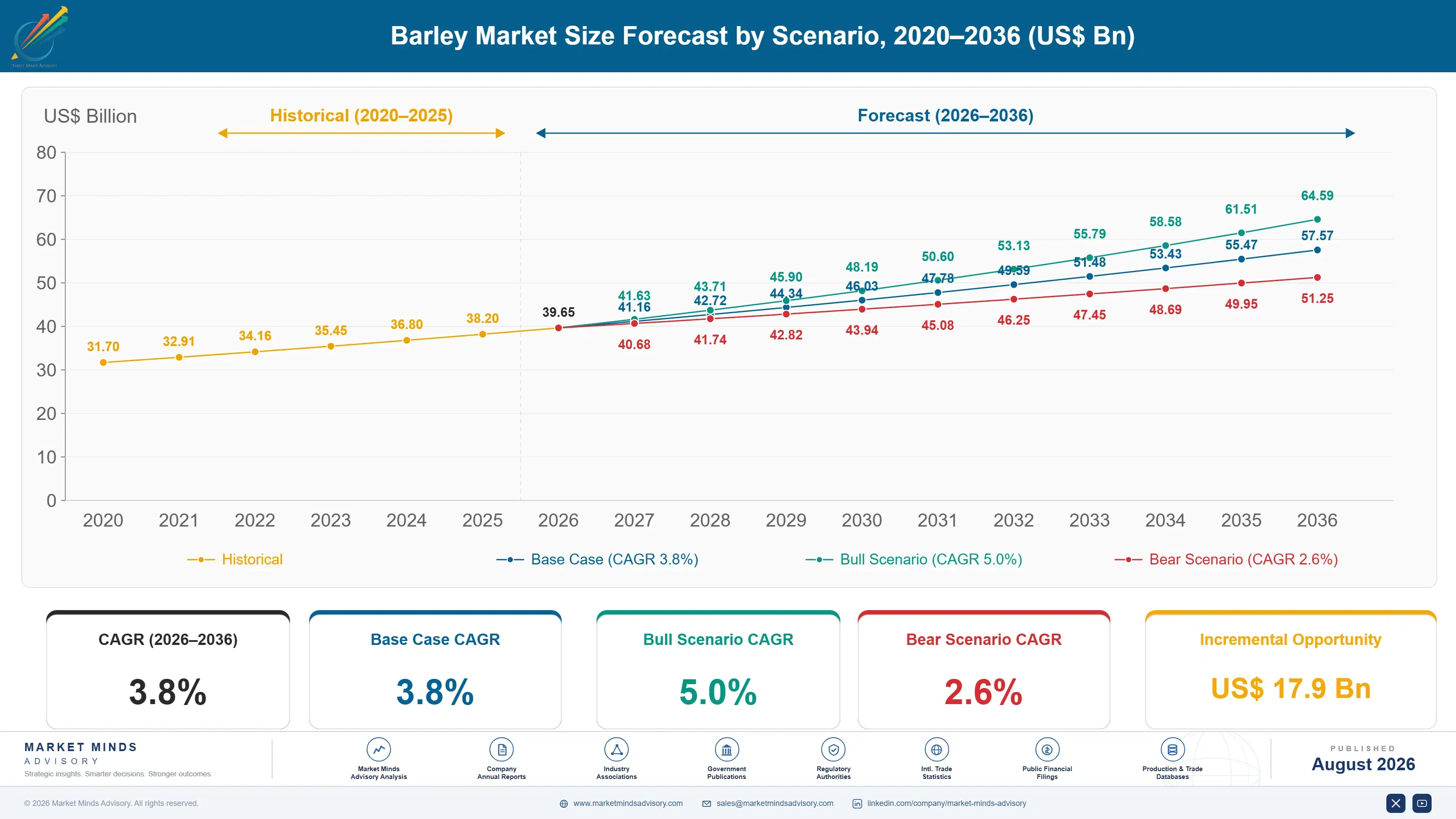
Barley production held broadly steady between 2020 and 2025, with weather-driven swings in Australia, Russia, and Ukraine causing the sharpest annual volume shifts across the historical period. Pricing proved far more volatile than tonnage, since the war in Ukraine disrupted Black Sea export corridors that a large share of global feed and malting trade had depended on for shipment.
The base case through 2036 rests on three mechanisms: continued premiumization in malting contracts as craft brewers and distillers pay up for specific varieties, steady feed substitution against corn wherever relative pricing favors barley in livestock rations, and rising food-grade demand as whole-grain and fiber-focused diets spread across North America and Western Europe. None of these mechanisms requires acreage expansion, which is precisely why margin growth is outpacing volume growth across the forecast period.
The bull case turns on a sustained corn price spike that pulls feed formulators toward barley substitution at scale across multiple major livestock-producing countries at once. The bear risk is a return of Black Sea export volumes at a pace that oversupplies global feed markets, compressing prices for exporting countries that depend on stable pricing to sustain planted acreage.

Malting Premiumization and Feed Substitution Dynamics

Three forces are reshaping barley at once: malting premiumization rewarding specific varieties, feed substitution economics against corn and wheat, and rising food-grade demand tied to whole-grain diets. Each pulls a different share of the harvest toward a different buyer, turning what was long a single commodity crop into a market with genuinely separate pricing tiers and buyer relationships. Producers slow to recognize this split risk losing customers to more responsive rivals.
MARKET CONCENTRATIONCR5 34%trading and malting capacity concentrated among a few majors
AVERAGE SELLING PRICE$245/tonnemalting grades command a substantial premium over feed grades
TOP PRODUCING COUNTRY SHARERussia 17%single largest national share of total global production volume
MALTING CAPACITY UTILIZATION81%malthouses running near practical seasonal processing ceiling capacity
TRADE INTENSITY24%share of global production moving across national export borders
FEED SUBSTITUTION ELASTICITY62%livestock rations shifting toward barley when relative pricing favors it
Commercially, malting contracts behave like specialty agreements rather than spot commodity trades. Maltsters contract acreage a season or more in advance, specify variety and protein content precisely, and pay a premium that has held even through years when feed-grade prices fell sharply, evidence that craft brewing and distilling demand is now firmly embedded in growing decisions across major producing regions. Buyers treat this consistency as a signal of long-term reliability.
The next decade will be shaped by climate volatility in key growing regions, whether corn pricing stays high enough to keep feed substitution economically rational, and how far whole-grain food trends spread beyond their current North American and European base into other major consuming markets. How trade policy evolves following Black Sea disruption will also shape pricing.
"Growers used to plant barley because rotation demanded it. Now the best growers are planting for a malting contract first and treating feed-grade as the fallback."
Director, Agricultural Commodities Practice · MMA Agricultural Commodities Practice · August 2026

Market Trends

Craft Distilling Demand Rewards Specific Two-Row Varieties

Single malt whisky production across Scotland, Ireland, and a growing number of American and Japanese distilleries has expanded distilling-grade barley demand well beyond what craft brewing alone drove a decade ago. Distillers specify particular two-row varieties bred for fermentability rather than simple protein content, and several maltsters have signed multi-year variety-specific contracts with growers to secure supply. The Scotch Whisky Association's own data shows new distillery openings running well above the historical average over the past five years, each requiring secured malting supply years before the first cask is filled.
Market Impact: Adds 190 million dollars food-grade demand
Corn Price Volatility Drives Livestock Feed Substitution

Livestock feed formulators across East Asia and parts of Europe increasingly treat barley as a flexible substitute for corn whenever relative pricing shifts in barley's favor, a substitution the USDA's own feed grain reporting has tracked closely for years. China's hog and poultry sectors, the largest single feed-consuming complex globally, have widened barley import volumes considerably during periods of elevated corn and sorghum pricing. This substitution flexibility gives barley exporters a demand buffer that purely feed-dependent grains lack, since formulators can swing rations toward barley within a single purchasing cycle rather than waiting for a new planting season.
Market Impact: Shifts 12 percent of export share

Market Opportunities and Growth Drivers

Whole-Grain Food Trends Expand Human Consumption Demand

Health-conscious consumers across North America and Western Europe are adopting barley as a fiber-dense alternative to wheat and rice in bread, soups, and packaged whole-grain products, a shift retailers have met by expanding private-label whole-grain barley lines considerably over the past several years. The USDA's dietary guidance continues to recommend increased whole-grain intake, a policy backdrop food manufacturers cite directly when justifying new barley-based product launches. This demand carries meaningfully better margins for growers supplying food-grade specifications than standard feed-grade contracts, since processors pay for consistent grain size and low defect rates.
Market Impact: Limits volume growth to 1 percent

Black Sea Export Disruption Reshapes Global Trade Flows

The war in Ukraine disrupted Black Sea export corridors that a large share of global barley trade historically depended on, forcing importing countries across the Middle East and North Africa to diversify sourcing toward Australia, France, and Argentina. Ukraine's own agricultural ministry has reported export volumes running well below pre-war levels for several consecutive seasons, even as alternative corridors through Romanian ports have partially offset the shortfall. This reshuffling has given non-Black Sea exporters durable market share gains in import markets they had not previously served at meaningful scale, a shift several exporters do not expect to fully reverse.
Market Impact: Cuts national output up to 20

Market Restraints and Challenges

Flat Planted Acreage Caps Total Volume Growth

Total global barley planted acreage has stayed roughly flat for over a decade, as growers in major producing countries increasingly rotate toward corn, soybeans, or canola whenever relative crop economics favor those alternatives over barley. The root cause is that barley yields per hectare have not improved as fast as competing crops, leaving growers with a weaker incentive to expand acreage even when malting premiums are attractive. Maltsters and feed buyers are mitigating this through longer-term variety-specific contracts guaranteeing growers a premium sufficient to hold acreage steady, and several breeding programs now target yield gains to close the competing-crop gap.
Market Impact: Adds 340 million dollars distilling demand

Weather Volatility Disrupts Supply Consistency Across Key Regions

Barley production in Australia, Russia, and Ukraine, three of the largest producing countries, remains highly sensitive to drought and unseasonal rainfall that can cut national output by a fifth or more in a single season. Australia's Bureau of Meteorology has documented increasingly variable rainfall patterns across the country's key growing regions over the past decade, forcing buyers to hold larger safety stocks than the trade historically required. Exporters are mitigating this through geographic diversification of sourcing contracts and increased use of forward pricing agreements, though the underlying weather risk itself remains largely outside any participant's control.
Market Impact: Adds 4 million tonnes feed demand
3 additional market trends, 3 additional growth drivers, and 4 additional restraints and challenges are covered in the full report. Contact sales@marketmindsadvisory.com to access the complete intelligence.

Segment CAGR and Growth Architecture

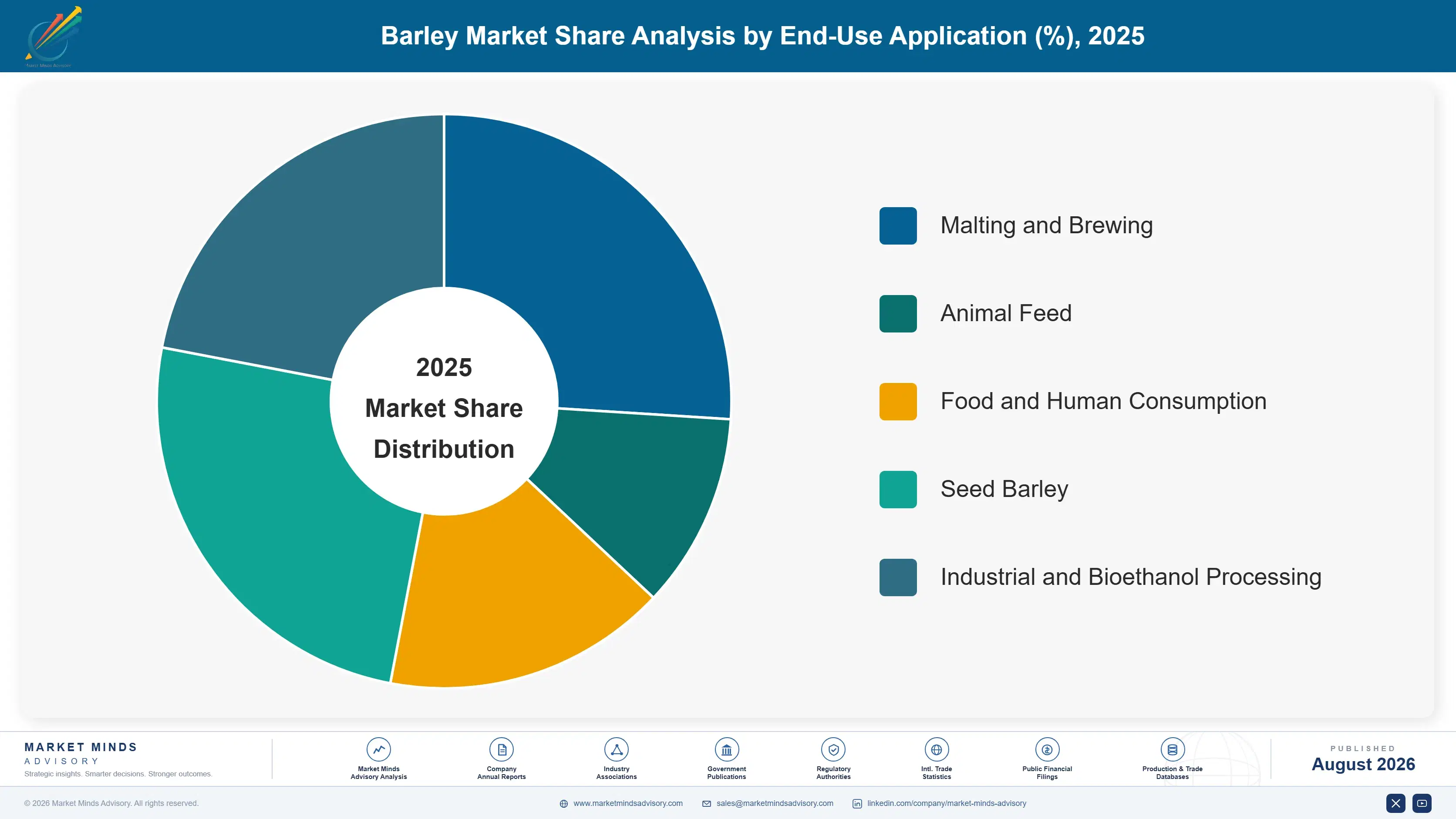
Barley is segmented here by end-use application rather than by variety, seed type, or growing region, since malting, feed, food, seed, and industrial buyers each specify quite distinct variety, protein, and quality standards that shape pricing and contracting decisions largely independent of where the underlying grain was actually grown, harvested, or stored before sale.
barley-market-2024-2034-trends-growth-insights-market-share-analysis-1787461508582

Food and Human Consumption

This segment is growing fastest as health-conscious consumers across North America and Western Europe adopt barley as a fiber-dense whole-grain alternative to wheat and rice in bread, soups, and packaged food products. Retailers have expanded private-label whole-grain barley lines considerably in response to this demand, and food processors increasingly specify consistent grain size and low defect rates that command a meaningful premium over standard feed-grade contracts. Growth here remains smaller in absolute tonnage than feed or malting demand, but margins per tonne run well ahead of both, giving growers with access to food-grade specification contracts a genuine incentive to prioritize this channel. Processors report the fastest customer growth coming from packaged soup manufacturers.
CAGR 5.2%

Malting and Brewing

Craft brewing and single malt whisky demand is expanding this segment faster than the overall market, as distillers and specialty brewers specify particular two-row varieties bred for fermentability rather than simple protein content. Scotland, Ireland, and a growing number of American and Japanese distilleries have driven new distillery openings at a pace well above the historical average, each requiring secured malting supply years in advance of production. Maltsters including Boortmalt and Malteurop have responded with multi-year variety-specific contracts that lock grower acreage well ahead of harvest. Pricing in this segment has decoupled meaningfully from feed-grade barley over the past several years, reflecting genuine scarcity of qualified malting-grade supply relative to rising distilling demand.
CAGR 4.6%
Full segment breakdown across 5 segments available in the complete report.

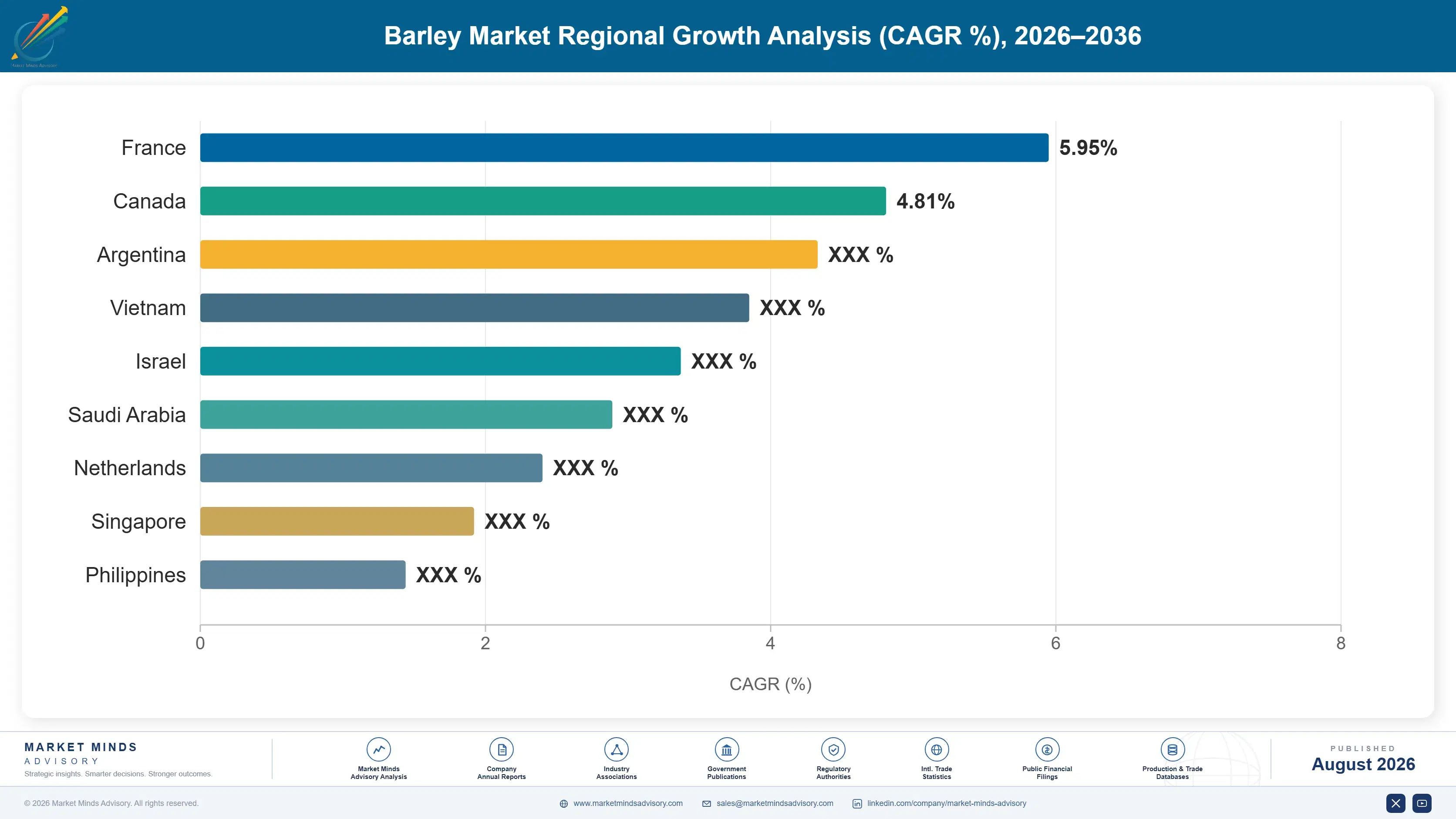
Regional Architecture and Country Demand Map

Western Europe and East Asia together account for roughly half of the global barley market, reflecting concentrated malting capacity and large livestock feed consumption, while South Asia and Pacific posts the fastest regional growth rate on Australian export expansion into Asian feed and malting markets each season.

North America

Livestock feed consumption anchors demand across the United States and Canada, with barley competing directly against corn in cattle and hog rations whenever relative pricing shifts in its favor. Craft distilling has added a fast-growing secondary demand channel, as new American whisky distilleries secure multi-year malting barley contracts well ahead of production. Canada remains among the largest global exporters, shipping substantial volumes into Asian feed and malting markets each season. Food-grade demand is expanding too, as whole-grain product manufacturers in both countries respond to dietary guidance favoring increased fiber intake, though this remains a smaller volume channel than feed or malting contracts across the region as a whole. Mexico adds smaller feed-grade purchasing tied to its livestock sector.
Share: 24% | CAGR: 4.1% (2026 to 2036)

Western Europe

France, Germany, Spain, and the United Kingdom together host the world's largest concentration of malting capacity, with maltsters like Boortmalt and Malteurop contracting acreage directly with growers a season or more in advance. Craft brewing and Scotch whisky production both drive premium variety-specific demand that has decoupled meaningfully from feed-grade pricing over the past several years. Feed consumption remains substantial too, particularly in France and Germany's large livestock sectors. The region exports significant malting barley volumes into Africa and the Middle East, giving European maltsters outsized influence over global malting-grade pricing relative to the region's own consumption footprint alone. Ireland's whiskey distilling sector adds a further premium demand layer distinct from Scotch-focused Scottish contracts.
Share: 26% | CAGR: 2.3% (2026 to 2036)
Regional intelligence for 5 additional markets available in the complete report: East Asia, South Asia and Pacific, Latin America, Middle East and Africa, Eastern Europe. Contact sales@marketmindsadvisory.com.
barley-market-2024-2034-trends-growth-insights-country-cagr-analysis-1787461509095

Where Barley Chain Participants Capture Margin

Participants across the barley value chain can lift margin capture in several genuinely distinct ways: shifting acreage toward variety-specific malting contracts, expanding food-grade processing capability, using forward pricing agreements to manage weather and export volatility more actively, and diversifying export customer relationships well beyond traditional Black Sea and European trading corridors entirely over time.

Variety-Specific Malting Contracts for Craft Distillers

Growers and maltsters who shift acreage toward variety-specific two-row contracts for craft distilling and brewing capture meaningfully higher per-tonne pricing than standard feed-grade sales, since distillers pay a scarcity premium for fermentability characteristics that ordinary feed barley does not need to meet. Maltsters offering multi-year contracts report considerably lower grower churn than those buying on spot terms each season, since growers value the pricing certainty, often worth 25 to 35 dollars per tonne, enough to commit acreage years in advance. The main constraint is that variety-specific seed takes several seasons to scale regionally.
Market Impact: Lifts contract pricing by 25 to 35 dollars per tonne

Food-Grade Processing Equipment and Capability Investment

Processors who invest in cleaning and grading equipment capable of meeting food-grade specifications, including consistent grain size and low defect rates, can serve the fastest-growing demand segment in the category at a meaningfully better margin than feed-grade sales. Several North American processors have already made this investment, and their blended selling price now runs 15 to 20 percent above feed-grade equivalents on comparable tonnage. The capital cost is moderate relative to malting infrastructure, giving mid-sized processors a realistic entry point into a segment historically dominated by larger integrated food manufacturers.
Market Impact: Adds 15 to 20 percent price premium per tonne

Forward Pricing Agreements Against Weather Volatility

Exporters and large buyers who lock forward pricing agreements ahead of harvest reduce exposure to the kind of sudden supply shocks that drought in Australia or Russia periodically produces, trading some upside during favorable harvests for protection against the downside of a poor one. Traders using this approach report roughly 30 percent steadier quarter-to-quarter margins than those relying primarily on spot purchasing, and the practice has become standard among the five largest trading houses over the past several years. Smaller regional traders are increasingly adopting similar tools as exchange-traded barley futures liquidity improves.
Market Impact: Reduces margin volatility by roughly 30 percentage points

Geographic Export Diversification Beyond Traditional Corridors

Exporters who diversify customer relationships beyond traditional Black Sea and European corridors, into growing Asian feed markets and North African food-grade demand, capture volume that competitors slower to reposition are ceding by default. Australian and Argentine exporters have gained meaningful durable market share in Middle Eastern and Asian markets since 2022, filling gaps left by Ukrainian export disruption. Building these relationships takes 2 to 3 years of consistent delivery performance before buyers commit to multi-year sourcing agreements, but the resulting customer base tends to prove considerably stickier than spot market relationships.
Market Impact: Adds 8 to 12 percent export volume share

Who Controls the Margin Pool

The market sits at moderate concentration, with the top five participants controlling thirty-four percent of global trading and malting capacity on a processing volume basis. Cargill and Archer-Daniels-Midland lead the trading side by a clear margin, while Boortmalt and Malteurop dominate dedicated malting capacity, leaving a meaningful gap before the next tier of regional challengers. Regional challengers compete mainly on price.
Current competitive activity centers on three fronts: variety-specific contracting to secure malting supply years ahead of distilling demand, geographic export diversification following Black Sea trade disruption, and food-grade processing investment to capture the fastest-growing demand segment. Trading houses are also expanding forward pricing tools to manage weather-driven supply volatility more actively than in past decades. These fronts increasingly determine which participants retain customers.

Emerging pressure comes from Australian and Argentine exporters who have captured durable market share in Middle Eastern and Asian markets since Ukrainian export disruption began, and from mid-sized processors investing directly in food-grade capability rather than ceding that segment to larger integrated manufacturers. Rankings among trading houses could shift meaningfully if Black Sea export volumes normalize faster than currently expected, reopening competition for customer relationships several non-Black Sea exporters now consider secured.
barley-market-2024-2034-trends-growth-insights-company-positioning-matrix-1787461509619

Competitive Moat and Risk Dimensions

CARGILL

Moat: Global storage and logistics scale

Cargill's global grain storage, port, and logistics network lets it move barley between producing and consuming regions faster and more reliably than smaller competitors, a scale advantage that becomes especially valuable during weather-driven supply disruptions when reliable delivery commands a real premium from buyers. Few competitors can match this global reach.
CARGILL

Risk: Exposure to trade policy shifts

Cargill's scale depends heavily on open cross-border trade flows, making the company disproportionately exposed to tariff disputes or export restrictions that individual governments periodically impose during domestic food security concerns, disruptions smaller regionally focused competitors are sometimes better positioned to route around. Diversified regional players sometimes navigate this risk more nimbly.
BOORTMALT

Moat: Integrated European malting capacity

Boortmalt's dedicated malting capacity across France and other European growing regions, combined with direct multi-year grower contracts, gives it a supply security advantage that trading-focused competitors lacking equivalent processing infrastructure cannot easily replicate without years of capital investment in malthouse construction. Replicating this network would take rivals many years and considerable capital to build from scratch.
BOORTMALT

Risk: Concentrated European supply exposure

Boortmalt's malting capacity concentration in Western Europe leaves it more exposed than globally diversified rivals to a poor regional harvest, since shifting malting operations to alternative growing regions on short notice is far more difficult than a pure trading house rerouting shipments. Globally diversified rivals can absorb a bad regional harvest far more easily.

Players Tracked

Prominent Players

Cargill
Archer-Daniels-Midland
Viterra
Boortmalt
Malteurop Group

Other Key Players

GrainCorp
Simpsons Malt
Soufflet Group
Rahr Corporation
Canada Malting Co
Bairds Malt
Crisp Malting Group
Muntons plc
Ireks GmbH
Swiss Malt
Great Western Malting
Cofco International
Louis Dreyfus Company
Glencore Agriculture
Nordic Malt

Recent Developments

APRIL 2025

Boortmalt expands French malthouse capacity

Boortmalt commissioned an expansion of malting capacity at one of its French facilities, aimed at meeting growing craft distilling and brewing demand for variety-specific malt across Western Europe. The expansion followed years of steady order growth from new distilleries entering the European market. Local growers expect further capacity additions soon.
Signal: Signals that maltsters are investing capacity ahead of confirmed long-term craft distilling demand growth trends across the entire region
OCTOBER 2024

Viterra deepens Australian export infrastructure investment

Viterra announced additional investment in Australian port and storage infrastructure to support growing barley export volumes into Asian feed and malting markets. The investment followed several seasons of rising demand as Asian buyers diversified sourcing away from Black Sea exporters. Regional officials welcomed the announcement publicly.
Signal: Confirms that Australia is consolidating durable market share gained since Black Sea trade disruption began across nearly every major market
JANUARY 2026

Cargill signs multi-year feed barley supply agreement in China

Cargill signed a multi-year supply agreement with a major Chinese feed manufacturer to provide barley for hog and poultry rations, locking in committed volume ahead of anticipated corn price volatility across the region. The deal reflects growing formalization of substitution purchasing. Analysts expect similar deals to follow.
Signal: Signals that feed substitution is shifting from opportunistic spot buying toward formal long-term contracts across the broader region too

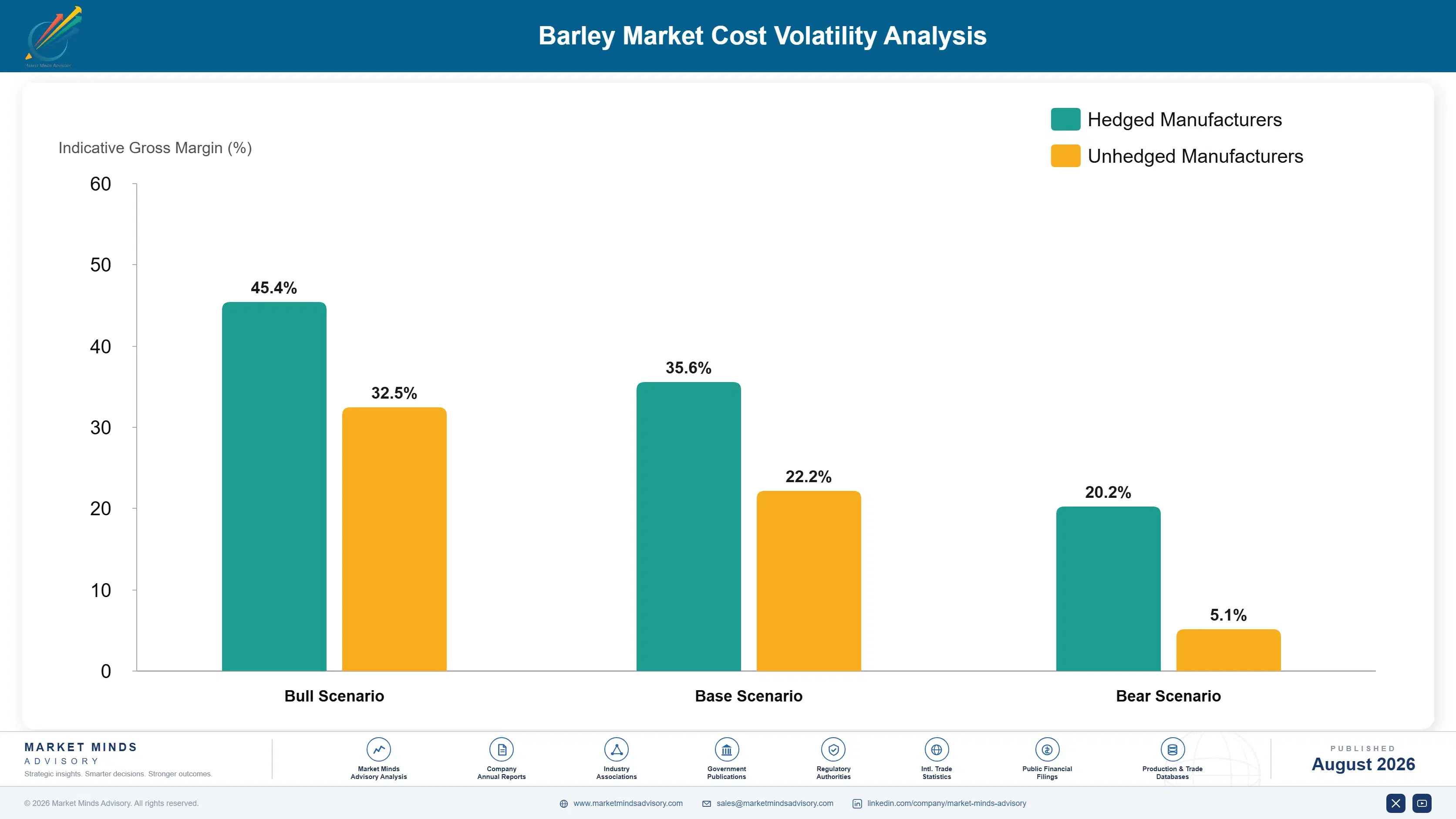
Land Rent and Fertilizer Cost Exposure

Land rental and fertilizer costs together account for roughly fifty-two percent of barley production cost of goods sold across major growing regions, with nitrogen fertilizer representing the largest single input given barley's relatively high nitrogen requirement relative to other cereal crops grown in rotation with it. Seed costs for variety-specific malting contracts add a smaller but meaningfully higher input cost than standard feed-grade seed varieties.
Fertilizer prices spiked sharply in 2022 following natural gas supply disruptions documented in the IEA's Gas Market Report, since nitrogen fertilizer production depends heavily on natural gas as a feedstock, pushing grower input costs up by an estimated thirty percent within a single season before gradually easing through 2023 and 2024. Several growers in Eastern Europe reported delaying planned acreage expansion during this period as margins compressed sharply.

Cost exposure varies by grower scale and region. Large commercial operations in North America and Australia negotiate fertilizer pricing directly with suppliers and absorb volatility more easily than smallholder growers across Eastern Europe and parts of South Asia, who typically purchase through intermediaries at less favorable terms. Growers with malting contracts carry less exposure than feed-grade sellers, since the premium partially buffers rising input costs.
barley-market-2024-2034-trends-growth-insights-cost-volatility-analysis-1787461509816

Multi-Year Fertilizer Supply Agreements

Larger growing operations have moved toward multi-year fertilizer purchase agreements with suppliers, trading some pricing flexibility for protection against the kind of sharp spikes documented during the 2022 natural gas volatility. This reduces season-to-season cost unpredictability and gives growers a steadier basis for budgeting acreage decisions well ahead of planting. Several growers weigh this stability when choosing fertilizer suppliers.

Precision Nitrogen Application Technology

Growers adopting precision application technology that targets nitrogen delivery more efficiently across a field are reducing total fertilizer volume needed per hectare without sacrificing yield, a meaningful hedge against future price spikes. Adoption has concentrated so far among larger commercial operations able to justify the equipment investment. Adoption has spread beyond large operations as financing options become more available.

Malting Contract Premiums as Cost Buffers

Maltsters offering multi-year variety-specific contracts increasingly structure premiums to partially offset grower input cost volatility, recognizing that growers who cannot manage fertilizer risk may otherwise shift acreage toward less input-intensive crops entirely, threatening long-term malting supply security. Maltsters see this as a way to protect long-term grower relationships that might otherwise erode under sustained cost pressure.

Portfolio Architecture for Margin Defence

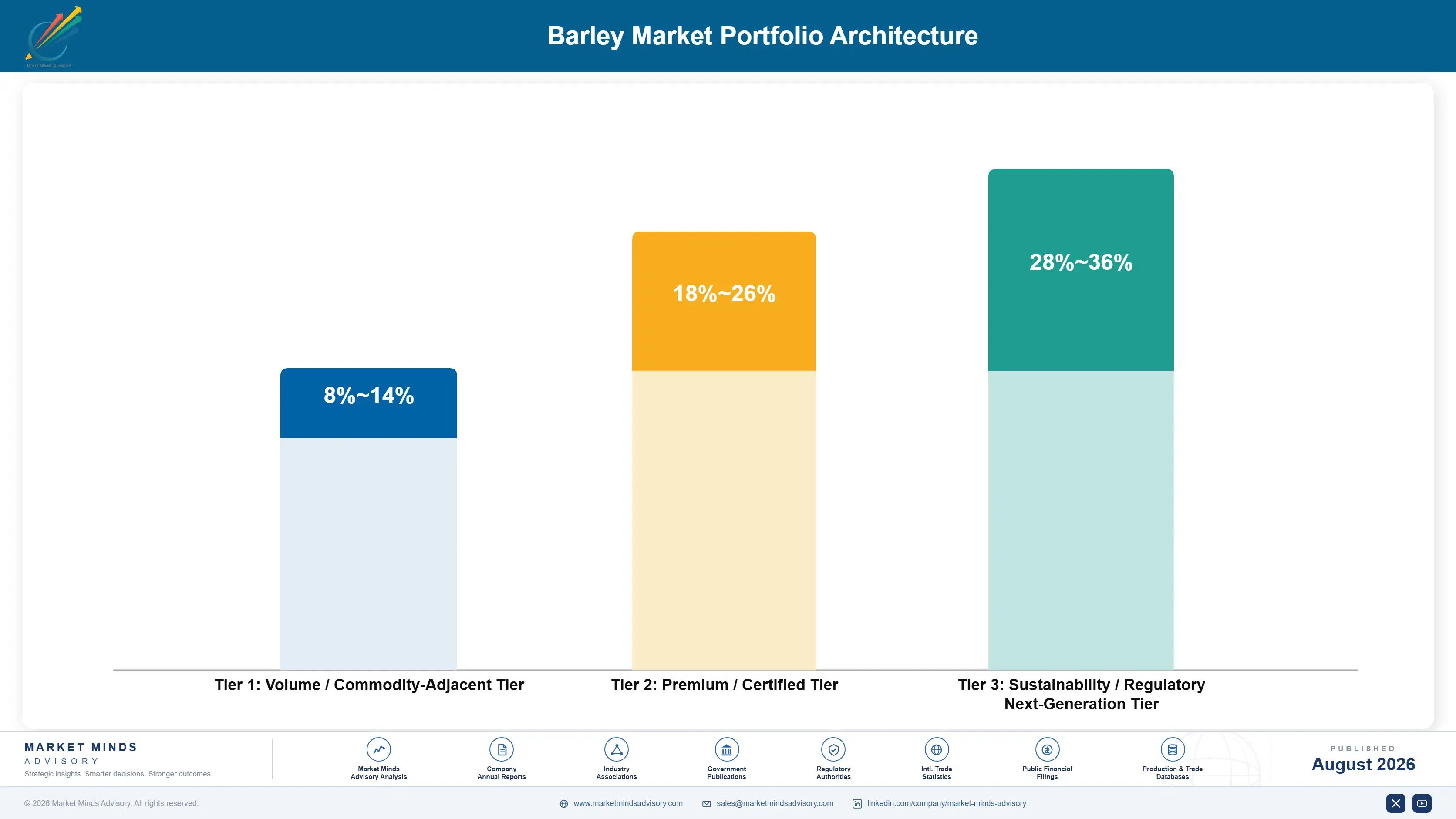
The portfolio splits into three tiers with distinct margin economics. Volume commodity-adjacent feed-grade barley competes largely on price against corn and wheat substitutes, premium certified malting-grade barley commands a durable multi-year contract premium, and a smaller next-generation tier built on food-grade and specialty distilling varieties sits above both on a per-tonne margin basis. This structure means overall margin depends far more on shifting mix toward premium tiers than on growing total tonnage.
The volume versus premium tension is real: feed-grade barley still represents the majority of global tonnage, but nearly all incremental margin growth is concentrated in malting and food-grade tiers, creating pressure on growers to shift acreage mix even where feed demand remains a stable base business in absolute terms. Producers who delay this mix shift risk ceding their most profitable relationships to competitors already positioned in the premium tier.

High-value margin pools concentrate in variety-specific distilling contracts and food-grade processing, both of which reward growers and processors able to meet precise specifications consistently across multiple seasons rather than simply delivering maximum tonnage at harvest. Producers demonstrating this consistency across cycles command a durable pricing advantage smaller, less consistent competitors struggle to close.

Volume / Commodity-Adjacent Tier

Standard feed-grade barley sold into livestock ration markets where pricing tracks closely against corn and wheat substitution economics from one season to the next, with little room for differentiation. Little differentiation exists across suppliers here.
Gross Margin: 8-14%

Premium / Certified Tier

Variety-specific malting barley sold under multi-year contracts to brewers and distillers specifying particular fermentability and protein characteristics, commanding pricing that has decoupled from feed-grade markets. Buyers here specify variety years in advance of harvest.
Gross Margin: 18-26%

Sustainability / Regulatory / Next-Generation Tier

Food-grade whole-grain barley and specialty craft distilling varieties serving health-focused food manufacturers and premium spirits producers willing to pay for consistent grain quality and traceable sourcing. Growth here outpaces every other tier in the category.
Gross Margin: 28-36%
barley-market-2024-2034-trends-growth-insights-portfolio-architecture-1787461510323

High-value Sub-segments and Strategic Watch-out

Craft Distilling Variety-Specific Contracts

This segment combines the fastest premium growth with the strongest grower loyalty in the category, driven by new distillery openings across Scotland, America, and Japan securing supply years in advance of production. Few competitors currently match this combination of loyalty and pricing power across the category.
Gross Margin: 30-38%

Food-Grade Whole-Grain Processing

Whole-grain dietary trends across North America and Western Europe support steady premium pricing here, though volume remains smaller than feed or malting tonnage across the category as a whole today. Volume here should keep expanding steadily as more manufacturers launch competing whole-grain product lines. Retailers see durable growth here.
Gross Margin: 26-34%

Standard Livestock Feed-Grade Barley

This remains the largest volume base in the category, with pricing tracking corn and wheat substitution economics closely, leaving margins thinner than the premium malting and food-grade tiers by a wide margin. Growers here compete almost entirely on yield and cost discipline rather than differentiation.
Gross Margin: 8-14%

Eastern European Export-Oriented Production

A strategic watch-out segment where Black Sea export normalization could reintroduce significant supply volume, potentially compressing pricing gains that Australian and Argentine exporters have secured since the trade disruption began in 2022. Exporters elsewhere are watching this segment closely for early signs of pricing pressure returning.
Gross Margin: 10-16%

Seasonal Contracting and Rotation Economics

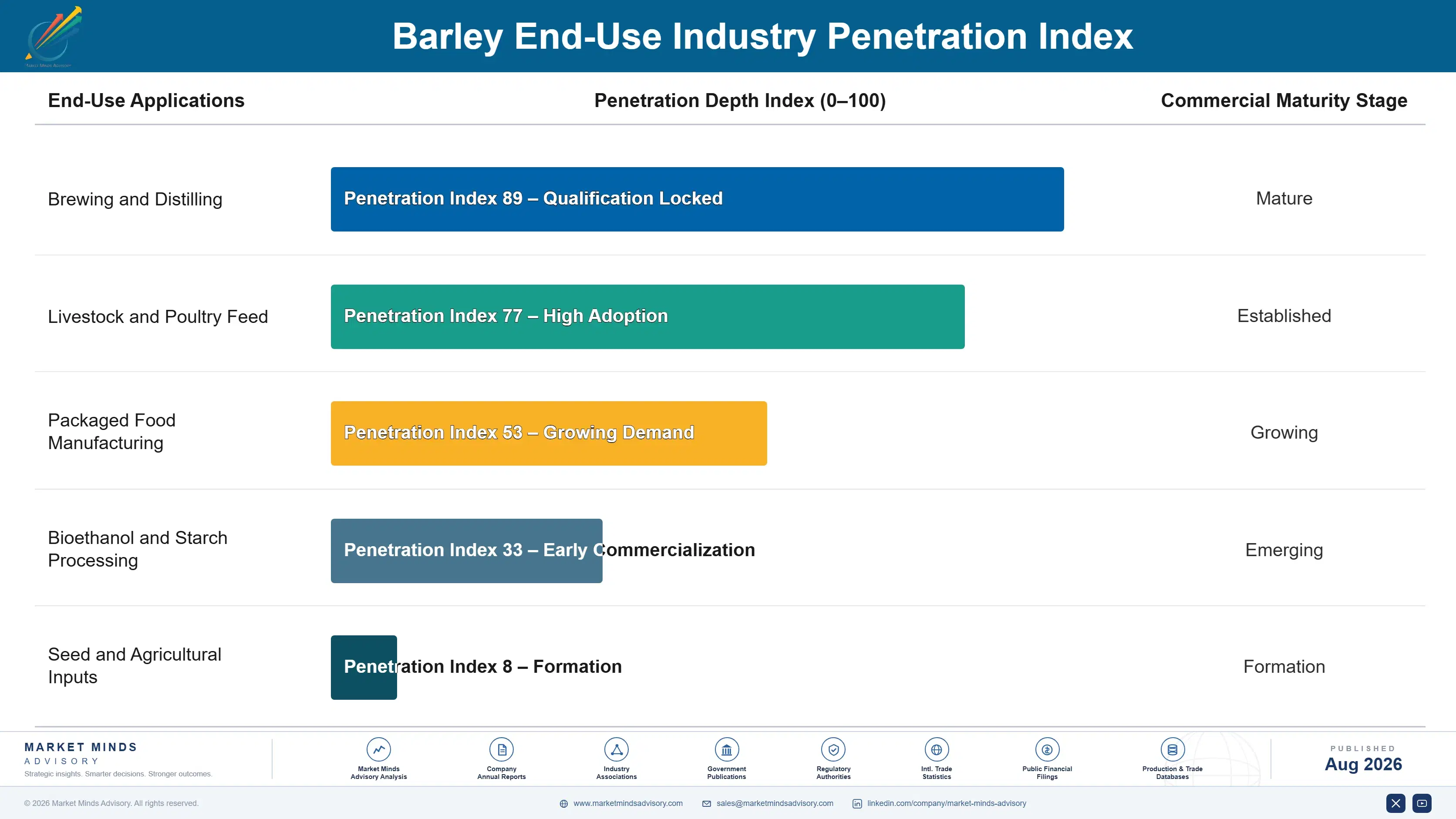
Barley demand behaves less like a discretionary purchase and more like a recurring seasonal commitment once a malting contract is signed, since maltsters and distillers plan production years ahead and rarely abandon a qualified grower relationship over a single difficult season. This gives growers with malting contracts considerably more revenue predictability than those selling purely on the feed-grade spot market. Buyers rarely abandon a qualified relationship over one difficult harvest alone.
Adoption depth varies by end-use vertical. Distillers commit deepest, often locking multi-year variety-specific agreements tied directly to production schedules set years in advance. Brewers commit almost as deeply, though with somewhat shorter contract horizons. Feed formulators, by contrast, show the shallowest commitment, since barley functions as a substitutable input they will swap toward corn or wheat within a single purchasing cycle whenever relative pricing shifts. This layered commitment structure shapes how quickly demand can shift between end uses.

A generational shift in buyer profile is underway too. Younger craft brewing and distilling entrepreneurs increasingly value traceable, variety-specific sourcing as a brand differentiator rather than treating grain as an interchangeable input, a mindset shift that is locking in premium demand durability even independent of near-term commodity price swings.
barley-market-2024-2034-trends-growth-insights-end-use-penetration-index-1787461510815

Where Barley Value Concentrates Next

These are among the four positions where our research anticipates prominent divergence between winners and laggards over the coming forecast period. Each is grounded in the demand model, the regulatory perimeter, and the announced capacity pipeline.
01 / CONTRACT MIX STRATEGY

Prioritize variety-specific malting acreage over feed-grade expansion

Malting and distilling demand is compounding well above feed-grade growth, and maltsters offering multi-year contracts report considerably lower grower churn than spot-market competitors. Growers still expanding purely feed-grade acreage are chasing a margin pool that keeps narrowing every season malting premiums widen further. The economics of variety-specific conversion now clear payback thresholds that looked marginal only a few years ago, making this the clearest allocation priority for growers with flexibility to shift acreage mix and lock in the strongest available terms before competitors follow suit.
02 / EXPORT DIVERSIFICATION POSITIONING

Lock Asian and North African customer relationships before Black Sea normalizes

Australian and Argentine exporters have captured durable market share in Middle Eastern and Asian markets since Ukrainian export disruption began, and these relationships are proving stickier than pure spot-market transactions once established. Exporters without diversified customer bases risk losing this share back to Black Sea producers should export corridors normalize faster than currently expected. The window for cementing these newer relationships through consistent delivery performance will not stay open indefinitely once Black Sea export volumes fully return and trade corridors fully stabilize again.
03 / INPUT COST RISK MANAGEMENT

Hedge fertilizer exposure before the next natural gas price spike

The 2022 fertilizer cost spike showed how exposed unhedged growers are to natural gas market volatility that drives nitrogen fertilizer pricing across every major producing region. Growers without multi-year supply agreements or precision application technology remain vulnerable to a repeat event, and margin compression during the last spike was severe enough to delay planned acreage expansion across Eastern Europe specifically. Locking in supply terms and adopting precision technology now costs considerably less than absorbing another comparable shock again later on.
04 / REGIONAL GROWTH SEQUENCING

Prioritize South Asia and Pacific expansion ahead of slower regions

South Asia and Pacific is growing faster than every other region tracked in this report, on the strength of Australian export expansion and India's growing domestic malting and food-grade market. Participants sequencing investment should weight this region ahead of slower-growing Eastern Europe, where much of the harvest already moves through established export channels rather than local processing. Early positioning here compounds advantage as regional buyers finalize longer-term supplier relationships that will prove difficult for late movers to unwind once set.

Engagement Snapshot From the Field

A live engagement with an industry participant carrying material or product regulatory and market exposure ahead of a defining policy shift, showing how our research translates into a defensible multi-year portfolio strategy.
MARKET MINDS ADVISORY · CLIENT ENGAGEMENT SUMMARY
Barley Producer Strategic Portfolio Review and Transition Roadmap 2026·Investment Scenario on Barley Exposure Evaluation 2025-26
CLIENT PROFILE
The client, a mid-sized regional maltster headquartered in Western Europe with reported annual revenue of approximately 310 million dollars (client-reported, unverified by MMA), operates malthouse capacity supplying craft brewers and distillers across several European countries, with a contract portfolio historically weighted toward shorter-term feed-grade adjacent purchasing rather than long-term variety-specific agreements. with a grower network built up over more than two decades of regional operation.
STRATEGIC CHALLENGE
The client faced margin compression as craft distilling customers increasingly demanded variety-specific supply guarantees years in advance, a contracting model the client's existing grower relationships and purchasing systems were not structured to support, leaving it at risk of losing key distilling accounts to better-positioned competing maltsters entirely. a shortfall that threatened its standing with its most important distilling customers.
MMA APPROACH
MMA conducted a comparative margin analysis across contract types using primary survey data and expert interviews with grower cooperatives and distilling buyers, benchmarked the client's grower relationship structure against leading maltsters, and modeled contract portfolio scenarios weighted by projected distilling demand growth through 2036, drawing on this report's underlying dataset.
KEY FINDINGS
  1. Distilling customers were willing to commit to five-year purchasing agreements in exchange for variety-specific acreage guarantees the client had not previously offered growers.
  2. The client's grower base was geographically well positioned but lacked the seed variety diversity distillers increasingly specified in their supply agreements. Distillers were open to funding seed diversification jointly if it secured long-term supply.
  3. Competing maltsters offering multi-year contracts reported meaningfully lower grower churn than the client's existing shorter-term purchasing approach. Several had already lost distilling accounts to competitors offering longer commitments.
  4. Regional growers were receptive to variety-specific contracts once shown a credible multi-year pricing commitment, removing a key barrier the client had assumed existed.
CLIENT PROFILE
The client, a mid-sized regional maltster headquartered in Western Europe with reported annual revenue of approximately 310 million dollars (client-reported, unverified by MMA), operates malthouse capacity supplying craft brewers and distillers across several European countries, with a contract portfolio historically weighted toward shorter-term feed-grade adjacent purchasing rather than long-term variety-specific agreements. with a grower network built up over more than two decades of regional operation.
STRATEGIC CHALLENGE
The client faced margin compression as craft distilling customers increasingly demanded variety-specific supply guarantees years in advance, a contracting model the client's existing grower relationships and purchasing systems were not structured to support, leaving it at risk of losing key distilling accounts to better-positioned competing maltsters entirely. a shortfall that threatened its standing with its most important distilling customers.
MMA APPROACH
MMA conducted a comparative margin analysis across contract types using primary survey data and expert interviews with grower cooperatives and distilling buyers, benchmarked the client's grower relationship structure against leading maltsters, and modeled contract portfolio scenarios weighted by projected distilling demand growth through 2036, drawing on this report's underlying dataset.
KEY FINDINGS
  1. Distilling customers were willing to commit to five-year purchasing agreements in exchange for variety-specific acreage guarantees the client had not previously offered growers.
  2. The client's grower base was geographically well positioned but lacked the seed variety diversity distillers increasingly specified in their supply agreements. Distillers were open to funding seed diversification jointly if it secured long-term supply.
  3. Competing maltsters offering multi-year contracts reported meaningfully lower grower churn than the client's existing shorter-term purchasing approach. Several had already lost distilling accounts to competitors offering longer commitments.
  4. Regional growers were receptive to variety-specific contracts once shown a credible multi-year pricing commitment, removing a key barrier the client had assumed existed.
RECOMMENDED STRATEGY
Phase 1: Phase 1 (0-6 months): Pilot variety-specific multi-year contracts with a subset of existing growers already supplying distilling-grade barley. with growers who expressed early willingness to convert additional acreage. Phase 2: Phase 2 (6-18 months): Expand seed variety access and secure two additional distilling customers under multi-year agreements. and formalize supply terms with each new partner. Phase 3: Phase 3 (18-36 months): Scale the contract model across the full grower base and formalize a distilling-focused product line. while monitoring grower conversion rates closely.
OUTCOME
Within eighteen months of implementing the phased strategy, the client reported securing two new multi-year distilling contracts and a reported blended margin improvement of roughly seven percentage points across its malting product lines (client-reported, unverified by MMA). Grower participation in the new contract model also exceeded initial internal projections by a wide margin.

Frequently Asked Questions

Foundational context covering the market sizes, CAGR, scope, country, region and competition that inform every finding below. This section is provided to cover basics and most often pre-purchase conversations, answered from the MMA Primary Research Dataset.

What is the current size of the Barley Market?

The global barley market was valued at approximately 38.2 billion dollars in 2025. Growth is concentrated in malting premiumization and food-grade whole-grain demand rather than acreage expansion.

How large will the Barley Market be by 2036?

The market is projected to reach approximately 57.6 billion dollars by 2036. This represents roughly a 1.45 times expansion from 2026 levels over the forecast period.

What is the CAGR for the Barley Market 2026 to 2036?

The market is forecast to grow at a compound annual growth rate of 3.8 percent between 2026 and 2036. Bull and bear scenarios range from 2.6 to 5.0 percent depending on weather and trade conditions.

Which segment is growing fastest?

Food and human consumption is the fastest-growing segment, expanding at approximately 5.2 percent annually. This is roughly 1.37 times the overall market growth rate, driven by whole-grain dietary trends.

Who are the major companies in the Barley Market?

Leading participants include Cargill, Archer-Daniels-Midland, Viterra, Boortmalt, and Malteurop Group. These five companies together control roughly thirty-four percent of global trading and malting processing capacity worldwide.

Which country is growing fastest?

Australia is the fastest-growing national market, expanding at approximately 6.0 percent annually. Growth is driven by export diversification into Asian markets following Black Sea trade disruption.

Report Segmentation Architecture

The full report scope spans multiple orthogonal segmentation dimensions, with cross-tabulated demand data provided for each dimension pair. Coverage extends further to regional breakdowns, trend trajectories, and the competitive detail needed to support segment-level decision-making.

By End-Use Application

  • Malting and Brewing
  • Animal Feed
  • Food and Human Consumption
  • Seed Barley
  • Industrial and Bioethanol Processing

By End-Use Industry

  • Brewing and Distilling
  • Livestock and Poultry Feed
  • Packaged Food Manufacturing
  • Bioethanol and Starch Processing
  • Seed and Agricultural Inputs

By Commercial Dimension

  • Direct Grower Contracts
  • Spot Market Trading
  • Export Trading House Channel
  • Cooperative Pooled Sales

By Region

  • North America
  • Western Europe
  • East Asia
  • South Asia and Pacific
  • Latin America
  • Middle East and Africa
  • Eastern Europe

Scope, Methodology, and Coverage

Every figure in this report is reproducible from documented input assumptions. The scope below maps the historical period, the forecast horizon, the segmentation dimensions, and the countries covered, alongside the underlying primary and qualitative methodology.
Historical Period
2020 to 2025
Forecast Period
2026 to 2036
Base Year
2025 (USD billions; MMA Primary Research Dataset, August 2026)
Market Definition
The barley market covers commercial production, trading, and processing of barley across malting and brewing, animal feed, human food, seed, and industrial applications including bioethanol and starch processing. It excludes finished beer, whisky, and packaged food products made from processed barley, which are valued as separate downstream markets.
Quantitative Units
USD billions (current prices); metric tons of production volume where applicable
Segmentation Dimensions
By End-Use Application; By End-Use Industry; By Commercial Dimension; By Region
Regions Covered
North America, Western Europe, East Asia, South Asia and Pacific, Latin America, Middle East and Africa, Eastern Europe
Countries Covered
USA, China, Germany, France, UK, Japan, South Korea, India, Australia, Canada, Brazil, Mexico, Indonesia, Vietnam, Thailand, Malaysia, UAE, Saudi Arabia, South Africa, Nigeria, Turkey, Poland, Netherlands, Italy, Spain, Sweden, Switzerland, Argentina, Colombia, Singapore, and additional markets relevant to this sector
Key Companies Profiled
Cargill, Archer-Daniels-Midland, Viterra, Boortmalt, Malteurop Group, GrainCorp, Simpsons Malt, Soufflet Group, Rahr Corporation, Canada Malting Co, Bairds Malt, Crisp Malting Group, Muntons plc, Ireks GmbH, Swiss Malt, Great Western Malting, Cofco International, Louis Dreyfus Company, Glencore Agriculture, Nordic Malt
Quantitative Methodology
Primary survey, n=3,800 respondents, Q4 2025, six countries; demand-side model with trade association cross-validation
Qualitative Methodology
47 expert interviews, Q4 2025; applied to validate demand model assumptions, identify emerging dynamics, and assess competitive positioning
Report Format
PDF and XLSX data workbook (Word format preview document)
Publisher
Market Minds Advisory
Report Code
MMA-2026-AGR-101
Published
August 2026
Contact
sales@marketmindsadvisory.com | www.marketmindsadvisory.com

Purchase the full Barley Market Report (2026 to 2036).

This report delivers a complete commercial assessment of the global barley market across end-use applications, trading dynamics, and seven world regions. It includes detailed segmentation analysis, competitive benchmarking of twenty profiled companies, and quantified weather and input cost risk assessments across every major producing geography. Analysts combine primary survey data from 3,800 respondents with 47 expert interviews conducted in the fourth quarter of 2025 to validate demand forecasts running through 2036. The report is designed to support acreage planning, contract mix strategy, and export diversification decisions for growers, maltsters, and trading houses alike.
Ten-year quantitative market forecast across all segments
Detailed application-level segmentation analysis and pricing
Seven-region demand breakdown with share and CAGR data
Twenty-company competitive profiles with moat and risk analysis
Input cost risk assessment with grower mitigation strategies
Malting contract and feed substitution economics analysis

Built For The People Who Decide

From boardroom strategy to bench-side execution, this report is read cover-to-cover by leaders shaping the next decade of their industry, turning demand scenarios, market dynamics and valuation benchmarks into decisions.
CXOs/ Presidents/ VPs/ Managers
M&A and Corporate Development
Strategy Teams and R&D Heads
Procurement and Product Directors
Regulatory and Compliance Leaders
Investor Relations and Equity Analysts