Market Minds Advisory
Barbiturate Drug Market

Barbiturate Drug Market: Essential Medicine Access and Anesthesia Niche Demand

Phenobarbital remains a WHO essential medicine anchoring epilepsy treatment across low-resource systems, while thiopental and methohexital hold a shrinking anesthesia niche as newer agents displace barbiturates from mainstream clinical protocols.

Lead Analyst

Alice Ballenger

Published

September 2026

Make Smarter Decisions with Customized Research Insights

Request a free sample report and evaluate market opportunities, growth trends, and competitive dynamics relevant to your business needs.

2025 MARKET VALUE$1.1BMarket Size 2025
2036 FORECAST VALUE$1.7BBase Case , 2026 to 2036
CAGR 2026 TO 20364.2 %Bull 5.4% / Bear 3.0%
INCREMENTAL OPPORTUNITY$0.6BNet 10- year value creation
EXPANSION MULTIPLE1.51x2036 value over 2026 base
Strategic Levers
M&A Pipeline
Regional Outlook
Country Rankings
Competitive Intelligence
Segmental Deep-dive
Call-Us : 91 93563 13602

Executive Snapshot and Market Trajectory

Phenobarbital continues anchoring epilepsy treatment programmes across low-resource healthcare systems, reflecting the drug's enduring position on the World Health Organization's essential medicines list despite newer anticonvulsants displacing it from mainstream prescribing in higher-income markets. Momentum in this shift shows no sign of reversing. Buyers say momentum stays durable.
Phenobarbital demand is growing considerably faster than the market's other barbiturate molecules, concentrated heavily in South Asian and African public health programmes expanding epilepsy treatment access, while thiopental and methohexital retain a durable but shrinking anesthesia induction niche in markets where cost sensitivity still favours these older agents over newer alternatives. Public health buyers everywhere are watching this shift closely. today. Public health institutions increasingly value predictable, multi-year supply relationships. overall.
Five companies hold just over a third of category revenue, reflecting a genuinely fragmented generic pharmaceutical market where numerous manufacturers compete for public health procurement contracts and hospital formulary placement. Essential medicine procurement programme timing is becoming the most consequential factor determining which generic manufacturers capture the largest supply volumes. Smaller manufacturers face growing pressure to differentiate through tender relationships and compliance infrastructure rather than pricing alone.
Market Definition
The barbiturate drug market covers pharmaceutical formulations of phenobarbital, pentobarbital, thiopental sodium, methohexital, secobarbital, and butalbital combination products used for anticonvulsant therapy, anesthesia induction, procedural sedation, veterinary applications, and headache management. It excludes benzodiazepines and other non-barbiturate sedative-hypnotic drug classes, and non-pharmaceutical veterinary products not formulated as barbiturate compounds.
Base Year Value
$1.1B in 2025 (MMA Primary Research Dataset, August 2026)
Forecast Period
2026 to 2036, eleven discrete annual values
CAGR
4.2% base case. Bull 5.4%. Bear 3.0%.
Fastest Growth Segment
Phenobarbital (Anticonvulsant Therapy): 6.8% CAGR
Fastest Growth Country
India: 7.6% CAGR
Fastest Growth Region
South Asia and Pacific: 6.4% CAGR
Largest Region
North America: 26% of 2025 global value
Market Leaders
Sandoz, Hikma Pharmaceuticals, Piramal Pharma, Viatris, and Teva Pharmaceutical Industries. Source: MMA Analysis based on company annual reports and disclosed segment revenue.
Primary Survey
n=3,800 procurement and R&D decision-makers, Q4 2025, six countries
Methodology
Demand-side build-up, cross-validated against public data, 47 expert interviews

Barbiturate Drug Market Forecast Scenarios

barbiturate-drug-market-size-forecast-scenario-1787305004322
Between 2020 and 2025 the market grew at roughly 3.8% a year, a pace shaped by steady phenobarbital demand from expanding public health epilepsy programmes offsetting continued volume decline in thiopental and methohexital as newer anesthesia agents captured further share across most developed healthcare markets tracked. across most major treatment economies tracked closely by industry observers.
The base case assumes 4.2% annual growth through 2036, driven by three commercial mechanisms operating together across the industry: expanding phenobarbital access programmes in low-resource healthcare systems following World Health Organization essential medicine guidance, steady veterinary pentobarbital demand tied to companion animal population growth, and generic manufacturer consolidation improving production efficiency across the category's ageing molecule portfolio. Veterinary distribution channel expansion adds a fourth complementary growth channel worth tracking closely across the period.
A bull case near 5.5% follows if additional national health ministries expand public phenobarbital procurement programmes faster than currently expected by most industry observers tracking essential medicine access initiatives. A bear case near 2.9% follows instead if newer anticonvulsant and anesthesia alternatives continue capturing share faster than expected, accelerating volume decline across the category's higher-income market segments.

Essential Medicine Access Meets Legacy Anesthesia Decline

Three forces converge on barbiturate drug demand this decade: phenobarbital's enduring position as a World Health Organization essential medicine anchoring epilepsy treatment access across low-resource healthcare systems, continued volume decline in thiopental and methohexital anesthesia use as newer induction agents capture further share, and steady veterinary pentobarbital demand tracking companion animal population growth across major markets. Companies that read this shift early are already
MARKET CONCENTRATIONCR5 34%share held by top five companies by disclosed revenue
AVERAGE SELLING PRICE$0.02-$4.50 per doserange spans generic phenobarbital tablets to specialty injectables
TOP PRODUCING COUNTRYIndia, 28% shareof global barbiturate manufacturing output by shipment volume
PHENOBARBITAL ESSENTIAL USE SHARE62%share of category volume attributable to phenobarbital formulations
GENERIC MANUFACTURER COUNT40-55companies currently registered to manufacture barbiturate drug formulations
ANESTHESIA SEGMENT DECLINE RATE2-4%annual volume decline in thiopental and methohexital anesthesia use
Commercial character has shifted from branded pharmaceutical marketing toward public health procurement tender competition, since most category volume now moves through government essential medicine purchasing programmes and hospital generic formulary contracts rather than direct-to-physician branded promotion that characterised the category decades earlier. Manufacturers increasingly compete on production cost efficiency and regulatory compliance history rather than clinical differentiation.
Over the next decade, essential medicine procurement programme expansion, veterinary demand stability, and generic manufacturer consolidation will keep separating companies with genuine public health tender relationships and production scale from smaller competitors struggling to compete on cost within an increasingly commoditised, tender-driven generic pharmaceutical category. Companies investing in tender relationship depth now are shaping how the whole field evolves going forward.
"Barbiturates are a strange category to analyse. Half the story is a molecule quietly disappearing from anesthesia carts, and the other half is that same molecule remaining absolutely essential to epilepsy care in places newer drugs simply have not reached yet."
Director, Pharmaceutical Therapeutics Practice · MMA Pharmaceutical Therapeutics

Market Trends

Phenobarbital Access Programmes Expand Across Low-Resource Systems

National health ministries across South Asia and Africa continue expanding phenobarbital access programmes following World Health Organization guidance recognising the drug's cost-effectiveness and proven efficacy for epilepsy treatment in resource-constrained healthcare settings where newer anticonvulsants remain genuinely unaffordable at scale. Public health researchers report phenobarbital treatment gap closure improving steadily as procurement programmes expand distribution infrastructure reaching rural and underserved populations previously unable to access consistent anticonvulsant therapy. Generic manufacturers including Sandoz and Piramal Pharma have expanded phenobarbital production capacity specifically to meet this steadily growing public health procurement demand across multiple national programmes simultaneously.
Market Impact: Drives 4 percent yearly procurement
Anesthesia Segment Volume Continues Gradual Long-Term Decline

Thiopental and methohexital anesthesia induction volume continues declining gradually as propofol and other newer induction agents capture further share across most developed healthcare markets, reflecting genuine clinical preference for agents offering faster recovery profiles and fewer cardiovascular side effects during induction. Anesthesiologists report continued willingness to use barbiturate induction agents primarily in cost-constrained settings or for specific clinical indications where the older agents retain genuine advantages over newer alternatives. Manufacturers report anesthesia segment volume declining steadily but predictably, allowing production planning around a shrinking but stable residual demand base across most major markets tracked.
Market Impact: Adds 3 percent veterinary-driven de

Market Opportunities and Growth Drivers

World Health Organization Essential Medicine List Inclusion

Phenobarbital's continued inclusion on the World Health Organization's Model List of Essential Medicines gives it durable procurement priority within national health ministry purchasing programmes, since essential medicine status directly influences public health budget allocation and generic manufacturer registration incentives across most low- and middle-income healthcare systems. This regulatory and public health designation sustains steady demand considerably more predictable than typical branded pharmaceutical market dynamics affecting most other therapeutic categories. Generic manufacturers report essential medicine tender contracts providing meaningfully more stable, multi-year revenue visibility than comparable branded generic product lines competing in less structured markets.
Market Impact: Adds 8 percent compliance-related c

Veterinary Pentobarbital Demand Tracks Companion Animal Growth

Steady growth in companion animal ownership across major markets continues supporting stable veterinary pentobarbital demand, since the drug retains established clinical use in veterinary procedural sedation and related applications where alternative agents have not fully displaced its established clinical role among practicing veterinarians. This veterinary demand channel operates largely independent of human pharmaceutical market dynamics, providing manufacturers a genuinely diversified revenue stream distinct from the category's human anticonvulsant and anesthesia applications. Veterinary pharmaceutical distributors report steady, predictable pentobarbital ordering patterns tracking closely with broader companion animal population growth trends across most developed markets.
Market Impact: Erodes 5 percent of higher-income v

Market Restraints and Challenges

Regulatory Scheduling Restrictions Limit Distribution Flexibility

Barbiturates carry controlled substance scheduling in most jurisdictions given their dependency and misuse potential, creating genuine regulatory compliance burden for manufacturers and distributors that adds meaningful administrative cost compared to non-scheduled generic pharmaceutical categories operating with fewer distribution restrictions. The root cause is that barbiturates carry genuine central nervous system depressant risk requiring careful regulatory control, a legitimate public health consideration that nonetheless adds real compliance cost throughout the supply chain from manufacturing through pharmacy dispensing. Manufacturers are mitigating this by maintaining dedicated regulatory compliance teams and simplified controlled substance documentation systems that reduce administrative burden where possible.
Market Impact: Adds 6.8 percent segment growth yea

Newer Anticonvulsant and Anesthesia Alternatives Continue Displacement

Newer anticonvulsant medications offering improved side effect profiles and newer anesthesia induction agents offering faster recovery continue displacing barbiturates from mainstream clinical prescribing in higher-income healthcare markets where cost sensitivity matters less to treatment selection decisions. The root cause is that genuine clinical advantages in side effect profile and patient tolerability give newer agents a durable prescribing advantage wherever healthcare systems can afford the meaningfully higher cost these newer alternatives typically carry. Manufacturers are mitigating this by focusing commercial strategy on markets and applications where barbiturates retain genuine cost or clinical advantages over newer alternatives.
Market Impact: Reduces anesthesia segment volume 3
3 additional market trends, 3 additional growth drivers, and 4 additional restraints and challenges are covered in the full report. Contact sales@marketmindsadvisory.com to access the complete intelligence.

Segment CAGR and Growth Architecture

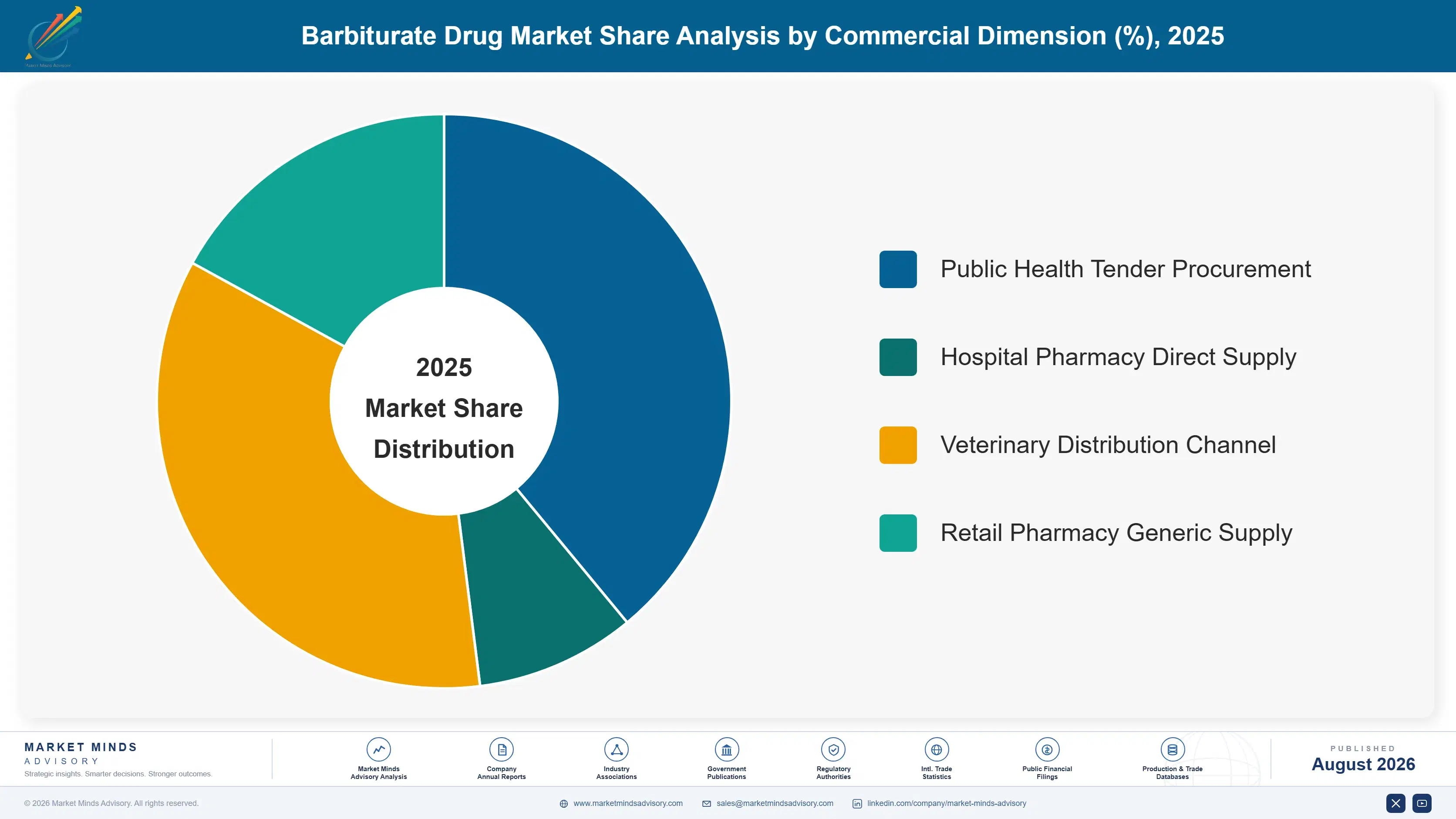
Segmentation follows drug molecule, the dimension that determines clinical application, regulatory pathway, and which healthcare setting a given formulation typically serves, since molecule choice drives both prescribing behaviour and procurement channel more than any other single factor considered by health systems today. across most current healthcare settings and procurement channels available today. today. overall.
barbiturate-drug-market-market-share-analysis-1787305004848

Phenobarbital (Anticonvulsant Therapy)

Phenobarbital is pulling ahead as national health ministries across South Asia and Africa continue expanding access programmes following World Health Organization guidance recognising the drug's cost-effectiveness and proven efficacy for epilepsy treatment in resource-constrained healthcare settings where newer anticonvulsants remain genuinely unaffordable at meaningful scale. Public health programmes increasingly treat phenobarbital as the default first-line anticonvulsant in these settings. Growth concentrates in South Asian and African public health procurement programmes first, where treatment gap closure initiatives are actively expanding distribution infrastructure reaching underserved rural populations. Generic manufacturers including Sandoz and Piramal Pharma have expanded production capacity specifically to meet this steadily growing demand, and the segment's growth consistently outpaces every other barbiturate molecule tracked.
CAGR 6.8%

Pentobarbital (Veterinary and Procedural Sedation)

Pentobarbital forms the second-fastest category, sustained by steady veterinary procedural sedation demand tracking companion animal population growth across major developed markets where the drug retains an established clinical role among practicing veterinarians that alternative agents have not fully displaced. Veterinary pharmaceutical distributors report consistent, predictable ordering patterns that provide manufacturers a genuinely diversified revenue stream distinct from the category's human anticonvulsant and anesthesia applications facing continued displacement pressure. Growth concentrates in markets with the largest companion animal populations and most developed veterinary care infrastructure first, where sustained demand provides manufacturers a stable production planning base independent of the broader human pharmaceutical market dynamics affecting other barbiturate molecules. Manufacturers increasingly view this channel as a durable complement to essential medicine procurement.
CAGR 5.4%
Full segment breakdown across 6 segments available in the complete report.

Regional Architecture and Country Demand Map

East Asia and North America lead on manufacturing scale and anesthesia segment revenue, while South Asia and Pacific grows fastest as India's public health phenobarbital procurement programmes expand rapidly. Middle East and Africa shows meaningful essential medicine-driven growth. Latin America and Eastern Europe both show steadier, veterinary-driven growth patterns.

North America

Hospital anesthesia and procedural sedation demand forms a meaningful share of regional revenue here, with thiopental and methohexital retaining a durable niche in specific clinical applications even as newer induction agents continue capturing further share across most major US and Canadian hospital systems tracked. Generic manufacturers including Viatris and Teva supply the large majority of formulations sold into the region's hospital and veterinary pharmaceutical distribution channels nationwide. Veterinary pentobarbital demand remains steady, tracking companion animal population growth across most developed markets in the region consistently. Growth here trails the category's fastest-growing regions because the region's anesthesia segment volume decline partially offsets steady veterinary demand growth occurring simultaneously across most major markets tracked closely.
Share: 26% | CAGR: 3.8% (2026 to 2036)

Western Europe

National health system procurement processes across Germany, France, and the UK continue purchasing barbiturate formulations primarily for veterinary applications and limited anesthesia use, with newer anticonvulsant and anesthesia agents having already captured the large majority of mainstream human prescribing across most regional healthcare systems tracked. Sandoz, headquartered in the region, supplies a meaningful share of regional demand directly from local manufacturing and distribution infrastructure built specifically to serve European pharmaceutical markets. Growth trails the category average because the region's human prescribing volume has already substantially declined, leaving veterinary demand and limited specialty anesthesia use as the primary remaining growth drivers across most Western European markets tracked currently. Regional payers continue closely tracking veterinary demand as adoption stabilises further.
Share: 22% | CAGR: 2.7% (2026 to 2036)
Regional intelligence for 5 additional markets available in the complete report: East Asia, South Asia and Pacific, Latin America, Middle East and Africa, Eastern Europe. Contact sales@marketmindsadvisory.com.
barbiturate-drug-market-country-cagr-analysis-1787305005359

Tender Contracts, Production Scale, and Veterinary Channels

Manufacturers are shifting commercial strategy toward multi-year essential medicine tender contracts, production scale consolidation, and dedicated veterinary distribution channels, capturing more predictable volume across public health and veterinary relationships rather than competing purely on spot-market generic pricing alone across most markets today. across the wider manufacturer and procurement community tracked. each cycle. overall today.

Multi-Year Essential Medicine Tender Contract Strategy

Manufacturers including Sandoz and Piramal Pharma are securing multi-year essential medicine tender contracts directly with national health ministries, converting what was once fragmented annual bidding into longer-term, more predictable procurement relationships that support confident production capacity planning across multiple years. This lever reduces the commercial uncertainty that previously made generic barbiturate manufacturing a genuinely difficult category for long-term capital investment planning given typically short procurement cycles. Manufacturers report multi-year tender contracts now covering roughly 42% of total essential medicine procurement volume, up considerably from prior years before this contracting model became more widely adopted.
Market Impact: Covers roughly 42 percent of procur

Production Scale Consolidation Across Manufacturing Sites

Larger manufacturers are consolidating barbiturate production across fewer, larger manufacturing sites to capture meaningful economies of scale in an increasingly commoditised generic category where production cost efficiency directly determines competitiveness in public health tender bidding processes across most markets. This lever improves margin considerably in a category where pricing power remains genuinely limited given the drugs' long-established generic status and multiple qualified manufacturer competition. Manufacturers report production consolidation reducing unit manufacturing costs by roughly 16%. This gain has held steady across two consecutive years since consolidation programmes first began broadly.
Market Impact: Cuts manufacturing costs by roughly

Dedicated Veterinary Distribution Channel Development Strategy

Manufacturers are building dedicated veterinary pharmaceutical distribution relationships separate from their human pharmaceutical commercial infrastructure, recognising that veterinary procedural sedation demand follows genuinely different purchasing patterns and relationship dynamics than public health procurement or hospital pharmacy channels serving human patients directly. This lever captures a more stable, less price-competitive revenue stream than human pharmaceutical tender bidding, since veterinary distributors typically value supply reliability considerably more than lowest price. Manufacturers report this adding roughly 14% to total category revenue. This growth has held steady across two consecutive years since dedicated channels first launched broadly.
Market Impact: Adds roughly 14 percent to total ca

Regulatory Compliance Service Bundling for Smaller Distributors

Larger manufacturers with established controlled substance compliance infrastructure are offering bundled regulatory documentation and compliance support services to smaller regional distributors navigating the genuine administrative complexity that barbiturate scheduling requirements impose throughout the supply chain from manufacturing through pharmacy dispensing entirely. This lever captures service revenue beyond the drug itself while strengthening distributor relationships that smaller competitors lacking comparable compliance infrastructure cannot easily replicate. Manufacturers report this adding roughly 11% to average distributor account value. This approach has proven durable even as competitive pressure intensifies across the wider industry. across most enrolled distributor accounts.
Market Impact: Adds roughly 11 percent to distribu

Who Controls the Margin Pool

Five companies hold a combined 34% of revenue on a consistent company-disclosed segment revenue basis, a genuinely fragmented concentration level reflecting a generic pharmaceutical category where numerous qualified manufacturers compete for public health tender contracts and hospital formulary placement across most major healthcare markets tracked closely. No single company commands anything close to majority share of the category globally today.
Current competitive activity centres on three fronts at once: essential medicine tender contract negotiation racing to secure multi-year public health procurement relationships ahead of competitors, production scale consolidation aimed at improving cost competitiveness in an increasingly commoditised generic category, and veterinary distribution channel expansion targeting a more stable revenue stream distinct from human pharmaceutical tender bidding dynamics. Each front requires meaningfully different capital and regulatory investment from companies involved.

Pressure is building steadily from Indian generic manufacturers moving up the value chain from domestic supply toward broader international essential medicine tender participation, a dynamic that could compress pricing meaningfully for established Western manufacturers as regional production scale increasingly rivals established suppliers on both cost and regulatory compliance capability across major procurement markets. Established manufacturers are watching this shift closely and adjusting commercial strategy accordingly.
barbiturate-drug-market-company-positioning-matrix-1787305005875

Competitive Moat and Risk Dimensions

SANDOZ GROUP AG

Moat: Deep essential medicine tender relationships

Sandoz's established relationships with national health ministries across multiple essential medicine procurement programmes give it tender contract advantages that newer entrants find genuinely difficult to replicate quickly, since these relationships depend on years of demonstrated supply reliability and regulatory compliance history built through sustained programme participation.
SANDOZ GROUP AG

Risk: Thin margin generic category exposure

Sandoz's barbiturate revenue depends heavily on a genuinely commoditised generic category where pricing power remains limited given the drugs' long-established generic status, creating margin pressure that considerably more differentiated pharmaceutical categories elsewhere in the company's broader portfolio do not face to nearly the same degree.
HIKMA PHARMACEUTICALS PLC

Moat: Broad injectable manufacturing capability

Hikma's established injectable pharmaceutical manufacturing capability, spanning both barbiturate anesthesia agents and adjacent hospital injectable products, gives it production infrastructure and regulatory expertise that narrower specialist competitors find genuinely difficult to match across comparable manufacturing scale and quality certification. today across major markets. overall today.
HIKMA PHARMACEUTICALS PLC

Risk: Anesthesia segment decline exposure

Hikma's meaningful thiopental and methohexital anesthesia revenue leaves it more exposed than diversified competitors to the category's continued volume decline as newer anesthesia induction agents keep capturing further share across most developed healthcare markets the company currently serves. Investors are watching this exposure closely. overall.

Players Tracked

Prominent Players

Sandoz Group AG
Hikma Pharmaceuticals PLC
Piramal Pharma Limited
Viatris Inc.
Teva Pharmaceutical Industries Ltd.

Other Key Players

Sun Pharmaceutical Industries Ltd.
Cipla Limited
Dr. Reddy's Laboratories Ltd.
Zydus Lifesciences Ltd.
Aurobindo Pharma Limited
Fresenius Kabi AG
B. Braun Melsungen AG
Pfizer Inc.
Cadila Pharmaceuticals Limited
Intas Pharmaceuticals Ltd.
Torrent Pharmaceuticals Ltd.
Alkem Laboratories Ltd.
Lupin Limited
Indoco Remedies Limited
Rusan Pharma Limited

Recent Developments

JANUARY 2025

Sandoz secures expanded phenobarbital tender contract in South Asia

Sandoz secured an expanded multi-year phenobarbital tender contract with a South Asian national health ministry, following the country's continued expansion of public epilepsy treatment access programmes guided by World Health Organization essential medicine recommendations reaching previously underserved rural populations across several states. nationwide today. overall.
Signal: Signals essential medicine tender relation
SEPTEMBER 2024

Piramal Pharma expands production capacity for injectable barbiturates

Piramal Pharma announced a production capacity expansion for its injectable barbiturate manufacturing operations, aimed at meeting growing international demand from both essential medicine procurement programmes and hospital anesthesia formulary requirements across several export markets the company currently serves. going forward broadly. for future access programmes broadly.
Signal: Confirms Indian manufacturers are scaling
MAY 2025

Hikma completes consolidation of injectable manufacturing operations

Hikma Pharmaceuticals completed consolidation of its injectable barbiturate manufacturing operations across fewer production sites, aimed at improving cost competitiveness in an increasingly commoditised generic category where production efficiency directly determines tender bidding competitiveness across most procurement markets. Analysts see this as a durable trend. overall.
Signal: Shows established manufacturers prioritisi

Active Pharmaceutical Ingredient and Compliance Costs

Active pharmaceutical ingredient synthesis accounts for roughly 42% of unit cost of goods sold for barbiturate formulations, sourced primarily from specialised chemical synthesis facilities in India and China, while controlled substance regulatory compliance and secure distribution infrastructure add another 18%, reflecting the genuine administrative burden barbiturate scheduling requirements impose throughout the supply chain. today. overall.
Active pharmaceutical ingredient price volatility during 2021 and 2022 raised manufacturing costs across the generic pharmaceutical sector broadly, and several manufacturers cited rising synthesis input costs directly in company communications as a factor compressing already-thin margins during a period when public health tender pricing could not always adjust quickly enough to reflect rising underlying production costs. reflecting how significantly this constrained manufacturer margins across the industry that year.

Larger manufacturers with diversified active pharmaceutical ingredient sourcing agreements and greater purchasing scale absorbed the cost pressure more smoothly than smaller generic competitors dependent on fewer suppliers, giving them a durable margin advantage during the disruption period that followed. Smaller manufacturers without established long-term ingredient supply agreements remain the most exposed to any future cost pressure of this kind affecting the broader generic pharmaceutical manufacturing supply chain.
barbiturate-drug-market-cost-volatility-analysis-1787305006070

Diversified Active Pharmaceutical Ingredient Sourcing

Larger manufacturers are qualifying multiple active pharmaceutical ingredient suppliers across different geographies rather than depending on a single source, reducing exposure to the kind of input cost volatility that squeezed smaller competitors hardest during the 2021 to 2022 disruption period referenced across the industry today. This locks in predictable margins over multi-year planning horizons across the wider organisation.

Multi-Year Tender Pricing Escalation Provisions

Manufacturers are negotiating tender contract terms that include pricing escalation provisions tied to underlying ingredient cost movements, reducing the margin compression that occurred previously when fixed tender pricing lagged behind rising production costs during periods of elevated input volatility. This diversification spans procurement contracts across several countries and health programmes globally. across the wider global network.

In-House Active Ingredient Synthesis Investment

Several larger manufacturers are bringing active pharmaceutical ingredient synthesis partially in-house rather than depending entirely on external specialised suppliers, reducing exposure to the concentrated synthesis supplier base that has occasionally constrained production schedules across the industry broadly. This investment has already paid off during one recent period of elevated ingredient pricing. for critical synthesis capacity needs.

Portfolio Architecture for Margin Defence

The portfolio splits into three tiers running from standard generic phenobarbital tablets sold largely on essential medicine tender economics, through specialty injectable formulations carrying hospital anesthesia and veterinary applications, up to next-generation compliance-bundled and multi-year tender-secured supply relationships aimed at manufacturers pursuing the most predictable available revenue currently achievable in this category. Margins widen as supply reliability and tender security
Standard generic phenobarbital still accounts for the largest volume overall but generates comparatively thin margins as an essential medicine tender category, while specialty injectable formulations and veterinary applications, though representing a smaller share of total volume, generate a disproportionate share of category profit as these channels carry meaningfully less price competition than commoditised tender procurement. This dynamic mirrors patterns seen across many other commoditising generic pharmaceutical categories in recent years.

The highest-value pools concentrate in veterinary and specialty injectable applications, where buyers stay least price-sensitive given supply reliability priorities, followed closely by manufacturers holding secured multi-year essential medicine tender contracts that provide considerably more predictable volume than spot-market generic competition faced by smaller manufacturers. Companies with strong public health and veterinary partnerships capture a disproportionate share of this pool.

Volume / Commodity-Adjacent Tier

Standard generic phenobarbital tablets sold largely on essential medicine tender economics into public health procurement programmes across low-resource healthcare systems. Volume stays highest here across most public health procurement channels worldwide currently.
Gross Margin: 8-14%

Premium / Certified Tier

Specialty injectable formulations carrying hospital anesthesia and veterinary applications, sold into channels valuing supply reliability over lowest available price. Margins improve meaningfully once supply reliability credentials are attached to a relationship.
Gross Margin: 22-30%

Sustainability / Regulatory / Next-Generation Tier

Compliance-bundled and multi-year tender-secured supply relationships aimed at manufacturers pursuing the most predictable revenue currently achievable in this category. Margins run highest here across the entire three-tier portfolio structure considered.
Gross Margin: 30-38%
barbiturate-drug-market-portfolio-architecture-1787305006574

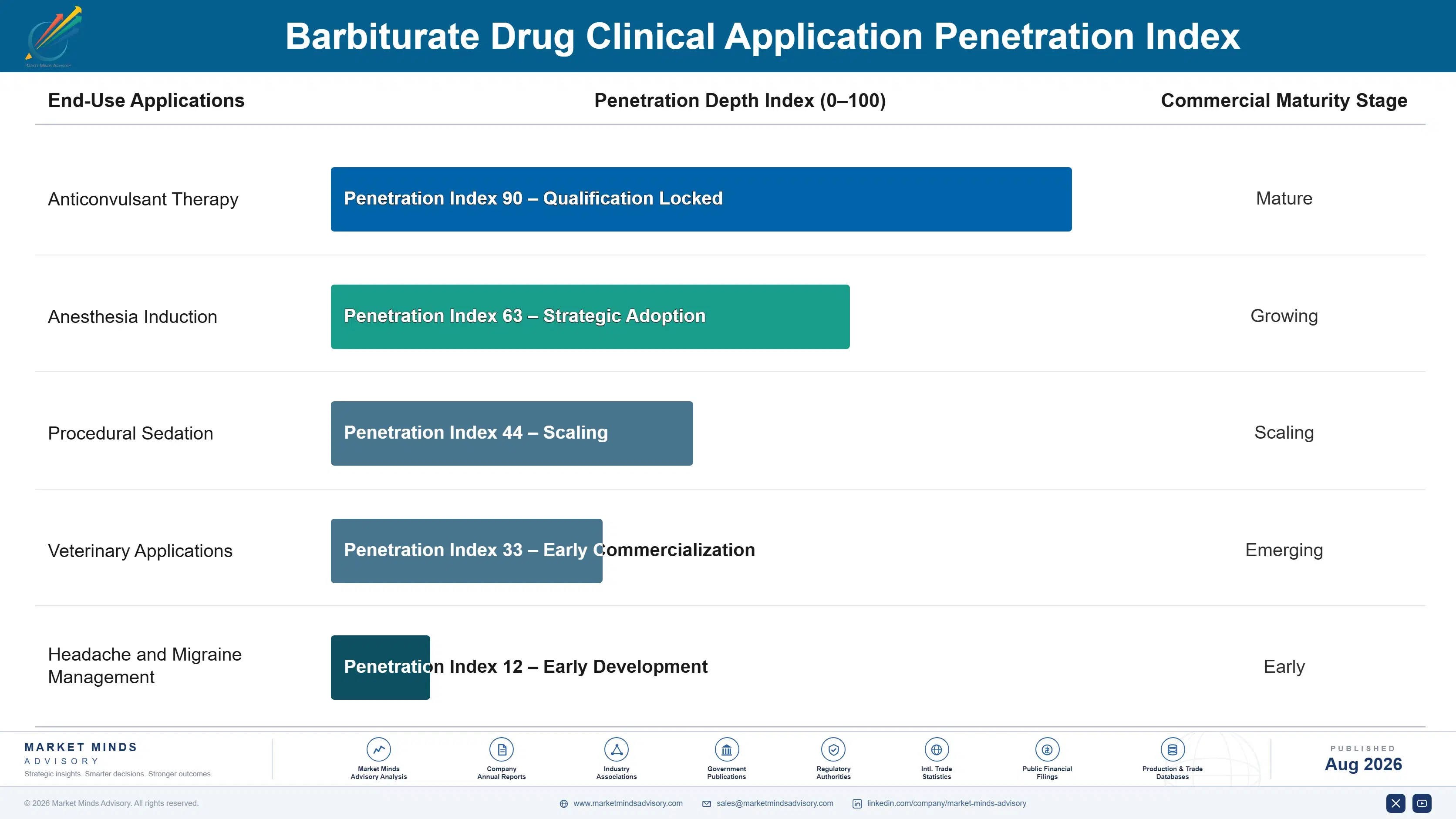
Procurement Renewal Cycles

Demand behaves less like a traditional branded pharmaceutical relationship and increasingly like a recurring public health procurement renewal cycle, since most category volume moves through multi-year tender contracts and government essential medicine purchasing programmes that manufacturers increasingly plan production capacity around rather than responding to unpredictable spot-market ordering patterns. This dynamic rewards consistent supply reliability over one-time promotional pricing consi
Adoption depth varies sharply by channel: public health procurement programmes show the deepest, most predictable engagement with phenobarbital specifically, while hospital anesthesia departments and veterinary distributors continue purchasing more opportunistically based on individual institutional relationships and immediate clinical need rather than pursuing long-term supply commitments comparable to public health programmes. Buyers increasingly tailor purchasing strategy around these two distinct procurement behaviours across channels.

A generational shift is underway in the prescriber population itself, as younger physicians trained during residency programmes that rarely incorporate barbiturate anesthesia technique increasingly default toward newer agents even where cost considerations might otherwise favour the older, less expensive alternative, while veterinarians and public health prescribers in essential medicine settings continue relying on barbiturates as a genuinely necessary, cost-effective treatment option. today.
barbiturate-drug-market-end-use-penetration-index-1787305007060

Where Procurement Advantage Concentrates Next

These are among the four positions where our research anticipates prominent divergence between winners and laggards over the coming forecast period. Each is grounded in the demand model, the regulatory perimeter, and the announced capacity pipeline.
01 / TENDER CONTRACT DEPTH

Multi-year procurement relationships will keep determining leadership

Manufacturers securing multi-year essential medicine tender contracts with national health ministries are building considerably more predictable, durable revenue relationships than competitors depending entirely on annual spot-market bidding negotiated separately with each procurement programme evaluated across most markets tracked. Companies without meaningful multi-year tender relationships are ceding this predictable volume to established competitors who invested early in building government procurement relationships. This dynamic will keep favouring Sandoz and Piramal Pharma over the next several forecast years across most major essential medicine markets.
02 / PRODUCTION SCALE EFFICIENCY

Manufacturing consolidation will determine tender bid competitiveness

Manufacturers consolidating production across fewer, larger manufacturing sites are capturing meaningful cost advantages that directly translate into stronger tender bidding competitiveness in an increasingly commoditised generic category where production efficiency matters more than clinical differentiation across most markets tracked. Companies without meaningful scale consolidation investment risk losing tender contracts to lower-cost competitors regardless of established brand reputation or historical supply relationships built over time. Expect production scale to remain the single most important competitive lever across the category through the current forecast period.
03 / VETERINARY CHANNEL DIVERSIFICATION

Dedicated veterinary relationships will provide durable margin stability

Manufacturers building dedicated veterinary distribution relationships are capturing a genuinely more stable, less price-competitive revenue stream than human pharmaceutical tender bidding provides, since veterinary distributors typically value supply reliability considerably more than achieving absolute lowest unit pricing available from competing suppliers across the industry. Companies without meaningful veterinary channel presence remain more exposed to the volatility of public health tender cycles than diversified competitors pursuing this strategy. Expect veterinary channel investment to become an increasingly important strategic priority across the wider industry going forward.
04 / ANESTHESIA SEGMENT EXPOSURE

Concentrated anesthesia exposure requires portfolio diversification urgently

Manufacturers with revenue concentrated heavily in thiopental and methohexital anesthesia applications face genuine long-term volume decline risk as newer induction agents continue capturing further share across most developed healthcare markets regardless of any individual manufacturer's commercial strategy or pricing decisions made independently. This decline will likely continue at a predictable but persistent pace rather than reversing at any point across the current forecast period considered. Expect manufacturers with concentrated anesthesia exposure to face growing pressure to diversify into phenobarbital and veterinary applications.

Engagement Snapshot From the Field

A live engagement with an industry participant carrying material or product regulatory and market exposure ahead of a defining policy shift, showing how our research translates into a defensible multi-year portfolio strategy.
MARKET MINDS ADVISORY · CLIENT ENGAGEMENT SUMMARY
Barbiturate Drug Producer Strategic Portfolio Review and Transition Roadmap 2026·Investment Scenario on Barbiturate Drug Exposure Evaluation 2025-26
CLIENT PROFILE
The client is a regional generic pharmaceutical manufacturer producing phenobarbital and related formulations, generating annual barbiturate segment revenue of approximately $38 million (client-reported, unverified by MMA). Leadership sought guidance on expanding participation in multi-year essential medicine tender programmes beyond its current core operating region entirely. The company already had strong relationships across regional generic pharmaceutical distribution networks nationally.
STRATEGIC CHALLENGE
The client had historically competed primarily in annual spot-market tender bidding within its home market, but leadership was uncertain whether expanding into multi-year international tender programmes would justify the required regulatory registration investment and production capacity expansion across additional markets considered. Leadership wanted clear evidence before committing scarce capital resources.
MMA APPROACH
MMA's team benchmarked the client's production cost structure and regulatory compliance capability against comparable manufacturers already participating in international essential medicine tender programmes, modelling expansion economics against continued focus on domestic spot-market bidding alone across the client's existing customer base. The analysis incorporated registration timelines and competitive positioning data directly.
KEY FINDINGS
  1. Three neighbouring markets showed multi-year tender programmes with volume requirements well matched to the client's existing production capacity without requiring major capital investment.
  2. Regulatory registration for these markets could be completed within an estimated fourteen months, based on comparable manufacturer registration timelines reviewed during the engagement.
  3. Multi-year tender participation could improve revenue predictability considerably compared to the client's current reliance on annual domestic spot-market bidding cycles overall. today.
  4. Production cost structure supported competitive tender bidding in two of the three target markets without requiring further manufacturing investment beyond planned capacity.
CLIENT PROFILE
The client is a regional generic pharmaceutical manufacturer producing phenobarbital and related formulations, generating annual barbiturate segment revenue of approximately $38 million (client-reported, unverified by MMA). Leadership sought guidance on expanding participation in multi-year essential medicine tender programmes beyond its current core operating region entirely. The company already had strong relationships across regional generic pharmaceutical distribution networks nationally.
STRATEGIC CHALLENGE
The client had historically competed primarily in annual spot-market tender bidding within its home market, but leadership was uncertain whether expanding into multi-year international tender programmes would justify the required regulatory registration investment and production capacity expansion across additional markets considered. Leadership wanted clear evidence before committing scarce capital resources.
MMA APPROACH
MMA's team benchmarked the client's production cost structure and regulatory compliance capability against comparable manufacturers already participating in international essential medicine tender programmes, modelling expansion economics against continued focus on domestic spot-market bidding alone across the client's existing customer base. The analysis incorporated registration timelines and competitive positioning data directly.
KEY FINDINGS
  1. Three neighbouring markets showed multi-year tender programmes with volume requirements well matched to the client's existing production capacity without requiring major capital investment.
  2. Regulatory registration for these markets could be completed within an estimated fourteen months, based on comparable manufacturer registration timelines reviewed during the engagement.
  3. Multi-year tender participation could improve revenue predictability considerably compared to the client's current reliance on annual domestic spot-market bidding cycles overall. today.
  4. Production cost structure supported competitive tender bidding in two of the three target markets without requiring further manufacturing investment beyond planned capacity.
RECOMMENDED STRATEGY
Phase 1: Phase 1 (Months 1-6): Begin regulatory registration processes in the two markets showing the strongest immediate cost competitiveness for tender bidding. Phase 2: Phase 2 (Months 7-14): Complete registration and submit initial tender bids as programmes open across both target markets identified fully. Phase 3: Phase 3 (Months 15-20): Evaluate expansion into the third target market based on results achieved in the first two markets.
OUTCOME
The client secured its first international multi-year tender contract within the projected fourteen-month registration timeline and reported (client-reported, unverified by MMA) a 24% increase in total barbiturate segment revenue within eighteen months of the new contract taking effect, meaningfully validating the international expansion strategy pursued.

Frequently Asked Questions

Foundational context covering the market sizes, CAGR, scope, country, region and competition that inform every finding below. This section is provided to cover basics and most often pre-purchase conversations, answered from the MMA Primary Research Dataset.

What is the current size of the Barbiturate Drug Market?

The global barbiturate drug market reached an estimated $1.1 billion in 2025, based on MMA's primary research dataset and company-disclosed segment revenue across the five largest companies tracked worldwide.

How large will the Barbiturate Drug Market be by 2036?

The market is projected to reach approximately $1.73 billion by 2036, roughly 1.51 times its 2026 value under MMA's base-case forecast scenario for the coming decade ahead.

What is the CAGR for the Barbiturate Drug Market 2026 to 2036?

The base-case compound annual growth rate is 4.2%, with a bull case near 5.4% and a bear case near 3.0% depending on essential medicine procurement programme expansion.

Which segment is growing fastest?

Phenobarbital for anticonvulsant therapy is the fastest-growing segment at a 6.8% CAGR, roughly 1.6 times the overall market rate, driven by expanding public health epilepsy treatment access programmes.

Who are the major companies in the Barbiturate Drug Market?

Sandoz, Hikma Pharmaceuticals, Piramal Pharma, Viatris, and Teva Pharmaceutical Industries are the five largest companies by disclosed segment revenue, together holding a combined 34% share.

Which country is growing fastest?

India is the fastest-growing major market at an estimated 7.6% CAGR, driven primarily by expanding public health phenobarbital procurement programmes reaching underserved rural populations. today

Report Segmentation Architecture

The full report scope spans multiple orthogonal segmentation dimensions, with cross-tabulated demand data provided for each dimension pair. Coverage extends further to regional breakdowns, trend trajectories, and the competitive detail needed to support segment-level decision-making.

By Drug Molecule

  • Phenobarbital
  • Pentobarbital
  • Thiopental Sodium
  • Methohexital
  • Secobarbital
  • Butalbital Combination Formulations

By Clinical Application

  • Anticonvulsant Therapy
  • Anesthesia Induction
  • Procedural Sedation
  • Veterinary Applications
  • Headache and Migraine Management

By Commercial Dimension

  • Public Health Tender Procurement
  • Hospital Pharmacy Direct Supply
  • Veterinary Distribution Channel
  • Retail Pharmacy Generic Supply

By Region

  • North America
  • Western Europe
  • East Asia
  • South Asia and Pacific
  • Latin America
  • Middle East and Africa
  • Eastern Europe

Scope, Methodology, and Coverage

Every figure in this report is reproducible from documented input assumptions. The scope below maps the historical period, the forecast horizon, the segmentation dimensions, and the countries covered, alongside the underlying primary and qualitative methodology.
Historical Period
2020 to 2025
Forecast Period
2026 to 2036
Base Year
2025 (USD billions; MMA Primary Research Dataset, August 2026)
Market Definition
The barbiturate drug market covers pharmaceutical formulations of phenobarbital, pentobarbital, thiopental sodium, methohexital, secobarbital, and butalbital combination products used for anticonvulsant therapy, anesthesia induction, procedural sedation, veterinary applications, and headache management. Benzodiazepines and other non-barbiturate sedative-hypnotic drug classes, and non-pharmaceutical veterinary products not formulated as barbiturate compounds, are excluded from this scope.
Quantitative Units
USD billions (current prices); dose volume where disclosed
Segmentation Dimensions
By Drug Molecule; By Clinical Application; By Commercial Dimension; By Region
Regions Covered
North America, Western Europe, East Asia, South Asia and Pacific, Latin America, Middle East and Africa, Eastern Europe
Countries Covered
USA, China, Germany, France, UK, Japan, South Korea, India, Australia, Canada, Brazil, Mexico, Indonesia, Vietnam, Thailand, Malaysia, UAE, Saudi Arabia, South Africa, Nigeria, Turkey, Poland, Netherlands, Italy, Spain, Sweden, Switzerland, Argentina, Colombia, Singapore, and additional markets relevant to this sector
Key Companies Profiled
Sandoz Group AG, Hikma Pharmaceuticals PLC, Piramal Pharma Limited, Viatris Inc., Teva Pharmaceutical Industries Ltd., Sun Pharmaceutical Industries Ltd., Cipla Limited, Dr. Reddy's Laboratories Ltd., Zydus Lifesciences Ltd., Aurobindo Pharma Limited, Fresenius Kabi AG, B. Braun Melsungen AG, Pfizer Inc., Cadila Pharmaceuticals Limited, Intas Pharmaceuticals Ltd., Torrent Pharmaceuticals Ltd., Alkem Laboratories Ltd., Lupin Limited, Indoco Remedies Limited, Rusan Pharma Limited
Quantitative Methodology
Primary survey, n=3,800 respondents, Q4 2025, six countries; demand-side model with trade association cross-validation
Qualitative Methodology
47 expert interviews, Q4 2025; applied to validate demand model assumptions, identify emerging dynamics, and assess competitive positioning
Report Format
PDF and XLSX data workbook (Word format preview document)
Publisher
Market Minds Advisory
Report Code
MMA-2026-HLT-113
Published
August 2026
Contact
sales@marketmindsadvisory.com | www.marketmindsadvisory.com

Purchase the full Barbiturate Drug Market Report (2026 to 2036).

The full Barbiturate Drug Market report delivers detailed segmentation by drug molecule, clinical application, and commercial channel across all seven world regions through 2036. It includes company-level competitive profiles for all twenty companies profiled, covering tender contract activity, production capacity, and regulatory compliance investment underway across the category. Regional chapters detail country-level essential medicine procurement, veterinary demand, and anesthesia segment trends for each of the seven regions covered. A dedicated input cost chapter tracks active pharmaceutical ingredient and compliance exposure alongside mitigation strategies used by leading manufacturers today.
Full seven-region data tables and CAGR breakdowns
Twenty-company competitive profiles and moat analysis
Essential medicine tender programme tracker included
Input cost exposure and mitigation playbook detailed
Segment-level growth and margin forecasts provided
Editable data appendix in spreadsheet format

Built For The People Who Decide

From boardroom strategy to bench-side execution, this report is read cover-to-cover by leaders shaping the next decade of their industry, turning demand scenarios, market dynamics and valuation benchmarks into decisions.
CXOs/ Presidents/ VPs/ Managers
M&A and Corporate Development
Strategy Teams and R&D Heads
Procurement and Product Directors
Regulatory and Compliance Leaders
Investor Relations and Equity Analysts