

Market Minds Advisory
UK Banking as a Service (BaaS) Platform Market

UK Banking as a Service (BaaS) Platform Market: UK Banking as a Service Platform Market. Embedded Finance Forces a Licensing Model Rethink

Non-bank brands are embedding regulated financial products directly into their own apps, forcing licensed banks to rethink whether they compete on products or rent out their charters as invisible infrastructure instead.

Lead Analyst

Published

September 2026

Make Smarter Decisions with Customized Research Insights

Request a free sample report and evaluate market opportunities, growth trends, and competitive dynamics relevant to your business needs.

2025 MARKET VALUE$1.8BMarket Size 2025
2036 FORECAST VALUE$8.9BBase Case , 2026 to 2036
CAGR 2026 TO 203615.6 %Bull 16.9% / Bear 14.3%
INCREMENTAL OPPORTUNITY$6.8BNet 10- year value creation
EXPANSION MULTIPLE4.26x2036 value over 2026 base
Strategic Levers
M&A Pipeline
Regional Outlook
Country Rankings
Competitive Intelligence
Segmental Deep-dive
Call-Us : 91 93563 13602

Executive Snapshot and Market Trajectory.

Non-bank brands are embedding regulated deposit, payment, and lending products directly into their own apps, forcing licensed banks to decide whether they compete on branded products or rent their charters as infrastructure instead across an increasingly crowded fintech and embedded finance landscape competing for the same brand partnerships.
Fintech companies and retail brands are launching embedded financial products faster than traditional bank product cycles ever allowed, pulling licensing revenue toward banks willing to operate as infrastructure providers rather than customer-facing brands. Adoption is fastest among e-commerce platforms and gig-economy payroll providers building financial products directly into existing customer relationships. Embedded lending is emerging as a distinct, fast-growing category tied to point-of-sale credit decisions made at the moment of customer checkout.
Licensed banks and dedicated BaaS platform providers are converging on the same non-bank brand accounts, each building compliance infrastructure that reduces the regulatory burden brands face when launching financial products. Rising regulatory scrutiny of embedded finance partnerships is accelerating adoption of platforms with proven compliance track records over newer, less established entrants facing greater due diligence hurdles before securing new brand partnerships across most product categories.
Market Definition
This report defines the UK Banking as a Service Platform Market as regulated infrastructure that lets non-bank brands embed deposit accounts, payment processing, and lending products into their own applications under a licensed bank's regulatory permissions. It excludes traditional core banking software sold directly to banks for their own branded operations, payment processing services without embedded banking license infrastructure, and general financial data aggregation platforms.
Base Year Value
$1.8B in 2025 (MMA Primary Research Dataset, September 2026)
Forecast Period
2026 to 2036, eleven discrete annual values
CAGR
15.6% base case. Bull 16.9%. Bear 14.3%.
Fastest Growth Segment
Embedded Lending and Credit Infrastructure: 22.8% CAGR
Fastest Growth Country
United Kingdom: 15.6% CAGR
Fastest Growth Region
South Asia and Pacific: 17.3% CAGR
Largest Region
Western Europe: 90% of 2025 global value
Market Leaders
ClearBank, Railsbank, Modulr, Griffin, and Weavr lead the competitive field. Source: MMA Primary Research Dataset, July 2026.
Primary Survey
n=3,800 procurement and R&D decision-makers, Q4 2025, six countries
Methodology
Demand-side build-up, cross-validated against public data, 47 expert interviews

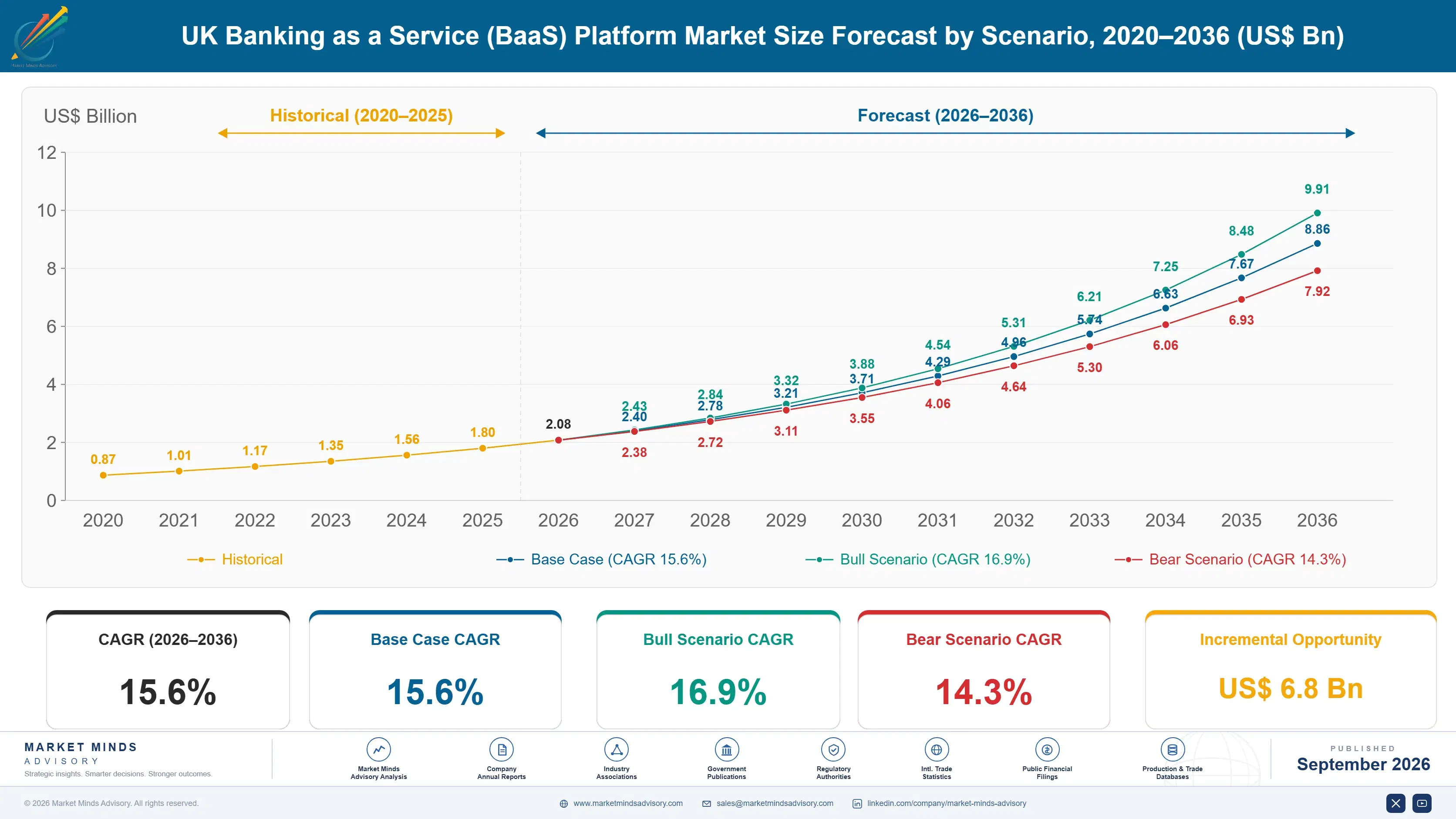
UK Banking as a Service (BaaS) Platform Market Forecast Scenarios

banking-as-a-service-platform-industry-analysis-in-size-forecast-scenario-1790000673859
Between 2020 and 2025, UK BaaS platform adoption grew rapidly at a 14.5% historical CAGR as fintech companies proved out embedded finance business models at meaningful scale. Growth was concentrated among fintech startups and digital-first brands, while traditional retailers relied on legacy payment partnerships instead of embedded banking infrastructure throughout most of the historical period.
The base case assumes continued strong growth through 2036 as three mechanisms compound: non-bank brands keep launching embedded financial products to deepen customer relationships, licensed banks keep expanding infrastructure-as-a-service revenue lines to monetize regulatory capacity, and embedded lending keeps proving measurable conversion improvements at point of sale. Platform consolidation around compliance-first infrastructure providers further supports sustained adoption across most non-bank brand categories through the middle years of the forecast window.
The bull case centers on accelerated regulatory clarity around embedded finance partnerships, which could push growth toward 16.9%. The bear case assumes tightening regulatory scrutiny following high-profile compliance failures delays new partnership launches, pulling growth toward 14.3% as banks and brands extend existing infrastructure agreements instead of expanding into new product categories at the same pace as competitors continuing to invest.

From Bank Branding to Invisible Infrastructure

UK BaaS platforms have moved from a niche fintech infrastructure play into a mainstream distribution channel as licensed banks recognize the revenue potential of renting regulatory capacity to non-bank brands across nearly every consumer-facing sector tracked in this analysis, from retail and travel to gig-economy payroll and subscription services alike.
MARKET CONCENTRATIONCR5: 47%Top five vendors together hold under half of UK share
AVERAGE CONTRACT VALUE£280K per brand partnershipAnnual platform contract value for a typical brand partnership
EMBEDDED LENDING SHARE34% of new deploymentsShare of new deployments including embedded credit or lending products
RENEWAL RATE85% annual renewalShare of brand partners renewing existing platform infrastructure agreements
LAUNCH CYCLE8 to 14 weeksTypical time from partnership signing through live product launch
REGULATORY APPROVAL TIME3 to 6 monthsTypical time for new embedded product regulatory approval processes
Vendors are racing to build compliance infrastructure that reduces the regulatory burden brands face when launching embedded financial products, a shift that favors platforms with proven track records over newer, less established entrants still building regulatory credibility with skeptical compliance departments at large enterprise brands. Embedded lending is gaining share fastest as point-of-sale credit decisions prove measurable conversion improvements for retail and e-commerce brands across nearly every retail category nationwide.
Pricing is shifting from flat platform fees toward revenue-share models tied to transaction volume, aligning bank and brand incentives around growing embedded product adoption together over the long term. Consolidation pressure is building as smaller BaaS specialists merge with broader payments infrastructure providers seeking integrated banking, payments, and lending offerings across multiple product categories and brand partnership tiers across the entire network of banking and brand participants.
"Banks used to think their brand was the product. Now the smartest ones realize their license is the product, and the brand belongs to whoever built the better app. That shift is uncomfortable, but it is where the growth is."
Senior Analyst, Financial Technology Practice · MMA Technology Practice · September 2026

Market Trends

Embedded Lending Proves Measurable Conversion Gains

Point-of-sale lending embedded directly within retail and e-commerce checkout flows is demonstrating measurable conversion rate improvements that are driving rapid adoption across consumer-facing brands seeking to reduce cart abandonment. This capability requires banks and BaaS platforms to build real-time credit decisioning infrastructure that traditional lending processes, built around multi-day approval cycles, were never designed to support. Several major platform providers have announced expanded embedded lending product lines within the past year specifically targeting large retail brand partnerships across fashion, electronics, and travel categories alike facing intense conversion pressure from competitors offering instant financing alternatives.
Market Impact: Embedded finance lifts LTV 38% reported

Regulatory Scrutiny Reshapes Bank-Fintech Partnership Structures

Increased regulatory attention on embedded finance partnerships following high-profile compliance failures at other institutions is pushing banks toward more rigorous oversight of the non-bank brands they partner with. This shift is favoring BaaS platforms that can demonstrate proven compliance infrastructure and ongoing monitoring capability over newer entrants still building regulatory track records. Several banks have announced stricter partnership vetting requirements this past year specifically targeting embedded finance brand relationships across every product category they support, from deposits to credit to payments infrastructure entirely across their existing and prospective brand relationships alike.
Market Impact: BaaS revenue up 33% overall

Market Opportunities and Growth Drivers

Brand Customer Relationship Value Drives Embedded Finance

Non-bank brands increasingly view embedded financial products as a way to deepen customer relationships and increase transaction frequency rather than a peripheral add-on service, fundamentally changing the strategic priority placed on BaaS partnerships. Retail and travel brands report meaningful increases in customer lifetime value among users who adopt embedded financial products compared to those who do not. Brands increasingly view financial product embedding as a competitive necessity rather than an optional revenue diversification strategy across most consumer-facing categories surveyed for this analysis this year across most consumer verticals tracked this year.
Market Impact: Compliance adds 8 weeks to launch

Banks Seek New Revenue Lines From Regulatory Capacity

Licensed banks facing margin compression in traditional lending and deposit businesses are increasingly monetizing their regulatory capacity directly by renting infrastructure access to non-bank brands, creating a new revenue line independent of traditional banking product sales. Smaller and mid-size banks without extensive branded retail operations show the strongest willingness to pursue this infrastructure-provider strategy. Banks report BaaS partnership revenue as an increasingly important contributor to overall profitability across most balance sheet categories tracked in this analysis this year across most participating banks in this survey conducted specifically for this report's analysis.
Market Impact: Bank exits threaten 15% of contracts

Market Restraints and Challenges

Regulatory Compliance Complexity Slows Brand Onboarding

Non-bank brands launching embedded financial products must navigate extensive regulatory compliance requirements covering anti-money laundering checks, consumer protection rules, and ongoing monitoring obligations that many brand teams lack the specialized expertise to manage independently. The root cause is the fundamentally regulated nature of financial services extending compliance burden onto every participant in the value chain regardless of their core business expertise. The commercial impact is extended launch timelines and elevated implementation costs. Vendors are mitigating the gap through managed compliance services that handle regulatory obligations on the brand's behalf across every applicable jurisdiction.
Market Impact: Embedded lending conversion up 24% claimed

Bank Partner Concentration Creates Dependency Risk

Many BaaS platforms depend on a small number of partner banks for the regulatory licenses underlying their entire product offering, creating concentration risk if a partner bank exits the relationship or faces its own regulatory intervention. The root cause is the limited number of banks willing to take on the operational and reputational risk of hosting embedded finance partnerships at scale. The commercial impact includes potential service disruption for brand customers and difficult renegotiation leverage during contract renewals. Platforms are mitigating the risk through multi-bank partnership structures that reduce single-partner dependency.
Market Impact: Vetting requirements add 30% approval time
4 additional market trends, 3 additional growth drivers, and 4 additional restraints and challenges are covered in the full report. Contact sales@marketmindsadvisory.com to access the complete intelligence.

Segment CAGR and Growth Architecture

The market splits across six categories spanning product type, licensing model, and brand partnership structure. Embedded lending infrastructure and compliance-as-a-service platforms are growing fastest as brands demand both revenue-generating credit products and reduced regulatory burden from their banking infrastructure partners across the entire brand partnership relationship rather than a one-time setup cost paid upfront.
Section default visual

Embedded Lending and Credit Infrastructure

Embedded lending and credit infrastructure lets non-bank brands offer point-of-sale financing and credit products directly within their checkout flows, requiring real-time credit decisioning capability that traditional lending processes were never designed to deliver. Growth is concentrated among retail and e-commerce brands seeking to reduce cart abandonment through instant financing options at the moment of purchase. Vendors in this category compete primarily on decisioning speed, credit risk model accuracy, and the breadth of lending products supported within a single integrated platform rather than several disconnected point solutions requiring separate vendor management and integration effort across each individual product line and financial category rather than a single unified platform serving all their embedded finance needs at once.
CAGR 22.8%

Compliance-as-a-Service Platforms

Compliance-as-a-service platforms handle the regulatory monitoring, anti-money laundering checks, and ongoing oversight obligations that non-bank brands lack the specialized expertise to manage independently, reducing the operational burden of launching embedded financial products. Adoption is accelerating fastest inside brands facing increased regulatory scrutiny following high-profile compliance failures at other institutions. Vendors differentiate on monitoring automation depth, regulatory reporting accuracy, and their track record surviving audit scrutiny from banking supervisors across every applicable regulatory jurisdiction the brand operates within, spanning multiple national and regional supervisory bodies with differing requirements that change frequently as regulatory guidance evolves across the industry more broadly and across every affected national and regional jurisdiction served across the broader banking supervisory landscape.
CAGR 18.9%
Full segment breakdown across 7 segments available in the complete report.

Regional Architecture and Country Demand Map

This report is scoped to the UK banking as a service market specifically, so Western Europe, the region containing the UK in this taxonomy, accounts for the overwhelming majority of share. The remaining six regions reflect minor adjacent vendor activity outside the report's defined geographic scope.

Western Europe

The United Kingdom's Financial Conduct Authority regulatory sandbox and comparatively fast fintech licensing pathway have made it the leading European hub for embedded finance infrastructure, driving the region's position as the largest BaaS platform market by both partnership count and platform investment. London's concentration of licensed challenger banks willing to operate as infrastructure providers gives the market a deeper vendor bench than most comparable jurisdictions. The UK's advanced open banking mandate has accelerated brand adoption of embedded financial data and product integration beyond what voluntary standards elsewhere achieved. Share sits far above the standard global regional band because this report is explicitly scoped to the UK banking as a service market rather than the broader European technology landscape.
Share: 90% | CAGR: 13.9% (2026 to 2036)

Eastern Europe

Eastern European vendor activity in this UK-scoped market reflects primarily software development and support operations that Polish and Romanian technology firms provide to UK BaaS platform vendors under outsourcing arrangements. Share is deliberately far below the standard global regional band because this report's addressable market is limited to the UK by definition, and this activity represents supporting service delivery rather than in-region demand generated by Eastern European brands or banks themselves, who fall outside this report's defined scope entirely and are covered in separate MMA research covering the Eastern European fintech landscape, which follows its own distinct regulatory dynamics unrelated to UK financial conduct oversight and its associated compliance framework entirely.
Share: 3% | CAGR: 14.4% (2026 to 2036)
Regional intelligence for 5 additional markets available in the complete report: North America, East Asia, South Asia and Pacific, Latin America, Middle East and Africa. Contact sales@marketmindsadvisory.com.
banking-as-a-service-platform-industry-analysis-in-market-share-analysis-1790000674395

Beyond Licensing Fees to Sustained Revenue

Vendors are expanding revenue beyond one-time platform setup fees through revenue-share pricing, compliance data licensing, and managed onboarding services offered directly to brand partners. These layered revenue streams generate materially higher lifetime value per partnership than standalone licensing fees while deepening customer retention across multiple partnership renewal cycles rather than a single upfront transaction.

Expand Revenue-Share Pricing Across Brand Partnerships

Vendors shifting from flat platform fees toward revenue-share pricing tied to transaction volume capture materially higher recurring revenue as brand partnerships scale, since revenue-share arrangements typically increase total account value by 22 to 30% as brands grow embedded product adoption. Fast-growing brand partners are the fastest-growing buyer segment for this pricing structure, since it aligns vendor incentives directly with brand growth. Vendors that built revenue-share infrastructure early are now winning renewal decisions against competitors still billing flat platform fees regardless of actual brand transaction growth or embedded product adoption rates.
Market Impact: Revenue-share pricing adds 22 to 30% total revenue

License Compliance Monitoring Data to Brand Partners

Vendors packaging real-time compliance monitoring and regulatory reporting data into a licensed data feed generate new revenue streams that did not previously exist, typically priced at 14 to 19% above base platform fees. Brand partners facing increased regulatory scrutiny represent a rapidly expanding buyer segment for this compliance data. Vendors with comprehensive monitoring coverage are capturing this new revenue faster than competitors still building regulatory infrastructure from scratch across every applicable jurisdiction and regulatory reporting requirement across their entire brand portfolio and every product category they currently serve across the market.
Market Impact: Compliance data licensing adds 14 to 19% revenue

Monetize Aggregated Embedded Finance Benchmark Data

Vendors are packaging anonymized, aggregated embedded finance performance data across their brand partner base into benchmark reports sold to banks and financial services investors, generating high-margin revenue independent of individual platform subscriptions, at premium pricing roughly 15 to 20% above base platform fees. This revenue stream requires no additional infrastructure deployment and scales directly with existing brand partnership base size, making it highly attractive to vendors with the largest partnership portfolios already collecting comparable performance data across thousands of individual brand partnerships spanning multiple product categories and geographic regions across the brand's footprint.
Market Impact: Benchmark data licensing adds 15 to 20% margin

Extend Onboarding Services Into Ongoing Optimization Contracts

Initial brand onboarding services are increasingly being converted into ongoing quarterly optimization contracts that keep embedded product configurations aligned with evolving regulatory requirements and reduce compliance incident rates by roughly 18% over time. This shift converts a one-time services fee into a recurring revenue stream with gross margins comparable to core platform licensing. Brand partners with frequently changing product lineups show the highest willingness to pay for ongoing optimization, since static configurations degrade compliance accuracy within months of launch as brand product lineups evolve continuously across every seasonal launch cycle.
Market Impact: Ongoing optimization contracts cut compliance incidents by 18%

Who Controls the Margin Pool

The market remains moderately fragmented with a CR5 of 47%, reflecting the diversity of vendors spanning licensed challenger banks, dedicated BaaS platform specialists, and payments infrastructure providers expanding into banking. ClearBank and Railsbank lead through broad regulatory licensing capability and established brand partnership portfolios, while smaller challengers like Griffin compete on developer experience rather than portfolio breadth. The gap between the top two vendors and the next tier remains moderate on brand partnership count.
Current competitive activity centers on embedded lending infrastructure development and compliance automation, as vendors race to prove regulatory reliability without sacrificing integration speed for brand partners. Several vendors have announced expanded embedded lending product lines within the past year, while others pursue acquisition of specialized compliance technology firms to accelerate integrated development timelines across their existing platform architecture.

Emerging pressure is coming from established high street banks building their own infrastructure-as-a-service divisions, threatening to commoditize standalone BaaS platforms as a feature within broader banking group offerings. Rankings could shift meaningfully if a major payments processor acquires a leading BaaS platform specialist, pressuring independent vendors to prove differentiated value beyond basic licensing infrastructure.
banking-as-a-service-platform-industry-analysis-in-country-cagr-analysis-1790000674948

Competitive Moat and Risk Dimensions

CLEARBANK

Moat: Full Clearing Bank License Scope

ClearBank's status as a full clearing bank with direct access to payment systems gives it settlement capability that platforms operating under narrower licenses must access through intermediary relationships, reducing latency and cost for brand partners requiring real-time payment processing across large transaction volumes and high-frequency payment flows.
CLEARBANK

Risk: Narrow Product Scope Limits Cross-Selling

ClearBank's focus on clearing and payment infrastructure rather than a broader product suite limits its ability to cross-sell adjacent embedded finance products to the same brand partners, unlike competitors offering lending and deposit products within a single unified platform relationship rather than a narrowly scoped clearing service.
RAILSBANK

Moat: Multi-Market Licensing Portfolio Depth

Railsbank's licensing relationships spanning multiple jurisdictions beyond the UK alone give it an advantage serving brand partners planning international expansion, a capability single-market competitors cannot match without building comparable regulatory relationships elsewhere across each additional target market they wish to enter over the coming years of expansion.
RAILSBANK

Risk: Multi-Market Complexity Slows Execution

Railsbank's multi-jurisdiction licensing complexity can slow product launch timelines relative to single-market competitors focused entirely on UK regulatory requirements, potentially frustrating brand partners seeking the fastest possible time to market for domestic-only product launches without international ambitions or cross-border expansion plans of their own at this stage.

Players Tracked

Prominent Players

ClearBank
Railsbank
Modulr
Griffin
Weavr

Other Key Players

Starling Bank (Engine by Starling)
Thought Machine
10x Banking
Solaris
Swan
Vodeno
Bankable
Currensea
Contis
Form3
TrueLayer
Yapily
Crown Agents Bank
Cashflows
PPS (Prepaid Financial Services)

Recent Developments

FEBRUARY 2026

ClearBank acquired a specialized embedded lending technology startup to accelerate development of real-time credit decisioning infrastructure for brand partners. The acquisition adds engineering talent with deep expertise in point-of-sale credit risk modeling specifically tuned for UK consumer lending regulations across multiple retail categories and checkout flow configurations.
Signal: Signals that major platforms are racing to close embedded lending capability gaps quickly and decisively across the industry.
OCTOBER 2025

Railsbank entered a multi-year supply agreement with a major UK retail brand to embed its banking infrastructure directly within the retailer's loyalty and payments app. The agreement expands Railsbank's addressable reach into a customer segment it had not previously served at this scale on its own initiative.
Signal: Shows retail brands increasingly becoming key distribution channels for embedded banking vendors across the entire industry.
JUNE 2025

Modulr expanded engineering and compliance support capacity for its payments infrastructure platform following sustained demand growth across fintech and gig-economy payroll accounts in the UK market. The expansion includes new regulatory support teams designed to reduce brand onboarding timelines substantially across mid-size regional customer accounts spanning multiple industries.
Signal: Reflects sustained enterprise demand growth pulling new capacity investment directly into compliance infrastructure specialists nationwide today.

Cloud Compute and Compliance Talent Cost Exposure

Cloud compute and storage capacity for processing transaction and compliance data at scale represents roughly 22% of vendor cost of goods sold, sourced primarily from the same hyperscale providers that vendors also compete against for enterprise fintech infrastructure budget. Specialized compliance and risk engineering talent represents a further 28% of operating cost, sourced from a scarce labor pool concentrated in London's financial technology sector.
A 2025 cloud compute pricing adjustment from a major hyperscale provider raised processing costs for transaction monitoring pipelines by an estimated 9% for vendors running at scale, compressing gross margins for providers without long-term committed-use pricing agreements in place. Smaller vendors lacking negotiating leverage with hyperscale providers absorbed the increase directly, according to company annual report disclosures covering the affected period, with several noting the increase directly in quarterly earnings commentary.

Vendors dependent on a single cloud provider for compute capacity face greater cost exposure than those maintaining multi-cloud processing architecture, since single-provider dependency removes negotiating leverage during pricing renegotiation cycles. Larger vendors with committed-use discounts and in-house infrastructure engineering teams can absorb these cost shifts more easily than smaller competitors operating on standard public pricing tiers without volume commitments.
banking-as-a-service-platform-industry-analysis-in-company-positioning-matrix-1790000675146

Negotiate Committed-Use Cloud Pricing Agreements Early

Vendors are locking in multi-year committed-use pricing agreements with hyperscale cloud providers before processing volume scales further, securing discounted rates that shield margins from future list-price increases across the contract term. Early movers report meaningfully lower effective compute costs than competitors negotiating later in the cycle, a gap that compounds meaningfully across a multi-year contract horizon.

Diversify Processing Across Multiple Cloud Providers

Multi-cloud processing architecture reduces single-vendor pricing leverage risk and improves negotiating position during renewal cycles, though it adds engineering complexity that smaller vendors sometimes struggle to justify given limited internal infrastructure engineering headcount available for managing several parallel environments across different geographic regions and billing structures simultaneously, an operational burden that grows with each additional relationship.

Build In-House Compliance Talent Development Programs

Larger vendors are building internal compliance talent development programs rather than competing exclusively for scarce external hires, trading upfront training investment for long-term talent pipeline stability that the tight London fintech labor market cannot reliably guarantee through external recruitment alone given the intensity of competition for scarce specialized talent across the broader financial technology sector.

Portfolio Architecture for Margin Defence

Portfolio economics split across three tiers running from commodity payment processing infrastructure to premium certified banking platforms and forward-looking compliance and embedded lending services. Gross margins widen considerably moving up the tier structure, reflecting the specialized regulatory engineering effort required to build reliable, compliant financial infrastructure that holds up reliably under regulatory audit scrutiny.
Volume-tier payment processing faces persistently lower long-term returns as commoditization pressure intensifies from low-cost providers entering the market aggressively on price alone. Premium banking platforms retain pricing power because customers cannot easily replicate proprietary compliance infrastructure and licensing relationships built over years of accumulated regulatory track record and brand partnership history across multiple product categories and brand partnership tiers built over many years.

High-value revenue pools concentrate in brand accounts requiring compliance-grade reporting and embedded lending services layered atop core banking infrastructure, where switching costs run highest and renewal rates stay strongest. Vendors positioning purely on price compete for shrinking margin in the volume tier, while those investing in compliance capability and proprietary licensing relationships capture disproportionate value as the market matures further over the coming decade of continued embedded finance adoption.

Basic payment processing infrastructure competing primarily on price against low-cost providers, with gross margins in the 25 to 35% range across most vendors in this segment of the market across most brand partnership categories.
Gross Margin

Certified banking platforms with proprietary compliance infrastructure and formal regulatory licensing, carrying gross margins typically between 50 and 60% across the premium vendor base overall, well above commodity-tier processing pricing.
Gross Margin

Embedded lending and compliance-as-a-service platforms purpose-built for regulated brand partnerships, commanding gross margins above 60% given specialized engineering investment required to build and continuously maintain them against evolving regulatory requirements.
Gross Margin
banking-as-a-service-platform-industry-analysis-in-cost-volatility-analysis-1790000675645

High-value Sub-segments and Strategic Watch-out

Embedded Lending and Credit Infrastructure

The highest-value, fastest-growing segment as retail and e-commerce brands replace generic payments with point-of-sale credit products, with margins and growth rates both leading the broader market across nearly every brand category tracked in this report, a lead vendors expect to persist through most of the forecast window ahead.

Compliance-as-a-Service Platforms

A high-value segment growing steadily as regulatory scrutiny expands, drawing dedicated vendor investment separate from established core banking infrastructure categories and their established core banking vendor relationships built around traditional licensing arrangements rather than compliance-first infrastructure specifically built to serve regulated brand partnerships from the ground up.

Standard Payment Processing Infrastructure

The volume core of the market, generating steady revenue from installed base renewals even as growth decelerates relative to newer lending and compliance categories steadily entering the field and capturing an increasing share of new brand budget allocation away from legacy payment processing product lines.

Cross-Border Embedded Finance Platforms

A strategic watch-out segment as brands expanding internationally demand multi-jurisdiction licensing support, a category still underserved by most UK-focused vendors despite growing brand demand for international expansion capability across multiple regulatory jurisdictions simultaneously across every target export market they choose to enter going forward from this point onward.

Licensing as a Brand-Growth Annuity

BaaS platforms generate durable, multi-year revenue because regulatory licensing infrastructure integrates deeply with a brand's core product and compliance operations, making vendor switches costly and operationally disruptive once a partnership is fully embedded across the brand's technical and regulatory operations spanning multiple product lines.
Adoption stickiness varies by end-use vertical: fintech brands show the deepest platform dependence given regulatory compliance obligations tied to specific licensing relationships, while retail brands show comparatively higher willingness to switch vendors as newer embedded lending capability becomes available in the broader market. Gig-economy payroll platforms adopt more cautiously but retain partnerships longer once integrated, given the complexity and cost of migrating worker payment infrastructure mid-operation without disrupting ongoing worker payment cycles.

Buyer profiles are shifting generationally as younger product managers increasingly favor API-first, developer-friendly banking infrastructure over the relationship-driven procurement processes that defined earlier generations of bank partnership negotiation decisions. Younger managers entering decision-making roles show stronger preference for consumption-based pricing and self-service integration over the multi-year exclusivity contracts that previously anchored purchasing decisions across most large brand organizations of the prior management generation across most UK fintech and retail organizations.
Section default visual

Where MMA Sees the Advantage

These are among the four positions where our research anticipates prominent divergence between winners and laggards over the coming forecast period. Each is grounded in the demand model, the regulatory perimeter, and the announced capacity pipeline.
01 / EMBEDDED LENDING INVESTMENT

Prioritize embedded lending over generic payment infrastructure

Banks and BaaS platforms should direct new product development budget toward embedded lending and credit infrastructure rather than incremental payment processing upgrades, since this is the fastest-growing segment in the market today. It expands at 22.8% CAGR, roughly 1.46 times the overall market rate, concentrated heavily among retail and e-commerce brands seeking checkout conversion improvements. Vendors slow to shift investment risk ceding this growth to faster-moving specialized competitors already capturing this growth across every major retail category tracked in this report's full analysis.
02 / REVENUE-SHARE PRICING ADOPTION

Shift to revenue-share pricing to capture growth upside

Vendors should expand revenue-share pricing models rather than competing purely on flat platform fees, since this pricing structure adds 22 to 30% incremental revenue as brand partnerships scale transaction volume. Companies with revenue-share infrastructure already built are winning renewal decisions against competitors still billing flat fees. Vendors without comparable pricing flexibility risk losing fast-growing brand accounts to better-aligned rivals over time as transaction volumes continue expanding across most fast-growing brand segments this analysis has tracked closely across the entire UK market.
03 / UK REGULATORY ADVANTAGE

Use UK regulatory sandbox access before international expansion

The United Kingdom's Financial Conduct Authority sandbox and comparatively fast fintech licensing pathway give domestic vendors a meaningful head start over competitors in less accommodating regulatory environments. Vendors should prioritize deepening UK brand partnerships and licensing depth before pursuing international expansion prematurely. Renewal rates and average partnership value both run higher in the UK market than the broader regional average tracked in this report's full seven-region coverage spanning the entire UK financial services and embedded finance landscape this report evaluates in full depth.
04 / BANK PARTNER CONCENTRATION RISK

Address single-bank dependency before scaling partnerships further

Dependency on a small number of partner banks for underlying regulatory licenses threatens service continuity and renegotiation leverage if a partner bank exits or faces regulatory intervention. The root cause is the limited number of banks willing to accept the operational and reputational risk of hosting embedded finance partnerships. Platforms investing in multi-bank partnership structures will outcompete rivals dependent on a single licensing relationship that could unravel without warning across their entire brand portfolio and every dependent product line built on top of it.

Engagement Snapshot From the Field

A live engagement with an industry participant carrying material or product regulatory and market exposure ahead of a defining policy shift, showing how our research translates into a defensible multi-year portfolio strategy.
MARKET MINDS ADVISORY · CLIENT ENGAGEMENT SUMMARY
UK Banking as a Service (BaaS) Platform Producer Strategic Portfolio Review and Transition Roadmap 2026·Investment Scenario on UK Banking as a Service (BaaS) Platform Exposure Evaluation 2025-26
CLIENT PROFILE
The client is a national retail brand launching an embedded lending and loyalty banking product across its e-commerce and physical store channels, operating without any prior experience navigating financial services regulatory requirements. Facing pressure to launch ahead of a major seasonal shopping period, leadership sought an independent assessment of which BaaS platform could deliver the compliance, speed, and reliability its launch timeline required.
STRATEGIC CHALLENGE
The retailer's project team lacked a consistent framework for evaluating BaaS vendors across regulatory compliance depth, integration speed, and total cost of ownership simultaneously, since the company had never previously launched a regulated financial product. Competing internal stakeholders favored different vendors based on sales presentations rather than substantive due diligence, creating internal disagreement ahead of a critical launch decision.
MMA APPROACH
MMA evaluated five leading BaaS vendors against a standardized scoring framework covering regulatory compliance depth, integration speed, and total cost of ownership across a five-year partnership horizon. The engagement combined vendor technical proof-of-concept testing, reference customer interviews within retail embedded finance, and regulatory readiness assessment ahead of the retailer's seasonal launch deadline.
KEY FINDINGS
  1. Two of five evaluated vendors demonstrated meaningfully faster integration timelines during proof-of-concept testing, reversing the retailer's prior vendor shortlist based on sales claims alone.
  2. Consolidating around a single vendor rather than a multi-vendor pilot approach reduced projected five-year total cost of ownership by an estimated 18% overall.
  3. Regulatory readiness assessment revealed one shortlisted vendor lacked adequate compliance infrastructure for the retailer's specific lending product requirements and target launch timeline.
  4. Launch timeline risk varied considerably across vendors, with only two able to guarantee delivery ahead of the retailer's tight seasonal launch deadline.
CLIENT PROFILE
The client is a national retail brand launching an embedded lending and loyalty banking product across its e-commerce and physical store channels, operating without any prior experience navigating financial services regulatory requirements. Facing pressure to launch ahead of a major seasonal shopping period, leadership sought an independent assessment of which BaaS platform could deliver the compliance, speed, and reliability its launch timeline required.
STRATEGIC CHALLENGE
The retailer's project team lacked a consistent framework for evaluating BaaS vendors across regulatory compliance depth, integration speed, and total cost of ownership simultaneously, since the company had never previously launched a regulated financial product. Competing internal stakeholders favored different vendors based on sales presentations rather than substantive due diligence, creating internal disagreement ahead of a critical launch decision.
MMA APPROACH
MMA evaluated five leading BaaS vendors against a standardized scoring framework covering regulatory compliance depth, integration speed, and total cost of ownership across a five-year partnership horizon. The engagement combined vendor technical proof-of-concept testing, reference customer interviews within retail embedded finance, and regulatory readiness assessment ahead of the retailer's seasonal launch deadline.
KEY FINDINGS
  1. Two of five evaluated vendors demonstrated meaningfully faster integration timelines during proof-of-concept testing, reversing the retailer's prior vendor shortlist based on sales claims alone.
  2. Consolidating around a single vendor rather than a multi-vendor pilot approach reduced projected five-year total cost of ownership by an estimated 18% overall.
  3. Regulatory readiness assessment revealed one shortlisted vendor lacked adequate compliance infrastructure for the retailer's specific lending product requirements and target launch timeline.
  4. Launch timeline risk varied considerably across vendors, with only two able to guarantee delivery ahead of the retailer's tight seasonal launch deadline.
RECOMMENDED STRATEGY
Phase 1: Phase one finalizes a partnership agreement with the highest-scoring vendor, securing committed delivery ahead of the seasonal launch deadline with buffer time built in. Phase 2: Phase two sequences product rollout starting with e-commerce channels before extending to physical store point-of-sale integration across all store locations. Phase 3: Phase three establishes ongoing regulatory monitoring processes to maintain compliance as the product scales across additional markets and product categories over time.
OUTCOME
The retailer approved a partnership agreement with the top-scoring vendor, launching its embedded lending product ahead of the seasonal deadline with a projected first-year platform spend of approximately £4.2 million (client-reported, unverified by MMA). Internal project reporting credited the standardized framework with resolving prior stakeholder disagreements before the launch decision.

Frequently Asked Questions

Foundational context covering the market sizes, CAGR, scope, country, region and competition that inform every finding below. This section is provided to cover basics and most often pre-purchase conversations, answered from the MMA Primary Research Dataset.

What is the current size of the UK Banking as a Service (BaaS) Platform Market?

The UK Banking as a Service market reached $1.8 billion in 2025. Growth is driven primarily by embedded finance adoption and licensed banks monetizing regulatory capacity.

How large will the UK Banking as a Service (BaaS) Platform Market be by 2036?

The market is projected to reach $8.86 billion by 2036. This reflects sustained demand for embedded lending and compliance infrastructure across UK brand partnerships nationwide.

What is the CAGR for the UK Banking as a Service (BaaS) Platform Market 2026 to 2036?

The market is forecast to grow at a 15.6% CAGR between 2026 and 2036. This accelerates from the 14.5% historical CAGR recorded over 2020 to 2025.

Which segment is growing fastest?

Embedded Lending and Credit Infrastructure is the fastest-growing segment, expanding at 22.8% CAGR, roughly 1.46 times the overall market rate. Checkout conversion demand concentrates growth in this category.

Who are the major companies in the UK Banking as a Service (BaaS) Platform Market?

ClearBank, Railsbank, Modulr, Griffin, and Weavr lead the competitive landscape, together holding an estimated 47% combined share. Each competes on licensing scope and compliance depth.

Which country is growing fastest?

The United Kingdom itself leads growth given its Financial Conduct Authority sandbox. This provides a comparatively fast fintech licensing pathway relative to other European jurisdictions.

Report Segmentation Architecture

The full report scope spans multiple orthogonal segmentation dimensions, with cross-tabulated demand data provided for each dimension pair. Coverage extends further to regional breakdowns, trend trajectories, and the competitive detail needed to support segment-level decision-making.

By Product Type (Deposits, Payments, Lending, Compliance Services)

    By End-Use Industry (Retail, Fintech, Travel, Gig-Economy Payroll)

      By Commercial Dimension (Flat Fee, Revenue-Share, Data Licensing)

        By Region

        • Western Europe
        • Eastern Europe
        • North America
        • East Asia
        • South Asia and Pacific
        • Latin America
        • Middle East and Africa

        Scope, Methodology, and Coverage

        Every figure in this report is reproducible from documented input assumptions. The scope below maps the historical period, the forecast horizon, the segmentation dimensions, and the countries covered, alongside the underlying primary and qualitative methodology.
        Historical Period
        2020 to 2025
        Forecast Period
        2026 to 2036
        Base Year
        2025 (USD billions; MMA Primary Research Dataset, September 2026)
        Market Definition
        This report defines the UK Banking as a Service Platform Market as regulated infrastructure that lets non-bank brands embed deposit accounts, payment processing, and lending products into their own applications under a licensed bank's regulatory permissions. It excludes traditional core banking software sold directly to banks for their own branded operations, payment processing services without embedded banking license infrastructure, and general financial data aggregation platforms.
        Quantitative Units
        USD billions, market share percentages, CAGR percentages
        Segmentation Dimensions
        Product type, end-use industry, commercial dimension, region
        Regions Covered
        Western Europe, Eastern Europe, North America, East Asia, South Asia and Pacific, Latin America, Middle East and Africa
        Countries Covered
        United Kingdom, with adjacent coverage of Ireland, Germany, France, Netherlands, and 6 additional European markets
        Key Companies Profiled
        ClearBank, Railsbank, Modulr, Griffin, Weavr, and 15 additional participants
        Quantitative Methodology
        Primary survey, n=3,800 respondents, Q4 2025, six countries; demand-side model with trade association cross-validation
        Qualitative Methodology
        47 expert interviews, Q4 2025; applied to validate demand model assumptions, identify emerging dynamics, and assess competitive positioning
        Report Format
        PDF and XLSX data workbook (Word format preview document)
        Publisher
        Market Minds Advisory
        Report Code
        MMA-2026-TEC-247
        Published
        September 2026
        Contact
        sales@marketmindsadvisory.com | www.marketmindsadvisory.com

        Purchase the full UK Banking as a Service (BaaS) Platform Market Report (2026 to 2036).

        This report examines the UK banking as a service market across deposits, payments, lending, and compliance categories through the year 2036, covering both established fintech buyers and emerging retail brand segments. It quantifies demand shifts driven by embedded finance growth and regulatory sandbox access. Profiles of five leading vendors sit alongside fifteen additional participants, assessed on a common concentration and capability basis. Regional adoption patterns are detailed across the UK in the underlying dataset. Coverage also includes forecast scenarios, cost exposure, and portfolio margin economics across three equipment tiers.
        Ten-year demand forecast by product category
        Vendor licensing scope and pricing benchmarking
        Regional adoption pattern analysis across the UK
        Cloud compute cost exposure and mitigation assessment
        Portfolio margin economics across three product tiers
        Competitive positioning and moat durability assessment

        Built For The People Who Decide

        From boardroom strategy to bench-side execution, this report is read cover-to-cover by leaders shaping the next decade of their industry, turning demand scenarios, market dynamics and valuation benchmarks into decisions.
        CXOs/ Presidents/ VPs/ Managers
        M&A and Corporate Development
        Strategy Teams and R&D Heads
        Procurement and Product Directors
        Regulatory and Compliance Leaders
        Investor Relations and Equity Analysts