

Market Minds Advisory
Latin America Banking as a Service (BaaS) Platform Market

Latin America Banking as a Service (BaaS) Platform Market: Latin America Banking as a Service Platform Market: Licence Rental, Instant Payment Rails and Who Carries The Blame 2026 to 2036

What is really being rented here is a banking licence and the regulatory blame attached to it. Every commercial term in this market follows from who answers to the regulator when something goes wrong.

Lead Analyst

Published

September 2026

Make Smarter Decisions with Customized Research Insights

Request a free sample report and evaluate market opportunities, growth trends, and competitive dynamics relevant to your business needs.

2025 MARKET VALUE$1.7BMarket Size 2025
2036 FORECAST VALUE$7.8BBase Case , 2026 to 2036
CAGR 2026 TO 203614.6 %Bull 15.9% / Bear 13.3%
INCREMENTAL OPPORTUNITY$5.8BNet 10- year value creation
EXPANSION MULTIPLE3.90x2036 value over 2026 base
Strategic Levers
M&A Pipeline
Regional Outlook
Country Rankings
Competitive Intelligence
Segmental Deep-dive
Call-Us : 91 93563 13602

Executive Snapshot and Market Trajectory.

What is really being rented in this market is a banking licence and the regulatory blame attached to it. Every commercial term follows from who answers to the supervisor when something goes wrong, which is rarely the party whose brand appears. Sponsor scarcity sets pricing here.
The market reaches USD 2.0 billion in 2026 and USD 7.8 billion by 2036, a 3.90 times expansion at 14.6% annually across Latin America. Instant payment rail integration services grow at 21.9%, half again the market rate of 14.6%, because regional payment systems moved faster than any platform was built to follow. Colombia compounds fastest at 23.4% on regulatory opening. Compliance absorbs roughly 31% of programme cost.
Five providers hold 39% of Latin American spending, low for financial infrastructure, because licensed banks, technology platforms and payment processors all supply this on quite different terms. Nubank, Dock, Galileo Financial Technologies, Pomelo and Mambu lead. Sponsor bank appetite decides how many programmes actually launch. Only around 11 institutions across the region actively sponsor third party programmes, and launching under one takes about nine months from signed agreement to live customer accounts.
Market Definition
This report covers banking as a service platforms across Latin America: the technology and licence access enabling non-banks to offer regulated financial products. It spans instant payment rail integration services, core ledger and account infrastructure, card issuing and processing platforms, compliance and regulatory reporting services, sponsor bank licence access arrangements, and credit origination and lending infrastructure supplied to programme operators. It excludes retail bank consumer products, merchant acquiring, standalone payment gateways, cryptocurrency exchanges and custody, and traditional core banking software sold to licensed banks.
Base Year Value
$1.7B in 2025 (MMA Primary Research Dataset, September 2026)
Forecast Period
2026 to 2036, eleven discrete annual values
CAGR
14.6% base case. Bull 15.9%. Bear 13.3%.
Fastest Growth Segment
Instant Payment Rail Integration Services: 21.9% CAGR
Fastest Growth Country
Colombia: 23.4% CAGR
Fastest Growth Region
South Asia and Pacific: 16.6% CAGR
Largest Region
Latin America: 51% of 2025 global value
Market Leaders
Nubank, Dock, Galileo Financial Technologies, Pomelo and Mambu lead on Latin American banking as a service platform revenue. Source: MMA Analysis.
Primary Survey
n=3,800 procurement and R&D decision-makers, Q4 2025, six countries
Methodology
Demand-side build-up, cross-validated against public data, 47 expert interviews

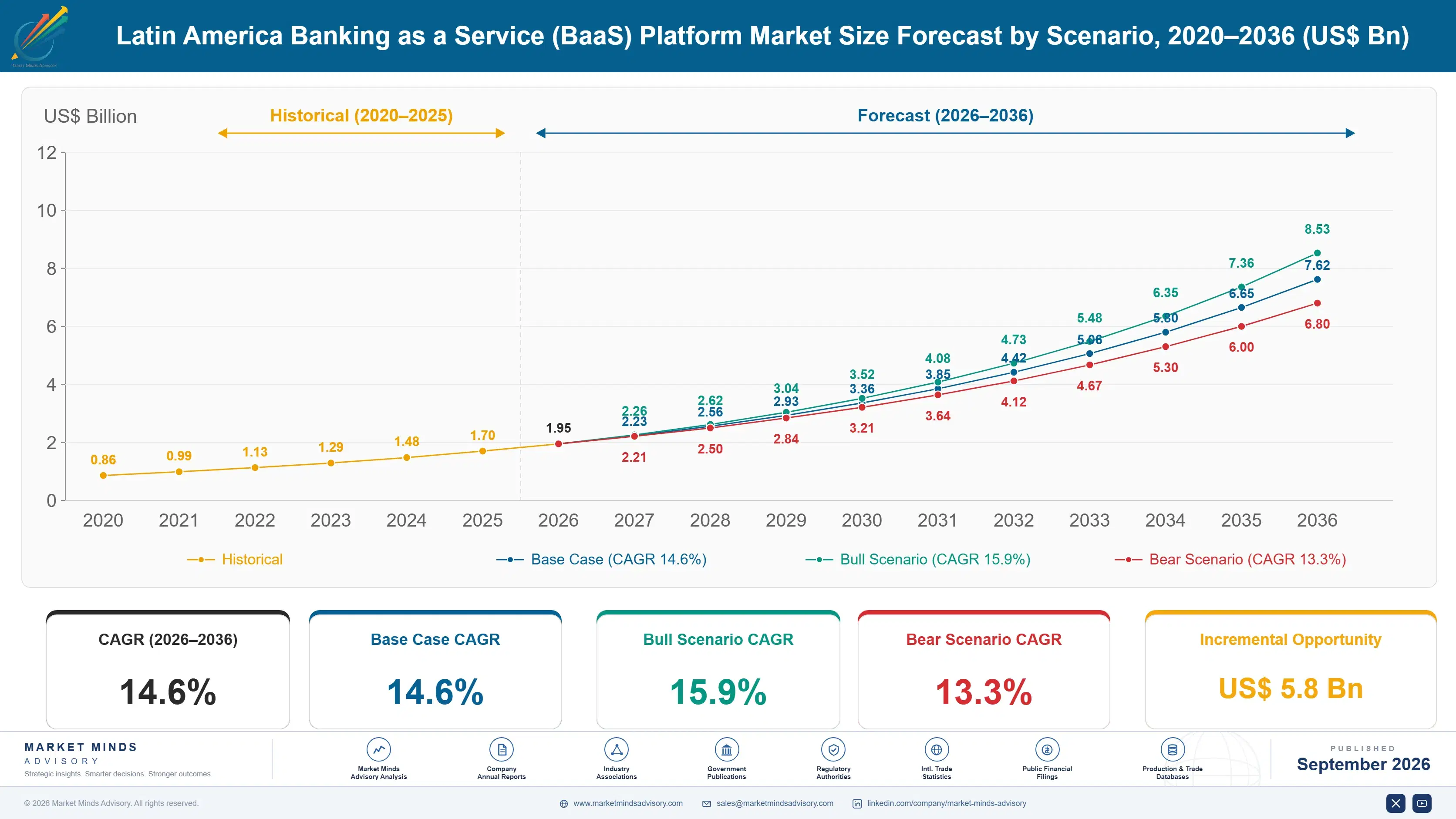
Latin America Banking as a Service (BaaS) Platform Market Forecast Scenarios

banking-as-a-service-platform-industry-analysis-in-size-forecast-scenario-1790000814523
Between 2020 and 2025 the category compounded at 13.2%, and the constraint moved from technology to licensing. Building the platform stopped being hard some years ago. Finding a licensed bank willing to sponsor programmes it did not control, and to answer for them when a supervisor asked, became the thing that actually determined how many launched and at what commercial terms.
The base case holds 14.6% on three mechanisms. Instant payment systems across Brazil, Mexico and Colombia keep expanding what a programme must integrate with, and those rails changed faster than platforms were designed to follow. Regulatory frameworks keep formalising, which raises compliance cost while making sponsor arrangements more predictable. And retailers and platforms keep embedding financial products into commerce they already control. Those three mechanisms run largely independently of one another.
The bull case at 15.9% assumes regulators across the region license non-banks directly at scale, which would remove sponsor dependency and the pricing that goes with it. The bear case at 13.3% is a supervisory reaction to a programme failure, where sponsor banks withdraw appetite across the board and launches stall regardless of platform capability or commercial demand.

Renting Somebody Else's Licence

The scarce thing is not software. Only around 11 institutions across Latin America actively sponsor third party programmes, and launching under one takes about nine months from signed agreement to live accounts. A platform provider without sponsor relationships is selling a product its customers cannot use. That scarcity, rather than any technology differentiation, sets pricing across the whole category and explains most of what happens commercially.
TOP FIVE CONCENTRATION39%Low, reflecting banks and technology platforms supplying on different terms
SPONSOR BANK AVAILABILITY11Institutions across the region actively sponsoring third party programmes
PROGRAMME LAUNCH PERIOD9 monthsFrom signed agreement to live customer accounts under a sponsor
COMPLIANCE COST SHARE31%Programme operating cost consumed by regulatory and compliance obligations
INSTANT PAYMENT SHARE58%Programme transaction volume moving over regional instant payment rails
PROGRAMME SURVIVAL RATE47%Launched programmes still operating after three full years
Instant payment rails changed everything and platforms are still catching up. Around 58% of programme transaction volume now moves over regional instant systems, and those rails evolved faster than platforms were architected to follow. Instant payment rail integration services grow at 21.9% against 14.6% for the market. A programme that cannot settle instantly is not competitive in Brazil, and increasingly not in Mexico or Colombia either.
Programmes fail more often than anybody advertises. Around 47% of launched programmes are still operating after three years, and compliance consumes roughly 31% of operating cost for those that survive. Sponsor banks watch that attrition closely, because a failed programme becomes their supervisory problem rather than the brand's. Providers who screen programmes properly protect sponsor relationships that took years to build.
"Everybody sells the technology and the technology is the easy part. The question that decides a deal is which bank will put its licence behind you and explain your customer to a supervisor at nine in the morning. There are about eleven of them and they all know each other."
Director, Financial Infrastructure and Embedded Finance Practice · MMA Technology Practice · September 2026

Market Trends

Sponsor Scarcity Rather Than Technology Sets Pricing

Only around 11 institutions across Latin America actively sponsor third party programmes, and launching under one takes about nine months from agreement to live accounts. A platform without sponsor relationships is selling something its customers cannot actually use, whatever the product does. That scarcity sets pricing across the category and explains why providers with bank relationships command terms that better technology alone never reaches, which newer entrants consistently underestimate before they attempt to launch anything. Relationships take years and rest on a track record with programmes a sponsor has already carried, which is not something engineering effort replaces.
Market Impact: Colombia compounds at 23.4% yearly

Instant Payment Rails Outpaced Platform Architecture

Around 58% of programme transaction volume now moves over regional instant payment systems, and those rails evolved considerably faster than platforms were designed to follow. Instant payment rail integration services grow at 21.9% against 14.6% for the market as a direct consequence. A programme that cannot settle instantly is not competitive in Brazil and increasingly not in Mexico or Colombia, which makes rail currency an operating requirement rather than a feature. Providers who fell behind find programmes migrating rather than negotiating, since a settlement delay cannot be explained to end customers at all.
Market Impact: Survival runs at just 47%

Market Opportunities and Growth Drivers

Regulatory Opening Expands Programme Launch Capacity

Colombia compounds at 23.4%, faster than any other Latin American market, as regulatory frameworks formalise and more institutions become willing to sponsor programmes under clearer rules. Formalisation raises compliance cost while making sponsor arrangements considerably more predictable, which is a trade most programme operators accept readily. Clearer rules also widen the pool beyond the 11 institutions currently sponsoring, which is the binding constraint on how many programmes can launch at all. Widening that pool matters more to launch volumes than any platform improvement any provider could deliver. Launch capacity follows the pool.
Market Impact: Only 47% survive three years

Retailers Embed Finance Into Commerce They Control

Regional retailers, marketplaces and logistics platforms increasingly embed accounts, cards and credit into transactions they already own, because the customer relationship exists and the financial product simply attaches to it. Those programmes convert better than standalone financial brands and survive longer than the 47% three year rate suggests for the category overall. They also bring transaction volume that makes instant payment integration economically worthwhile from the first month. Those programmes also present better to sponsor banks, since an existing commerce relationship makes customer behaviour predictable in ways a standalone brand cannot demonstrate.
Market Impact: Compliance takes 31% of cost

Market Restraints and Challenges

Programme Failures Become The Sponsor Bank's Problem

Around 47% of launched programmes still operate after three years, and a failure becomes the sponsor bank's supervisory problem rather than the brand's. The root cause is that the licence and the regulatory obligation sit with the bank while the customer relationship and the marketing sit elsewhere. Commercially this makes sponsors cautious and slow. Mitigation runs through rigorous programme screening, through capital and reserve requirements imposed by the provider, and through staged volume limits. Sponsors withdraw appetite from the provider rather than from the individual programme, which is why screening protects everything.
Market Impact: Only 11 sponsors operate regionally

Compliance Cost Consumes Programme Unit Economics

Regulatory and compliance obligations absorb roughly 31% of programme operating cost, which is high enough that many programmes never reach viable unit economics at the volumes they achieve. The root cause is that obligations scale with jurisdiction and product type rather than with programme size. Commercially this kills small programmes. Mitigation runs through shared compliance infrastructure across a provider's programme base, through automated reporting, and through product scope discipline at launch. Product scope discipline at launch is the cheapest of those and the one most operators skip in their enthusiasm.
Market Impact: Instant rails carry 58% of volume
4 additional market trends, 3 additional growth drivers, and 2 additional restraints and challenges are covered in the full report. Contact sales@marketmindsadvisory.com to access the complete intelligence.

Segment CAGR and Growth Architecture

Segmentation follows platform function and licence dependency, since each carries quite different regulatory exposure, sponsor requirement and integration burden. Six functions cover the market: instant payment rail integration, sponsor bank licence access arrangements, compliance and regulatory reporting services, card issuing and processing platforms, core ledger and account infrastructure, and credit origination and lending infrastructure.
banking-as-a-service-platform-industry-analysis-in-market-share-analysis-1790000815059

Instant Payment Rail Integration Services

Instant payment rail integration services grow at 21.9%, half again the market rate of 14.6%, because around 58% of programme transaction volume now moves over regional instant systems and those rails evolved faster than platforms were architected to follow them. A programme that cannot settle instantly is simply not competitive in Brazil, and increasingly not in Mexico or Colombia either. Rail currency is therefore an operating requirement rather than a product feature, and providers who fell behind find programmes migrating away rather than negotiating over it. Local engineering capacity is what makes rail response possible within operating timeframes. Rail changes arrive with little notice and cannot be deferred by any programme currently settling.
CAGR 21.9%

Compliance And Regulatory Reporting Services

Compliance and regulatory reporting services compound at 18.3% because obligations absorb roughly 31% of programme operating cost and scale with jurisdiction and product type rather than with programme size. Shared compliance infrastructure across a provider's whole programme base is the only way small programmes reach viable unit economics at the volumes they actually achieve. Sponsor banks also weigh a provider's compliance capability directly, since a programme failure becomes their supervisory problem rather than the brand's, which makes this capability commercially decisive. Providers demonstrating it reach sponsor conversations that competitors with better platforms never get invited into at all. Better platforms lose those conversations routinely. Compliance depth is the commercial argument.
CAGR 18.3%
Full segment breakdown across 6 segments available in the complete report.

Regional Architecture and Country Demand Map

This is a Latin America scoped report, so the regional table records where the supplied platform value originates. Latin America holds 51% through regional platforms, sponsor banks and compliance operations built locally. North America supplies 24% through card issuing and core ledger technology. Colombia leads country growth.

Latin America

Latin America accounts for 51% of supplied platform value, far above the usual band because this is a Latin America scoped report and regional platforms, sponsor banks and compliance operations all sit within the region. Nubank, Dock and Pomelo built regional positions that depend on sponsor relationships and instant payment rail familiarity no external provider matches. Brazilian instant payment integration is the deepest regional capability anywhere. Growth at 14.2% tracks the market closely, since supply and demand largely coincide geographically here. Sponsor relationships and regulatory operations both sit here, which is where the genuinely defensible value in this market concentrates rather than in the platform technology itself. Technology alone travels easily.
Share: 51% | CAGR: 14.2% (2026 to 2036)

North America

North America accounts for 24% of supplied platform value through card issuing and processing infrastructure and core ledger technology reaching Latin American programmes. Galileo Financial Technologies supplies from here into regional operators, and card scheme infrastructure originates in the region regardless of where programmes operate. Instant payment rail integration is the capability these providers have found hardest to build remotely. Growth at 15.1% runs above the market rate on card issuing volume rather than any licence or compliance capability. Card scheme infrastructure originates here regardless of where programmes operate, which guarantees a durable contribution even as regional providers take platform share. Rail integration has proved the hardest capability to build remotely.
Share: 24% | CAGR: 15.1% (2026 to 2036)
Regional intelligence for 5 additional markets available in the complete report: Western Europe, South Asia and Pacific, Eastern Europe, East Asia, Middle East and Africa. Contact sales@marketmindsadvisory.com.
banking-as-a-service-platform-industry-analysis-in-country-cagr-analysis-1790000815589

Where Programme Revenue Is Won

Sponsor scarcity rather than technology sets pricing, instant payment rails moved faster than platforms followed, and programme failures land on the bank rather than the brand. The four levers below follow those conditions rather than any argument about platform capability, which converged years ago. Each addresses a regulatory or commercial condition instead. Capability comes last.

Secure Sponsor Relationships Before Selling Anything

Only around 11 institutions across Latin America actively sponsor third party programmes, and launching under one takes about 9 months from agreement to live accounts. A platform provider without sponsor relationships is selling something its customers cannot use whatever the product does. Those relationships take years to build and depend on a track record with programmes the sponsor has already carried, which is not something capital or engineering can substitute for. Sponsor appetite decides launches. A provider without relationships cannot launch anything, and capital does not shorten the years those relationships take.
Market Impact: Only 11 sponsors now operate across the region

Stay Current With Instant Payment Rail Changes

Around 58% of programme volume moves over regional instant payment systems, and those rails evolved considerably faster than platforms were architected to follow. A programme that cannot settle instantly is not competitive in Brazil and increasingly not elsewhere. Providers who fell behind find programmes migrating rather than negotiating, since rail currency is an operating requirement and a programme operator cannot explain settlement delays to its own customers at all. Local engineering response is what maintains currency through change windows that arrive with limited notice. Deferral is not available. Currency is continuous work.
Market Impact: Instant rails now carry fully 58% of volume

Screen Programmes To Protect Sponsor Appetite

Around 47% of launched programmes still operate after 3 years and a failure becomes the sponsor bank's supervisory problem rather than the brand's. Providers screening programmes rigorously protect relationships that took years to establish and cannot be replaced. Those signing every programme that will pay are spending sponsor goodwill on customers who will not survive, and the sponsor withdraws appetite from the provider rather than from the individual programme. Goodwill spent on a failing programme cannot be recovered from anywhere. Screening protects the relationship. Every signed programme spends some of it.
Market Impact: Only 47% of programmes now survive three years

Share Compliance Infrastructure Across The Programme Base

Compliance absorbs roughly 31% of programme operating cost and scales with jurisdiction and product type rather than with programme size, which is why small programmes never reach viable unit economics. Shared infrastructure across a provider's whole base is the only route to fixing that. It also demonstrates the compliance capability sponsor banks weigh directly when deciding which providers to work with at all. Compliance depth is also what sponsor banks assess directly before agreeing to carry anybody's programmes, which makes shared infrastructure a commercial argument rather than a cost measure.
Market Impact: Compliance now takes a full 31% of cost

Who Controls the Margin Pool

Five providers hold 39% of Latin American banking as a service platform spending, low for financial infrastructure, because licensed banks, technology platforms and payment processors all supply this capability on quite different commercial terms. Nubank, Dock, Galileo Financial Technologies, Pomelo and Mambu lead. All participants are assessed on Latin American banking as a service platform revenue rather than on broader banking or payment processing businesses they also operate. Concentration has stayed low because the three supply routes rarely appear on the same shortlist.
Competition runs on sponsor relationships and instant payment rail currency far more than on platform capability, which converged some years ago. The second dimension is compliance infrastructure depth, because sponsor banks weigh it directly when deciding which providers to work with and programme operators cannot reach viable economics without it. Platform capability competes a distant third behind both of those.

Pressure is emerging from regulators licensing non-banks directly in some markets, which would remove sponsor dependency entirely. Rankings shift where regulatory frameworks formalise and instant payment adoption deepens, particularly across Colombia, Mexico and Brazil over the coming decade. Platform-only providers carry the most exposure to sponsor appetite withdrawing.
banking-as-a-service-platform-industry-analysis-in-company-positioning-matrix-1790000816124

Competitive Moat and Risk Dimensions

NUBANK

Moat: Own Licence Position

Nubank holds its own banking licences across major regional markets, which removes the sponsor dependency constraining every platform-only competitor to around 11 available institutions. Programmes launching under an owned licence avoid both the scarcity and the nine month onboarding period. Competitors renting licence access carry a cost and a timeline an owner never faces.
NUBANK

Risk: Competitive Programme Conflict

Providing infrastructure to programmes that compete with its own consumer banking business creates a conflict programme operators can see clearly and reasonably worry about. Neutral providers do not carry that problem at all. Licence ownership is a genuine advantage and it comes attached to a commercial position that some prospective customers will decline on principle.
DOCK

Moat: Regional Rail Depth

Dock built instant payment rail integration across Brazilian and regional systems that evolved faster than most platforms could follow, and around 58% of programme volume moves over those rails. Rail currency is an operating requirement rather than a feature. Providers building remotely find this the hardest capability to maintain through change windows.
DOCK

Risk: Sponsor Concentration Exposure

Platform providers without their own licence depend on a sponsor pool of around 11 institutions, and appetite can withdraw across the board after any programme failure anywhere in the market. Rail depth does not substitute for licence access when a sponsor steps back. That dependency is the single largest risk any platform-only provider in this region carries.

Players Tracked

Prominent Players

Nubank
Dock
Galileo Financial Technologies
Pomelo
Mambu

Other Key Players

Marqeta
Rapyd
Belvo
Bitso Business
Conta Simples
Swap
QI Tech
Zoop
Matera
Fitbank
Celcoin
Nuvei
dLocal
Uala
Pismo

Recent Developments

MARCH 2025

Colombian Framework Widens Sponsor Institution Participation

Colombian regulatory formalisation brought additional institutions into third party programme sponsorship under clearer rules, a policy development rather than any corporate transaction. Sponsor availability across the region sits near eleven institutions, which is the binding constraint on how many programmes can launch regardless of platform capability or commercial demand.
Signal: Widening the sponsor pool matters more to launch volumes than any platform improvement ever does anywhere.
SEPTEMBER 2024

Instant Payment Rail Changes Force Platform Re-Engineering

Regional instant payment system changes required platform re-engineering across multiple providers, a technical development rather than any acquisition. Around 58% of programme volume moves over these rails and changes arrive with limited notice, which favours providers holding local engineering capacity able to respond within operating timeframes.
Signal: Rail currency is an operating requirement that a programme operator cannot explain away to its own customers.
JUNE 2025

Sponsor Banks Tighten Programme Screening After Failures

Sponsor institutions tightened programme screening and imposed staged volume limits following programme failures across the region, a risk development rather than any corporate event. Around 47% of launched programmes still operate after three years, and each failure becomes the sponsor's supervisory problem rather than the brand's.
Signal: Sponsors withdraw appetite from the provider rather than from the individual programme that actually failed anywhere.

What A Programme Costs

Compliance, reporting and financial crime operations absorb roughly 31% of programme cost, and those obligations scale with jurisdiction and product type rather than with programme size. Sponsor bank fees and reserve requirements take around 22%. Platform engineering including instant payment rail maintenance absorbs about 24%, with card scheme and processing fees taking the remaining balance.
Sponsor bank fees rose across several regional markets through 2023 and 2024 as programme failures made institutions reprice the supervisory risk they were carrying on behalf of others. Nubank Annual Report 2024 and Mambu investor materials both record compliance operations and partner bank arrangements among principal operating variables. Providers with their own licences avoided that repricing entirely while platform-only competitors absorbed it directly. Licence ownership removed the exposure entirely for those holding one.

The competitive disadvantage mechanism is licence dependency rather than technology cost. A provider renting licence access pays sponsor fees, accepts reserve requirements and carries repricing risk that an owner does not face at all. Exposure concentrates among platform-only providers, since sponsor appetite can withdraw across the whole market after a failure they had no involvement in whatsoever.
banking-as-a-service-platform-industry-analysis-in-cost-volatility-analysis-1790000816320

Share Compliance Operations Across Every Programme

Compliance, reporting and financial crime operations absorb roughly 31% of programme cost and scale with jurisdiction rather than with programme size or transaction volume. Sharing that infrastructure across a whole programme base is the only route to viable economics for smaller operators. It also demonstrates the capability sponsor banks assess directly before agreeing to carry anybody's programmes.

Acquire A Licence Rather Than Renting Access Indefinitely

Sponsor bank fees and reserve requirements absorb around 22% of programme cost and were repriced upward after failures made institutions reassess supervisory risk. Owning a licence removes that line entirely along with the repricing exposure attached. The regulatory process is slow and expensive, and it is the only permanent answer to a sponsor pool this narrow.

Maintain Local Engineering For Rail Change Response

Platform engineering including instant payment rail maintenance absorbs about 24% of cost, and rail changes arrive with limited notice across regional systems. Local engineering capacity responds within operating timeframes where remote teams cannot. Providers treating rail maintenance as routine platform work discover during a change window that it is neither routine nor deferrable for any programme currently settling.

Portfolio Architecture for Margin Defence

Margin architecture separates on licence dependency rather than technical difficulty. Core ledger and account infrastructure earns least, since capable alternatives are numerous and configuration rather than regulation is the differentiator. Card issuing and credit infrastructure sit above on processing economics. Instant payment integration, compliance services and sponsor licence access earn most, because each depends on something a competitor cannot simply build.
The volume versus premium tension runs between platform licensing and licence-backed programme delivery, which reward opposite commitments entirely. Platform licensing scales across many small programmes at modest prices and no regulatory exposure. Licence-backed delivery carries supervisory obligation and commands far more. Providers holding platform capability without licence access are competing in the half of this market where technology alone decides. That is the half where price competition is sharpest and where technology converged years ago.

High-value pools concentrate in sponsor licence access and in compliance services, and neither is reached through platform development. Licence access requires either owning one or holding relationships with a pool of around eleven institutions. Compliance requires operations across jurisdictions with different obligations. Both explain why concentration sits at 39% while the genuinely defensible positions are held by considerably fewer participants than that.

Volume / Commodity-Adjacent

Core ledger and account infrastructure, where capable alternatives are numerous and configuration flexibility rather than regulatory capability determines selection between competing providers. The thirteen point spread separates providers running shared platform infrastructure from those maintaining bespoke deployments per programme operator.
Gross Margin: 38% to 51%

Premium / Certified

Card issuing and processing platforms and credit origination and lending infrastructure, where processing economics and risk capability determine selection alongside integration effort. The twelve point spread tracks how much scheme and processing volume each provider aggregates across its programme base.
Gross Margin: 56% to 68%

Sustainability / Regulatory / Next-Generation

Instant payment rail integration, compliance and regulatory reporting services and sponsor bank licence access arrangements, each depending on capability a competitor cannot simply build. The fourteen point spread reflects licence position and depth of regional regulatory operations combined.
Gross Margin: 72% to 86%
banking-as-a-service-platform-industry-analysis-in-portfolio-architecture-1790000816821

High-value Sub-segments and Strategic Watch-out

Instant Payment Rail Integration Services

Grows at 21.9% because around 58% of programme volume moves over regional instant systems that evolved faster than platforms followed. The fourteen point spread reflects local engineering capacity. Rail currency is an operating requirement rather than any product feature. Migration follows any failure to keep up.
Gross Margin: 72% to 86%

Compliance And Regulatory Reporting Services

Grows at 18.3% because obligations absorb roughly 31% of programme cost and scale with jurisdiction rather than programme size. The fourteen point spread reflects operations depth. Sponsor banks weigh this capability directly before agreeing to anything. Small programmes cannot carry it alone. Jurisdictions multiply the work.
Gross Margin: 72% to 86%

Card Issuing And Processing Platforms

Grows at 13.4% on programme card volumes across a region where card issuance remains the most familiar financial product. The twelve point spread reflects processing aggregation. Scheme economics improve materially with volume across a provider's programme base. Aggregation across programmes is the lever. Card issuance remains familiar.
Gross Margin: 56% to 68%

Core Ledger And Account Infrastructure

Grows at 9.6%, slowest of the six functions, because capable alternatives are numerous and configuration rather than regulation differentiates them. The thirteen point spread reflects deployment sharing. Technology alone decides selection here, which caps what anybody can charge. Alternatives here are numerous. Configuration decides selection.
Gross Margin: 38% to 51%

Why Sponsors Decide Everything

The annuity here is the sponsor relationship rather than any platform contract. A provider holding relationships with several of the roughly 11 sponsoring institutions can launch programmes; one without them cannot, whatever its technology does. Those relationships took years and a track record of programmes the sponsor already carried successfully. Capital and engineering cannot substitute for that, which is why platform quality decides so little in this market.
Depth varies by whether the provider owns a licence. An owner faces no sponsor fees, no reserve requirements and no repricing after somebody else's programme fails somewhere in the region. A renter faces all three and can lose access to the market entirely if appetite withdraws broadly. That difference explains most of the margin variation here.

The buyer has changed as the products have. A financial technology founder evaluated platform capability and integration effort against a launch timeline. A retailer embedding accounts into commerce it already owns evaluates whether the programme survives supervision and settles instantly. A sponsor bank evaluates whether the provider's screening will keep it out of a supervisory conversation. The third buyer decides more than the first two combined.
banking-as-a-service-platform-industry-analysis-in-end-use-penetration-index-1790000817310

What Wins Programme Business

These are among the four positions where our research anticipates prominent divergence between winners and laggards over the coming forecast period. Each is grounded in the demand model, the regulatory perimeter, and the announced capacity pipeline.
01 / SPONSOR RELATIONSHIP PRIORITY

Get The Bank Before The Customer

Only around eleven institutions across Latin America actively sponsor third party programmes, and launching under one takes about nine months from signed agreement to live customer accounts. A platform provider without sponsor relationships is selling something its customers physically cannot use whatever the product happens to do. Those relationships take years and a track record with programmes the sponsor already carried, which neither capital nor engineering substitutes for at all in this particular market for any provider attempting entry without them.
02 / RAIL CURRENCY MAINTENANCE

Follow The Payment Systems, Not The Roadmap

Around 58% of programme transaction volume moves over regional instant payment systems, and those rails evolved considerably faster than platforms were originally architected to follow them. A programme unable to settle instantly is not competitive in Brazil and increasingly not in Mexico or Colombia either. Providers who fell behind find programmes migrating away rather than negotiating, because a settlement delay cannot be explained to end customers who expect instant settlement as a basic condition rather than a differentiating feature of any programme at all.
03 / PROGRAMME SCREENING DISCIPLINE

Refuse The Customers Who Will Fail

Around 47% of launched programmes are still operating after three full years, and each failure becomes the sponsor bank's supervisory problem rather than the sponsoring brand's problem at all. Providers screening rigorously protect relationships that took years to establish and genuinely cannot be replaced quickly. Those signing everybody who will pay are spending sponsor goodwill on customers who will not survive their own first three years of trading under supervision under a borrowed licence that somebody else answers for from the outset onward.
04 / LICENCE OWNERSHIP PATH

Stop Renting What Decides Everything

Sponsor fees and reserve requirements absorb around 22% of programme cost and were repriced upward after failures made institutions reassess supervisory risk they carry for others. Owning a licence removes that cost line entirely along with the repricing exposure permanently attached to it. The regulatory process is slow and expensive, and it remains the only durable answer to a sponsor pool of roughly eleven institutions carrying appetite that can withdraw across the whole market at once after any regional failure.

Engagement Snapshot From the Field

A live engagement with an industry participant carrying material or product regulatory and market exposure ahead of a defining policy shift, showing how our research translates into a defensible multi-year portfolio strategy.
MARKET MINDS ADVISORY · CLIENT ENGAGEMENT SUMMARY
Latin America Banking as a Service (BaaS) Platform Producer Strategic Portfolio Review and Transition Roadmap 2026·Investment Scenario on Latin America Banking as a Service (BaaS) Platform Exposure Evaluation 2025-26
CLIENT PROFILE
A regional commerce platform planning to embed accounts and cards into transactions it already handled, having selected a technology provider on platform capability and integration effort. Nobody had established which sponsor bank would carry the programme or whether that institution had appetite for the customer segment involved. Nobody had approached a sponsor bank at all before the provider was selected.
STRATEGIC CHALLENGE
Product wanted the platform with the strongest capability and fastest integration. Legal wanted certainty about regulatory obligation before committing. Nobody had approached a sponsor bank at all, and the launch date had already been communicated internally against a technology timeline that assumed sponsorship was administrative. Everyone assumed sponsorship was an administrative step.
MMA APPROACH
MMA mapped sponsor institution appetite across the region against the platform's customer profile and product scope, and compared providers on sponsor relationships rather than on platform capability. We modelled compliance cost against projected programme volumes to test unit economics. Work drew on 47 expert interviews conducted in Q4 2025 with sponsor banks, platform providers and programme operators.
KEY FINDINGS
  1. Of roughly 11 sponsoring institutions across the region, only 3 had any appetite for the platform's customer profile and intended product scope.
  2. The selected technology provider held no relationship with any of those 3 institutions, which would have added months to a launch already scheduled.
  3. Compliance cost at projected volumes consumed enough of the unit economics that the initial product scope was not viable (client-reported, unverified by MMA).
  4. Sponsor onboarding takes around 9 months, which nobody involved in the launch planning had accounted for in the internal timeline already communicated.
CLIENT PROFILE
A regional commerce platform planning to embed accounts and cards into transactions it already handled, having selected a technology provider on platform capability and integration effort. Nobody had established which sponsor bank would carry the programme or whether that institution had appetite for the customer segment involved. Nobody had approached a sponsor bank at all before the provider was selected.
STRATEGIC CHALLENGE
Product wanted the platform with the strongest capability and fastest integration. Legal wanted certainty about regulatory obligation before committing. Nobody had approached a sponsor bank at all, and the launch date had already been communicated internally against a technology timeline that assumed sponsorship was administrative. Everyone assumed sponsorship was an administrative step.
MMA APPROACH
MMA mapped sponsor institution appetite across the region against the platform's customer profile and product scope, and compared providers on sponsor relationships rather than on platform capability. We modelled compliance cost against projected programme volumes to test unit economics. Work drew on 47 expert interviews conducted in Q4 2025 with sponsor banks, platform providers and programme operators.
KEY FINDINGS
  1. Of roughly 11 sponsoring institutions across the region, only 3 had any appetite for the platform's customer profile and intended product scope.
  2. The selected technology provider held no relationship with any of those 3 institutions, which would have added months to a launch already scheduled.
  3. Compliance cost at projected volumes consumed enough of the unit economics that the initial product scope was not viable (client-reported, unverified by MMA).
  4. Sponsor onboarding takes around 9 months, which nobody involved in the launch planning had accounted for in the internal timeline already communicated.
RECOMMENDED STRATEGY
Phase 1: Phase one: select the platform provider on sponsor relationships rather than capability, since only three institutions had appetite for this profile. Phase 2: Phase two: narrow the launch product scope so compliance cost fits the unit economics at realistic early volumes rather than projected ones. Phase 3: Phase three: reset the internal launch date against the nine month sponsor onboarding period rather than against any technology timeline.
OUTCOME
The platform reselected its provider on sponsor relationships and narrowed the initial product scope (client-reported, unverified by MMA). The programme launched within the revised timeline where the original plan would have stalled at sponsor onboarding. Sponsor appetite is now confirmed before any provider selection, which is the change that outlasted the engagement.

Frequently Asked Questions

Foundational context covering the market sizes, CAGR, scope, country, region and competition that inform every finding below. This section is provided to cover basics and most often pre-purchase conversations, answered from the MMA Primary Research Dataset.

What is the current size of the Latin America Banking as a Service (BaaS) Platform Market?

Latin American value reaches USD 2.0 billion in 2026, measured across six platform functions. The 2025 base was USD 1.7 billion on the same basis.

How large will the Latin America Banking as a Service (BaaS) Platform Market be by 2036?

The market reaches USD 7.8 billion by 2036, an increase of USD 5.8 billion across the forecast period. That represents 3.90 times expansion from the 2026 base.

What is the CAGR for the Latin America Banking as a Service (BaaS) Platform Market 2026 to 2036?

The base case runs at 14.6% annually, with a bull case at 15.9% if regulators license non-banks directly and a bear case at 13.3% if sponsor banks withdraw appetite after failures.

Which segment is growing fastest?

Instant payment rail integration services grow at 21.9%, half again the market rate of 14.6%. Regional payment systems moved faster than platforms were built to follow them.

Who are the major companies in the Latin America Banking as a Service (BaaS) Platform Market?

Nubank, Dock, Galileo Financial Technologies, Pomelo and Mambu lead on regional platform revenue, holding 39% between them. Belvo and QI Tech hold smaller positions in the market.

Which country is growing fastest?

Colombia compounds fastest at 23.4%, as regulatory frameworks formalise and more institutions become willing to sponsor programmes under clearer rules. Mexico and Peru follow behind.

Report Segmentation Architecture

The full report scope spans multiple orthogonal segmentation dimensions, with cross-tabulated demand data provided for each dimension pair. Coverage extends further to regional breakdowns, trend trajectories, and the competitive detail needed to support segment-level decision-making.

By Platform Function

  • Instant Payment Rail Integration Services
  • Compliance And Regulatory Reporting Services
  • Sponsor Bank Licence Access Arrangements
  • Card Issuing And Processing Platforms
  • Credit Origination And Lending Infrastructure
  • Core Ledger And Account Infrastructure

By End-Use Industry

  • Retail And Marketplace Commerce Platforms
  • Logistics And Mobility Operators
  • Payroll And Human Resources Providers
  • Agricultural And Rural Supply Networks
  • Telecommunications And Utility Providers
  • Financial Technology Consumer Brands

By Commercial Dimension

  • Platform Licensing Subscription
  • Transaction Revenue Share
  • Sponsor Bank Fee Arrangements
  • Interchange Participation Agreements
  • Programme Managed Service Delivery
  • Direct Licence Backed Delivery

By Region

  • Latin America
  • North America
  • Western Europe
  • South Asia and Pacific
  • Eastern Europe
  • East Asia
  • Middle East and Africa

Scope, Methodology, and Coverage

Every figure in this report is reproducible from documented input assumptions. The scope below maps the historical period, the forecast horizon, the segmentation dimensions, and the countries covered, alongside the underlying primary and qualitative methodology.
Historical Period
2020 to 2025
Forecast Period
2026 to 2036
Base Year
2025 (USD billions; MMA Primary Research Dataset, September 2026)
Market Definition
This report covers banking as a service platforms across Latin America: the technology and licence access enabling non-banks to offer regulated financial products, spanning instant payment rail integration, core ledger and account infrastructure, card issuing and processing platforms, compliance and regulatory reporting services, sponsor bank licence access arrangements, and credit origination infrastructure. It excludes retail bank consumer products, merchant acquiring, standalone payment gateways, cryptocurrency exchanges and custody, and core banking software sold to licensed banks.
Quantitative Units
USD millions, Latin American banking as a service platform revenue; live programmes operating; sponsor institutions active in the region; programme launch periods in months; compliance share of programme operating cost; instant payment share of transaction volume; programme survival rates.
Segmentation Dimensions
Platform function and licence dependency; end-use programme operator type; commercial revenue route; supplied value origin across seven regions.
Regions Covered
Latin America, North America, Western Europe, South Asia and Pacific, Eastern Europe, East Asia, Middle East and Africa
Countries Covered
Brazil, Mexico, Colombia, Chile, Argentina, Peru, Ecuador, Uruguay, Costa Rica, Panama, United States, Canada, United Kingdom, Germany, Netherlands, Spain, Poland, Romania, India, Singapore.
Key Companies Profiled
Nubank, Dock, Galileo Financial Technologies, Pomelo, Mambu, Marqeta, Rapyd, Belvo, Swap, QI Tech, Zoop, Matera, Celcoin, dLocal, Uala.
Quantitative Methodology
Primary survey, n=3,800 respondents, Q4 2025, six countries; demand-side model with trade association cross-validation
Qualitative Methodology
47 expert interviews, Q4 2025; applied to validate demand model assumptions, identify emerging dynamics, and assess competitive positioning
Report Format
PDF and XLSX data workbook (Word format preview document)
Publisher
Market Minds Advisory
Report Code
MMA-2026-TEC-191
Published
September 2026
Contact
sales@marketmindsadvisory.com | www.marketmindsadvisory.com

Purchase the full Latin America Banking as a Service (BaaS) Platform Market Report (2026 to 2036).

This report sizes the Latin American banking as a service platform market from 2026 to 2036 across six platform functions, six programme operator types and seven supplied value origins. It explains why only around eleven sponsoring institutions across the region make licence access rather than technology the binding constraint on programme launches. Instant payment rails carrying around 58% of programme volume are analysed as an operating requirement platforms were not architected to follow. Programme survival at roughly 47% after three years is examined as the reason sponsor appetite decides commercial terms. Regional analysis explains where supplied value originates.
Six platform functions sized through to 2036
Sponsor institution availability quantified against programme launch capacity
Instant payment rail dependency analysed across programme volumes
Twenty named providers assessed on regional platform revenue
Four revenue levers with quantified commercial impact
Anonymised commerce platform launch engagement documented in full

Built For The People Who Decide

From boardroom strategy to bench-side execution, this report is read cover-to-cover by leaders shaping the next decade of their industry, turning demand scenarios, market dynamics and valuation benchmarks into decisions.
CXOs/ Presidents/ VPs/ Managers
M&A and Corporate Development
Strategy Teams and R&D Heads
Procurement and Product Directors
Regulatory and Compliance Leaders
Investor Relations and Equity Analysts