Market Minds Advisory
Banana Puree Market

Banana Puree Market: Baby Food Reformulation, Traceability Certification, and Disease Risk Through 2036

Baby food reformulation toward single-ingredient purees, functional beverage demand for whole-fruit texture, and Ecuador's export concentration are reshaping how processors price and contract banana puree supply through the next decade.

Lead Analyst

Lisa Gevelber

Published

September 2026

Make Smarter Decisions with Customized Research Insights

Request a free sample report and evaluate market opportunities, growth trends, and competitive dynamics relevant to your business needs.

2025 MARKET VALUE$1.6BMarket Size 2025
2036 FORECAST VALUE$3.3BBase Case , 2026 to 2036
CAGR 2026 TO 20366.9 %Bull 8.1% / Bear 5.7%
INCREMENTAL OPPORTUNITY$1.6BNet 10- year value creation
EXPANSION MULTIPLE1.95x2036 value over 2026 base
Strategic Levers
M&A Pipeline
Regional Outlook
Country Rankings
Competitive Intelligence
Segmental Deep-dive
Call-Us : 91 93563 13602

Executive Snapshot and Market Trajectory

Banana puree has moved from a bakery filler ingredient to a headline label claim, as baby food brands market it as the sole listed ingredient on packaging and functional beverage makers use it for a texture that fruit concentrate alone cannot replicate in finished retail products today.
Demand concentrates around baby food reformulation toward simpler, single-ingredient labels and around smoothie and juice blends seeking genuine whole-fruit mouthfeel rather than added sugar or artificial thickeners. Processing capacity clusters near Ecuador, Costa Rica, and the Philippines, close to where fruit is grown, then ships onward as aseptic concentrate or individually quick-frozen puree to formulators across North America, Europe, and East Asia, each with distinct quality specifications.
Supply chains remain exposed to weather and disease pressure on banana crops, particularly Fusarium wilt strains that have already forced some growers to shift acreage away from historically productive growing regions entirely. Buyers increasingly demand traceability documentation tied to deforestation and labor regulations now taking effect across the European Union, reshaping which suppliers can even bid on contracts serving that market and adding real compliance cost to onboarding new growing regions.
Market Definition
The banana puree market covers processed, homogenized banana pulp and concentrate sold as an ingredient across baby food, nutraceutical, beverage, bakery, dairy, and foodservice applications, delivered as frozen, aseptic, or individually quick-frozen format. It excludes fresh whole bananas and banana flour or powder products, which are treated as separate markets.
Base Year Value
$1.6B in 2025 (MMA Primary Research Dataset, August 2026)
Forecast Period
2026 to 2036, eleven discrete annual values
CAGR
6.9% base case. Bull 8.1%. Bear 5.7%.
Fastest Growth Segment
Baby Food and Infant Nutrition: 9.8% CAGR
Fastest Growth Country
India: 10.2% CAGR
Fastest Growth Region
South Asia and Pacific: 9.0% CAGR
Largest Region
East Asia: 28% of 2025 global value
Market Leaders
Döhler Group, AGRANA Beteiligungs AG, Kerry Group plc, SVZ International BV, Ingredion Incorporated. Source: MMA Analysis based on company annual reports and disclosed processing capacity.
Primary Survey
n=3,800 procurement and R&D decision-makers, Q4 2025, six countries
Methodology
Demand-side build-up, cross-validated against public data, 47 expert interviews

Banana Puree Market Forecast Scenarios

banana-puree-market-trends-growth-insights-size-forecast-scenario-1787461669473
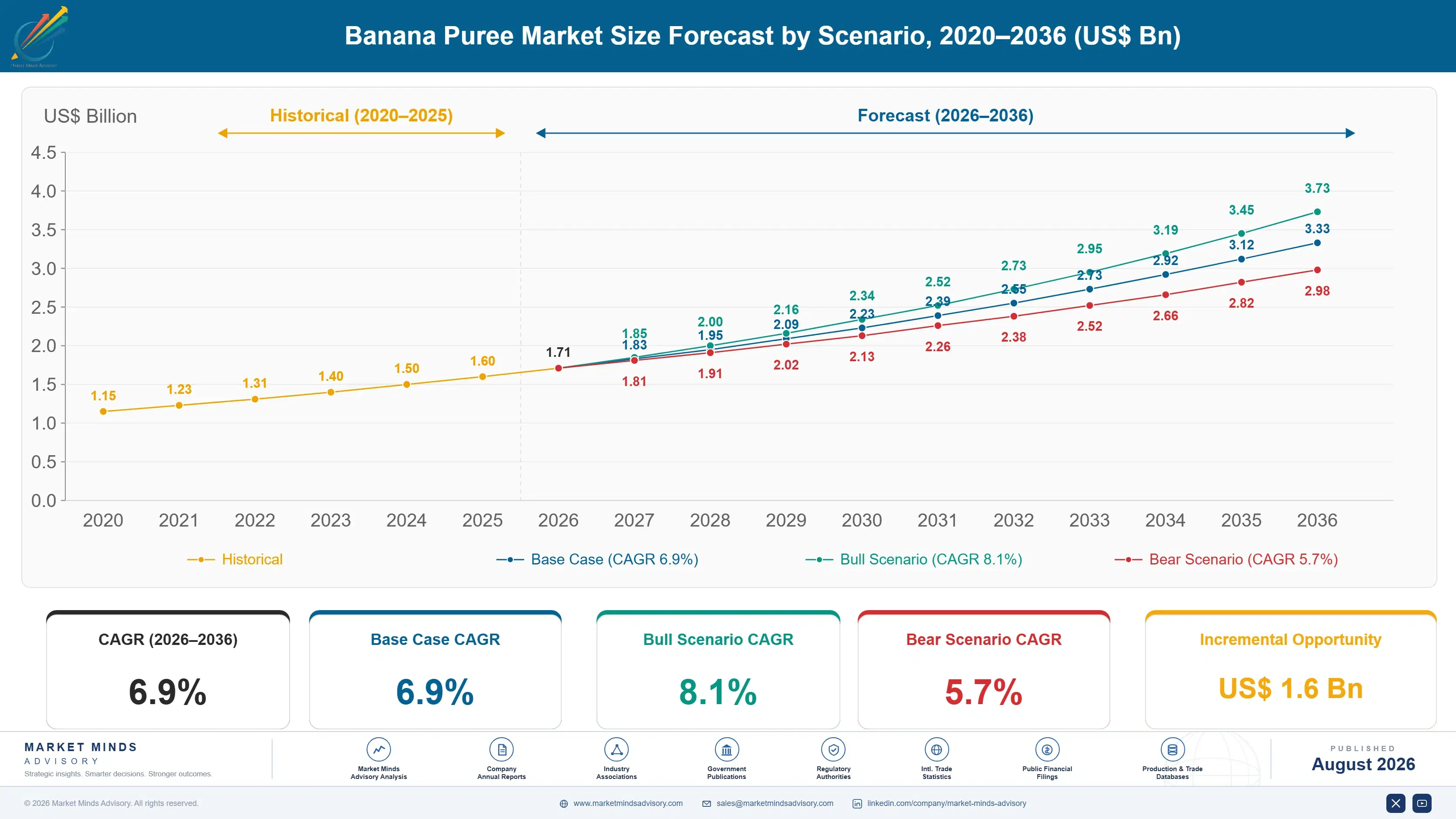
Between 2020 and 2025, banana puree demand grew unevenly, dipping during pandemic-era foodservice closures before rebounding sharply as baby food and functional beverage brands expanded puree-based product lines. Processors in Ecuador and the Philippines added aseptic packing capacity to meet that rebound, delivering a historical CAGR near 6.1 percent across the period despite periodic crop disease disruptions.
MMA's base case projects 6.9 percent CAGR through 2036, anchored in three commercial mechanisms: continued baby food reformulation toward single-ingredient, recognizable-label products across major retail markets, expanding functional beverage demand for genuine whole-fruit texture over clarified juice concentrate, and steady bakery and confectionery use as a natural sweetness and moisture-retention ingredient. Processing capacity investment across Latin America and Southeast Asia supports this trajectory without requiring dramatic new fruit acreage expansion in the near term.
The bull case rests on faster-than-modeled baby food category growth in East Asia alongside broader clean-label reformulation across snack and bakery categories globally. The bear case centers on a severe Fusarium wilt outbreak disrupting key growing regions, or retailers accelerating private-label price competition that compresses processor margins across the value chain faster than efficiency gains can offset.

Two Buyers, One Fruit Supply Chain

Banana puree sits between two very different buyer types: baby food and functional beverage formulators who pay for traceable, single-origin sourcing and clean processing documentation, and bakery or dairy manufacturers who buy primarily on landed cost and consistent viscosity specifications rather than provenance. Both buyer types draw from the same fruit supply, but rarely compete for the same lots of raw material.
MARKET CONCENTRATION (CR5)32%Top five processors hold moderate combined pricing influence globally
AVERAGE SELLING PRICE SPREAD$1,850/tonne (aseptic concentrate)Aseptic concentrate commands notable premium over frozen puree pricing
TOP PRODUCING COUNTRY SHAREEcuador, 31%Single country supplies well over a quarter of exports
CAPACITY UTILIZATION76%Processors run plants below theoretical full annual capacity levels
TRADE INTENSIVENESS58%Majority of processed output crosses international borders every year
FEEDSTOCK SHARE OF COGS62%Fresh fruit input costs dominate total processing cost structure
That split shapes how processors invest. Aseptic concentrate serving baby food and beverage customers commands meaningfully higher pricing than frozen bulk puree sold into bakery and foodservice channels, but it also requires tighter microbiological control, dedicated aseptic filling lines, and packaging investment that smaller processors struggle to justify at limited volume. Larger processors increasingly run both product lines from the same facility to spread that fixed cost across a wider customer base.
Processing capacity concentrates near growing regions in Ecuador, Costa Rica, and the Philippines, where fruit reaches the plant within hours of harvest rather than days, preserving flavor and nutrient content that buyers increasingly specify by name in procurement contracts across both retail and industrial channels. Freight cost from these origin countries to Europe and North America remains a meaningful share of landed cost for frozen shipments.
"Everyone treats banana puree like a commodity fruit input. But the baby food buyers paying up for single-origin traceability are quietly subsidizing the processing capacity that keeps bulk bakery pricing this stable."
Director, Food Ingredients Practice · MMA Agriculture and Food Ingredients Practice · August 2026

Market Trends

FDA Closer to Zero Plan Reshapes Baby Food Sourcing

The US FDA's Closer to Zero action plan, targeting reduced heavy metal levels in baby food, has pushed manufacturers toward single-ingredient banana puree with full lot-level traceability rather than blended multi-fruit purees that complicate contamination tracing when a recall investigation becomes necessary. Suppliers who can document soil testing, harvest location, and processing chain of custody now qualify for baby food contracts that previously accepted looser sourcing documentation, and several major baby food brands have already reformulated top-selling pouch products around single-origin banana puree exclusively, citing this traceability requirement directly in supplier communications.
Market Impact: Adds 15 percent addressable customer base
Sugar Reduction Rules Push Beverage Makers Toward Whole Fruit

Sugar reduction labeling requirements taking effect across the European Union and several US states have pushed smoothie and juice manufacturers to replace added sugar syrups with whole-fruit banana puree, which delivers natural sweetness and body without triggering added-sugar disclosure on nutrition labels. Beverage formulators increasingly specify banana puree at meaningfully higher inclusion rates than five years ago specifically to hit sugar reduction targets while preserving mouthfeel, and this substitution has proven durable rather than a temporary reformulation exercise tied to a single product cycle, marketing campaign, or retailer promotion window.
Market Impact: Adds 9 percent to dairy-alternative offtake

Market Opportunities and Growth Drivers

Aseptic Packaging Investment Extends Shelf Stable Puree Reach

Processors investing in aseptic bag-in-box and aseptic drum packaging have extended banana puree usable shelf life well beyond frozen product, cutting cold-chain logistics costs for customers shipping across very long distances from Ecuador or the Philippines to Europe and North America. That shelf stability has opened entirely new customer segments, including smaller regional bakeries and beverage co-packers that previously found frozen puree logistics requirements too costly to justify given their comparatively modest annual purchase volumes and limited cold storage infrastructure available on site at most of their production facilities today.
Market Impact: Threatens up to 14 percent supply

Plant Based Dairy Alternative Growth Lifts Puree Demand

Plant-based yogurt and ice cream brands increasingly use banana puree as a functional base ingredient, since it provides natural sweetness, creamy texture, and clean-label appeal without dairy or the synthetic stabilizers that many plant-based products still require to hold their structure together properly over time. As oat, almond, and coconut-based dairy alternatives continue gaining retail shelf space across North America and Western Europe, banana puree inclusion in formulations has grown alongside that category, particularly in indulgent dessert-style products where texture matters considerably more than it does in beverage applications overall.
Market Impact: Cuts processor margins by 5 points

Market Restraints and Challenges

Fusarium Wilt Disease Pressure Threatens Growing Region Yields

Tropical Race 4, a Fusarium wilt strain resistant to most commercial banana cultivars, has spread across growing regions in Asia and Latin America over the past decade, forcing some growers to abandon infected plots entirely rather than risk further contamination spreading through irrigation water or contaminated soil on equipment. The root cause is decades of reliance on a narrow set of banana cultivars with limited genetic disease resistance, and while breeding programs are developing resistant varieties, commercial-scale replanting remains years away, so processors are diversifying sourcing across more growing countries to manage the ongoing yield risk directly.
Market Impact: Adds 11 percent to baby-food-grade demand

Retailer Private Label Pricing Pressure Compresses Processor Margins

Major grocery retailers across North America and Western Europe have pushed private-label bakery and beverage suppliers to accept lower per-unit puree pricing as part of broader cost-reduction programs following recent grocery inflation cycles across both regions. The root cause is retailer bargaining power concentrated among a handful of large chains that account for a disproportionate share of processor volume, leaving smaller processors with limited negotiating leverage relative to larger competitors. Some processors are responding by shifting mix toward branded, traceability-certified baby food and beverage contracts that carry sturdier pricing protection.
Market Impact: Lifts beverage-grade volume by 8 percent
2 additional market trends, 4 additional growth drivers, and 3 additional restraints and challenges are covered in the full report. Contact sales@marketmindsadvisory.com to access the complete intelligence.

Segment CAGR and Growth Architecture

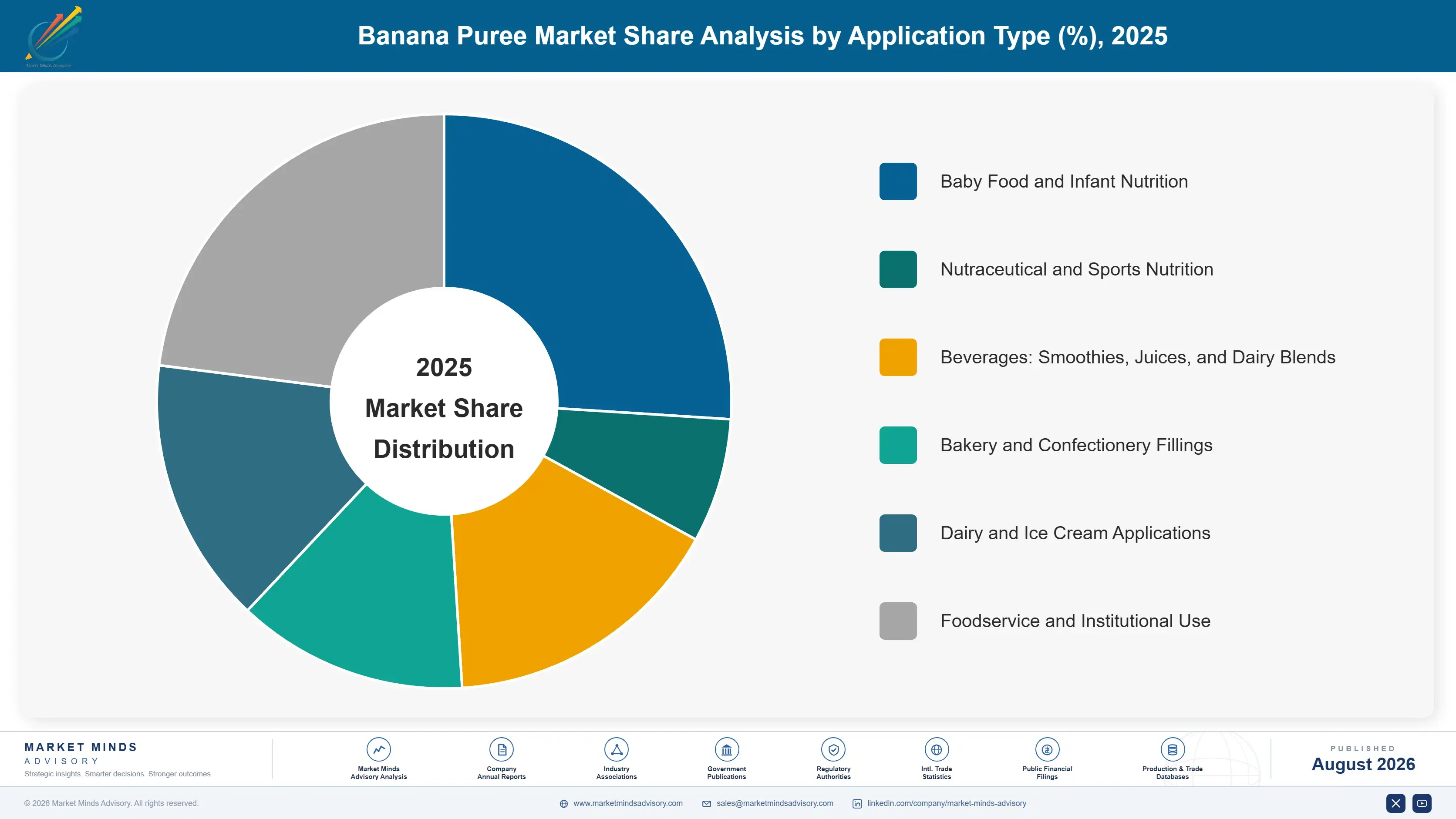
MMA segments the banana puree market by end-use application rather than by packaging or processing format, since baby food, nutraceutical, beverage, bakery, dairy, and foodservice buyers each purchase against distinct traceability, viscosity, and shelf-life specifications that shape which processors even qualify to supply them at all commercially, regardless of underlying fruit quality or origin.
banana-puree-market-trends-growth-insights-market-share-analysis-1787461670031

Baby Food and Infant Nutrition

Baby food and infant nutrition is the fastest-growing segment, expanding at 9.8 percent annually as brands reformulate pouch and jar products around single-ingredient banana puree carrying full lot-level traceability documentation, driven partly by heavy metal contamination scrutiny under regulatory initiatives in the United States and comparable frameworks now emerging across the wider European Union market. Suppliers into this segment must document soil testing, harvest location, and unbroken chain-of-custody records, a bar that excludes processors sourcing from multiple undocumented smallholder farms without proper aggregation and testing infrastructure already in place. Premium pricing reflects that documentation burden, and buyers rarely switch suppliers once a source clears their qualification audit successfully and enters production.
CAGR 9.8%

Nutraceutical and Sports Nutrition Applications

Nutraceutical and sports nutrition applications rank second at 9.2 percent CAGR, as protein bar, recovery drink, and energy gel formulators use banana puree for natural carbohydrate content and potassium alongside genuine whole-fruit label positioning that resonates strongly with performance-focused consumers. This segment demands tighter particle size consistency than bakery-grade puree, since it often runs through high-speed extrusion or bottling lines that clog easily with inconsistent fiber content left in the puree. Growth here tracks the broader sports nutrition category's expansion beyond dedicated athletes into mainstream wellness consumers, and formulators increasingly treat banana puree as a functional ingredient worth specifying by name rather than a generic fruit filler on the label.
CAGR 9.2%
Full segment breakdown across 6 segments available in the complete report.

Regional Architecture and Country Demand Map

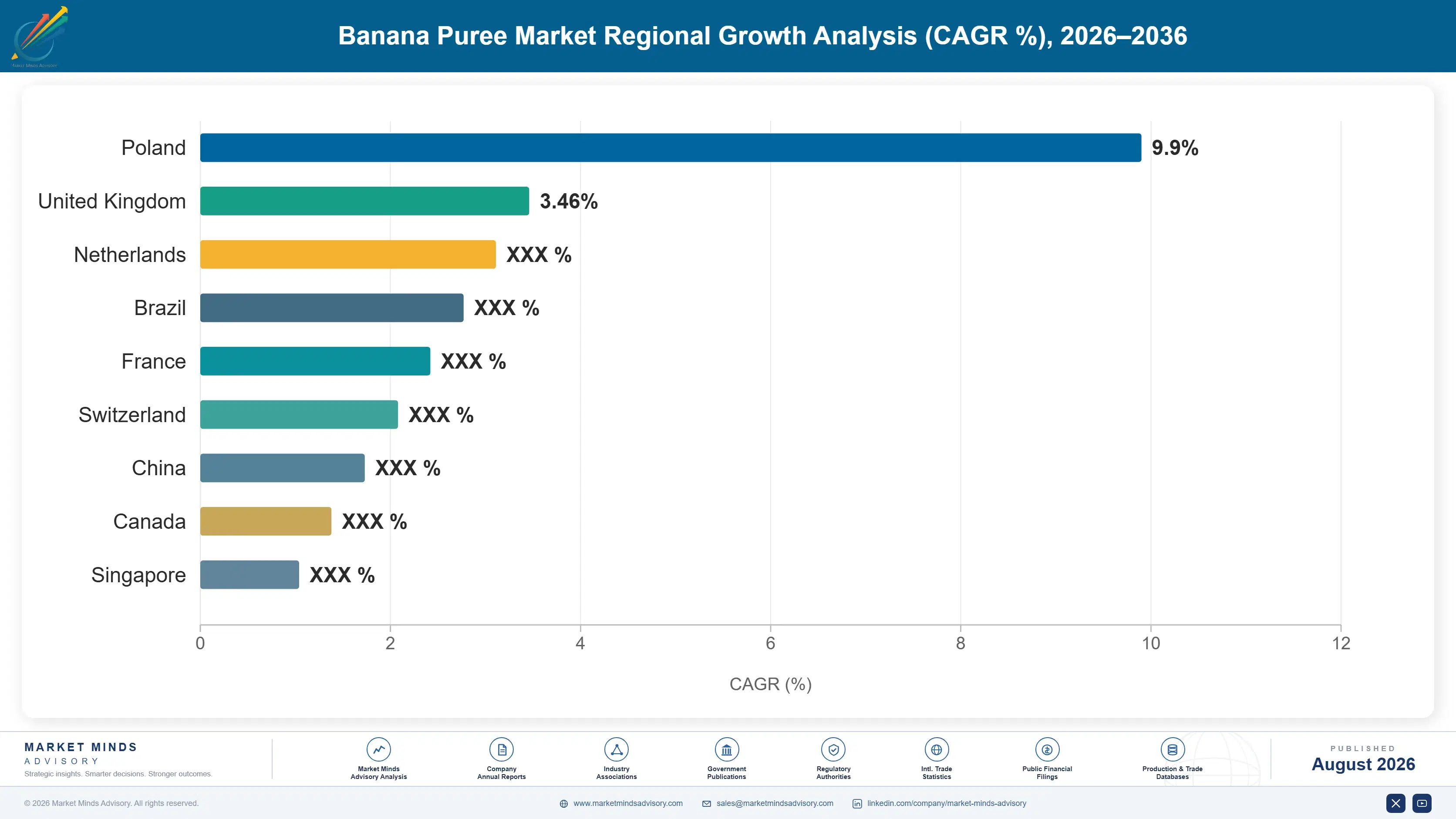
Banana puree demand spreads across seven regions unevenly, weighted toward East Asia's rapidly expanding baby food and functional beverage manufacturing base, while Latin America supplies a disproportionate share of the raw fruit that both origin and destination markets ultimately process into finished puree products for consumers.

East Asia

China's rapidly expanding baby food sector, still recovering consumer trust after past contamination scandals, has driven demand for traceable single-ingredient banana puree from processors willing to open supply chains to third-party audit. Domestic infant formula and pouch food brands increasingly market banana puree provenance directly on packaging, a marketing tactic largely borrowed from Western baby food brands. Japan and South Korea add nutraceutical and functional beverage demand, where banana puree serves as a natural sweetener in protein drinks and recovery beverages sold through convenience store channels nationwide. Regional import reliance on Philippine and Ecuadorian puree remains high, since domestic banana cultivation cannot meet processing-grade volume requirements at any meaningful scale.
Share: 28% | CAGR: 8.0% (2026 to 2036)

North America

Baby food reformulation toward single-ingredient, traceable purees has reshaped procurement at major US baby food brands, several of which now specify banana puree sourced from a named growing region directly in supplier contracts rather than accepting blended, multi-origin material. Smoothie and functional beverage brands add further demand, using banana puree to hit sugar reduction targets while preserving natural sweetness and thick mouthfeel that consumers associate with whole fruit. Plant-based dairy alternative brands, concentrated heavily in this region, increasingly specify banana puree as a functional base ingredient in yogurt and ice cream style products. Supply relies on imports from Latin America, since domestic banana cultivation is negligible at commercial processing scale.
Share: 22% | CAGR: 6.5% (2026 to 2036)
Regional intelligence for 5 additional markets available in the complete report: Western Europe, South Asia and Pacific, Latin America, Middle East and Africa, Eastern Europe. Contact sales@marketmindsadvisory.com.
banana-puree-market-trends-growth-insights-country-cagr-analysis-1787461670544

Where Puree Margin Actually Concentrates

Processors capture the widest margins by moving volume toward traceability-certified baby food and nutraceutical contracts rather than by chasing bulk bakery tonnage, since documentation depth, packaging format, growing-region diversification, and forward integration into contracted cultivation each defend pricing power far more durably than simply expanding raw processing throughput every single harvest season each year.

Aseptic Packaging Capacity Expansion Into New Customer Segments

Processors that add aseptic bag-in-box and drum filling capacity can serve smaller regional bakeries and beverage co-packers that previously found frozen puree's cold-chain logistics too costly, expanding the addressable customer base by roughly 15 percent without adding new growing acreage of their own. That packaging investment typically pays back within two to three years through the combination of new customer volume and reduced freight cost per unit shipped, since aseptic product tolerates longer transit times without temperature-controlled trucking, a meaningful cost advantage over frozen logistics on longer shipping routes to distant markets.
Market Impact: Expands addressable customer base by roughly 15 points

Single Origin Traceability Certification For Baby Food

Processors that build lot-level traceability systems, covering soil testing, harvest location, and unbroken chain of custody, gain access to baby food contracts that pay a premium often exceeding 25 percent over standard bakery-grade pricing per tonne shipped. Building this documentation infrastructure requires meaningful upfront investment in testing partnerships and record-keeping systems, but the resulting contracts tend to run multiple years once a customer's quality team completes its audit, insulating that revenue from the spot price swings that affect bulk frozen puree sold into less discerning bakery and foodservice channels globally.
Market Impact: Commands a premium above 25 percent per tonne

Growing Region Diversification To Manage Disease Risk

Processors sourcing fruit across three or more growing countries, rather than concentrating in a single origin, reduce exposure to any one region's Fusarium wilt outbreak or weather disruption, protecting roughly 80 percent of annual supply from a localized crop failure event. This diversification requires maintaining quality relationships and testing protocols across multiple growing regions simultaneously, which raises administrative cost relative to single-origin sourcing. But processors who diversified early recovered faster from recent regional disease outbreaks than single-origin competitors, who faced months of supply gaps before securing alternate growing region relationships and completing new supplier qualification.
Market Impact: Protects roughly 80 percent of annual supply volume

Forward Integration Into Contracted Growing Operations

Processors that secure long-term contracted acreage with growers, rather than buying entirely on the open fruit market, lock in roughly 45 percent of their annual volume needs at negotiated prices ahead of harvest season. This forward integration insulates against spot fruit price spikes during regional supply shortfalls and gives processors leverage to require specific disease-resistant cultivars and sustainable farming practices as a condition of the contract. The tradeoff is reduced flexibility to chase the cheapest spot fruit available in a given quarter, but most large processors judge that tradeoff worthwhile given the baby food segment's traceability demands.
Market Impact: Locks in 45 percent of annual fruit volume

Who Controls the Margin Pool

Ranked by estimated annual processing capacity, the top five banana puree processors together hold a CR5 near 32 percent, a fragmented field reflecting the industry's roots in regional fruit aggregation rather than global consolidation. The gap between the largest processor and mid-sized regional challengers is modest, since scale advantages in fruit sourcing matter less here than in more capital-intensive processing categories.
Competitive activity currently plays out along three dimensions: traceability documentation depth, since processors who can certify single-origin, lot-level sourcing win baby food contracts unavailable to blended-origin competitors; packaging format breadth, as processors running both aseptic and frozen lines serve a wider customer base than single-format competitors; and growing-region diversification, which protects against localized disease and weather disruption better than single-country sourcing.

Emerging pressure comes from Philippine processors expanding aseptic capacity to compete directly with established Ecuadorian and Costa Rican suppliers on baby food and beverage contracts previously dominated almost entirely by Latin American origin fruit. Rankings could shift within a few years if Philippine processors complete traceability certification fast enough to win contracts currently reserved for longer-established Latin American suppliers with deeper, decades-old customer relationships already in place.
banana-puree-market-trends-growth-insights-company-positioning-matrix-1787461671059

Competitive Moat and Risk Dimensions

DÖHLER GROUP

Moat: Global Fruit Sourcing Network

Döhler operates fruit sourcing and processing relationships across multiple growing regions simultaneously, letting it blend or single-source puree depending on customer traceability requirements without depending on any one country's harvest. That breadth, combined with decades of baby food and beverage customer relationships, gives it negotiating reach that smaller single-origin processors cannot match.
DÖHLER GROUP

Risk: Complex Multi-Region Cost Structure

Managing quality and cost consistency across many growing regions simultaneously adds administrative complexity that leaner, single-origin competitors avoid entirely. A quality incident traced to any one sourcing region risks broader reputational spillover across Döhler's full customer base, even when other regions remain unaffected by that specific issue.
AGRANA BETEILIGUNGS AG

Moat: European Fruit Preparation Leadership

AGRANA has built deep, long-standing relationships with major European baby food and dairy brands through its fruit preparations business, giving it default-supplier status on many reformulation projects before competitors are even invited to bid. That incumbency advantage compounds over successive product launches within the same customer accounts.
AGRANA BETEILIGUNGS AG

Risk: Heavy Western Europe Concentration

Revenue concentration in Western Europe leaves AGRANA more exposed than globally diversified competitors to regional cost pressures, including energy prices and slower packaged food volume growth relative to faster-expanding Asian and Latin American consumer markets, where several competitors have already built stronger, earlier local processing footholds.

Players Tracked

Prominent Players

Döhler Group
AGRANA Beteiligungs AG
Kerry Group plc
SVZ International BV
Ingredion Incorporated

Other Key Players

Symrise AG
Materne SAS
Sun Impex LLC
Fresh Del Monte Produce Inc
Andina Foods SAC
Capricorn Food Products India Ltd
Prodalim Group
Van Drunen Farms
AGRIFOODS International Cooperative Ltd
Ecoripe Tropicals
MK Fruits Inc
Sudpaq Co Ltd
Vital Fruchtprodukte GmbH
Pulpine SAS
Bell Flavors and Fragrances Inc

Recent Developments

FEBRUARY 2026

Döhler Expands Traceability Program Across Grower Network

Döhler Group extended its lot-level traceability program to cover a larger share of its contracted banana growing network across Latin America and West Africa, aiming to meet rising documentation requirements from baby food customers in North America and the European Union facing tightening contamination scrutiny.
Signal: Reflects growing customer demand for verified single-origin sourcing ahead of expected regulatory tightening on baby food supply chains.
SEPTEMBER 2025

AGRANA Signs Long Term Supply Agreement With Retailer

AGRANA signed a multi-year supply agreement with a major European private-label retailer to provide banana puree across its baby food and bakery filling product lines, replacing a prior sourcing arrangement that had split volume across three smaller regional suppliers previously under separate, shorter-term individual contracts.
Signal: Signals retailer consolidation toward fewer, larger, traceability-certified suppliers rather than maintaining multiple smaller regional sourcing relationships.
MAY 2025

Philippine Processor Completes New Aseptic Filling Line

A leading Philippine banana puree processor completed construction of a new aseptic filling line aimed squarely at serving baby food and beverage export customers across East Asia, adding meaningful shelf-stable capacity to a regional market previously dominated almost entirely by Latin American aseptic puree suppliers.
Signal: Indicates Philippine processors are investing to compete directly with Ecuadorian and Costa Rican suppliers on premium contracts.

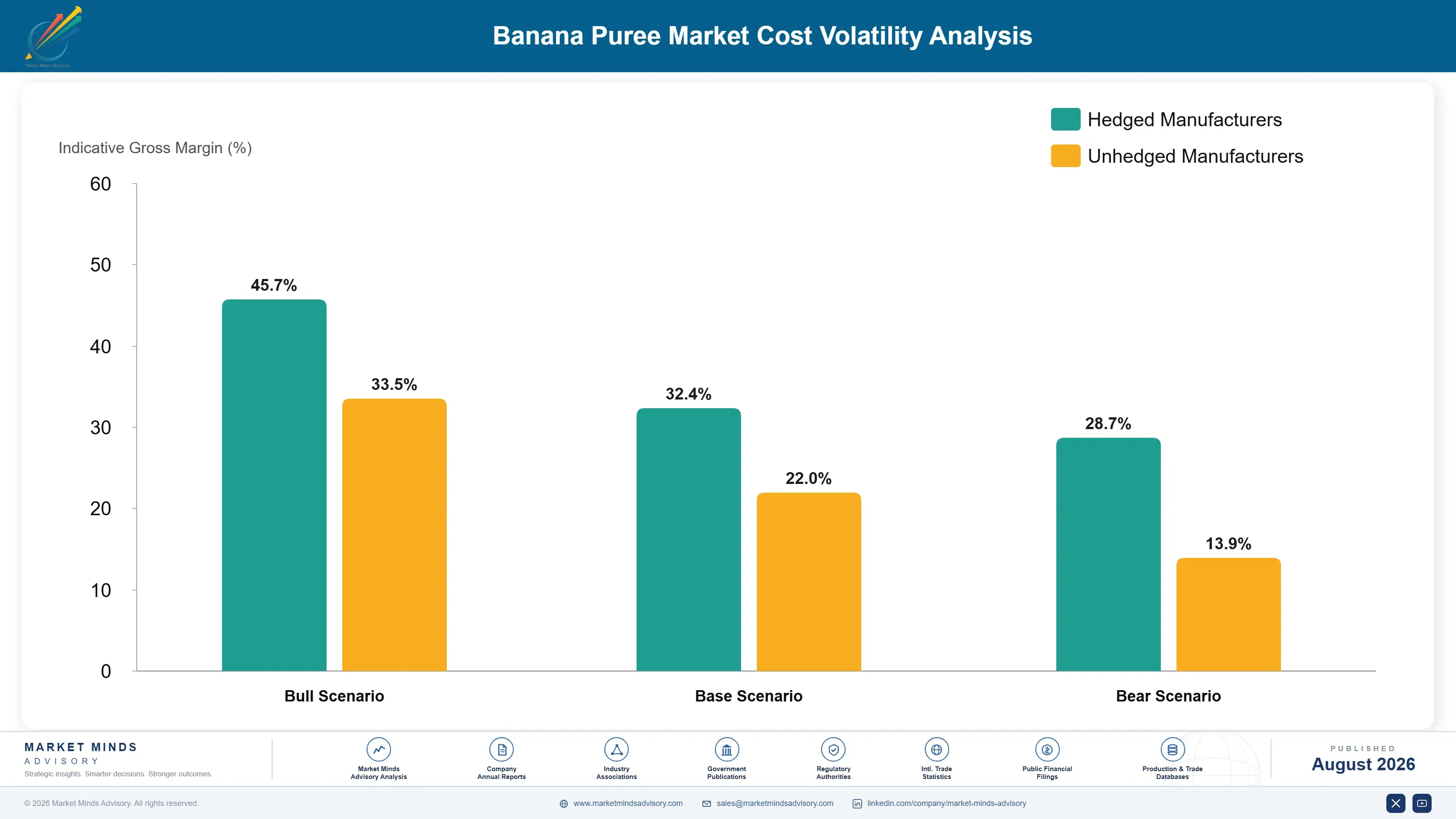
Fresh Fruit Costs Drive Processor Economics

Fresh banana fruit, sourced primarily from contracted grower networks and open-market purchases across Ecuador, Costa Rica, and the Philippines, accounts for roughly 62 percent of banana puree's cash cost of goods sold. Most processors buy fruit through a mix of long-term grower contracts and spot purchases rather than owning plantations outright, leaving cost exposure tied to regional harvest conditions.
Fresh Del Monte Produce Inc's 2024 annual report noted that adverse weather across Central American growing regions reduced harvest volumes in several quarters, pushing spot fruit prices up by more than 15 percent within a single season as processors competed for a tighter available supply. Puree processors without long-term grower contracts passed most of that increase through to bakery and foodservice customers within one quarter, while baby food contracts on fixed annual pricing absorbed the increase internally instead.

Processors without long-term grower contracts or diversified sourcing face a persistent cost disadvantage against vertically integrated competitors, since spot fruit purchases expose them fully to short-term price spikes that contracted buyers largely avoid. This falls hardest on smaller regional processors buying through open-market brokers, while larger processors with direct grower relationships across multiple countries maintain comparatively stable input costs through volatile harvest seasons.
banana-puree-market-trends-growth-insights-cost-volatility-analysis-1787461671255

Multi-Year Grower Contracts With Fixed Pricing Formulas

Processors are increasingly negotiating multi-year grower contracts with pricing tied to a benchmark formula rather than pure spot purchasing each harvest. These agreements typically guarantee a minimum volume commitment in exchange for price stability, smoothing quarter-to-quarter cost swings and giving processors a defensible basis for offering baby food customers longer, more stable annual pricing terms.

Growing Region Diversification Across Three or More Countries

Sourcing fruit across multiple growing countries simultaneously protects processors against localized weather events or disease outbreaks that would otherwise disrupt a single-origin supply chain entirely. While diversification adds modest coordination overhead across quality standards and testing protocols, it meaningfully reduces the odds of an unplanned supply gap tied to any single region's harvest failure.

Forward Contracted Acreage With Selected Grower Partners

Processors that secure dedicated contracted acreage with specific growers, rather than buying entirely on the open market, lock in predictable volume and cost well ahead of harvest season. This forward integration requires closer technical support relationships with growers on cultivation practices, but it insulates processors from spot price spikes during regional supply shortfalls far more effectively than open-market buying.

Portfolio Architecture for Margin Defence

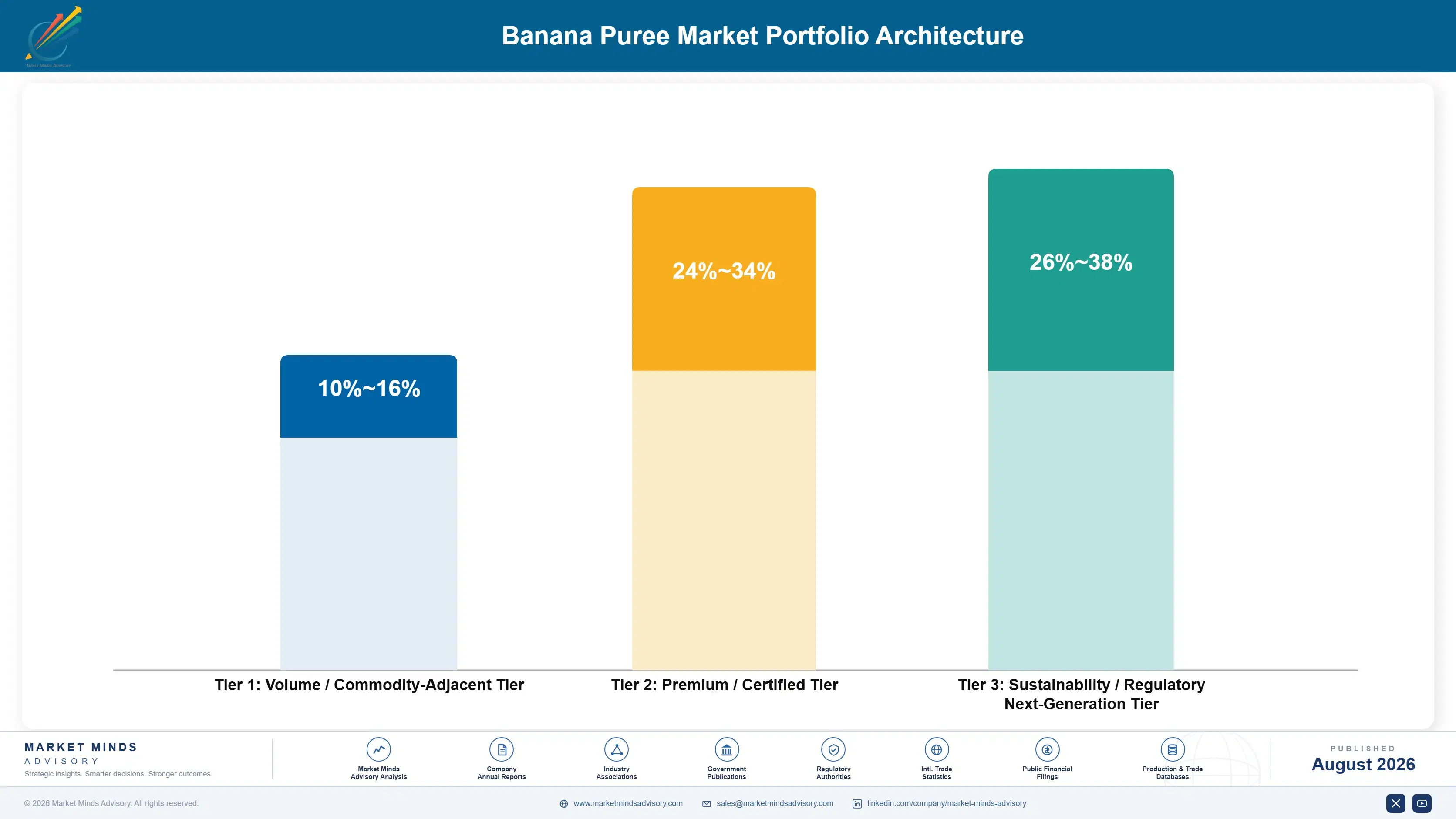
Banana puree's portfolio splits into three margin tiers that track documentation and certification depth rather than processing volume alone. Bulk frozen puree serving bakery and foodservice competes almost entirely on landed cost, while traceability-certified grade earns a durable premium tied to baby food and nutraceutical qualification, and a smaller organic and deforestation-free tier is only beginning to command distinct pricing recognition.
The tension between volume and premium tiers plays out in sourcing decisions, since building lot-level traceability across contracted growers sacrifices some open-market purchasing flexibility for a considerably higher, more durable margin later. Processors that hesitate to build that documentation infrastructure risk ceding the fastest-growing, highest-margin baby food segment to competitors willing to invest in grower relationships and certification systems first.

High-value margin pools concentrate almost entirely in traceability-certified baby food and nutraceutical grade, where documentation barriers keep casual entrants out far longer than in any other tier of the portfolio structure. Beverage and dairy alternative grade sits in between, commanding a moderate premium tied to sugar-reduction positioning rather than certification difficulty, while bulk bakery and foodservice grades remain firmly commodity-priced regardless of origin or processor scale.

Volume / Commodity-Adjacent Tier

Bulk frozen and standard aseptic puree sold into bakery, confectionery, and foodservice channels, priced largely on landed cost with minimal traceability documentation, competing on delivery reliability against other fruit-based fillers in thin, harvest-cycle-driven margins.
Gross Margin: 10%-16%

Premium / Certified Tier

Lot-level traceability-certified puree serving baby food and nutraceutical customers, carrying documented soil testing, harvest location, and unbroken chain-of-custody records that command a durable price premium over commodity grade, sustained by high customer switching costs once qualified.
Gross Margin: 24%-34%

Sustainability / Regulatory / Next-Generation Tier

Organic-certified and deforestation-free puree meeting emerging European Union sourcing regulations, priced at a speculative premium ahead of proven mainstream commercial volume, appealing chiefly to brand owners pursuing supply chain sustainability commitments across their portfolios.
Gross Margin: 26%-38%
banana-puree-market-trends-growth-insights-portfolio-architecture-1787461671756

High-value Sub-segments and Strategic Watch-out

Baby Food and Infant Nutrition Grade

Baby food and infant nutrition grade combines the fastest segment CAGR at 9.8 percent with the highest achievable margin in the portfolio, protected by traceability certification barriers that take years to build and that most smaller processors never complete at meaningful commercial scale worldwide today.
Gross Margin: 26%-34%

Nutraceutical and Sports Nutrition Grade

Nutraceutical and sports nutrition grade grows at 9.2 percent and commands a solid premium tied to particle consistency and functional label positioning, though competitive intensity is rising steadily as more processors pursue this fast-growing, image-conscious wellness category directly across mainstream retail and specialty online channels alike.
Gross Margin: 22%-28%

Bakery and Confectionery Filling Grade

Bakery and confectionery filling grade remains the volume anchor of the portfolio, growing near the overall market average with thin, cyclical margins that leave little room for differentiation beyond competitive price and consistent, reliable delivery performance across every single production order placed each quarter of the year.
Gross Margin: 10%-15%

Foodservice and Institutional Grade

Foodservice and institutional grade warrants a strategic watch, since its slow 5.3 percent growth rate and persistently thin margin leave it quite vulnerable to substitution by cheaper fruit concentrates if institutional buyers ever standardize on lower-cost alternatives across large-volume annual purchasing contracts and multi-year tenders.
Gross Margin: 8%-12%

Why Certified Supply Relationships Hold

Once a baby food or nutraceutical customer completes a supplier's traceability audit, that relationship behaves more like an annuity than a transactional fruit purchase. Requalifying an alternate source means re-running soil testing, harvest documentation, and chain-of-custody verification from scratch, so buyers tolerate modest price increases from an incumbent supplier rather than restart that lengthy audit process for marginal savings elsewhere.
Stickiness varies sharply by end-use vertical. Baby food customers rarely switch suppliers once traceability qualification is complete, since any change risks reopening a costly documentation review. Nutraceutical formulators switch somewhat more readily when a competing processor offers meaningfully better particle consistency. Bakery and foodservice buyers show the least stickiness of all, since specification requirements are looser and landed cost dominates purchasing decisions almost entirely.

A generational shift is also underway among buyers themselves. Younger procurement teams at both baby food and beverage brands increasingly demand deforestation-free and regenerative farming documentation alongside traditional price and quality metrics, favoring processors who can demonstrate grower-level sustainability credentials. This shift is gradual rather than abrupt, but it is steering incremental volume toward processors investing early in certification and grower traceability systems.
banana-puree-market-trends-growth-insights-end-use-penetration-index-1787461672246

Where MMA Sees the Advantage

These are among the four positions where our research anticipates prominent divergence between winners and laggards over the coming forecast period. Each is grounded in the demand model, the regulatory perimeter, and the announced capacity pipeline.
01 / BABY FOOD CERTIFICATION PRIORITY

Build lot-level traceability infrastructure before baby food contracts lock in

Baby food demand is growing at 9.8 percent annually while traceability certification barriers keep casual entrants out of the segment entirely, protecting incumbent margins for years at a time. Processors who build soil testing, harvest documentation, and chain-of-custody systems across their entire grower networks within the next two years will capture premium pricing and multi-year contracts before competitors close the documentation gap. Waiting risks ceding this highest-margin segment permanently to processors already investing in grower-level traceability infrastructure and audit-ready systems today.
02 / GROWING REGION DIVERSIFICATION

Diversify fruit sourcing across three or more countries before disease strikes again

Tropical Race 4 disease pressure has already forced growers in several regions to abandon infected plots entirely, and single-origin processors face real risk of a sudden localized supply shortfall disrupting contracted customer volume without warning. Processors who diversify sourcing across three or more growing countries now protect roughly 80 percent of annual supply from any single region's crop failure event or extended weather disruption. Delaying this diversification risks a repeat of recent supply gaps that cost single-origin competitors months of lost customer volume and market share.
03 / GROWER CONTRACT INTEGRATION

Lock in contracted acreage now to stabilize fruit costs long term

Fresh fruit accounts for 62 percent of cash cost and tracks harvest conditions that have swung spot prices more than 15 percent within a single season in recent years across multiple growing countries. Processors still buying entirely on the open market absorb that volatility directly, while those with contracted acreage lock in predictable cost and volume well ahead of harvest season. Securing multi-year grower contracts now, before the next weather-driven price spike, would meaningfully reduce margin variability across future reporting periods and contract renewals.
04 / NUTRACEUTICAL SEGMENT POSITIONING

Deepen nutraceutical formulator ties while the wellness category still consolidates

Nutraceutical and sports nutrition demand is growing at 9.2 percent annually, and formulators across protein bars, recovery drinks, and energy gels are still finalizing which processors will anchor their supply for the coming decade of category growth. Processors who deepen technical support relationships with major nutraceutical formulators now, well ahead of final supplier lock-in decisions, stand to secure multi-year volume commitments across a fast-expanding wellness category. Competitors who wait risk entering a shortlist that has already effectively closed for this product cycle.

Engagement Snapshot From the Field

A live engagement with an industry participant carrying material or product regulatory and market exposure ahead of a defining policy shift, showing how our research translates into a defensible multi-year portfolio strategy.
MARKET MINDS ADVISORY · CLIENT ENGAGEMENT SUMMARY
Banana Puree Producer Strategic Portfolio Review and Transition Roadmap 2026·Investment Scenario on Banana Puree Exposure Evaluation 2025-26
CLIENT PROFILE
The client, a mid-size North American baby food brand selling pouch and jar products through major grocery and club retail channels nationwide, generated approximately 210 million US dollars in annual revenue (client-reported, unverified by MMA) and had long sourced banana puree almost entirely from a single Central American growing region for over eight consecutive years.
STRATEGIC CHALLENGE
Following a Tropical Race 4 disease outbreak that damaged acreage in the client's primary sourcing region, the client faced a real risk of supply disruption and needed to diversify its grower base across additional countries within eighteen months, without compromising the single-ingredient traceability documentation its retail customers required on every shipment.
MMA APPROACH
MMA benchmarked grower networks across four alternative growing countries, assessing disease resistance practices, traceability infrastructure, and logistics cost to the client's US processing facility. The team modeled a phased diversification timeline balancing supply continuity against qualification cost, and facilitated introductory calls between the client's supply chain team and two shortlisted grower cooperatives meeting the sourcing criteria.
KEY FINDINGS
  1. A single-region sourcing dependency exposed the client to a documented 22 percent supply reduction risk following the regional Tropical Race 4 disease outbreak.
  2. Two of four candidate grower cooperatives already maintained traceability documentation systems fully compatible with the client's existing major retail customer requirements and audit standards.
  3. Diversifying to three growing countries would protect approximately 80 percent of annual puree volume from any single future regional supply disruption event.
  4. Full grower qualification and traceability system alignment would take nine to twelve months to complete per each new sourcing region added to the network.
CLIENT PROFILE
The client, a mid-size North American baby food brand selling pouch and jar products through major grocery and club retail channels nationwide, generated approximately 210 million US dollars in annual revenue (client-reported, unverified by MMA) and had long sourced banana puree almost entirely from a single Central American growing region for over eight consecutive years.
STRATEGIC CHALLENGE
Following a Tropical Race 4 disease outbreak that damaged acreage in the client's primary sourcing region, the client faced a real risk of supply disruption and needed to diversify its grower base across additional countries within eighteen months, without compromising the single-ingredient traceability documentation its retail customers required on every shipment.
MMA APPROACH
MMA benchmarked grower networks across four alternative growing countries, assessing disease resistance practices, traceability infrastructure, and logistics cost to the client's US processing facility. The team modeled a phased diversification timeline balancing supply continuity against qualification cost, and facilitated introductory calls between the client's supply chain team and two shortlisted grower cooperatives meeting the sourcing criteria.
KEY FINDINGS
  1. A single-region sourcing dependency exposed the client to a documented 22 percent supply reduction risk following the regional Tropical Race 4 disease outbreak.
  2. Two of four candidate grower cooperatives already maintained traceability documentation systems fully compatible with the client's existing major retail customer requirements and audit standards.
  3. Diversifying to three growing countries would protect approximately 80 percent of annual puree volume from any single future regional supply disruption event.
  4. Full grower qualification and traceability system alignment would take nine to twelve months to complete per each new sourcing region added to the network.
RECOMMENDED STRATEGY
Phase 1: Phase 1 (Months 1 to 4): Complete grower network benchmarking and shortlist two additional sourcing region candidates for onboarding review. Phase 2: Phase 2 (Months 5 to 12): Run traceability system alignment and quality audits with the top-ranked shortlisted grower cooperative candidate. Phase 3: Phase 3 (Months 13 to 18): Finalize multi-region sourcing contracts and fully integrate volume forecasting across all three grower relationships.
OUTCOME
The client diversified to three grower regions within seventeen months, reducing single-region supply risk while maintaining full traceability documentation across every sourcing relationship established. Reported supply disruption incidents fell by approximately 65 percent (client-reported, unverified by MMA) across the following two harvest cycles, restoring retailer confidence in continuity.

Frequently Asked Questions

Foundational context covering the market sizes, CAGR, scope, country, region and competition that inform every finding below. This section is provided to cover basics and most often pre-purchase conversations, answered from the MMA Primary Research Dataset.

What is the current size of the Banana Puree Market?

MMA estimates the global banana puree market at 1.6 billion US dollars in 2025, spanning baby food, nutraceutical, beverage, bakery, dairy, and foodservice applications across all major producing and consuming regions worldwide.

How large will the Banana Puree Market be by 2036?

MMA projects the market to reach approximately 3.33 billion US dollars by 2036, up from 1.71 billion in 2026, as baby food and nutraceutical demand continues expanding faster than bulk bakery volume.

What is the CAGR for the Banana Puree Market 2026 to 2036?

The base case CAGR is 6.9 percent for 2026 to 2036. Bull and bear scenarios range between 8.1 percent and 5.7 percent depending on disease pressure and reformulation outcomes.

Which segment is growing fastest?

Baby food and infant nutrition is the fastest-growing segment at 9.8 percent CAGR, roughly 1.4 times the overall market rate, driven by single-ingredient reformulation and traceability requirements.

Who are the major companies in the Banana Puree Market?

Leading processors include Döhler Group, AGRANA Beteiligungs AG, Kerry Group plc, SVZ International BV, and Ingredion Incorporated, together holding an estimated CR5 near 32 percent of processing capacity.

Which country is growing fastest?

India is the fastest-growing country market at approximately 10.2 percent CAGR, supported by rapidly expanding packaged baby food consumption and a large domestic banana crop base.

Report Segmentation Architecture

The full report scope spans multiple orthogonal segmentation dimensions, with cross-tabulated demand data provided for each dimension pair. Coverage extends further to regional breakdowns, trend trajectories, and the competitive detail needed to support segment-level decision-making.

By Application Type

  • Baby Food and Infant Nutrition
  • Nutraceutical and Sports Nutrition
  • Beverages: Smoothies, Juices, and Dairy Blends
  • Bakery and Confectionery Fillings
  • Dairy and Ice Cream Applications
  • Foodservice and Institutional Use

By End-Use Industry

  • Baby Food and Infant Formula
  • Nutraceuticals and Functional Foods
  • Beverage Manufacturing
  • Bakery and Confectionery
  • Dairy and Frozen Desserts

By Commercial Dimension

  • Direct Processor Sales
  • Distributor and Broker Sales
  • Private Label Contract Supply
  • Foodservice Distribution

By Region

  • North America
  • Western Europe
  • East Asia
  • South Asia and Pacific
  • Latin America
  • Middle East and Africa
  • Eastern Europe

Scope, Methodology, and Coverage

Every figure in this report is reproducible from documented input assumptions. The scope below maps the historical period, the forecast horizon, the segmentation dimensions, and the countries covered, alongside the underlying primary and qualitative methodology.
Historical Period
2020 to 2025
Forecast Period
2026 to 2036
Base Year
2025 (USD billions; MMA Primary Research Dataset, August 2026)
Market Definition
The banana puree market covers processed, homogenized banana pulp and concentrate sold as an ingredient across baby food, nutraceutical, beverage, bakery, dairy, and foodservice applications, delivered as frozen, aseptic, or individually quick-frozen format. It excludes fresh whole bananas and banana flour or powder products, which are treated as separate markets.
Quantitative Units
USD billions (current prices); metric tonnes for volume-based segment analysis
Segmentation Dimensions
By Application Type; By End-Use Industry; By Commercial Dimension; By Region
Regions Covered
North America, Western Europe, East Asia, South Asia and Pacific, Latin America, Middle East and Africa, Eastern Europe
Countries Covered
USA, China, Germany, France, UK, Japan, South Korea, India, Australia, Canada, Brazil, Mexico, Indonesia, Vietnam, Thailand, Malaysia, UAE, Saudi Arabia, South Africa, Nigeria, Turkey, Poland, Netherlands, Italy, Spain, Sweden, Switzerland, Argentina, Colombia, Singapore, and additional markets relevant to this sector
Key Companies Profiled
Döhler Group, AGRANA Beteiligungs AG, Kerry Group plc, SVZ International BV, Ingredion Incorporated, Symrise AG, Materne SAS, Sun Impex LLC, Fresh Del Monte Produce Inc, Andina Foods SAC, Capricorn Food Products India Ltd, Prodalim Group, Van Drunen Farms, AGRIFOODS International Cooperative Ltd, Ecoripe Tropicals, MK Fruits Inc, Sudpaq Co Ltd, Vital Fruchtprodukte GmbH, Pulpine SAS, Bell Flavors and Fragrances Inc
Quantitative Methodology
Primary survey, n=3,800 respondents, Q4 2025, six countries; demand-side model with trade association cross-validation
Qualitative Methodology
47 expert interviews, Q4 2025; applied to validate demand model assumptions, identify emerging dynamics, and assess competitive positioning
Report Format
PDF and XLSX data workbook (Word format preview document)
Publisher
Market Minds Advisory
Report Code
MMA-2026-AGR-102
Published
August 2026
Contact
sales@marketmindsadvisory.com | www.marketmindsadvisory.com

Purchase the full Banana Puree Market Report (2026 to 2036).

This report gives procurement, brand, and investment teams a full commercial picture of the global banana puree market through 2036. It covers segmentation by end-use application, all seven regional markets with detailed demand mechanisms, and a competitive assessment of twenty processors evaluated on estimated processing capacity. Readers get quantified trend, driver, and restraint analysis, fresh fruit cost exposure modeling, and portfolio margin architecture across three pricing tiers. A dedicated revenue lever framework and anonymized case study translate the analysis into specific, actionable sourcing and product decisions.
Twenty-company competitive benchmarking on processing capacity basis
Seven-region demand architecture with quantified growth mechanisms
Segment-level CAGR modeling across six MECE application categories
Fresh fruit cost exposure and disease risk mitigation playbook
Three-tier portfolio margin architecture and pricing analysis
Anonymized client case study with recommended sourcing strategy

Built For The People Who Decide

From boardroom strategy to bench-side execution, this report is read cover-to-cover by leaders shaping the next decade of their industry, turning demand scenarios, market dynamics and valuation benchmarks into decisions.
CXOs/ Presidents/ VPs/ Managers
M&A and Corporate Development
Strategy Teams and R&D Heads
Procurement and Product Directors
Regulatory and Compliance Leaders
Investor Relations and Equity Analysts