Market Minds Advisory
Banana Bread Market

Banana Bread Market: Premiumization, Free-From Formats, and the Cafe-to-Retail Shift

Banana bread is shifting from a homemade staple into a branded snacking category as cafes, grocers, and frozen bakers race to capture premium, protein-enriched, and gluten-free formats before private label erodes the category's expanding margin.

Lead Analyst

Lisa Gevelber

Published

September 2026

Make Smarter Decisions with Customized Research Insights

Request a free sample report and evaluate market opportunities, growth trends, and competitive dynamics relevant to your business needs.

2025 MARKET VALUE$3.2BMarket Size 2025
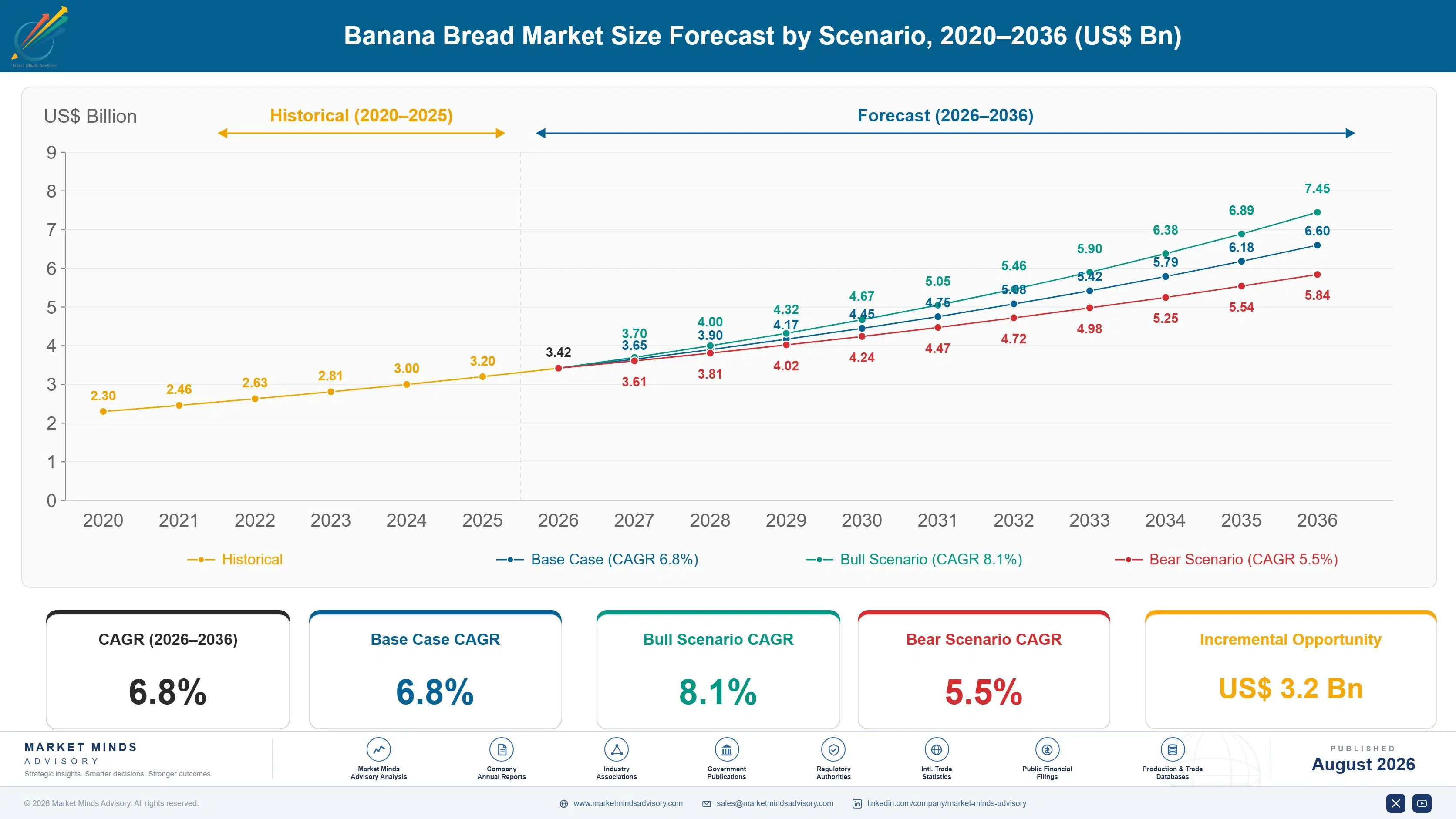
2036 FORECAST VALUE$6.6BBase Case , 2026 to 2036
CAGR 2026 TO 20366.8 %Bull 8.1% / Bear 5.5%
INCREMENTAL OPPORTUNITY$3.2BNet 10- year value creation
EXPANSION MULTIPLE1.94x2036 value over 2026 base
Strategic Levers
M&A Pipeline
Regional Outlook
Country Rankings
Competitive Intelligence
Segmental Deep-dive
Call-Us : 91 93563 13602

Executive Snapshot and Market Trajectory

Banana bread has moved well beyond home kitchens into cafe counters, grocery bakery aisles, and frozen retail, with grab-and-go convenience and nostalgia positioning both pulling packaged volume higher even as ingredient costs and private label competition squeeze branded manufacturer margins across most developed retail channels worldwide overall.
Growth concentrates in protein-enriched and gluten-free formats aimed at fitness-conscious and free-from shoppers, alongside frozen ready-to-bake loaves that let grocers offer in-store fresh-baked aroma without full bakery staffing. North America and Western Europe still account for the largest branded volume, while the Philippines and other banana-growing economies in South Asia and the Pacific are formalizing traditional banana bread into packaged retail products faster than any other region.
Competitive character splits between global cafe chains like Starbucks that treat banana bread as a signature counter item and packaged bakery manufacturers such as Entenmann's defending grocery shelf space against private label. Regulatory pressure is modest here compared to other food categories, but rising cocoa, nut, and packaging costs are compressing margins meaningfully fastest for smaller regional bakers without scale purchasing power or private label contract volume to offset input inflation.
Market Definition
This report covers packaged and foodservice banana bread products, including retail loaf cakes, frozen ready-to-bake formats, cafe and bakery counter items, and mix-based preparations sold for banana bread specifically. It excludes generic banana snack foods, banana chips, and banana-flavored products that are not marketed or sold as banana bread.
Base Year Value
$3.2B in 2025 (MMA Primary Research Dataset, August 2026)
Forecast Period
2026 to 2036, eleven discrete annual values
CAGR
6.8% base case. Bull 8.1%. Bear 5.5%.
Fastest Growth Segment
Protein-Enriched Banana Bread: 11.5% CAGR
Fastest Growth Country
Philippines: 10.2% CAGR
Fastest Growth Region
South Asia and Pacific: 8.8% CAGR
Largest Region
North America: 28% of 2025 global value
Market Leaders
Starbucks Corporation, Entenmann's (Bimbo Bakeries USA), Otis Spunkmeyer, Greggs plc, Warburtons. Source: MMA Analysis based on company annual reports.
Primary Survey
n=3,800 procurement and R&D decision-makers, Q4 2025, six countries
Methodology
Demand-side build-up, cross-validated against public data, 47 expert interviews

Banana Bread Market Forecast Scenarios

banana-bread-market-size-forecast-scenario-1787462171855
Packaged banana bread demand accelerated unevenly between 2020 and 2025 as home baking surged during pandemic lockdowns, then gave way to grab-and-go retail and cafe formats once mobility normalized. A historical CAGR of 5.6% reflects that transition, with frozen ready-to-bake formats gaining shelf space fastest as grocers sought bakery aroma without added in-store labor costs.
The base case assumes 6.8% annual growth through 2036, anchored by three mechanisms: continued cafe chain menu expansion around signature banana bread items, grocery private label banana loaf proliferation that grows category volume even as it pressures branded margins, and rising protein-enriched and gluten-free formulation adoption among health-conscious snackers. Together these push packaged banana bread further from its homemade origins into a genuine branded snacking category with its own dedicated retail shelf space in most developed grocery chains.
A bull scenario assumes fitness and free-from formats scale faster than expected across North America and Western Europe, pushing growth toward 8.1%. The bear case turns on sustained cocoa, nut, and packaging cost inflation squeezing smaller regional bakers out of the category entirely, ceding shelf space to private label alone and dragging growth down toward roughly 5.5%.

Cafe Counters, Grocery Aisles, and the Branding Race

Banana bread sits at the intersection of home baking nostalgia and modern grab-and-go snacking, a positioning few bakery categories share as cleanly. Cafe chains built banana bread into signature counter items decades ago, and that foodservice presence still generates more category revenue than packaged retail, even as grocery private label proliferation pulls volume growth toward the retail channel faster than foodservice can match it in most markets today.
MARKET CONCENTRATION (CR5)22%Category remains fragmented across bakers and cafe chains
AVERAGE RETAIL PRICE$4.80 per loafBranded packaged loaf pricing across major grocery retailers
TOP PRODUCING COUNTRY SHAREUnited States, 24%Largest single national market for branded banana bread
PRIVATE LABEL PENETRATION34% of volumeRetailer own-brand loaves capture meaningful category shelf space
FOODSERVICE CHANNEL SHARE41% of revenueCafe and bakery counter sales outweigh packaged retail volume
KEY INPUT COST SHARE46% of COGSFlour, banana puree, and packaging dominate total production cost
Commercially, the category splits between foodservice items sold at a meaningful premium per slice and packaged retail loaves competing on price against private label. Branded manufacturers like Entenmann's defend grocery shelf space through flavor variation and larger pack formats, while cafe operators like Starbucks and Greggs protect margin through counter positioning that private label cannot easily replicate at scale in any meaningful way.
Over the next decade, free-from and protein-enriched formats will pull category growth as fitness and dietary-restriction shoppers seek familiar comfort baking in formats that fit their routines. Private label penetration will keep rising, pressuring branded manufacturers to compete increasingly on innovation and format rather than on shelf price alone across most developed grocery markets over the next several years.
"Banana bread survived as a category because it never really left the kitchen. The winners now are the ones translating that kitchen memory onto a cafe counter or a grocery shelf without losing it."
Director, Consumer Bakery and Snacking Practice · MMA Agriculture & Food Ingredients Practice · August 2026

Market Trends

Protein-Enriched Banana Bread for Fitness Snacking

Bakery manufacturers and cafe chains are reformulating banana bread with added whey, pea, or collagen protein to capture fitness-oriented snackers who want familiar comfort baking without pure indulgence positioning. Starbucks and several regional cafe chains have added protein-enriched banana bread variants to counter menus since 2024, priced at a meaningful premium over the classic recipe. Packaged retail brands are following with shelf-stable protein loaf formats aimed at the same shopper. This reformulation trend is pulling banana bread into the broader functional snacking category, a positioning largely absent from the category five years ago.
Market Impact: Adds 4-5% same-store attachment sales

Frozen Ready-to-Bake Loaf Formats in Grocery

Grocers are expanding frozen ready-to-bake banana bread formats that let in-store bakeries deliver fresh-baked aroma and warm product without the labor cost of scratch baking from raw ingredients. Otis Spunkmeyer and several private label frozen bakery suppliers have expanded distribution of par-baked and thaw-and-serve banana bread loaves since 2023, particularly across grocery chains looking to compete with cafe bakery counters. This format lets smaller grocers offer a fresh-bakery experience without hiring dedicated bakery staff, extending banana bread's retail footprint into stores that previously carried only shelf-stable packaged versions of the product.
Market Impact: Adds 9.8% gluten-free segment growth

Market Opportunities and Growth Drivers

Cafe Chain Menu Expansion Around Signature Items

Global and regional cafe chains including Starbucks and Greggs continue to expand banana bread's role on counter menus, treating it as a reliable, low-complexity item that drives incremental attachment sales alongside coffee purchases. Greggs reported meaningful year-over-year growth in bakery item attachment rates tied partly to banana bread and similar loaf cake offerings in its most recent annual report. This foodservice channel commands significantly higher per-unit pricing than packaged retail, giving cafe operators an incentive to keep expanding banana bread's counter presence across new store formats and daypart occasions beyond breakfast.
Market Impact: Cuts branded margin 150 basis points

Free-From and Gluten-Free Reformulation Demand Rising

Rising diagnosed and self-reported gluten sensitivity across North America and Western Europe is pushing bakery manufacturers to reformulate banana bread with gluten-free flour blends, since the recipe's naturally moist, dense texture translates well to alternative flours compared to drier baked goods. Warburtons and several specialty bakers have launched dedicated gluten-free banana bread lines since 2023, typically priced at a meaningful premium over standard recipes. This reformulation trend also intersects with vegan demand, since banana bread's traditional recipe already substitutes easily for egg and dairy, giving reformulators a comparatively low technical barrier to entry versus other baked goods categories.
Market Impact: Raises input costs 6-8% annually

Market Restraints and Challenges

Private Label Price Pressure on Branded Margins

Grocery retailers including Tesco and Sainsbury's have expanded own-brand banana bread and loaf cake lines priced meaningfully below branded competitors, capturing volume from shoppers who see limited difference between private label and branded recipes. The root cause is banana bread's low technical differentiation ceiling relative to other baked goods, since the recipe is simple enough that private label bakers can replicate quality closely. The commercial impact shows up as margin compression for branded manufacturers defending shelf space through promotional spending. Branded players are mitigating exposure by shifting toward protein-enriched and gluten-free formats private label has been slower to replicate.
Market Impact: Adds 11.5% segment growth premium

Banana and Packaging Input Cost Volatility

Banana bread manufacturers depend on banana puree pricing that tracks volatile global banana commodity markets, alongside flour, sugar, and packaging costs that have all seen meaningful inflation since 2022. The root cause is the category's exposure to multiple volatile agricultural commodities simultaneously rather than a single dominant input, making cost hedging more complex than for single-ingredient bakery categories. The commercial impact falls hardest on smaller regional bakers without the purchasing scale to negotiate favorable multi-year supply contracts. Larger manufacturers are mitigating exposure through diversified sourcing across multiple banana-growing regions and longer-term flour and packaging supply agreements.
Market Impact: Adds 9% frozen format share
3 additional market trends, 4 additional growth drivers, and 2 additional restraints and challenges are covered in the full report. Contact sales@marketmindsadvisory.com to access the complete intelligence.

Segment CAGR and Growth Architecture

MMA segments the banana bread market by product formulation rather than by sales channel, since dietary formulation, not where a loaf is sold, drives the cost structure and margin differences that separate classic recipes from protein-enriched, gluten-free, and vegan variants competing today for the same shopper occasion across grocery, foodservice, and frozen retail channels alike.
banana-bread-market-market-share-analysis-1787462172397

Protein-Enriched Banana Bread

Protein-enriched banana bread is the fastest-growing segment, pulled by fitness-oriented snackers who want familiar comfort baking without abandoning protein intake goals tied to gym routines and macro tracking apps. Starbucks and several regional cafe chains added protein-fortified counter items since 2024, and packaged retail brands quickly followed with shelf-stable versions using whey, pea, or collagen protein blends. The segment commands a meaningful price premium over classic recipes, since protein fortification adds real ingredient cost that manufacturers pass through to price-insensitive fitness shoppers. Demand concentrates in North America and Western Europe where gym membership and protein snacking culture run deepest, though the format is beginning to appear on cafe counters in East Asian markets with growing fitness culture as well.
CAGR 11.5%

Gluten-Free Banana Bread

Gluten-free banana bread is the second-fastest segment, benefiting from banana bread's naturally moist, dense texture that translates comparatively well to alternative flour blends versus drier baked goods categories. Warburtons and several specialty bakers launched dedicated gluten-free lines since 2023, typically priced at a meaningful premium that shoppers with diagnosed or self-reported gluten sensitivity appear willing to pay for a familiar comfort item. The segment also draws interest from shoppers without formal gluten sensitivity who simply perceive gluten-free baking as a marginally healthier choice, widening its addressable base beyond the core dietary-restriction shopper. Growth concentrates in North America and Western Europe, where gluten-free labeling and retail merchandising infrastructure is most developed across major grocery chains.
CAGR 9.8%
Full segment breakdown across 6 segments available in the complete report.

Regional Architecture and Country Demand Map

Banana bread's retail and foodservice footprint concentrates across North America and Western Europe's cafe and grocery bakery culture, while the Philippines and other banana-growing economies across South Asia and the Pacific are formalizing traditional recipes into packaged products faster than any other region tracked in this analysis.

North America

Starbucks, Entenmann's, and a wide field of regional bakeries anchor the largest branded banana bread market anywhere, built on decades of cafe counter presence and grocery bakery aisle placement across the United States and Canada. Grab-and-go convenience culture and home baking nostalgia reinforce each other here more directly than in any other region, giving the category unusually broad appeal across demographic groups. Protein-enriched and gluten-free reformulation is advancing fastest in this region too, tracking broader fitness and free-from consumer trends that reached North American retail earlier than most other markets. Private label penetration remains meaningful but has not displaced branded shelf presence the way it has in parts of Western Europe.
Share: 28% | CAGR: 7.5% (2026 to 2036)

Western Europe

The United Kingdom's banana loaf cake tradition gives Western Europe a distinct cultural entry point into the category, with Greggs and Warburtons both treating banana bread as an established, rather than novel, bakery item. Private label penetration runs higher here than in North America, since UK and continental grocers have built sophisticated own-brand bakery programs that shoppers trust as closely comparable to branded recipes. Gluten-free reformulation is advancing meaningfully here too, tracking the region's relatively high rate of diagnosed gluten sensitivity. Growth trails the global average because the category is already well-established across most retail channels, leaving less headroom for pure distribution expansion compared to earlier-stage regions still building out modern retail infrastructure.
Share: 22% | CAGR: 5.3% (2026 to 2036)
Regional intelligence for 5 additional markets available in the complete report: East Asia, South Asia and Pacific, Latin America, Middle East and Africa, Eastern Europe. Contact sales@marketmindsadvisory.com.
banana-bread-market-country-cagr-analysis-1787462172908

Format Innovation and Channel Expansion Playbook

Banana bread manufacturers extract more value from a mature category by shifting format and channel mix rather than competing purely on price against private label. The levers below concentrate on capturing premium formats, defending foodservice margin, and building distribution in regions where the category remains comparatively underdeveloped relative to its cultural familiarity across the board today.

Protein Fortification for Fitness Snacking Occasions

Manufacturers that added whey, pea, or collagen protein to banana bread recipes are capturing a shopper segment willing to pay a price premium of roughly 25 to 35% over classic recipes, since protein fortification directly addresses a specific dietary goal rather than pure indulgence. Starbucks and several packaged retail brands moved early on this reformulation, securing counter and shelf presence before slower-moving competitors could respond. Processors without protein-enriched offerings increasingly lose fitness-oriented shoppers entirely to competitors, rather than simply losing share within a shared category, since these shoppers actively seek out the format by name.
Market Impact: Adds a 25 to 35% price premium overall

Frozen Format Licensing for Grocery Bakery Programs

Frozen par-baked and thaw-and-serve banana bread formats let manufacturers sell into grocery in-store bakery programs without requiring the grocer to staff scratch baking capability, opening a distribution channel that fully packaged retail products cannot reach. Otis Spunkmeyer and similar frozen bakery suppliers have built dedicated grocery bakery program relationships that generate a meaningful 6 to 9% margin premium over standard packaged retail, since grocers pay for convenience and reduced labor risk rather than negotiating on ingredient cost. Manufacturers without frozen format capability are locked out of this channel regardless of how strong their packaged retail brand recognition already is.
Market Impact: Adds 6 to 9% grocery bakery revenue share

Gluten-Free Line Extension for Free-From Retail Sets

Manufacturers that built dedicated gluten-free banana bread lines are winning placement in the fast-growing free-from retail sets that most major grocery chains now merchandise separately from standard bakery aisles, a placement standard packaged competitors cannot access without reformulation. Warburtons and specialty bakers that moved early captured shelf space in these sets before competitors could qualify, and free-from set placement typically carries 15 to 20% less private label competition than standard bakery aisles today. Manufacturers still absent from free-from sets are increasingly invisible to the specific shopper segment actively searching that part of the store for products just like this one.
Market Impact: Wins 15 to 20% more free-from set placement

Cafe Counter Exclusivity Partnerships for Regional Bakers

Regional bakery manufacturers that secure exclusive cafe counter supply agreements with growing regional coffee chains capture meaningfully higher per-unit pricing than they could through grocery retail alone, while avoiding direct price comparison against private label loaves sitting on a nearby shelf. These exclusivity agreements typically run 3 to 5 years and include volume commitments that give smaller bakers planning certainty they otherwise lack in fragmented grocery retail negotiations. Bakers without foodservice relationships remain dependent entirely on grocery channels where private label competition is most direct and margin runs consistently thinner across nearly every account they serve.
Market Impact: Adds 20 to 30% foodservice unit margin overall

Who Controls the Margin Pool

CR5 in banana bread sits near 22%, reflecting a category still dominated by regional bakers and cafe chains rather than global consolidation. Starbucks leads through cafe counter scale, with Entenmann's close behind in packaged grocery retail, while the gap to mid-tier challengers like Otis Spunkmeyer and Greggs remains wide enough that meaningful consolidation looks unlikely before private label pressure forces smaller players to exit.
Current competitive activity centers on three fronts: protein and gluten-free reformulation racing to capture fitness and free-from shoppers, frozen format expansion into grocery bakery programs, and cafe counter exclusivity agreements that lock in foodservice distribution. Larger manufacturers are moving fastest on all three, while smaller regional bakers without capital access risk losing both foodservice and free-from retail set placement at once.

Emerging pressure comes from private label proliferation across Western European and North American grocery chains, where retailers increasingly view banana bread as easy to replicate at acceptable quality without licensing a branded recipe. The Philippines and other Pacific-adjacent markets are also producing fast-growing regional bakers formalizing traditional recipes into packaged formats, and some could eventually export into developed markets, challenging established Western brands on price.
banana-bread-market-company-positioning-matrix-1787462173428

Competitive Moat and Risk Dimensions

STARBUCKS CORPORATION

Moat: Global Cafe Counter Distribution

Starbucks' vast global store footprint gives it counter distribution scale no packaged bakery competitor can match, letting it test and roll out banana bread variants across thousands of locations simultaneously. This distribution advantage also lets Starbucks command meaningfully higher per-unit foodservice pricing than any packaged retail competitor achieves for a comparable product.
STARBUCKS CORPORATION

Risk: Menu Rotation Vulnerability

Banana bread's counter presence at Starbucks depends on continued menu prioritization against other bakery items competing for the same limited counter space, and any rotation away from banana bread toward a newer item could meaningfully affect category volume given the chain's outsized foodservice share of total category revenue.
ENTENMANN'S (BIMBO BAKERIES USA)

Moat: Grocery Shelf Presence Nationwide

Entenmann's decades of grocery relationships and shelf placement across the United States give it packaged retail distribution scale that newer or regional competitors struggle to match, particularly in mainstream grocery chains outside major urban centers. This established presence lets the brand defend shelf space even against aggressive private label pricing.
ENTENMANN'S (BIMBO BAKERIES USA)

Risk: Private Label Price Pressure

Entenmann's competes directly against retailer own-brand banana bread priced meaningfully below its packaged loaves, forcing continuous promotional spending to defend volume rather than relying on brand loyalty alone. This pressure is most acute in commodity-adjacent classic recipe formats where private label quality differentiation is hardest to demonstrate.

Players Tracked

Prominent Players

Starbucks Corporation
Entenmann's (Bimbo Bakeries USA)
Otis Spunkmeyer
Greggs plc
Warburtons

Other Key Players

Panera Bread
Costco Wholesale
Sara Lee
McKee Foods
Hostess Brands
Tesco plc
Sainsbury's
Mrs. Freshley's
Flowers Foods
Vachon Inc.
George Weston Limited
Lantmännen Unibake
Aryzta AG
J&J Snack Foods Corp
Finsbury Food Group

Recent Developments

FEBRUARY 2025

Starbucks Adds Protein-Enriched Banana Bread to US Menu

Starbucks introduced a protein-enriched banana bread variant across United States company-operated stores, formulated with added whey protein and priced at a premium over its classic banana nut bread. The launch followed positive response to limited regional testing conducted during the prior year across select West Coast markets.
Signal: Confirms major cafe chains are treating protein fortification as a mainstream menu strategy rather than a niche test.
JUNE 2025

Warburtons Launches Dedicated Gluten-Free Banana Bread Line

Warburtons launched a dedicated gluten-free banana bread product line across major United Kingdom grocery chains, produced in a segregated gluten-free facility to avoid cross-contamination risk. The launch expands the company's free-from bakery portfolio beyond bread into the loaf cake category for the first time in the brand's history.
Signal: Signals established bread manufacturers are extending free-from capability into adjacent loaf cake categories previously left to specialists.
NOVEMBER 2025

Otis Spunkmeyer Expands Frozen Banana Bread Grocery Program

Otis Spunkmeyer expanded its frozen par-baked banana bread program to a larger number of grocery in-store bakery partners across North America, adding thaw-and-serve formats designed for stores without scratch baking equipment. The expansion followed strong reorder rates from initial grocery partners onboarded during the prior year.
Signal: Confirms grocery in-store bakery programs are becoming a durable distribution channel independent of packaged retail shelf sales.

Banana, Flour, and Packaging Cost Exposure

Banana puree and pulp account for roughly 22% of direct ingredient cost, with flour, sugar, and packaging together adding a further meaningful share, bringing total input costs to approximately 46% of cost of goods sold. Unlike single-commodity bakery categories, banana bread manufacturers manage exposure across multiple volatile agricultural inputs simultaneously rather than one dominant ingredient.
Global banana commodity prices rose meaningfully following adverse weather and disease pressure across major exporting regions in 2023 and 2024, with the USDA's agricultural market reports documenting sustained price volatility across that period. Packaging costs also increased as paperboard and film pricing tracked broader input inflation across the same window. Manufacturers without diversified banana sourcing across multiple growing regions absorbed meaningfully higher per-unit ingredient costs than competitors with geographically diversified supply agreements already in place beforehand.

Exposure varies sharply by manufacturer type: large branded players with multi-region banana sourcing agreements and packaging supply contracts absorb volatility more evenly than smaller regional bakers dependent on single-source local supply. Cafe chains with centralized procurement, like Starbucks, negotiate better terms than independent bakeries, creating a genuine cost disadvantage for smaller competitors that compounds during periods of sustained commodity inflation across multiple inputs at once.
banana-bread-market-cost-volatility-analysis-1787462173623

Multi-Region Banana Sourcing Diversification

Larger manufacturers increasingly source banana puree from multiple growing regions rather than depending on a single country, reducing exposure to localized weather or disease events that can spike pricing sharply. This diversification requires supplier relationship investment but meaningfully smooths input cost volatility across consecutive growing seasons and export cycles each year across the supply chain.

Multi-Year Packaging Supply Agreements

Manufacturers are increasingly locking in multi-year packaging supply agreements ahead of anticipated inflation, trading some flexibility for predictable per-unit packaging cost. Smaller bakers without the volume commitments to negotiate multi-year terms remain more exposed to spot packaging price increases, especially heading into peak holiday baking season each year across most major markets they serve.

Recipe Formulation Flexibility Across Flour Types

Some manufacturers have built recipe flexibility that allows substituting between flour types based on relative pricing without meaningfully affecting product taste or texture, since banana bread's dense, moist profile is more forgiving of flour substitution than lighter baked goods categories. This flexibility reduces exposure to any single flour commodity price spike during periods of tight regional supply.

Portfolio Architecture for Margin Defence

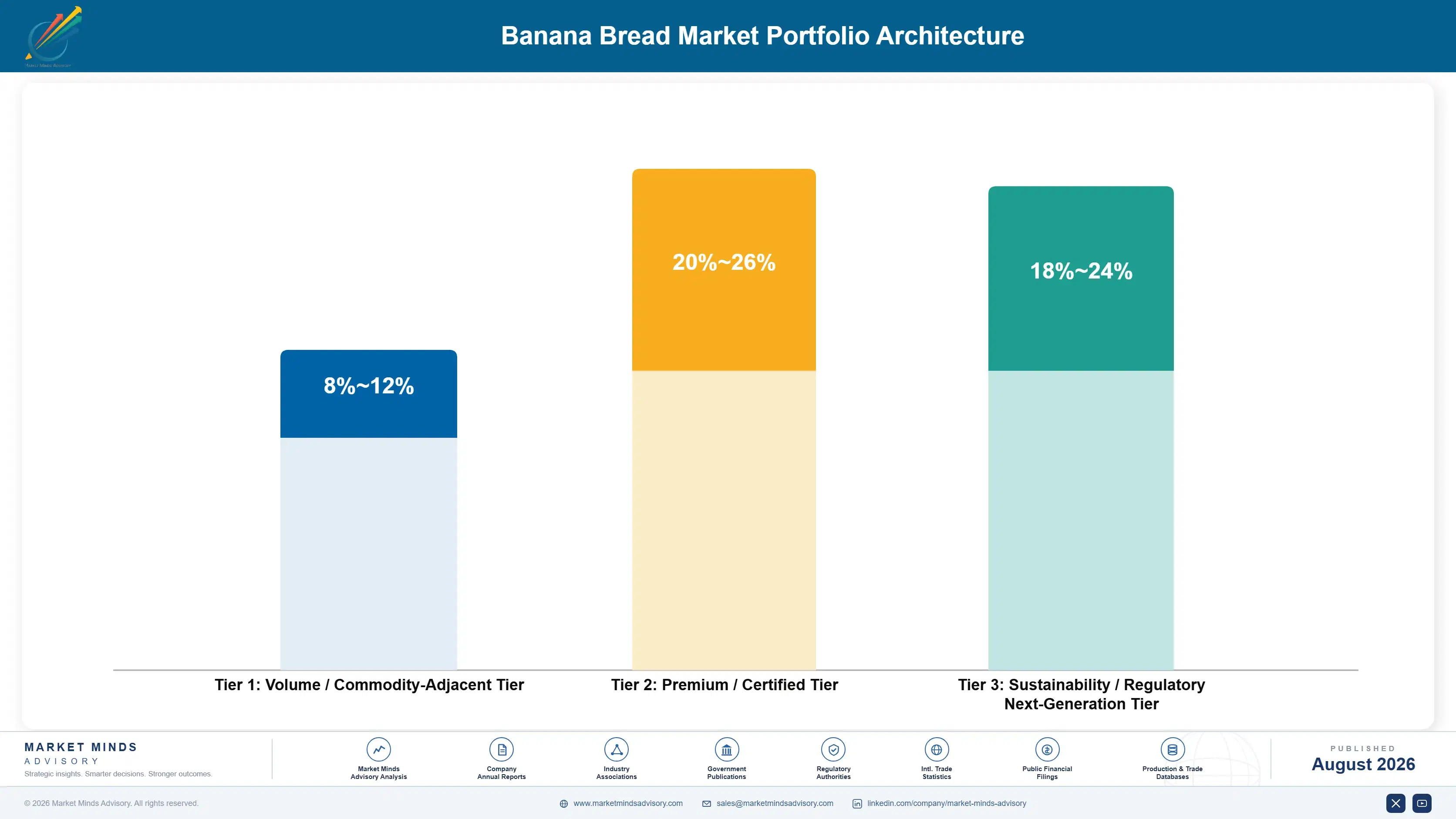
Banana bread portfolios split across three tiers with different margin economics: a volume tier built on classic packaged and private label recipes, a premium tier built on protein-enriched and gluten-free formats, and an emerging next-generation tier tied to clean-label and functional ingredient positioning that shoppers are only beginning to pay a defined premium for consistently across most retail channels today.
The tension between volume and premium runs deep in how manufacturers allocate limited reformulation and production capacity: every production line converted to gluten-free or protein-enriched output is a line unavailable for classic recipe volume that still generates the bulk of category revenue today. Get the mix wrong and a manufacturer either misses premium demand or overinvests in specialty capacity that outpaces actual shopper willingness to pay for it in the near term.

High-value margin pools concentrate overwhelmingly in foodservice counter sales and premium reformulated retail products, not in private-label-adjacent classic packaged loaves. Manufacturers that built cafe counter relationships and reformulation capability early, Starbucks and Warburtons among them, now capture a share of total category profit well above their share of total unit volume sold each year across nearly every account they touch.

Volume / Commodity-Adjacent Tier

Classic and private label banana bread sold through grocery retail on tight promotional pricing, competing primarily on shelf price and pack size rather than formulation differentiation or premium positioning across most accounts.
Gross Margin: 8-12%

Premium / Certified Tier

Protein-enriched and gluten-free banana bread sold at meaningful price premiums to fitness and free-from shoppers through both grocery free-from sets and cafe counter menus, commanding stronger margin through formulation differentiation.
Gross Margin: 20-26%

Sustainability / Regulatory / Next-Generation Tier

Clean-label, reduced-sugar, and responsibly sourced banana bread aimed at shoppers and cafe chains with public health and sustainability positioning commitments, still a small volume tier but growing as ingredient transparency expectations continue to rise.
Gross Margin: 18-24%
banana-bread-market-portfolio-architecture-1787462174124

High-value Sub-segments and Strategic Watch-out

Protein-Enriched Banana Bread (High-Value, High-Growth)

Protein-enriched banana bread combines the fastest unit growth in the category with meaningfully above-average margins, making it the single most attractive segment for manufacturers with reformulation and cafe counter relationships already in place. Demand continues to outpace available shelf and counter space across nearly every developed market tracked.
Gross Margin: 20-26%

Gluten-Free Banana Bread (High-Value, Moderate-Growth)

Gluten-free banana bread carries better margin than classic recipes and continues gaining free-from retail set placement, though growth is more moderate than protein-enriched since it depends on dedicated production facility investment to avoid cross-contamination risk across every single batch produced at commercial scale nationwide.
Gross Margin: 18-24%

Classic Banana Bread (Volume Core)

Classic banana bread remains the largest single format by unit volume and the backbone of manufacturer cash flow, even though margin sits well below the specialty tiers. Nearly every bakery and cafe chain depends on this volume base to fund reformulation investment elsewhere in the portfolio.
Gross Margin: 8-12%

Private-Label-Adjacent Classic Loaves (Strategic Watch-Out)

Branded classic banana bread sold in categories where private label quality has closed most of the perceived gap carries the thinnest margin in the portfolio, making it the segment most exposed to being displaced entirely if retailers keep expanding own-brand programs further in the years ahead.
Gross Margin: 4-8%

Occasion Loyalty and Format Switching

Banana bread demand runs more on repeat occasion habit than on formal contracts, since most volume moves through everyday grocery and cafe purchases rather than negotiated supply agreements typical of industrial food categories. Shoppers who buy banana bread as a breakfast or snack habit tend to repurchase the same format regularly, giving manufacturers a meaningful base of predictable, low-churn demand once a shopper adopts the category.
Adoption depth varies sharply by end-use occasion: shoppers buying banana bread as a nostalgic comfort item show strong format loyalty and resist switching even when private label offers a lower price, while fitness-oriented protein snackers switch more readily toward whichever brand currently offers the strongest protein content or flavor variety. Cafe counter buyers, largely driven by convenience and impulse, show the least loyalty of any occasion, purchasing whatever is available at the counter that day.

A generational shift is underway among shoppers too: younger buyers increasingly treat banana bread as a functional snack tied to fitness or dietary goals rather than pure nostalgia, rewarding manufacturers that reformulated early over those still positioning the product purely as a comfort classic from an earlier generation.
banana-bread-market-end-use-penetration-index-1787462174616

Where Banana Bread Margin Concentrates

These are among the four positions where our research anticipates prominent divergence between winners and laggards over the coming forecast period. Each is grounded in the demand model, the regulatory perimeter, and the announced capacity pipeline.
01 / REFORMULATION TIMING ADVANTAGE

Early protein and gluten-free movers now defend a durable shelf lead

Manufacturers that reformulated banana bread with added protein or dedicated gluten-free production before competitors now hold shelf and counter placement that later movers cannot quickly replicate, since retailers and cafe chains rarely displace an established reformulated item once shopper habit forms around it. This timing advantage matters more than raw brand scale, because free-from retail sets and cafe fitness menus reward whichever product already occupies the position. Manufacturers without early reformulation now face a slower path back into these categories, even with meaningful new marketing investment behind a late entry.
02 / PRIVATE LABEL EXPOSURE

Classic recipe formats face the sharpest private label substitution risk

Branded classic banana bread faces the sharpest private label substitution risk in the category, since the recipe's technical simplicity gives retailer own-brand bakers little quality gap to close before shoppers stop paying a branded premium. This risk concentrates specifically in commodity-adjacent packaged retail rather than in foodservice or reformulated premium tiers where private label has not meaningfully caught up. Manufacturers still depending heavily on classic recipe volume without reformulation or foodservice diversification face continued margin erosion as private label penetration keeps rising across major grocery chains.
03 / REGIONAL FORMALIZATION OPPORTUNITY

The Philippines and Pacific markets are turning informal supply into formal volume

The Philippines and nearby Pacific-adjacent markets are converting a long-standing informal, traditional banana bread market into measurable formal retail volume faster than any other region tracked in this report. This formalization is culturally distinct from Western reformulation trends, since it reflects existing product familiarity meeting new retail infrastructure rather than genuinely new demand creation. Manufacturers and retailers that build relationships in this region now will be better positioned than those waiting for the shift to become obvious in trade and retail sales data.
04 / FOODSERVICE MARGIN DEFENSE

Cafe counter exclusivity is becoming the clearest margin defense available

Manufacturers and bakers that secure cafe counter exclusivity agreements capture meaningfully higher per-unit pricing than packaged retail alone can offer, while sidestepping direct shelf comparison against private label loaves entirely. This margin advantage compounds over multi-year agreement terms, since counter placement is far stickier once shopper habit forms around a specific cafe's banana bread than packaged retail brand loyalty tends to be. Bakers without foodservice relationships remain dependent on grocery channels where private label competition is most direct and margin keeps compressing.

Engagement Snapshot From the Field

A live engagement with an industry participant carrying material or product regulatory and market exposure ahead of a defining policy shift, showing how our research translates into a defensible multi-year portfolio strategy.
MARKET MINDS ADVISORY · CLIENT ENGAGEMENT SUMMARY
Banana Bread Producer Strategic Portfolio Review and Transition Roadmap 2026·Investment Scenario on Banana Bread Exposure Evaluation 2025-26
CLIENT PROFILE
The client is a mid-sized regional bakery manufacturer producing classic packaged banana bread for grocery retail across a single national market, with limited foodservice presence and no reformulated product lines. Revenue approached $180 million in the most recent fiscal year (client-reported, unverified by MMA), though margins had compressed steadily as national grocery chains expanded private label banana bread lines priced meaningfully below the client's branded packaged loaves.
STRATEGIC CHALLENGE
The manufacturer had no protein-enriched or gluten-free product lines and no foodservice distribution relationships, leaving it entirely dependent on packaged grocery retail at a moment when private label penetration in that channel was rising fastest. Leadership needed to decide which reformulation and channel investments to prioritize given limited capital, and how quickly competitors might close the same opportunity.
MMA APPROACH
MMA benchmarked the manufacturer's cost structure and margin against reformulated and foodservice-diversified peers, modeled the capital and facility investment required for segregated gluten-free production, and evaluated regional cafe chain partnership opportunities against the manufacturer's existing production and distribution footprint. The analysis prioritized initiatives by capital intensity against expected margin recovery timeline.
KEY FINDINGS
  1. The manufacturer's classic recipe portfolio faced the sharpest private label substitution risk in its core market, with retailer own-brand loaves already capturing meaningful volume share.
  2. Gluten-free reformulation required dedicated segregated production capacity that the manufacturer's existing facility could not support without meaningful capital investment in new equipment and space.
  3. Regional cafe chains in the manufacturer's core market had no existing banana bread supply relationship, representing a genuine foodservice distribution opportunity competitors had not yet pursued.
  4. Protein-enriched reformulation carried lower capital intensity than gluten-free production, making it the faster near-term path to premium margin capture given the manufacturer's capital constraints.
CLIENT PROFILE
The client is a mid-sized regional bakery manufacturer producing classic packaged banana bread for grocery retail across a single national market, with limited foodservice presence and no reformulated product lines. Revenue approached $180 million in the most recent fiscal year (client-reported, unverified by MMA), though margins had compressed steadily as national grocery chains expanded private label banana bread lines priced meaningfully below the client's branded packaged loaves.
STRATEGIC CHALLENGE
The manufacturer had no protein-enriched or gluten-free product lines and no foodservice distribution relationships, leaving it entirely dependent on packaged grocery retail at a moment when private label penetration in that channel was rising fastest. Leadership needed to decide which reformulation and channel investments to prioritize given limited capital, and how quickly competitors might close the same opportunity.
MMA APPROACH
MMA benchmarked the manufacturer's cost structure and margin against reformulated and foodservice-diversified peers, modeled the capital and facility investment required for segregated gluten-free production, and evaluated regional cafe chain partnership opportunities against the manufacturer's existing production and distribution footprint. The analysis prioritized initiatives by capital intensity against expected margin recovery timeline.
KEY FINDINGS
  1. The manufacturer's classic recipe portfolio faced the sharpest private label substitution risk in its core market, with retailer own-brand loaves already capturing meaningful volume share.
  2. Gluten-free reformulation required dedicated segregated production capacity that the manufacturer's existing facility could not support without meaningful capital investment in new equipment and space.
  3. Regional cafe chains in the manufacturer's core market had no existing banana bread supply relationship, representing a genuine foodservice distribution opportunity competitors had not yet pursued.
  4. Protein-enriched reformulation carried lower capital intensity than gluten-free production, making it the faster near-term path to premium margin capture given the manufacturer's capital constraints.
RECOMMENDED STRATEGY
Phase 1: Phase 1 (Year 1): Launch a protein-enriched banana bread line using existing production equipment, funding gluten-free facility planning from improved reformulated product margin. Phase 2: Phase 2 (Years 2 to 3): Secure exclusive supply agreements with regional cafe chains lacking an existing banana bread relationship, building foodservice distribution from a standing start. Phase 3: Phase 3 (Years 3 to 4): Invest in segregated gluten-free production capacity once reformulated and foodservice margin gains have funded the required capital investment.
OUTCOME
Within two fiscal years, the manufacturer's protein-enriched line reached a meaningful share of total volume and secured exclusive supply agreements with several regional cafe chains that had not previously carried the brand (client-reported, unverified by MMA). Gluten-free facility planning is underway, positioning the manufacturer to close its remaining reformulation gap faster than leadership had originally expected.

Frequently Asked Questions

Foundational context covering the market sizes, CAGR, scope, country, region and competition that inform every finding below. This section is provided to cover basics and most often pre-purchase conversations, answered from the MMA Primary Research Dataset.

What is the current size of the Banana Bread Market?

The global banana bread market was valued at approximately $3.2 billion in 2025. This covers packaged retail, foodservice, and frozen ready-to-bake banana bread products sold globally.

How large will the Banana Bread Market be by 2036?

MMA projects the market will reach approximately $6.6 billion by 2036, up from roughly $3.4 billion in 2026. That represents an expansion multiple of about 1.94 times over the ten-year forecast period.

What is the CAGR for the Banana Bread Market 2026 to 2036?

The base case CAGR is 6.8% annually, with a bull scenario near 8.1% and a bear scenario near 5.5%. This range reflects sensitivity to input cost inflation and private label competition intensity.

Which segment is growing fastest?

Protein-enriched banana bread is the fastest-growing segment, expanding at roughly 11.5% annually, about 1.7 times the overall market's pace. Gluten-free banana bread follows as the second-fastest segment at approximately 9.8% annually.

Who are the major companies in the Banana Bread Market?

Leading players include Starbucks Corporation, Entenmann's (Bimbo Bakeries USA), Otis Spunkmeyer, Greggs plc, and Warburtons. Together these five hold an estimated 22% combined market concentration today.

Which country is growing fastest?

The Philippines is the fastest-growing national market, expanding near 10.2% annually as traditional banana bread formalizes into branded packaged retail products. Australia follows as a smaller but meaningfully growing regional market.

Report Segmentation Architecture

The full report scope spans multiple orthogonal segmentation dimensions, with cross-tabulated demand data provided for each dimension pair. Coverage extends further to regional breakdowns, trend trajectories, and the competitive detail needed to support segment-level decision-making.

By Product Formulation

  • Classic Banana Bread
  • Gluten-Free Banana Bread
  • Vegan Banana Bread
  • Protein-Enriched Banana Bread
  • Frozen Ready-to-Bake Banana Bread
  • Mini/Snack-Size Banana Bread Loaves

By End-Use Channel

  • Grocery Retail
  • Foodservice and Cafe
  • Convenience and Impulse
  • Frozen and Bakery Program
  • Institutional and Catering

By Commercial Dimension

  • Branded Packaged Goods
  • Private Label
  • Direct Foodservice Supply
  • Export and Cross-Border Trade

By Region

  • North America
  • Western Europe
  • East Asia
  • South Asia and Pacific
  • Latin America
  • Middle East and Africa
  • Eastern Europe

Scope, Methodology, and Coverage

Every figure in this report is reproducible from documented input assumptions. The scope below maps the historical period, the forecast horizon, the segmentation dimensions, and the countries covered, alongside the underlying primary and qualitative methodology.
Historical Period
2020 to 2025
Forecast Period
2026 to 2036
Base Year
2025 (USD billions; MMA Primary Research Dataset, August 2026)
Market Definition
This report defines the banana bread market as packaged retail, foodservice, and frozen ready-to-bake banana bread products sold globally, across classic, protein-enriched, gluten-free, vegan, and mini format variants. It excludes generic banana snack foods, banana chips, and banana-flavored products not marketed or sold specifically as banana bread.
Quantitative Units
USD billions (current prices); metric tonnes product weight where cited
Segmentation Dimensions
By Product Formulation; By End-Use Channel; By Commercial Dimension; By Region
Regions Covered
North America, Western Europe, East Asia, South Asia and Pacific, Latin America, Middle East and Africa, Eastern Europe
Countries Covered
USA, China, Germany, France, UK, Japan, South Korea, India, Australia, Canada, Brazil, Mexico, Indonesia, Vietnam, Thailand, Malaysia, UAE, Saudi Arabia, South Africa, Nigeria, Turkey, Poland, Netherlands, Italy, Spain, Sweden, Switzerland, Argentina, Colombia, Singapore, and additional markets relevant to this sector
Key Companies Profiled
Starbucks Corporation, Entenmann's (Bimbo Bakeries USA), Otis Spunkmeyer, Greggs plc, Warburtons, Panera Bread, Costco Wholesale, Sara Lee, McKee Foods, Hostess Brands, Tesco plc, Sainsbury's, Mrs. Freshley's, Flowers Foods, Vachon Inc., George Weston Limited, Lantmännen Unibake, Aryzta AG, J&J Snack Foods Corp, Finsbury Food Group
Quantitative Methodology
Primary survey, n=3,800 respondents, Q4 2025, six countries; demand-side model with trade association cross-validation
Qualitative Methodology
47 expert interviews, Q4 2025; applied to validate demand model assumptions, identify emerging dynamics, and assess competitive positioning
Report Format
PDF and XLSX data workbook (Word format preview document)
Publisher
Market Minds Advisory
Report Code
MMA-2026-AGR-102
Published
August 2026
Contact
sales@marketmindsadvisory.com | www.marketmindsadvisory.com

Purchase the full Banana Bread Market Report (2026 to 2036).

The full Banana Bread Market report delivers detailed sizing and forecasts across all six product-formulation segments, all seven world regions, and twenty profiled companies through 2036. It includes granular regional data tables, competitive benchmarking on a consistent foodservice and retail volume basis, and input cost sensitivity modeling tied to global banana and packaging markets. Subscribers receive access to the underlying primary survey dataset (n=3,800 respondents, Q4 2025, six countries) and qualitative expert interview findings (n=47 interviews, Q4 2025). The report also includes segment-level margin analysis and a portfolio tiering framework analysts can apply directly to company assessments.
Full segmentation across six product-formulation categories
Seven-region market sizing with growth forecasts
Twenty-company competitive benchmarking on consistent basis
Input cost sensitivity modeling tied to commodity markets
Access to primary survey dataset of 3,800 respondents
Portfolio tiering framework for margin benchmarking

Built For The People Who Decide

From boardroom strategy to bench-side execution, this report is read cover-to-cover by leaders shaping the next decade of their industry, turning demand scenarios, market dynamics and valuation benchmarks into decisions.
CXOs/ Presidents/ VPs/ Managers
M&A and Corporate Development
Strategy Teams and R&D Heads
Procurement and Product Directors
Regulatory and Compliance Leaders
Investor Relations and Equity Analysts