Market Minds Advisory
Bamboo Cups Market

Bamboo Cups Market: A Sustainability Story That Regulators Read Carefully

A commercial reading of bamboo drinkware, where the reusable version was withdrawn across Europe over the resin holding it together, and the single-use fibre version quietly took the market instead.

Lead Analyst

Bilal Shaikh

Published

September 2026

Make Smarter Decisions with Customized Research Insights

Request a free sample report and evaluate market opportunities, growth trends, and competitive dynamics relevant to your business needs.

2025 MARKET VALUE$0.6BMarket Size 2025
2036 FORECAST VALUE$1.7BBase Case , 2026 to 2036
CAGR 2026 TO 20369.4 %Bull 10.6% / Bear 8.0%
INCREMENTAL OPPORTUNITY$1.0BNet 10- year value creation
EXPANSION MULTIPLE2.46x2036 value over 2026 base
Strategic Levers
M&A Pipeline
Regional Outlook
Country Rankings
Competitive Intelligence
Segmental Deep-dive
Call-Us : 91 93563 13602

Executive Snapshot and Market Trajectory

The reusable bamboo cup was a marketing triumph and a regulatory failure. Bamboo powder held together with melamine resin released formaldehyde into hot drinks, European authorities withdrew products across the market, and the category's growth moved to moulded fibre single-use cups instead. The story survived; the product did not.
The market stands at USD 0.62 billion in 2025 and reaches USD 1.67 billion by 2036 at a 9.4% CAGR. Moulded bamboo fibre single-use cups grow fastest at 14.2%, about 1.51 times the overall rate, because they contain no resin binder and raise no food contact question. Western Europe holds 26% of value on single-use plastic rules, while India posts the quickest national growth at 13.8%.
Fragmentation is extreme, with the top five holding roughly 18% of bamboo cup revenue across foodservice packaging groups, specialist compostable brands, and a very long tail of Chinese and Vietnamese manufacturers. Two forces pull against each other. Plastic bans and visible sustainability positioning keep creating demand, while food contact enforcement and greenwashing scrutiny keep testing whether the products can support what is printed on them. Enforcement now reads the printed label rather carefully.
Market Definition
The bamboo cups market covers drinking vessels and cup components manufactured principally from bamboo, spanning moulded bamboo fibre single-use cups, bamboo fibre composite reusable cups, solid bamboo turned and laminated cups, bamboo-fibre paper cups, and bamboo lids and accessories. Conventional paper and plastic cups without bamboo content, bamboo cutlery, plates and straws, bamboo textiles, flooring and construction products, bamboo pulp sold as a raw material, and cup filling, printing and distribution services are excluded.
Base Year Value
$0.6B in 2025 (MMA Primary Research Dataset, August 2026)
Forecast Period
2026 to 2036, eleven discrete annual values
CAGR
9.4% base case. Bull 10.6%. Bear 8.0%.
Fastest Growth Segment
Moulded Bamboo Fibre Single-Use Cups: 14.2% CAGR
Fastest Growth Country
India: 13.8% CAGR
Fastest Growth Region
South Asia and Pacific: 11.6% CAGR
Largest Region
Western Europe: 26% of 2025 global value
Market Leaders
Huhtamaki, Vegware, BioPak, Detpak, Ecoware. Source: MMA Analysis based on company annual reports.
Primary Survey
n=3,800 procurement and R&D decision-makers, Q4 2025, six countries
Methodology
Demand-side build-up, cross-validated against public data, 47 expert interviews

Bamboo Cups Market Forecast Scenarios

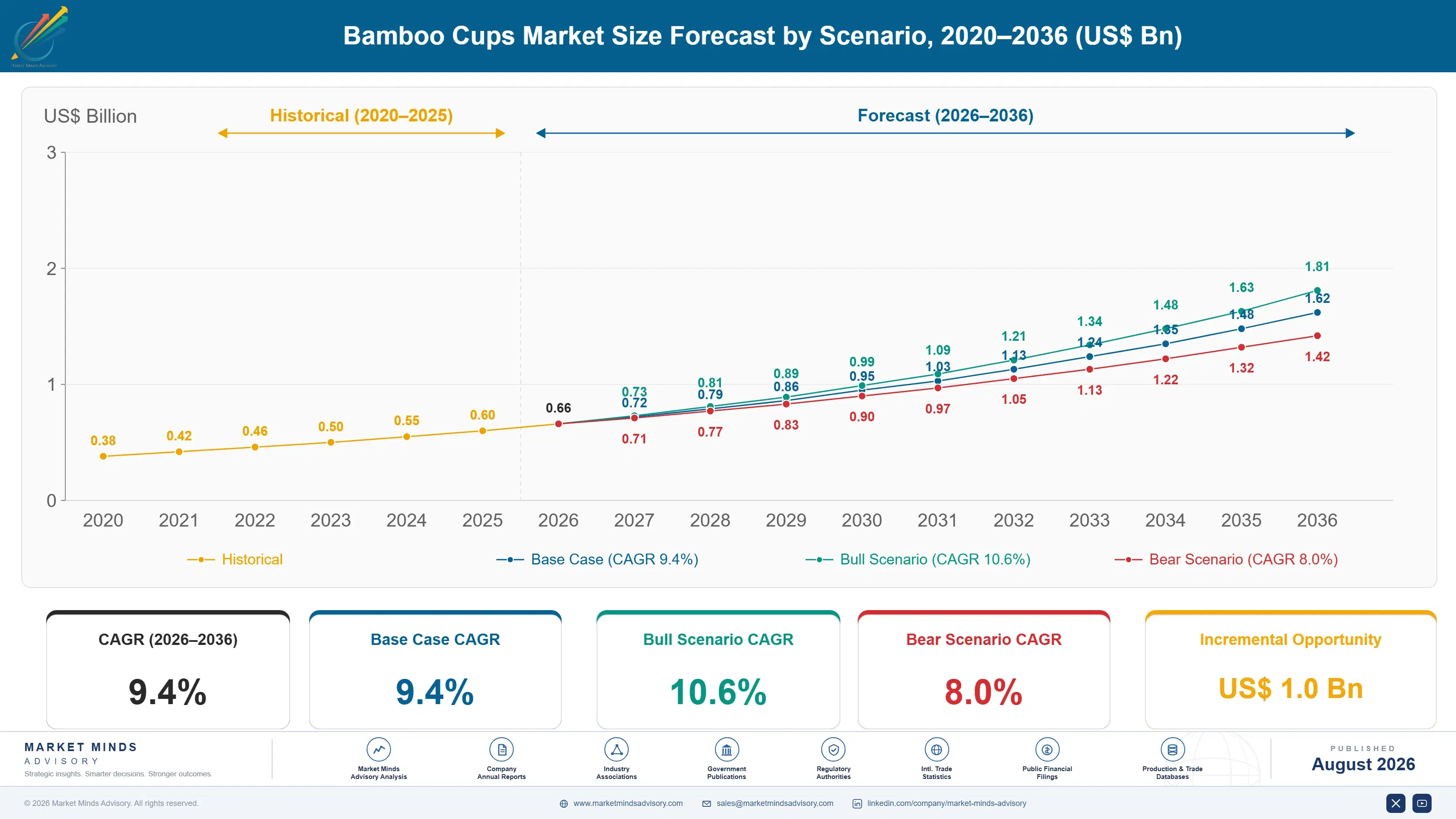
bamboo-cups-market-size-forecast-scenario-1787331987294
Growth from 2020 to 2025 compounded near 8.2%, and two opposite events sit inside that number. Single-use plastic bans across Europe and India created substitution demand on fixed dates, while European food safety authorities simultaneously found that bamboo-melamine composite cups released formaldehyde and withdrew them from sale. Reusable composite volume collapsed. Moulded fibre and bamboo-paper formats absorbed the demand and the category kept growing anyway.
Three mechanisms carry the base case to 9.4%. First, single-use plastic substitution, where bans on named items force foodservice operators to change material on published timetables. Second, quick service and coffee chain specification, since a visible fibre cup carries brand sustainability messaging that a plastic-lined paper cup cannot. Third, bamboo-fibre paper stock adoption, which lets converters run bamboo content on existing paper cup lines rather than investing in moulding capacity.
The bull case at 10.6% assumes plastic bans widen further and bamboo fibre paper stock reaches cost parity with wood pulp. The bear case at 8.0% assumes greenwashing enforcement questions bamboo claims more broadly, moulded fibre performance limits keep hot drink applications with plastic-lined paper, and Chinese oversupply drives pricing to a level where regional manufacturers exit the category entirely.

Two Bamboo Cups, One Regulatory Problem

Demand rests on three foundations. Plastic legislation provides the timetable, since a banned cup creates demand on a date nobody negotiates. Brand positioning provides the premium, because a visible fibre cup communicates something plastic-lined paper cannot, and operators pay two to four times conventional cost. And food contact regulation sets the limit, since anything with a resin binder now faces migration testing a substantial share of samples has failed.
MARKET CONCENTRATIONCR5: 18%Among the most fragmented categories in foodservice packaging
COST MULTIPLE2 to 4 timesBamboo fibre cup cost against a plastic-lined paper equivalent
HOT LIQUID HOLD TIME20 to 60 minutesPeriod before uncoated fibre begins losing its integrity
BAMBOO GROWTH CYCLE3 to 5 yearsHarvest maturity against decades for conventional pulpwood species
COMPLIANCE FAILURE RATEAbout 12%Composite samples exceeding migration limits in official testing
CHINESE SUPPLY SHAREAbout 61%Manufacturing output from the single dominant producing country
Commercially the split inside this category matters more than the category total. Moulded fibre and bamboo-paper cups contain no binder and raise no migration question, so they carry the growth. Composite reusable cups made from bamboo powder and melamine resin were withdrawn across European markets after roughly 12% of samples exceeded formaldehyde limits, and that damage reached the whole bamboo story.
The next decade turns on performance and cost. Uncoated fibre holds a hot drink for twenty to sixty minutes before softening, which keeps long-dwell applications with plastic-lined paper. Bamboo-fibre paper stock at 11.6% growth sidesteps that by running on existing cup lines with conventional coatings. Chinese manufacturers hold roughly 61% of supply and price accordingly, which is the constraint every regional producer works inside.
"The bamboo reusable cup did more damage to plant fibre packaging credibility than any competitor could have managed. It was a resin product with bamboo powder in it, sold as a bamboo cup, and a regulator eventually read the label properly."
Director, Foodservice Packaging and Plant Fibre Materials Practice · MMA Packagi

Market Trends

Food Contact Enforcement Removed The Reusable Composite Cup

Bamboo fibre composite cups are bamboo powder bound with melamine-formaldehyde resin, and European authorities established that hot liquids drove formaldehyde and melamine migration above legal limits in a substantial share of samples. Bamboo powder was also never an authorised additive for food contact plastics, which made the products unlawful independent of any test result. Withdrawals ran across multiple markets and the reputational damage reached bamboo packaging generally rather than the composite format alone. Roughly 12% of tested samples exceeded migration limits. That damage reached every bamboo format sitting on the shelf beside it.
Market Impact: Bans name 10 single-use items
Bamboo Paper Stock Runs On Existing Cup Lines

Substituting bamboo pulp for a share of wood pulp in cup board lets a converter make a bamboo cup on the paper cup machine it already owns, with the same coating, the same forming, and the same hot liquid performance. That avoids moulding capital entirely and sidesteps the dwell time limits uncoated fibre carries. Bamboo-fibre paper cups grow at 11.6% for that reason. The sustainability claim is weaker than a fully moulded fibre cup and considerably easier to defend than a composite one. For a paper cup converter this needs no new capital.
Market Impact: Operators pay 2 to 4 times

Market Opportunities and Growth Drivers

Plastic Bans Force Foodservice Material Substitution

Prohibitions on named single-use plastic items across Europe, India, and a widening set of other markets remove specific cups and lids from sale on published dates rather than discouraging their use. Foodservice operators need replacements that run on existing filling and lidding equipment inside the timetable, which is what created this category's demand in the first place. Bamboo competes there against moulded pulp, paper, and coated fibre rather than against plastic. Legislation rather than consumer preference drives essentially all of this volume. Reading the statute book forecasts this better than any survey.
Market Impact: Integrity holds 20 to 60 minutes

Visible Fibre Carries Brand Messaging Paper Cannot

A cup that visibly looks like plant fibre communicates something to a customer holding it that a plastic-lined white paper cup does not, and quick service and coffee chains will pay two to four times conventional cost for that signal on a high-visibility item. The messaging value sits in the appearance rather than in any measurable environmental outcome, which is precisely why greenwashing enforcement has begun paying attention. Operators specify it centrally across thousands of outlets, which makes each decision very large. A single decision covers thousands of outlets all at once.
Market Impact: China holds 61% of supply

Market Restraints and Challenges

Uncoated Fibre Loses Integrity In Long Hot Dwell

Moulded bamboo fibre holds a hot drink for twenty to sixty minutes before softening at the base and rim, which is adequate for takeaway coffee and inadequate for anything held longer. The root cause is that fibre without a barrier coating absorbs liquid, and adding a coating compromises both the compostability claim and the visible fibre appearance the operator was buying. Commercially this keeps long-dwell applications with plastic-lined paper. Producers mitigate through denser forming, water-based barrier coatings, and bamboo paper stock formats instead. Long-dwell beverage service stays with plastic-lined paper entirely.
Market Impact: About 12% of samples failed

Chinese Oversupply Sets Pricing Every Regional Producer Faces

Roughly 61% of bamboo cup manufacturing output comes from China, where bamboo is abundant, moulding capacity was built at scale, and labour cost is a fraction of Western equivalents. The root cause is resource geography combined with capacity added faster than demand grew. Commercially this caps what any regional producer can charge for an identical product. Participants mitigate through certification and traceability that Chinese supply frequently lacks, regional service and lead time advantages, and moving into bamboo paper formats where conversion is local. Cost competition is simply not available as a strategy.
Market Impact: Growth reaches 11.6% annually
4 additional market trends, 3 additional growth drivers, and 2 additional restraints and challenges are covered in the full report. Contact sales@marketmindsadvisory.com to access the complete intelligence.

Segment CAGR and Growth Architecture

Segmentation follows cup construction, a single classification describing how bamboo is incorporated into the finished vessel. Each construction carries its own manufacturing route, food contact status, hot liquid performance, and cost position, so commercial economics track the build rather than the beverage served in it. End-use channel and sales route appear separately within the framework as their own distinct dimensions.
bamboo-cups-market-market-share-analysis-1787331987820

Moulded Bamboo Fibre Single-Use Cups

Moulded bamboo fibre single-use cups grow fastest at 14.2%, about 1.51 times the overall 9.4% rate, and regulatory cleanliness rather than performance explains most of it. Forming a cup from bamboo pulp with no resin binder raises none of the migration questions that destroyed the composite reusable format, and the visible fibre appearance is exactly what operators are paying for. Hot liquid dwell of twenty to sixty minutes limits the applications, and water-based barrier coatings extend it at some cost to the compostability claim. Chinese moulding capacity dominates supply and sets the price everybody else works inside. Documentation rather than price is the only real differentiation available to anybody outside China.
CAGR 14.2%

Bamboo-Fibre Paper Cups

Bamboo-fibre paper cups grow at 11.6%, the second-fastest construction, and manufacturing convenience rather than any environmental advantage drives it. Substituting bamboo pulp for part of the wood pulp in cup board lets a converter produce a bamboo cup on the paper cup line it already owns, with unchanged coating, forming, and hot liquid performance. That avoids moulding capital and the dwell time limits uncoated fibre carries. The sustainability claim is genuinely weaker than a fully moulded fibre cup, though considerably easier to defend than a composite one ever was. Conversion happens regionally rather than in China. For an existing paper cup converter this is by far the cheapest entry route available.
CAGR 11.6%
Full segment breakdown across 5 segments available in the complete report.

Regional Architecture and Country Demand Map

Plastic legislation and foodservice culture together set this distribution rather than population. Western Europe leads on single-use plastic rules and enforcement, while South Asia and Pacific grows quickest as bans reach very large foodservice volumes with abundant local bamboo supply. Documentation decides who supplies the volume.

North America

North America holds 25% of value on very large coffee and quick service volumes where a visible fibre cup carries brand messaging across thousands of outlets. Plastic legislation is patchwork rather than federal, with state and municipal bans varying enough that a chain operating nationally cannot standardise on a single material. Composting infrastructure is limited outside a handful of metropolitan areas, which makes the disposal claim difficult to substantiate. Advertising enforcement on environmental claims has become genuinely active here. Growth of 8.8% reflects chain specification decisions rather than any coherent regulatory timetable across the region. A chain operating nationally cannot standardise on a single material, which raises complexity cost considerably.
Share: 25% | CAGR: 8.8% (2026 to 2036)

Western Europe

Regulation defines this market and also nearly destroyed part of it. Western Europe holds 26% of value, with single-use plastic rules creating the substitution demand that built the category and food safety authorities simultaneously withdrawing bamboo-melamine composite cups across multiple markets after migration testing. Industrial composting access is better than anywhere without being universal. Coffee shop culture and takeaway volumes are very large, and packaging waste regulation continues to tighten. Growth of 7.6% is the slowest of the seven regions, reflecting a substitution wave that has largely already passed through. The composite withdrawal happened here first, and buyers in this region now ask about construction before they ask about price.
Share: 26% | CAGR: 7.6% (2026 to 2036)
Regional intelligence for 5 additional markets available in the complete report: East Asia, South Asia and Pacific, Latin America, Middle East and Africa, Eastern Europe. Contact sales@marketmindsadvisory.com.
bamboo-cups-market-country-cagr-analysis-1787331988329

Where Bamboo Cup Margin Actually Survives

Selling a sustainability story into a category where one product type was withdrawn for resin migration is a claim enforcement now checks. The four moves below rest on ground that survives it: binder-free construction, certification Chinese supply lacks, paper-line conversion, and chain specification rather than distributor listings. None of the four is a sustainability claim.

Sell Binder-Free Construction As The Compliance Position

Bamboo powder bound with melamine resin was withdrawn across European markets after roughly 12% of tested samples exceeded migration limits, and bamboo powder was never an authorised food contact additive in the first place. A moulded fibre cup with no binder raises none of those questions, and that is now a commercial argument rather than a technical footnote. Buyers who were caught by the composite withdrawal ask about construction before they ask about price. Producers still selling composite reusables carry an exposure their pricing does not reflect. Construction is now a purchasing question.
Market Impact: About 12% of composite samples fail

Certify And Trace What Chinese Supply Usually Cannot

China holds roughly 61% of bamboo cup output at prices no regional producer can match on an identical product, which means competing on cost is not available. Chain of custody certification, food contact documentation, migration testing records, and verified bamboo sourcing are frequently absent from that supply and are increasingly demanded by large operators and regulators alike. Producers who hold complete documentation win specification decisions that pricing alone never reaches. The documentation costs real money and it is the only defensible differentiation available. Nothing else survives a direct Chinese price comparison at all.
Market Impact: China holds roughly 61% of all cate

Convert Bamboo Content On Existing Paper Cup Lines

Substituting bamboo pulp for part of the wood pulp in cup board produces a bamboo cup on equipment a converter already owns, with unchanged coating, forming, and hot liquid performance, and it grows at 11.6% for that reason. It avoids moulding capital entirely and avoids the twenty to sixty minute dwell limit uncoated fibre carries. The environmental claim is weaker and considerably more defensible than a composite one. For a paper cup converter this is the cheapest route into the category by a wide margin. Moulding capital is not required at any point.
Market Impact: The paper stock format grows at 11.

Win Chain Specification, Not Distributor Listings

A coffee or quick service chain specifies cups centrally across thousands of outlets, which makes each decision enormous and each loss equally so, while a distributor listing delivers scattered volume at whatever margin the catalogue allows. Chains also ask for documentation, audit rights, and supply continuity that distributors never request, which favours producers who hold them. Getting into that specification requires food safety and sustainability teams rather than a purchasing contact. Producers organised around distributor relationships never see the specification being written. One lost specification can remove 3000 outlets of volume overnight.
Market Impact: One chain decision covers 3000 outl

Who Controls the Margin Pool

Fragmentation is extreme: the top five hold roughly 18% of bamboo cup revenue, across foodservice packaging groups, specialist compostable brands, and a long tail of Asian manufacturers with variable documentation. The gap between leaders and challengers is certification and chain access rather than moulding capability, which is widely held. All participants here are assessed on one basis, revenue from bamboo-content cups and cup components, excluding conventional paper and plastic cups, cutlery
Competition runs along four lines. First, food contact documentation, since the composite withdrawal made construction and testing records a purchasing question. Second, chain specification access, because central decisions cover thousands of outlets at once. Third, cost position, which Chinese supply sets for everybody on identical products. Fourth, format breadth across moulded, paper stock, and lids, as operators prefer one supplier for the whole serve.

Pressure is building from two directions. Chinese oversupply prices identical moulded product below what any regional producer can match, and documentation gaps are the only reason buyers pay more. Meanwhile greenwashing enforcement is testing whether fibre cups deliver the disposal outcome they imply. Rankings should favour suppliers with complete documentation and chain positions over those competing on moulded cost or narrative alone.
bamboo-cups-market-company-positioning-matrix-1787331988844

Competitive Moat and Risk Dimensions

HUHTAMAKI

Moat: Foodservice scale and chain relationships

Huhtamaki supplies foodservice packaging to large chains globally with the food safety documentation, audit capability, and supply continuity those accounts require, none of which the long tail of bamboo manufacturers can provide. Its paper cup converting base makes bamboo-fibre paper stock a straightforward extension rather than a new capability. Global manufacturing footprint lets chains standardise a specification across regions.
HUHTAMAKI

Risk: Fibre appearance and cost position

Bamboo content in paper cup board delivers a weaker visible fibre appearance than moulded formats, which is precisely what brand-led operators are paying the premium to obtain. Chinese moulded supply undercuts on identical product where documentation is not the deciding factor. Bamboo also sits inside a very large foodservice portfolio and competes internally for attention against far bigger product lines.
VEGWARE

Moat: Compostable positioning and specification depth

Vegware built its position specifically on compostable foodservice packaging with the certification and disposal guidance that credibility in this category now requires, which is exactly what the composite withdrawal made valuable. Its specification and technical support reach operators who must defend a claim rather than simply buy a cup. Breadth across the serve lets a customer source one documented range.
VEGWARE

Risk: Composting access and price premium

Compostable claims depend on collection and industrial composting access that most markets do not provide, which greenwashing enforcement has begun testing directly. Product carries a genuine cost premium that price-led operators will not pay whatever the documentation says. Manufacturing depends substantially on Asian supply, which limits control over the traceability the positioning relies upon.

Players Tracked

Prominent Players

Huhtamaki
Vegware
BioPak
Detpak
Ecoware

Other Key Players

Genpak
Dart Container
Karat Packaging
Eco-Products
Sabert
Duni
Novolex
Fuling Global
Zhejiang Jiacheng Environmental
Anhui Jinhui Ecological
Hangzhou Xinsheng Packaging
Bambu
EcoSoul Home
Yash Pakka
Pappco Greenware

Recent Developments

MARCH 2025

Enforcement extends to environmental claims on fibre foodservice

Consumer authorities in several markets challenged compostability claims on plant fibre cups, on the basis that disposal routes suited to the material do not exist where consumers use them. These were enforcement actions rather than transactions, and they moved the evidence burden toward disposal infrastructure rather than material composition.
Signal: Enforcement now asks where the cup ends up
SEPTEMBER 2024

Bamboo pulp cup board qualifies with major converters

Cup board containing bamboo pulp completed qualification with foodservice converters running conventional paper cup lines, allowing bamboo content without moulding investment or changes to coating and forming. These were material qualifications rather than acquisitions, and they opened the category to every existing paper cup converter at once.
Signal: Paper line conversion opens this whole cat
MAY 2024

Bamboo composite reusable cup withdrawals conclude across Europe

Remaining bamboo-melamine composite reusable cups were removed from European sale following migration findings and the determination that bamboo powder is not an authorised food contact additive. These were regulatory withdrawals rather than corporate decisions, and the reputational damage reached bamboo packaging generally rather than the composite format alone.
Signal: A single non-compliant construction damage

Bamboo Pulp, Coatings, Moulding Energy, Freight

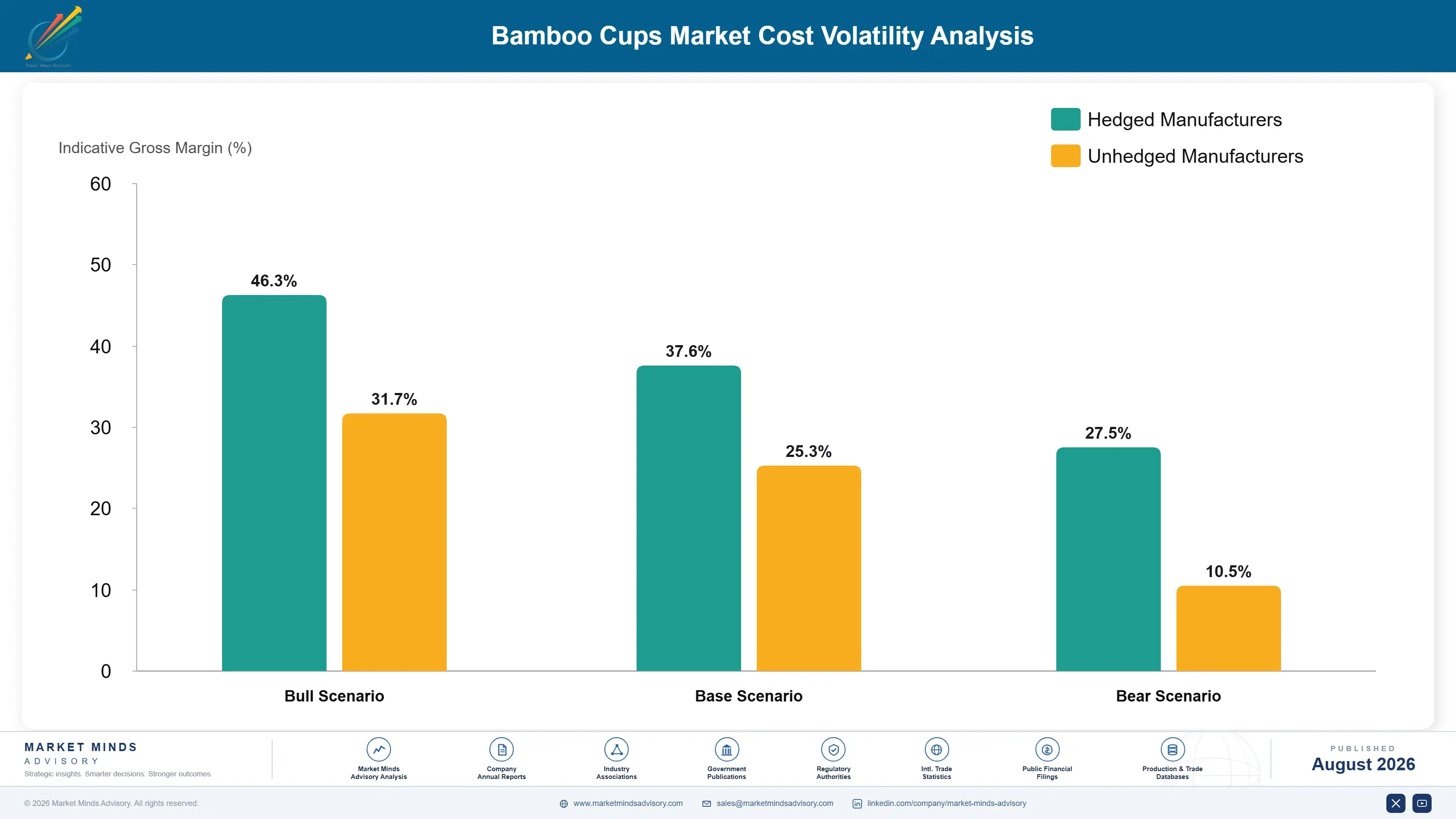
Fibre and forming dominate this cost sheet in roughly equal measure. Bamboo pulp and fibre run 30% to 40% of cup cost, sourced overwhelmingly from Chinese and Southeast Asian processing. Forming energy adds 16% to 24% because wet fibre must be dried under heat and pressure. Barrier coatings contribute 10% to 16%, and outbound freight a further 12% to 20% because cups are mostly air.
Freight rather than material drove the cost shock in this category, since container rates from Asia rose to multiples of prior levels and cups occupy volume rather than weight. Huhtamaki and Karat Packaging both disclosed freight and input cost pressure across that period. Energy costs then compounded it for any producer forming outside Asia, with IEA analysis recording European industrial gas at several times prior-year levels.

Exposure separates by manufacturing location rather than by scale. A producer forming in Asia carries low fibre and labour cost with high outbound freight, while one forming regionally carries the reverse and cannot match Asian pricing. Bamboo paper stock changes that arithmetic entirely, since board ships far more efficiently than formed cups and conversion happens near the customer, which is an advantage nobody markets clearly.
bamboo-cups-market-cost-volatility-analysis-1787331989039

Convert bamboo board regionally rather than importing formed cups

Formed cups are mostly air and outbound freight runs 12% to 20% of cost, while cup board ships flat at a fraction of that. Importing bamboo pulp board and forming near the customer keeps the fibre cost advantage while removing most of the freight penalty. It requires paper cup converting rather than moulding, which most regional converters already have.

Hold complete food contact documentation as a product feature

The composite withdrawal made construction records, migration testing, and food contact declarations a purchasing question rather than a filing requirement. Chinese supply frequently lacks them and large operators increasingly refuse to buy without them. Assembling that documentation costs testing money once per format and provides the only defensible differentiation available against a cost base nobody can match on price.

Qualify water-based coatings that hold the compostability claim

Uncoated moulded fibre softens after twenty to sixty minutes of hot liquid contact, and plastic lamination solves that while destroying both the compostability claim and the visible fibre appearance operators are paying for. Water-based dispersion barriers extend dwell time with a considerably smaller claim penalty. Qualification requires migration and disintegration testing per formulation, which several competitors have not funded.

Portfolio Architecture for Margin Defence

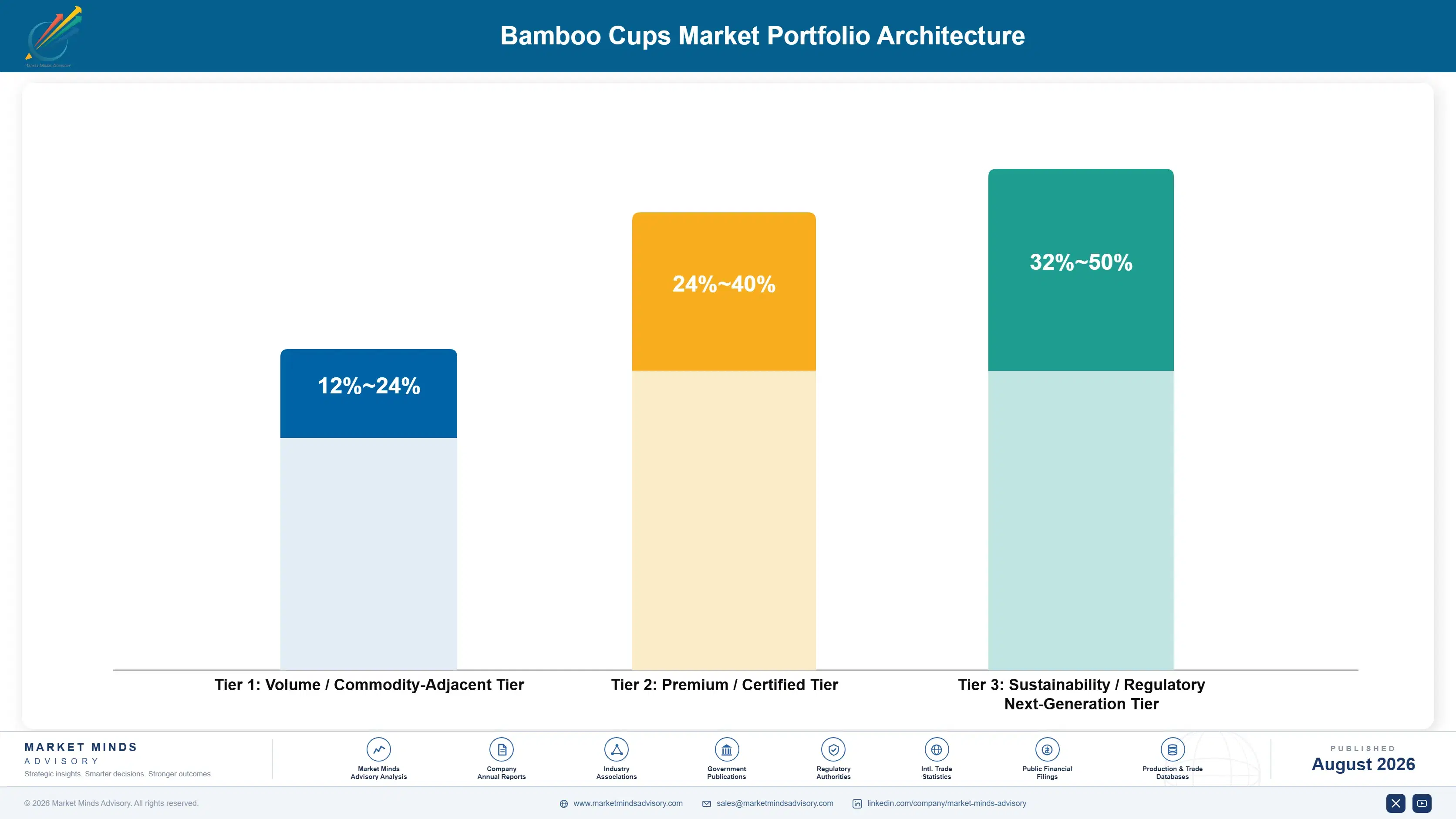
The portfolio splits into three tiers with different economics. Standard moulded fibre cups form the volume tier, where Chinese supply sets pricing and documentation is the only differentiation available. Certified moulded formats with complete food contact records earn more because large operators refuse to buy without them. Bamboo paper stock and coated formats price against manufacturing convenience and dwell performance rather than a competing quotation.
The tension runs between imported moulded volume that fills a catalogue and documented formats that earn the return. Standard moulded cups keep distributor listings active, cover the range operators expect, and hold the accounts through which certified work sells. Yet they compete against Chinese supply at prices no regional producer can approach. Suppliers handling this well accept thin moulded margin while directing effort toward documentation and regional paper conversion.

High-value pools concentrate where documentation or capability limits competition: certified moulded formats with migration testing records, bamboo paper stock converted regionally on existing lines, coated cups that hold both dwell time and the compostability claim, and matched lid and cup systems specified together. All four escape the Chinese price comparison. Undocumented moulded imports sit at the other end, where a dozen suppliers offer the identical cup.

Volume / Commodity-Adjacent Tier

Standard imported moulded bamboo fibre cups and basic lids sold on delivered price. The range is wide because freight position and forming location separate suppliers considerably at otherwise identical product specifications.
Gross Margin: 12-24%

Premium / Certified Tier

Moulded and paper formats carrying complete food contact documentation, migration testing, and chain of custody certification. The range is wide because documentation depth varies enormously and only some operators pay for it consistently.
Gross Margin: 24-40%

Sustainability / Regulatory / Next-Generation Tier

Water-based coated fibre cups, regionally converted bamboo paper stock, and matched compostable serve systems. The range is wide because coating qualification is scarce while regional conversion still carries board import cost entirely.
Gross Margin: 32-50%
bamboo-cups-market-portfolio-architecture-1787331989540

High-value Sub-segments and Strategic Watch-out

Moulded Bamboo Fibre Single-Use Cups

High growth at 14.2%, the fastest construction, because binder-free forming raises none of the migration questions that removed composite reusables from sale. Chinese capacity sets pricing and documentation is the only differentiation any regional producer genuinely holds here. Binder-free forming is the entire regulatory advantage here.
Gross Margin: 12-32%

Bamboo-Fibre Paper Cups

High value with strong growth at 11.6%, running on paper cup lines converters already own with unchanged coating and hot liquid performance. The environmental claim is weaker than moulded fibre and far easier to defend than any composite construction was. No moulding capital is required at all.
Gross Margin: 20-36%

Solid Bamboo Turned and Laminated Cups

The premium niche, growing at 8.4% on gift, hospitality, and retail drinkware where appearance and durability justify the price. Volumes are small, hand finishing limits scale, and food contact treatment of any lacquer applied requires genuine care. Any lacquer applied to it needs genuine food contact care.
Gross Margin: 28-46%

Bamboo Fibre Composite Reusable Cups

The strategic watch-out, growing at only 3.6% after European withdrawals over melamine and formaldehyde migration from the resin binder. Bamboo powder was never an authorised food contact additive, which makes the format a liability rather than an opportunity. Nobody should be building any volume here at all.
Gross Margin: 8-22%

How Foodservice Cup Listings Hold

Demand commits at chain specification or distributor listing and repeats as reorders. A cup approved into a chain specification has passed food contact review, equipment trials, brand appearance sign-off, and increasingly a claim assessment, which makes it awkward to displace. That protects incumbents reasonably. The genuine competitive moments are a chain range review, a new plastic ban, and any enforcement action questioning a claim printed on the cup.
Stickiness varies by documentation depth and equipment fit. Certified formats stick hardest, since a buyer who was caught by the composite withdrawal will not reopen a documented supply lightly. Matched cup and lid systems stick through equipment compatibility. Bamboo paper stock sticks through converter qualification. Undocumented moulded imports stick least, moving on price at every purchase because a dozen suppliers offer an identical cup.

Buyer profiles have moved from purchasing managers comparing case prices toward food safety, sustainability, and legal functions with a veto. Legal now asks what the cup can be claimed to be, which nobody asked before. That change rewards suppliers bringing migration testing, chain of custody records, and honest disposal guidance, and penalises those still selling a narrative to a buyer whose employer was already challenged over one.
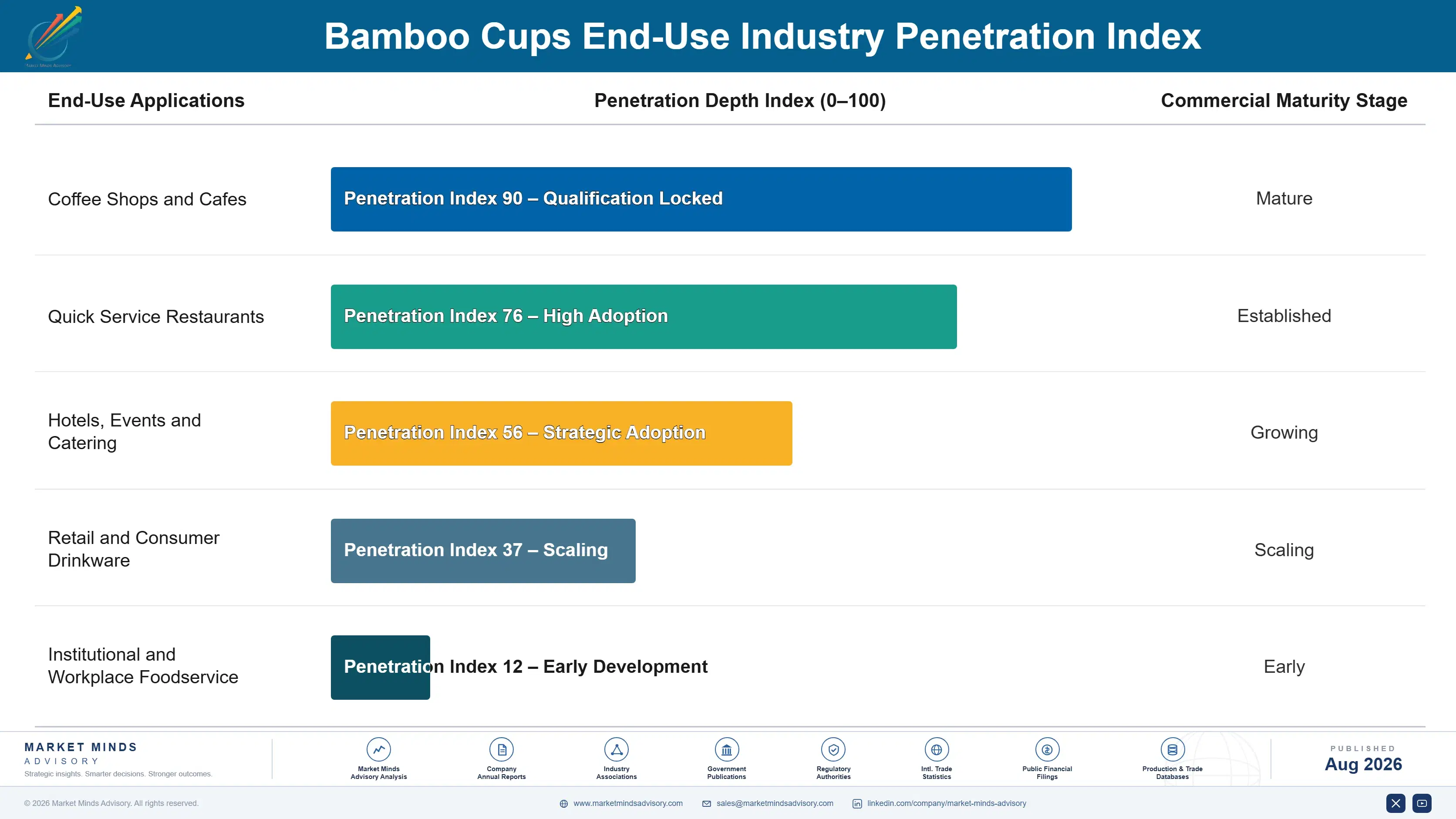
bamboo-cups-market-end-use-penetration-index-1787331990028

Our Call On Bamboo Cups

These are among the four positions where our research anticipates prominent divergence between winners and laggards over the coming forecast period. Each is grounded in the demand model, the regulatory perimeter, and the announced capacity pipeline.
01 / BINDER-FREE CONSTRUCTION PRIORITY

Composite reusables are a liability, not a product

Bamboo powder bound with melamine resin was withdrawn across European markets after roughly 12% of tested samples exceeded migration limits, and the powder was never an authorised food contact additive in the first place. A moulded fibre cup with no binder raises none of those questions, which has become a commercial argument rather than a technical footnote. Buyers caught by that withdrawal now ask about construction before they ask about price, and producers still selling composites carry an entirely unpriced exposure.
02 / DOCUMENTATION AS DIFFERENTIATION

You cannot beat Chinese cost, so sell the paperwork

China holds roughly 61% of bamboo cup output at prices no regional producer can match on an identical moulded product, which means cost competition is simply not available as a strategy at all. Chain of custody certification, migration testing records, and food contact declarations are frequently missing from that supply and increasingly demanded by large operators and regulators alike. That documentation costs real money once per format and it is the only defensible differentiation this category actually offers anybody at all.
03 / REGIONAL PAPER CONVERSION

Board ships flat and formed cups ship air

Outbound freight runs 12% to 20% of cup cost because formed cups occupy volume rather than weight, while bamboo pulp cup board ships flat and densely at a fraction of that. Converting regionally on paper cup lines a business already owns keeps the fibre cost advantage while removing most of the freight penalty, and it sidesteps the twenty to sixty minute dwell limit uncoated moulded fibre carries. For any paper cup converter this is the cheapest available entry into the category.
04 / CHAIN SPECIFICATION ACCESS

One central decision covers thousands of outlets

A coffee or quick service chain specifies its cups centrally across thousands of outlets, which makes each decision enormous and each loss equally so, while distributor listings deliver only scattered volume at catalogue margin. Chains also demand documentation, audit rights, and supply continuity that distributors simply never request, which favours precisely the producers who already hold them. Reaching that decision requires food safety and sustainability functions rather than a purchasing contact, and suppliers organised around distributors never even see it happening.

Engagement Snapshot From the Field

A live engagement with an industry participant carrying material or product regulatory and market exposure ahead of a defining policy shift, showing how our research translates into a defensible multi-year portfolio strategy.
MARKET MINDS ADVISORY · CLIENT ENGAGEMENT SUMMARY
Bamboo Cups Producer Strategic Portfolio Review and Transition Roadmap 2026·Investment Scenario on Bamboo Cups Exposure Evaluation 2025-26
CLIENT PROFILE
A coffee chain operating 1,180 outlets across six countries engaged MMA after a consumer authority queried the compostability claim printed on its bamboo fibre cups. The client reported paying roughly 2.6 times conventional paper cup cost for the format, no disposal route data for any of its markets, and no migration testing records from its supplier (client-reported, unverified by MMA).
STRATEGIC CHALLENGE
Removing the claim would look like retreat and invite comment, while defending it required disposal evidence the client did not hold and its Asian supplier could not produce. Marketing wanted the fibre appearance retained, legal wanted the claim gone, and finance questioned the premium entirely. The board needed a defensible position before the authority escalated.
MMA APPROACH
MMA mapped actual disposal routes for the client's cups by market rather than accepting the supplier's certification, which nobody had examined. We obtained migration and food contact documentation directly from the manufacturer instead of relying on the distributor's assurances. We then compared the premium being paid against what the format could credibly support in each of the six markets separately.
KEY FINDINGS
  1. Industrial composting reached under 6% of the client's cup volume, and in three of six markets no suitable route existed at all (client-reported, unverified by MMA).
  2. The supplier held no migration testing records for the coated variant, which represented about 40% of volume and carried the greatest food contact exposure.
  3. Bamboo pulp cup board was available from two European converters at roughly 1.4 times conventional cost, against 2.6 times for imported moulded cups.
  4. Consumer research showed the fibre appearance carried the brand message regardless of any printed claim, which nobody internally had tested before at any point.
CLIENT PROFILE
A coffee chain operating 1,180 outlets across six countries engaged MMA after a consumer authority queried the compostability claim printed on its bamboo fibre cups. The client reported paying roughly 2.6 times conventional paper cup cost for the format, no disposal route data for any of its markets, and no migration testing records from its supplier (client-reported, unverified by MMA).
STRATEGIC CHALLENGE
Removing the claim would look like retreat and invite comment, while defending it required disposal evidence the client did not hold and its Asian supplier could not produce. Marketing wanted the fibre appearance retained, legal wanted the claim gone, and finance questioned the premium entirely. The board needed a defensible position before the authority escalated.
MMA APPROACH
MMA mapped actual disposal routes for the client's cups by market rather than accepting the supplier's certification, which nobody had examined. We obtained migration and food contact documentation directly from the manufacturer instead of relying on the distributor's assurances. We then compared the premium being paid against what the format could credibly support in each of the six markets separately.
KEY FINDINGS
  1. Industrial composting reached under 6% of the client's cup volume, and in three of six markets no suitable route existed at all (client-reported, unverified by MMA).
  2. The supplier held no migration testing records for the coated variant, which represented about 40% of volume and carried the greatest food contact exposure.
  3. Bamboo pulp cup board was available from two European converters at roughly 1.4 times conventional cost, against 2.6 times for imported moulded cups.
  4. Consumer research showed the fibre appearance carried the brand message regardless of any printed claim, which nobody internally had tested before at any point.
RECOMMENDED STRATEGY
Phase 1: Phase 1 (0 to 4 months): Remove compostability claims in the three markets without disposal routes and retain the fibre appearance without them. Phase 2: Phase 2 (4 to 14 months): Move volume to regionally converted bamboo paper stock at lower cost and obtain full migration documentation. Phase 3: Phase 3 (14 to 24 months): Requalify the coated variant with tested water-based barriers or discontinue it entirely from the range.
OUTCOME
The client withdrew the unsupportable claims without measurable brand impact, since research showed the appearance rather than the printed text carried the message. Moving to regionally converted bamboo board cut the cup premium from about 2.6 times to 1.4 times conventional cost, and the authority closed its query once documentation was produced (client-reported, unverified by MMA).

Frequently Asked Questions

Foundational context covering the market sizes, CAGR, scope, country, region and competition that inform every finding below. This section is provided to cover basics and most often pre-purchase conversations, answered from the MMA Primary Research Dataset.

What is the current size of the Bamboo Cups Market?

The global bamboo cups market is valued at USD 0.62 billion in 2025, covering moulded fibre single-use cups, composite reusables, solid bamboo cups, bamboo-fibre paper cups, and lids. Conventional paper and plastic cups are excluded.

How large will the Bamboo Cups Market be by 2036?

The market is forecast to reach USD 1.67 billion by 2036 in the base case, about 2.46 times the 2026 level. That represents incremental value of roughly USD 0.99 billion across the decade.

What is the CAGR for the Bamboo Cups Market 2026 to 2036?

The market grows at a 9.4% CAGR in the base case, with bull and bear scenarios at 10.6% and 8.0%. The spread turns mainly on claim enforcement and bamboo paper stock cost parity.

Which segment is growing fastest?

Moulded bamboo fibre single-use cups grow fastest at 14.2%, about 1.51 times the overall rate, because binder-free forming raises no migration questions. Bamboo-fibre paper cups follow at 11.6%.

Who are the major companies in the Bamboo Cups Market?

Leading suppliers include Huhtamaki, Vegware, BioPak, Detpak, and Ecoware. Fragmentation is extreme, with the top five holding roughly 18% of bamboo cup revenue above a long tail of Asian manufacturers.

Which country is growing fastest?

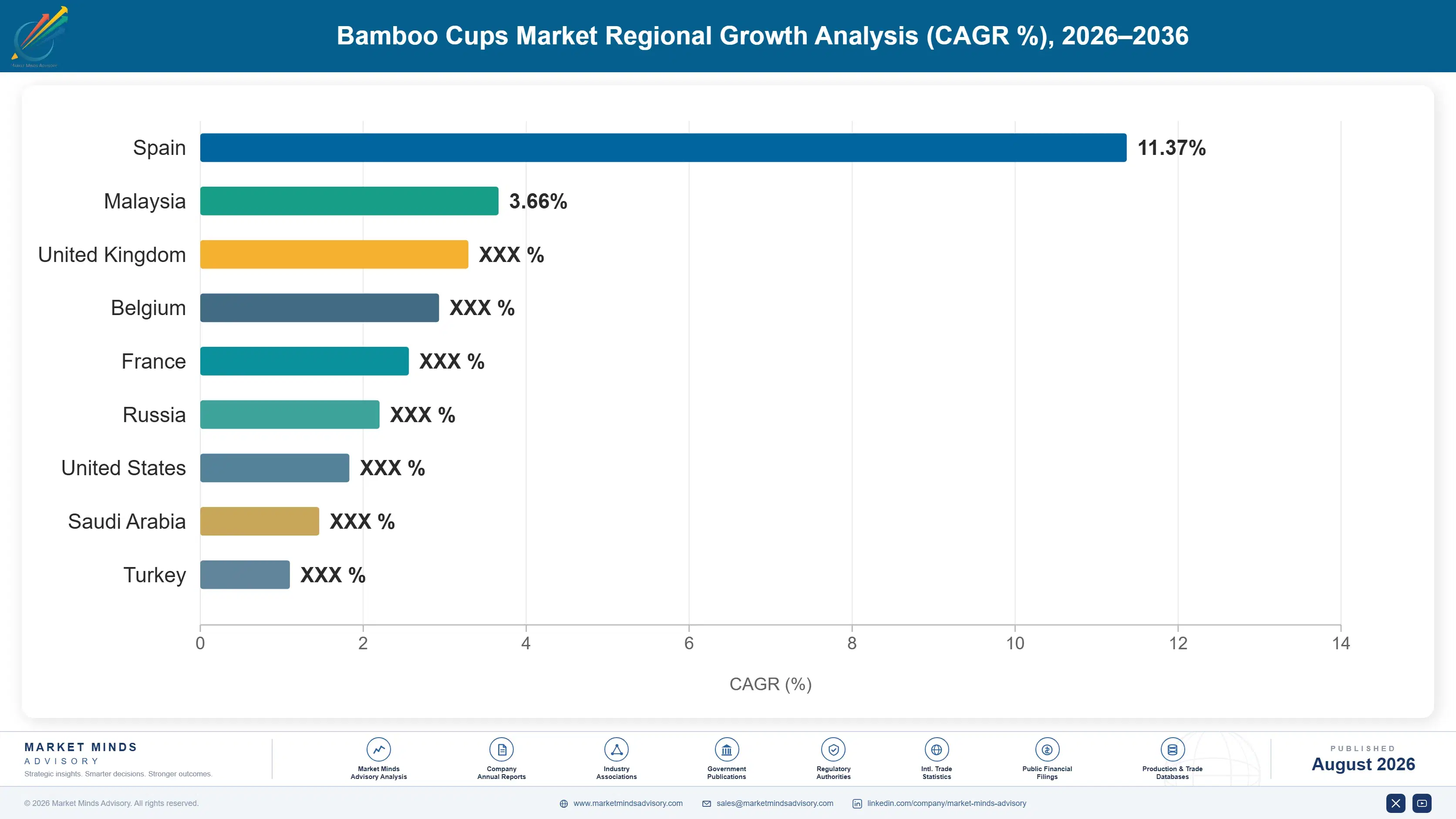
India grows fastest at a 13.8% CAGR, as plastic prohibitions cover enormous foodservice volumes and domestic bamboo supply is abundant. China and Indonesia follow on regulation and local capacity.

Report Segmentation Architecture

The full report scope spans multiple orthogonal segmentation dimensions, with cross-tabulated demand data provided for each dimension pair. Coverage extends further to regional breakdowns, trend trajectories, and the competitive detail needed to support segment-level decision-making.

By Cup Construction

  • Moulded Bamboo Fibre Single-Use Cups
  • Bamboo Fibre Composite Reusable Cups
  • Solid Bamboo Turned and Laminated Cups
  • Bamboo-Fibre Paper Cups
  • Bamboo Lids and Accessories

By End-Use Industry

  • Coffee Shops and Cafes
  • Quick Service Restaurants
  • Hotels, Events and Catering
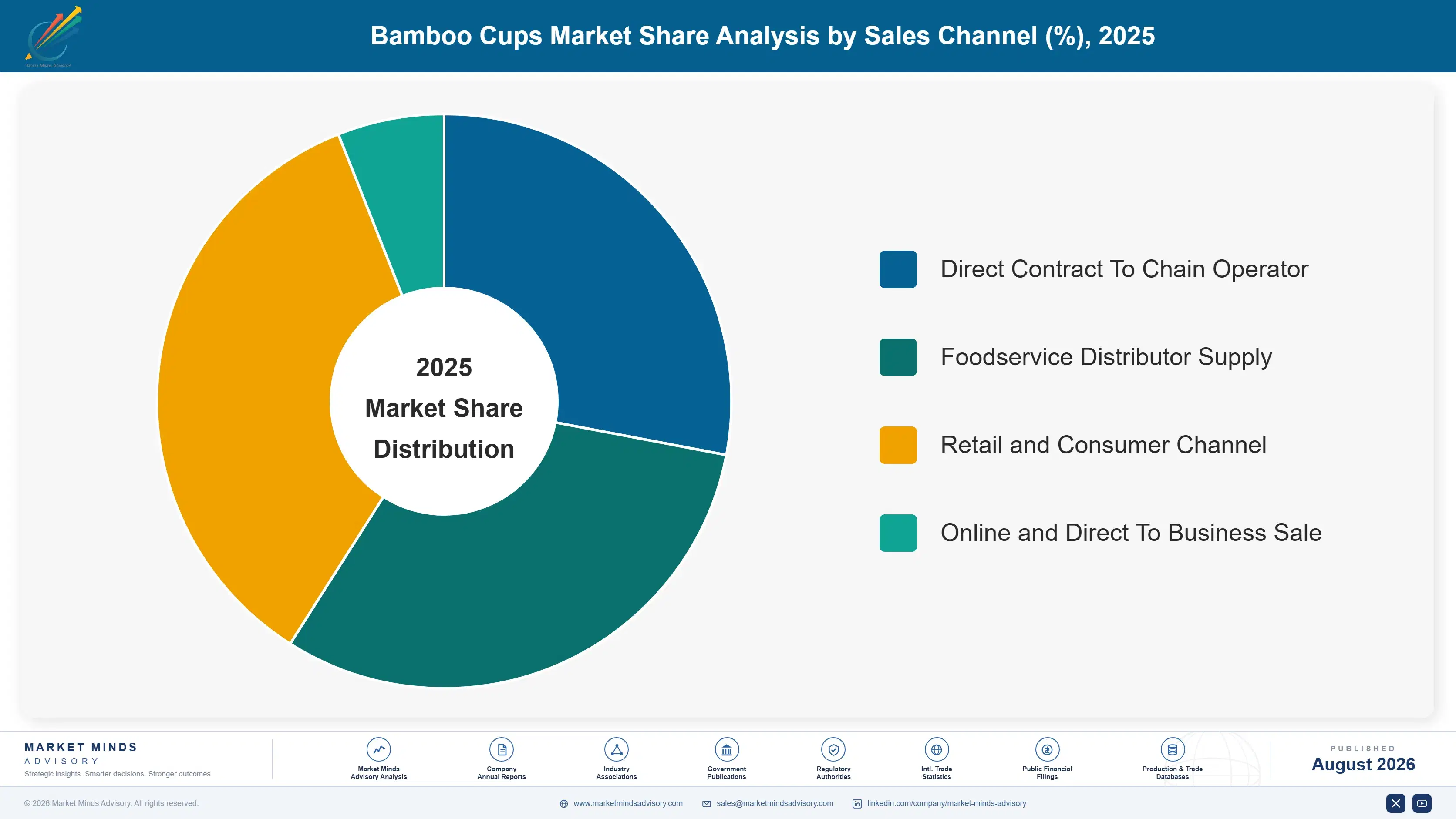
  • Retail and Consumer Drinkware
  • Institutional and Workplace Foodservice

By Sales Channel

  • Direct Contract To Chain Operator
  • Foodservice Distributor Supply
  • Retail and Consumer Channel
  • Online and Direct To Business Sale

By Region

  • North America
  • Western Europe
  • East Asia
  • South Asia and Pacific
  • Latin America
  • Middle East and Africa
  • Eastern Europe

Scope, Methodology, and Coverage

Every figure in this report is reproducible from documented input assumptions. The scope below maps the historical period, the forecast horizon, the segmentation dimensions, and the countries covered, alongside the underlying primary and qualitative methodology.
Historical Period
2020 to 2025
Forecast Period
2026 to 2036
Base Year
2025 (USD billions; MMA Primary Research Dataset, August 2026)
Market Definition
The bamboo cups market comprises the manufacture and sale of drinking vessels and cup components made principally from bamboo, valued at manufacturer selling prices to chain operators, foodservice distributors, retailers, and institutional buyers. It spans moulded bamboo fibre single-use cups, bamboo fibre composite reusable cups bound with resin, solid bamboo turned and laminated cups, cups made from board containing bamboo pulp, and bamboo lids and accessories supplied with them, together with the food contact documentation, barrier coatings, and printing applied to them. Conventional paper and plastic cups containing no bamboo, bamboo cutlery, plates, straws and stirrers, bamboo textiles, flooring, furniture and construction products, bamboo pulp and board sold as a raw material rather than a finished cup, beverage contents, and cup filling, printing and distribution services purchased separately are excluded.
Quantitative Units
USD billions (current prices); volume in billion units and thousand tonnes of fibre
Segmentation Dimensions
By Cup Construction; By End-Use Industry; By Sales Channel; By Region
Regions Covered
North America, Western Europe, East Asia, South Asia and Pacific, Latin America, Middle East and Africa, Eastern Europe
Countries Covered
UK, Germany, France, Netherlands, Italy, Spain, Sweden, Ireland, USA, Canada, China, Japan, South Korea, Taiwan, India, Australia, New Zealand, Indonesia, Vietnam, Thailand, Malaysia, Brazil, Mexico, Chile, Colombia, UAE, Saudi Arabia, Kenya, Rwanda, Poland, and additional markets relevant to this sector
Key Companies Profiled
Huhtamaki, Vegware, BioPak, Detpak, Ecoware, Genpak, Dart Container, Karat Packaging, Eco-Products, Sabert, Duni, Novolex, Fuling Global, Zhejiang Jiacheng Environmental, Anhui Jinhui Ecological, Hangzhou Xinsheng Packaging, Bambu, EcoSoul Home, Yash Pakka, Pappco Greenware
Quantitative Methodology
Primary survey, n=3,800 respondents, Q4 2025, six countries; demand-side model with trade association cross-validation
Qualitative Methodology
47 expert interviews, Q4 2025; applied to validate demand model assumptions, identify emerging dynamics, and assess competitive positioning
Report Format
PDF and XLSX data workbook (Word format preview document)
Publisher
Market Minds Advisory
Report Code
MMA-2026-PAC-372
Published
August 2026
Contact
sales@marketmindsadvisory.com | www.marketmindsadvisory.com

Purchase the full Bamboo Cups Market Report (2026 to 2036).

The full MMA Bamboo Cups report sizes the market across five cup constructions, five end-use channels, four sales routes, and seven regions through 2036. It profiles 20 suppliers on a consistent basis of bamboo-content cup and component revenue, scoring each on food contact documentation, chain specification access, cost position, and format breadth. Scenario models quantify how plastic prohibitions, claim enforcement, and bamboo paper stock adoption move both volume and achievable margin by construction. The report also includes disposal route mapping by market, food contact compliance status by construction, landed cost comparison between imported moulded and regionally converted formats, and chain specification tracking across major operators.
Five-construction and four-channel market sizing to 2036
Twenty-supplier benchmark on bamboo cup and component revenue
Disposal route mapping by market and cup construction
Food contact compliance status across bamboo cup constructions
Landed cost comparison for imported moulded against regional conversion
Chain specification tracking across major foodservice operators

Built For The People Who Decide

From boardroom strategy to bench-side execution, this report is read cover-to-cover by leaders shaping the next decade of their industry, turning demand scenarios, market dynamics and valuation benchmarks into decisions.
CXOs/ Presidents/ VPs/ Managers
M&A and Corporate Development
Strategy Teams and R&D Heads
Procurement and Product Directors
Regulatory and Compliance Leaders
Investor Relations and Equity Analysts